' A virtuoso display to
pp. 51-53 · Read in the full issue

Books
The Pacific Rrom 1600 To 1760
' A virtuoso display to marvel at and envy '
Monopolists and Freebooters.
Volume II of The Pacific Since Magellan. By O.H.K. Spate.
Published 1983 by Australian National University Press, PO Box 4, Canberra, ACT, Aust ralia 2600. ISBN 0 7081 1844 5.
In reviewing Oskar Spate’s first volume in the series, The Pacific Since Magellan, Fran Hezel, in another place, said of The Span ish Lake, “Spate has effected a virtuoso display of scholarship that we ordinary mortals in Pacif ic studies can only marvel at and envy”. This ordinary mortal had the same feeling after reading the second volume, Monopolists and Freebooters, which covers the period 1600 to the 1760 s (but runs on into the nineteenth cen tury where necessary to set up the next volume).
It is not an easy work to situate within the series. How do you describe a book which, by Spate’s own admission, “lacks the unity given to its predecessor by the theme of Iberian domina tion and, I may hope, to its successor by that of the geog raphical and commercial opening of the vast expanse of the Ocean ic waters”. This is a bridging volume in the series, and it takes the form of a giant patchwork quilt with varying patterns and subtle changes of color.
So to begin with let us look briefly at what is in each chapter.
The book opens with the Dutch penetration, from west and from east across the Pacific, into the Asian domains of the Spaniards in the 1600 s. It moves north in chapter 3 to investigate the tangle of Japanese internal rivalries which led in the 1640 s to the policy of Japanese seclusion for over two centuries, with one lit tle island of commercial ex change her only window on the world.
Chapter 4 surveys the shifts and trends in the commercial and
maritime empires of East Asia during the 17th century, fitting them concisely into wider de velopments of the world capital ist economy. In chapter 5 we return to two ends of the Spanish Pacific empire: in the west the pacification of the Marianas and in the east the debate about the shape and importance of Califor nia. There follow a most read able chapter on Pacific buc caneers and one which explores
William Dampier’s reputation
against the reality of his achieve ments, as well as giving us a glimpse of a little-known Scot tish colonisation experiment in Darien.
Chapter 8 takes us back to Europe and war between Britain, France, the Netherlands and Spain, and then out to the Pacific again as the French make their entry, voyaging to China and establishing Cape Horn as the
standard passage between the At lantic and the South Sea. Next is a chapter of episodes which bore lightly on the Pacific during a quiet interlude (1700-1760) The South Seas Company and La Plata; Alberoni’s role in stoking up a new drive for Spanish em pire; the last privateers; and fam ous “Jenkin’s Ear” which led to war.
Chapter 10 takes us into the icy northern reaches of the Pacif ic so often neglected by those who live in the warm southwest.
We follow Bering as he laid the foundations for a Russian Ameri ca which would endure into the 1860 s. Chapter 11 is full of British offensives in East Asian waters; Anson capturing the Manila Gallion and going on to become First Lord of the Admir alty; the fall of Manila; and struggles for national commer cial and strategic advantage in the Sulu archipelago.
We follow in chapter 12 the winding-down of the Galleon trade, Spate setting it nicely in the context of a contest for domi nance by Spanish vested inter ests. Then we swing again to Spain’s Pacific littoral in North America with the establishment of insecure Californian colonies which would become major cities of today’s west coast. Fin ally there is the last of empire Peru with the creaking Span ish colonial structure under pre ssure from Indians and Criollos.
As independence comes to this part of the Americas we get a glimpse forward of the Pacific in a new age of steam and changing cargoes.
All this is a delight and an edification to read from cover to cover. But for my money there are half a dozen treatments with in those covers which will help to make Monopolists and Freeboo ters a central text and reference tool on the bookshelves of any body interested in the past of the Oceanic region, and indeed beyond.
Chapter 4, “Survivals and Ar rivals in East Asia” is to my mind the best in the book. Spate apologises in his preface for writ ing such a European-centred book unavoidable overall, for that is the nature of the beast but here in chapter 4 we have a sympathetic, incisive treatment
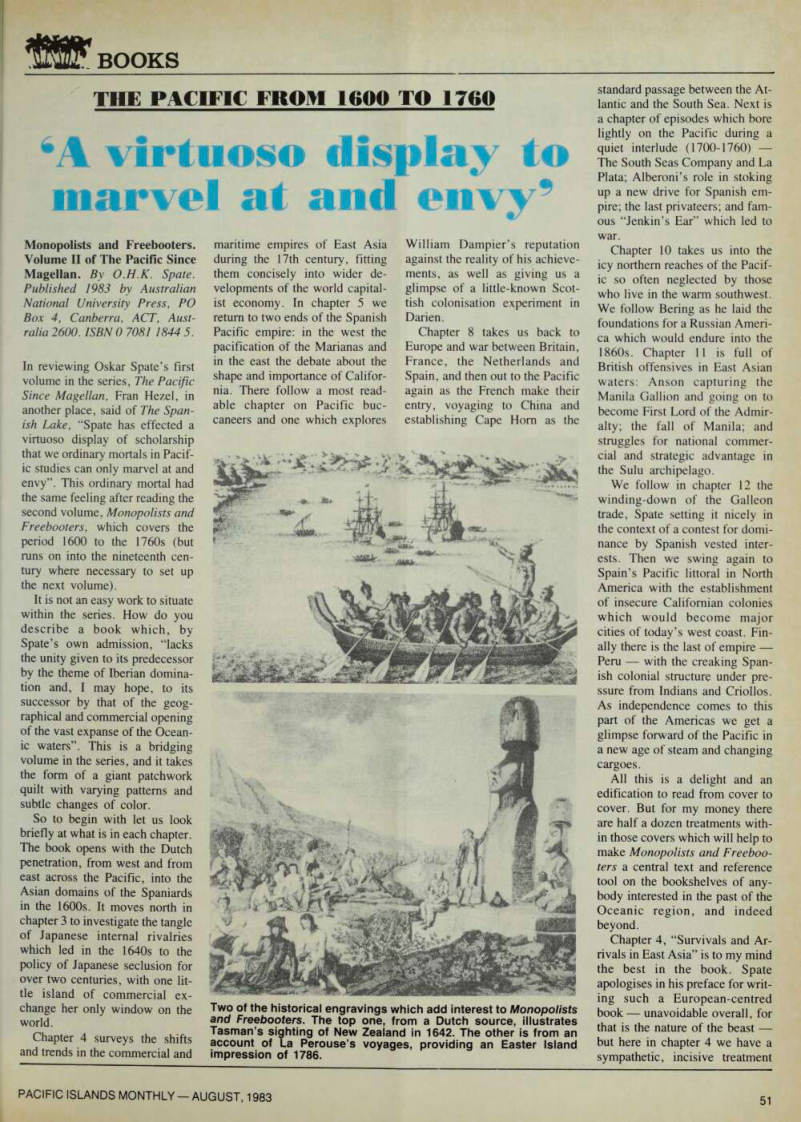
Two of the historical engravings which add interest to Monopolists and Freebooters. The top one, from a Dutch source, illustrates Tasman's sighting of New Zealand in 1642. The other is from an account of La Perouse’s voyages, providing an Easter Island impression of 1786.
of dynamic Asian policies and their commercial operations. We get a feeling of communities Asian and European engaged in an exquisite dance, stepping towards one another in new com mercial beginnings, retreating, trying new steps, new passages.
And Spate does not neglect the macro-economic trends, as the western economy begins to turn towards mass production in Europe and mass marketing in Asia. This is “significant his tory”: not just the art of story telling but the systematising of the record and meaning of human behavior over long periods as well. Thus Spate sums up crisply in this chapter the Portuguese legacy in Asia, the real reasons for European domination of Asian trade, the reason for France’s lack of commercial suc cess, and so on.
Another area which stands out in the book is Spate’s chapter on the buccaneers compulsive reading, this and especially his comments on the sources pertaining to them. Spate pro vides in the footnotes to chapter 6 a navigable channel through the readings on one of the more sensationalist areas of maritime history, to a degree which makes them an independent essay on the historiography of the theme. This is a feature of the footnotes as a whole: comprising 75 pages, they are a veritable booklet in themselves which will become a standard bibliographic source for scholars, and a fascinating read to boot.
For those interested in the his tory of the classic age of col onialism and its structures of domination, Spate’s last chapter is illuminating, with its concise description of one of the central functionaries of the European colonial system at all times and in all places the corregidor or district officer, with massive loc al influence and few effective restraints. Much of Europe’s col onial heritage can be traced back to these men, who, in Spate’s words “give the impression of being failed lawyers or the youn ger sons of the seedier gentry”.
They were also the focus of much protest even rebellion by Indios and by the mixed race Criollos, collaborators with
the Spaniards, thrusting ever up wards, with one eye on the In dian masses below as revolution neared.
Finally there are some lovely sketches of individual per sonalities and judicious judg ments on their limitations. Aust ralians will do well to read the portraits of Tasman, damned with faint praise, and of Dam pier, a sensible second-in command but “as a commander, an almost pitiable failure”: sober portraits, both, of men sanctified in the mythology of Australian history. And I defy anyone to remain unaffected by the poig nant journal descriptions of Ber ing and his colleagues living and dying on Bering Island during a dreadful winter of discovery.
One of the pre-eminent virtues of Monopolists and Freebooters is its scope. Spate drives home the fact of the enormous range of environments encompassed by this ocean, from forbidding arct ic wastes, through the sandy, arid shores of parts of the Americas, to the tropics splen did. But the book also stretches the historical eye well beyond the Pacific to the rest of world de velopments in the 16th and 17th centuries. On page one Spate reminds the reader that ours is not the first global century and readers will find here a world peopled not only by Castilians but by Hollanders and the English, by Japanese, Koreans, Filipinos, Russians, Aleuts and American Indians; the Oceanic islanders, Spate promises us, will come into their own in the third volume of the series.
All this is done in the rich prose which is a characteristic of Spate’s work. He is master of the wry characterisation of persons or events (the motives of the buccaneers were “purely, or im purely, predatory” one of the most famous, Henry Morgan, died “more in the odor of rum than of sanctity”) and of the witty editorial comment (when de scribing the proposal by Bering’s suffering party to break up their wrecked ship to build a smaller vessel Spate writes: “There’ll al ways be an apparatchik : objec tion was made that nobody had ever heard of building a vessel from a wreck(!)”). There is of
course a meticulous attention to detail, demonstrated in the very beginning with a salutary essay on usages of historical time, dis tance and currency, things often treated casually in lesser scho lars’ works: nothing is left to chance, or to misconstrual.
For all these reasons Monopol ists and Freebooters is not a book for the literary fool or the fainthearted. Just occasionally the pleasure in the story is les sened by the mass of erudition and at points it becomes imposs ible to continue holding all the threads of events and influences
in one’s finite hands. This is a dilemma for Spate, whether to write a simpler book or quite plainly the best book available on this “Dark Age of Pacific his
toriography”. Spate has chosen
the latter and who will gainsay him? The Pacific has given us some of the world’s most endur ing historical scholarship; witness Beaglehole’s introduc tions and annotations to Cook’s
journals. Like these, Spate’s
work shall stand long after the short-lived monographs are all
remaindered.
Peter
Hempenstall.