People
pp. 47-49 · Read in the full issue
Manuele Palehau Leaone, 85, of Tokelau, is regarded by visit ing academics and others as the leading authority on his coun try’s history, music and customs.
In recognition of his “disting uished service to his people over 60 years”, Queen Elizabeth II honored him in this year’s Birth day Honors with the Queen’s Service Order for Community Service (QSO).
The order, exclusive to New Zealand (which administers the territory of Tokelau, about 480 km north of Western Samoa), was instituted by the Queen in 1975 to “recognise valuable voluntary service to the com munity and meritorious and faithful public service”.
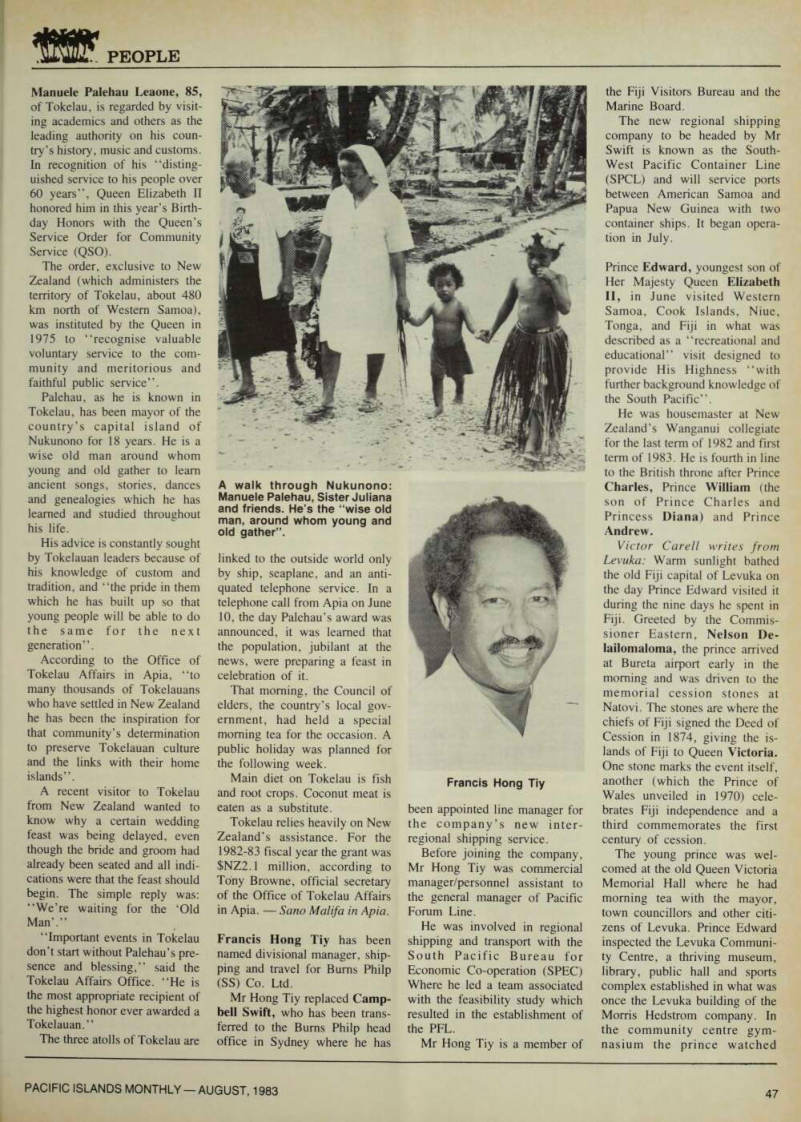
Palehau, as he is known in Tokelau, has been mayor of the country’s capital island of Nukunono for 18 years. He is a wise old man around whom young and old gather to learn ancient songs, stories, dances and genealogies which he has learned and studied throughout his life.
His advice is constantly sought by Tokelauan leaders because of his knowledge of custom and tradition, and “the pride in them which he has built up so that young people will be able to do the same for the next generation”.
According to the Office of Tokelau Affairs in Apia, “to many thousands of Tokelauans who have settled in New Zealand he has been the inspiration for that community’s determination to preserve Tokelauan culture and the links with their home islands”.
A recent visitor to Tokelau from New Zealand wanted to know why a certain wedding feast was being delayed, even though the bride and groom had already been seated and all indi cations were that the feast should begin. The simple reply was; “We’re waiting for the ‘Old Man’.”
“Important events in Tokelau don’t start without Palehau’s pre sence and blessing,” said the Tokelau Affairs Office. “He is the most appropriate recipient of the highest honor ever awarded a Tokelauan.”
The three atolls of Tokelau are
linked to the outside world only by ship, seaplane, and an anti quated telephone service. In a telephone call from Apia on June 10, the day Palehau’s award was announced, it was learned that the population, jubilant at the news, were preparing a feast in celebration of it.
That morning, the Council of elders, the country’s local gov ernment, had held a special morning tea for the occasion. A public holiday was planned for the following week.
Main diet on Tokelau is fish and root crops. Coconut meat is eaten as a substitute.
Tokelau relies heavily on New Zealand’s assistance. For the 1982-83 fiscal year the grant was SNZ2.I million, according to Tony Browne, official secretary of the Office of Tokelau Affairs in Apia. Sano Malifa in Apia.
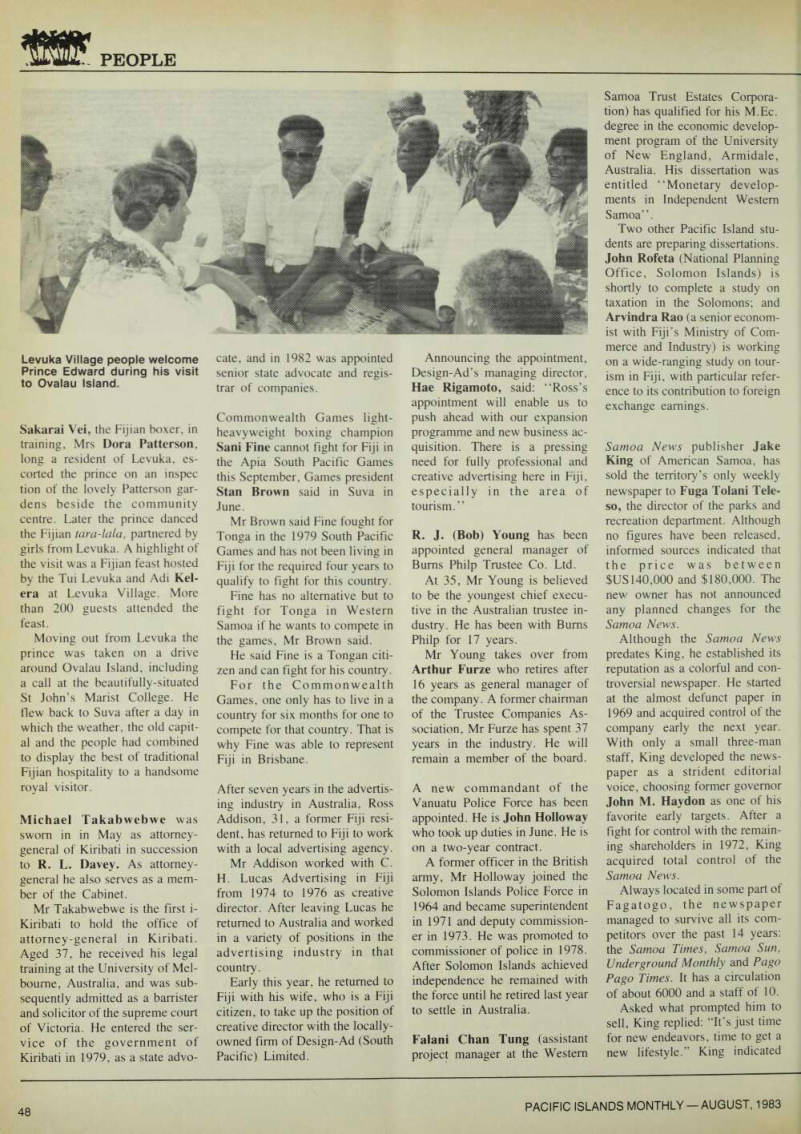
Francis Hong Tiy has been named divisional manager, ship ping and travel for Bums Philp (SS) Co. Ltd.
Mr Hong Tiy replaced Camp bell Swift, who has been trans ferred to the Bums Philp head office in Sydney where he has
been appointed line manager for the company’s new inter regional shipping service.
Before joining the company, Mr Hong Tiy was commercial manager/personnel assistant to the general manager of Pacific Forum Line.
He was involved in regional shipping and transport with the South Pacific Bureau for Economic Co-operation (SPEC) Where he led a team associated with the feasibility study which resulted in the establishment of the PEL.
Mr Hong Tiy is a member of
the Fiji Visitors Bureau and the Marine Board.
The new regional shipping company to be headed by Mr Swift is known as the South- West Pacific Container Line (SPCL) and will service ports between American Samoa and Papua New Guinea with two container ships. It began opera tion in July.
Prince Edward, youngest son of Her Majesty Queen Elizabeth 11, in June visited Western Samoa, Cook Islands, Niue, Tonga, and Fiji in what was described as a “recreational and educational” visit designed to provide His Highness “with further background knowledge of the South Pacific”.
He was housemaster at New Zealand’s Wanganui collegiate for the last term of 1982 and first term of 1983. He is fourth in line to the British throne after Prince Charles, Prince William (the son of Prince Charles and Princess Diana) and Prince Andrew.
Victor Carell writes from Levuka: Warm sunlight bathed the old Fiji capital of Levuka on the day Prince Edward visited it during the nine days he spent in Fiji. Greeted by the Commis sioner Eastern, Nelson De lailomaloma, the prince arrived at Bureta airport early in the morning and was driven to the memorial cession stones at Natovi. The stones are where the chiefs of Fiji signed the Deed of Cession in 1874, giving the is lands of Fiji to Queen Victoria.
One stone marks the event itself, another (which the Prince of Wales unveiled in 1970) cele brates Fiji independence and a third commemorates the first century of cession.
The young prince was wel comed at the old Queen Victoria Memorial Hall where he had morning tea with the mayor, town councillors and other citi zens of Levuka. Prince Edward inspected the Levuka Communi ty Centre, a thriving museum, library, public hall and sports complex established in what was once the Levuka building of the Morris Hedstrom company. In the community centre gym nasium the prince watched
A walk through Nukunono: Manuele Palehau, Sister Juliana and friends. He’s the “wise old man, around whom young and old gather”.
Francis Hong Tiy
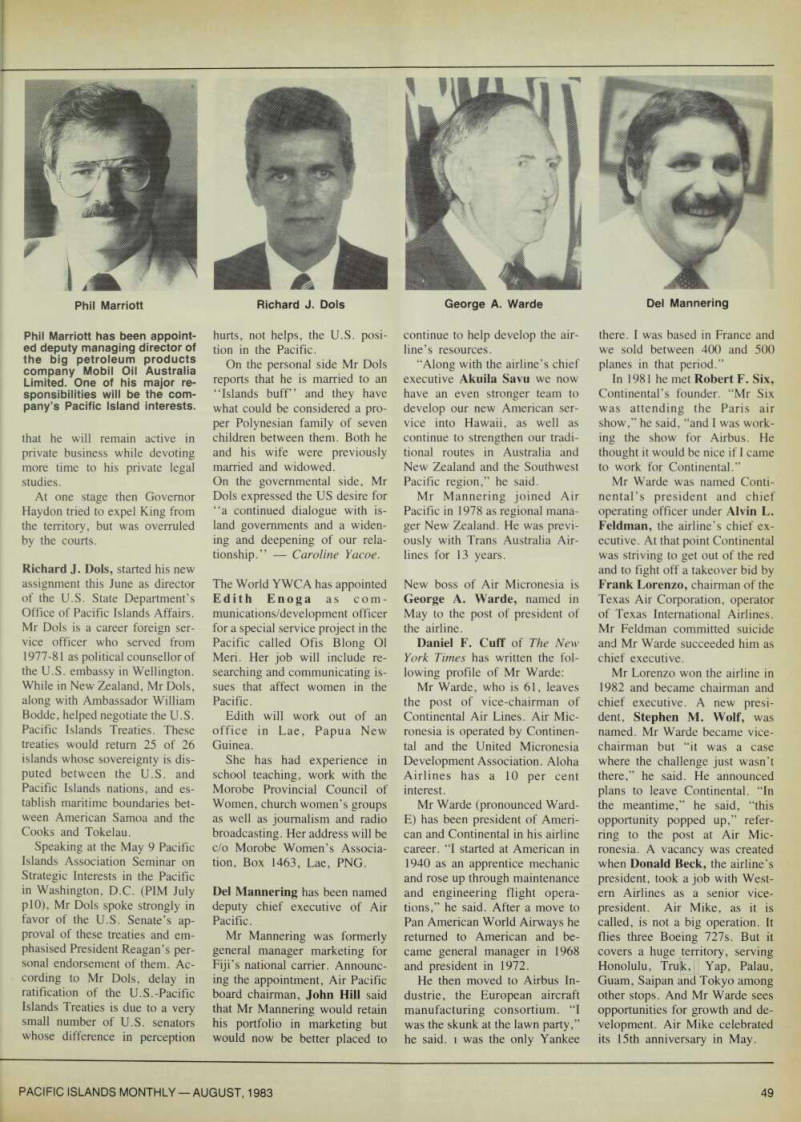
Sakarai Vei, the Fijian boxer, in training, Mrs Dora Patterson, long a resident of Levuka, es corted the prince on an inspec tion of the lovely Patterson gar dens beside the community centre. Later the prince danced the Fijian tara-lala, partnered by girls from Levuka. A highlight of the visit was a Fijian feast hosted by the Tui Levuka and Adi Kel era at Levuka Village. More than 200 guests attended the feast.
Moving out from Levuka the prince was taken on a drive around Ovalau Island, including a call at the beautifully-situated St John’s Marist College. He flew back to Suva after a day in which the weather, the old capit al and the people had combined to display the best of traditional Fijian hospitality to a handsome royal visitor.
Michael Takabwebwe was sworn in in May as attorney general of Kiribati in succession to R. L. Davey. As attorney general he also serves as a mem ber of the Cabinet.
Mr Takabwebwe is the first i- Kiribati to hold the office of attorney-general in Kiribati.
Aged 37, he received his legal training at the University of Mel bourne, Australia, and was sub sequently admitted as a barrister and solicitor of the supreme court of Victoria. He entered the ser vice of the government of Kiribati in 1979, as a state advo
cate, and in 1982 was appointed senior state advocate and regis trar of companies.
Commonwealth Games light heavyweight boxing champion Sani Fine cannot fight for Fiji in the Apia South Pacific Games this September, Games president Stan Brown said in Suva in June.
Mr Brown said Fine fought for Tonga in the 1979 South Pacific Games and has not been living in Fiji for the required four years to qualify to fight for this country.
Fine has no alternative but to fight for Tonga in Western Samoa if he wants to compete in the games, Mr Brown said.
He said Fine is a Tongan citi zen and can fight for his country.
For the Commonwealth Games, one only has to live in a country for six months for one to compete for that country. That is why Fine was able to represent Fiji in Brisbane.
After seven years in the advertis ing industry in Australia, Ross Addison, 31, a former Fiji resi dent, has returned to Fiji to work with a local advertising agency.
Mr Addison worked with C.
H. Lucas Advertising in Fiji from 1974 to 1976 as creative director. After leaving Lucas he returned to Australia and worked in a variety of positions in the advertising industry in that country.
Early this year, he returned to Fiji with his wife, who is a Fiji citizen, to take up the position of creative director with the locally owned firm of Design-Ad (South Pacific) Limited.
Announcing the appointment,
Design-Ad’s managing director,
Hae Rigamoto, said: “Ross’s appointment will enable us to push ahead with our expansion programme and new business ac quisition. There is a pressing need for fully professional and creative advertising here in Fiji, especially in the area of tourism.”
R. J. (Bob) Young has been
appointed general manager of
Bums Philp Trustee Co. Ltd.
At 35, Mr Young is believed to be the youngest chief execu tive in the Australian trustee in dustry. He has been with Bums Philp for 17 years.
Mr Young takes over from Arthur Furze who retires after 16 years as general manager of the company. A former chairman of the Trustee Companies As sociation, Mr Furze has spent 37 years in the industry. He will remain a member of the board.
A new commandant of the Vanuatu Police Force has been appointed. He is John Holloway who took up duties in June. He is on a two-year contract.
A former officer in the British army, Mr Holloway joined the Solomon Islands Police Force in 1964 and became superintendent in 1971 and deputy commission er in 1973. He was promoted to commissioner of police in 1978.
After Solomon Islands achieved independence he remained with the force until he retired last year to settle in Australia.
Falani Chan Tung (assistant project manager at the Western
Samoa Trust Estates Corpora tion) has qualified for his M.Ec. degree in the economic develop ment program of the University of New England, Armidale, Australia. His dissertation was entitled “Monetary develop ments in Independent Western Samoa”.
Two other Pacific Island stu dents are preparing dissertations.
John Rofeta (National Planning Office, Solomon Islands) is shortly to complete a study on taxation in the Solomons; and Arvindra Rao (a senior econom ist with Fiji’s Ministry of Com merce and Industry) is working on a wide-ranging study on tour ism in Fiji, with particular refer ence to its contribution to foreign exchange earnings.
Samoa News publisher Jake King of American Samoa, has sold the territory’s only weekly newspaper to Fuga Tolani Tele so, the director of the parks and recreation department. Although no figures have been released, informed sources indicated that the price was between SUS 140,000 and $lBO,OOO. The new owner has not announced any planned changes for the Samoa News.
Although the Samoa News predates King, he established its reputation as a colorful and con troversial newspaper. He started at the almost defunct paper in 1969 and acquired control of the company early the next year.
With only a small three-man staff, King developed the news paper as a strident editorial voice, choosing former governor John M. Haydon as one of his favorite early targets. After a fight for control with the remain ing shareholders in 1972, King acquired total control of the Samoa News.
Always located in some part of Fagatogo, the newspaper managed to survive all its com petitors over the past 14 years: the Samoa Times, Samoa Sun, Underground Monthly and Pago Pago Times. It has a circulation of about 6000 and a staff of 10.
Asked what prompted him to sell, King replied: “It’s just time for new endeavors, time to get a new lifestyle.” King indicated
Levuka Village people welcome Prince Edward during his visit to Ovalau Island.
that he will remain active in private business while devoting more time to his private legal studies.
At one stage then Governor Haydon tried to expel King from the territory, but was overruled by the courts.
Richard J. Dols, started his new assignment this June as director of the U.S. State Department’s Office of Pacific Islands Affairs.
Mr Dols is a career foreign ser vice officer who served from 1977-81 as political counsellor of the U.S. embassy in Wellington.
While in New Zealand, Mr Dols, along with Ambassador William Bodde, helped negotiate the U.S.
Pacific Islands Treaties. These treaties would return 25 of 26 islands whose sovereignty is dis puted between the U.S. and Pacific Islands nations, and es tablish maritime boundaries bet ween American Samoa and the Cooks and Tokelau.
Speaking at the May 9 Pacific Islands Association Seminar on Strategic Interests in the Pacific in Washington, D.C. (PIM July plO), Mr Dols spoke strongly in favor of the U.S. Senate’s ap proval of these treaties and em phasised President Reagan’s per sonal endorsement of them. Ac cording to Mr Dols, delay in ratification of the U.S.-Pacific Islands Treaties is due to a very small number of U.S. senators whose difference in perception
hurts, not helps, the U.S. posi tion in the Pacific.
On the personal side Mr Dols reports that he is married to an “Islands buff’ and they have what could be considered a pro per Polynesian family of seven children between them. Both he and his wife were previously married and widowed.
On the governmental side, Mr Dols expressed the US desire for “a continued dialogue with is land governments and a widen ing and deepening of our rela
tionship.”
Caroline Yacoe.
The World YWCA has appointed Edith Enoga as com munications/development officer for a special service project in the Pacific called Ofis Blong Ol Meri. Her job will include re searching and communicating is sues that affect women in the Pacific.
Edith will work out of an office in Lae, Papua New Guinea.
She has had experience in school teaching, work with the Morobe Provincial Council of Women, church women’s groups as well as journalism and radio broadcasting. Her address will be c/o Morobe Women’s Associa tion, Box 1463, Lae, PNG.
Del Mannering has been named deputy chief executive of Air Pacific.
Mr Mannering was formerly general manager marketing for Fiji’s national carrier. Announc ing the appointment, Air Pacific board chairman, John Hill said that Mr Mannering would retain his portfolio in marketing but would now be better placed to
continue to help develop the air line’s resources.
“Along with the airline’s chief executive Akuila Savu we now have an even stronger team to develop our new American ser vice into Hawaii, as well as continue to strengthen our tradi tional routes in Australia and New Zealand and the Southwest Pacific region,” he said.
Mr Mannering joined Air Pacific in 1978 as regional mana ger New Zealand. He was previ ously with Trans Australia Air lines for 13 years.
New boss of Air Micronesia is George A. Warde, named in May to the post of president of the airline.
Daniel F. Cuff of The New York Times has written the fol lowing profile of Mr Warde: Mr Warde, who is 61, leaves the post of vice-chairman of Continental Air Lines. Air Mic ronesia is operated by Continen tal and the United Micronesia Development Association. Aloha Airlines has a 10 per cent interest.
Mr Warde (pronounced Ward- E) has been president of Ameri can and Continental in his airline career. “I started at American in 1940 as an apprentice mechanic and rose up through maintenance and engineering flight opera tions,” he said. After a move to Pan American World Airways he returned to American and be came general manager in 1968 and president in 1972.
He then moved to Airbus In dustrie, the European aircraft manufacturing consortium. “I was the skunk at the lawn party,” he said, i was the only Yankee
there. I was based in France and we sold between 400 and 500 planes in that period.”
In 1981 he met Robert F. Six, Continental’s founder. “Mr Six was attending the Paris air show,” he said, “and I was work ing the show for Airbus. He thought it would be nice if I came to work for Continental.”
Mr Warde was named Conti nental’s president and chief operating officer under Alvin L.
Feldman, the airline’s chief ex ecutive. At that point Continental was striving to get out of the red and to fight off a takeover bid by Frank Lorenzo, chairman of the Texas Air Corporation, operator of Texas International Airlines.
Mr Feldman committed suicide and Mr Warde succeeded him as chief executive.
Mr Lorenzo won the airline in 1982 and became chairman and chief executive. A new presi dent, Stephen M. Wolf, was named. Mr Warde became vice chairman but “it was a case where the challenge just wasn’t there,” he said. He announced plans to leave Continental. “In the meantime,” he said, “this opportunity popped up,” refer ring to the post at Air Mic ronesia. A vacancy was created when Donald Beck, the airline’s president, took a job with West ern Airlines as a senior vice president. Air Mike, as it is called, is not a big operation. It flies three Boeing 7275. But it covers a huge territory, serving Honolulu, Trulk, Yap, Palau, Guam, Saipan and Tokyo among other stops. And Mr Warde sees opportunities for growth and de velopment. Air Mike celebrated its 15th anniversary in May.
Phil Marriott
Phil Marriott has been appoint ed deputy managing director of the big petroleum products company Mobil Oil Australia Limited. One of his major re sponsibilities will be the com pany’s Pacific Island interests.
Richard J. Dols
George A. Warde
Del Mannering