‘It is my love for you that has
pp. 55-58 · Read in the full issue

Yesterday
‘It is my love for you that has me punish you so lightly . . .'
JOSEPH THEROUX concludes a two-part series on the life and times of WILHELM HEINRICH SOLF, governor of pre-World War I German Samoa.
Solf included many non- Germans in his government: British, American and mixed race. He chose Dick Williams, an Irishman, to be deputy ad ministrator (amtmann) of Savai’i (he who staged the shows). To boost agricultural development, Solf brought in the German Pro fessor E. Wohtmann in 1903 to study the potential of the islands.
He identified ideal sites for growing cocoa, for instance, sites that are still flourishing today.
Richard Deeken surfaced again in 1904, founding the Sa moan Co-operative Trading Soc iety. He sought by this manoeuvre to realise the plan laid out in his book. He wanted to fund the co-op by taxing the whole Samoan population.
Deeken recruited Mata’afa and other chiefs and orators, includ ing Lauaki (of whom more later).
As it was against Self’s econom ic principles, he summarily banned the co-op on December 14, 1904. But the chiefs and orators (the Tuma and Pule) did not cease their efforts.
While Solf was on holiday in New Zealand, the Samoan lead ers of the co-op tried to institute the program, despite Self’s ban.
They were arrested and impris oned. Others broke open the jail and released them. Upon Self’s return, he disbanded the Tumua and Pule and the Fono, and hand picked his own Fono. When the jailbreak became known, Thomas Trood wrote in his Is land Reminiscences, “some of the citizens at once exclaimed ‘Shoot them down!’ ‘Shoot them down!’ which, had it been done by the government, would have brought on another native war ... Dr Solf has never worked on such lines.” He finally suc ceeded in supressing the co-op in 1907, and many of the leaders were pardoned, including Lauaki. But Deeken and others saw the government reshuffle as
harsh and arbitrary and continued their agitating in the Reichstag. • • • About 1899, a wealthy German businessman named Gustav Kunst purchased Vailima, the last home of Robert Louis Stevenson, from the writer’s widow (the sale negotiated by H.
J. Moors, the remarkable Ameri can expatriate: see PIM August, September 1981). Kunst made considerable additions and im
provements, including piped wa
ter and electricity.
“More recently,’’ Moors wrote in his With Stevenson in Samoa, “Vailima thus improved and beautified, has been acquired by the German Government from Mr Kunst’s nephew and heir and is now the official residence of the Governor, Dr Solf,’’ The imperial governor moved into “Government House’’ about the end of 1905. • • • In 1908, Solf returned to Ger many and Kaiser Wilhelm II “Der tupu sili von Samoa” awarded him the Order of the Prussian Crown (second class).
During the visit he met 21-year old Johanna Dotti, of Neuenha gen. She was high-spirited, sports-minded and cultured.
They married after a brief court ship. Johanna and Wilhelm re turned to Samoa; “. . . their honeymoon trip was the voyage out,” son Otto wrote. In later years, “she had very vivid recol lections of her first married years perhaps her happiest, as is so often the case and spoke of Apia often. When my parents corresponded, they always sign ed their letters, cables etc. with ‘Alofa,’ and I remember my mother telling me that it could also mean ‘I love you’.”
In Apia, she joined the Frauen-Verein (“Women’s Committee”) and the sports club, and was an active member of both. She delighted everyone by continuing to play, in true Samoan style, even when soaked by tropical downpours, the Samoanische Zeitung reported.
Solf admitted that she “was a far better sportswoman than he was a sportsman.” • • • Lauaki Namalau’ulu Mamoe was one of the great, though tragic, figures of Samoan history. (Mamoe was his given name, Namalau’ulu his orator title, and Lauaki, an honorary title in herited from his father, had been bestowed by a visiting Tongan
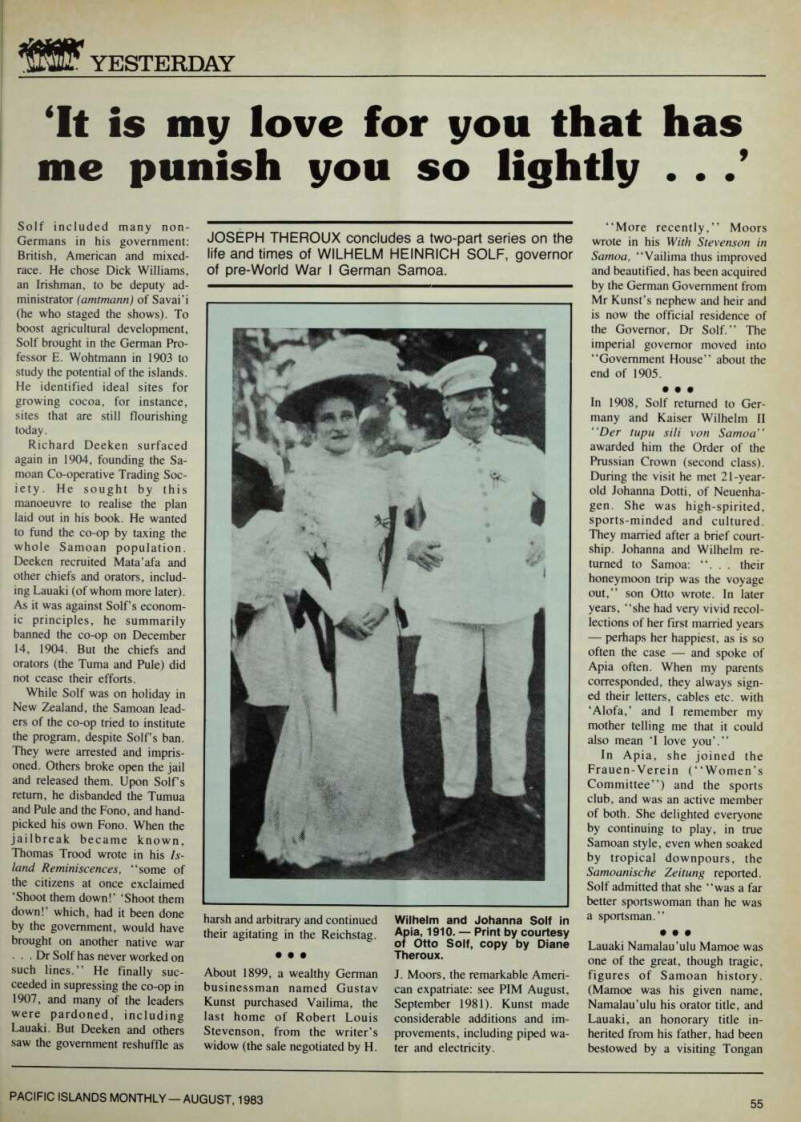
Wilhelm and Johanna Solf in Apia, 1910. - Print by courtesy of Otto Solf, copy by Diane Theroux.
chief; hence it is correct to spell it with a k.). He was the leading orator of Savai’i, handsome, dig nified, from a long line of king makers and intriguers. Even Solf referred to him as ‘‘a grand, eloquent epeaker”. He had been a member of the ill-fated Copra Co-operative.
Solf wrote: ‘‘A Samoan politi cian, he could not conceive that Germany for all time and alone without recourse to America and England was ruling in Samoa. He found Germany tedi ous he wanted a change.” (McKay’s Chronology of West ern Samoa).
Lauaki and Solf had basic dif ferences. Lauaki charged that the German administration sought to divide the Samoans; Lauaki was against the poll tax; he was angry when the copra prices paid to the Samoans had declined in 1904; he wanted the Tumua and Pule (whom Solf saw as mere trouble makers) recognised, not the Faipule Fono (created by Solf); Like Solf, he sought the abolition of the ali’i sill but Lauaki
wanted a return to a traditional
political structure.
Part of the problem was that he was so like Solf: cultured, stub born, articulate, devious, aloof.
A showdown was inevitable.
When Solf and Johanna toured Savai’i in November of 1908, it was as much a political jaunt as a social one. Lauaki had formed the Mau a Pule (literally, ‘The Opposition Movement of Savai’i”) and Solf saw this, rightly, as a threat to the German administration.
“ ‘Do not talk to me decep tively,’ said the governor to the Savaiians in various speeches, ‘and do not try to use your Samoan tricks. I am not so easily deceived by your tongafitis (knaveries); you often speak of the fa’a Samoa (Samoan cus tom), but only when you wish to bring it in. I try to uphold the good Samoan customs, but do not wish for tricks to be covered by them.’ ” ‘Quoted by
Keesing).
At Safotulafai, Solf delivered his last speech about the Mau a
Pule. He called Lauaki a ‘‘dangerous agitator” and or dered him to remain in Savai’i. ‘‘He succeeded by his person ality and ability to beat the Sa moan chiefs and orators at their own game talking. One at tempt after another by some par ty to gain superiority, was bro ken up, not by military force, but by the power of his eloquence,” wrote R.P. Berking, his collector of customs, in PIM, April, 1936.
But on January 18, 1909, Lauaki arrived at Vaiusu with ‘‘a canoe fleet” of armed men. ‘‘Faced with this show of force, Solf forgave Lauaki his past mis deeds and attempted to reach an agreement with him as to the future. But as the two had been dedicated for many years to the attainment of irreconcilable ob jectives, nothing was achieved.” (Davidson, Samoa mo Samoa). ‘‘[Solf] had a shrewd but harsh understanding of native respect for force,” Furnas wrote. ‘‘When unrealistic ambition in a brilliant Savai’i talking chief named Lauati [sic] culminated in
armed defiance of the govern ment, he [Solf] easily maintained his mana by showing nothing but easy-going contempt and simul taneously whistling up war ships.” The warships were from the German China Station. They arrived in March with 300 Sol omon Island troops.
Aggie Grey spoke of the inci dent in her biography. “As can be imagined,” she said, “the sight of the armed black troops was too much for the Samoans.
They surrendered, begging that their villages by spared, and Solf agreed.”
With permission of the Faipule Fono, Solf had Lauaki and 11 others, including relatives and a Samoan pastor (72 in all), de ported to Saipan. There were suspensions, fines and forced labor for those who were allowed to remain. (The labor included erecting government buildings on confiscated land in Savai’i.) Solf issued a proclamation ‘To All Samoa”. It concluded: ‘‘You will understand that it is my love for you that has made
me punish you so lightly. This will teach Samoa a lesson and will cause all to bear in mind that there is only one head in Samoa and that is His Majesty the Kais er.” (Quoted by Keesing.) Spoken like a father to his misbehaving children. Or like a Samoan matai to his extended
family. For the punishments
could have been far worse.
Fletcher observed wryly that “. . . within the velvet glove was the Prussian hand of steel.”
The exiled group was not al lowed to return until 1915, when New Zealand ruled the islands.
Berking wrote (PIM, April
1936): “It is very remarkable that Lauati’s [sic] followers on their return to Samoa, after the out break of the Great War, express ed publicly their full appreciation of the justice that had been dealt out to them by Dr Solf. ’ ’
But Lauaki was never to see his homeland again. He died on the return voyage. And all but one of the exiled leaders died in the Influenza Pandemic of 1918. • • • On August 31, 1909, Johanna gave birth to their first child.
They named her, ironically
enough, after a Savai’i orator, a priestess who had been the adop tive mother and counsellor to Samoa’s only queen, Salamasina, who had lived 400
years before; So’oa’emalelagi, ‘‘One who has fallen from heaven”. She was called Lagi (‘‘Heaven”) for short and forev er after. ‘‘When my sister was bom,” Otto Solf wrote, ‘‘the local chiefs declared her ‘a princess’ and she was given land and all sorts of honors.”
Who could predict that Lagi, like her mother, would die before her time, of inhumanities inflict ed in Nazi concentration camps? • • • Solf completed his service in Samoa in 1910. On September 22, he, Lagi and Johanna (six months pregnant with first son Hans Heinrich) boarded the Atua and sailed for Fiji, laden with gifts and thanks, cries of “Hoch, hoch, hoch” (three cheers) ring ing in their ears. From all quar ters there was praise for his ad ministration. But Solf himself was dissatisfied. He said: “I leave Samoa unhealed of its great evils: doubt, suspicion and jealousy.” (Quoted in Rowe.) He knew the desire for independ ence had not been quashed with Lauaki. The Mau would reappear and the bloody days that pre ceded his administration would return under the New Zealand administration. But he had kept the peace, built hospitals and the government buildings that are still in use, largely unchanged.
He increased the revenue from
14,000 pounds in 1900 to 41,350 pounds in 1911. Where the col ony had been supported at the beginning, it now paid a share into the Colonial Office.
However, back in the Reich stag, Richard Deeken’s charges were spouted by Self’s enemies.
The major charge? That Solf was guilty of verkanakerung ■ — from the root word kanaka in other words, ‘‘going native” Lloyd Osbourne, Robert Louis Steven son’s stepson, tells the story in his introduction to Rowe’s book: “. . .he had to defend himself . . . from an impassioned charge that while in Samoa he had worn flowers in his hair . . . at Samoan revels. Dr Solf bent his head and revealed a perfectly bald scalp. T have no hair to put flowers in,’ he said. ‘Look for yourselves, gentlemen.’ The Reichstag could almost see them selves reflected in his shiny pate, and the ensuing roar of laughter shook the chamber. ’ ’ • • • In 1911, he became Secretary of State for the Colonial Office under Wilhelm 11, a post he held until the fall of the Kaiser’s government in 1918. During the chaotic months surrounding the armistice negotiations, he was Foreign Secretary for just two months.
In the years since his gover norship, he had often spoken of Germany’s role as a colonial power. But it was a lone voice.
Germany had lost her posses sions, but had a hope of regain ing them. Fletcher wrote that Solf gave ‘‘a lecture in Berlin in 1916 before the German church authorities upon missionary en terprise. The German missio nary, he said, had a special mis sion. Natives were the best asset of the colonies, but they must be brought under proper control by mission work. Christianity and kultur German kultur were to go hand in hand.” This was one of Solf’s favorite themes: “Kolonisieren ist Missioniern,” he often said. But not in strict religious or Kulturell terms. John Moses (in NZ Journal of History, ‘‘The Solf Regime in Western Samoa”) maintains that it im plied missionising in the widest sense of education and ‘‘the best European culture could offer
with the best of the native cul ture.” In 1917 Solf was in Leip
zig, explaining Germany’s desire
for the recovery of her posses sions. ‘‘Germany’s pre-war humane treatment of the native races has won for her the moral right to be called a great Colonial Power.” (Quoted in Fletcher’s book Stevenson s Germany). He could not, however, have been
thinking of Germany’s treatment
of certain African tribes, of which had been extinguished.
But few looked at his record in the Pacific. • • • In 1920, the Weimar Republic
appointed him charge d’affaires
to the embassy in Tokyo. At the end of that year he was named ambassador. He presented his credentials on February 26, 1921, and served until the end of 1928. During these years he was president of the Asiatic Society of Japan and signed the German
Japanese Trade Agreement of
1928. When, at the age of 65, he was due to retire, the Reichstag requested that he remain to repre sent them at the coronation of Hirohito.
He returned to Germany with his wife, daughter and three sons. In 1929, Heidelberg Un iversity awarded him the honor ary degree of doctor of political science and the following year
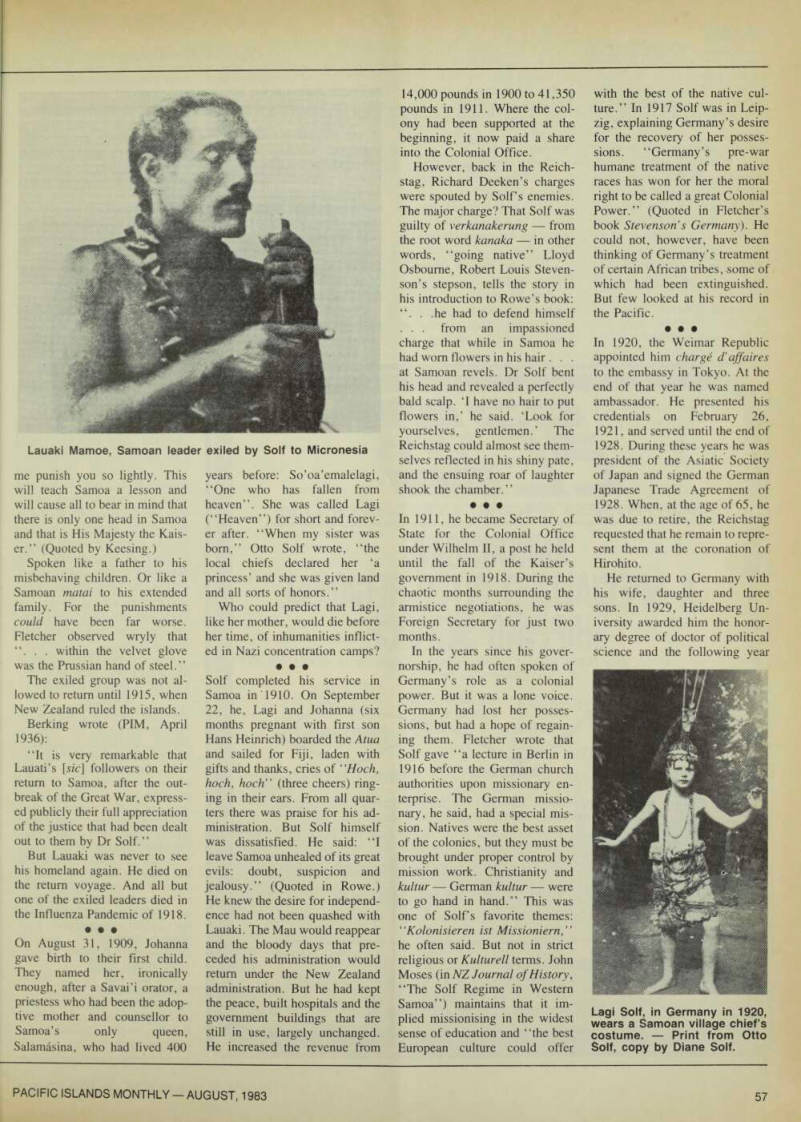
Lauaki Mamoe, Samoan leader exiled by Solf to Micronesia
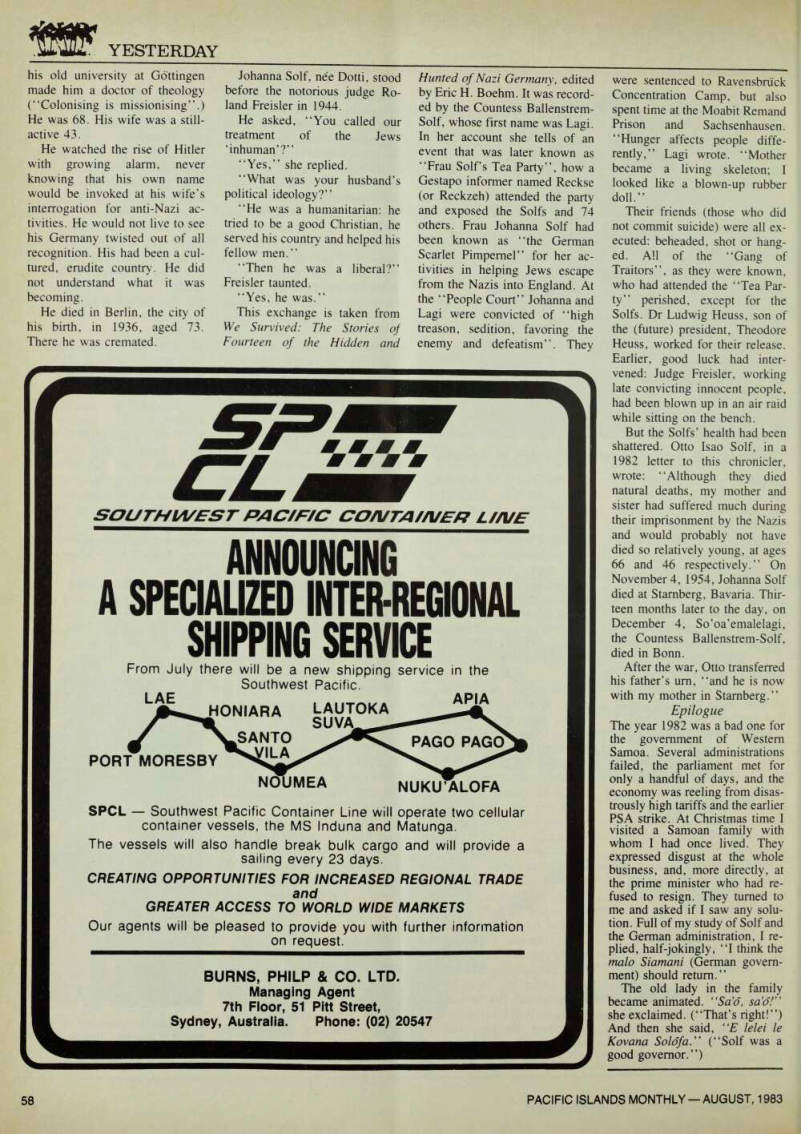
Lagi Solf, in Germany in 1920, wears a Samoan village chief’s costume. - Print from Otto Solf, copy by Diane Solf.
his old university at Gottingen made him a doctor of theology (“Colonising is missionising”.) He was 68. His wife was a still active 43.
He watched the rise of Hitler with growing alarm, never knowing that his own name would be invoked at his wife’s interrogation for anti-Nazi ac tivities. He would not live to see his Germany twisted out of all recognition. His had been a cul tured, erudite country. He did not understand what it was becoming.
He died in Berlin, the city of his birth, in 1936, aged 73.
There he was cremated.
Johanna Solf, nee Dotti, stood before the notorious judge Ro land Freisler in 1944.
He asked, “You called our treatment of the Jews ‘inhuman’?”
“Yes,” she replied.
“What was your husband’s political ideology?”
“He was a humanitarian; he tried to be a good Christian, he served his country and helped his fellow men.”
“Then he was a liberal?”
Freisler taunted.
“Yes, he was.”
This exchange is taken from We Survived: The Stones of Fourteen of the Hidden and
Hunted of Nazi Germany, edited by Eric H. Boehm. It was record ed by the Countess Ballenstrem- Solf, whose first name was Lagi.
In her account she tells of an event that was later known as “Frau Solf’s Tea Party’’, how a Gestapo informer named Reckse (or Reckzeh) attended the party and exposed the Solfs and 74 others. Frau Johanna Solf had been known as “the German Scarlet Pimpernel’’ for her ac tivities in helping Jews escape from the Nazis into England. At the “People Court’’ Johanna and Lagi were convicted of “high treason, sedition, favoring the enemy and defeatism”. They
were sentenced to Ravensbruck Concentration Camp, but also spent time at the Moabit Remand Prison and Sachsenhausen.
“Hunger affects people diffe rently,” Lagi wrote. “Mother became a living skeleton; I looked like a blown-up rubber doll.”
Their friends (those who did not commit suicide) were all ex ecuted: beheaded, shot or hang ed. All of the “Gang of Traitors”, as they were known, who had attended the “Tea Par ty” perished, except for the Solfs. Dr Ludwig Heuss, son of the (future) president, Theodore Heuss, worked for their release.
Earlier, good luck had inter vened: Judge Freisler, working late convicting innocent people, had been blown up in an air raid while sitting on the bench.
But the Solfs’ health had been shattered. Otto Isao Solf, in a 1982 letter to this chronicler, wrote: “Although they died natural deaths, my mother and sister had suffered much during their imprisonment by the Nazis and would probably not have died so relatively young, at ages 66 and 46 respectively.” On November 4, 1954, Johanna Solf died at Stamberg, Bavaria. Thir teen months later to the day, on December 4, So’oa’emalelagi, the Countess Ballenstrem-Solf, died in Bonn.
After the war, Otto transferred his father’s um, “and he is now with my mother in Stamberg.”
Epilogue
The year 1982 was a bad one for the government of Western Samoa. Several administrations failed, the parliament met for only a handful of days, and the economy was reeling from disas trously high tariffs and the earlier PSA strike. At Christmas time I visited a Samoan family with whom I had once lived. They expressed disgust at the whole business, and, more directly, at the prime minister who had re fused to resign. They turned to me and asked if I saw any solu tion. Full of my study of Solf and the German administration, I re plied, half-jokingly, “I think the malo Siamani (German govern ment) should return.”
The old lady in the family became animated. “Sa’o, sa'6!” she exclaimed. (“That’s right!”) And then she said, “E lelei le Kovana Solofa .” (“Solf was a good governor.”)