the Solomons’
pp. 37-42 · Read in the full issue


Tropicalities
Tribute to the Solomons’
Kuai Maueha
About 100 people attended the opening of an exhibition of the work of Solomon Islands artist Kuai Mauecha in Honiara on May 15, the second anniversary of his death.
The exhibition was financed by the Australian South Pacific Cultures Fund, and was open to the public at the Australian High Commission building from May 15 to June 3.
Formally opening the exhibi tion, Solomon Islands Minister for Education, Training and Cul tural Affairs Michael Evo thank ed and congratulated Australian High Commissioner Trevor Sofield for his sponsoring of the exhibition, which had been set up by the writers of this report.
The attendance at the opening and the minister’s words of ad miration and support differed markedly from the poor response in 1974 when an exhibition of Kuai’s outstanding work was mounted at the Solomon Islands National Museum by Anna Cra ven. It took nearly two years for this significant change in ap preciation to develop, en couraged in particular by the interest of individuals connected with the University of the South Pacific, especially Dr John Chick and Professor Albert Wendt.
In addition to a core of work left by Kuai when he died mostly carvings, but some draw ings a number of sculptures and items of copperwork were lent by individuals resident in Solomon Islands and overseas.
Pieces were flown in for the exhibition by Air Pacific from Australia, New Zealand and Fiji.
It was not possible to get back some of his best pieces now in California. But photos were sent instead.
Three of his largest works were found damaged and dump ed in a small garden shed amidst tall grass at the Betikama Carv ing Centre at the Seventh-day Adventist headquarters, where Kuai worked for some time, and were carefully restored. It might have been possible to bring in
many more sculptures and cop pers had the Betikama Carving Centre kept a careful record of the purchasers of Kuai’s works.
The generous and helpful re sponse from people and institu tions was a fitting tribute to Kuai who well deserves to be recog nised and remembered as an ar tist of note in the South Pacific region.
All those who knew Kuai speak very highly and warmly of him, and he emerges not only as a very creative and talented artist but also as a unique personality.
Considering his late start as an artist, he was a prolific one, seemingly never short of ideas.
He poured out what could almost be described as a stream of pure, untrammelled creativeness. A very few of his carvings give the impression that the subject or form might have been suggested by other people. But these appear rather stilted, and are easy to distinguish from his true flowing work, the definitive form of which often must have been in spired by the piece of timber itself.
It is perhaps difficult from this exhibition to see a particular trend or development in his work as there was no selection accord ing to year or phase all works available have been exhibited and the dates of most are not recorded. It can only be stated that Kuai was working with cop per for a period from the end of 1977 to 1979.
It is easier to divide his carv ings into the more, or less, suc cessful. There were times when he added much shell inlay to his work (probably an earlier tenden cy), other times when he various ly stained, burnt or polished the piece, or left his pieces, very successfully, entirely unpolished or ungamished.
There were times when Kuai, like most Solomon Islands car vers, felt the urgent need to earn money and therfore to turn out something akin to “airport art” which more readily sold to everyday tourists. It is this need to earn a living that hampers the development of contemporary art in the Solomons, and handicaps many individuals who might otherwise explore their own ta lents and abilities, being as they are, not quite so single-minded or totally immersed in their craft as was Kuai, nor so suggestive to dreams and stories.
Kuai Maueha was about 48 when he died in hospital in Hon iara on May 15, 1981, from heart failure following a fall from a tree.
He was bom into the Tongaba sub-clan of the main Kaitu’u clan (sa'a) of Bellona (Mungiki), at a time when Christianity was being introduced. He was the first of two sons bom to Maueha by his first wife Utuika. At an early age he fell and severely damaged his spine, an injury which affected him for life. One of his biggest disappointments was his failure
to find a wife, and he would always help others whose mar riages were encountering dif ficulties. He was a very religious Seventh-day Adventist and loved to preach to young people about his church, and often studied his Bible.
As an artist he was not truly recognised by his nation and it is sad to think that most of his better works, created at the peak of his career in the 19705, are overseas. Although he tried wood-carving in 1962, he did not become serious about it until 1969 when in Western Sol omons. He then moved to Honia ra where he continued to produce carvings and in 1972 turned up at the Betikama Carving Centre, at the Seventh-day Adventist head quarters just outside the town.
During this period his carvings gradually became known, and a number of individuals recognised his talent. His first solo exhibi tion was held at the National Museum in October 1974. In 1976 he participated in a Univer sity of the South Pacific Centre workshop on art and dance in Honiara where he was introduced to line drawing and other techni ques. This was followed by three months as artist-in-residence at the University of the South Pacif-
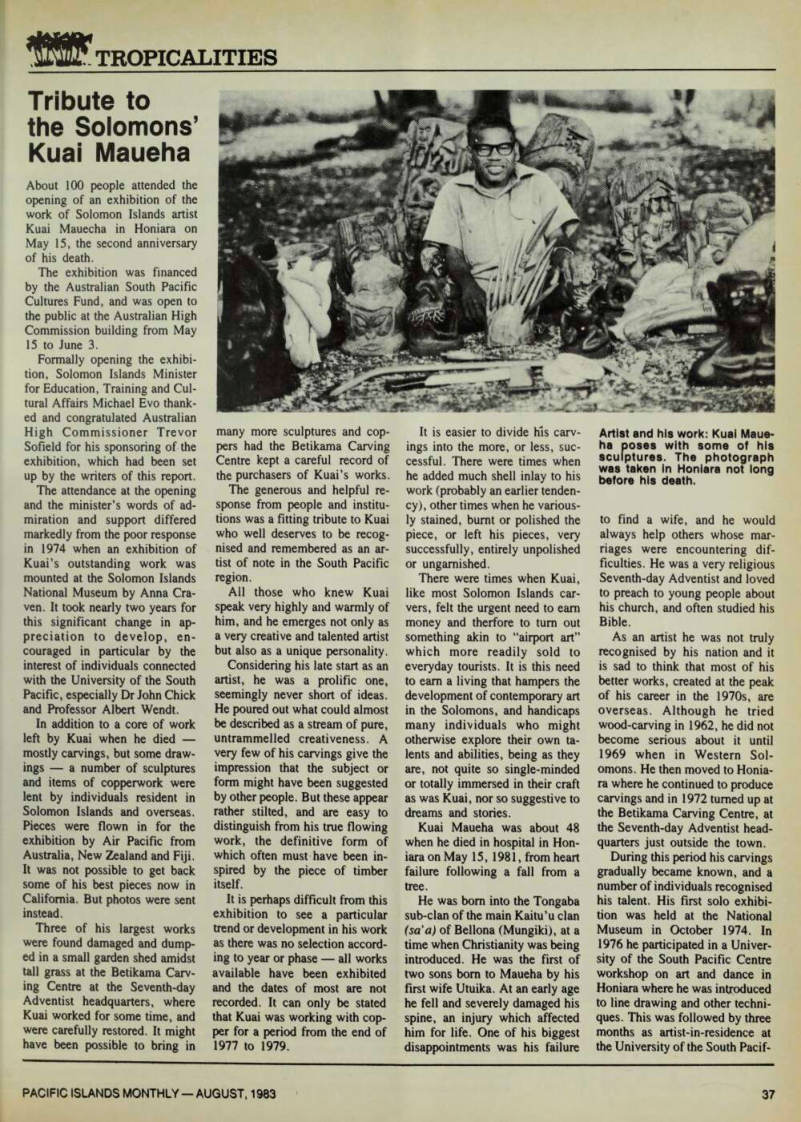
Artist and his work: Kuai Maue ha poses with some of his sculptures. The photograph was taken in Honiara not long before his death.
ic in Suva. Other Pacific Islan ders were able to experience his creativity at this time and some of his major works now remain elsewhere in the Pacific. As a follow-up to this, he worked for some months during 1978 at the USP Centre in Honiara, and his work was on exhibition there.
Up to this time he had been working mostly as an employed carver at the Betikama Carving Centre. Betikama provided a sec ure communal environment for him, as well as an overseas outlet for his creations. He was in troduced to working in copper there and explored that medium for some months. But he had a much more spontaneous sense for creating in timber, according to the shape and inspiration each piece gave him, and he soon returned to this medium.
Each individual form, every group of figures or heads, has a complex story associated with it, often based on biblical themes or traditional Polynesian stories from his native Bellona. It is extremely unfortunate that the mass of the pieces exhibited have lost their personal account.
Kuai Maueha died only par tially recorded, his creativity and complex imagination represented only in three-dimensional sym bols and not, regrettably, on pap er as a story-teller. He was not just a carver many people did not understand or appreciate his art. He was a unique artist of considerable abstract vision.
More or less self-taught, his ori ginality was totally uninfluenced by any school of art, and his work often displayed a strong sense of humor behind his religi ous faith. Although this fact is not widely acknowledged, his death was a great loss to Sol
omon Islands.
A. V. Steven -
son and A . Craven .
Palmyra murder
appeal rejected
A federal appeals court in San Francisco in May refused to dis miss murder charges against Buck Walker and Stephanie Steams, who are charged with killing a San Diego woman on Palmyra atoll, in the northern Line Islands, almost nine years ago (PIM Sep ’Bl p 23).
In an order filed in California on May 31, the 9th Circuit Court of Appeals rejected defence ar guments that the indictments should be dismissed because Walker and Steams had already been convicted of felonies re lated to the murder, Walker’s attorney Earle A, Partington said.
Partington said he received word of the appeals court deci sion which he called a “dis grace” in the mail.
He said he and attorneys for Steams will ask the U.S. Sup reme Court for a hearing on the matter.
Walker and Steams, his for mer girlfriend, were arrested in Honolulu in 1974 after they showed up in a 10 m yacht owned by Malcolm Graham and his wife, Eleanor.
A subsequent search of Palmy ra by Coast Guard and FBI offi cials turned up no trace of the Grahams that year. Walker and Steams were convicted in federal court a year later of stealing the Grahams’ yacht, Sea Wind.
Both defendants went to pris on. Walker later escaped and was recaptured in Arizona.
Meanwhile, in 1981, skeletal remains later identified as those of Eleanor Graham were washed up on a beach in the Palmyra lagoon. Walker and
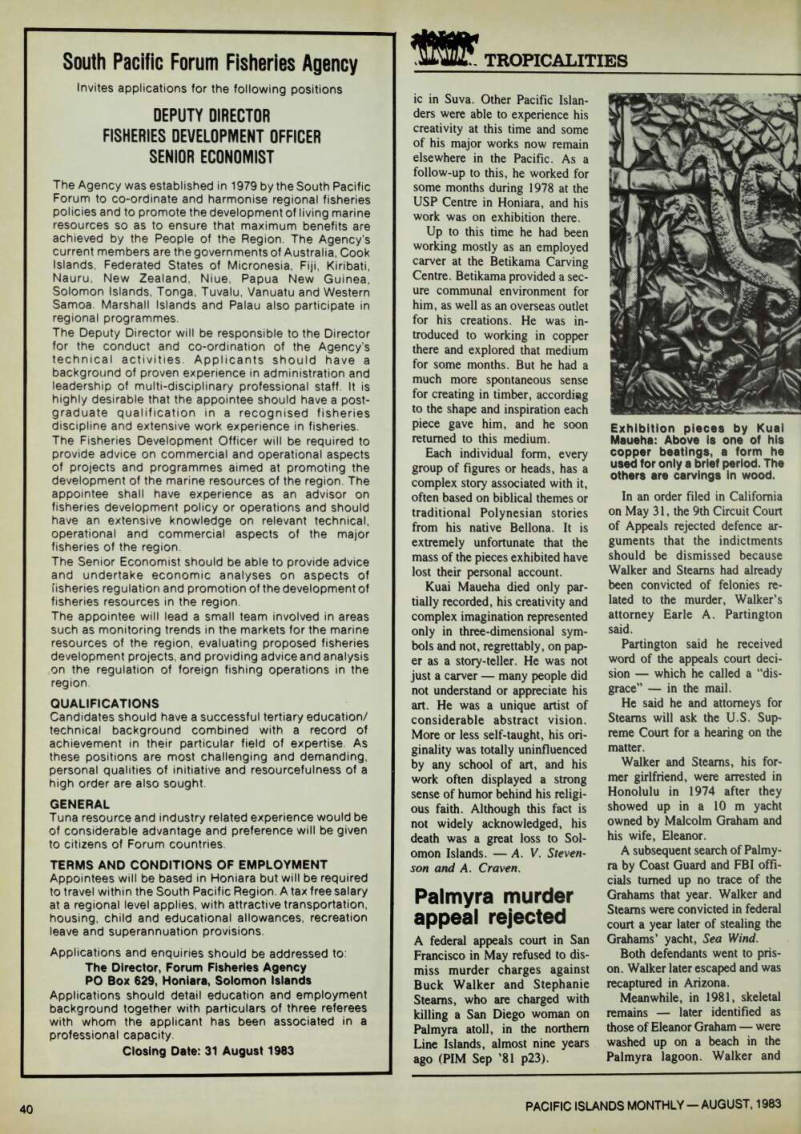
Exhibition pieces by Kuai Maueha: Above is one of his copper beatings, a form he used for only a brief period. The others are carvings in wood.
Steams were then indicted for her murder. No trace of her husband has ever been found.
In arguments before the appeals court in April, Steams’ attorney, Leonard Wineglass, ar gued that prosecuting her on the murder charge constituted “dou ble jeopardy” since she had al ready been convicted of theft.
Partington argued that even though Walker’s theft conviction was later thrown out because he was denied a speedy trial, his client could not be tried for mur der because the theft charge was a “lesser included offence” that is inherently part of the murder indictment.
Walker and Steams have al ways maintained that the Grahams drowned while fishing in the atoll’s lagoon. Walker remains in federal prison.
Steams now lives in California.
Raro’s golfing
hour of glory
The Rarotonga Golf Club has achieved fame (or notoriety?) be cause of the charms (or fiendish devilry?) of its well-kept nine hole course set among the masts, stays and anchor pads of the wireless aerial farm at Black Rock.
The club in June realised a long-cherished ambition when it acted as the first host club in the 1983 Pro-Am Golf Tournament Pacific Circuit.
A very full program was or ganised for the visiting profes sionals and amateurs and local players over the four days June 24-27.
A total of SNZ 10,000 in prize money was available in prizes for the professionals, and a wide range of prizes were there to be won by successful amateurs.
After competing at Rarotonga, visiting golfers had the choice of continuing to take part in the circuit by moving on to French Polynesia, American Samoa, Western Samoa, and Fiji.
Incidentally, course record holder at the time of the tourna ment was none other the Cook Islands Prime Minister Geoffrey Henry. His record figure was 64, for two rounds of nine holes.
Bill Coppell.
Democracy, or
Dem a’ crazy?
The deportation from Vanuatu earlier this year of Englishwoman Christine Coombe (PIM May pi 7, June pi 1), and the consequent closure of the small weekly paper known as Voice of Vanuatu, generated considerable heat.
While critics of the deporta tion have been given wide media coverage, the same cannot be said for those who strongly sup ported it.
One such person is Grace Mera Molisa whose verses on the
subject were printed in the last issue of Voice of Vanuatu. Ms Molisa has now requested PIM to
reproduce them. Slightly shor
tened for legal reasons, they ap pear below.
Freedom of the Press
is a shining jewel
in the crown of any Democracy.
What is Democracy? is it something to cherish?
Or is it Dem a’ crazy?
So-called “Democracy”
is wielded over our heads like a guillotine by a handful of corrupt and power-hungry, dissident, misfit, tools of multi-nationals distorting truth via stacking a biased paper.
Who is to say that the Australian, Fijian or any other brand of Democracy is any better than our Democracy?
Our own system of Consensus is more democratic than the dictatorship
of the vote against the minority.
What Freedom of Speech is there in Freedom of the Press when my individual and human rights are denied in the unbalanced and twisted information hawked by a one-sided Press?
The other side of the coin of Freedom is Responsiblity
and Dignity . . .
Our democracy bom of consensus is the outcome
of personal
conversation
confronting
consulting
and consolidating
a political position
by means of direct dialogue ensuring a balanced
insight
derived from equitably expressed views conductive
to complete understanding
and harmonious existence in a common community.
What right
has the dictatorship of an outsider,
Australia, Fiji,
or World Press to interfere in the internal politics of our sovereign state by aiding and abetting dissent and disorder
pre-empting
the decisions we on our own accord by Constitutional right and sovereign duty should freely make?
This paternalistic
and condescending
tenth-rate journalist
of capitalist media is here purely to tarnish and taint our original Thought
and Life-style
in the consumptive and acquisitive interests
of capitalist
economic expansion.
The hardest slap in the face for every Ni Vanuatu
and the entire Republic is the impudence of this person presuming to be our mouthpiece.
We Ni Vanuatu can run our own Independent
Newspaper
in the same way We attained political Independence and many other achievements since!
Knowing a bunch of school dropouts is no ground to claim Ni Vanuatu cannot write nor run newspapers.
Government prohibits and deports undesirable aliens in the same way Mother England
“Champion” America
antiquated France and riff raff Aussie do for security reasons except we are more humane patient and compassionate.
The law exists to provide for Newspapers as in any Democracy.
The first duty of Government is to its citizens as in any other country.
These are, the frank, personal opinions, of my authentic autochthonous Ni Vanuatu Self.
Ancient garden
under threat
Archeologists at the National Museum of Papua New Guinea are pushing to have an ancient
Western Highlands garden site,
which also contains a number of traditional buildings, declared a World Heritage area.
Environment writer for The
Sydney Morning Herald, Joseph
Glascott, reports:
One of the oldest gardens in the world, dating back 9000 years, and traditional buildings, including a cult house which no one can enter, are threatened in Papua New Guinea.
The garden has been dis covered by archeologists of the Australian National University in the Western Highlands of PNG near Mt Hagen.
The archeologists have un covered drainage and ditch lines which show that 9000 years ago Papua New Guineans were among the world’s first gardeners.
The difficult problems of pre serving such historic and natural wonders were explained to dele gates to the UNESCO Regional Conference on Historic Places at Sydney University in May.
Archeological work in Kuk Swamp in the Wahgi Valley has found that people were planting crops in the area as soon as it was warm enough after the close of the last Ice Age.
The only comparable finds have been made in Western Asia, Southeast Asia and Central America.
Miss Pamela Swadling, the Australian curator of prehistory at the National Museum of Papua New Guinea, said the garden was threatened by development of a tea plantation and cassava planta tion by the Government’s Prim ary Industry Department.
The museum wanted the gar den preserved.
“But the Papua New Guinea Government and its Primary In dustry Department do not have the funds or the interest to pre serve the area,” she said.
“The local people do not ap preciate the great historical sig nificance of the garden.
“We need people from other parts of the world to support us in having the garden declared a World Heritage area.”
Miss Swadling and Mr Theo dore Mawe, of the prehistory department of the museum, said the traditional buildings, espe cially the religious buildings, of Papua New Guinea, were in dan ger of being lost by neglect.
“The power of the old relig ions has declined with the in roads of Christianity,” Miss Swadling said.