“An extraordinary challenge to
p. 43 · Read in the full issue
Political Currents
New Caledonia
“An extraordinary challenge to human intelligence”
ALAIN ROLLAT, associate chief of the political service of the leading French daily Le Monde, was in New Caledonia earlier this year to cover the visit of GEORGES LEMOINE, France’s secretary of state for overseas departments and territories. The accompanying text is a translation of an article he wrote in the June issue of the Noumea-based French language monthly, 30 Jours.
The great merit of the speech delivered by the Secretary of State for Overseas Departments and Territories in Noumea on May 20 was that it faced the inhabitants of New Caledonia squarely with their responsibilities.
No metropolitan Frenchman, not even the president of the Republic himself, holds the key to the future of this beautiful South Pacific land. Mr Georges Lemoine was right in saying straight out: the future of New Caledonia will be what local Europeans and Kanaks make of it.
What will they make of it?
No fair-minded person of de mocratic, republican persuasion can: • Question the legitimacy of the nationalist aspirations of the Kanak community. It is a good thing that the broad French Left has a record of activity on issues of human rights and social justice in New Caledonia. French socie ty has debts to the Melanesian community which must be paid. • Ignore the rights of the Europeans who, by the whim of fate, were bom in New Caledonia, be they descendants of convicts, of deported activists of the 1870 Paris Commune, or of rebels from Algeria’s Kabylia.
French society has historic obli gations with regard to these people. • Ignore the legitimacy of the message emerging from every local election: so far there is simply no majority in New Caledonia in favor of independ ence for the territory. • Accept that, under cover of nationalism, the militant struggle for the emancipation of the Kanak community, pressed by extremist minorities, should one day end up substituting despot ism for justice. • Tolerate the humble condi
tions of life of Europeans “in the bush” being used as a political alibi by the front men of the local conservative Right who, for their part, happily and habitually sub stitute the spirit of jingoism for French national spirit. • Endorse the Kanak argu ment that the right to self determination should belong to Kanaks alone. In supporting such an argument, with its overtones of apartheid, the leaders of the independence movement are do ing no service to their cause. One cannot fight inequalities by in stituting new inequalities.
The New Caledonian question represents an extraordinary chal lenge to human intelligence.
May I, without prejudice, be permitted to make an observa tion. As one who has knocked
about this wretched planet of ours quite a bit, I believe there is a great danger of the New Caledonian population lapsing into a state of permanent contem plation of its own navel. Howev er formidable it may be, this New Caledonian question seems too often to be posed in terms which are in many respects out moded in these days of the end of the 20th century.
Here are communities who have lived together for more than a century on this small “pebble” of theirs, who have the opportun ity of achieving much together in this part of the world, and who
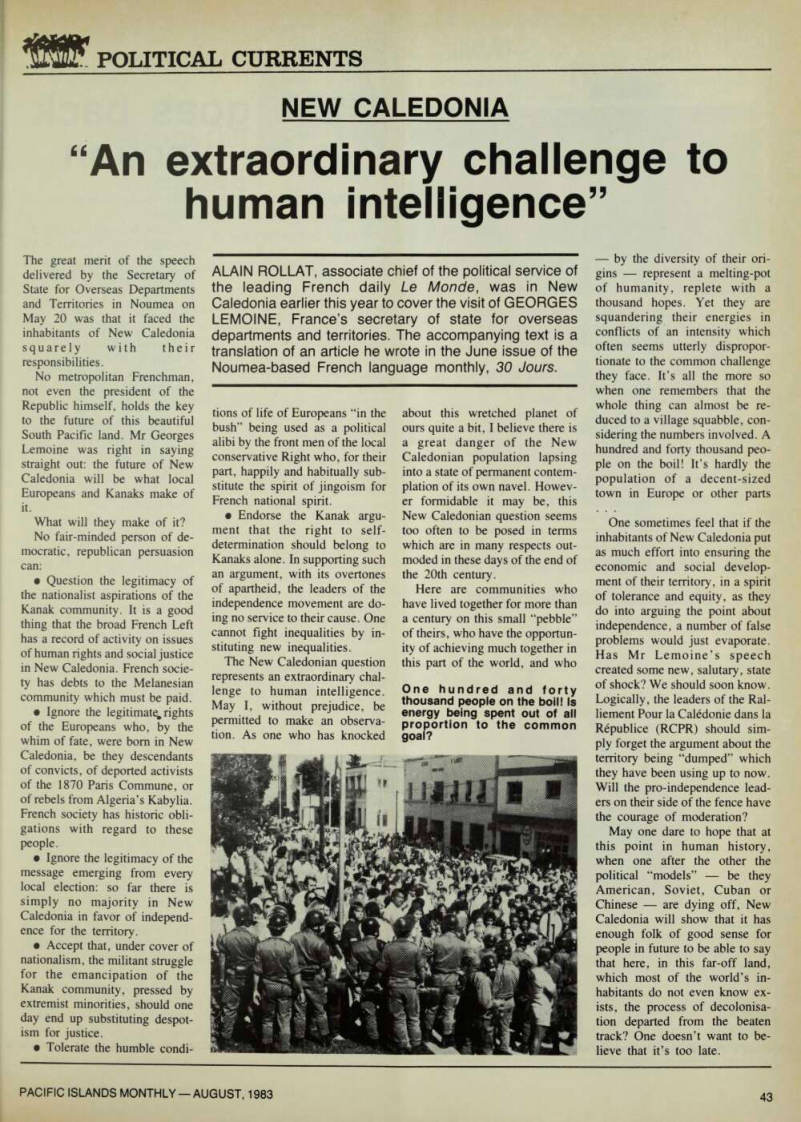
by the diversity of their ori gins represent a melting-pot of humanity, replete with a thousand hopes. Yet they are squandering their energies in conflicts of an intensity which often seems utterly dispropor tionate to the common challenge they face. It’s all the more so when one remembers that the whole thing can almost be re duced to a village squabble, con sidering the numbers involved. A hundred and forty thousand peo ple on the boil! It’s hardly the population of a decent-sized town in Europe or other parts One sometimes feel that if the inhabitants of New Caledonia put as much effort into ensuring the economic and social develop ment of their territory, in a spirit of tolerance and equity, as they do into arguing the point about independence, a number of false problems would just evaporate.
Has Mr Lemoine’s speech created some new, salutary, state of shock? We should soon know.
Logically, the leaders of the Ral liement Pour la Caledonie dans la Republice (RCPR) should sim ply forget the argument about the territory being “dumped” which they have been using up to now.
Will the pro-independence lead ers on their side of the fence have the courage of moderation?
May one dare to hope that at this point in human history, when one after the other the political “models” be they American, Soviet, Cuban or Chinese are dying off, New Caledonia will show that it has enough folk of good sense for people in future to be able to say that here, in this far-off land, which most of the world’s in habitants do not even know ex ists, the process of decolonisa tion departed from the beaten track? One doesn’t want to be lieve that it’s too late.
One hundred and forty thousand people on the boil! Is energy being spent out of all proportion to the common goal?