French Army Map
p. 35 · Read in the full issue
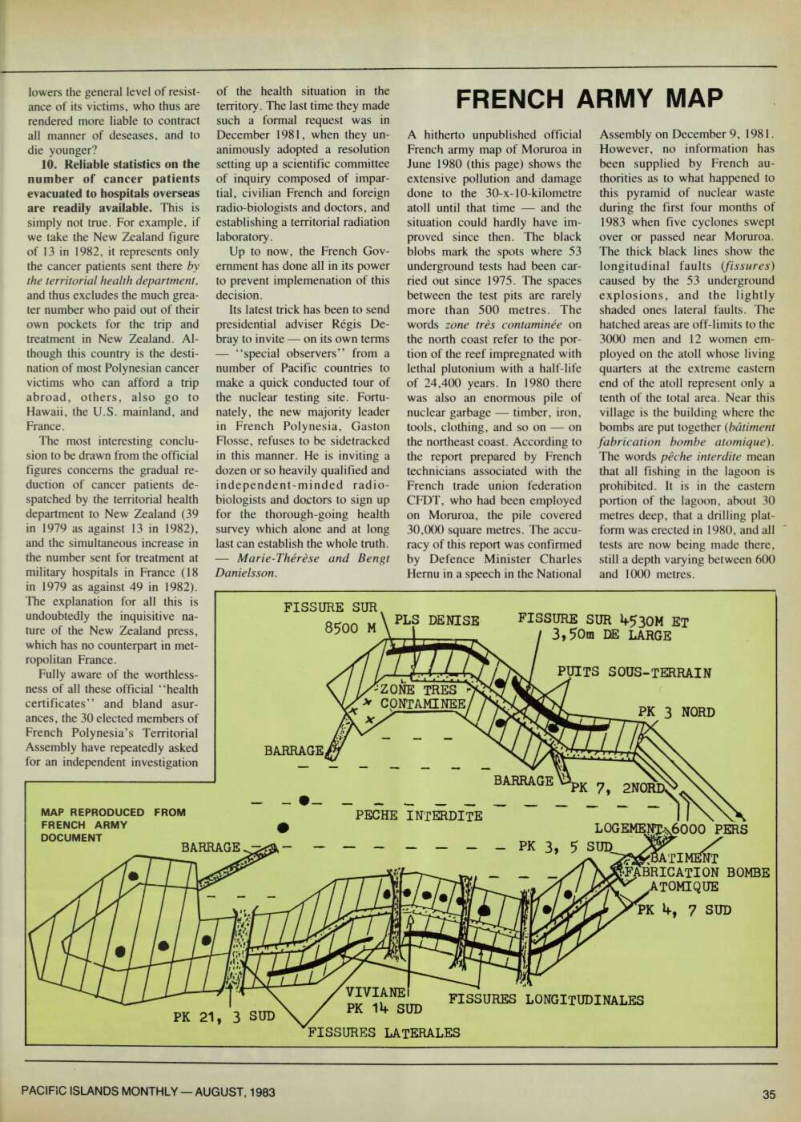
A hitherto unpublished official French army map of Moruroa in June 1980 (this page) shows the extensive pollution and damage done to the 30-x-10-kilometre atoll until that time and the situation could hardly have improved since then. The black blobs mark the spots where 53 underground tests had been carried out since 1975. The spaces between the test pits are rarely more than 500 metres. The words zone tres contaminee on the north coast refer to the portion of the reef impregnated with lethal plutonium with a half-life of 24,400 years. In 1980 there was also an enormous pile of nuclear garbage timber, iron, tools, clothing, and so on on the northeast coast. According to the report prepared by French technicians associated with the French trade union federation CFDT, who had been employed on Moruroa, the pile covered 30,000 square metres. The accuracy of this report was confirmed by Defence Minister Charles Hemu in a speech in the National
Assembly on December 9, 1981.
However, no information has been supplied by French au thorities as to what happened to this pyramid of nuclear waste during the first four months of 1983 when five cyclones swept over or passed near Moruroa.
The thick black lines show the
longitudinal faults (fissures )
caused by the 53 underground
explosions, and the lightly
shaded ones lateral faults. The hatched areas are off-limits to the 3000 men and 12 women em ployed on the atoll whose living quarters at the extreme eastern end of the atoll represent only a tenth of the total area. Near this village is the building where the bombs are put together ( bdtiment fabrication bombe atomique).
The words peche interdite mean that all fishing in the lagoon is prohibited. It is in the eastern portion of the lagoon, about 30
metres deep, that a drilling plat
form was erected in 1980, and all tests are now being made there, still a depth varying between 600 and 1000 metres.