Before the Paris
pp. 15-18 · Read in the full issue
The Month
Before the Paris ‘round table’
Twenty New Caledonian politic al leaders left Noumea in early July for discussions in Paris on a statute of internal autonomy. The French Secretary of State for Overseas Departments and Ter ritories, Georges Lemoine, had invited the Independence Front (IF), the Republican party (RPCR), the Centre party (FNSC), two representatives of the Great Council of Chiefs, and, at the last minute, a non-aligned member of the Territorial As sembly, Mme Marie-Paule Serve. The round table was to take place from July 8 to 13.
The Independence Front sent a delegation of five, all Union Caledonienne (UC) members of the assembly.
IF spokesman Nidoish Nas seline told a press conference at Tontouta airport that the five, who include UC leaders Eloi Machoro and Yeiwene Yeiwene, were taking part in the discus sions as representatives of the Kanak people, not as political party leaders. “We are not going to Paris to discuss things with the RPCR,” Mr Naisseline said.
“We are going as representa tives of the Kanak people in thier quest for independence. The IF will discuss autonomy, but only if it is a transition towards independence.
“But we’ll wait to see the final statute, to be voted by the French Parliament in October, and after that we’ll look at the consequences.”
Asked about the possibility of a “clash” between the IF delega tion and the French Government, Mr Yeiwene said: “It’s for the French Government to take the
responsibility if this happens. A clear timetable for independence must be given with this statute if not we won’t be in place at the table.”
The FNSC spokesman said his group were not very optimistic that much would come out of the discussions. “Both the IF and the RCPR have taken extreme positions,” said Christian Bois sery. “Being in the middle is a difficult role for us. We need to make suggestions which will be aceptable to all.”
“In any case,” he added.
“The FNSC members are going as men of goodwill. WeTe ready to make concessions, but always in the framework of the French Republic. We’re not going to Paris to talk about independence, but about the evolution of gov ernmental institutions. ’ ’
Speaking to the press before he left for Paris in late June,
Republican leader Jacques Laf
leur said: “My party hopes to see the rules of the democratic game respected. If we’re to avoid con frontations in New Caledonia, those in power must act accord ing to the rules.”
Referring to the RPCR de mand for fresh elections, Dick Ukeiwe said before his depar ture; “We in the RPCR prefer elections to be held before the application of a statute of auton omy. This is one means of re specting the rules of the democ ratic process.
“But we can’t make condi tions. We’re going to the round table as guests, and our position will be a function of what is served up to us.”
Although not invited to Paris,
Noumea Notebook Helen Fraser
two other groups have launched ideas on the autonomy question.
The anti-independence
Caledonia Front put out a pro position for a decentralised reg ional government, based on that recently decided by France for Corsica.
Their idea would create a reg ional assembly, with its president holding executive office. New Caledonians would control their own budget, but most powers would rest with France.
Caledonian Front leader Justin Guillemard would like the pro position to be put to a referen
dum, although he acknowledges
the chances are not high.
Mr Guillemard was also in the news recently when he wrote to Queen Elizabeth II protesting against the behaviour of Aust ralia’s Prime Minister Hawke
and Foreign Minister Hayden.
Referring to recent statements by the two men on New Caledonia, Mr Guillemard complained to Her Majesty about their “out rageous language, attitude and declarations”.
The lengthy letter describes Mr Hawke’s support for inde pendence as “supporting Marx ism and international Commun ism”. The Queen was also warn ed that the statements by the Australian Government were “detrimental to good and cordial relations between friends and neighbors”. The Caledonian Front also wrote to Mr Hawke in
early May.
The Caledonian Youth Party (AJC) also put up suggestions for a decentralised statute on the eve of the round table. The AJC was formed in 1979 and has several hundred members.
They want to see two elected
bodies in New Caledonia, one the Territorial Assembly, the other a Council of New Caledo nian Affairs, to be the local executive, with a president as its head. The AJC puts emphasis on freedom of commerical relations for such a decentralised territory, with the lifting of import quotas
being proposed.
The AJC contests the IF claim for recognition of the Kanak peo ple as the legitimate people of New Caledonia. “Why separate people who were bom and live
together in this territory, having
need of each other, and having together created the New Caledonia of today?” they ask.
They are “not against the Kanaks, but they are against Kanak socialist independence”.
New Caledonia now has her first-ever Kanak judge. Fote Trolue, 34, from Lifou Island,
has been installed as a magistrate in one of the lower courts. Mr Trolue was warmly welcomed as a magistrate in traditional cere monies by his colleagues and by the State Prosecutor, Mr Bilbao.
Mr Trolue completed his studies at the University of Montpellier in France. Helen Fraser.
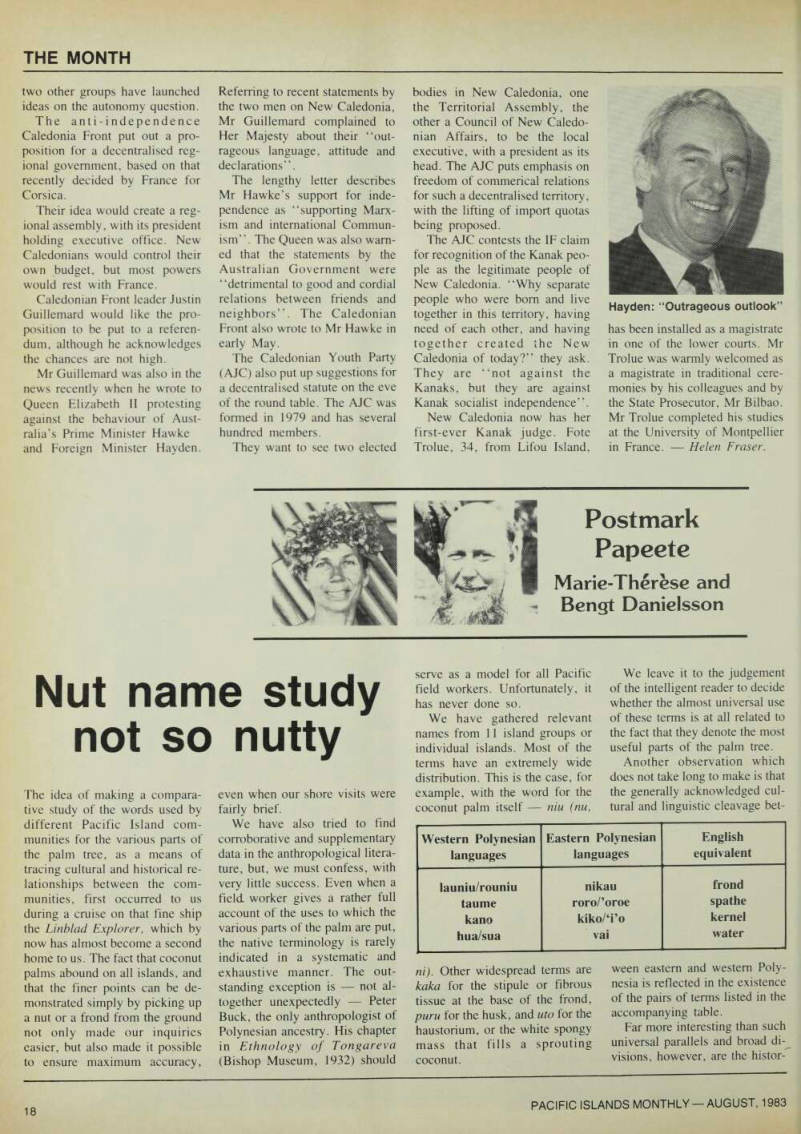
Hayden: “Outrageous outlook”