petitions in the Cooks
pp. 14-15 · Read in the full issue
Tangled tale of electoral petitions in the Cooks
Following the March 1983 general election in the Cook Islands, there were three elec
toral petitions. They were
heard by Chief Justice Sir Graham Speight, and the pro ceedings were conducted in a
predominantly low-ley man
ner, quite unlike the almighty row that followed the 1978 elections and the “fly-in” vo ters issue.
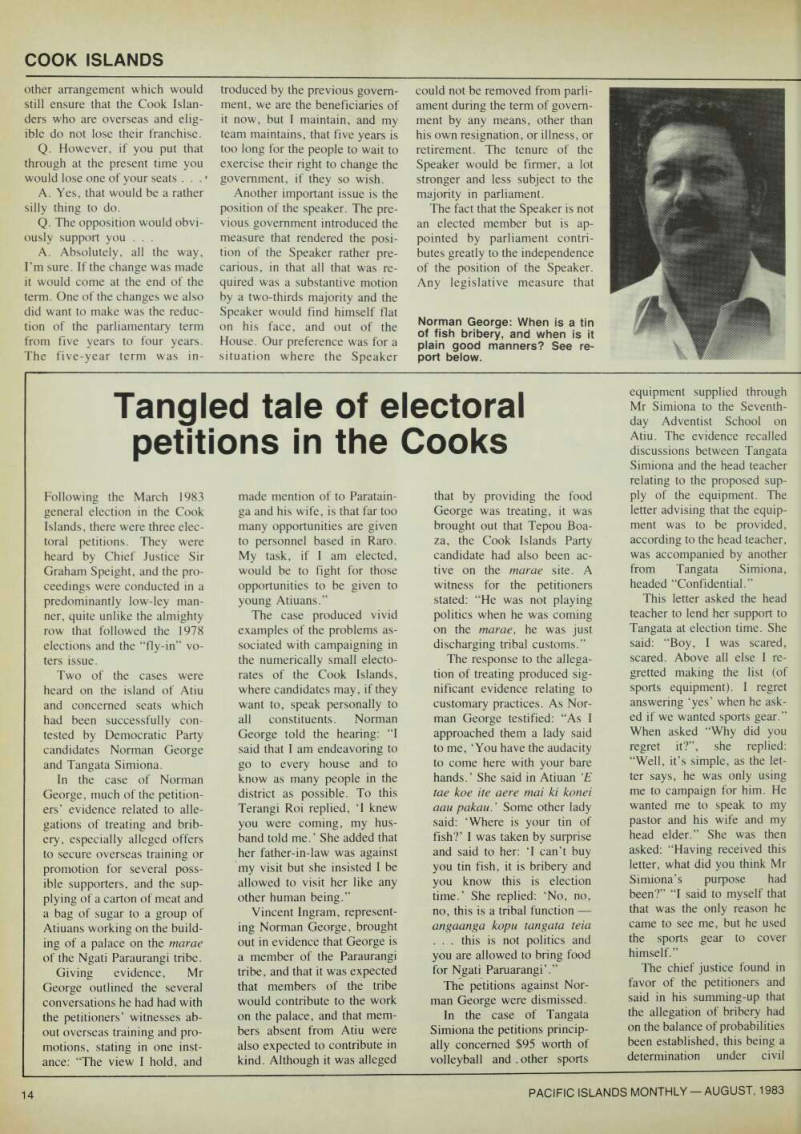
Two of the cases were heard on the island of Atiu and concerned seats which had been successfully con tested by Democratic Party candidates Norman George and Tangata Simiona.
In the case of Norman George, much of the petition ers’ evidence related to alle gations of treating and brib
ery, especially alleged offers
to secure overseas training or promotion for several poss ible supporters, and the sup plying of a carton of meat and a bag of sugar to a group of Atiuans working on the build ing of a palace on the marae of the Ngati Paraurangi tribe.
Giving evidence, Mr George outlined the several conversations he had had with the petitioners’ witnesses ab out overseas training and pro motions, stating in one inst ance; “The view I hold, and
made mention of to Paratain ga and his wife, is that far too
many opportunities are given
to personnel based in Raro.
My task, if I am elected, would be to fight for those opportunities to be given to young Atiuans.”
The case produced vivid examples of the problems as sociated with campaigning in the numerically small electo rates of the Cook Islands, where candidates may, if they want to, speak personally to all constituents. Norman George told the hearing: “I said that I am endeavoring to go to every house and to know as many people in the district as possible. To this Terangi Roi replied, T knew you were coming, my hus band told me. ’ She added that her father-in-law was against my visit but she insisted I be allowed to visit her like any other human being.”
Vincent Ingram, represent
ing Norman George, brought
out in evidence that George is a member of the Paraurangi tribe, and that it was expected that members of the tribe would contribute to the work on the palace, and that mem bers absent from Atiu were also expected to contribute in kind. Although it was alleged
that by providing the food George was treating, it was brought out that Tepou Boa za, the Cook Islands Party candidate had also been ac tive on the marae site. A witness for the petitioners stated: “He was not playing politics when he was coming on the marae, he was just discharging tribal customs.”
The response to the allega
tion of treating produced sig
nificant evidence relating to customary practices. As Nor man George testified: “As I approached them a lady said to me, ‘You have the audacity to come here with your bare hands.’ She said in Atiuan ‘E tae koe ite acre mai ki konei aau pakau. ’ Some other lady said: ‘Where is your tin of fish?’ I was taken by surprise and said to her: T can’t buy you tin fish, it is bribery and you know this is election time.’ She replied: ‘No, no, no, this is a tribal function angaanga kopu tangata teia . . . this is not politics and you are allowed to bring food
for Ngati Paruarangi’.”
The petitions against Nor
man George were dismissed.
In the case of Tangata
Simiona the petitions princip
ally concerned $95 worth of volleyball and .other sports
equipment supplied through
Mr Simiona to the Seventh day Adventist School on Atiu. The evidence recalled discussions between Tangata Simiona and the head teacher relating to the proposed sup ply of the equipment. The letter advising that the equip ment was to be provided, according to the head teacher,
was accompanied by another
from Tangata Simiona, headed “Confidential.”
This letter asked the head teacher to lend her support to Tangata at election time. She said: “Boy, I was scared, scared. Above all else I re gretted making the list (of sports equipment). I regret answering ‘yes’ when he ask ed if we wanted sports gear.”
When asked “Why did you regret it?”, she replied: “Well, it’s simple, as the let ter says, he was only using me to campaign for him. He wanted me to speak to my pastor and his wife and my head elder.” She was then asked: “Having received this letter, what did you think Mr Simiona’s purpose had been?” “I said to myself that that was the only reason he came to see me, but he used the sports gear to cover himself.”
The chief justice found in favor of the petitioners and said in his summing-up that the allegation of bribery had on the balance of probabilities been established, this being a determination under civil
law. The chief justice described Tangata Simiona’s actions as being an error of judgment. He declared the election result void.
The third electoral petition concerned the Rarotonga seat of Ruaau, which had been won by the Democratic party candidate Harry Napa by a majority of two votes after a judicial recount.
The petitioners alleged that Chief Electoral Officer, Andrew Turua had been responsible for irregularities in the manner in which postal votes were recorded and counted.
Much of the argument centred upon the appointment of a certain Miss Anderson as a deputy returning officer.
The chief justice dismissed this petition when he ruled that Miss Anderson’s appointment was valid and that the procedures earned out were in accordance with the Electoral Act.
There was a further allegation that Harry Napa had committed corrupt practices of treating before and during the election in that he personally or by other persons on his behalf gave foodstuffs to persons for the purpose of procuring his own election. No evidence was offered that Harry Napa had personally offered refreshments on election day and much of the argument related to the actions of people who may have been considered to have been acting as his agents. Food
was available for Democratic Party workers and supporters at the home of Alex Munro, a well-known member of the Democratic Party, and the chief justice found that none of the witnesses called by the petitioners had been induced to vote for Harry Napa by being offered food and drink, The petition was dismissed, Footnote: Reporters for the Cook Islands News, in com mon with their colleagues elsewhere, need to be wary in the terminology they use when reporting court cases, In its Saturday, May 21 edi tion, the paper reported that Tangata Simiona had been “found guilty of bribery” in respect of the general election contest for the Teenui- Mapumai seat on Atiu. As the paper pointed out in its retrac tion of May 25: “In law the expression ‘found guilty’ car ries with it the suggestion that criminal proceedings had been brought, resulting in that
finding.”
As reported above, the court had found that an alle gation of bribery against Mr Simiona had, on the balance of probabilities, been estab lished. The Cook Island News accordingly published an apology to Mr Simiona, “for using an expression which suggests he had been the sub ject of criminal proceedings, and regrets any embarrass ment that may have been caused to him.” W. G.
Coppell.