New PM describes the world as
pp. 9-15 · Read in the full issue


Cook Islands
New PM describes the world as seen from Rarotonga
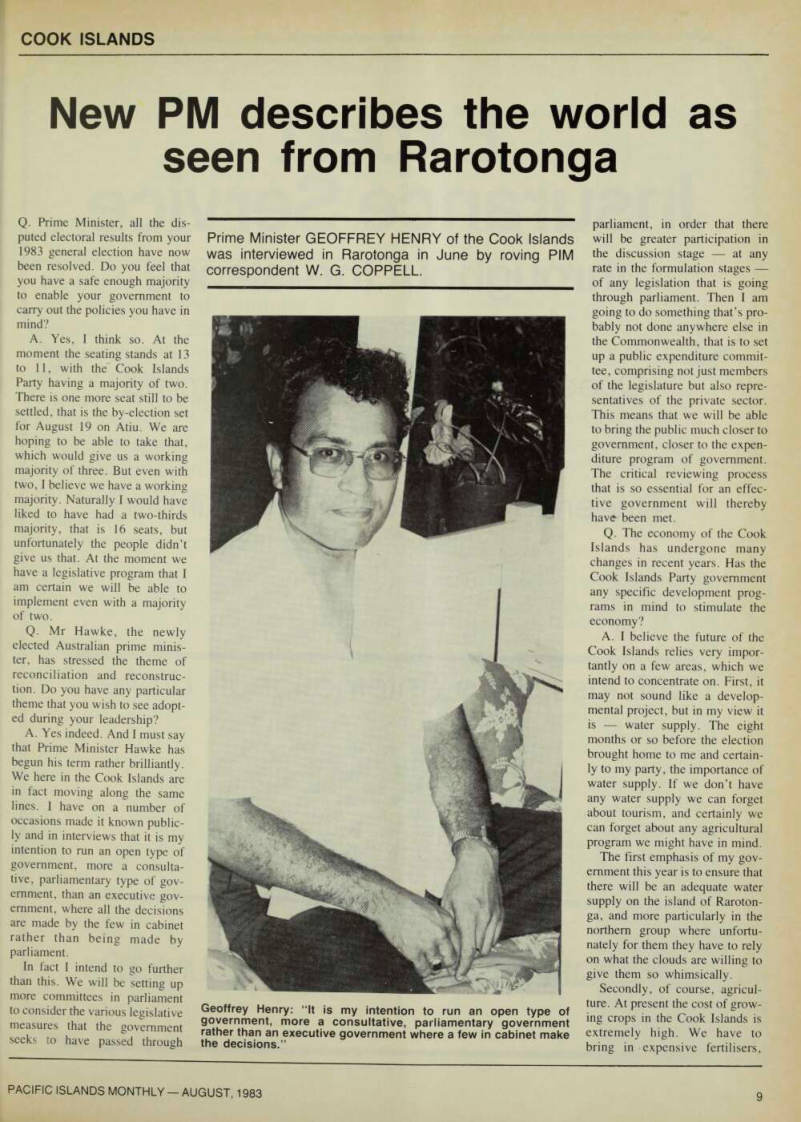
Prime Minister GEOFFREY HENRY of the Cook Islands was interviewed in Rarotonga in June by roving PIM correspondent W. G. COPPELL.
Q. Prime Minister, all the dis puted electoral results from your 1983 general election have now been resolved. Do you feel that you have a safe enough majority to enable your government to carry out the policies you have in mind?
A. Yes, I think so. At the moment the seating stands at 13 to 11, with the Cook Islands
Party having a majority of two.
There is one more seat still to be settled, that is the by-election set for August 19 on Atiu. We are hoping to be able to take that, which would give us a working majority of three. But even with two, I believe we have a working majority. Naturally I would have liked to have had a two-thirds majority, that is 16 seats, but
unfortunately the people didn’t
give us that. At the moment we have a legislative program that I am certain we will be able to implement even with a majority of two.
Q. Mr Hawke, the newly elected Australian prime minis ter, has stressed the theme of reconciliation and reconstruc tion. Do you have any particular theme that you wish to see adopt
ed during your leadership?
A. Yes indeed. And I must say that Prime Minister Hawke has begun his term rather brilliantly.
We here in the Cook Islands are in fact moving along the same lines. I have on a number of occasions made it known public ly and in interviews that it is my intention to run an open type of government, more a consulta tive, parliamentary type of gov ernment, than an executive gov ernment, where all the decisions are made by the few in cabinet rather than being made by parliament.
In fact I intend to go further than this. We will be setting up more committees in parliament to consider the various legislative measures that the government seeks to have passed through
parliament, in order that there will be greater participation in the discussion stage at any rate in the formulation stages of any legislation that is going through parliament. Then I am going to do something that’s pro bably not done anywhere else in the Commonwealth, that is to set up a public expenditure commit tee, comprising not just members of the legislature but also repre sentatives of the private sector.
This means that we will be able to bring the public much closer to government, closer to the expen diture program of government.
The critical reviewing process that is so essential for an effec tive government will thereby have been met.
Q. The economy of the Cook Islands has undergone many changes in recent years. Has the Cook Islands Party government any specific development prog rams in mind to stimulate the economy?
A. I believe the future of the Cook Islands relies very impor tantly on a few areas, which we intend to concentrate on. First, it may not sound like a develop mental project, but in my view it is water supply. The eight months or so before the election brought home to me and certain ly to my party, the importance of water supply. If we don’t have any water supply we can forget about tourism, and certainly we can forget about any agricultural program we might have in mind.
The first emphasis of my gov ernment this year is to ensure that there will be an adequate water supply on the island of Raroton ga, and more particularly in the northern group where unfortu nately for them they have to rely on what the clouds are willing to give them so whimsically.
Secondly, of course, agricul ture. At present the cost of grow ing crops in the Cook Islands is extremely high. We have to bring in expensive fertilisers,
Geoffrey Henry: “It is my intention to run an open type of government, more a consultative, parliamentary government rather than an executive government where a few in cabinet make the decisions.”
very expensive chemical sprays, and so forth. To give the growers a surcease we have decided to grant a two-year tax moratorium on all incomes earned by grow ers, and in this way we hope they will get an incentive. Added to this we have cut back the price of fertilisers by half to lower the
costs of crop-growing. Agricul
ture will continue to be an impor
‘l’d like to see our relations with New Zealand continue to develop ... At the same time I believe that the country is ripe to establish closer relations with other countries in the Pacific ... I would like to encourage a closer relationship with Australia, in particular, and with Papua New Guinea.’
rant thing for us. We are going to emphasise not only exports which are extremely important, but also growing food for the table, for eating, because this a major problem. To do this we have to make growing not a chore, growing must become a “fun” thing once more.
The third area which I believe is most important and at the moment it is the biggest money spinner for the Cook Islands is tourism. At present the number of tourists visiting the Cook Is lands is just under 22,000 a year.
In fact there was a slight drop of 3.8 per cent last year and I am concerned that on the figures given to me on the first quarter this year there’s been a drop of approximately 6 per cent com pared with last year. This bodes ill for us, so we have to do something about tourism. It is our policy to double the number of tourists coming into the coun try from 22,000 to approximately 44,000 which we believe we will be able to take with only a slight increase in the number of beds.
We can take that number quite comfortably without any major disruption, socially or culturally.
Lastly, there is the matter of our marine resources, probably, in the long term, the most impor tant area of all. We have estab lished a new Ministry of Marine resources divorced from the
Ministry of Agriculture. Its job is
to ensure that whatever is out there in that water, in the three million square kilometres of it, belongs to us. We’ve got to
know what is there, and how we can best use it for the benefit of the Cook Islands.
Q. The drift of population to New Zealand and elsewhere, in cluding Australia continues.
Perhaps it’s at a diminished rate just now, but it must be a matter of concern to your government that so many young and able people are continuing to leave the Cook Islands.
A. Yes, to an extent it is a matter of concern and you would probably find that the economists of today would regard it as a major problem. I’m not so con cerned, nor do I regard it as a major problem. Certainly we are losing some of our more industri ous people, they are travelling to overseas countries, looking for greener pastures. I know of no surefire way of stopping them from leaving the country, and in any case I’m not sure that I would want to stop them.
I’ll tell you why. Last year, for example, and at the beginning of this year, we’ve had groups of people travelling to New Zealand to raise funds for a variety of
community projects. One team
went and came back with
$60,000 after being in New Zea land for just 10 days. Another team went and came back in two weeks with $BB,OOO. A team from Mangaia went and came back with $BO,OOO. That’s a lot of money coming in over a short time, and it’s an amount of money which could not be found here in the Cook Islands, no matter how hard the people here worked to get it.
We really are in the business of the export of people. The fact that there are something like 20,000 Cook Islanders in New Zealand is good for us. For ex ample, every time a group of people go to New Zealand to raise funds, the 20,000 Cook Islanders there are putting up the money to send back home. On top of this come particularly the Christmas periods when a lot of money is remitted home by Cook Islanders. Anything up to $250,000 is coming at that time from Cook Islanders living over seas. In a sense I’m not worried about more Cook Islanders being in Australia. In fact I’m looking forward to that.
Q. Foreign investment is al ways a thorny question for the small Pacific Islands nations. Do you see the Cook Islands Gov ernment providing substantial in centives for the overseas investor to move capital into the Cooks?
A. Yes, indeed. In 1976 the Cook Islands Party government
passed the Development Incen
tives Act. Together with that there was prepared a code of development. The purpose of the Act was to provide incentive schemes to attract foreign capit al. Important concessions were made with regard to taxation levies and duties, as well as the guarantee of no competition for a period of, say, four to five years, or even more in some cases. We are looking forward to foreign capital becoming more involved in our economy, together with Cook Islanders as well.
Q. In the past there has been criticism of the Cook Islands Government on the grounds that there has been government con trol of the media, of the press and radio. Is government policy go
ing to change in this respect?
A. Well, we have an interest ing situation here. Apart from one privately owned FM radio
station that came into existence back in about 1977-78, the only national newspaper is produced by government and the radio station in the country is com
pletely funded by government.
In a sense government domi nation was almost unavoidable.
This year, in accordance with my party’s manifesto, we’ve decided that we shall give the private sector the opportunity of taking over control and ownership of the government-owned radio sta tion as well as the newspaper. In this way we hope the newspaper as well as the radio will be
completely controlled by the pri
vate sector and therefore from that point of view more critical of the work of government, con structive in their criticism, and more informative as far as the public is concerned.
Q. To return to tourism. It obviously continues to play a major role in the Cook Islands economy. Is your government going to have any stated policies about local equity in major tour
ist developments?
A. We are hopeful that the
developments that take place in that area would in the main be owned by Cook Islanders. But where it is clear that foreign capital is essential for the de velopment to take place, we have a minimum requirement of no less than 10 per cent equity, or
‘We are in the business of the export of people. The fact that there are something like 20,000 Cook Islanders in New Zealand is good for us. For example, every time a group of people go to New Zealand to raise funds, the 20,000 Cook Islanders there are putting up the money to send back home.’
one per cent of gross profit, would belong to a local entity.
Our hope is that, in contrast to some other places in the world.
Cook Islanders will benefit di rectly from any tourist activity that takes place.
Q. The Cook Islands have relied for many years on grants in-aid from New Zealand. Do you expect the rate of funding to be maintained or even increased?
A. I’m hoping that the donor countries would consider in creasing their aid. We’ve been lucky this year, our application for the grant-in-aid from the New Zealand Government has been met in full in fact with an increase of $50,000. We are looking to other countries for assistance in this area. I can’t help feeling that donor countries have to accept that a small coun try like mine, with a total land area of 240 square kilometres in the scattered situation that we have, there is no way, given our resources, that we can ever be
come completely independent. I
am hoping that donor countries would accept that as a fact.
Let us, allow us, the pleasure and the joy of pursuing a goal of economic independence, because that we have to chase anyway, to make life meaningful and worth while. It must be accepted, how
ever, that we can never attain it.
Q. When governments change in the Cook Islands and they
have only changed once really
there are questions about will there be any changes in relation ships between the Cook Islands and New Zealand. Does your
government see any substantial change or will the present rela tionships be kept on much as
they are?
A. We have enjoyed an ex
tremely sound working relation
ship with the New Zealand gov ernment. I guess it started off in the beginning as a sort of father child type of relationship. New Zealand was the country with the colony, and it was very much paternal. In 1965 we became kind of partners as it were. But since then the relationship bet ween the two countries has in deed matured considerably, to the point where New Zealand is
actively seeking acceptance
overseas of our state of
independence.
Our constitution leaves itself open to the interpretation that we might still be controlled by New Zealand, but that is not the case.
New Zealand is anxious that it is seen by the outside world that we have a perfect relationship bet
ween two sovereign independent
states. I’d like to see our rela tions with New Zealand continue to develop. We’ve enjoyed it very much and we don’t want to lose it.
At the same time I believe that the country is ripe to establish closer relations with other coun tries in the Pacific. We have a
very close relationship with Fiji, Western Samoa, Tonga, and so on. I would like to encourage a closer relationship with Aust ralia, in particular, and with Papua New Guinea.
Q. I was about to ask you about your government’s attitude to South Pacific regional ar rangements, such as the South Pacific Forum, the Forum Line, the South Pacific Commission all those regional activities?
A. We are firm believers in regional organisations. We are a founding member of the Forum, and a fully fledged member of the South Pacific Commission.
We have attained membership of the Pacific Islands Industrial De velopment Scheme and we are involved in a variety of other regional activities such as the Forum Line and the South Pacif ic Regional Civil Aviation Coun cil. I would like to see a situation where these organisations offer more of an opportunity for coun tries to get together and talk things out, rather than their be coming the channels of aid to the Pacific. I firmly believe that the
most useful way of giving aid to Pacific countries is through bila teral aid directly from govern ment to government, rather than
through costly intermediary
organisations.
Q. The Cook Islands constitu tion is framed in such a sway that it requires a two-thirds majority in parliament to bring about
changes. During the period of the
Democratic Party’s rule they did have a two-thirds majority and were able to make some very substantial changes to the con stitution. You don’t have that two-thirds majority. Are there any constitutional changes you would like to bring forward and hope that perhaps the opposition would give you support in the interests of the nation?
A. Yes, there are some. I must say that it is unfortunate for us that we didn’t get our two-thirds majority in order to ensure that our proposals for changes in the constitution could be put through. For example we are determined to alter the constitu tion to do away with the overseas seat and have it replaced by some
other arrangement which would still ensure that the Cook Islan ders who are overseas and elig ible do not lose their franchise.
Q. However, if you put that through at the present time you would lose one of your seats . . . ’
A. Yes, that would be a rather
silly thing to do.
Q. The opposition would obvi
ously support you . . .
A. Absolutely, all the way.
I’m sure. If the change was made it would come at the end of the term. One of the changes we also did want to make was the reduc tion of the parliamentary term from five years to four years.
The five-year term was in
troduced by the previous govern ment, we are the beneficiaries of it now, but I maintain, and my team maintains, that five years is too long for the people to wait to exercise their right to change the government, if they so wish.
Another important issue is the position of the speaker. The pre vious government introduced the measure that rendered the posi tion of the Speaker rather pre carious, in that all that was re quired was a substantive motion by a two-thirds majority and the Speaker would find himself flat on his face, and out of the House. Our preference was for a situation where the Speaker
could not be removed from parli ament during the term of govern ment by any means, other than his own resignation, or illness, or retirement. The tenure of the Speaker would be firmer, a lot stronger and less subject to the
majority in parliament.
The fact that the Speaker is not an elected member but is ap
pointed by parliament contri
butes greatly to the independence of the position of the Speaker.
Any legislative measure that
Norman George: When is a tin of fish bribery, and when is it plain good manners? See re port below.
jeopardises that particular aspect
of the situation should be re moved. I hope that the members of the opposition will assist us.
There is also a restriction on the time that Parliament can meet after the holding of a general election. Before, we had a re quirement that parliament had to meet within 90 days of the date of the election. But a change was introduced by the previous gov ernment requiring that parlia ment was not to meet until all electoral petitions about the elec tion had been determined by the High Court, sometimes these petitions can go on for a long time.
This year we were fortunate that there were only three peti tions considered by the High Court and all of them have now been disposed of. Parliament can now meet.
I do not think it is necessary for Parliament to wait until the High Court has done its business in relation to the election. It seems to me that the 90-day requirement is adequate to pro tect the interests of the country.
Q. In other words, you think that once the elections are over, government should be able to get on with its legislative business?
A. And get on with the task of running the country.