Margaret
pp. 7-8 · Read in the full issue
Letters
Margaret Mead and
Png
I read with the greatest interest Albert Wendt’s review of Profes sor Derek Freeman’s Margaret Mead and Samoa: The Making and Unmaking of an An thropological Myth. It is a relief that Professor Freeman, a non- Samoan, has been so accurate, Wendt (one of the “objects” studied and written about) ag rees, about what the real Samoa is all about. He should be, after all he studied the Samoans for some 40 years, as against Mead’s nine months. Yet, Mead is the myth around the world. Through Mead’s writings, real Samoa is,
unfortunately, portrayed wrong
ly. It is time her fame is chal lenged and questioned from all sides. Thanks to both Wendt and Freeman the record is now beginning to be put right.
Now that Mead’s credibility is being challenged, it is an oppor tune time for someone to do the same for her “fictitious” writ ings about my country, Papua New Guinea. Although I am not an anthropologist, I challenge the late Mead’s Growing Up In PNG, New Lives For Old: Cul tural Transformation Manus, 1928-1953, The Mountain Arap esh and Sex and Temperament in Three Primitive Societies.
What do foreigners, like Mead, know about our own peo ple, culture and ways of life? The ones qualified to write an thropological books about us are ourselves.
When I was PNG’s ambas sador to the USA in the 1970 s for five years, I travelled extensive
ly, addressing countless audi
ences about PNG. Most people have read something about the country. Mead’s books about PNG (and Samoa) have truly set her up as the “expert” on our
people.
The Americans view us as
primitive people practising free
love, etc. Rubbish. My view about the USA is that many of its citizens fit well into these categories. They, like other foreigners, should write about themselves and definitely not ab out us.
My family knew Mead very well. She was our friend but a very aggressive woman. She considered herself above others and that she was the authority on the Papua New Guinean (and Samoan) ways of life.
I argued with her on numerous occasions with a view to correct ing her numerous errors about PNG. She was never convinced.
I wish she were still alive to read Freeman’s book and Wendt’s review.
In 1978, PNG put on a major cultural exhibition at the Ameri can Museum of Natural History in New York. The former Gover nor-General, Sir Tore Lokoloko, was there to open the exhibition. A day before the opening. Mead sent me a copy of the speech she was going to deliver. She had not been invited to speak at the opening. I called her and said that she was not going to speak because I had planned for only two, the presi dent of the museum and the governor-general, to speak.
When she insisted, I said “no” but invited her to the opening.
She attended but did not speak.
A few weeks after her death, a U.S. senator asked me to speak at her church memorial service in Washington D.C. I declined be cause if I had spoken I would not have said anything good about her. I attended a packed church.
When I heard three speeches made about Mead’s good work among the “primitives” in PNG (and Samoa), and how she had put these two countries on the world map, I almost felt sick.
Before the service was over, I left the church, disgusted.
The people of PNG and Samoa have a lot of work to do to correct the damage Mead created about us internationally.
Freeman and Wendt have start ed. It is now Papua New Gui neans’ turn. Papua New Guinean academics: Wake up and start the ball rolling now. We’ve had enough.
Paulias N. Matane
(Secretary, Department of Foreign Affairs and Trade) Port Moresby, Papua New Guinea
From Hula to
Flamenco?
I was somewhat surprised that my simple plea for more accurate reporting of archeological con cerns in PIM (Feb. plO), excited such ire from Robert Langdon (PIM, May p 9).
The points raised by Mr Lang don perhaps require some riposte. One could for instance throw back into his court the “invidiousness” of his own pos ition at the Australian National University not being held by an Australian Aborigine or a Pacific Islander. By innuendo Mr Lang don sugests that a higher degree from the ANU isn’t worth very much. If he feels that way about that worthy institution, one won ders why he sought employment there in the first place.
The idea that the 18th-century Hawaiian masks were copied from Spanish helmets is indeed
ingenious, although one wonders about the other side of this “in terchange of ideas” referred to by Mr Langdon. Is Flamenco dancing perhaps influenced by Hawaiian hula? I await a letter from Erich von Daniken violent ly disagreeing with Mr Lang don’s interpretation. Surely it would be as logical to suggest that the Hawaiian masks were copies of spacemen’s helmets?
(Dr) Matthew Spriggs
University of Hawaii at Manoa Hawaii,
Usa
Explaining Palau’s
plebiscite
In regard to Mr Takeuchi’s “The super tangle that is Palau” (PIM, Apr. p 23), let me explain to PIM readers that the result of the plebiscite held in Palau in Feb ruary on the Compact of Free Association is not a fair indica tion of the Palauan people’s per ceptions of their future political status.
First of all, the compact is a very complex legal document which is very hard to com prehend without specialist legal interpretation. Secondly, there were no legal representatives in volved in the educational prog-
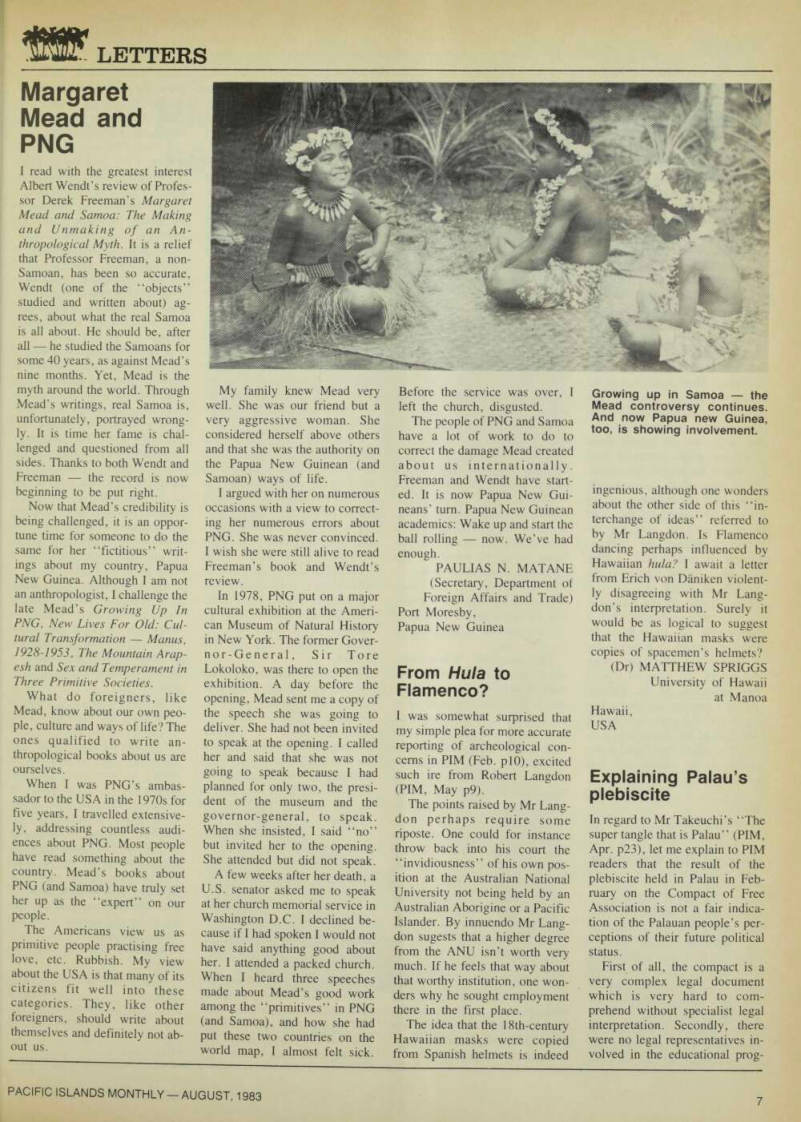
Growing up in Samoa - the Mead controversy continues.
And now Papua new Guinea, too, is showing involvement.
ram. Thirdly, the time allotted for the educational program was too short, given the complexity of the compact. This being the case, more than 75 per cent of the people who went to the polls in February were not able to read and understand the compact and its implications.
Unfortunately, the problems did not end there. The people selected to do the work of educating the voters included many individuals very prominent in the island. In the view of many, they were paid so gener ously for their work that they became active campaigners for the compact, rather than serious educators in the details of the compact. Their tactic was to in terpret parts of the compact which are favorable and benefi cial to Palau and the Palauans, but then tend to ignore those parts that might otherwise bind Palau and her people. This work ed so successfully, some people think, that the majority of the people who went to the polls were swayed to vote for the compact without the slightest idea of its real impact on them and their island nation in the foreseeable future.
The result of the plebiscite clearly demonstrates that a biased view was imposed on the Palauan people. It only created confusion and indecision among the voters. To interpret it as a true reflection of the Palauan people’s perceptions about their future political status would be in violation of the democratic prin ciples of which the United States claims to be strong and true advocate.
Vincent Ito.
Koror Republic of Belau
Behind the Coombe
affair (1)
Since Christine Coombe, your contributor to “The Month” sec tion (PIM, May pi 7), chose to write about me, my husband and our country in the manner that she had been doing in her own paper Voice of Vanuatu, I hereby beg some space in which to put my side of the story.
My objections to Christine Coombe’s style of journalism have nothing to do with my being
the wife of the minister of home affairs. Similarly, my involve ment in government dates from the Vanuaaku Party’s participa tion in government. My hus band, however, though a staunch and dedicated member of the Vanuaaku Party, and one-time commissioned special represen tative of the government, with ministerial rank, on the island of Santo during the rebellion, was appointed minister of home af fairs on February 1, 1983. Neith er he nor his position is respons ible for my opinions, nor am I nor my position responsible for his opinions.
The so-called “researched” and “investigated” information hawked by the Christine Coombe duet as it appears on page 18 of the May issue of PIM could all have easily been substantiated or denied by the mere picking up of a telephone. It is most disap pointing that otherwise good magazines like PIM and Islands Business have stooped to publish such garbage.
I have also read in the May PIM that Robert Keith-Reid, the political reporter for Fiji media, is involved in the writing up of a “Code of Ethics” for journalists in that country. I hope this means that in future people who make a living from relaying information will be ethical and act more responsibly in the exercise of their function, and be more courteous in their interaction with persons they hound for news (in order that they, the journalists, may make a living).
Journalists regularly prey on
Vanuatu. When they don’t get what they are after, they console
themselves by making spitefully
derogatory remarks about Vanuatu.
Despite whatever hallucina tions Christine Coombe may be hatching up in her head about Vanuatu becoming a police state, or certain of her collaborators being influential, may I point out that Vila is more peace-loving than many towns in the Pacific.
Our police are more gentle and our prisons offer a better life than any prison in cities in Australia, New Zealand, Fiji and many other countries of the Pacific and the world. A woman can go swimming alone on a lonely beach in Vanuatu and not be raped. The same cannot be said of many so-called developed countries.
Christine Coombe should thank her lucky stars that we have been extremely generous in allowing her all the freedom she enjoyed in our beautiful country for so long.
For your “The Month” sec tion of the magazine please get a ni-Vanuatu to write about Vanuatu, or at least get someone who knows something about Vanuatu to report from here.
Christine Coombe writing for Vanuatu is an insult to every citizen of Vanuatu wherever PIM is sold.
For the information of readers I would appreciate you also pub
lishing the following opinions,
the third section of which be came the “letter” to Crhistine Coombe. It was written because she personally was going around soliciting ni-Vanuatu support for her stay. My letter appeared in the last issue of her Voice of Vanuatu.
Grace Molisa
Port-Vila Vanuatu • See also “Tropicalities”
Behind the Coombe
affair (2)
I read with keen interest the March, April and May issues of PIM. Christine Coombe did quite well in putting the record straight over the deportation issue. She was deported from Vanuatu be
cause she published material ab out the government in “her own paper Voice of Vanuatu” in somebody else’s country.
I think Christine Coombe is making a big deal out of this.
Firstly too much attention is given to her. The “inside story” (May) stretched the situation to the extent of having “a truck convoy ... to block the air field” if the readers of Voice of Vanuatu knew when she was leaving. Vanuatu’s constitution maintains freedom of expression, but commonsense requires that this freedom be treated with respect.
It is no surprise that a number of influential personalities in Vanuatu political circles voiced their concern about her deporta tion. The deportation order coin cided with the first parliamentary sitting for 1983. The individuals mentioned were expecting the Prime Minister, Walter Lini, to be toppled from his seat. A vote of no-confidence in the prime minister was soon to be tabled in parliament. Who amongst the politicians would not have grasp ed this opportunity to square a score with the PM?
While freedom of the press may appear to have been at stake, Coombe made herself vul nerable in allowing the politi cians, in their bid to topple the government, take her issue as a front to attack Walter Lini
personally.
Readers of Voice of Vanuatu shouldn’t be agitated about Coombe’s deportation. That’s not the end of a free press. We don’t need her in Vanuatu to ensure a free press and free speech for us. If, in fact, the Voice of Vanuatu had always been the “opinion of ni- Vanuatu” (Islands Business, Ap ril ’B3), we can handle our opin ions ourselves, the way we want to. There’s no reason why Allan Andrews and Simeon Roberts, with their experience in publish ing Voice of Vanuatu, to sit and mourn her departure. Let’s be independent. Produce our own
paper!
Barry S. Ilaisa
(ni-Vanuatu) University of the South Pacific Suva Fiji
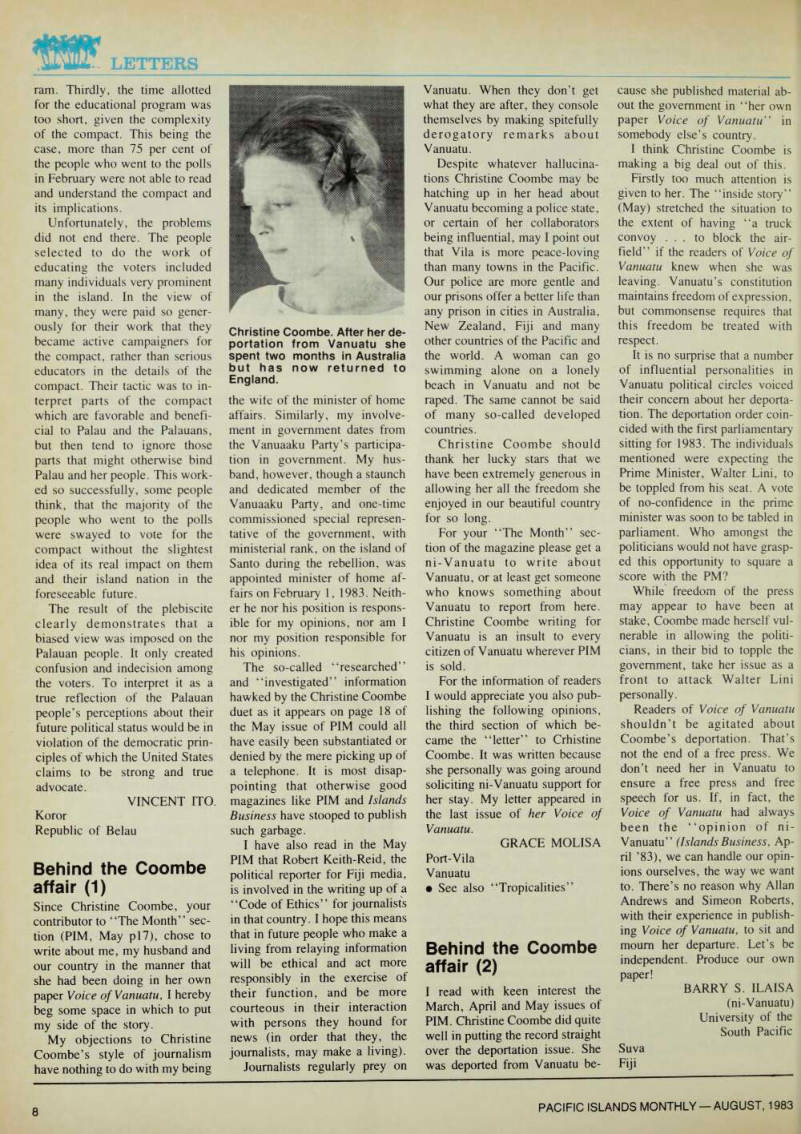
Christine Coombe. After her de portation from Vanuatu she spent two months in Australia but has now returned to
England.