when nature goes mad
pp. 49-50 · Read in the full issue
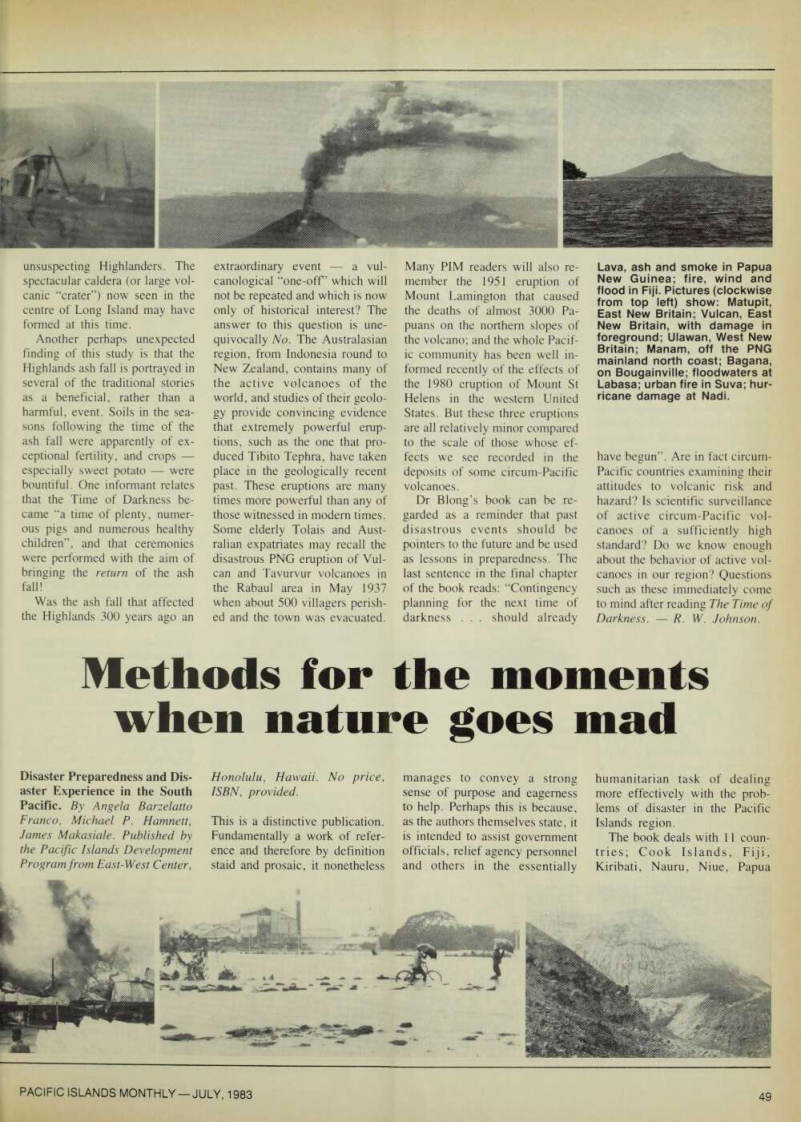
Methods for the moments when nature goes mad
Disaster Preparedness and Dis aster Experience in the South Pacific. By Angela Barzelatto Franco, Michael P. Hamnett, James Makasiale. Published by the Pacific Islands Development Program from East-West Center,
Honolulu, Hawaii. No price, ISBN, provided.
This is a distinctive publication.
Fundamentally a work of refer ence and therefore by definition staid and prosaic, it nonetheless
manages to convey a strong sense of purpose and eagerness to help. Perhaps this is because, as the authors themselves state, it is intended to assist government officials, relief agency personnel and others in the essentially
humanitarian task of dealing more effectively with the prob lems of disaster in the Pacific Islands region.
The book deals with 11 coun tries; Cook Islands, Fiji, Kiribati, Nauru, Niue, Papua
New Guinea, Solomon Islands, Tonga, Tuvalu, Vanuatu and Western Samoa. It consists of a regional overview, plus three profiles of each of the countries: a country profile, a disaster ex perience profile, and a disaster preparedness profile. Some use ful though necessarily limited case studies of natural disasters are also included. A prominent feature of the publication is the excellence and clarity of its many maps. These are invaluable, par ticularly to the specialist reader.
As the authors readily con cede, any document of this na ture, aiming as it does to provide current information across a very broad spectrum, inevitably be comes quickly out of date. How ever, as submitted later in this review, this shortcoming can to some extent be controlled. In any case, a considerable proportion of the statistical and other infor mation will remain valid in the much longer term.
As to detailed contents them selves, the regional overview comprises a commendable effort to present in succinct and read able form adequate information on subjects which are, by their very nature, complex and di verse. These include the nature of Pacific societies, regional economies, disaster threats and effects, some broad comment on disaster preparedness and a ma jor segment on problems and prospects.
As a general observation, it might have been more effective in terms of format not to segre gate disaster preparedness on the one hand from problems and prospects on the other. A smoother run through past, cur rent and desirable future aspects could have produced stronger identification and emphasis of requirements for the years which lie ahead. However, this com ment in no way detracts from the value of the regional overview.
The way in which the latter quite rightly highlights important facets of planning, mitigation, warning, emergency manage ment, relief aspects and so on, constitutes eminently useful re ference material and comment for those directly concerned with the disaster affairs of the region.
It is when it comes to regional
co-operation that the overview finds some difficulty in propos ing a clear overall strategy; and perhaps, in a way, this helps to underscore the realism and there fore the value of the publication as a whole. Much recent experi ence in the region, including a
Disaster Preparedness Strategies
Seminar held in March 1983, tends to indicate that a selective rather than a blanket approach to disaster preparedness and re
sponse is generally preferable.
This is not to say that the region al countries should not and will not seek to work together on major matters of mutual concern in the disaster field. What it does suggest is that, for a variety of reasons and differences, national programs supported by bilateral assistance and support arrange ments in most cases offer the best prospects for offsetting and re covering from disaster events.
It is, of course, in its country profile material that the publica tion runs its greatest risk of inac curacy through outdating. To be otherwise in areas so diverse as government expenditure, cash crop agriculture, medical
facilities and port capacities would border on the miraculous.
In its other profiles, covering disaster experience and disaster preparedness, the problem of outdating is not so marked; though clearly these, as with all other aspects, must be periodic ally reviewed if the whole docu ment is to maintain its viability and usefulness. It is in this con nection that the loose-leaf format used by the publishers is emi nently sensible. The question
then remains of how, in practical terms, to keep the document cur rent. Here, a possibility might be to place a collation responsibility with the proposed disaster pre paredness staff officer shortly, it is understood, to be established in SPEC (the South Pacific Bureau for Economic Co operation), whilst leaving the publication responsibility with the originators, East-West Center.
One further major point is worthy of mention. It concerns the general ambience in which this publication is likely to be used. Counter-disaster effec tiveness in the South Pacific is a many-sided affair and it has now reached a stage where, in many cases, firm and positive prog rams are needed if, in the future, governments and communities alike are to deal satisfactorily with their disaster problems. As a distinguished and very ex perienced government minister, Dr S. Langi Kavaliku of Tonga, recently said: “The time has come for concrete actions, par ticularly concerning national is sues, the role of regional and
international organisations, and joint ventures between countries for coping with disasters. In the final analysis, each country must present and develop its own case with respect to its needs and resources”.
There seems little doubt, therefore, that many planning, organisational, training and other activities will be put in train during the coming years. The publication under review has a very real place in such activities.
The authors are to be con gratulated on the end-product of what has clearly been a long, painstaking and complicated
undertaking. They would un doubtedly wish this review to acknowledge the effort and con tribution made by all those who helped to research and collate the mass of detailed information which had to be considered be fore the final shape of this publi cation could be determined.
W. Nick Carter.
* Air Vice-Marshal Carter is an international disaster consultant who from 1969-78 was director of the Australian Counter Disas
ter College.
Books received
The Winds of Change: Norfolk Island 1950-1982. By Merval Hoare. Published 1983 by Institute of Pacific Studies, Un iversity of the South Pacific, Box 1168, Suva, Fiji. No ISBN, no price given.
The Birds and Birdlore of Samoa. By Corey and Shirley Muse. Published May 1983 by University of Washington Press, Seattle, Washington 98105. ISBN 0 295 95983 5. Price SUS 15.00.
The Language of Easter Island: Its Development and Eastern Polynesian Relationships. By Robert Langdon and Darrell Tryon. Published 1983 by the Institute for Polynesian Studies, Brigham Young University, Hawaii Campus, Laie, Hawaii 96762. ISBN 0 939154 32 2. No price given.
Solomon Islands Trade Directory 1983 and Republic of Vanuatu Trade Direc tory 1983. Published by B. J. S. Agencies Ltd, PO Box 439, Honiara, Solomon Islands. No ISBN. Copies are free of charge.
The Resolution Journal of Johann Reinhold Forster 1772-1775, Volumes l- IV. Edited by Michael E. Hoare. Publish ed 1982 by the Hakluyt Society, c/o the Map Room, British Library Reference Division, London WCIB 3DG. ISBN 0 904180 10 7. Price £4O sterling for the set of four volumes.
Bushwalking in Papua New Guinea. By Riall W. Nolan. Published 1983 by Lonely Planet Publications, PO. Box 88, South Yarra, 3141, Australia. ISBN 0 908086 41 5. Price $A6.95.
Micronationalist movements in Papua New Guinea. By R. J. May. Published 1982 by The Australian National Universi ty, PO Box 4, Canberra, ACT 2600. ISBN 0 908160 27 5. No price given.
Fijian Artefacts: Tasmanian Museum and Art Gallery Collection. By Rod Ewins. Published 1982 by Tasmanian Museum and Art Gallery, GPO Box 1164 M, Hobart, Tasmania 7001. ISBN 0 7246 1099 5. Price $A14.90.
Pacific Constitutions. Edited by Peter Sack. Published 1982 by Research School of Social Sciences, Australian National University, PO Box 4, Canberra. ISBN 0 86784 164 8. No price given.
Pacific Profiles: Personal Experiences of 100 South Pacific Islanders. Edited by Robert A. C. Stewart. Published 1982 by University of the South Pacific, PO Box 1168, Suva, Fiji. No price or ISBN num ber given.
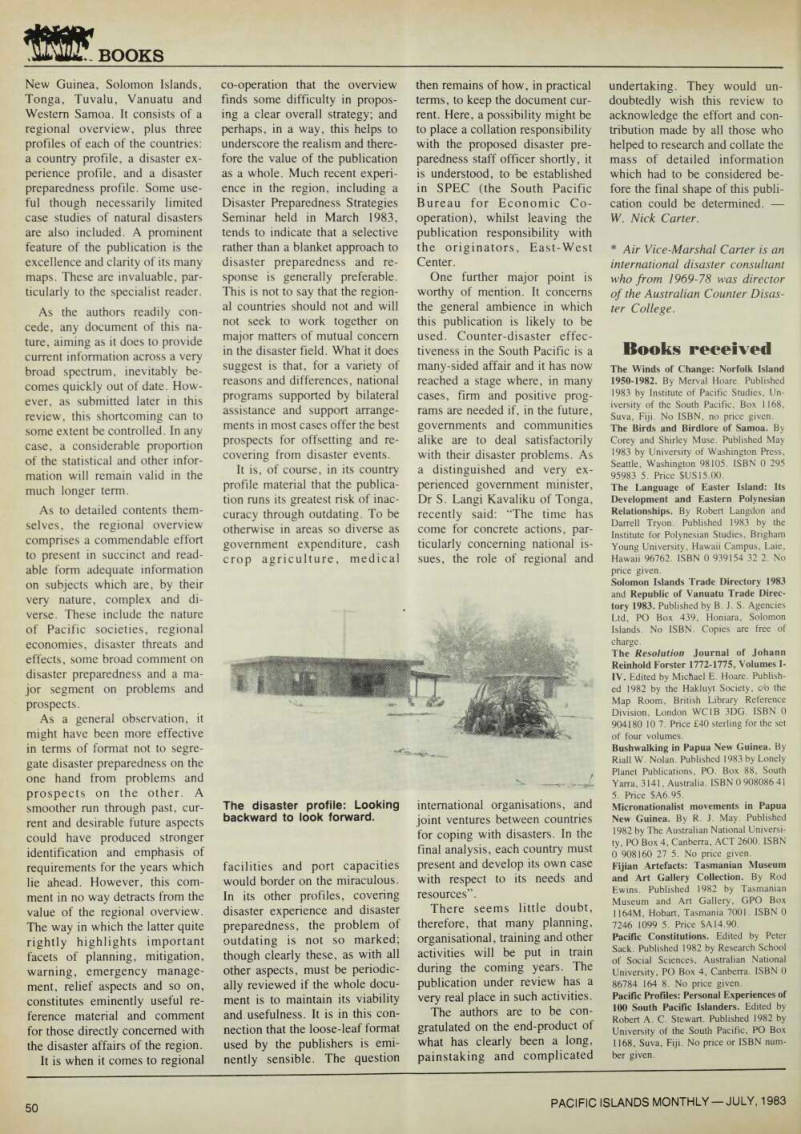
The disaster profile: Looking backward to look forward.