again . . .
pp. 47-49 · Read in the full issue
Books
A ‘time of darkness ' that could well come again . . .
The Time of Darkness: Local Legends and Volcanic Reality in Papua New Guinea. By R. J.
Blong. Published 1982 by the Australian National University Press, Canberra, and the Un iversity of Washington Press, Seattle, USA. ISBN 0 7081 1096 7. Price $A23.95.
Touring through the mountain ous Highlands region of Papua
New Guinea in bright clear weather is a memorable experi ence in which the eye is attracted by lofty forest-clad peaks, by the vivid colors of the region’s uni que birds, plants, and butterflies, and by the exotic traditional cos tumes of the Highlands people.
Few spellbound tourists travel ling by road would have much occasion to cast more than a glance at the dull layers of vol
canic ash that are exposed in roadcuts throughout the High lands, but one of these layers which Australian scientist Rus sell Blong has called Tibito Tephra (tephra is the name used by geologists for a layer of vol canic ash) provides evidence that as recently as about 300 years ago the majestic face of the Highlands was ruined by a heavy rain of ash particles.
The sun was blotted out for days, and the Highlanders of the time must have suffered starva tion, deprivation, and death as crops were destroyed, streams and pools were polluted, houses collapsed, and edible bush mar supials and pigs perished in the ashes.
Stories of this “time of dark ness” in one form or another have been passed down from one generation to the next, and many of them tell of fearful days when the lush green of one of the most beautiful places in the Pacific was mantled by a deathly pall,
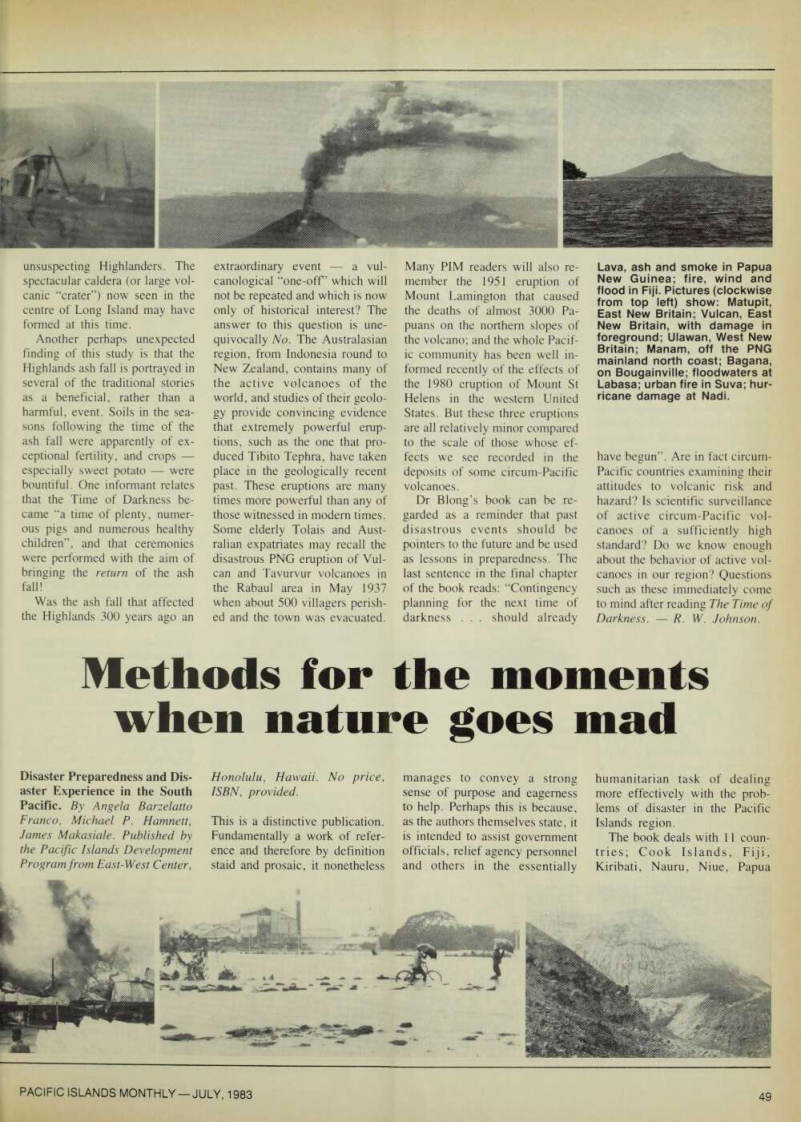
Eruption on Kar Kar Island off the north coast of the Papua New Guinea mainland. Pic
ture
by Brian Mennis.
Two books on major disasters: Dissecting the past and protecting the future
when psychological stress even terror must have reigned as the fine volcanic ash fell to depths of several centimetres,
abruptly interrupting the seasonal
pattern of life.
Dr Blong, a lecturer in geomorphology at Macquarie University in Sydney, has col lected together and made a spe cial investigation of the stories of the Time of Darkness (what bet ter title for the book). He dis tributed a questionnaire to many centres in the Highlands and so acquired from almost 100 infor mants (mainly social an thropologists and staff of the Summer School of Linguistics) data which they in turn obtained
by questioning people in their
respective areas of interest. Dr Blong then combined these re sponses with previously docu mented stories of the Time of Darkness and with his own geological observations and in terpretations of the ash layer, and assessed all of this information with reference to what is known about the effects of volcanic ash falls elsewhere in the world. His book is a fine piece of scientific
detective work, drawing together
the results of several years of research and creating for us a vivid picture of what the ash fall must have been like and what its effects must have been.
Dr Blong has written his book in mainly non-technical lan guage, and the Australian Na
tional University Press has main tained the high standard of pre sentation that it normally accords to books on the Pacific. Some chapter headings are not espe cially informative and the con tents list does not include chapter sub-headings, which means the task of re-locating particular sec tions of interest is hindered somewhat; a few photographs would also have enhanced the text. However, these are minor criticisms of a book that can be
strongly recommended, not just
to oral historians and vulcanolog ists, but to the non-specialist interested in the cultural and natural history of PNG.
The book contains some unex pected conclusions. For exam ple, the ash of Tibito Tephra probably did not originate from one of the geologically youthful volcanoes in the Highlands reg ion (many Highlands peaks are volcanoes the Hagen Range, for example, near the town of the same name, consists of three extinct volcanic centres). Rather, Dr Blong believes the ash came from Long Island volcano in the Bismarck Sea about 150 kilometres east of Madang, off the north coast of New Guinea.
A vast eruption cloud was form ed that may have risen as high as 30 kilometres. This cloud was
caught by high-altitude easterly
winds that drove the ash plume westwards across New Guinea dumping its uninvited load on the
unsuspecting Highlanders. The
spectacular caldera (or large vol canic “crater”) now seen in the centre of Long Island may have formed at this time.
Another perhaps unexpected finding of this study is that the Highlands ash fall is portrayed in several of the traditional stories as a beneficial, rather than a harmful, event. Soils in the sea sons following the time of the ash fall were apparently of ex
ceptional fertility, and crops
especially sweet potato were bountiful. One informant relates that the Time of Darkness be came “a time of plenty, numer ous pigs and numerous healthy children”, and that ceremonies were performed with the aim of bringing the return of the ash fall!
Was the ash fall that affected the Highlands 300 years ago an
extraordinary event a vul canological “one-off’ which will not be repeated and which is now only of historical interest? The answer to this question is une quivocally No. The Australasian region, from Indonesia round to New Zealand, contains many of the active volcanoes of the world, and studies of their geolo
gy provide convincing evidence
that extremely powerful erup
tions, such as the one that pro duced Tibito Tephra, have taken place in the geologically recent past. These eruptions are many times more powerful than any of those witnessed in modem times.
Some elderly Tolais and Aust ralian expatriates may recall the disastrous PNG eruption of Vul can and Tavurvur volcanoes in the Rabaul area in May 1937 when about 500 villagers perish ed and the town was evacuated.
Many PIM readers will also re member the 1951 eruption of Mount Lamington that caused the deaths of almost 3000 Pa puans on the northern slopes of the volcano; and the whole Pacif ic community has been well in formed recently of the effects of the 1980 eruption of Mount St Helens in the western United States. But these three eruptions are all relatively minor compared to the scale of those whose ef fects we see recorded in the deposits of some circum-Pacific volcanoes.
Dr Blong’s book can be re garded as a reminder that past disastrous events should be pointers to the future and be used as lessons in preparedness. The last sentence in the final chapter of the book reads: “Contingency planning for the next time of darkness . . . should already
have begun”. Are in fact circum- Pacific countries examining their attitudes to volcanic risk and hazard? Is scientific surveillance of active circum-Pacific vol canoes of a sufficiently high standard? Do we know enough about the behavior of active vol canoes in our region? Questions such as these immediately come to mind after reading The Time of
Darkness.
R. W. Johnson.
Lava, ash and smoke in Papua New Guinea; fire, wind and flood in Fiji. Pictures (clockwise from top left) show: Matupit, East New Britain; Vulcan, East New Britain, with damage in foreground; Ulawan, West New Britain; Manam, off the PNG mainland north coast; Bagana, on Bougainville; floodwaters at Labasa; urban fire in Suva; hur ricane damage at Nadi.