People
pp. 43-45 · Read in the full issue
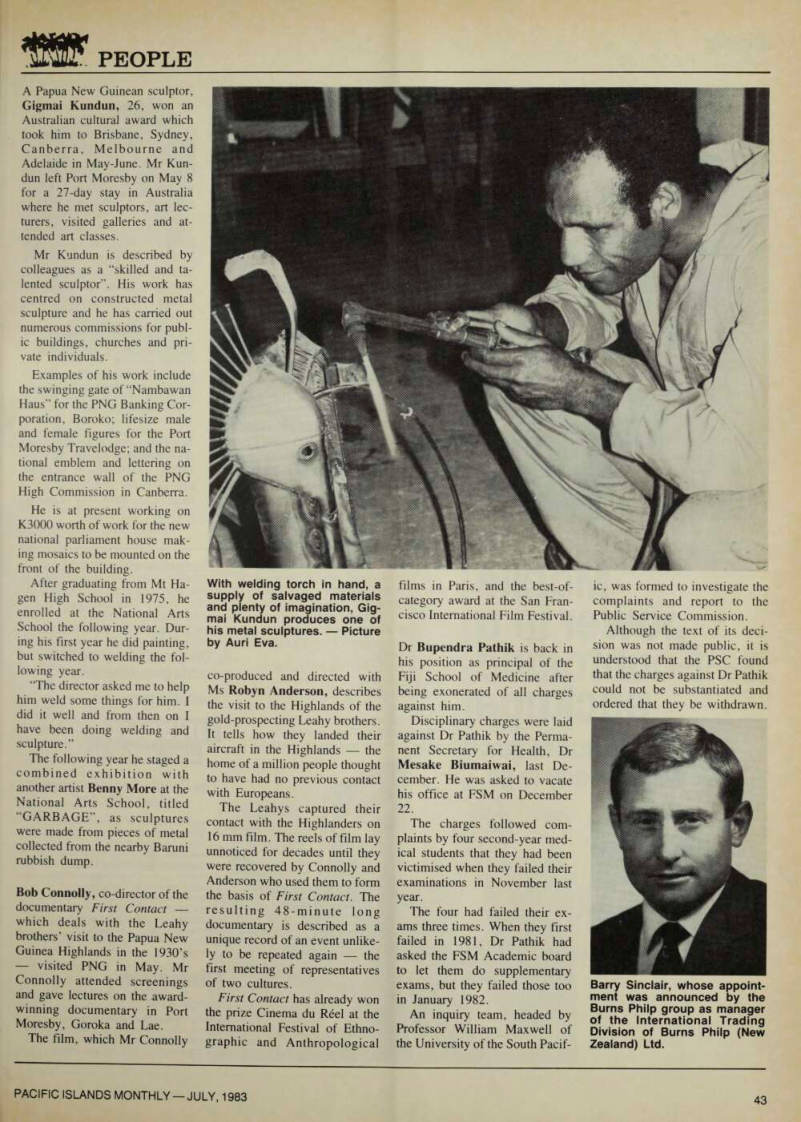

A Papua New Guinean sculptor, Gigmai Kundun, 26, won an Australian cultural award which took him to Brisbane, Sydney, Canberra, Melbourne and Adelaide in May-June. Mr Kun dun left Port Moresby on May 8 for a 27-day stay in Australia where he met sculptors, art lec turers, visited galleries and at tended art classes.
Mr Kundun is described by colleagues as a “skilled and ta lented sculptor”. His work has centred on constructed metal sculpture and he has carried out numerous commissions for publ ic buildings, churches and pri vate individuals.
Examples of his work include the swinging gate of “Nambawan Haus” for the PNG Banking Cor poration, Boroko; lifesize male and female figures for the Port Moresby Travelodge; and the na tional emblem and lettering on the entrance wall of the PNG High Commission in Canberra.
He is at present working on K3OOO worth of work for the new national parliament house mak ing mosaics to be mounted on the front of the building.
After graduating from Mt Ha gen High School in 1975, he enrolled at the National Arts School the following year. Dur ing his first year he did painting, but switched to welding the fol lowing year.
“The director asked me to help him weld some things for him. I did it well and from then on I have been doing welding and sculpture.”
The following year he staged a combined exhibition with another artist Benny More at the National Arts School, titled “GARBAGE”, as sculptures were made from pieces of metal collected from the nearby Baruni rubbish dump.
Bob Connolly, co-director of the documentary First Contact which deals with the Leahy brothers’ visit to the Papua New Guinea Highlands in the 1930’s visited PNG in May. Mr Connolly attended screenings and gave lectures on the award winning documentary in Port Moresby, Goroka and Lae.
The film, which Mr Connolly
films in Paris, and the best-of category award at the San Fran cisco International Film Festival.
Dr Bupendra Pathik is back in his position as principal of the Fiji School of Medicine after being exonerated of all charges against him.
Disciplinary charges were laid against Dr Pathik by the Perma nent Secretary for Health, Dr Mesake Biumaiwai, last De cember. He was asked to vacate his office at FSM on December 22.
The charges followed com plaints by four second-year med ical students that they had been victimised when they failed their examinations in November last year.
The four had failed their ex ams three times. When they first failed in 1981, Dr Pathik had asked the FSM Academic board to let them do supplementary exams, but they failed those too in January 1982.
An inquiry team, headed by Professor William Maxwell of the University of the South Pacif
co-produced and directed with Ms Robyn Anderson, describes the visit to the Highlands of the gold-prospecting Leahy brothers.
It tells how they landed their aircraft in the Highlands the home of a million people thought to have had no previous contact with Europeans.
The Leahys captured their contact with the Highlanders on 16 mm film. The reels of film lay unnoticed for decades until they were recovered by Connolly and Anderson who used them to form the basis of First Contact. The resulting 48-minute long documentary is described as a unique record of an event unlike ly to be repeated again the first meeting of representatives of two cultures.
First Contact has already won the prize Cinema du Reel at the International Festival of Ethno graphic and Anthropological
ic, was formed to investigate the complaints and report to the Public Service Commission.
Although the text of its deci sion was not made public, it is understood that the PSC found that the charges against Dr Pathik could not be substantiated and ordered that they be withdrawn.
With welding torch in hand, a supply of salvaged materials and plenty of imagination, Gig mai Kundun produces one of his metal sculptures. - Picture by Auri Eva.
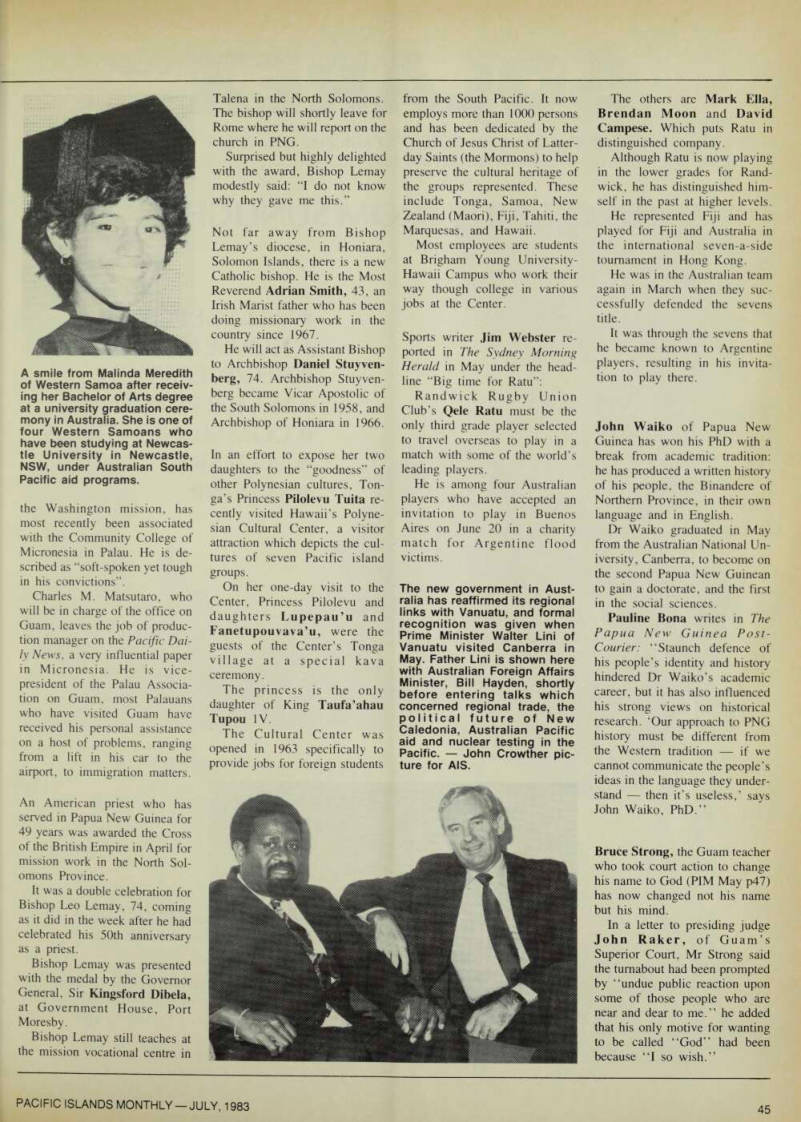
Barry Sinclair, whose appoint ment was announced by the Burns Philp group as manager of the International Trading Division of Burns Philp (New Zealand) Ltd.
James William Harris, 46, for mer manager of co-operative education at the Polynesian Cul tural Center, Honolulu, has been appointed director of central planning and development for the kingdom of Tonga.
Mr Harris is the first top-level government official appointed from outside Tonga and will re port directly to Tonga’s Prime Minister, Prince Fatefehi Tu’ipelehake.
In his time at the Polynesian Cultural Center, he wrote a manual for both the Center and Brigham Young University- Hawaii Campus, where he taught Pacific history and regional de velopment courses.
Married, and with five chil dren, Mr Harris was bom in Tonga but attended elementary and high school in New Zealand.
He completed his undergraduate studies at the then Church Col lege of Hawaii (now BYU- Hawaii Campus) where he has graduated valedictorian. He later earned a master’s degree at
Brigham Young University, Pro
vo, with honors.
A staunch member of The Church of Jesus Christ of Latter day Saints (the Mormons), Har ris served as superintendent of LDS church schools for Tonga, Fiji, Tahiti, Kiribati, Niue, Rarotonga, and Tuvalu in 1974.
Former Community College of
Micronesia president Resio Moses has been sworn in as the second elected governor of Ponape State, Federated States of Micronesia.
Former Governor Leo A. Fal cam, who lost to Moses in a runoff election on March 29, handed the Ponape State flag to Moses as a symbol of the transfer of power.
The Palau Senate has approved the appointments of Noriwo Übedei and Charles M. Matsut aro as Palau representatives to head liaison offices in Washing ton, DC, and Guam.
Noriwo Übedei, who will head
James William Harris
the Washington mission, has most recently been associated with the Community College of Micronesia in Palau. He is de scribed as “soft-spoken yet tough in his convictions”.
Charles M. Matsutaro, who will be in charge of the office on Guam, leaves the job of produc tion manager on the Pacific Dai ly News, a very influential paper in Micronesia. He is vice president of the Palau Associa tion on Guam, most Palauans who have visited Guam have received his personal assistance on a host of problems, ranging from a lift in his car to the airport, to immigration matters.
An American priest who has served in Papua New Guinea for 49 years was awarded the Cross of the British Empire in April for mission work in the North Sol omons Province.
It was a double celebration for Bishop Leo Lemay, 74, coming as it did in the week after he had celebrated his 50th anniversary as a priest.
Bishop Lemay was presented with the medal by the Governor General, Sir Kingsford Dibela, at Government House, Port
Moresby.
Bishop Lemay still teaches at the mission vocational centre in
Talena in the North Solomons.
The bishop will shortly leave for Rome where he will report on the church in PNG.
Surprised but highly delighted
with the award, Bishop Lemay modestly said: “I do not know why they gave me this.”
Not far away from Bishop Lemay’s diocese, in Honiara, Solomon Islands, there is a new Catholic bishop. He is the Most Reverend Adrian Smith, 43, an Irish Marist father who has been doing missionary work in the country since 1967.
He will act as Assistant Bishop
to Archbishop Daniel Stuyven
berg, 74. Archbishop Stuyven
berg became Vicar Apostolic of the South Solomons in 1958, and Archbishop of Honiara in 1966.
In an effort to expose her two daughters to the “goodness” of other Polynesian cultures, Ton ga’s Princess Pilolevu Tuita re cently visited Hawaii’s Polyne sian Cultural Center, a visitor attraction which depicts the cul tures of seven Pacific island groups.
On her one-day visit to the Center, Princess Pilolevu and
daughters Lupepau’u and
Fanetupouvava’u, were the guests of the Center’s Tonga village at a special kava ceremony.
The princess is the only
daughter of King Taufa’ahau
Tupou IV.
The Cultural Center was opened in 1963 specifically to provide jobs for foreign students
from the South Pacific. It now employs more than 1000 persons and has been dedicated by the Church of Jesus Christ of Latter day Saints (the Mormons) to help preserve the cultural heritage of the groups represented. These include Tonga, Samoa, New Zealand (Maori), Fiji, Tahiti, the Marquesas, and Hawaii.
Most employees are students at Brigham Young University- Hawaii Campus who work their way though college in various jobs at the Center.
Sports writer Jim Webster re ported in The Sydney Morning Herald in May under the head line “Big time for Ratu”: Randwick Rugby Union Club’s Qele Ratu must be the only third grade player selected to travel overseas to play in a match with some of the world’s leading players.
He is among four Australian players who have accepted an invitation to play in Buenos Aires on June 20 in a charity match for Argentine flood victims.
The others are Mark Ella, Brendan Moon and David Campese. Which puts Ratu in distinguished company.
Although Ratu is now playing in the lower grades for Rand wick, he has distinguished him self in the past at higher levels.
He represented Fiji and has played for Fiji and Australia in the international seven-a-side tournament in Hong Kong.
He was in the Australian team again in March when they suc cessfully defended the sevens title.
It was through the sevens that he became known to Argentine players, resulting in his invita tion to play there.
John Waiko of Papua New Guinea has won his PhD with a break from academic tradition: he has produced a written history of his people, the Binandere of Northern Province, in their own language and in English.
Dr Waiko graduated in May from the Australian National Un iversity, Canberra, to become on the second Papua New Guinean to gain a doctorate, and the first in the social sciences.
Pauline Bona writes in The Papua New Guinea Post- Courier: “Staunch defence of his people’s identity and history hindered Dr Waiko’s academic career, but it has also influenced his strong views on historical research. ‘Our approach to PNG history must be different from the Western tradition if we cannot communicate the people’s ideas in the language they under stand then it’s useless,’ says John Waiko, PhD.’’
Bruce Strong, the Guam teacher who took court action to change his name to God (PIM May p 47) has now changed not his name but his mind.
In a letter to presiding judge John Raker, of Guam’s Superior Court, Mr Strong said the turnabout had been prompted by “undue public reaction upon some of those people who are near and dear to me.” he added that his only motive for wanting to be called “God” had been because “I so wish.”
A smile from Malinda Meredith of Western Samoa after receiv ing her Bachelor of Arts degree at a university graduation cere mony in Australia. She is one of four Western Samoans who have been studying at Newcas tle University in Newcastle, NSW, under Australian South Pacific aid programs.
The new government in Aust ralia has reaffirmed its regional links with Vanuatu, and formal
recognition was given when
Prime Minister Walter Lini of Vanuatu visited Canberra in May. Father Lini is shown here with Australian Foreign Affairs
Minister, Bill Hayden, shortly
before entering talks which concerned regional trade, the political future of New Caledonia, Australian Pacific aid and nuclear testing in the
Pacific. - John Crowther pic
ture for AIS.