Islnads
Pacific
Monthly
July, 1983
American Samoa US$l75 Australia "Asl 50 Cook Islands NZ$l5O Fi|i f- FSI 50 Hawaii '
1.11 NZ^^j
' SI usn .■ TflTO?—
Vanuatu V I j/jl
Westcn ' Jty
i > ■
Registered Post^^
Publication nIwTOPI2IO 1
mmm
Advertisements & other items, p. 2 (1 item)
0 Hitachi
A * **■ m Ik.
I i.
A »? 91 111
® HITACHI
15
DIGITAL AUDIO
Ns
Compact Disc
Digital Audio Playe
I Hitachi has crossed the threshold of a music lover’s dream. Perfect concert reproduction is now a reality. It is all possible due to the new Hitachi DA-1000, one of the world’s first commercially available compact disc digital audio players. It is an exciting new form of sound system that relies on digital audio signal encoding, rather than an analog system. This allows performance levels that far exceed even the finest conventional turntable. The result is pure, clean sound, absolutely faithful to the original performance.
The Hitachi DA-1000 plays digital audio compact discs (CD), the disc format adopted by all of the major audio manufacturers. A compact disc is capable of storing an uninterrupted 60 minutes of beautiful music on a single side.
The compact disc is perfectly smooth. Its clear plastic protective surface eliminates the annoying effects of dust, scratches and wear.
The music you hear will sound exactly the same as when the artist originally recorded it, the first time you play the disc as well as the 1000th.
The DA-1000 was crafted to ensure superior performance as well as optimum convenience. The vertical design offers the space-saving benefits of component rack installation, as well as the ease of a cassettestyle front loading system.
The DA-1000 delivers a comprehensive playback control. With a simple touch of the fingertip, the user may elect to pick-up Forward or Reverse, Cue, Repeat, and Auto Search.
The DA-1000 also has Program Playback, a feature which allows the user to program up to 15 selections for playback in any sequence, automatically.
One listen is worth a thousand words. Come and witness for yourself the superior sound of the Hitachi DA-1000.
0 HITACHI
A World Leader in Technology • AUSTRALIA: Hitachi Sales Australia Pty., Ltd,, 153 Keys Road, Moorabbin, Victoria 3189 Rhone: (555) 8722 • PAPUA NEW GUINEA: S O. Svensson (N.G.) Ltd., P.O. Box 705, Port Moresby Phone: 21-2111 • FIJI ISLANDS: Burns Philp(South Sea)Company Ltd., G.P.O. Box 355, Suva Phone: 311777 • NEW CALEDONIA: Caldis, B.P Ml, Noumea Phone: 26. 23. 50 •TAHITI: Ets Chene Alain, P.O. Box 272, Papeete Phone: 2. 88. 68. • SOLOMON ISLANDS : Technique Radios Centre Ltd., P.O. Box 465, Honiara Phone: 416
Pacific Islands Monthly
Vol. 54 No. 7 July 1983 (USPS 952480)
Representatives
AUSTRALIA: Distribution: The Herald and Weekly Times Ltd., 44-74 Flinders St., Melbourne, Vic., 3000 Advertis ing Reps Brisbane D. Wood, Anday Agency, Box 1918, GPO Brisbane, 4001, telephone 44-3485, 44-1546; Adelaide Hastwell Williamson Rouse Pty. Ltd., PO Box 419, Norwood, SA, 5067; 59 Kensington Road, Norwood; telephone (08) 332-3322, telex 87113.
FIJI: Distribution and subscriptions Desai Book shops, PO. Box 160, Suva, Fiji, telephone Suva 23036.
Advertising Fiji Times & Herald Ltd., 20 Gordon St., Suva, telephone 31-2111, telex FJ2124.
FRENCH POLYNESIA: Distribution Hachette Pacifi que, 10 Ave Bruat, Papeete, telephone 25610.
HAWAII, UNITED STATES: Distribution PIM, Hawaii, PO Box 22250, Honolulu, Hawaii, 96822. Advertising Brian C. Asgill, Apt. 1308, 1676 Ala Moana Blvd., Honolulu, Hawaii, 96815, telephone (808) 955-9718.
JAPAN: Advertising and subscriptions Universal Media Corporation, GPO Box 46, Tokyo, telephone 666- 3036, cables UNIMEDIA Tokio, telex 2524665.
KOREA: Advertising and subscriptions World Mar keting, Inc, Box 4010, Seoul; phone 776-5291-3, telex K 23232.
MALAYSIA: Advertising and subscriptions Worldwide Media Services, 57-B Komplex Damai, Jin Dato Haji Eusoff, Kuala Lumpur, telephone 63-9340, cables WORLDMEDIA Kuala Lumpur, telex 31533.
NEW CALEDONIA; Distribution Depot Centre de Presse Michel Pentecost, CBP2, Noumea, telephone 27- 2434, 27-4729.
NEW ZEALAND: Distribution Gordon & Gotch, PO Box 584, 2 Carr Road, Mt. Roskill, Auckland 4. Advertising International Media Representatives Ltd., PO Box 2313, Auckland, telephone 79-5487; 49-3389, cables Intereps, Auckland. Subscriptions Ross Haines & Son Ltd., PO Box 1289, Auckland, telephone 76-9042.
PAPUA NEW GUINEA: Distribution Gordon & Gotch, PO Box 3395, Port Moresby, telephone 25-4551.25-4855.
Advertising PNG Post-Courier, PO Box 85, Port Mores by, telephone 21-2577, telex 22120.
PHILIPPINES: Advertising The GF Group, 12 San Ignacio St., Uroaneta Village. Makati, Metro Manila, tele phone 817-7299, telex 45950 and 4233.
UNITED KINGDOM: The Herald & Weekly Times Ltd., No 1 Maltravers Street,London WC2R 3DZ, England, telephone 01 836 5162, telex London 21989.
UNITED STATES MAINLAND: Advertising Joshua B.
Powers Jr., Powers International Inc., 551 Fifth Ave., New York, New York 10 017, telephone 867-9580, telex 236514.
Subscriptions PIM, Hawaii, PO Box 22250, Honolulu, Hawaii. 96822.
Payments by personal cheque are only acceptable in Australian (from a branch in Australia), U.S. and New Zealand currency. For all other remittances please send an international bank draft in Australian dollars.
Published monthly by Pacific Publications (Aust.) Pty.
Ltd. and printed in Australia by Walter Alteri Printing (Australia) Pty. Ltd., Dingley. Vic.
Australian cover price is recommended retail only.
Registered by Australia Post, publication No. NBPI2IO.
Second class postage paid at Honolulu, Hawaii, Copy right Pacific Publications (Aust.) Pty. Ltd.
Postmaster Honolulu: Send address changes to PIM Hawaii, PO Box 22250, Honolulu, Hawaii, 96822,
Subscriptions
Local Aust.
American Samoa $US21 $18 Australia $A18 $18 Canada $US27 $25 Cook Islands $19 Fiji $18 French Polynesia $22 Guam
Sus23
$20 Hawaii
Sus23
$20 Japan $20 Kiribati $19 Micronesia $US23 $20 Nauru $21 New Caledonia $22 New Zealand $NZ24 $18 Niue $19 Norfolk Island $15 Northern Marianas $US23 $20 Papua New Guinea $23 Solomon islands $19 Tonga $19 T uvalu $19 United Kingdom Stg 15 $25 U.S. Mainland
Sus27
$25 Vanuatu $19 Western Samoa $18 Elsewhere $A25
Inside
• THE USA AND THE ISLANDS Nicky Holford reports from Washington, DC, on a recent seminar on Pacific Islands affairs held in the U.S. capital ... 10 • HAWAII Robert C. Kiste reflects on the pressures for, and the problems of, a more active regional role for Hawaii 11 • FRENCH POLYNESIA Marie-Therese and Bengt Danielsson describe the efforts serious and otherwise to raise funds for the reconstruction of the cyclone-ravaged territory, and the trial of two men guilty of the brutal murder of Olivier Breaud in Tahiti in 1980 12 • VANUATU Julie-Ann Ellis looks beyond the political strife in Port-Vila to describe what she calls the “culture clash” now unfolding on the island of Pentecost 19 • WESTERN SAMOA Sano Malifa reports on a recent event that has been widely welcomed in Western Samoa the appointment of the country’s first Samoan chief justice 31 • PAPUA NEW GUINEA PNG’s three Dash 7 aircraft have proved too expensive and the government is moving to terminate the agreement under which they were being leased 41 • YESTERDAY Joseph Theroux contributes the first article in a two-part series on Wilhelm Friedrich Solf, a remarkably able governor of German Samoa. 52
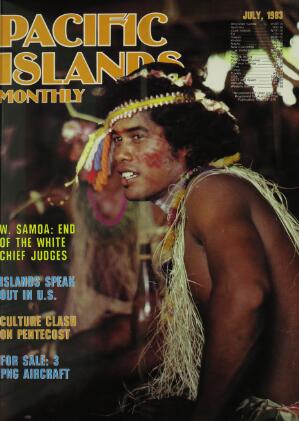
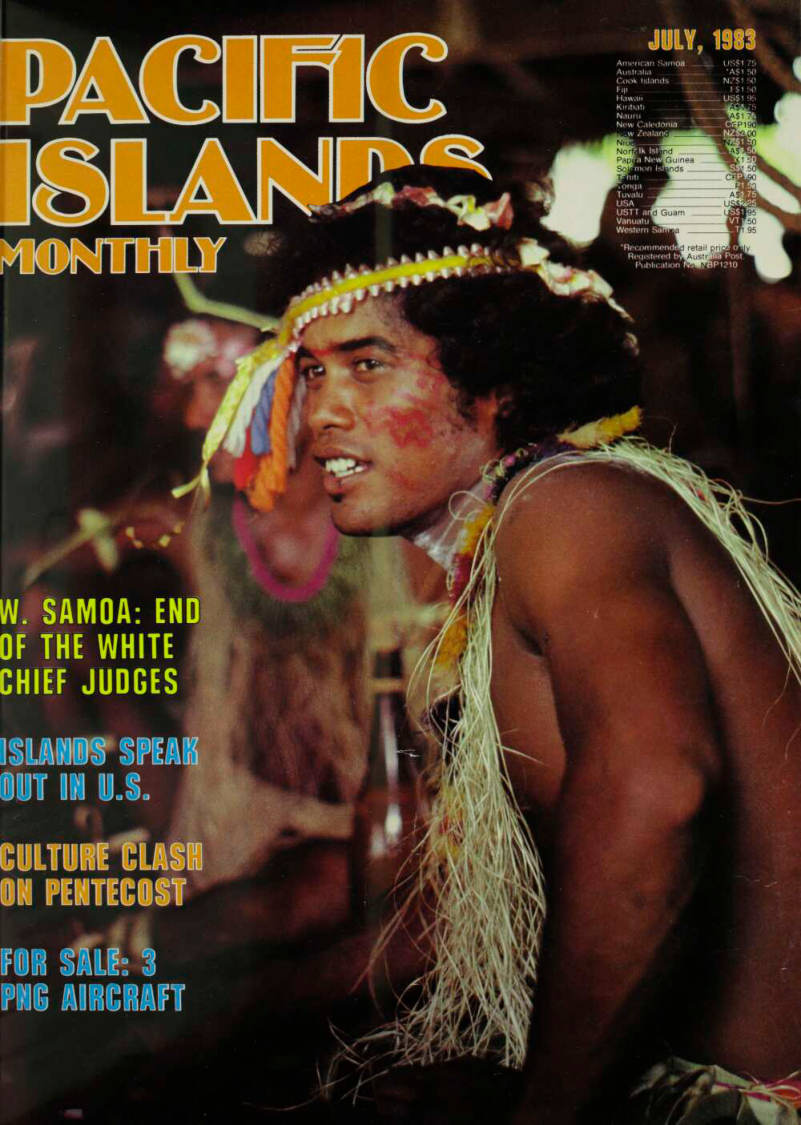
Cover picture: A young man and his bottle of palm toddy at Satawal, Caroline Islands. Bengt Danielsson picture.
Australia in the Pacific 39 Books 47 Cook Islands 27 Deaths 66 Fiji 25, 29, 36, 37, 43 French Polynesia 12, 36 Islands Press 57 Kiribati 29 Letters 7 Maoris 28 Micronesia 17, 39 Nauru 27 New Caledonia 15 Niue 27 Notes from the North 17 Noumea Notebook 15 Pacific Report 5
Papua New Guinea ... 23, 41, 43, 45, 47, 51 People 43 Political Currents 31 Postmark Papeete 12 Regional Pacific Affairs 10 Report from Vanuatu 19 Shipping timetables 62 Solomon Islands 33 The Month 11 Tonga 45 Tradewinds 36 Tropicalities 23 Vanuatu 19, 29 View from Honolulu 11 Western Samoa 31, 52 Yachts 58 Yesterday 52
Advertisements & other items, pp. 3-4 (2 items)
Founded 1930 by R. W. Robson
Editor Angus Smales Associate Editor Malcolm Salmon Advertising Manager Stephen Brandon Editorial Adviser John Carter A Pacific Publications production 76 Clarence Street, Sydney, 2000, GPO Box 3408, Sydney, 2001.
Cables: PACPUB Sydney.
Telex: 21242 (answers INTARAD).
Telephone: Sydney 20-231.
Melbourne 63-0211.
Manager: John Berry (03) 63-0211 Ext. 1860.
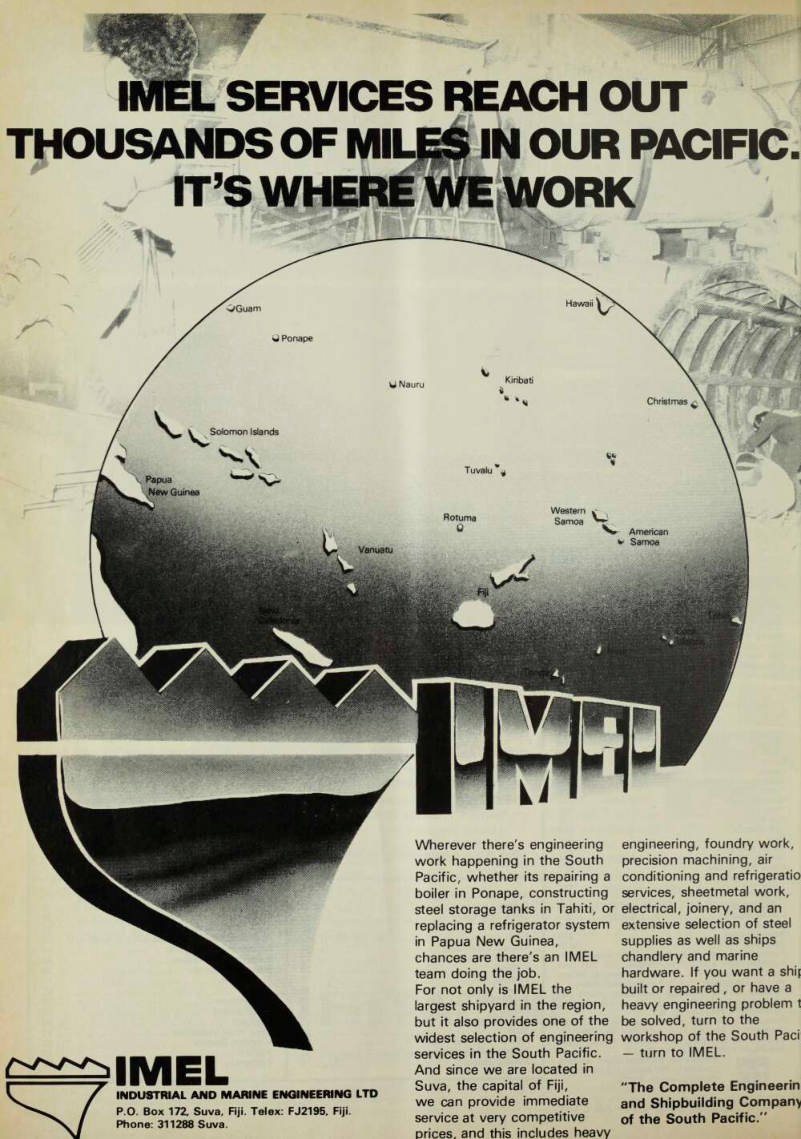
P^^Imel
L SERVICES REACH OUT
THOUSANDS OF MILES IN OUR PACIFIC.
IT’S
OR Hawaii WGuam m Ponape Kiribati U Nauru » % Christmas Solomon Islands Tuvalu Papua Western y Samoa Vr American V Samoa Rotuma 0 V- Vanuatu / AH' ti f ■ ii
p^^IMEL
INDUSTRIAL AND MARINE ENGINEERING LTD
P.O. Box 172, Suva, Fiji. Telex; FJ2195, Fiji.
Phone: 311288 Suva.
Wherever there's engineering work happening in the South Pacific, whether its repairing a boiler in Ponape, constructing steel storage tanks in Tahiti, or replacing a refrigerator system in Papua New Guinea, chances are there's an IMEL team doing the job.
For not only is IMEL the largest shipyard in the region, but it also provides one of the widest selection of engineering services in the South Pacific.
And since we are located in Suva, the capital of Fiji, we can provide immediate service at very competitive □rices. and this includes heavy engineering, foundry work, precision machining, air conditioning and refrigeratio services, sheetmetal work, electrical, joinery, and an extensive selection of steel supplies as well as ships chandlery and marine hardware. If you want a shif built or repaired , or have a heavy engineering problem t be solved, turn to the workshop of the South Pad turn to IMEL.
"The Complete Engineerin and Shipbuilding Companv of the South Pacific.”
Pacific Report
A Dike Around Moruroa?
The French Government is seeking tenders for a CFP3OO million (about $A2.5 million) project at its sensitive nuclear testing site of Moruroa Atoll in the Tuamotu Islands group, French Polynesia. The project is believed to involve the design and construction of a protective dike-type structure around the atoll to protect it from wave damage during storms. Moruroa has been lashed several times reportedly severely damaged by this year’s extraordinary series of cyclones in the area.
“Fake” Document In Fiji Inquiry
Siddiq Koya, a former leader of Fiji’s parliamentary opposition, has branded as “faked” a document allegedly signed by him committing any National Federation Party government in Fiji to “co-operative” and “friendly” relations with the Soviet Union.
According to the document, the party would adopt this policy in return for “help” given by the Soviet Union in the campaign for the July 1982 elections. Among steps that would be taken, according to the document, were Fiji’s granting of permission for the organisation of Soviet scientific experiments in Fiji territory, and the establishment of a “USSR Embassy for the South Pacific” in Fiji. The ruling Alliance Party distributed copies of the document to media offices in Suva late in May, just two days before a commission of inquiry into the conduct of the July elections (PIM Jun p 29) was due to resume hearings. In a statement accompanying the copies of the document, Prime Minister Ratu Sir Kamisese Mara expressed concern about the length and cost of the inquiry, but added that “efforts by counsel for the principal parties to abbreviate the hearings had proved fruitless.” The Fiji Times reported that NFP leader Jai Ram Reddy had turned down an offer by the Alliance Party to shorten the inquiry by discarding the remaining four issues to be dealt with by it. These included the allegations about NFP links with the Soviet Union. Mr Reddy was insistent that Alliance Party charges on this matter should be aired at the inquiry. Release of the alleged secret document followed.
Png, Solomons, Confront Soviets At Escap
Fallout from last year’s oceanographic research cruise in the South Pacific of the Soviet vessel Kallisto (PIM May 'B2 p 6) was thick at the annual commission session of the United Nations body ESCAP in Bangkok in April. Soviet representative Ernest Obminskiy attempted to have read into the minutes the fact that oceanographic data collected by Kallisto had been made available to ESCAP’s committee on offshore areas, which is known internally as CCOP/SOPAC. The Hong Kong-based weekly Asiaweek reports: “This met immediate resistance, notably from the Solomon Islands and Papua New Guinea delegations. They protested that they had not been informed about the Kallisto’s ‘research’ activities, and they reminded fellow delegates that a similar offer of access to this information had been ‘thrown out the window’, as one delegate put it, during an earlier CCOP/SOPAC. Therefore, they said, the Soviet offer was ‘irrevelant’ to the ESCAP report. The Solomon Islands and PNG members accused the Soviets of ‘trying to force this offer down the throat’ of the South Pacific states in order to give the Kallisto’s activities an aura of respectability. (The Kallisto is, of course, a highly sophisticated intelligence-gathering craft). A mood of confrontation developed as the Soviet delegation, led by Mr Obminskiy, adopted what even the most charitable witnesses describe as a bullying and hectoring attitude towards the Solomons and PNG delegations. As a consequence, the meeting’s closing ceremony had to be put off for four hours while the Bangladeshi chairman sought a compromise. In the end, the paragraph with which the Soviets were so obsessed was accepted. But an additional note recorded the majority’s regret that the USSR had persisted in pressing its offers of marine research on CCOP/SOPAC members (though) these offers were clearly unwelcome’.”
Breaud Killers Sentenced In Tahiti
Two men who three years ago kidnapped and murdered the son of a wealthy French banker in Tahiti (PIM Jun ’BO pl 9) were sentenced to jail for life at hard labor in May. Yves Le Goff and
Daniel Chelle were convicted of the unlawful abduction and murder of 26-year-old Olivier Breaud. They had demanded a ransom of $1.5 million for him, but, according to prosecution lawyers, had panicked after the kidnapping, beaten Breaud to death, burned his body, and thrown the remains over a cliff. Le Goff’s wife Claudine was found guilty of helping the two and was sentenced to 15 years’ imprisonment.
Cooks Pm Speaks Out On Adb
Cook Islands Prime Minister Geoffrey Henry told the annual meeting of the Asian Development Bank in Manila in May that he was “disturbed” to see ADB aid to South Pacific countries fall last year to $U525.5 million from the level of $37.7 million the year before. He said the ADB was the South Pacific’s bank as much as it was that of the Asian member countries. Mr Henry said he was pleased that the ADB planned to open a regional office in the South Pacific, and immediately offered the Cook Islands as a home for the office. He added that he expected nationals of South Pacific countries to play a part in running the regional office, pointing out his concern that among the 1400 employees of the ADB at present there was not one national of a developing South Pacific country.
Nakayama, Olter Elected In Fsm
The third Congress of the Federated States of Micronesia unanimously re-elected Tosiwo Nakayama as FSM president in May. Mr Nakayama, from the Truk group, became first FSM president when constitutional government was introduced in 1979. Elected as vice-president was Bailey Olter, from Ponape.
Mr Olter stood successfully against the outgoing vice-president, Petrus Tun of Yap.
Outs And Ins Of President Deroburt
Nauru’s President Hammer Deßoburt was out of office for four days in May. He resigned on May 16, and was re-elected by the parliament by 11 votes to four on May 20. Unsuccessful candidate for the presidency was the member for Übenide, Derog Gioura. Reason for this latest manifestation of the Byzantine character of Nauru politics was ostensibly a differ ence over the timing of the next sitting of parliament. But some observers see Mr Deßoburt deliberately testing his support in view of a rumored serious challenge to his position later in the year. Back in the presidential chair, Mr Deßoburt immediately reappointed his former Cabinet.
New Caledonian Students In Fiji
Fourteen high school students from Lifou Island, in New Caledonia’s Loyalty group, arrived in Fiji in May for a three-week course to improve their English and their knowledge of neigh boring countries.
France S 70-Kilotonne N-Test
Following a blast of an estimated 50 kilotonnes in April (PIM June p 5), France detonated a 70-kilotonne nuclear device at Moruroa, French Polynesia, in May. The explosion drew strong protests from a number of quarters, including Australian Foreign Minister, Bill Hayden, who, as well as protesting against the test, reiterated his government’s commitment to the idea of a nuclear-free southwest Pacific. His Papua New Guinean coun terpart Rabbie Namaliu said Pacific nations should protest more strongly about French nuclear testing and consider trade as a means of bringing pressure on France. Mr Namaliu said the issue was certain to be raised at the South Pacific Forum meeting in Australia later in the year.
Bugging Charge Png Note For Australia
The Papua New Guinea Government in May lodged a diplomat ic note with the Australian Government concerning allegations of telephone-bugging. The country’s Secretary for Foreign Affairs Paulias Matane called Australian High Commissioner Ron Birch to his office to hand over the note, whose text was not disclosed. The move followed reports in an Australian weekly newspaper, The National Times that the Australian High Com mission building at Waigani housed sophisticated electronic monitoring equipment capable of listening in at will to telephone calls anywhere in PNG. The day before the note was handed to Mr Birch, PNG Prime Minister Michael Somare told parliament
that he believed assurances from the Australian Government that there was no eavesdropping equipment in the High Commission, but that the government would still be lodging a diplomatic note expressing its concern. He planned to discuss the matter with Australia’s Prime Minister Hawke when he visited PNG in June.
Absent Quarter Of A Million
Almost 250,000 Pacific Islanders are estimated to be no longer living in their countries of origin. Seventy-five per cent of these no longer live in the Islands at all, but in the metropolitan countries of New Zealand, the United States, Australia, Canada and France. The figures are contained in the South Pacific Commission’s monthly newsletter for May, 1983. The SPC’s Dr John Connell says in an accompanying article that present trends in the economies of the South Pacific region suggest that migration to metropolitan countries fringing the Pacific will continue. He said this was especially true for the Polynesian countries. According to the figures, about 90,000 Pacific Islan ders live in New Zealand and a similar number in the United States
Western Samoans In U.S. Uniforms?
A senior U.S. coastguard official was in Apia in June to discuss with the government of Prime Minister Tofilau Eti problems associated with surveillance of Western Samoa’s exclusive economic zone. Earlier, Tofilau had held talks in Hawaii with U.S. military authorities on questions of technical assistance to Western Samoa, defence, and the surveillance problem. Tofilau also had an exploratory discussion on the sensitive issue of recruitment of Western Samoan citizens into the U.S. armed forces. He told a Radio Australia reporter in Apia that while he had got a sympathetic hearing on this matter, there were still some problems to be ironed out.
Png’S Crackdown On Crime, Group Fighting
Papua New Guinea has introduced stiffer prison sentences in an attempt to reduce tribal fighting and urban crime. From now on those convicted of breaking and entering will be jailed for at least three years. Those taking part in group fighting in which someone is killed are to be jailed for at least four years. The changes went through the PNG parliament in May with almost unanimous support from government and opposition members.
Government member Thomas Negints, who introduced the measures, said rapid changes in PNG had brought an ever increasing breakdown in law and order. Police Minister John Gehino said that many people in urban areas were now so afraid they will not go out at night.
September Cut-Off Date For Fishermen
From September 1, any foreign fishing vessel operating in the 200-mile exclusive economic zones of South Pacific Forum countries without being registered with the Forum’s Fisheries Agency will be liable to arrest. Announcing the date, a spokes man for the agency said from its Honiara headquarters that South Korean, Taiwanese and American tuna fishing com panies had expressed willingness to comply with the registration requirement. But Japanese companies were proving noticeably reluctant to recognise the agency, preferring as they do to make agreements with individual countries. Ships registered with the Forum will be required to report to it by radio each Wednesday on their position and their catch.
Solomons Told “Cut Birth Rate”
Governor Tony Hughes of Solomon Islands Central Bank has warned of lower living standards if the country does not cut its population growth rate which is now running at three and a half per cent a year, one of the highest in the world. Mr Hughes said in his annual report released in May that real income per head will drop unless the birth rate is reduced. He said that in 1983 a quarter of a million people in Solomon Islands were sharing cash income of $lOO million, or about $4OO per head. He said a reasonable assumption about real economic growth, and a continued population increase of three and a half per cent, would mean a fall by one quarter in the level of welfare over the next 20 years.
Money: San Juan Raps Marshalls, Palau
The Marshall Islands Republic’s Chief Secretary Oscar deßrum has told the U.S. House of Representatives in Washington that
his government is “critically confronted with a serious financial crisis, created in large part by a series of unfulfilled expectations based on calculated projections of funds under the Compact of Free Association, approval of which has been unexpectedly delayed.” Explaining that his government based its borrowing on the pledge of a previous U.S. administration that the United Nations trusteeship would terminate in 1981 when compact level funding would be available, Mr deßrum said they obtained overseas loans to build badly needed infrastructural projects basic to the development of their economy. The government now found itself with SUS37.I million in disbursed long-term debt, and inadequate resources to meet loan repayments during this fiscal year and subsequent years. Debt service payments would range from $2.7 million in this fiscal year to $9.5 million in 1984, obligating 93 per cent of their local revenues. The Marshalls Attorney-General Carl Ingram told the U.S. committee that the Marshall Islands Government wants the United States to help defer the payments to the Midland Bank (England) for the power plant. The power plant referred to was installed by the British firm of Ipseco International Power Systems with a loan package guaranteed by the British Government and banks on a similar deal to one negotiated with Palau. Pedro Sanjuan, assistant secretary of the interior for territorial and international affairs, told the Marshallese delegation that Britain had been advised through the U.S. State Department that the U.S. would not bail out the Marshalls or the Midland Bank. U.S. auditors began a review in April of the Marshall Islands’ financial transactions after a U.S. Congress sub-committee meeting at the end of February had expressed concern at the size of the Marshall Islands’ debts. Mr Sanjuan told the U.S. House of Representatives’ committee that the Marshalls and Palau had proved they were not prepared to make sound financial deci sions. The Marshalls had bought aircraft and electrical generat ing equipment far in excess of the islands’ needs and ability to pay. Palau had entered into an over-designed project (power station), and Palauan leaders had admitted Palau may not be able to repay the loan. He added that the American Samoa Government was experiencing a very severe financial crisis brought about, completely, he said, by local mismanagement.
Jaf To Jaws, Journalists Get Organised
Journalists in Western Samoa have formed their own associa tion, the Journalists’ Association of Western Samoa, or JAWS.
The first of its kind in the country, the association aims to raise professional standards and to improve relationships for example, with exchange programs with journalists in other countries. A constitution has been approved and the publisher of The Samoa Times, Faalogo Pito, has been elected president of the association. Formation of the Journalists’ Association of Fiji, JAF, was announced earlier this year (PIM May p 44).
SIX AUSTRALIANS DEAD IN PNG AIR CRASH Six Australians died when a light aircraft crashed about 70 kilometres from Port Moresby in May. Papua New Guinea’s Air Search and Rescue Centre said the bodies of three men, two boys and a girl were winched out of the jungle by helicopter near the Kokoda Gap. The Australians, all from Newcastle, New South Wales, had borrowed the plane for a holiday in PNG.
Mitterrand’S Oui To Scientist’S Visit
New Zealand Prime Minister Robert Muldoon announced in May on his return from a visit to Paris that French President Mitterrand had agreed to his proposal that a New Zealand scientist be allowed to visit the French nuclear testing site at Moruroa Atoll, French Polynesia.
Introducing Umaenupnae And Umaeneag
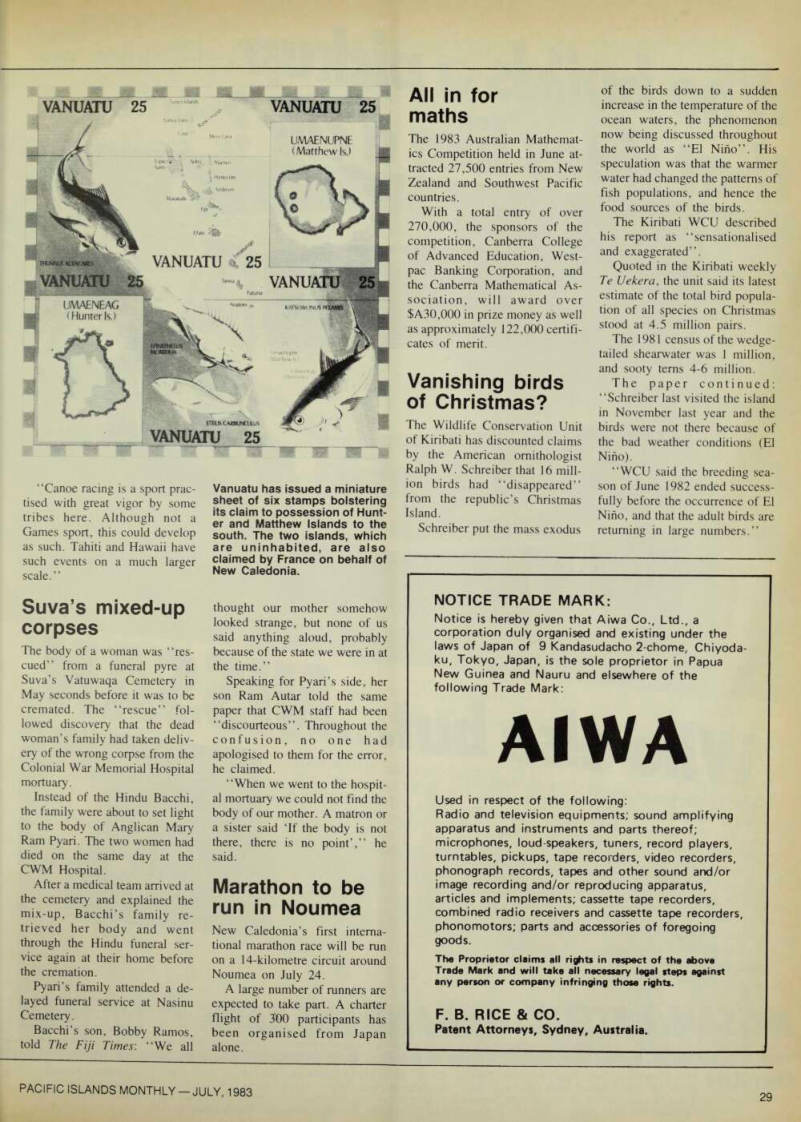
Vanuatu has demonstratively underlined its claim to the islands of Matthew and Hunter (PIM Jun p 7) by issuing a series of six stamps featuring the islands, which are identified as Umaenup nae (Matthew) and Umaeneag (Hunter) Islands. The stamps also highlight the notion of Vanuatu’s exclusive economic zone, and show a number of fish species found in the area. (See also Tropicalities.)
Chinese Ping Pong Coach In Apia
Ren Guo Ji, a table tennis coach from the People’s Republic of China, has arrived in Apia to help coach Western Samoa s table tennis team for the South Pacific Games in Apia in September
“Everything’s

Letters
got a
moral ..
In my judgment you could not have chosen anyone better qual ified to comment on my recently published book Margaret Mead and Samoa: The Making and Unmaking of an Anthropological Myth than the shrewdly insight ful and acutely knowledgeable Samoan poet and novelist Albert Wendt. While being highly ap preciative of his review (PIM Apr. plO) I would, if I may, like to clarify a crucially important point concerning the sexual mores and behavior of the Samoans.
Professor Wendt suggests that I have accepted “too readily” the testimony of Samoan elders concerning the sexual morality of their society, and so have over looked the extent to which Sa moans depart from this morality.
In her account of Samoa, Mar garet Mead asserted (as I note on p. 289 of my book) that pre marital promiscuity was “ex pected”; that there was (as I note on p.9lf), a “passive accept ance” of this pre-marital promis cuity by the “religious au thorities”; and that “the socie ty” was “not interested” in adultery when it occurred. She is here, obviously, making asser tions about the sexual morality of the Samoans. It is with the refu tation of these assertions that I am primarily concerned in Chap ter 16 of my book, and in show ing that, in Albert Wendt’s words, the Samoans, in their public morality, “forbid pre marital and extra-marital sex and promiscuity”.
That this was indeed the public morality of Samoa in the 1920 s (the period to which Mead’s writings on the Samoans specif ically refer), with sexual inter course between unmarried per sons being held to be both a sin and a crime, is demonstrated by cases in the archives of the courts of American Samoa. For exam ple, on May 6, 1929, in the district court at Fagatoga, on the island of Tutuila, Lafitaga, an unmarried male, having admitted that he knew it was wrong for a
man and woman to have “inter course with each other unless they were married,” was ac cused of committing “the crime of fornication” by “lewdly and lasciviously co-habiting” with a woman while not being legally married to her.
As is evident from this inst ance, sexual intercourse of a kind that was explicitly forbidden in Samoan society did nonetheless occur in the 19205, as, I have no doubt, it always has. And, in deed, in my book I give not a few instances of adultery, sexual as sault and the like. I am then by no means unaware of the realities of Samoan sexual behaviour and my field-notes contain detailed information on numerous cases quite as florid as any to be found in Albert Wendt’s remarkable novels about Samoa.
The extent to which adolescent girls engage in pre-marital inter course I examine in my study of 1967 of a sample of 67 young females (varying in age from 12 to 22 years) from a village on the south coast of Upolu. This study (which is reported on p. 239 of my book) showed that pre marital intercourse had been en gaged in by about 20 per cent of 15-year-old girls, about 30 per cent of 16-year-old girls, and about 40 per cent of 17-year-old girls. Thus, while my investiga tions show that, in Wendt’s words, the public morality of Samoa forbids pre-marital sex and promiscuity, they also docu ment that deviations from this strict morality do indeed occur,
and to a far from inconsiderable extent. It is however crucially important to realise that these deviations are, in terms of the public sexual morality of the Samoans, viewed as illicit, and are liable, if detected, to social disapproval and punishment.
Samoa is thus very far from being, as Margaret Mead quite erroneously reported, a liberta rian sexual paradise where dal liance is all.
I would also note that the rhetorical utterance: “Ask the sailors!” to which Professor Wendt refers did not originate with me and is not be found in my book. It is the unaided inven tion of one of the newspaper reporters at whose hands I have suffered much during recent months, being his somewhat compacted version of my having mentioned to him that Captain Charles Wilkes, U.S.N., of the United States Exploring Expedi tion, when he visited Samoa in 1839, recorded in his journal that among the Samoans “there was no indiscriminate intercourse”, the women of Samoa, in the estimation of this eminent sailor, “exhibiting a strange contrast to those of Tahiti.”
Derek Freeman
Emeritus Professor of Anthropology Australian National University Canberra ACT Australia
Palau compact
“unconstitutional”
Floyd Takeuchi in his April arti cle “The Super Tangle that is Palau” has effectively presented
the United States Government’s point of view on Palau. But that
position ignores key legal and
political issues which demons trate concerted U.S. attempts to undermine the democratic pro cess in Palau. Some background: 1) Palau is still part of the U.N. Trust Territory. In 1979, the Palauans drafted a constitu tion banning military use of land and prohibiting the entry of nuc lear weapons and nuclear waste without 75 per cent approval by voters. Despite strong U.S. ob jections to these provisions, Palauans approved this constitu tion by a 92 per cent margin. In two subsequent referenda necessitated by U.S. insistence that the Palau constitution and U.S. military plans were “in compatible” the Palauans first rejected a “sanitised” ver sion, and then reapproved their original nuclear-free constitution in 1980 by a 78 per cent vote. 2) Since U.S. military plans were first announced in 1972 for use of 32,000 acres (almost 30 per cent) of Palau land for jungle warfare training, nuclear and conventional weapons storage and transit of nuclear vessels and aircraft, Palauans have been op posing the military. So it is not surprising that in the February 10 vote on the “Compact of Free Association” the Palauans again refused to provide the 75 per cent vote needed to allow a U.S. nuclear presence in their islands. 3) On the February 10 ballot were two questions: The first on the compact and the second on the nuclear provision. The sec ond question clearly stated that the compact could not “take ef fect” unless 75 per cent of the people voted yes. International law expert Roger Clark’s exami nation of the drafting history of the ballot makes it clear the U.S. not only agreed beforehand on the ballot wording but in fact dictated the language to Palau Ambassador Salii in a November 11, 1982 cable. Prof. Clark con cludes that “the U.S., having acquiesced in, or perhaps even insisted upon, the way in which the issue was presented is surely bound by the results. The voters were asked for a 75 per cent majority; they did not give it. . .
The compact cannot take effect.”
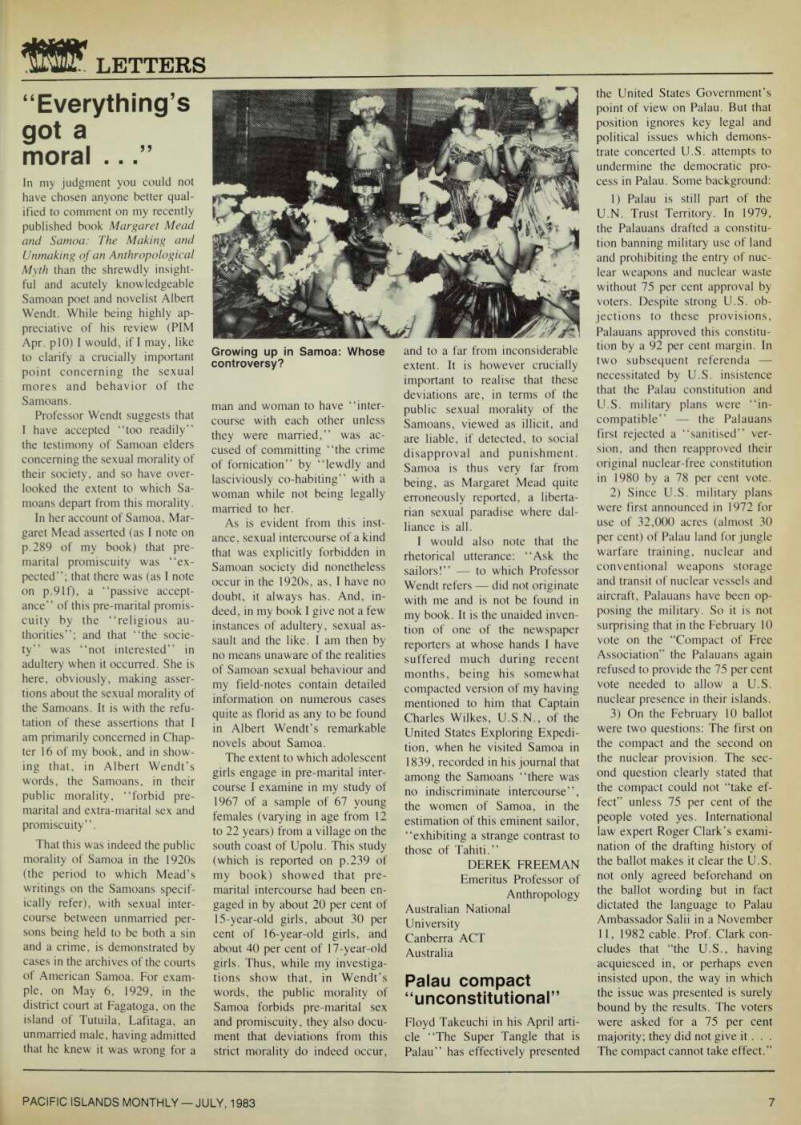
Growing up in Samoa: Whose controversy?
4) The State Department and Mr Takeuchi now characterise the conflict between the compact and the Palau constitution as an “intemaf’matter for the Palauans to resolve. Contrary to Mr Takeuchi’s and the State Depart ment’s position, it is in fact time for the U.S. to reconcile the compact and its military plans with the Palau constitution. As Prof. Clark states of the compact: “An unconstitutional treaty is just that unconstitutional.”
Through four referenda in as many years, the Palauans have repeatedly voted in favor of their constitution over the compact.
Although Mr Takeuchi and the State Department disagree, Prof.
Clark states that “there is nothing in the U.N. Charter which binds the people of the Trust Territory to permanent servitude to securi ty interests defined in Washing ton, D.C.” But U.S. actions threaten Palau’s right to freely determine its future. Ignoring the principle of democracy in its U.N. Trust Territory, the U.S. is attempting to railroad through its military plans. History has de monstrated, however, that the people of Palau will rise to the occasion.
Giff Johnson
Honolulu, Hawaii
Usa
From a Jayapura
diary ...
The following is an extract from my diary which I think could be of interest to your readers.
Jayapura, November 27, 1982.
I go to the immigration office.
So the turmoil starts. I tell them (officials) that I want to go to Vanimo by boat, do I need a visa? (I have an Australian pass port and enough money for a ticket to Caims). Three different people, three different desks, couldn’t get any sense.
No. 3 official insists that I need a visa and that I have to apply to PNG embassy in Jakar ta. Of course I don’t believe him, he’s wanting money out of me.
“Maybe I can help you.” “Twen ty dollars,” he says, I don’t ans wer, he comes down to $lO.
And this business of trying to extract money. An Indon friend smiled, shrugged his shoulders,
and said “Something Indonesian” when I told him.
Oh well! Perhaps it is “some thing Indonesian.” Nevertheless I disapprove strongly. Nowhere else did I encounter demands for money. Indeed I found officials and ordinary everyday Indone sians very helpful. Tarakan, Am bon, I’d go again.
David Richardson
Caims, Qld.
Australia
Dr Gajdusek gives
progress report
Early this year the Nobel Prize recipient Dr Daniel Carleton Gaj dusek spoke to a standing-room only audience at the University of Hawaii. He outlined the prog ress being made by him, together with colleagues from various countries, in supplying the ans wers to several neurological mysteries which have confronted medical researchers. Of particu lar interest to those involved in the Pacific Islands were his re marks on the elimination of kuru, the mysterious and fatal disease which afflicted the Fore people at Okapa in Papua New Guinea’s Eastern Highlands. He also re ported on work being done in Irian Jaya to unravel the mesh of factors relating to a set of neurological syndromes appear ing among the people of certain Auyu and Jakai villages.
Dr Gajdusek now offers a scenario which with great cer tainty predicts the ultimate disap pearance of kuru. There were 12 deaths from the disease in 1982, whereas over the last 25 years there have regularly been bet ween 100 and 300 deaths each year. Although the disease con tinues at this diminished rate, evidence has been adduced which gives the answer to the mysterious incidence of kuru: the people previously practised a form of ritualised cannibalism, eating the brains of deceased relatives.
Dr Gajdusek gave the instance of two brothers and a sister who all went down with kuru in the same year and had last been together as a group in 1957 when they had consumed the brain tissue of a deceased woman.
From evidence such as this it had been possible to plot the extend ed incubation period of kuru and
to assert that changed social be haviors will lead to its elimination.
Dr Gajdusek also pointed out that whereas the parent genera tion among these Fore people was illiterate, the Fore now num ber among their society “two with Royal College of Surgeons
qualification from Glasgow,
others with medical degrees, sev eral helicopter pilots and several
lawyers”. The spread of literacy
and higher levels of education among the Fore people will en sure that they are unlikely to return to the practices which brought such misery to their ancestors.
The most convincing proof of the victory over kuru is that the youngest patient in 1982 was over 30 years of age, and that each year the initial onslaught of the syndrome strikes down older victims. The passing of time will certainly see the final disappear ance of kuru.
The other neurological puzzle
to which Gajdusek and his col
leagues have been addressing
themselves relates to some of the Auyu and Jakai peoples of Irian Jaya. They have had the highest incidence in the world of the combination of the crippling syn dromes of the conditions known as amytrophic lateral sclerosis,
parkinsonism-dementia and
poliomyeloradiculitis.
The affected villages are situated on a low coastal plain 100-200 kilometres inland from the tidal swamplands, and they
are drained by slow-moving
localised rivers.
There are only two other places in the world where there has been a high incidence of a combination of amytrophic later al sclerosis and parkinsonism dementia. These are the southern villages of Guam and the Kii peninsula in Japan. In these two instances the people were rela tively isolated from outside influ ences, but since the end of World War 11, as contacts have in creased, so the incidence of the syndromes has diminished.
Gajdusek and his co-workers have turned the focus upon the one environmental element com mon to the Irianese, the Guama nians and the Kii Japanese. The water used by all three com munities, is extremely soft.
Analysis of the water in the area concerned in Irian Jaya has shown that it is extremely low in calcium and magnesium but high in aluminium, silicon, titanium, chromium and manganese. In fact the calcium and magnesium deficiencies are higher than those found in southern Guam or on the Kii peninsula.
Dr Gajdusek says categorical
ly that as the affected Irianese come into closer contact with the outside world and start to use imported foodstuffs and encount er other new products, the miner al deficiencies will be redressed.
Indeed, he says that if they moved from their traditional homelands to areas watered by the mountain-fed rivers of Irian Jaya their health would im
mediately be improved.
In fact, the Indonesian au thorities are at present engaged in a forcible re-location of the af flicted Auyu and Jakai to the neighborhood of the major river systems where they are used as labor in the lumber industry. So, in a perverse manner, this traumatic movement of popula tion for narrow economic pur poses could result in the eventual disappearance of maladies which for decades have brought misery to these communities.
W. G. Coppell
Waverton, NSW Australia
How many
canisters?
Thank you very much for pub lishing my article on sub-seabed disposal of radio-active waste (PIM Apr. pls).
However, there is an error in it as it appeared.
In listing the number of canis ters I wrote that there were ‘TO 5 to 10 6 canisters,” which has been translated as “one million to 10 million” when in fact it is one hundred thousand to one million.
As I do not want to overstate my case by making exaggerated claims, I was wondering if you could print a correction for this in a future issue. I am sorry about this but I do not wish to mislead people who probably have no other access to information.
Geoffrey P. Glasby
Wellington, New Zealand
Advertisements & other items, p. 8 (1 item)
feooNua
PI am %■ o o C o o o \ S-99
So nice to come home to.
Pioneer Personna.
If home is where your music is, here’s the system for you.
Pioneer’s Personna S-99 is the personal-sized system—only 32 centimeters wide and 21 centimeters deep. But unlike so many other smallsize systems, this one has true hi-fi specs and sound. The separate components include an Integrated Stereo Amp (65W/Ch), a Quartz- PLL FM/AM Synthesizer Tuner, a programmable front-loading Full-Auto Turntable packed with extras, and an Auto-Reverse (REC/PLAY) Cassette Deck with Dolby* B/C noise reduction and lots more. Each of these works through Auto-Function for one-touch operation, and each has an array of conveniences (many of them computerized) to make life a lot easier for you. The three-way speaker systems have special Ribbon Supertweeters for tingling highs. And available at option is the matching Sound Processor CA-X 7 with a 7-band graphic equalizer, echo unit, mixing panpots and lots more. Come home to the system that delivers sound you can really live with. The Personna shelf component system S-99, from Pioneer. * ‘Dolby’ and the double-D symbol are trademarks of Dolby Laboratories Licensing Corporation.
CD PIONEER’
For further information, please contact: Australia: Pioneer Marketing Services Pty. Ltd. (Incorporated in Victoria), P.O. Box 295, Mordialloc, Victoria, 3195 Tel: 580-9911 Fiji Islands: Brijlal & Company,G.P.O. Box No. 362, Suva, Fiji Islands Tel: 22258 New Zealand: Monaco Distributors Ltd., 2 Poland Road, Glenfield, Auckland, New Zealand Tel: (09) 444-9144 Norfolk Island: Burns Philp (Norfolk Island) Ltd., P.O. Box 21, Norfolk Island Vanuatu: Burns Philp (Vanuatu) Ltd., Vila, Vanuatu Nauru Island: Jacob Enterprises, P.O. Box No. 4, Republic of Nauru Tahiti: Tahiti Hi-Fi, P.O. Box 848, Papeete, Tahiti New Caledonia: Menard Pacifique Sari, B.P. 3899, Noumea, New Caledonia Tel: 27.62*23 American Samoa: Transpac Corporation, P.O. Box 1477, Pago Pago, American Samoa 96799 Tel: 633-5224 , T , OM7 Rarotonga: South Seas International Ltd., P.O. Box 49, Rarotonga, Cook Islands Tel. 2 oZf Papua New Guinea: Bali Merchants Pty. Ltd, P.O. Box 6103, Boroko Tel: 254887
seminar in Washington DC.
Islands concerns well aired at seminar in Washington DC.
A seminar sponsored by the Pacific Islands Association on the subject “Strategic Interests in
the Pacific” brought together
more than 170 high-ranking par ticipants in the U.S. capital of
Washington, DC, in May.
Co-hosting the seminar, which was held in a committee room of the US Congress, was the Na tional Institute of Public Policy (NIPP), a leading US “think tank” on strategic issues.
NIPP chairman George Witt man opened the seminar with an overview of the subject. He said: “Strategic interests in the South Pacific on the one hand involve large to medium size nations that seek to maintain or expand an influence regionally, and on the other a group of small to ex tremely small nations and ter ritories that wish to gain from the major powers interest in their
continued political and security
alignment.”
New Zealand’s ambassador to the US Lance Adams-Schneider made a strong statement in which he praised the relationship bet ween New Zealand, Australia and the US, but strongly criticised the US for claiming sovereignty over about 25 islands in four Pacific countries Tuvalu, Kiribati, the Cook Is lands, and Tokelau.
Mr Adams-Schneider said: “The US has claimed sovereign ty over these islands since 1939.
But it has never administered any of them, nor has it borne any of the responsibility for their up keep or the development of re sponsible government in them, or for the welfare of the people.
“These claims have not been
recognised by any other
country.”
The US position was in troduced by Thomas Shoesmith, acting assistant secretary of state for East Asian and Pacific affairs.
He was followed by Richard J.
Dols, newly appointed director
of Pacific Island affairs in the
State Department.
Mr Dols told the seminar: “The United States has a long
New York-based Pacific affairs writer NICKY HOLFORD reports on a recent seminar held in Washington DC which dealt with major political, economic and military issues in the Pacific today.
history of contact with the Is lands, a history that has little to do with global strategic issues and much to do with competition for dollars and souls.”
Calling the US interest a “re cent one”, and one that was previously “a kind of strategic insulation,” Mr Dols said the US “has an obvious direct interest in protecting US territory in the Pacific, and defence respon sibilities in Micronesia.”
“The primary American de fence concern is security of lines
of communication air and sea to our friends and allies in Asia to Australia and New Zea land and to the Islands themselves.”
The threat of Soviet Far East ern forces that have “grown alarmingly” in the last decade is one that the US takes seriously, he said.
The strategic interests of the Federated States of Micronesia were outlined by Asterio Takesy, secretary of external affairs.
Only a month away from the
planned signing of the Compact
of Free Association with the US, Mr Takesy said that the years of negotiating with the US have given Micronesians “a good start
in forming relationships with
other countries.” ‘Today we are more optimistic than ever before
concerning the security, stabili
ty, and economic future of the
Pacific region.”
Australia’s ambassador to the US, Sir Robert Cotton, outlined
his country’s ‘‘long-standing his
torical ties with the nations of the South Pacific,” emphasising that his varied political career has enabled him to fully appreciate ‘‘the Pacific way.”
“In the years ahead we will undoubtedly face considerable
economic, political and strategic
problems,” he said. “But in our view the Pacific is in a better position than many other regions to weather the difficult times which might lie ahead.”
The potential for economic ex ploitation of many Pacific na tions was covered by Papua New Guinea’s ambassador to the Un ited Nations and the US, Kubu lan Los, who said: “The Pacific region is open and to an extent unprotected. Similarly, its economic resources are largely untapped and attractive.
“Having abundant resources which are mostly unexploited
poses potential security problems
to the region. Just as defence,
security, and political stability
are important, so is economic
security.”
American Samoa’s Congress man Fofo Sunia told the seminar; “For those of us who live in and are part of the Pacific it is of paramount importance that our part of the world does not be come the next arena for the sport of confrontation against those competing for supremacy in this world.”
Although not formally repre
sented, France sent a high ranking official from its Washington embassy, Philippe Selz, to reply to questions on France’s policies in the Pacific region.
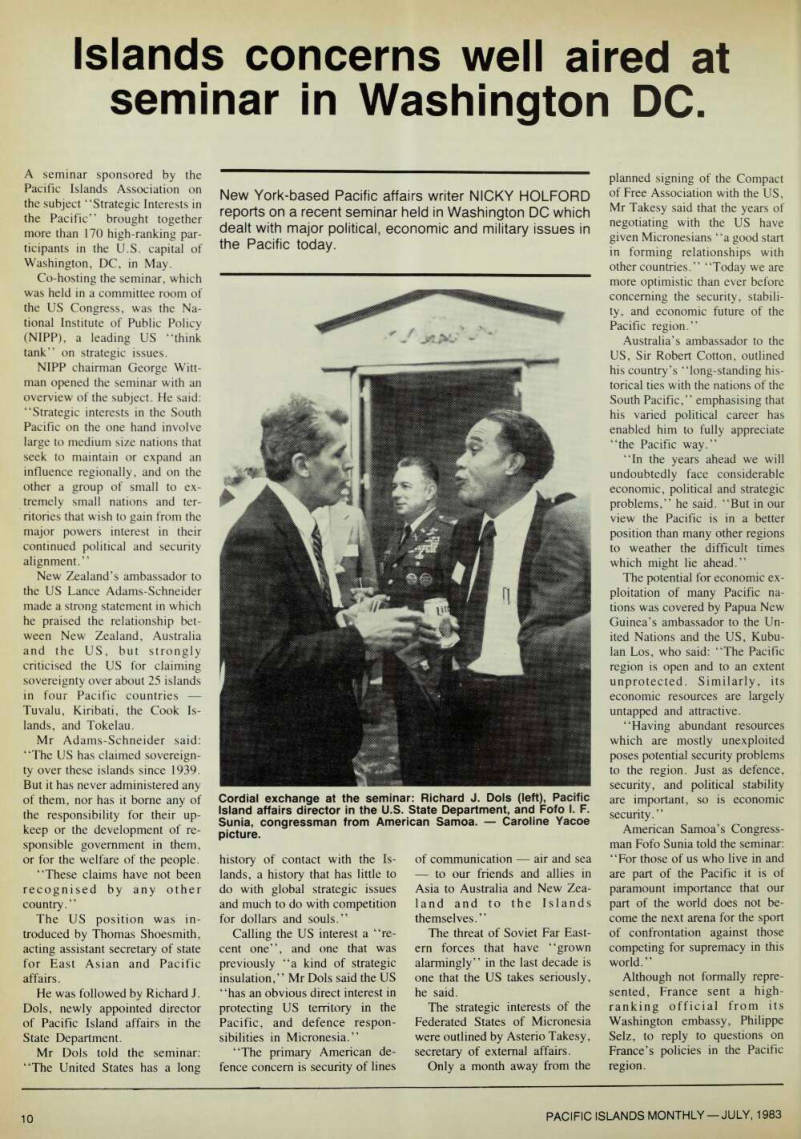
Cordial exchange at the seminar: Richard J. Dols (left), Pacific Island affairs director in the U.S. State Department, and Fofo I. F.
Sunia, congressman from American Samoa. - Caroline Yacoe picture.
Questions were directed to Counsellor Selz about the status of French territories in the South Pacific. “The general status of French territories in the South Pacific New Caledonia and French Polynesia is under review by the French Govern ment, and the future of these islands will be newly defined in a few weeks, maybe a month,’’ said Mr Selz.
When asked about continued nuclear testing in French Poly nesia, Mr Selz said he could not answer such questions until Paris had reviewed the situation.
The subject of nuclear testing and disposal of nuclear wastes dominated much of the question
and-answer period.
“We are sensitive to the nuc lear concerns of the Islands peo ples the same concerns are a matter of debate in our own
society,’’ said Richard Dols of
US policy.
“But to allow what began as opposition to nuclear testing to expand into an opposition to all things nuclear is only to decrease our common security.’’
Director of the Pacific Islands Association, Lelei Lelaulau of Western Samoa, explained the background to the seminar as follows: “Our purpose is not to take a political stance but to raise the level of attention given to Pacific Islands affairs by policy and decision makers at the high est level of the United States Government.
“This seminar has been our first tentative Washington ap proach. It has turned out to be a bold step towards greater under standing of the issues in our region. Nicky Holford in New York.
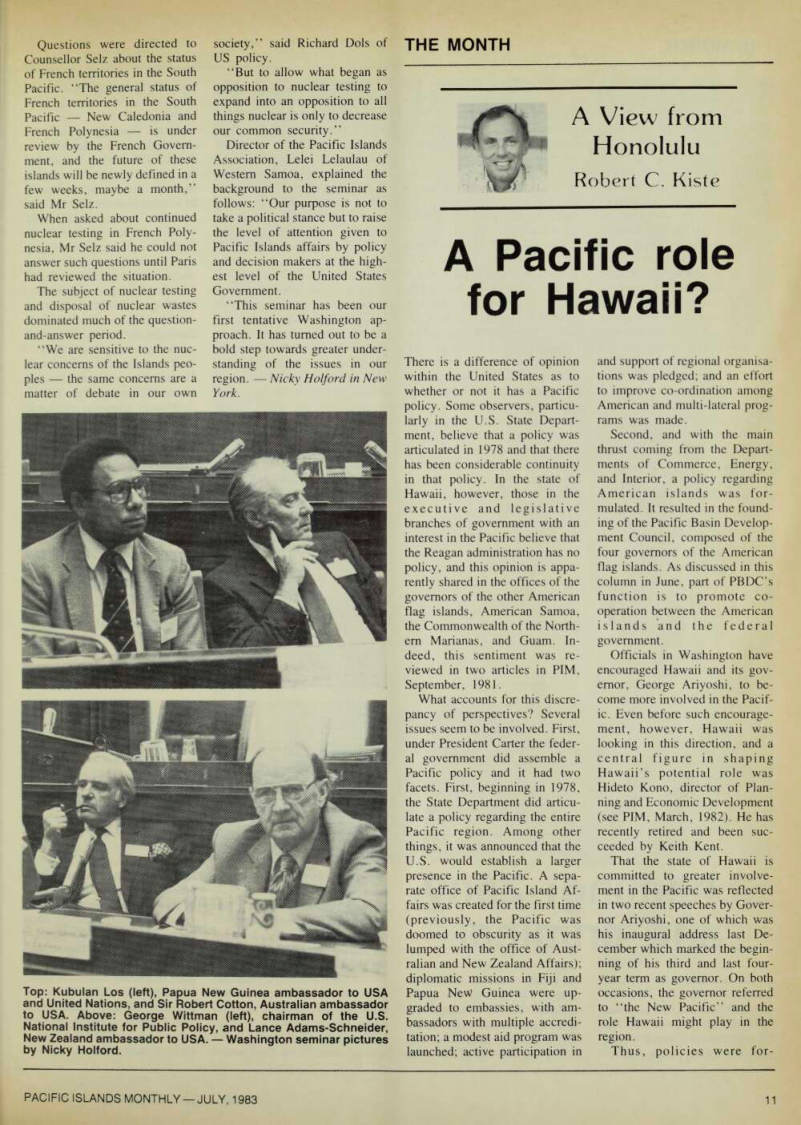
Top: Kubulan Los (left), Papua New Guinea ambassador to USA and United Nations, and Sir Robert Cotton, Australian ambassador to USA. Above: George Wittman (left), chairman of the U.S.
National Institute for Public Policy, and Lance Adams-Schneider, New Zealand ambassador to USA. - Washington seminar pictures by Nicky Holford.
for Hawaii?
The Month
A Pacific role for Hawaii?
There is a difference of opinion within the United States as to whether or not it has a Pacific policy. Some observers, particu larly in the U.S. State Depart ment, believe that a policy was articulated in 1978 and that there has been considerable continuity in that policy. In the state of Hawaii, however, those in the executive and legislative branches of government with an interest in the Pacific believe that the Reagan administration has no policy, and this opinion is appa rently shared in the offices of the governors of the other American flag islands, American Samoa, the Commonwealth of the North ern Marianas, and Guam. In deed, this sentiment was re viewed in two articles in PIM, September, 1981.
What accounts for this discre pancy of perspectives? Several issues seem to be involved. First, under President Carter the feder al government did assemble a Pacific policy and it had two facets. First, beginning in 1978, the State Department did articu late a policy regarding the entire Pacific region. Among other things, it was announced that the U.S. would establish a larger presence in the Pacific. A sepa rate office of Pacific Island Af fairs was created for the first time (previously, the Pacific was doomed to obscurity as it was lumped with the office of Aust ralian and New Zealand Affairs); diplomatic missions in Fiji and Papua New Guinea were up graded to embassies, with am bassadors with multiple accredi tation; a modest aid program was launched; active participation in
and support of regional organisa tions was pledged; and an effort to improve co-ordination among American and multi-lateral prog rams was made.
Second, and with the main thrust coming from the Depart ments of Commerce, Energy, and Interior, a policy regarding American islands was for mulated. It resulted in the found ing of the Pacific Basin Develop ment Council, composed of the four governors of the American flag islands. As discussed in this column in June, part of PBDC’s function is to promote co operation between the American islands and the federal government.
Officials in Washington have encouraged Hawaii and its gov ernor, George Ariyoshi, to be come more involved in the Pacif ic. Even before such encourage ment, however, Hawaii was looking in this direction, and a central figure in shaping Hawaii’s potential role was Hideto Kono, director of Plan ning and Economic Development (see PIM, March, 1982). He has recently retired and been suc ceeded by Keith Kent.
That the state of Hawaii is committed to greater involve ment in the Pacific was reflected in two recent speeches by Gover nor Ariyoshi, one of which was his inaugural address last De cember which marked the begin ning of his third and last four year term as governor. On both occasions, the governor referred to “the New Pacific” and the role Hawaii might play in the region.
Thus, policies were for
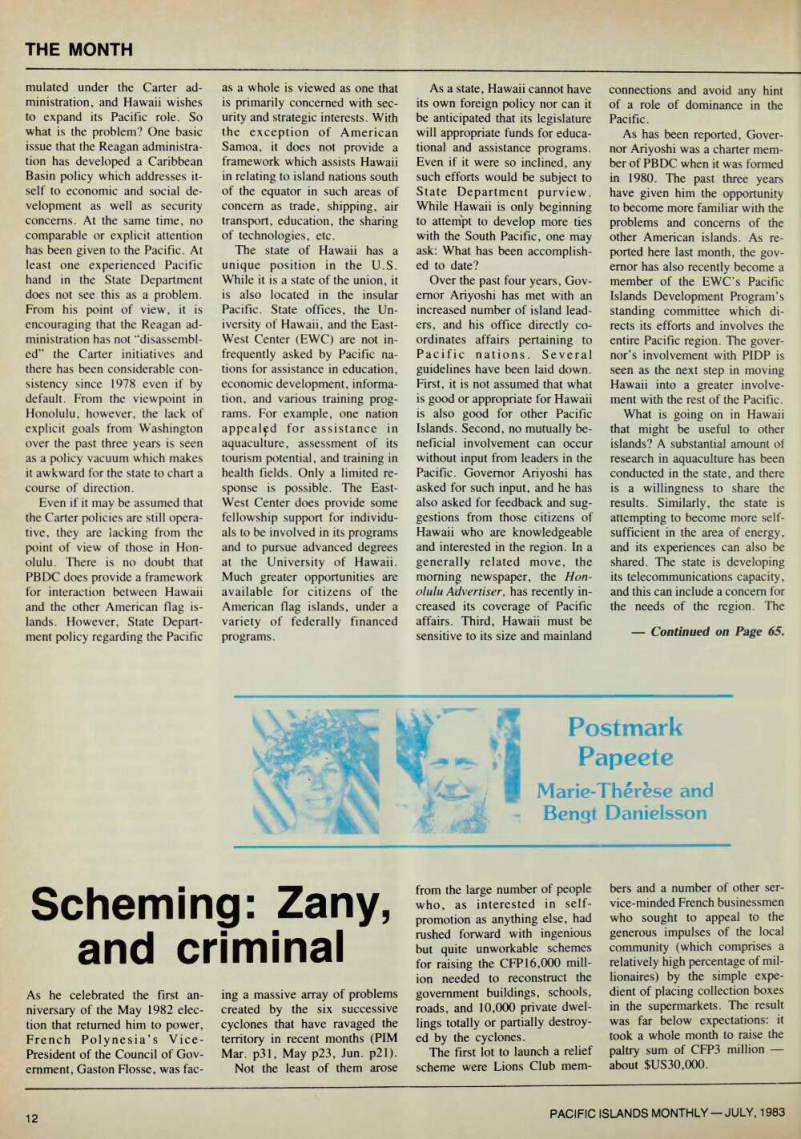
A View from Honolulu Robert C. Kiste
mulated under the Carter ad ministration, and Hawaii wishes to expand its Pacific role. So what is the problem? One basic issue that the Reagan administra tion has developed a Caribbean Basin policy which addresses it self to economic and social de velopment as well as security concerns. At the same time, no comparable or explicit attention has been given to the Pacific. At least one experienced Pacific hand in the State Department does not see this as a problem.
From his point of view, it is encouraging that the Reagan ad ministration has not “disassembl ed” the Carter initiatives and there has been considerable con sistency since 1978 even if by default. From the viewpoint in Honolulu, however, the lack of explicit goals from Washington over the past three years is seen as a policy vacuum which makes it awkward for the state to chart a course of direction.
Even if it may be assumed that the Carter policies are still opera tive, they are lacking from the point of view of those in Hon olulu. There is no doubt that PBDC does provide a framework for interaction between Hawaii and the other American flag is lands. However, State Depart ment policy regarding the Pacific
as a whole is viewed as one that is primarily concerned with sec urity and strategic interests. With the exception of American Samoa, it does not provide a framework which assists Hawaii in relating to island nations south of the equator in such areas of concern as trade, shipping, air transport, education, the sharing of technologies, etc.
The state of Hawaii has a unique position in the U.S.
While it is a state of the union, it is also located in the insular Pacific. State offices, the Un iversity of Hawaii, and the East- West Center (EWC) are not in frequently asked by Pacific na tions for assistance in education, economic development, informa tion, and various training prog rams. For example, one nation appealed for assistance in aquaculture, assessment of its tourism potential, and training in health fields. Only a limited re sponse is possible. The East- West Center does provide some fellowship support for individu als to be involved in its programs and to pursue advanced degrees at the University of Hawaii.
Much greater opportunities are available for citizens of the American flag islands, under a
variety of federally financed
programs.
As a state, Hawaii cannot have its own foreign policy nor can it be anticipated that its legislature will appropriate funds for educa tional and assistance programs.
Even if it were so inclined, any such efforts would be subject to State Department purview.
While Hawaii is only beginning to attempt to develop more ties with the South Pacific, one may ask: What has been accomplish ed to date?
Over the past four years, Gov ernor Ariyoshi has met with an increased number of island lead ers, and his office directly co ordinates affairs pertaining to Pacific nations. Several guidelines have been laid down.
First, it is not assumed that what is good or appropriate for Hawaii is also good for other Pacific Islands. Second, no mutually be neficial involvement can occur without input from leaders in the Pacific. Governor Ariyoshi has asked for such input, and he has also asked for feedback and sug gestions from those citizens of Hawaii who are knowledgeable and interested in the region. In a generally related move, the morning newspaper, the Hon olulu Advertiser, has recently in creased its coverage of Pacific affairs. Third, Hawaii must be sensitive to its size and mainland
connections and avoid any hint of a role of dominance in the Pacific.
As has been reported, Gover nor Ariyoshi was a charter mem ber of PBDC when it was formed in 1980. The past three years have given him the opportunity to become more familiar with the problems and concerns of the other American islands. As re ported here last month, the gov ernor has also recently become a member of the EWC’s Pacific
Islands Development Program’s
standing committee which di rects its efforts and involves the entire Pacific region. The gover nor’s involvement with PIDP is seen as the next step in moving Hawaii into a greater involve ment with the rest of the Pacific.
What is going on in Hawaii that might be useful to other islands? A substantial amount of research in aquaculture has been conducted in the state, and there is a willingness to share the results. Similarly, the state is attempting to become more self sufficient in the area of energy, and its experiences can also be shared. The state is developing its telecommunications capacity, and this can include a concern for the needs of the region. The
Continued on Page 65.
University of Hawaii is provid ing special training programs in the areas of health and medicine for students'from the American flag islands, \ and these programs might be fcade available to others. The promotion of island products in the state is mentioned as another possibility.
The concern for Pacific affairs in Hawaii is also found in the state legislature, particularly in the House of Representatives.
Clayton Hee has taken the mas ter’s degree in Pacific Islands Studies at the university. Byron Baker has had long interest in the area, and he is the author of the text in the photo-essay book Mic ronesia: The Breadfruit Revolu tion which appeared some years ago.
The most active on the scene is Fred Rohlfmg, House Minority Leader, former Attorney-General for American Samoa and current U.S. alternate delegate to the South Pacific Conference. In the first session of the Twelfth Legislature of the State of Hawaii which adjourned in late April, he successfully introduced a resolution which encouraged the U.S. Senate to ratify the treaties of friendship that were negotiated by former Ambas sador William Bodde with the Cook Islands, Kiribati, Tuvalu, and the Tokelau Islands and New Zealand during the Carter ad ministration and which, after re view, have been supported by President Reagan (PIM June, p 6).
All of this activity in Hawaii is
in its beginning stages and there is a vague quality about the lot of it. It is fair to say that Hawaii is groping to find a role in the Pacific, and it would like some clearer signals from the nation’s capital. Hawaii is a giant in the Pacific, and with all the best of intentions, there are substantial dangers involved. As state offi cials tend to the business of satisfying their own constituen cies and promoting the interests of Hawaii, it will be difficult to remain truly sensitive to the needs of small island states.
Also, there needs to be an awareness that there are consid erable reservations in the Pacific about a greater U.S. involve ment. Essentially, the policy in itiated in 1978 by the State De partment was a sign that Washington intended to play a greater role with its ANZUS partners Australia and New Zealand in promoting regional security in the Pacific. The very fact of a greater U.S. presence, whether Hawaii is part of it or not, can precipitate super-power rivalry in the region, a situation unwanted by the island states.
Lastly, the discussions about a greater role for Hawaii refer not only to insular island states but the larger Pacific Basin, and the latter is defined to include the giant rim countries of Japan, the People’s Republic of China, Taiwan, South Korea, etc. As Hawaii carves out a future in the Pacific and develops its econom ic and other ties with the rim countries the small island states are correct to fear that they will be the losers in the larger game.
Robert C. Kiste.
Scheming: Zany,
and criminal
As he celebrated the first anniversary of the May 1982 election that returned him to power, French Polynesia’s Vice- President of the Council of Govemment, Gaston Flosse, was fac-
ing a massive array of problems created by the six successive cyclones that have ravaged the territory in recent months (PIM Mar. p3l, May p 23, Jun. p2l).
Not the least of them arose
from the large number of people who, as interested in self promotion as anything else, had rushed forward with ingenious but quite unworkable schemes for raising the CFPI6,OOO mill ion needed to reconstruct the government buildings, schools, roads, and 10,000 private dwel lings totally or partially destroy ed by the cyclones.
The first lot to launch a relief scheme were Lions Club mem
bers and a number of other ser vice-minded French businessmen who sought to appeal to the generous impulses of the local community (which comprises a relatively high percentage of mil lionaires) by the simple expe dient of placing collection boxes in the supermarkets. The result was far below expectations: it took a whole month to raise the paltry sum of CFP3 million about SUS3O,OOO.
Postmark Papeete Marie-Thérèse and Bengt Danielsson
For his part Senator Daniel Millaud (who was elected by the former Autonomist majority headed by Francis Sanford) counted on the spirit of “national solidarity’’ which the French people are supposed to harbor towards their compatriotes over seas. To stir their emotions, he secured from Papeete’s TV ser vice a number of newsreel films showing the awful cyclone dam age, and flew off with them to France to arrange their nation wide distribution.
Unfortunately, the campaign backfired. The few donations that came in were mainly from metropolitan Opposition leaders like the Gaullist Mayor of Paris Jacques Chirac, who did not miss the splendid opportunity present ed by the occasion to make snide remarks about the indifference of the ruling socialist majority.
There were also messages of sympathy from four former gov ernors and high commissioners of French Polynesia but no money.
What is more, the Hiroshima like images of a paradise turned into a hell scared many people who had planned a holiday in Tahiti this year so badly that they immediately cancelled their bookings. In the end the local tourist authority had to mount a counter-offensive in the French media, saying that temporary visitors would find the same beautiful beaches and lovely vahine as usual.
Our Number One Crooner, Gabilou, who has made quite a name for himself in the USA, was convinced that the American people would be more generous, and set as his modest goal a campaign to persuade each and every one of them to part with a dollar apiece. The only trouble with this simple scheme to raise SUS22B million was that in order to launch it the local authorities would have to spend huge sums on US TV and radio time, as well as space in the leading US news papers which they wisely re fused to do.
A slightly more realistic plan, hatched by the territory’s Deputy Jean Juventin called for the French Parliament to launch a national appeal.
But the parliamentary machine was so slow in producing the
required piece of legislation that by the time it came France itself had suffered flood disasters of such magnitude that the cyclone damage in French Polynesia was all but forgotten.
All this left the CFPI6,OOO million bill still firmly in the deft hands of Gaston Flosse. Un daunted, he set up a special relief agency, and, as a stopgap mea sure, slapped new taxes on the earnings of the big commercial
companies, and on beer (three francs per bottle or can, an im post which will produce CFP6O million a year). At the same time he sought a CFP3SOO million loan at two per cent interest from the French Government, repay able over 20 years. This was designed to defray relief costs at least until the end of the year.
The only piece of pruning to meet with serious opposition was the cancellation of the CFP4O
million subsidy for the forthcom ing TIURAI (July 14) celebra tions. The subsidy is mainly ear marked for cash prizes to be paid
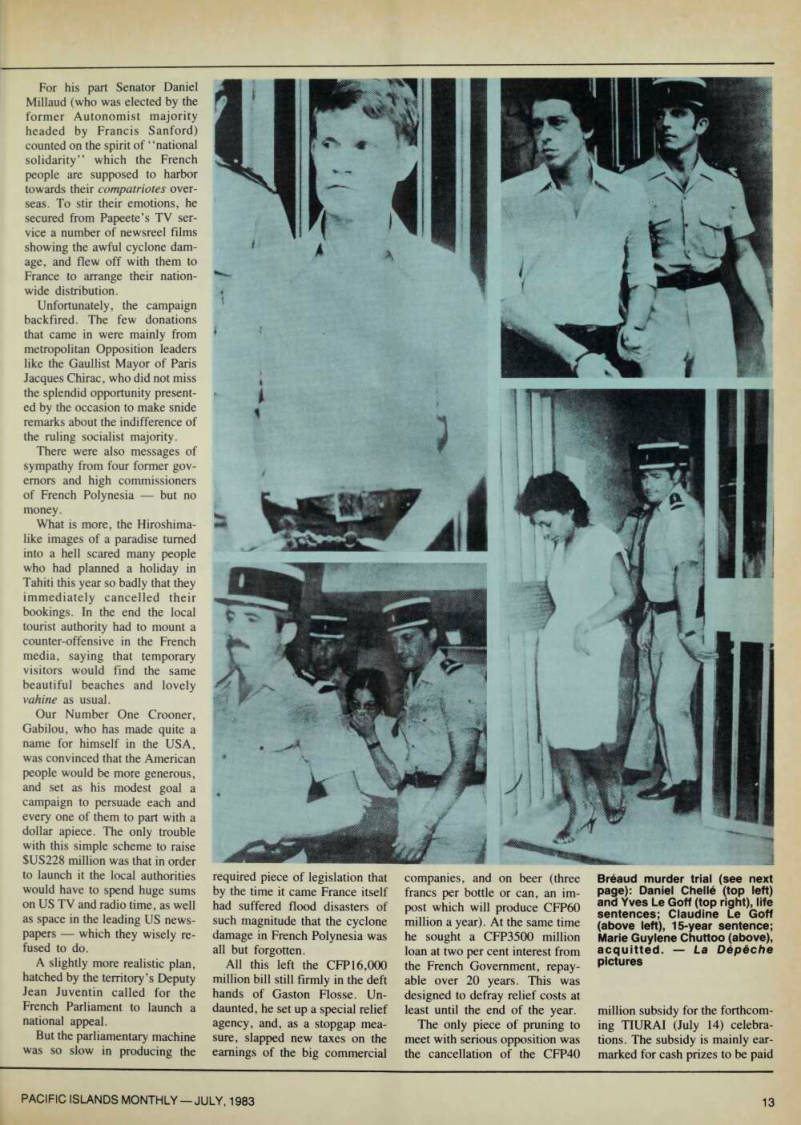
Bréaud murder trial (see next page): Daniel Chellé (top left) and Yves Le Goff (top right), life sentences; Claudine Le Goff (above left), 15-year sentence; Marie Guylene Chuttoo (above), acquitted. - La Dépêche pictures
to all and sundry who perform some of them of very dubious talent. Not surprisingly, this cooled the patriotic fervor of a great number of dancers, musi cians and singers, who announc ed either that they were no longer interested in the celebrations or that they were migrating to the greener fields of the hotels and nightclubs of Honolulu. This could well turn out a blessing, since the TIURAI celebrations have gradually lost what used to be their special charm: the spon taneous warmth and merriment
of happy Polynesian fishermen
and farmers who took great de light in coming to Papeete once a year to defend the honor of their small and distant home islands.
For one short week at the end of May all the “trials” described above were forgotten as the be lated trial of the brutal murders of Olivier Breaud, got underway.
Olivier Breaud, the son of weal thy French banker Jean Breaud, was murdered in March 1980 (PIM May ’BO pl 7, Jun ’BO, p 19).
Why it took the examining magistrate three long years to gather his evidence is extremely hard to understand, considering the clear guilt of the two French carpet-baggers Yves Le Goff and Daniel Chelle, who had committ ed the fourfold crime of kidnap ping, illegal detention, torture and murder.
The most commonly heard ex planation in official circles is that long promised and essential re forms in the whole old
fashioned, colonial-type judicial
system were in the offing, and that it was better for all concern ed to wait until they were imple mented (PIM Aug ’7B p 29).
More malicious private gossip
had it that the many postpone ments of the trial were due to the politically explosive nature of the revelations which the murderers would be able and willing to make. For example, they had been on very friendly terms with persons working in the office of Vice-President Francis Sanford.
These people had helped them to get loans of up to CFP6O million to launch a textile venture, which was a transparent swindle. And had not these same people been guests at the lively sex orgies put on by the killers’ wives (both
legal and de facto), who also ran a massage parlor based on the Oriental model?
Whatever the reasons for this
extraordinarily long delay, it de
finitely worked to the killers’ advantage. For while the case was in limbo, the new Socialist government in France had abol ished the death penalty (despite the fact that opinion polls showed that two-thirds of the French people were in favor of
retaining it).
Since it was a foregone con clusion that the two would get life sentences, there is no doubt that it was the expected airing of lurid details that drew huge crowds to the court hearings, which lasted four full days, from May 17 to 20. For those who were licking their lips in antici pation of juicy scandals, howev er, the trial was a terrible disap pointment: the names of only a
few smallfry politicians were
mentioned, and, worse still, the so-called sex orgies turned out to be of very poor quality. This was
proved by the color pictures
which had been conveniently mounted in albums by the mur derers, no doubt with the aim of
blackmailing the people portray
ed in them.
But the real revelation of the trial was the monstrous and thoroughly evil character of the mastermind behind the scheme, Yves Le Goff, who, incidentally, had already committed another murder in France he shot his mother-in-law been sentenced to an eight-year-old term, and been given back his freedom after only six years as a reward
for “good behavior”. . .
The charges ran to 62 pages and took two and a half hours to read out. They recounted in grue some detail how Le Goff and Chelle had captured Olivier Breaud in order to extract a ran som of $2 million from his pa rents, but then got so scared by
the ensuing police hunt that they
clubbed him to death, breaking both his arms and his legs before crushing his skull. Their attempt to dispose of their victim by dousing him with petrol and set ting him on fire failed miserably.
The charred body, hastily hidden in a creek near Le Goff’s luxuri ous villa, was the ultimate proof of their guilt.
But they still had the perverse satisfaction of hearing an anatomist, called in as an expert, explain that the exposure to fire may have been responsible for some of the broken bones that the police thought had been smashed by the sadistic murderers.
Throughout the trial, the two men showed not the slightest sign of remorse. In the most despicable manner, each accused the other of beating Breaud to death. Even their own lawyers became so exasperated that they shouted at them to tell them that their only hope of getting any lightening of their sentences was to tell the truth. But it was all in vain.
As for Mrs Claudine Le Goff, and Daniel Chelle’s constant companion, a Mauritian girl with the unlikely name of Marie Guy lene Chuttoo, the court had much greater difficulty in ascertaining the exact extent of their partici pation in the crime.
Mrs Le Goff eventually ad mitted that she had made the phone call to Olivier Breaud (posing as a former schoolmate) that lured him into death trap.
But the Mauritian girl kept on protesting her innocence, even though she had been present in Le Goff’s villa on the day of the crime, and obligingly looked af ter the couple’s children when Breaud’s body was taken away and hidden.
When all was said and done by the accused, the witnesses, and the eight lawyers engaged for the case, Le Goff and Challe got life sentences, just as everyone had
expected from the start. Mrs Le Goff got a 15-year term, and Marie Guylene Chuttoo, whose involvement seems to have been of the same order, was acquitted.
The lawyers for Le Goff and Challe immediately asked the French appeal court to quash the sentence and order a retrial in France. The grounds invoked were exactly the same as in sev eral recent court cases in Papeete involving Tahitian freedom fighters the unconstitutional maintenance in French Pacific colonies of a special judicial sys tem which is unfair to the na tives, who legally are French citizens (PIM ’79 p 29). What the condemned killers can reason ably hope is that less outraged and concerned French jurors will show a greater degree of clemen cy than could be hoped for in Papeete, the scene of their crime.
Whatever the outcome of the retrial may be, this sordid affair has served the useful purpose of highlighting the nefarious effects
of present immigration policies.
Even at the time when poor Olivier Breaud was kidnapped, the Tahoeraa party leader, Gas ton Flosse, asked the then minis ter for the French overseas ter ritories, Paul Dijoud, why so many French criminals were al lowed to settle in Tahiti (PIM Jun ’BO pi 9). The minister replied lamely that a former criminal who had freedom of movement in France could also settle in any
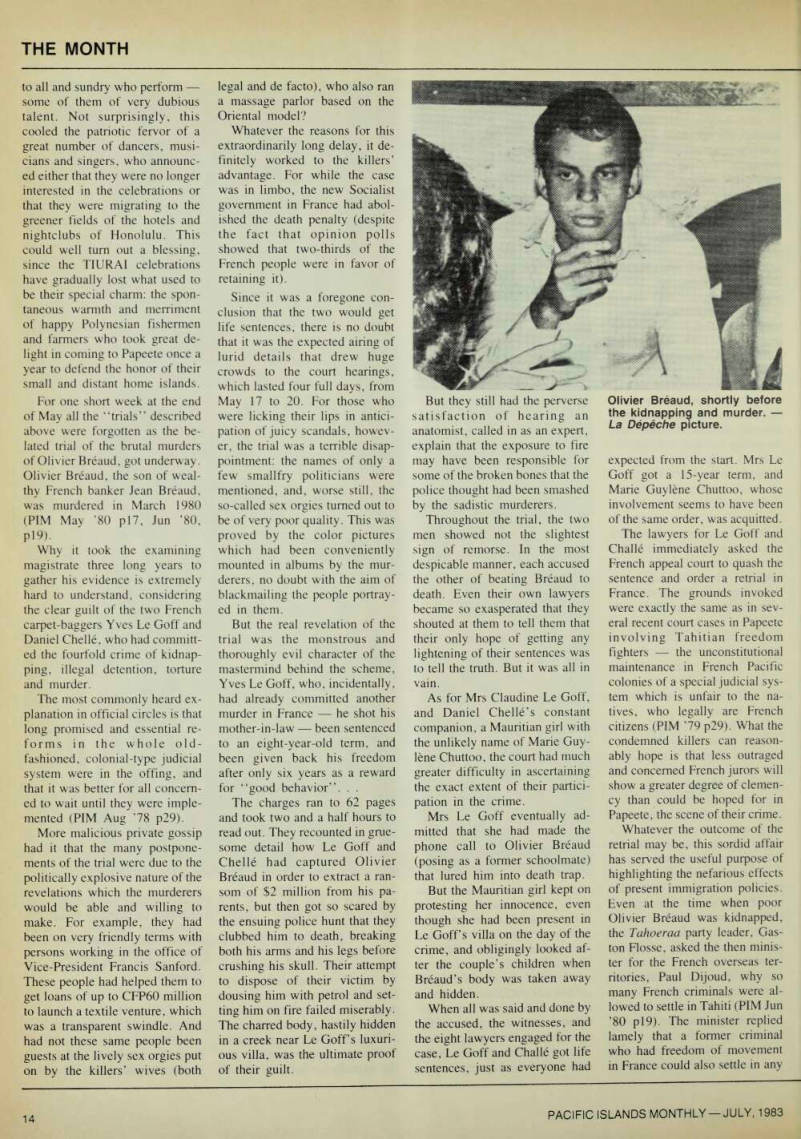
Olivier Bréaud, shortly before the kidnapping and murder. - La Dépêche picture.
overseas territory, since they are integral parts of the French Republic.
This reply did not satisfy Flos se or any other Polynesian political leader for that matter.
He has since hardened his posi tion to the point of including in his present draft of a new con stitution for French Polynesia a paragraph transferring responsi bility for immigration from the French police to the local Poly nesian government.
However, what worries him and other local leaders today is not so much the occasional im migrant with a criminal record as the steadily swelling tide of ordi nary honest Frenchmen who come to Tahiti in quest of
paradise.
Well, many of the 25,000 new settlers also hail from the former French colonies in Africa and Asia. (For instance, the Chuttoo tribe was'imported from Mauritius by a former governor
and his wife, who were fed up with lazy Polynesian servants).
This is why there is a growing and justified fear among the Polynesians that they will one day become a minority group in their own country, exactly as the Melanesians have in New Caledonia where they are out numbered by the French and other Pacific Islanders.
The timing seemed perfect, therefore, when, right in the mid dle of the Breaud trial, the pre
sent minister for overseas ter ritories, Georges Lemoine, stepped off the plane on his way home from Noumea to continue negotiations with local leaders for a new constitution, negotia tions which had been broken off for the duration of the cyclone season.
But, sad to relate, the minister had not a word to say about this
crucial immigration problem.
Marie -Therese and Bengt Danielsson.
Lemoine cools

it - for now
As New Caledonians waited tensely for the mid-May visit of the Minister for Overseas Ter ritories Georges Lemoine, a fatal shooting in the northwest spark ed off a round of angry demonst
rations by the Independence
Front and the Palika Party.
On May 11, Louis Poitchily, 31, a member of the revolutio nary socialist Palika Party, was shot dead at Temala village, 320 kilometres northwest of Noumea. Poitchily was killed af ter an argument between four Kanaks and a European outside the village store. A 47-year-old
European, Alphonse Sauvageot,
later gave himself up to police.
In retaliation for the shooting, a larger group of Kanaks then burnt five buildings in the vil lage, including the post office and the store, as well as two cars.
Police had arrived at the scene but were forced to leave for reinforcements. Before burning the buildings, the Kanak group had first thrown rocks at the houses. A woman and two chil dren were reported to be slightly
injured by the rocks.
News of the shooting which amazingly was first reported on local TV as concerning a diffe rent man produced a quick reaction from Independence Front and Palika members. Sev eral hundred Independentists marched that night through Noumea streets, and then held a sit-in in front of the French High Commission, protesting against what they termed “yet another assassination”.
Central Noumea walls and footpaths were extensively spray-painted with protest slogans.
The following day, as Inde pendence Front members demon strated through Noumea and in the interior, Kanaks from Temala and neighboring villages carried Poitchily’s coffin through the streets of Voh, the nearby town.
The burial of Poitchily that afternoon without a death certifi cate or an autopsy posed prob lems for the French judicial sys tem. The family of the dead man had refused permission for the
authorities to enter the tribe and examine the body. A spokesman for the family said: “An autopsy won’t bring him back to life and we are fed up with French justice.’’
Independence Front leaders organised another demonstra tion, of 1000 people, in Noumea on Friday, May 13, as well as smaller ones in the countryside.
The French prosecutor told re porters that Mr Sauvageot, un employed since being laid off by the nickel company SEN, had admitted the killing. He said that an alcohol reading of 0.239 was taken from Sauvageot two hours after the shooting.
After appearing briefly in Noumea’s court to be charged with wilful homicide, Sauvageot was sent to Noumea’s jail Camp Est, pending trial.
Two weeks later, after discreet negotiations between the au thorities, the Poitchily family and Palika, the body was ex humed and an autopsy conducted within the Temala tribe and in the presence of representatives from neighboring tribes.
For the arrival on May 19 of Georges Lemoine, more than half of New Caledonia’s adult population turned out to demons trate their feelings for and against the independence issue. A senior police officer estimated that
25,000 members of anti independence groups marched through Noumea before assembl ing in Noumea’s central park the Place des Cocotiers. En route they delivered a motion to the French High Commission, cal ling for the dissolution of the Territorial Assembly and for new elections in the territory. They claim the Independence Front- Centre party coalition in local power is not representative of the majority. (The Centre party changed sides in June last year and the next elections are not due until July 1984).
For the Independence Front and Palika demonstration, police estimated 7000 to 8000, and again demonstrations also oc curred in country towns. The Independentists marched through Noumea streets and later leaders handed the French High Com mission a motion asking France to set a timetable for independ ence, with autonomy as the first step. The motion also called on France to recognise the legitima cy of the Kanak people as the first occupants of New Caledonia.
At one stage, as the opposing demonstrators assembled at either end of the Place des Cocotiers, they passed within yards of each other. Three squads of riot police successfully
Noumea Notebook Helen Fraser
kept the two groups apart and there were no incidents. Both demonstrations had well or ganised marshals of their own and leaders had called on their supporters not to respond to any provocation. But Mr Lemoine, whose plane arrived three hours late, was taken to the French High Commission by helicopter, where he met political leaders in the afternoon.
On Thursday, May 19, Mr Lemoine visited the interior of New Caledonia and personally experienced the New Caledonian reality that of a vocal and determined anti-independence movement, and, on the other hand, an equally determined pro independence force, with very little middle ground.
During his helicopter trip around the countryside Mr Lemoine visited development projects, farms, schools, war memorials etc. At Poindimie on the east coast, 100 members of Palika demonstrated during the minister’s visit. As Mr Lemoine approached the leader, he de manded to know if the minister really thought the land he was standing on belonged to France.
To shouts from the demon strators of “Reply . . . reply . . Mr Lemoine reflected for
some time before walking away in silence.
When Mr Lemoine crossed to Bourail on the west side of New Caledonia’s main island he found among the welcoming crowd a demonstration of several hun dred. The welcome speech of Bourail’s Centre party mayor was interrupted by abuse and heckling, and calls for New Caledonia to remain French. As the minister left the town hall the noisy group shouted “Reply to us . . . ’ ’ and followed him as he toured the town. Bourail mayor Jean-Pierre Aifa (who is also Speaker of the Territorial Assem bly) later described the behavior of the demonstrators as disgust ing, and said they were people from Noumea not Bourail.
But the long-awaited event was the speech given by Mr Lemoine before the assembly on Friday, May 20, concerning French intentions for the territ ory. However, to the packed and well-guarded assembly, the minister made a “solemn call for responsibility’’ and said that Caledonians must sort out their problems.
The speech, which was broad cast live by local TV and radio, offered something to both sides: for the Independence Front, re
cognition by France of the legiti macy of the Kanak people as New Caledonia’s first occupants, and a guarantee for anti independence forces that all in habitants (except itinerants) would be consulted on the territ ory’s future.
Such a consultation would al most certainly lead to an anti independence vote. The 60,000 Kanaks have become a minority (43 per cent) in their own land in recent decades due to France’s encouragement of immigration to the territory and heavy settlement after colonisation in 1853. There are 80,000 white, Polynesian and Asian settlers in the territory.
On the question of self determination the minister said “France rejects no hypothesis, including independence”, but that all communities would de cide this issue. “If New Caledonia decides one day to become a nation it will be be cause Caledonians themselves have decided to do so and not because the French government decreed it,” he said. In a message to extremists from either side, Mr Lemoine told the assembly that France was determined to maintain law and order and would tolerate no further violence.
The minister also invited New Caledonian political leaders to come to Paris at the end of June for discussions on the proposed statute of autonomy. After the speech the leader of the anti independence republican party (RPCR), Jacques Lafleur said he was “very satisfied’’ with its contents. “For the first time in the past two years the legitimate rights of all communities in New Caledonia have been recog nised,’’ he said.
However, Mr Lafleur is a moderate harder-line anti independence leaders were said to be most displeased with the speech. The Centre party (FNSC) also welcomed the speech. Their leaders said they had waited a long time to hear talk of dialogue and consensus.
In a cooler response, the Inde pendence Front said the speech was made only to appease the population, and that it “categor ically denies colonisation as the indisputable source of the present situation”.
The brief statement added that the minister’s words “cultivated ambiguity, and offered no guarantee for the future in disre garding the Kanak people’s ina lienable right to recover their
sovereignty”.
Helen Fraser.
Advertisements & other items, p. 16 (1 item)
Suzuki
III!
m
the name of performance.
SJ4ID Metal-Top
SUZUKI Vehicles are shipped to approximately
100 countries throughout the world and are well received by users in those countries.
Behind the high-quality of SUZUKI
4-wheelers is the in-depth research
carried out from all aspects, rigorous
tests and an extensive after-sales
service network Vehicles that are ready
when you need them and which you can
trust when driving. SUZUKI Vehicles.
Stripe tape and free-wheel-hubs are optional. 4-Door 4 r , ; Photo: Canvas *■ umm
PAPUA NEW GUINEA . PNG MOTORS
GUAM & SAIPAN ISLAND CYCLERY, INC.
FIJI NIRANJANS AUTOPORT LTD.
SOLOMON ISLANDS . . . SOLOMON ISLAND SERVICE STATION LTD.
NEW CALEDONIA STE. SUPERCAL
VANUATU HENRI LEROUX
NIUE ISLAND BURNS PHILP (SOUTH SEA) CO., LTD.
TAHITI NIPPON AUTOMOTO
NORFOLK MARTIN’S AGENCIES LTD.
SAMOA PACIFIC PRODUCTS, INC.
TONGA PACIFIC PRODUCTS, INC.
NAURU EQUAPAC MOTORS
KIRIBATI KIRIBATI CO-OPERATIVE WHOLESALE SOCIETY LIMITED
RAROTONGA . . . AUTO HOLDINGS LTD.
SUZUKI MOTOR CO., LTD
SUZUKI
300 Takatsuka, Hamamatsu, Japan Since 1955, a world leader in mini-vehicles. 1
SUZUKI I
Marianas: The ‘other’ Micronesia
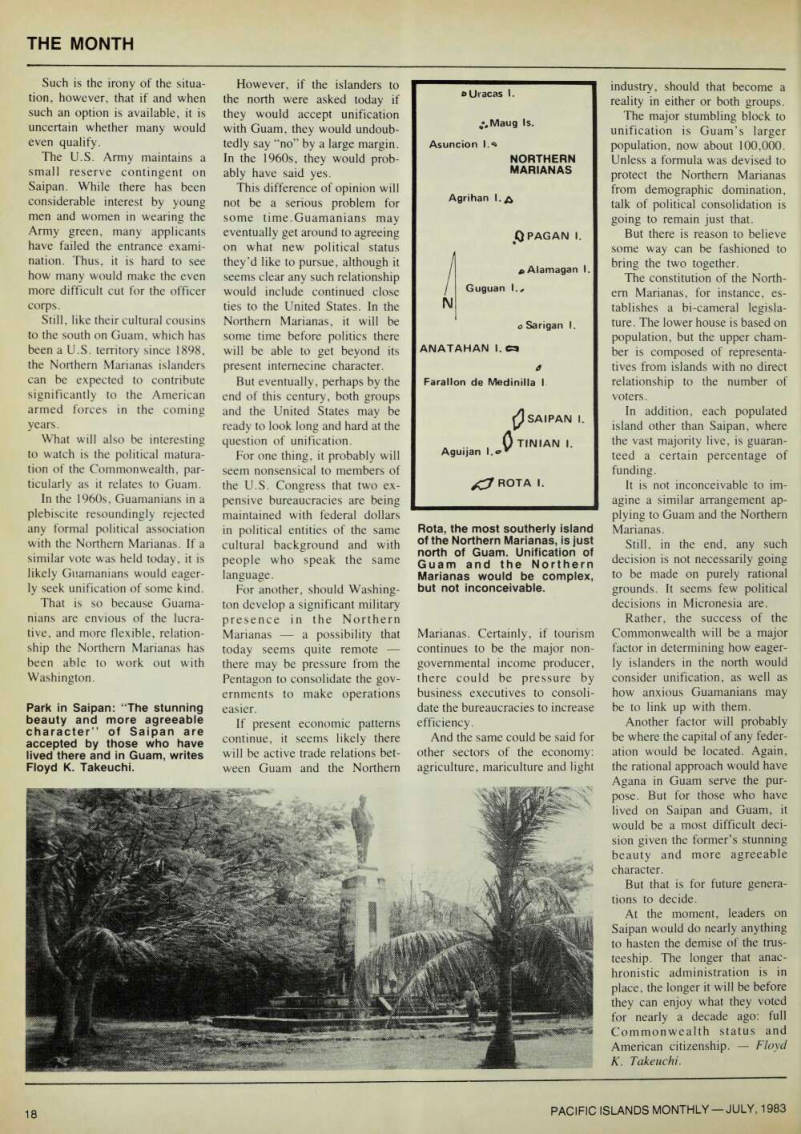
‘other’ Micronesia
It is not surprising that one as sociates the term “Micronesia” these days with the island gov ernments on the road to free association: Palau, the Marshall Islands and the Federated States
of Micronesia have dominated the news in recent months.
But tucked away in the north west comer of the Trust Territory is the Northern Marianas which stretch from Rota in the south to
Farallon de Pajaros in the north.
The group, and its approxi mately 17,000 inhabitants, are something of a political anoma ly. They are unabashedly pro- American, so much so that one of the hot issues there has been whether local residents can soon become officers in the United States military.
At present, Northern Marianas residents are eligible to serve in the enlisted ranks. But until the
group achieves “full” U.S. com monwealth status that is, when the trusteeship is ter minated the highest rank a young man or woman from those islands could hope to achieve is sergeant.
It is an indication of how seriously the United States wants to keep the soon-to-be Common wealth happy that efforts are underway to find the means to open commissioned ranks.
Notes from the North Floyd K. Takeuchi on Micronesia
Such is the irony of the situa tion, however, that if and when such an option is available, it is uncertain whether many would
even qualify.
The U.S. Army maintains a small reserve contingent on Saipan. While there has been considerable interest by young men and women in wearing the
Army green, many applicants
have failed the entrance exami nation. Thus, it is hard to see how many would make the even more difficult cut for the officer corps.
Still, like their cultural cousins to the south on Guam, which has been a U.S. territory since 1898, the Northern Marianas islanders can be expected to contribute significantly to the American armed forces in the coming years.
What will also be interesting to watch is the political matura tion of the Commonwealth, par ticularly as it relates to Guam.
In the 19605, Guamanians in a
plebiscite resoundingly rejected
any formal political association with the Northern Marianas. If a similar vote was held today, it is likely Guamanians would eager ly seek unification of some kind.
That is so because Guama nians are envious of the lucra tive, and more flexible, relation ship the Northern Marianas has been able to work out with
Washington.
However, if the islanders to the north were asked today if they would accept unification with Guam, they would undoub tedly say “no” by a large margin.
In the 19605, they would prob ably have said yes.
This difference of opinion will not be a serious problem for some time. Guamanians may eventually get around to agreeing on what new political status they’d like to pursue, although it seems clear any such relationship would include continued close ties to the United States. In the Northern Marianas, it will be some time before politics there will be able to get beyond its present internecine character.
But eventually, perhaps by the
end of this century, both groups and the United States may be ready to look long and hard at the question of unification.
For one thing, it probably will seem nonsensical to members of the U.S. Congress that two ex
pensive bureaucracies are being
maintained with federal dollars in political entities of the same cultural background and with people who speak the same
language.
For another, should Washing ton develop a significant military presence in the Northern Marianas a possibility that
today seems quite remote
there may be pressure from the Pentagon to consolidate the gov ernments to make operations easier.
If present economic patterns continue, it seems likely there will be active trade relations bet ween Guam and the Northern
Marianas. Certainly, if tourism continues to be the major non
governmental income producer,
there could be pressure by business executives to consoli date the bureaucracies to increase
efficiency.
And the same could be said for other sectors of the economy:
agriculture, mariculture and light
industry, should that become a reality in either or both groups.
The major stumbling block to unification is Guam’s larger population, now about 100,000.
Unless a formula was devised to protect the Northern Marianas from demographic domination, talk of political consolidation is going to remain just that.
But there is reason to believe some way can be fashioned to
bring the two together.
The constitution of the North ern Marianas, for instance, es tablishes a bi-cameral legisla ture. The lower house is based on population, but the upper cham ber is composed of representa tives from islands with no direct relationship to the number of voters.
In addition, each populated island other than Saipan, where the vast majority live, is guaran teed a certain percentage of
funding.
It is not inconceivable to im agine a similar arrangement ap plying to Guam and the Northern Marianas.
Still, in the end, any such decision is not necessarily going to be made on purely rational grounds. It seems few political decisions in Micronesia are.
Rather, the success of the Commonwealth will be a major factor in determining how eager ly islanders in the north would consider unification, as well as how anxious Guamanians may be to link up with them.
Another factor will probably be where the capital of any feder ation would be located. Again, the rational approach would have Agana in Guam serve the pur pose. But for those who have lived on Saipan and Guam, it would be a most difficult deci sion given the former’s stunning beauty and more agreeable character.
But that is for future genera tions to decide.
At the moment, leaders on
Saipan would do nearly anything
to hasten the demise of the trus teeship. The longer that anac hronistic administration is in place, the longer it will be before they can enjoy what they voted for nearly a decade ago: full Commonwealth status and
American citizenship.
Floyd
K. Takeuchi.
Park in Saipan: “The stunning beauty and more agreeable character” of Saipan are accepted by those who have lived there and in Guam, writes Floyd K. Takeuchi.
Rota, the most southerly island of the Northern Marianas, is just north of Guam. Unification of Guam and the Northern Marianas would be complex, but not inconceivable.
Culture clash
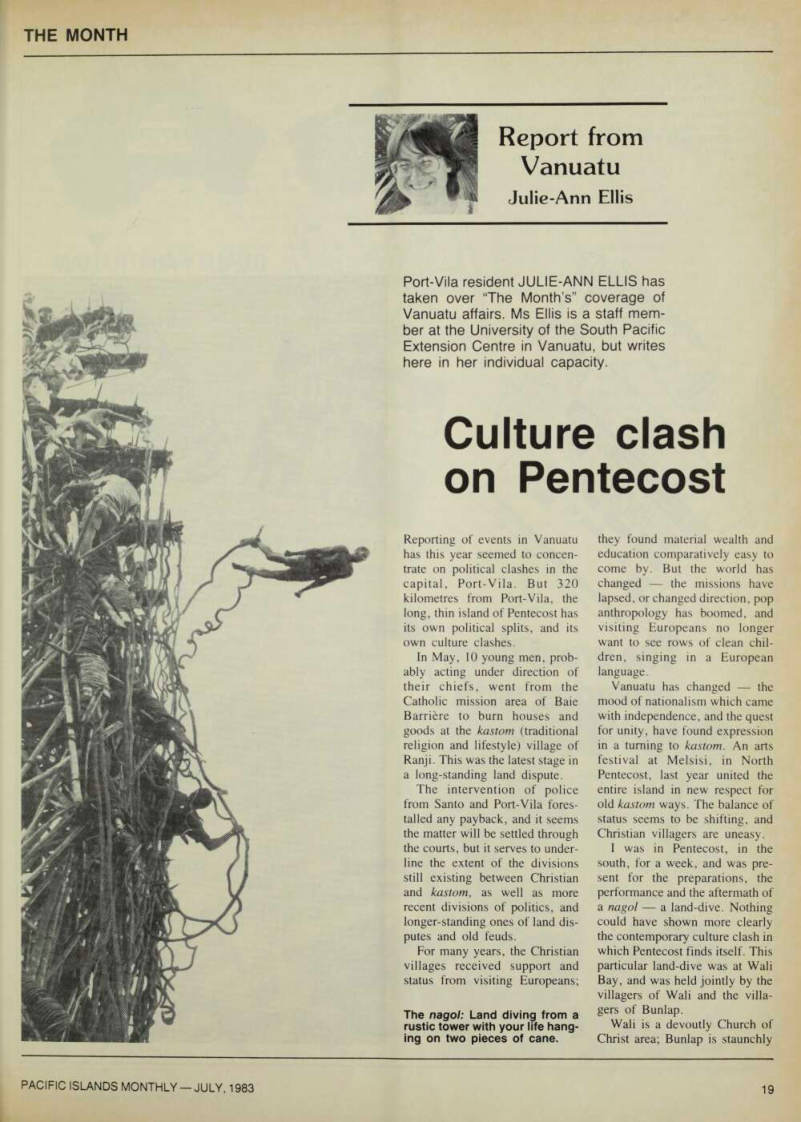

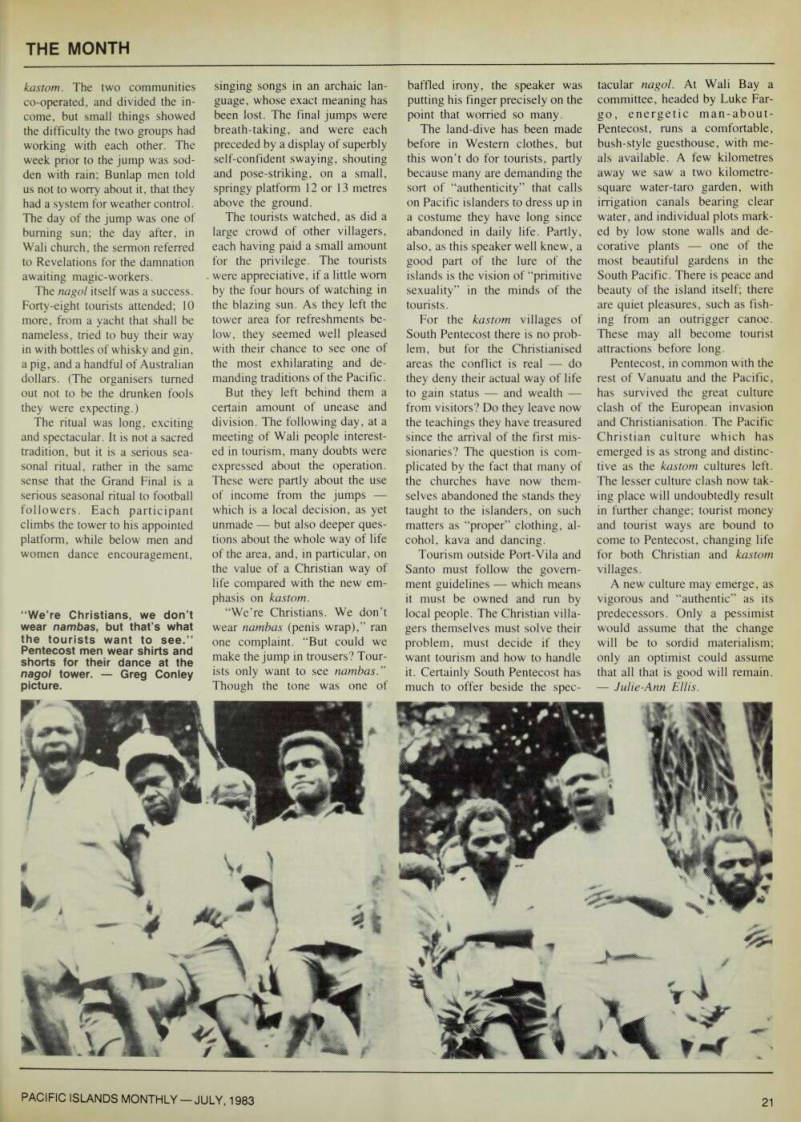
on Pentecost
Port-Vila resident JULIE-ANN ELLIS has taken over “The Month’s” coverage of Vanuatu affairs. Ms Ellis is a staff mem ber at the University of the South Pacific Extension Centre in Vanuatu, but writes here in her individual capacity.
Reporting of events in Vanuatu has this year seemed to concen trate on political clashes in the capital, Port-Vila. But 320 kilometres from Port-Vila, the long, thin island of Pentecost has its own political splits, and its own culture clashes.
In May, 10 young men, prob ably acting under direction of their chiefs, went from the Catholic mission area of Baie Barriere to burn houses and goods at the kastom (traditional religion and lifestyle) village of Ranji. This was the latest stage in a long-standing land dispute.
The intervention of police from Santo and Port-Vila fores talled any payback, and it seems the matter will be settled through the courts, but it serves to under line the extent of the divisions still existing between Christian and kastom, as well as more recent divisions of politics, and longer-standing ones of land dis putes and old feuds.
For many years, the Christian villages received support and status from visiting Europeans;
they found material wealth and education comparatively easy to come by. But the world has changed the missions have lapsed, or changed direction, pop anthropology has boomed, and visiting Europeans no longer want to see rows of clean chil dren, singing in a European language.
Vanuatu has changed the mood of nationalism which came with independence, and the quest for unity, have found expression in a turning to kastom. An arts festival at Melsisi, in North Pentecost, last year united the entire island in new respect for old kastom ways. The balance of status seems to be shifting, and Christian villagers are uneasy.
I was in Pentecost, in the south, for a week, and was pre sent for the preparations, the performance and the aftermath of a nagol a land-dive. Nothing could have shown more clearly the contemporary culture clash in which Pentecost finds itself. This particular land-dive was at Wali Bay, and was held jointly by the villagers of Wali and the villa gers of Bunlap.
Wali is a devoutly Church of Christ area; Bunlap is staunchly
Report from Vanuatu Julie-Ann Ellis
The nagol: Land diving from a rustic tower with your life hang ing on two pieces of cane.
kastom. The two communities co-operated, and divided the in come, but small things showed the difficulty the two groups had working with each other. The week prior to the jump was sod den with rain; Bunlap men told us not to worry about it, that they had a system for weather control.
The day of the jump was one of burning sun; the day after, in Wali church, the sermon referred to Revelations for the damnation
awaiting magic-workers.
The nagol itself was a success.
Forty-eight tourists attended; 10 more, from a yacht that shall be nameless, tried to buy their way in with bottles of whisky and gin, a pig, and a handful of Australian dollars. (The organisers turned out not to be the drunken fools
they were expecting.)
The ritual was long, exciting and spectacular. It is not a sacred tradition, but it is a serious sea sonal ritual, rather in the same sense that the Grand Final is a serious seasonal ritual to football followers. Each participant climbs the tower to his appointed platform, while below men and women dance encouragement,
singing songs in an archaic lan guage, whose exact meaning has been lost. The final jumps were breath-taking, and were each
preceded by a display of superbly
self-confident swaying, shouting and pose-striking, on a small, springy platform 12 or 13 metres above the ground.
The tourists watched, as did a large crowd of other villagers, each having paid a small amount for the privilege. The tourists - were appreciative, if a little worn by the four hours of watching in the blazing sun. As they left the tower area for refreshments be low, they seemed well pleased with their chance to see one of the most exhilarating and de manding traditions of the Pacific.
But they left behind them a certain amount of unease and division. The following day, at a meeting of Wali people interest ed in tourism, many doubts were
expressed about the operation.
These were partly about the use of income from the jumps which is a local decision, as yet unmade but also deeper ques tions about the whole way of life of the area, and, in particular, on the value of a Christian way of life compared with the new em phasis on kastom.
“We’re Christians. We don’t wear nambas (penis wrap),” ran one complaint. “But could we make the jump in trousers? Tour ists only want to see nambas.”
Though the tone was one of
baffled irony, the speaker was
putting his finger precisely on the
point that worried so many.
The land-dive has been made before in Western clothes, but this won’t do for tourists, partly because many are demanding the sort of “authenticity” that calls on Pacific islanders to dress up in a costume they have long since abandoned in daily life. Partly, also, as this speaker well knew, a good part of the lure of the islands is the vision of “primitive sexuality” in the minds of the tourists.
For the kastom villages of South Pentecost there is no prob lem, but for the Christianised areas the conflict is real do they deny their actual way of life to gain status and wealth from visitors? Do they leave now the teachings they have treasured since the arrival of the first mis sionaries? The question is com plicated by the fact that many of the churches have now them selves abandoned the stands they taught to the islanders, on such matters as “proper” clothing, al cohol, kava and dancing.
Tourism outside Port-Vila and Santo must follow the govern ment guidelines which means it must be owned and run by local people. The Christian villa gers themselves must solve their problem, must decide if they want tourism and how to handle it. Certainly South Pentecost has much to offer beside the spec
tacular nagol. At Wali Bay a committee, headed by Luke Far go, energetic man-about- Pentecost, runs a comfortable, bush-style guesthouse, with me als available. A few kilometres away we saw a two kilometre square water-taro garden, with irrigation canals bearing clear water, and individual plots mark ed by low stone walls and de corative plants one of the most beautiful gardens in the South Pacific. There is peace and beauty of the island itself; there are quiet pleasures, such as fish ing from an outrigger canoe.
These may all become tourist attractions before long.
Pentecost, in common with the rest of Vanuatu and the Pacific, has survived the great culture clash of the European invasion and Christianisation. The Pacific Christian culture which has emerged is as strong and distinc tive as the kastom cultures left.
The lesser culture clash now tak ing place will undoubtedly result in further change; tourist money and tourist ways are bound to come to Pentecost, changing life for both Christian and kastom villages.
A new culture may emerge, as vigorous and “authentic” as its predecessors. Only a pessimist would assume that the change will be to sordid materialism; only an optimist could assume that all that is good will remain.
Julie-Ann Ellis.
“We’re Christians, we don’t wear nambas, but that’s what the tourists want to see."
Pentecost men wear shirts and shorts for their dance at the
nagol tower. - Greg Conley
picture.
Advertisements & other items, pp. 20-22 (1 item)
quencher with
MANUFACTURED IN AUSTRALIA BY:
R. M. GOW & CO. LTD.
30 Gow Street, Moorooka Queensland, 4105. Australia.
P.0.80x 111, Cables: Fidelity Moorooka Telex: GOWCO AA42839 Queensland, 4105 Australia 255? f.
Read ytof. fee; e
QUALITY AUSTRALIAN
«•»*» Wat
'ANNs.
I*.
Si M a Vk '♦\H' 4 1 I W i S * Pi M A 1 5* & esT c* ✓
ASSTD. FLAVOURS
* We*
The great thirst
quencher with
real fruit flavour.
GOLD
Fulfrute Fruit Juice Cordial really quenches the thirst.
Fulfrute is economical in the 2 litre Flagon, so Mums love it as much as the kids.
Fiamyfg
ORANGE
750 m CORDALS
2 LITRE CORDIALS
GOLD
CREST
p&ifrutß
orange wurr juice *o LD Fulfrute - another R.M.Gow Group quality product.
£ $ 0 >»
First of the Second-Generation Commuterliners
Space is the operative word on board the new wide-bodied Shorts 360 commuter aircraft.
Space for 36 passengers to relax in airconditioned comfort; space to stand up and walk about; space for overhead lockers and wide-view windows; space for galley and toilet facilities; space for a stewardess to provide inflight cabin service.
Add to this low initial and operating costs (our break-even load factor is the lowest of them all), outstanding fuel productivity (especially in the essential short-hop segment), excellent hush properties and a proven heritage based on the highly successful 330 Commuterliner now operational with over 30 major regional airlines and the argument for selecting this new technology profit-maker for fleet expansion in the ’Bo’s becomes pretty well invincible.
Especially when you consider that it is now in airline service at least two years ahead of its closest competitor!
Why wait for years to buy a plane which needs a 60% load to break even when you can buy the one that makes money at 40% today!
L.
D Leading the regional airline fleets to the 90’s SHORT BROTHERS LIMITED PO Box 241 Airport Road Belfast BT3 9DZ, Northern Ireland Telephone 0232 58444 Telex 74688 Telegrams Aircraft Belfast Short Brothers Ltd., Berkeley Square House, Berkeley Square London WIX 6DY. Tel: 01-629-9541 Telex: 24934 Short Brothers (USA) Inc. West Coast—2222 Martin Drive, Suite 255, Irvine, California 92715. Tel: (714) 955 2330. TWX 910 595 2846. 1725 Jefferson Davis Highway, Suite 510, Crystal City 2, Arlington Va. 22202. Tel: (703) 920 0404. Telex 710-955-0849.
Short Bros. (Australia) Pty., Ltd,, 20 Loftus Street, Sydney 2000. Telephone (02) 27 3701. Telex AA 23969.
Putting the
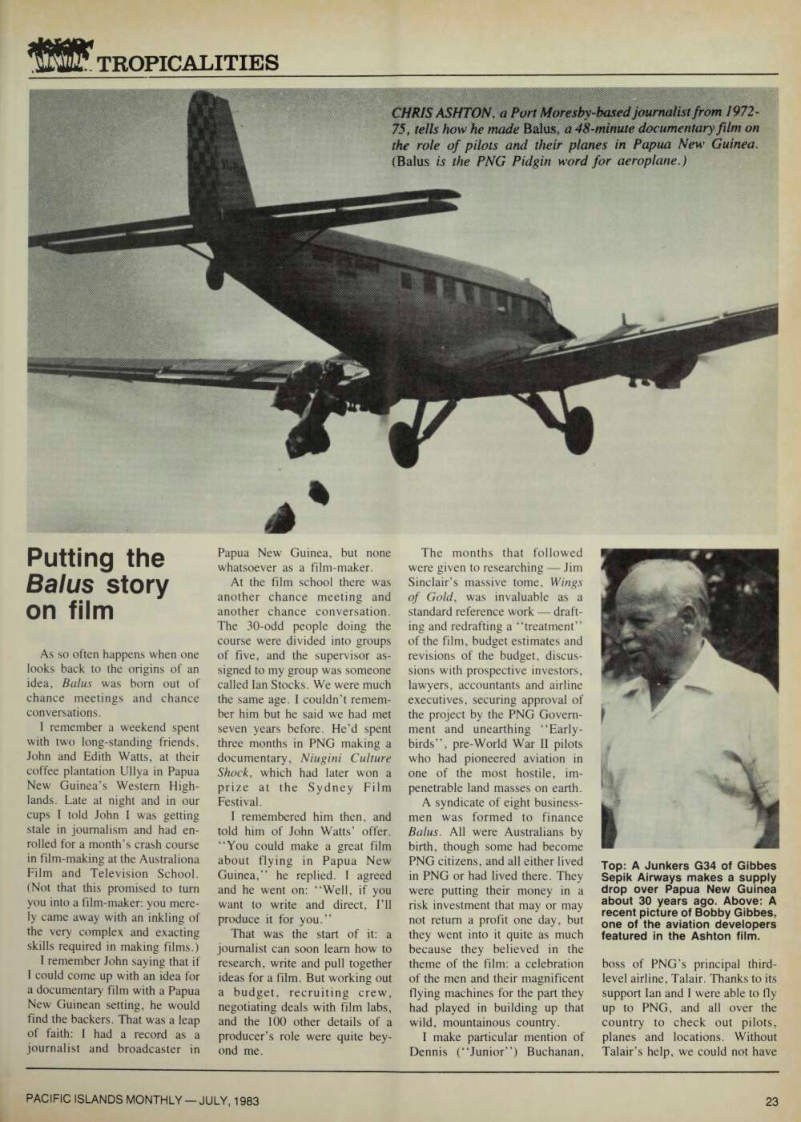

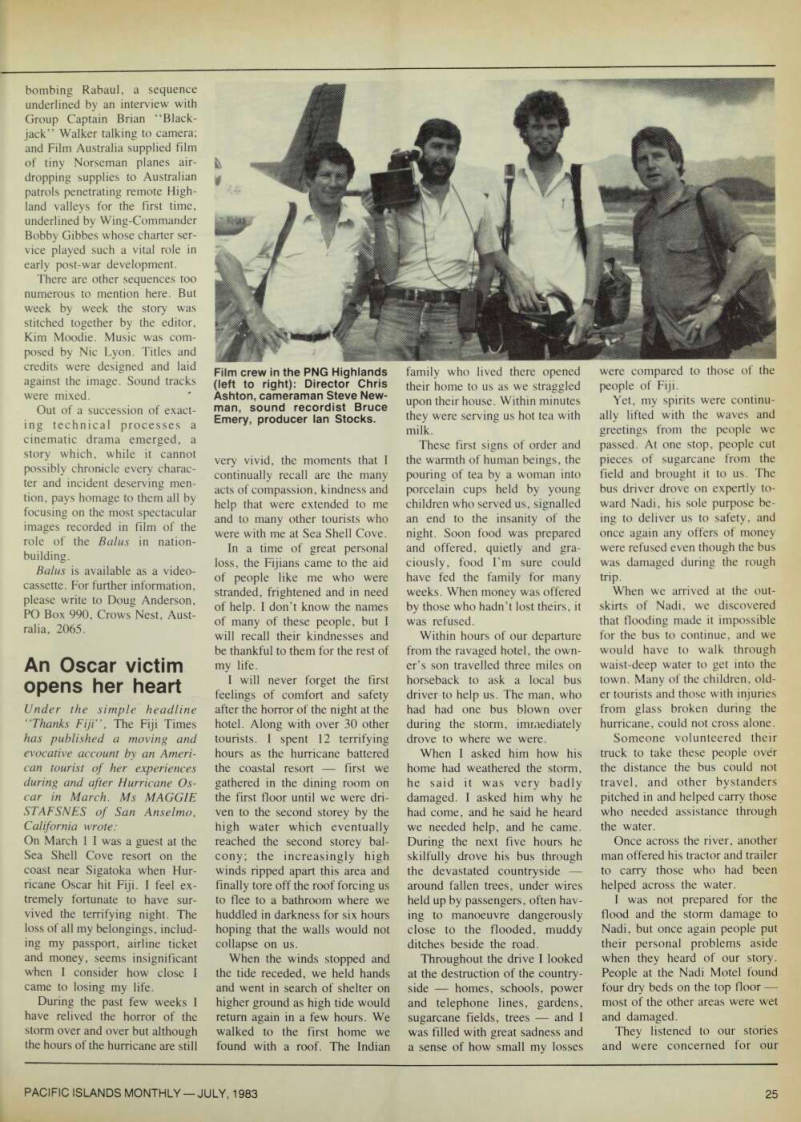

Tropicalities
Putting the Balus story on film
As so often happens when one looks back to the origins of an idea, Balus was bom out of chance meetings and chance conversations.
I remember a weekend spent with two long-standing friends, John and Edith Watts, at their coffee plantation Ullya in Papua New Guinea’s Western High lands. Late at night and in our cups I told John I was getting stale in journalism and had en rolled for a month’s crash course in film-making at the Australiona Film and Television School. (Not that this promised to turn you into a film-maker: you mere ly came away with an inkling of the very complex and exacting skills required in making films.) I remember John saying that if I could come up with an idea for a documentary film with a Papua New Guinean setting, he would find the backers. That was a leap of faith: I had a record as a journalist and broadcaster in
Papua New Guinea, but none whatsoever as a film-maker.
At the film school there was another chance meeting and another chance conversation.
The 30-odd people doing the course were divided into groups of five, and the supervisor as signed to my group was someone called lan Stocks. We were much the same age. I couldn’t remem ber him but he said we had met seven years before. He’d spent three months in PNG making a documentary, Niugini Culture Shock, which had later won a prize at the Sydney Film Festival.
I remembered him then, and told him of John Watts’ offer.
“You could make a great film about flying in Papua New Guinea,” he replied. I agreed and he went on: “Well, if you want to write and direct. I’ll produce it for you.”
That was the start of it; a journalist can soon leam how to research, write and pull together ideas for a film. But working out a budget, recruiting crew, negotiating deals with film labs, and the 100 other details of a producer’s role were quite bey ond me.
The months that followed were given to researching Jim Sinclair’s massive tome, Wings of Gold, was invaluable as a standard reference work draft ing and redrafting a “treatment” of the film, budget estimates and revisions of the budget, discus sions with prospective investors, lawyers, accountants and airline executives, securing approval of the project by the PNG Govern ment and unearthing “Early birds”, pre-World War II pilots who had pioneered aviation in one of the most hostile, im penetrable land masses on earth.
A syndicate of eight business men was formed to finance Balus. All were Australians by birth, though some had become PNG citizens, and all either lived in PNG or had lived there. They were putting their money in a risk investment that may or may not return a profit one day, but they went into it quite as much because they believed in the theme of the film: a celebration of the men and their magnificent flying machines for the part they had played in building up that wild, mountainous country.
I make particular mention of Dennis (“Junior”) Buchanan,
boss of PNG’s principal third level airline, Talair. Thanks to its support lan and I were able to fly up to PNG, and all over the country to check out pilots, planes and locations. Without Talair’s help, we could not have
CHRIS ASHTON, a Port Moresby-based journalist from 1972- 75, tells how he made Balus, a 48-minute documentary film on the role of pilots and their planes in Papua New Guinea . (Balus is the PNG Pidgin word for aeroplane .)
Top: A Junkers G34 of Gibbes
Sepik Airways makes a supply
drop over Papua New Guinea about 30 years ago. Above: A recent picture of Bobby Gibbes, one of the aviation developers featured in the Ashton film.
brought the film in for a budget of less than SIOO,OOO.
Unforeseen delays kept push ing back the shooting schedule, closer and closer to the wet sea son. There were problems with getting the money from investors into the bank, with settling a contra deal with Air Niugini, and with the PNG Government’s Of fice of Information approving our project. But it all came to gether at last. lan flew into Port Moresby on November 1 with the cameraman (Steve Newman) and sound re cordist (Bruce Emery). I had already arrived to prepare the way. Everyone assured us we should be safe, that the rainy season didn’t begin until Decem ber, but that it was not something you could set your watch by. In fact we finished on November 21, and the wet started two days later.
Those three weeks are imprint ed on my mind in indelible ink: a succession of motel rooms blur ring into one another, of 150 kilograms of film equipment
the absolute minimum lugged to and from airports, of hire cars and airport waiting rooms, of 34 flights in 19 days, of Cessnas, Islanders, Fokkers, choppers, even an RAAF Hercules trans port, half an island criss-crossed in a round trip from Sydney that spanned 15,000 kilometres.
The logistics of filming on a limited budget in a limited shoot
ing schedule, entirely dependent
on aircraft and the vagaries of weather, brought home to all of us just what the point of our film was.
At one point I was escorting the film crew into the remote Frieda River mineral exploration camp in the West Sepik by Islan der and helicopter. Some of our surplus film equipment had been left at Madang airport to reduce our weight; the rest was in Port Moresby. lan was on his way to Port Moresby via Lae, and half our unused filmstock, earlier consigned from Port Moresby to
Mount Hagen, had disappeared.
Three days later we were
reunited in Port Moresby, sur plus gear included.
The filmstock was discovered afterwards in Talair’s operations room in Port Moresby, never having left, and stored there to keep it cool.
To illustrate how diverse and even bizarre are the cargoes car ried by PNG’s air services I persuaded Talair’s one female pilot, Juliet Chubb, to let me film her flying cardboard cartons of baby crocodiles from a crocodile farm in the Papuan Gulf to a large commercial farm outside
Port Moresby.
Juliet is slim, blonde and pleasing to the eye in her bell
bottom jeans and high-heeled
boots. This was a sequence. I knew, that would wow television audiences in Europe and Ameri ca. But at the last minute she backed out, fearful that her male colleagues would mock her for being singled out for stardom.
An amiable male pilot flew in her place but somehow he lacked the element of whacky comedy that Juliet would have brought to the
sequence. It ended on the cutting room floor.
Back in Australia the long and arduous task of post-production began. From the musty film arc hives of Film Australia, the War Museum, Cinesound Movietone and the National Library in Can berra I had already unearthed quite extraordinary segments showing the feats of pilots and planes in the early days of aviation.
The pioneer of cinema photo graphy, Frank Hurley, had led the expedition which flew a sea plane, a Curtis Seagull, for the first time over Papua in 1922, and had filmed it. From a variety of sources I also uncovered am ple film of the first great airlift in aviation history: the cumbersome Junker G3ls which flew thousands of tons of dredge parts into the Bulolo Valley so that vast deposits of alluvial gold might be mined in the 19305.
The War Museum provided film showing RAAF Beaufigh ters in action and Mitchell bom bers of the U.S. Fifth Air Force
bombing Rabaul, a sequence underlined by an interview with Group Captain Brian “Black jack” Walker talking to camera; and Film Australia supplied film of tiny Norseman planes air dropping supplies to Australian patrols penetrating remote High land valleys for the first time, underlined by Wing-Commander Bobby Gibbes whose charter ser vice played such a vital role in early post-war development.
There are other sequences too numerous to mention here. But week by week the story was stitched together by the editor, Kim Moodie. Music was com posed by Nic Lyon. Titles and credits were designed and laid against the image. Sound tracks were mixed.
Out of a succession of exact ing technical processes a cinematic drama emerged, a story which, while it cannot possibly chronicle every charac ter and incident deserving men tion, pays homage to them all by focusing on the most spectacular images recorded in film of the role of the Balus in nation building.
Balus is available as a video cassette. For further information, please write to Doug Anderson, PO Box 990, Crows Nest, Aust ralia, 2065.
An Oscar victim
opens her heart
Under the simple headline “Thanks Fiji ”, The Fiji Times has published a moving and evocative account by an Ameri can tourist of her experiences during and after Hurricane Os car in March. Ms MAGGIE STAFSNES of San Anselmo, California wrote: On March 1 I was a guest at the Sea Shell Cove resort on the coast near Sigatoka when Hur ricane Oscar hit Fiji. I feel ex tremely fortunate to have sur vived the terrifying night. The loss of all my belongings, includ ing my passport, airline ticket and money, seems insignificant when I consider how close I came to losing my life.
During the past few weeks I have relived the horror of the storm over and over but although the hours of the hurricane are still
very vivid, the moments that I continually recall are the many acts of compassion, kindness and help that were extended to me and to many other tourists who were with me at Sea Shell Cove.
In a time of great personal loss, the Fijians came to the aid of people like me who were stranded, frightened and in need of help. I don’t know the names of many of these people, but I will recall their kindnesses and be thankful to them for the rest of my life.
I will never forget the first feelings of comfort and safety after the horror of the night at the hotel. Along with over 30 other tourists. I spent 12 terrifying hours as the hurricane battered the coastal resort first we gathered in the dining room on the first floor until we were dri ven to the second storey by the high water which eventually reached the second storey bal cony; the increasingly high winds ripped apart this area and finally tore off the roof forcing us to flee to a bathroom where we huddled in darkness for six hours hoping that the walls would not collapse on us.
When the winds stopped and the tide receded, we held hands and went in search of shelter on higher ground as high tide would return again in a few hours. We walked to the first home we found with a roof. The Indian
family who lived there opened their home to us as we straggled upon their house. Within minutes they were serving us hot tea with milk.
These first signs of order and the warmth of human beings, the pouring of tea by a woman into porcelain cups held by young children who served us, signalled an end to the insanity of the night. Soon food was prepared and offered, quietly and gra ciously, food I’m sure could have fed the family for many weeks. When money was offered by those who hadn’t lost theirs, it was refused.
Within hours of our departure from the ravaged hotel, the own er’s son travelled three miles on horseback to ask a local bus driver to help us. The man, who had had one bus blown over during the storm, immediately drove to where we were.
When I asked him how his home had weathered the storm, he said it was very badly damaged. I asked him why he had come, and he said he heard we needed help, and he came.
During the next five hours he skilfully drove his bus through the devastated countryside around fallen trees, under wires held up by passengers, often hav
ing to manoeuvre dangerously
close to the flooded, muddy ditches beside the road.
Throughout the drive I looked at the destruction of the country side homes, schools, power and telephone lines, gardens, sugarcane fields, trees and I was filled with great sadness and a sense of how small my losses
were compared to those of the
people of Fiji.
Yet, my spirits were continu ally lifted with the waves and greetings from the people we passed. At one stop, people cut pieces of sugarcane from the field and brought it to us. The bus driver drove on expertly to ward Nadi, his sole purpose be ing to deliver us to safety, and once again any offers of money were refused even though the bus
was damaged during the rough
trip.
When we arrived at the out skirts of Nadi, we discovered that flooding made it impossible for the bus to continue, and we would have to walk through waist-deep water to get into the town. Many of the children, old er tourists and those with injuries from glass broken during the hurricane, could not cross alone.
Someone volunteered their truck to take these people over the distance the bus could not travel, and other bystanders pitched in and helped carry those who needed assistance through the water.
Once across the river, another man offered his tractor and trailer to carry those who had been helped across the water.
I was not prepared for the flood and the storm damage to Nadi, but once again people put
their personal problems aside
when they heard of our story.
People at the Nadi Motel found four dry beds on the top floor most of the other areas were wet
and damaged.
They listened to our stories and were concerned for our
Film crew in the PNG Highlands (left to right): Director Chris Ashton, cameraman Steve New man, sound recordist Bruce
Emery, producer Ian Stocks.
plight and were helpful in many ways. They offered food, drink, clothing and comfort.
I headed for the airport as soon as I could the next morning and began the overwhelming task of getting home without any identification, money, ticket or with no way to contact anyone as Nadi had no outside communications.
I was in great need of the love and comfort of my family after the shock of the preceding 24 hours. I didn’t have to explain this need to anyone. Everyone I talked with at the airport showed compassion and wanted to help.
An immigration officer ex plained my circumstances to a taxi driver who drove me to the police station so that I could make a report. The security em ployees opened a locker where I had stored gifts for my children upon my arrival as soon as they heard that the key had been washed out to sea with my be longings. People came up to me who had heard of my misfortune and offered money to help me out until I could get home.
The employees of Air New Zealand, Sharon Bower, Pat Fraser and especially Aziz Mohammed, the head of Traffic Services for the Nadi Airport, worked relentlessly for two days in an effort to get me on any departing airplane for the U.S. to unite me with my family. They never stopped trying, and their hard work and warmth gave me strength as the three days wore on.
As I finally cleared immigra tion about seventy-two hours af ter the ordeal began, I was to get one more dose of “Fijian con cern.” The immigration officer looked at my paper from the police which explained the loss of my passport and property and said, “Where have you been?
We’ve been looking for you as our boss heard about you and wanted to take you to his home so you could rest.”
I returned to the safety and comfort of my home and to the love of my family and friends, but my thoughts continue to re turn to the devastation I left behind and to the hardships that will face the small country of Fiji because of a storm that stayed
less than 24 hours. My sadness is great for this country where peo ple gave so much to me when so much had been taken from them.
Words can never express the tremendous feelings of respect, warmth and thankfulness I will always carry in my heart for the people of Fiji, but I hope these words can somehow convey my deep and everlasting gratitude to the many who cared.
Mercy flight
with toddy
On a recent Friday afternoon Nauru’s Department of Civil Av iation received a telephone re quest from Sydney for assistance from Air Nauru to undertake a “mission of mercy”. The mis sion involved securing some Gil bertese palm toddy from Kiribati and carrying it to Sydney on the first available flight.
The toddy was being requested
by a Dr Cramdon of Westmead Hospital, Sydney, on behalf of an I-Kiribati woman, Mrs Mikaere, who had been flown from Tarawa two weeks earlier by a Royal Australian Air Force Hercules Cl3o aircraft on a mer cy medical flight. Mrs Mikaere was seriously ill following com plications in giving birth to her first child. The child subsequent ly died and Mrs Mikaere was suffering from severe
depression.
Dr Cramdon was anxious to satisfy a plea from Mrs Mikaere for some toddy and turned to Air Nauru for help.
There were no flights from Tarawa scheduled before the fol lowing Monday to connect with the Sydney flight. However the
delayed ON 121 flight leaving on
Saturday presented an opportuni
ty to carry some down.
Hearing of the need for toddy, a member of the Nauru airport staff, Sika Tulua, a Tuvaluan, offered to supply some from his own brewing, and two bottles of a potent-looking mixture were despatched per safe hand care of a returning visitor from Sydney.
At last report Mrs Mikaere had undergone major surgery and had
not yet tasted her toddy. But Dr Cramdon said that the fact that it was there as a gift from Nauru had cheered her no end. She had thanked the sender and was look ing forward to polishing off the toddy when she had sufficiently recovered.
Dr Cramdon has extended his thanks to Air Nauru, and espe cially Sika Tulua for his humanitarian gesture. Nauru Bulletin.
Niuean paper
launched in NZ
The Niue Consular Office in Newton, Auckland, New Zea land, in April took a hand in launching Niue News, a well produced 12-page “newsletter” printed in English and Niuean.
Reflecting on past failures in attempts to produce multilingual newspapers, the editorial in the first issue suggests that they may have failed because they were mu/ft'-lingual. The editorial said: “. . .the fact that the Samoana paper is still being published indicates an implied preference for a bilingual publication, thus pointing to an identity factor.”
Subscriptions are sought to Niue News. They can be had by sending SNZI2 or its equivalent to the paper at P.O. Box 68-541, Newton, Auckland. Although at first it is being helped by the Niue Government, it is hoped that the newsletter will become financially self-supporting.
UNICEF helps
in the Cooks
Co-operation has begun between the government of the Cook Is lands and the United Nations Children’s Fund (UNICEF) on the provision of clean water sup plies and improved sanitation to several remote northern islands including Rakahanga and Manihiki. A total of SUS 11,670 was recently released to the Cooks ministry of health by the office of the UNICEF representa tive for the Pacific in Manila. In the latter half of 1984, it is expected that UNICEF will give further support to sanitation ef forts on the remaining Northern Islands. These efforts comple-
“I looked at the destruction . . . and I was filled with great sadness, and a sense of how small my losses were com pared to those of the people of
Fiji.” - Maggie Stafsnes in her
message to the people of Fiji.
ment the water supply work of the Australian Development As sitance Bureau in the Cook Islands.
UNICEF is acting in the be lief, that adequate clean water supply, and the use of proper sanitation facilities, reduce such childhood diseases as intestinal parasites, diarrhoea and skin infections.
The Cook Islands Government demonstrated its support of UN ICEF activities by recently con tributing SUSIOOO to UNICEF’s general resources.
Games: Maoris
try again
Previously unsuccessful in its bid to win membership of the South Pacific Games Council for New Zealand’s Maoris, the New Zea land Maori Sports Federation (Inc.) is pressing ahead with its campaign in the lead-up to the Seventh South Pacific Games to be held in Apia in September.
It is seeking an amendment to the charter of the SPGC along the following lines: “Associate membership shall be open to the indigenous peoples (whose coun tries are members of the South Pacific Commission, Forum, and Conference) of the South Pacific who are not already members of the council.”
In its action it has the full
support of the New Zealand Ma ori Council, Maori Women’s Welfare League, and the en dorsement of New Zealand’s Minister of Maori Affairs.
New Zealand is a member of the South Pacific Commission, Forum and Conference, but has never been officially involved with the SPGC. Government pol icy has been not to interfere with sports organisations, but to offer assistance where appropriate.
A statement issued by the fed eration says: “Participation in the South Pacific Games will strengthen our cultural heritage with our relatives, as well as provide a basis for on-going con tacts and exchanges in sport. . .
“Whilst the Maoris may ap pear to dominate in such sports as Rugby Union, their participa tion in the Games could well provide an incentive for other Rugby-playing countries in the South Pacific. Likewise it could be said that Maori Rugby could improve its own style. Of par ticular interest are the skills inhe rent in tackling.
“The Maori Lawn Tennis As sociation is affiliated to the New Zealand Lawn Tennis Associa tion and holds an annual tourna ment. In the past the association has made contact with other ten nis countries, and participation in the Games will enhance these contacts.
“Soccer and cricket appear to offer very little interest for the Maori, but the Games may pro vide an incentive to develop that interest.
New Zealand Maori Sports Fed eration: Pre-season tournament for women in Auckland.
“Canoe racing is a sport prac tised with great vigor by some tribes here. Although not a Games sport, this could develop as such. Tahiti and Hawaii have such events on a much larger scale.”
Suva’s mixed-up
corpses
The body of a woman was “res cued” from a funeral pyre at Suva’s Vatuwaqa Cemetery in May seconds before it was to be cremated. The “rescue” fol lowed discovery that the dead woman’s family had taken deliv ery of the wrong corpse from the Colonial War Memorial Hospital mortuary.
Instead of the Hindu Bacchi, the family were about to set light to the body of Anglican Mary Ram Pyari. The two women had died on the same day at the CWM Hospital.
After a medical team arrived at the cemetery and explained the mix-up, Bacchi’s family re trieved her body and went through the Hindu funeral ser vice again at their home before the cremation.
Pyari’s family attended a de layed funeral service at Nasinu
Cemetery.
Bacchi’s son, Bobby Ramos, told The Fiji Times: “We all
thought our mother somehow looked strange, but none of us said anything aloud, probably because of the state we were in at the time.’’
Speaking for Pyari’s side, her son Ram Autar told the same paper that CWM staff had been “discourteous”. Throughout the confusion, no one had apologised to them for the error, he claimed.
“When we went to the hospit al mortuary we could not find the body of our mother. A matron or a sister said ‘lf the body is not there, there is no point’,” he said.
Marathon to be
run in Noumea
New Caledonia’s first interna tional marathon race will be run on a 14-kilometre circuit around Noumea on July 24.
A large number of runners are expected to take part. A charter flight of 3f)o participants has been organised from Japan alone.
All in for
maths
The 1983 Australian Mathemat ics Competition held in June at tracted 27,500 entries from New Zealand and Southwest Pacific countries.
With a total entry of over 270,000, the sponsors of the competition, Canberra College of Advanced Education, West pac Banking Corporation, and the Canberra Mathematical As sociation, will award over $A30,000 in prize money as well as approximately 122,000 certifi cates of merit.
Vanishing birds
of Christmas?
The Wildlife Conservation Unit of Kiribati has discounted claims by the American ornithologist Ralph W. Schreiber that 16 mill ion birds had “disappeared’’ from the republic’s Christmas Island.
Schreiber put the mass exodus
of the birds down to a sudden increase in the temperature of the ocean waters, the phenomenon now being discussed throughout the world as “El Nino’’. His speculation was that the warmer water had changed the patterns of fish populations, and hence the food sources of the birds.
The Kiribati WCU described his report as “sensationalised and exaggerated’’.
Quoted in the Kiribati weekly Te Uekera, the unit said its latest estimate of the total bird popula tion of all species on Christmas stood at 4.5 million pairs.
The 1981 census of the wedge tailed shearwater was 1 million, and sooty terns 4-6 million.
The paper continued: “Schreiber last visited the island in November last year and the birds were not there because of the bad weather conditions (El Nino).
“WCU said the breeding sea son of June 1982 ended success fully before the occurrence of El Nino, and that the adult birds are returning in large numbers.’’
Vanuatu has issued a miniature sheet of six stamps bolstering its claim to possession of Hunt er and Matthew Islands to the south. The two islands, which are uninhabited, are also claimed by France on behalf of New Caledonia.
Advertisements & other items, pp. 24-30 (1 item)
Allison Turbines Teach A
GREAT UTILITY AIRFRAME
NEW TRICKS
New Islander BN-2T turbine performance: Max. take-off weight now 7000 lb (3175 kg) Max. landing weight now 6800 lb (3084 kg) Max. zero fuel weight now 6600 lb (2994 kg) Max. payload now approx. 2960 lb (1343 kg) Payload approx, with max. fuel now 1520 lb (689 kg) Max. range (no reserves) now 728 nm (1349 km) Pilatus Britten-Norman Twin Allison 250 turbo prop engines drive the 10-place model BN2T Islander higher and faster than ever before. Good news for this rugged STOL workhorse with rough strip capability. Less noise, more comfort, bigger payloads. Improved performance all the way, especially in high tropical skies. And because the Allison 250 is distributed in this part of the world by Hawker Pacific you can count on full support for parts and service.
Also available with Lycoming piston engines. Islander model BN-2B features increased landing weight, improved seats, furnishings / A member of instrument panel and new 78 inch propellers that reduce GRDFt cabin noise, not performance. Contact us for details.
ISLANDER
Distributed by;
Hawker Pacific
Hawker Pacific Pty. Ltd, Inc, in N.SW. Hangar 135 Bankstown Airport, N.SW. 2200. Telephone: Sydney (02) 708 8536, (02) 708 8555 Brisbane (07) 277 3833, Perth (09) 332 7630 Telex AA20720.
A HAWKER SIDDELEY COMPANY
And the beat
goes on.
And on. And on. And 0n...
National’s newest Way stereo cassette player is auto-reverse—so when the beat’s going strong there’s no need to flip the cassette. The music just keeps on coming!
With Dolby* B noise reduction, an anti-rolling mechanism, and tape selector for both metal and normal tape the RQ-R5 is simply a sound sensation. Feather-touch play and tape direction controls and large, lockable FF/REW buttons give you quick, precise, one hand operation.
Included with the RQ- R 5 is our unique FM/AM inline tuner remote control, so small you can clip it to a shirt pocket.
So when you want to swing to your favorite station, there’s a new “Way” to do it.
For music on The move—RQ-R5 it's the only Way” to go!
X
National
National, Panasonic and Technics are the brandnames of ■ m 0' I m r i . : fciSST"-:-- - ■I
FORESTMIL
PORTABLE
SAWMILL
A Mini Self Contained Sawmill
complete with Diesel Engine or Electric Motor it 4 w i m <- Forestmil produces any size accurate timber ready to use up to 12" x 9" x 24'.
Purchase price and operating cost of Forestmil is less than other sawing equipment with similar production capacity.
Forestmil reduces timber waste and also reduces log transport cost. Timber is sawn direct from the log in the forest Forestmil can be moved to a new location in one hour.
Forestmil will saw hardwood or softwood from logs of any diameter.
Over 1000 Forestmils are sawing timber in 23 countries.
Forestmil has been manufactured for 18 years.
For literature and prices please contact the manufacturers.
MacQuarrie Industries Pty.Ltd.
P O Box 20, Coburg 3058, Victoria, Australia Phone 350-3411 Telex 33729. Cables Macbound, Melbourne.
‘INSTANT
HOUSES’
and Commercial Buildings with Therma-Panelf the fully insulated inter-locking Building System Cyclone rated [GH George Hudson Homes (Aust.) pty. Ltd 186 Hume Highway Cabramatta NSW 2166 Australia. Tel: (02) 727 9066. Telex: AA25800 Post coupon for details and prices.
NOTICE TRADE MARK:
Notice is hereby given that Aiwa Co., Ltd., a corporation duly organised and existing under the laws of Japan of 9 Kandasudacho 2-chome, Chiyodaku, Tokyo, Japan, is the sole proprietor in Papua New Guinea and Nauru and elsewhere of the following Trade Mark;
AIWA
Used in respect of the following: Radio and television equipments; sound amplifying apparatus and instruments and parts thereof; microphones, loud-speakers, tuners, record players, turntables, pickups, tape recorders, video recorders, phonograph records, tapes and other sound and/or image recording and/or reproducing apparatus, articles and implements; cassette tape recorders, combined radio receivers and cassette tape recorders, phonomotors; parts and accessories of foregoing goods.
The Proprietor claims all rights in respect of the above Trade Mark and will take all necessary legal steps against any person or company infringing those rights.
F. B. RICE & CO.
Patent Attorneys, Sydney, Australia.
Who builds a P^uP
r«,”
a car
* - »■ & W. p n u
DAT
, .w 700
\fho else but*
SSXZSS&
» ■ s /\nd we restyled Nissan doesn't skirnp irteiiors to
SSwnendesigntnolot ,,rf«
-ssi-nSff"
SSd«?S S:S S i« a cat Ntesan or
lIS Sdtonm. «*« M innovative,
sss^sis-*-'
"noise. veKdovioWld •
NISSAN
ONE AND THE SAME
-\CW H wvv 1
N/DATSUN:
iATCI IKS Max Haleck Inc. Pago Pago, American Samoa Cook Islands Motor Centre Ltd. Rarotonga Cook Islands Carpenters Motors ATSUN s,,wa Fiji Atnll Auto Stores Tarawa. Kiribati Jacob Enterprises Nauru Agence Alma S.A. Noumea New Caledonia Suva, Fiji Atoll Auto Stores Tarawa, Kiribati Jacob Enterprises Nauru Agence Mima d m ,-. ands Sirius Motors Norfolk Island Boroko Motors Port Moresby, Papua New Guinea United EnterprisesJ-tc L Hon lsland -r- . ... .. a n 1 n, t_u;*; o \ TroHinn i tri Pnrt \/ib Vanuatu Morns Hedstrom Ltd. Apia, Western oamoa CO Motors run iviuicsuy, rajjua new uumsa 1 . , T . ~, . Ppntornct Wanna Tradino Ltd. Port Vila, Vanuatu Morris Hedstrom Ltd. Apia, Western Samoc Tahitibull S.A.R.L. Papeete, Tahiti
A Samoan chief
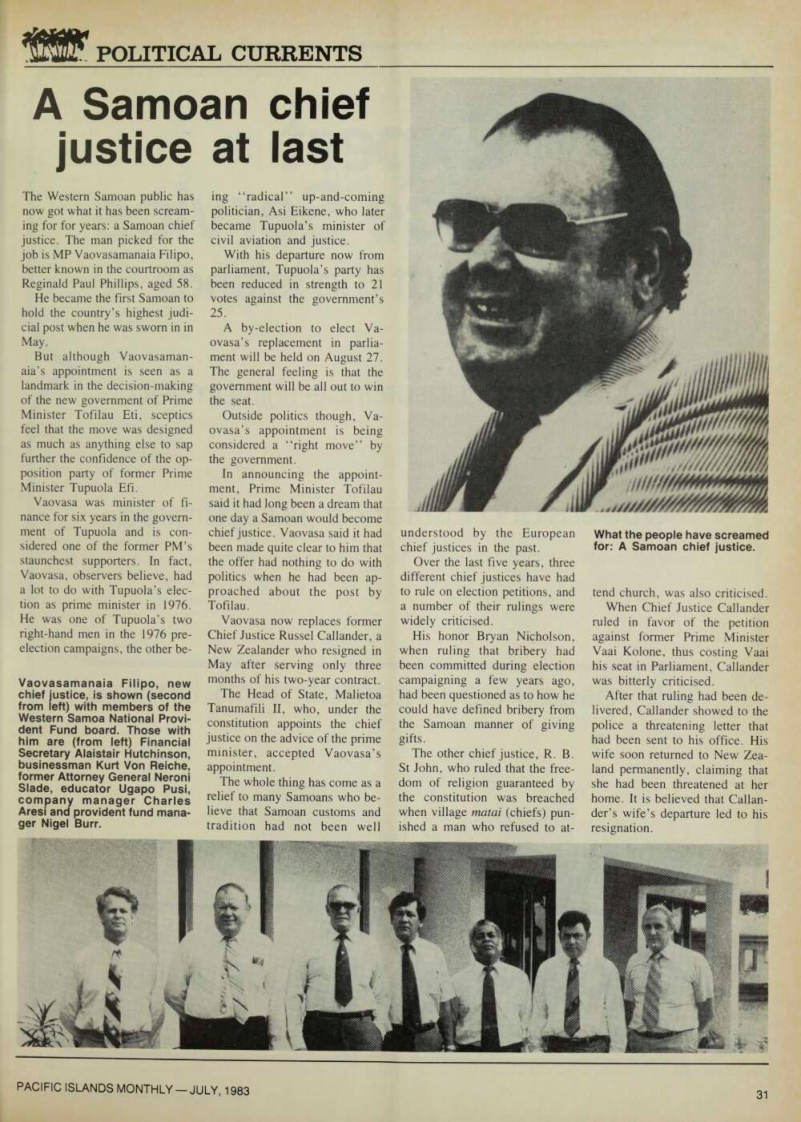

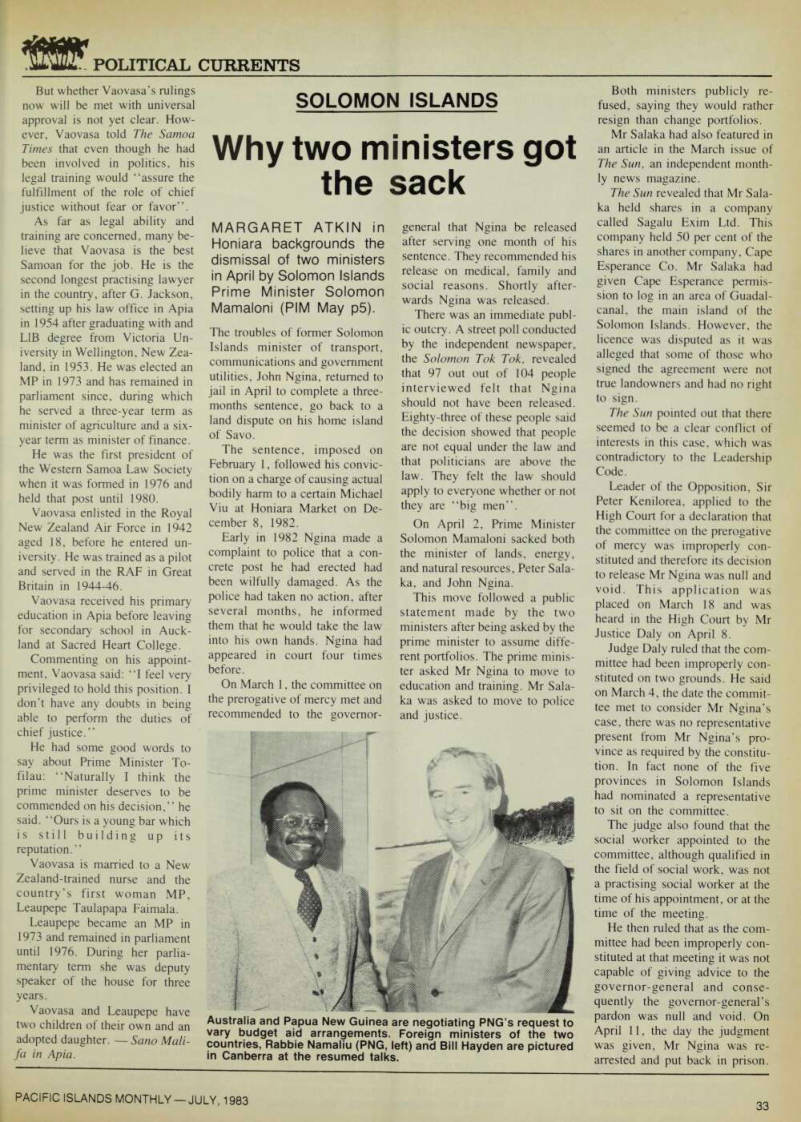
Political Currents
A Samoan chief justice at last
The Western Samoan public has now got what it has been scream ing for for years: a Samoan chief justice. The man picked for the job is MP Vaovasamanaia Filipo, better known in the courtroom as Reginald Paul Phillips, aged 58.
He became the first Samoan to hold the country’s highest judi cial post when he was sworn in in May.
But although Vaovasaman aia’s appointment is seen as a landmark in the decision-making of the new government of Prime Minister Tofilau Eti, sceptics feel that the move was designed as much as anything else to sap further the confidence of the op position party of former Prime Minister Tupuola Efi.
Vaovasa was minister of fi nance for six years in the govern ment of Tupuola and is con sidered one of the former PM’s staunchest supporters. In fact, Vaovasa, observers believe, had a lot to do with Tupuola’s elec tion as prime minister in 1976.
He was one of Tupuola’s two right-hand men in the 1976 pre election campaigns, the other be
ing “radical” up-and-coming politician, Asi Eikene, who later became Tupuola’s minister of civil aviation and justice.
With his departure now from parliament, Tupuola’s party has been reduced in strength to 21 votes against the government’s 25.
A by-election to elect Va ovasa’s replacement in parlia ment will be held on August 27.
The general feeling is that the government will be all out to win the seat.
Outside politics though, Va ovasa’s appointment is being considered a “right move” by the government.
In announcing the appoint ment, Prime Minister Tofilau said it had long been a dream that one day a Samoan would become chief justice. Vaovasa said it had been made quite clear to him that the offer had nothing to do with politics when he had been ap proached about the post by Tofilau.
Vaovasa now replaces former Chief Justice Russel Callander, a New Zealander who resigned in May after serving only three months of his two-year contract.
The Head of State, Malietoa Tanumafili 11, who, under the constitution appoints the chief justice on the advice of the prime minister, accepted Vaovasa’s appointment.
The whole thing has come as a relief to many Samoans who be lieve that Samoan customs and tradition had not been well
understood by the European chief justices in the past.
Over the last five years, three different chief justices have had to rule on election petitions, and a number of their rulings were widely criticised.
His honor Bryan Nicholson, when ruling that bribery had been committed during election campaigning a few years ago, had been questioned as to how he could have defined bribery from the Samoan manner of giving gifts.
The other chief justice, R. B.
St John, who ruled that the free dom of religion guaranteed by the constitution was breached when village matai (chiefs) pun ished a man who refused to at
tend church, was also criticised.
When Chief Justice Callander ruled in favor of the petition against former Prime Minister Vaai Kolone, thus costing Vaai his seat in Parliament, Callander was bitterly criticised.
After that ruling had been de livered, Callander showed to the police a threatening letter that had been sent to his office. His wife soon returned to New Zea land permanently, claiming that she had been threatened at her home. It is believed that Callan der’s wife’s departure led to his resignation.
Vaovasamanaia Filipo, new chief justice, is shown (second from left) with members of the Western Samoa National Provi dent Fund board. Those with him are (from left) Financial Secretary Alaistair Hutchinson, businessman Kurt Von Reiche, former Attorney General Neroni Slade, educator Ugapo Pusi, company manager Charles Aresi and provident fund mana ger Nigel Burr.
What the people have screamed for: A Samoan chief justice.
But whether Vaovasa’s rulings now will be met with universal approval is not yet clear. How ever, Vaovasa told The Samoa Times that even though he had been involved in politics, his legal training would “assure the fulfillment of the role of chief justice without fear or favor’’.
As far as legal ability and training are concerned, many be lieve that Vaovasa is the best Samoan for the job. He is the second longest practising lawyer in the country, after G. Jackson, setting up his law office in Apia in 1954 after graduating with and LIB degree from Victoria Un iversity in Wellington, New Zea land, in 1953. He was elected an MP in 1973 and has remained in parliament since, during which he served a three-year term as minister of agriculture and a six year term as minister of finance.
He was the first president of the Western Samoa Law Society when it was formed in 1976 and held that post until 1980.
Vaovasa enlisted in the Royal New Zealand Air Force in 1942 aged 18, before he entered un iversity. He was trained as a pilot and served in the RAF in Great Britain in 1944-46.
Vaovasa received his primary education in Apia before leaving for secondary school in Auck land at Sacred Heart College.
Commenting on his appoint
ment, Vaovasa said: “I feel very privileged to hold this position. I don’t have any doubts in being able to perform the duties of
chief justice.”
He had some good words to say about Prime Minister To filau: “Naturally I think the prime minister deserves to be commended on his decision,” he said. “Ours is a young bar which is still building up its reputation.”
Vaovasa is married to a New Zealand-trained nurse and the country’s first woman MP,
Leaupepe Taulapapa Faimala.
Leaupepe became an MP in 1973 and remained in parliament until 1976. During her parlia mentary term she was deputy speaker of the house for three years.
Vaovasa and Leaupepe have two children of their own and an adopted daughter. Sano Mali fa in Apia.
Advertisements & other items, p. 32 (1 item)
Expert
Insurance Service
throughout the islands
Queensland Insurance (Fiji) Limited
Head Office. 34 Usher St.. SUVA General Manager: L G. Liddell A.A.1.1, Assistant Managers : R. Jackson. Vijay Lai. Phone; 23851.
LAUTOKA OFFICE: Burns Philp Bldg., Naviti St. District Manager: J Dalton. Phone: 60642.
LABASA OFFICE: Burns Philp Bldg. District Manager; R. Sharma Phone: 8 2139
Queensland Insurance (PNG) Limited
PAPUA NEW GUINEA
Head Office. B N G Building, Musgrave St..PORT MORESBY. General Manager: T. Sarti Phone: 21 2144.
LAE 4th St. & Coronation Drive District Manager: C. D Hillier Phone. 423873.
MOUNT HAGEN: Hagen Drive District Manager: G. Hayes Phone: 521002.
ARAWA: Chebu St. District Manager: J. Longbut. Phone: 951555 MADANG: Kasagten St District Manager N D. Ramage. Phone: 82 2020 RABAUL Wirraway St. District Managenß. McManus Phone: 921014.
QBE Insurance (International) Limited
VANUATU. PORT VILA: Rue de Pans, Suite 19,Oceania Bldg. Manager: I R Martin.
Phone: 2299.
SANTO: Burns Philp ( Vanuatu) Ltd. Phone: 230.
PACIFIC AGENCIES
NEW CALEDONIA: Ste. W. A. Johnston, SARD 5 Rue Anatole France, NOUMEA Phone: 272083.
TAHITI Arthur Chung. Immeuble 8.1.5.. Front de Mer, PAPEETE Phone: 2.86 19.
NIUE Burns Philp (South Sea) Company Ltd.
NORFOLK ISLAND: Burns Philp ('N I) Company Ltd. Phone: 2191 SAMOA APIA, Burns Philp (South Sea) Company Ltd Phone: 22611 TONGA Burns Philp (South Sea) Company Ltd NUKUALOFA Phone 21500 HAAPAI. VAVAU
MEMBERSOFTHE
INSURANCE GROUP LIMITED
Why two ministers got
Solomon Islands
Why two ministers got the sack
Margaret Atkin In
Honiara backgrounds the dismissal of two ministers in April by Solomon Islands Prime Minister Solomon
Mamaloni (PIM May p 5).
The troubles of former Solomon Islands minister of transport, communications and government utilities, John Ngina, returned to jail in April to complete a three months sentence, go back to a land dispute on his home island of Savo.
The sentence, imposed on February 1, followed his convic tion on a charge of causing actual bodily harm to a certain Michael Viu at Honiara Market on De cember 8, 1982.
Early in 1982 Ngina made a complaint to police that a con crete post he had erected had been wilfully damaged. As the police had taken no action, after several months, he informed them that he would take the law into his own hands. Ngina had appeared in court four times before.
On March 1, the committee on the prerogative of mercy met and recommended to the govemor
general that Ngina be released after serving one month of his sentence. They recommended his release on medical, family and social reasons. Shortly after wards Ngina was released.
There was an immediate publ ic outcry. A street poll conducted
by the independent newspaper,
the Solomon Tok Tok, revealed that 97 out out of 104 people interviewed felt that Ngina should not have been released.
Eighty-three of these people said the decision showed that people are not equal under the law and that politicians are above the law. They felt the law should apply to everyone whether or not
they are “big men”.
On April 2, Prime Minister Solomon Mamaloni sacked both the minister of lands, energy, and natural resources, Peter Sala ka, and John Ngina.
This move followed a public statement made by the two ministers after being asked by the prime minister to assume diffe rent portfolios. The prime minis ter asked Mr Ngina to move to education and training. Mr Sala ka was asked to move to police
and justice.
Both ministers publicly re fused, saying they would rather
resign than change portfolios.
Mr Salaka had also featured in an article in the March issue of The Sun, an independent month
ly news magazine.
The Sun revealed that Mr Sala ka held shares in a company called Sagalu Exim Ltd. This company held 50 per cent of the shares in another company, Cape Esperance Co. Mr Salaka had
given Cape Esperance permis
sion to log in an area of Guadal canal, the main island of the Solomon Islands. However, the licence was disputed as it was alleged that some of those who signed the agreement were not true landowners and had no right
to sign.
The Sun pointed out that there seemed to be a clear conflict of interests in this case, which was
contradictory to the Leadership
Code.
Leader of the Opposition, Sir Peter Kenilorea, applied to the High Court for a declaration that the committee on the prerogative of mercy was improperly con stituted and therefore its decision to release Mr Ngina was null and void. This application was placed on March 18 and was heard in the High Court by Mr Justice Daly on April 8.
Judge Daly ruled that the com mittee had been improperly con stituted on two grounds. He said on March 4, the date the commit tee met to consider Mr Ngina’s case, there was no representative present from Mr Ngina’s pro vince as required by the constitu tion. In fact none of the five provinces in Solomon Islands had nominated a representative to sit on the committee.
The judge also found that the social worker appointed to the
committee, although qualified in
the field of social work, was not a practising social worker at the time of his appointment, or at the time of the meeting.
He then ruled that as the com mittee had been improperly con stituted at that meeting it was not capable of giving advice to the governor-general and conse quently the governor-general’s pardon was null and void. On
April 11, the day the judgment
was given, Mr Ngina was re arrested and put back in prison.
Australia and Papua New Guinea are negotiating PNG’s request to vary budget aid arrangements. Foreign ministers of the two countries, Rabbie Namaliu (PNG, left) and Bill Hayden are pictured in Canberra at the resumed talks.
Advertisements & other items, pp. 34-35 (1 item)
The Toyota Roadmasters
READY TO TAKE
ON THE TOUGHESTOOBS.
Meet Toyota’s hard working commercial vehicles. Tough. Durable. Ready to meet the challenge of the worst roads and climates. Ready to do the job called for with ease. Rugged veterans, each one specifically designed to meet the different demands of the world’s businesses. One of them is just right for you. There are no vehicles more reliable. And if you need it, Toyota is ready with fast
backup service. Toyota’s road masters,
they’re a winning team.
n *
HI-LUX 4WD
TOYOTA
QUALITY SERVICE
AMERICAN SAMOA: BURNS PHILP (SOUTH SEA)
CO., LTD., P.O. Box 129, Pago Pago.
COOK ISLANDS: COOK ISLANDS TRADING
CORPORATION LTD., P.O. Box 92, Rarotonga.
FIJI: AUTOMOTIVE SUPPLIES COMPANY, G.P.O.
Box 355, Suva.
GUAM & MICRONESIA: ATKINS, KROLL (GUAM) LTD., P.O. Box 6428, Tamuning.
KIRIBATI: TARAWA MOTORS, P.O. Box 36,
Bairiki, Tarawa, Kiribati.
NAURU: NAURU COOPERATIVE SOCIETY.
NEW CALEDONIA: SERVICE IMPORTATION
AUTOMOBILE DU PACIFIQUE, Rond-Point
du Pacifique (Station Total) B.P. 438, Noume
HI ACE
A ms i
HI-LUX
DOUBLE CAB
iTiTZ in
HEAVY DUTY
TRUCK
NORFOLK ISLAND; BORRY’S LIMITED. P.O. Box 169.
PAPUA NEW GUINEA: ELA MOTORS.
Scratchley Rd„ Badili, P.O. Box 675, Port Moresby.
SAIPAN: MICROL CORPORATION, P.O. Box 267,
Saipan.
SOLOMON: MENDANA ENTERPRISES (5.1.) LTD.,
G.P.O. Box 174, Honiara.
TAHITI: NIPPON AUTOMOTO. P.O. Box 342, Papeete.
TONGA: BURNS PHILP (SOUTH SEA) CO.. LTD..
P.O. Box 55, Nukualofa.
VANUATU: VANUATU MOTORS, P.O. Box 18,
Port Vila.
WESTERN SAMOA: BURNS PHILP (SOUTH SEA)
CO., LTD., P.O. Box 188, Apia.
TOYOTA
The Toyota range includes:
COROLLA, STARLET, CORONA, CRESSIDA, HI-LUX,
STOUT, HI ACE, DYNA, COASTER and LAND CRUISER
Scandal rocks port authority and
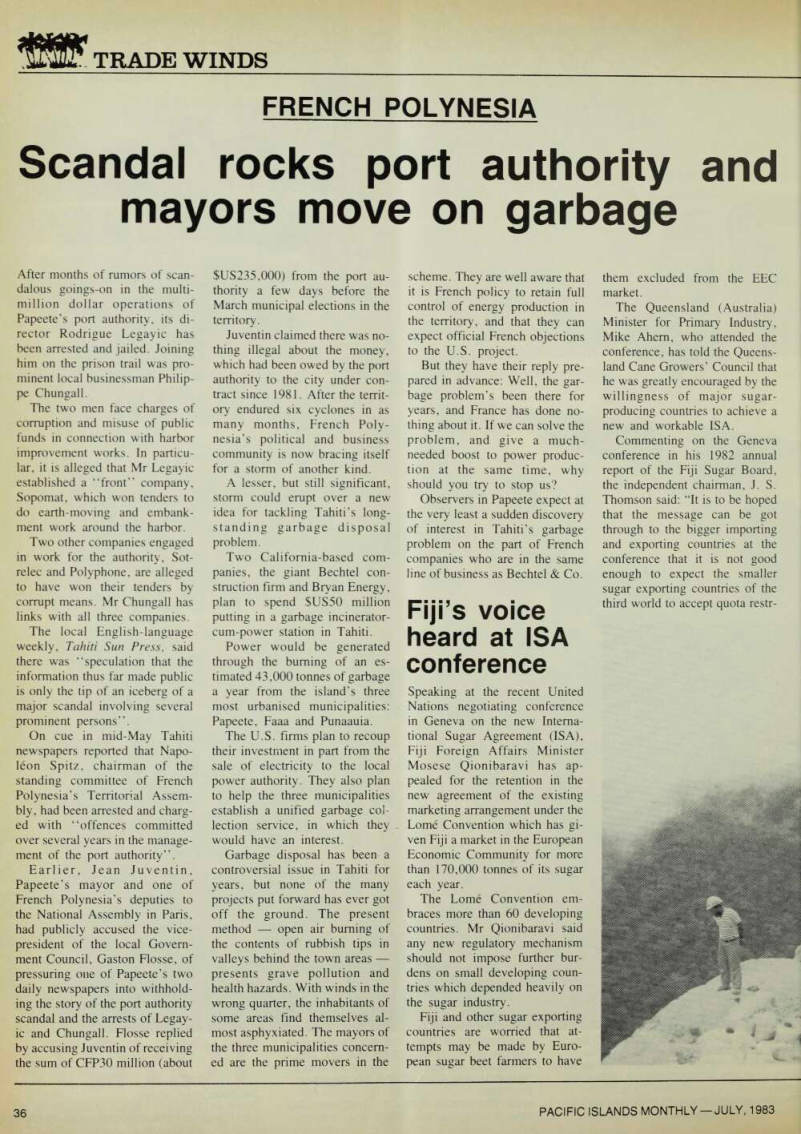
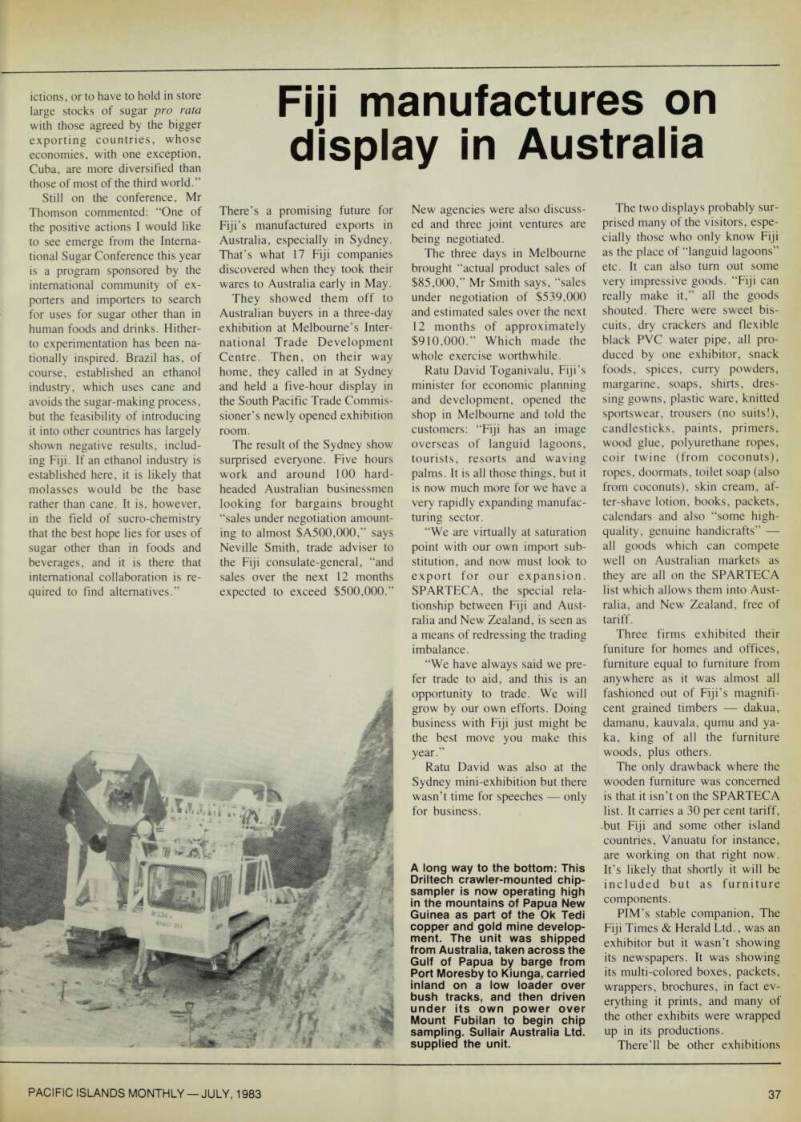
Trade Winds
French Polynesia
Scandal rocks port authority and mayors move on garbage
After months of rumors of scan dalous goings-on in the multi million dollar operations of Papeete’s port authority, its di rector Rodrigue Legayic has been arrested and jailed. Joining him on the prison trail was pro minent local businessman Philip pe Chungall.
The two men face charges of corruption and misuse of public funds in connection with harbor improvement works. In particu lar, it is alleged that Mr Legayic established a “front” company, Sopomat, which won tenders to do earth-moving and embank ment work around the harbor.
Two other companies engaged in work for the authority, Sot relec and Poly phone, are alleged to have won their tenders by corrupt means. Mr Chungall has links with all three companies.
The local English-language weekly, Tahiti Sun Press, said there was “speculation that the information thus far made public is only the tip of an iceberg of a major scandal involving several prominent persons”.
On cue in mid-May Tahiti newspapers reported that Napo leon Spitz, chairman of the standing committee of French Polynesia’s Territorial Assem bly, had been arrested and charg ed with “offences committed over several years in the manage ment of the port authority”.
Earlier, Jean Juventin, Papeete’s mayor and one of French Polynesia’s deputies to the National Assembly in Paris, had publicly accused the vice president of the local Govern ment Council, Gaston Flosse, of pressuring one of Papeete’s two daily newspapers into withhold ing the story of the port authority scandal and the arrests of Legay ic and Chungall. Flosse replied by accusing Juventin of receiving the sum of CFP3O million (about
$U5235,000) from the port au thority a few days before the March municipal elections in the territory.
Juventin claimed there was no thing illegal about the money, which had been owed by the port authority to the city under con tract since 1981. After the territ ory endured six cyclones in as many months, French Poly nesia’s political and business community is now bracing itself for a storm of another kind.
A lesser, but still significant, storm could erupt over a new idea for tackling Tahiti’s long standing garbage disposal problem.
Two California-based com panies, the giant Bechtel con struction firm and Bryan Energy, plan to spend SUSSO million putting in a garbage incinerator cum-power station in Tahiti.
Power would be generated through the burning of an es timated 43,000 tonnes of garbage a year from the island’s three most urbanised municipalities: Papeete, Faaa and Punaauia.
The U.S. firms plan to recoup their investment in part from the sale of electricity to the local power authority. They also plan to help the three municipalities establish a unified garbage col lection service, in which they would have an interest.
Garbage disposal has been a controversial issue in Tahiti for years, but none of the many projects put forward has ever got off the ground. The present method open air burning of the contents of rubbish tips in valleys behind the town areas presents grave pollution and health hazards. With winds in the wrong quarter, the inhabitants of some areas find themselves al most asphyxiated. The mayors of the three municipalities concern ed are the prime movers in the
scheme. They are well aware that it is French policy to retain full control of energy production in the territory, and that they can expect official French objections to the U.S. project.
But they have their reply pre pared in advance: Well, the gar bage problem’s been there for years, and France has done no thing about it. If we can solve the problem, and give a much needed boost to power produc tion at the same time, why should you try to stop us?
Observers in Papeete expect at the very least a sudden discovery of interest in Tahiti’s garbage problem on the part of French companies who are in the same line of business as Bechtel & Co.
Fiji’s voice
heard at ISA
conference
Speaking at the recent United Nations negotiating conference in Geneva on the new Interna tional Sugar Agreement (ISA), Fiji Foreign Affairs Minister Mosese Qionibaravi has ap pealed for the retention in the new agreement of the existing marketing arrangement under the Lome Convention which has gi ven Fiji a market in the European Economic Community for more than 170,000 tonnes of its sugar each year.
The Lome Convention em braces more than 60 developing countries. Mr Qionibaravi said any new regulatory mechanism should not impose further bur dens on small developing coun tries which depended heavily on the sugar industry.
Fiji and other sugar exporting countries are worried that at tempts may be made by Euro pean sugar beet farmers to have
them excluded from the EEC market.
The Queensland (Australia)
Minister for Primary Industry,
Mike Ahem, who attended the conference, has told the Queens land Cane Growers’ Council that he was greatly encouraged by the
willingness of major sugar
producing countries to achieve a new and workable ISA.
Commenting on the Geneva conference in his 1982 annual report of the Fiji Sugar Board, the independent chairman, J. S.
Thomson said: “It is to be hoped that the message can be got through to the bigger importing and exporting countries at the conference that it is not good enough to expect the smaller sugar exporting countries of the third world to accept quota restr-
ictions, or to have to hold in store large stocks of sugar pro rata with those agreed by the bigger exporting countries, whose economies, with one exception, Cuba, are more diversified than those of most of the third world.”
Still on the conference, Mr Thomson commented; “One of the positive actions I would like to see emerge from the Interna tional Sugar Conference this year is a program sponsored by the international community of ex porters and importers to search for uses for sugar other than in human foods and drinks. Hither to experimentation has been na tionally inspired. Brazil has, of course, established an ethanol industry, which uses cane and avoids the sugar-making process, but the feasibility of introducing it into other countries has largely shown negative results, includ ing Fiji. If an ethanol industry is established here, it is likely that molasses would be the base rather than cane. It is, however, in the field of sucro-chemistry that the best hope lies for uses of sugar other than in foods and beverages, and it is there that international collaboration is re quired to find alternatives.”
A long way to the bottom: This Driltech crawler-mounted chip
sampler is now operating high
in the mountains of Papua New Guinea as part of the Ok Tedi copper and gold mine develop ment. The unit was shipped from Australia, taken across the Gulf of Papua by barge from Port Moresby to Kiunga, carried inland on a low loader over bush tracks, and then driven under its own power over Mount Fubilan to begin chip sampling. Sullair Australia Ltd. supplied the unit.
display in Australia
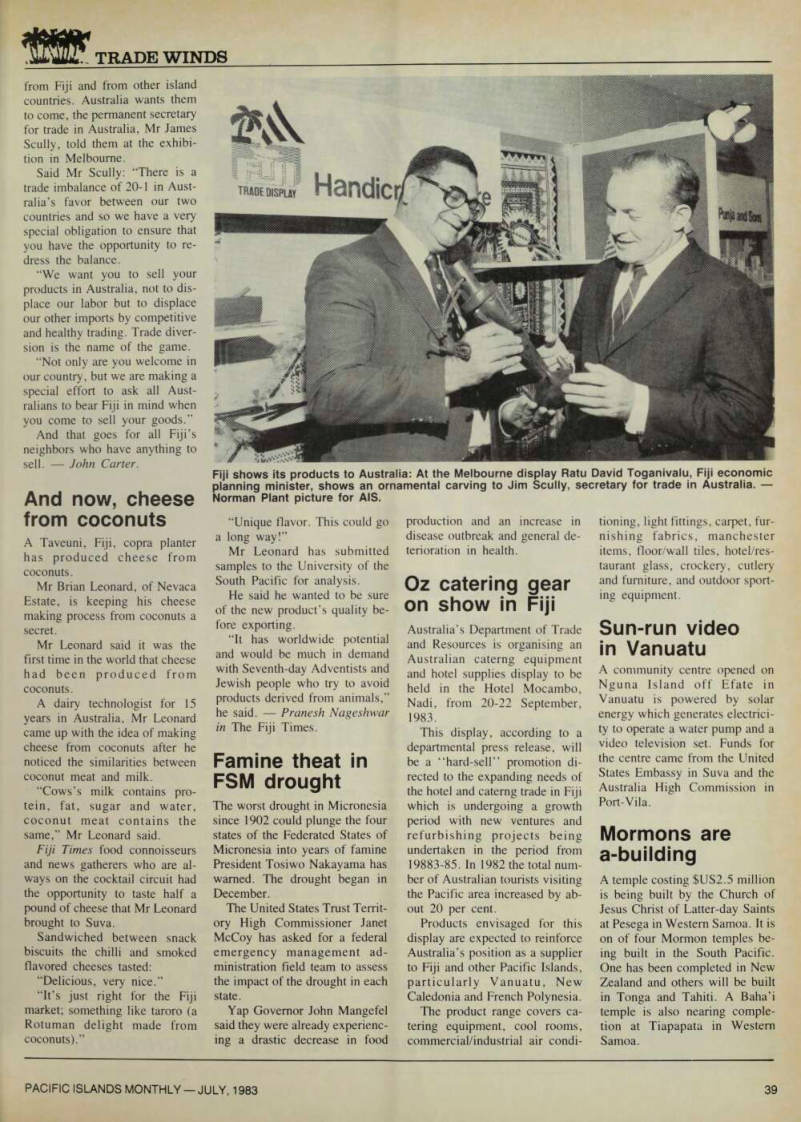
Fiji manufactures on display in Australia
There’s a promising future for Fiji’s manufactured exports in
Australia, especially in Sydney.
That’s what 17 Fiji companies discovered when they took their wares to Australia early in May.
They showed them off to Australian buyers in a three-day exhibition at Melbourne’s Inter national Trade Development Centre. Then, on their way home, they called in at Sydney and held a five-hour display in the South Pacific Trade Commis sioner’s newly opened exhibition room.
The result of the Sydney show surprised everyone. Five hours work and around 100 hard headed Australian businessmen
looking for bargains brought
“sales under negotiation amount ing to almost $A500,000,” says Neville Smith, trade adviser to
the Fiji consulate-general, “and
sales over the next 12 months expected to exceed $500,000.”
New agencies were also discuss ed and three joint ventures are being negotiated.
The three days in Melbourne brought “actual product sales of $85,000,” Mr Smith says, “sales under negotiation of $539,000 and estimated sales over the next 12 months of approximately $910,000.” Which made the whole exercise worthwhile.
Ratu David Toganivalu, Fiji’s minister for economic planning and development, opened the shop in Melbourne and told the customers: “Fiji has an image overseas of languid lagoons, tourists, resorts and waving palms. It is all those things, but it is now much more for we have a very rapidly expanding manufac turing sector.
“We are virtually at saturation point with our own import sub stitution, and now must look to export for our expansion.
SPARTECA, the special rela tionship between Fiji and Aust ralia and New Zealand, is seen as a means of redressing the trading imbalance.
“We have always said we pre fer trade to aid, and this is an opportunity to trade. We will grow by our own efforts. Doing business with Fiji just might be the best move you make this year,”
Ratu David was also at the Sydney mini-exhibition but there wasn’t time for speeches only for business.
The two displays probably sur prised many of the visitors, espe cially those who only know Fiji as the place of “languid lagoons” etc. It can also turn out some very impressive goods. “Fiji can really make it,” all the goods shouted. There were sweet bis cuits, dry crackers and flexible black PVC water pipe, all pro duced by one exhibitor, snack foods, spices, curry powders, margarine, soaps, shirts, dres sing gowns, plastic ware, knitted sportswear, trousers (no suits!), candlesticks, paints, primers, wood glue, polyurethane ropes, coir twine (from coconuts), ropes, doormats, toilet soap (also from coconuts), skin cream, af ter-shave lotion, books, packets, calendars and also “some high quality, genuine handicrafts” — all goods which can compete well on Australian markets as they are all on the SPARTECA list which allows them into Aust ralia, and New Zealand, free of tariff.
Three firms exhibited their funiture for homes and offices, furniture equal to furniture from anywhere as it was almost all fashioned out of Fiji’s magnifi cent grained timbers — dakua, damanu, kauvala, qumu and ya ka, king of all the furniture woods, plus others.
The only drawback where the wooden furniture was concerned is that it isn’t on the SPARTECA list. It carries a 30 per cent tariff, -but Fiji and some other island countries, Vanuatu for instance, are working on that right now.
It’s likely that shortly it will be included but as furniture components.
PIM’s stable companion, The Fiji Times & Herald Ltd., was an exhibitor but it wasn’t showing its newspapers. It was showing its multi-colored boxes, packets, wrappers, brochures, in fact ev erything it prints, and many of the other exhibits were wrapped up in its productions.
There’ll be other exhibitions
from Fiji and from other island countries. Australia wants them to come, the permanent secretary for trade in Australia, Mr James Scully, told them at the exhibi tion in Melbourne.
Said Mr Scully: “There is a trade imbalance of 20-1 in Aust ralia’s favor between our two countries and so we have a very special obligation to ensure that you have the opportunity to re dress the balance.
“We want you to sell your products in Australia, not to dis place our labor but to displace our other imports by competitive and healthy trading. Trade diver sion is the name of the game.
“Not only are you welcome in our country, but we are making a special effort to ask all Aust ralians to bear Fiji in mind when you come to sell your goods.”
And that goes for all Fiji’s neighbors who have anything to
sell.
John Carter.
And now, cheese
from coconuts
A Taveuni, Fiji, copra planter has produced cheese from coconuts.
Mr Brian Leonard, of Nevaca Estate, is keeping his cheese making process from coconuts a secret.
Mr Leonard said it was the first time in the world that cheese had been produced from coconuts.
A dairy technologist for 15 years in Australia, Mr Leonard came up with the idea of making cheese from coconuts after he noticed the similarities between coconut meat and milk.
“Cows’s milk contains pro tein, fat, sugar and water, coconut meat contains the same,” Mr Leonard said.
Fiji Times food connoisseurs and news gatherers who are al ways on the cocktail circuit had the opportunity to taste half a pound of cheese that Mr Leonard brought to Suva.
Sandwiched between snack biscuits the chilli and smoked flavored cheeses tasted: “Delicious, very nice.”
“It’s just right for the Fiji market; something like taroro (a Rotuman delight made from coconuts).”
“Unique flavor. This could go a long way!”
Mr Leonard has submitted samples to the University of the South Pacific for analysis.
He said he wanted to be sure of the new product’s quality be fore exporting.
“It has worldwide potential and would be much in demand with Seventh-day Adventists and Jewish people who try to avoid products derived from animals,” he said. Pranesh Nageshwar in The Fiji Times.
Famine theat in
FSM drought
The worst drought in Micronesia since 1902 could plunge the four states of the Federated States of Micronesia into years of famine President Tosiwo Nakayama has warned. The drought began in December.
The United States Trust Territ ory High Commissioner Janet McCoy has asked for a federal emergency management ad ministration field team to assess the impact of the drought in each state.
Yap Governor John Mangefel said they were already experienc ing a drastic decrease in food
production and an increase in disease outbreak and general de terioration in health.
Oz catering gear
on show in Fiji
Australia’s Department of Trade and Resources is organising an Australian caterng equipment and hotel supplies display to be held in the Hotel Mocambo, Nadi, from 20-22 September, 1983.
This display, according to a departmental press release, will be a “hard-sell” promotion di rected to the expanding needs of the hotel and caterng trade in Fiji which is undergoing a growth period with new ventures and refurbishing projects being undertaken in the period from 19883-85. In 1982 the total num ber of Australian tourists visiting the Pacific area increased by ab out 20 per cent.
Products envisaged for this display are expected to reinforce Australia’s position as a supplier to Fiji and other Pacific Islands, particularly Vanuatu, New Caledonia and French Polynesia.
The product range covers ca tering equipment, cool rooms, commercial/industrial air condi
tioning, light fittings, carpet, fur nishing fabrics, manchester items, floor/wall tiles, hotel/res taurant glass, crockery, cutlery and furniture, and outdoor sport ing equipment.
Sun-run video
in Vanuatu
A community centre opened on Nguna Island off Efate in Vanuatu is powered by solar energy which generates electrici ty to operate a water pump and a video television set. Funds for the centre came from the United States Embassy in Suva and the Australia High Commission in Port-Vila.
Mormons are
a-building
A temple costing SUS2.S million is being built by the Church of Jesus Christ of Latter-day Saints at Pesega in Western Samoa. It is on of four Mormon temples be ing built in the South Pacific.
One has been completed in New Zealand and others will be built in Tonga and Tahiti. A Baha’i temple is also nearing comple tion at Tiapapata in Western Samoa.
Fiji shows its products to Australia: At the Melbourne display Ratu David Toganivalu, Fiji economic planning minister, shows an ornamental carving to Jim Scully, secretary for trade in Australia. - Norman Plant picture for AIS.
Advertisements & other items, pp. 38-40 (1 item)
,/auijl am ||e jeifl. yJS| pue-op || jm jsaq aip A|uo uaq/w
IS9M
,/auijl am ||e jeifl. yJS| pue-op jm jsaq aip A|uo uaq/w r /a W O. * S' •' ■
Starting & Staying
¥ER w r
AMP
POWER
V i7VOII
X continuous use
71 f DBZP CfCLE BATTER*
LUHU
m
MARM
Sow
AW/AY
/ “JgggW* Vt,
Power Boats Need Different Batteries
There is a big difference between a car battery and a marine battery.
A car battery, for example, is never really discharged, as it is only used for a few seconds each day and promptly re-charged. Not so your cruiser or sportsfisherman.
Starting the engine is only the beginning. During the day, weekend or cruise, how often will you run the live bait tank, the depth sounder, the nav. lights or maintain a listening watch on your radio transceiver?
As well as cranking power, boats need staying power. Boats need Besco’s Marine Batteries, deep cycle, heavy duty marine batteries.
If your boat is getting a little flat in the electrics department, write or phone BESCO today and ask for more information, more facts about
BESCO MARINE BATTERIES.
BESCO
/ Batteries Division Of Sims Products Pty. L td. J_ / A Peko Wall send Group Member Papua New Guinea: Lae, Automarine Industries, P.O. Box 785, Ph. 42-1125; Rabaul, Automarine Industries, P.O. Box 248, Ph. 92-2574; Port Moresby, Par Sales, P.O. Box 1680, Boroko, Ph. 25-6266. Fiji: Suva, Fiji Bandag, 23 Sinoma Street, Walu Bay, Ph. 31-1200. New Caledonia: Noumea, Andre Thuilier, BP 889, Ph. 27-4906. Solomon Islands: Honiara, Guadalcanal Electrics Ltd., P.O. Box 521. Hongkong: Kowloon, T. L. Knight & Co., P.O. Box 95585 IST, Ph. 366-5341. New Zealand: Auckland, Battery Services (Ind.) Ltd., P.O. Box 27- 375, Ph. 69-4111; Wellington, Gould Batteries, 58 Hautana Street, Lower Hutt, TLX NZ3714.
Australia: Sydney, Besco Batteries, P.O. Box 1, Villawood, Ph. 632-0251, TLX 21886; Jarwill International Pty. Ltd., 410 Kent Street, Sydney, Ph. 264-3477, TLX 72102.
LEADERS IN BATTERY TECHNOLOGY —
an arrangement
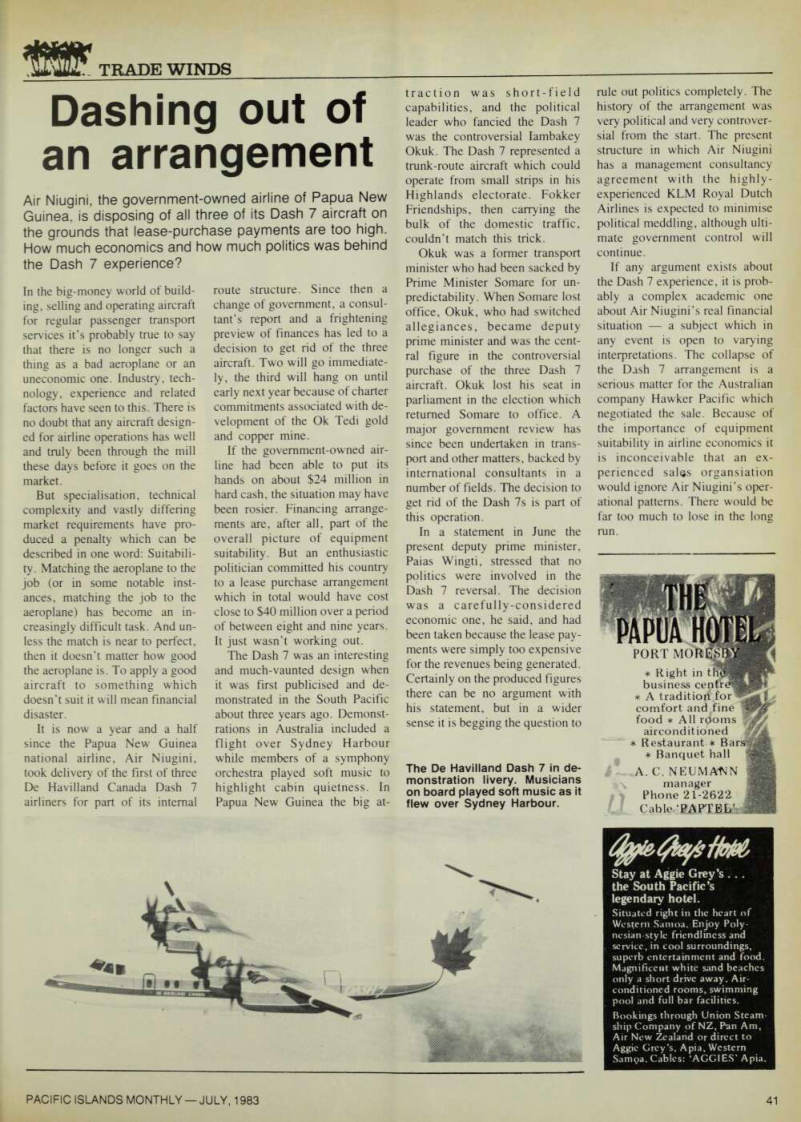
Dashing out of an arrangement
Air Niugini, the government-owned airline of Papua New Guinea, is disposing of all three of its Dash 7 aircraft on the grounds that lease-purchase payments are too high.
How much economics and how much politics was behind the Dash 7 experience?
In the big-money world of build
ing, selling and operating aircraft
for regular passenger transport services it’s probably true to say that there is no longer such a thing as a bad aeroplane or an uneconomic one. Industry, tech nology, experience and related factors have seen to this. There is no doubt that any aircraft design ed for airline operations has well and truly been through the mill these days before it goes on the market.
But specialisation, technical
complexity and vastly differing
market requirements have pro duced a penalty which can be described in one word: Suitabili ty. Matching the aeroplane to the job (or in some notable inst ances, matching the job to the aeroplane) has become an in creasingly difficult task. And un less the match is near to perfect, then it doesn’t matter how good the aeroplane is. To apply a good aircraft to something which doesn’t suit it will mean financial disaster.
It is now a year and a half since the Papua New Guinea national airline, Air Niugini, took delivery of the first of three De Havilland Canada Dash 7 airliners for part of its internal
route structure. Since then a change of government, a consul tant’s report and a frightening preview of finances has led to a decision to get rid of the three aircraft. Two will go immediate ly, the third will hang on until early next year because of charter commitments associated with de velopment of the Ok Tedi gold and copper mine.
If the government-owned air line had been able to put its hands on about $24 million in hard cash, the situation may have been rosier. Financing arrange ments are, after all, part of the
overall picture of equipment
suitability. But an enthusiastic politician committed his country to a lease purchase arrangement which in total would have cost close to $4O million over a period of between eight and nine years.
It just wasn’t working out.
The Dash 7 was an interesting and much-vaunted design when it was first publicised and de monstrated in the South Pacific about three years ago. Demonst rations in Australia included a
flight over Sydney Harbour
while members of a symphony orchestra played soft music to
highlight cabin quietness. In
Papua New Guinea the big at
traction was short-field
capabilities, and the political
leader who fancied the Dash 7 was the controversial lambakey Okuk. The Dash 7 represented a trunk-route aircraft which could operate from small strips in his Highlands electorate. Fokker Friendships, then carrying the bulk of the domestic traffic, couldn’t match this trick.
Okuk was a former transport minister who had been sacked by Prime Minister Somare for un predictability. When Somare lost office, Okuk, who had switched
allegiances, became deputy
prime minister and was the cent ral figure in the controversial purchase of the three Dash 7 aircraft. Okuk lost his seat in parliament in the election which returned Somare to office. A major government review has since been undertaken in trans port and other matters, backed by international consultants in a number of fields. The decision to get rid of the Dash 7s is part of
this operation.
In a statement in June the present deputy prime minister, Paias Wingti, stressed that no politics were involved in the Dash 7 reversal. The decision was a carefully-considered economic one, he said, and had been taken because the lease pay ments were simply too expensive for the revenues being generated.
Certainly on the produced figures
there can be no argument with his statement, but in a wider sense it is begging the question to
rule out politics completely. The history of the arrangement was very political and very controver sial from the start. The present structure in which Air Niugini has a management consultancy agreement with the highly
experienced KLM Royal Dutch
Airlines is expected to minimise
political meddling, although ulti
mate government control will continue.
If any argument exists about the Dash 7 experience, it is prob ably a complex academic one about Air Niugini’s real financial situation a subject which in any event is open to varying interpretations. The collapse of the Dash 7 arrangement is a serious matter for the Australian company Hawker Pacific which negotiated the sale. Because of the importance of equipment suitability in airline economics it is inconceivable that an ex
perienced sales organsiation
would ignore Air Niugini’s oper ational patterns. There would be far too much to lose in the long run.
The De Havilland Dash 7 in de monstration livery. Musicians on board played soft music as it flew over Sydney Harbour.
Advertisements & other items, pp. 41-42 (1 item)
p
IM-
PORT MOfc
♦ Right in business cep ♦ A traditio|f jfor comfort and fine food * All rpoms airconditioned * Restaurant * Ba ♦ Banquet hall
,j\. C. NEUMANN
manager Phone 21-2622 cable mnsm
Stay at Aggie Grey’s . . . the South Pacific’s
legendary hotel.
Situated right in the heart of Western Samoa. Enjoy Polynesian-style friendliness and service, in cool surroundings, superb entertainment and food.
Magnificent white sand beaches only a short drive away. Airconditioned rooms, swimming pool and full bar facilities.
Bookings through Union Steamship Company of NZ, Fan Am, Air New Zealand or direct to Aggie Grey’s, Apia, Western Sampa. Cables; ‘AGGIES’Apia.
non-fat dried Mil* mm m li! mm f-uuL uKcAm tamin enriched $
ffli mi
KIM
POW
POWDER,
§Anehor .
MM!
T
SKiM MILK
POWDER
A
ANCHOR
ANCHOR
ft
I'Ebsl
m ii. ■ ii ,
NEW
ZEALAND
DAIRY
BOARD
Anchor - premium quality dairy produce, packed with all the goodness of the finest pasture in the world.
Fresh to you from the world’s number one dairy
producer. New Zealand Dairy Board.
Enquiries to: PO Box 417 Wellington, New Zealand
Telex: NZ3348 DAPMARK
Telephone: 724-399
People
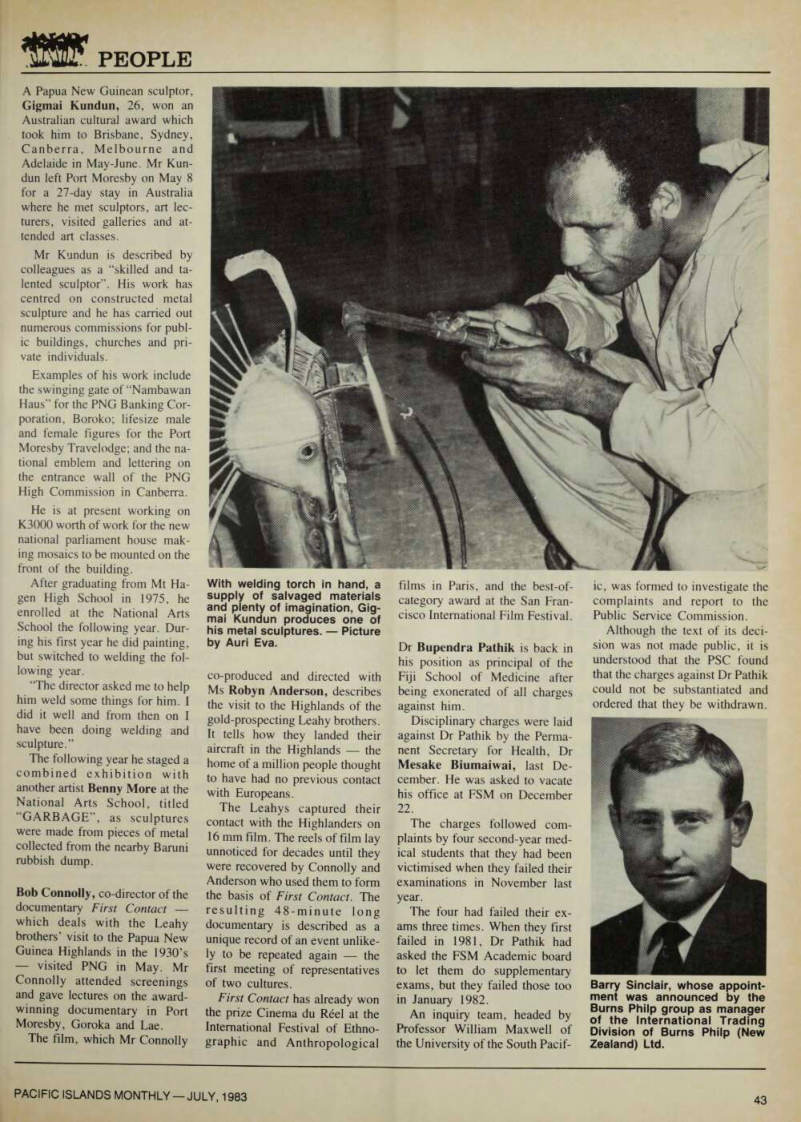

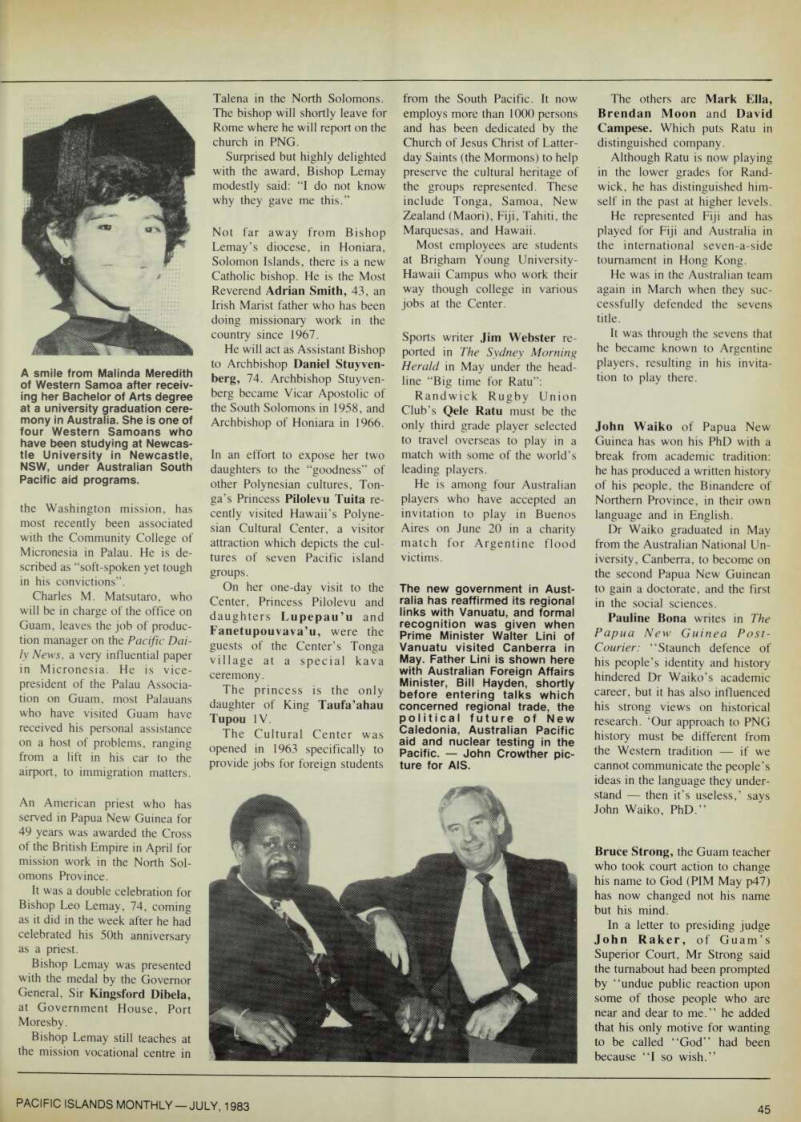
A Papua New Guinean sculptor, Gigmai Kundun, 26, won an Australian cultural award which took him to Brisbane, Sydney, Canberra, Melbourne and Adelaide in May-June. Mr Kun dun left Port Moresby on May 8 for a 27-day stay in Australia where he met sculptors, art lec turers, visited galleries and at tended art classes.
Mr Kundun is described by colleagues as a “skilled and ta lented sculptor”. His work has centred on constructed metal sculpture and he has carried out numerous commissions for publ ic buildings, churches and pri vate individuals.
Examples of his work include the swinging gate of “Nambawan Haus” for the PNG Banking Cor poration, Boroko; lifesize male and female figures for the Port Moresby Travelodge; and the na tional emblem and lettering on the entrance wall of the PNG High Commission in Canberra.
He is at present working on K3OOO worth of work for the new national parliament house mak ing mosaics to be mounted on the front of the building.
After graduating from Mt Ha gen High School in 1975, he enrolled at the National Arts School the following year. Dur ing his first year he did painting, but switched to welding the fol lowing year.
“The director asked me to help him weld some things for him. I did it well and from then on I have been doing welding and sculpture.”
The following year he staged a combined exhibition with another artist Benny More at the National Arts School, titled “GARBAGE”, as sculptures were made from pieces of metal collected from the nearby Baruni rubbish dump.
Bob Connolly, co-director of the documentary First Contact which deals with the Leahy brothers’ visit to the Papua New Guinea Highlands in the 1930’s visited PNG in May. Mr Connolly attended screenings and gave lectures on the award winning documentary in Port Moresby, Goroka and Lae.
The film, which Mr Connolly
films in Paris, and the best-of category award at the San Fran cisco International Film Festival.
Dr Bupendra Pathik is back in his position as principal of the Fiji School of Medicine after being exonerated of all charges against him.
Disciplinary charges were laid against Dr Pathik by the Perma nent Secretary for Health, Dr Mesake Biumaiwai, last De cember. He was asked to vacate his office at FSM on December 22.
The charges followed com plaints by four second-year med ical students that they had been victimised when they failed their examinations in November last year.
The four had failed their ex ams three times. When they first failed in 1981, Dr Pathik had asked the FSM Academic board to let them do supplementary exams, but they failed those too in January 1982.
An inquiry team, headed by Professor William Maxwell of the University of the South Pacif
co-produced and directed with Ms Robyn Anderson, describes the visit to the Highlands of the gold-prospecting Leahy brothers.
It tells how they landed their aircraft in the Highlands the home of a million people thought to have had no previous contact with Europeans.
The Leahys captured their contact with the Highlanders on 16 mm film. The reels of film lay unnoticed for decades until they were recovered by Connolly and Anderson who used them to form the basis of First Contact. The resulting 48-minute long documentary is described as a unique record of an event unlike ly to be repeated again the first meeting of representatives of two cultures.
First Contact has already won the prize Cinema du Reel at the International Festival of Ethno graphic and Anthropological
ic, was formed to investigate the complaints and report to the Public Service Commission.
Although the text of its deci sion was not made public, it is understood that the PSC found that the charges against Dr Pathik could not be substantiated and ordered that they be withdrawn.
With welding torch in hand, a supply of salvaged materials and plenty of imagination, Gig mai Kundun produces one of his metal sculptures. - Picture by Auri Eva.
Barry Sinclair, whose appoint ment was announced by the Burns Philp group as manager of the International Trading Division of Burns Philp (New Zealand) Ltd.
James William Harris, 46, for mer manager of co-operative education at the Polynesian Cul tural Center, Honolulu, has been appointed director of central planning and development for the kingdom of Tonga.
Mr Harris is the first top-level government official appointed from outside Tonga and will re port directly to Tonga’s Prime Minister, Prince Fatefehi Tu’ipelehake.
In his time at the Polynesian Cultural Center, he wrote a manual for both the Center and Brigham Young University- Hawaii Campus, where he taught Pacific history and regional de velopment courses.
Married, and with five chil dren, Mr Harris was bom in Tonga but attended elementary and high school in New Zealand.
He completed his undergraduate studies at the then Church Col lege of Hawaii (now BYU- Hawaii Campus) where he has graduated valedictorian. He later earned a master’s degree at
Brigham Young University, Pro
vo, with honors.
A staunch member of The Church of Jesus Christ of Latter day Saints (the Mormons), Har ris served as superintendent of LDS church schools for Tonga, Fiji, Tahiti, Kiribati, Niue, Rarotonga, and Tuvalu in 1974.
Former Community College of
Micronesia president Resio Moses has been sworn in as the second elected governor of Ponape State, Federated States of Micronesia.
Former Governor Leo A. Fal cam, who lost to Moses in a runoff election on March 29, handed the Ponape State flag to Moses as a symbol of the transfer of power.
The Palau Senate has approved the appointments of Noriwo Übedei and Charles M. Matsut aro as Palau representatives to head liaison offices in Washing ton, DC, and Guam.
Noriwo Übedei, who will head
James William Harris
the Washington mission, has most recently been associated with the Community College of Micronesia in Palau. He is de scribed as “soft-spoken yet tough in his convictions”.
Charles M. Matsutaro, who will be in charge of the office on Guam, leaves the job of produc tion manager on the Pacific Dai ly News, a very influential paper in Micronesia. He is vice president of the Palau Associa tion on Guam, most Palauans who have visited Guam have received his personal assistance on a host of problems, ranging from a lift in his car to the airport, to immigration matters.
An American priest who has served in Papua New Guinea for 49 years was awarded the Cross of the British Empire in April for mission work in the North Sol omons Province.
It was a double celebration for Bishop Leo Lemay, 74, coming as it did in the week after he had celebrated his 50th anniversary as a priest.
Bishop Lemay was presented with the medal by the Governor General, Sir Kingsford Dibela, at Government House, Port
Moresby.
Bishop Lemay still teaches at the mission vocational centre in
Talena in the North Solomons.
The bishop will shortly leave for Rome where he will report on the church in PNG.
Surprised but highly delighted
with the award, Bishop Lemay modestly said: “I do not know why they gave me this.”
Not far away from Bishop Lemay’s diocese, in Honiara, Solomon Islands, there is a new Catholic bishop. He is the Most Reverend Adrian Smith, 43, an Irish Marist father who has been doing missionary work in the country since 1967.
He will act as Assistant Bishop
to Archbishop Daniel Stuyven
berg, 74. Archbishop Stuyven
berg became Vicar Apostolic of the South Solomons in 1958, and Archbishop of Honiara in 1966.
In an effort to expose her two daughters to the “goodness” of other Polynesian cultures, Ton ga’s Princess Pilolevu Tuita re cently visited Hawaii’s Polyne sian Cultural Center, a visitor attraction which depicts the cul tures of seven Pacific island groups.
On her one-day visit to the Center, Princess Pilolevu and
daughters Lupepau’u and
Fanetupouvava’u, were the guests of the Center’s Tonga village at a special kava ceremony.
The princess is the only
daughter of King Taufa’ahau
Tupou IV.
The Cultural Center was opened in 1963 specifically to provide jobs for foreign students
from the South Pacific. It now employs more than 1000 persons and has been dedicated by the Church of Jesus Christ of Latter day Saints (the Mormons) to help preserve the cultural heritage of the groups represented. These include Tonga, Samoa, New Zealand (Maori), Fiji, Tahiti, the Marquesas, and Hawaii.
Most employees are students at Brigham Young University- Hawaii Campus who work their way though college in various jobs at the Center.
Sports writer Jim Webster re ported in The Sydney Morning Herald in May under the head line “Big time for Ratu”: Randwick Rugby Union Club’s Qele Ratu must be the only third grade player selected to travel overseas to play in a match with some of the world’s leading players.
He is among four Australian players who have accepted an invitation to play in Buenos Aires on June 20 in a charity match for Argentine flood victims.
The others are Mark Ella, Brendan Moon and David Campese. Which puts Ratu in distinguished company.
Although Ratu is now playing in the lower grades for Rand wick, he has distinguished him self in the past at higher levels.
He represented Fiji and has played for Fiji and Australia in the international seven-a-side tournament in Hong Kong.
He was in the Australian team again in March when they suc cessfully defended the sevens title.
It was through the sevens that he became known to Argentine players, resulting in his invita tion to play there.
John Waiko of Papua New Guinea has won his PhD with a break from academic tradition: he has produced a written history of his people, the Binandere of Northern Province, in their own language and in English.
Dr Waiko graduated in May from the Australian National Un iversity, Canberra, to become on the second Papua New Guinean to gain a doctorate, and the first in the social sciences.
Pauline Bona writes in The Papua New Guinea Post- Courier: “Staunch defence of his people’s identity and history hindered Dr Waiko’s academic career, but it has also influenced his strong views on historical research. ‘Our approach to PNG history must be different from the Western tradition if we cannot communicate the people’s ideas in the language they under stand then it’s useless,’ says John Waiko, PhD.’’
Bruce Strong, the Guam teacher who took court action to change his name to God (PIM May p 47) has now changed not his name but his mind.
In a letter to presiding judge John Raker, of Guam’s Superior Court, Mr Strong said the turnabout had been prompted by “undue public reaction upon some of those people who are near and dear to me.” he added that his only motive for wanting to be called “God” had been because “I so wish.”
A smile from Malinda Meredith of Western Samoa after receiv ing her Bachelor of Arts degree at a university graduation cere mony in Australia. She is one of four Western Samoans who have been studying at Newcas tle University in Newcastle, NSW, under Australian South Pacific aid programs.
The new government in Aust ralia has reaffirmed its regional links with Vanuatu, and formal
recognition was given when
Prime Minister Walter Lini of Vanuatu visited Canberra in May. Father Lini is shown here with Australian Foreign Affairs
Minister, Bill Hayden, shortly
before entering talks which concerned regional trade, the political future of New Caledonia, Australian Pacific aid and nuclear testing in the
Pacific. - John Crowther pic
ture for AIS.
Advertisements & other items, pp. 44-46 (1 item)
package
Mobile
power in a
self-contained
package
No extras to buy
Delivered ready to go
F a a □
LEI29.HPH S&P
20kVA or 31kVA power wherever you want it. From rugged, reliable Dis-gen units that come complete with cabinet fuel tank, power outlets, etc. And need no special mounting platform.
Dis-gen electric generating sets. An astute combination of Onan generator and Perkins diesel.
Tough enough to take the hardest knocks, In mining. Construction sites.
Outback engineering projects. Hire companies Or anywhere you need a durable, dependable 240/415v power source.
A special marine model is also available.
Rigid underchassis protects the unit wherever you take it. And however you get it there. On a truck or a trailer. On skids. Or lifted in by crane. Undercarriages, 2 or 4 wheels, available as options.
Dis-gen. Mobility and power in a selfcontained package.
Dis-gen 20kVA and 31kVA
electric generating sets.
Available from:
LINCOLN ■
ARC WELDING
The Lincoln Electric Company
(Aust.) Pfy. Ltd.
Sydney (Head Office) 35 Bryant Street, Padstow, NSW 2211 Telephone: (02) 772 7222 Telex: 22792 Cobles; "Linconweld", Sydney Newcastle Telephone: (049) 61 5381 Telex 28263 Wollongong Telephone: (042) 28 0565 Melbourne Telephone: (03) 481 8444 Telex: 31958 Brisbane Telephone: (07) 277 2955 Telex: 41268 Townsville Telephone: (077) 79 9777 Telex: 47247 Mackay Telephone: (079) 51 2599 Telex 48655 Adelaide Telephone; (08) 43 8061 Telex 82794 Perm Telephone: (09) 277 8744 Telex: 92914 Karratha (WA) Telephone: (091) 85 2405 Telex: 99640 Launceston Telephone: (003) 26 3388 Telex: 58517
Distragen
Distragen Pty Ltd.
New South Wales (Head Office) 4 Mitchell Road, Brookvole, NSW 2100 Telephone: (02) 9381777 Telex: 27733 Melbourne Telephone: (03) 4810508 Telex 31958 Brisbane Telephone: (07) 275 2926 Telex: 41268
SSN
• SOLAREX '#
5 BELLONA AVE., REGENTS PARK 2143 AUSTRALIA TELEPHONE (02) 644 5055 TELEX AA 21975
ELECTRICITY FROM SUNLIGHT
m *; yjr r, «JaWfc. •' SnmJßk 2 .fft & HP V "J 1 1 It m • ■ sn * anTi * Tin lb. ': \ n
VILLAGE POWER
HOUSE LIGHTING
REFRIGERATION
WATER PUMPING
COMMUNICATIONS
MILITARY
MARINE
One of the earths most abundant elements, Silicon, is the basic ingredient of the two materials shown here sand, and the solar cell.
Combined together as a single panel or in an array of multiple panels, and by adding one extra free ingredient sunlight solar cells can generate sufficient electricity for almost any
application.
again . . .
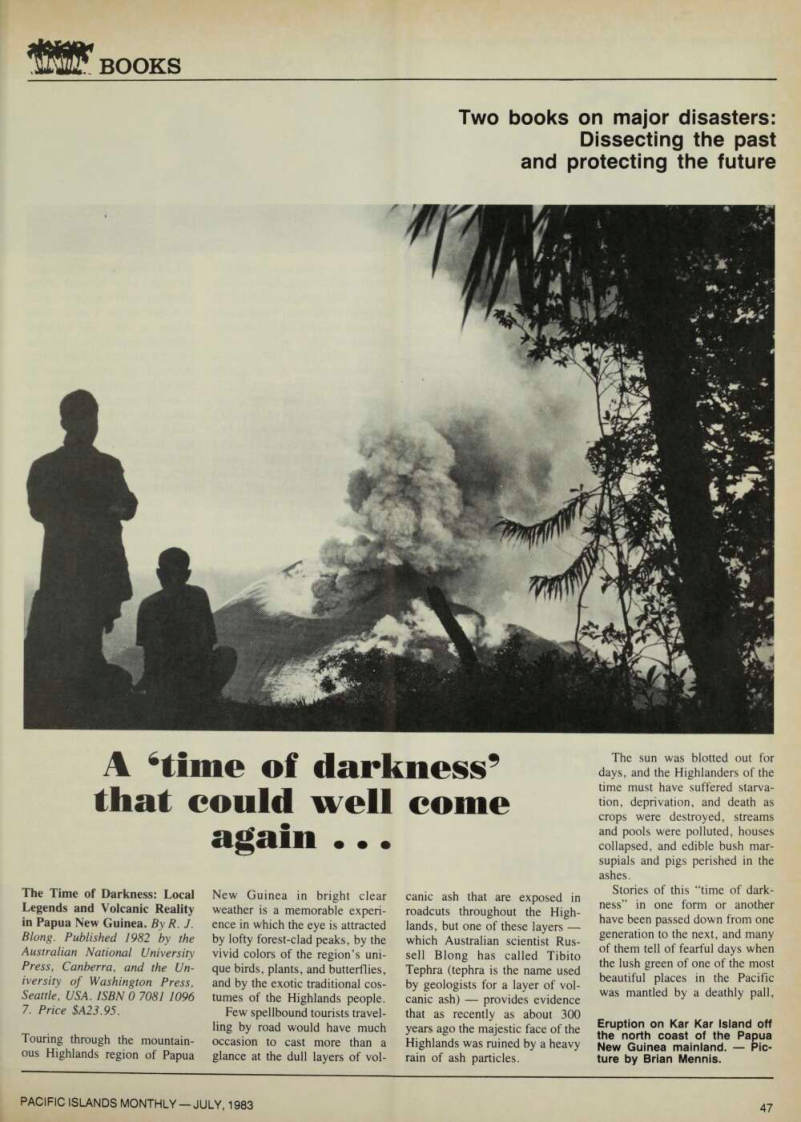
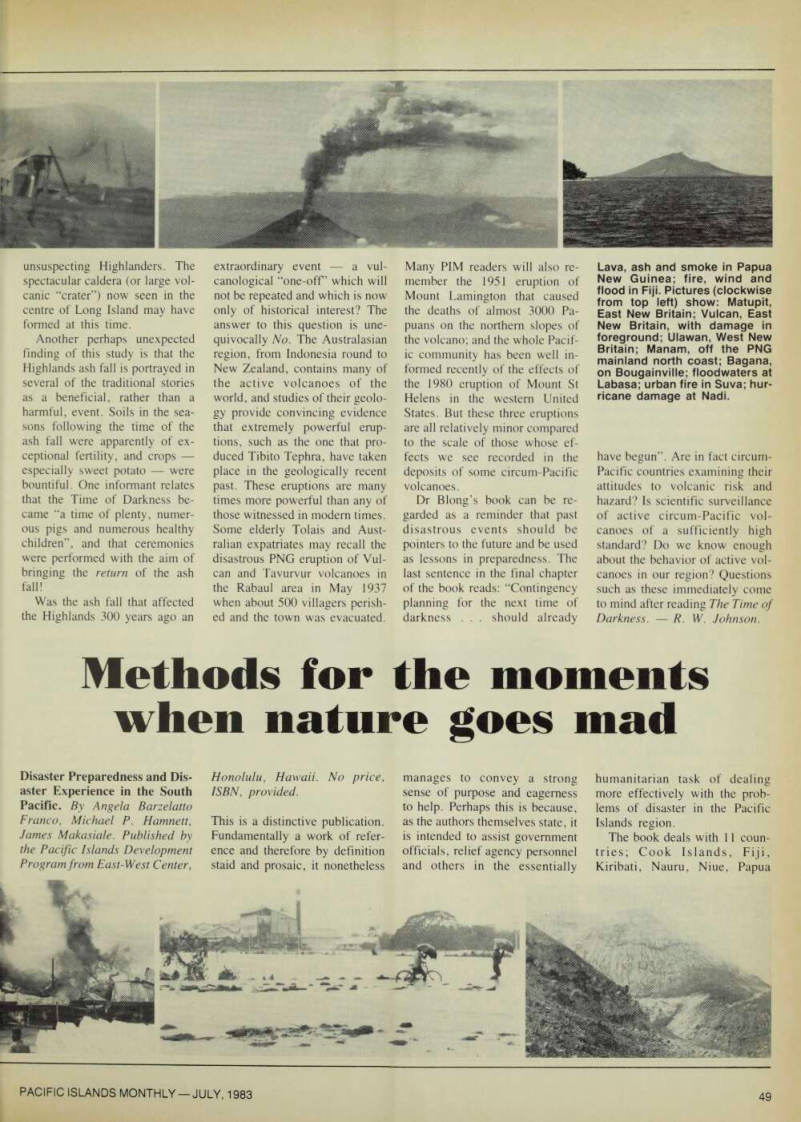
Books
A ‘time of darkness ' that could well come again . . .
The Time of Darkness: Local Legends and Volcanic Reality in Papua New Guinea. By R. J.
Blong. Published 1982 by the Australian National University Press, Canberra, and the Un iversity of Washington Press, Seattle, USA. ISBN 0 7081 1096 7. Price $A23.95.
Touring through the mountain ous Highlands region of Papua
New Guinea in bright clear weather is a memorable experi ence in which the eye is attracted by lofty forest-clad peaks, by the vivid colors of the region’s uni que birds, plants, and butterflies, and by the exotic traditional cos tumes of the Highlands people.
Few spellbound tourists travel ling by road would have much occasion to cast more than a glance at the dull layers of vol
canic ash that are exposed in roadcuts throughout the High lands, but one of these layers which Australian scientist Rus sell Blong has called Tibito Tephra (tephra is the name used by geologists for a layer of vol canic ash) provides evidence that as recently as about 300 years ago the majestic face of the Highlands was ruined by a heavy rain of ash particles.
The sun was blotted out for days, and the Highlanders of the time must have suffered starva tion, deprivation, and death as crops were destroyed, streams and pools were polluted, houses collapsed, and edible bush mar supials and pigs perished in the ashes.
Stories of this “time of dark ness” in one form or another have been passed down from one generation to the next, and many of them tell of fearful days when the lush green of one of the most beautiful places in the Pacific was mantled by a deathly pall,
Eruption on Kar Kar Island off the north coast of the Papua New Guinea mainland. Pic
ture
by Brian Mennis.
Two books on major disasters: Dissecting the past and protecting the future
when psychological stress even terror must have reigned as the fine volcanic ash fell to depths of several centimetres,
abruptly interrupting the seasonal
pattern of life.
Dr Blong, a lecturer in geomorphology at Macquarie University in Sydney, has col lected together and made a spe cial investigation of the stories of the Time of Darkness (what bet ter title for the book). He dis tributed a questionnaire to many centres in the Highlands and so acquired from almost 100 infor mants (mainly social an thropologists and staff of the Summer School of Linguistics) data which they in turn obtained
by questioning people in their
respective areas of interest. Dr Blong then combined these re sponses with previously docu mented stories of the Time of Darkness and with his own geological observations and in terpretations of the ash layer, and assessed all of this information with reference to what is known about the effects of volcanic ash falls elsewhere in the world. His book is a fine piece of scientific
detective work, drawing together
the results of several years of research and creating for us a vivid picture of what the ash fall must have been like and what its effects must have been.
Dr Blong has written his book in mainly non-technical lan guage, and the Australian Na
tional University Press has main tained the high standard of pre sentation that it normally accords to books on the Pacific. Some chapter headings are not espe cially informative and the con tents list does not include chapter sub-headings, which means the task of re-locating particular sec tions of interest is hindered somewhat; a few photographs would also have enhanced the text. However, these are minor criticisms of a book that can be
strongly recommended, not just
to oral historians and vulcanolog ists, but to the non-specialist interested in the cultural and natural history of PNG.
The book contains some unex pected conclusions. For exam ple, the ash of Tibito Tephra probably did not originate from one of the geologically youthful volcanoes in the Highlands reg ion (many Highlands peaks are volcanoes the Hagen Range, for example, near the town of the same name, consists of three extinct volcanic centres). Rather, Dr Blong believes the ash came from Long Island volcano in the Bismarck Sea about 150 kilometres east of Madang, off the north coast of New Guinea.
A vast eruption cloud was form ed that may have risen as high as 30 kilometres. This cloud was
caught by high-altitude easterly
winds that drove the ash plume westwards across New Guinea dumping its uninvited load on the
unsuspecting Highlanders. The
spectacular caldera (or large vol canic “crater”) now seen in the centre of Long Island may have formed at this time.
Another perhaps unexpected finding of this study is that the Highlands ash fall is portrayed in several of the traditional stories as a beneficial, rather than a harmful, event. Soils in the sea sons following the time of the ash fall were apparently of ex
ceptional fertility, and crops
especially sweet potato were bountiful. One informant relates that the Time of Darkness be came “a time of plenty, numer ous pigs and numerous healthy children”, and that ceremonies were performed with the aim of bringing the return of the ash fall!
Was the ash fall that affected the Highlands 300 years ago an
extraordinary event a vul canological “one-off’ which will not be repeated and which is now only of historical interest? The answer to this question is une quivocally No. The Australasian region, from Indonesia round to New Zealand, contains many of the active volcanoes of the world, and studies of their geolo
gy provide convincing evidence
that extremely powerful erup
tions, such as the one that pro duced Tibito Tephra, have taken place in the geologically recent past. These eruptions are many times more powerful than any of those witnessed in modem times.
Some elderly Tolais and Aust ralian expatriates may recall the disastrous PNG eruption of Vul can and Tavurvur volcanoes in the Rabaul area in May 1937 when about 500 villagers perish ed and the town was evacuated.
Many PIM readers will also re member the 1951 eruption of Mount Lamington that caused the deaths of almost 3000 Pa puans on the northern slopes of the volcano; and the whole Pacif ic community has been well in formed recently of the effects of the 1980 eruption of Mount St Helens in the western United States. But these three eruptions are all relatively minor compared to the scale of those whose ef fects we see recorded in the deposits of some circum-Pacific volcanoes.
Dr Blong’s book can be re garded as a reminder that past disastrous events should be pointers to the future and be used as lessons in preparedness. The last sentence in the final chapter of the book reads: “Contingency planning for the next time of darkness . . . should already
have begun”. Are in fact circum- Pacific countries examining their attitudes to volcanic risk and hazard? Is scientific surveillance of active circum-Pacific vol canoes of a sufficiently high standard? Do we know enough about the behavior of active vol canoes in our region? Questions such as these immediately come to mind after reading The Time of
Darkness.
R. W. Johnson.
Lava, ash and smoke in Papua New Guinea; fire, wind and flood in Fiji. Pictures (clockwise from top left) show: Matupit, East New Britain; Vulcan, East New Britain, with damage in foreground; Ulawan, West New Britain; Manam, off the PNG mainland north coast; Bagana, on Bougainville; floodwaters at Labasa; urban fire in Suva; hur ricane damage at Nadi.
Advertisements & other items, p. 48 (2 items)
Books
Cameron
G°o^ Which one of these 11 aircraft is on "FIRE"
O ] or has a torched ; through Turbo or " 1 Exhaust Pipe?
Well you wouldn't know if you did not have an engine Fire Detector Kit.
Engine Fires have a habit of not letting you know until it's too LATE.
FIRE DETECTOR KITS
? are available from:
JOHN
CAMERON
AVIATION
HANGAR 473, BANKSTOWN AIRPORT,
SYDNEY, AUSTRALIA
PHONE: (02)707 2011, TELEX: AA 72716
when nature goes mad
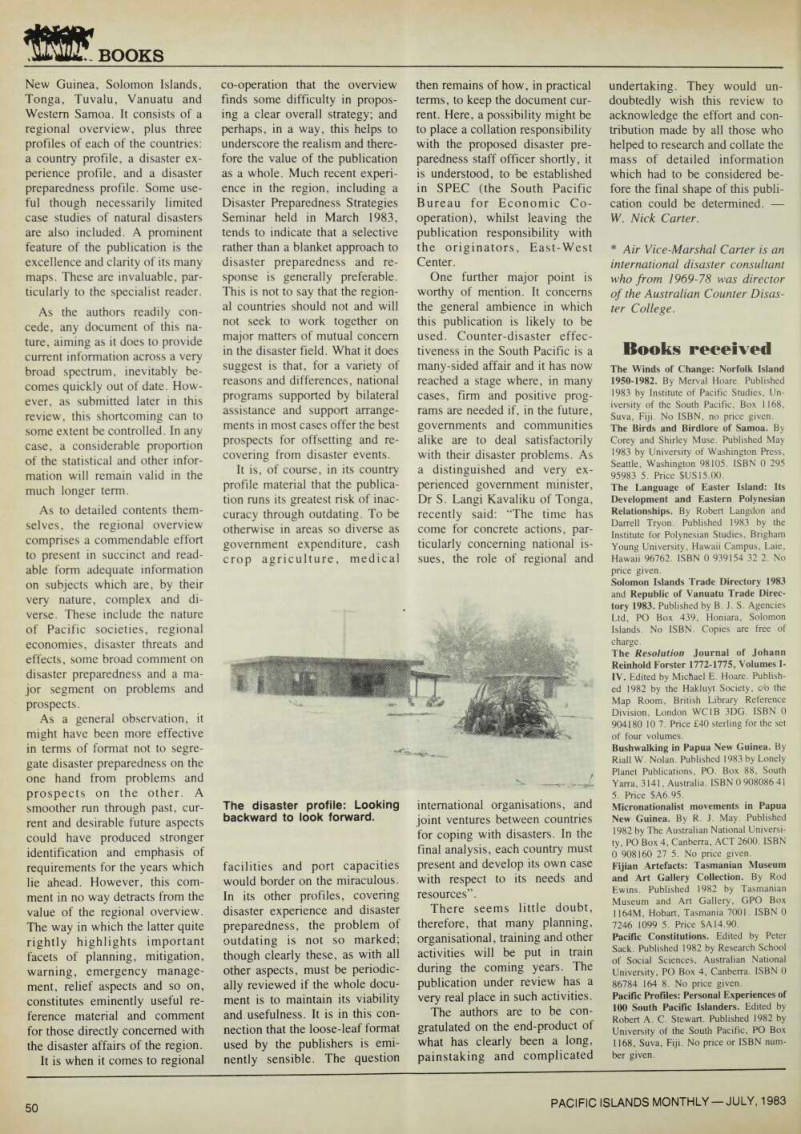
Methods for the moments when nature goes mad
Disaster Preparedness and Dis aster Experience in the South Pacific. By Angela Barzelatto Franco, Michael P. Hamnett, James Makasiale. Published by the Pacific Islands Development Program from East-West Center,
Honolulu, Hawaii. No price, ISBN, provided.
This is a distinctive publication.
Fundamentally a work of refer ence and therefore by definition staid and prosaic, it nonetheless
manages to convey a strong sense of purpose and eagerness to help. Perhaps this is because, as the authors themselves state, it is intended to assist government officials, relief agency personnel and others in the essentially
humanitarian task of dealing more effectively with the prob lems of disaster in the Pacific Islands region.
The book deals with 11 coun tries; Cook Islands, Fiji, Kiribati, Nauru, Niue, Papua
New Guinea, Solomon Islands, Tonga, Tuvalu, Vanuatu and Western Samoa. It consists of a regional overview, plus three profiles of each of the countries: a country profile, a disaster ex perience profile, and a disaster preparedness profile. Some use ful though necessarily limited case studies of natural disasters are also included. A prominent feature of the publication is the excellence and clarity of its many maps. These are invaluable, par ticularly to the specialist reader.
As the authors readily con cede, any document of this na ture, aiming as it does to provide current information across a very broad spectrum, inevitably be comes quickly out of date. How ever, as submitted later in this review, this shortcoming can to some extent be controlled. In any case, a considerable proportion of the statistical and other infor mation will remain valid in the much longer term.
As to detailed contents them selves, the regional overview comprises a commendable effort to present in succinct and read able form adequate information on subjects which are, by their very nature, complex and di verse. These include the nature of Pacific societies, regional economies, disaster threats and effects, some broad comment on disaster preparedness and a ma jor segment on problems and prospects.
As a general observation, it might have been more effective in terms of format not to segre gate disaster preparedness on the one hand from problems and prospects on the other. A smoother run through past, cur rent and desirable future aspects could have produced stronger identification and emphasis of requirements for the years which lie ahead. However, this com ment in no way detracts from the value of the regional overview.
The way in which the latter quite rightly highlights important facets of planning, mitigation, warning, emergency manage ment, relief aspects and so on, constitutes eminently useful re ference material and comment for those directly concerned with the disaster affairs of the region.
It is when it comes to regional
co-operation that the overview finds some difficulty in propos ing a clear overall strategy; and perhaps, in a way, this helps to underscore the realism and there fore the value of the publication as a whole. Much recent experi ence in the region, including a
Disaster Preparedness Strategies
Seminar held in March 1983, tends to indicate that a selective rather than a blanket approach to disaster preparedness and re
sponse is generally preferable.
This is not to say that the region al countries should not and will not seek to work together on major matters of mutual concern in the disaster field. What it does suggest is that, for a variety of reasons and differences, national programs supported by bilateral assistance and support arrange ments in most cases offer the best prospects for offsetting and re covering from disaster events.
It is, of course, in its country profile material that the publica tion runs its greatest risk of inac curacy through outdating. To be otherwise in areas so diverse as government expenditure, cash crop agriculture, medical
facilities and port capacities would border on the miraculous.
In its other profiles, covering disaster experience and disaster preparedness, the problem of outdating is not so marked; though clearly these, as with all other aspects, must be periodic ally reviewed if the whole docu ment is to maintain its viability and usefulness. It is in this con nection that the loose-leaf format used by the publishers is emi nently sensible. The question
then remains of how, in practical terms, to keep the document cur rent. Here, a possibility might be to place a collation responsibility with the proposed disaster pre paredness staff officer shortly, it is understood, to be established in SPEC (the South Pacific Bureau for Economic Co operation), whilst leaving the publication responsibility with the originators, East-West Center.
One further major point is worthy of mention. It concerns the general ambience in which this publication is likely to be used. Counter-disaster effec tiveness in the South Pacific is a many-sided affair and it has now reached a stage where, in many cases, firm and positive prog rams are needed if, in the future, governments and communities alike are to deal satisfactorily with their disaster problems. As a distinguished and very ex perienced government minister, Dr S. Langi Kavaliku of Tonga, recently said: “The time has come for concrete actions, par ticularly concerning national is sues, the role of regional and
international organisations, and joint ventures between countries for coping with disasters. In the final analysis, each country must present and develop its own case with respect to its needs and resources”.
There seems little doubt, therefore, that many planning, organisational, training and other activities will be put in train during the coming years. The publication under review has a very real place in such activities.
The authors are to be con gratulated on the end-product of what has clearly been a long, painstaking and complicated
undertaking. They would un doubtedly wish this review to acknowledge the effort and con tribution made by all those who helped to research and collate the mass of detailed information which had to be considered be fore the final shape of this publi cation could be determined.
W. Nick Carter.
* Air Vice-Marshal Carter is an international disaster consultant who from 1969-78 was director of the Australian Counter Disas
ter College.
Books received
The Winds of Change: Norfolk Island 1950-1982. By Merval Hoare. Published 1983 by Institute of Pacific Studies, Un iversity of the South Pacific, Box 1168, Suva, Fiji. No ISBN, no price given.
The Birds and Birdlore of Samoa. By Corey and Shirley Muse. Published May 1983 by University of Washington Press, Seattle, Washington 98105. ISBN 0 295 95983 5. Price SUS 15.00.
The Language of Easter Island: Its Development and Eastern Polynesian Relationships. By Robert Langdon and Darrell Tryon. Published 1983 by the Institute for Polynesian Studies, Brigham Young University, Hawaii Campus, Laie, Hawaii 96762. ISBN 0 939154 32 2. No price given.
Solomon Islands Trade Directory 1983 and Republic of Vanuatu Trade Direc tory 1983. Published by B. J. S. Agencies Ltd, PO Box 439, Honiara, Solomon Islands. No ISBN. Copies are free of charge.
The Resolution Journal of Johann Reinhold Forster 1772-1775, Volumes l- IV. Edited by Michael E. Hoare. Publish ed 1982 by the Hakluyt Society, c/o the Map Room, British Library Reference Division, London WCIB 3DG. ISBN 0 904180 10 7. Price £4O sterling for the set of four volumes.
Bushwalking in Papua New Guinea. By Riall W. Nolan. Published 1983 by Lonely Planet Publications, PO. Box 88, South Yarra, 3141, Australia. ISBN 0 908086 41 5. Price $A6.95.
Micronationalist movements in Papua New Guinea. By R. J. May. Published 1982 by The Australian National Universi ty, PO Box 4, Canberra, ACT 2600. ISBN 0 908160 27 5. No price given.
Fijian Artefacts: Tasmanian Museum and Art Gallery Collection. By Rod Ewins. Published 1982 by Tasmanian Museum and Art Gallery, GPO Box 1164 M, Hobart, Tasmania 7001. ISBN 0 7246 1099 5. Price $A14.90.
Pacific Constitutions. Edited by Peter Sack. Published 1982 by Research School of Social Sciences, Australian National University, PO Box 4, Canberra. ISBN 0 86784 164 8. No price given.
Pacific Profiles: Personal Experiences of 100 South Pacific Islanders. Edited by Robert A. C. Stewart. Published 1982 by University of the South Pacific, PO Box 1168, Suva, Fiji. No price or ISBN num ber given.
The disaster profile: Looking backward to look forward.
Miklouho-Maclay
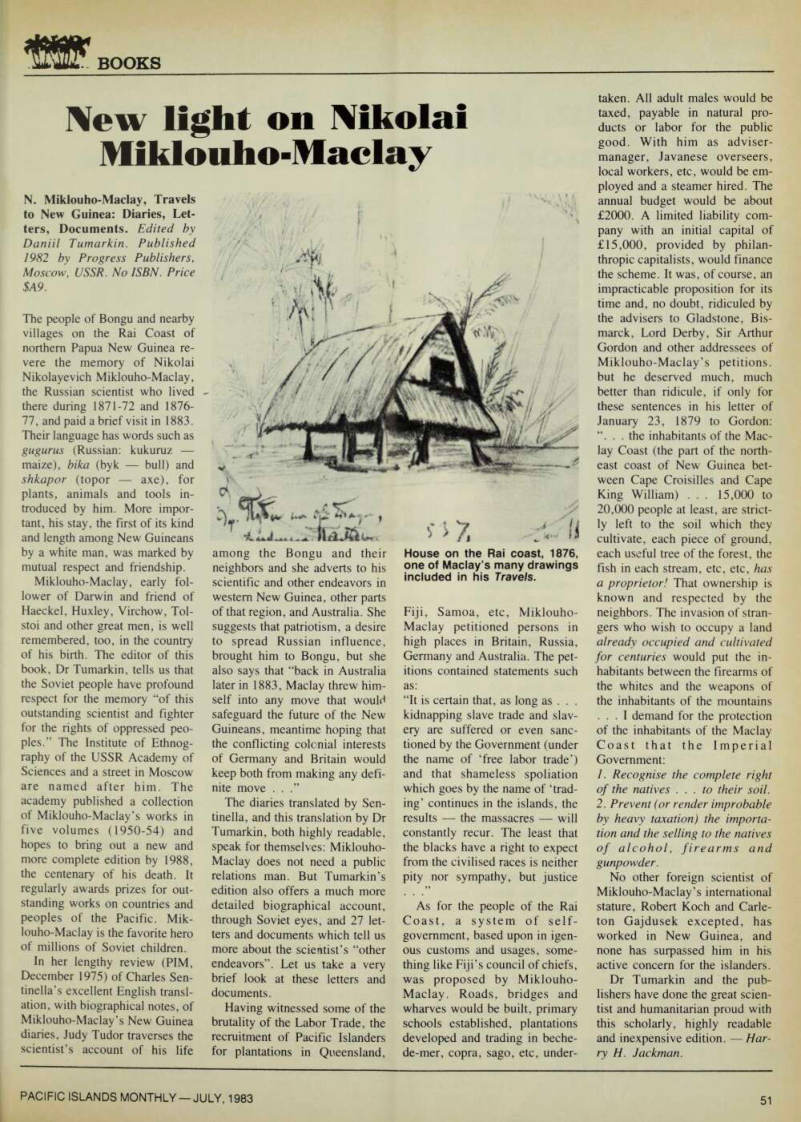
Mew light on Nikolai Miklouho-Maclay
N. Miklouho-Maclay, Travels to New Guinea: Diaries, Let ters, Documents. Edited by Daniil Tumarkin. Published 1982 by Progress Publishers, Moscow, USSR. No ISBN. Price SA9.
The people of Bongu and nearby villages on the Rai Coast of northern Papua New Guinea re vere the memory of Nikolai Nikolayevich Miklouho-Maclay, the Russian scientist who lived there during 1871-72 and 1876- 77, and paid a brief visit in 1883.
Their language has words such as gugurus (Russian; kukuruz maize), bika (byk bull) and shkapor (topor axe), for plants, animals and tools in troduced by him. More impor tant, his stay, the first of its kind and length among New Guineans by a white man, was marked by mutual respect and friendship.
Miklouho-Maclay, early fol lower of Darwin and friend of Haeckel, Huxley, Virchow, Tol stoi and other great men, is well remembered, too, in the country of his birth. The editor of this book, Dr Tumarkin, tells us that the Soviet people have profound respect for the memory “of this outstanding scientist and fighter for the rights of oppressed peo ples.” The Institute of Ethnog raphy of the USSR Academy of Sciences and a street in Moscow are named after him. The academy published a collection of Miklouho-Maclay’s works in five volumes (1950-54) and hopes to bring out a new and more complete edition by 1988, the centenary of his death. It regularly awards prizes for out standing works on countries and peoples of the Pacific. Mik louho-Maclay is the favorite hero of millions of Soviet children.
In her lengthy review (PIM, December 1975) of Charles Sen tinella’s excellent English transl ation, with biographical notes, of Miklouho-Maclay’s New Guinea diaries, Judy Tudor traverses the scientist’s account of his life
among the Bongu and their neighbors and she adverts to his scientific and other endeavors in western New Guinea, other parts of that region, and Australia. She suggests that patriotism, a desire to spread Russian influence, brought him to Bongu, but she also says that “back in Australia later in 1883, Maclay threw him self into any move that would safeguard the future of the New Guineans, meantime hoping that the conflicting colonial interests of Germany and Britain would keep both from making any defi nite move ...”
The diaries translated by Sen tinella, and this translation by Dr Tumarkin, both highly readable, speak for themselves: Miklouho- Maclay does not need a public relations man. But Tumarkin’s edition also offers a much more detailed biographical account, through Soviet eyes, and 27 let ters and documents which tell us more about the scientist’s “other endeavors”. Let us take a very brief look at these letters and documents.
Having witnessed some of the brutality of the Labor Trade, the recruitment of Pacific Islanders for plantations in Queensland,
Fiji, Samoa, etc, Miklouho- Maclay petitioned persons in high places in Britain, Russia, Germany and Australia. The pet itions contained statements such as: “It is certain that, as long as . . . kidnapping slave trade and slav ery are suffered or even sanc tioned by the Government (under the name of ‘free labor trade’) and that shameless spoliation which goes by the name of ‘trad ing’ continues in the islands, the results the massacres will constantly recur. The least that the blacks have a right to expect from the civilised races is neither pity nor sympathy, but justice As for the people of the Rai Coast, a system of self government, based upon in igen ous customs and usages, some thing like Fiji’s council of chiefs, was proposed by Miklouho- Maclay. Roads, bridges and wharves would be built, primary schools established, plantations developed and trading in beche de-mer, copra, sago, etc, under
taken. All adult males would be taxed, payable in natural pro ducts or labor for the public good. With him as adviser manager, Javanese overseers, local workers, etc, would be em ployed and a steamer hired. The annual budget would be about £2OOO. A limited liability com pany with an initial capital of £15,000, provided by philan thropic capitalists, would finance the scheme. It was, of course, an impracticable proposition for its time and, no doubt, ridiculed by the advisers to Gladstone, Bis marck, Lord Derby, Sir Arthur Gordon and other addressees of Miklouho-Maclay’s petitions, but he deserved much, much better than ridicule, if only for these sentences in his letter of January 23, 1879 to Gordon: . . the inhabitants of the Mac lay Coast (the part of the north east coast of New Guinea bet ween Cape Croisilles and Cape King William) . . . 15,000 to 20,000 people at least, are strict ly left to the soil which they cultivate, each piece of ground, each useful tree of the forest, the fish in each stream, etc, etc, has a proprietor! That ownership is known and respected by the neighbors. The invasion of stran gers who wish to occupy a land already occupied and cultivated for centuries would put the in habitants between the firearms of the whites and the weapons of the inhabitants of the mountains ... I demand for the protection of the inhabitants of the Maclay Coast that the Imperial Government: 1. Recognise the complete right of the natives ... to their soil. 2. Prevent (or render improbable by heavy taxation) the importa tion and the selling to the natives of alcohol, firearms and gunpowder.
No other foreign scientist of Miklouho-Maclay’s international stature, Robert Koch and Carle ton Gajdusek excepted, has worked in New Guinea, and none has surpassed him in his active concern for the islanders.
Dr Tumarkin and the pub lishers have done the great scien tist and humanitarian proud with this scholarly, highly readable
and inexpensive edition.
Har-
ry H. Jackman.
House on the Rai coast, 1876, one of Maclay’s many drawings included in his Travels.
Wilhelm Heinrich Solf, good
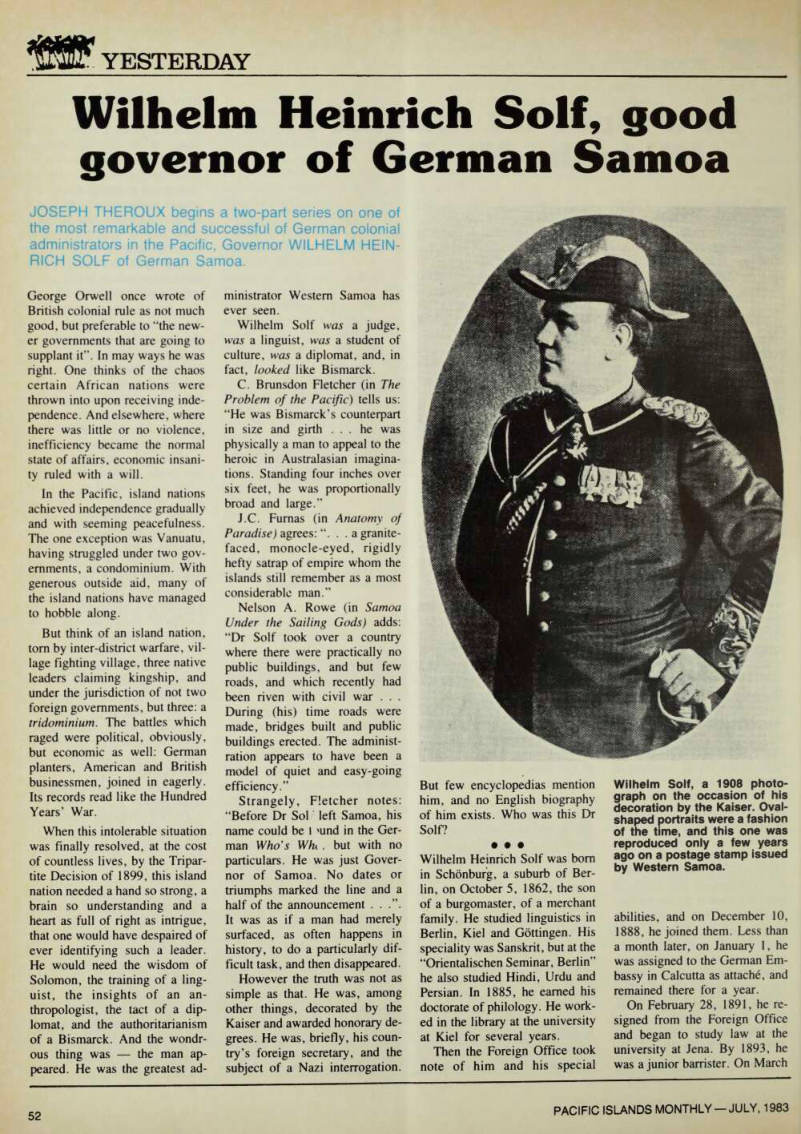

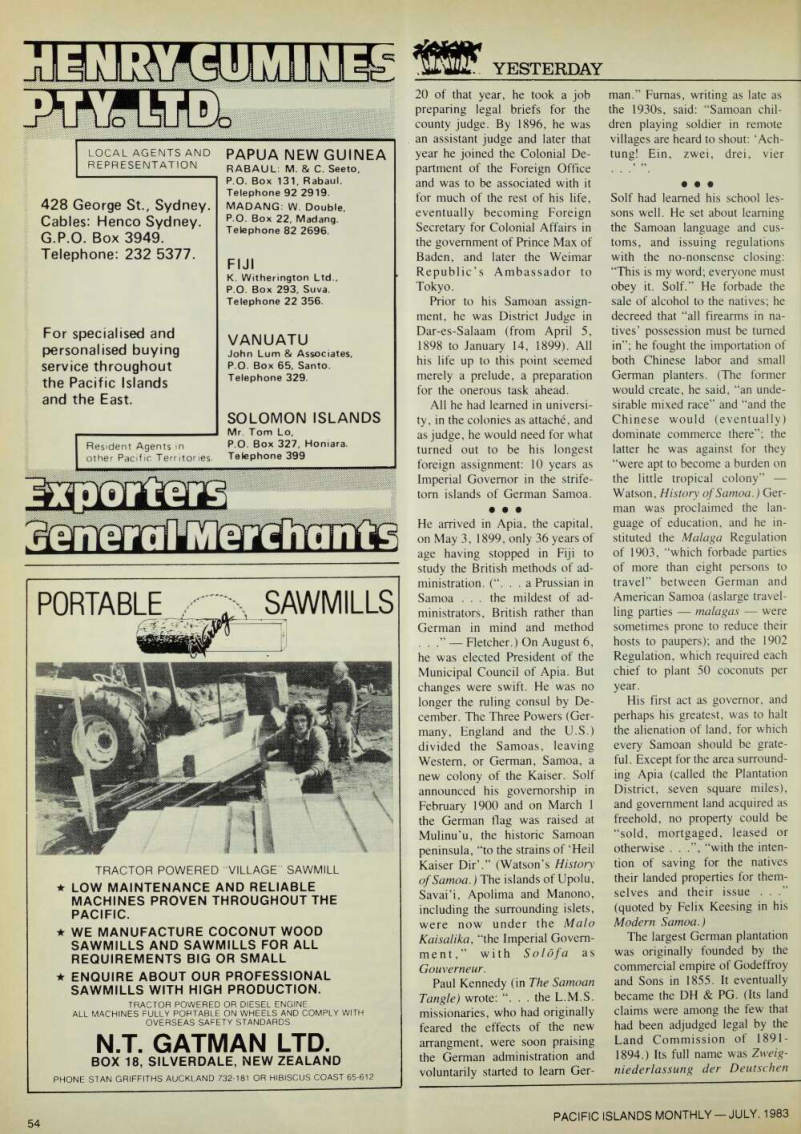
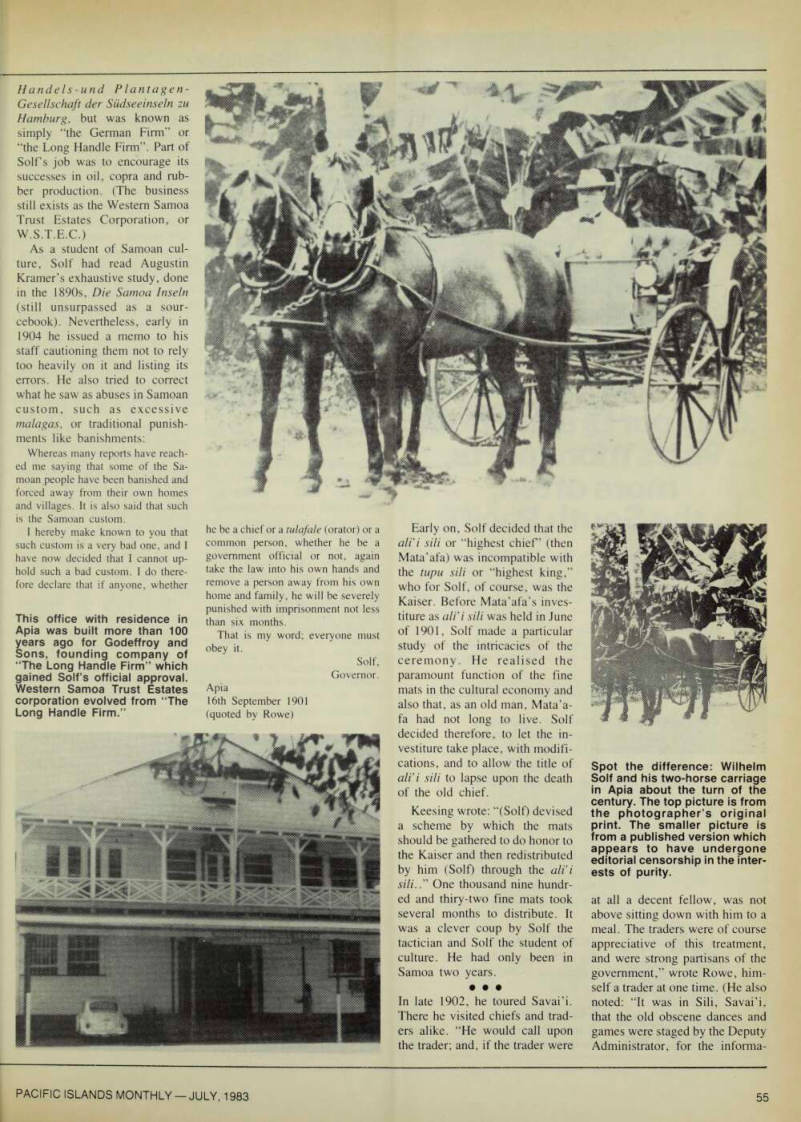
Yesterday
Wilhelm Heinrich Solf, good governor of German Samoa
JOSEPH THEROUX begins a two-part series on one of the most remarkable and successful of German colonial administrators in the Pacific, Governor WILHELM HEIN RICH SOLE of German Samoa.
George Orwell once wrote of British colonial rule as not much good, but preferable to “the new er governments that are going to supplant it”. In may ways he was right. One thinks of the chaos certain African nations were thrown into upon receiving inde pendence. And elsewhere, where there was little or no violence, inefficiency became the normal state of affairs, economic insani ty ruled with a will.
In the Pacific, island nations achieved independence gradually and with seeming peacefulness.
The one exception was Vanuatu, having struggled under two gov ernments, a condominium. With generous outside aid, many of the island nations have managed to hobble along.
But think of an island nation, tom by inter-district warfare, vil lage fighting village, three native leaders claiming kingship, and under the jurisdiction of not two foreign governments, but three; a tridominium. The battles which raged were political, obviously, but economic as well: German planters, American and British businessmen, joined in eagerly.
Its records read like the Hundred Years’ War.
When this intolerable situation was finally resolved, at the cost of countless lives, by the Tripar tite Decision of 1899, this island nation needed a hand so strong, a brain so understanding and a heart as full of right as intrigue, that one would have despaired of ever identifying such a leader.
He would need the wisdom of Solomon, the training of a ling uist, the insights of an an thropologist, the tact of a dip lomat, and the authoritarianism of a Bismarck. And the wondr ous thing was the man ap peared. He was the greatest ad
ministrator Western Samoa has ever seen.
Wilhelm Solf was a judge, was a linguist, was a student of culture, was a diplomat, and, in fact, looked like Bismarck.
C. Brunsdon Fletcher (in The Problem of the Pacific) tells us: “He was Bismarck’s counterpart in size and girth ... he was physically a man to appeal to the heroic in Australasian imagina tions. Standing four inches over six feet, he was proportionally broad and large.”
J.C. Furnas (in Anatomy of Paradise) agrees: “. . .a granite faced, monocle-eyed, rigidly hefty satrap of empire whom the islands still remember as a most considerable man.”
Nelson A. Rowe (in Samoa Under the Sailing Gods) adds: “Dr Solf took over a country where there were practically no public buildings, and but few roads, and which recently had been riven with civil war . . .
During (his) time roads were made, bridges built and public buildings erected. The administ ration appears to have been a model of quiet and easy-going efficiency.”
Strangely, Fletcher notes: “Before Dr Sol left Samoa, his name could be 1 >und in the Ger man Who’s Whi . but with no particulars. He was just Gover nor of Samoa. No dates or triumphs marked the line and a half of the announcement . . .”.
It was as if a man had merely surfaced, as often happens in history, to do a particularly dif ficult task, and then disappeared.
However the truth was not as simple as that. He was, among other things, decorated by the Kaiser and awarded honorary de grees. He was, briefly, his coun try’s foreign secretary, and the subject of a Nazi interrogation.
But few encyclopedias mention him, and no English biography of him exists. Who was this Dr Solf? • • • Wilhelm Heinrich Solf was bom in Schonburg, a suburb of Ber lin, on October 5, 1862, the son of a burgomaster, of a merchant family. He studied linguistics in Berlin, Kiel and Gottingen. His speciality was Sanskrit, but at the “Orientalischen Seminar, Berlin” he also studied Hindi, Urdu and Persian. In 1885, he earned his doctorate of philology. He work ed in the library at the university at Kiel for several years.
Then the Foreign Office took note of him and his special
abilities, and on December 10, 1888, he joined them. Less than a month later, on January 1, he was assigned to the German Em bassy in Calcutta as attache, and remained there for a year.
On February 28, 1891, he re signed from the Foreign Office and began to study law at the university at Jena. By 1893, he was a junior barrister. On March
Wilhelm Solf, a 1908 photo graph on the occasion of his decoration by the Kaiser. Oval shaped portraits were a fashion of the time, and this one was reproduced only a few years ago on a postage stamp issued by Western Samoa.
20 of that year, he took a job preparing legal briefs for the county judge. By 1896, he was an assistant judge and later that year he joined the Colonial De partment of the Foreign Office and was to be associated with it for much of the rest of his life, eventually becoming Foreign Secretary for Colonial Affairs in the government of Prince Max of Baden, and later the Weimar Republic’s Ambassador to Tokyo.
Prior to his Samoan assign ment, he was District Judge in Dar-es-Salaam (from April 5, 1898 to January 14, 1899). All his life up to this point seemed merely a prelude, a preparation for the onerous task ahead.
All he had learned in universi ty, in the colonies as attache, and as judge, he would need for what turned out to be his longest foreign assignment: 10 years as Imperial Governor in the strife tom islands of German Samoa. • • • He arrived in Apia, the capital, on May 3, 1899, only 36 years of age having stopped in Fiji to study the British methods of ad ministration. (“. . . a Prussian in Samoa ... the mildest of ad ministrators, British rather than German in mind and method . . Fletcher.) On August 6, he was elected President of the Municipal Council of Apia. But changes were swift. He was no longer the ruling consul by De cember. The Three Powers (Ger many, England and the U.S.) divided the Samoas, leaving Western, or German, Samoa, a new colony of the Kaiser. Solf announced his governorship in February 1900 and on March 1 the German flag was raised at Mulinu’u, the historic Samoan peninsula, “to the strains of ‘Heil Kaiser Dir’.” (Watson’s History of Samoa.) The islands of Upolu, Savai’i, Apolima and Manono, including the surrounding islets, were now under the Malo Kaisalika, “the Imperial Govem ment,” with Sold fa as Gouverneur.
Paul Kennedy (in The Samoan Tangle) wrote; “. . . the L.M.S. missionaries, who had originally feared the effects of the new arrangment, were soon praising the German administration and voluntarily started to learn Ger
man.” Fumas, writing as late as the 19305, said: “Samoan chil dren playing soldier in remote villages are heard to shout: ‘Ach tung! Ein, zwei, drei, vier 9 99 • • • Solf had learned his school les sons well. He set about learning the Samoan language and cus toms, and issuing regulations with the no-nonsense closing: “This is my word; everyone must obey it. Solf.” He forbade the sale of alcohol to the natives; he decreed that “all firearms in na tives’ possession must be turned in”; he fought the importation of both Chinese labor and small German planters. (The former would create, he said, “an unde sirable mixed race” and “and the Chinese would (eventually) dominate commerce there”; the latter he was against for they “were apt to become a burden on the little tropical colony”
Watson, History of Samoa.) Ger man was proclaimed the lan guage of education, and he in stituted the Malaga Regulation of 1903, “which forbade parties of more than eight persons to travel” between German and American Samoa (aslarge travel ling parties malagas were sometimes prone to reduce their hosts to paupers); and the 1902 Regulation, which required each chief to plant 50 coconuts per year.
His first act as governor, and perhaps his greatest, was to halt the alienation of land, for which every Samoan should be grate ful. Except for the area surround ing Apia (called the Plantation District, seven square miles), and government land acquired as freehold, no property could be “sold, mortgaged, leased or otherwise . . .”, “with the inten tion of saving for the natives their landed properties for them selves and their issue . . .” (quoted by Felix Keesing in his Modern Samoa.) The largest German plantation was originally founded by the commercial empire of Godeffroy and Sons in 1855. It eventually became the DH & PG. (Its land claims were among the few that had been adjudged legal by the Land Commission of 1891- 1894.) Its full name was Zweig niederlassung der Deutschen
Handels-und Plantagen- Gesellschaft der Sudseeinseln zu Hamburg, but was known as simply “the German Firm” or “the Long Handle Firm”. Part of Solf’s job was to encourage its successes in oil, copra and rub ber production. (The business still exists as the Western Samoa Trust Estates Corporation, or
W.S.T.E.C.)
As a student of Samoan cul ture, Solf had read Augustin Kramer’s exhaustive study, done in the 1890 s, Die Samoa Inseln (still unsurpassed as a sour cebook). Nevertheless, early in 1904 he issued a memo to his staff cautioning them not to rely too heavily on it and listing its errors. He also tried to correct what he saw as abuses in Samoan custom, such as excessive
malagas, or traditional punish
ments like banishments: Whereas many reports have reach ed me saying that some of the Sa moan people have been banished and forced away from their own homes and villages. It is also said that such is the Samoan custom.
I hereby make known to you that such custom is a very bad one, and I have now decided that I cannot up hold such a bad custom. I do there fore declare that if anyone, whether
he be a chief or a tulafale (orator) or a common person, whether he be a government official or not, again take the law into his own hands and remove a person away from his own home and family, he will be severely punished with imprisonment not less than six months.
That is my word; everyone must
obey it.
Solf, Governor.
Apia
16th September 1901 (quoted by Rowe)
Early on, Solf decided that the ali’i sili or “highest chief’ (then Mata’afa) was incompatible with the tupu sili or “highest king,” who for Solf, of course, was the Kaiser. Before Mata’afa’s inves titure as ali’i sili was held in June of 1901, Solf made a particular study of the intricacies of the ceremony. He realised the paramount function of the fine mats in the cultural economy and also that, as an old man, Mata’a fa had not long to live. Solf decided therefore, to let the in vestiture take place, with modifi cations, and to allow the title of ali’i sili to lapse upon the death of the old chief.
Keesing wrote: “(Solf) devised a scheme by which the mats should be gathered to do honor to the Kaiser and then redistributed by him (Solf) through the ali’i sili..” One thousand nine hundr ed and thiry-two fine mats took several months to distribute. It was a clever coup by Solf the tactician and Solf the student of culture. He had only been in Samoa two years. • • • In late 1902, he toured Savai’i.
There he visited chiefs and trad ers alike. “He would call upon the trader; and, if the trader were
at all a decent fellow, was not above sitting down with him to a meal. The traders were of course appreciative of this treatment, and were strong partisans of the government,” wrote Rowe, him self a trader at one time. (He also noted; “It was in Sili, Savai’i, that the old obscene dances and games were staged by the Deputy Administrator, for the informa-
This office with residence in Apia was built more than 100 years ago for Godeffroy and Sons, founding company of “The Long Handle Firm” which gained Solf’s official approval.
Western Samoa Trust Estates corporation evolved from “The Long Handle Firm.”
Spot the difference: Wilhelm Solf and his two-horse carriage in Apia about the turn of the century. The top picture is from the photographer’s original print. The smaller picture is from a published version which appears to have undergone editorial censorship in the inter ests of purity.
tion of the governor; probably for the last time.”) But the German planters, odd ly enough, were not “strong partisans”.
A certain Richard Deeken, an ex-lieutenant turned cocoa plant er, had published a book in 1902 of “travel sketches and observa tions” called Manuia Samoa! (sometimes translated as Heil Samoa!). He included inviting descriptions of the islands as a German settlement and alluring photos of scantily clad Samoan girls. He envisioned a “little Ger many”, ruled by German planters and worked by imported coolie labor from China. Solf, against imported labor and in favor of “the Long Handle Firm”, came down hard against him, and Deeken retaliated by beginning a long campaign to have Solf re moved by the Reichstag.
Keesing records the opinion of a mysterious “German official” (probably Solf) as to the ag ro/economic future of the islands: Samoa is not the country for small settlement and I cannot write too strongly against the emmigration of small settlers. The economic exploi tation of this well-promising colony shall and must be the task of the person of medium and great capital.
The work now done by small settlers traders, planters or craftsmen will need to be done by employees of individuals or companies with suffi cient means, selected people who by contract are entitled to leave for home after so many years.
Actually Solf failed to prevent the imporation of Chinese labor ers. In 1903, 208 of them ar rived. He sought, instead, three year contracts for them. They would then return to China. In 1905, 550 swelled the ranks.
Legislation was passed to keep Chinese laborers away from Sa moan women. It, too, failed. (“Race-contamination” was a common liberal belief in those days. Solf was not immune to it.
Rowe waxes indignant on the subject. So while many Chinese did return, some stayed and went into business and married Sa moan girls, who loved being treated like queens. And as for the races mixing, they produced beautiful families, girls like goddesses.) Solf also had run-ins with the Catholic clergy. Though he pre
ferred them generally to other missionaries, for their tolerance of Samoan customs, he disagreed on educational grounds. Bishop Broyer, as described in Hugh Laracy’s essay “The Solf-Broyer Dispute” (NZ Journal of His tory), sought an agricultural school supported by the govern ment but staffed by Catholics.
Solf wanted a religiously mixed school. Broyer, like Deeken, contacted his connections in the Reichstag, and he and Solf even tually compromised. It was to the ruling Central Party’s credit that they never lost faith in Solf.
“Old-timers in Apia still look back on his regime as a sort of grim Golden Age when, however arbitrary government was, every body knew just where he stood, or at least could rapidly find out,” Furnas wrote, “by stepping out of line ...” An example?
Once, as Solf rode his carriage through Apia, a Father Wilhelm Halles saluted Solf with his left hand. Halles later maintained that he was unable to salute with his right hand as he was carrying packages. Solf had Broyer trans fer (banish?) Halles to Leone in American Samoa. German jus tice could be harsh.
His relations with Samoans were generally cordial. Speaking toth eFono, or Legislature, . .
Dr. Solf is remembered to have said that he wished them to at tend their fonos attired in their tappa (sic) cloths and hung with their ulas of scented flowers, for so he could admire them; while dressed in imitation of white men they looked like apes; and with this dictum they are said to have been much pleased.” (Rowe).
After all, he was praising their native costume, at a time when few Europeans, let alone Ger mans, saw much to compliment in it.
“Dr Solf is about the best man that anyone could sit alongside at any function, as he knows every allusion in every language, and if his near neighbors are not so well versed as he is, he will willingly give them a helping hand so that they can understand the gist of what is going on.” ( Samoanische Zeitung, September 24, 1910.) o Next month: A revolt defused, achievements, departure from Samoa, and an old lady’s recollec tions of 1982.
Advertisements & other items, pp. 53-56 (1 item)
Hotel Shilla:
I -S
A MEMORABLE EXCEPTION
Known for its graciousness, Seoul's Hotel Shilla renders a traditional Korean ambience inspired by the renowned Shilla Dynasty.
This splendid setting, just a short thirty-minute drive from the airport, offers the most beautiful wooded gardens in town, 738 luxurious suites and rooms, 13 elegant banquet rooms, international restaurants, and expert services tailored to the needs of the business man or woman and visitors who wish to enjoy a unique and charming experience.
Above all, our guests return to us time after time because of our dedication to personalized, attentive service which makes all the difference in the world.
For Reservation: • Hotel Shilla Representive Office »New York: (212) 564-0718 (collect) •Tokyo: (03) 586-7571 'Osaka: (06) 271-7571 Odner Hotels Representatives Office «Hong Kong: (5) 262251 •Taipei: 5515933 'Singapore: 2353474 ‘Bangkok: 2521181 HRI Office 'U.S.A (except N.Y. State): 800-223-1230 (toll free)«N.Y. State: (212) 751-8915 (collect) 'London: (01) 583-3050 'Paris: (01) 079-0000 'Frankfurt: (0611) 283345 'Riyadh: (01) 4R4-8411 'Svdnev: 233-8422 SSo Paulo: (11) 251-5021 Associated with the <z>io/t£ Otuxo.
AIAL HOTEL SVSTEM
JOHN A. TETLEY CO.. INC.
C*ux International Association Odner Hotel Representatives Ltd (O H R )
Seoul, Korea
202, 2-Ga, Jangchung-Dong, Chung-Ku, Seoul, Korea Tel: 295-3111, 3121, 3131, 3141, Cable: HOTELSHILLA C.P.O. Box: 7000 Telex: SHILLA K 24257, 24160
jiMiMpcMjTi?
LOCAL AGENTS AND
REPRESENTATION
428 George St., Sydney.
Cables: Henco Sydney.
G.P.O. Box 3949.
Telephone: 232 5377.
PAPUA NEW GUINEA
RABAUL: M. & C. Seeto, P.O. Box 131, Rabaul.
Telephone 92 2919.
MADANG: W. Double, P.O. Box 22, Madang.
Telephone 82 2696.
FIJI
K. Witherington Ltd., P.O. Box 293, Suva.
Telephone 22 356.
For specialised and
personalised buying
service throughout
the Pacific Islands and the East.
VANUATU
John Lum & Associates, P.O. Box 65, Santo.
Telephone 329.
SOLOMON ISLANDS
Resident Agents in other Pacific Territories.
Mr. Tom Lo, P.O. Box 327, Honiara.
Telephone 399
tie
L i
PORTABLE
SAWMILLS
H « I i m
TRACTOR POWERED VILLAGE SAWMILL
★ LOW MAINTENANCE AND RELIABLE
MACHINES PROVEN THROUGHOUT THE
PACIFIC.
★ WE MANUFACTURE COCONUT WOOD
SAWMILLS AND SAWMILLS FOR ALL
REQUIREMENTS BIG OR SMALL
★ ENQUIRE ABOUT OUR PROFESSIONAL
SAWMILLS WITH HIGH PRODUCTION.
TRACTOR POWERED OR DIESEL ENGINE
ALL MACHINES FULLY PORTABLE ON WHEELS AND COMPLY WITH
OVERSEAS SAFETY STANDARDS.
NT. GATMAN LTD.
BOX 18, SILVERDALE, NEW ZEALAND
PHONE STAN GRIFFITHS AUCKLAND 732-181 OR HIBISCUS COAST 65-612
A >2 6'- N r » V
Only our Dragon Boat
visits more ports,
more often,
in the South Pacific.
The New Guinea Pacific Line offers the quality handling you're used to, through its exclusive containerised service to Papua New Guinea and the Solomon Islands.
Rely on us all the way. • Fast transit times to all ports. • A guaranteed schedule every 30 days, thanks to berths in Papua New Guinea and Honiara reserved for N.G.P.L. use. • Safe, secure transport of goods in containers both L.C.L., and F.C.L. - no more damage or pilferage of cargo. • A wide coverage of all ports with the monthly container service from Hong Kong, Singapore, Taiwan, the Philippines, Malaysia and Bangkok to all Papua New Guinea ports and Honiara.
For further details on our reliable Dragon Boat service contact;
PAPUA NEW GUINEA
Steamship Trading Co., Ltd.
Port Moresby Telephone: 212000
NEW GUINEA
PACIFIC LINE
HONG KONG
Swire Shipping (Agencies) Ltd.
Telephone: 5-264311
SINGAPORE S
Straits Shipping Re. Ltd.
Telephone: 436071 z
Islands
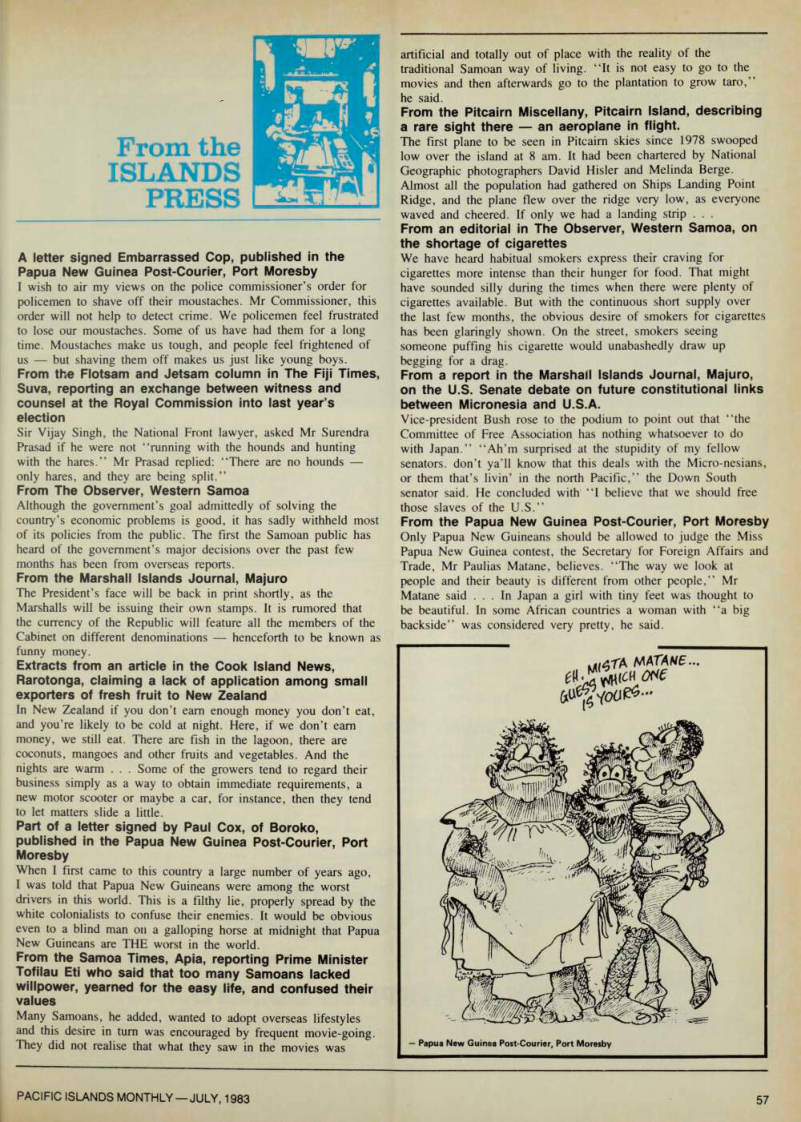
From the
Press
A letter signed Embarrassed Cop, published in the Papua New Guinea Post-Courier, Port Moresby I wish to air my views on the police commissioner’s order for policemen to shave off their moustaches. Mr Commissioner, this order will not help to detect crime. We policemen feel frustrated to lose our moustaches. Some of us have had them for a long time. Moustaches make us tough, and people feel frightened of us but shaving them off makes us just like young boys.
From the Flotsam and Jetsam column in The Fiji Times, Suva, reporting an exchange between witness and counsel at the Royal Commission into last year’s election Sir Vijay Singh, the National Front lawyer, asked Mr Surendra Prasad if he were not “running with the hounds and hunting with the hares.” Mr Prasad replied: “There are no hounds only hares, and they are being split.”
From The Observer, Western Samoa Although the government’s goal admittedly of solving the country’s economic problems is good, it has sadly withheld most of its policies from the public. The first the Samoan public has heard of the government’s major decisions over the past few months has been from overseas reports.
From the Marshall islands Journal, Majuro The President’s face will be back in print shortly, as the Marshalls will be issuing their own stamps. It is rumored that the currency of the Republic will feature all the members of the Cabinet on different denominations henceforth to be known as funny money.
Extracts from an article in the Cook Island News, Rarotonga, claiming a lack of application among small exporters of fresh fruit to New Zealand In New Zealand if you don’t earn enough money you don’t eat, and you’re likely to be cold at night. Here, if we don’t earn money, we still eat. There are fish in the lagoon, there are coconuts, mangoes and other fruits and vegetables. And the nights are warm . . . Some of the growers tend to regard their business simply as a way to obtain immediate requirements, a new motor scooter or maybe a car, for instance, then they tend to let matters slide a little.
Part of a letter signed by Paul Cox, of Boroko, published in the Papua New Guinea Post-Courier, Port
Moresby
When I first came to this country a large number of years ago, I was told that Papua New Guineans were among the worst drivers in this world. This is a filthy lie, properly spread by the white colonialists to confuse their enemies. It would be obvious even to a blind man on a galloping horse at midnight that Papua New Guineans are THE worst in the world.
From the Samoa Times, Apia, reporting Prime Minister Tofilau Eti who said that too many Samoans lacked willpower, yearned for the easy life, and confused their values Many Samoans, he added, wanted to adopt overseas lifestyles and this desire in turn was encouraged by frequent movie-going.
They did not realise that what they saw in the movies was
artificial and totally out of place with the reality of the traditional Samoan way of living. “It is not easy to go to the movies and then afterwards go to the plantation to grow taro,’’ he said.
From the Pitcairn Miscellany, Pitcairn Island, describing a rare sight there an aeroplane in flight.
The first plane to be seen in Pitcairn skies since 1978 swooped low over the island at 8 am. It had been chartered by National Geographic photographers David Hisler and Melinda Berge.
Almost all the population had gathered on Ships Landing Point Ridge, and the plane flew over the ridge very low, as everyone waved and cheered. If only we had a landing strip . . .
From an editorial in The Observer, Western Samoa, on the shortage of cigarettes We have heard habitual smokers express their craving for cigarettes more intense than their hunger for food. That might have sounded silly during the times when there were plenty of cigarettes available. But with the continuous short supply over the last few months, the obvious desire of smokers for cigarettes has been glaringly shown. On the street, smokers seeing someone puffing his cigarette would unabashedly draw up begging for a drag.
From a report in the Marshall Islands Journal, Majuro, on the U.S. Senate debate on future constitutional links between Micronesia and U.S.A.
Vice-president Bush rose to the podium to point out that “the Committee of Free Association has nothing whatsoever to do with Japan.” “Ah’m surprised at the stupidity of my fellow senators, don’t ya’ll know that this deals with the Micro-nesians, or them that’s livin’ in the north Pacific,” the Down South senator said. He concluded with “I believe that we should free those slaves of the U.S.”
From the Papua New Guinea Post-Courier, Port Moresby Only Papua New Guineans should be allowed to judge the Miss Papua New Guinea contest, the Secretary for Foreign Affairs and Trade, Mr Paulias Matane, believes. “The way we look at people and their beauty is different from other people,” Mr Matane said ... In Japan a girl with tiny feet was thought to be beautiful. In some African countries a woman with “a big backside” was considered very pretty, he said.
- Papua New Guinea Post-Courier, Port Moresby
Yachts
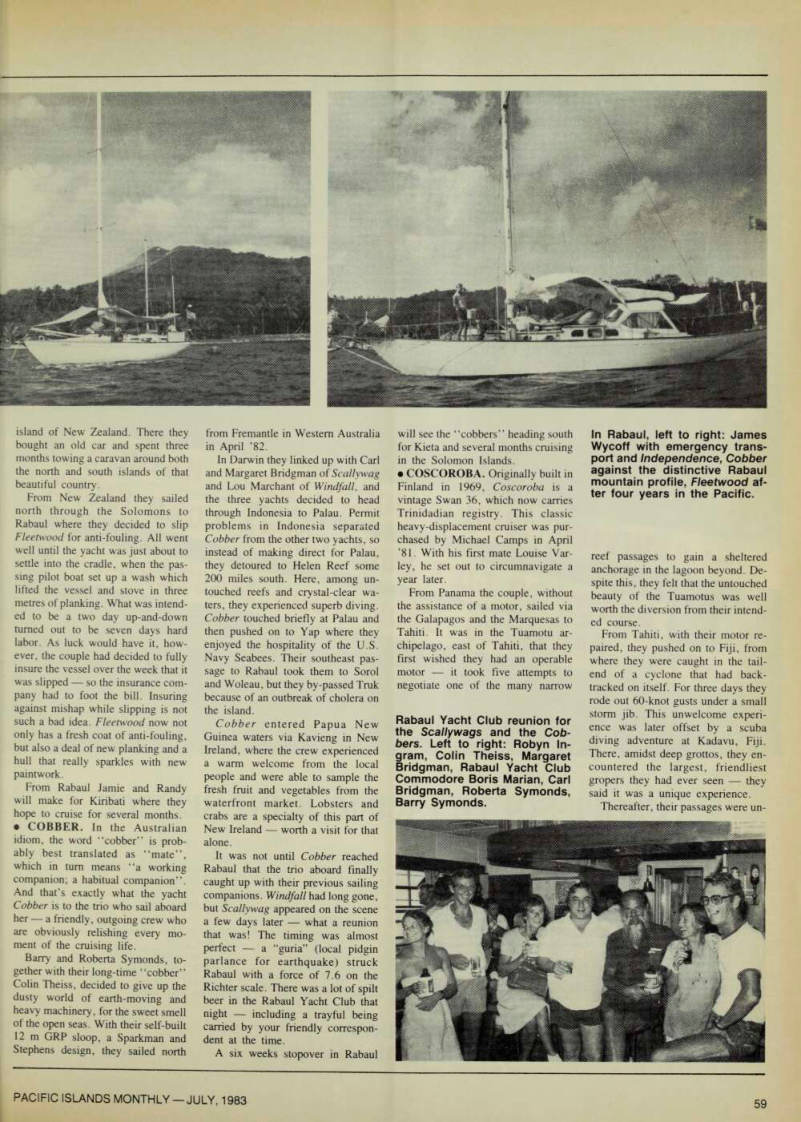
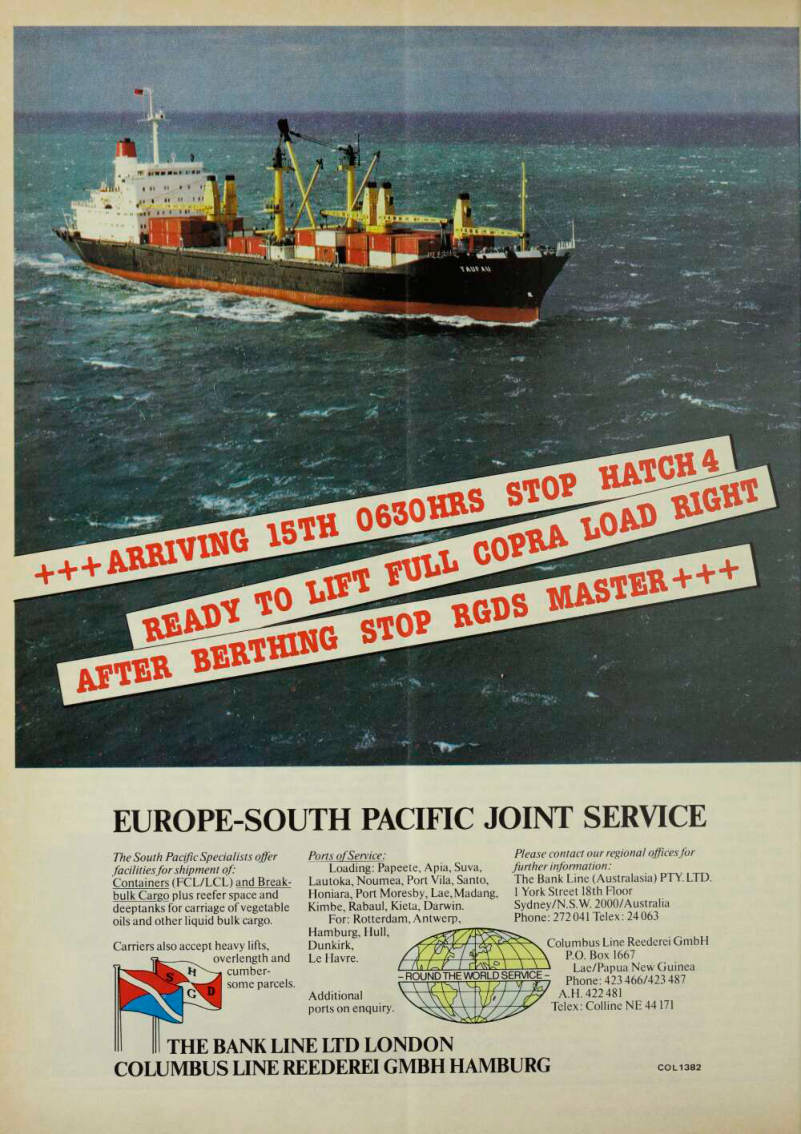
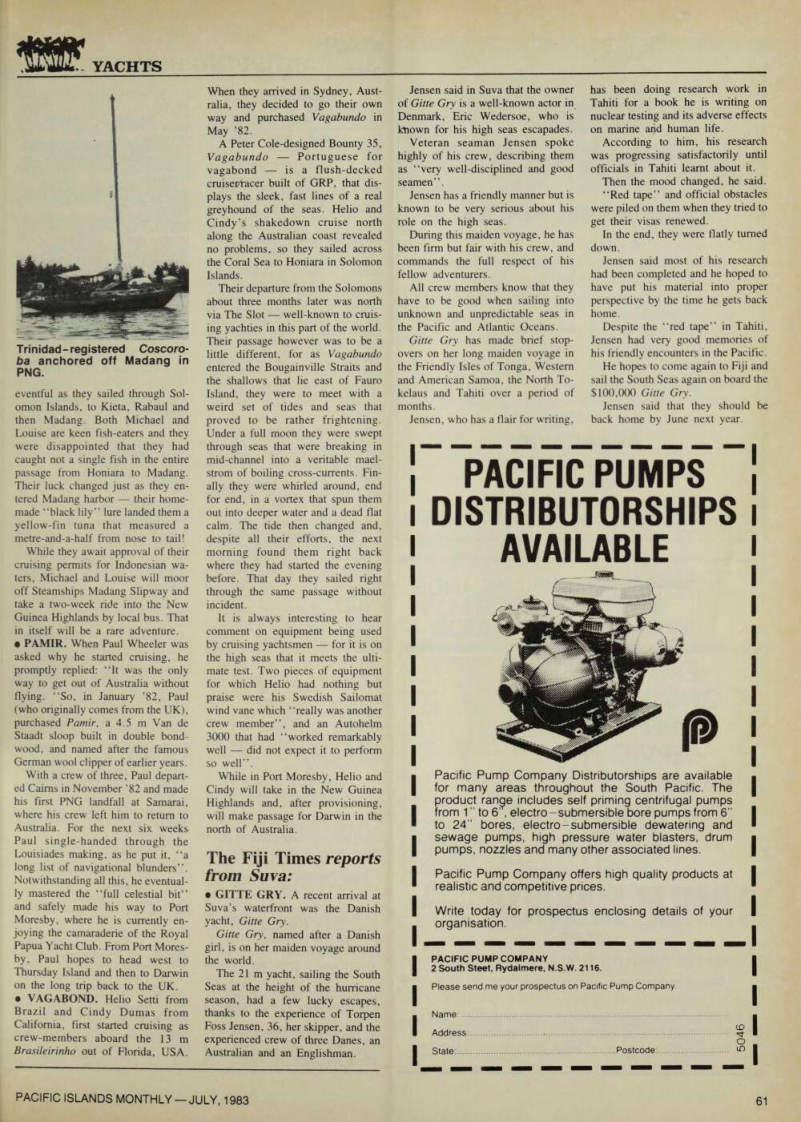
Lan G. Menzies Re
ports from Rabaul,
Madang and Port
Moresby, Papua New
Guinea:
• INDEPENDENCE: Named after owner James Wycoff s home town in Kansas, Independence is a flush decked 10 m Islander sloop in GRP, Wycoff is a single-hander who revels in the cruising life. A former pharma cist and bush pilot in Alaska, James purchased Independence in 1975. For five years he cruised Alaskan waters out of Juneau and then headed for warmer climes in the South Pacific.
A leisurely cruise across the Pacif ic to the Queensland coast, and then up through Solomon Islands eventu ally brought James to Rabaul, where Independence was lifted out of the water and cradled for anti-fouling and minor repairs. One of those repairs is to replace the main hatch, which was shattered when James plummeted from the mast. The se vere cuts and bruises that James suffered, and the shattered hatch, are
healing well.
One of the problems that James has encountered with this particular Islander 33 (let’s face it no boat is
perfect), is that most of the stowage is on the starboard side. With the large volume of stores required for long-distance cruising, there has been a problem maintaining the ba lance of the vessel. James hopes to correct this with an interior refit before his departure for Port Moresby and the next major leg of his circum
navigation across the Indian Ocean. • FLEETWOOD.Originally launch ed as yawl in 1949 for the Mackinac Races on the Great Lakes, Fleetwood is a delightful John Alden 40 built of
strip plank and proudly displaying
the graceful lines of her era. During her racing career she took out the blue ribbon no fewer than five times
from ’5O to ’56. Now cutter-rigged, she is lovingly maintained as the cruising home of Jamie and Randy Brown.
The Browns purchased Fleetwood in ’74 and eventually started cruising from their home port of San Diego in ’79. Their cruise across the Pacific took them to Whangarei on the north
island of New Zealand. There they bought an old car and spent three months towing a caravan around both the north and south islands of that beautiful country.
From New Zealand they sailed north through the Solomons to Rabaul where they decided to slip Fleetwood for anti-fouling. All went well until the yacht was just about to settle into the cradle, when the pas sing pilot boat set up a wash which lifted the vessel and stove in three metres of planking. What was intend ed to be a two day up-and-down turned out to be seven days hard labor. As luck would have it, how ever, the couple had decided to fully insure the vessel over the week that it was slipped so the insurance com pany had to foot the bill. Insuring against mishap while slipping is not such a bad idea. Fleetwood now not only has a fresh coat of anti-fouling, but also a deal of new planking and a hull that really sparkles with new
paintwork.
From Rabaul Jamie and Randy will make for Kiribati where they hope to cruise for several months. • COBBER. In the Australian idiom, the word “cobber” is prob ably best translated as “mate”, which in turn means “a working companion; a habitual companion”.
And that’s exactly what the yacht Cobber is to the trio who sail aboard her a friendly, outgoing crew who are obviously relishing every mo ment of the cruising life.
Barry and Roberta Symonds, to gether with their long-time “cobber”
Colin Theiss, decided to give up the dusty world of earth-moving and heavy machinery, for the sweet smell of the open seas. With their self-built 12 m GRP sloop, a Sparkman and
Stephens design, they sailed north
from Fremantle in Western Australia in April ’B2.
In Darwin they linked up with Carl
and Margaret Bridgman of Scallywag
and Lou Marchant of Windfall, and the three yachts decided to head through Indonesia to Palau. Permit problems in Indonesia separated Cobber from the other two yachts, so instead of making direct for Palau, they detoured to Helen Reef some 200 miles south. Here, among un touched reefs and crystal-clear wa ters, they experienced superb diving.
Cobber touched briefly at Palau and then pushed on to Yap where they enjoyed the hospitality of the U.S.
Navy Seabees. Their southeast pas sage to Rabaul took them to Sorol and Woleau, but they by-passed Truk because of an outbreak of cholera on the island.
Cobber entered Papua New Guinea waters via Kavieng in New Ireland, where the crew experienced a warm welcome from the local people and were able to sample the fresh fruit and vegetables from the waterfront market. Lobsters and crabs are a specialty of this part of New Ireland worth a visit for that alone.
It was not until Cobber reached Rabaul that the trio aboard finally caught up with their previous sailing companions. Windfall had long gone, but Scallywag appeared on the scene a few days later what a reunion that was! The timing was almost perfect a “guria” (local pidgin
parlance for earthquake) struck
Rabaul with a force of 7.6 on the Richter scale. There was a lot of spilt beer in the Rabaul Yacht Club that
night including a trayful being
carried by your friendly correspon dent at the time.
A six weeks stopover in Rabaul
will see the “cobbers” heading south for Kieta and several months cruising in the Solomon Islands. • COSCOROBA. Originally built in Finland in 1969, Coscoroba is a vintage Swan 36, which now carries Trinidadian registry. This classic heavy-displacement cruiser was pur chased by Michael Camps in April ’Bl. With his first mate Louise Var ley, he set out to circumnavigate a year later.
From Panama the couple, without the assistance of a motor, sailed via the Galapagos and the Marquesas to Tahiti. It was in the Tuamotu ar chipelago, east of Tahiti, that they first wished they had an operable motor it took five attempts to negotiate one of the many narrow
reef passages to gain a sheltered anchorage in the lagoon beyond. De spite this, they felt that the untouched beauty of the Tuamotus was well worth the diversion from their intend ed course.
From Tahiti, with their motor re paired, they pushed on to Fiji, from where they were caught in the tail end of a cyclone that had back tracked on itself. For three days they rode out 60-knot gusts under a small storm jib. This unwelcome experi ence was later offset by a scuba diving adventure at Kadavu, Fiji.
There, amidst deep grottos, they en countered the largest, friendliest gropers they had ever seen they said it was a unique experience.
Thereafter, their passages were un-
Rabaul Yacht Club reunion for the Scallywags and the Cob bers. Left to right: Robyn In gram, Colin Theiss, Margaret Bridgman, Rabaul Yacht Club Commodore Boris Marian, Carl Bridgman, Roberta Symonds, Barry Symonds.
In Rabaul, left to right: James Wycoff with emergency trans port and Independence, Cobber against the distinctive Rabaul mountain profile, Fleetwood af ter four years in the Pacific.
eventful as they sailed through Sol omon Islands, to Kieta, Rabaul and then Madang. Both Michael and Louise are keen fish-eaters and they were disappointed that they had caught not a single fish in the entire passage from Honiara to Madang.
Their luck changed just as they en tered Madang harbor their home made “black lily” lure landed them a yellow-fin tuna that measured a metre-and-a-half from nose to tail!
While they await approval of their cruising permits for Indonesian wa ters, Michael and Louise will moor
off Steamships Madang Slipway and
take a two-week ride into the New Guinea Highlands by local bus. That in itself will be a rare adventure, t PAMIR. When Paul Wheeler was asked why he started cruising, he
promptly replied: “It was the only
way to get out of Australia without flying. “So, in January ’B2, Paul (who originally comes from the UK), purchased Pamir, a 4.5 m Van de Staadt sloop built in double bond wood, and named after the famous German wool clipper of earlier years.
With a crew of three, Paul depart ed Cairns in November ’B2 and made his first PNG landfall at Samarai, where his crew left him to return to Australia. For the next six weeks
Paul single-handed through the
Louisiades making, as he put it, “a long list of navigational blunders”.
Notwithstanding all this, he eventual ly mastered the “full celestial bit” and safely made his way to Port Moresby, where he is currently en joying the camaraderie of the Royal Papua Yacht Club. From Port Mores by, Paul hopes to head west to Thursday Island and then to Darwin on the long trip back to the UK. • VAGABOND. Helio Setti from Brazil and Cindy Dumas from California, first started cruising as crew-members aboard the 13 m Brasileirinho out of Florida, USA.
When they arrived in Sydney, Aust ralia, they decided to go their own way and purchased Vagabundo in May ’B2.
A Peter Cole-designed Bounty 35, Vagabundo Portuguese for vagabond is a flush-decked cruiseriacer built of GRP, that dis plays the sleek, fast lines of a real greyhound of the seas. Helio and Cindy’s shakedown cruise north along the Australian coast revealed no problems, so they sailed across the Coral Sea to Honiara in Solomon Islands.
Their departure from the Solomons about three months later was north via The Slot well-known to cruis ing yachties in this part of the world.
Their passage however was to be a little different, for as Vagabundo entered the Bougainville Straits and the shallows that lie east of Fauro Island, they were to meet with a weird set of tides and seas that proved to be rather frightening.
Under a full moon they were swept through seas that were breaking in mid-channel into a veritable mael strom of boiling cross-currents. Fin ally they were whirled around, end for end, in a vortex that spun them out into deeper water and a dead flat calm. The tide then changed and, despite all their efforts, the next morning found them right back where they had started the evening before. That day they sailed right through the same passage without incident.
It is always interesting to hear comment on equipment being used by cruising yachtsmen for it is on the high seas that it meets the ulti mate test. Two pieces of equipment for which Helio had nothing but praise were his Swedish Sailomat wind vane which “really was another crew member”, and an Autohelm 3000 that had “worked remarkably well did not expect it to perform so well”.
While in Port Moresby, Helio and Cindy will take in the New Guinea Highlands and, after provisioning, will make passage for Darwin in the north of Australia.
The Fiji Times reports
from Suva:
• GITTE GRY. A recent arrival at Suva’s waterfront was the Danish yacht, Gitte Gry.
Gitte Gry, named after a Danish girl, is on her maiden voyage around the world.
The 21 m yacht, sailing the South Seas at the height of the hurricane season, had a few lucky escapes, thanks to the experience of Torpen Foss Jensen, 36, her skipper, and the experienced crew of three Danes, an Australian and an Englishman.
Jensen said in Suva that the owner of Gitte Gry is a well-known actor in Denmark, Eric Wedersoe, who is known for his high seas escapades.
Veteran seaman Jensen spoke highly of his crew, describing them as “very well-disciplined and good seamen”.
Jensen has a friendly manner but is known to be very serious about his role on the high seas.
During this maiden voyage, he has been firm but fair with his crew, and commands the full respect of his fellow adventurers.
All crew members know that they have to be good when sailing into unknown and unpredictable seas in the Pacific and Atlantic Oceans.
Gitte Gry has made brief stop overs on her long maiden voyage in the Friendly Isles of Tonga, Western and American Samoa, the North To kelaus and Tahiti over a period of months.
Jensen, who has a flair for writing.
has been doing research work in Tahiti for a book he is writing on nuclear testing and its adverse effects on marine and human life.
According to him, his research
was progressing satisfactorily until
officials in Tahiti learnt about it.
Then the mood changed, he said.
“Red tape” and official obstacles were piled on them when they tried to get their visas renewed.
In the end, they were flatly turned down.
Jensen said most of his research had been completed and he hoped to have put his material into proper perspective by the time he gets back home.
Despite the “red tape” in Tahiti, Jensen had very good memories of his friendly encounters in the Pacific.
He hopes to come again to Fiji and sail the South Seas again on board the $lOO,OOO Gitte Gry.
Jensen said that they should be back home by June next year.
Trinidad-registered Coscoro ba anchored off Madang in
Png.
Advertisements & other items, pp. 58-62 (1 item)
Kyowa Shipping Co., Ltd.
YOUR BUSINESS PARTNER
HEAD
sth FI., Phone: Japan S. Korea Taiwan Singapore Hong Kong To: Solomon Is., New Caledonia, Fiji, W. Samoa, A. Samoa, Tahiti, Cook Is., Tonga, Vanuatu, Tuvalu. Nauru To: Guam, Saipan, Truk, Ponape, Majuro, Yap, Koror
Taiwan Hong Kong Singapore Philippines
U ■*' f-k To; Papua New Guinea, Pacific Islands. * :v r fw rr
KYOWA
KYOWA SHIPPING CO., LTD.
OFF I CE OSAKA OFFICE:
Sahara Bids 39 8 2-ch™ Nishi-Shinbasbi, Mina.b-ku, Tbkyo, Japan 03 a,,™ Bldg 7.b Floor 2-U. S s,„ s a J 03'437)2885 'Rep- Cables; “MARIQUEEN' Tokyo Telex ; 242-4651 Kyowa J Phone. 06(533)5821 (Rep.) Cab Q —^
mm mtmt I ••• ' mi m V‘
I II " ' "
44 • •■I ••• rtii • * • • i» WL,
uvp—
after
EUROPE-SOUTH PACIFIC JOINT SERVICE
The South Pacific Specialists offer facilities for shipment of: Containers (FCL/LCL) and Breakbulk Cargo plus reefer space and deeptanks for carriage of vegetable oils and other liquid bulk cargo.
Carriers also accept heavy lifts, overlength and cumbersome parcels.
C\D Ports of Service: Loading: Papeete, Apia, Suva, Lautoka, Noumea, Port Vila, Santo, Honiara, Port Moresby, Lae,Madang, Kimbe, Rabaul, Kieta, Darwin.
For: Rotterdam, Antwerp, Hamburg, Hull, Dunkirk, Le Havre.
Please contact our regional offices for further information: The Bank Line (Australasia) PTY.LTD. 1 York Street 18th Floor Sydney/N.S.W. 2000/Australia Phone: 272041 Telex: 24063
- ROUND THE WORLD SERVICE -
Additional ports on enquiry.
Columbus Line Reederei GmbH P.O. Box 1667 Lae/Papua New Guinea Phone: 423 466/423 487 422481 Colline NE44171
THE BANK LINE LTD LONDON
COLUMBUS LINE REEDEREI GMBH HAMBURG
C0L1382
PACIFIC PUMPS
DISTRIBUTORSHIPS
AVAILABLE
Pacific Pump Company Distributorships are available for many areas throughout the South Pacific. The product range includes self priming centrifugal pumps from 1 ” to 6, electro-submersible bore pumps from 6” to 24" bores, electro-submersible dewatering and sewage pumps, high pressure water blasters, drum pumps, nozzles and many other associated lines.
Pacific Pump Company offers high quality products at realistic and competitive prices.
Write today for prospectus enclosing details of your organisation.
PACIFIC PUMP COMPANY
2 South Steet, Rydalmere, N.S.W. 2116.
Please send me your prospectus on Pacific Pump Company jm l Name State: Address: Postcode: CD o ID
CARGO VESSEL FOR SALE
405 gross tons, 166 net, 420 dwt.
Length 47.3 metres. Beam 7.5 metres. Draft 3.8 metres.
Dcutz SBA 8M Diesel, 585 S.H.P. at 750 rpm. 2.5: 1 reduction driving variable pitch propeller giving about 10.5 knots. 2 holds giving 28000 cu ft grain capacity.
Hydraulic deck gear with swinging derricks.
No. 1 hatch 3 ton s.w.l. No. 2 hatch 5 ton s.w.l.
Radar, auto pilot, 5.5.8., V.H.F.
In class with Bureau Veritas and in excellent condition.
Lying at Port-Vila, Vanuatu.
AslBo,ooo
Contact: Vanua Navigation Ltd.
P.O. Box 44, Port-Vila, Vanuatu Telephone: 2027, 2028. Telex: 1033 VANUA
PACIFIC ISLANDS
TRANSPORT LINE
M.V. SIRIUS
EXPRESS
CONTAINER
•REEFER
SERVICE
between U.S.
West Coast ports and
TAHITI SAMOA S'--
JUUL
Qeqeral Stearqship Qorpora tiori General Agents 400 California Street, San Francisco. CA, USA PAPEETE: Agence Maritime Internationale, Tahiti PAGO PAGO: Polynesia Shipping Services, Inc.
APIA: Burns Philp (South Sea) Company, Ltd. a
Shipping Schedules
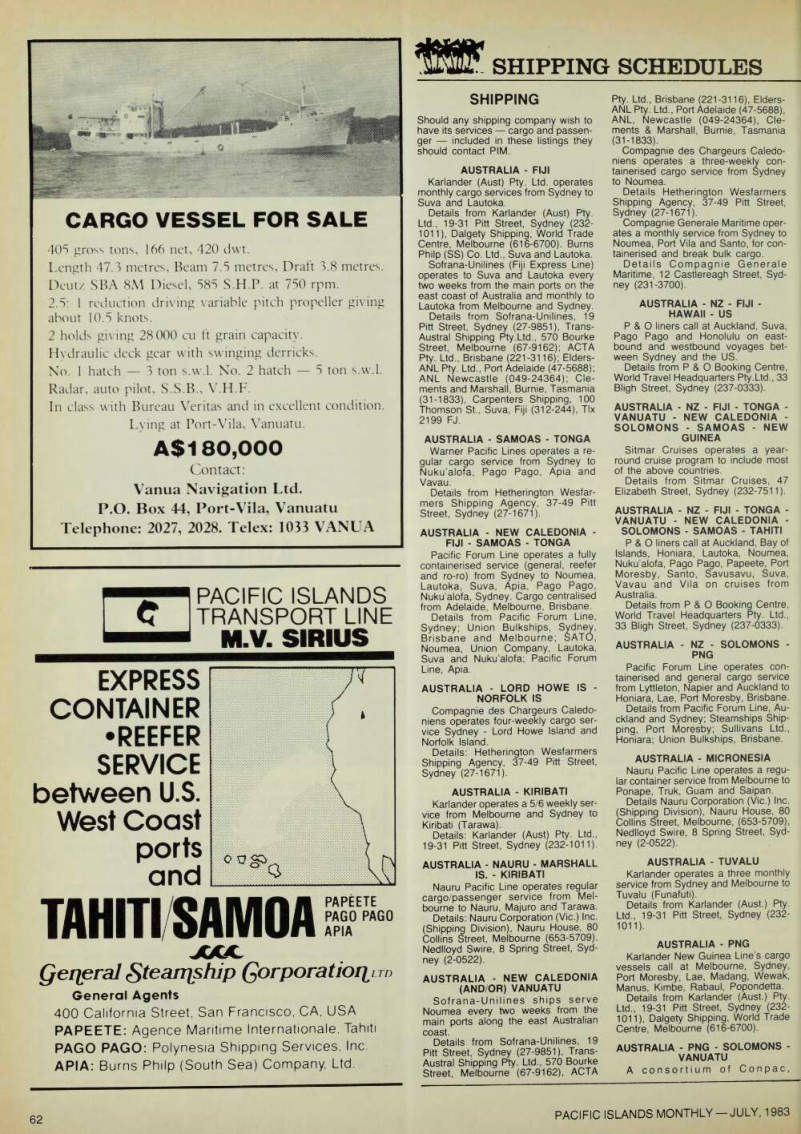
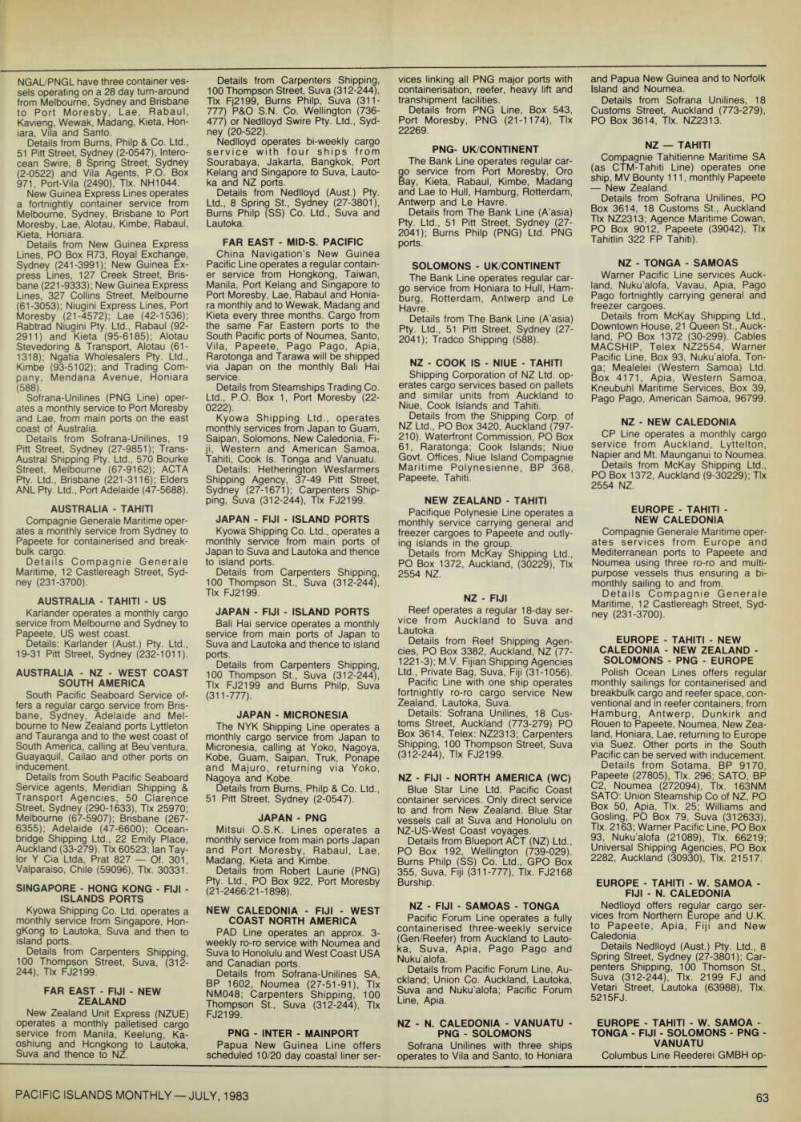
Shipping
Should any shipping company wish to have its services cargo and passen ger included in these listings they should contact PIM.
Australia - Fiji
Karlander (Aust) Pty. Ltd. operates monthly cargo services from Sydney to Suva and Lautoka.
Details from Karlander (Aust) Pty.
Ltd., 19-31 Pitt Street, Sydney (232- 1011), Dalgety Shipping, World Trade Centre, Melbourne (616-6700). Burns Philp (SS) Cos. Ltd., Suva and Lautoka.
Sofrana-Unilines (Fiji Express Line) operates to Suva and Lautoka every two weeks from the main ports on the east coast of Australia and monthly to Lautoka from Melbourne and Sydney.
Details from Sofrana-Unilines, 19 Pitt Street, Sydney (27-9851), Trans- Austral Shipping Pty.Ltd., 570 Bourke Street, Melbourne (67-9162): ACTA Pty. Ltd., Brisbane (221-3116); Elders- ANL Pty. Ltd., Port Adelaide (47-5688); ANL Newcastle (049-24364); Cle ments and Marshall, Burnie, Tasmania (31-1833), Carpenters Shipping, 100 Thomson St., Suva, Fiji (312-244), Tlx 2199 FJ.
Australia - Samoas - Tonga
Warner Pacific Lines operates a re gular cargo service from Sydney to Nukualofa, Pago Pago, Apia and Vavau.
Details from Hetherington Wesfar mers Shipping Agency, 37-49 Pitt Street, Sydney (27-1671).
Australia - New Caledonia -
Fiji - Samoas - Tonga
Pacific Forum Line operates a fully containerised service (general, reefer and ro-ro) from Sydney to Noumea, Lautoka, Suva, Apia, Pago Pago, Nukualofa, Sydney. Cargo centralised from Adelaide, Melbourne, Brisbane.
Details from Pacific Forum Line, Sydney: Union Bulkships, Sydney, Brisbane and Melbourne: SATO, Noumea, Union Company, Lautoka, Suva and Nukualofa; Pacific Forum Line, Apia.
Australia - Lord Howe Is -
Norfolk Is
Compagnie des Chargeurs Caledo niens operates four-weekly cargo ser vice Sydney - Lord Howe Island and Norfolk Island.
Details: Hetherington Wesfarmers Shipping Agency, 37-49 Pitt Street, Sydney (27-1671).
Australia - Kiribati
Karlander operates a 5/6 weekly ser vice from Melbourne and Sydney to Kiribati (Tarawa).
Details: Karlander (Aust) Pty. Ltd., 19-31 Pitt Street, Sydney (232-1011).
Australia - Nauru - Marshall
Is. - Kiribati
Nauru Pacific Line operates regular cargo/passenger service from Mel bourne to Nauru, Majuro and Tarawa.
Details: Nauru Corporation (Vic.) Inc. (Shipping Division), Nauru House, 80 Collins Street, Melbourne (653-5709).
Nedlloyd Swire, 8 Spring Street, Syd ney (2-0522).
Australia - New Caledonia
(And/Or) Vanuatu
Sofrana-Unilines ships serve Noumea every two weeks from the main ports along the east Australian coast.
Details from Sofrana-Unilines, 19 Pitt Street, Sydney (27-9851), Trans- Austral Shipping Pty. Ltd., 570 Bourke Street, Melbourne (67-9162), ACTA
Pty. Ltd., Brisbane (221-3116), Elders- ANL Pty. Ltd., Port Adelaide (47-5688), ANL, Newcastle (049-24364), Cle ments & Marshall, Burnie, Tasmania (31-1833).
Compagnie des Chargeurs Caledo niens operates a three-weekly con tainerised cargo service from Sydney to Noumea.
Details Hetherington Wesfarmers Shipping Agency, 37-49 Pitt Street,
Sydney (27-1671).
Compagnie Generate Maritime oper ates a monthly service from Sydney to Noumea, Port Vila and Santo, for con tainerised and break bulk cargo.
Details Compagnie Generate Maritime, 12 Castlereagh Street, Syd ney (231-3700).
Australia - Nz - Fiji -
Hawaii - Us
P & O liners call at Auckland, Suva, Pago Pago and Honolulu on east bound and westbound voyages bet ween Sydney and the US.
Details from P & O Booking Centre, World Travel Headquarters Pty.Ltd., 33 Bligh Street, Sydney (237-0333).
AUSTRALIA - NZ - FIJI - TONGA -
Vanuatu - New Caledonia -
Solomons - Samoas - New
Guinea
Sitmar Cruises operates a year round cruise program to include most of the above countries.
Details from Sitmar Cruises, 47 Elizabeth Street, Sydney (232-7511).
AUSTRALIA - NZ - FIJI - TONGA -
Vanuatu - New Caledonia -
Solomons - Samoas - Tahiti
P & O liners call at Auckland, Bay of Islands, Honiara, Lautoka, Noumea, Nukualofa, Pago Pago, Papeete, Port Moresby, Santo, Savusavu, Suva, Vavau and Vila on cruises from Australia.
Details from P & O Booking Centre, World Travel Headquarters Pty. Ltd., 33 Bligh Street, Sydney (237-0333).
Australia - Nz - Solomons -
Png
Pacific Forum Line operates con tainerised and general cargo service from Lyttleton, Napier and Auckland to Honiara, Lae, Port Moresby, Brisbane.
Details from Pacific Forum Line, Au ckland and Sydney: Steamships Ship ping, Port Moresby: Sullivans Ltd., Honiara: Union Bulkships, Brisbane.
Australia - Micronesia
Nauru Pacific Line operates a regu lar container service from Melbourne to Ponape, Truk, Guam and Saipan.
Details Nauru Corporation (Vic.) Inc. (Shipping Division), Nauru House, 80 Collins Street, Melbourne, (653-5709), Nedlloyd Swire, 8 Spring Street, Syd ney (2-0522).
Australia - Tuvalu
Karlander operates a three monthly service from Sydney and Melbourne to Tuvalu (Funafuti).
Details from Karlander (Aust.) Pty.
Ltd., 19-31 Pitt Street, Sydney (232- 1011).
Australia - Png
Karlander New Guinea Line’s cargo vessels call at Melbourne, Sydney, Port Moresby, Lae, Madang, Wewak, Manus, Kimbe, Rabaul, Popondetta.
Details from Karlander (Aust.) Pty.
Ltd., 19-31 Pitt Street, Sydney (232- 1011), Dalgety Shipping, World Trade Centre, Melbourne (616-6700).
Australia - Png - Solomons -
Vanuatu
A consortium of Conpac,
NGAL/PNGL have three container ves sels operating on a 28 day turn-around from Melbourne, Sydney and Brisbane to Port Moresby, Lae, Rabaul, Kavieng, Wewak, Madang, Kieta, Hon iara, Vila and Santo.
Details from Burns, Philp & Cos. Ltd., 51 Pitt Street, Sydney (2-0547), Intero cean Swire, 8 Spring Street, Sydney (2-0522) and Vila Agents, P.O. Box 971, Port-Vila (2490), Tlx. NH1044.
New Guinea Express Lines operates a fortnightly container service from Melbourne, Sydney, Brisbane to Port Moresby, Lae, Alotau, Kimbe, Rabaul, Kieta, Honiara.
Details from New Guinea Express Lines, PO Box R 73, Royal Exchange, Sydney (241-3991); New Guinea Ex press Lines, 127 Creek Street, Bris bane (221-9333); New Guinea Express Lines, 327 Collins Street, Melbourne (61-3053); Niugini Express Lines, Port Moresby (21-4572); Lae (42-1536); Rabtrad Niugini Pty. Ltd., Rabaul (92- 2911) and Kieta (95-6185); Alotau Stevedoring & Transport, Alotau (61- 1318); Ngatia Wholesalers Pty. Ltd., Kimbe (93-5102); and Trading Com pany, Mendana Avenue, Honiara (588).
Sofrana-Unilines (PNG Line) oper ates a monthly service to Port Moresby and Lae, from main ports on the east coast of Australia.
Details from Sofrana-Unilines, 19 Pitt Street, Sydney (27-9851); Trans- Austral Shipping Pty. Ltd., 570 Bourke Street, Melbourne (67-9162); ACTA Pty. Ltd., Brisbane (221-3116); Elders ANL Pty. Ltd., Port Adelaide (47-5688).
Australia - Tahiti
Compagnie Generate Maritime oper ates a monthly service from Sydney to Papeete for containerised and break bulk cargo.
Details Compagnie Generale Maritime, 12 Castlereagh Street, Syd ney (231-3700).
Australia - Tahiti - Us
Karlander operates a monthly cargo service from Melbourne and Sydney to Papeete, US west coast.
Details: Karlander (Aust.) Pty. Ltd., 19-31 Pitt Street, Sydney (232-1011).
Australia - Nz - West Coast
South America
South Pacific Seaboard Service of fers a regular cargo service from Bris bane, Sydney, Adelaide and Mel bourne to New Zealand ports Lyttleton and Tauranga and to the west coast of South America, calling at Beu’ventura, Guayaquil, Cailao and other ports on inducement.
Details from South Pacific Seaboard Service agents, Meridian Shipping & Transport Agencies, 50 Clarence Street, Sydney (290-1633), Tlx 25970; Melbourne (67-5907); Brisbane (267- 6355); Adelaide (47-6600); Ocean bridge Shipping Ltd., 22 Emily Place, Auckland (33-279). Tlx 60523; lan Tay lor Y Cia Ltd a, Prat 827 Of. 301, Valparaiso, Chile (59096), Tlx. 30331.
SINGAPORE - HONG KONG - FIJI -
Islands Ports
Kyowa Shipping Cos. Ltd. operates a monthly service from Singapore, Hon g Kong to Lautoka, Suva and then to island ports.
Details from Carpenters Shipping, 100 Thompson Street, Suva, (312- 244), Tlx FJ2199.
Far East - Fiji - New
Zealand
New Zealand Unit Express (NZUE) operates a monthly palletised cargo service from Manila, Keelung, Ka oshiung and Hongkong to Lautoka, Suva and thence to NZ.
Details from Carpenters Shipping, 100 Thompson Street, Suva (312-244), Tlx Fj2199, Burns Philp, Suva (311- 777) P&O S.N. Cos. Wellington (736- 477) or Nedlloyd Swire Pty. Ltd., Syd ney (20-522).
Nedlloyd operates bi-weekly cargo service with four ships from Sourabaya, Jakarta, Bangkok, Port Kelang and Singapore to Suva, Lauto ka and NZ ports.
Details from Nedlloyd (Aust.) Pty.
Ltd., 8 Spring St., Sydney (27-3801), Burns Philp (SS) Cos. Ltd., Suva and Lautoka.
Far East - Mid-S. Pacific
China Navigation’s New Guinea Pacific Line operates a regular contain er service from Hongkong, Taiwan, Manila, Port Kelang and Singapore to Port Moresby, Lae, Rabaul and Honia ra monthly and to Wewak, Madang and Kieta every three months. Cargo from the same Far Eastern ports to the South Pacific ports of Noumea, Santo, Vila, Papeete, Pago Pago, Apia, Rarotonga and Tarawa will be shipped via Japan on the monthly Bali Hai service.
Details from Steamships Trading Cos.
Ltd., P.O. Box 1, Port Moresby (22- 0222).
Kyowa Shipping Ltd., operates monthly services from Japan to Guam, Saipan, Solomons, New Caledonia, Fi ji, Western and American Samoa, Tahiti, Cook Is. Tonga and Vanuatu.
Details: Hetherington Wesfarmers Shipping Agency, 37-49 Pitt Street, Sydney (27-1671); Carpenters Ship ping, Suva (312-244), Tlx FJ2199.
Japan - Fiji - Island Ports
Kyowa Shipping Cos. Ltd., operates a monthly service from main ports of Japan to Suva and Lautoka and thence to island ports.
Details from Carpenters Shipping, 100 Thompson St., Suva (312-244), Tlx FJ2199.
Japan - Fiji - Island Ports
Bali Hai service operates a monthly service from main ports of Japan to Suva and Lautoka and thence to island ports.
Details from Carpenters Shipping, 100 Thompson St., Suva (312-244), Tlx FJ2199 and Burns Philp, Suva (311-777).
Japan - Micronesia
The NYK Shipping Line operates a monthly cargo service from Japan to Micronesia, calling at Yoko, Nagoya, Kobe, Guam, Saipan, Truk, Ponape and Majuro, returning via Yoko, Nagoya and Kobe.
Details from Burns, Philp & Cos. Ltd., 51 Pitt Street, Sydney (2-0547).
Japan - Png
Mitsui O.S.K. Lines operates a monthly service from main ports Japan and Port Moresby, Rabaul, Lae, Madang, Kieta and Kimbe.
Details from Robert Laurie (PNG) Pty. Ltd., PO Box 922, Port Moresby (21-2466/21-1898).
New Caledonia - Fiji - West
Coast North America
PAD Line operates an approx. 3weekly ro-ro service with Noumea and Suva to Honolulu and West Coast USA and Canadian ports.
Details from Sofrana-Unilines SA, BP 1602, Noumea (27-51-91), Tlx NMO4B; Carpenters Shipping, 100 Thompson St., Suva (312-244), Tlx FJ2199.
Png - Inter - Mainport
Papua New Guinea Line offers scheduled 10/20 day coastal liner ser
vices linking all PNG major ports with containerisation, reefer, heavy lift and transhipment facilities.
Details from PNG Line, Box 543, Port Moresby, PNG (21-1174), Tlx 22269.
Png- Uk/Continent
The Bank Line operates regular car go service from Port Moresby, Oro Bay, Kieta, Rabaul, Kimbe, Madang and Lae to Hull, Hamburg, Rotterdam, Antwerp and Le Havre.
Details from The Bank Line (A’asia) Pty. Ltd., 51 Pitt Street, Sydney (27- 2041); Burns Philp (PNG) Ltd. PNG ports.
Solomons - Uk/Continent
The Bank Line operates regular car go service from Honiara to Hull, Ham burg, Rotterdam, Antwerp and Le Havre.
Details from The Bank Line (A’asia) Pty. Ltd., 51 Pitt Street, Sydney (27- 2041); Tradco Shipping (588).
NZ - COOK IS - NIUE - TAHITI Shipping Corporation of NZ Ltd. op erates cargo services based on pallets and similar units from Auckland to Niue, Cook Islands and Tahiti.
Details from the Shipping Corp. of NZ Ltd., PO Box 3420, Auckland (797- 210). Waterfront Commission, PO Box 61, Raratonga; Cook Islands; Niue Govt. Offices, Niue Island Compagnie Maritime Polynesienne, BP 368, Papeete, Tahiti.
New Zealand - Tahiti
Pacifique Polynesie Line operates a monthly service carrying general and freezer cargoes to Papeete and outly ing islands in the group.
Details from McKay Shipping Ltd., PO Box 1372, Auckland, (30229), Tlx 2554 NZ.
Nz - Fiji
Reef operates a regular 18-day ser vice from Auckland to Suva and Lautoka.
Details from Reef Shipping Agen cies, PO Box 3382, Auckland, NZ (77- 1221-3); M.V. Fijian Shipping Agencies Ltd., Private Bag, Suva, Fiji (31-1056).
Pacific Line with one ship operates fortnightly ro-ro cargo service New Zealand, Lautoka, Suva.
Details: Sofrana Unilines, 18 Cus toms Street, Auckland (773-279) PO Box 3614, Telex: NZ2313; Carpenters Shipping, 100 Thompson Street, Suva (312-244), Tlx FJ2199.
NZ - FIJI - NORTH AMERICA (WC) Blue Star Line Ltd. Pacific Coast container services. Only direct service to and from New Zealand. Blue Star vessels call at Suva and Honolulu on NZ-US-West Coast voyages.
Details from Blueport ACT (NZ) Ltd., PO Box 192, Wellington (739-029).
Burns Philp (SS) Co. Ltd., GPO Box 355, Suva, Fiji (311-777), Tlx. FJ2168 Burship.
NZ - FIJI - SAMOAS - TONGA Pacific Forum Line operates a fully containerised three-weekly service (Gen/Reefer) from Auckland to Lauto ka, Suva, Apia, Pago Pago and Nukualofa.
Details from Pacific Forum Line, Au ckland: Union Co. Auckland, Lautoka, Suva and Nukualofa; Pacific Forum Line, Apia.
NZ - N. CALEDONIA - VANUATU -
Png - Solomons
Sofrana Unilines with three ships operates to Vila and Santo, to Honiara
and Papua New Guinea and to Norfolk Island and Noumea.
Details from Sofrana Unilines, 18 Customs Street, Auckland (773-279), PO Box 3614, Tlx. NZ2313.
Nz — Tahiti
Compagnie Tahitienne Maritime SA (as CTM-Tahiti Line) operates one ship, MV Bounty 111, monthly Papeete — New Zealand.
Details from Sofrana Unilines, PO Box 3614, 18 Customs St., Auckland Tlx NZ2313; Agence Maritime Cowan, PO Box 9012, Papeete (39042), Tlx Tahitlin 322 FP Tahiti).
Nz - Tonga - Samoas
Warner Pacific Line services Auck land, Nukualofa, Vavau, Apia, Pago Pago fortnightly carrying general and freezer cargoes.
Details from McKay Shipping Ltd., Downtown House, 21 Queen St., Auck land, PO Box 1372 (30-299). Cables MACSHIP, Telex NZ2554, Warner Pacific Line, Box 93, Nukualofa, Ton ga; Mealelei (Western Samoa) Ltd.
Box 4171, Apia, Western Samoa, Kneubuhl Maritime Services, Box 39, Pago Pago, American Samoa, 96799.
Nz - New Caledonia
CP Line operates a monthly cargo service from Auckland, Lyttelton, Napier and Mt. Maunganui to Noumea.
Details from McKay Shipping Ltd., PO Box 1372, Auckland (9-30229); Tlx 2554 NZ.
Europe - Tahiti -
New Caledonia
Compagnie Generate Maritime oper ates services from Europe and Mediterranean ports to Papeete and Noumea using three ro-ro and multi purpose vessels thus ensuring a bi monthly sailing to and from.
Details Compagnie Generale Maritime, 12 Castlereagh Street, Syd ney (231-3700).
Europe - Tahiti - New
Caledonia - New Zealand -
Solomons - Png - Europe
Polish Ocean Lines offers regular monthly sailings for containerised and breakbulk cargo and reefer space, con ventional and in reefer containers, from Hamburg, Antwerp, Dunkirk and Rouen to Papeete, Noumea, New Zea land, Honiara, Lae, returning to Europe via Suez. Other ports in the South Pacific can be served with inducement.
Details from Sotama, BP 9170, Papeete (27805), Tlx. 296; SATO, BP C2, Noumea (272094), Tlx. 163NM SATO: Union Steamship Co of NZ, PO Box 50, Apia, Tlx. 25; Williams and Gosling, PO Box 79, Suva (312633), Tlx. 2163; Warner Pacific Line, PO Box 93, Nukualofa (21089), Tlx. 66219; Universal Shipping Agencies, PO Box 2282, Auckland (30930), Tlx. 21517.
EUROPE - TAHITI - W. SAMOA -
Fiji - N. Caledonia
Nedlloyd offers regular cargo ser vices from Northern Europe and U.K. to Papeete, Apia, Fiji and New Caledonia.
Details Nedlloyd (Aust.) Pty. Ltd., 8 Spring Street, Sydney (27-3801); Car penters Shipping, 100 Thomson St., Suva (312-244), Tlx. 2199 FJ and Vetari Street, Lautoka (63988), Tlx. 5215FJ.
EUROPE - TAHITI - W. SAMOA - TONGA - FIJI - SOLOMONS - PNG -
Vanuatu
Columbus Line Reederei GMBH op-
erates regular services from Hamburg, Hull, Rotterdam, Antwerp, Dunkirk, Le Havre, to Papeete, Apia, Suva, Lauto ka, Noumea, Port Moresby, Lae, Hon iara, Kieta, Rabaul, Lae, and return to Europe.
Details from Columbus Overseas Services Pty. Ltd., 333 George Street, Sydney (290-2966). Columbus Maritime Service, 17 Albert Street, Au ckland (77-3460); Carpenters Ship ping, 100 Thompson St., Suva (312- 224), Tlx. 2199 FJ.
UK - N. CONTINENT - W. SAMOA -
Tonga ■ Fiji
The Bank Line operates a regular cargo service from Hull, Hamburg, Bre men, Antwerp, Rotterdam and Le Havre to Apia, Nukualofa, Suva and Lautoka.
Details from The Bank Line (A’asia) Pty. Ltd., 51 Pitt Street, Sydney (27- 2041); Bums Philp (South Sea) Co.
Ltd., Suva and Lautoka.
UK - N. CONTINENT - PNG -
Solomons
The Bank Line operates a regular cargo service from Hull, Hamburg, Bre men, Antwerp, Rotterdam and Le Havre to Port Moresby, Lae, Madang, Kimbe, Rabaul, Kieta and Honiara and on inducement to Yandina.
Details from The Bank Line (A sia) Pty. Ltd., 51 Pitt Street, Sydney (27- 2041); Burns Philp (PNG) Ltd. PNG ports; Tradco Shipping (588).
Uk/N. Continent - Tahiti -
N. Caledonia - Vanuatu
The Bank Line operates a regular cargo service from Hull, Hamburg, Bre men, Antwerp, Rotterdam and Le Havre to Papeete, Noumea, Port-Vila and Santo.
Details from The Bank Line (A’asia) Pty. Ltd., 51 Pitt Street, Sydney (27- 2041); Ets A M. Fare UTE, Papeete; Ets. Ballande, Noumea.
US - FIJI - TAHITI - NZ -
Australia
The Bank Savill Line Ltd. operates regular cargo services from U.S. Gulf ports to Australia and N.Z. Calls at Suva, Lautoka and Papeete on demand.
Details from The Bank and Savill Line Ltd., 51 Pitt Street, Sydney (27- 2041) or Orient Shipping Services, 32 Bridge Street, Sydney (241-2753).
U.S. - Hawaii - Kiribati -
Micronesia
Philippines, Micronesia & Orient Navigation Co. (PM&O Lines) operates regular container service on selfsus tained ship with ro-ro capabilities from Oakland, Portland and Honolulu to Tarawa, Ebeye, Majuro, Kosrae, Ponape, Truk, Saipan, Yap and Koror.
Details for Micronesia can be ob tained from Larry Guerrero, PM&O Owners Rep. PO Box 803, Saipan, Ml 96950, Cable COMMONTIME, Tlx 783605; PM&O: PM&O Lines, 181 Fremont St., San Francisco, California 94-105, Cable PMONAV.
Us - Hawaii • Nauru -
Micronesia
Nauru Pacific Line operates regular conventional container and passenger service from San Francisco and Hon olulu to Majuro, Ponape, Truk and Saipan. Cargo is accepted for Nauru and Kosrai with transhipment at Majuro and Ponape.
Details from Nauru Corporation (Vic.) Inc. (Shipping Division), Nauru House, 80 Collins Street, Melbourne (653-5709); Nauru Air and Shipping Agency, Suite 2803, China Basin
Building, 185 Berry Street, San Fran sisco, California 94107 (543-1737).
Hawaii • Tahiti • Samoas
Marshall Islands Maritime Co oper ates a service every 32 days between Honolulu, Papeete, Pago Pago and Apia.
Details from the Maritime Co. of the Pacific, 567 South King Street, Suite 310, Honolulu, Hawaii, Morris Hed strom, Box 189, Apia, Western Samoa and the Marshall Islands Maritime Co., Box 679, Majuro, Marshall Islands.
Us - Noumea - Fiji
PAD Line operates an approx. 3weekly ro-ro service from West coast USA and Canada to Noumea, Suva and Lautoka.
Details from Sofrana-Unilines SA, BP 1602, Moumea (27-51-91), Tlx.
NMO4B; Carpenters Shipping, 100 Thompson St., Suva (31-2244), Tlx.
FJ2199; Trans-Austral Shipping, Box R 232 PO, Royal Exchange, NSW (27- 2441), Tlx. AA21204.
Us - Tahiti - Samoa
Pacific Islands Transport operates a five weekly cargo service from North America west coast ports to Papeete, Pago Pago, Apia.
Details from Polynesia Shipping Ser vices Inc. PO Box 1478, Pago Pago 96799.
Polynesia Line operates container and general cargo service from US west coast ports to Papeete and Pago
Pago
Details from Polynesia Shipping Ser vices Inc., PO Box 1478, Pago Pago 96799.
Advertisements & other items, pp. 64-65 (2 items)
28 Day Service
THE
LINE
United Kingdom and Continent to:
PAPEETE • NOUMEA
PAPUA NEW GUINEA and SOLOMON ISLANDS
PORT VI LA & SANTO BY TRANSHIPMENT * United Kingdom and Continent to: SUVA AND LAUTOKA (FCL LCL & UNITISED ONLY) Papua New Guinea and Solomon Islands to:
UNITED KINGDOM and CONTINENT
For particulars apply:
THE BANK LINE (AUSTRALASIA) PTY. LTD.
Suite 801, 51 Pitt Street, Sydney 2000. Australia. Tel: 272041. Tlx: 24063.
FOR SALE
LARGE STOCKS OF
GARDNER ENGINE PARTS
TO SUIT L 3, LX, LW
AS WELL AS SEVERAL
LW ENGINES IN GOOD
CONDITION
ISLAND ENTERPRISES
LIMITED
P.O. BOX 364, HONIARA
Phone: 06-52
Cable: POWER HONIARA
Role of Hawaii
65
PACIFIC ISLANDS MONTHLY —JULY, 1983
Role of Hawaii From Page 12
SHIPPING SCHEDULES
DEATHS of Islands People
Dr Vincent Zigas In Brisbane, Queensland, on March 25 at the age of 63.
Vin Zigas, a specialist doctor in neurology and virology, was the medical worker who revealed the existence of the neurological disease kuru popularly known as laughing sickness among the Fore people of Okapa in the Papua New Guinea Eastern Highlands.
In 1956, while working as a medical officer for the then Aust ralian administration of PNG, he was the first to clinically docu ment the sickness and to initiate research. The project became of wide interest in international medical circles and attracted a team of researchers, including Dr Gajdusek whose work on it won him the 1976 Nobel Prize
for Medicine and Physiology.
Although never as widely
known as Dr Gajdusek, Dr Zigas was recognised as the man who first realised the existence of a puzzling disease and who took steps to do something about it.
Vin Zigas was an outgoing and entertaining man who had the
unusual background of becoming
an Australian citizen after being an officer of the German military forces in World War 11. He was bom in Estonia, one of the Baltic states of Europe, and trained as a doctor in Germany. At the out break of war he became an army medical officer, first with the celebrated Afrika Korps and sub
sequently at Munich Military
Hospital.
Four years after the war he entered Australia under a major
migration scheme sponsored by Australia, and within a few months joined the PNG Depart ment of Health. He established a highly successful career in PNG over a period of more than 20 years before returning to Aust ralia to live in Brisbane.
He was a contributor to medic al and scientific journals. After his initial researches into kuru he spent some time in USA, includ ing a period as Visiting Scientist with the U.S. Government and on post-graduate training in virology. He applied this to his work in PNG on his return. He was a member of the American Academy of Neurology which published the results of his work on the effects of kuru on the central nervous system. An gus Smales.
Mrs Vera Gibson In Labasa on May 4 aged 69.
Mrs Gibson was born in Rakiraki but spent most of her life in Labasa.
In 1938 her late husband built the Grand Eastern Hotel, which she managed until ill-health forc ed her to sell it in 1982. She was involved in the Red Cross and the Girl Guides movement, and was a member of Labasa Hospit al’s board of visitors.
Advertising
Aggie Grey’s 41 Aiwa patents 29 Amatil 38 Asian Ladies 66 Asia Tonga Trading 66 Atlantic Trading 66 Bank Line 64 Besco Jarwil 40 Cameron Aviation 48 Clarion Shoji 68 Columbus Line 60 Gatman 54 Gow 20 Hawker Pacific 24 Henry Cumines 54 Hitachi 2 Hudson Homes 28
Imel 4
Island Enterprises 65 Kyowa Line 58 Lincoln Electric 44 MacQuarrie Industries 28 Mankinyan 66 Matsushita 26 New Zealand Dairy 42 NG Pacific Line 56 Nissan 30 Pacific Pumps 61 Papua Hotel 41 Perhen Game 66 Pioneer 8 P.l.T. Line 63 QBE Insurance 32 Shilla Hotel 53 Short Bros 22 Solarex 46 Suzuki Marine 67 Suzuki Motors 16 Toyota 34 Vanua Navigation 63
Advertisements & other items, pp. 66-68 (2 items)
Require
GUINEA FOWL
Day-Old
Available weekly all year.
Ex-Sydney Airport $l6O per hundred Enquiries; Perlhen Game Farm PO Box 14 Luddenham, NSW 2750 Australia Tel: (047) 73 4146
PIM SUBSCRIBERS
The pilot lost his life and the cargo was destroyed when a courier aircraft crashed and burnt south of Sydney on May 23. The cargo included cheques and records being sent from PlM’s registered office in Sydney to accountancy services in Melbourne. If you paid a subscription about that time and your cheque has not been processed, or if subscription problems have occurred, you may be affected. PIM apologises, and will respond promptly to notification of any irregularities.
ASIAN LADIES
Attractive Asian ladies wish to meet/correspond with foreign gentlemen.
Write to: The Advertiser, Box 42, Duffy, NSW, Australia 2611.
ATLANTIC TRADING CO.
Fine Quality Swiss Watches Cannon & Rotary Brands.
Divers, Dress, Fashion watches available.
Agents inquiries welcome
ATLANTIC TRADING CO.
Office: sth Floor, ANZ Bank Building 411 Kent Street, Sydney Australia 2000 Phone 29 3777 Telex INTSY AAIOIOI BIRMINCO
REQUIRE
DRIED SHARK FINS
FOR PRICES AND
INFORMATION ETC.,
PLEASE WRITE TO:
S. DADDOW,
ASIA TONGA TRADING,
7 KASAI ROAD,
REPUBLIC OF SINGAPORE
2880.
CABLE: "ASIATONGA"
PETER FISHER TRADING Pty. Ltd.
381 PITT STREET, SYDNEY, 2000, AUSTRALIA
Telephone: 264 5395 CABLES: “FISHERION”, SYDNEY
TELEX: AUSTAS AA20149 ATT. PETER FISHER
EXPORTERS TO THE PACIFIC ISLANDS
Coconut Grinding
MACHINE
Very popular in Malaysia/ Singapore/lndonesia Grinds 200 nuts/hour.
All direct/agent enquiries to: Manager Mankimyan P/L PO Box 226 Potts Point
NSW 2011
Australia
SUZUKI...
Hie name of PERFORMANCE
SUZUKI OUTBOARDS are truly ALL ROUND PERFORMER... reliable, durable and economical under any situation.
SUZUKI prepared outboards line up exclusively for the usage of professionals, and of course, also for the pleasure. Each has different construction respectively, so that you can choose your engine that is best suited to your boat and usage.
Get the fruitful life through SUZUKI OUTBOARDS. y s A - W* v k Zs i \ n V 16 types from 2ps to 140ps
SUZUKI•
SUZUKI MOTOR CO, LTD Hamamatsu, Japan SUZUKI GENERATOR 2500 A ■KMDAAi^y I ?, aSTOBUTOTS LTD. PHONE: 58-599 • PAPUA NEW GUINEA HI SPEED DIESEL SERVICE FT mnAprLiu" SSf AUTCXgRTLjq PHONE: 381555 •TAH1T1 NIPPON AUTOMOTO PHONE:2-98-19 *SOLOMOI HnMF L 979nfik & 593 • VANUATU HENRI LEROUX *NEW CALEDONIA STE. SUPERCAL a AND rvn TOV H^ E K^ S^f^^£l S.9i^9.Sy£ rS ' lNC - PHONE: 639-9140 • WESTERN SAMOA VATCO LTD. «GUAM ONGA BURNSPHILP CO., LTD. • NAURU EQUIPAC MOTORS PHONE; 4019 •TONGA JNGA EQUIPMENT «YAP AMBROSE «KOROR BECHESRRAK T. COMPANY PHONE: 338 *TRUK KIOMASA STORE PHONE- 470
Smartest tuner on the road.
Clarion PE-9001 is one of a kind.
It’s a new breed of car stereo that lets you select your favorite music source at the push of a button. No more annoying knobs to twiddle with while you’re trying to concentrate on driving.
Thanks to an electronic tuner, station location is pushbutton simple. And you have a choice of tuning modes: 10-station (SFM, SAM) memory preset, auto-scan, and manual. Frequency and time are
displayed digitally, and advanced
circuitry includes auto DX/LO FM signal monitoring, SASC (signal-activated FM stereo control) and CZI noise elimination. The cassette section has auto reverse and metal tape selector. A power amplifier is built in.
Concentrated in this one smart unit is everything you need to enjoy living room quality stereo right in your car.
This car-filling sound is delivered with superb stereo realism through a pair of well-matched, high-power SK-317G, 2-way, 2-speaker systems housed in bass reflex enclosures.
So why not get smart and go pushbutton with new generation digital car electronics from Clarion. The people who make the smartest tuners on the road. Plus a whole range of quality engineered car stereo components to grade up your in-car entertainment system to living room standards.
©Clarion
CLARION CO., LTD.
Tokyo, Japan Australia: Amalgamated Wireless (Australasia) Ltd., 554 Parramatta Road, Ashfield, N.S.W., 2131 / New Zealand: AWA New Zealand Limited, P.O. Box 50-248, Ponrua / Fiji Islands: Briilal & Co., Ltd., G.P.O. Box 362, Suva / Tahiti: HI-FI Shangrila, B.P. 200, Papeete / New Caledonia: Caldis, 8.P.M1, Noumea Cedex / Guam: Micropac Audio Inc., P.O. Box 3478, Agana, Guam 96910, U.S.A. Tel: 472-8091, Cable Code: HIFI AUDIO AGANA / Vanuatu: The Sound Centre, P.O. Box 434, Vila / Cook Islands: South Seas International Ltd.. P.O. Box 49, Rarotonga / Papua New Guinea: Hagemeyer (P.N.G.) Pty. Ltd., P.O. Box 1428, Boroko, Port Moresby.