an arrangement
p. 41 · Read in the full issue
Dashing out of an arrangement
Air Niugini, the government-owned airline of Papua New Guinea, is disposing of all three of its Dash 7 aircraft on the grounds that lease-purchase payments are too high.
How much economics and how much politics was behind the Dash 7 experience?
In the big-money world of build
ing, selling and operating aircraft
for regular passenger transport services it’s probably true to say that there is no longer such a thing as a bad aeroplane or an uneconomic one. Industry, tech nology, experience and related factors have seen to this. There is no doubt that any aircraft design ed for airline operations has well and truly been through the mill these days before it goes on the market.
But specialisation, technical
complexity and vastly differing
market requirements have pro duced a penalty which can be described in one word: Suitabili ty. Matching the aeroplane to the job (or in some notable inst ances, matching the job to the aeroplane) has become an in creasingly difficult task. And un less the match is near to perfect, then it doesn’t matter how good the aeroplane is. To apply a good aircraft to something which doesn’t suit it will mean financial disaster.
It is now a year and a half since the Papua New Guinea national airline, Air Niugini, took delivery of the first of three De Havilland Canada Dash 7 airliners for part of its internal
route structure. Since then a change of government, a consul tant’s report and a frightening preview of finances has led to a decision to get rid of the three aircraft. Two will go immediate ly, the third will hang on until early next year because of charter commitments associated with de velopment of the Ok Tedi gold and copper mine.
If the government-owned air line had been able to put its hands on about $24 million in hard cash, the situation may have been rosier. Financing arrange ments are, after all, part of the
overall picture of equipment
suitability. But an enthusiastic politician committed his country to a lease purchase arrangement which in total would have cost close to $4O million over a period of between eight and nine years.
It just wasn’t working out.
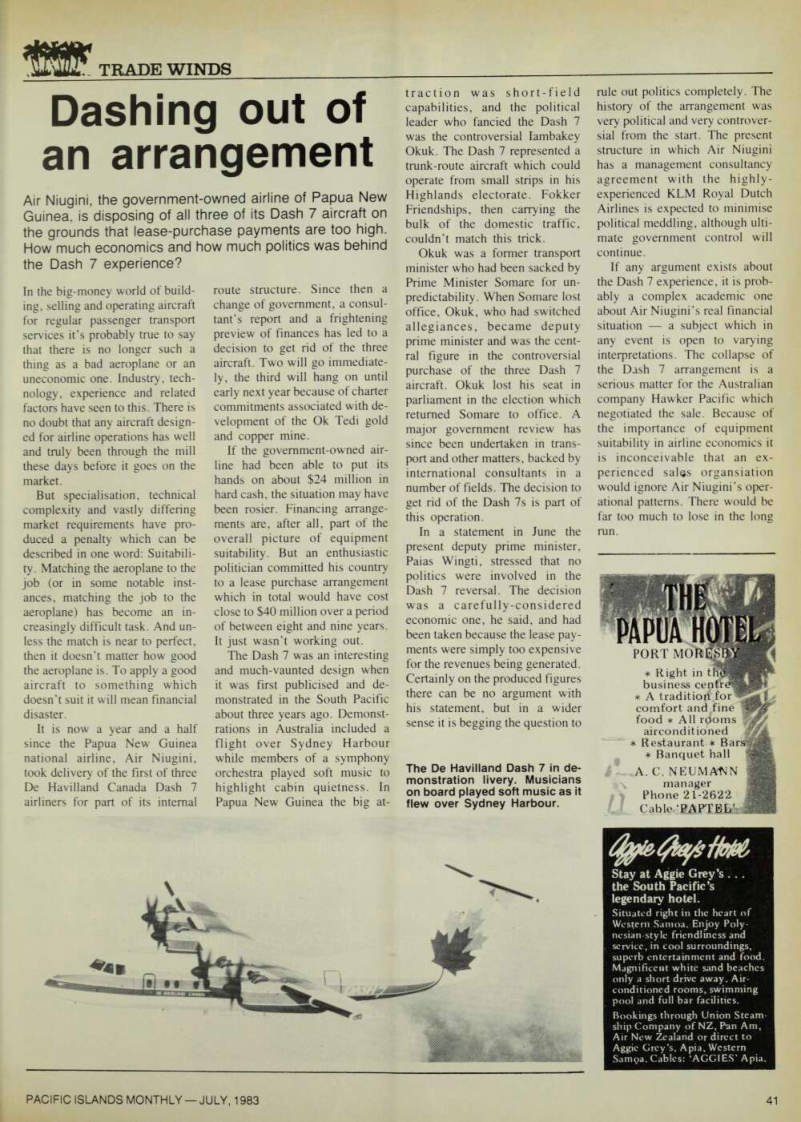
The Dash 7 was an interesting and much-vaunted design when it was first publicised and de monstrated in the South Pacific about three years ago. Demonst rations in Australia included a
flight over Sydney Harbour
while members of a symphony orchestra played soft music to
highlight cabin quietness. In
Papua New Guinea the big at
traction was short-field
capabilities, and the political
leader who fancied the Dash 7 was the controversial lambakey Okuk. The Dash 7 represented a trunk-route aircraft which could operate from small strips in his Highlands electorate. Fokker Friendships, then carrying the bulk of the domestic traffic, couldn’t match this trick.
Okuk was a former transport minister who had been sacked by Prime Minister Somare for un predictability. When Somare lost office, Okuk, who had switched
allegiances, became deputy
prime minister and was the cent ral figure in the controversial purchase of the three Dash 7 aircraft. Okuk lost his seat in parliament in the election which returned Somare to office. A major government review has since been undertaken in trans port and other matters, backed by international consultants in a number of fields. The decision to get rid of the Dash 7s is part of
this operation.
In a statement in June the present deputy prime minister, Paias Wingti, stressed that no politics were involved in the Dash 7 reversal. The decision was a carefully-considered economic one, he said, and had been taken because the lease pay ments were simply too expensive for the revenues being generated.
Certainly on the produced figures
there can be no argument with his statement, but in a wider sense it is begging the question to
rule out politics completely. The history of the arrangement was very political and very controver sial from the start. The present structure in which Air Niugini has a management consultancy agreement with the highly
experienced KLM Royal Dutch
Airlines is expected to minimise
political meddling, although ulti
mate government control will continue.
If any argument exists about the Dash 7 experience, it is prob ably a complex academic one about Air Niugini’s real financial situation a subject which in any event is open to varying interpretations. The collapse of the Dash 7 arrangement is a serious matter for the Australian company Hawker Pacific which negotiated the sale. Because of the importance of equipment suitability in airline economics it is inconceivable that an ex
perienced sales organsiation
would ignore Air Niugini’s oper ational patterns. There would be far too much to lose in the long run.
The De Havilland Dash 7 in de monstration livery. Musicians on board played soft music as it flew over Sydney Harbour.