display in Australia
pp. 37-39 · Read in the full issue
Fiji manufactures on display in Australia
There’s a promising future for Fiji’s manufactured exports in
Australia, especially in Sydney.
That’s what 17 Fiji companies discovered when they took their wares to Australia early in May.
They showed them off to Australian buyers in a three-day exhibition at Melbourne’s Inter national Trade Development Centre. Then, on their way home, they called in at Sydney and held a five-hour display in the South Pacific Trade Commis sioner’s newly opened exhibition room.
The result of the Sydney show surprised everyone. Five hours work and around 100 hard headed Australian businessmen
looking for bargains brought
“sales under negotiation amount ing to almost $A500,000,” says Neville Smith, trade adviser to
the Fiji consulate-general, “and
sales over the next 12 months expected to exceed $500,000.”
New agencies were also discuss ed and three joint ventures are being negotiated.
The three days in Melbourne brought “actual product sales of $85,000,” Mr Smith says, “sales under negotiation of $539,000 and estimated sales over the next 12 months of approximately $910,000.” Which made the whole exercise worthwhile.
Ratu David Toganivalu, Fiji’s minister for economic planning and development, opened the shop in Melbourne and told the customers: “Fiji has an image overseas of languid lagoons, tourists, resorts and waving palms. It is all those things, but it is now much more for we have a very rapidly expanding manufac turing sector.
“We are virtually at saturation point with our own import sub stitution, and now must look to export for our expansion.
SPARTECA, the special rela tionship between Fiji and Aust ralia and New Zealand, is seen as a means of redressing the trading imbalance.
“We have always said we pre fer trade to aid, and this is an opportunity to trade. We will grow by our own efforts. Doing business with Fiji just might be the best move you make this year,”
Ratu David was also at the Sydney mini-exhibition but there wasn’t time for speeches only for business.
The two displays probably sur prised many of the visitors, espe cially those who only know Fiji as the place of “languid lagoons” etc. It can also turn out some very impressive goods. “Fiji can really make it,” all the goods shouted. There were sweet bis cuits, dry crackers and flexible black PVC water pipe, all pro duced by one exhibitor, snack foods, spices, curry powders, margarine, soaps, shirts, dres sing gowns, plastic ware, knitted sportswear, trousers (no suits!), candlesticks, paints, primers, wood glue, polyurethane ropes, coir twine (from coconuts), ropes, doormats, toilet soap (also from coconuts), skin cream, af ter-shave lotion, books, packets, calendars and also “some high quality, genuine handicrafts” — all goods which can compete well on Australian markets as they are all on the SPARTECA list which allows them into Aust ralia, and New Zealand, free of tariff.
Three firms exhibited their funiture for homes and offices, furniture equal to furniture from anywhere as it was almost all fashioned out of Fiji’s magnifi cent grained timbers — dakua, damanu, kauvala, qumu and ya ka, king of all the furniture woods, plus others.
The only drawback where the wooden furniture was concerned is that it isn’t on the SPARTECA list. It carries a 30 per cent tariff, -but Fiji and some other island countries, Vanuatu for instance, are working on that right now.
It’s likely that shortly it will be included but as furniture components.
PIM’s stable companion, The Fiji Times & Herald Ltd., was an exhibitor but it wasn’t showing its newspapers. It was showing its multi-colored boxes, packets, wrappers, brochures, in fact ev erything it prints, and many of the other exhibits were wrapped up in its productions.
There’ll be other exhibitions
from Fiji and from other island countries. Australia wants them to come, the permanent secretary for trade in Australia, Mr James Scully, told them at the exhibi tion in Melbourne.
Said Mr Scully: “There is a trade imbalance of 20-1 in Aust ralia’s favor between our two countries and so we have a very special obligation to ensure that you have the opportunity to re dress the balance.
“We want you to sell your products in Australia, not to dis place our labor but to displace our other imports by competitive and healthy trading. Trade diver sion is the name of the game.
“Not only are you welcome in our country, but we are making a special effort to ask all Aust ralians to bear Fiji in mind when you come to sell your goods.”
And that goes for all Fiji’s neighbors who have anything to
sell.
John Carter.
And now, cheese
from coconuts
A Taveuni, Fiji, copra planter has produced cheese from coconuts.
Mr Brian Leonard, of Nevaca Estate, is keeping his cheese making process from coconuts a secret.
Mr Leonard said it was the first time in the world that cheese had been produced from coconuts.
A dairy technologist for 15 years in Australia, Mr Leonard came up with the idea of making cheese from coconuts after he noticed the similarities between coconut meat and milk.
“Cows’s milk contains pro tein, fat, sugar and water, coconut meat contains the same,” Mr Leonard said.
Fiji Times food connoisseurs and news gatherers who are al ways on the cocktail circuit had the opportunity to taste half a pound of cheese that Mr Leonard brought to Suva.
Sandwiched between snack biscuits the chilli and smoked flavored cheeses tasted: “Delicious, very nice.”
“It’s just right for the Fiji market; something like taroro (a Rotuman delight made from coconuts).”
“Unique flavor. This could go a long way!”
Mr Leonard has submitted samples to the University of the South Pacific for analysis.
He said he wanted to be sure of the new product’s quality be fore exporting.
“It has worldwide potential and would be much in demand with Seventh-day Adventists and Jewish people who try to avoid products derived from animals,” he said. Pranesh Nageshwar in The Fiji Times.
Famine theat in
FSM drought
The worst drought in Micronesia since 1902 could plunge the four states of the Federated States of Micronesia into years of famine President Tosiwo Nakayama has warned. The drought began in December.
The United States Trust Territ ory High Commissioner Janet McCoy has asked for a federal emergency management ad ministration field team to assess the impact of the drought in each state.
Yap Governor John Mangefel said they were already experienc ing a drastic decrease in food
production and an increase in disease outbreak and general de terioration in health.
Oz catering gear
on show in Fiji
Australia’s Department of Trade and Resources is organising an Australian caterng equipment and hotel supplies display to be held in the Hotel Mocambo, Nadi, from 20-22 September, 1983.
This display, according to a departmental press release, will be a “hard-sell” promotion di rected to the expanding needs of the hotel and caterng trade in Fiji which is undergoing a growth period with new ventures and refurbishing projects being undertaken in the period from 19883-85. In 1982 the total num ber of Australian tourists visiting the Pacific area increased by ab out 20 per cent.
Products envisaged for this display are expected to reinforce Australia’s position as a supplier to Fiji and other Pacific Islands, particularly Vanuatu, New Caledonia and French Polynesia.
The product range covers ca tering equipment, cool rooms, commercial/industrial air condi
tioning, light fittings, carpet, fur nishing fabrics, manchester items, floor/wall tiles, hotel/res taurant glass, crockery, cutlery and furniture, and outdoor sport ing equipment.
Sun-run video
in Vanuatu
A community centre opened on Nguna Island off Efate in Vanuatu is powered by solar energy which generates electrici ty to operate a water pump and a video television set. Funds for the centre came from the United States Embassy in Suva and the Australia High Commission in Port-Vila.
Mormons are
a-building
A temple costing SUS2.S million is being built by the Church of Jesus Christ of Latter-day Saints at Pesega in Western Samoa. It is on of four Mormon temples be ing built in the South Pacific.
One has been completed in New Zealand and others will be built in Tonga and Tahiti. A Baha’i temple is also nearing comple tion at Tiapapata in Western Samoa.
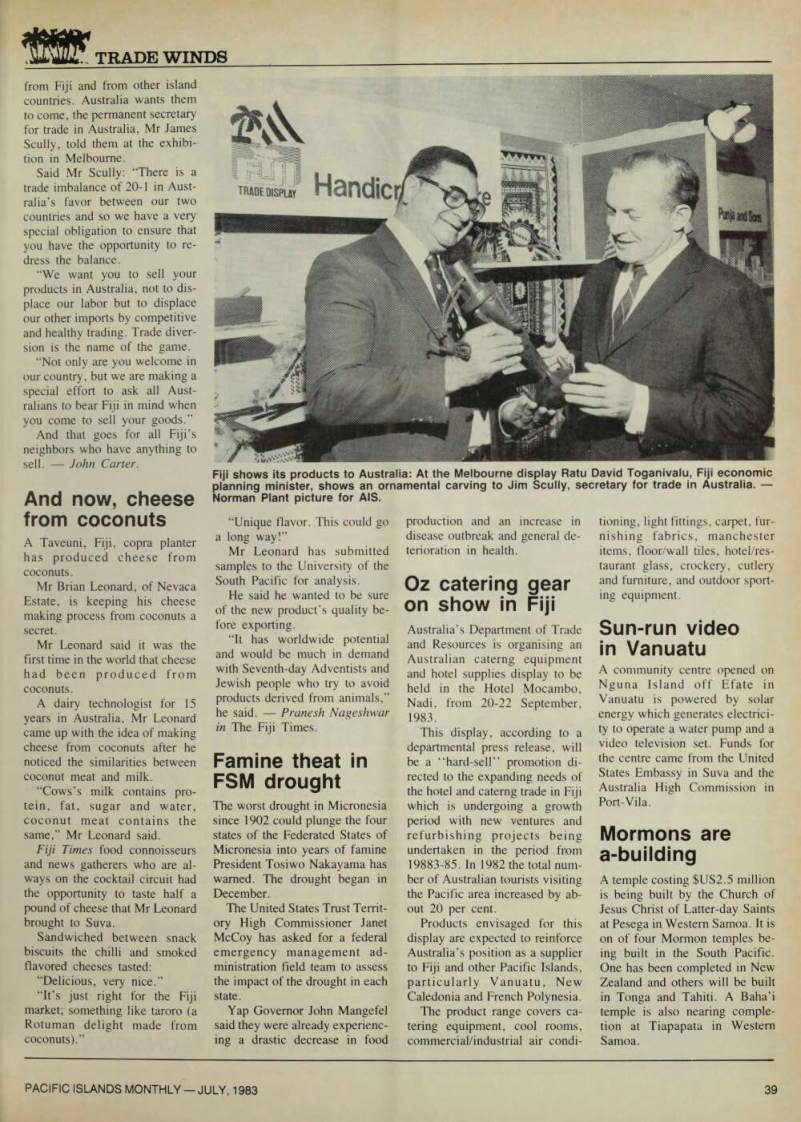
Fiji shows its products to Australia: At the Melbourne display Ratu David Toganivalu, Fiji economic planning minister, shows an ornamental carving to Jim Scully, secretary for trade in Australia. - Norman Plant picture for AIS.