Scandal rocks port authority and
pp. 36-37 · Read in the full issue
Trade Winds
French Polynesia
Scandal rocks port authority and mayors move on garbage
After months of rumors of scan dalous goings-on in the multi million dollar operations of Papeete’s port authority, its di rector Rodrigue Legayic has been arrested and jailed. Joining him on the prison trail was pro minent local businessman Philip pe Chungall.
The two men face charges of corruption and misuse of public funds in connection with harbor improvement works. In particu lar, it is alleged that Mr Legayic established a “front” company, Sopomat, which won tenders to do earth-moving and embank ment work around the harbor.
Two other companies engaged in work for the authority, Sot relec and Poly phone, are alleged to have won their tenders by corrupt means. Mr Chungall has links with all three companies.
The local English-language weekly, Tahiti Sun Press, said there was “speculation that the information thus far made public is only the tip of an iceberg of a major scandal involving several prominent persons”.
On cue in mid-May Tahiti newspapers reported that Napo leon Spitz, chairman of the standing committee of French Polynesia’s Territorial Assem bly, had been arrested and charg ed with “offences committed over several years in the manage ment of the port authority”.
Earlier, Jean Juventin, Papeete’s mayor and one of French Polynesia’s deputies to the National Assembly in Paris, had publicly accused the vice president of the local Govern ment Council, Gaston Flosse, of pressuring one of Papeete’s two daily newspapers into withhold ing the story of the port authority scandal and the arrests of Legay ic and Chungall. Flosse replied by accusing Juventin of receiving the sum of CFP3O million (about
$U5235,000) from the port au thority a few days before the March municipal elections in the territory.
Juventin claimed there was no thing illegal about the money, which had been owed by the port authority to the city under con tract since 1981. After the territ ory endured six cyclones in as many months, French Poly nesia’s political and business community is now bracing itself for a storm of another kind.
A lesser, but still significant, storm could erupt over a new idea for tackling Tahiti’s long standing garbage disposal problem.
Two California-based com panies, the giant Bechtel con struction firm and Bryan Energy, plan to spend SUSSO million putting in a garbage incinerator cum-power station in Tahiti.
Power would be generated through the burning of an es timated 43,000 tonnes of garbage a year from the island’s three most urbanised municipalities: Papeete, Faaa and Punaauia.
The U.S. firms plan to recoup their investment in part from the sale of electricity to the local power authority. They also plan to help the three municipalities establish a unified garbage col lection service, in which they would have an interest.
Garbage disposal has been a controversial issue in Tahiti for years, but none of the many projects put forward has ever got off the ground. The present method open air burning of the contents of rubbish tips in valleys behind the town areas presents grave pollution and health hazards. With winds in the wrong quarter, the inhabitants of some areas find themselves al most asphyxiated. The mayors of the three municipalities concern ed are the prime movers in the
scheme. They are well aware that it is French policy to retain full control of energy production in the territory, and that they can expect official French objections to the U.S. project.
But they have their reply pre pared in advance: Well, the gar bage problem’s been there for years, and France has done no thing about it. If we can solve the problem, and give a much needed boost to power produc tion at the same time, why should you try to stop us?
Observers in Papeete expect at the very least a sudden discovery of interest in Tahiti’s garbage problem on the part of French companies who are in the same line of business as Bechtel & Co.
Fiji’s voice
heard at ISA
conference
Speaking at the recent United Nations negotiating conference in Geneva on the new Interna tional Sugar Agreement (ISA), Fiji Foreign Affairs Minister Mosese Qionibaravi has ap pealed for the retention in the new agreement of the existing marketing arrangement under the Lome Convention which has gi ven Fiji a market in the European Economic Community for more than 170,000 tonnes of its sugar each year.
The Lome Convention em braces more than 60 developing countries. Mr Qionibaravi said any new regulatory mechanism should not impose further bur dens on small developing coun tries which depended heavily on the sugar industry.
Fiji and other sugar exporting countries are worried that at tempts may be made by Euro pean sugar beet farmers to have
them excluded from the EEC market.
The Queensland (Australia)
Minister for Primary Industry,
Mike Ahem, who attended the conference, has told the Queens land Cane Growers’ Council that he was greatly encouraged by the
willingness of major sugar
producing countries to achieve a new and workable ISA.
Commenting on the Geneva conference in his 1982 annual report of the Fiji Sugar Board, the independent chairman, J. S.
Thomson said: “It is to be hoped that the message can be got through to the bigger importing and exporting countries at the conference that it is not good enough to expect the smaller sugar exporting countries of the third world to accept quota restr-
ictions, or to have to hold in store large stocks of sugar pro rata with those agreed by the bigger exporting countries, whose economies, with one exception, Cuba, are more diversified than those of most of the third world.”
Still on the conference, Mr Thomson commented; “One of the positive actions I would like to see emerge from the Interna tional Sugar Conference this year is a program sponsored by the international community of ex porters and importers to search for uses for sugar other than in human foods and drinks. Hither to experimentation has been na tionally inspired. Brazil has, of course, established an ethanol industry, which uses cane and avoids the sugar-making process, but the feasibility of introducing it into other countries has largely shown negative results, includ ing Fiji. If an ethanol industry is established here, it is likely that molasses would be the base rather than cane. It is, however, in the field of sucro-chemistry that the best hope lies for uses of sugar other than in foods and beverages, and it is there that international collaboration is re quired to find alternatives.”
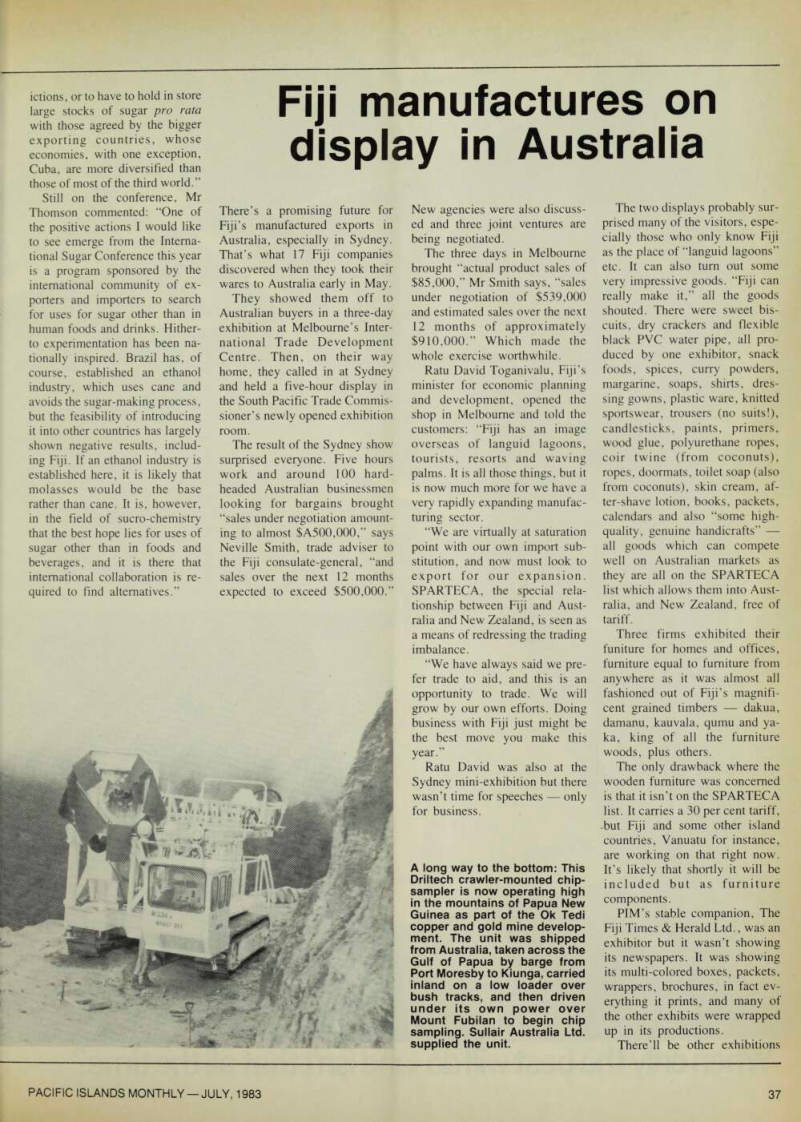
A long way to the bottom: This Driltech crawler-mounted chip
sampler is now operating high
in the mountains of Papua New Guinea as part of the Ok Tedi copper and gold mine develop ment. The unit was shipped from Australia, taken across the Gulf of Papua by barge from Port Moresby to Kiunga, carried inland on a low loader over bush tracks, and then driven under its own power over Mount Fubilan to begin chip sampling. Sullair Australia Ltd. supplied the unit.