Why two ministers got
p. 33 · Read in the full issue
Solomon Islands
Why two ministers got the sack
Margaret Atkin In
Honiara backgrounds the dismissal of two ministers in April by Solomon Islands Prime Minister Solomon
Mamaloni (PIM May p 5).
The troubles of former Solomon Islands minister of transport, communications and government utilities, John Ngina, returned to jail in April to complete a three months sentence, go back to a land dispute on his home island of Savo.
The sentence, imposed on February 1, followed his convic tion on a charge of causing actual bodily harm to a certain Michael Viu at Honiara Market on De cember 8, 1982.
Early in 1982 Ngina made a complaint to police that a con crete post he had erected had been wilfully damaged. As the police had taken no action, after several months, he informed them that he would take the law into his own hands. Ngina had appeared in court four times before.
On March 1, the committee on the prerogative of mercy met and recommended to the govemor
general that Ngina be released after serving one month of his sentence. They recommended his release on medical, family and social reasons. Shortly after wards Ngina was released.
There was an immediate publ ic outcry. A street poll conducted
by the independent newspaper,
the Solomon Tok Tok, revealed that 97 out out of 104 people interviewed felt that Ngina should not have been released.
Eighty-three of these people said the decision showed that people are not equal under the law and that politicians are above the law. They felt the law should apply to everyone whether or not
they are “big men”.
On April 2, Prime Minister Solomon Mamaloni sacked both the minister of lands, energy, and natural resources, Peter Sala ka, and John Ngina.
This move followed a public statement made by the two ministers after being asked by the prime minister to assume diffe rent portfolios. The prime minis ter asked Mr Ngina to move to education and training. Mr Sala ka was asked to move to police
and justice.
Both ministers publicly re fused, saying they would rather
resign than change portfolios.
Mr Salaka had also featured in an article in the March issue of The Sun, an independent month
ly news magazine.
The Sun revealed that Mr Sala ka held shares in a company called Sagalu Exim Ltd. This company held 50 per cent of the shares in another company, Cape Esperance Co. Mr Salaka had
given Cape Esperance permis
sion to log in an area of Guadal canal, the main island of the Solomon Islands. However, the licence was disputed as it was alleged that some of those who signed the agreement were not true landowners and had no right
to sign.
The Sun pointed out that there seemed to be a clear conflict of interests in this case, which was
contradictory to the Leadership
Code.
Leader of the Opposition, Sir Peter Kenilorea, applied to the High Court for a declaration that the committee on the prerogative of mercy was improperly con stituted and therefore its decision to release Mr Ngina was null and void. This application was placed on March 18 and was heard in the High Court by Mr Justice Daly on April 8.
Judge Daly ruled that the com mittee had been improperly con stituted on two grounds. He said on March 4, the date the commit tee met to consider Mr Ngina’s case, there was no representative present from Mr Ngina’s pro vince as required by the constitu tion. In fact none of the five provinces in Solomon Islands had nominated a representative to sit on the committee.
The judge also found that the social worker appointed to the
committee, although qualified in
the field of social work, was not a practising social worker at the time of his appointment, or at the time of the meeting.
He then ruled that as the com mittee had been improperly con stituted at that meeting it was not capable of giving advice to the governor-general and conse quently the governor-general’s pardon was null and void. On
April 11, the day the judgment
was given, Mr Ngina was re arrested and put back in prison.
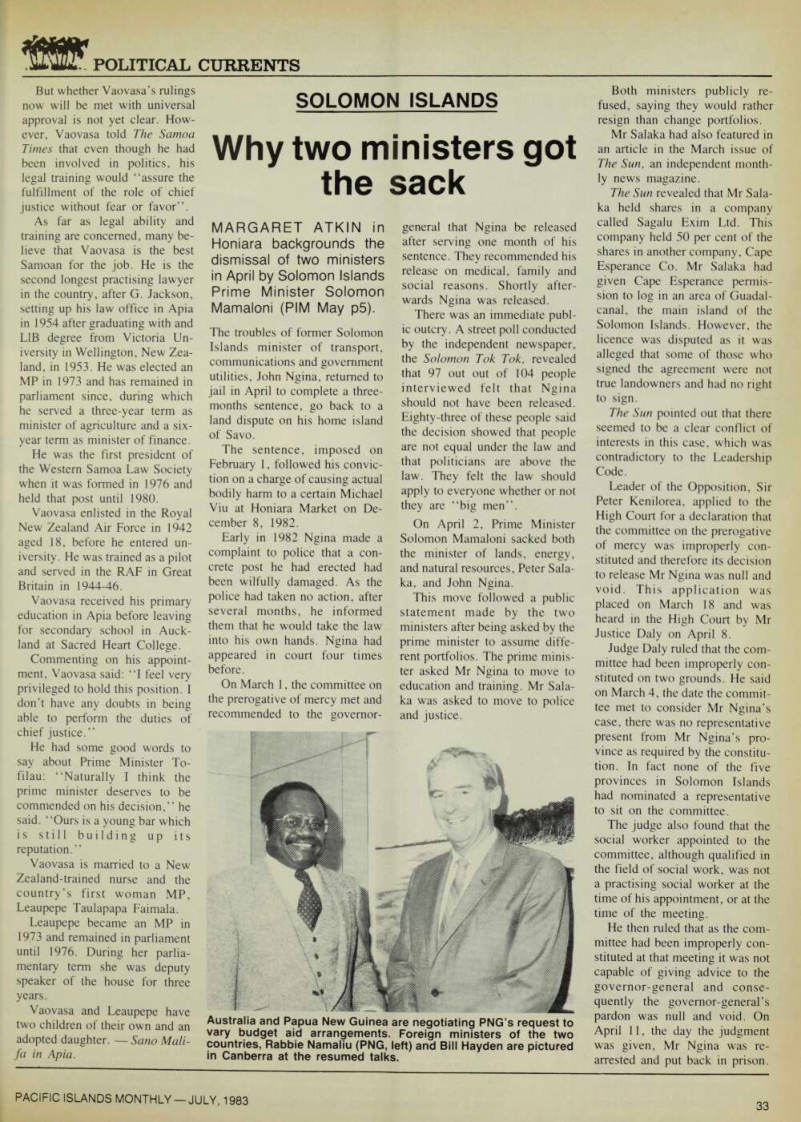
Australia and Papua New Guinea are negotiating PNG’s request to vary budget aid arrangements. Foreign ministers of the two countries, Rabbie Namaliu (PNG, left) and Bill Hayden are pictured in Canberra at the resumed talks.