A Samoan chief
pp. 31-33 · Read in the full issue

Political Currents
A Samoan chief justice at last
The Western Samoan public has now got what it has been scream ing for for years: a Samoan chief justice. The man picked for the job is MP Vaovasamanaia Filipo, better known in the courtroom as Reginald Paul Phillips, aged 58.
He became the first Samoan to hold the country’s highest judi cial post when he was sworn in in May.
But although Vaovasaman aia’s appointment is seen as a landmark in the decision-making of the new government of Prime Minister Tofilau Eti, sceptics feel that the move was designed as much as anything else to sap further the confidence of the op position party of former Prime Minister Tupuola Efi.
Vaovasa was minister of fi nance for six years in the govern ment of Tupuola and is con sidered one of the former PM’s staunchest supporters. In fact, Vaovasa, observers believe, had a lot to do with Tupuola’s elec tion as prime minister in 1976.
He was one of Tupuola’s two right-hand men in the 1976 pre election campaigns, the other be
ing “radical” up-and-coming politician, Asi Eikene, who later became Tupuola’s minister of civil aviation and justice.
With his departure now from parliament, Tupuola’s party has been reduced in strength to 21 votes against the government’s 25.
A by-election to elect Va ovasa’s replacement in parlia ment will be held on August 27.
The general feeling is that the government will be all out to win the seat.
Outside politics though, Va ovasa’s appointment is being considered a “right move” by the government.
In announcing the appoint ment, Prime Minister Tofilau said it had long been a dream that one day a Samoan would become chief justice. Vaovasa said it had been made quite clear to him that the offer had nothing to do with politics when he had been ap proached about the post by Tofilau.
Vaovasa now replaces former Chief Justice Russel Callander, a New Zealander who resigned in May after serving only three months of his two-year contract.
The Head of State, Malietoa Tanumafili 11, who, under the constitution appoints the chief justice on the advice of the prime minister, accepted Vaovasa’s appointment.
The whole thing has come as a relief to many Samoans who be lieve that Samoan customs and tradition had not been well
understood by the European chief justices in the past.
Over the last five years, three different chief justices have had to rule on election petitions, and a number of their rulings were widely criticised.
His honor Bryan Nicholson, when ruling that bribery had been committed during election campaigning a few years ago, had been questioned as to how he could have defined bribery from the Samoan manner of giving gifts.
The other chief justice, R. B.
St John, who ruled that the free dom of religion guaranteed by the constitution was breached when village matai (chiefs) pun ished a man who refused to at
tend church, was also criticised.
When Chief Justice Callander ruled in favor of the petition against former Prime Minister Vaai Kolone, thus costing Vaai his seat in Parliament, Callander was bitterly criticised.
After that ruling had been de livered, Callander showed to the police a threatening letter that had been sent to his office. His wife soon returned to New Zea land permanently, claiming that she had been threatened at her home. It is believed that Callan der’s wife’s departure led to his resignation.
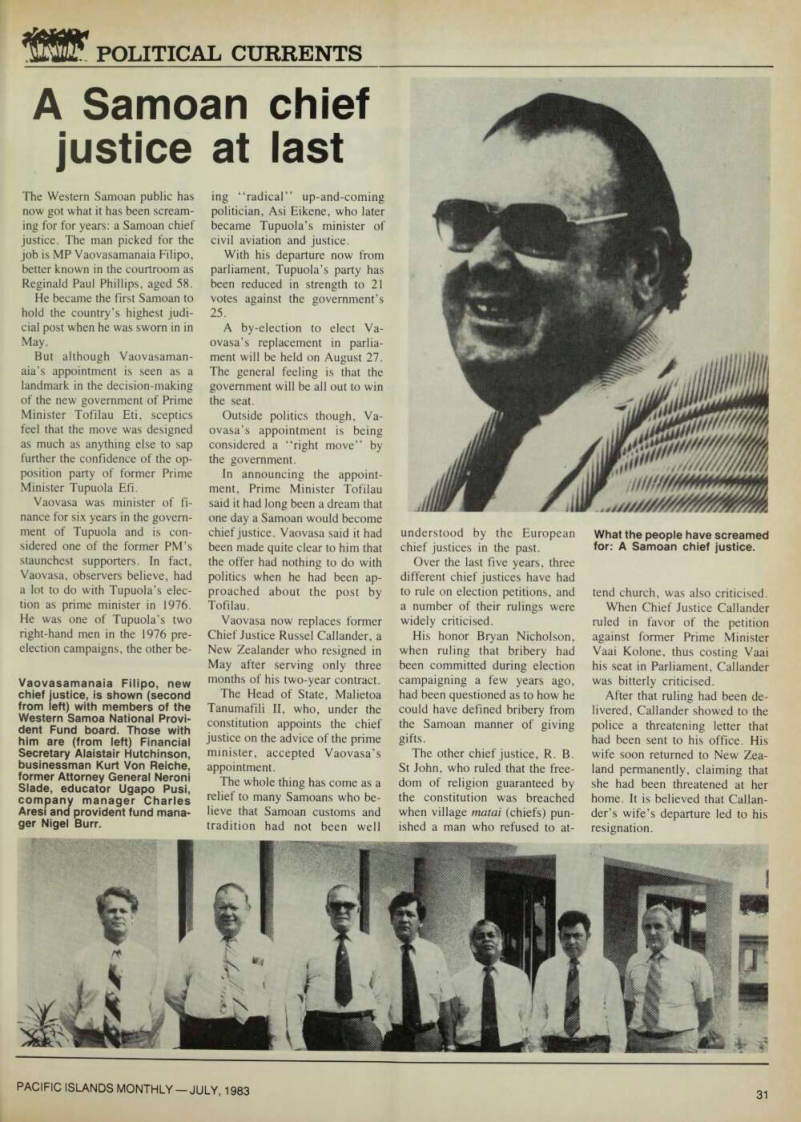
Vaovasamanaia Filipo, new chief justice, is shown (second from left) with members of the Western Samoa National Provi dent Fund board. Those with him are (from left) Financial Secretary Alaistair Hutchinson, businessman Kurt Von Reiche, former Attorney General Neroni Slade, educator Ugapo Pusi, company manager Charles Aresi and provident fund mana ger Nigel Burr.
What the people have screamed for: A Samoan chief justice.
But whether Vaovasa’s rulings now will be met with universal approval is not yet clear. How ever, Vaovasa told The Samoa Times that even though he had been involved in politics, his legal training would “assure the fulfillment of the role of chief justice without fear or favor’’.
As far as legal ability and training are concerned, many be lieve that Vaovasa is the best Samoan for the job. He is the second longest practising lawyer in the country, after G. Jackson, setting up his law office in Apia in 1954 after graduating with and LIB degree from Victoria Un iversity in Wellington, New Zea land, in 1953. He was elected an MP in 1973 and has remained in parliament since, during which he served a three-year term as minister of agriculture and a six year term as minister of finance.
He was the first president of the Western Samoa Law Society when it was formed in 1976 and held that post until 1980.
Vaovasa enlisted in the Royal New Zealand Air Force in 1942 aged 18, before he entered un iversity. He was trained as a pilot and served in the RAF in Great Britain in 1944-46.
Vaovasa received his primary education in Apia before leaving for secondary school in Auck land at Sacred Heart College.
Commenting on his appoint
ment, Vaovasa said: “I feel very privileged to hold this position. I don’t have any doubts in being able to perform the duties of
chief justice.”
He had some good words to say about Prime Minister To filau: “Naturally I think the prime minister deserves to be commended on his decision,” he said. “Ours is a young bar which is still building up its reputation.”
Vaovasa is married to a New Zealand-trained nurse and the country’s first woman MP,
Leaupepe Taulapapa Faimala.
Leaupepe became an MP in 1973 and remained in parliament until 1976. During her parlia mentary term she was deputy speaker of the house for three years.
Vaovasa and Leaupepe have two children of their own and an adopted daughter. Sano Mali fa in Apia.