Putting the
pp. 23-29 · Read in the full issue

Tropicalities
Putting the Balus story on film
As so often happens when one looks back to the origins of an idea, Balus was bom out of chance meetings and chance conversations.
I remember a weekend spent with two long-standing friends, John and Edith Watts, at their coffee plantation Ullya in Papua New Guinea’s Western High lands. Late at night and in our cups I told John I was getting stale in journalism and had en rolled for a month’s crash course in film-making at the Australiona Film and Television School. (Not that this promised to turn you into a film-maker: you mere ly came away with an inkling of the very complex and exacting skills required in making films.) I remember John saying that if I could come up with an idea for a documentary film with a Papua New Guinean setting, he would find the backers. That was a leap of faith: I had a record as a journalist and broadcaster in
Papua New Guinea, but none whatsoever as a film-maker.
At the film school there was another chance meeting and another chance conversation.
The 30-odd people doing the course were divided into groups of five, and the supervisor as signed to my group was someone called lan Stocks. We were much the same age. I couldn’t remem ber him but he said we had met seven years before. He’d spent three months in PNG making a documentary, Niugini Culture Shock, which had later won a prize at the Sydney Film Festival.
I remembered him then, and told him of John Watts’ offer.
“You could make a great film about flying in Papua New Guinea,” he replied. I agreed and he went on: “Well, if you want to write and direct. I’ll produce it for you.”
That was the start of it; a journalist can soon leam how to research, write and pull together ideas for a film. But working out a budget, recruiting crew, negotiating deals with film labs, and the 100 other details of a producer’s role were quite bey ond me.
The months that followed were given to researching Jim Sinclair’s massive tome, Wings of Gold, was invaluable as a standard reference work draft ing and redrafting a “treatment” of the film, budget estimates and revisions of the budget, discus sions with prospective investors, lawyers, accountants and airline executives, securing approval of the project by the PNG Govern ment and unearthing “Early birds”, pre-World War II pilots who had pioneered aviation in one of the most hostile, im penetrable land masses on earth.
A syndicate of eight business men was formed to finance Balus. All were Australians by birth, though some had become PNG citizens, and all either lived in PNG or had lived there. They were putting their money in a risk investment that may or may not return a profit one day, but they went into it quite as much because they believed in the theme of the film: a celebration of the men and their magnificent flying machines for the part they had played in building up that wild, mountainous country.
I make particular mention of Dennis (“Junior”) Buchanan,
boss of PNG’s principal third level airline, Talair. Thanks to its support lan and I were able to fly up to PNG, and all over the country to check out pilots, planes and locations. Without Talair’s help, we could not have
CHRIS ASHTON, a Port Moresby-based journalist from 1972- 75, tells how he made Balus, a 48-minute documentary film on the role of pilots and their planes in Papua New Guinea . (Balus is the PNG Pidgin word for aeroplane .)
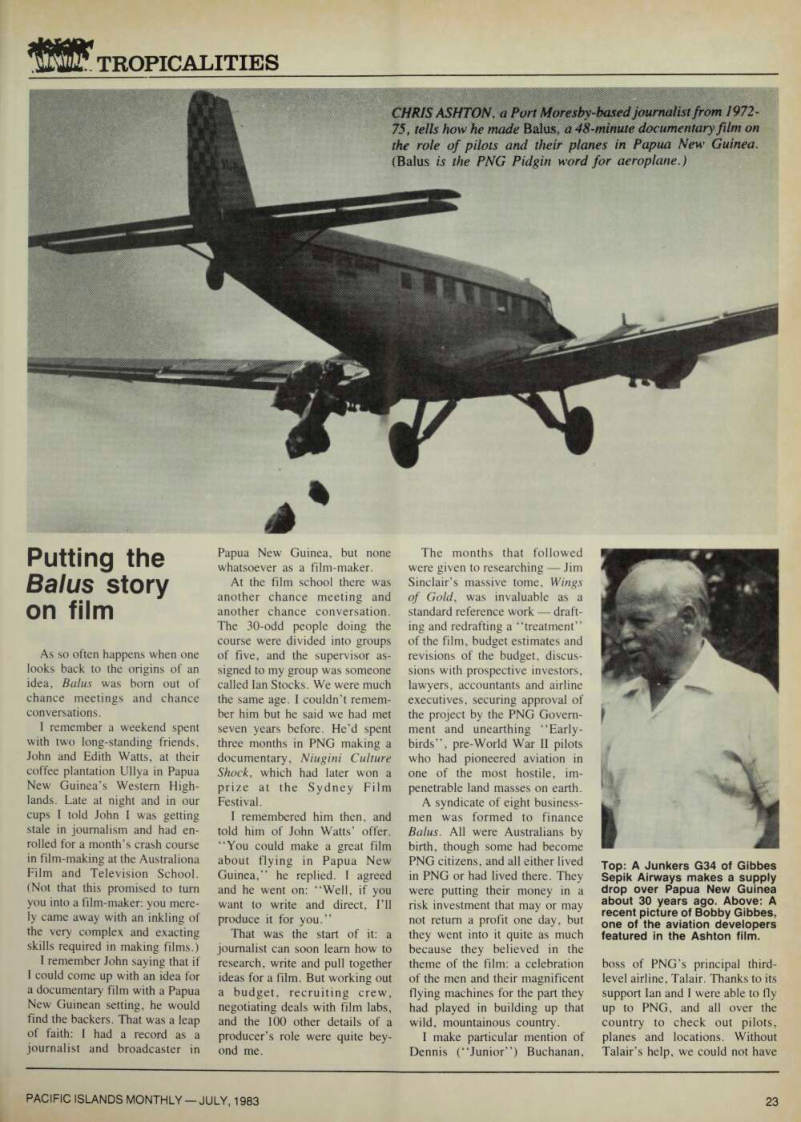
Top: A Junkers G34 of Gibbes
Sepik Airways makes a supply
drop over Papua New Guinea about 30 years ago. Above: A recent picture of Bobby Gibbes, one of the aviation developers featured in the Ashton film.
brought the film in for a budget of less than SIOO,OOO.
Unforeseen delays kept push ing back the shooting schedule, closer and closer to the wet sea son. There were problems with getting the money from investors into the bank, with settling a contra deal with Air Niugini, and with the PNG Government’s Of fice of Information approving our project. But it all came to gether at last. lan flew into Port Moresby on November 1 with the cameraman (Steve Newman) and sound re cordist (Bruce Emery). I had already arrived to prepare the way. Everyone assured us we should be safe, that the rainy season didn’t begin until Decem ber, but that it was not something you could set your watch by. In fact we finished on November 21, and the wet started two days later.
Those three weeks are imprint ed on my mind in indelible ink: a succession of motel rooms blur ring into one another, of 150 kilograms of film equipment
the absolute minimum lugged to and from airports, of hire cars and airport waiting rooms, of 34 flights in 19 days, of Cessnas, Islanders, Fokkers, choppers, even an RAAF Hercules trans port, half an island criss-crossed in a round trip from Sydney that spanned 15,000 kilometres.
The logistics of filming on a limited budget in a limited shoot
ing schedule, entirely dependent
on aircraft and the vagaries of weather, brought home to all of us just what the point of our film was.
At one point I was escorting the film crew into the remote Frieda River mineral exploration camp in the West Sepik by Islan der and helicopter. Some of our surplus film equipment had been left at Madang airport to reduce our weight; the rest was in Port Moresby. lan was on his way to Port Moresby via Lae, and half our unused filmstock, earlier consigned from Port Moresby to
Mount Hagen, had disappeared.
Three days later we were
reunited in Port Moresby, sur plus gear included.
The filmstock was discovered afterwards in Talair’s operations room in Port Moresby, never having left, and stored there to keep it cool.
To illustrate how diverse and even bizarre are the cargoes car ried by PNG’s air services I persuaded Talair’s one female pilot, Juliet Chubb, to let me film her flying cardboard cartons of baby crocodiles from a crocodile farm in the Papuan Gulf to a large commercial farm outside
Port Moresby.
Juliet is slim, blonde and pleasing to the eye in her bell
bottom jeans and high-heeled
boots. This was a sequence. I knew, that would wow television audiences in Europe and Ameri ca. But at the last minute she backed out, fearful that her male colleagues would mock her for being singled out for stardom.
An amiable male pilot flew in her place but somehow he lacked the element of whacky comedy that Juliet would have brought to the
sequence. It ended on the cutting room floor.
Back in Australia the long and arduous task of post-production began. From the musty film arc hives of Film Australia, the War Museum, Cinesound Movietone and the National Library in Can berra I had already unearthed quite extraordinary segments showing the feats of pilots and planes in the early days of aviation.
The pioneer of cinema photo graphy, Frank Hurley, had led the expedition which flew a sea plane, a Curtis Seagull, for the first time over Papua in 1922, and had filmed it. From a variety of sources I also uncovered am ple film of the first great airlift in aviation history: the cumbersome Junker G3ls which flew thousands of tons of dredge parts into the Bulolo Valley so that vast deposits of alluvial gold might be mined in the 19305.
The War Museum provided film showing RAAF Beaufigh ters in action and Mitchell bom bers of the U.S. Fifth Air Force
bombing Rabaul, a sequence underlined by an interview with Group Captain Brian “Black jack” Walker talking to camera; and Film Australia supplied film of tiny Norseman planes air dropping supplies to Australian patrols penetrating remote High land valleys for the first time, underlined by Wing-Commander Bobby Gibbes whose charter ser vice played such a vital role in early post-war development.
There are other sequences too numerous to mention here. But week by week the story was stitched together by the editor, Kim Moodie. Music was com posed by Nic Lyon. Titles and credits were designed and laid against the image. Sound tracks were mixed.
Out of a succession of exact ing technical processes a cinematic drama emerged, a story which, while it cannot possibly chronicle every charac ter and incident deserving men tion, pays homage to them all by focusing on the most spectacular images recorded in film of the role of the Balus in nation building.
Balus is available as a video cassette. For further information, please write to Doug Anderson, PO Box 990, Crows Nest, Aust ralia, 2065.
An Oscar victim
opens her heart
Under the simple headline “Thanks Fiji ”, The Fiji Times has published a moving and evocative account by an Ameri can tourist of her experiences during and after Hurricane Os car in March. Ms MAGGIE STAFSNES of San Anselmo, California wrote: On March 1 I was a guest at the Sea Shell Cove resort on the coast near Sigatoka when Hur ricane Oscar hit Fiji. I feel ex tremely fortunate to have sur vived the terrifying night. The loss of all my belongings, includ ing my passport, airline ticket and money, seems insignificant when I consider how close I came to losing my life.
During the past few weeks I have relived the horror of the storm over and over but although the hours of the hurricane are still
very vivid, the moments that I continually recall are the many acts of compassion, kindness and help that were extended to me and to many other tourists who were with me at Sea Shell Cove.
In a time of great personal loss, the Fijians came to the aid of people like me who were stranded, frightened and in need of help. I don’t know the names of many of these people, but I will recall their kindnesses and be thankful to them for the rest of my life.
I will never forget the first feelings of comfort and safety after the horror of the night at the hotel. Along with over 30 other tourists. I spent 12 terrifying hours as the hurricane battered the coastal resort first we gathered in the dining room on the first floor until we were dri ven to the second storey by the high water which eventually reached the second storey bal cony; the increasingly high winds ripped apart this area and finally tore off the roof forcing us to flee to a bathroom where we huddled in darkness for six hours hoping that the walls would not collapse on us.
When the winds stopped and the tide receded, we held hands and went in search of shelter on higher ground as high tide would return again in a few hours. We walked to the first home we found with a roof. The Indian
family who lived there opened their home to us as we straggled upon their house. Within minutes they were serving us hot tea with milk.
These first signs of order and the warmth of human beings, the pouring of tea by a woman into porcelain cups held by young children who served us, signalled an end to the insanity of the night. Soon food was prepared and offered, quietly and gra ciously, food I’m sure could have fed the family for many weeks. When money was offered by those who hadn’t lost theirs, it was refused.
Within hours of our departure from the ravaged hotel, the own er’s son travelled three miles on horseback to ask a local bus driver to help us. The man, who had had one bus blown over during the storm, immediately drove to where we were.
When I asked him how his home had weathered the storm, he said it was very badly damaged. I asked him why he had come, and he said he heard we needed help, and he came.
During the next five hours he skilfully drove his bus through the devastated countryside around fallen trees, under wires held up by passengers, often hav
ing to manoeuvre dangerously
close to the flooded, muddy ditches beside the road.
Throughout the drive I looked at the destruction of the country side homes, schools, power and telephone lines, gardens, sugarcane fields, trees and I was filled with great sadness and a sense of how small my losses
were compared to those of the
people of Fiji.
Yet, my spirits were continu ally lifted with the waves and greetings from the people we passed. At one stop, people cut pieces of sugarcane from the field and brought it to us. The bus driver drove on expertly to ward Nadi, his sole purpose be ing to deliver us to safety, and once again any offers of money were refused even though the bus
was damaged during the rough
trip.
When we arrived at the out skirts of Nadi, we discovered that flooding made it impossible for the bus to continue, and we would have to walk through waist-deep water to get into the town. Many of the children, old er tourists and those with injuries from glass broken during the hurricane, could not cross alone.
Someone volunteered their truck to take these people over the distance the bus could not travel, and other bystanders pitched in and helped carry those who needed assistance through the water.
Once across the river, another man offered his tractor and trailer to carry those who had been helped across the water.
I was not prepared for the flood and the storm damage to Nadi, but once again people put
their personal problems aside
when they heard of our story.
People at the Nadi Motel found four dry beds on the top floor most of the other areas were wet
and damaged.
They listened to our stories and were concerned for our
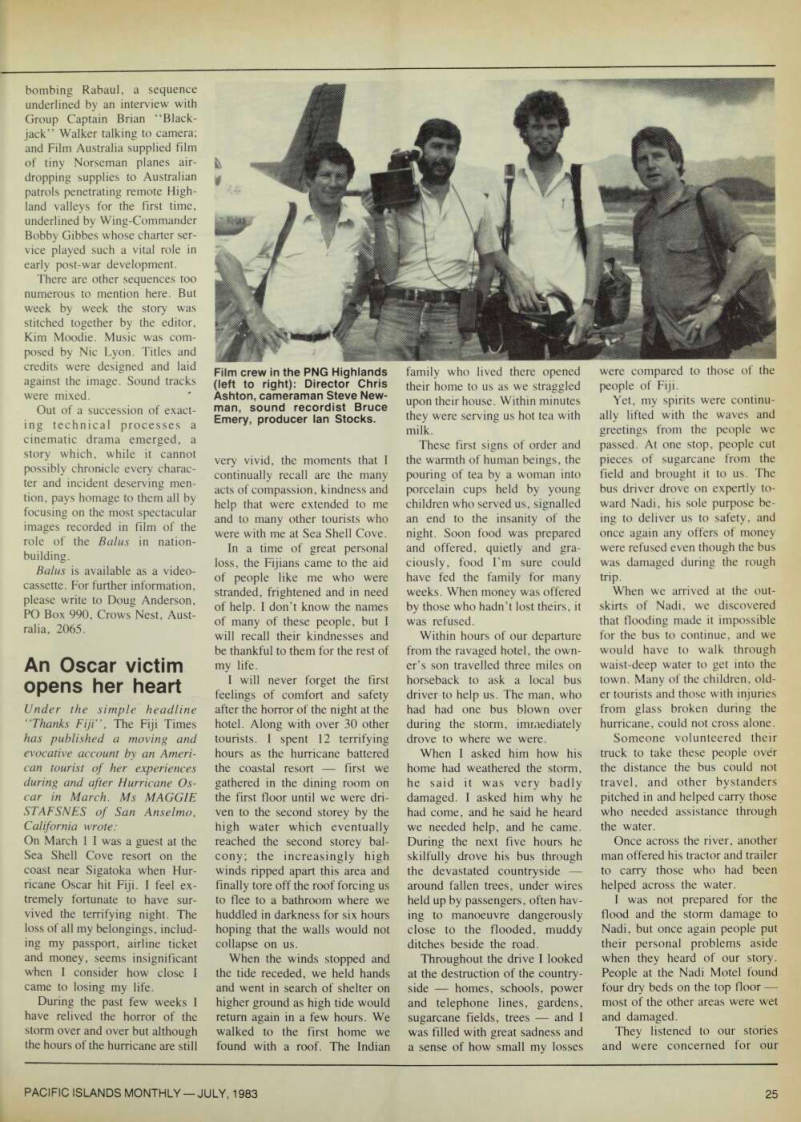
Film crew in the PNG Highlands (left to right): Director Chris Ashton, cameraman Steve New man, sound recordist Bruce
Emery, producer Ian Stocks.
plight and were helpful in many ways. They offered food, drink, clothing and comfort.
I headed for the airport as soon as I could the next morning and began the overwhelming task of getting home without any identification, money, ticket or with no way to contact anyone as Nadi had no outside communications.
I was in great need of the love and comfort of my family after the shock of the preceding 24 hours. I didn’t have to explain this need to anyone. Everyone I talked with at the airport showed compassion and wanted to help.
An immigration officer ex plained my circumstances to a taxi driver who drove me to the police station so that I could make a report. The security em ployees opened a locker where I had stored gifts for my children upon my arrival as soon as they heard that the key had been washed out to sea with my be longings. People came up to me who had heard of my misfortune and offered money to help me out until I could get home.
The employees of Air New Zealand, Sharon Bower, Pat Fraser and especially Aziz Mohammed, the head of Traffic Services for the Nadi Airport, worked relentlessly for two days in an effort to get me on any departing airplane for the U.S. to unite me with my family. They never stopped trying, and their hard work and warmth gave me strength as the three days wore on.
As I finally cleared immigra tion about seventy-two hours af ter the ordeal began, I was to get one more dose of “Fijian con cern.” The immigration officer looked at my paper from the police which explained the loss of my passport and property and said, “Where have you been?
We’ve been looking for you as our boss heard about you and wanted to take you to his home so you could rest.”
I returned to the safety and comfort of my home and to the love of my family and friends, but my thoughts continue to re turn to the devastation I left behind and to the hardships that will face the small country of Fiji because of a storm that stayed
less than 24 hours. My sadness is great for this country where peo ple gave so much to me when so much had been taken from them.
Words can never express the tremendous feelings of respect, warmth and thankfulness I will always carry in my heart for the people of Fiji, but I hope these words can somehow convey my deep and everlasting gratitude to the many who cared.
Mercy flight
with toddy
On a recent Friday afternoon Nauru’s Department of Civil Av iation received a telephone re quest from Sydney for assistance from Air Nauru to undertake a “mission of mercy”. The mis sion involved securing some Gil bertese palm toddy from Kiribati and carrying it to Sydney on the first available flight.
The toddy was being requested
by a Dr Cramdon of Westmead Hospital, Sydney, on behalf of an I-Kiribati woman, Mrs Mikaere, who had been flown from Tarawa two weeks earlier by a Royal Australian Air Force Hercules Cl3o aircraft on a mer cy medical flight. Mrs Mikaere was seriously ill following com plications in giving birth to her first child. The child subsequent ly died and Mrs Mikaere was suffering from severe
depression.
Dr Cramdon was anxious to satisfy a plea from Mrs Mikaere for some toddy and turned to Air Nauru for help.
There were no flights from Tarawa scheduled before the fol lowing Monday to connect with the Sydney flight. However the
delayed ON 121 flight leaving on
Saturday presented an opportuni
ty to carry some down.
Hearing of the need for toddy, a member of the Nauru airport staff, Sika Tulua, a Tuvaluan, offered to supply some from his own brewing, and two bottles of a potent-looking mixture were despatched per safe hand care of a returning visitor from Sydney.
At last report Mrs Mikaere had undergone major surgery and had
not yet tasted her toddy. But Dr Cramdon said that the fact that it was there as a gift from Nauru had cheered her no end. She had thanked the sender and was look ing forward to polishing off the toddy when she had sufficiently recovered.
Dr Cramdon has extended his thanks to Air Nauru, and espe cially Sika Tulua for his humanitarian gesture. Nauru Bulletin.
Niuean paper
launched in NZ
The Niue Consular Office in Newton, Auckland, New Zea land, in April took a hand in launching Niue News, a well produced 12-page “newsletter” printed in English and Niuean.
Reflecting on past failures in attempts to produce multilingual newspapers, the editorial in the first issue suggests that they may have failed because they were mu/ft'-lingual. The editorial said: “. . .the fact that the Samoana paper is still being published indicates an implied preference for a bilingual publication, thus pointing to an identity factor.”
Subscriptions are sought to Niue News. They can be had by sending SNZI2 or its equivalent to the paper at P.O. Box 68-541, Newton, Auckland. Although at first it is being helped by the Niue Government, it is hoped that the newsletter will become financially self-supporting.
UNICEF helps
in the Cooks
Co-operation has begun between the government of the Cook Is lands and the United Nations Children’s Fund (UNICEF) on the provision of clean water sup plies and improved sanitation to several remote northern islands including Rakahanga and Manihiki. A total of SUS 11,670 was recently released to the Cooks ministry of health by the office of the UNICEF representa tive for the Pacific in Manila. In the latter half of 1984, it is expected that UNICEF will give further support to sanitation ef forts on the remaining Northern Islands. These efforts comple-
“I looked at the destruction . . . and I was filled with great sadness, and a sense of how small my losses were com pared to those of the people of
Fiji.” - Maggie Stafsnes in her
message to the people of Fiji.
ment the water supply work of the Australian Development As sitance Bureau in the Cook Islands.
UNICEF is acting in the be lief, that adequate clean water supply, and the use of proper sanitation facilities, reduce such childhood diseases as intestinal parasites, diarrhoea and skin infections.
The Cook Islands Government demonstrated its support of UN ICEF activities by recently con tributing SUSIOOO to UNICEF’s general resources.
Games: Maoris
try again
Previously unsuccessful in its bid to win membership of the South Pacific Games Council for New Zealand’s Maoris, the New Zea land Maori Sports Federation (Inc.) is pressing ahead with its campaign in the lead-up to the Seventh South Pacific Games to be held in Apia in September.
It is seeking an amendment to the charter of the SPGC along the following lines: “Associate membership shall be open to the indigenous peoples (whose coun tries are members of the South Pacific Commission, Forum, and Conference) of the South Pacific who are not already members of the council.”
In its action it has the full
support of the New Zealand Ma ori Council, Maori Women’s Welfare League, and the en dorsement of New Zealand’s Minister of Maori Affairs.
New Zealand is a member of the South Pacific Commission, Forum and Conference, but has never been officially involved with the SPGC. Government pol icy has been not to interfere with sports organisations, but to offer assistance where appropriate.
A statement issued by the fed eration says: “Participation in the South Pacific Games will strengthen our cultural heritage with our relatives, as well as provide a basis for on-going con tacts and exchanges in sport. . .
“Whilst the Maoris may ap pear to dominate in such sports as Rugby Union, their participa tion in the Games could well provide an incentive for other Rugby-playing countries in the South Pacific. Likewise it could be said that Maori Rugby could improve its own style. Of par ticular interest are the skills inhe rent in tackling.
“The Maori Lawn Tennis As sociation is affiliated to the New Zealand Lawn Tennis Associa tion and holds an annual tourna ment. In the past the association has made contact with other ten nis countries, and participation in the Games will enhance these contacts.
“Soccer and cricket appear to offer very little interest for the Maori, but the Games may pro vide an incentive to develop that interest.
New Zealand Maori Sports Fed eration: Pre-season tournament for women in Auckland.
“Canoe racing is a sport prac tised with great vigor by some tribes here. Although not a Games sport, this could develop as such. Tahiti and Hawaii have such events on a much larger scale.”
Suva’s mixed-up
corpses
The body of a woman was “res cued” from a funeral pyre at Suva’s Vatuwaqa Cemetery in May seconds before it was to be cremated. The “rescue” fol lowed discovery that the dead woman’s family had taken deliv ery of the wrong corpse from the Colonial War Memorial Hospital mortuary.
Instead of the Hindu Bacchi, the family were about to set light to the body of Anglican Mary Ram Pyari. The two women had died on the same day at the CWM Hospital.
After a medical team arrived at the cemetery and explained the mix-up, Bacchi’s family re trieved her body and went through the Hindu funeral ser vice again at their home before the cremation.
Pyari’s family attended a de layed funeral service at Nasinu
Cemetery.
Bacchi’s son, Bobby Ramos, told The Fiji Times: “We all
thought our mother somehow looked strange, but none of us said anything aloud, probably because of the state we were in at the time.’’
Speaking for Pyari’s side, her son Ram Autar told the same paper that CWM staff had been “discourteous”. Throughout the confusion, no one had apologised to them for the error, he claimed.
“When we went to the hospit al mortuary we could not find the body of our mother. A matron or a sister said ‘lf the body is not there, there is no point’,” he said.
Marathon to be
run in Noumea
New Caledonia’s first interna tional marathon race will be run on a 14-kilometre circuit around Noumea on July 24.
A large number of runners are expected to take part. A charter flight of 3f)o participants has been organised from Japan alone.
All in for
maths
The 1983 Australian Mathemat ics Competition held in June at tracted 27,500 entries from New Zealand and Southwest Pacific countries.
With a total entry of over 270,000, the sponsors of the competition, Canberra College of Advanced Education, West pac Banking Corporation, and the Canberra Mathematical As sociation, will award over $A30,000 in prize money as well as approximately 122,000 certifi cates of merit.
Vanishing birds
of Christmas?
The Wildlife Conservation Unit of Kiribati has discounted claims by the American ornithologist Ralph W. Schreiber that 16 mill ion birds had “disappeared’’ from the republic’s Christmas Island.
Schreiber put the mass exodus
of the birds down to a sudden increase in the temperature of the ocean waters, the phenomenon now being discussed throughout the world as “El Nino’’. His speculation was that the warmer water had changed the patterns of fish populations, and hence the food sources of the birds.
The Kiribati WCU described his report as “sensationalised and exaggerated’’.
Quoted in the Kiribati weekly Te Uekera, the unit said its latest estimate of the total bird popula tion of all species on Christmas stood at 4.5 million pairs.
The 1981 census of the wedge tailed shearwater was 1 million, and sooty terns 4-6 million.
The paper continued: “Schreiber last visited the island in November last year and the birds were not there because of the bad weather conditions (El Nino).
“WCU said the breeding sea son of June 1982 ended success fully before the occurrence of El Nino, and that the adult birds are returning in large numbers.’’
Vanuatu has issued a miniature sheet of six stamps bolstering its claim to possession of Hunt er and Matthew Islands to the south. The two islands, which are uninhabited, are also claimed by France on behalf of New Caledonia.