Culture clash
pp. 19-21 · Read in the full issue

on Pentecost
Port-Vila resident JULIE-ANN ELLIS has taken over “The Month’s” coverage of Vanuatu affairs. Ms Ellis is a staff mem ber at the University of the South Pacific Extension Centre in Vanuatu, but writes here in her individual capacity.
Reporting of events in Vanuatu has this year seemed to concen trate on political clashes in the capital, Port-Vila. But 320 kilometres from Port-Vila, the long, thin island of Pentecost has its own political splits, and its own culture clashes.
In May, 10 young men, prob ably acting under direction of their chiefs, went from the Catholic mission area of Baie Barriere to burn houses and goods at the kastom (traditional religion and lifestyle) village of Ranji. This was the latest stage in a long-standing land dispute.
The intervention of police from Santo and Port-Vila fores talled any payback, and it seems the matter will be settled through the courts, but it serves to under line the extent of the divisions still existing between Christian and kastom, as well as more recent divisions of politics, and longer-standing ones of land dis putes and old feuds.
For many years, the Christian villages received support and status from visiting Europeans;
they found material wealth and education comparatively easy to come by. But the world has changed the missions have lapsed, or changed direction, pop anthropology has boomed, and visiting Europeans no longer want to see rows of clean chil dren, singing in a European language.
Vanuatu has changed the mood of nationalism which came with independence, and the quest for unity, have found expression in a turning to kastom. An arts festival at Melsisi, in North Pentecost, last year united the entire island in new respect for old kastom ways. The balance of status seems to be shifting, and Christian villagers are uneasy.
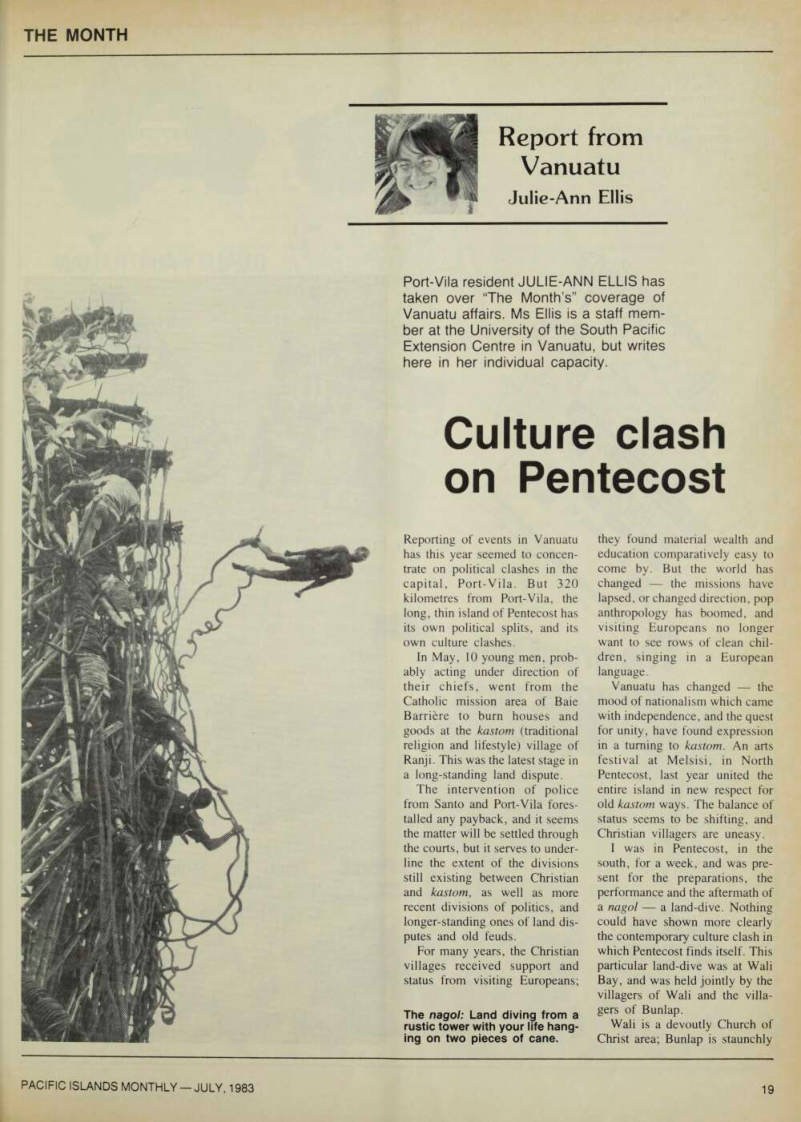
I was in Pentecost, in the south, for a week, and was pre sent for the preparations, the performance and the aftermath of a nagol a land-dive. Nothing could have shown more clearly the contemporary culture clash in which Pentecost finds itself. This particular land-dive was at Wali Bay, and was held jointly by the villagers of Wali and the villa gers of Bunlap.
Wali is a devoutly Church of Christ area; Bunlap is staunchly
Report from Vanuatu Julie-Ann Ellis
The nagol: Land diving from a rustic tower with your life hang ing on two pieces of cane.
kastom. The two communities co-operated, and divided the in come, but small things showed the difficulty the two groups had working with each other. The week prior to the jump was sod den with rain; Bunlap men told us not to worry about it, that they had a system for weather control.
The day of the jump was one of burning sun; the day after, in Wali church, the sermon referred to Revelations for the damnation
awaiting magic-workers.
The nagol itself was a success.
Forty-eight tourists attended; 10 more, from a yacht that shall be nameless, tried to buy their way in with bottles of whisky and gin, a pig, and a handful of Australian dollars. (The organisers turned out not to be the drunken fools
they were expecting.)
The ritual was long, exciting and spectacular. It is not a sacred tradition, but it is a serious sea sonal ritual, rather in the same sense that the Grand Final is a serious seasonal ritual to football followers. Each participant climbs the tower to his appointed platform, while below men and women dance encouragement,
singing songs in an archaic lan guage, whose exact meaning has been lost. The final jumps were breath-taking, and were each
preceded by a display of superbly
self-confident swaying, shouting and pose-striking, on a small, springy platform 12 or 13 metres above the ground.
The tourists watched, as did a large crowd of other villagers, each having paid a small amount for the privilege. The tourists - were appreciative, if a little worn by the four hours of watching in the blazing sun. As they left the tower area for refreshments be low, they seemed well pleased with their chance to see one of the most exhilarating and de manding traditions of the Pacific.
But they left behind them a certain amount of unease and division. The following day, at a meeting of Wali people interest ed in tourism, many doubts were
expressed about the operation.
These were partly about the use of income from the jumps which is a local decision, as yet unmade but also deeper ques tions about the whole way of life of the area, and, in particular, on the value of a Christian way of life compared with the new em phasis on kastom.
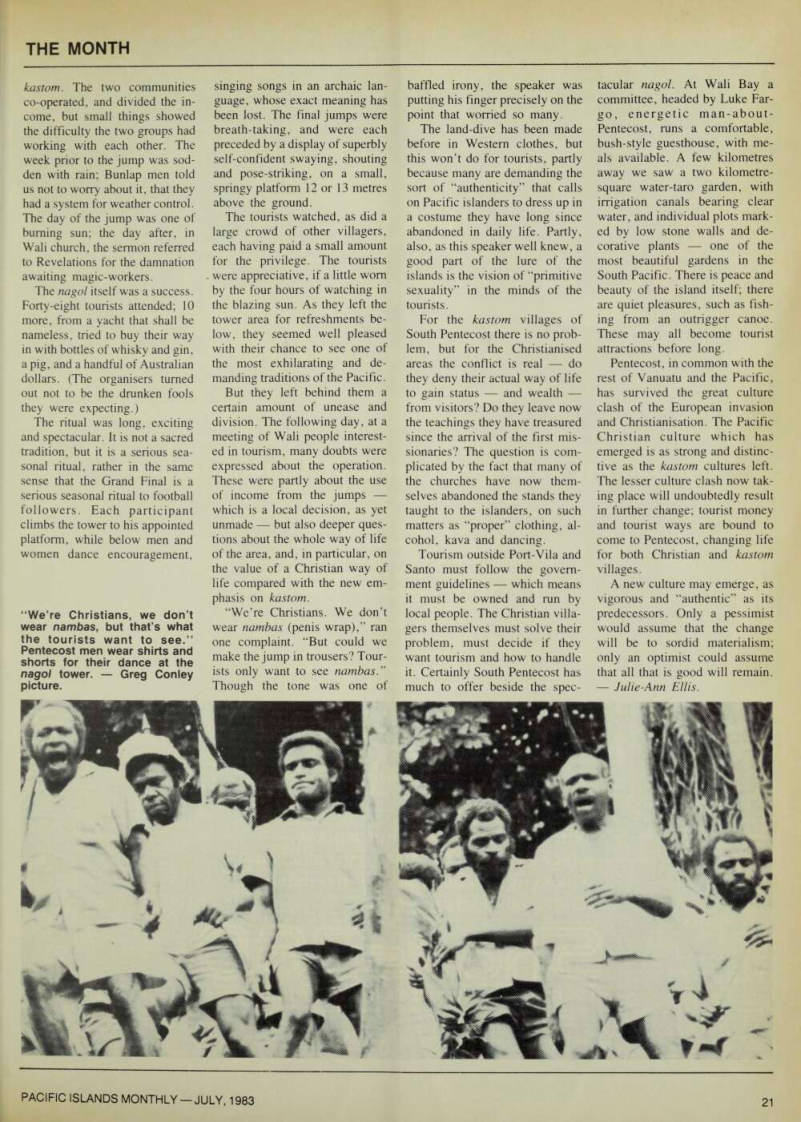
“We’re Christians. We don’t wear nambas (penis wrap),” ran one complaint. “But could we make the jump in trousers? Tour ists only want to see nambas.”
Though the tone was one of
baffled irony, the speaker was
putting his finger precisely on the
point that worried so many.
The land-dive has been made before in Western clothes, but this won’t do for tourists, partly because many are demanding the sort of “authenticity” that calls on Pacific islanders to dress up in a costume they have long since abandoned in daily life. Partly, also, as this speaker well knew, a good part of the lure of the islands is the vision of “primitive sexuality” in the minds of the tourists.
For the kastom villages of South Pentecost there is no prob lem, but for the Christianised areas the conflict is real do they deny their actual way of life to gain status and wealth from visitors? Do they leave now the teachings they have treasured since the arrival of the first mis sionaries? The question is com plicated by the fact that many of the churches have now them selves abandoned the stands they taught to the islanders, on such matters as “proper” clothing, al cohol, kava and dancing.
Tourism outside Port-Vila and Santo must follow the govern ment guidelines which means it must be owned and run by local people. The Christian villa gers themselves must solve their problem, must decide if they want tourism and how to handle it. Certainly South Pentecost has much to offer beside the spec
tacular nagol. At Wali Bay a committee, headed by Luke Far go, energetic man-about- Pentecost, runs a comfortable, bush-style guesthouse, with me als available. A few kilometres away we saw a two kilometre square water-taro garden, with irrigation canals bearing clear water, and individual plots mark ed by low stone walls and de corative plants one of the most beautiful gardens in the South Pacific. There is peace and beauty of the island itself; there are quiet pleasures, such as fish ing from an outrigger canoe.
These may all become tourist attractions before long.
Pentecost, in common with the rest of Vanuatu and the Pacific, has survived the great culture clash of the European invasion and Christianisation. The Pacific Christian culture which has emerged is as strong and distinc tive as the kastom cultures left.
The lesser culture clash now tak ing place will undoubtedly result in further change; tourist money and tourist ways are bound to come to Pentecost, changing life for both Christian and kastom villages.
A new culture may emerge, as vigorous and “authentic” as its predecessors. Only a pessimist would assume that the change will be to sordid materialism; only an optimist could assume that all that is good will remain.
Julie-Ann Ellis.
“We’re Christians, we don’t wear nambas, but that’s what the tourists want to see."
Pentecost men wear shirts and shorts for their dance at the
nagol tower. - Greg Conley
picture.