Miklouho-Maclay
p. 51 · Read in the full issue
Mew light on Nikolai Miklouho-Maclay
N. Miklouho-Maclay, Travels to New Guinea: Diaries, Let ters, Documents. Edited by Daniil Tumarkin. Published 1982 by Progress Publishers, Moscow, USSR. No ISBN. Price SA9.
The people of Bongu and nearby villages on the Rai Coast of northern Papua New Guinea re vere the memory of Nikolai Nikolayevich Miklouho-Maclay, the Russian scientist who lived there during 1871-72 and 1876- 77, and paid a brief visit in 1883.
Their language has words such as gugurus (Russian; kukuruz maize), bika (byk bull) and shkapor (topor axe), for plants, animals and tools in troduced by him. More impor tant, his stay, the first of its kind and length among New Guineans by a white man, was marked by mutual respect and friendship.
Miklouho-Maclay, early fol lower of Darwin and friend of Haeckel, Huxley, Virchow, Tol stoi and other great men, is well remembered, too, in the country of his birth. The editor of this book, Dr Tumarkin, tells us that the Soviet people have profound respect for the memory “of this outstanding scientist and fighter for the rights of oppressed peo ples.” The Institute of Ethnog raphy of the USSR Academy of Sciences and a street in Moscow are named after him. The academy published a collection of Miklouho-Maclay’s works in five volumes (1950-54) and hopes to bring out a new and more complete edition by 1988, the centenary of his death. It regularly awards prizes for out standing works on countries and peoples of the Pacific. Mik louho-Maclay is the favorite hero of millions of Soviet children.
In her lengthy review (PIM, December 1975) of Charles Sen tinella’s excellent English transl ation, with biographical notes, of Miklouho-Maclay’s New Guinea diaries, Judy Tudor traverses the scientist’s account of his life
among the Bongu and their neighbors and she adverts to his scientific and other endeavors in western New Guinea, other parts of that region, and Australia. She suggests that patriotism, a desire to spread Russian influence, brought him to Bongu, but she also says that “back in Australia later in 1883, Maclay threw him self into any move that would safeguard the future of the New Guineans, meantime hoping that the conflicting colonial interests of Germany and Britain would keep both from making any defi nite move ...”
The diaries translated by Sen tinella, and this translation by Dr Tumarkin, both highly readable, speak for themselves: Miklouho- Maclay does not need a public relations man. But Tumarkin’s edition also offers a much more detailed biographical account, through Soviet eyes, and 27 let ters and documents which tell us more about the scientist’s “other endeavors”. Let us take a very brief look at these letters and documents.
Having witnessed some of the brutality of the Labor Trade, the recruitment of Pacific Islanders for plantations in Queensland,
Fiji, Samoa, etc, Miklouho- Maclay petitioned persons in high places in Britain, Russia, Germany and Australia. The pet itions contained statements such as: “It is certain that, as long as . . . kidnapping slave trade and slav ery are suffered or even sanc tioned by the Government (under the name of ‘free labor trade’) and that shameless spoliation which goes by the name of ‘trad ing’ continues in the islands, the results the massacres will constantly recur. The least that the blacks have a right to expect from the civilised races is neither pity nor sympathy, but justice As for the people of the Rai Coast, a system of self government, based upon in igen ous customs and usages, some thing like Fiji’s council of chiefs, was proposed by Miklouho- Maclay. Roads, bridges and wharves would be built, primary schools established, plantations developed and trading in beche de-mer, copra, sago, etc, under
taken. All adult males would be taxed, payable in natural pro ducts or labor for the public good. With him as adviser manager, Javanese overseers, local workers, etc, would be em ployed and a steamer hired. The annual budget would be about £2OOO. A limited liability com pany with an initial capital of £15,000, provided by philan thropic capitalists, would finance the scheme. It was, of course, an impracticable proposition for its time and, no doubt, ridiculed by the advisers to Gladstone, Bis marck, Lord Derby, Sir Arthur Gordon and other addressees of Miklouho-Maclay’s petitions, but he deserved much, much better than ridicule, if only for these sentences in his letter of January 23, 1879 to Gordon: . . the inhabitants of the Mac lay Coast (the part of the north east coast of New Guinea bet ween Cape Croisilles and Cape King William) . . . 15,000 to 20,000 people at least, are strict ly left to the soil which they cultivate, each piece of ground, each useful tree of the forest, the fish in each stream, etc, etc, has a proprietor! That ownership is known and respected by the neighbors. The invasion of stran gers who wish to occupy a land already occupied and cultivated for centuries would put the in habitants between the firearms of the whites and the weapons of the inhabitants of the mountains ... I demand for the protection of the inhabitants of the Maclay Coast that the Imperial Government: 1. Recognise the complete right of the natives ... to their soil. 2. Prevent (or render improbable by heavy taxation) the importa tion and the selling to the natives of alcohol, firearms and gunpowder.
No other foreign scientist of Miklouho-Maclay’s international stature, Robert Koch and Carle ton Gajdusek excepted, has worked in New Guinea, and none has surpassed him in his active concern for the islanders.
Dr Tumarkin and the pub lishers have done the great scien tist and humanitarian proud with this scholarly, highly readable
and inexpensive edition.
Har-
ry H. Jackman.
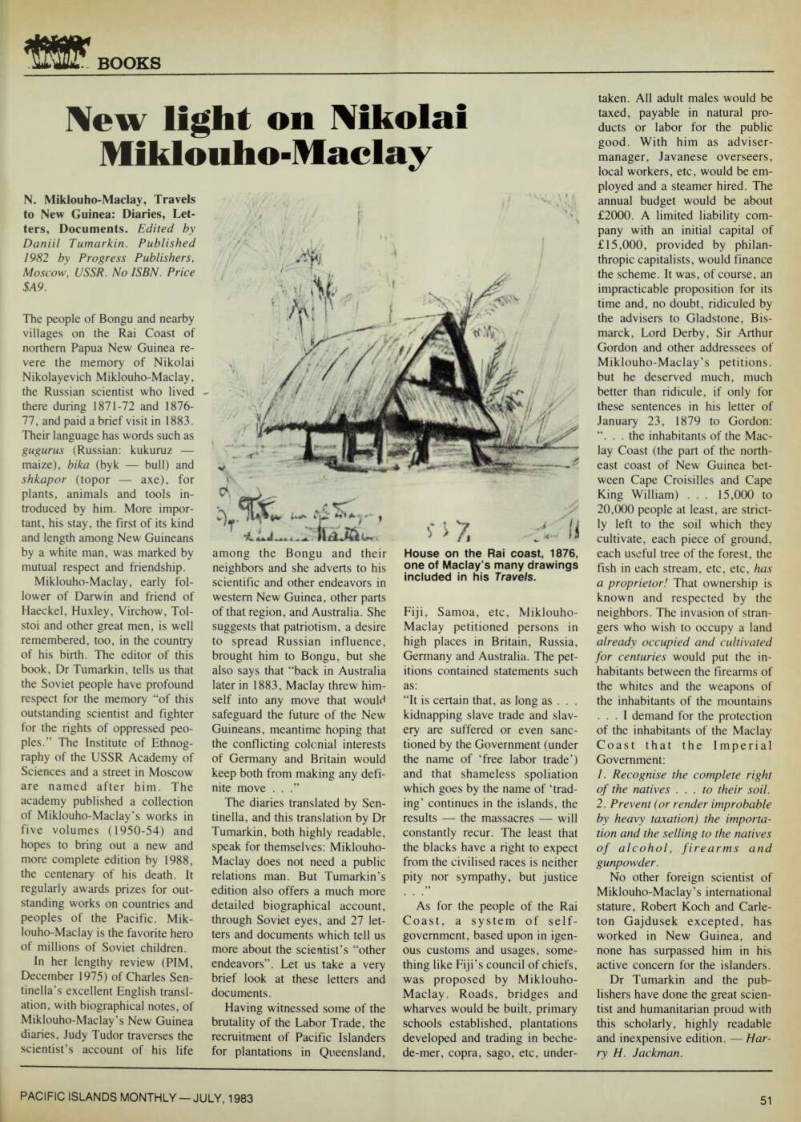
House on the Rai coast, 1876, one of Maclay’s many drawings included in his Travels.