for Hawaii?
pp. 11-65 · Read in the full issue
The Month
A Pacific role for Hawaii?
There is a difference of opinion within the United States as to whether or not it has a Pacific policy. Some observers, particu larly in the U.S. State Depart ment, believe that a policy was articulated in 1978 and that there has been considerable continuity in that policy. In the state of Hawaii, however, those in the executive and legislative branches of government with an interest in the Pacific believe that the Reagan administration has no policy, and this opinion is appa rently shared in the offices of the governors of the other American flag islands, American Samoa, the Commonwealth of the North ern Marianas, and Guam. In deed, this sentiment was re viewed in two articles in PIM, September, 1981.
What accounts for this discre pancy of perspectives? Several issues seem to be involved. First, under President Carter the feder al government did assemble a Pacific policy and it had two facets. First, beginning in 1978, the State Department did articu late a policy regarding the entire Pacific region. Among other things, it was announced that the U.S. would establish a larger presence in the Pacific. A sepa rate office of Pacific Island Af fairs was created for the first time (previously, the Pacific was doomed to obscurity as it was lumped with the office of Aust ralian and New Zealand Affairs); diplomatic missions in Fiji and Papua New Guinea were up graded to embassies, with am bassadors with multiple accredi tation; a modest aid program was launched; active participation in
and support of regional organisa tions was pledged; and an effort to improve co-ordination among American and multi-lateral prog rams was made.
Second, and with the main thrust coming from the Depart ments of Commerce, Energy, and Interior, a policy regarding American islands was for mulated. It resulted in the found ing of the Pacific Basin Develop ment Council, composed of the four governors of the American flag islands. As discussed in this column in June, part of PBDC’s function is to promote co operation between the American islands and the federal government.
Officials in Washington have encouraged Hawaii and its gov ernor, George Ariyoshi, to be come more involved in the Pacif ic. Even before such encourage ment, however, Hawaii was looking in this direction, and a central figure in shaping Hawaii’s potential role was Hideto Kono, director of Plan ning and Economic Development (see PIM, March, 1982). He has recently retired and been suc ceeded by Keith Kent.
That the state of Hawaii is committed to greater involve ment in the Pacific was reflected in two recent speeches by Gover nor Ariyoshi, one of which was his inaugural address last De cember which marked the begin ning of his third and last four year term as governor. On both occasions, the governor referred to “the New Pacific” and the role Hawaii might play in the region.
Thus, policies were for
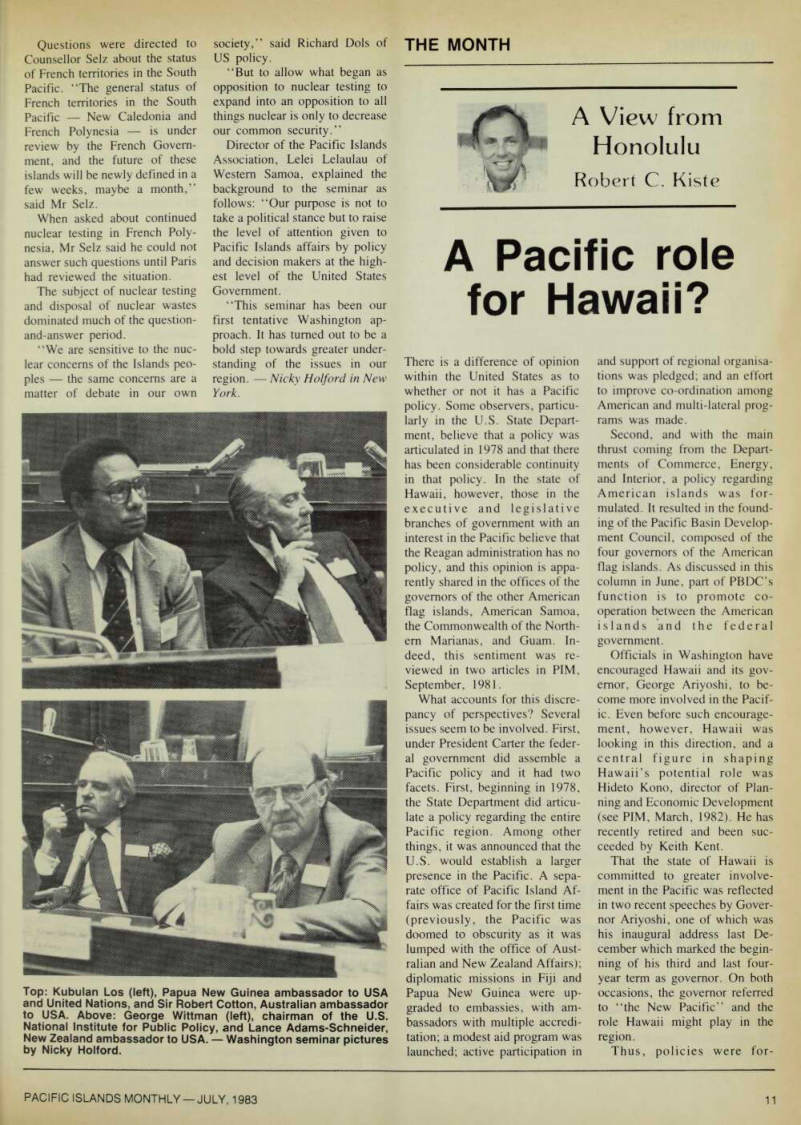
A View from Honolulu Robert C. Kiste
mulated under the Carter ad ministration, and Hawaii wishes to expand its Pacific role. So what is the problem? One basic issue that the Reagan administra tion has developed a Caribbean Basin policy which addresses it self to economic and social de velopment as well as security concerns. At the same time, no comparable or explicit attention has been given to the Pacific. At least one experienced Pacific hand in the State Department does not see this as a problem.
From his point of view, it is encouraging that the Reagan ad ministration has not “disassembl ed” the Carter initiatives and there has been considerable con sistency since 1978 even if by default. From the viewpoint in Honolulu, however, the lack of explicit goals from Washington over the past three years is seen as a policy vacuum which makes it awkward for the state to chart a course of direction.
Even if it may be assumed that the Carter policies are still opera tive, they are lacking from the point of view of those in Hon olulu. There is no doubt that PBDC does provide a framework for interaction between Hawaii and the other American flag is lands. However, State Depart ment policy regarding the Pacific
as a whole is viewed as one that is primarily concerned with sec urity and strategic interests. With the exception of American Samoa, it does not provide a framework which assists Hawaii in relating to island nations south of the equator in such areas of concern as trade, shipping, air transport, education, the sharing of technologies, etc.
The state of Hawaii has a unique position in the U.S.
While it is a state of the union, it is also located in the insular Pacific. State offices, the Un iversity of Hawaii, and the East- West Center (EWC) are not in frequently asked by Pacific na tions for assistance in education, economic development, informa tion, and various training prog rams. For example, one nation appealed for assistance in aquaculture, assessment of its tourism potential, and training in health fields. Only a limited re sponse is possible. The East- West Center does provide some fellowship support for individu als to be involved in its programs and to pursue advanced degrees at the University of Hawaii.
Much greater opportunities are available for citizens of the American flag islands, under a
variety of federally financed
programs.
As a state, Hawaii cannot have its own foreign policy nor can it be anticipated that its legislature will appropriate funds for educa tional and assistance programs.
Even if it were so inclined, any such efforts would be subject to State Department purview.
While Hawaii is only beginning to attempt to develop more ties with the South Pacific, one may ask: What has been accomplish ed to date?
Over the past four years, Gov ernor Ariyoshi has met with an increased number of island lead ers, and his office directly co ordinates affairs pertaining to Pacific nations. Several guidelines have been laid down.
First, it is not assumed that what is good or appropriate for Hawaii is also good for other Pacific Islands. Second, no mutually be neficial involvement can occur without input from leaders in the Pacific. Governor Ariyoshi has asked for such input, and he has also asked for feedback and sug gestions from those citizens of Hawaii who are knowledgeable and interested in the region. In a generally related move, the morning newspaper, the Hon olulu Advertiser, has recently in creased its coverage of Pacific affairs. Third, Hawaii must be sensitive to its size and mainland
connections and avoid any hint of a role of dominance in the Pacific.
As has been reported, Gover nor Ariyoshi was a charter mem ber of PBDC when it was formed in 1980. The past three years have given him the opportunity to become more familiar with the problems and concerns of the other American islands. As re ported here last month, the gov ernor has also recently become a member of the EWC’s Pacific
Islands Development Program’s
standing committee which di rects its efforts and involves the entire Pacific region. The gover nor’s involvement with PIDP is seen as the next step in moving Hawaii into a greater involve ment with the rest of the Pacific.
What is going on in Hawaii that might be useful to other islands? A substantial amount of research in aquaculture has been conducted in the state, and there is a willingness to share the results. Similarly, the state is attempting to become more self sufficient in the area of energy, and its experiences can also be shared. The state is developing its telecommunications capacity, and this can include a concern for the needs of the region. The
Continued on Page 65.
University of Hawaii is provid ing special training programs in the areas of health and medicine for students'from the American flag islands, \ and these programs might be fcade available to others. The promotion of island products in the state is mentioned as another possibility.
The concern for Pacific affairs in Hawaii is also found in the state legislature, particularly in the House of Representatives.
Clayton Hee has taken the mas ter’s degree in Pacific Islands Studies at the university. Byron Baker has had long interest in the area, and he is the author of the text in the photo-essay book Mic ronesia: The Breadfruit Revolu tion which appeared some years ago.
The most active on the scene is Fred Rohlfmg, House Minority Leader, former Attorney-General for American Samoa and current U.S. alternate delegate to the South Pacific Conference. In the first session of the Twelfth Legislature of the State of Hawaii which adjourned in late April, he successfully introduced a resolution which encouraged the U.S. Senate to ratify the treaties of friendship that were negotiated by former Ambas sador William Bodde with the Cook Islands, Kiribati, Tuvalu, and the Tokelau Islands and New Zealand during the Carter ad ministration and which, after re view, have been supported by President Reagan (PIM June, p 6).
All of this activity in Hawaii is
in its beginning stages and there is a vague quality about the lot of it. It is fair to say that Hawaii is groping to find a role in the Pacific, and it would like some clearer signals from the nation’s capital. Hawaii is a giant in the Pacific, and with all the best of intentions, there are substantial dangers involved. As state offi cials tend to the business of satisfying their own constituen cies and promoting the interests of Hawaii, it will be difficult to remain truly sensitive to the needs of small island states.
Also, there needs to be an awareness that there are consid erable reservations in the Pacific about a greater U.S. involve ment. Essentially, the policy in itiated in 1978 by the State De partment was a sign that Washington intended to play a greater role with its ANZUS partners Australia and New Zealand in promoting regional security in the Pacific. The very fact of a greater U.S. presence, whether Hawaii is part of it or not, can precipitate super-power rivalry in the region, a situation unwanted by the island states.
Lastly, the discussions about a greater role for Hawaii refer not only to insular island states but the larger Pacific Basin, and the latter is defined to include the giant rim countries of Japan, the People’s Republic of China, Taiwan, South Korea, etc. As Hawaii carves out a future in the Pacific and develops its econom ic and other ties with the rim countries the small island states are correct to fear that they will be the losers in the larger game.
Robert C. Kiste.