seminar in Washington DC.
pp. 10-11 · Read in the full issue
Islands concerns well aired at seminar in Washington DC.
A seminar sponsored by the Pacific Islands Association on the subject “Strategic Interests in
the Pacific” brought together
more than 170 high-ranking par ticipants in the U.S. capital of
Washington, DC, in May.
Co-hosting the seminar, which was held in a committee room of the US Congress, was the Na tional Institute of Public Policy (NIPP), a leading US “think tank” on strategic issues.
NIPP chairman George Witt man opened the seminar with an overview of the subject. He said: “Strategic interests in the South Pacific on the one hand involve large to medium size nations that seek to maintain or expand an influence regionally, and on the other a group of small to ex tremely small nations and ter ritories that wish to gain from the major powers interest in their
continued political and security
alignment.”
New Zealand’s ambassador to the US Lance Adams-Schneider made a strong statement in which he praised the relationship bet ween New Zealand, Australia and the US, but strongly criticised the US for claiming sovereignty over about 25 islands in four Pacific countries Tuvalu, Kiribati, the Cook Is lands, and Tokelau.
Mr Adams-Schneider said: “The US has claimed sovereign ty over these islands since 1939.
But it has never administered any of them, nor has it borne any of the responsibility for their up keep or the development of re sponsible government in them, or for the welfare of the people.
“These claims have not been
recognised by any other
country.”
The US position was in troduced by Thomas Shoesmith, acting assistant secretary of state for East Asian and Pacific affairs.
He was followed by Richard J.
Dols, newly appointed director
of Pacific Island affairs in the
State Department.
Mr Dols told the seminar: “The United States has a long
New York-based Pacific affairs writer NICKY HOLFORD reports on a recent seminar held in Washington DC which dealt with major political, economic and military issues in the Pacific today.
history of contact with the Is lands, a history that has little to do with global strategic issues and much to do with competition for dollars and souls.”
Calling the US interest a “re cent one”, and one that was previously “a kind of strategic insulation,” Mr Dols said the US “has an obvious direct interest in protecting US territory in the Pacific, and defence respon sibilities in Micronesia.”
“The primary American de fence concern is security of lines
of communication air and sea to our friends and allies in Asia to Australia and New Zea land and to the Islands themselves.”
The threat of Soviet Far East ern forces that have “grown alarmingly” in the last decade is one that the US takes seriously, he said.
The strategic interests of the Federated States of Micronesia were outlined by Asterio Takesy, secretary of external affairs.
Only a month away from the
planned signing of the Compact
of Free Association with the US, Mr Takesy said that the years of negotiating with the US have given Micronesians “a good start
in forming relationships with
other countries.” ‘Today we are more optimistic than ever before
concerning the security, stabili
ty, and economic future of the
Pacific region.”
Australia’s ambassador to the US, Sir Robert Cotton, outlined
his country’s ‘‘long-standing his
torical ties with the nations of the South Pacific,” emphasising that his varied political career has enabled him to fully appreciate ‘‘the Pacific way.”
“In the years ahead we will undoubtedly face considerable
economic, political and strategic
problems,” he said. “But in our view the Pacific is in a better position than many other regions to weather the difficult times which might lie ahead.”
The potential for economic ex ploitation of many Pacific na tions was covered by Papua New Guinea’s ambassador to the Un ited Nations and the US, Kubu lan Los, who said: “The Pacific region is open and to an extent unprotected. Similarly, its economic resources are largely untapped and attractive.
“Having abundant resources which are mostly unexploited
poses potential security problems
to the region. Just as defence,
security, and political stability
are important, so is economic
security.”
American Samoa’s Congress man Fofo Sunia told the seminar; “For those of us who live in and are part of the Pacific it is of paramount importance that our part of the world does not be come the next arena for the sport of confrontation against those competing for supremacy in this world.”
Although not formally repre
sented, France sent a high ranking official from its Washington embassy, Philippe Selz, to reply to questions on France’s policies in the Pacific region.
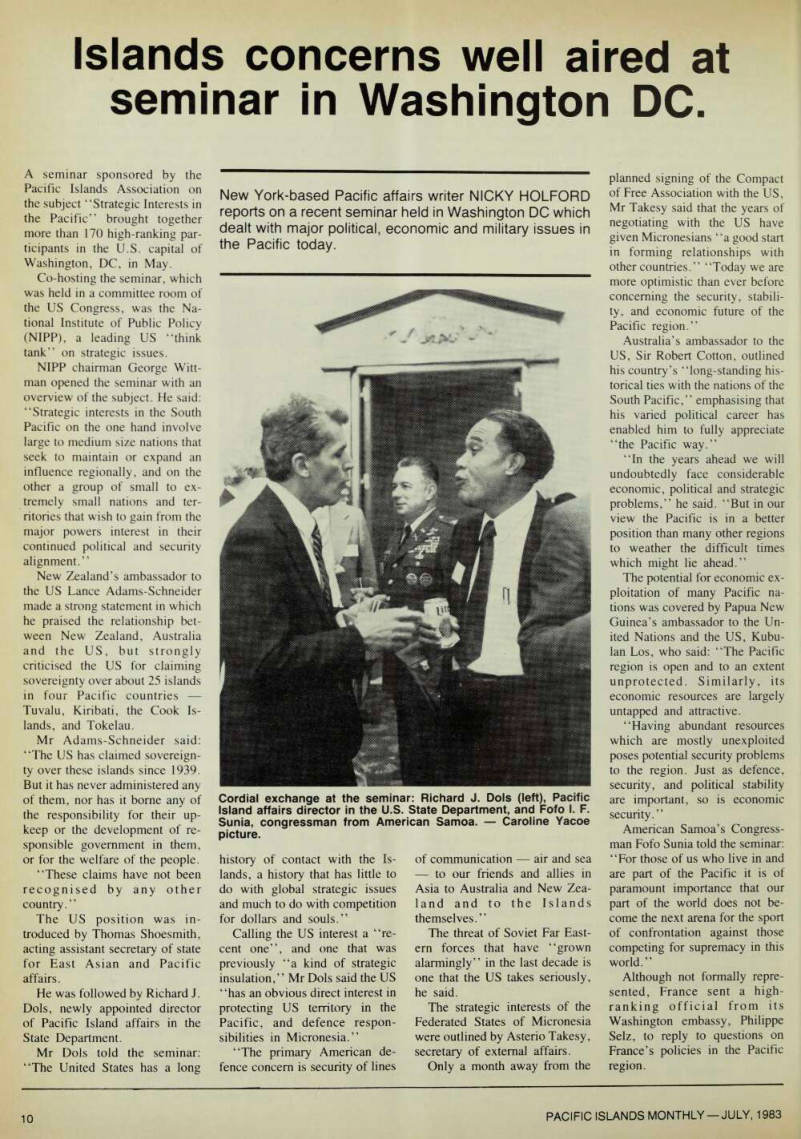
Cordial exchange at the seminar: Richard J. Dols (left), Pacific Island affairs director in the U.S. State Department, and Fofo I. F.
Sunia, congressman from American Samoa. - Caroline Yacoe picture.
Questions were directed to Counsellor Selz about the status of French territories in the South Pacific. “The general status of French territories in the South Pacific New Caledonia and French Polynesia is under review by the French Govern ment, and the future of these islands will be newly defined in a few weeks, maybe a month,’’ said Mr Selz.
When asked about continued nuclear testing in French Poly nesia, Mr Selz said he could not answer such questions until Paris had reviewed the situation.
The subject of nuclear testing and disposal of nuclear wastes dominated much of the question
and-answer period.
“We are sensitive to the nuc lear concerns of the Islands peo ples the same concerns are a matter of debate in our own
society,’’ said Richard Dols of
US policy.
“But to allow what began as opposition to nuclear testing to expand into an opposition to all things nuclear is only to decrease our common security.’’
Director of the Pacific Islands Association, Lelei Lelaulau of Western Samoa, explained the background to the seminar as follows: “Our purpose is not to take a political stance but to raise the level of attention given to Pacific Islands affairs by policy and decision makers at the high est level of the United States Government.
“This seminar has been our first tentative Washington ap proach. It has turned out to be a bold step towards greater under standing of the issues in our region. Nicky Holford in New York.
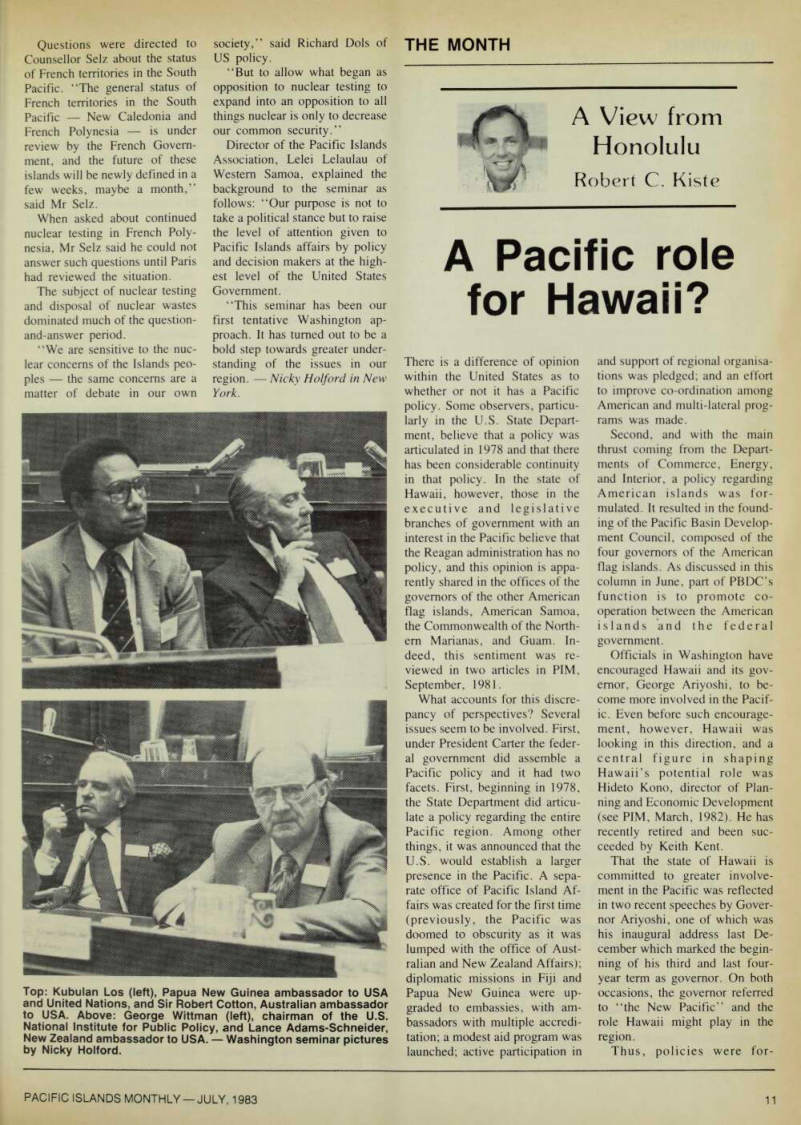
Top: Kubulan Los (left), Papua New Guinea ambassador to USA and United Nations, and Sir Robert Cotton, Australian ambassador to USA. Above: George Wittman (left), chairman of the U.S.
National Institute for Public Policy, and Lance Adams-Schneider, New Zealand ambassador to USA. - Washington seminar pictures by Nicky Holford.