“Everything’s
pp. 7-9 · Read in the full issue

Letters
got a
moral ..
In my judgment you could not have chosen anyone better qual ified to comment on my recently published book Margaret Mead and Samoa: The Making and Unmaking of an Anthropological Myth than the shrewdly insight ful and acutely knowledgeable Samoan poet and novelist Albert Wendt. While being highly ap preciative of his review (PIM Apr. plO) I would, if I may, like to clarify a crucially important point concerning the sexual mores and behavior of the Samoans.
Professor Wendt suggests that I have accepted “too readily” the testimony of Samoan elders concerning the sexual morality of their society, and so have over looked the extent to which Sa moans depart from this morality.
In her account of Samoa, Mar garet Mead asserted (as I note on p. 289 of my book) that pre marital promiscuity was “ex pected”; that there was (as I note on p.9lf), a “passive accept ance” of this pre-marital promis cuity by the “religious au thorities”; and that “the socie ty” was “not interested” in adultery when it occurred. She is here, obviously, making asser tions about the sexual morality of the Samoans. It is with the refu tation of these assertions that I am primarily concerned in Chap ter 16 of my book, and in show ing that, in Albert Wendt’s words, the Samoans, in their public morality, “forbid pre marital and extra-marital sex and promiscuity”.
That this was indeed the public morality of Samoa in the 1920 s (the period to which Mead’s writings on the Samoans specif ically refer), with sexual inter course between unmarried per sons being held to be both a sin and a crime, is demonstrated by cases in the archives of the courts of American Samoa. For exam ple, on May 6, 1929, in the district court at Fagatoga, on the island of Tutuila, Lafitaga, an unmarried male, having admitted that he knew it was wrong for a
man and woman to have “inter course with each other unless they were married,” was ac cused of committing “the crime of fornication” by “lewdly and lasciviously co-habiting” with a woman while not being legally married to her.
As is evident from this inst ance, sexual intercourse of a kind that was explicitly forbidden in Samoan society did nonetheless occur in the 19205, as, I have no doubt, it always has. And, in deed, in my book I give not a few instances of adultery, sexual as sault and the like. I am then by no means unaware of the realities of Samoan sexual behaviour and my field-notes contain detailed information on numerous cases quite as florid as any to be found in Albert Wendt’s remarkable novels about Samoa.
The extent to which adolescent girls engage in pre-marital inter course I examine in my study of 1967 of a sample of 67 young females (varying in age from 12 to 22 years) from a village on the south coast of Upolu. This study (which is reported on p. 239 of my book) showed that pre marital intercourse had been en gaged in by about 20 per cent of 15-year-old girls, about 30 per cent of 16-year-old girls, and about 40 per cent of 17-year-old girls. Thus, while my investiga tions show that, in Wendt’s words, the public morality of Samoa forbids pre-marital sex and promiscuity, they also docu ment that deviations from this strict morality do indeed occur,
and to a far from inconsiderable extent. It is however crucially important to realise that these deviations are, in terms of the public sexual morality of the Samoans, viewed as illicit, and are liable, if detected, to social disapproval and punishment.
Samoa is thus very far from being, as Margaret Mead quite erroneously reported, a liberta rian sexual paradise where dal liance is all.
I would also note that the rhetorical utterance: “Ask the sailors!” to which Professor Wendt refers did not originate with me and is not be found in my book. It is the unaided inven tion of one of the newspaper reporters at whose hands I have suffered much during recent months, being his somewhat compacted version of my having mentioned to him that Captain Charles Wilkes, U.S.N., of the United States Exploring Expedi tion, when he visited Samoa in 1839, recorded in his journal that among the Samoans “there was no indiscriminate intercourse”, the women of Samoa, in the estimation of this eminent sailor, “exhibiting a strange contrast to those of Tahiti.”
Derek Freeman
Emeritus Professor of Anthropology Australian National University Canberra ACT Australia
Palau compact
“unconstitutional”
Floyd Takeuchi in his April arti cle “The Super Tangle that is Palau” has effectively presented
the United States Government’s point of view on Palau. But that
position ignores key legal and
political issues which demons trate concerted U.S. attempts to undermine the democratic pro cess in Palau. Some background: 1) Palau is still part of the U.N. Trust Territory. In 1979, the Palauans drafted a constitu tion banning military use of land and prohibiting the entry of nuc lear weapons and nuclear waste without 75 per cent approval by voters. Despite strong U.S. ob jections to these provisions, Palauans approved this constitu tion by a 92 per cent margin. In two subsequent referenda necessitated by U.S. insistence that the Palau constitution and U.S. military plans were “in compatible” the Palauans first rejected a “sanitised” ver sion, and then reapproved their original nuclear-free constitution in 1980 by a 78 per cent vote. 2) Since U.S. military plans were first announced in 1972 for use of 32,000 acres (almost 30 per cent) of Palau land for jungle warfare training, nuclear and conventional weapons storage and transit of nuclear vessels and aircraft, Palauans have been op posing the military. So it is not surprising that in the February 10 vote on the “Compact of Free Association” the Palauans again refused to provide the 75 per cent vote needed to allow a U.S. nuclear presence in their islands. 3) On the February 10 ballot were two questions: The first on the compact and the second on the nuclear provision. The sec ond question clearly stated that the compact could not “take ef fect” unless 75 per cent of the people voted yes. International law expert Roger Clark’s exami nation of the drafting history of the ballot makes it clear the U.S. not only agreed beforehand on the ballot wording but in fact dictated the language to Palau Ambassador Salii in a November 11, 1982 cable. Prof. Clark con cludes that “the U.S., having acquiesced in, or perhaps even insisted upon, the way in which the issue was presented is surely bound by the results. The voters were asked for a 75 per cent majority; they did not give it. . .
The compact cannot take effect.”
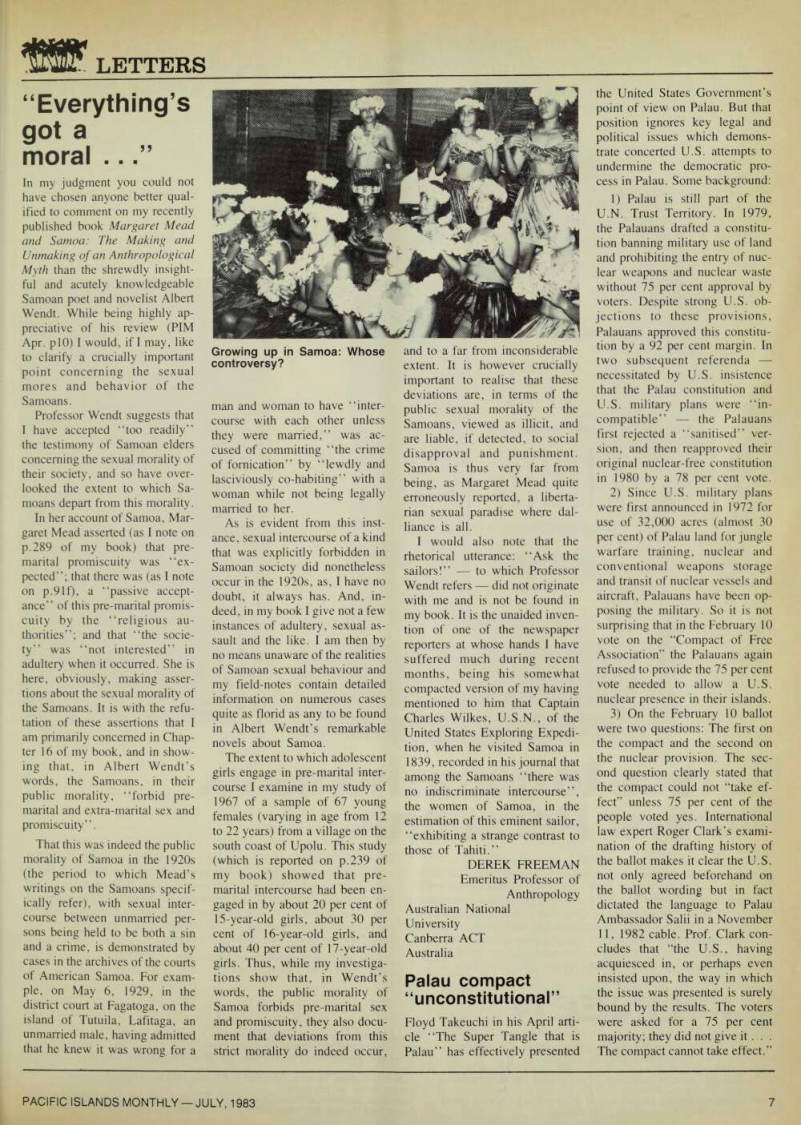
Growing up in Samoa: Whose controversy?
4) The State Department and Mr Takeuchi now characterise the conflict between the compact and the Palau constitution as an “intemaf’matter for the Palauans to resolve. Contrary to Mr Takeuchi’s and the State Depart ment’s position, it is in fact time for the U.S. to reconcile the compact and its military plans with the Palau constitution. As Prof. Clark states of the compact: “An unconstitutional treaty is just that unconstitutional.”
Through four referenda in as many years, the Palauans have repeatedly voted in favor of their constitution over the compact.
Although Mr Takeuchi and the State Department disagree, Prof.
Clark states that “there is nothing in the U.N. Charter which binds the people of the Trust Territory to permanent servitude to securi ty interests defined in Washing ton, D.C.” But U.S. actions threaten Palau’s right to freely determine its future. Ignoring the principle of democracy in its U.N. Trust Territory, the U.S. is attempting to railroad through its military plans. History has de monstrated, however, that the people of Palau will rise to the occasion.
Giff Johnson
Honolulu, Hawaii
Usa
From a Jayapura
diary ...
The following is an extract from my diary which I think could be of interest to your readers.
Jayapura, November 27, 1982.
I go to the immigration office.
So the turmoil starts. I tell them (officials) that I want to go to Vanimo by boat, do I need a visa? (I have an Australian pass port and enough money for a ticket to Caims). Three different people, three different desks, couldn’t get any sense.
No. 3 official insists that I need a visa and that I have to apply to PNG embassy in Jakar ta. Of course I don’t believe him, he’s wanting money out of me.
“Maybe I can help you.” “Twen ty dollars,” he says, I don’t ans wer, he comes down to $lO.
And this business of trying to extract money. An Indon friend smiled, shrugged his shoulders,
and said “Something Indonesian” when I told him.
Oh well! Perhaps it is “some thing Indonesian.” Nevertheless I disapprove strongly. Nowhere else did I encounter demands for money. Indeed I found officials and ordinary everyday Indone sians very helpful. Tarakan, Am bon, I’d go again.
David Richardson
Caims, Qld.
Australia
Dr Gajdusek gives
progress report
Early this year the Nobel Prize recipient Dr Daniel Carleton Gaj dusek spoke to a standing-room only audience at the University of Hawaii. He outlined the prog ress being made by him, together with colleagues from various countries, in supplying the ans wers to several neurological mysteries which have confronted medical researchers. Of particu lar interest to those involved in the Pacific Islands were his re marks on the elimination of kuru, the mysterious and fatal disease which afflicted the Fore people at Okapa in Papua New Guinea’s Eastern Highlands. He also re ported on work being done in Irian Jaya to unravel the mesh of factors relating to a set of neurological syndromes appear ing among the people of certain Auyu and Jakai villages.
Dr Gajdusek now offers a scenario which with great cer tainty predicts the ultimate disap pearance of kuru. There were 12 deaths from the disease in 1982, whereas over the last 25 years there have regularly been bet ween 100 and 300 deaths each year. Although the disease con tinues at this diminished rate, evidence has been adduced which gives the answer to the mysterious incidence of kuru: the people previously practised a form of ritualised cannibalism, eating the brains of deceased relatives.
Dr Gajdusek gave the instance of two brothers and a sister who all went down with kuru in the same year and had last been together as a group in 1957 when they had consumed the brain tissue of a deceased woman.
From evidence such as this it had been possible to plot the extend ed incubation period of kuru and
to assert that changed social be haviors will lead to its elimination.
Dr Gajdusek also pointed out that whereas the parent genera tion among these Fore people was illiterate, the Fore now num ber among their society “two with Royal College of Surgeons
qualification from Glasgow,
others with medical degrees, sev eral helicopter pilots and several
lawyers”. The spread of literacy
and higher levels of education among the Fore people will en sure that they are unlikely to return to the practices which brought such misery to their ancestors.
The most convincing proof of the victory over kuru is that the youngest patient in 1982 was over 30 years of age, and that each year the initial onslaught of the syndrome strikes down older victims. The passing of time will certainly see the final disappear ance of kuru.
The other neurological puzzle
to which Gajdusek and his col
leagues have been addressing
themselves relates to some of the Auyu and Jakai peoples of Irian Jaya. They have had the highest incidence in the world of the combination of the crippling syn dromes of the conditions known as amytrophic lateral sclerosis,
parkinsonism-dementia and
poliomyeloradiculitis.
The affected villages are situated on a low coastal plain 100-200 kilometres inland from the tidal swamplands, and they
are drained by slow-moving
localised rivers.
There are only two other places in the world where there has been a high incidence of a combination of amytrophic later al sclerosis and parkinsonism dementia. These are the southern villages of Guam and the Kii peninsula in Japan. In these two instances the people were rela tively isolated from outside influ ences, but since the end of World War 11, as contacts have in creased, so the incidence of the syndromes has diminished.
Gajdusek and his co-workers have turned the focus upon the one environmental element com mon to the Irianese, the Guama nians and the Kii Japanese. The water used by all three com munities, is extremely soft.
Analysis of the water in the area concerned in Irian Jaya has shown that it is extremely low in calcium and magnesium but high in aluminium, silicon, titanium, chromium and manganese. In fact the calcium and magnesium deficiencies are higher than those found in southern Guam or on the Kii peninsula.
Dr Gajdusek says categorical
ly that as the affected Irianese come into closer contact with the outside world and start to use imported foodstuffs and encount er other new products, the miner al deficiencies will be redressed.
Indeed, he says that if they moved from their traditional homelands to areas watered by the mountain-fed rivers of Irian Jaya their health would im
mediately be improved.
In fact, the Indonesian au thorities are at present engaged in a forcible re-location of the af flicted Auyu and Jakai to the neighborhood of the major river systems where they are used as labor in the lumber industry. So, in a perverse manner, this traumatic movement of popula tion for narrow economic pur poses could result in the eventual disappearance of maladies which for decades have brought misery to these communities.
W. G. Coppell
Waverton, NSW Australia
How many
canisters?
Thank you very much for pub lishing my article on sub-seabed disposal of radio-active waste (PIM Apr. pls).
However, there is an error in it as it appeared.
In listing the number of canis ters I wrote that there were ‘TO 5 to 10 6 canisters,” which has been translated as “one million to 10 million” when in fact it is one hundred thousand to one million.
As I do not want to overstate my case by making exaggerated claims, I was wondering if you could print a correction for this in a future issue. I am sorry about this but I do not wish to mislead people who probably have no other access to information.
Geoffrey P. Glasby
Wellington, New Zealand