Scheming: Zany,
pp. 12-15 · Read in the full issue
and criminal
As he celebrated the first anniversary of the May 1982 election that returned him to power, French Polynesia’s Vice- President of the Council of Govemment, Gaston Flosse, was fac-
ing a massive array of problems created by the six successive cyclones that have ravaged the territory in recent months (PIM Mar. p3l, May p 23, Jun. p2l).
Not the least of them arose
from the large number of people who, as interested in self promotion as anything else, had rushed forward with ingenious but quite unworkable schemes for raising the CFPI6,OOO mill ion needed to reconstruct the government buildings, schools, roads, and 10,000 private dwel lings totally or partially destroy ed by the cyclones.
The first lot to launch a relief scheme were Lions Club mem
bers and a number of other ser vice-minded French businessmen who sought to appeal to the generous impulses of the local community (which comprises a relatively high percentage of mil lionaires) by the simple expe dient of placing collection boxes in the supermarkets. The result was far below expectations: it took a whole month to raise the paltry sum of CFP3 million about SUS3O,OOO.
Postmark Papeete Marie-Thérèse and Bengt Danielsson
For his part Senator Daniel Millaud (who was elected by the former Autonomist majority headed by Francis Sanford) counted on the spirit of “national solidarity’’ which the French people are supposed to harbor towards their compatriotes over seas. To stir their emotions, he secured from Papeete’s TV ser vice a number of newsreel films showing the awful cyclone dam age, and flew off with them to France to arrange their nation wide distribution.
Unfortunately, the campaign backfired. The few donations that came in were mainly from metropolitan Opposition leaders like the Gaullist Mayor of Paris Jacques Chirac, who did not miss the splendid opportunity present ed by the occasion to make snide remarks about the indifference of the ruling socialist majority.
There were also messages of sympathy from four former gov ernors and high commissioners of French Polynesia but no money.
What is more, the Hiroshima like images of a paradise turned into a hell scared many people who had planned a holiday in Tahiti this year so badly that they immediately cancelled their bookings. In the end the local tourist authority had to mount a counter-offensive in the French media, saying that temporary visitors would find the same beautiful beaches and lovely vahine as usual.
Our Number One Crooner, Gabilou, who has made quite a name for himself in the USA, was convinced that the American people would be more generous, and set as his modest goal a campaign to persuade each and every one of them to part with a dollar apiece. The only trouble with this simple scheme to raise SUS22B million was that in order to launch it the local authorities would have to spend huge sums on US TV and radio time, as well as space in the leading US news papers which they wisely re fused to do.
A slightly more realistic plan, hatched by the territory’s Deputy Jean Juventin called for the French Parliament to launch a national appeal.
But the parliamentary machine was so slow in producing the
required piece of legislation that by the time it came France itself had suffered flood disasters of such magnitude that the cyclone damage in French Polynesia was all but forgotten.
All this left the CFPI6,OOO million bill still firmly in the deft hands of Gaston Flosse. Un daunted, he set up a special relief agency, and, as a stopgap mea sure, slapped new taxes on the earnings of the big commercial
companies, and on beer (three francs per bottle or can, an im post which will produce CFP6O million a year). At the same time he sought a CFP3SOO million loan at two per cent interest from the French Government, repay able over 20 years. This was designed to defray relief costs at least until the end of the year.
The only piece of pruning to meet with serious opposition was the cancellation of the CFP4O
million subsidy for the forthcom ing TIURAI (July 14) celebra tions. The subsidy is mainly ear marked for cash prizes to be paid
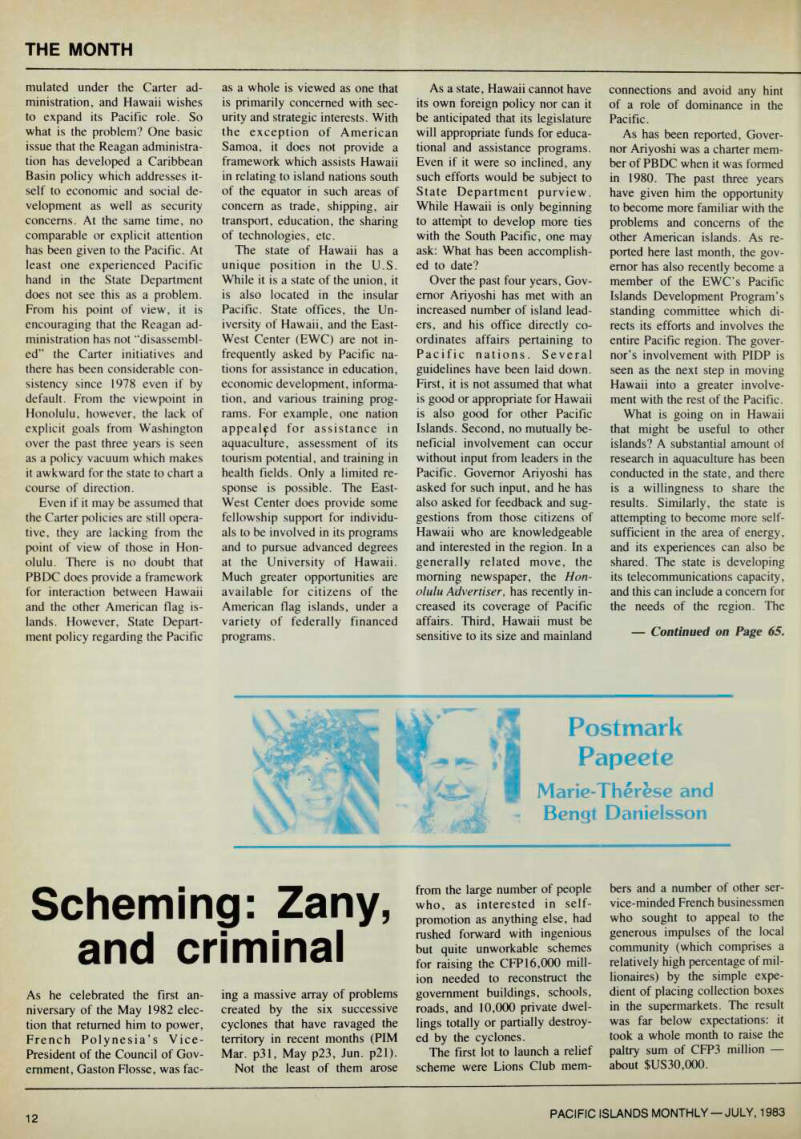
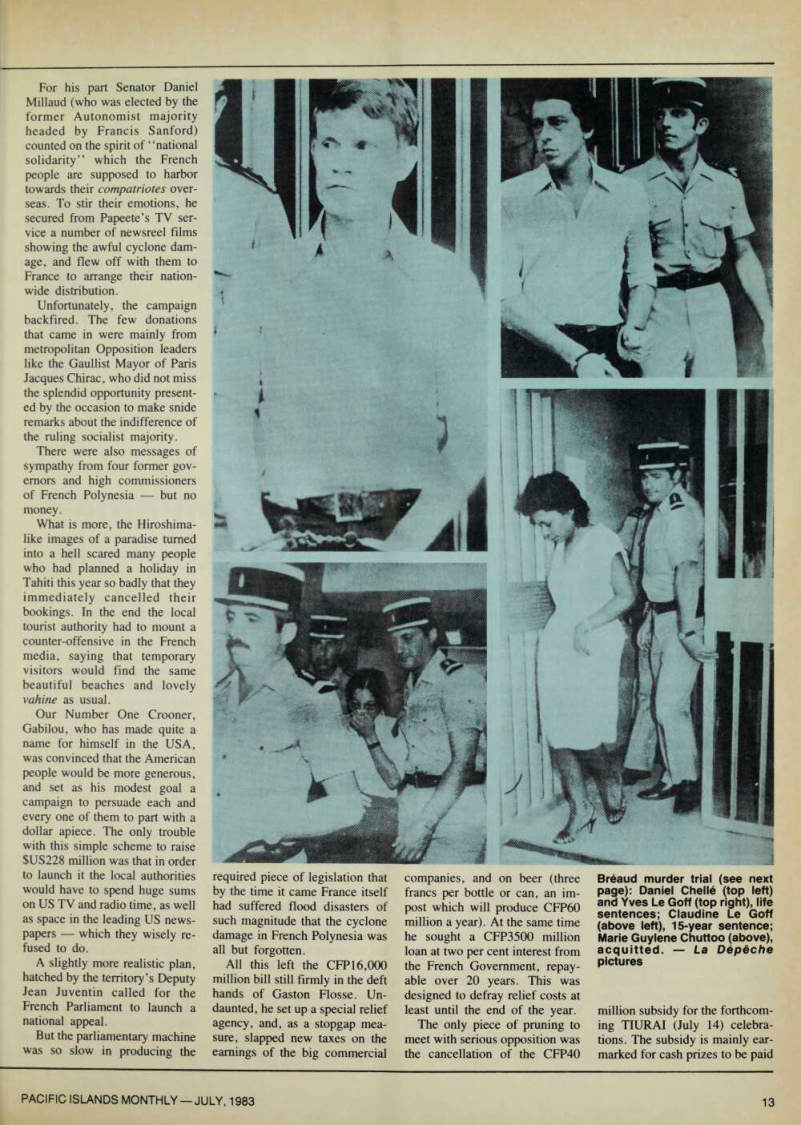
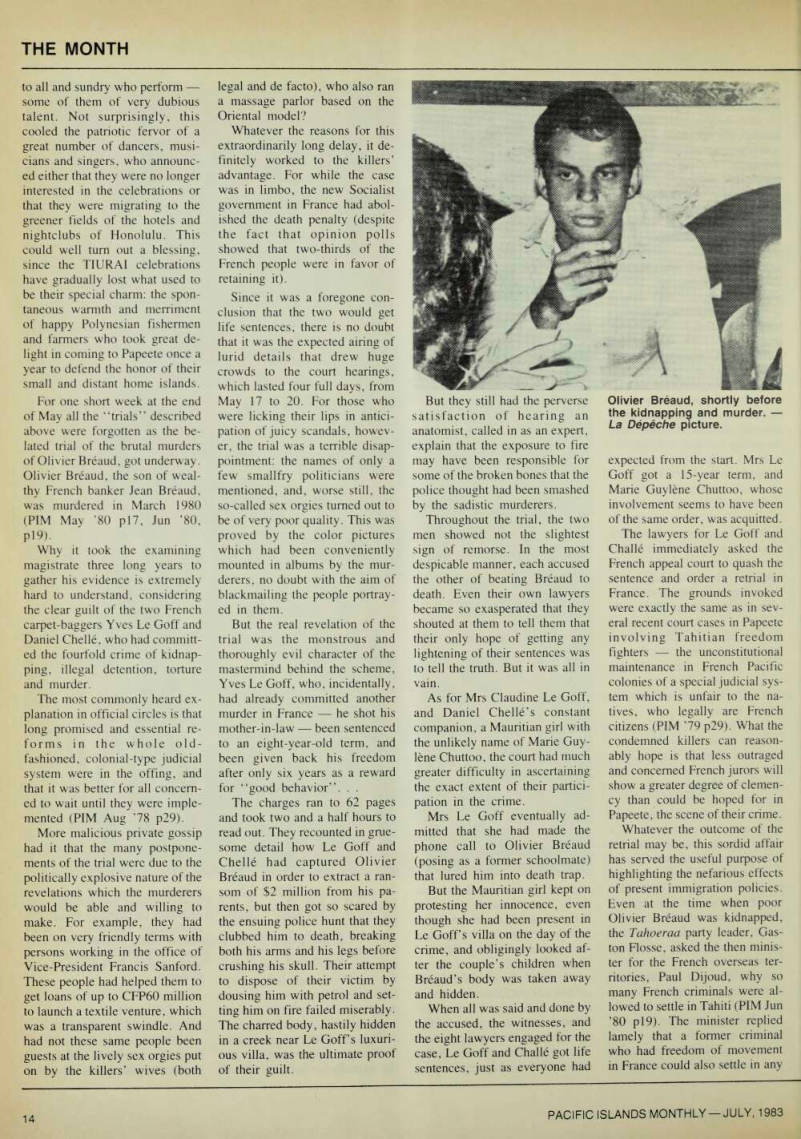
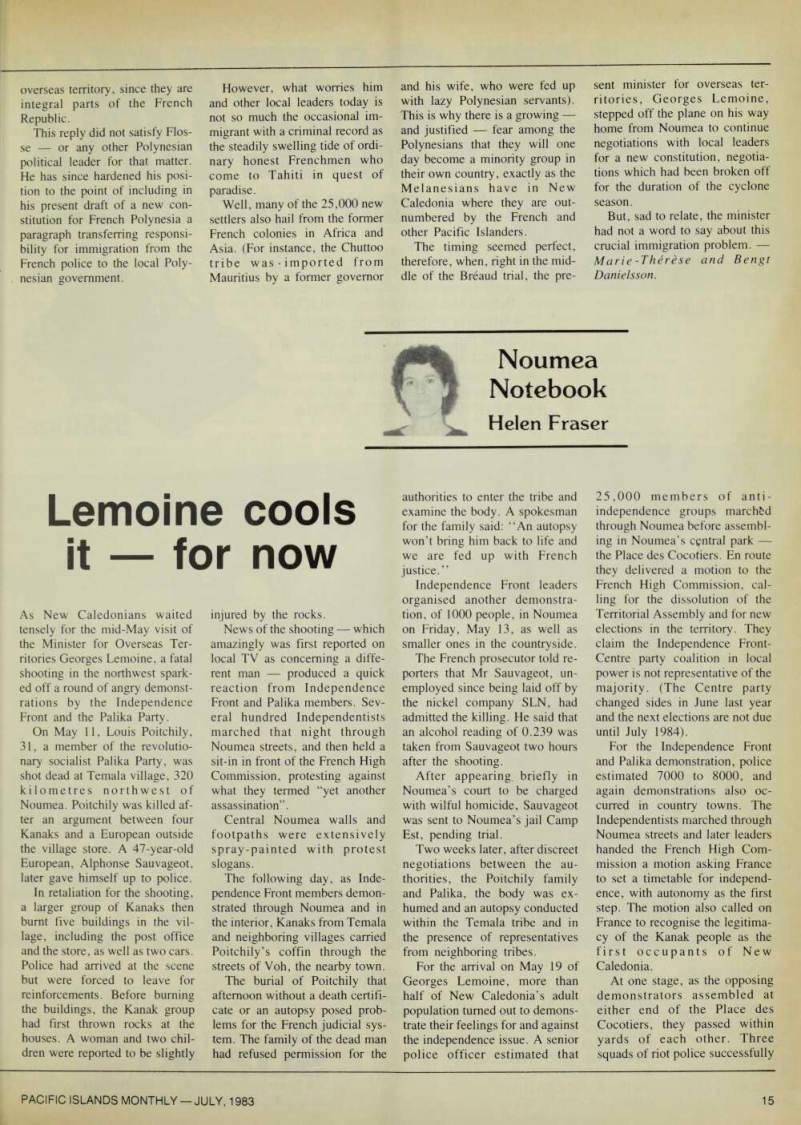
Bréaud murder trial (see next page): Daniel Chellé (top left) and Yves Le Goff (top right), life sentences; Claudine Le Goff (above left), 15-year sentence; Marie Guylene Chuttoo (above), acquitted. - La Dépêche pictures
to all and sundry who perform some of them of very dubious talent. Not surprisingly, this cooled the patriotic fervor of a great number of dancers, musi cians and singers, who announc ed either that they were no longer interested in the celebrations or that they were migrating to the greener fields of the hotels and nightclubs of Honolulu. This could well turn out a blessing, since the TIURAI celebrations have gradually lost what used to be their special charm: the spon taneous warmth and merriment
of happy Polynesian fishermen
and farmers who took great de light in coming to Papeete once a year to defend the honor of their small and distant home islands.
For one short week at the end of May all the “trials” described above were forgotten as the be lated trial of the brutal murders of Olivier Breaud, got underway.
Olivier Breaud, the son of weal thy French banker Jean Breaud, was murdered in March 1980 (PIM May ’BO pl 7, Jun ’BO, p 19).
Why it took the examining magistrate three long years to gather his evidence is extremely hard to understand, considering the clear guilt of the two French carpet-baggers Yves Le Goff and Daniel Chelle, who had committ ed the fourfold crime of kidnap ping, illegal detention, torture and murder.
The most commonly heard ex planation in official circles is that long promised and essential re forms in the whole old
fashioned, colonial-type judicial
system were in the offing, and that it was better for all concern ed to wait until they were imple mented (PIM Aug ’7B p 29).
More malicious private gossip
had it that the many postpone ments of the trial were due to the politically explosive nature of the revelations which the murderers would be able and willing to make. For example, they had been on very friendly terms with persons working in the office of Vice-President Francis Sanford.
These people had helped them to get loans of up to CFP6O million to launch a textile venture, which was a transparent swindle. And had not these same people been guests at the lively sex orgies put on by the killers’ wives (both
legal and de facto), who also ran a massage parlor based on the Oriental model?
Whatever the reasons for this
extraordinarily long delay, it de
finitely worked to the killers’ advantage. For while the case was in limbo, the new Socialist government in France had abol ished the death penalty (despite the fact that opinion polls showed that two-thirds of the French people were in favor of
retaining it).
Since it was a foregone con clusion that the two would get life sentences, there is no doubt that it was the expected airing of lurid details that drew huge crowds to the court hearings, which lasted four full days, from May 17 to 20. For those who were licking their lips in antici pation of juicy scandals, howev er, the trial was a terrible disap pointment: the names of only a
few smallfry politicians were
mentioned, and, worse still, the so-called sex orgies turned out to be of very poor quality. This was
proved by the color pictures
which had been conveniently mounted in albums by the mur derers, no doubt with the aim of
blackmailing the people portray
ed in them.
But the real revelation of the trial was the monstrous and thoroughly evil character of the mastermind behind the scheme, Yves Le Goff, who, incidentally, had already committed another murder in France he shot his mother-in-law been sentenced to an eight-year-old term, and been given back his freedom after only six years as a reward
for “good behavior”. . .
The charges ran to 62 pages and took two and a half hours to read out. They recounted in grue some detail how Le Goff and Chelle had captured Olivier Breaud in order to extract a ran som of $2 million from his pa rents, but then got so scared by
the ensuing police hunt that they
clubbed him to death, breaking both his arms and his legs before crushing his skull. Their attempt to dispose of their victim by dousing him with petrol and set ting him on fire failed miserably.
The charred body, hastily hidden in a creek near Le Goff’s luxuri ous villa, was the ultimate proof of their guilt.
But they still had the perverse satisfaction of hearing an anatomist, called in as an expert, explain that the exposure to fire may have been responsible for some of the broken bones that the police thought had been smashed by the sadistic murderers.
Throughout the trial, the two men showed not the slightest sign of remorse. In the most despicable manner, each accused the other of beating Breaud to death. Even their own lawyers became so exasperated that they shouted at them to tell them that their only hope of getting any lightening of their sentences was to tell the truth. But it was all in vain.
As for Mrs Claudine Le Goff, and Daniel Chelle’s constant companion, a Mauritian girl with the unlikely name of Marie Guy lene Chuttoo, the court had much greater difficulty in ascertaining the exact extent of their partici pation in the crime.
Mrs Le Goff eventually ad mitted that she had made the phone call to Olivier Breaud (posing as a former schoolmate) that lured him into death trap.
But the Mauritian girl kept on protesting her innocence, even though she had been present in Le Goff’s villa on the day of the crime, and obligingly looked af ter the couple’s children when Breaud’s body was taken away and hidden.
When all was said and done by the accused, the witnesses, and the eight lawyers engaged for the case, Le Goff and Challe got life sentences, just as everyone had
expected from the start. Mrs Le Goff got a 15-year term, and Marie Guylene Chuttoo, whose involvement seems to have been of the same order, was acquitted.
The lawyers for Le Goff and Challe immediately asked the French appeal court to quash the sentence and order a retrial in France. The grounds invoked were exactly the same as in sev eral recent court cases in Papeete involving Tahitian freedom fighters the unconstitutional maintenance in French Pacific colonies of a special judicial sys tem which is unfair to the na tives, who legally are French citizens (PIM ’79 p 29). What the condemned killers can reason ably hope is that less outraged and concerned French jurors will show a greater degree of clemen cy than could be hoped for in Papeete, the scene of their crime.
Whatever the outcome of the retrial may be, this sordid affair has served the useful purpose of highlighting the nefarious effects
of present immigration policies.
Even at the time when poor Olivier Breaud was kidnapped, the Tahoeraa party leader, Gas ton Flosse, asked the then minis ter for the French overseas ter ritories, Paul Dijoud, why so many French criminals were al lowed to settle in Tahiti (PIM Jun ’BO pi 9). The minister replied lamely that a former criminal who had freedom of movement in France could also settle in any
Olivier Bréaud, shortly before the kidnapping and murder. - La Dépêche picture.
overseas territory, since they are integral parts of the French Republic.
This reply did not satisfy Flos se or any other Polynesian political leader for that matter.
He has since hardened his posi tion to the point of including in his present draft of a new con stitution for French Polynesia a paragraph transferring responsi bility for immigration from the French police to the local Poly nesian government.
However, what worries him and other local leaders today is not so much the occasional im migrant with a criminal record as the steadily swelling tide of ordi nary honest Frenchmen who come to Tahiti in quest of
paradise.
Well, many of the 25,000 new settlers also hail from the former French colonies in Africa and Asia. (For instance, the Chuttoo tribe was'imported from Mauritius by a former governor
and his wife, who were fed up with lazy Polynesian servants).
This is why there is a growing and justified fear among the Polynesians that they will one day become a minority group in their own country, exactly as the Melanesians have in New Caledonia where they are out numbered by the French and other Pacific Islanders.
The timing seemed perfect, therefore, when, right in the mid dle of the Breaud trial, the pre
sent minister for overseas ter ritories, Georges Lemoine, stepped off the plane on his way home from Noumea to continue negotiations with local leaders for a new constitution, negotia tions which had been broken off for the duration of the cyclone season.
But, sad to relate, the minister had not a word to say about this
crucial immigration problem.
Marie -Therese and Bengt Danielsson.