The land issue in Vanuatu: White
pp. 60-62 · Read in the full issue

Trade Winds
The land issue in Vanuatu: White devils vs. Black saints?
Professor Jean Guiart’s reply to my letter on the Vanuatu land question distorts the facts about the role of plantation agriculture in the Vanuatu economy and shows little understanding of the issue of payment for improve ments on land.
Firstly, there is no question that payment to settlers for im provements would relate only to improvements of lasting usefulness and value. Govern ment policy statements, the Land Reform Regulation, 1980, and the Alienated Land Act, 1982, all made it clear that mere speculators in titles, or those whose farming practices left land damaged rather than improved, would receive no payment. In deed they might not even be recognised as “alienators”.
While director of rural lands I totally supported that policy and indeed strengthened it by recom mending the adoption, from the Queensland pastoral lease sys tem, of the principle that certain kinds of improvements, carried out before a certain date (after which their cost could be con sidered to have been well and truly recouped), would not at tract payment even if there was still value left in them. That principle was adopted in the Alienated Land Act, 1982, and the relevant date fixed by gov ernment at July 30, 1970, 10 years before independence. Re cent improvements were still to be recognised as meriting payment.
But there is a sharp difference between working within accept ed conventions of compensation, which are grounded in economic rationality and supported by pre cedent, and doing away with payment for improvements al together which, despite his occasional disclaimer, is really what Professor Guiart’s letter is supporting. And unfortunately two other provisions of the Alienated Land Act, 1982, come
close to introducing naked ex propriation de facto. These are the provisions that an alienator not granted a lease must leave the land within six months of notifi cation (i.e., without first receiv ing payment for improvements, except perhaps a first instal ment); and the provision that payment could be made over 10 years at no interest.
These provisions opened the way to a grab for properties without serious regard to the value and scale of the enter-
Dr ALAN W. WARD, whose letter of resignation from the post of director of rural lands in Vanuatu was published in RIM (Nov 82 p 8), here replies to comments in further letters on the subject from Professor JEAN GUIART and
Jean-Claude Rouleau (Rim Feb P 7).
Dr Ward's reply is printed at length because the issues he discusses are relevant not only to the problems of economic development in Vanuatu, but in many other Pacific Island coun tries as well.
prises, and made it extremely difficult to preserve administra tively the distinction between in competent developers who did not deserve either a lease or a payment and the competent far mers whose well-run enterprises were still important to Vanuatu.
It laid them open to-the carpet bagging activities of other expat riate residents (or newcomers), in collusion with some of the ni- Vanuatu elite, and sometimes
without opportunity for villagers
to develop an informed choice on the matter.
I doubt if this is the effect that Professor Guiart would want, yet his generalised attack on the pre
independence planters reinforces
the threat. To take some of his points: 1. It simply is not true to imply that all land was alienated by force and guile or that all land alienation wqs resented. Certain ly a great deal of it was, but the historical record also shows that settlers were often encouraged, not so much for their cash pay ments but for the trade they attracted, new experiences they offered, or as allies and bulwarks in inter-tribal war. Some land alienations, especially by the
missions, were not challenged at all until the political mobilisation of the late 19705. 2. It is also false to imply that all recent land development was resented by the villagers. Some was, some wasn’t. The very best of the recently improved grass lands developments such as Re ntabao Ranch and 4K Ranch on Efate were not objected to right up to independence. 3. Professor Guiart’s asser tion that settlers “mistreated the people for a century” also re quires qualification. Indeed there was mistreatment and brutality on some plantations. There were also harmonious relationships and opportunities for the people
of the over-crowded islands to find work. Many of these mig rant workers now fear for their jobs or already feed the drift to towns. The plantation sector, properly regulated, can contri bute to decentralised
development.
4. It is misleading to say that
recent good development is
“rare”. It is not all that rare.
Despite the plenitude of rundown and neglected properties, there were about 40 plantations well maintained and receiving new development and skilled man agement at independence. 5. Particularly when he dis parages the running of cattle under copra or on improved grasslands Professor Guiart total ly overlooks the importance of even a small number of well run plantations to the wider economy of Vanuatu. It is indeed true that in New Caledonia extensive cat tle ranching on valley land is a wasteful use of a scarce resource.
But Vanuatu is a very different country, with hundreds of thousands of hectares of unde veloped arable land and a small
population. The land produces
superb quality beef and Vanuatu has the prospect of a sound beef export industry provided that re
gular supply and quality control
are maintained.
For this purpose even a few
large plantations, putting first
quality animals through the abat toirs in considerable numbers, can underpin the small-holder economy around them. They can also sustain the more expensive breeding programmes, whilst their heavy machinery, work shops, transport and other facilities can also service the small-holders. In short, small holder farming and plantation farming are seen as complemen tary, not opposed. Perhaps gov ernment services can provide facilities similar, but they imply deeper dependence on aid and are not often as efficient as well-
run private sector enterprises. 6. Villagers properly con fronted with the range of options and allowed to give their majori ty or general opinion are not particularly opposed to or fearful of granting leases. Even the grant of a lease knowing that it may be transferred is not especially ob jectionable. There is consider able control on new lessees be cause the law requires the les sors’ consent to the transfer (though they may not arbitrarily or unreasonably withhold it), the leases lapse if the development conditions in them are not met, and the government controls en try and residency permits. If Pro fessor Guiart has any doubts ab out the usefulness of the leasehold system he should ask the people of Eton village, south east Efate, who are making a variety of leasehold arrange ments to gain both revenue from rent (the rents are re-assessed every five years) and assistance from the planters in the develop ment of their own village-based enterprises. 7. As yet Vanuatu does not
have enough people skilled in large estate management (as compared with small farm man agement which I agree the people can handle very well) to maintain all of the big and useful planta tions. This is generally accepted among much of government, as is the need for at least a transition phase of leasehold arrangements.
What is not so well understood is that for sound development to be attracted matters such as pay ment for improvements do need to be handled within due and reasonable economic and legal processes. Otherwise confidence is shaken, and once again it is
only the high-risk, quick-rip-off
investors who will enter, rather than the committed farmers, satisfied with reasonable but sec ure returns for sustained work. I agree with Professor Guiart that it is a privilege to live and work in Vanuatu but it is stupid to expect expatriate farmers not to want at least to break even. And, whatever the glorious profits of the past (or the myths about them), these are not times for
easy pickings from farming.
8. I agree that villagers are often willing to let long-standing settlers stay on as lessees or in semi-retirement on house sites.
Unfortunately the confusion ab out who is truly custom owner sometimes allows the more ag
gressive or greedy claimants,
when supported by militant
politicians, to override their more tolerant compatriots. The process is regrettably not as reasonable as Professor Guiart would have us believe.
This is really the crux of the matter, and the only possible justification for these long dis courses. The ni-Vanuatu people are indeed generally reasonable, willing and able to think about land and settlers according to the kinds of distinctions and consid erations suggested above. Most are not given to stereotyping and are perfectly capable, when in formed of all options, to work out mutually beneficial arrange ments with settlers, and to bar gain shrewdly. They are not par ticular racially intolerant.
The trouble is that the stark dichotomy of wicked exploiting
expatriates battening parasitical
ly upon innocent, susceptible and
exploited villagers, was painted
during nationalist mobilisation.
This is perhaps understandable when the goal to be won is political liberty and there is in deed a reactionary and speculator settler element to be got rid of.
But it is a very unhelpful dichotomy when it is persisted with at the stage of reconstruction.
My frustration in Vanuatu was that it was persisted with after independence to the point that rational, beneficial arrangements with the more genuinely creative
settlers and investors were going down the drain along with the
rank exploiters. My complaint
with Professor Guiart is that, despite occasional modifications, his letter also persists with that
unhelpful dichotomy.
In this regard I fear that the
professor, despite his good inten
tions, could be something of a false friend to the Melanesian people. It seems that, like most of the metropolitan French, he has difficulty in seeing and repre
senting the Oceanic peoples,
white and black, as they really are varied and complex sets of
peoples, trying more honestly
than ever before to establish for themselves and their children in the region a genuine modus vivendi which is based on mutual respect across racial lines (what ever the majority race in each country), and sensible collabora tion in economic development.
M. Rouleau’s applause of my “sacrifice” in leaving my post in Vanuatu is misplaced. It was rather something of a retreat from failure to establish, amidst the political and cultural pre ssures, adequate reflection and consideration of the issues dis cussed above. The applause is really owing to the small band of people, ni-Vanuatu and expat riate, who are still there, toiling at the problems of land administ ration, upon which so much
depends.
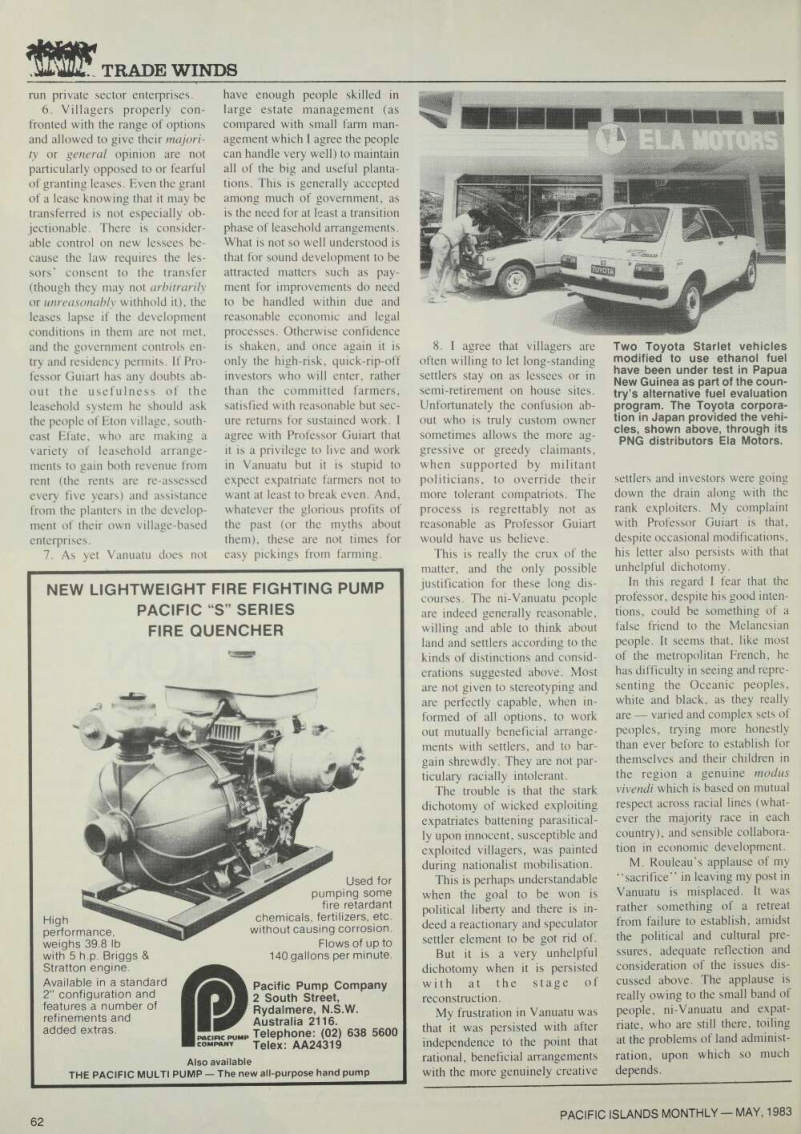
Two Toyota Starlet vehicles modified to use ethanol fuel have been under test in Papua New Guinea as part of the coun try’s alternative fuel evaluation program. The Toyota corpora tion in Japan provided the vehi cles, shown above, through its PNG distributors Ela Motors.