Yachts
pp. 63-69 · Read in the full issue
Christine Capra
reports from Tarawa, Kiribati:
•BIG BEAR H. During delivery from Pago Pago to Hawaii, Helmut and Anne Petrak’s Down Easter 45 went on a reef at Christmas Island last October. Helmut was advised by doctors in Pago Pago not to make the sail up to Hawaii because of a de bilitating back problem. He decided instead to have Big Bear H delivered.
The delivery skipper said that the grounding occurred at night, during a severe squall. “The Satellite Navigator gave our position as 50 miles away from Christmas, and visi bility was poor in the heavy rain. The next thing I knew, we hit the reef,” he said. Helmut flew to Christmas with a team of salvage experts, hop ing to winch Big Bear H off the reef.
However, the boat was taking on water by this time, and they were only able to salvage equipment and engine parts. •PRINDI. This 11-m Hartley design sloop was built by Larry Bardsley and Sue Olsen over a five-year period near their home on Horseshoe Bay, Magnetic Island, Queensland. After
a shakedown cruise along the Aust ralian east coast, Prindi set sail from Sydney. Ports of call have included New Caledonia. Ouvea in the Loyal ty group, Vanuatu, and Cherry Is land, a Polynesian island in the Solomons.
Prindi has been in sailing company with a 15-m Garden ketch, Phobos,
since they met owner-skippers Reese Clark and Connie Rossitto in Port- Vila. Home port for Phobos is San Francisco. Reese and Connie have been sailing Phobos around the Pacific for three years, visiting French Polynesia, the Cook Islands.
Samoa, Tonga, Fiji, New Zealand, Vanuatu and Solomon Islands. Crew member Sam Abel of Vanuatu joined the boat in Port-Vila. During the passage from Port-Vila to Tabiteuea, Sam hooked a big marlin, as well as a sailfish.
In January. Phobos and Prindi called at Tabiteuea, in southern Kiribati. “The people of Tabiteuea could only recall one other yacht ever having visited their island,” Sue said. Their eight-year-old son. Ad riel, was invited to stay ashore during their week-long stay. “When it came to sail on, his Gilbertese ‘family’ asked if he would like to stay with them for a year or so,” Sue recalls.
Blonde-haired Adriel decided to con tinue sailing aboard Prindi.
Sue reports that they took two Gilbertese youths from Tabiteuea to Abemama, and were honored with a huge feast and traditional singing and dancing by the youth’s families.
“The Gilbertese people have been so friendly and generous, we’ll be sad to
leave here,” she adds. Phobos and Prindi enjoyed a month-long stay in Tarawa lagoon before sailing for the Marshall Islands in March. •WANDOROBO. Danish single hander Jan Bagge has been sailing this sloop, a Rival 31, for six years.
He began in South Africa, crossed the Atlantic to Brazil, and then up into the Caribbean and on through the Panama Canal to Ecuador. From there he sailed up to Hawaii, where he met up with Hurricane Iwa while berthed in the Ala Wai Yacht Harbor on Oahu. ”1 was lucky to have a secure berth. It was really eerie when the electricity failed and Honolulu was completely blacked out,” Jan recalls. When the weather improved, Wandorobo sailed west to the Mar shall Islands, where Jan enjoyed some excellent fishing. He explains: ”1 just cut up a piece of yellow plastic shopping bag, secured it to a hook, and trailed it behind the boat.
Everytime I pulled in the line, there was a big tuna on it.”
From the Marshalls, Jan sailed to Tarawa, finding a comfortable an chorage in the southeast corner of the lagoon in company with yachts Phobos, Prindi, and Farouche. From here, he plans to sail down through the southern atolls of Kiribati before
going on to Fiji.
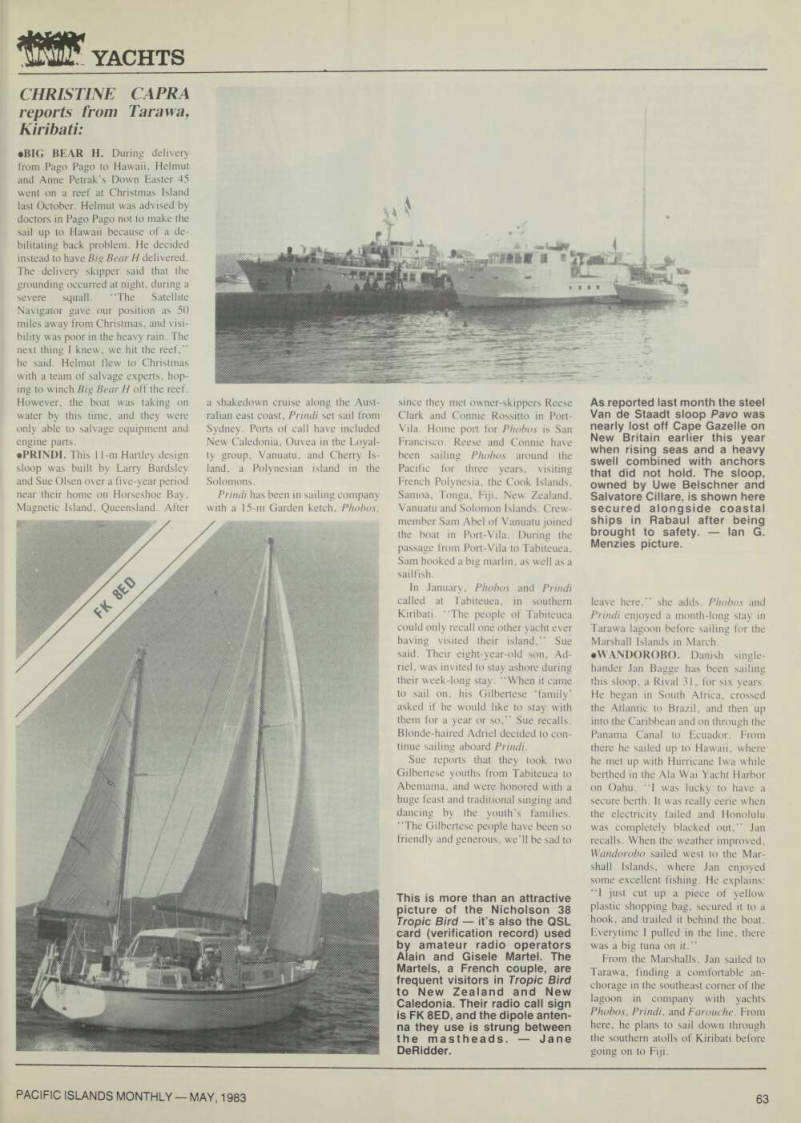
As reported last month the steel Van de Staadt sloop Pavo was nearly lost off Cape Gazelle on New Britain earlier this year when rising seas and a heavy swell combined with anchors that did not hold. The sloop, owned by Uwe Belschner and Salvatore Cillare, is shown here secured alongside coastal ships in Rabaul after being
brought to safety. - Ian G.
Menzies picture.
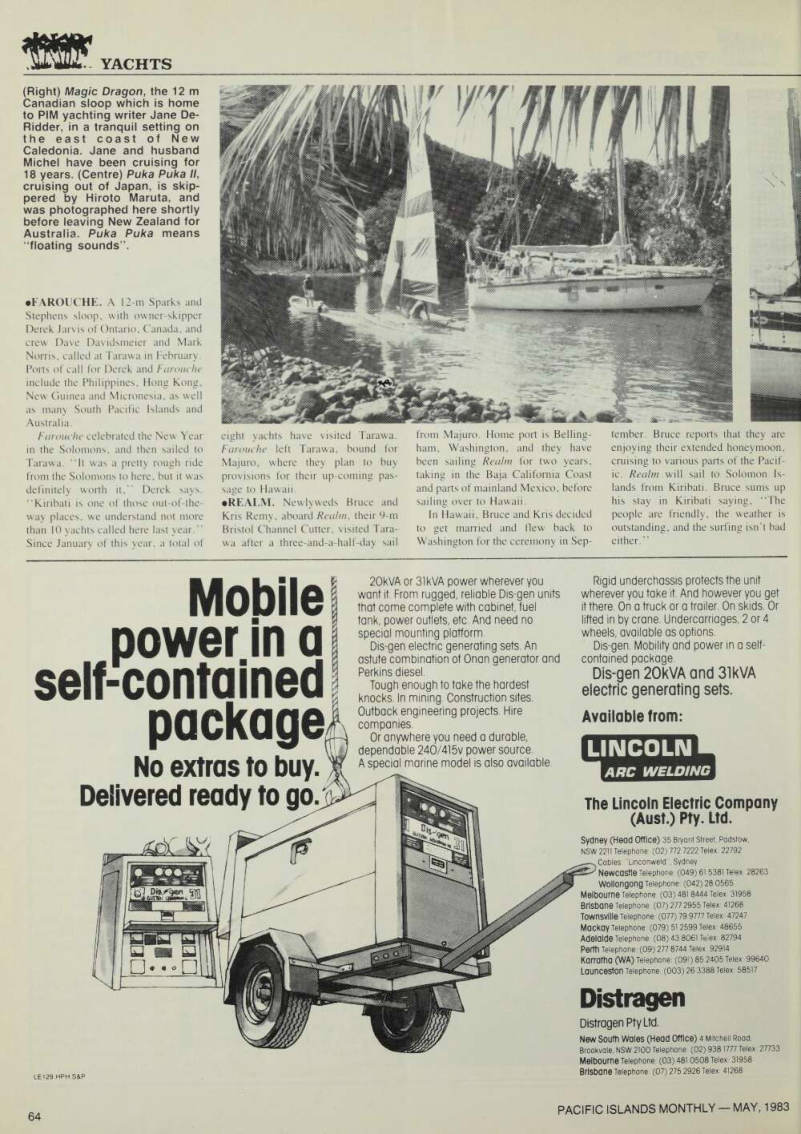
This is more than an attractive picture of the Nicholson 38 Tropic Bird - it’s also the QSL card (verification record) used by amateur radio operators Alain and Gisele Martel. The Martels, a French couple, are frequent visitors in Tropic Bird to New Zealand and New Caledonia. Their radio call sign is FK 8ED, and the dipole anten na they use is strung between the mastheads. - Jane DeRidder.
•FAROUCHE. A 12-m Sparks and Stephens sloop, with owner-skipper Derek Jarvis of Ontario, Canada, and crew Dave Davidsmeier and Mark Norris, called at Tarawa in February.
Ports of call for Derek and Farouche include the Philippines, Hong Kong, New Guinea and Micronesia, as well as many South Pacific Islands and Australia.
Farouche celebrated the New Year in the Solomons, and then sailed to Tarawa. “It was a pretty rough ride from the Solomons to here, but it was definitely worth it,” Derek says.
“Kiribati is one of those out-of-the way places, we understand not more than 10 yachts called here last year."
Since January of this year, a total of
eight yachts have visited Tarawa.
Farouche left Tarawa, bound for Majuro, where they plan to buy provisions for their up-coming pas sage to Hawaii. • REALM. Newlyweds Bruce and Kris Remy, aboard Realm , their 9-m Bristol Channel Cutter, visited Tara wa after a three-and-a-half-day sail
from Majuro. Home port is Bellingham, Washington, and they have been sailing Realm for two years, taking in the Baja California Coast and parts of mainland Mexico, before sailing over to Hawaii.
In Hawaii. Bruce and Kris decided to get married and flew back to Washington for the ceremony in Sep-
tember. Bruce reports that they are enjoying their extended honeymoon, cruising to various parts of the Pacif ic. Realm will sail to Solomon Is lands from Kiribati. Bruce sums up his stay in Kiribati saying, “The people are friendly, the weather is outstanding, and the surfing isn’t bad either.
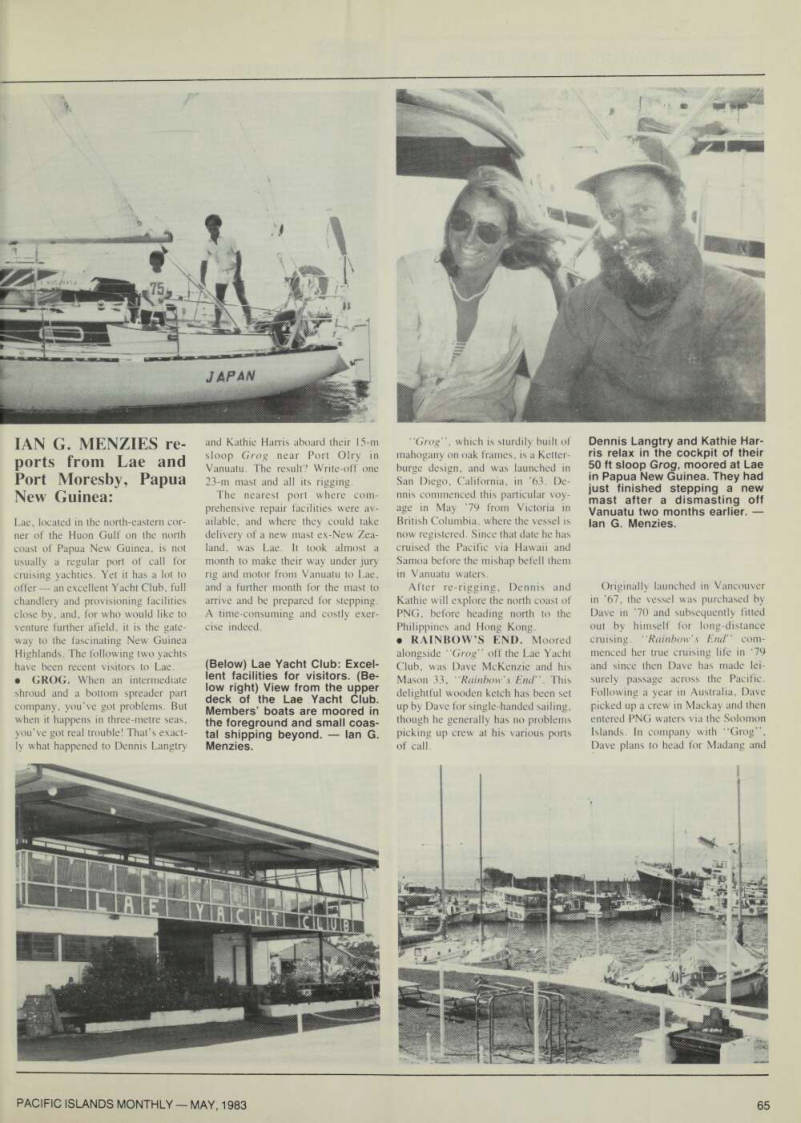
(Right) Magic Dragon, the 12 m Canadian sloop which is home to PIM yachting writer Jane De- Ridder, in a tranquil setting on the east coast of New Caledonia. Jane and husband Michel have been cruising for 18 years. (Centre) Puka Puka II, cruising out of Japan, is skip pered by Hiroto Maruta, and was photographed here shortly before leaving New Zealand for Australia. Puka Puka means
“floating sounds".
Ian G. Menzies Re
ports from Lae and
Port Moresby, Papua
New Guinea:
Lae, located in the north-eastern cor ner of the Huon Gulf on the north coast of Papua New Guinea, is not usually a regular port of call for cruising yachties. Yet it has a lot to offer — an excellent Yacht Club, full chandlery and provisioning facilities close by, and, for who would like to venture further afield, it is the gate way to the fascinating New Guinea Highlands. The following two yachts have been recent visitors to Lae. • GROG. When an intermediate shroud and a bottom spreader part company, you’ve got problems. But when it happens in three-metre seas, you’ve got real trouble! That’s exact ly what happened to Dennis Langtry
and Kathie Harris aboard their 15-m sloop Grog near Port Olry in Vanuatu. The result? Write-off one 23-m mast and all its rigging.
The nearest port where com prehensive repair facilities were av ailable, and where they could take delivery of anew mast ex-New Zea land, was Lae. It took almost a month to make their way under jury rig and motor from Vanuatu to Lae, and a further month for the mast to arrive and be prepared for stepping.
A time-consuming and costly exer cise indeed.
"Grog", which is sturdily built of mahogany on oak frames, is a Ketter burge design, and was launched in San Diego, California, in '63. De nnis commenced this particular voy age in May ’79 from Victoria in British Columbia, where the vessel is now registered. Since that date he has cruised the Pacific via Hawaii and Samoa before the mishap befell them in Vanuatu waters.
After re-rigging, Dennis and Kathie will explore the north coast of PNG, before heading north to the Philippines and Hong Kong.
• Rainbow S End. Moored
alongside "Grog" off the Lae Yacht Club, was Dave McKenzie and his Mason 33, "Rainbow’s End". This delightful wooden ketch has been set up by Dave for single-handed sailing, though he generally has no problems picking up crew at his various ports of call.
Originally launched in Vancouver in ’67, the vessel was purchased by Dave in ’7O and subsequently fitted out by himself for long-distance cruising. "Rainbow’s End" com menced her true cruising life in ‘79 and since then Dave has made lei surely passage across the Pacific.
Following a year in Australia, Dave picked up a crew in Mackay and then entered PNG waters via the Solomon Islands. In company with “Grog”, Dave plans to head for Madang and
(Below) Lae Yacht Club: Excel lent facilities for visitors. (Be low right) View from the upper deck of the Lae Yacht Club.
Members’ boats are moored in the foreground and small coas
tal shipping beyond. - Ian G.
Menzies.
Dennis Langtry and Kathie Har ris relax in the cockpit of their 50 ft sloop Grog, moored at Lae in Papua New Guinea. They had just finished stepping a new mast after a dismasting off Vanuatu two months earlier.- Ian G. Menzies.
then venture up the mighty Sepik River before making passage for the
Philippines.
• WINDFALL. Lou Marchant is one of those fortunate yachtsmen who have been able to combine a career with a desire to “go cruising” he’s a marine insurance broker. With his all-girl crew Carolyn Hoag (San Francisco), Sue Taylor (New
Zealand) and Lorene Jenkins (South Australia) Lou departed his home port of Darwin in November ’B2 for Port Moresby. As the south east trades were still blowing strongly, he was forced to motor against head winds for almost 1000 miles!
“Windfall” is a 12-m Bore design steel ketch, which has an air of solidity and reliability about her. She
was launched in Darwin in ’74, just in time to compete in the last Darwin to Timor Yacht Race. When the disastrous Cyclone Tracy hit Darwin at Christmas of that year, “Wind fall” survived with only superficial
damage.
For the last eight years Lou has lived on board and regularly cruised Indonesian waters during that period.
From Port Moresby, Lou will make passage for Truk in Micronesia, where they will cruise for several months. After that as Lou says “who knows?” • SAROENA. When John and Rai da Bedford decided to build their 13 m ketch, Saroena, one of the require ments was that it should truly be “a home away from home”. They suc
ceeded admirably. Based originally
on a 12 m Roberts Spray, the Bed fords extended the vessel, increased its draught, and added a substantial wheelhouse. Heavily built of klegecell and fibreglass, Saroena is a solid, sea-kindly yacht, constructed with long-distance cruising in mind.
The galley is extremely well de signed with a dieseline stove positioned almost on the centre-line so that it does not require gimballing.
The stove also helps to creat a cosy warmth in cooler climes. For quick meals there is a back-up gas system, plus deep sinks and spacious and accessible storage. A real kitchen.
After completing the vessel at Tweed Heads on the central coast of eastern Australia, the Bedfords spent a year cruising the Great Barrier Reef before eventually departing for PNG waters in November ’B2. Working their way up through the D’Entrecas teaux and Trobriand Islands, they sailed into the Huon Gulf and the port of Lae. There, moored right off the
Lae Yacht Club, they discovered two other yachts from their home port of Tweed Heads. You can imagine the reunion.
John and Raida have nothing but praise for the hospitality showered on them by the members and staff of the Lae Yacht Club. If the Bedfords’ praise is any recommendation, then
perhaps cruising yachties should put
Lae on their list of ports of call. It is the largets port in PNG, has a thriv ing commercial centre, and as men tioned earlier, is the gateway to the
Highlands Region.
After two weeks in Lae, Saroena headed south to Samarai and on to Port Moresby, where the Bedfords were joined by their son Justin, and his friend Paul Barrett, who will help crew the vessel back to Cairns. • HONU. Though one of the smaller ocean cruisers, the Cascade 29 Honu from Cordova, Alaska, has some of the biggest adventures. Her maiden voyage (this was before she was complete) took her up to Prince Wil liam Sound at 62 deg. north latitude.
Of that early voyage across the Gulf of Alaska, Francine Matthews says, “I thought for sure we were going to die. I wrote my will.” But as Mike Matthews explained, “We didn’t have much choice. I was transferr ed.” The young couple had had the fibreglass hull and decks shipped up to Biorka, a little island near Sitka where Mike was working on an air craft navigational aid station. Here they began the interior finishing and fitting-out of Honu (‘Sea Turtle’) with Francine supplying the know how. “I did a lot of reading to tell us how to do it,” she said. Franc Mates book, “ From a Bare Hull”, was their most useful source of expertise.
The project took the better part of two years. When they’d completed
Honu they had three garage sales in an attempt to fit everything in. then they were off in May 1981 from Kodiak direct to Hawaii ... or as direct as headwinds would allow.
Priorities for the Matthews couple are somewhat different from those of many of their fellow cruising yach ties. For instance, where an engine might have gone they carry two dive tanks. They not only carry two wind surfers below decks on ocean passages but also two regular surfboards. The only electrics aboard are a compass light and a tape deck powered by solar panel and car bat tery. They carry an outboard but seldom use it except for docking.
They used only four gallons of petrol between Hawaii and New Zealand on a route which included a 39-day passage to the Marquesas from Hawaii. Though they admit that the boat “is a little tight”, they have no intention of getting a larger vessel, for they have noticed that people with large and complex boats sometimes run out of time and money trying to keep ahead of maintenance and re pairs. “We have time to have fun and our money is holding out well . . .”
Mike and Francine plan on “going on round”, but not until they’ve spent another season exploring the islands of the South Pacific. • SHAULA. This is the second ma jor offshore voyage for Echo and Merrill Shreve in their Portland, Ore
gon, registered Kendall 32 Shaula, and their third visit to New Zealand.
They’d raised their family and were tired of working. Both wanted to travel. Merrill had served eight years in the wartime navy, and as for Echo, 'Tm happiest round the water'. So they sold a smaller vessel and, from a bare hull, built Shaula, in design a predecessor to the well known West sail 32. Simplicity is their byword.
For instance, Shaula has a lead line instead of a depth sounder. She
boasts no transmitting capabilities.
To fill their water tanks, the Shreves catch rainwater off the deck simply by plugging the scuppers. Echo says: “Much of the pleasure from this way of life is discovering how we can depend on our own resources.” Their route has taken them off the beaten track. They’ve visited Christmas and Fanning Islands, and Kosrae, as well as Queensland, Australia, and the more frequent South Pacific islands.
Plans? They have to be back home by September to take care of rental property, but they hope to head for Alaska come the next northern summer. • BONNY LASS. This 20-tonne, 13.7 m Taiwan-built ketch is cruising home for four joint owners. Don Zobel, Louise Sherman, Dan Curtis and Jim McCormick left San Francis co on their Brewer 45 in March 1982, heading west around. When they arrived in New Zealand they bought a van for touring. We talked with Don and Louise in Matauwhi Bay in the Bay of Islands. They pointed out that in joint ownership the main problem lies in determining route and agre eing on length of time to spend in each area. South Africa, the Carib bean and Florida are included in Bonny Lass’s future cruising plans. • STARLIGHT. “The boat is a being. She determines my plans. I’m only the helmsman,” says Michael Davidson of his 11.6 m sloop, the one with the Port Orford cedar hull and the dusty bilge. Ed Monk drew up this Cascade design in 1935.
Brian Lange built Starlight at his father’s Port Townsend, Washing ton, shipyard in 1971 when he was a lad. Now foreman of Salthouse Bros.
Shipyard in Greenhithe near Auck land, Brian has a chance to supervise the yacht's haulout and to check out his handiwork. The present owner, Michael Davidson, left Vancouver with Starlight in 1979, sailing through the South Sea Islands to New Zealand where he will have spent a year and a half by the time he heads back toward the Pacific northwest to “reconstruct financially”. During his lengthy stay in New Zealand Michael has toured both north and south islands half a dozen times by hitch-hiking, by train, in his own car, as well as on Starlight. He spent
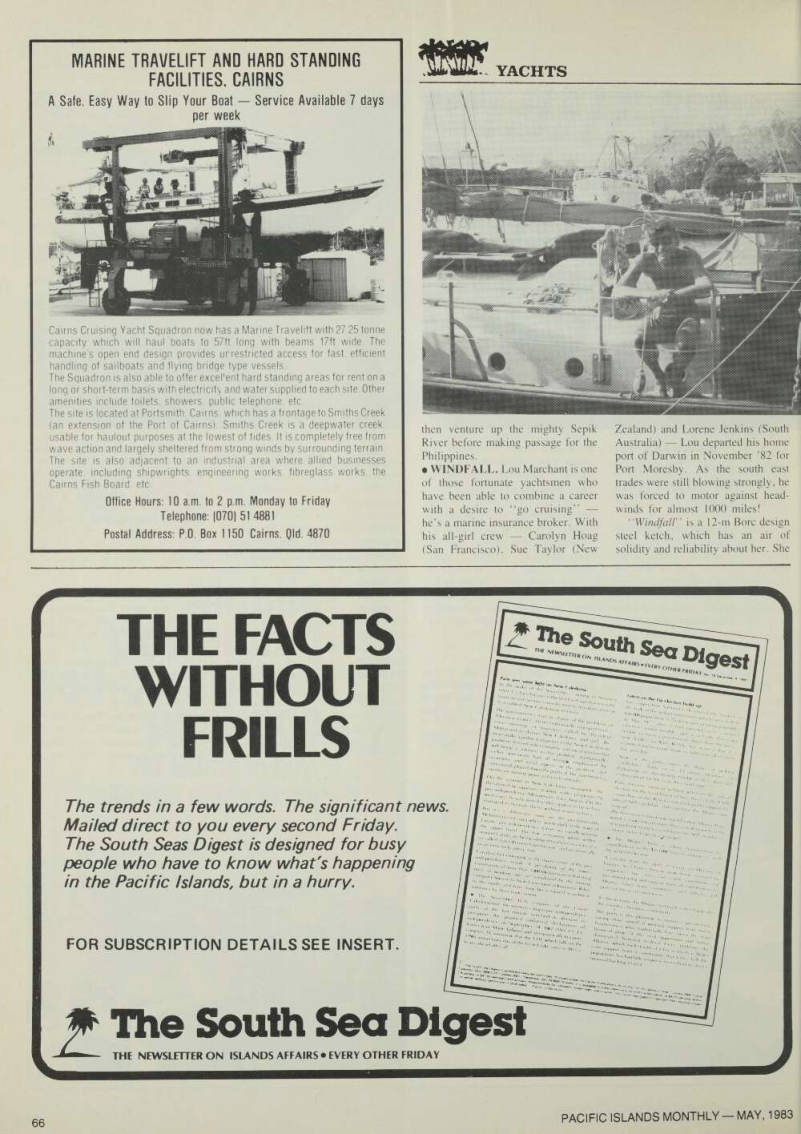
(Above left) Dave McKenzie on board his Mason 33 Rainbow's End, moored off the Lae Yacht Club. (Above) Lou Marchant with Carolyn Hoag, one of the members of his all-girl crew on board Windfall in Port Moresby.
Lou has been cruising Indone sian and PNG waters for seven
years. - Ian G. Menzies.
the winter in Akaroa harbor in Christchurch with a Dickenson diesel heater keeping the vessel snug below decks. Unlike other cruising vessels.
Starlight, for aesthetic reasons, has no stanchions or lifelines. Instead, Michael, who frequently sails single handed, relies on safety harness and handrails to stay aboard. Twice he has been washed overboard, once when crossing the Columbia River bar. At such times an extra surge of adrenalin helps him heave himself back aboard by means of a security line which keeps him tethered to the boat when he is in the cockpit or on deck. • KARANA. Sharing the same Bay of Islands anchorage with Starlight as well as the same port of registry (Portland) and the same yacht club affiliation, Karana is another cruis ing vessel without stanchions or lifelines. Karana is so small (7.5 m) that they would only get in the way, her owner David Ingalls reckons.
She’s a Bahama 25 which David, architect, and Jan Lippen-Holz, teacher, built starting from a bare
hull, making a superbly professional
job for a couple of amateur ship wrights! David explains his choice of yacht with the comment: “It fits in the garage and it was affordable.”
Though he says his next boat will have standing headroom, he is aware of the many advantages of small craft. He says there’s usually room for a tiny yacht to tie up in the most crowded of ports; the 1.19 m draught means they can anchor in shallow anchorages; and they’re al ways glad of it when painting. After
repainting the mini-sloop in Orongo
Bay in the Bay of Islands, David and Jan headed off on a six-to-eight-week
camping trip leaving Karana swing
ing on an Opua mooring.
• VICTORIA. Robert and Linda Ahbel sailed their hefty 30-ton steel vessel (15.3 m x 4.8 mby 2.18 m) into Opua in the Bay of Islands in September with the engine out of commission. Designed with a cargo hold where their double bunk
stateroom is now, Victoria is the smallest design from the board of east coast naval architect Murray Watts, known for his megabuck steel craft. The re-engined, repainted and refurbished vessel will set off home ward bound via the Australs, Papeete and Palmyra. Once home in Washington State’s San Juan Islands, Robert and Linda plan to “blow up”
Victoria s lines to 14m, and build a new vessel themselves in Friday Har bour where Robert has a shed, hoists and welding gear rented out during their absence. Here Robert a tanker engineer by trade has al ready built a steel crabber and two sailing boats. The Ahbels plan to use their next boat to fish for albacore, something they have done success fully in the past with Victoria. • DISTANT STAR. Robert Ahbel recognised a bushy-bearded neighbor on a double-ended Honolulu registered boat which was mastless on the hard at Oram’s Marina in Whangarei as the proprietor of the “Bushwacker Barbershop’’ in Bel mont, California. Though he still barbers for barter from time to time
amongst the cruising community.
Dean Poore says: “My scissors are pretty rusty now.’’ Robert had a Seawitch Ketch for six years before buying his Danish-built foam-core Saggitta 30 Distant Star. About the Seawitch, Robert remarked, “She was too big, too slow, had too much maintenance and was strictly a down wind boat.” He estimates that over the three years he has cruised the South Pacific in Distant Star almost 65 per cent of his sailing has been to windward. With cruising companion Lynn Oakley, Dean is headed on westward, but route and time reckon ing have yet to be settled. At one time “in real estate”, Lynn is a bit of a wine and food connoisseur which makes Distant Star’s travelling extra
interesting.
Jon Knedel, Teri Bonge and Tim Bonge from the ferro-cement yacht Hummingbird, recently in the South Pacific out of Texas,