Pacific
Islands
Monthly
Mwim
American Samoa US$l.75 Australia *A$l.5O Cook Islands NZ$l.5O Fiji F 51.50 Hawaii US$l.95 Kiribati A 51.75 Nauru A 51.75 New Caledonia CFPI9O New Zealand NZ$2.OO Niue NZ$l.5O Norfolk Island A$l.SO Papua New Guinea K 1.50 Solomon Islands 551.50 Tahiti CFPI9O Tonga " P 1.50 Tuvalu "... A 51.75
Usa 3T-3* Us$L25
USTT and Guam US$l.95
Varmatg E^TI.SO
retail price only s Registered by Australia Post *
sthj
(uxEHli^SKffl
•' iBSIm
Advertisements & other items, p. 2 (1 item)
to Video
VMS vtis vu<
tr -”■= -3 ws
nr\ ffik «. S'
,£> » 180 180 -g.
The VT-11E is video at its easiest. Easy operation: Play, Record, Fast Forward, Rewind and Visual Searc during playback via a four-corner access switch.
From Hitachi, the gateway to greater video entertainment.
VT-11E
Features • 1-Pro|ram/10‘Day Preset Recording .*». • 240-min. Recording/Playback with E-240 Tape • Visual Search • Freeze Actiln • Wired Remote Control 5
!B:QQ
0 HITACHI
• AUSTRALIA: Hitachi Sales Australia Pty., Ltd., 153 Keys Road, Moorabbin, Victoria 3189 Phone: (555) 8722 • NEW ZEALAND: AWA New Zealand Limited, Wi-neera Drive, P.O. Box 50-248, Porirua Phone: PRO 75-069 • PAPUA NEW GUINEA: s.O. Svensson (N.G.) Ltd., P.O.
Box 705, Port Moresby;Phone: 21-2111 FIJI ISLANDS: AWA New Zealand Limited, 47 Foster Road (P.O. Box 858) Suva Fiji;Phone: 312071 NEW CALEDONIA: Caldis, B.P. Ml, Noumea Phone: 26.23.50 TAHITI: Ets Chene Alain, P.O. Box 272, Papeete Phone: 2.88.68 SOLOMON ISLANDS: Technique Radios Centre Lt P.O. Box 465, Honiara;Phone: 416
Pacific Islands Monthly
Vol. 54 No. 5 May 1983 (USPS 952480)
Representatives
AUSTRALIA: Distribution; The Herald and Weekly Times Ltd., 44-74 Flinders St., Melbourne, Vic., 3000. Advertis ing Reps Brisbane D. Wood, Anday Agency, Box 1918, GPO Brisbane, 4001, telephone 44-3485, 44-1546; Adelaide Hastwell Williamson Rouse Pty. Ltd., PO Box 419, Norwood, SA, 5067; 59 Kensington Road, Norwood; telephone (08) 332-3322, telex 87113.
FIJI: Distribution and subscriptions Desai Book shops, P.O. Box 160, Suva, Fiji, telephone Suva 23036.
Advertising Fiji Times & Herald Ltd., 20 Gordon St., Suva, telephone 31-2111, telex FJ2124.
FRENCH POLYNESIA: Distribution Hachette Pacifi que, 10 Ave Bruat, Papeete, telephone 25610.
HAWAII, UNITED STATES: Distribution PIM, Hawaii, PO Box 22250, Honolulu, Hawaii, 96822. Advertising Brian C. Asgill, Apt. 1308,1676 Ala Moana Blvd., Honolulu, Hawaii, 96815, telephone (808) 955-9718.
JAPAN: Advertising and subscriptions Universal Media Corporation, GPO Box 46, Tokyo, telephone 666- 3036, cables UNIMEDIA Tokio, telex 2524665.
KOREA: Advertising and subscriptions World Mar keting, Inc, Box 4010, Seoul; phone 776-5291-3, telex K 23232.
MALAYSIA: Advertising and subscriptions Worldwide Media Services, 57-B Komplex Damai, Jin Dato Haji Eusoff, Kuala Lumpur, telephone 63-9340, cables WORLDMEDIA Kuala Lumpur, telex 31533.
NEW CALEDONIA: Distribution Depot Centre de Presse Michel Pentecost, CBP2, Noumea, telephone 27- 2434, 27-4729.
NEW ZEALAND: Distribution Gordon & Gotch, PO Box 584, 2 Carr Road, Mt. Roskill, Auckland 4. Advertising International Media Representatives Ltd., PO Box 2313, Auckland, telephone 79-5487; 49-3389, cables Intereps, Auckland. Subscriptions Ross Haines & Son Ltd., PO Box 1289, Auckland, telephone 76-9042.
PAPUA NEW GUINEA: Distribution Gordon & Gotch, PO Box 3395, Port Moresby, telephone 25-4551,25-4855.
Advertising PNG Post-Courier, PO Box 85, Port Mores by, telephone 21-2577, telex 22120.
PHILIPPINES: Advertising The GF Group, 12 San Ignacio St., Uroaneta Village, Makati, Metro Manila, tele phone 817-7299. telex 45950 and 4233.
UNITED KINGDOM: The Herald & Weekly Times Ltd., No 1 Maltravers Street,London WC2R 3DZ, England, telephone 01 836 5162, telex London 21989.
UNITED STATES MAINLAND: Advertising Joshua B Powers Jr., Powers International Inc., 551 Fifth Ave., New York, New York 10 017, telephone 867-9580, telex 236514.
Subscriptions PIM, Hawaii, PO Box 22250, Honolulu, Hawaii, 96822.
Payments by personal cheque are only acceptable in Australian (from a branch in Australia), U.S. and New Zealand currency. For all other remittances please send an international bank draft in Australian dollars.
Published monthly by Pacific Publications (Aust.) Pty.
Ltd. and printed in Australia by Walter Alteri Printing (Australia) Pty. Ltd., Dingley, Vic.
Australian cover price is recommended retail only.
Registered by Australia Post, publication No. NBPI2IO.
Second class postage paid at Honolulu, Hawaii. Copy right Pacific Publications (Aust.) Pty. Ltd.
Postmaster Honolulu: Send address changes to PIM Hawaii, PO Box 22250, Honolulu, Hawaii, 96822.
Subscriptions
Local Aust.
American Samoa $US21 $18 Australia $A18 $18 Canada $US27 $25 Cook Islands $19 Fiji $18 French Polynesia $22 Guam
Sus23
$20 Hawaii
Sus23
$20 Japan $20 Kiribati $19 Micronesia $US23 $20 Nauru $21 New Caledonia $22 New Zealand $NZ24 $18 Niue $19 Norfolk Island $15 Northern Marianas $US23 $20 Papua New Guinea $23 Solomon Islands $19 Tonga $19 Tuvalu $19 United Kingdom Stg 15 $25 U.S. Mainland $US27 $25 Vanuatu $19 Western Samoa $18 Elsewhere $A25
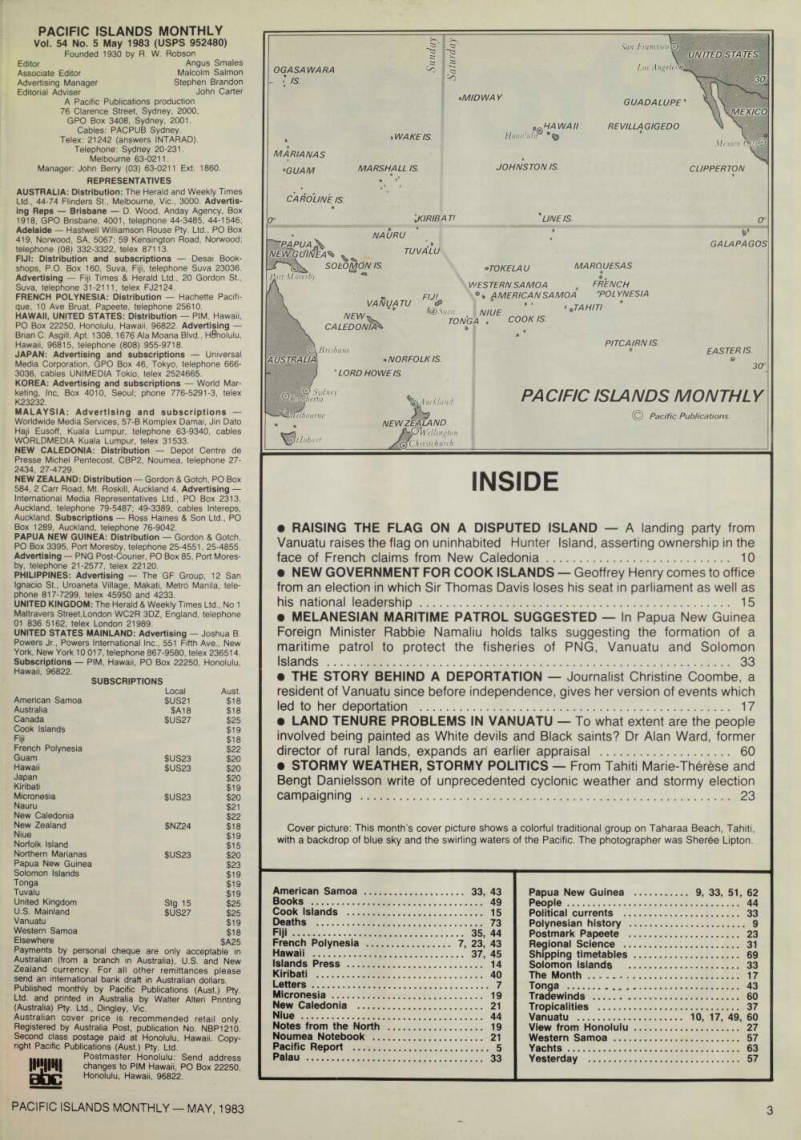
Inside
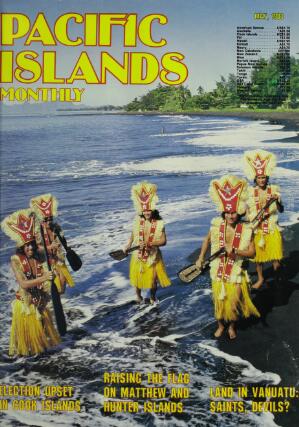
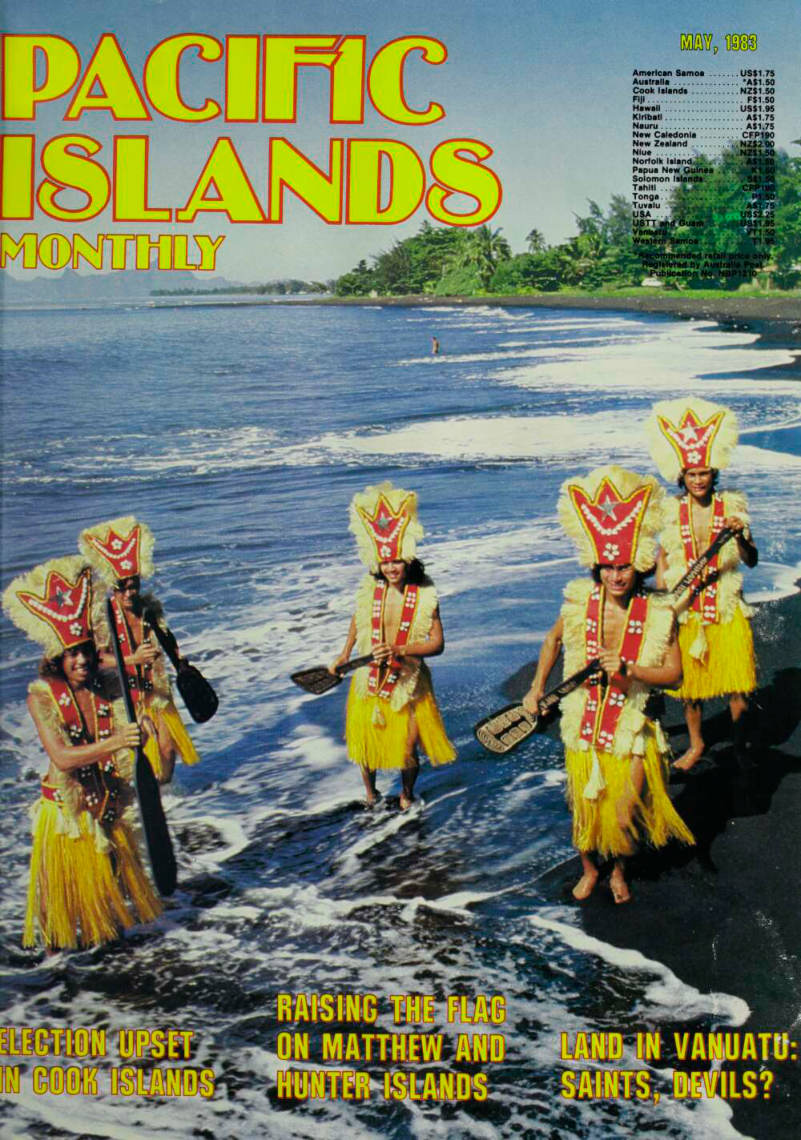
• RAISING THE FLAG ON A DISPUTED ISLAND A landing party from Vanuatu raises the flag on uninhabited Hunter Island, asserting ownership in the face of French claims from New Caledonia 10 • NEW GOVERNMENT FOR COOK ISLANDS Geoffrey Henry comes to office from an election in which Sir Thomas Davis loses his seat in parliament as well as his national leadership 15 • MELANESIAN MARITIME PATROL SUGGESTED In Papua New Guinea Foreign Minister Rabbie Namaliu holds talks suggesting the formation of a maritime patrol to protect the fisheries of PNG, Vanuatu and Solomon Islands 33 • THE STORY BEHIND A DEPORTATION Journalist Christine Coombe, a resident of Vanuatu since before independence, gives her version of events which led to her deportation 17 • LAND TENURE PROBLEMS IN VANUATU To what extent are the people involved being painted as White devils and Black saints? Dr Alan Ward, former director of rural lands, expands an earlier appraisal 60 • STORMY WEATHER, STORMY POLITICS From Tahiti Marie-Therese and Bengt Danielsson write of unprecedented cyclonic weather and stormy election campaigning 23 Cover picture: This month's cover picture shows a colorful traditional group on Taharaa Beach, Tahiti, with a backdrop of blue sky and the swirling waters of the Pacific. The photographer was Sher6e Lipton.
American Samoa 33, 43 Books 49 Cook Islands 15 Deaths 73 Fiji 35, 44 French Polynesia 7, 23, 43 Hawaii 37, 45 Islands Press 14 Kiribati 40 Letters 7 Micronesia 19 New Caledonia 21 Niue 44 Notes from the North 19 Noumea Notebook 21 Pacific Report 5 Palau 33
Papua New Guinea 9, 33, 51, 62 People 44 Political currents 33 Polynesian history 9 Postmark Papeete 23 Regional Science 31 Shipping timetables 69 Solomon Islands 33 The Month 17
Tonga 43
Tradewinds 60 Tropicalities 37 Vanuatu 10, 17, 49, 60 View from Honolulu 27 Western Samoa 57 Yachts 63 Yesterday 57
Advertisements & other items, pp. 3-4 (2 items)
Founded 1930 by R. W. Robson
Editor Angus Smales Associate Editor Malcolm Salmon Advertising Manager Stephen Brandon Editorial Adviser John Carter A Pacific Publications production 76 Clarence Street, Sydney, 2000, GPO Box 3408, Sydney, 2001.
Cables: PACPUB Sydney.
Telex: 21242 (answers INTARAD).
Telephone: Sydney 20-231.
Melbourne 63-0211.
Manager: John Berry (03) 63-0211 Ext. 1860.
Protect
with Australian Safety and Security Equipment □ □ □ Workforce, property, valuables, environment.
They all need protection, from injury, damage, theft, fire. You can rely on Australian Safety and Security Equipment to protect efficiently and effectively. That’s because Australian equipment is made to standards rated among the strictest in the world. Products that cover a wide range of functions are readily available.
Protective clothing. Helmets. Gloves. Eye and ear protectors. Dust and air masks. Life jackets and rafts. Fire fighting equipment. Respirators.
Warning and detection systems. Security devices. Locks and safes. Emergency lighting systems. Check to see how Australia can fulfil your requirements. □ □ □ □ □ o 3: □ U □ □ A n □ AA a For more information Ask the Australian Trade Commissioner Port Moresby: Phone 25 9333. Suva: Phone: 31 2844.
Honolulu; Phone (808) 524 5050. Noumea: Phone 27 2414, 27 2426. lAi
Pacific Report
Uni Survives, Sokomanu Speaks Out
Vanuatu’s Prime Minister Father Walter Lini survived a no confidence motion in parliament in April, but failed to win the full support of his Vanuaaku Party MPs. Four former Vanuaaku Party ministers voted in favor of the motion, while three other members of the party abstained. The motion, lost 22 votes to 13, alleged that Fr Lini had contravened the constitution by securing an overseas loan. Fr Lini told parliament he had been involved with the loan as a private individual, not as PM, and threatened legal action against the movers of the motion. A week earlier, another no-confidence motion against him had been ruled out of order by Speaker Maxime Carlot. In a separate development, Vanuatu’s President Ati George Sokomanu has sharply criticised the Uni-led government in an interview with an Australian newspaper. Of the no-confidence motion, he told Colleen Ryan of the Sydney-based weekly The National Times that Fr Lini “had brought the whole thing on himself.” “There has not been proper consultation with the executive. He is not following party rules. The whole problem has come because of lack of administration and know-how at the top. It is on the executive side the Vanuaaku Party has no proper co ordination.” President Sokomanu made it clear in the interview he saw himself as a credible alternative prime minister.
Extra Aid From Australia For Png
Following an April visit to Port Moresby by Australian Foreign Minister Bill Hayden, Australia is unlikely to go ahead with planned cuts in aid to Papua New Guinea over the next few years. Australian aid this financial year amounts to about $U.5.210 million, roughly a quarter of the total PNG budget.
Under present arrangements, aid is supposed to drop by about five per cent a year, but the PNG Government, hard hit by the world economic recession, and facing the threat of disintegra tion of some government services, is asking that there should be no decrease in aid over the next two years, and a decrease of only two per cent for the following two years. On his return to Canberra, Mr Hayden said that the Australian Government would give an extra $lO million in bridging aid to PNG “as an expression of faith and commitment, while it considers the PNG request.”
Mamaloni Sacks Two Ministers
Solomon Islands Prime Minister Solomon Mamaloni in April sacked two ministers, and postponed the next sitting of parlia ment for two months. The sacked ministers were Peter Salaka and John Ngina. Mr Salaka held the portfolio of Lands, Energy and Natural Resources, and Mr Ngina that of Transport, Communications and Government Utilities. Mr Ngina had short ly before been convicted and jailed on a charge of causing another man bodily harm, and Mr Salaka last year drew a High Court reprimand in a case involving a foreign logging company.
Both men are members of Mr Mamaloni’s People’s Alliance Party, and are reported to have strongly supported him in cabinet. Following announcement of the sackings Mr Mamaloni left for his third overseas trip within a month. He went to South Korea.
Priests Deported, Say Irian Jaya Rebels
Rebels in the Indonesian province of Irian Jaya claim that the Jakarta government has deported to the Netherlands five Dutch priests working as missionaries in the province. The claim was made in a report from the rebel movement sent to the Port Moresby office of Radio Australia in April. Signed by the “field commander” of the largest Irian Jaya rebel grouping, Donald Derey, the report said the priests had been deported because the Indonesian Government wanted the people of Irian Jaya to become Muslims. He also accused Indonesian officials of interfering with the supply of food and medicines to drought victims in the province.
French Helicopters On Hunter Island
The Vanuatu Government has claimed that France is moving to establish a presence on the usually uninhabited islands of Matthew and Hunter which are in dispute between the two countries. The islands lie between Vanuatu and New Caledonia.
A statement issued in Port-Vila late in March said that Vanuatu
will pursue the matter in international forums if France continues to refuse recognition of Vanuatu’s sovereignty over the islands.
The statement added, however, that Vanuatu remained con vinced that the matter can be resolved amicably with France.
Quoting radio reports from Australia and Vanuatu, the Noumea daily Les Nouvelles said that, even though the French Govern ment remained silent on the matter, French naval vessels had been active in the vicinity of the islands, and that Puma helicopters had landed on Hunter. The daily speculated that their goal was to prepare a helicopter landing pad on the island and to replace the plaque announcing French sovereignty over Hunter which had been removed some weeks before by a Vanuatu Government mission (See report this issue PIM).
Kilauea Eruption Destroys Houses
Lava from Hawaii’s Kilauea volcano, which has been active for several months, continued to flow through hillside areas in April, destroying several houses. Authorities said about 150 people had been ordered to evacuate their homes on April 9 as a wall of lava five metres high and 300 metres wide flowed down the volcano’s side.
W. Samoa: Devaluation, Plea To Undp
Following a 16 per cent devaluation of Western Samoa’s currency in March, the cost of diesel fuel and kerosene in the country rose by 57c. Price of a gallon of petrol became SWS3.B7, or about $A2.60. Fares on the country’s flag-carrier Polynesian Airlines rose by 11 per cent. Some imported goods soared in price by as much as 350 per cent. In an effort to ease its severe economic problems, the government announced in April that it would ask the United Nations for aid equivalent to $75 million. It said it would approach the United Nations Development Program for the aid in the form of a grant. The UNDP was set up to help the world’s 33 least developed countries. Western Samoa is the only South Pacific country elegible for the aid. Prime Minister Tofilau Eti said the aid request was small by international standards, and justified because the country had received no increase in foreign aid during the past three years.
Officials Quizzed On Ttpi Affairs
Members of an Interior and Insular Affairs Sub-committee of the US House of Representatives have sharply questioned ad ministration witnesses on the administration’s Fiscal Year 1984 budget for the Trust Territory of the Pacific Islands and particularly on the health needs of the islanders and a recent outbreak of cholera on Truk. Administration witnesses, including Pedro San Juan, assistant secretary for territorial and interna tional affairs in the Department of the Interior, and Janet McCoy, high commissioner of the TTPI, said the cholera outbreak, which occurred at the end of August 1982, has now been halted.
Danger, however, remains, and longterm improvements in sewerage, water, and health-care facilities must be undertaken before the island can be considered cholera-free. In addition to the SUSI. 6 million appropriated in December 1982 on an emergency basis to combat the epidemic on Truk, Secretary San Juan asked for another $2 million for Truk water improve ments to continue longterm health improvements. Mr San Juan requested $87,909,000 for operations and construction in the TTPI for FY 1984, a five per cent increase over last year’s request. Committee members questioned the witnesses sharply on the adequacy of American efforts to aid the region. Question ing focused on the closing and reductions in force in US Government offices formerly concerned with TTPI liaison and administration, on the need to maintain the existing territorial infrastructure, and particularly on health, water and sewerage facilities on Truk and Ebeye Island in the Marshalls. Members expressed concern about over-crowding and slum conditions on Ebeye Island near the Kwajalein Missile Range, which they feared might lead to cholera outbreak there similar to the one on Truk. In reply, administration witnesses pointed out that the US Department of Defence had recently contributed $2 million to help improve water treatment on the island, and that another $2 million was on the way. The US Government is hoping to resettle some of the inhabitants of Ebeye on nearby atolls,
witnesses said, relieving the crowded conditions on Ebeye.
Congressmen expressed concern at the large debt to foreign governments currently owed by the government of the Marshall Islands. They pointed out that foreign governments lending the Marshall Islands money may assume that the US Government will repay the loans, should other means of repayment prove impossible. The Congressmen pointedly declared that the US Government would not be responsible for such debts.
Solomons To Change Timor Stand?
The Solomon Islands Government co-ordinating committee has unanimously recommended a reversal of the country’s position on East Timor at next year’s general assembly of the United Nations. A member of the committee, Joses Tuhanuku, said that the Solomons’ vote in support of Indonesia earlier this year had taken the committee by surprise. The co-ordinating committee is made up of two representatives from each of the three groups in the country’s coalition government. Mr Tuhanuku said the committee would recommend to Prime Minister Solomon Mamaloni that the Solomons support the Portuguese resolution which calls for self-determination for the people of East Timor.
Mr Tuhanuku also said that his party, the National Democratic Party, wanted the Solomon Islands to offer asylum to Seth Rumkorem, rebel Irian Jaya leader, who has been in Papua New Guinea for several months waiting for a country to offer him asylum. He fled Irian Jaya late last year but the United Nations High Commissioner for Refugees has been unable to find a country prepared to accept him.
Samoa To Mix Games, Independence Fest
Western Samoa’s cabinet agreed in March to defer the country’s annual independence celebrations from June to coincide with the Pacific Games in Apia in September. Secretary of the Games Organising Committee, John McDonald, said the com mittee had requested the deferment to enable overseas visitors to the games to see the celebrations. Between 30,000 and 40,000 people travel to Apia from all over the country for the elaborate independence celebrations, which last three days. Mr McDonald said the Pacific Games in September are expected to be attended by about 2000 athletes. He said that catering problems had been solved through offers of assistance from the Australian army, the United States navy and the loan of a United Nations catering consultant, David Aite, who is normally involv ed with training schemes for the South Pacific hotel industry.
Kwajalein Islands Go Back To Owners
Six islands in the Kwajalein Atoll were returned to their Marshallese owners in March, when Marshalls Chief Secretary Oscar deßrum signed quitclaim deeds on behalf of the govern ment of the republic. The six islands were Ninni, Gea, Gugee gue, Ningi, North Loi and South Loi. The United States had held use rights to the islands since the 1950 s in conjunction with the Kwajalein Missile Range. The U.S. agreed to return them during negotiations on the current Kwajalein Interim Use Agreement.
When the chief secretary signed the quitclaim deeds on March 17, ownership immediately reverted to the rightful owners under Marshallese tradition and custom.
PNG: 50TH ANNIVERSARY OF THE “BIG WALK”
March 28 saw 50th anniversary observances of what is known in the modern history of Papua New Guinea as the Big Walk: the expedition begun on March 28, 1933, by the two gold prospecting Leahy brothers, Mick and Dan, and Australian government officer Jim Taylor. It was the first expedition in PNG to use aircraft for reconnaissance, and the first to use film. It led to the discovery of the Wahgi Valley in the Chimbu District, and of about 200,000 people whose existence had previously been unknown. Jim Taylor, 82, a long-time resident of the Eastern Highlands town of Goroka, took part in the 50th anniversary celebrations, as did Danny, the last of the Leahy brothers.
Several hundred people, blacks and whites, took part in the 50th anniversary emulation of the Big Walk. Reporting the event, Peter Hastings, foreign editor of the Sydney Morning Herald, quoted PNG Prime Minister Michael Somare as addressing Jim Taylor at a reception held for the occasion: “You are a legend in your lifetime, the living link between Australia and this country”.
Hastings noted that film of the expedition shot by the late Mick Leahy “has been made into a dramatic documentary film called
First Contact due to be shown later this year on (Sydney’s) Channel 7”. Hastings said the film “comprises some of the most dramatic visual records of Highland reaction to the white intruders”.
Upng Students To Help Aboriginals
Students at the University of Papua New Guinea have opened a fund to sponsor Australian Aboriginal students through universi ty studies in PNG, believing that Australia’s Aboriginals do not get enough encouragement or opportunity to study at university level in Australia. Mr Burford Maiago, president of the UPNG branch of the PNG Aboriginal and Islander Cultural Society, said that preparations are being made for Aboriginal students to begin studies on the Port Moresby campus next year.
Aid From Tonga For Fiji, Oz
Tonga is giving financial assistance to victims of recent bush fires in Australia and those affected by Cyclone Oscar in Fiji.
Bushfires in the Australian states of Victoria and South Australia in February killed 71 people and destroyed more than 2000 homes. In Fiji, Cyclone Oscar killed seven people and caused extensive damage to housing and crops. The Acting Prime Minister of Tonga, Baron Tuita, said late in March that his country would give $17,600 to Australia and $BBOO to Fiji. He said in making these donations, Tonga was mindful of the various forms of assistance it had received from these two countries in the past, particularly following the devastation caused by Cyclone Isaac in March last year. Baron Tuita said he regretted Tonga was not able to provide larger amounts of financial assistance.
U.S. Senate Committee Approves Treaties
The U.S. Senate Foreign Relations Committee has approved four friendship treaties with Pacific countries that had been blocked by objections for more than a year. The treaties will now be considered for approval by the Senate. Under the treaties the U.S. will drop claims to 26 islands and atolls, including four in the Cook Islands. The then Economic Development Minister in the Cooks, Vincent Ingram, in a statement in March described as scurrilous claims by some American senators and witnesses before the Foreign Relations Committee which suggested that the Cook Islands were likely to become pro-Soviet. He said he did not see any Soviet threat to the Cook Islands, nor to any nation in the South Pacific.
W. Samoa Slashes Budget Spending
The Legislative Assembly in Apia in March passed the Western Samoan government’s 1983 budget. Two opposition members voted for the budget, while four others were not in the house, when it divided 25 to 16 in favor. The budget originally presented was for $46.3 million, but this was later pared down by $134,000 by the public accounts committee. By comparison the Western Samoan Government budgeted for $47.4 million last year.
International Pressure On Ptuf
A leading Pacific trade unionist has claimed that the Brussels based International Confederation of Free Trade Unions (ICF TU) is trying to sabotage the independence of the Pacific Trade Union Forum. The secretary of the Solomon Islands National Union of workers, Joses Tuhanuku, claims the ICFTU is pressuring its Pacific affiliates not to go ahead with the establishment of a PTUF secretariat. This was to be discussed at the co-ordinating meeting of the PTUF in Vanuatu in April.
Australian, New Zealand and Fiji trade union councils are members of the mainly Western ICFTU. The Solomons National Union of Workers is affiliated to the Leftwing World Federation of Trade Unions (WFTU), while trade unions in Western Samoa, Vanuatu and Kiribati are not attached to either group. Mr Tuhanuku said the PTUF should stay independent of both, but he is not optimistic that this can be maintained because of ICFTU pressure.
MORE OZ, NZ, HELP FOR FORUM LINE The Australian and New Zealand Governments have formally signed an aid agreement to help finance a regional shipping service from Fiji to Tuvalu and Kiribati. Under the agreement, each country will provide $300,000 to the Pacific Forum Line.
The agreement is to be reviewed at the end of the year. The Pacific Forum Line has been losing money since it was set up five years ago to serve Pacific Island countries.
Statistician

Letters
Statistician strikes back
In your February issue I read the article by Bengt and Marie- Therese Danielsson headed “Fact, fiction, and figuring in the budget debate.”
For the information of your readers, I want to go into a little more detail about employment
and unemployment figures, and
the inflation rate, in French Polynesia.
The “huge proportion of ex patriate Frenchmen” employed as civil servants and government employees is about 28 per cent when military personnel are in cluded, and 14 per cent if only civilian personnel are counted.
I agree with the authors when they say that unemployed people are “statistically non-existent” in French Polynesia. But it’s the same in many other countries in the Pacific and elsewhere. Only the big developed nations have
good figures on unemployment.
At the last census (April 29, 1977), 1689 unemployed persons were recorded, and the unem ployment rate was 3.8 per cent.
Even if it’s logical to think that this rate has increased, it is not reasonable to suggest that “there are probably about 20,000 poor devils” without jobs in 1983 in French Polynesia. It’s a gratuit ous affirmation absolutely with out foundation. The next census (October 15, 1983) will provide the answer.
The article further says: “Offi cially it (the inflation rate) was 15 per cent in 1982, but was actually at least twice as high.”
With this statement, the authors question my honesty, and the probity of my collaborators.
I don’t claim that the consum er price index of French Poly nesia is the best in the Pacific no price index in the world is perfect. I just think that this index is a good and objective “tool”. It has been built up from the results of a survey of house hold expenditures in 1979. Every month 8000 prices are recorded from about 200 shops and mar kets around Tahiti and Moorea.
As a statistician’s office, we try, and I think successfully, to
apply international recommenda tions (Commission of Statistics of the United Nations, New Delhi, November 8-19, 1976), and particularly the following one; “The credibility of statistics requires that the office of statist ics is, and has the reputation of
being, impartial and objective.”
This is a rule that all statisticians, even French ones, try to follow.
When the authors write that the inflation rate is actually twice the official result, I think it’s another gratuitous affirmation.
I hope Marie-Therese and Bengt Danielsson will explain in an early issue of PIM how they arrive at this conclusion. Then your readers will be fully informed.
Gerard Baudchon
Director, Territorial Institute of Statistics Papeete Tahiti French Polynesia
How “independent”
after all?
The process of granting inde pendence to the former colonies is almost completed, and what we get is trouble and uncertainty for all.
Why? It is because some for mer colonies became militant, too poor to feed themselves, and not experienced enough to look after their own affairs.
Economically, they haven’t got a chance of competing with the already developed countries.
The only alternative is to beg for a fair deal, or flirt with the super powers as some are doing at present.
Sometimes those who led their people to independence had to sacrifice their own people’s free dom by aligning themselves with communism, or some other form of socialism.
Socialism is a social state like that of Hitler’s Germany. World War II had to be fought for individual freedom.
The Russians didn’t die in the Pacific to liberate us, or even in Africa, so why do we have to look to Russia for help? Some people are trying to pit the Un ited States and its Western allies against the Soviet and its Eastern bloc, just because the developing countries cannot run the race.
Mismanagement and corrup-
tion cannot be tolerated in any independent country, and least of all in poor developing indepen dent countries.
There are more killings now than in colonial days. They ap pear to be wanton killings, simi lar to those in Nazi Germany.
There is more uncertainty about the future for most people, ex cept for those in power.
There is no such thing as non
alignment in developing coun
tries. One is either dependent on the Soviet and its bloc, or on the United States and its allies in one way or another, even if this dependence is concealed.
It is a matter of choice freedom for all, or for just a few who are in power for the time
being.
We cannot all be equal. But at least we should enjoy freedom.
Timothy Deje
Nauru Central Pacific
Indigestible
pancakes
I wish to express both my amaze ment and disappointment about an article in the February issue of
Pim.
As one interested in Pacific Island studies and an active re searcher into Pacific Island af fairs, I have always enjoyed reading your magazine. I find the contents diverse and informative.
However I believe that the article in the Tropicalities section, page 23 (PIM Feb 1983) on the Pan cake Manor in Brisbane has low
ered your previously high
standard.
This article is quite pointless and trivial and its attempts to give it a Pacific connection are miserable.
Am I to understand from this that PIM has gone the way of other less illustrious publications and is going to make general restaurant appraisals a regular feature? Perhaps I can anticipate a column by some self-appointed wine expert covering the “wines of the region”.
Ngaire Rea
Arncliffe NSW Australia There's no “Chinese Wall” bet ween the Pacific Islands and the rest of the world, and there are forms of pancake in the Islands just as there are everywhere else.
We found Professor Richard son’s article of considerable in terest, and its “Pacific connec tion” quite adequate. We have no present intention of introduc
ing a column on wines.
Pim.
We flew off
course ...
I would like to correct an errqr which appeared in your publica tion dated January 1983. The error appeared in an article on Edward Akilo Piawe on page 39 of that issue.
Mr Piawe was awarded a pilot scholarship from Australian Aerospace Pty Ltd, agents for the De Havilland Aircraft of Canada range of aircraft in Australia and the Pacific, and not from the Australian Flying Training School, who were the people contracted to train him.
Mr Piawe who has since re turned to Papua New Guinea is
What cost for a new nation any new nation - to keep its flag flying?
now employed by Air Niugini as a trainee pilot and is soon to start his Fokker F 27 course.
We of Australian Aerospace wish him every success and hap piness in his new career.
D. C. Newson
Manager
Australian Aerospace Yagoona
Nsw
Australia
On superior
outsiders
Dr Matthew Spriggs, I imagine, sees nothing invidious in the fact that he, rather than a native Hawaiian, is assistant professor of archaeology at the University of Hawaii at Manoa. “It just so happens,” I can imagine him saying, “that there are no native Hawaiians who are qualified ar chaeologists like I am.” As an
archaeologist, Dr Spriggs is
therefore superior to the native Hawaiian.
Dr Spriggs sets a good deal of store by superior qualifications.
With a doctorate of philosophy from the Australian National Un iversity, he finds that the report ing in PIM of anthropological
and particularly archaeological
research in the Pacific is “often inaccurate” (PIM Feb plO). He therefore suggests that PIM should get a qualified ar chaeologist to “check the accura cy of the reports that are publish ed in its pages”.
Dr Spriggs cites several cases in the September and October issues of 1982, which, he claims, were inaccurate. One was my review of Richard Feinberg’s
book Anuta in which I suggested that two outsiders a Prussian and a Lascar who were left on Tikopia in 1813 may have had some influence, both genetically and culturally, on the subsequent history of that island and on
neighboring Anuta.
I did not suggest that the Prus sian and the Lascar had to be superior to the Tikopians to have had children merely that, be ing human, it would have been strange if they did not. On the other hand, I did imply that as the Prussian and the Lascar would have arrived on Tikopia with some knowledge that the Tikopians didn’t have, it could well be that the Tikopians were smart enough to learn something from them.
Dr Spriggs, with his PhD from ANU, finds my ideas about Tikopia just as invidious as the theory expounded in my book The Lost Caravel. This is that castaways from the Spanish caravel San Lesmes, lost in the Eastern Pacific in the early 16th century, played a significant role both genetically and culturally on the various Polynesian islands where they happened to settle.
According to Dr Spriggs, my argument on this matter is of the same order as Erich von Dani ken’s claim that Kiribati was influenced by spacemen.
“When will Pacific prehistory and culture be properly credited to Pacific islanders themselves rather than to ‘superior’ outsid ers?” Dr Spriggs asks.
I believe, Mr Editor, that I know the answer. It is when “superior” outsiders such as Dr Spriggs, the Prussian, the Lascar
and “my” Spanish castaways
don’t happen to be around to exert an influence on the Pacific islanders’ history and culture.
Please note, however, that “superior” is Dr Spriggs’ term, not mine. I would expect that, in some accomplishments, Dr Spriggs, for example, would be considerably inferior to many Pacific islanders.
Robert Langdon
Canberra ACT Australia
Shark callers
not news Dr W. G. Coppell’s praise of Dennis O’Rourke’s documentary film The Shark Callers of Kontu (PIM, Mar. p2l) is good news, indeed. But those shark callers are not news.
Readers may remember my review of Glenys Koehnke’s fine book The Shark Callers (PIM, Aug. ’75). They may have read, too, lan Stuart’s review of that book {PNG Post-Courier, May 2, 1975), and Hank Nelson’s {Journal of Pacific History, Vol. 12, Pt. 4, 1977).
There are accounts of the shark callers by Hortense Pow dermaker (1933), W. C. Groves (1936), Gil Patten (1954), Bengt Anell (1955) and others. Perhaps the best one is in Otto Schlaginhaufen’s Muliama: Zwei Jahre unter Suedsee-Insulanern (1959). And, of course, Abel Janszoon Tasman, the great sailor, bartered beads for a shark off New Ireland on April 7, 1643. Tasman’s journal has a drawing of three islanders in a
canoe, one of them blowing a conch shell, an important tool used by shark callers.
Harry H. Jackman
Angaston, South Australia Australia
Give the credit
to France
While it is true that Mme Sol ange Petit-Skinner is “an an
thropologist and psychologist
from the United States’’ (PIM Feb.) in terms of residence, I am sure that those of the U.S. academic community who are familiar with her work would not want to deny France the credit for her training.
Albert J.Schutz
University of Hawaii Honolulu, Hawaii,
Usa
“Thank you, Papua
New Guinea ..
Since returning from Papua New Guinea in January, I have been purchasing PIM to keep up with the country’s events. I was inter ested in PNG before travelling there but now my interest has deepened a lot. My experiences in PNG will never be forgotten.
I am only 19 and it was my first venture alone anywhere, so there was some apprehension.
But what I found there was better than anything I could have wish ed for.
My thanks go to so many of PNG’s people who extended such a warm and unconditional welcome to me. Not only is the country itself beautiful, but, more importantly, the people are also.
My month in the country went much too quickly, every new face brought more stories and a new friendship. I have never felt warmth and care to such a degree before thanks Papua New Guinea.
Sure, Papua New Guinea has got its problems, so has Australia and every other country. But I found a very special people there, a people the country can be very proud of. Thanks again for everything, PNG, and keep up the great work.
Mark Cooper
Geelong, Victoria Australia
An 18th century drawing from one of Cook’s voyages, showing Hawaiians whose masks may have been copied from Spanish helmets. Not a superior influence, but rather an interchange of ideas, writes
Robert Langdon.
Advertisements & other items, p. 8 (1 item)
The Image.
H COMPLETES
THE DRESS.
A fine watch shows superb taste in dress. Its also the symbol of your success.
A precision made pen on the other hand, is both a symbol of your success and of your abilities.
This is called Penupmanship.
Parker is the number one pen company in the world because no other company offers such elegant yet reliable symbols of Penupmanship.
Matte Black Arrow
A PARKER COMPLETES
THE IMAGE.
A Parker is available through better local suppliers, or for trade enquiries contact Parker Pen (Australia) Pty. Ltd., 159 Cleveland Street, Chippendale, N.S.W 2008. Telephone: Sydney (02) 6994405, Telex: Sydney PPENSY 22026
SSB/PP/038
greatness has
Matthew and Hunter: Their greatness has been thrust upon them ...
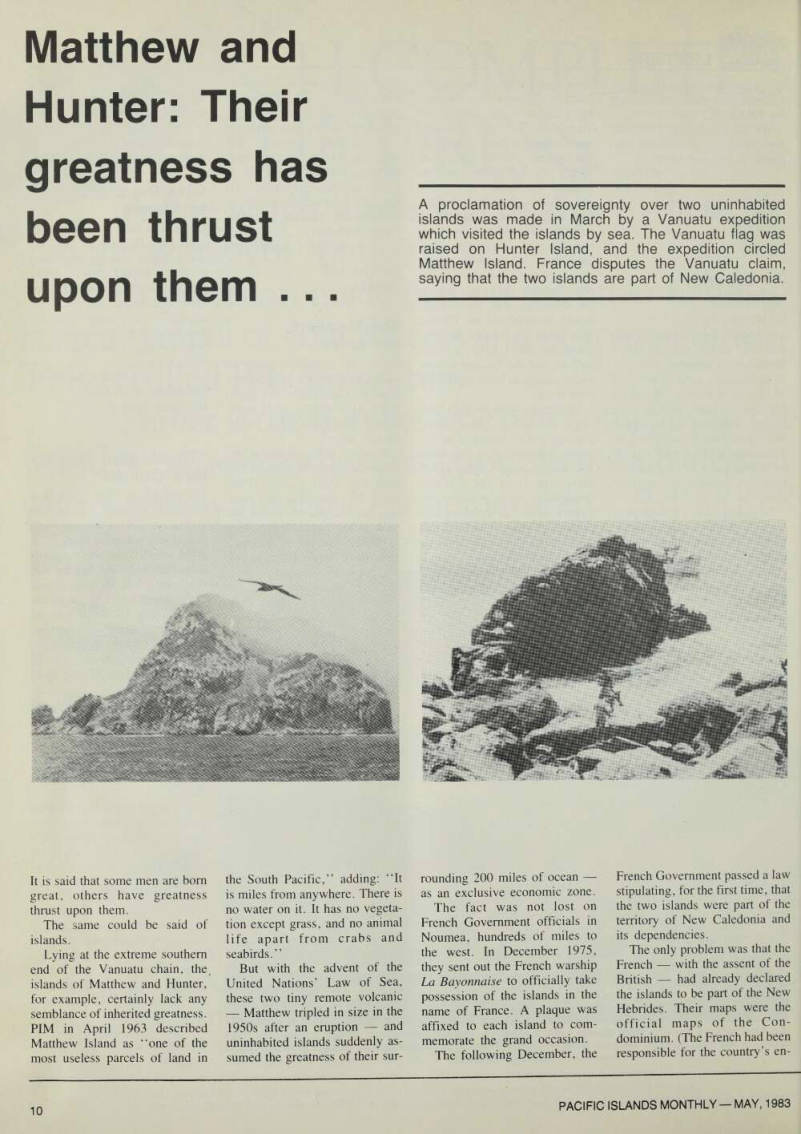
A proclamation of sovereignty over two uninhabited islands was made in March by a Vanuatu expedition which visited the islands by sea. The Vanuatu flag was raised on Hunter Island, and the expedition circled Matthew Island. France disputes the Vanuatu claim, saying that the two islands are part of New Caledonia.
It is said that some men are born great, others have greatness thrust upon them.
The same could be said of islands.
Lying at the extreme southern end of the Vanuatu chain, the, islands of Matthew and Hunter, for example, certainly lack any semblance of inherited greatness.
PIM in April 1963 described Matthew Island as ‘‘one of the most useless parcels of land in
the South Pacific,” adding: “It is miles from anywhere. There is no water on it. It has no vegeta tion except grass, and no animal life apart from crabs and seabirds.”
But with the advent of the United Nations’ Law of Sea, these two tiny remote volcanic Matthew tripled in size in the
1950 s after an eruption and
uninhabited islands suddenly as sumed the greatness of their sur
rounding 200 miles of ocean as an exclusive economic zone.
The fact was not lost on French Government officials in Noumea, hundreds of miles to the west. In December 1975, they sent out the French warship La Bayonnaise to officially take possession of the islands in the name of France. A plaque was affixed to each island to com memorate the grand occasion.
The following December, the
French Government passed a law stipulating, for the first time, that the two islands were part of the territory of New Caledonia and
its dependencies.
The only problem was that the French with the assent of the British had already declared the islands to be part of the New Hebrides. Their maps were the official maps of the Con dominium. (The French had been responsible for the country’s en-
Howled down as hoax
tire mapping program, but after 1960 France retained topograph ical mapping while the British undertook geological mapping.) The French-made maps clearly showed the islands as part of the New Hebrides, within the ad ministrative jurisdiction of the Tanna district agent.
The French had, in fact, been mapping the islands as part of the New Hebrides for more than a century.
Thus it was no surprise when Vanuatu, upon its independence in July 1980, repudiated the be lated French claims to its territory.
Now Vanuatu has gone ahead
and successfully asserted its au thority over the islands by raising its flag on Hunter Island.
An official government party led by Tafea local government council secretary, Joe Joseph, hoisted his country’s colors on March 9.
Radio Vanuatu broke the story two days later, but in New Caledonia it was howled down as a hoax by the pro-French media.
The media claimed that Vanuatu could not bypass French navy radar, that Hunter Island wqs almost impossible to land upon, and that the island did not smoke in the way described in Vanuatu reports.
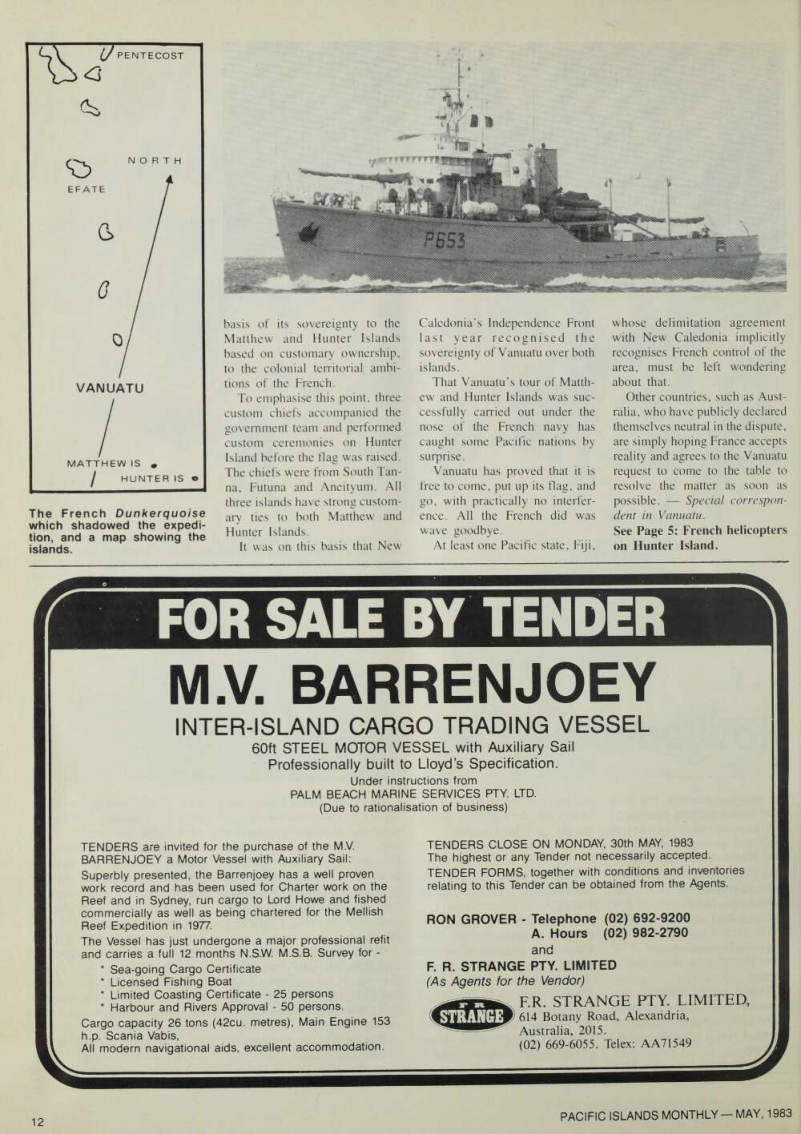
On March 10, the French pat rol vessel Dunkerquoise met up with the Vanuatu government vessel Euphrosyne on its way back to Aneityum from Matthew Island. Discounting its radar, all the Dunkerquoise may have seen
was the Euphrosyne rounding,
and then leaving, Matthew Island.
At least this appears to be what was reported to the French au thorities. It led to France’s De fence Minister Charles Hemu de nying that the Hunter Island flag raising took place.
But the question remains, did France turn a blind eye?
In Port-Vila French Govem
merit officials had spoken know ingly of Vanuatu’s intentions a week before the event.
In any case, the French dip lomatic response had been to continue to repeat its assertion that its claims to the islands are “incontestable”. Unlike the Vanuatu Government, France
has studiously avoided publish
ing any evidence to support its “claims”.
For its part the Vanuatu Gov ernment refuses to accept that any French claim to the islands exists. All that exists, it says, on the French side is a half-hearted attempt at annexation.
Vanuatu strongly contrasts the
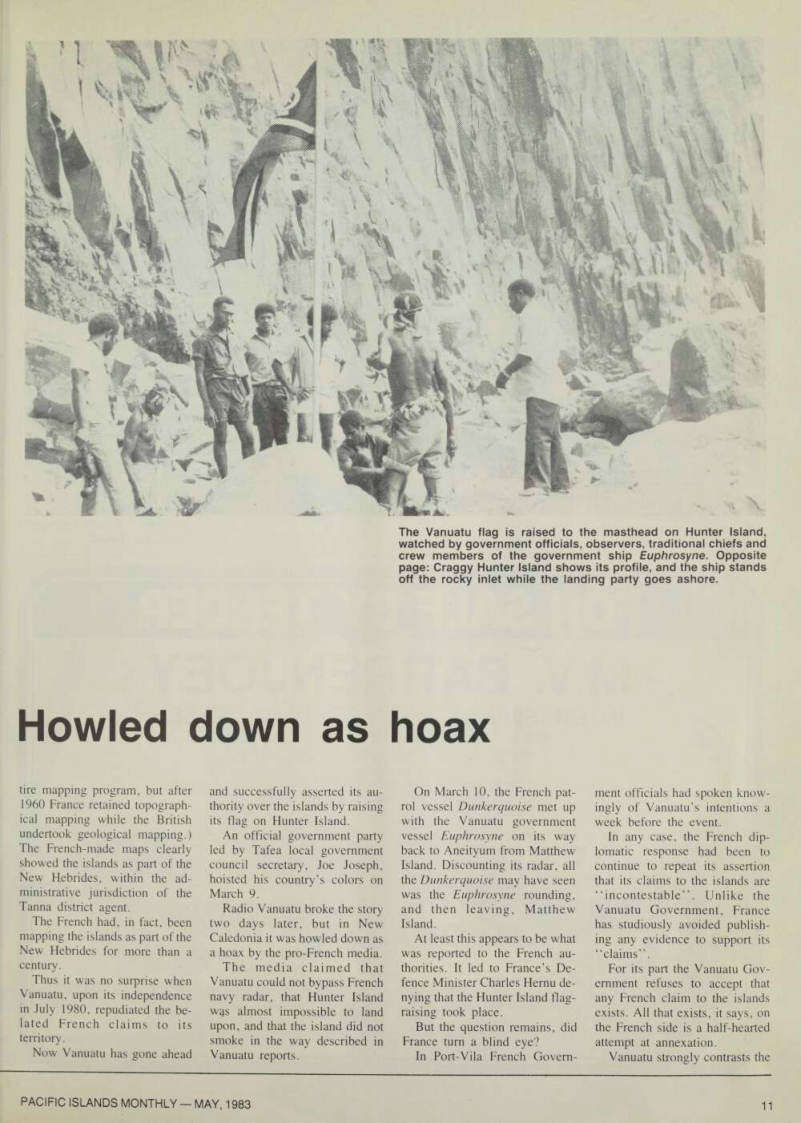
The Vanuatu flag is raised to the masthead on Hunter Island, watched by government officials, observers, traditional chiefs and crew members of the government ship Euphrosyne. Opposite page: Craggy Hunter Island shows its profile, and the ship stands off the rocky inlet while the landing party goes ashore.
basis of its sovereignty to the Matthew and Hunter Islands based on customary ownership, to the colonial territorial ambi tions of the French.
To emphasise this point, three custom chiefs accompanied the government team and performed custom ceremonies on Hunter Island before the flag was raised.
The chiefs were from South Tan na, Futuna and Aneityum. All three islands have strong custom ary ties to both Matthew and Hunter Islands.
It was on this basis that New
Caledonia’s Independence Front last year recognised the sovereignty of Vanuatu over both islands.
That Vanuatu’s tour of Matth ew and Hunter Islands was suc cessfully carried out under the nose of the French navy has caught some Pacific nations by
surprise.
Vanuatu has proved that it is free to come, put up its flag, and go, with practically no interfer ence. All the French did was
wave goodbye.
At least one Pacific state, Fiji,
whose delimitation agreement with New Caledonia implicitly recognises French control of the area, must be left wondering about that.
Other countries, such as Aust ralia, who have publicly declared themselves neutral in the dispute, are simply hoping France accepts reality and agrees to the Vanuatu request to come to the table to resolve the matter as soon as
possible.
Special correspon-
dent in Vanuatu.
See Page 5: French helicopters on Hunter Island.
The French Dunkerquoise which shadowed the expedi tion, and a map showing the islands.
Advertisements & other items, pp. 12-13 (1 item)
M.V. Barrenjoey
r FOR SALE BY TENDER
INTER-ISLAND CARGO TRADING VESSEL
60ft STEEL MOTOR VESSEL with Auxiliary Sail
Professionally built to Lloyd’s Specification.
Under instructions from
PALM BEACH MARINE SERVICES PTY. LTD.
(Due to rationalisation of business) TENDERS are invited for the purchase of the MV.
BARRENJOEY a Motor Vessel with Auxiliary Sail; Superbly presented, the Barrenjoey has a well proven work record and has been used for Charter work on the Reef and in Sydney, run cargo to Lord Howe and fished commercially as well as being chartered for the Mellish Reef Expedition in 1977.
The Vessel has just undergone a major professional refit and carries a full 12 months N.S.W. M.S.B. Survey for - * Sea-going Cargo Certificate * Licensed Fishing Boat * Limited Coasting Certificate - 25 persons * Harbour and Rivers Approval - 50 persons.
Cargo capacity 26 tons (42cu. metres), Main Engine 153 h.p. Scania Vabis, TENDERS CLOSE ON MONDAY, 30th MAY, 1983 The highest or any Tender not necessarily accepted.
TENDER FORMS, together with conditions and inventories relating to this Tender can be obtained from the Agents.
RON GROVER - Telephone (02) 692-9200 A. Hours (02) 982-2790 and
F. R. STRANGE PTY. LIMITED
(As Agents for the Vendor)
F.R. STRANGE PTY. LIMITED.
614 Botany Road, Alexandria, Australia, 2015. (02) 669-6055. Telex: AA71549 s/
We can prove youll profit by
experience with Super 748
Nearly 4 million hours of operating experience in just about every conceivable short-haul environment prove that Super 748 offers seat-mile costs as low as 10.65 cents per nautical mile. More than 350 earlier versions of 748 have built up this experience with some 80 operators in 50 different countries. Super 748 adds the latest flight-deck technology and other advances to this proven basic engine/airframe combination, with its known operating and maintenance costs, outstanding airfield performance, reliability and passenger appeal.
Even if projected new-technology turboprops in the 40/50seat category achieve their hoped-for economics and performance, the inevitable processes of escalation will ensure that, when they enter service, their seat-mile costs will still be higher than those of Super 748. And a Super 748 purchased now will be building traffic and putting profits in your bank well before the new-technology turboprops have proved themselves.
Super 748 the proven facts ■ less than 1 maintenance man-hour per flying hour, contributing to operating costs equivalent to only 10.65 cents per seat-nautical mile. ■ outstanding airfield performance. ■ ability to operate multi-stop routes without refuelling. ■ environmental noise levels already well below all existing and proposed international noise standards. ■ pressurised, air-conditioned cabin with full service amenities and reclining seats and ample leg-room for 48 passengers, overhead luggage bins and 6.6 cu ft of baggage-hold space per passenger. ■ worldwide technical support organisation proven over 20 years of 748 operation.
A.
Super74B
BRITISH AEROSPACE
onscros/ioct in its rnan&s of aerospace pf~o£/nsmnws British Aerospace PLC, Kingston-upon-Thames, England
Islands
From the
Press
The Samoa Times, Apia, Western Samoa Two journalists from two of the world’s best-known newspapers the Observer in Britain and the New York Times in the United States, Messrs Gaven Young and Richard Bernstein respectively, have been gathering material in Apia for articles on the controversy over Margaret Mead’s book about coming of age in Samoa and about Derek Freeman’s book which contradicts her conclusions. Mead found in the 1920 s that Samoans had an open attitude towards sex, and allegedly hid nothing from their children. Coupled with the freedom of the children to move from natural parents to de facto parents in aunts and uncles, Mead concluded that this was the reason the Samoans were free from guilts and hangups. Freeman on the other hand is arguing in his book that Mead’s Samoa of free-loving natives did not exist at all. Where the truth lies will probably never be satisfactorily determined. But one thing is certain: For better or for worse, Samoa is getting more publicity from this controversy than from any other event in its history.
From an article by Phyllis Rex in Tohi Tala Niue, Niue, on the need to protect the Niuean language from
inroads by the English language
The pressures exerted by the English language are enormous.
English is forever adopting words from other languages without a second thought. Where English is introduced as a second language it generally has more status attached to it than the local language and could eventually replace the local language altogether. English has often been described as “greedy and all-devouring.” With the help of all who are interested, we can prevent Niuean from being devoured. Apart from the ever-increasing danger of using English only, we also face the task of coping with terms made necessary by new technology. It will be interesting to observe how well the Niuean language copes with computers and all their associated terminology.
Part of a letter to The Fiji Times, Suva, in which Meli Bogileka suggests that the famous song Isa Lei should be identified with Fiji, not merely with Suva The Isa Lei song which we hear every night when our radio programs close should have new words at the end. The last verse which goes “. . . mai Suva nanuma tikoga” means “. . . do always remember Suva.” Since this song is more or less a national farewell, I suggest that a national name such as Fiji or Viti should be substituted for Suva, so the line reads “. . . mai Fiji (or Viti) nanuma tikoga.”
A statement by Micronesian Senator Henchi Balos, published in the Marshall Islands Journal, about families displaced from Bikini Atoll by nuclear tests Our desires are very simple. In 1946, when we were moved away from home we were told that the move would be temporary and that the United States would care for us until we could return home. Thirty-seven years have passed and we are still not home. We are told that Bikini will not be safe to live on for more than 100 years. We ask only that the United States continued to care for us until we can return home. As you know we are unhappy with the Compact of Free Association because we do not want to be left in the care of the Marshall Islands
Government. The Marshall Islands Government did not cause the damage at Bikini and it should not be asked to take care of us as a result of that damage. We do not want the United States to walk away from us and close the book on Bikini.
From a news feature by Bernard Maladina, published in The Times of Papua New Guinea, Port Moresby Some areas of Port Moresby are so rascal-ridden that they have become a financial risk to insure. And insurance firms in the national capital will not issue insurance cover on people’s homes that do not have a burglar alarm, a watchdog, security bars and lights and a fence.
The Samoa Times, Apia, Western Samoa We should stop relying on other people’s advice which, over the years, has been found most unreliable. Over the years because of deep respect for Christianity and fear of the white missionaries, Samoans have progressively surrendered to the power of the foreign gods. Anything a white man said must be good, and only white men were to be trusted. This is the saddest part of the whole exercise, because it is not the foreigners who do not trust the Samoans, but the Samoans themselves who have no faith in their own people.
From Akio Heine’s column in the Marshall Islands Journal “Aaarrgh, you touch my woman, me clonk your head with big rock!” Beware of Neanderthal men hanging out at disco bars.
Friday and Saturday nights. If you go near their women, either by intention or mistake, they are likely to beat your head with Stone Age tools like rocks, instead of using words to convey how they feel about your asking to dance with their women.
From a letter published in the Vanuatu government newspaper, Tam-Tam, complaining about the closing of a road beneath State House in Port-Vila People who are working at the Prime Minister’s Office now have to walk up the hill. Think about that when it rains sometimes, what will happen if they arrive at their offices with their shorts and shirts full of mud? Please, people who have been involved in setting up the road block, wake up to the fact that by taking such a step, you have not solved the security problem, but helped to make it worse by creating a new situation where the lives of little children are going to be endangered by the heavy traffic and also civil servants at the PM’s Office are going to arrive very late for work.
Comment from The Reporter, published by the Papua New Guinea University of Technology in Lae, PNG For the past few months we have been greatly disturbed by a number of cars moving in and out of the numbered lodges at any time of the day and night as if it was a public road. I would like to kindly ask those directly responsible to ask their visitors to leave their cars out on the streets if he/she is not spending the night with you. Taking cars in for a short conversation and then leaving at any time of the night is very disturbing to innocent students who are either asleep or studying.
A reference in the Cook Islands News to police investigation work on Palmerston Island (population 53) He (the police commissioner) said of all the reported incidents on the island, no charges had been laid as none could be substantiated, apart from three domestic assaults which were not
proceeded with.
Information Bulletin of the University of the South
Pacific, Fiji
It’s an ill wind which blows no good, and Hurricane Oscar has actually helped two British scientists doing research on Fiji fungi. Some of the trees which were blown down contain fungus specimens which were previously inaccessible because they were growing so high in the tree canopy.
From a letter to the editor appearing in The Times of Papua New Guinea, Port Moresby It is difficult to gauge the extent to which the Papua New Guinea Department of Education actually deceives itself in its energetic attempts to deceive everyone else.
Quiet election campaigning leads
Cook Islands
Quiet election campaigning leads up to dramatic result
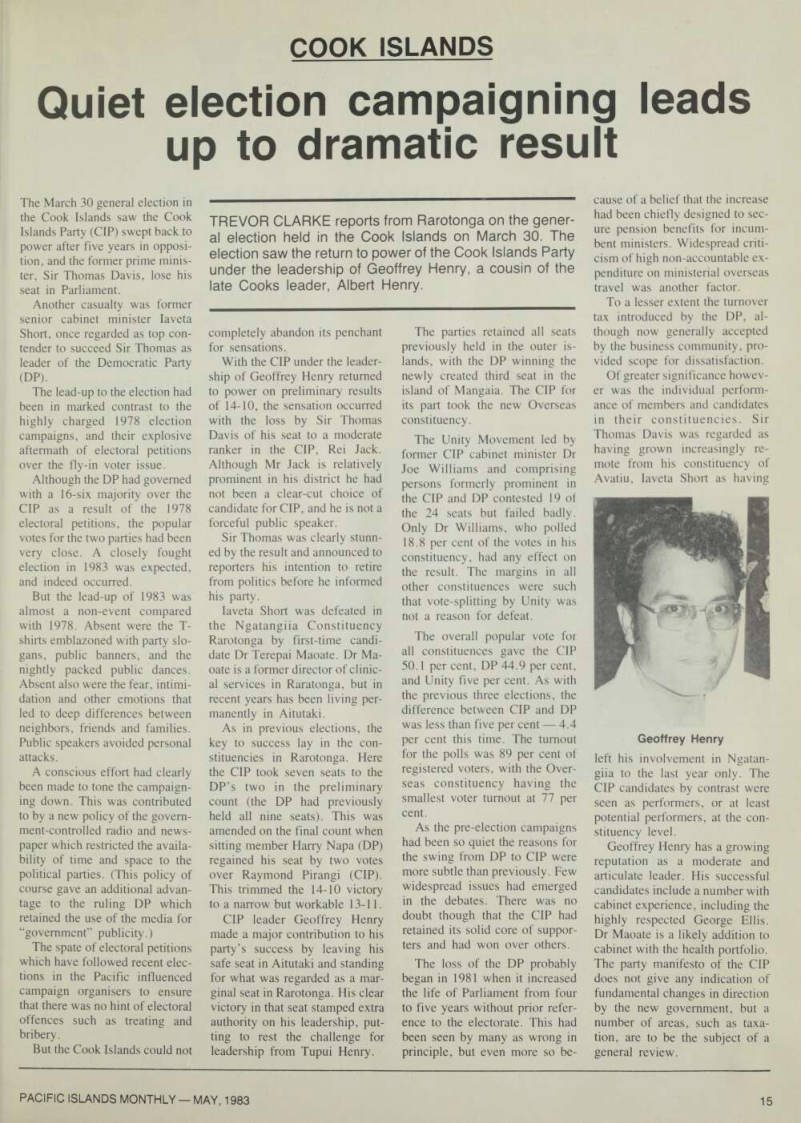
TREVOR CLARKE reports from Rarotonga on the gener al election held in the Cook Islands on March 30. The election saw the return to power of the Cook Islands Party under the leadership of Geoffrey Henry, a cousin of the late Cooks leader, Albert Henry.
The March 30 general election in the Cook Islands saw the Cook Islands Party (CIP) swept back to power after five years in opposi tion, and the former prime minis ter, Sir Thomas Davis, lose his seat in Parliament.
Another casualty was former senior cabinet minister laveta Short, once regarded as top con tender to succeed Sir Thomas as leader of the Democratic Party (DP).
The lead-up to the election had been in marked contrast to the highly charged 1978 election campaigns, and their explosive aftermath of electoral petitions over the fly-in voter issue.
Although the DP had governed with a 16-six majority over the CIP as a result of the 1978 electoral petitions, the popular votes for the two parties had been very close. A closely fought election in 1983 was expected, and indeed occurred.
But the lead-up of 1983 was almost a non-event compared with 1978. Absent were the T shirts emblazoned with party slo gans, public banners, and the nightly packed public dances.
Absent also were the fear, intimi dation and other emotions that led to deep differences between neighbors, friends and families.
Public speakers avoided personal attacks.
A conscious effort had clearly been made to tone the campaign ing down. This was contributed to by a new policy of the govern ment-controlled radio and news paper which restricted the availa bility of time and space to the political parties. (This policy of course gave an additional advan tage to the ruling DP which retained the use of the media for “government” publicity.) The spate of electoral petitions which have followed recent elec tions in the Pacific influenced campaign organisers to ensure that there was no hint of electoral offences such as treating and bribery.
But the Cook Islands could not
completely abandon its penchant for sensations.
With the CIP under the leader ship of Geoffrey Henry returned to power on preliminary results of 14-10, the sensation occurred with the loss by Sir Thomas Davis of his seat to a moderate ranker in the CIP, Rei Jack.
Although Mr Jack is relatively prominent in his district he had not been a clear-cut choice of candidate for CIP, and he is not a forceful public speaker.
Sir Thomas was clearly stunn ed by the result and announced to reporters his intention to retire from politics before he informed his party. laveta Short was defeated in the Ngatangiia Constituency Rarotonga by first-time candi date Dr Terepai Maoate. Dr Ma oate is a former director of clinic al services in Raratonga, but in recent years has been living per manently in Aitutaki.
As in previous elections, the key to success lay in the con stituencies in Rarotonga. Here the CIP took seven seats to the DP’s two in the preliminary count (the DP had previously held all nine seats). This was amended on the final count when sitting member Harry Napa (DP) regained his seat by two votes over Raymond Pirangi (CIP).
This trimmed the 14-10 victory to a narrow but workable 13-11.
CIP leader Geoffrey Henry made a major contribution to his party’s success by leaving his safe seat in Aitutaki and standing for what was regarded as a mar ginal seat in Rarotonga. His clear victory in that seat stamped extra authority on his leadership, put ting to rest the challenge for leadership from Tupui Henry.
The parties retained all seats previously held in the outer is lands, with the DP winning the newly created third seat in the island of Mangaia. The CIP for its part took the new Overseas
constituency.
The Unity Movement led by former CIP cabinet minister Dr Joe Williams and comprising
persons formerly prominent in
the CIP and DP contested 19 of the 24 seats but failed badly.
Only Dr Williams, who polled 18.8 per cent of the votes in his constituency, had any effect on the result. The margins in all other constituences were such
that vote-splitting by Unity was
not a reason for defeat.
The overall popular vote for all constituences gave the CIP 50.1 per cent, DP 44.9 per cent, and Unity five per cent. As with the previous three elections, the difference between CIP and DP was less than five per cent 4.4 per cent this time. The turnout for the polls was 89 per cent of registered voters, with the Over
seas constituency having the
smallest voter turnout at 77 per cent.
As the pre-election campaigns
had been so quiet the reasons for the swing from DP to CIP were more subtle than previously. Few widespread issues had emerged in the debates. There was no doubt though that the CIP had retained its solid core of suppor ters and had won over others.
The loss of the DP probably began in 1981 when it increased the life of Parliament from four to five years without prior refer ence to the electorate. This had been seen by many as wrong in principle, but even more so be
cause of a belief that the increase had been chiefly designed to sec ure pension benefits for incum bent ministers. Widespread criti cism of high non-accountable ex penditure on ministerial overseas travel was another factor.
To a lesser extent the turnover tax introduced by the DP, al though now generally accepted by the business community, pro vided scope for dissatisfaction.
Of greater significance howev er was the individual perform ance of members and candidates in their constituencies. Sir Thomas Davis was regarded as having grown increasingly re mote from his constituency of Avatiu, laveta Short as having
left his involvement in Ngatan giia to the last year only. The CIP candidates by contrast were seen as performers, or at least potential performers, at the con stituency level.
Geoffrey Henry has a growing reputation as a moderate and articulate leader. His successful candidates include a number with cabinet experience, including the highly respected George Ellis.
Dr Maoate is a likely addition to cabinet with the health portfolio.
The party manifesto of the CIP does not give any indication of fundamental changes in direction by the new government, but a number of areas, such as taxa tion, are to be the subject of a general review.
Geoffrey Henry
Advertisements & other items, p. 16 (1 item)
Solarex
5 BELLONA AVE., REGENTS PARK 2143 AUSTRALIA TELEPHONE (02) 644 5055 TELEX AA 21975
ELECTRICITY FROM SUNLIGHT
m \
VILLAGE POWER
HOUSE LIGHTING
REFRIGERATION
WATER PUMPING
COMMUNICATIONS
MILITARY
MARINE
One of the earths most abunbant elements, Silicon, is the basic ingredient of the two materials shown here sand, and the solar cell.
Combined together as a single panel or in an array of multiple panels, and by adding one extra free ingredient sunlight solar cells can generate sufficient electricity for almost any application.
a deportation
The Month
Inside story of a deportation
• Long exile for • France unveils Bikini people Pl 9 new plan P2l
• Regional role of Hawaii P 27
• Stormy weather, stormy vote P 23
“When are you leaving? You’re in danger.”
The words coming over the phone lacked any trace of con cern. The voice of the man de scribing himself as “John Smith” reminded Voice of Vanuatu staff people of a source which is sel dom far from the prime minis ter’s side . . .
Then, screeching to a halt out side the newspaper’s office, came a truck of the Mobile Force, the military wing of Vanuatu’s police.
The truck was filled with sol diers. One got out, came to the office, and asked for a three month subscription to Voice of Vanuatu. When I asked him to come back the following week, he left with a broad grin on his face . . .
These were two incidents, minor frustrations, which occurr ed during a morning in the last week of production of Voice of Vanuatu.
At any time from March 12 when the “Order of Removal from Vanuatu” and the “Notice to Leave Vanuatu” were served, I could have been jailed.
The order, signed by the Minister of Home Affairs, Sela Molisa, said I might be kept in prison or in police custody, at his discretion, and while in jail this would be lawful custody.
My priority was clear. If I
were to stand by the freedom of
the press and speech, granted by
Vanuatu’s constitution, then I had to exercise the right to con tinue producing the newspaper.
The order and the notice gave me two weeks to leave Vanuatu.
The notice described me as an undesirable resident, and as a
security threat.
The papers were served on Saturday, March 12, at 9 p.m. in my office, by Commissioner of
English-born Christine Coombe was a freelance journalist in Vanuatu, and was established there before independ ence. She established and operated the Voice of Vanuatu newspaper, and she was Vanuatu correspondent for RIM and for Radio Australia. She was deported in March following an unsuccessful appeal against an order signed by Home Affairs Minister Sela Molisa. The order declared her to be an undesirable resident and to be a security risk.
Here she tells of her last weeks in Vanuatu before being put on an aircraft for Australia.
Police and Principal Immigration Officer, Bill Herman.
When the news got out, there was a public outcry thoughout Vanuatu. A petition was cir culated at the instigation of read ers. Page by page it was de livered to the prime minister’s office.
The petition was headed “We
want Voice of Vanuatu and free dom of speech”. All but one of the signatures were from Melanesians.
Foreigners put their heads in the sand. Friends insisted the telephones were tapped and the office bugged. Local advertisers grew scarce. One said the com pany feared to be seen supporting Voice of Vanuatu.
While reporters tend to be quick to notice policemen and police cars, I’m confident my movements were being watched.
I rarely went anywhere unaccom panied by a staff member. They knew to contact our lawyer if I didn’t come back when I said I would.
Their support and the support
from other colleagues was re markable. But I was shattered to hear that my staff had spent most of one morning discussing what a “free press” was. They’d come to the conclusion that it meant Christine could write just what she liked. Quickly I put them straight. I thought I’d explained the principles of a free press well
enough. But what they needed was to see it being exercised.
From then on they confidently snubbed the many attempts to undermine their will.
Privately we kept our spirits
up by re-writing a few hymns.
The favorite was “Amazing Grace”. I threatened staff with immediate dismissal if they sang it in the streets. They laughed.
Port-Vila lawyers, Hudson and Co., were instructed on the
Monday morning following the
notices being served.
Parliament opened that week and the first point of the opening speech from Leader of the Op position Vincent Boulekone was that the constitution had again been defiled by the deportation order on the editor of Voice of Vanuatu.
Voice of Vanuatu has closed its doors, he said, government has 100 per cent control of its information weekly and the na tional radio. There will be no freedom of speech, the Opposi tion Leader said.
While Voice of Vanuatu was rolling from the presses on the Friday following the opening of parliament the leader of the op position fought to have his open
ing speech accurately recorded.
The official parliamentary re cords had blurred his comments on freedom of speech, he said.
Hudson and Co. wrote to the minister for home affairs asking for reconsideration of the order and notice on the grounds that
they infringed the constitution
and proclamations by the general
assembly of the United Nations which both uphold the freedom of speech and the right to work.
Report from Vanuatu Christine Coombe
Voice Of Vanuatu
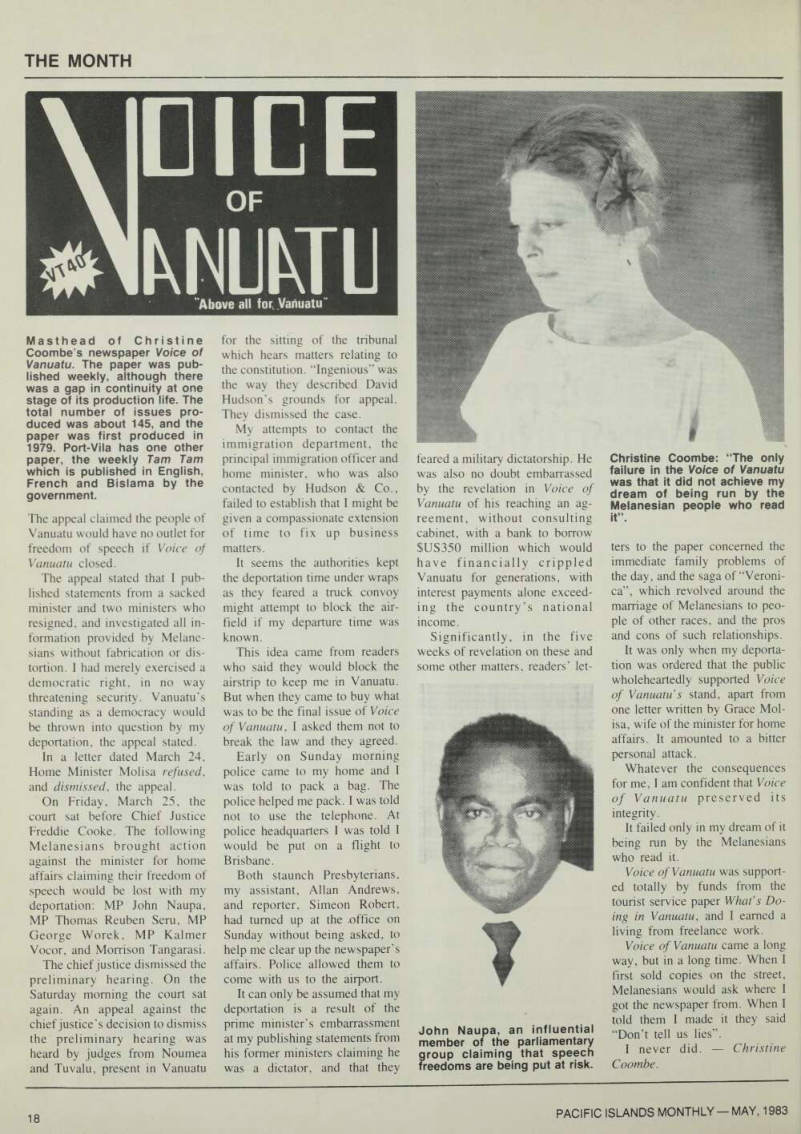
Above all for Vanuatu
Masthead of Christine Coombe’s newspaper Voice of Vanuatu. The paper was pub lished weekly, although there was a gap in continuity at one stage of its production life. The total number of issues pro duced was about 145, and the paper was first produced in 1979. Port-Vila has one other paper, the weekly Tam Tam which is published in English, French and Bislama by the government.
The appeal claimed the people of Vanuatu would have no outlet for freedom of speech if Voice of Vanuatu closed.
The appeal stated that I pub lished statements from a sacked minister and two ministers who resigned, and investigated all in formation provided by Melane sians without fabrication or dis tortion. I had merely exercised a democratic right, in no way
threatening security. Vanuatu’s
standing as a democracy would be thrown into question by my
deportation, the appeal stated.
In a letter dated March 24, Home Minister Molisa refused, and dismissed, the appeal.
On Friday, March 25, the court sat before Chief Justice Freddie Cooke. The following Melanesians brought action against the minister for home affairs claiming their freedom of speech would be lost with my deportation: MP John Naupa, MP Thomas Reuben Seru, MP George Worek, MP Kalmer Vocor, and Morrison Tangarasi.
The chief justice dismissed the preliminary hearing. On the Saturday morning the court sat again. An appeal against the chief justice’s decision to dismiss
the preliminary hearing was
heard by judges from Noumea and Tuvalu, present in Vanuatu
for the sitting of the tribunal which hears matters relating to the constitution. “Ingenious” was the way they described David
Hudson’s grounds for appeal.
They dismissed the case.
My attempts to contact the
immigration department, the
principal immigration officer and
home minister, who was also contacted by Hudson & Co., failed to establish that I might be
given a compassionate extension
of time to fix up business matters.
It seems the authorities kept the deportation time under wraps as they feared a truck convoy might attempt to block the air field if my departure time was known.
This idea came from readers who said they would block the airstrip to keep me in Vanuatu.
But when they came to buy what was to be the final issue of Voice of Vanuatu, I asked them not to break the law and they agreed.
Early on Sunday morning
police came to my home and I was told to pack a bag. The police helped me pack. I was told not to use the telephone. At police headquarters I was told I would be put on a flight to Brisbane.
Both staunch Presbyterians, my assistant, Allan Andrews, and reporter, Simeon Robert, had turned up at the .office on Sunday without being asked, to help me clear up the newspaper’s affairs. Police allowed them to come with us to the airport.
It can only be assumed that my deportation is a result of the prime minister’s embarrassment at my publishing statements from his former ministers claiming he was a dictator, and that they
feared a military dictatorship. He was also no doubt embarrassed by the revelation in Voice of Vanuatu of his reaching an ag reement, without consulting cabinet, with a bank to borrow SUS3SO million which would have financially crippled Vanuatu for generations, with interest payments alone exceed ing the country’s national income.
Significantly, in the five weeks of revelation on these and some other matters, readers’ let-
ters to the paper concerned the
immediate family problems of
the day, and the saga of “Veroni ca”, which revolved around the marriage of Melanesians to peo ple of other races, and the pros and cons of such relationships.
It was only when my deporta tion was ordered that the public
wholeheartedly supported Voice
of Vanuatu’s stand, apart from one letter written by Grace Mol isa, wife of the minister for home affairs. It amounted to a bitter
personal attack.
Whatever the consequences for me, I am confident that Voice
of Vanuatu preserved its
integrity.
It failed only in my dream of it being run by the Melanesians who read it.
Voice of Vanuatu was support ed totally by funds from the tourist service paper What’s Do ing in Vanuatu, and I earned a living from freelance work.
Voice of Vanuatu came a long way, but in a long time. When I first sold copies on the street, Melanesians would ask where I got the newspaper from. When I told them I made it they said “Don’t tell us lies”.
I never did.
Christine
Coombe.
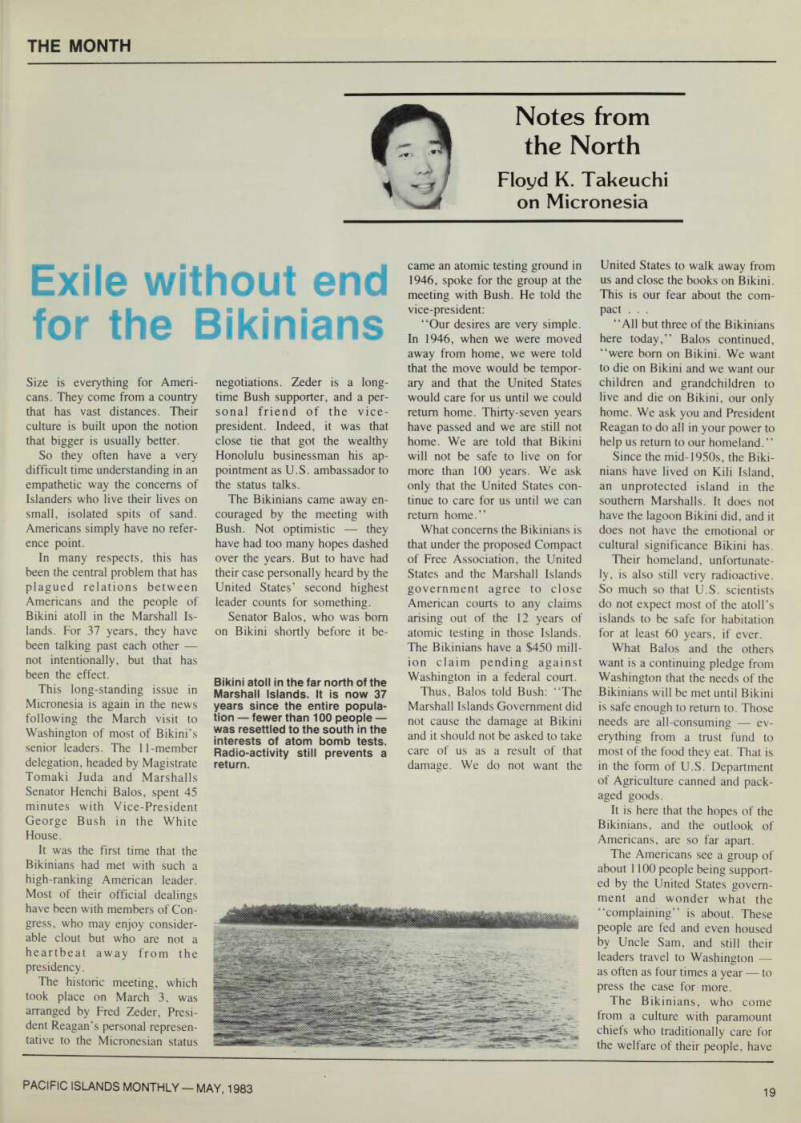
John Naupa, an influential member of the parliamentary group claiming that speech freedoms are being put at risk.
Christine Coombe: “The only failure in the Voice of Vanuatu was that it did not achieve my dream of being run by the Melanesian people who read it”.
Exile without end

for the Bikinians
Size is everything for Ameri cans. They come from a country that has vast distances. Their culture is built upon the notion that bigger is usually better.
So they often have a very difficult time understanding in an empathetic way the concerns of Islanders who live their lives on small, isolated spits of sand.
Americans simply have no refer ence point.
In many respects, this has been the central problem that has plagued relations between Americans and the people of Bikini atoll in the Marshall Is lands. For 37 years, they have been talking past each other not intentionally, but that has been the effect.
This long-standing issue in Micronesia is again in the news following the March visit to Washington of most of Bikini’s senior leaders. The 11-member delegation, headed by Magistrate Tomaki Juda and Marshalls Senator Henchi Balos, spent 45 minutes with Vice-President George Bush in the White House.
It was the first time that the Bikinians had met with such a high-ranking American leader.
Most of their official dealings have been with members of Con gress, who may enjoy consider able clout but who are not a heartbeat away from the presidency.
The historic meeting, which took place on March 3, was arranged by Fred Zeder, Presi dent Reagan’s personal represen tative to the Micronesian status
negotiations. Zeder is a long time Bush supporter, and a per sonal friend of the vice president. Indeed, it was that close tie that got the wealthy Honolulu businessman his ap pointment as U.S. ambassador to the status talks.
The Bikinians came away en couraged by the meeting with Bush. Not optimistic they have had too many hopes dashed over the years. But to have had their case personally heard by the United States’ second highest leader counts for something.
Senator Balos, who was bom on Bikini shortly before it be-
came an atomic testing ground in 1946, spoke for the group at the meeting with Bush. He told the
vice-president;
“Our desires are very simple.
In 1946, when we were moved away from home, we were told that the move would be tempor ary and that the United States would care for us until we could return home. Thirty-seven years have passed and we are still not home. We are told that Bikini will not be safe to live on for more than 100 years. We ask only that the United States con tinue to care for us until we can return home.”
What concerns the Bikinians is that under the proposed Compact of Free Association, the United States and the Marshall Islands government agree to close American courts to any claims arising out of the 12 years of atomic testing in those Islands.
The Bikinians have a $450 mill
ion claim pending against
Washington in a federal court.
Thus, Balos told Bush: “The Marshall Islands Government did not cause the damage at Bikini and it should not be asked to take care of us as a result of that damage. We do not want the
United States to walk away from us and close the books on Bikini.
This is our fear about the com pact . . .
“All but three of the Bikinians here today,” Bales continued, “were bom on Bikini. We want to die on Bikini and we want our children and grandchildren to live and die on Bikini, our only home. We ask you and President Reagan to do all in your power to help us return to our homeland. ’ ’
Since the mid-19505, the Biki nians have lived on Kili Island, an unprotected island in the southern Marshalls. It does not have the lagoon Bikini did, and it does not have the emotional or cultural significance Bikini has.
Their homeland, unfortunate ly, is also still very radioactive.
So much so that U.S. scientists do not expect most of the atoll’s islands to be safe for habitation for at least 60 years, if ever.
What Balos and the others want is a continuing pledge from Washington that the needs of the Bikinians will be met until Bikini is safe enough to return to. Those needs are all-consuming ev erything from a trust fund to most of the food they eat. That is in the form of U.S. Department of Agriculture canned and pack aged goods.
It is here that the hopes of the Bikinians, and the outlook of Americans, are so far apart.
The Americans see a group of about 1100 people being support ed by the United States govern ment and wonder what the “complaining” is about. These people are fed and even housed by Uncle Sam, and still their leaders travel to Washington as often as four times a year to press the case for more.
The Bikinians, who come from a culture with paramount chiefs who traditionally care for the welfare of their people, have
Notes from the North Floyd K. Takeuchi on Micronesia
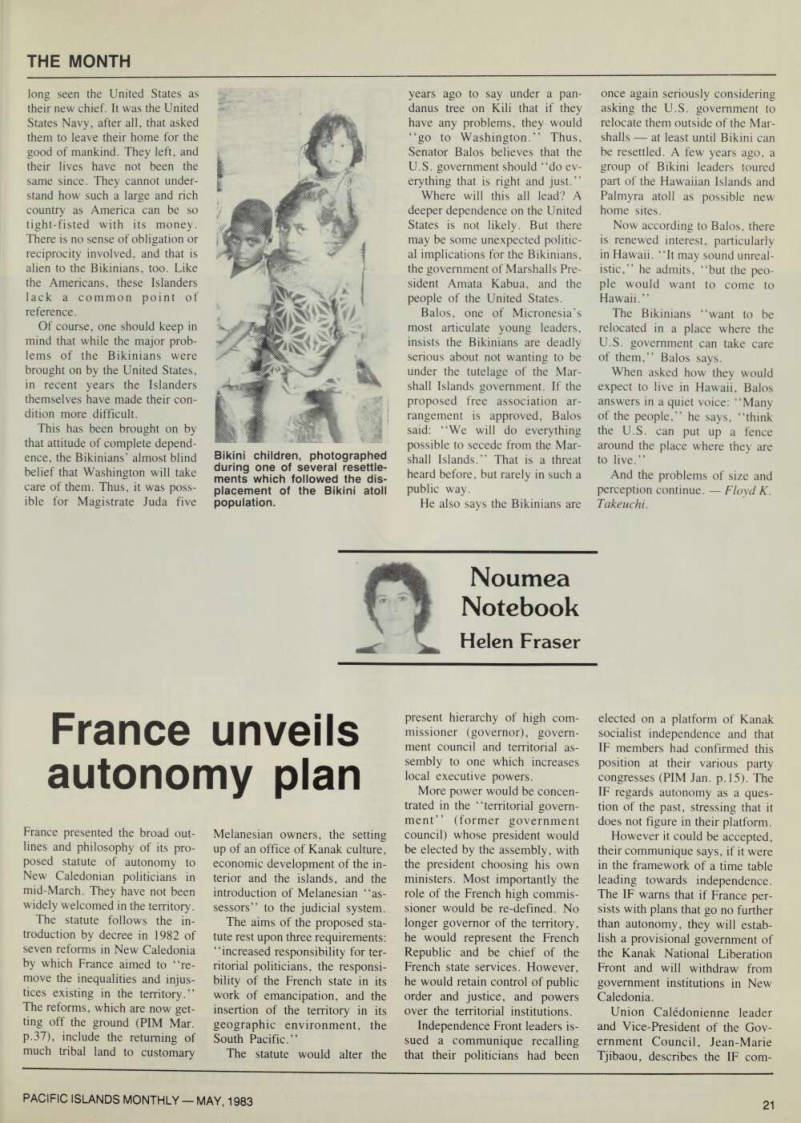
Bikini atoll in the far north of the Marshall Islands. It is now 37 years since the entire popula tion - fewer than 100 people was resettled to the south in the interests of atom bomb tests.
Radio-activity still prevents a return.
long seen the United States as their new chief. It was the United States Navy, after all, that asked them to leave their home for the good of mankind. They left, and their lives have not been the same since. They cannot under stand how such a large and rich country as America can be so tight-fisted with its money.
There is no sense of obligation or reciprocity involved, and that is alien to the Bikinians, too. Like the Americans, these Islanders lack a common point of reference.
Of course, one should keep in mind that while the major prob lems of the Bikinians were brought on by the United States, in recent years the Islanders themselves have made their con dition more difficult.
This has been brought on by that attitude of complete depend ence, the Bikinians’ almost blind belief that Washington will take care of them. Thus, it was poss ible for Magistrate Juda five
years ago to say under a pan danus tree on Kili that if they have any problems, they would “go to Washington.” Thus, Senator Balos believes that the U.S. government should “do ev
erything that is right and just.”
Where will this all lead? A deeper dependence on the United States is not likely. But there may be some unexpected politic al implications for the Bikinians, the government of Marshalls Pre sident Amata Kabua, and the people of the United States.
Balos, one of Micronesia’s most articulate young leaders, insists the Bikinians are deadly serious about not wanting to be under the tutelage of the Mar shall Islands government. If the proposed free association ar rangement is approved, Balos said: “We will do everything possible to secede from the Mar shall Islands.” That is a threat heard before, but rarely in such a
public way.
He also says the Bikinians are
once again seriously considering asking the U.S. government to relocate them outside of the Mar shalls at least until Bikini can be resettled. A few years ago, a group of Bikini leaders toured part of the Hawaiian Islands and Palmyra atoll as possible new home sites.
Now according to Balos, there is renewed interest, particularly in Hawaii. “It may sound unreal istic,” he admits, “but the peo ple would want to come to Hawaii.”
The Bikinians “want to be relocated in a place where the U.S. government can take care of them,” Balos says.
When asked how they would expect to live in Hawaii, Balos answers in a quiet voice: “Many of the people,” he says, “think the U.S. can put up a fence around the place where they are to live.”
And the problems of size and
perception continue.
Takeuchi.
Floyd K.
Bikini children, photographed during one of several resettle ments which followed the dis placement of the Bikini atoll population.
Advertisements & other items, p. 20 (1 item)
Our Super 80 gives
The Super 80's newly-designed undeline ceiling with suspended luggage compartments, and the roominess of three-and-iwo seating, are shown in this Super 80 cabin mock-up.
I & ■ 1 WT
four out of five passengers
a window or an aisle seat.
The first thing you’ll feel when you step into our new Super 80 is a sense of space-from front to back and side to side.
You won’t find that in narrow-cabin jets with six-across seating. They stuff 159 passengers into 28 rows. Our new Super 80 stretches 152 seats along 32 rows. Four additional rows, all oniy five seats wide, take away the crowded feeling.
The Super 80 is a realization of advantages we’ve always had in DC-9 jetliners-wider seats and a wider aisle, because we have only five seats across instead of six.
Four out of five passengers get a window or aisle seat in the Super 80.
Wherever you sit, you get more room to yourself.
Every seat is just as wide as those in the jumbo jets.
We’ve redesigned the seat supports, too, so carry-on luggage slips easily underneath.
Because our New Super 80 is quiet on the outside, you’d expect it to be quieter inside-and it is. Frankly, you have to hear it (or not hear it) to believe it.
The new DC-9 Super 80. It’s everything the world needs to fly comfortably in the future.
And it’s here, today.
Supe
/MCDOyV/V
autonomy plan
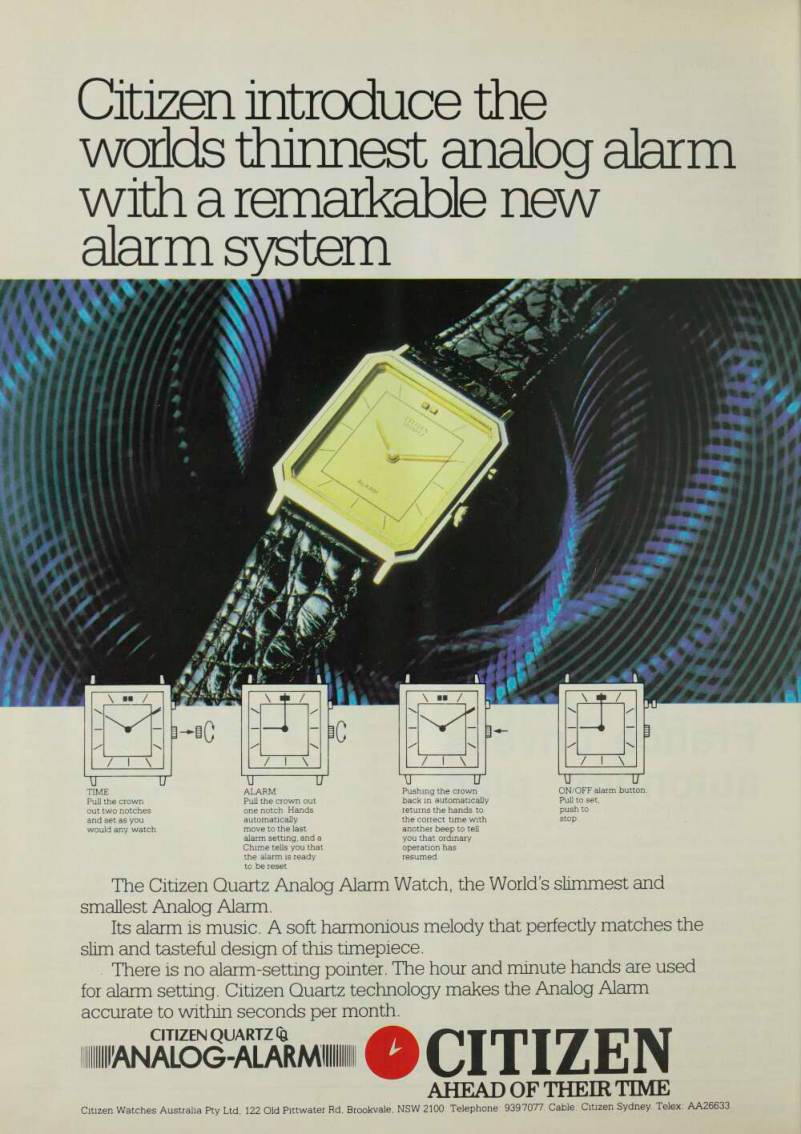
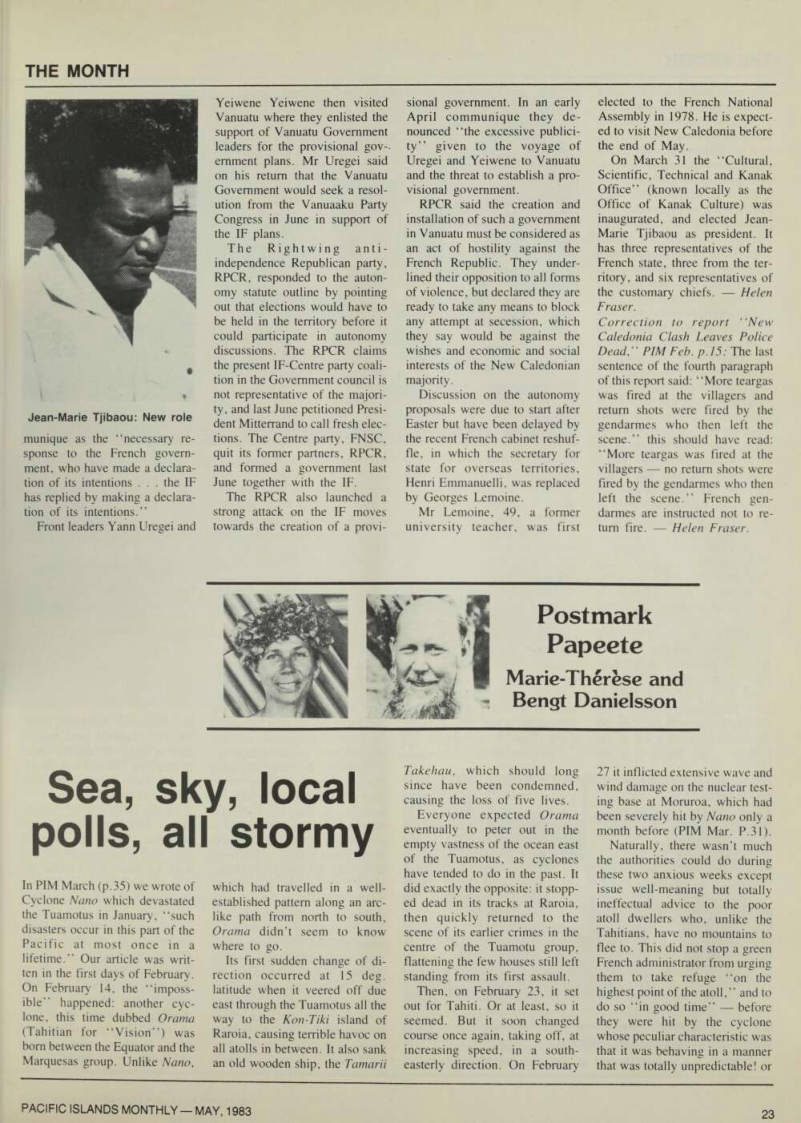
France unveils autonomy plan
France presented the broad out lines and philosophy of its pro posed statute of autonomy to New Caledonian politicians in mid-March. They have not been widely welcomed in the territory.
The statute follows the in troduction by decree in 1982 of seven reforms in New Caledonia by which France aimed to “re move the inequalities and injus tices existing in the territory.”
The reforms, which are now get ting off the ground (PIM Mar. p. 37), include the returning of much tribal land to customary
Melanesian owners, the setting up of an office of Kanak culture, economic development of the in terior and the islands, and the introduction of Melanesian “as sessors” to the judicial system.
The aims of the proposed sta tute rest upon three requirements: “increased responsibility for ter ritorial politicians, the responsi bility of the French state in its work of emancipation, and the insertion of the territory in its geographic environment, the South Pacific.”
The statute would alter the
present hierarchy of high com missioner (governor), govern ment council and territorial as sembly to one which increases local executive powers.
More power would be concen trated in the “territorial govern ment” (former government council) whose president would be elected by the assembly, with the president choosing his own ministers. Most importantly the role of the French high commis sioner would be re-defined. No longer governor of the territory, he would represent the French Republic and be chief of the French state services. However, he would retain control of public order and justice, and powers over the territorial institutions.
Independence Front leaders is sued a communique recalling that their politicians had been
elected on a platform of Kanak socialist independence and that IF members had confirmed this position at their various party congresses (PIM Jan. p. 15). The IF regards autonomy as a ques tion of the past, stressing that it does not figure in their platform.
However it could be accepted, their communique says, if it were in the framework of a time table leading towards independence.
The IF warns that if France per sists with plans that go no further than autonomy, they will estab lish a provisional government of the Kanak National Liberation Front and will withdraw from government institutions in New Caledonia.
Union Caledonienne leader and Vice-President of the Gov ernment Council, Jean-Marie Tjibaou, describes the IF corn-
Noumea Notebook Helen Fraser
munique as the “necessary re sponse to the French govern ment, who have made a declara tion of its intentions ... the IF has replied by making a declara tion of its intentions.”
Front leaders Yann Uregei and
Yeiwene Yeiwene then visited Vanuatu where they enlisted the support of Vanuatu Government leaders for the provisional gov-, emment plans. Mr Uregei said on his return that the Vanuatu Government would seek a resol ution from the Vanuaaku Party Congress in June in support of the IF plans.
The Rightwing anti
independence Republican party,
RPCR, responded to the auton omy statute outline by pointing out that elections would have to be held in the territory before it could participate in autonomy discussions. The RPCR claims the present IF-Centre party coali tion in the Government council is not representative of the majori ty, and last June petitioned Presi dent Mitterrand to call fresh elec tions. The Centre party, FNSC, quit its former partners, RPCR, and formed a government last June together with the IF.
The RPCR also launched a strong attack on the IF moves towards the creation of a provi
sional government. In an early April communique they de nounced “the excessive publici ty” given to the voyage of Uregei and Yeiwene to Vanuatu and the threat to establish a pro visional government.
RPCR said the creation and installation of such a government in Vanuatu must be considered as an act of hostility against the French Republic. They under lined their opposition to all forms of violence, but declared they are ready to take any means to block any attempt at secession, which they say would be against the wishes and economic and social interests of the New Caledonian majority.
Discussion on the autonomy proposals were due to start after Easter but have been delayed by the recent French cabinet reshuf fle, in which the secretary for state for overseas territories, Henri Emmanuelli, was replaced by Georges Lemoine.
Mr Lemoine, 49, a former university teacher, was first
elected to the French National Assembly in 1978. He is expect ed to visit New Caledonia before the end of May.
On March 31 the “Cultural, Scientific, Technical and Kanak Office” (known locally as the Office of Kanak Culture) was inaugurated, and elected Jean- Marie Tjibaou as president. It has three representatives of the French state, three from the ter ritory, and six representatives of the customary chiefs. Helen Fraser.
Correction to report “New Caledonia Clash Leaves Police Dead,” PIM Feb. p. 15: The last sentence of the fourth paragraph of this report said: “More teargas was fired at the villagers and return shots were fired by the gendarmes who then left the scene.” this should have read: “More teargas was fired at the villagers no return shots were fired by the gendarmes who then left the scene.” French gen darmes are instructed not to re
turn fire.
Helen Fraser.
Jean-Marie Tjibaou: New role
Advertisements & other items, p. 22 (1 item)
©Citizen
Citizen introduce the
worlds thinnest analog alarm
with a remarkable new
alarm system
if
'd.V/A
A 4T f. % r ** n
TIME
Pull the crown out two notches and set as you would any watch
ALARM
Pull the crown out one notch Hands automatically move to the last alarm setting, and a Chime tells you that the alarm is ready to be reset.
W D"
Pushing the crown back in automatically returns the hands to the correct time with another beep to tell you that ordinary operation has resumed.
ON/OFF alarm button.
Pull to set, push to stop The Citizen Quartz Analog Alarm Watch, the World’s slimmest and
smallest Analog Alarm.
Its alarm is music. A soft harmonious melody that perfectly matches the slim and tasteful design of this timepiece.
There is no alarm-setting pointer. The hour and minute hands are used for alarm setting. Citizen Quartz technology makes the Analog Alarm
accurate to within seconds per month.
CITIZEN QUARTZ Ql
lIANALOG-ALARMIIIIIII
©CITIZEN
AHEAD OF THEIR TIME
Citizen Watches Australia Pty Ltd, 122 Old Pittwater Rd, Brookvale, NSW 2100. Telephone: 9397077. Cable: Citizen Sydney. Telex: AA26633.
Sea, sky, local
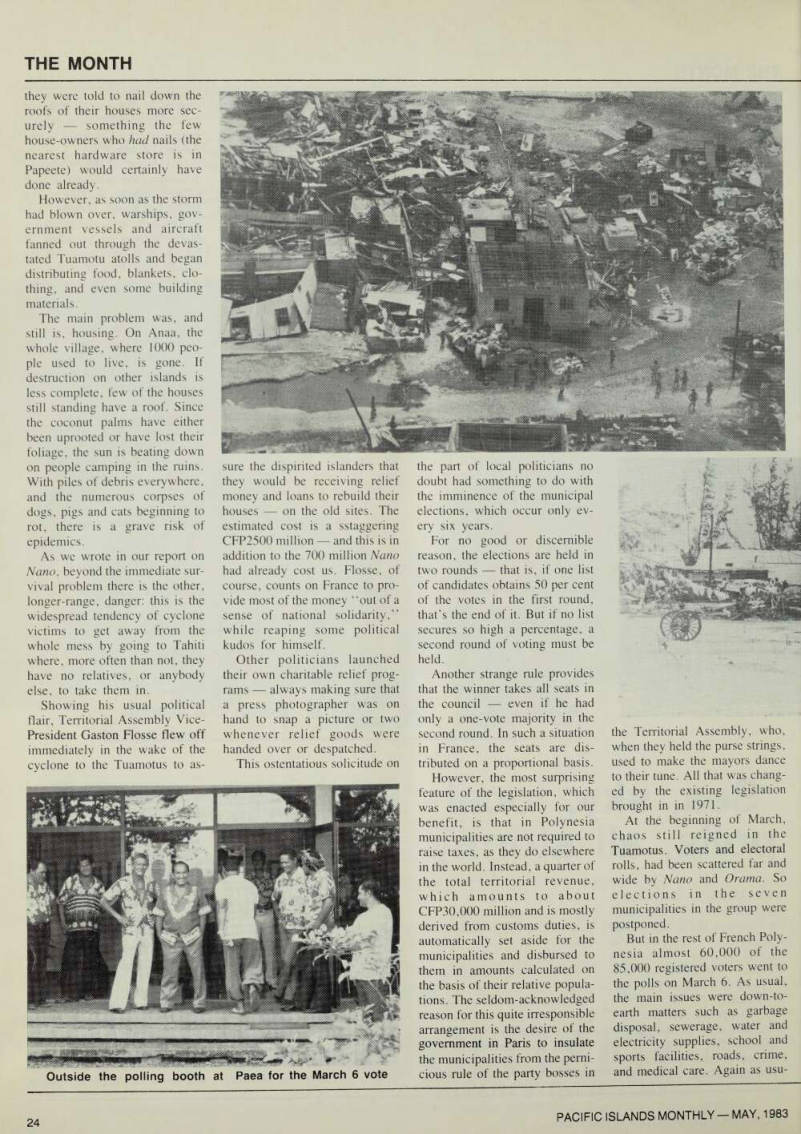
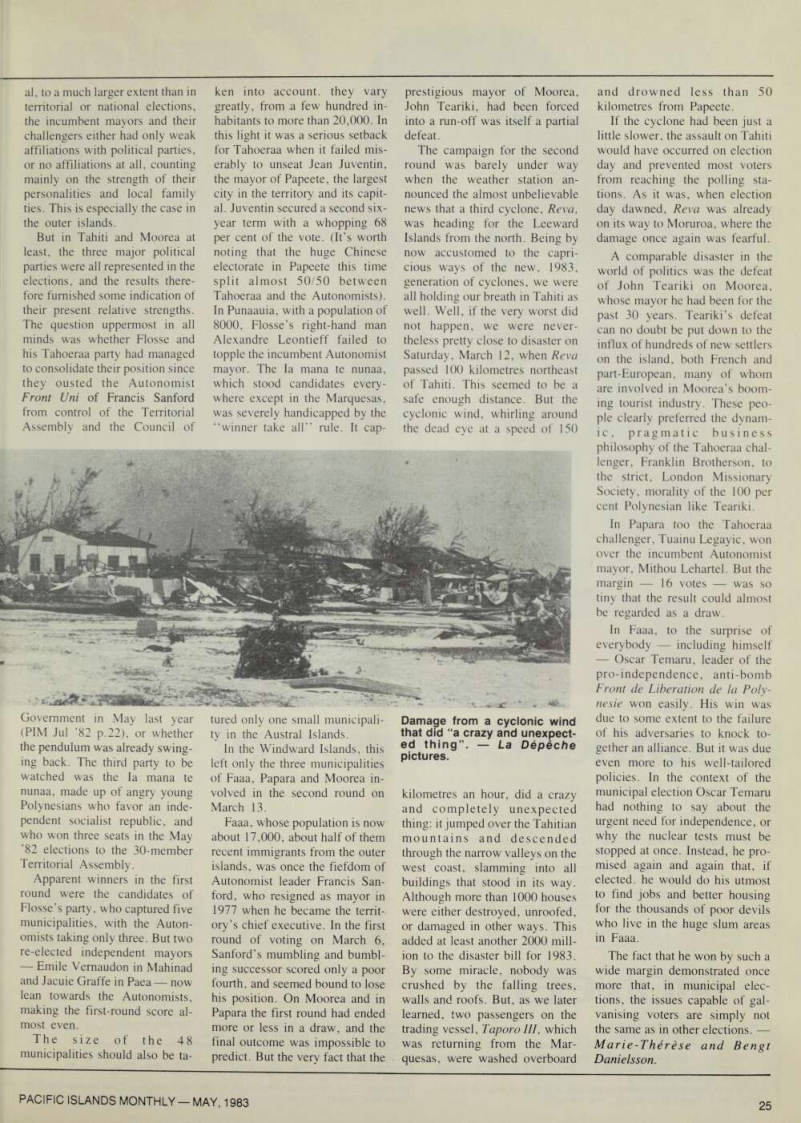
polls, all stormy
In PIM March (p. 35) we wrote of Cyclone Nano which devastated the Tuamotus in January, “such disasters occur in this part of the Pacific at most once in a lifetime.” Our article was writ ten in the first days of February.
On February 14, the “imposs ible” happened; another cyc lone, this time dubbed Orama (Tahitian for “Vision”) was bom between the Equator and the Marquesas group. Unlike Nano,
which had travelled in a well established pattern along an arc like path from north to south, Orama didn’t seem to know where to go.
Its first sudden change of di rection occurred at 15 deg. latitude when it veered off due east through the Tuamotus all the way to the Kon-Tiki island of Raroia, causing terrible havoc on all atolls in between. It also sank an old wooden ship, the Tamarii
Takehau, which should long since have been condemned, causing the loss of five lives.
Everyone expected Orama
eventually to peter out in the empty vastness of the ocean east of the Tuamotus, as cyclones have tended to do in the past. It did exactly the opposite: it stopped dead in its tracks at Raroia, then quickly returned to the scene of its earlier crimes in the centre of the Tuamotu group, flattening the few houses still left standing from its first assault.
Then, on February 23, it set out for Tahiti. Or at least, so it seemed. But it soon changed course once again, taking off, at increasing speed, in a south-
easterly direction. On February
27 it inflicted extensive wave and wind damage on the nuclear test ing base at Moruroa, which had been severely hit by Nano only a month before (PIM Mar. P. 31), Naturally, there wasn’t much the authorities could do during these two anxious weeks except issue well-meaning but totally ineffectual advice to the poor atoll dwellers who, unlike the Tahitians, have no mountains to flee to. This did not stop a green French administrator from urging them to take refuge “on the highest point of the atoll,” and to do so “in good time” before they were hit by the cyclone whose peculiar characteristic was that it was behaving in a manner that was totally unpredictable! or
Postmark Papeete Marie-Thérèse and Bengt Danielsson
they were told to nail down the roofs of their houses more sec urely something the few house-owners who had nails (the nearest hardware store is in Papeete) would certainly have
done already.
However, as soon as the storm had blown over, warships, gov ernment vessels and aircraft fanned out through the devas tated Tuamotu atolls and began distributing food, blankets, clo thing, and even some building materials.
The main problem was, and still is, housing. On Anaa, the whole village, where 1000 peo ple used to live, is gone. If destruction on other islands is less complete, few of the houses still standing have a roof. Since the coconut palms have either been uprooted or have lost their foliage, the sun is beating down on people camping in the ruins.
With piles of debris everywhere, and the numerous corpses of dogs, pigs and cats beginning to rot, there is a grave risk of
epidemics.
As we wrote in our report on Nano, beyond the immediate sur vival problem there is the other, longer-range, danger: this is the
widespread tendency of cyclone
victims to get away from the whole mess by going to Tahiti where, more often than not, they have no relatives, or anybody else, to take them in.
Showing his usual political
flair, Territorial Assembly Vice- President Gaston Flosse flew off immediately in the wake of the cyclone to the Tuamotus to as-
sure the dispirited islanders that they would be receiving relief money and loans to rebuild their houses on the old sites. The estimated cost is a sstaggering CFP2SOO million and this is in addition to the 700 million Nano had already cost us. Flosse, of course, counts on France to pro vide most of the money “out of a sense of national solidarity,’’
while reaping some political
kudos for himself.
Other politicians launched their own charitable relief prog rams always making sure that a press photographer was on hand to snap a picture or two whenever relief goods were handed over or despatched.
This ostentatious solicitude on
the part of local politicians no doubt had something to do with the imminence of the municipal elections, which occur only ev ery six years.
For no good or discernible reason, the elections are held in two rounds that is, if one list of candidates obtains 50 per cent of the votes in the first round, that’s the end of it. But if no list secures so high a percentage, a second round of voting must be held.
Another strange rule provides that the winner takes all seats in the council even if he had only a one-vote majority in the second round. In such a situation in France, the seats are dis tributed on a proportional basis.
However, the most surprising feature of the legislation, which was enacted especially for our benefit, is that in Polynesia municipalities are not required to raise taxes, as they do elsewhere in the world. Instead, a quarter of the total territorial revenue, which amounts to about CFP3O,OOO million and is mostly derived from customs duties, is automatically set aside for the municipalities and disbursed to them in amounts calculated on the basis of their relative popula tions. The seldom-acknowledged reason for this quite irresponsible arrangement is the desire of the government in Paris to insulate the municipalities from the perni cious rule of the party bosses in
the Territorial Assembly, who, when they held the purse strings, used to make the mayors dance to their tune. All that was chang ed by the existing legislation brought in in 1971.
At the beginning of March, chaos still reigned in the Tuamotus. Voters and electoral rolls, had been scattered far and wide by Nano and Orama. So elections in the seven municipalities in the group were
postponed.
But in the rest of French Poly nesia almost 60,000 of the 85,000 registered voters went to the polls on March 6. As usual, the main issues were down-to earth matters such as garbage disposal, sewerage, water and
electricity supplies, school and
sports facilities, roads, crime, and medical care. Again as usu
Outside the polling booth at Paea for the March 6 vote
al, to a much larger extent than in territorial or national elections, the incumbent mayors and their challengers either had only weak
affiliations with political parties,
or no affiliations at all, counting mainly on the strength of their personalities and local family ties. This is especially the case in the outer islands.
But in Tahiti and Moorea at least, the three major political parties were all represented in the elections, and the results there fore furnished some indication of their present relative strengths.
The question uppermost in all minds was whether Flosse and his Tahoeraa party had managed to consolidate their position since they ousted the Autonomist Front Uni of Francis Sanford from control of the Territorial Assembly and the Council of
Government in May last year (PIM Jul ’B2 p. 22), or whether the pendulum was already swing ing back. The third party to be watched was the la mana te nunaa, made up of angry young Polynesians who favor an inde pendent socialist republic, and who won three seats in the May ’B2 elections to the 30-member Territorial Assembly.
Apparent winners in the first round were the candidates of Flosse’s party, who captured five municipalities, with the Auton omists taking only three. But two re-elected independent mayors Emile Vernaudon in Mahinad and Jacuie Graffe in Paea now lean towards the Autonomists, making the first-round score al most even.
The size of the 48 municipalities should also be ta
ken into account, they vary greatly, from a few hundred in habitants to more than 20,000. In this light it was a serious setback for Tahoeraa when it failed mis erably to unseat Jean Juventin, the mayor of Papeete, the largest city in the territory and its capit al. Juventin secured a second six year term with a whopping 68 per cent of the vote. (It’s worth noting that the huge Chinese electorate in Papeete this time split almost 50/50 between Tahoeraa and the Autonomists).
In Punaauia, with a population of 8000, Flosse’s right-hand man Alexandre Leontieff failed to topple the incumbent Autonomist mayor. The la mana te nunaa, which stood candidates every where except in the Marquesas, was severely handicapped by the “winner take all" rule. It cap
tured only one small municipali ty in the Austral Islands.
In the Windward Islands, this left only the three municipalities of Faaa, Papara and Moorea in volved in the second round on March 13.
Faaa, whose population is now about 17,000, about half of them recent immigrants from the outer islands, was once the fiefdom of Autonomist leader Francis San ford, who resigned as mayor in 1977 when he became the territ ory’s chief executive. In the first round of voting on March 6, Sanford’s mumbling and bumbl ing successor scored only a poor fourth, and seemed bound to lose his position. On Moorea and in Papara the first round had ended more or less in a draw, and the final outcome was impossible to predict. But the very fact that the
prestigious mayor of Moorea, John Teariki, had been forced into a run-off was itself a partial defeat.
The campaign for the second round was barely under way when the weather station an nounced the almost unbelievable news that a third cyclone, Reva, was heading for the Leeward Islands from the north. Being by now accustomed to the capri cious ways of the new, 1983, generation of cyclones, we were all holding our breath in Tahiti as well. Well, if the very worst did not happen, we were never theless pretty close to disaster on Saturday, March 12, when Reva passed 100 kilometres northeast of Tahiti. This seemed to be a safe enough distance. But the
cyclonic wind, whirling around
the dead eye at a speed of 150
kilometres an hour, did a crazy and completely unexpected thing: it jumped over the Tahitian mountains and descended through the narrow valleys on the west coast, slamming into all buildings that stood in its way.
Although more than 1000 houses were either destroyed, unroofed, or damaged in other ways. This added at least another 2000 mill ion to the disaster bill for 1983.
By some miracle, nobody was crushed by the falling trees, walls and roofs. But, as we later learned, two passengers on the trading vessel, Taporolll, which was returning from the Mar quesas, were washed overboard
and drowned less than 50 kilometres from Papeete.
If the cyclone had been just a little slower, the assault on Tahiti would have occurred on election day and prevented most voters from reaching the polling sta tions. As it was, when election day dawned, Reva was already on its way to Moruroa, where the damage once again was fearful.
A comparable disaster in the world of politics was the defeat of John Teariki on Moorea, whose mayor he had been for the past 30 years. Teariki’s defeat can no doubt be put down to the influx of hundreds of new settlers on the island, both French and part-European, many of whom are involved in Moorea’s boom ing tourist industry. These peo
ple clearly preferred the dynam
ic, pragmatic business philosophy of the Tahoeraa chal lenger, Franklin Brotherson, to the strict, London Missionary Society, morality of the 100 per cent Polynesian like Teariki.
In Papara too the Tahoeraa
challenger, Tuainu Legayic, won
over the incumbent Autonomist mayor, Mithou Lehartel. But the margin 16 votes was so tiny that the result could almost be regarded as a draw.
In Faaa, to the surprise of
everybody including himself
Oscar Temaru, leader of the
pro-independence, anti-bomb
Front de Liberation de la Poly nesie won easily. His win was due to some extent to the failure of his adversaries to knock to gether an alliance. But it was due even more to his well-tailored policies. In the context of the municipal election Oscar Temaru had nothing to say about the urgent need for independence, or why the nuclear tests must be stopped at once. Instead, he pro mised again and again that, if elected, he would do his utmost to find jobs and better housing for the thousands of poor devils who live in the huge slum areas in Faaa.
The fact that he won by such a wide margin demonstrated once more that, in municipal elec tions, the issues capable of gal vanising voters are simply not the same as in other elections.
Marie-Thérèse and Bengt Danielsson.
Damage from a cyclonic wind that did “a crazy and unexpect ed thing”. - La Dépêche pictures.
Advertisements & other items, p. 26 (1 item)
Gnmom
Portable Component System
w % i : [•
CK-7T
I’d rather Carry Com!
Carry Com packs like a portable, but unpacks into four individual components. It’s a true component system, just like a home hi-fi.
Carry it everywhere and enjoy hi-fi sound with sweet highs and rich lows. The sound is bigger and deeper because the entire front of each speaker is a “Flat Woofer” of a unique Pioneer design.
Carry Com’s stereo FM/MW/SW tuner has quartz-PLL synthesizer accuracy with computer-like preset tuning, even a digital timer and frequency readout. The amp has its own 5-band graphic equalizer to let you adjust the sound to your liking. Cassette taping is fun and easy with Skip-Search, Dolby* noise reduction, metal-tape play and lots more.
Home or away, it’s Carry Com. The only one to play. * ‘Dolby’ and the double-D symbol are trademarks of Dolby Laboratories Licensing Corporation.
CK-7T
(!,)) PIONEER'
For further information, please contact: Australia: Pioneer Electronics Australia Pty. Ltd., P.O. Box 295, Mordialloc, Victoria, 3195 Tel: 580-9911 Fiji Islands: Brijlal & Company,G.P.O. Box No. 362, Suva, Fiji Islands Tel: 22258 New Zealand: Monaco Distributors Ltd., 2 Poland Road, Glenfield, Auckland, New Zealand Tel: (09) 444-9144 Norfolk Island: Burns Philp (Norfolk Island) Ltd, P.O. Box 21, Norfolk Island Vanuatu: Burns Philp (Vanuatu) Ltd, Vila, Vanuatu Nauru Island: Jacob Enterprises, P.O. Box No. 4, Republic of Nauru Tahiti; Tahiti Hi-Fi, P.O. Box 848, Papeete, Tahiti New Caledonia: Menard Pacifique Sari, B.R 3899, Noumea, New Caledonia Tel: 27-62*23 American Samoa: Transpac Corporation, P.O. Box 1477, Pago Pago, American 5am0a96799 Tel: 633-5224 . , 0007 Rarotonga; South Seas International Ltd, P.O. Box 49, Rarotonga, Cook Islands Tel. 232 r Papua New Guinea: Bali Merchants Pty. Ltd, P.O. Box 6103, Boroko Tel: 254887
success story
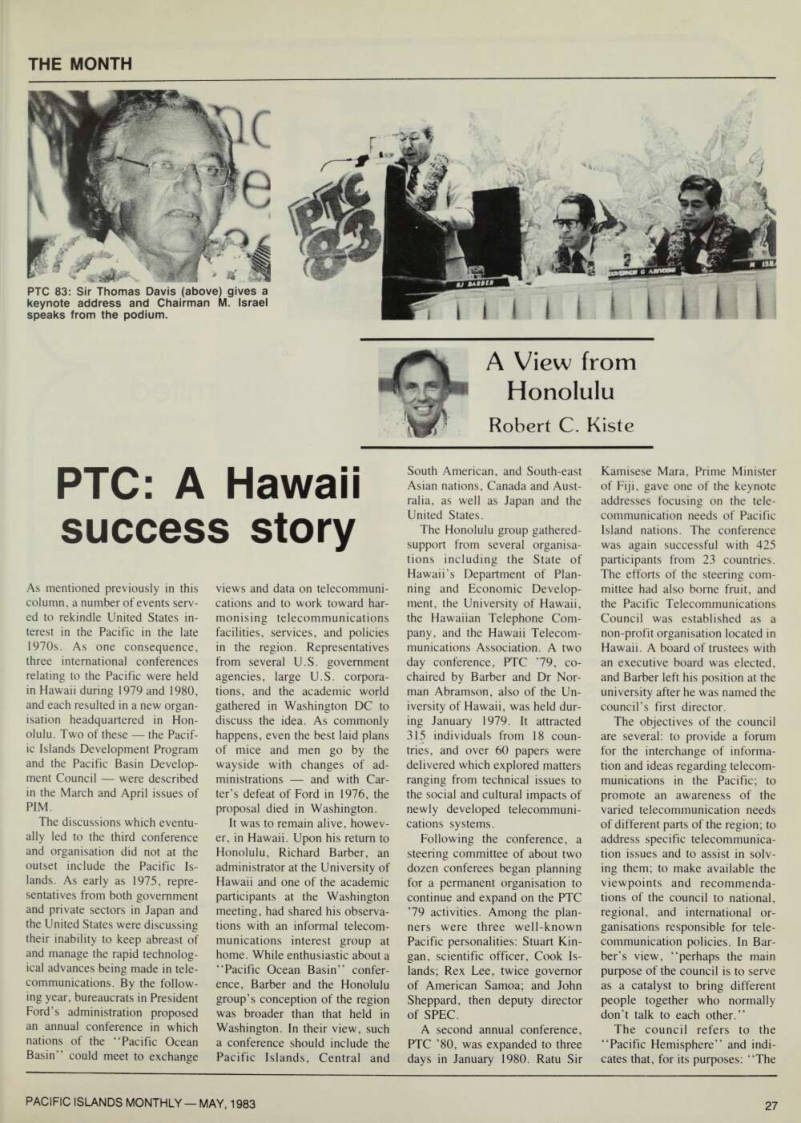

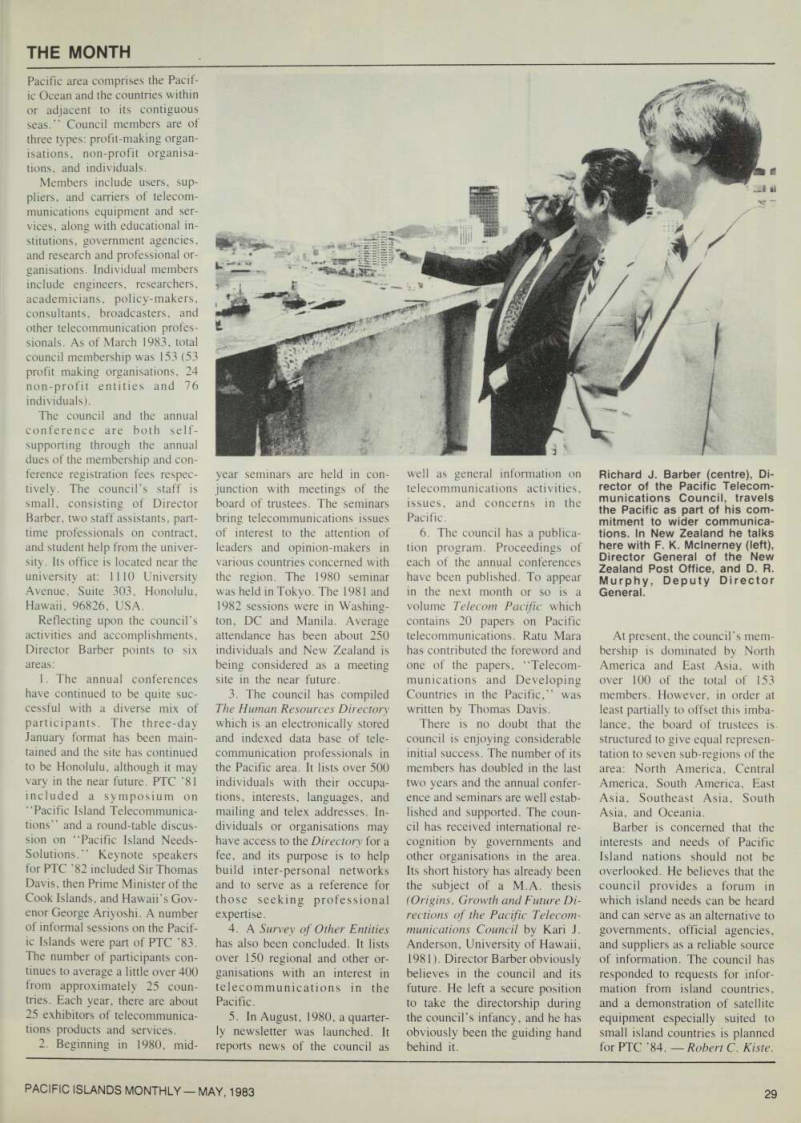
PTC: A Hawaii success story
As mentioned previously in this column, a number of events serv ed to rekindle United States in terest in the Pacific in the late 19705. As one consequence, three international conferences relating to the Pacific were held in Hawaii during 1979 and 1980, and each resulted in a new organ isation headquartered in Hon olulu. Two of these the Pacif
ic Islands Development Program
and the Pacific Basin Develop ment Council were described in the March and April issues of
Pim.
The discussions which eventu ally led to the third conference and organisation did not at the outset include the Pacific Is lands. As early as 1975, repre sentatives from both government and private sectors in Japan and the United States were discussing their inability to keep abreast of and manage the rapid technolog ical advances being made in tele communications. By the follow ing year, bureaucrats in President Ford’s administration proposed an annual conference in which nations of the “Pacific Ocean Basin’’ could meet to exchange
views and data on telecommuni cations and to work toward har monising telecommunications facilities, services, and policies in the region. Representatives from several U.S. government agencies, large U.S. corpora tions, and the academic world gathered in Washington DC to discuss the idea. As commonly happens, even the best laid plans of mice and men go by the wayside with changes of ad ministrations and with Car ter’s defeat of Ford in 1976, the proposal died in Washington.
It was to remain alive, howev er, in Hawaii. Upon his return to Honolulu, Richard Barber, an administrator at the University of Hawaii and one of the academic participants at the Washington meeting, had shared his observa tions with an informal telecom munications interest group at home. While enthusiastic about a “Pacific Ocean Basin’’ confer ence, Barber and the Honolulu group’s conception of the region was broader than that held in Washington. In their view, such a conference should include the Pacific Islands, Central and
South American, and South-east Asian nations, Canada and Aust ralia, as well as Japan and the United States.
The Honolulu group gathered support from several organisa tions including the State of Hawaii’s Department of Plan ning and Economic Develop ment, the University of Hawaii, the Hawaiian Telephone Com pany, and the Hawaii Telecom munications Association. A two day conference, PTC ’79, co chaired by Barber and Dr Nor man Abramson, also of the Un iversity of Hawaii, was held dur ing January 1979. It attracted 315 individuals from 18 coun tries, and over 60 papers were delivered which explored matters ranging from technical issues to the social and cultural impacts of newly developed telecommuni cations systems.
Following the conference, a steering committee of about two dozen conferees began planning for a permanent organisation to continue and expand on the PTC ’79 activities. Among the plan ners were three well-known Pacific personalities; Stuart Kin gan, scientific officer, Cook Is lands; Rex Lee, twice governor of American Samoa; and John Sheppard, then deputy director of SPEC.
A second annual conference, PTC ’BO, was expanded to three days in January 1980. Ratu Sir
Kamisese Mara, Prime Minister of Fiji, gave one of the keynote addresses focusing on the tele communication needs of Pacific Island nations. The conference was again successful with 425 participants from 23 countries.
The efforts of the steering com mittee had also borne fruit, and the Pacific Telecommunications Council was established as a non-profit organisation located in Hawaii. A board of trustees with an executive board was elected, and Barber left his position at the university after he was named the council’s first director.
The objectives of the council are several: to provide a forum for the interchange of informa tion and ideas regarding telecom munications in the Pacific; to promote an awareness of the varied telecommunication needs of different parts of the region; to address specific telecommunica tion issues and to assist in solv ing them; to make available the viewpoints and recommenda tions of the council to national, regional, and international or
ganisations responsible for tele
communication policies. In Bar ber’s view, “perhaps the main purpose of the council is to serve as a catalyst to bring different
people together who normally
don’t talk to each other.’’
The council refers to the “Pacific Hemisphere’’ and indi cates that, for its purposes; “The
PTC 83: Sir Thomas Davis (above) gives a keynote address and Chairman M. Israel speaks from the podium.
A View from Honolulu Robert C. Kiste
Pacific area comprises the Pacif ic Ocean and the countries within or adjacent to its contiguous seas.” Council members are of three types: profit-making organ isations, non-profit organisa tions, and individuals.
Members include users, sup pliers, and carriers of telecom munications equipment and ser vices, along with educational in stitutions, government agencies, and research and professional or ganisations. Individual members include engineers, researchers, academicians, policy-makers, consultants, broadcasters, and other telecommunication profes sionals. As of March 1983, total council membership was 153 (53 profit making organisations, 24 non-profit entities and 76 individuals).
The council and the annual conference are both self supporting through the annual dues of the membership and con ference registration fees respec tively. The council’s staff is small, consisting of Director Barber, two staff assistants, part time professionals on contract, and student help from the univer sity. Its office is located near the university at: 1110 University Avenue, Suite 303, Honolulu, Hawaii, 96826, USA.
Reflecting upon the council’s activities and accomplishments, Director Barber points to six areas: 1. The annual conferences have continued to be quite suc cessful with a diverse mix of participants. The three-day January format has been main tained and the site has continued to be Honolulu, although it may vary in the near future. PTC ’Bl included a symposium on “Pacific Island Telecommunica tions” and a round-table discus sion on “Pacific Island Needs- Solutions.” Keynote speakers for PTC 'B2 included Sir Thomas Davis, then Prime Minister of the Cook Islands, and Hawaii’s Gov enor George Ariyoshi. A number of informal sessions on the Pacif ic Islands were part of PTC ’B3.
The number of participants con tinues to average a little over 400 from approximately 25 coun tries. Each year, there are about 25 exhibitors of telecommunica tions products and services. 2. Beginning in 1980, mid-
year seminars are held in con junction with meetings of the board of trustees. The seminars bring telecommunications issues of interest to the attention of leaders and opinion-makers in various countries concerned with the region. The 1980 seminar was held in Tokyo. The 1981 and 1982 sessions were in Washing ton, DC and Manila. Average attendance has been about 250 individuals and New Zealand is being considered as a meeting site in the near future. 3. The council has compiled The Human Resources Directory which is an electronically stored and indexed data base of tele communication professionals in the Pacific area. It lists over 500 individuals with their occupa tions, interests, languages, and mailing and telex addresses. In dividuals or organisations may have access to the Directory for a fee, and its purpose is to help build inter-personal networks and to serve as a reference for
those seeking professional
expertise.
4. A Survey of Other Entities has also been concluded. It lists over 150 regional and other or ganisations with an interest in telecommunications in the Pacific. 5. In August, 1980, a quarter ly newsletter was launched. It reports news of the council as
well as general information on telecommunications activities, issues, and concerns in the Pacific. 6. The council has a publica tion program. Proceedings of each of the annual conferences have been published. To appear in the next month or so is a volume Telecom Pacific which contains 20 papers on Pacific telecommunications. Ratu Mara has contributed the foreword and one of the papers, “Telecom munications and Developing Countries in the Pacific,” was written by Thomas Davis.
There is no doubt that the council is enjoying considerable initial success. The number of its members has doubled in the last two years and the annual confer ence and seminars are well estab lished and supported. The coun cil has received international re cognition by governments and other organisations in the area.
Its short history has already been the subject of a M.A. thesis (Origins, Growth and Future Di rections of the Pacific Telecom munications Council by Kari J.
Anderson, University of Hawaii, 1981). Director Barber obviously believes in the council and its future. He left a secure position to take the directorship during the council’s infancy, and he has obviously been the guiding hand behind it.
At present, the council's mem bership is dominated by North America and East Asia, with over 100 of the total of 153 members. However, in order at least partially to offset this imba lance, the board of trustees is structured to give equal represen tation to seven sub-regions of the area: North America, Central America, South America, East Asia, Southeast Asia, South Asia, and Oceania.
Barber is concerned that the interests and needs of Pacific Island nations should not be overlooked. He believes that the council provides a forum in which island needs can be heard and can serve as an alternative to governments, official agencies, and suppliers as a reliable source of information. The council has responded to requests for infor mation from island countries, and a demonstration of satellite
equipment especially suited to
small island countries is planned
for PTC ’B4.
Robert C. Kiste.
Richard J. Barber (centre), Di rector of the Pacific Telecom munications Council, travels the Pacific as part of his com mitment to wider communica tions. In New Zealand he talks here with F. K. Mclnerney (left), Director General of the New Zealand Post Office, and D. R.
Murphy, Deputy Director General.
Advertisements & other items, pp. 28-30 (2 items)
Expert
Insurance Service
throughout the islands
Queensland Insurance (Fiji) Limited
Head Office. 34 Usher St . SUVA . General Manager: L. G, Liddell A.A.1.1. Assistant Managers ; R. Jackson. Vijay Lai Phone: 23851.
LAUTOKA OFFICE Burns Phi Ip Bldg , Naviti StDistrict Manager: J, Dalton. Phone: 60642.
LABASA OFFICE: Burns Philp Bldg. District Manager: R. Sharma Phone: 8 2139
Queensland Insurance (PNG) Limited
PAPUA NEW GUINEA
Head Office. B N.G Building. Musgrave St..PORT MORESBY. General Manager: T. Sarti Phone. 212144 LAE 4th St. & Coronation Drive. District Manager: C. D Hillier Phone. 423873.
MOUNT HAGEN: Hagen Drive District Manager G. Hayes Phone: 521002 ARAWA Chebu St. District Manager: J. Longbut. Phone: 951555.
MADANG: Kasagten St. District Manager: N. D. Ramage. Phone: 822020 RABAUL: Wirraway St District Managerß. McManus Phone: 921014.
QBE Insurance (International) Limited
VANUATU. PORT VILA: Rue de Pans, Suite 19,Oceania Bldg. Manager: I R. Martin.
Phone: 2299.
SANTO: Burns Philp ( Vanuatu) Ltd Phone: 230.
PACIFIC AGENCIES
NEW CALEDONIA: Ste. W A. Johnston, S.A.R.L. 5 Rue Anatole France, NOUMEA Phone: 272083.
TAHITI: Arthur Chung. Immeuble BIS. Front de Mer, PAPEETE Phone: 2.86.19.
NIUE: Burns Philp (South Sea) Company Ltd NORFOLK ISLAND: Burns Philp ('N I ) Company Ltd. Phone: 2191 SAMOA: APIA, Burns Philp (South Sea) Company Ltd. Phone: 22611 TONGA Burns Philp (South Sea) Company Ltd. NUKUALOFA Phone 21500 HAAPAI, VAVAU
MEMBERSOFTHE
’«2?QBE INSURANCE GROUP LIMITED
Tp
M V m r / W hen Sansui mates computers with high performance component systems you get convenience. Like "Compu Edit.," a feature that allows automatic edit recording of songs from disc to tape in any programmed order. And the "Compu-Selector System" for one-touch synchronized play. And memory station selection.
Intelligent Super Compo the smartest hi-fi systems ever designed. rr > r* r t r ■ i illl IT l For further information please contact: SANSUI ELECTRIC CO., LTD. 14-1 Izumi 2-chome, Suginami-ku, Tokyo 168, Japan. _... on „ - f p . • Australia VANFI (Aust.) Pty. Ltd. 297, City Road, South Melbourne, Victoria 3205, Australia Phone: 690-6200/283 Alfred Place, North Sydney, N.S.W 2060, Australia Phone. 929-0293 • Fiji Prabhu Brothers Ltd. P.O. Box 183, Nadi Phone: 71122 • Papua New Guinea Oceania Indent Agency (P.N.G.) Pty. Ltd. Box 5518, Boroko, Port Moresby Phone.
PM 256411 • New Zealand David Reid Electronics Ltd. P.O. Box 2630, Auckland, Phone: 488-049 •New Caledonia M.M. Mercier Michel B P 1123, Noumea Phona 27.59.11 • Central Pacific Nauru Co-operative Society Republic of Nauru • Vanuatu The Sound Centre P.O. Box 434, Villa Phone: 2035 • Tahiti SIMEL P.O. Box 3338 Papeete Phone.
Congress: An appraisal
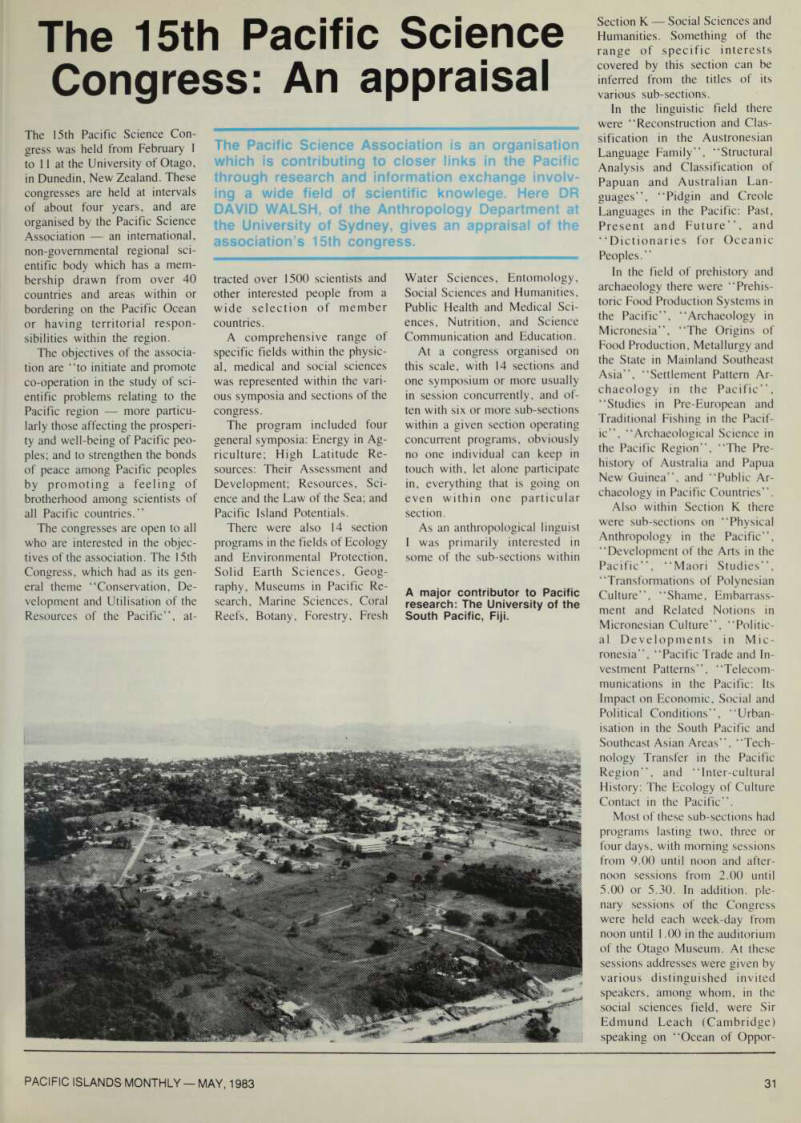
The 15th Pacific Science Congress: An appraisal
The Pacific Science Association is an organisation which is contributing to closer links in the Pacific through research and information exchange involv ing a wide field of scientific knowlege. Here DR DAVID WALSH, of the Anthropology Department at the University of Sydney, gives an appraisal of the association’s 15th congress.
The 15th Pacific Science Con gress was held from February 1 to 11 at the University of Otago, in Dunedin, New Zealand. These congresses are held at intervals of about four years, and are organised by the Pacific Science Association an international,
non-govemmental regional sci
entific body which has a mem bership drawn from over 40 countries and areas within or bordering on the Pacific Ocean or having territorial respon sibilities within the region.
The objectives of the associa tion are “to initiate and promote co-operation in the study of sci entific problems relating to the
Pacific region more particu
larly those affecting the prosperi ty and well-being of Pacific peo ples; and to strengthen the bonds of peace among Pacific peoples
by promoting a feeling of
brotherhood among scientists of all Pacific countries.”
The congresses are open to all who are interested in the objec tives of the association. The 15th Congress, which had as its gen eral theme “Conservation, De velopment and Utilisation of the Resources of the Pacific”, at
traded over 1500 scientists and other interested people from a wide selection of member countries.
A comprehensive range of specific fields within the physic al, medical and social sciences was represented within the vari ous symposia and sections of the congress.
The program included four general symposia: Energy in Ag riculture; High Latitude Re sources: Their Assessment and Development; Resources, Sci ence and the Law of the Sea; and Pacific Island Potentials.
There were also 14 section programs in the fields of Ecology and Environmental Protection, Solid Earth Sciences, Geog raphy, Museums in Pacific Re search, Marine Sciences, Coral Reefs, Botany, Forestry, Fresh
Water Sciences, Entomology, Social Sciences and Humanities, Public Health and Medical Sci ences, Nutrition, and Science Communication and Education.
At a congress organised on this scale, with 14 sections and one symposium or more usually in session concurrently, and of ten with six or more sub-sections within a given section operating concurrent programs, obviously no one individual can keep in touch with, let alone participate in, everything that is going on even within one particular section.
As an anthropological linguist I was primarily interested in some of the sub-sections within
Section K Social Sciences and Humanities. Something of the range of specific interests covered by this section can be inferred from the titles of its various sub-sections.
In the linguistic field there were “Reconstruction and Clas sification in the Austronesian Language Family”, “Structural Analysis and Classification of Papuan and Australian Lan guages”, “Pidgin and Creole Languages in the Pacific: Past, Present and Future”, and “Dictionaries for Oceanic
Peoples.”
In the field of prehistory and archaeology there were “Prehis toric Food Production Systems in the Pacific”, “Archaeology in Micronesia”, “The Origins of Food Production, Metallurgy and the State in Mainland Southeast Asia”, “Settlement Pattern Ar chaeology in the Pacific”, “Studies in Pre-European and Traditional Fishing in the Pacif ic”, “Archaeological Science in the Pacific Region”, “The Pre history of Australia and Papua New Guinea”, and “Public Ar chaeology in Pacific Countries”.
Also within Section K there were sub-sections on “Physical Anthropology in the Pacific”, “Development of the Arts in the Pacific”, “Maori Studies”, “Transformations of Polynesian Culture”, “Shame, Embarrass ment and Related Notions in Micronesian Culture”, “Politic al Developments in Mic ronesia”, “Pacific Trade and In vestment Patterns”, “Telecom munications in the Pacific: Its Impact on Economic, Social and Political Conditions”, “Urban isation in the South Pacific and Southeast Asian Areas”, “Tech nology Transfer in the Pacific Region”, and “Inter-cultural History: The Ecology of Culture Contact in the Pacific”.
Most of these sub-sections had programs lasting two, three or four days, with morning sessions from 9.00 until noon and after noon sessions from 2.00 until 5.00 or 5.30. In addition, ple nary sessions of the Congress were held each week-day from noon until 1.00 in the auditorium of the Otago Museum. At these sessions addresses were given by various distinguished invited speakers, among whom, in the social sciences field, were Sir Edmund Leach (Cambridge) speaking on “Ocean of Oppor
A major contributor to Pacific research: The University of the South Pacific, Fiji.
tunities?”, and Professor R.
Gerard Ward (Australian Nation al University) speaking on “Ag riculture, Size and Distance in Pacific Island Futures”. Some of the evenings were taken up with section dinners, and others were used for meetings of various learned and scientific societies whose members, usually dispers ed throughout Australasia and the Pacific, were gathered in Dunedin for the Congress.
While most of the papers in the linguistic sub-sections and certain specific papers in other sub-sections (notably a couple of linguistically oriented papers in the “Maori Studies’’ sub section, several papers in the sub-sections concerned with Oceanic prehistory and cultural anthropology, and even a couple of papers in the sub-section on “Pacific Trade and Investment Patterns”) were of interest to me, my main concern was with the papers in the sub-section on “Reconstruction and Classifica tion in the Austronesian Lan guage Family”. This sub-section had a program of 23 papers (in cluding my own offering on the lower-order reconstruction of flora and fauna nomenclature within the East Austronesian lin guistic subgroup) which oc cupied four days of the congress.
The Austronesian language family is a grouping of related languages which is of about the same linguistic status as the In do-European language family. It has over 800 member languages distributed throughout the Pacific region, from Easter Island in the east to Hawaii and southern Taiwan in the north to New Zealand in the south, and even to Madagascar in the west. It in cludes all the indigenous lan guages of Polynesia and Mic ronesia, most of those in island Melanesia and coastal Papua New Guinea, and most of the languages of the Philippines, In donesia and Malaysia.
Much of the recent and current research on these languages is historically oriented, being con cerned with the reconstruction of aspects of ancestral languages at various levels within the family (e.g. reconstruction of Proto- Polynesian, the language im mediately ancestral to the Poly nesian sub-group of languages).
and with investigating the pat terns of sub-grouping within the family, i.e. with finding out which groups of Austronesian languages have members that are more closely related to each other than they are to other lan guages in the family.
The keynote address in the sub-section dealing with recon struction and classification in the
Austronesian family was given
by Professor George Grace (Lin
guistics Department, University
of Hawaii at Manoa). His topic was “Oceanic Sub-grouping:
Retrospect and Prospect” a
consideration of what had been achieved in the sub-grouping of the Oceanic, or East Austrone sian, languages since the late 1940 s (when his involvement with the field had begun), and of what was likely to be achieved during the next two decades.
This particular sub-section at tracted about 40 linguists from universities throughout the Pacif ic region and even from two in
Europe.
One of the great values of meetings such as the Pacific Sci ence Congress is that they bring together, from many different locations, the experts in a given field, such as the above
mentioned historically-oriented
investigation of the Austronesian
languages, and provide them
with opportunities to consider aspects of each other’s work.
These opportunities exist not
only, nor even always primarily,
in the formal conference ses sions, but also in informal dis cussions which often go on well into the small hours of the
morning.
This particular congress brought together most of the specialists in one of my own main fields of research and gave me ample chance to talk at length with them. If the other 1500 or so
participants found the Congress
to be similarly productive then part, at least, of its objective will have been achieved.
Another part will have been achieved if the longterm results of these contacts between scien tists from many specific fields eventually contribute to the well being and harmonious co existence of all of us who live in
the Pacific region.
David
Walsh.
Advertisements & other items, p. 32 (2 items)
Science Congress
Portable /
FOR SALE
MICROGRAPHICS
EQUIPMENT
A complete range of near new Micrographics equipment is for sale. The equipment which is less than 1 year old includes: 35 mm 2000 E Camera Model No. 78ABA with stand. 201 Reader Printer Model No. 29588 16 mm 3401 Camera Model No. 41988 with 416 feeder Model No. 41618 G 500 Reader Printer Model No. 275A8C P 74 Processor with Replenisher Kit For further details please contact: The Manager P.O. Box 4005, Matautu-uta Apia, Western Samoa or phone 20 932 collect.
PORTABLE /
SAWMILLS
■ I
TRACTOR POWERED VILLAGE SAWMILL
★ LOW MAINTENANCE AND RELIABLE
MACHINES PROVEN THROUGHOUT THE
PACIFIC.
★ WE MANUFACTURE COCONUT WOOD
SAWMILLS AND SAWMILLS FOR ALL
REQUIREMENTS BIG OR SMALL
★ ENQUIRE ABOUT OUR PROFESSIONAL
SAWMILLS WITH HIGH PRODUCTION.
TRACTOR POWERED OR DIESEL ENGINE.
ALL MACHINES FULLY PORTABLE ON WHEELS AND COMPLY WITH
OVERSEAS SAFETY STANDARDS.
NT. GATMAN LTD.
BOX 18, SILVERDALE, NEW ZEALAND
PHONE STAN GRIFFITHS AUCKLAND 732-181 OR HIBISCUS COAST 65-612
Breaking ranks on
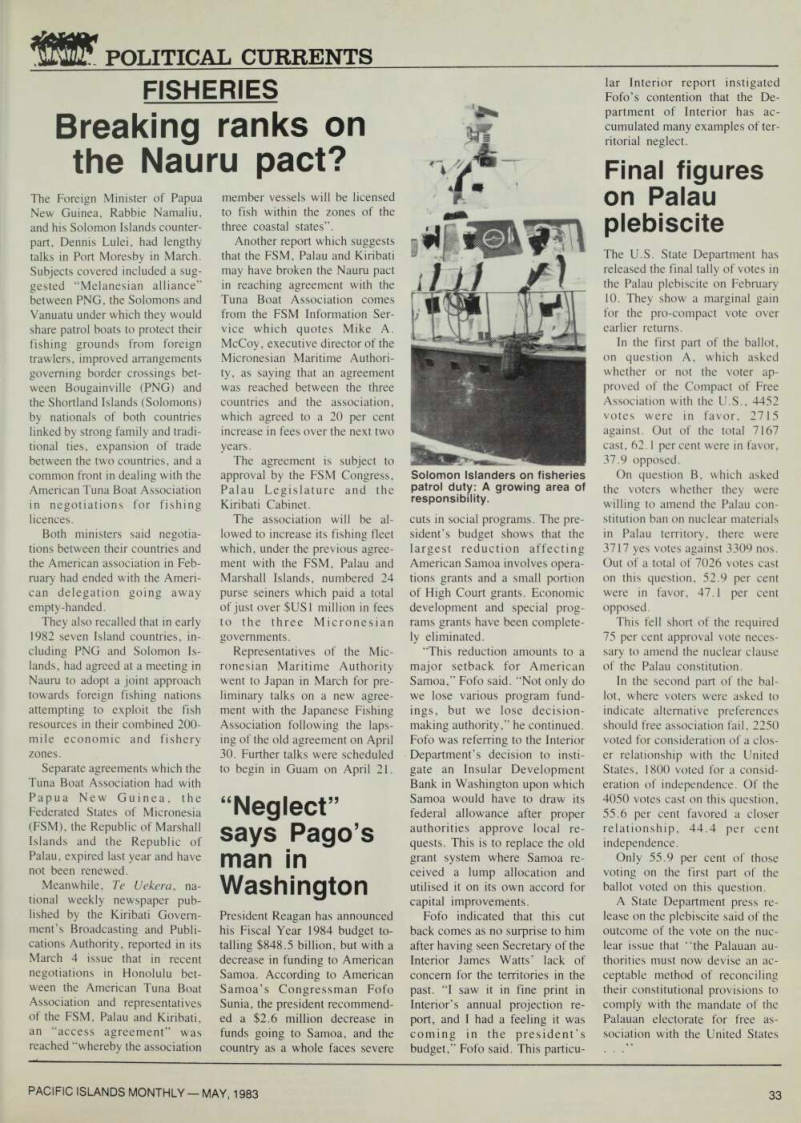
Political Currents
Fisheries
Breaking ranks on the Nauru pact?
The Foreign Minister of Papua New Guinea, Rabbie Namaliu, and his Solomon Islands counter part, Dennis Lulei, had lengthy talks in Port Moresby in March.
Subjects covered included a sug gested “Melanesian alliance” between PNG, the Solomons and Vanuatu under which they would share patrol boats to protect their fishing grounds from foreign trawlers, improved arrangements governing border crossings bet ween Bougainville (PNG) and the Shortland Islands (Solomons) by nationals of both countries linked by strong family and tradi tional ties, expansion of trade between the two countries, and a common front in dealing with the American Tuna Boat Association in negotiations for fishing licences.
Both ministers said negotia tions between their countries and the American association in Feb ruary had ended with the Ameri can delegation going away empty-handed.
They also recalled that in early 1982 seven Island countries, in cluding PNG and Solomon Is lands, had agreed at a meeting in Nauru to adopt a joint approach towards foreign fishing nations attempting to exploit the fish resources in their combined 200mile economic and fishery zones.
Separate agreements which the Tuna Boat Association had with Papua New Guinea, the Federated States of Micronesia (FSM), the Republic of Marshall Islands and the Republic of Palau, expired last year and have not been renewed.
Meanwhile, Te Uekera, na tional weekly newspaper pub lished by the Kiribati Govern ment’s Broadcasting and Publi cations Authority, reported in its March 4 issue that in recent negotiations in Honolulu bet ween the American Tuna Boat Association and representatives of the FSM, Palau and Kiribati, an “access agreement” was reached “whereby the association
member vessels will be licensed to fish within the zones of the three coastal states”.
Another report which suggests that the FSM, Palau and Kiribati may have broken the Nauru pact in reaching agreement with the Tuna Boat Association comes from the FSM Information Ser vice which quotes Mike A.
McCoy, executive director of the Micronesian Maritime Authori ty, as saying that an agreement was reached between the three countries and the association, which agreed to a 20 per cent increase in fees over the next two years.
The agreement is subject to
approval by the FSM Congress,
Palau Legislature and the Kiribati Cabinet.
The association will be al lowed to increase its fishing fleet which, under the previous agree ment with the FSM, Palau and Marshall Islands, numbered 24 purse seiners which paid a total of just over SUSI million in fees to the three Micronesian governments.
Representatives of the Mic ronesian Maritime Authority went to Japan in March for pre liminary talks on a new agree ment with the Japanese Fishing
Association following the laps
ing of the old agreement on April 30. Further talks were scheduled to begin in Guam on April 21.
“Neglect”
says Pago’s
man in
Washington
President Reagan has announced his Fiscal Year 1984 budget to talling $848.5 billion, but with a decrease in funding to American Samoa. According to American Samoa’s Congressman Fofo Sunia, the president recommend ed a $2.6 million decrease in funds going to Samoa, and the country as a whole faces severe
cuts in social programs. The pre sident’s budget shows that the
largest reduction affecting
American Samoa involves opera tions grants and a small portion of High Court grants. Economic
development and special prog
rams grants have been complete
ly eliminated.
“This reduction amounts to a major setback for American Samoa,” Fofo said. “Not only do we lose various program fund ings, but we lose decision
making authority,” he continued.
Fofo was referring to the Interior Department’s decision to insti gate an Insular Development Bank in Washington upon which Samoa would have to draw its federal allowance after proper authorities approve local re quests. This is to replace the old grant system where Samoa re ceived a lump allocation and utilised it on its own accord for
capital improvements.
Fofo indicated that this cut back comes as no surprise to him after having seen Secretary of the Interior James Watts’ lack of concern for the territories in the past. “I saw it in fine print in Interior’s annual projection re port, and I had a feeling it was
coming in the president’s
budget,” Fofo said. This particu
lar Interior report instigated Fofo’s contention that the De partment of Interior has ac cumulated many examples of ter ritorial neglect.
Final figures
on Palau
plebiscite
The U.S. State Department has released the final tally of votes in the Palau plebiscite on February
10. They show a marginal gain
for the pro-compact vote over earlier returns.
In the first part of the ballot, on question A, which asked whether or not the voter ap proved of the Compact of Free Association with the U.S., 4452 votes were in favor, 2715 against. Out of the total 7167 cast, 62.1 per cent were in favor,
37.9 opposed.
On question B, which asked the voters whether they were willing to amend the Palau con stitution ban on nuclear materials in Palau territory, there were 3717 yes votes against 3309 nos.
Out of a total of 7026 votes cast on this question, 52.9 per cent were in favor, 47.1 per cent
opposed.
This fell short of the required 75 per cent approval vote neces sary to amend the nuclear clause of the Palau constitution.
In the second part of the bal lot, where voters were asked to indicate alternative preferences should free association fail, 2250 voted for consideration of a clos er relationship with the United States, 1800 voted for a consid eration of independence. Of the 4050 votes cast on this question, 55.6 per cent favored a closer relationship, 44.4 per cent
independence.
Only 55.9 per cent of those voting on the first part of the ballot voted on this question.
A State Department press re lease on the plebiscite said of the outcome of the vote on the nuc lear issue that “the Palauan au thorities must now devise an ac ceptable method of reconciling their constitutional provisions to comply with the mandate of the Palauan electorate for free as sociation with the United States
Solomon Islanders on fisheries patrol duty: A growing area of responsibility.
Advertisements & other items, p. 34 (1 item)
Kenwood
It's life-enrichment.
From Kenwood.
The audio professionals.
The computer-controlled Compact Component Series. It’s not much wider than an LP (350 mm).
But it sounds like “king-size” stereo. * • 11 L M mir TTm*
COMPACT COMPONENT SERIES
Senes-9 A-9 Stereo Integrated Amplifier with Built-in Graphic Equalizer T-9 Quartz Synthesizer AM/FM Tuner with Built-in Program Timer X-9 Computer Cassette Deck with DPSS Direct Program Search System P-9 Vertical Front Loading Computerized Automatic Turntable with Linear Tracking Arm SRM-9 Personality ’ Audio Rack
KENWOOD
★ New corporate symbol
TRIO-KENWOOD CORPORATION
Shionogi Shibuya Building, 17-5, 2-chome, Shibuya, Shibuya-ku, Tokyo 150, Japan TRIO-KENWOOD (AUSTRALIA) PTY. LTD. (incorporated in n.s.w) 4E Woodcock Place, Lane Cove, N.S.W. 2066, Australia. Tel: 428-1455 NEW ZEALAND JOHN GILBERT & CO., LTD. Auckland Tel.ooll-64-9-30839 FIJI FERE’S DUTY FREE CENTRE LTD. Tel. 25496, 25497 PAPUA NEW GUINEA S.O. SVENSSON (N.G.) LTD. Port Moresby Tel. 212158, 212111 SOLOMON ISLANDS TECHNIQUE RADIOS CENTRE LTD. Honiara Tel. 416 NEW CALEDONIA HI-FI VOX Noumea Tel. 27-2466, 28-2931 VANUATU FUNG CHOI LUEN. Port-Vila Tel. 2556
TAHITI MAISON AURORE Papeete Tel. 29703
AMERICAN SAMOA ISLAND PACIFIC AGENCIES, INC. Pago Pago Tel. 633-4687
REPUBLIC OF NAURU NAURU CO-OPERATIVE SOCIETY
MARIANA ISLANDS J.C. TENORIO ENTERPRISES Saipan Tel. 6445
big post-poll inquiry
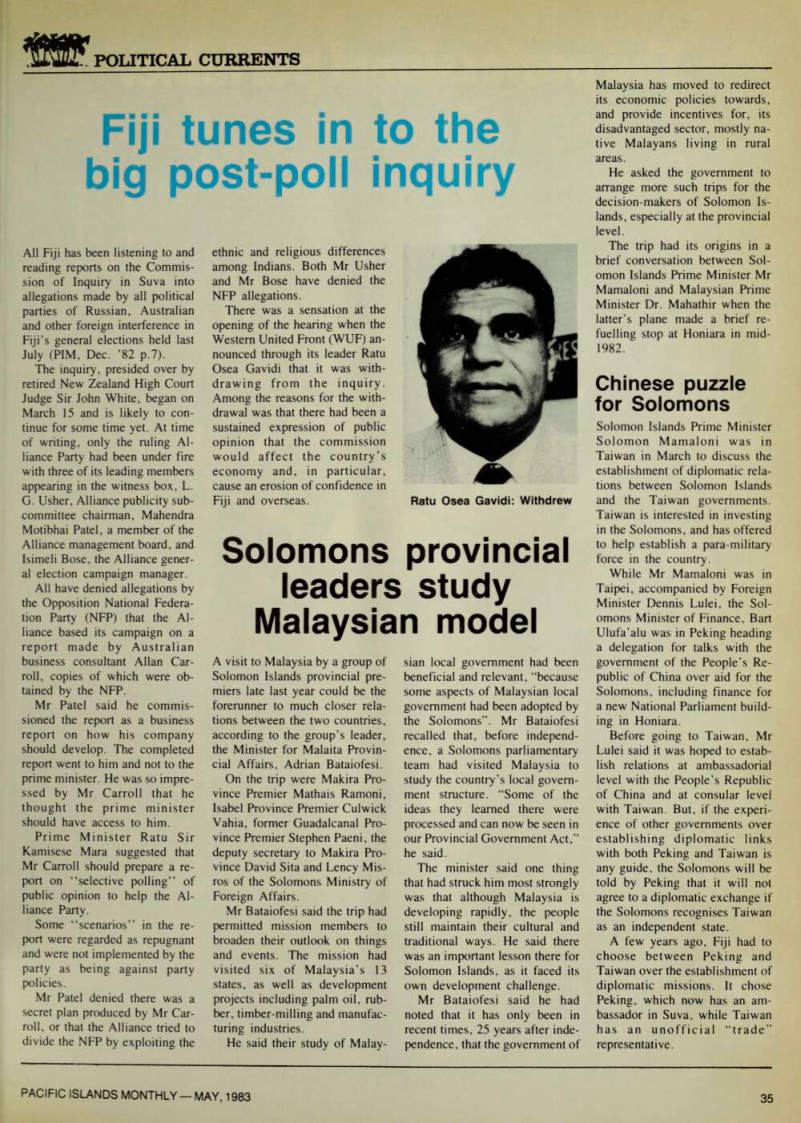
Fiji tunes in to the big post-poll inquiry
All Fiji has been listening to and reading reports on the Commis sion of Inquiry in Suva into allegations made by all political parties of Russian, Australian and other foreign interference in Fiji’s general elections held last July (PIM, Dec. ’B2 p. 7).
The inquiry, presided over by retired New Zealand High Court Judge Sir John White, began on March 15 and is likely to con tinue for some time yet. At time of writing, only the ruling Al liance Party had been under fire with three of its leading members appearing in the witness box, L.
G. Usher, Alliance publicity sub committee chairman, Mahendra Motibhai Patel, a member of the Alliance management board, and Isimeli Bose, the Alliance gener al election campaign manager.
All have denied allegations by the Opposition National Federa tion Party (NFP) that the Al liance based its campaign on a report made by Australian business consultant Allan Car roll, copies of which were ob tained by the NFP.
Mr Patel said he commis sioned the report as a business report on how his company should develop. The completed report went to him and not to the prime minister. He was so impre ssed by Mr Carroll that he thought the prime minister should have access to him.
Prime Minister Ratu Sir Kamisese Mara suggested that Mr Carroll should prepare a re port on “selective polling’’ of public opinion to help the Al liance Party.
Some “scenarios” in the re port were regarded as repugnant and were not implemented by the party as being against party policies.
Mr Patel denied there was a secret plan produced by Mr Car roll, or that the Alliance tried to divide the NFP by exploiting the
ethnic and religious differences among Indians. Both Mr Usher and Mr Bose have denied the
NFP allegations.
There was a sensation at the opening of the hearing when the Western United Front (WUF) an nounced through its leader Ratu Osea Gavidi that it was with
drawing from the inquiry.
Among the reasons for the with drawal was that there had been a
sustained expression of public
opinion that the commission would affect the country’s economy and, in particular, cause an erosion of confidence in Fiji and overseas.
Solomons provincial
leaders study Malaysian model
A visit to Malaysia by a group of Solomon Islands provincial pre miers late last year could be the forerunner to much closer rela tions between the two countries, according to the group’s leader, the Minister for Malaita Provin cial Affairs, Adrian Bataiofesi.
On the trip were Makira Pro vince Premier Mathais Ramoni, Isabel Province Premier Culwick Vahia, former Guadalcanal Pro vince Premier Stephen Paeni, the deputy secretary to Makira Pro vince David Sita and Lency Mis ros of the Solomons Ministry of
Foreign Affairs.
Mr Bataiofesi said the trip had permitted mission members to broaden their outlook on things and events. The mission had visited six of Malaysia’s 13 states, as well as development projects including palm oil, rub ber, timber-milling and manufac
turing industries.
He said their study of Malay
sian local government had been beneficial and relevant, “because some aspects of Malaysian local government had been adopted by the Solomons". Mr Bataiofesi recalled that, before independ ence, a Solomons parliamentary team had visited Malaysia to study the country’s local govern ment structure. “Some of the ideas they learned there were processed and can now be seen in our Provincial Government Act,” he said.
The minister said one thing that had struck him most strongly was that although Malaysia is
developing rapidly, the people
still maintain their cultural and traditional ways. He said there was an important lesson there for Solomon Islands, as it faced its
own development challenge.
Mr Bataiofesi said he had noted that it has only been in recent times, 25 years after inde pendence, that the government of
Malaysia has moved to redirect its economic policies towards, and provide incentives for, its disadvantaged sector, mostly na tive Malayans living in rural areas.
He asked the government to arrange more such trips for the decision-makers of Solomon Is lands, especially at the provincial level.
The trip had its origins in a brief conversation between Sol omon Islands Prime Minister Mr Mamaloni and Malaysian Prime Minister Dr. Mahathir when the latter’s plane made a brief re fuelling stop at Honiara in mid -1982.
Chinese puzzle
for Solomons
Solomon Islands Prime Minister Solomon Mamaloni was in Taiwan in March to discuss the establishment of diplomatic rela tions between Solomon Islands and the Taiwan governments.
Taiwan is interested in investing in the Solomons, and has offered to help establish a para-military force in the country.
While Mr Mamaloni was in Taipei, accompanied by Foreign Minister Dennis Lulei, the Sol omons Minister of Finance, Bart Ulufa’alu was in Peking heading a delegation for talks with the government of the People’s Re public of China over aid for the Solomons, including finance for a new National Parliament build ing in Honiara.
Before going to Taiwan, Mr Lulei said it was hoped to estab lish relations at ambassadorial level with the People’s Republic of China and at consular level with Taiwan. But, if the experi ence of other governments over establishing diplomatic links with both Peking and Taiwan is any guide, the Solomons will be told by Peking that it will not agree to a diplomatic exchange if the Solomons recognises Taiwan as an independent state.
A few years ago, Fiji had to choose between Peking and Taiwan over the establishment of diplomatic missions. It chose Peking, which now has an am bassador in Suva, while Taiwan has an unofficial “trade" representative.
Ratu Osea Gavidi: Withdrew
Advertisements & other items, p. 36 (1 item)
■ mnsk}
The
* v "€
National’s new
RX-C6O is a “head”
above the rest.
Dynamic, original and professional.
Earth, Wind and Fire is definitely a head above the rest.
The RX-C6O, a portable component stereo system with a big 40 watts peak music power Output, detachable 2-way/4-speaker system, MW/SWI/SW2/FM stereo receiver, and metal tape compatible cassette deck, is also a headan AX amorphous record/playback headabove the rest. The RX-C6o’s special AX head, usually found only in the very best hi-fi cassette decks, delivers startlingly clear, clean sound reproduction with a frequency response much wider than ordinary component portables.
With Dolby* noise reduction, separate recording level controls for each channel with LED meters for .• - -r- r-v accurate readings, and a Tape Program Sensor (TPS) for fast, easy song selection, it's no wonder we call the RX-C6O the “professional portable.”
Compact and lightweight, with a 3-way power supply (AC/battery/car), the RX-C6O goes everywhere. And its little brother, the RX-C5O and big brother, RX-ClOO serve up great sound in each super design.
The RX-C6O, RX-C5O and RX-ClOO-built by professionals, choice of professionals.
" '■ 'Trademark of Dolby laboratories.
■ mnsk}
National, Panasonic and Technics are the brandnames of Matsushita Electric.
Developing,
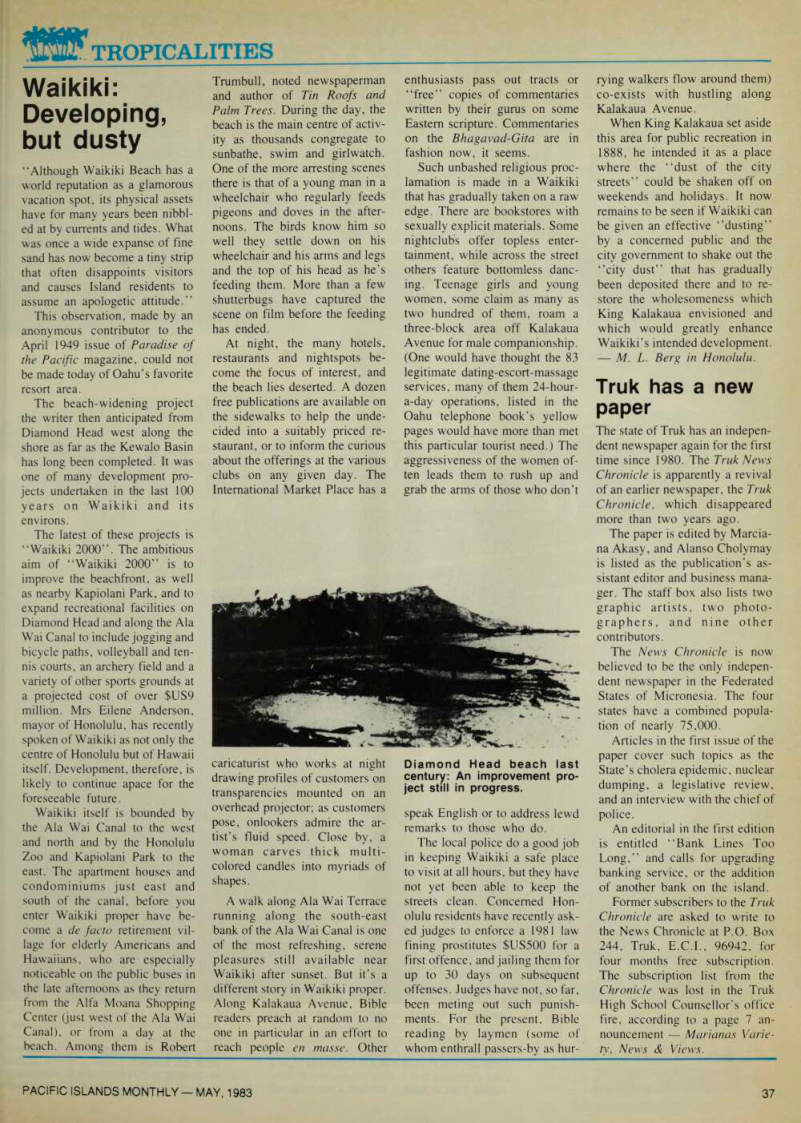
Tropicalities
Waikiki: Developing, but dusty
“Although Waikiki Beach has a world reputation as a glamorous vacation spot, its physical assets have for many years been nibbl ed at by currents and tides. What was once a wide expanse of fine sand has now become a tiny strip that often disappoints visitors and causes Island residents to assume an apologetic attitude.”
This observation, made by an anonymous contributor to the April 1949 issue of Paradise of the Pacific magazine, could not be made today of Oahu’s favorite resort area.
The beach-widening project the writer then anticipated from Diamond Head west along the shore as far as the Kewalo Basin has long been completed. It was one of many development pro jects undertaken in the last 100 years on Waikiki and its environs.
The latest of these projects is “Waikiki 2000”. The ambitious aim of “Waikiki 2000” is to improve the beachfront, as well as nearby Kapiolani Park, and to expand recreational facilities on Diamond Head and along the Ala Wai Canal to include jogging and
bicycle paths, volleyball and ten
nis courts, an archery field and a variety of other sports grounds at a projected cost of over SUS 9 million. Mrs Eilene Anderson, mayor of Honolulu, has recently spoken of Waikiki as not only the centre of Honolulu but of Hawaii itself. Development, therefore, is likely to continue apace for the foreseeable future.
Waikiki itself is bounded by the Ala Wai Canal to the west and north and by the Honolulu Zoo and Kapiolani Park to the east. The apartment houses and condominiums just east and south of the canal, before you enter Waikiki proper have be come a de facto retirement vil lage for elderly Americans and Hawaiians, who are especially noticeable on the public buses in the late afternoons as they return from the Alfa Moana Shopping Center (just west of the Ala Wai Canal), or from a day at the beach. Among them is Robert
Trumbull, noted newspaperman and author of Tin Roofs and Palm Trees. During the day, the beach is the main centre of activ ity as thousands congregate to sunbathe, swim and girl watch.
One of the more arresting scenes there is that of a young man in a wheelchair who regularly feeds pigeons and doves in the after noons. The birds know him so well they settle down on his wheelchair and his arms and legs and the top of his head as he’s feeding them. More than a few shutterbugs have captured the scene on film before the feeding has ended.
At night, the many hotels, restaurants and nightspots be come the focus of interest, and the beach lies deserted. A dozen free publications are available on the sidewalks to help the unde cided into a suitably priced re staurant, or to inform the curious about the offerings at the various clubs on any given day. The International Market Place has a
caricaturist who works at night drawing profiles of customers on transparencies mounted on an overhead projector; as customers pose, onlookers admire the ar tist’s fluid speed. Close by, a woman carves thick multi colored candles into myriads of
shapes.
A walk along Ala Wai Terrace
running along the south-east
bank of the Ala Wai Canal is one of the most refreshing, serene pleasures still available near Waikiki after sunset. But it’s a different story in Waikiki proper.
Along Kalakaua Avenue, Bible readers preach at random to no one in particular in an effort to reach people en masse. Other
enthusiasts pass out tracts or “free” copies of commentaries written by their gurus on some Eastern scripture. Commentaries on the Bhagavad-Gita are in fashion now, it seems.
Such unbashed religious proc lamation is made in a Waikiki that has gradually taken on a raw edge. There are bookstores with sexually explicit materials. Some nightclubs offer topless enter tainment, while across the street others feature bottomless danc ing. Teenage girls and young women, some claim as many as two hundred of them, roam a three-block area off Kalakaua Avenue for male companionship. (One would have thought the 83 legitimate dating-escort-massage services, many of them 24-hour a-day operations, listed in the Oahu telephone book’s yellow pages would have more than met this particular tourist need.) The aggressiveness of the women of ten leads them to rush up and grab the arms of those who don’t
speak English or to address lewd remarks to those who do.
The local police do a good job in keeping Waikiki a safe place to visit at all hours, but they have not yet been able to keep the streets clean. Concerned Hon olulu residents have recently ask ed judges to enforce a 1981 law fining prostitutes SUSSOO for a first offence, and jailing them for up to 30 days on subsequent offenses. Judges have not, so far, been meting out such punish ments. For the present, Bible reading by laymen (some of whom enthrall passers-by as hur
rying walkers flow around them) co-exists with hustling along Kalakaua Avenue.
When King Kalakaua set aside this area for public recreation in 1888, he intended it as a place where the “dust of the city streets” could be shaken off on weekends and holidays. It now remains to be seen if Waikiki can be given an effective “dusting” by a concerned public and the city government to shake out the “city dust” that has gradually been deposited there and to re store the wholesomeness which King Kalakaua envisioned and which would greatly enhance Waikiki’s intended development.
M. L. Berg in Honolulu.
Truk has a new
paper
The state of Truk has an indepen dent newspaper again for the first time since 1980. The Truk News Chronicle is apparently a revival of an earlier newspaper, the Truk Chronicle, which disappeared more than two years ago.
The paper is edited by Marcia na Akasy, and Alanso Cholymay is listed as the publication’s as sistant editor and business mana ger. The staff box also lists two graphic artists, two photo graphers, and nine other contributors.
The News Chronicle is now believed to be the only indepen dent newspaper in the Federated States of Micronesia. The four states have a combined popula tion of nearly 75,000.
Articles in the first issue of the paper cover such topics as the State’s cholera epidemic, nuclear dumping, a legislative review, and an interview with the chief of police.
An editorial in the first edition is entitled “Bank Lines Too Long,” and calls for upgrading banking service, or the addition of another bank on the island.
Former subscribers to the Truk Chronicle are asked to write to the News Chronicle at P.O. Box 244, Truk, E.C.L, 96942, for four months free subscription.
The subscription list from the Chronicle was lost in the Truk High School Counsellor’s office fire, according to a page 7 an nouncement Marianas Varie ty, News & Views.
Diamond Head beach last century: An improvement pro ject still in progress.
Advertisements & other items, pp. 38-42 (1 item)
On The Toughestoobs.
THE TOYOTA ROADMASTERS:
READY TO TAKE
Meet Toyota’s hard working commercial vehicles. Tough. Durable. Ready to meet the challenge of the worst roads and climates. Ready to do the job called for with ease. Rugged veterans, each one specifically designed to meet the different demands of the world’s businesses. One of them is just right for you. There are no vehicles more reliable. And if you need it, Toyota is ready with fast
backup service. Toyota’s roadmasters,
they’re a winning team.
% saF mm: ■ 1 : : ”, W ■mi
HI-LUX 4WD
TOYOTA
QUALITY SERVICE
AMERICAN SAMOA: BURNS PHILP (SOUTH SEA)
CO., LTD., P.O. Box 129, Pago Pago.
COOK ISLANDS: COOK ISLANDS TRADING
CORPORATION LTD., P.O. Box 92, Rarotonga.
FIJI: AUTOMOTIVE SUPPLIES COMPANY, G.P.O.
Box 355, Suva.
GUAM & MICRONESIA: ATKINS. KROLL (GUAM) LTD., P.O. Box 6428, Tamuning.
KIRIBATI: TARAWA MOTORS, P.O. Box 36,
Bairiki, Tarawa, Kiribati.
NAURU: NAURU COOPERATIVE SOCIETY.
NEW CALEDONIA: SERVICE IMPORTATION
AUTOMOBILE DU PACIFIQUE, Rond-Point
Hi i Dopifinno /.Qtatinn Tntflh R P 438. NOUm
NORFOLK ISLAND: BORRY’S LIMITED, RO. Box 169.
PAPUA NEW GUINEA: ELA MOTORS,
Scratchley Rd„ Badili, P.O. Box 675, Port Moresby.
SAIPAN: MICROL CORPORATION. P.O. Box 267,
Saipan.
SOLOMON: MENDANA ENTERPRISES (S.i.) LTD.,
G.PO. Box 174, Honiara.
TAHITI: NIPPON AUTOMOTO, P.O. Box 342, Papeete.
TONGA: BURNS PHILP (SOUTH SEA) CO., LTD., P.O. Box 55, Nuku’alofa.
VANUATU: VANUATU MOTORS, P.O. Box 18,
Port Vila.
WESTERN SAMOA: BURNS PHILP (SOUTH SEA)
CO., LTD., P.O. Box 188, Apia.
TOYOTA
The Toyota range includes:
COROLLA, STARLET, CORONA, CRESSIDA, HI-LUX,
STOUT, HI ACE, DYNA, COASTER and LAND CRUISER
ii m ; i |ipp m m wnips m ii H w ■ m •sm / //TT
BOARDWALK BANDMASTER
Q IL 5
CARRY AUDIO Component System CA-70
Who says music appreciation has to be an indoor affair? Now AlWA’s versatile CA-70 gives you real high performance sound that doesn’t stop at the doorstep.
Three-way power operation from AC house current, selfcontained batteries or DC car battery connection make it possible.
The CA-70’s got great sounds too, thanks to its 5-band graphic equalizer tone controls and an all-new “Acoustic 3-dimensional” 5-way speaker system, a new design that recreates bass more realistically than any portable you’ve ever heard before. Other top features abound: Dolby* noise reduction, soft-touch mode controls, sensitive 4-band radio and detachable 2-way speakers (with exclusive “wireless” connection to the main unit.). PHONO and AUX terminals mean you can easily connect external audio components, for even more sound enjoyment. AIWA in hand? Strike up the band! •Dolby and the double-D symbol are trademarks of Dolby Laboratories Licensing Corporation
AIWA*
AIWA Co., Ltd. 11-9, Ueno 1-chome, Taito-ku, Tokyo, Japan.
Distributors: Australia AIWA Australia Pty., Ltd./Cook Islands Island Merchants Ltd./Fiji P. Hargovind & Co., D. Ranchhod & Co./Guam Micropac Audio, Inc./New Caledonia hifivox/New Zealand Milaw Trading Co., Ltd./P.N.G. Oceania Indent Agency (P.N.G.) Pty., Ltd./Solomon Islands Harvest Pacific Ltd./Tahiti Fare Hi-Fi Stereo/Vanuatu (New Hebrides) The Sound Centre Ltd.
Long nightmare
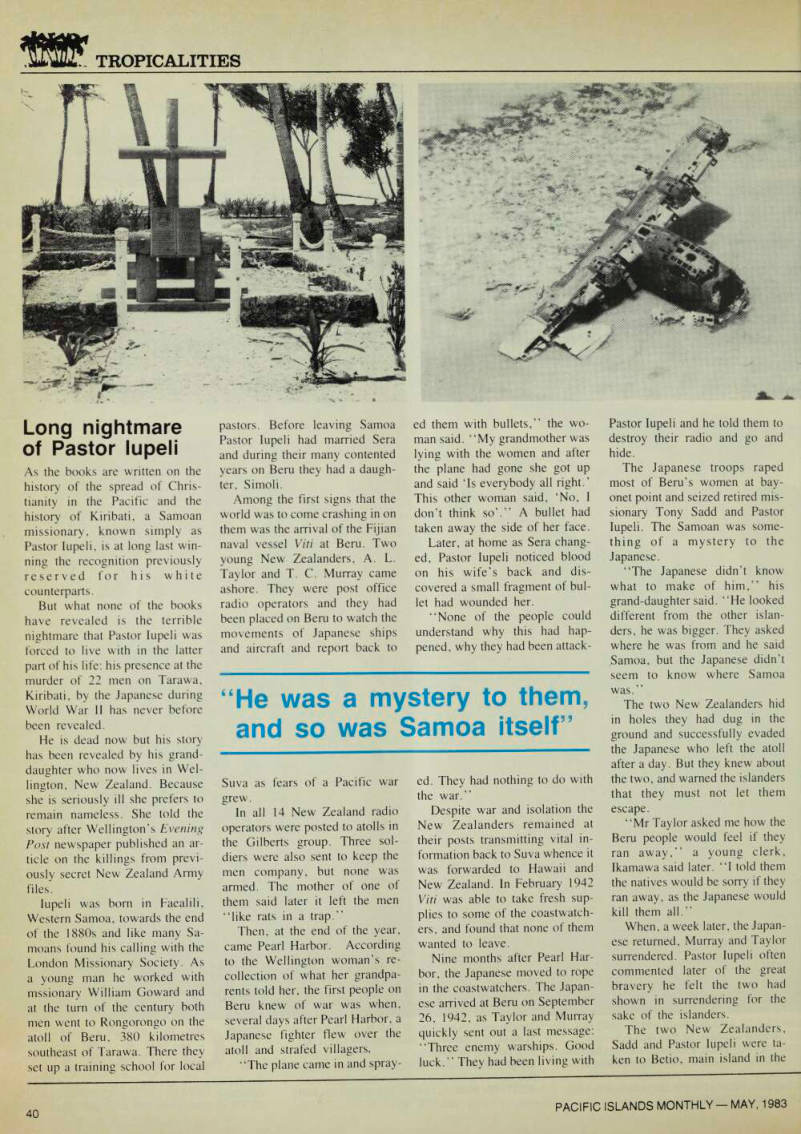
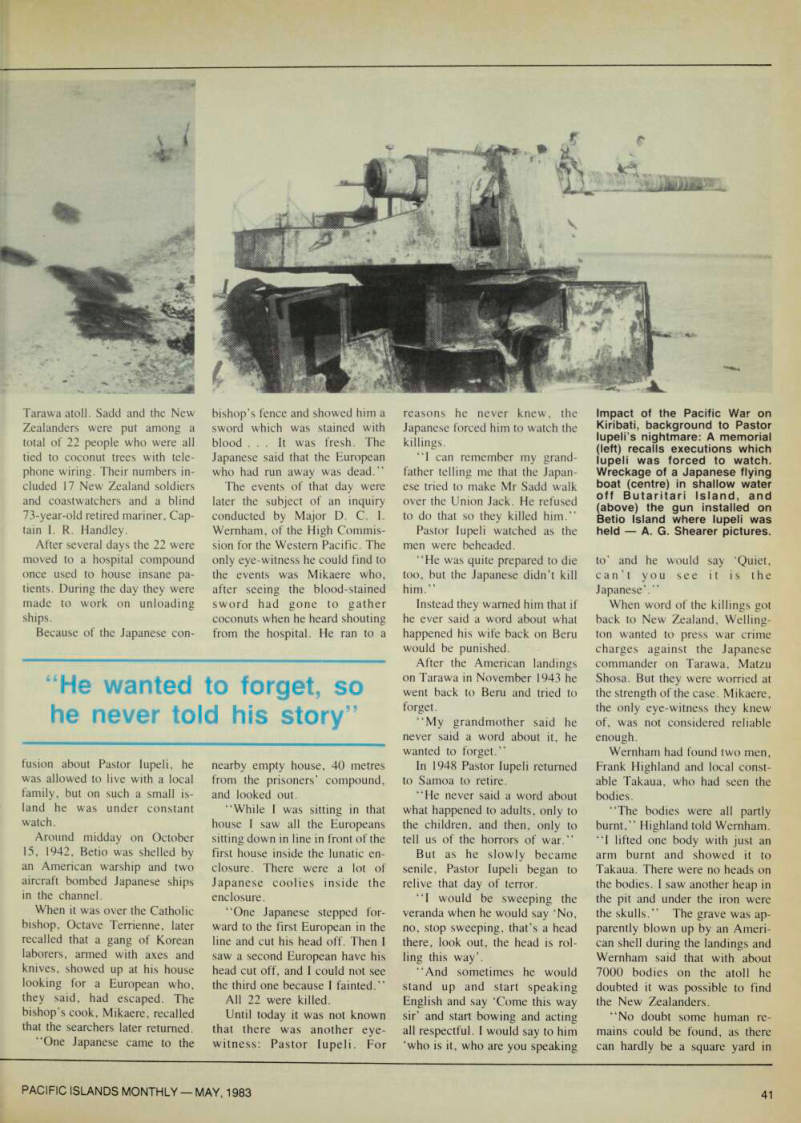
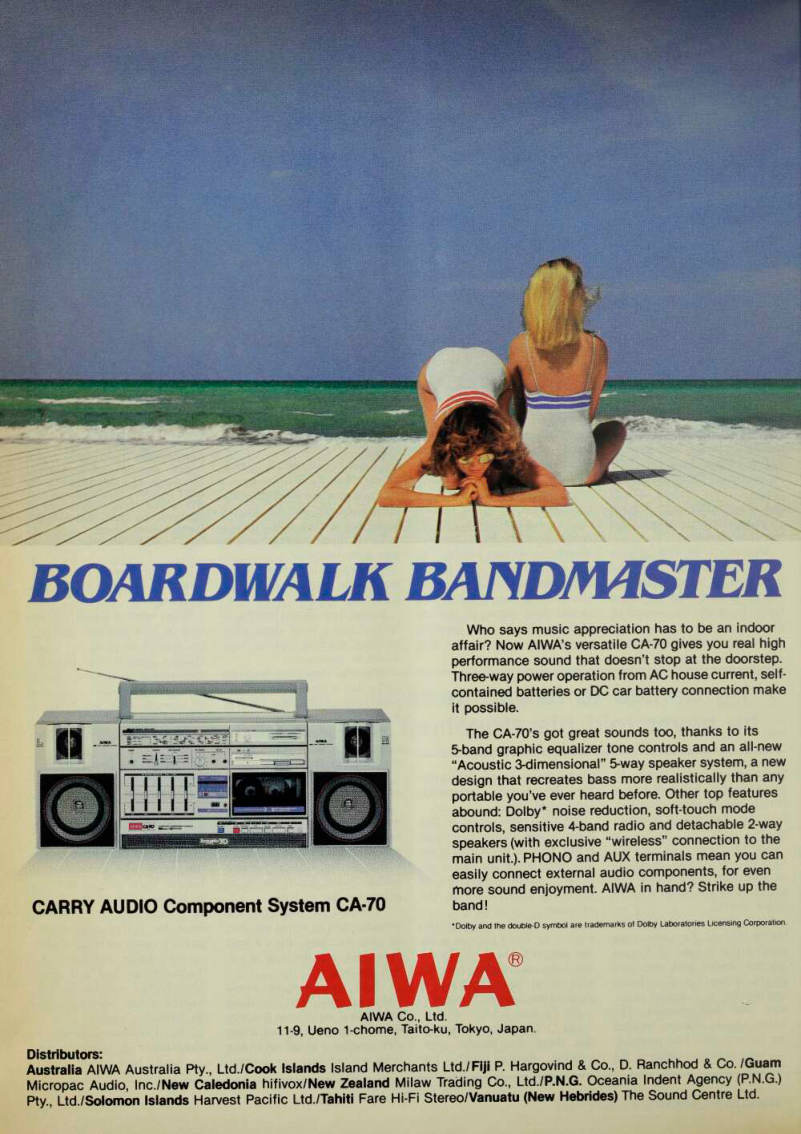
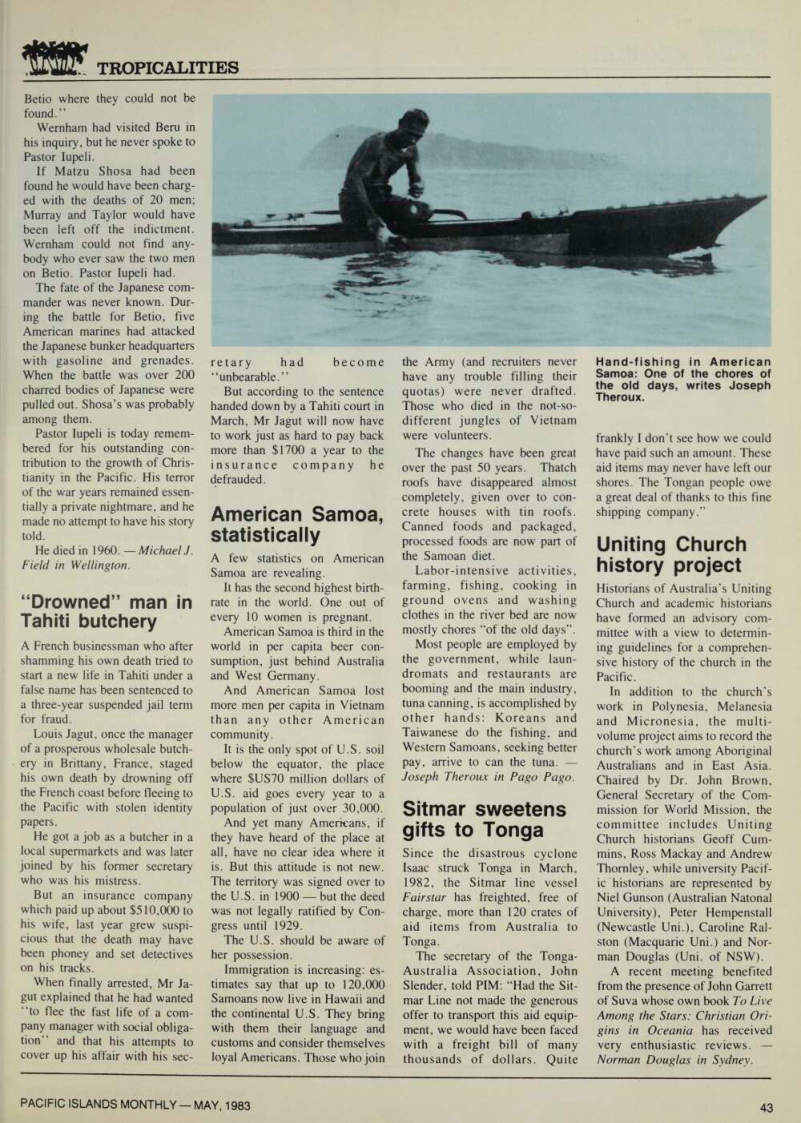
of Pastor lupeli
As the books are written on the history of the spread of Chris tianity in the Pacific and the history of Kiribati, a Samoan missionary, known simply as Pastor lupeli, is at long last win
ning the recognition previously
reserved for his white counterparts.
But what none of the books have revealed is the terrible nightmare that Pastor lupeli was forced to live with in the latter part of his life: his presence at the murder of 22 men on Tarawa, Kiribati, by the Japanese during World War II has never before been revealed.
He is dead now but his story has been revealed by his grand daughter who now lives in Wel lington, New Zealand. Because she is seriously ill she prefers to remain nameless. She told the story after Wellington’s Evening Post newspaper published an ar ticle on the killings from previ ously secret New Zealand Army files. lupeli was bom in Faealili, Western Samoa, towards the end of the 1880 s and like many Sa moans found his calling with the
London Missionary Society. As
a young man he worked with mssionary William Goward and at the turn of the century both men went to Rongorongo on the atoll of Beru, 380 kilometres southeast of Tarawa. There they set up a training school for local
pastors. Before leaving Samoa Pastor lupeli had married Sera and during their many contented years on Beru they had a daugh ter, Simoli.
Among the first signs that the world was to come crashing in on them was the arrival of the Fijian naval vessel Viti at Beru. Two young New Zealanders, A. L.
Taylor and T. C. Murray came ashore. They were post office radio operators and they had been placed on Beru to watch the movements of Japanese ships and aircraft and report back to
“He was a mystery to them, and so was Samoa itself”
Suva as fears of a Pacific war grew.
In all 14 New Zealand radio operators were posted to atolls in the Gilberts group. Three sol diers were also sent to keep the men company, but none was armed. The mother of one of them said later it left the men “like rats in a trap.”
Then, at the end of the year, came Pearl Harbor. According to the Wellington woman’s re collection of what her grandpa rents told her, the first people on Beru knew of war was when, several days after Pearl Harbor, a Japanese fighter flew over the atoll and strafed villagers.
“The plane came in and spray
ed them with bullets,” the wo man said. “My grandmother was lying with the women and after the plane had gone she got up and said Ts everybody all right.’
This other woman said, ‘No, I don’t think so’.” A bullet had taken away the side of her face.
Later, at home as Sera chang ed, Pastor lupeli noticed blood on his wife’s back and dis covered a small fragment of bul let had wounded her.
“None of the people could understand why this had hap pened, why they had been attack
ed. They had nothing to do with the war.”
Despite war and isolation the New Zealanders remained at their posts transmitting vital in formation back to Suva whence it was forwarded to Hawaii and New Zealand. In February 1942 Viti was able to take fresh sup plies to some of the coastwatch ers, and found that none of them wanted to leave.
Nine months after Pearl Har bor, the Japanese moved to rope in the coastwatchers. The Japan ese arrived at Beru on September 26, 1942, as Taylor and Murray quickly sent out a last message: “Three enemy warships. Good luck.” They had been living with
Pastor lupeli and he told them to destroy their radio and go and hide.
The Japanese troops raped most of Bern’s women at bay onet point and seized retired mis sionary Tony Sadd and Pastor lupeli. The Samoan was some thing of a mystery to the Japanese.
“The Japanese didn’t know what to make of him,’’ his grand-daughter said. “He looked different from the other islan ders, he was bigger. They asked where he was from and he said Samoa, but the Japanese didn’t seem to know where Samoa was.’’
The two New Zealanders hid in holes they had dug in the ground and successfully evaded the Japanese who left the atoll after a day. But they knew about the two, and warned the islanders that they must not let them escape.
“ Mr Taylor asked me how the Bern people would feel if they ran away,” a young clerk, Ikamawa said later. “I told them the natives would be sorry if they ran away, as the Japanese would kill them all.”
When, a week later, the Japan ese returned, Murray and Taylor surrendered. Pastor lupeli often commented later of the great bravery he felt the two had shown in surrendering for the sake of the islanders.
The two New Zealanders, Sadd and Pastor lupeli were ta ken to Betio, main island in the
Tarawa atoll. Sadd and the New Zealanders were put among a total of 22 people who were all tied to coconut trees with tele phone wiring. Their numbers in cluded 17 New Zealand soldiers and coastwatchers and a blind 73-year-old retired mariner. Cap tain I. R. Handley.
After several days the 22 were moved to a hospital compound once used to house insane pa tients. During the day they were made to work on unloading
ships.
Because of the Japanese con
“He wanted to forget, so he never told his story”
fusion about Pastor lupeli, he was allowed to live with a local family, but on such a small is land he was under constant watch.
Around midday on October 15, 1942, Betio was shelled by an American warship and two aircraft bombed Japanese ships in the channel.
When it was over the Catholic bishop, Octave Terrienne, later recalled that a gang of Korean laborers, armed with axes and knives, showed up at his house looking for a European who, they said, had escaped. The bishop’s cook, Mikaere, recalled that the searchers later returned.
“One Japanese came to the
bishop’s fence and showed him a sword which was stained with blood ... It was fresh. The Japanese said that the European who had run away was dead.”
The events of that day were later the subject of an inquiry conducted by Major D. C. I.
Wernham, of the High Commis sion for the Western Pacific. The only eye-witness he could find to the events was Mikaere who, after seeing the blood-stained sword had gone to gather coconuts when he heard shouting from the hospital. He ran to a
nearby empty house, 40 metres
from the prisoners’ compound,
and looked out.
“While I was sitting in that house I saw all the Europeans sitting down in line in front of the first house inside the lunatic en closure. There were a lot of Japanese coolies inside the enclosure.
“One Japanese stepped for ward to the first European in the line and cut his head off. Then I saw a second European have his head cut off, and I could not see the third one because I fainted.”
All 22 were killed.
Until today it was not known that there was another eye witness: Pastor lupeli. For
reasons he never knew, the Japanese forced him to watch the
killings.
“I can remember my grand father telling me that the Japan ese tried to make Mr Sadd walk over the Union Jack. He refused to do that so they killed him.”
Pastor lupeli watched as the men were beheaded.
“He was quite prepared to die too, but the Japanese didn’t kill him.”
Instead they warned him that if he ever said a word about what happened his wife back on Bern would be punished.
After the American landings on Tarawa in November 1943 he went back to Bern and tried to
forget.
“My grandmother said he never said a word about it, he wanted to forget.”
In 1948 Pastor lupeli returned to Samoa to retire.
“He never said a word about what happened to adults, only to the children, and then, only to tell us of the horrors of war.”
But as he slowly became senile, Pastor lupeli began to relive that day of terror.
“I would be sweeping the veranda when he would say ‘No, no, stop sweeping, that’s a head there, look out, the head is rol
ling this way’.
“And sometimes he would stand up and start speaking English and say ‘Come this way sir’ and start bowing and acting all respectful. I would say to him ‘who is it, who are you speaking
to’ and he would say 'Quiet, can ’ t you see it is the
Japanese’.”
When word of the killings got back to New Zealand, Welling ton wanted to press war crime
charges against the Japanese
commander on Tarawa, Matzu Shosa. But they were worried at the strength of the case. Mikaere,
the only eye-witness they knew
of, was not considered reliable
enough.
Wernham had found two men, Frank Highland and local const able Takaua, who had seen the bodies.
“The bodies were all partly burnt,” Highland told Wemham.
“I lifted one body with just an arm burnt and showed it to Takaua. There were no heads on the bodies. I saw another heap in the pit and under the iron were the skulls.” The grave was ap parently blown up by an Ameri can shell during the landings and Wernham said that with about 7000 bodies on the atoll he doubted it was possible to find the New Zealanders.
“No doubt some human re mains could be found, as there can hardly be a square yard in
Impact of the Pacific War on Kiribati, background to Pastor lupeli’s nightmare: A memorial (left) recalls executions which lupeli was forced to watch.
Wreckage of a Japanese flying boat (centre) in shallow water off Butaritari Island, and (above) the gun installed on Betio Island where lupeli was held - A. G. Shearer pictures.
Betio where they could not be found.”
Wemham had visited Bern in his inquiry, but he never spoke to
Pastor lupeli.
If Matzu Shosa had been found he would have been charg ed with the deaths of 20 men; Murray and Taylor would have been left off the indictment.
Wemham could not find any body who ever saw the two men on Betio. Pastor lupeli had.
The fate of the Japanese com mander was never known. Dur ing the battle for Betio, five American marines had attacked
the Japanese bunker headquarters
with gasoline and grenades.
When the battle was over 200 charred bodies of Japanese were pulled out. Shosa’s was probably among them.
Pastor lupeli is today remem bered for his outstanding con tribution to the growth of Chris tianity in the Pacific. His terror of the war years remained essen
tially a private nightmare, and he
made no attempt to have his story told.
He died in 1960. — Michael J.
Field in Wellington.
“Drowned” man in
Tahiti butchery
A French businessman who after shamming his own death tried to start a new life in Tahiti under a false name has been sentenced to
a three-year suspended jail term
for fraud.
Louis Jagut, once the manager of a prosperous wholesale butch ery in Brittany, France, staged his own death by drowning off the French coast before fleeing to the Pacific with stolen identity papers.
He got a job as a butcher in a local supermarkets and was later joined by his former secretary who was his mistress.
But an insurance company which paid up about $510,000 to his wife, last year grew suspi cious that the death may have been phoney and set detectives on his tracks.
When finally arrested, Mr Ja gut explained that he had wanted “to flee the fast life of a com pany manager with social obliga tion” and that his attempts to cover up his affair with his sec
retary had become “unbearable.”
But according to the sentence handed down by a Tahiti court in March, Mr Jagut will now have to work just as hard to pay back more than $l7OO a year to the insurance company he defrauded.
American Samoa,
statistically
A few statistics on American Samoa are revealing.
It has the second highest birth rate in the world. One out of every 10 women is pregnant.
American Samoa is third in the world in per capita beer con sumption, just behind Australia and West Germany.
And American Samoa lost more men per capita in Vietnam than any other American community.
It is the only spot of U.S. soil below the equator, the place where SUS7O million dollars of U.S. aid goes every year to a population of just over 30,000.
And yet many Americans, if they have heard of the place at all, have no clear idea where it is. But this attitude is not new.
The territory was signed over to the U.S. in 1900 but the deed was not legally ratified by Con gress until 1929.
The U.S. should be aware of her possession.
Immigration is increasing: es timates say that up to 120,000 Samoans now live in Hawaii and the continental U.S. They bring with them their language and customs and consider themselves loyal Americans. Those who join
the Army (and recruiters never have any trouble filling their quotas) were never drafted.
Those who died in the not-so different jungles of Vietnam were volunteers.
The changes have been great over the past 50 years. Thatch roofs have disappeared almost completely, given over to con crete houses with tin roofs.
Canned foods and packaged, processed foods are now part of the Samoan diet.
Labor-intensive activities, farming, fishing, cooking in ground ovens and washing clothes in the river bed are now mostly chores “of the old days”.
Most people are employed by the government, while laun dromats and restaurants are booming and the main industry, tuna canning, is accomplished by other hands: Koreans and Taiwanese do the fishing, and Western Samoans, seeking better pay, arrive to can the tuna.
Joseph Theroux in Pago Pago.
Sitmar sweetens
gifts to Tonga
Since the disastrous cyclone Isaac struck Tonga in March, 1982, the Sitmar line vessel Fair star has freighted, free of charge, more than 120 crates of aid items from Australia to Tonga.
The secretary of the Tonga- Australia Association, John Slender, told PIM: “Had the Sit mar Line not made the generous offer to transport this aid equip ment, we would have been faced with a freight bill of many thousands of dollars. Quite
frankly I don’t see how we could have paid such an amount. These aid items may never have left our shores. The Tongan people owe a great deal of thanks to this fine shipping company.”
Uniting Church
history project
Historians of Australia’s Uniting Church and academic historians have formed an advisory com mittee with a view to determin ing guidelines for a comprehen sive history of the church in the Pacific.
In addition to the church’s work in Polynesia, Melanesia and Micronesia, the multi volume project aims to record the church’s work among Aboriginal Australians and in East Asia.
Chaired by Dr. John Brown, General Secretary of the Com mission for World Mission, the committee includes Uniting Church historians Geoff Cum mins, Ross Mackay and Andrew Thomley, while university Pacif ic historians are represented by Niel Gunson (Australian Natonal University), Peter Hempenstall (Newcastle Uni.), Caroline Ral ston (Macquarie Uni.) and Nor man Douglas (Uni. of NSW).
A recent meeting benefited from the presence of John Garrett of Suva whose own book To Live Among the Stars: Christian Ori gins in Oceania has received very enthusiastic reviews.
Norman Douglas in Sydney.
Hand-fishing in American Samoa: One of the chores of the old days, writes Joseph Theroux.
People
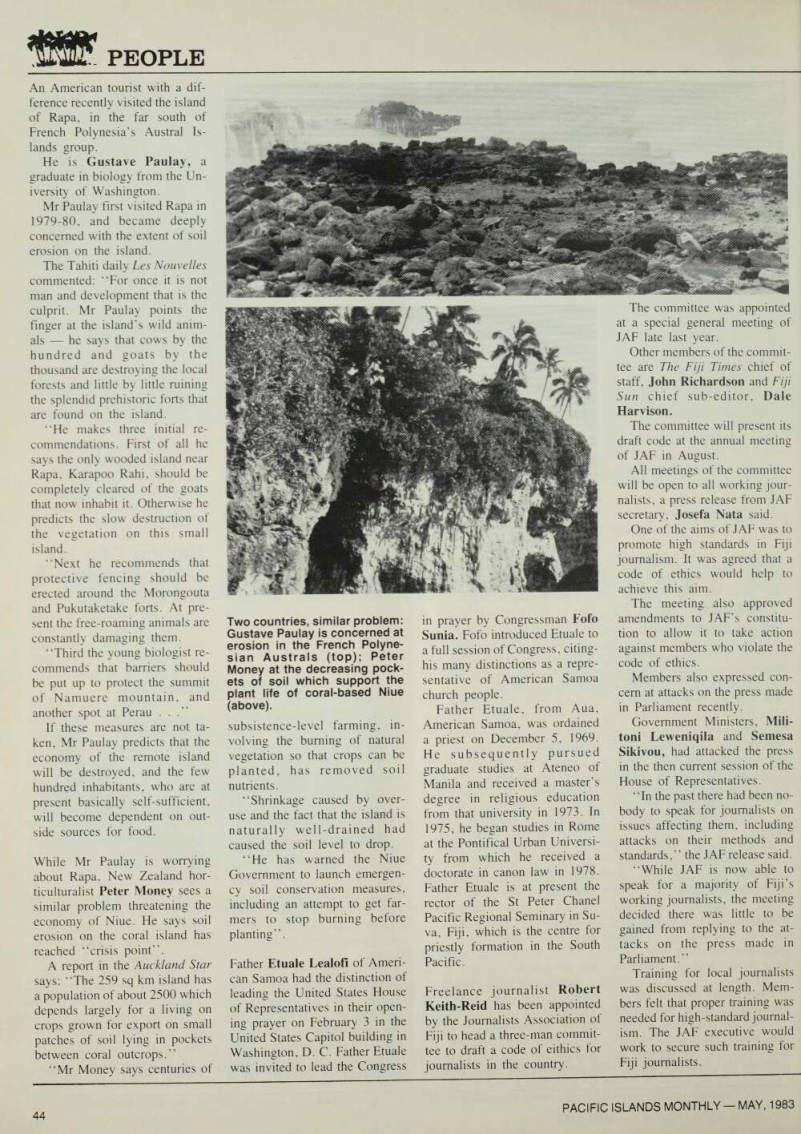
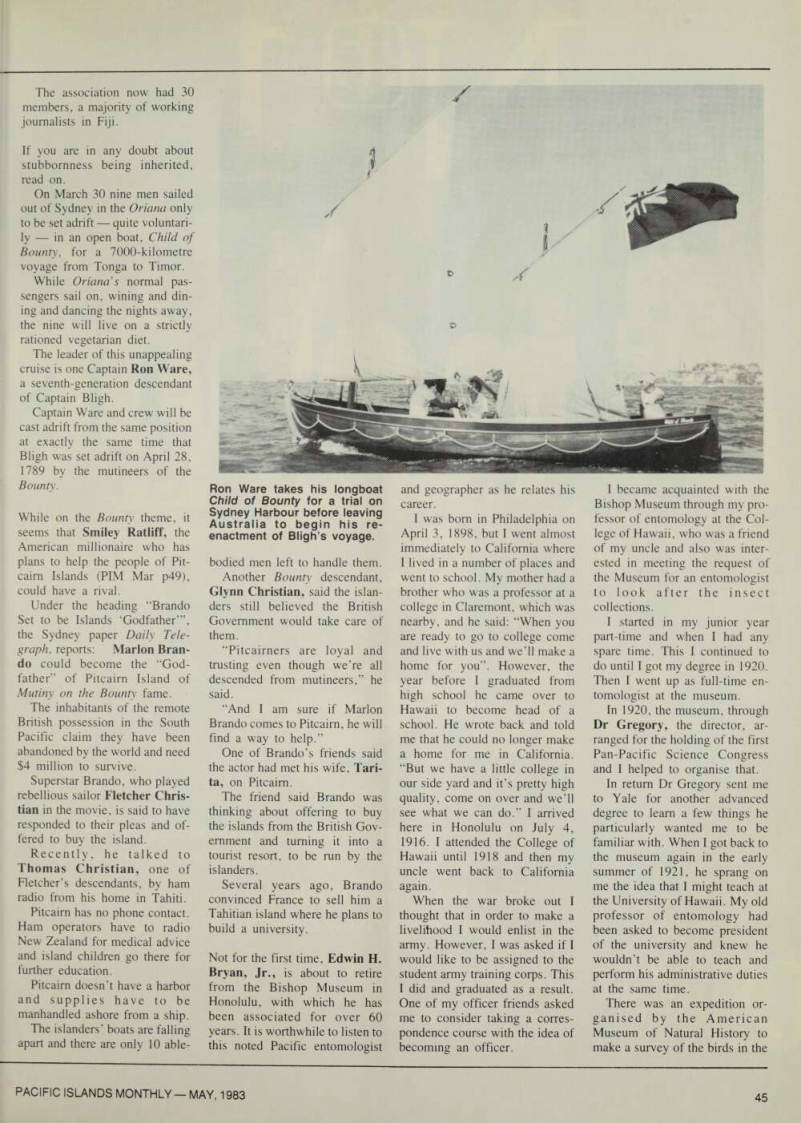
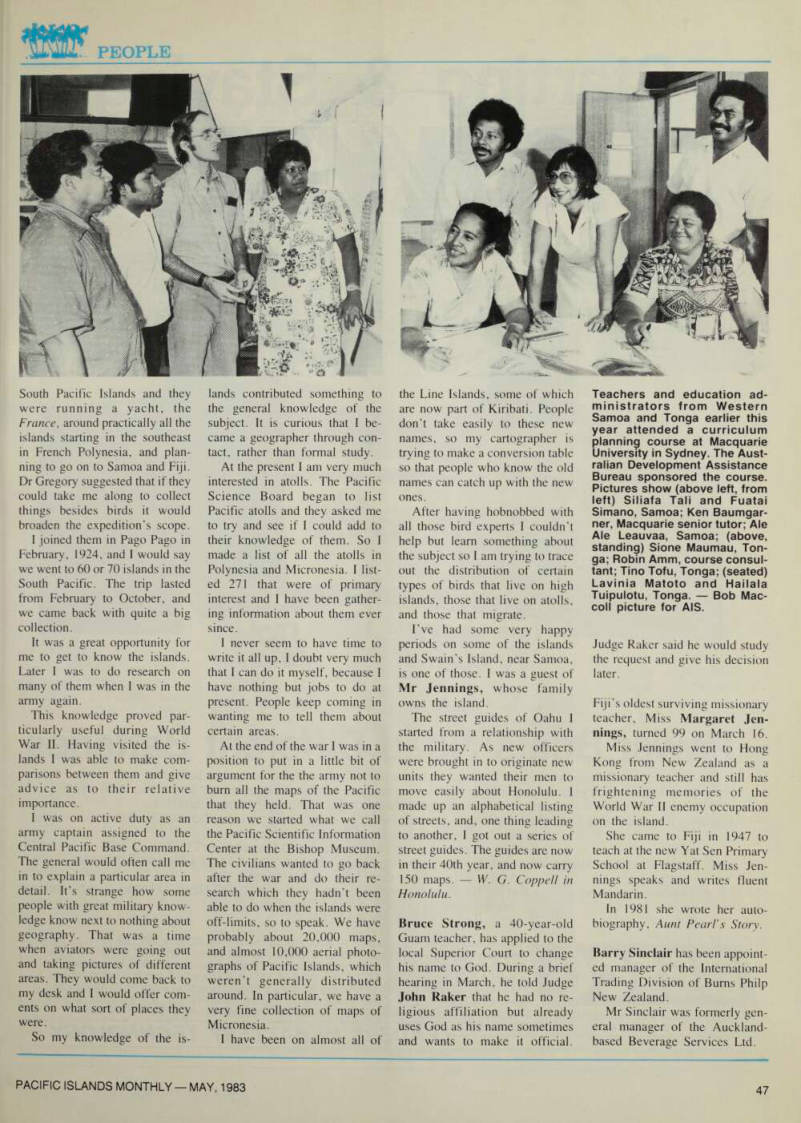
An American tourist with a dif ference recently visited the island of Rapa, in the far south of French Polynesia’s Austral Is lands group.
He is Gustave Paulay, a graduate in biology from the Un iversity of Washington.
Mr Paulay first visited Rapa in 1979-80, and became deeply concerned with the extent of soil erosion on the island.
The Tahiti daily Les Nouvelles commented: “For once it is not man and development that is the culprit. Mr Paulay points the finger at the island’s wild anim als he says that cows by the hundred and goats by the thousand are destroying the local forests and little by little ruining the splendid prehistoric forts that are found on the island.
“He makes three initial re commendations. First of all he says the only wooded island near Rapa, Karapoo Rahi, should be completely cleared of the goats that now inhabit it. Otherwise he predicts the slow destruction of the vegetation on this small island.
“Next he recommends that protective fencing should be erected around the Morongouta and Pukutaketake forts. At pre sent the free-roaming animals are constantly damaging them.
“Third the young biologist re commends that barriers should be put up to protect the summit of Namuere mountain, and another spot at Perau ...”
If these measures are not ta ken, Mr Paulay predicts that the economy of the remote island will be destroyed, and the few hundred inhabitants, who are at present basically self-sufficient, will become dependent on out side sources for food.
While Mr Paulay is worrying about Rapa, New Zealand hor ticulturalist Peter Money sees a similar problem threatening the economy of Niue. He says soil erosion on the coral island has reached “crisis point”.
A report in the Auckland Star says: “The 259 sq km island has a population of about 2500 which depends largely for a living on crops grown for export on small patches of soil lying in pockets between coral outcrops.”
“Mr Money says centuries of
subsistence-level farming, in volving the burning of natural vegetation so that crops can be planted, has removed soil nutrients.
“Shrinkage caused by over use and the fact that the island is naturally well-drained had caused the soil level to drop.
“He has warned the Niue Government to launch emergen cy soil conservation measures, including an attempt to get far mers to stop burning before planting”.
Father Etuale Lealofi of Ameri can Samoa had the distinction of leading the United States House of Representatives in their open ing prayer on February 3 in the United States Capitol building in Washington, D. C. Father Etuale was invited to lead the Congress
in prayer by Congressman Fofo Sunia. Fofo introduced Etuale to a full session of Congress, citing his many distinctions as a repre sentative of American Samoa church people.
Father Etuale, from Aua, American Samoa, was ordained a priest on December 5, 1969.
He subsequently pursued graduate studies at Ateneo of Manila and received a master’s degree in religious education from that university in 1973. In 1975, he began studies in Rome at the Pontifical Urban Universi ty from which he received a doctorate in canon law in 1978.
Father Etuale is at present the rector of the St Peter Chanel Pacific Regional Seminary in Su va, Fiji, which is the centre for priestly formation in the South Pacific.
Freelance journalist Robert Keith-Reid has been appointed by the Journalists Association of Fiji to head a three-man commit tee to draft a code of eithics for journalists in the country.
The committee was appointed at a special general meeting of JAF late last year.
Other members of the commit tee are The Fiji Times chief of staff, John Richardson and Fiji Sun chief sub-editor. Dale Harvison.
The committee will present its draft code at the annual meeting of JAF in August.
All meetings of the committee will be open to all working jour nalists, a press release from JAF secretary, Josefa Nata said.
One of the aims of JAF was to promote high standards in Fiji journalism. It was agreed that a code of ethics would help to achieve this aim.
The meeting also approved amendments to JAF’s constitu tion to allow it to take action against members who violate the code of ethics.
Members also expressed con cern at attacks on the press made in Parliament recently.
Government Ministers, Mili toni Leweniqila and Semesa Sikivou, had attacked the press in the then current session of the House of Representatives.
“In the past there had been no body to speak for journalists on issues affecting them, including attacks on their methods and standards,” the JAF release said.
“While JAF is now able to speak for a majority of Fiji’s working journalists, the meeting decided there was little to be gained from replying to the at tacks on the press made in Parliament.”
Training for local journalists was discussed at length. Mem bers felt that proper training was needed for high-standard journal ism. The JAF executive would work to secure such training for Fiji journalists.
Two countries, similar problem: Gustave Paulay is concerned at erosion in the French Polyne sian Australs (top); Peter Money at the decreasing pock ets of soil which support the plant life of coral-based Niue
(above).
The association now had 30 members, a majority of working
journalists in Fiji.
If you are in any doubt about stubbornness being inherited, read on.
On March 30 nine men sailed out of Sydney in the Oriana only to be set adrift quite voluntari ly in an open boat, Child of Bounty, for a 7000-kilometre voyage from Tonga to Timor.
While Oriana s normal pas sengers sail on, wining and din
ing and dancing the nights away,
the nine will live on a strictly rationed vegetarian diet.
The leader of this unappealing cruise is one Captain Ron Ware, a seventh-generation descendant
of Captain Bligh.
Captain Ware and crew will be cast adrift from the same position at exactly the same time that Bligh was set adrift on April 28, 1789 by the mutineers of the Bounty.
While on the Bounty theme, it seems that Smiley Ratliff, the American millionaire who has plans to help the people of Pit cairn Islands (PIM Mar p 49), could have a rival.
Under the heading “Brando Set to be Islands ‘Godfather’”, the Sydney paper Daily Tele graph, reports: Marlon Bran do could become the “God father” of Pitcairn Island of Mutiny on the Bounty fame.
The inhabitants of the remote British possession in the South Pacific claim they have been abandoned by the world and need $4 million to survive.
Superstar Brando, who played
rebellious sailor Fletcher Chris tian in the movie, is said to have responded to their pleas and of fered to buy the island.
Recently, he talked to Thomas Christian, one of Fletcher’s descendants, by ham radio from his home in Tahiti.
Pitcairn has no phone contact.
Ham operators have to radio New Zealand for medical advice and island children go there for further education.
Pitcairn doesn’t have a harbor and supplies have to be manhandled ashore from a ship.
The islanders’ boats are falling apart and there are only 10 able-
bodied men left to handle them.
Another Bounty descendant, Glynn Christian, said the islan ders still believed the British Government would take care of them.
“Pitcairners are loyal and trusting even though we’re all descended from mutineers,” he said.
“And I am sure if Marlon Brando comes to Pitcairn, he will find a way to help.”
One of Brando’s friends said the actor had met his wife, Tari ta, on Pitcairn.
The friend said Brando was
thinking about offering to buy
the islands from the British Gov ernment and turning it into a tourist resort, to be run by the islanders.
Several years ago, Brando convinced France to sell him a Tahitian island where he plans to build a university.
Not for the first time, Edwin H.
Bryan, Jr., is about to retire from the Bishop Museum in Honolulu, with which he has been associated for over 60 years. It is worthwhile to listen to this noted Pacific entomologist
and geographer as he relates his career.
I was bom in Philadelphia on April 3, 1898, but I went almost immediately to California where I lived in a number of places and went to school. My mother had a brother who was a professor at a college in Claremont, which was nearby, and he said; “When you are ready to go to college come and live with us and we’ll make a home for you”. However, the year before I graduated from high school he came over to Hawaii to become head of a school. He wrote back and told me that he could no longer make a home for me in California.
“But we have a little college in our side yard and it’s pretty high quality, come on over and we’ll see what we can do.” I arrived here in Honolulu on July 4, 1916. I attended the College of Hawaii until 1918 and then my uncle went back to California
again.
When the war broke out I thought that in order to make a livelihood I would enlist in the army. However, I was asked if I would like to be assigned to the student army training corps. This I did and graduated as a result.
One of my officer friends asked me to consider taking a corres pondence course with the idea of becoming an officer.
I became acquainted with the Bishop Museum through my pro fessor of entomology at the Col lege of Hawaii, who was a friend of my uncle and also was inter ested in meeting the request of the Museum for an entomologist to look after the insect collections.
I started in my junior year part-time and when I had any spare time. This I continued to do until I got my degree in 1920.
Then I went up as full-time en tomologist at the museum.
In 1920, the museum, through Dr Gregory, the director, ar ranged for the holding of the first Pan-Pacific Science Congress and I helped to organise that.
In return Dr Gregory sent me to Yale for another advanced degree to leam a few things he particularly wanted me to be familiar with. When I got back to the museum again in the early summer of 1921, he sprang on me the idea that I might teach at the University of Hawaii. My old
professor of entomology had
been asked to become president of the university and knew he wouldn’t be able to teach and perform his administrative duties at the same time.
There was an expedition or
ganised by the American
Museum of Natural History to make a survey of the birds in the
Ron Ware takes his longboat Child of Bounty for a trial on
Sydney Harbour before leaving
Australia to begin his re enactment of Bligh’s voyage.
South Pacific Islands and they were running a yacht, the France, around practically all the islands starting in the southeast in French Polynesia, and plan ning to go on to Samoa and Fiji.
Dr Gregory suggested that if they could take me along to collect things besides birds it would broaden the expedition’s scope.
I joined them in Pago Pago in February, 1924, and I would say we went to 60 or 70 islands in the South Pacific. The trip lasted from February to October, and we came back with quite a big collection.
It was a great opportunity for me to get to know the islands.
Later I was to do research on many of them when I was in the
army again.
This knowledge proved par ticularly useful during World War 11. Having visited the is lands I was able to make com parisons between them and give advice as to their relative
importance.
I was on active duty as an army captain assigned to the Central Pacific Base Command.
The general would often call me in to explain a particular area in detail. It's strange how some people with great military know ledge know next to nothing about geography. That was a time when aviators were going out and taking pictures of different areas. They would come back to my desk and I would offer cem ents on what sort of places they were.
So my knowledge of the is
lands contributed something to the general knowledge of the subject. It is curious that I be came a geographer through con tact, rather than formal study.
At the present I am very much interested in atolls. The Pacific Science Board began to list Pacific atolls and they asked me to try and see if I could add to their knowledge of them. So I made a list of all the atolls in Polynesia and Micronesia. I list ed 271 that were of primary interest and I have been gather ing information about them ever since.
I never seem to have time to write it all up, I doubt very much that I can do it myself, because I have nothing but jobs to do at
present. People keep coming in
wanting me to tell them about certain areas.
At the end of the war I was in a position to put in a little bit of argument for the the army not to bum all the maps of the Pacific that they held. That was one reason we started what we call the Pacific Scientific Information Center at the Bishop Museum.
The civilians wanted to go back after the war and do their re search which they hadn’t been able to do when the islands were off-limits, so to speak. We have probably about 20,000 maps, and almost 10,000 aerial photo graphs of Pacific Islands, which weren’t generally distributed around. In particular, we have a very fine collection of maps of Micronesia.
I have been on almost all of
the Line Islands, some of which are now part of Kiribati. People don’t take easily to these new names, so my cartographer is trying to make a conversion table so that people who know the old names can catch up with the new ones.
After having hobnobbed with all those bird experts I couldn’t help but learn something about the subject so I am trying to trace out the distribution of certain types of birds that live on high islands, those that live on atolls, and those that migrate.
I’ve had some very happy periods on some of the islands and Swain’s Island, near Samoa, is one of those. I was a guest of Mr Jennings, whose family owns the island.
The street guides of Oahu I started from a relationship with the military. As new officers were brought in to originate new units they wanted their men to move easily about Honolulu. I made up an alphabetical listing of streets, and, one thing leading to another, I got out a series of street guides. The guides are now in their 40th year, and now carry
150 maps.
W. G. Coppell in
Honolulu.
Bruce Strong, a 40-year-old Guam teacher, has applied to the local Superior Court to change his name to God. During a brief hearing in March, he told Judge John Raker that he had no re
ligious affiliation but already
uses God as his name sometimes and wants to make it official.
Judge Raker said he would study the request and give his decision later.
Fiji’s oldest surviving missionary
teacher, Miss Margaret Jen nings, turned 99 on March 16.
Miss Jennings went to Hong Kong from New Zealand as a missionary teacher and still has frightening memories of the World War II enemy occupation on the island.
She came to Fiji in 1947 to teach at the new Yat Sen Primary School at Flagstaff. Miss Jen nings speaks and writes fluent Mandarin.
In 1981 she wrote her auto biography, Aunt Pearl’s Story.
Barry Sinclair has been appoint ed manager of the International Trading Division of Bums Philp New Zealand.
Mr Sinclair was formerly gen eral manager of the Auckland based Beverage Services Ltd.
Teachers and education ad ministrators from Western Samoa and Tonga earlier this year attended a curriculum planning course at Macquarie University in Sydney. The Aust ralian Development Assistance Bureau sponsored the course.
Pictures show (above left, from left) Siliafa Tali and Fuatai Simano, Samoa; Ken Baumgar ner, Macquarie senior tutor; Ale Ale Leauvaa, Samoa; (above, standing) Sione Maumau, Ton ga; Robin Amm, course consul tant; Tino Tofu, Tonga; (seated) Lavinia Matoto and Hailala
Tuipulotu, Tonga. - Bob Mac
coil picture for AIS.
Advertisements & other items, pp. 46-48 (1 item)
Anchor - premium quality dairy produce, packed with
nonfat dried m Ip
ANCHOR
m U! ruU,CREAM „ j Jlfi
fAMIN ENRICHED 0 aLJI:
M MILK
k
■'OWO
ROW
F p •Anchor
SKIM MILK
►w
7DER
9t anchor
ANCHOR
ANCHOR
L 3 R& US Anchor - premium quality dairy produce, packed with all the goodness of the finest pasture in the world.
Fresh to you from the world’s number one dairy
producer, New Zealand Dairy Board.
NEW
ZEALAND
DAIRY
BOARD
Enquiries to: PO Box 417 Wellington, New Zealand
Telex: NZ3348 DAPMARK
Telephone: 724-399
Starting & Staying
PCffER
' mm •v ** fi
AMP
m -unsn Y mm
wmr
cm S3 \
GSZ?
Power Boats Need Different Batteries
There is a big difference between a car battery and a marine battery.
A car battery, for example, is never really discharged, as it is only used for a few seconds each day and promptly re-charged. Not so your cruiser or sportsfisherman.
Starting the engine is only the beginning. During the day, weekend or cruise, how often will you run the live bait tank, the depth sounder, the nav. lights or maintain a listening watch on your radio transceiver?
As well as cranking power, boats need staying power. Boats need Besco’s Marine Batteries, deep cycle, heavy duty marine batteries.
If your boat is getting a little flat in the electrics department, write or phone BESCO today and ask for more information, more facts about
BESCO MARINE BATTERIES.
BESCO
Papua New Guinea: Lae/Rabaul Auto Marine Industries, PO Box 785, Port Moresby; Par Sales Pty. Ltd., Boroko. 25-6266. Fiji: Bar Motor Parts LUL, PO Box 51, Bar, 74-070 New Caledonia: Lotissement Industrie!, BP 889, Noumea. 27-4906. Hong Kong. Tl.
Knight & Co., PO Box 5585, T.S.T. Kowloon, 3-66 5341. N.Z.: Battery Services (Industrial) I Ltd., PO 27-375, Auckland 4, 694-111. Gould Batteries, 58 Hautana St., L°'wer Hutt Welhngton.
Telex: CHACO N.Z. 3714. Other Areas: Jarwil International p^-L M.,4 I (^ontS^ f Sydney.
B*„e,mD,vn,on 0! S,ms hodden Pty Ltd. j 2OOO. (02) 264-3477. Telex: AA 72102. Besco Battenes, VHlawood, 2163. (02) 632-0251.
A Peko Wall send Group Member LEADERS IN BATTERY TECHNOLOGY-
non-academic history
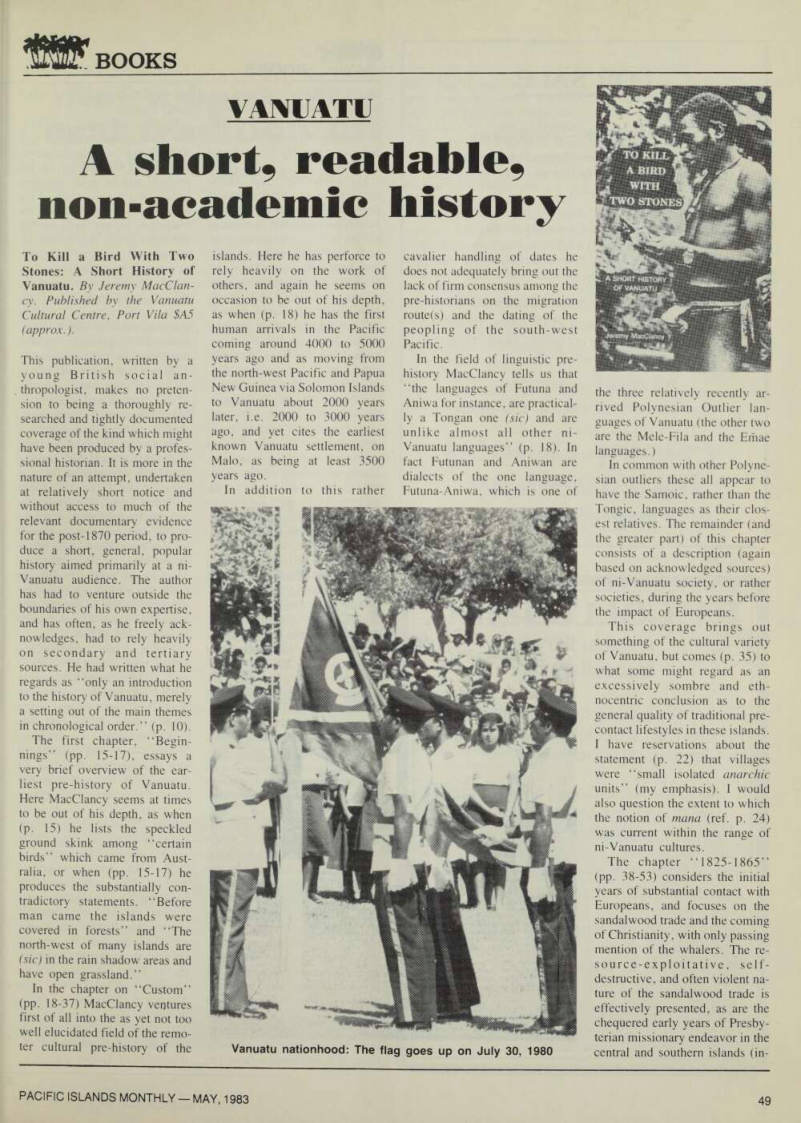

Books
Vanuatu
A short, readable, non-academic history
To Kill a Bird With Two Stones: A Short History of Vanuatu. By Jeremy Mac Cla ncy. Published by the Vanuatu Cultural Centre, Port Vila SAS (approx.).
This publication, written by a young British social an thropologist, makes no preten sion to being a thoroughly re searched and tightly documented coverage of the kind which might have been produced by a profes sional historian. It is more in the nature of an attempt, undertaken at relatively short notice and without access to much of the relevant documentary evidence for the post-1870 period, to pro duce a short, general, popular history aimed primarily at a ni- Vanuatu audience. The author has had to venture outside the boundaries of his own expertise, and has often, as he freely ack nowledges, had to rely heavily
on secondary and tertiary
sources. He had written what he regards as “only an introduction to the history of Vanuatu, merely a setting out of the main themes in chronological order.” (p. 10).
The first chapter, “Begin
nings” (pp. 15-17), essays a very brief overview of the ear liest pre-history of Vanuatu.
Here Mac Clancy seems at times to be out of his depth, as when (p. 15) he lists the speckled ground skink among “certain birds” which came from Aust ralia, or when (pp. 15-17) he produces the substantially con tradictory statements. “Before man came the islands were covered in forests” and “The north-west of many islands are (sic) in the rain shadow areas and have open grassland.”
In the chapter on “Custom” (pp. 18-37) Mac Clancy ventures first of all into the as yet not too well elucidated field of the remo ter cultural pre-history of the
islands. Here he has perforce to rely heavily on the work of others, and again he seems on occasion to be out of his depth, as when (p. 18) he has the first human arrivals in the Pacific coming around 4000 to 5000 years ago and as moving from the north-west Pacific and Papua New Guinea via Solomon Islands to Vanuatu about 2000 years later, i.e. 2000 to 3000 years ago, and yet cites the earliest known Vanuatu settlement, on Malo, as being at least 3500 years ago.
In addition to this rather
cavalier handling of dates he does not adequately bring out the lack of firm consensus among the
pre-historians on the migration
route(s) and the dating of the peopling of the south-west Pacific.
In the field of linguistic pre
history Mac Clancy tells us that
“the languages of Futuna and Aniwa for instance, are practical ly a Tongan one (sic) and are unlike almost all other ni- Vanuatu languages” (p. 18). In fact Futunan and Aniwan are dialects of the one language, Futuna-Aniwa, which is one of
the three relatively recently ar rived Polynesian Outlier lan guages of Vanuatu (the other two are the Mele-Fila and the Erhae
languages.)
In common with other Polyne sian outliers these all appear to have the Samoic, rather than the Tongic, languages as their clos est relatives. The remainder (and the greater part) of this chapter consists of a description (again based on acknowledged sources) of ni-Vanuatu society, or rather societies, during the years before
the impact of Europeans.
This coverage brings out something of the cultural variety of Vanuatu, but comes (p. 35) to what some might regard as an excessively sombre and eth nocentric conclusion as to the general quality of traditional pre contact lifestyles in these islands.
I have reservations about the statement (p. 22) that villages were “small isolated anarchic units” (my emphasis). I would also question the extent to which the notion of mana (ref. p. 24) was current within the range of ni-Vanuatu cultures.
The chapter “1825-1865” (pp. 38-53) considers the initial years of substantial contact with Europeans, and focuses on the sandalwood trade and the coming
of Christianity, with only passing
mention of the whalers. The re
source-exploitative, self
destructive, and often violent na ture of the sandalwood trade is effectively presented, as are the
chequered early years of Presby
terian missionary endeavor in the central and southern islands (in-
Vanuatu nationhood: The flag goes up on July 30, 1980
eluding Paton’s infamous at
tempt at gunboat Christianity)
and the beginnings of the Melanesian Mission (Anglican) presence primarily in the north ern islands.
In ”1866-1906” (pp. 54-79) the infamous ”black-birding” period is well described and the impact on traditional ni-Vanuatu society of those who survived the labor trade and returned to the islands is considered. There is a brief but sound treatment of the effects of the labor trade on the
beginnings and early develop
ment of Bislama. Also effective is the description of the back ground and lead-up to the estab lishment of that bizarre creation, the Anglo-French Con dominium. Sound coverage is given to the beginnings of exten sive alienation of land by Euro pean planters (mainly French) and to the increasing awareness among ni-Vanuatu of the poten tial during this period of the Christian missionary presence as a counter to the heavily exploita tive aspects of the total European
impact.
”1906-1939” (pp. 80-104) deals with the early years of the Condominium including its inef fectual Joint Court which suc ceeded only in furthering the alienation of land by Europeans.
The vicissitudes of the plantation economy in the ’2os and ’3os are well described, as are the con tinuing and changing activities of the missions. There are glimpses in this chapter of changes in ni- Vanuatu notions about Euro peans and the European pre sence, but more attention might well have been given to on-going indigenous value structures dur ing this period. ”1939-1970” (pp. 105-22) deals with the impact of World War 2 on Vanuatu, with some indigenous millenary movements (especially John Frum), with the economic development of the ’sos and ’6os which saw the increasing involvement of ni- Vanuatu in the cash economy, with the substantial development of European-style education for ni-Vanuatu, and with the begin nings of ni-Vanuatu involvement in political activity above village level through local government councils and through Advisory Council’s progression from be
ing entirely nominated to being partly elected.
In “The Seventies” (pp. 123- 39) Mac Clancy attempts a very difficult task, namely the neces sarily brief description of the eventful and at times turbulent decade which culminated in the attainment of independence for Vanuatu. In my opinion the coverage gives insufficient re cognition to the degree of politic al sophistication and organisa tional efficiency developed by the Vanuaaku Party during this period. This chapter includes brief accounts of the develop ment of Nagriamel, of the emergence of independence-by -1980 as a viable proposition, and of the complex progression to wards that independence. As Mac Clancy well recognises, these events are too recent for a definitive account to be possible.
When that account does become possible it will merit and require not a chapter but an entire book. ”1980” (pp. 140-147) briefly recounts the final hectic rundown to the declaration of independ ence in July 1980 and the subse quent mopping-up operations.
Mac Clancy, writing in October 1980, was too close in time to the events to be able to state the full extent of French official duplici ty during this period.
I have at some points in this review been critical of some as pects of Mac Clancy’s approach, but my overall verdict is that this book constitutes a very worth while attempt at a short, emi nently readable, non-academic history a history primarily of the European impact on Vanuatu. If it has a bias this consists of an over-concentration on events in the Presbyterian sphere of influence at the ex pense of those in the sphere of the Melanesian Mission.
The book, which was printed in Port Vila, contains many photographic illustrations which are of considerable intrinsic documentary and historical inter est. The author has very laudably donated the copyright, and any profits from the book, to the Vanuatu Cultural Centre, from
which it is obtainable.
David
Walsh.
*Dr Walsh lectures in an thropological linguistics at the University of Sydney.
Advertisements & other items, p. 50 (1 item)
P.F. Collier,Inc.
FOR SALE
A. Approx. 130 SEPIK Ethnographica (part of the late Tom Slimmon collection) comprising a number of old. interesting and some large pieces, e.g. • Flute stop (Yuat River). Cultcrocodiles from Ambonwari. Meri-Canoe (Murik Distr.), Ancestor poles (Washkuk Distr.). very old Culthooks from Korewori, shields, masks, figures, weaponry, etc.
B. Approx. 50 pieces from INDONESIA • Batak. Mias, Dayak, Java origin, miniature figures, medicine containers. Batak magician stick, weaponry, etc.
Will send photos upon request Both collections are presently in Singapore Interested parties please write to:
PPe/ett //.
33, Rebecca Road, Singapore 1026
P.F. COLLIER,INC.
A Subsidiary of
Macmillan, Inc.
One of the world’s leading publishers is looking for a local distributor for its outstanding reference works: ★ 24 Volume Collier’s Encyclopedia ★ 20 Volume Merit Students Encyclopedia Pre-school and childrens books also available for direct sales packages Interested parties should write to: P. F. Collier, Inc. 866 Third Avenue New York, New York 10022 ATT: R. J. Guinn
Melanesia ...
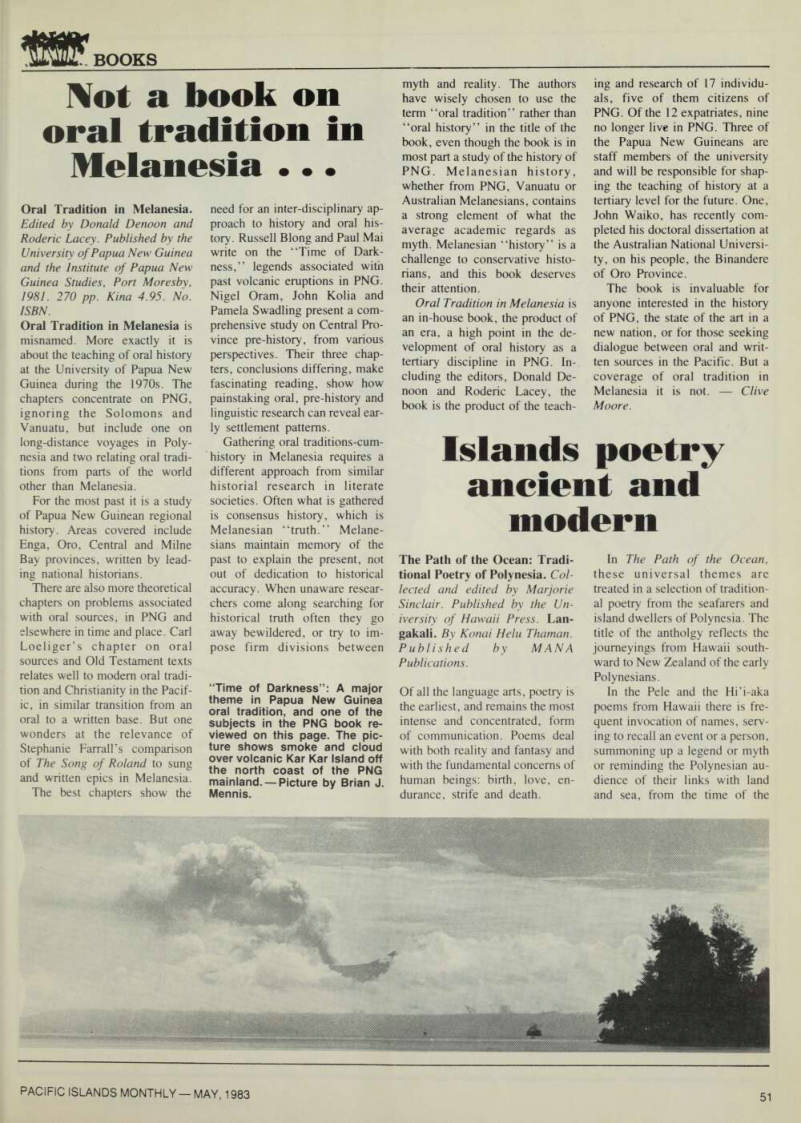
Not a book on oral tradition in Melanesia ...
Oral Tradition in Melanesia.
Edited by Donald Denoon and Roderic Lacey. Published by the University of Papua New Guinea and the Institute of Papua New Guinea Studies, Port Moresby, 1981. 270 pp. Kina 4.95. No.
Isbn.
Oral Tradition in Melanesia is misnamed. More exactly it is about the teaching of oral history at the University of Papua New Guinea during the 19705. The chapters concentrate on PNG, ignoring the Solomons and Vanuatu, but include one on long-distance voyages in Poly nesia and two relating oral tradi tions from parts of the world other than Melanesia.
For the most past it is a study of Papua New Guinean regional history. Areas covered include Enga, Oro, Central and Milne
Bay provinces, written by lead
ing national historians.
There are also more theoretical chapters on problems associated with oral sources, in PNG and elsewhere in time and place. Carl
Loeliger’s chapter on oral
sources and Old Testament texts relates well to modem oral tradi tion and Christianity in the Pacif ic, in similar transition from an oral to a written base. But one wonders at the relevance of
Stephanie Farrall’s comparison
of The Song of Roland to sung and written epics in Melanesia.
The best chapters show the
need for an inter-disciplinary ap proach to history and oral his tory. Russell Blong and Paul Mai write on the “Time of Dark ness,” legends associated with past volcanic eruptions in PNG.
Nigel Oram, John Kolia and Pamela Swadling present a com prehensive study on Central Pro vince pre-history, from various perspectives. Their three chap ters, conclusions differing, make fascinating reading, show how painstaking oral, pre-history and linguistic research can reveal ear ly settlement patterns.
Gathering oral traditions-cum history in Melanesia requires a different approach from similar historial research in literate societies. Often what is gathered is consensus history, which is Melanesian “truth.” Melane sians maintain memory of the past to explain the present, not out of dedication to historical accuracy. When unaware resear chers come along searching for historical truth often they go away bewildered, or try to im pose firm divisions between
myth and reality. The authors have wisely chosen to use the term “oral tradition” rather than “oral history” in the title of the book, even though the book is in most part a study of the history of PNG. Melanesian history, whether from PNG, Vanuatu or Australian Melanesians, contains a strong element of what the average academic regards as myth. Melanesian “history” is a challenge to conservative histo rians, and this book deserves their attention.
Oral Tradition in Melanesia is an in-house book, the product of an era, a high point in the de velopment of oral history as a tertiary discipline in PNG. In cluding the editors, Donald De noon and Roderic Lacey, the book is the product of the teach
ing and research of 17 individu als, five of them citizens of PNG. Of the 12 expatriates, nine no longer live in PNG. Three of the Papua New Guineans are staff members of the university and will be responsible for shap ing the teaching of history at a tertiary level for the future. One, John Waiko, has recently com pleted his doctoral dissertation at the Australian National Universi ty, on his people, the Binandere of Oro Province.
The book is invaluable for anyone interested in the history of PNG, the state of the art in a new nation, or for those seeking dialogue between oral and writ ten sources in the Pacific. But a coverage of oral tradition in
Melanesia it is not.
Clive
Moore.
Islands poetry

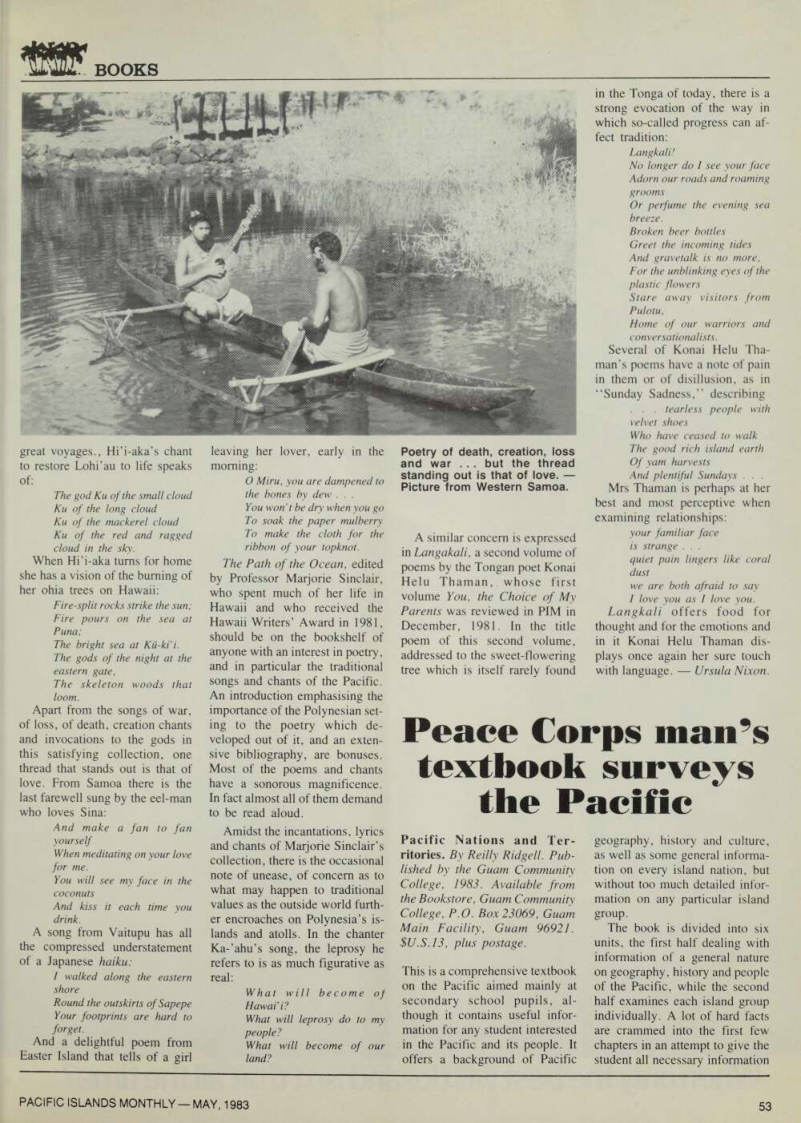
ancient and modern
The Path of the Ocean: Tradi tional Poetry of Polynesia. Col lected and edited by Marjorie Sinclair. Published by the Un iversity of Hawaii Press. Lan gakali. By Konai Helu Thaman.
Published by MANA Publications.
Of all the language arts, poetry is the earliest, and remains the most intense and concentrated, form of communication. Poems deal with both reality and fantasy and with the fundamental concerns of human beings: birth, love, en durance, strife and death.
In The Path of the Ocean, these universal themes are treated in a selection of tradition al poetry from the seafarers and island dwellers of Polynesia. The title of the antholgy reflects the joumeyings from Hawaii south ward to New Zealand of the early Polynesians.
In the Pele and the Hi’i-aka poems from Hawaii there is fre quent invocation of names, serv ing to recall an event or a person, summoning up a legend or myth or reminding the Polynesian au dience of their links with land and sea, from the time of the
“Time of Darkness”: A major theme in Papua New Guinea oral tradition, and one of the subjects in the PNG book re viewed on this page. The pic ture shows smoke and cloud over volcanic Kar Kar Island off the north coast of the PNG
mainland. - Picture by Brian J.
Mennis.
great voyages., Hi’i-aka’s chant to restore Lohi’au to life speaks of: The god Ku of the small cloud Ku of the long cloud Ku of the mackerel cloud Ku of the red and ragged cloud in the sky.
When Hi’i-aka turns for home she has a vision of the burning of her ohia trees on Hawaii; Fire-split rocks strike the sun; Fire pours on the sea at Puna; The bright sea at Ku-ki’i.
The gods of the night at the eastern gate, The skeleton woods that loom.
Apart from the songs of war, of loss, of death, creation chants and invocations to the gods in
this satisfying collection, one
thread that stands out is that of love. From Samoa there is the last farewell sung by the eel-man who loves Sina; And make a fan to fan yourself When meditating on your love for me.
You will see my face in the coconuts And kiss it each time you drink.
A song from Vaitupu has all the compressed understatement of a Japanese haiku: I walked along the eastern shore Round the outskirts of Sapepe Your footprints are hard to forget.
And a delightful poem from Easter Island that tells of a girl
leaving her lover, early in the
morning:
O Miru, you are dampened to the bones by dew . . .
You won’t be dry when you go To soak the paper mulberry To make the cloth for the ribbon of your topknot.
The Path of the Ocean, edited by Professor Marjorie Sinclair, who spent much of her life in Hawaii and who received the Hawaii Writers’ Award in 1981, should be on the bookshelf of anyone with an interest in poetry, and in particular the traditional songs and chants of the Pacific.
An introduction emphasising the importance of the Polynesian set ing to the poetry which de veloped out of it, and an exten sive bibliography, are bonuses.
Most of the poems and chants have a sonorous magnificence.
In fact almost all of them demand to be read aloud.
Amidst the incantations, lyrics and chants of Marjorie Sinclair’s collection, there is the occasional note of unease, of concern as to what may happen to traditional values as the outside world furth er encroaches on Polynesia’s is lands and atolls. In the chanter Ka-’ahu’s song, the leprosy he refers to is as much figurative as real: What will become of Hawaii?
What will leprosy do to my people?
What will become of our land?
A similar concern is expressed in Langakali, a second volume of poems by the Tongan poet Konai Helu Thaman, whose first volume You, the Choice of My Parents was reviewed in PIM in December, 1981. In the title poem of this second volume, addressed to the sweet-flowering tree which is itself rarely found
in the Tonga of today, there is a strong evocation of the way in which so-called progress can af fect tradition: Langkali!
No longer do I see your face Adorn our roads and roaming grooms Or perfume the evening sea breeze.
Broken beer bottles Greet the incoming tides And gravetalk is no more, For the unblinking eyes of the plastic flowers Stare away visitors from Pulotu, Home of our warriors and conversationalists.
Several of Konai Helu Tha man’s poems have a note of pain in them or of disillusion, as in
“Sunday Sadness,” describing
. . . tearless people with velvet shoes Who have ceased to walk The good rich island earth Of yam harvests And plentiful Sundays . . .
Mrs Thaman is perhaps at her best and most perceptive when
examining relationships:
your familiar face is strange . . . quiet pain lingers like coral dust we are both afraid to say I love you as I love you.
Langkali offers food for thought and for the emotions and in it Konai Helu Thaman dis plays once again her sure touch
with language.
Ursula Nixon.
Poetry of death, creation, loss and war . . . but the thread standing out is that of love.- Picture from Western Samoa.
Advertisements & other items, p. 52 (1 item)
quencher with
MANUFACTURED IN AUSTRALIA BY:
R. M. GOW & CO. LTD.
30-Gow Street, Moorooka Queensland, 4105. Australia.
P.O. Box 111, Moorooka Queensland, 4105 Australia Cables: Fidelity Telex: GOWCO AA42839 A A 11 U 4 £ m & & *
The great thirst
quencher with
real fruit flavour.
S& % Read ytof. y e *e
QUALITY AUSTRALIAN
c *»esr % er 'ce Mock mix c* * Vcc» (TiO ro
ASSTD. FLAVOURS
GOLD
Riumfg
cm MCE
2 LITRE CORDIALS ?
GOLD
■ CREST
Fulfrute Fruit Juice Cordial really quenches the thirst.
Fulfrute is economical in the 2 litre Flagon, so Mums love it as much as the kids.
750 m CORDIALS
& mwrjutOßcomwL
P&LFRirrfc
orange RUttr juice cowhal
«OLD
Fulfrute - another R.M.Gow Group quality product,
Peace Corps man’s
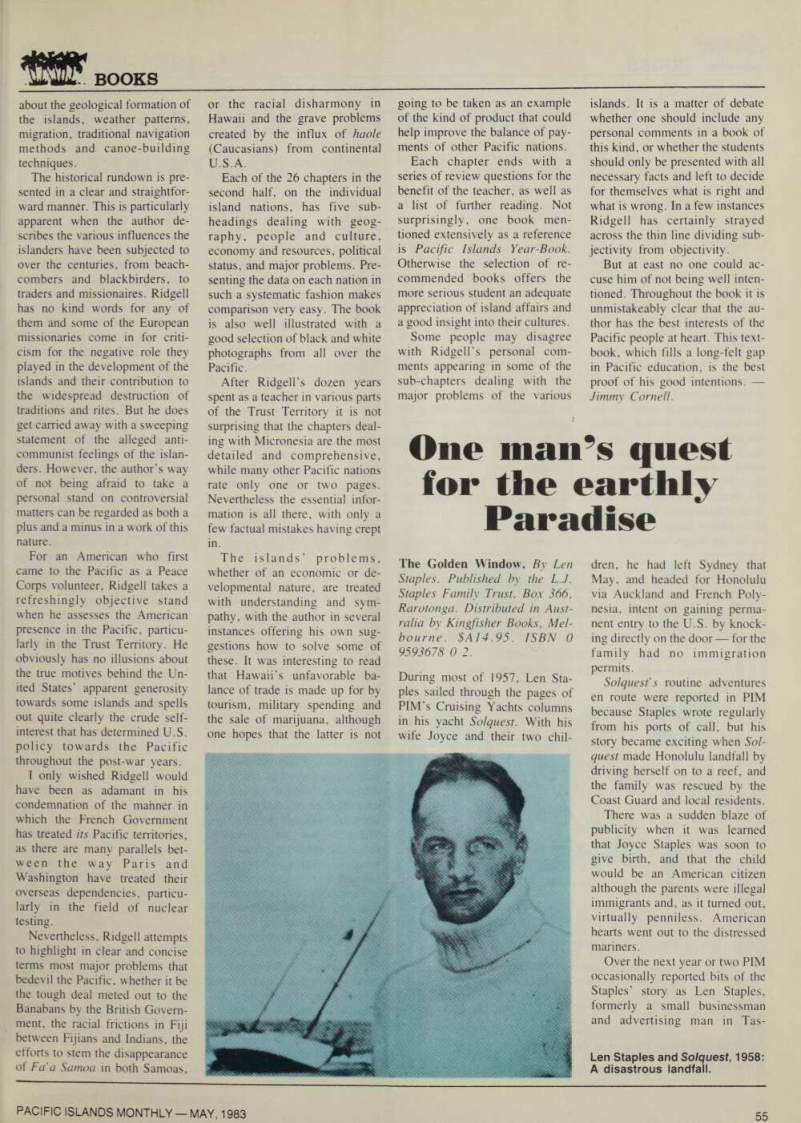
textbook surveys the Pacific
Pacific Nations and Ter ritories. By Reilly Ridgell. Pub lished by the Guam Community College, 1983. Available from the Bookstore, Guam Community College, P.O. Box 23069, Guam Main Facility, Guam 96921.
SU.S.I3, plus postage.
This is a comprehensive textbook on the Pacific aimed mainly at
secondary school pupils, al
though it contains useful infor mation for any student interested in the Pacific and its people. It offers a background of Pacific
geography, history and culture,
as well as some general informa tion on every island nation, but without too much detailed infor mation on any particular island group.
The book is divided into six units, the first half dealing with information of a general nature on geography, history and people of the Pacific, while the second half examines each island group individually. A lot of hard facts are crammed into the first few chapters in an attempt to give the student all necessary information
about the geological formation of the islands, weather patterns, migration, traditional navigation methods and canoe-building techniques.
The historical rundown is pre sented in a clear and straightfor ward manner. This is particularly apparent when the author de scribes the various influences the islanders have been subjected to over the centuries, from beach combers and blackbirders, to traders and missionaires. Ridgell has no kind words for any of them and some of the European missionaries come in for criti cism for the negative role they played in the development of the islands and their contribution to the widespread destruction of traditions and rites. But he does get carried away with a sweeping statement of the alleged anti communist feelings of the islan ders. However, the author’s way of not being afraid to take a personal stand on controversial matters can be regarded as both a plus and a minus in a work of this nature.
For an American who first came to the Pacific as a Peace Corps volunteer, Ridgell takes a refreshingly objective stand when he assesses the American presence in the Pacific, particu larly in the Trust Territory. He obviously has no illusions about the true motives behind the Un ited States’ apparent generosity towards some islands and spells out quite clearly the crude self interest that has determined U.S. policy towards the Pacific throughout the post-war years.
I only wished Ridgell would have been as adamant in his condemnation of the manner in which the French Government has treated its Pacific territories, as there are many parallels bet ween the way Paris and Washington have treated their
overseas dependencies, particu
larly in the field of nuclear
testing.
Nevertheless, Ridgell attempts to highlight in clear and concise terms most major problems that bedevil the Pacific, whether it be the tough deal meted out to the Banabans by the British Govern ment, the racial frictions in Fiji between Fijians and Indians, the efforts to stem the disappearance of Fa’a Samoa in both Samoas,
or the racial disharmony in Hawaii and the grave problems created by the influx of haole (Caucasians) from continental
U.S.A.
Each of the 26 chapters in the second half, on the individual island nations, has five sub headings dealing with geog
raphy, people and culture,
economy and resources, political status, and major problems. Pre senting the data on each nation in such a systematic fashion makes comparison very easy. The book is also well illustrated with a good selection of black and white photographs from all over the Pacific.
After Ridgell’s dozen years spent as a teacher in various parts of the Trust Territory it is not surprising that the chapters deal ing with Micronesia are the most detailed and comprehensive, while many other Pacific nations rate only one or two pages.
Nevertheless the essential infor mation is all there, with only a few factual mistakes having crept in.
The islands' problems, whether of an economic or de velopmental nature, are treated with understanding and sym pathy, with the author in several instances offering his own sug gestions how to solve some of these. It was interesting to read that Hawaii’s unfavorable ba lance of trade is made up for by
tourism, military spending and
the sale of marijuana, although one hopes that the latter is not
going to be taken as an example of the kind of product that could help improve the balance of pay ments of other Pacific nations.
Each chapter ends with a series of review questions for the benefit of the teacher, as well as a list of further reading. Not surprisingly, one book men tioned extensively as a reference is Pacific Islands Year-Book.
Otherwise the selection of re commended books offers the more serious student an adequate appreciation of island affairs and a good insight into their cultures.
Some people may disagree
with Ridgell’s personal com
ments appearing in some of the
sub-chapters dealing with the
major problems of the various
islands. It is a matter of debate whether one should include any personal comments in a book of this kind, or whether the students should only be presented with all necessary facts and left to decide for themselves what is right and what is wrong. In a few instances
Ridgell has certainly strayed
across the thin line dividing sub
jectivity from objectivity.
But at east no one could ac cuse him of not being well inten tioned. Throughout the book it is unmistakeably clear that the au thor has the best interests of the Pacific people at heart. This text book, which fills a long-felt gap in Pacific education, is the best proof of his good intentions.
Jimmy Cornell.
Advertisements & other items, p. 54 (1 item)
When only the best will do-and isn't that all the time?
■ m me. mm □ * v-' ■r r^M
tCiStr:
m m When only the best will do-and isn't that all the time?
One man’s quest
for the earthly Paradise
The Golden Window. By Len Staples. Published by the L.J.
Staples Family Trust, Box 366, Rarotonga. Distributed in Aust ralia by Kingfisher Books, Mel bourne. $A14.95. ISBN 0 9593678 0 2.
During most of 1957, Len Sta ples sailed through the pages of PlM’s Cruising Yachts columns in his yacht Solquest. With his wife Joyce and their two chil-
dren, he had left Sydney that May, and headed for Honolulu via Auckland and French Poly nesia, intent on gaining perma nent entry to the U.S. by knock ing directly on the door for the family had no immigration permits.
Solquest’s routine adventures en route were reported in PIM because Staples wrote regularly from his ports of call, but his story became exciting when Sol quest made Honolulu landfall by driving herself on to a reef, and the family was rescued by the Coast Guard and local residents.
There was a sudden blaze of publicity when it was learned that Joyce Staples was soon to give birth, and that the child would be an American citizen although the parents were illegal immigrants and, as it turned out, virtually penniless. American hearts went out to the distressed mariners.
Over the next year or two PIM occasionally reported bits of the Staples’ story as Len Staples, formerly a small businessman and advertising man in Tas-
Len Staples and Solquest, 1958: A disastrous landfall.
mania, fought a long fight to stay in the U.S. with their new son Kim.
They got much warm and un stinting help from ordinary peo ple and from many officials who had to administer the system, appeals even being made to the President, and an Act of Con gress passed.
But by 1959 Staples’ attitude to the U.S. had soured, and the family returned to Australia, where his marriage to Joyce broke up, and from where he began a long search for new happiness in the islands of the South Pacific. He lives today in Rarotonga, after having tried Tahiti, New Zealand, Lord Howe Island (off the east coast of Australia), and Queensland.
The Golden Window is his autobiography, and it makes compelling reading. He is, to begin with, a competent writer, and his descriptive passages of small boat sailing, and storms at sea, are in themselves worth the price of admission. The narrative fairly dashes along, and there are no boring chapters.
The real fascination however is with the unfolding story of a restless soul in search of Nirva na. Time and again he fights through to rainbow’s end, only to find no joy, and the search must go on. Again it will entirely consume his restless energy, and the energy of the people close to him, for Staples is entirely self centred in his search, claiming the full attention and support of those around him.
Probably it is this aspect of Staples’ character that makes The Golden Window compulsive reading. He demands our atten tion too, and he gets it, even at times against our better judg ment. Why should we have to sit here while this prickly, inwardly
suspicious personality presents
us with a detailed account of his thoughts, fears and transgres sions, and yet never once gives us his age?
Staples clearly is a remarkable persuader, who having convinc ed himself of the rightness of his course, knows how to take us along with him. But only until the end of his story. When the
words stop and he has no more claim on our attention, we are left with a feeling of relief that his life wasn’t ours; that our involvement was only tenuous.
The passage in which he writes of his disenchantment with the America he thought would be his Holy Grail is an example both of his ability with words, and of his propensity for disillusionment.
“The idealism originally motivating our quest had long since withered and died. Rose tinted spectacles of naive gulli
bility had been replaced by re
vealing magnification of close
scrutiny, bringing into critical
focus the country we had entered at such a frightening cost, with repayments made from an irrep laceable, irrecoverable and now depleted treasury of time, health and money.
“I discerned a paradox, in which the abundant American affluence created an insatiable hunger for still more, and all basic values were sacrificed to the pursuit of a nebulous ultimate Utopia, while no one possessed
time enough to enjoy what they
already held; and I recalled the
languid islands of Polynesia,
where the opposite was true.
“I perceived the American im age, a mould of conformity im possibly emerged from a mon grel breed, in which there was an obsessive regard for group par ticipation, group striving, group deprivation, and group domi nance, wherein the possibility of plural harmoniousness was bas tardised into brutalised com petitiveness. Every frenetic mi nute of every frenetic day, Americans brought to bear on each other emotional, social and financial pressures forcing their fellow human into stipulated moulds of conformity, and those who did not conform were outcasts.”
The aggressively non conformist Staples sees Ameri cans as living in “a corrosive society which distilled within them deep reservoirs of suspicion and mistrust”. Americans at home were “at the one time generous yet selfish, companion able yet estranged”.
In Rarotonga during his first lengthy stay on a beachfront leasehold he finds that Ura, his
French Polynesian girl friend, is not the lady he thought she was, and he leaves Utopia for Auck land where he meets and marries Temuana, from the Cook island of Manihiki, 19 years his junior.
As the Holy Grail is not in New Zealand either, they go to Lord Howe Island where Staples feels that “maybe our search is over”. But there is unhappiness and tragedy for them there.
Staples takes on the bureau crats over the sections of the Lord Howe Island Act which give perks to the locally born and is soon involved in ‘‘currents of discrimination, of deliberate ob
struction and sucking quicksands
of harassment.”
But even worse was to come when the Staples’ 13-week-old daughter was found to be dead after Staples one night had cradl ed her in his arms, and police charged him with murder, alleg ing he had suffocated the child.
In Sydney, an inquest found she had died not of suffocation but of pneumonitis, a viral form of pneumonia, and he was released.
They left Lord Howe forever,
Staples expressing a contempt
for the local people that might be actionable if it were possible to libel a community.
A great many tourists to pre sent-day Rarotonga know the Staples’ beachside motel, The
Little Polynesian, and probably
know Staples too. He says he wants to spend the rest of his time quietly painting and writ ing, perhaps on Manihiki, and educate his children.
“All searching is done,” he writes, “and I have come to rest at the point of compromise . . . the half-way swing of the
pendulum.”
It is hard to believe that he
truly has come to rest.
Stuart
Inder.
Books received
Monopolists and Freebooters. By 0. H.
K. Spate. Published 1983 by Australian National University Press, P.O Box 4, Canberra, ACT, 2600. ISBN o 7081 1844 5. Price $39.00.
Travels to New Guinea: Diaries, Let ters, Documents. By N. Mikloucho- Maclay. Published 1982 by Progress Pub lishers, Moscow. Distributed by Current Book Distributors Pty. Ltd., 425 Pitt Street, Sydney, NSW, 2000. Price $8.75.
Which Future for Norfolk Island? By Christopher Nobbs. Published 1983 by Norfolk Marketing, Box 114, Norfolk Island. No ISBN. Price $6.95.
Advertisements & other items, p. 56 (1 item)
Forestmil
PORTABLE
SAWMILL
A Mini Self Contained Sawmill
complete with Diesel Engine or Electric Motor Forestmil produces any size accurate timber ready to use up to 12" x 9" x 24'.
Purchase price and operating cost of Forestmil is less than other sawing equipment with similar production capacity.
Forestmil reduces timber waste and also reduces log transport cost. Timber is sawn direct from the log in the forest.
Forestmil can be moved to a new location in one hour.
Forestmil will saw hardwood or softwood from logs of any diameter.
Over 1000 Forestmils are sawing timber in 23 countries.
IH Forestmil has been manufactured for 18 years.
For literature and prices please contact the manufacturers.
Mac Quarrie Industries Pty.Ltd.
P.O. Box 20, Coburg 3058, Victoria, Australia.
Phone: 350-3411. Telex: 33729. Cables: Macbound, Melbourne.
Samoa calls, and Harry Moors
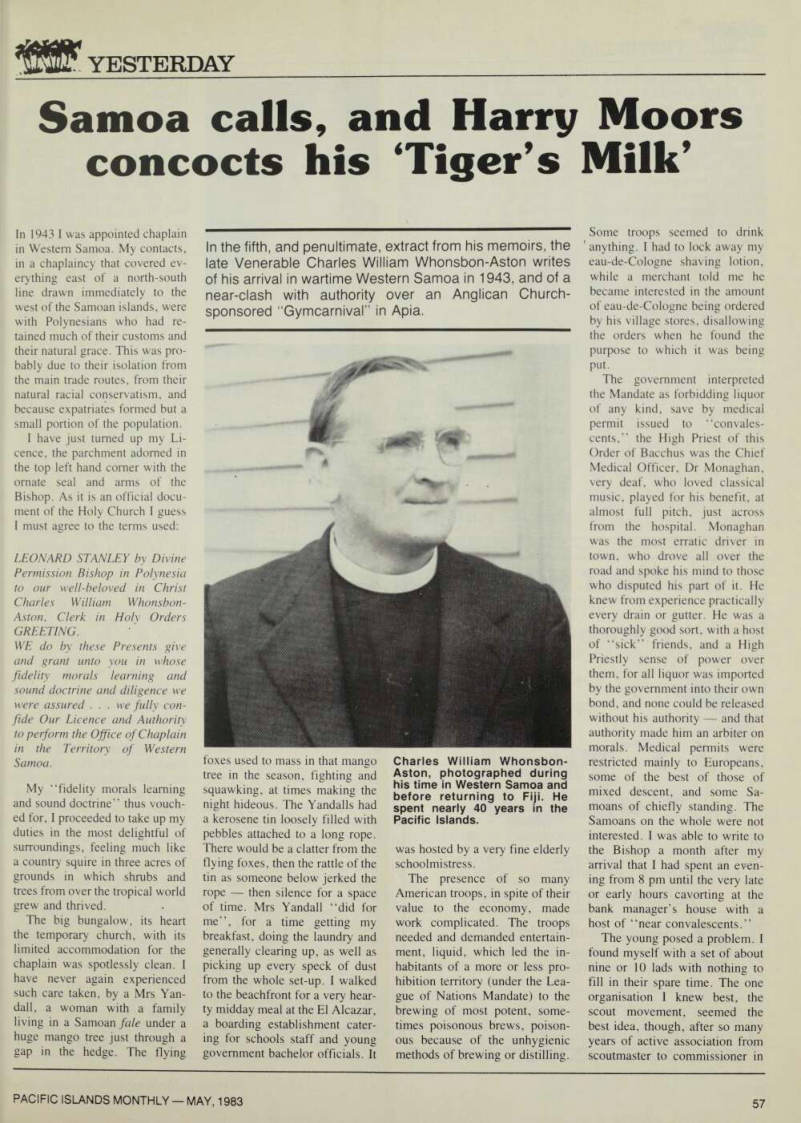
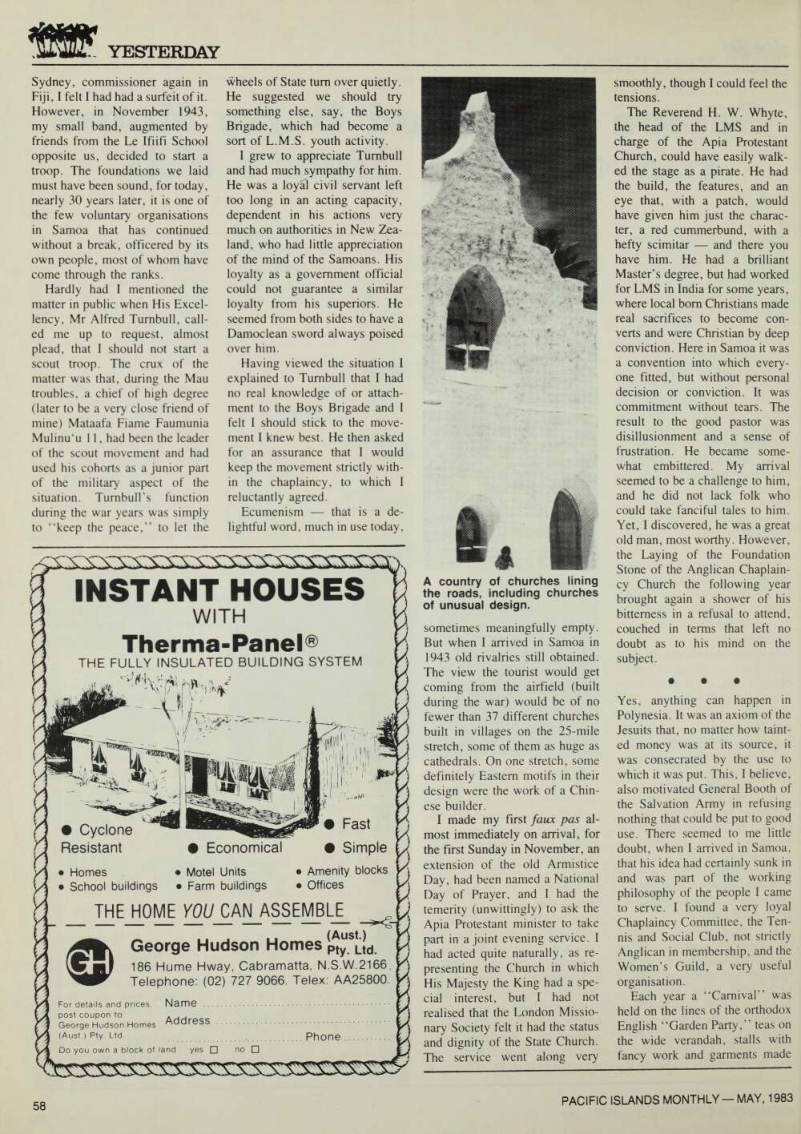
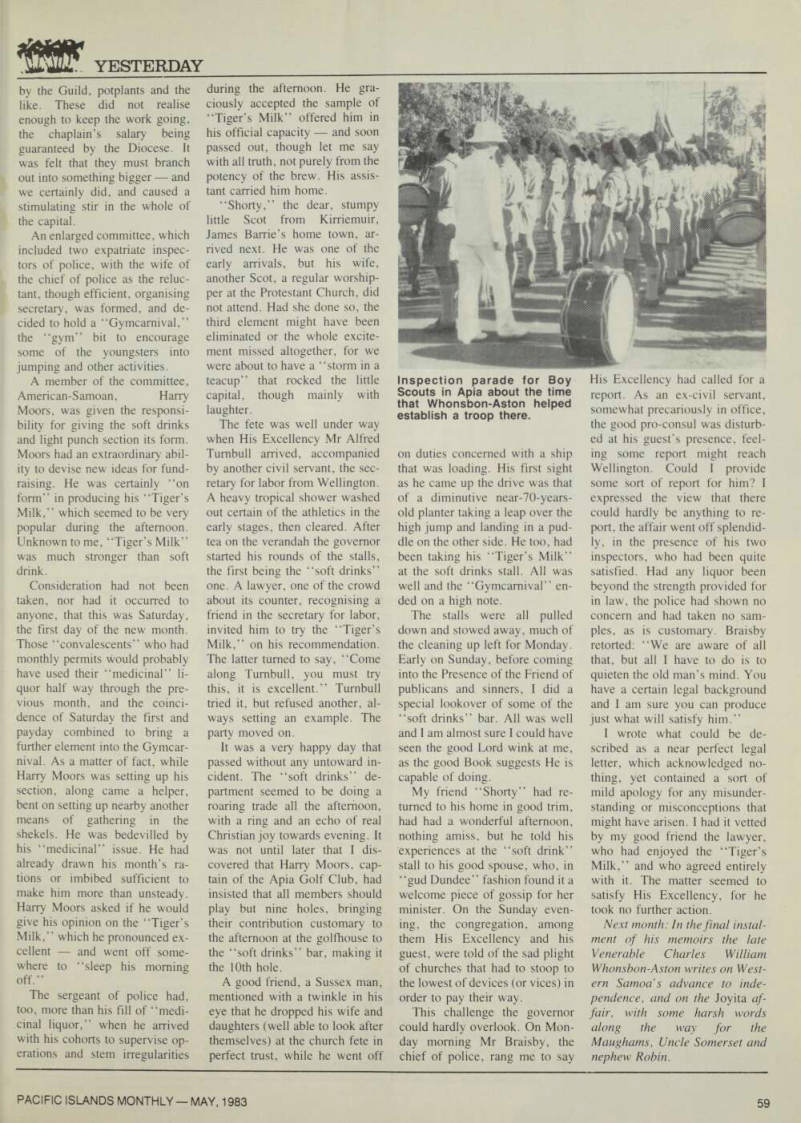
Yesterday
Samoa calls, and Harry Moors concocts his ‘Tiger’s Milk’
In 1943 I was appointed chaplain in Western Samoa. My contacts, in a chaplaincy that covered ev erything east of a north-south line drawn immediately to the west of the Samoan islands, were with Polynesians who had re tained much of their customs and their natural grace. This was pro bably due to their isolation from the main trade routes, from their natural racial conservatism, and because expatriates formed but a small portion of the population.
I have just turned up my Li cence, the parchment adorned in the top left hand corner with the ornate seal and arms of the Bishop. As it is an official docu ment of the Holy Church I guess I must agree to the terms used: LEONARD STANLEY by Divine
Permission Bishop in Polynesia
to our well-beloved in Christ Charles William Whonsbon- Aston, Clerk in Holy Orders
Greeting.
WE do by these Presents give and grant unto you in whose
fidelity morals learning and
sound doctrine and diligence we were assured . . . we fully con fide Our Licence and Authority to perform the Office of Chaplain in the Territory of Western Samoa.
My “fidelity morals learning
and sound doctrine” thus vouch ed for, I proceeded to take up my duties in the most delightful of
surroundings, feeling much like
a country squire in three acres of grounds in which shrubs and trees from over the tropical world grew and thrived.
The big bungalow, its heart the temporary church, with its limited accommodation for the chaplain was spotlessly clean. I
have never again experienced
such care taken, by a Mrs Yan dall, a woman with a family living in a Samoan fale under a huge mango tree just through a gap in the hedge. The flying
In the fifth, and penultimate, extract from his memoirs, the late Venerable Charles William Whonsbon-Aston writes of his arrival in wartime Western Samoa in 1943, and of a near-clash with authority over an Anglican Church sponsored “Gymcarnival” in Apia.
foxes used to mass in that mango tree in the season, fighting and squawking, at times making the night hideous. The Yandalls had a kerosene tin loosely filled with pebbles attached to a long rope.
There would be a clatter from the flying foxes, then the rattle of the tin as someone below jerked the rope then silence for a space of time. Mrs Yandall “did for me”, for a time getting my breakfast, doing the laundry and generally clearing up, as well as picking up every speck of dust from the whole set-up. I walked to the beachfront for a very hear ty midday meal at the El Alcazar, a boarding establishment cater ing for schools staff and young government bachelor officials. It
was hosted by a very fine elderly schoolmistress.
The presence of so many American troops, in spite of their value to the economy, made work complicated. The troops needed and demanded entertain ment, liquid, which led the in habitants of a more or less pro hibition territory (under the Lea gue of Nations Mandate) to the brewing of most potent, some times poisonous brews, poison ous because of the unhygienic methods of brewing or distilling.
Some troops seemed to drink anything. I had to lock away my eau-de-Cologne shaving lotion, while a merchant told me he became interested in the amount of eau-de-Cologne being ordered by his village stores, disallowing the orders when he found the purpose to which it was being put.
The government interpreted the Mandate as forbidding liquor of any kind, save by medical permit issued to “convales cents,” the High Priest of this Order of Bacchus was the Chief Medical Officer, Dr Monaghan, very deaf, who loved classical music, played for his benefit, at almost full pitch, just across from the hospital. Monaghan was the most erratic driver in town, who drove all over the road and spoke his mind to those who disputed his part of it. He knew from experience practically every drain or gutter. He was a thoroughly good sort, with a host of “sick” friends, and a High Priestly sense of power over them, for all liquor was imported by the government into their own bond, and none could be released without his authority and that authority made him an arbiter on morals. Medical permits were restricted mainly to Europeans, some of the best of those of mixed descent, and some Sa moans of chiefly standing. The Samoans on the whole were not interested. I was able to write to the Bishop a month after my arrival that I had spent an even ing from 8 pm until the very late or early hours cavorting at the bank manager’s house with a host of “near convalescents.”
The young posed a problem. I found myself with a set of about nine or 10 lads with nothing to fill in their spare time. The one organisation I knew best, the scout movement, seemed the best idea, though, after so many years of active association from scoutmaster to commissioner in
Charles William Whonsbon- Aston, photographed during his time in Western Samoa and before returning to Fiji. He spent nearly 40 years in the Pacific Islands.
Sydney, commissioner again in
Fiji, I felt I had had a surfeit of it.
However, in November 1943, my small band, augmented by friends from the Le Ifiifi School opposite us, decided to start a troop. The foundations we laid must have been sound, for today, nearly 30 years later, it is one of
the few voluntary organisations
in Samoa that has continued without a break, officered by its own people, most of whom have come through the ranks.
Hardly had I mentioned the matter in public when His Excel lency, Mr Alfred Turnbull, call ed me up to request, almost plead, that I should not start a scout troop. The crux of the matter was that, during the Mau troubles, a chief of high degree (later to be a very close friend of mine) Mataafa Fiame Faumunia Mulinu‘u 11, had been the leader of the scout movement and had used his cohorts as a junior part of the military aspect of the situation. Turnbull’s function during the war years was simply to “keep the peace,” to let the
wheels of State turn over quietly.
He suggested we should try something else, say, the Boys Brigade, which had become a sort of L.M.S. youth activity.
I grew to appreciate Turnbull and had much sympathy for him.
He was a loyal civil servant left too long in an acting capacity, dependent in his actions very much on authorities in New Zea land, who had little appreciation of the mind of the Samoans. His loyalty as a government official could not guarantee a similar loyalty from his superiors. He seemed from both sides to have a Damoclean sword always poised over him.
Having viewed the situation I explained to Turnbull that I had no real knowledge of or attach ment to the Boys Brigade and I felt I should stick to the move ment I knew best. He then asked for an assurance that I would keep the movement strictly with in the chaplaincy, to which I reluctantly agreed.
Ecumenism that is a de lightful word, much in use today.
sometimes meaningfully empty.
But when I arrived in Samoa in 1943 old rivalries still obtained.
The view the tourist would get coming from the airfield (built during the war) would be of no fewer than 37 different churches built in villages on the 25-mile stretch, some of them as huge as cathedrals. On one stretch, some definitely Eastern motifs in their design were the work of a Chin ese builder.
I made my first faux pas al most immediately on arrival, for the first Sunday in November, an extension of the old Armistice Day, had been named a National Day of Prayer, and I had the temerity (unwittingly) to ask the Apia Protestant minister to take part in a joint evening service. I had acted quite naturally, as re presenting the Church in which His Majesty the King had a spe cial interest, but I had not realised that the London Missio nary Society felt it had the status and dignity of the State Church.
The service went along very
smoothly, though I could feel the tensions.
The Reverend H. W. Whyte, the head of the LMS and in charge of the Apia Protestant Church, could have easily walk ed the stage as a pirate. He had the build, the features, and an eye that, with a patch, would have given him just the charac ter, a red cummerbund, with a hefty scimitar and there you have him. He had a brilliant Master’s degree, but had worked for LMS in India for some years, where local bom Christians made real sacrifices to become con verts and were Christian by deep conviction. Here in Samoa it was a convention into which every one fitted, but without personal decision or conviction. It was commitment without tears. The result to the good pastor was disillusionment and a sense of frustration. He became some what embittered. My arrival seemed to be a challenge to him, and he did not lack folk who could take fanciful tales to him.
Yet, I discovered, he was a great old man, most worthy. However, the Laying of the Foundation Stone of the Anglican Chaplain cy Church the following year brought again a shower of his bitterness in a refusal to attend, couched in terms that left no doubt as to his mind on the
subject.
• • • Yes, anything can happen in Polynesia. It was an axiom of the Jesuits that, no matter how taint ed money was at its source, it was consecrated by the use to which it was put. This, I believe, also motivated General Booth of the Salvation Army in refusing nothing that could be put to good use. There seemed to me little doubt, when I arrived in Samoa, that his idea had certainly sunk in and was part of the working philosophy of the people I came to serve. I found a very loyal Chaplaincy Committee, the Ten nis and Social Club, not strictly Anglican in membership, and the Women’s Guild, a very useful
organisation.
Each year a “Carnival” was held on the lines of the orthodox English “Garden Party,” teas on the wide verandah, stalls with fancy work and garments made
A country of churches lining the roads, including churches of unusual design.
by the Guild, potplants and the like. These did not realise enough to keep the work going, the chaplain’s salary being guaranteed by the Diocese. It was felt that they must branch out into something bigger and we certainly did, and caused a stimulating stir in the whole of the capital.
An enlarged committee, which
included two expatriate inspec
tors of police, with the wife of the chief of police as the reluc
tant, though efficient, organising
secretary, was formed, and de cided to hold a “Gymcamival,” the “gym” bit to encourage some of the youngsters into jumping and other activities.
A member of the committee,
American-Samoan, Harry
Moors, was given the responsi bility for giving the soft drinks and light punch section its form.
Moors had an extraordinary abil ity to devise new ideas for fund raising. He was certainly “on form” in producing his “Tiger’s Milk,” which seemed to be very popular during the afternoon.
Unknown to me, “Tiger’s Milk” was much stronger than soft drink.
Consideration had not been taken, nor had it occurred to anyone, that this was Saturday, the first day of the new month.
Those “convalescents” who had
monthly permits would probably
have used their “medicinal” li quor half way through the pre vious month, and the coinci dence of Saturday the first and payday combined to bring a further element into the Gymcar nival. As a matter of fact, while Harry Moors was setting up his section, along came a helper, bent on setting up nearby another means of gathering in the shekels. He was bedevilled by his “medicinal” issue. He had already drawn his month’s ra tions or imbibed sufficient to make him more than unsteady.
Harry Moors asked if he would give his opinion on the “Tiger’s Milk,” which he pronounced ex cellent and went off some where to “sleep his morning off.”
The sergeant of police had, too, more than his fill of “medi cinal liquor,” when he arrived with his cohorts to supervise op erations and stem irregularities
during the afternoon. He gra ciously accepted the sample of “Tiger’s Milk’’ offered him in his official capacity and soon passed out, though let me say with all truth, not purely from the potency of the brew. His assis tant carried him home.
“Shorty,” the dear, stumpy little Scot from Kirriemuir, James Barrie’s home town, ar rived next. He was one of the early arrivals, but his wife, another Scot, a regular worship per at the Protestant Church, did not attend. Had she done so, the third element might have been eliminated or the whole excite ment missed altogether, for we were about to have a “storm in a teacup” that rocked the little
capital, though mainly with
laughter.
The fete was well under way when His Excellency Mr Alfred Turnbull arrived, accompanied by another civil servant, the sec retary for labor from Wellington.
A heavy tropical shower washed out certain of the athletics in the early stages, then cleared. After tea on the verandah the governor started his rounds of the stalls, the first being the “soft drinks” one. A lawyer, one of the crowd about its counter, recognising a friend in the secretary for labor, invited him to try the “Tiger’s Milk,” on his recommendation.
The latter turned to say, “Come along Turnbull, you must try this, it is excellent.” Turnbull tried it, but refused another, al ways setting an example. The party moved on.
It was a very happy day that passed without any untoward in cident. The “soft drinks” de partment seemed to be doing a roaring trade all the afternoon, with a ring and an echo of real Christian joy towards evening. It was not until later that I dis covered that Harry Moors, cap tain of the Apia Golf Club, had insisted that all members should play but nine holes, bringing their contribution customary to the afternoon at the golfhouse to the “soft drinks” bar, making it the 10th hole.
A good friend, a Sussex man, mentioned with a twinkle in his eye that he dropped his wife and daughters (well able to look after themselves) at the church fete in perfect trust, while he went off
on duties concerned with a ship that was loading. His first sight as he came up the drive was that of a diminutive near-70-years old planter taking a leap over the high jump and landing in a pud dle on the other side. He too, had been taking his “Tiger’s Milk’’ at the soft drinks stall. All was well and the “Gymcamival’’ en ded on a high note.
The stalls were all pulled down and stowed away, much of the cleaning up left for Monday.
Early on Sunday, before coming into the Presence of the Friend of publicans and sinners, I did a special lookover of some of the “soft drinks’’ bar. All was well and I am almost sure I could have seen the good Lord wink at me, as the good Book suggests He is
capable of doing.
My friend “Shorty’’ had re turned to his home in good trim, had had a wonderful afternoon, nothing amiss, but he told his experiences at the “soft drink’’ stall to his good spouse, who, in “gud Dundee’’ fashion found it a welcome piece of gossip for her minister. On the Sunday even ing, the congregation, among them His Excellency and his guest, were told of the sad plight of churches that had to stoop to the lowest of devices (or vices) in order to pay their way.
This challenge the governor could hardly overlook. On Mon
day morning Mr Braisby, the
chief of police, rang me to say
His Excellency had called for a report. As an ex-civil servant, somewhat precariously in office, the good pro-consul was disturb ed at his guest’s presence, feel ing some report might reach
Wellington. Could I provide
some sort of report for him? I expressed the view that there could hardly be anything to re port, the affair went off splendid ly, in the presence of his two inspectors, who had been quite satisfied. Had any liquor been
beyond the strength provided for
in law, the police had shown no concern and had taken no sam ples, as is customary. Braisby retorted: “We are aware of all that, but all I have to do is to quieten the old man’s mind. You have a certain legal background and I am sure you can produce just what will satisfy him.’’
I wrote what could be de scribed as a near perfect legal letter, which acknowledged no thing, yet contained a sort of mild apology for any misunder
standing or misconceptions that
might have arisen. I had it vetted by my good friend the lawyer, who had enjoyed the “Tiger’s Milk,’’ and who agreed entirely with it. The matter seemed to satisfy His Excellency, for he took no further action.
Next month: In the final instal ment of his memoirs the late Venerable Charles William Whonsbon-Aston writes on West ern Samoa’s advance to inde pendence, and on the Joyita af fair, with some harsh words along the way for the Maughams, Uncle Somerset and
nephew Robin.
Inspection parade for Boy Scouts in Apia about the time that Whonsbon-Aston helped establish a troop there.
Advertisements & other items, p. 58 (1 item)
Instant Houses
WITH
Therma-Panel®
THE FULLY INSULATED BUILDING SYSTEM
'V / \
JLI
• Cyclone
Resistant • Homes • School buildings • Economical Motel Units Farm buildings • Fast • Simple Amenity blocks Offices
THE HOME YOU CAN ASSEMBLE
George Hudson Homes p*y $ u d , 186 Hume Hway, Cabramatta, N.5.W.2166 Telephone: (02) 727 9066. Telex: AA25800.
I l For details and prices. Name post coupon to: Address ( George Hudson Homes MUU,ei,b (Aust ) Pty Ltd Do you own a block of land yes □ no □ Phone
The land issue in Vanuatu: White

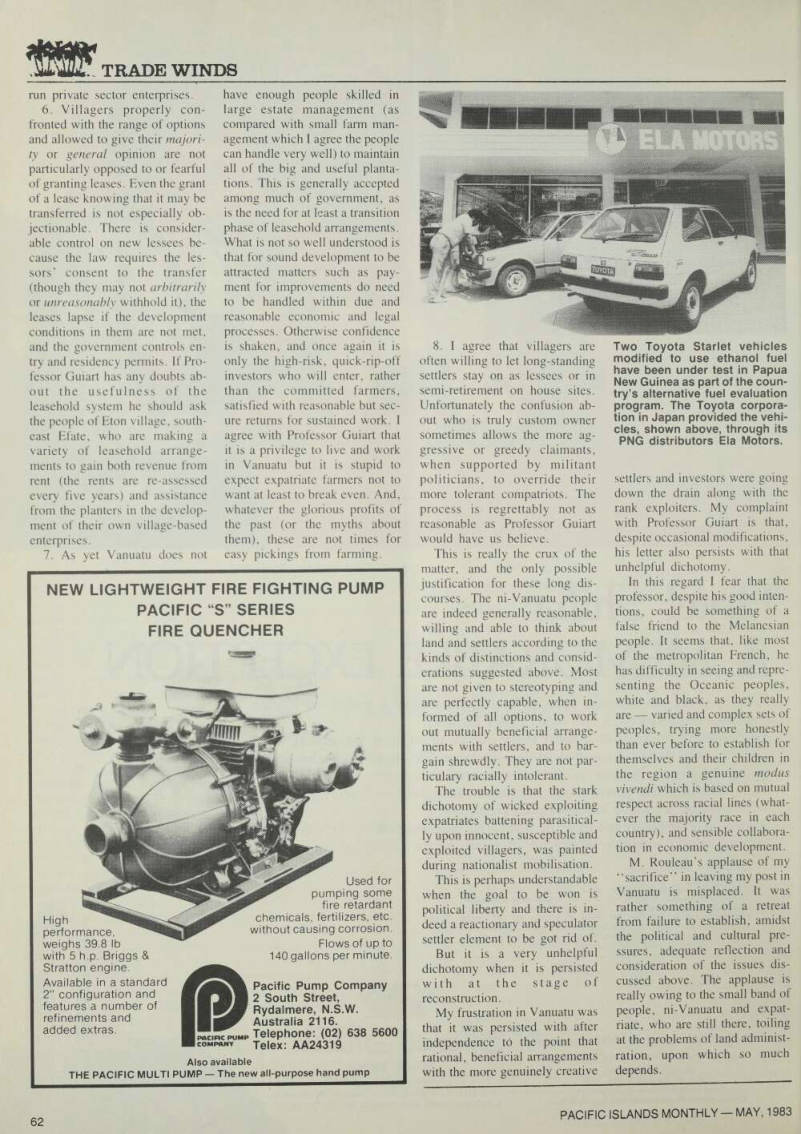
Trade Winds
The land issue in Vanuatu: White devils vs. Black saints?
Professor Jean Guiart’s reply to my letter on the Vanuatu land question distorts the facts about the role of plantation agriculture in the Vanuatu economy and shows little understanding of the issue of payment for improve ments on land.
Firstly, there is no question that payment to settlers for im provements would relate only to improvements of lasting usefulness and value. Govern ment policy statements, the Land Reform Regulation, 1980, and the Alienated Land Act, 1982, all made it clear that mere speculators in titles, or those whose farming practices left land damaged rather than improved, would receive no payment. In deed they might not even be recognised as “alienators”.
While director of rural lands I totally supported that policy and indeed strengthened it by recom mending the adoption, from the Queensland pastoral lease sys tem, of the principle that certain kinds of improvements, carried out before a certain date (after which their cost could be con sidered to have been well and truly recouped), would not at tract payment even if there was still value left in them. That principle was adopted in the Alienated Land Act, 1982, and the relevant date fixed by gov ernment at July 30, 1970, 10 years before independence. Re cent improvements were still to be recognised as meriting payment.
But there is a sharp difference between working within accept ed conventions of compensation, which are grounded in economic rationality and supported by pre cedent, and doing away with payment for improvements al together which, despite his occasional disclaimer, is really what Professor Guiart’s letter is supporting. And unfortunately two other provisions of the Alienated Land Act, 1982, come
close to introducing naked ex propriation de facto. These are the provisions that an alienator not granted a lease must leave the land within six months of notifi cation (i.e., without first receiv ing payment for improvements, except perhaps a first instal ment); and the provision that payment could be made over 10 years at no interest.
These provisions opened the way to a grab for properties without serious regard to the value and scale of the enter-
Dr ALAN W. WARD, whose letter of resignation from the post of director of rural lands in Vanuatu was published in RIM (Nov 82 p 8), here replies to comments in further letters on the subject from Professor JEAN GUIART and
Jean-Claude Rouleau (Rim Feb P 7).
Dr Ward's reply is printed at length because the issues he discusses are relevant not only to the problems of economic development in Vanuatu, but in many other Pacific Island coun tries as well.
prises, and made it extremely difficult to preserve administra tively the distinction between in competent developers who did not deserve either a lease or a payment and the competent far mers whose well-run enterprises were still important to Vanuatu.
It laid them open to-the carpet bagging activities of other expat riate residents (or newcomers), in collusion with some of the ni- Vanuatu elite, and sometimes
without opportunity for villagers
to develop an informed choice on the matter.
I doubt if this is the effect that Professor Guiart would want, yet his generalised attack on the pre
independence planters reinforces
the threat. To take some of his points: 1. It simply is not true to imply that all land was alienated by force and guile or that all land alienation wqs resented. Certain ly a great deal of it was, but the historical record also shows that settlers were often encouraged, not so much for their cash pay ments but for the trade they attracted, new experiences they offered, or as allies and bulwarks in inter-tribal war. Some land alienations, especially by the
missions, were not challenged at all until the political mobilisation of the late 19705. 2. It is also false to imply that all recent land development was resented by the villagers. Some was, some wasn’t. The very best of the recently improved grass lands developments such as Re ntabao Ranch and 4K Ranch on Efate were not objected to right up to independence. 3. Professor Guiart’s asser tion that settlers “mistreated the people for a century” also re quires qualification. Indeed there was mistreatment and brutality on some plantations. There were also harmonious relationships and opportunities for the people
of the over-crowded islands to find work. Many of these mig rant workers now fear for their jobs or already feed the drift to towns. The plantation sector, properly regulated, can contri bute to decentralised
development.
4. It is misleading to say that
recent good development is
“rare”. It is not all that rare.
Despite the plenitude of rundown and neglected properties, there were about 40 plantations well maintained and receiving new development and skilled man agement at independence. 5. Particularly when he dis parages the running of cattle under copra or on improved grasslands Professor Guiart total ly overlooks the importance of even a small number of well run plantations to the wider economy of Vanuatu. It is indeed true that in New Caledonia extensive cat tle ranching on valley land is a wasteful use of a scarce resource.
But Vanuatu is a very different country, with hundreds of thousands of hectares of unde veloped arable land and a small
population. The land produces
superb quality beef and Vanuatu has the prospect of a sound beef export industry provided that re
gular supply and quality control
are maintained.
For this purpose even a few
large plantations, putting first
quality animals through the abat toirs in considerable numbers, can underpin the small-holder economy around them. They can also sustain the more expensive breeding programmes, whilst their heavy machinery, work shops, transport and other facilities can also service the small-holders. In short, small holder farming and plantation farming are seen as complemen tary, not opposed. Perhaps gov ernment services can provide facilities similar, but they imply deeper dependence on aid and are not often as efficient as well-
run private sector enterprises. 6. Villagers properly con fronted with the range of options and allowed to give their majori ty or general opinion are not particularly opposed to or fearful of granting leases. Even the grant of a lease knowing that it may be transferred is not especially ob jectionable. There is consider able control on new lessees be cause the law requires the les sors’ consent to the transfer (though they may not arbitrarily or unreasonably withhold it), the leases lapse if the development conditions in them are not met, and the government controls en try and residency permits. If Pro fessor Guiart has any doubts ab out the usefulness of the leasehold system he should ask the people of Eton village, south east Efate, who are making a variety of leasehold arrange ments to gain both revenue from rent (the rents are re-assessed every five years) and assistance from the planters in the develop ment of their own village-based enterprises. 7. As yet Vanuatu does not
have enough people skilled in large estate management (as compared with small farm man agement which I agree the people can handle very well) to maintain all of the big and useful planta tions. This is generally accepted among much of government, as is the need for at least a transition phase of leasehold arrangements.
What is not so well understood is that for sound development to be attracted matters such as pay ment for improvements do need to be handled within due and reasonable economic and legal processes. Otherwise confidence is shaken, and once again it is
only the high-risk, quick-rip-off
investors who will enter, rather than the committed farmers, satisfied with reasonable but sec ure returns for sustained work. I agree with Professor Guiart that it is a privilege to live and work in Vanuatu but it is stupid to expect expatriate farmers not to want at least to break even. And, whatever the glorious profits of the past (or the myths about them), these are not times for
easy pickings from farming.
8. I agree that villagers are often willing to let long-standing settlers stay on as lessees or in semi-retirement on house sites.
Unfortunately the confusion ab out who is truly custom owner sometimes allows the more ag
gressive or greedy claimants,
when supported by militant
politicians, to override their more tolerant compatriots. The process is regrettably not as reasonable as Professor Guiart would have us believe.
This is really the crux of the matter, and the only possible justification for these long dis courses. The ni-Vanuatu people are indeed generally reasonable, willing and able to think about land and settlers according to the kinds of distinctions and consid erations suggested above. Most are not given to stereotyping and are perfectly capable, when in formed of all options, to work out mutually beneficial arrange ments with settlers, and to bar gain shrewdly. They are not par ticular racially intolerant.
The trouble is that the stark dichotomy of wicked exploiting
expatriates battening parasitical
ly upon innocent, susceptible and
exploited villagers, was painted
during nationalist mobilisation.
This is perhaps understandable when the goal to be won is political liberty and there is in deed a reactionary and speculator settler element to be got rid of.
But it is a very unhelpful dichotomy when it is persisted with at the stage of reconstruction.
My frustration in Vanuatu was that it was persisted with after independence to the point that rational, beneficial arrangements with the more genuinely creative
settlers and investors were going down the drain along with the
rank exploiters. My complaint
with Professor Guiart is that, despite occasional modifications, his letter also persists with that
unhelpful dichotomy.
In this regard I fear that the
professor, despite his good inten
tions, could be something of a false friend to the Melanesian people. It seems that, like most of the metropolitan French, he has difficulty in seeing and repre
senting the Oceanic peoples,
white and black, as they really are varied and complex sets of
peoples, trying more honestly
than ever before to establish for themselves and their children in the region a genuine modus vivendi which is based on mutual respect across racial lines (what ever the majority race in each country), and sensible collabora tion in economic development.
M. Rouleau’s applause of my “sacrifice” in leaving my post in Vanuatu is misplaced. It was rather something of a retreat from failure to establish, amidst the political and cultural pre ssures, adequate reflection and consideration of the issues dis cussed above. The applause is really owing to the small band of people, ni-Vanuatu and expat riate, who are still there, toiling at the problems of land administ ration, upon which so much
depends.
Two Toyota Starlet vehicles modified to use ethanol fuel have been under test in Papua New Guinea as part of the coun try’s alternative fuel evaluation program. The Toyota corpora tion in Japan provided the vehi cles, shown above, through its PNG distributors Ela Motors.
Advertisements & other items, pp. 61-62 (1 item)
Hotel Shilla:
A MEMORABLE EXCEPTION
Known for its graciousness, Seoul's Hotel Shilla renders a traditional Korean ambience inspired by the renowned Shilla Dynasty.
This splendid setting, just a short thirty-minute drive from the airport, offers the most beautiful wooded gardens in town, 738 luxurious suites and rooms, 13 elegant banquet rooms, international restaurants, and expert services tailored to the needs of the business man or woman and visitors who wish to enjoy a unique and charming experience.
Above all, our guests return to us time after time because of our dedication to personalized, attentive service which makes all the difference in the world.
For Reservation: • Hotel Shilla Representive Office »New York: (212) 564-0718 (collect) •Tokyo; (03) 586-7571 ‘Osaka: (06) 271-7571 Odner Hotels Representatives Office »Hong Kong: (5) 262251 «Taipei; 5515933 ‘Singapore: 2353474 ‘Bangkok; 2521181 HRI Office ‘U.S.A (except N.Y. State): 800-223-1230 (toll free)‘N.Y. State: (212) 751-8915 (collect) ‘London: (01) 583-3050 ‘Paris: (01) 079-0000 ‘Frankfurt; (0611) 283345 ‘Riyadh; (01) 464-841 1 ‘Svdnev: 233-8422 SAo Paulo: (11) 251-5021 one o / C Jh<fJ&adinff7 iotcls of the World Represented byltvi Associated with the O^uta
AJALHOiaSVSIEM
Seoul, Korea
Cftux International Association Odner Hotel Representatives Ltd (O H R )
JOHN A. TETLEY CO.. INC.
202, 2-Ga, Jangchung-Dong, Chung-Ku, Seoul, Korea Tel: 295-3111, 3121, 3131, 3141, Cable: HOTELSHILLA C.P.O. Box: 7000 Telex: SHILLA K 24257, 24160
NEW LIGHTWEIGHT FIRE FIGHTING PUMP
PACIFIC “S” SERIES
FIRE QUENCHER
I m * A .
W.
High performance weighs 39.8 lb with 5 h.p. Briggs & Stratton engine.
Available in a standard 2" configuration and features a number of refinements and added extras.
Used for pumping some fire retardant chemicals, fertilizers, etc. without causing corrosion.
Flows of up to 140 gallons per minute.
Pacific Pump Company 2 South Street, Rydalmere, N.S.W.
Australia 2116. i p«c.«c pomp Telephone: (02) 638 5600 (company Telex: AA24319 Also available THE PACIFIC MULTI PUMP The new all-purpose hand pump
Yachts
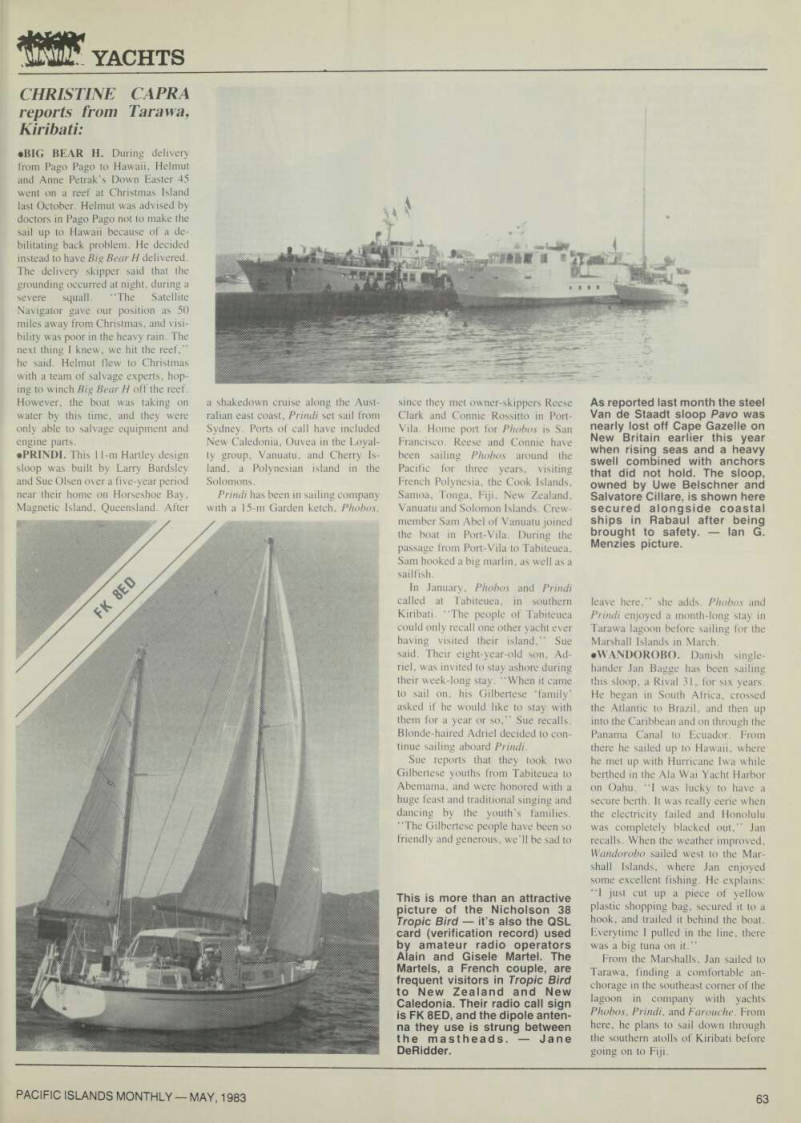

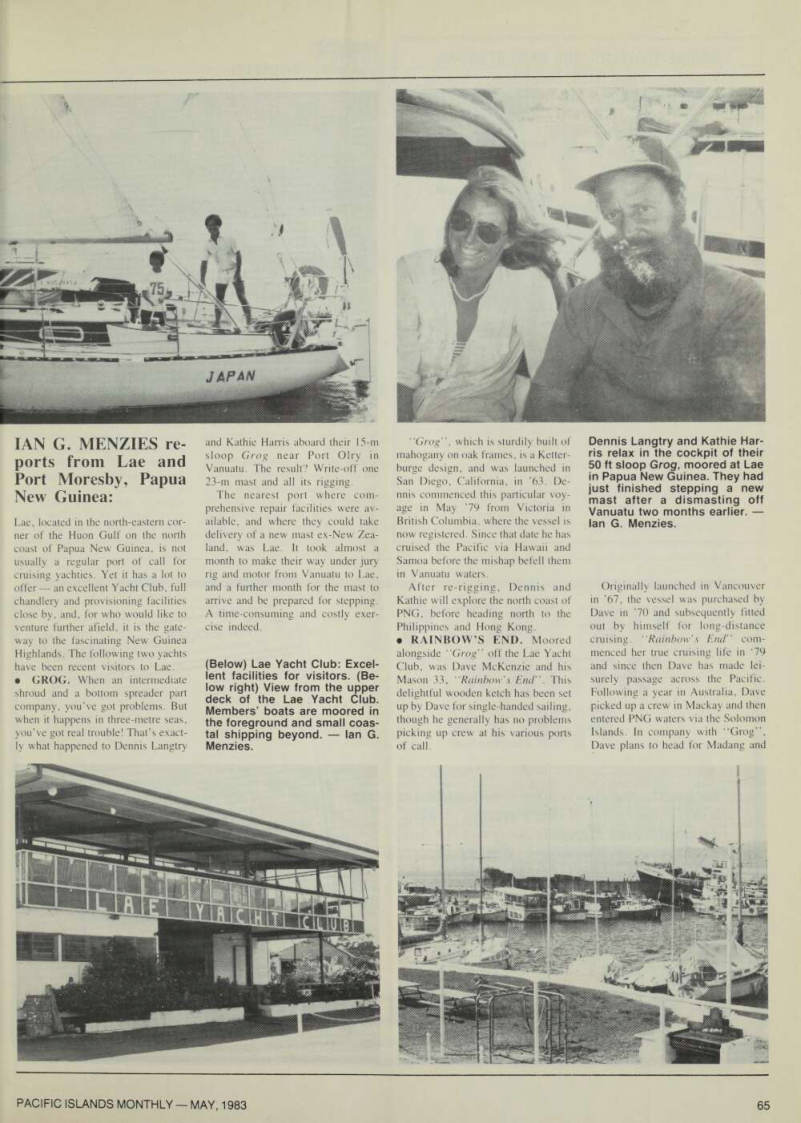
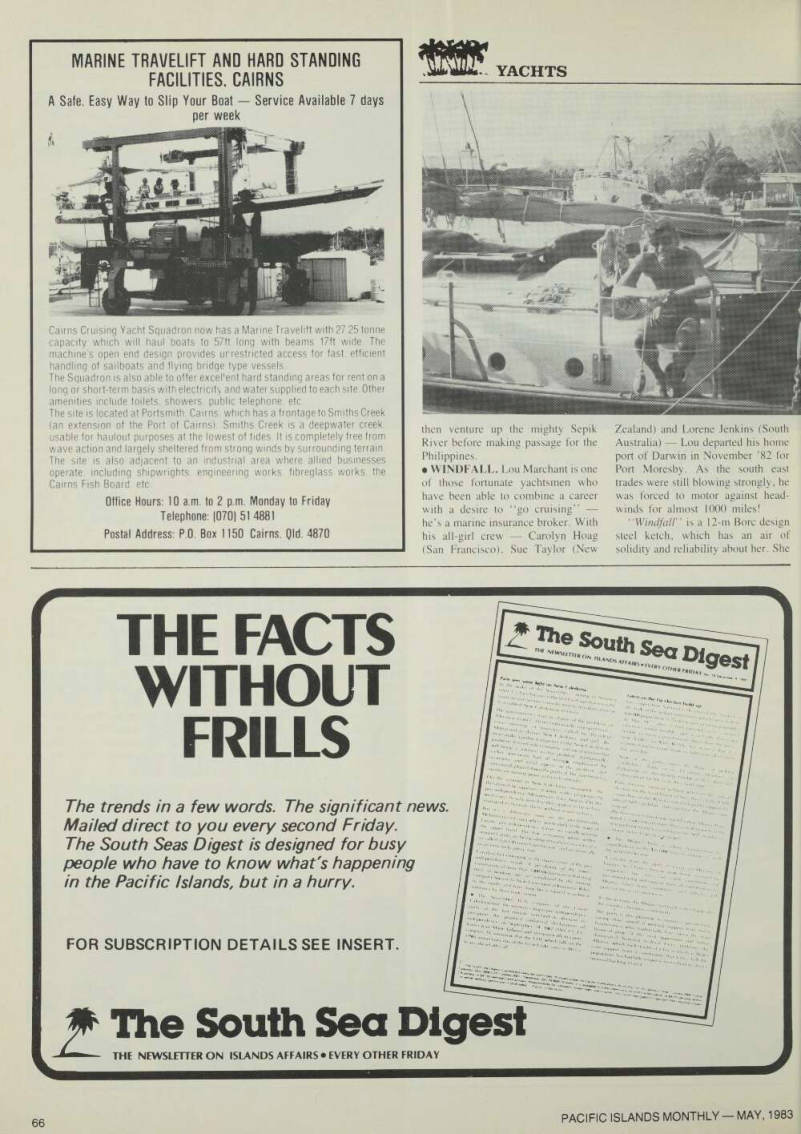
Christine Capra
reports from Tarawa, Kiribati:
•BIG BEAR H. During delivery from Pago Pago to Hawaii, Helmut and Anne Petrak’s Down Easter 45 went on a reef at Christmas Island last October. Helmut was advised by doctors in Pago Pago not to make the sail up to Hawaii because of a de bilitating back problem. He decided instead to have Big Bear H delivered.
The delivery skipper said that the grounding occurred at night, during a severe squall. “The Satellite Navigator gave our position as 50 miles away from Christmas, and visi bility was poor in the heavy rain. The next thing I knew, we hit the reef,” he said. Helmut flew to Christmas with a team of salvage experts, hop ing to winch Big Bear H off the reef.
However, the boat was taking on water by this time, and they were only able to salvage equipment and engine parts. •PRINDI. This 11-m Hartley design sloop was built by Larry Bardsley and Sue Olsen over a five-year period near their home on Horseshoe Bay, Magnetic Island, Queensland. After
a shakedown cruise along the Aust ralian east coast, Prindi set sail from Sydney. Ports of call have included New Caledonia. Ouvea in the Loyal ty group, Vanuatu, and Cherry Is land, a Polynesian island in the Solomons.
Prindi has been in sailing company with a 15-m Garden ketch, Phobos,
since they met owner-skippers Reese Clark and Connie Rossitto in Port- Vila. Home port for Phobos is San Francisco. Reese and Connie have been sailing Phobos around the Pacific for three years, visiting French Polynesia, the Cook Islands.
Samoa, Tonga, Fiji, New Zealand, Vanuatu and Solomon Islands. Crew member Sam Abel of Vanuatu joined the boat in Port-Vila. During the passage from Port-Vila to Tabiteuea, Sam hooked a big marlin, as well as a sailfish.
In January. Phobos and Prindi called at Tabiteuea, in southern Kiribati. “The people of Tabiteuea could only recall one other yacht ever having visited their island,” Sue said. Their eight-year-old son. Ad riel, was invited to stay ashore during their week-long stay. “When it came to sail on, his Gilbertese ‘family’ asked if he would like to stay with them for a year or so,” Sue recalls.
Blonde-haired Adriel decided to con tinue sailing aboard Prindi.
Sue reports that they took two Gilbertese youths from Tabiteuea to Abemama, and were honored with a huge feast and traditional singing and dancing by the youth’s families.
“The Gilbertese people have been so friendly and generous, we’ll be sad to
leave here,” she adds. Phobos and Prindi enjoyed a month-long stay in Tarawa lagoon before sailing for the Marshall Islands in March. •WANDOROBO. Danish single hander Jan Bagge has been sailing this sloop, a Rival 31, for six years.
He began in South Africa, crossed the Atlantic to Brazil, and then up into the Caribbean and on through the Panama Canal to Ecuador. From there he sailed up to Hawaii, where he met up with Hurricane Iwa while berthed in the Ala Wai Yacht Harbor on Oahu. ”1 was lucky to have a secure berth. It was really eerie when the electricity failed and Honolulu was completely blacked out,” Jan recalls. When the weather improved, Wandorobo sailed west to the Mar shall Islands, where Jan enjoyed some excellent fishing. He explains: ”1 just cut up a piece of yellow plastic shopping bag, secured it to a hook, and trailed it behind the boat.
Everytime I pulled in the line, there was a big tuna on it.”
From the Marshalls, Jan sailed to Tarawa, finding a comfortable an chorage in the southeast corner of the lagoon in company with yachts Phobos, Prindi, and Farouche. From here, he plans to sail down through the southern atolls of Kiribati before
going on to Fiji.
As reported last month the steel Van de Staadt sloop Pavo was nearly lost off Cape Gazelle on New Britain earlier this year when rising seas and a heavy swell combined with anchors that did not hold. The sloop, owned by Uwe Belschner and Salvatore Cillare, is shown here secured alongside coastal ships in Rabaul after being
brought to safety. - Ian G.
Menzies picture.
This is more than an attractive picture of the Nicholson 38 Tropic Bird - it’s also the QSL card (verification record) used by amateur radio operators Alain and Gisele Martel. The Martels, a French couple, are frequent visitors in Tropic Bird to New Zealand and New Caledonia. Their radio call sign is FK 8ED, and the dipole anten na they use is strung between the mastheads. - Jane DeRidder.
•FAROUCHE. A 12-m Sparks and Stephens sloop, with owner-skipper Derek Jarvis of Ontario, Canada, and crew Dave Davidsmeier and Mark Norris, called at Tarawa in February.
Ports of call for Derek and Farouche include the Philippines, Hong Kong, New Guinea and Micronesia, as well as many South Pacific Islands and Australia.
Farouche celebrated the New Year in the Solomons, and then sailed to Tarawa. “It was a pretty rough ride from the Solomons to here, but it was definitely worth it,” Derek says.
“Kiribati is one of those out-of-the way places, we understand not more than 10 yachts called here last year."
Since January of this year, a total of
eight yachts have visited Tarawa.
Farouche left Tarawa, bound for Majuro, where they plan to buy provisions for their up-coming pas sage to Hawaii. • REALM. Newlyweds Bruce and Kris Remy, aboard Realm , their 9-m Bristol Channel Cutter, visited Tara wa after a three-and-a-half-day sail
from Majuro. Home port is Bellingham, Washington, and they have been sailing Realm for two years, taking in the Baja California Coast and parts of mainland Mexico, before sailing over to Hawaii.
In Hawaii. Bruce and Kris decided to get married and flew back to Washington for the ceremony in Sep-
tember. Bruce reports that they are enjoying their extended honeymoon, cruising to various parts of the Pacif ic. Realm will sail to Solomon Is lands from Kiribati. Bruce sums up his stay in Kiribati saying, “The people are friendly, the weather is outstanding, and the surfing isn’t bad either.
(Right) Magic Dragon, the 12 m Canadian sloop which is home to PIM yachting writer Jane De- Ridder, in a tranquil setting on the east coast of New Caledonia. Jane and husband Michel have been cruising for 18 years. (Centre) Puka Puka II, cruising out of Japan, is skip pered by Hiroto Maruta, and was photographed here shortly before leaving New Zealand for Australia. Puka Puka means
“floating sounds".
Ian G. Menzies Re
ports from Lae and
Port Moresby, Papua
New Guinea:
Lae, located in the north-eastern cor ner of the Huon Gulf on the north coast of Papua New Guinea, is not usually a regular port of call for cruising yachties. Yet it has a lot to offer — an excellent Yacht Club, full chandlery and provisioning facilities close by, and, for who would like to venture further afield, it is the gate way to the fascinating New Guinea Highlands. The following two yachts have been recent visitors to Lae. • GROG. When an intermediate shroud and a bottom spreader part company, you’ve got problems. But when it happens in three-metre seas, you’ve got real trouble! That’s exact ly what happened to Dennis Langtry
and Kathie Harris aboard their 15-m sloop Grog near Port Olry in Vanuatu. The result? Write-off one 23-m mast and all its rigging.
The nearest port where com prehensive repair facilities were av ailable, and where they could take delivery of anew mast ex-New Zea land, was Lae. It took almost a month to make their way under jury rig and motor from Vanuatu to Lae, and a further month for the mast to arrive and be prepared for stepping.
A time-consuming and costly exer cise indeed.
"Grog", which is sturdily built of mahogany on oak frames, is a Ketter burge design, and was launched in San Diego, California, in '63. De nnis commenced this particular voy age in May ’79 from Victoria in British Columbia, where the vessel is now registered. Since that date he has cruised the Pacific via Hawaii and Samoa before the mishap befell them in Vanuatu waters.
After re-rigging, Dennis and Kathie will explore the north coast of PNG, before heading north to the Philippines and Hong Kong.
• Rainbow S End. Moored
alongside "Grog" off the Lae Yacht Club, was Dave McKenzie and his Mason 33, "Rainbow’s End". This delightful wooden ketch has been set up by Dave for single-handed sailing, though he generally has no problems picking up crew at his various ports of call.
Originally launched in Vancouver in ’67, the vessel was purchased by Dave in ’7O and subsequently fitted out by himself for long-distance cruising. "Rainbow’s End" com menced her true cruising life in ‘79 and since then Dave has made lei surely passage across the Pacific.
Following a year in Australia, Dave picked up a crew in Mackay and then entered PNG waters via the Solomon Islands. In company with “Grog”, Dave plans to head for Madang and
(Below) Lae Yacht Club: Excel lent facilities for visitors. (Be low right) View from the upper deck of the Lae Yacht Club.
Members’ boats are moored in the foreground and small coas
tal shipping beyond. - Ian G.
Menzies.
Dennis Langtry and Kathie Har ris relax in the cockpit of their 50 ft sloop Grog, moored at Lae in Papua New Guinea. They had just finished stepping a new mast after a dismasting off Vanuatu two months earlier.- Ian G. Menzies.
then venture up the mighty Sepik River before making passage for the
Philippines.
• WINDFALL. Lou Marchant is one of those fortunate yachtsmen who have been able to combine a career with a desire to “go cruising” he’s a marine insurance broker. With his all-girl crew Carolyn Hoag (San Francisco), Sue Taylor (New
Zealand) and Lorene Jenkins (South Australia) Lou departed his home port of Darwin in November ’B2 for Port Moresby. As the south east trades were still blowing strongly, he was forced to motor against head winds for almost 1000 miles!
“Windfall” is a 12-m Bore design steel ketch, which has an air of solidity and reliability about her. She
was launched in Darwin in ’74, just in time to compete in the last Darwin to Timor Yacht Race. When the disastrous Cyclone Tracy hit Darwin at Christmas of that year, “Wind fall” survived with only superficial
damage.
For the last eight years Lou has lived on board and regularly cruised Indonesian waters during that period.
From Port Moresby, Lou will make passage for Truk in Micronesia, where they will cruise for several months. After that as Lou says “who knows?” • SAROENA. When John and Rai da Bedford decided to build their 13 m ketch, Saroena, one of the require ments was that it should truly be “a home away from home”. They suc
ceeded admirably. Based originally
on a 12 m Roberts Spray, the Bed fords extended the vessel, increased its draught, and added a substantial wheelhouse. Heavily built of klegecell and fibreglass, Saroena is a solid, sea-kindly yacht, constructed with long-distance cruising in mind.
The galley is extremely well de signed with a dieseline stove positioned almost on the centre-line so that it does not require gimballing.
The stove also helps to creat a cosy warmth in cooler climes. For quick meals there is a back-up gas system, plus deep sinks and spacious and accessible storage. A real kitchen.
After completing the vessel at Tweed Heads on the central coast of eastern Australia, the Bedfords spent a year cruising the Great Barrier Reef before eventually departing for PNG waters in November ’B2. Working their way up through the D’Entrecas teaux and Trobriand Islands, they sailed into the Huon Gulf and the port of Lae. There, moored right off the
Lae Yacht Club, they discovered two other yachts from their home port of Tweed Heads. You can imagine the reunion.
John and Raida have nothing but praise for the hospitality showered on them by the members and staff of the Lae Yacht Club. If the Bedfords’ praise is any recommendation, then
perhaps cruising yachties should put
Lae on their list of ports of call. It is the largets port in PNG, has a thriv ing commercial centre, and as men tioned earlier, is the gateway to the
Highlands Region.
After two weeks in Lae, Saroena headed south to Samarai and on to Port Moresby, where the Bedfords were joined by their son Justin, and his friend Paul Barrett, who will help crew the vessel back to Cairns. • HONU. Though one of the smaller ocean cruisers, the Cascade 29 Honu from Cordova, Alaska, has some of the biggest adventures. Her maiden voyage (this was before she was complete) took her up to Prince Wil liam Sound at 62 deg. north latitude.
Of that early voyage across the Gulf of Alaska, Francine Matthews says, “I thought for sure we were going to die. I wrote my will.” But as Mike Matthews explained, “We didn’t have much choice. I was transferr ed.” The young couple had had the fibreglass hull and decks shipped up to Biorka, a little island near Sitka where Mike was working on an air craft navigational aid station. Here they began the interior finishing and fitting-out of Honu (‘Sea Turtle’) with Francine supplying the know how. “I did a lot of reading to tell us how to do it,” she said. Franc Mates book, “ From a Bare Hull”, was their most useful source of expertise.
The project took the better part of two years. When they’d completed
Honu they had three garage sales in an attempt to fit everything in. then they were off in May 1981 from Kodiak direct to Hawaii ... or as direct as headwinds would allow.
Priorities for the Matthews couple are somewhat different from those of many of their fellow cruising yach ties. For instance, where an engine might have gone they carry two dive tanks. They not only carry two wind surfers below decks on ocean passages but also two regular surfboards. The only electrics aboard are a compass light and a tape deck powered by solar panel and car bat tery. They carry an outboard but seldom use it except for docking.
They used only four gallons of petrol between Hawaii and New Zealand on a route which included a 39-day passage to the Marquesas from Hawaii. Though they admit that the boat “is a little tight”, they have no intention of getting a larger vessel, for they have noticed that people with large and complex boats sometimes run out of time and money trying to keep ahead of maintenance and re pairs. “We have time to have fun and our money is holding out well . . .”
Mike and Francine plan on “going on round”, but not until they’ve spent another season exploring the islands of the South Pacific. • SHAULA. This is the second ma jor offshore voyage for Echo and Merrill Shreve in their Portland, Ore
gon, registered Kendall 32 Shaula, and their third visit to New Zealand.
They’d raised their family and were tired of working. Both wanted to travel. Merrill had served eight years in the wartime navy, and as for Echo, 'Tm happiest round the water'. So they sold a smaller vessel and, from a bare hull, built Shaula, in design a predecessor to the well known West sail 32. Simplicity is their byword.
For instance, Shaula has a lead line instead of a depth sounder. She
boasts no transmitting capabilities.
To fill their water tanks, the Shreves catch rainwater off the deck simply by plugging the scuppers. Echo says: “Much of the pleasure from this way of life is discovering how we can depend on our own resources.” Their route has taken them off the beaten track. They’ve visited Christmas and Fanning Islands, and Kosrae, as well as Queensland, Australia, and the more frequent South Pacific islands.
Plans? They have to be back home by September to take care of rental property, but they hope to head for Alaska come the next northern summer. • BONNY LASS. This 20-tonne, 13.7 m Taiwan-built ketch is cruising home for four joint owners. Don Zobel, Louise Sherman, Dan Curtis and Jim McCormick left San Francis co on their Brewer 45 in March 1982, heading west around. When they arrived in New Zealand they bought a van for touring. We talked with Don and Louise in Matauwhi Bay in the Bay of Islands. They pointed out that in joint ownership the main problem lies in determining route and agre eing on length of time to spend in each area. South Africa, the Carib bean and Florida are included in Bonny Lass’s future cruising plans. • STARLIGHT. “The boat is a being. She determines my plans. I’m only the helmsman,” says Michael Davidson of his 11.6 m sloop, the one with the Port Orford cedar hull and the dusty bilge. Ed Monk drew up this Cascade design in 1935.
Brian Lange built Starlight at his father’s Port Townsend, Washing ton, shipyard in 1971 when he was a lad. Now foreman of Salthouse Bros.
Shipyard in Greenhithe near Auck land, Brian has a chance to supervise the yacht's haulout and to check out his handiwork. The present owner, Michael Davidson, left Vancouver with Starlight in 1979, sailing through the South Sea Islands to New Zealand where he will have spent a year and a half by the time he heads back toward the Pacific northwest to “reconstruct financially”. During his lengthy stay in New Zealand Michael has toured both north and south islands half a dozen times by hitch-hiking, by train, in his own car, as well as on Starlight. He spent
(Above left) Dave McKenzie on board his Mason 33 Rainbow's End, moored off the Lae Yacht Club. (Above) Lou Marchant with Carolyn Hoag, one of the members of his all-girl crew on board Windfall in Port Moresby.
Lou has been cruising Indone sian and PNG waters for seven
years. - Ian G. Menzies.
the winter in Akaroa harbor in Christchurch with a Dickenson diesel heater keeping the vessel snug below decks. Unlike other cruising vessels.
Starlight, for aesthetic reasons, has no stanchions or lifelines. Instead, Michael, who frequently sails single handed, relies on safety harness and handrails to stay aboard. Twice he has been washed overboard, once when crossing the Columbia River bar. At such times an extra surge of adrenalin helps him heave himself back aboard by means of a security line which keeps him tethered to the boat when he is in the cockpit or on deck. • KARANA. Sharing the same Bay of Islands anchorage with Starlight as well as the same port of registry (Portland) and the same yacht club affiliation, Karana is another cruis ing vessel without stanchions or lifelines. Karana is so small (7.5 m) that they would only get in the way, her owner David Ingalls reckons.
She’s a Bahama 25 which David, architect, and Jan Lippen-Holz, teacher, built starting from a bare
hull, making a superbly professional
job for a couple of amateur ship wrights! David explains his choice of yacht with the comment: “It fits in the garage and it was affordable.”
Though he says his next boat will have standing headroom, he is aware of the many advantages of small craft. He says there’s usually room for a tiny yacht to tie up in the most crowded of ports; the 1.19 m draught means they can anchor in shallow anchorages; and they’re al ways glad of it when painting. After
repainting the mini-sloop in Orongo
Bay in the Bay of Islands, David and Jan headed off on a six-to-eight-week
camping trip leaving Karana swing
ing on an Opua mooring.
• VICTORIA. Robert and Linda Ahbel sailed their hefty 30-ton steel vessel (15.3 m x 4.8 mby 2.18 m) into Opua in the Bay of Islands in September with the engine out of commission. Designed with a cargo hold where their double bunk
stateroom is now, Victoria is the smallest design from the board of east coast naval architect Murray Watts, known for his megabuck steel craft. The re-engined, repainted and refurbished vessel will set off home ward bound via the Australs, Papeete and Palmyra. Once home in Washington State’s San Juan Islands, Robert and Linda plan to “blow up”
Victoria s lines to 14m, and build a new vessel themselves in Friday Har bour where Robert has a shed, hoists and welding gear rented out during their absence. Here Robert a tanker engineer by trade has al ready built a steel crabber and two sailing boats. The Ahbels plan to use their next boat to fish for albacore, something they have done success fully in the past with Victoria. • DISTANT STAR. Robert Ahbel recognised a bushy-bearded neighbor on a double-ended Honolulu registered boat which was mastless on the hard at Oram’s Marina in Whangarei as the proprietor of the “Bushwacker Barbershop’’ in Bel mont, California. Though he still barbers for barter from time to time
amongst the cruising community.
Dean Poore says: “My scissors are pretty rusty now.’’ Robert had a Seawitch Ketch for six years before buying his Danish-built foam-core Saggitta 30 Distant Star. About the Seawitch, Robert remarked, “She was too big, too slow, had too much maintenance and was strictly a down wind boat.” He estimates that over the three years he has cruised the South Pacific in Distant Star almost 65 per cent of his sailing has been to windward. With cruising companion Lynn Oakley, Dean is headed on westward, but route and time reckon ing have yet to be settled. At one time “in real estate”, Lynn is a bit of a wine and food connoisseur which makes Distant Star’s travelling extra
interesting.
Jon Knedel, Teri Bonge and Tim Bonge from the ferro-cement yacht Hummingbird, recently in the South Pacific out of Texas,
Usa.
Advertisements & other items, pp. 64-68 (1 item)
package
Mobile
power in a
self-contained
package
No extras to buy.
Delivered ready to go.
f DiSSi a a
LEI 29 HPH S&P
20KVA or 31kVA power wherever you want it. From rugged, reliable Dis-gen units that come complete with cabinet, fuel tank, power outlets, etc. And need no special mounting platform.
Dis-gen electric generating sets. An astute combination of Onan generator and Perkins diesel.
Tough enough to take the hardest knocks. In mining. Construction sites.
Outback engineering projects. Hire companies Or anywhere you need a durable, dependable 240/415v power source.
A special marine model is also available.
Rigid underchassis protects the unit wherever you take it. And however you get it there. On a truck or a trailer. On skids. Or lifted in by crane. Undercarriages, 2 or 4 wheels, available as options.
Dis-gen. Mobility and power in a selfcontained package.
Dis-gen 20kVA and 31kVA
electric generating sets.
Available (ram;
LINCOLN ■
I ARC WELDING
The Lincoln Electric Company
(Ausf.) Ply. Ltd.
Sydney (Head Office) 35 Bryant Street, Padstow, NSW 2211 Telephone: (02) 772 7222 Telex: 22792 Cables: Tinconweid", Sydney Newcastle Telephone (049) 61 5381 Telex 28263 Wollongong Telephone: (042) 28 0565 Melbourne Telephone. (03) 481 8444 Telex: 31958 Brisbane Telephone; (07) 277 2955 Telex: 41268 Townsville Telephone: (077) 79 9777 Telex: 47247 Mac Kay Telephone: (079) 51 2599 Telex 48655 Adelaide Telephone: (08) 43 8061 Telex 82794 Perth Telephone: (09) 277 8744 Telex: 92914 Karratha (WA) Telephone: (091) 85 2405 Telex: 99640 Launceston Telephone; (003) 26 3388 Telex: 58517
Distragen
Distragen Pty Ltd.
New South Wales (Head Office) 4 Mitchell Road, Brookvale, NSW 2100 Telephone: (02) 9381777 Telex: 27733 Melbourne Telephone: (03) 481 0508 Telex 31958 Brisbane Telephone: (07) 275 2926 Telex: 41268 22*
MARINE TRAVELIFT AND HARD STANDING
FACILITIES, CAIRNS
A Safe. Easy Way to Slip Your Boat Service Available 7 days per week r.
Cairns Cruising Yacht Squadron now has a Marine Travelift with 27.25 tonne capacity which will haul boats to 57ft long with beams 17ft wide The machine’s open end design provides unrestricted access for fast, efficient handling of sailboats and flying bridge type vessels.
The Squadron is also able to offer excel'ent hard standing areas for rent on a long or short-term basis with electricity and water supplied to each site. Other amenities include toilets, showers, public telephone, etc.
The site is located at Portsmith. Cairns, which has a frontage to Smiths Creek (an extension of the Port of Cairns). Smiths Creek is a deepwater creek, usable for haulout purposes at the lowest of tides. It is completely free from wave action and largely sheltered from strong winds by surrounding terrain The site is also adjacent to an industrial area where allied businesses operate, including shipwrights, engineering works, fibreglass works, the Cairns Fish Board, etc Office Hours: 10 a.m. to 2 p.m. Monday to Friday
Telephone: (070) 51 4881
Postal Address: P.O. Box 1150 Cairns. Old. 4870
THE FACTS
WITHOUT
FRILLS
The trends in a few words. The significant news Mailed direct to you every second Friday.
The South Seas Digest is designed for busy people who have to know what's happening in the Pacific Islands , but in a hurry.
FOR SUBSCRIPTION DETAILS SEE INSERT.
The South Sea Digest
THE NEWSLETTER ON ISLANDS AFFAIRS • EVERY OTHER FRIDAY
iJ?®.SouthSea
Di 9est
f *IOAY
SUZUKI...
The name of PERFORMANCE
SUZUKI OUTBOARDS are truly ALL ROUND PERFORMER... reliable, durable and economical under any situation.
SUZUKI prepared outboards line up exclusively for the usage of professionals, and of course, also for the pleasure. Each has different construction respectively, so that you can choose your engine that is best suited to your boat and usage.
Get the fruitful life through SUZUKI OUTBOARDS. —■ rrrs r* i a* i m w i ~== 16 types from 2ps to 140ps
SUZUKI 1
SUZUKI MOTOR CO., LTD. Hamamatsu, Japan SUZUKI GENERATOR 2500 A MFW ZEALAND SOUTH PACIFIC SUZUKI DISTRIBUTORS LTD. PHONE; 58-599 •PAPUA NEW GUINEA HI SPEED DIESEL TWICE PTYLTD PHONE - 42-2679#FIJINIRANJANS AUTOPORT LTD. PHONE: 381555 •TAHITI NIPPON AUTOMOTO PHONE:2-98- SOLOMON' SOLOMON ISLAND PHONE: 565 • VANUATU HENRI LERgU* • NEW CALEDONIA STE SUPERCAL 27206 YAP AMBROSE «KOROR BECHESRRAK T. COMPANY PHONE: 338 *TRUK KIOMASA STORE PHONE: 470
Shipping Schedules
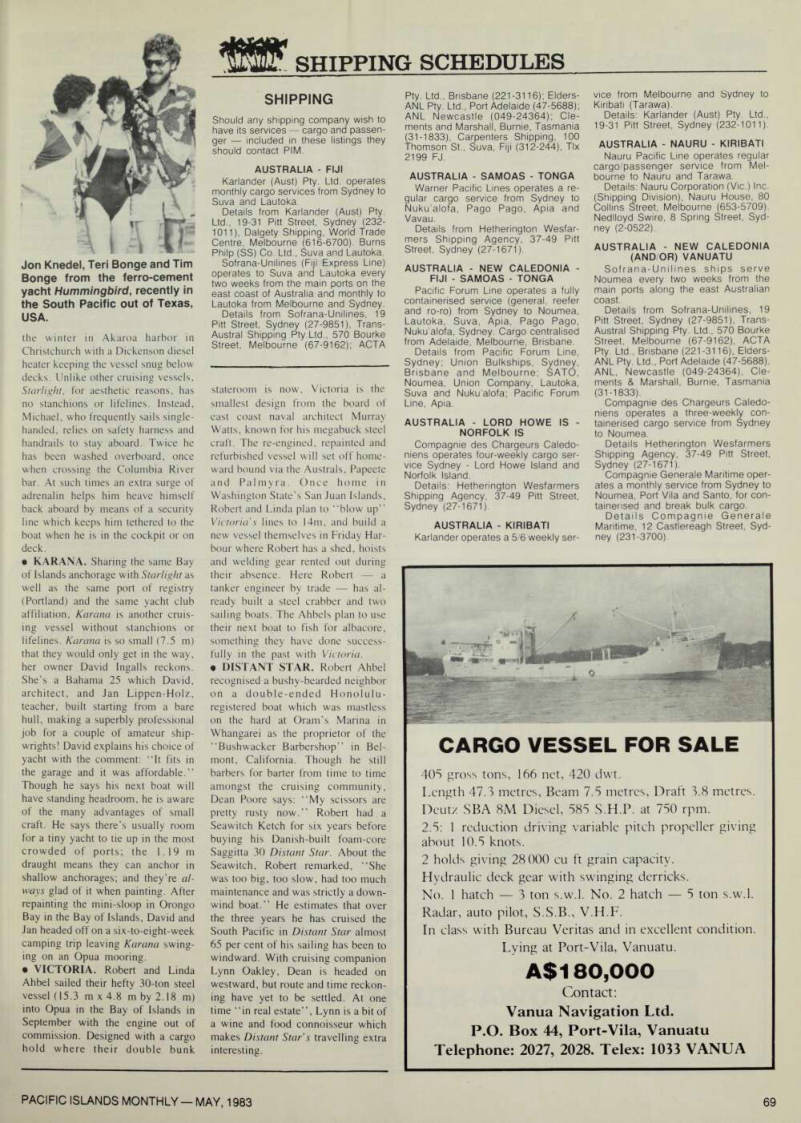
Shipping
Should any shipping company wish to have its services cargo and passen ger included in these listings they should contact PIM.
Australia - Fiji
Karlander (Aust) Pty. Ltd. operates monthly cargo services from Sydney to Suva and Lautoka.
Details from Karlander (Aust) Pty.
Ltd., 19-31 Pitt Street, Sydney (232- 1011), Dalgety Shipping, World Trade Centre, Melbourne (616-6700). Burns Philp (SS) Co. Ltd., Suva and Lautoka.
Sofrana-Unilines (Fiji Express Line) operates to Suva and Lautoka every two weeks from the main ports on the east coast of Australia and monthly to Lautoka from Melbourne and Sydney.
Details from Sofrana-Unilines, 19 Pitt Street, Sydney (27-9851), Trans- Austral Shipping Pty.Ltd., 570 Bourke Street, Melbourne (67-9162); ACTA
Pty. Ltd., Brisbane (221-3116); Elders- ANL Pty. Ltd., Port Adelaide (47-5688); ANL Newcastle (049-24364); Cle ments and Marshall, Burnie, Tasmania (31-1833), Carpenters Shipping, 100 Thomson St., Suva, Fiji (312-244), Tlx 2199 FJ.
Australia - Samoas - Tonga
Warner Pacific Lines operates a re gular cargo service from Sydney to Nukualofa, Pago Pago, Apia and Vavau.
Details from Hetherington Wesfar mers Shipping Agency, 37-49 Pitt Street, Sydney (27-1671).
Australia - New Caledonia -
Fiji - Samoas - Tonga
Pacific Forum Line operates a fully containerised service (general, reefer and ro-ro) from Sydney to Noumea, Lautoka, Suva, Apia, Pago Pago, Nukualofa, Sydney. Cargo centralised from Adelaide, Melbourne, Brisbane.
Details from Pacific Forum Line, Sydney; Union Bulkships, Sydney, Brisbane and Melbourne; SATO, Noumea, Union Company, Lautoka, Suva and Nukualofa; Pacific Forum Line, Apia.
Australia - Lord Howe Is -
Norfolk Is
Compagnie des Chargeurs Caledo niens operates four-weekly cargo ser vice Sydney - Lord Howe Island and Norfolk Island.
Details: Hetherington Wesfarmers Shipping Agency, 37-49 Pitt Street, Sydney (27-1671).
Australia - Kiribati
Karlander operates a 5/6 weekly ser
vice from Melbourne and Sydney to Kiribati (Tarawa).
Details: Karlander (Aust) Pty. Ltd., 19-31 Pitt Street, Sydney (232-1011).
Australia - Nauru - Kiribati
Nauru Pacific Line operates regular cargo/passenger service from Mel bourne to Nauru and Tarawa.
Details: Nauru Corporation (Vic.) Inc. (Shipping Division), Nauru House, 80 Collins Street, Melbourne (653-5709).
Nedlloyd Swire, 8 Spring Street, Syd ney (2-0522).
Australia - New Caledonia
(And Or) Vanuatu
Sofrana-Unilines ships serve Noumea every two weeks from the main ports along the east Australian coast.
Details from Sofrana-Unilines, 19 Pitt Street, Sydney (27-9851), Trans- Austral Shipping Pty, Ltd., 570 Bourke Street, Melbourne (67-9162), ACTA Pty. Ltd., Brisbane (221-3116), Elders- ANL Pty. Ltd., Port Adelaide (47-5688), ANL, Newcastle (049-24364), Cle ments & Marshall, Burnie, Tasmania (31-1833).
Compagnie des Chargeurs Caledo nians operates a three-weekly con tainerised cargo service from Sydney to Noumea.
Details Hetherington Wesfarmers Shipping Agency, 37-49 Pitt Street, Sydney (27-1671).
Compagnie Generale Maritime oper ates a monthly service from Sydney to Noumea, Port Vila and Santo, for con tainerised and break bulk cargo.
Details Compagnie Generale Maritime, 12 Castlereagh Street, Syd ney (231-3700).
Advertisements & other items, p. 69 (1 item)
AslBo,ooo
a ■■
CARGO VESSEL FOR SALE
405 gross tons, 166 net, 420 dwt.
Length 47.3 metres. Beam 7.5 metres, Draft 3.8 metres.
Dcutz SBA 8M Diesel, 585 S.H.P. at 750 rpm. 2.5; 1 reduction driving variable pitch propeller giving about 10.5 knots. 2 holds giving 28000 cu ft grain capacity.
Hydraulic deck gear with swinging derricks.
No. 1 hatch 3 ton s.w.l. No. 2 hatch 5 ton s.w.l.
Radar, auto pilot, 5.5.8., V.H.F.
In class with Bureau Veritas and in excellent condition.
Lying at Port-Vila, Vanuatu.
AslBo,ooo
Contact: Vanua Navigation Ltd.
P.O. Box 44, Port-Vila, Vanuatu Telephone: 2027, 2028. Telex: 1033 VANUA
Australia - Nz - Fiji -
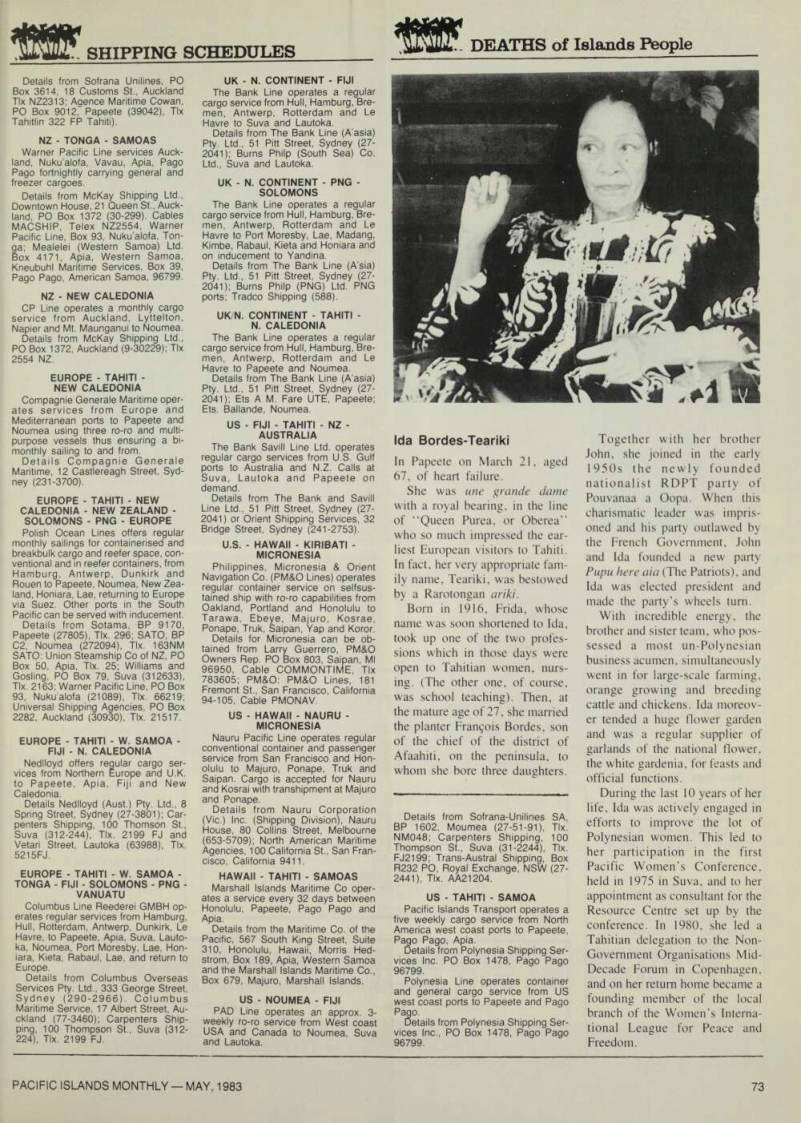
Hawaii - Us
P&O liners call at Auckland, Suva, Pago Pago and Honolulu on east bound and westbound voyages bet ween Sydney and the US.
Details from P&O Booking Centre, World Travel Headquarters Pty.Ltd,, 33 Bligh Street, Sydney (237-0333).
AUSTRALIA - NZ - FIJI - TONGA -
Vanuatu - New Caledonia -
Solomons - Samoas - New
Guinea
Sitmar Cruises operates a year round cruise program to include most of the above countries.
Details from Sitmar Cruises, 47 Elizabeth Street, Sydney (232-7511).
AUSTRALIA - NZ - FIJI - TONGA -
Vanuatu - New Caledonia -
Solomons - Samoas - Tahiti
P&O liners call at Auckland, Bay of Islands, Honiara, Lautoka, Noumea, Nukualofa, Pago Pago, Papeete, Port Moresby, Santo, Savusavu, Suva, Vavau and Vila on cruises from Australia.
Details from P&O Booking Centre, World Travel Headquarters Pty. Ltd., 33 Bligh Street, Sydney (237-0333).
Australia - Nz - Solomons -
Png
Pacific Forum Line operates con tainerised and general cargo service from Lyttleton, Napier and Auckland to Honiara, Lae, Port Moresby, Brisbane.
Details from Pacific Forum Line, Au ckland and Sydney; Steamships Ship ping, Port Moresby: Sullivans Ltd., Honiara: Union Bulkships, Brisbane.
Australia - Micronesia
Nauru Pacific Line operates a regu lar container service from Melbourne to Majuro, Kosrae, Ponape, Truk, Guam and Saipan.
Details Nauru Corporation (Vic.) Inc. (Shipping Division), Nauru House, 80 Collins Street, Melbourne, (653-5709), Nedlloyd Swire, 8 Spring Street, Syd ney (2-0522).
Australia - Tuvalu
Karlander operates a three monthly service from Sydney and Melbourne to Tuvalu (Funafuti).
Details from Karlander (Aust.) Pty, Ltd., 19-31 Pitt Street, Sydney (232- 1011).
Australia - Png
Karlander New Guinea Line's cargo vessels call at Melbourne, Sydney, Port Moresby, Lae, Madang, Wewak, Manus, Kimbe, Rabaul, Popondetta.
Details from Karlander (Aust.) Pty.
Ltd., 19-31 Pitt Street, Sydney (232- 1011), Dalgety Shipping, World Trade Centre, Melbourne (616-6700).
Australia - Png - Solomons -
Vanuatu
A consortium of Conpac, NGAL/PNGL have three container ves sels operating on a 28 day turn-around from Melbourne, Sydney and Brisbane to Port Moresby, Lae, Rabaul, Kavieng, Wewak, Madang, Kieta, Hon iara, Vila and Santo.
Details from Burns, Philp & Co. Ltd., 51 Pitt Street, Sydney (2-0547) and Interocean Swire, 8 Spring Street, Syd ney (2-0522).
New Guinea Express Lines operates
a fortnightly container service from Melbourne, Sydney, Brisbane to Port Moresby, Lae, Alotau, Kimbe, Rabaul, Kieta, Honiara.
Details from New Guinea Express Lines, PO Box R 73, Royal Exchange, Sydney (241-3991); New Guinea Ex press Lines, 127 Creek Street, Bris bane (221-9333); New Guinea Express Lines, 327 Collins Street, Melbourne (61-3053); Niugini Express Lines, Port Moresby (21-4572); Lae (42-1536); Rabtrad Niugini Pty. Ltd., Rabaul (92- 2911) and Kieta (95-6185); Alotau Stevedoring & Transport, Alotau (61- 1318); Ngatia Wholesalers Pty. Ltd., Kimbe (93-5102); and Trading Com pany, Mendana Avenue, Honiara (588).
Sofrana-Unilines (PNG Line) oper ates a monthly service to Port Moresby and Lae, from main ports on the east coast of Australia.
Details from Sofrana-Unilines, 19 Pitt Street, Sydney (27-9851); Trans- Austral Shipping Pty. Ltd., 570 Bourke Street, Melbourne (67-9162); ACTA Pty. Ltd., Brisbane (221-3116); Elders ANL Pty. Ltd., Port Adelaide (47-5688).
Australia - Tahiti
Compagnie Generale Maritime oper ates a monthly service from Sydney to Papeete for containerised and break bulk cargo.
Details Compagnie Generale Maritime, 12 Castlereagh Street, Syd ney (231-3700).
Australia - Tahiti - Us
Karlander operates a monthly cargo service from Melbourne and Sydney to Papeete, US west coast.
Details: Karlander (Aust.) Pty. Ltd., 19-31 Pitt Street, Sydney (232-1011).
Australia - Nz - West Coast
South America
South Pacific Seaboard Service of fers a regular cargo service from Bris bane, Sydney, Adelaide and Mel bourne to New Zealand ports Lyttleton and Tauranga and to the west coast of South America, calling at Beu’ventura, Guayaquil, Cailao and other ports on inducement.
Details from South Pacific Seaboard Service agents, Meridian Shipping & Transport Agencies, 50 Clarence Street, Sydney (290-1633), Tlx 25970; Melbourne (67-5907); Brisbane (267- 6355); Adelaide (47-6600); Ocean bridge Shipping Ltd., 22 Emily Place, Auckland (33-279). Tlx 60523; lan Tay lor Y Cia Ltda, Prat 827 Of. 301, Valparaiso, Chile (59096), Tlx. 30331.
SINGAPORE - HONG KONG - FIJI -
Islands Ports
Kyowa Shipping Co. Ltd. operates a monthly service from Singapore, Hon g Kong to Lautoka, Suva and then to island ports.
Details from Carpenters Shipping, 100 Thompson Street, Suva, (312- 244), Tlx FJ2199.
Far East - Fiji - New
Zealand
New Zealand Unit Express (NZUE) operates a monthly palletised cargo service from Manila, Keelung, Ka oshiung and Hongkong to Lautoka, Suva and thence to NZ.
Details from Carpenters Shipping, 100 Thompson Street, Suva (312-244), Tlx Fj2199, Burns Philp, Suva (311- 777) P&O S.N. Co. Wellington (736- 477) or Nedlloyd Swire Pty. Ltd., Syd ney (20-522).
Nedlloyd operates bi-weekly cargo service with four ships from
Sourabaya, Jakarta, Bangkok, Port Kelang and Singapore to Suva, Lauto ka and NZ ports.
Details from Nedlloyd (Aust.) Pty.
Ltd., 8 Spring St., Sydney (27-3801), Burns Philp (SS) Co. Ltd., Suva and Lautoka.
Far East - Mid-S. Pacific
China Navigation’s New Guinea Pacific Line operates a regular contain er service from Hongkong, Taiwan, Manila, Port Kelang and Singapore to Port Moresby, Lae, Rabaul and Honia ra monthly and to Wewak, Madang and Kieta every three months. Cargo from the same Far Eastern ports to the South Pacific ports of Noumea, Santo, Vila, Papeete, Pago Pago, Apia, Rarotonga and Tarawa will be shipped via Japan on the monthly Bali Hai service.
Details from Steamships Trading Co.
Ltd., P.O. Box 1, Port Moresby (22- 0222).
Kyowa Shipping Ltd., operates monthly services from Japan to Guam, Saipan, Solomons, New Caledonia, Fi ji, Western and American Samoa, Tahiti, Cook Is. Tonga and Vanuatu.
Details: Hetherington Wesfarmers Shipping Agency, 37-49 Pitt Street, Sydney (27-1671); Carpenters Ship ping, Suva (312-244), Tlx FJ2199.
Japan - Fiji - Island Ports
Kyowa Shipping Co. Ltd., operates a monthly service from main ports of Japan to Suva and Lautoka and thence to island ports.
Details from Carpenters Shipping, 100 Thompson St., Suva (312-244), Tlx FJ2199.
Japan - Fiji - Island Ports
Bali Hai service operates a monthly service from main ports of Japan to Suva and Lautoka and thence to island ports.
Details from Carpenters Shipping, 100 Thompson St., Suva (312-244), Tlx FJ2199 and Burns Philp, Suva (311-777).
Japan - Micronesia
The NYK Shipping Line operates a monthly cargo service from Japan to Micronesia, calling at Yoko, Nagoya, Kobe, Guam, Saipan, Truk, Ponape and Majuro, returning via Yoko, Nagoya and Kobe.
Details from Burns Philp & Co. Ltd., 51 Pitt Street, Sydney (2-0547).
Japan - Png
Mitsui O.S.K. Lines operates a monthly service from main ports Japan and Port Moresby, Rabaul, Lae, Madang, Kieta and Kimbe.
Details from Robert Laurie (PNG) Pty. Ltd., PO Box 922, Port Moresby (21-2466/21-1898).
New Caledonia - Fiji - West
Coast North America
PAD Line operates an approx. 3weekly ro-ro service with Noumea and Suva to Honolulu and West Coast USA and Canadian ports.
Details from Sofrana-Unilines SA, BP 1602, Noumea (27-51-91), Tlx NMO4B; Carpenters Shipping, 100 Thompson St., Suva (312-244), Tlx FJ2199.
Png - Inter - Mainport
Papua New Guinea Line offers scheduled 10/20 day coastal liner ser vices linking all PNG major ports with containerisation, reefer, heavy lift and transhipment facilities.
Details from PNG Line, Box 543, Port Moresby, PNG (21-1174), Tlx 22269.
Png- Uk/Continent
The Bank Line operates regular car go service from Port Moresby, Oro Bay, Kieta, Rabaul, Kimbe, Madang and Lae to Hull, Hamburg, Rotterdam, Antwerp and Le Havre.
Details from The Bank Line (A’asia) Pty. Ltd., 51 Pitt Street, Sydney (27- 2041); Burns Philp (PNG) Ltd. PNG ports.
Solomons - Uk/Continent
The Bank Line operates regular car go service from Honiara to Hull, Ham burg, Rotterdam, Antwerp and Le Havre.
Details from The Bank Line (A’asia) Pty. Ltd., 51 Pitt Street, Sydney (27- 2041); Tradco Shipping (588).
NZ - COOK IS - NIUE - TAHITI Shipping Corporation of NZ Ltd. op erates cargo services based on pallets and similar units from Auckland to Niue, Cook Islands and Tahiti.
Details from the Shipping Corp. of NZ Ltd., PO Box 3420, Auckland (797- 210). Waterfront Commission, PO Box 61, Raratonga; Cook Islands; Niue Govt. Offices, Niue Island Compagnie Maritime Polynesienne, BP 368, Papeete, Tahiti.
New Zealand - Tahiti
Pacifique Polynesie Line operates a monthly service carrying general and freezer cargoes to Papeete and outly ing islands in the group.
Details from McKay Shipping Ltd., PO Box 1372, Auckland, (30229), Tlx 2554 NZ.
Nz - Fiji
Reef operates a regular 18-day ser vice from Auckland to Suva and Lautoka.
Details from Reef Shipping Agen cies, PO Box 3382, Auckland, NZ (77- 1221-3); M.V. Fijian Shipping Agencies Ltd., Private Bag, Suva, Fiji (31-1056), Pacific Line with one ship operates fortnightly ro-ro cargo service New Zealand, Lautoka, Suva.
Details: Sofrana Unilines, 18 Cus toms Street, Auckland (773-279) PO Box 3614, Telex: NZ2313; Carpenters Shipping, 100 Thompson Street, Suva (312-244), Tlx FJ2199.
NZ - FIJI - NORTH AMERICA (WC) Blue Star Line Ltd. Pacific Coast container services. Only direct service to and from New Zealand. Blue Star vessels call at Suva and Honolulu on NZ-US-West Coast voyages.
Details from Blueport ACT (NZ) Ltd., PO Box 192, Wellington (739-029).
Burns Philp (SS) Co. Ltd., GPO Box 355, Suva, Fiji (311-777), Tlx. FJ2168 Burship.
NZ - FIJI - SAMOAS - TONGA Pacific Forum Line operates a fully containerised three-weekly service (Gen/Reefer) from Auckland to Lauto ka, Suva, Apia, Pago Pago and Nukualofa.
Details from Pacific Forum Line, Au ckland; Union Co. Auckland, Lautoka, Suva and Nukualofa; Pacific Forum Line, Apia.
NZ - N. CALEDONIA - VANUATU -
Png - Solomons
Sofrana Unilines with three ships operates to Vila and Santo, to Honiara and Papua New Guinea and to Norfolk Island and Noumea.
Details from Sofrana Unilines, 18 Customs Street, Auckland (773-279), PO Box 3614, Tlx. NZ2313.
Nz Tahiti
Compagnie Tahitienne Maritime SA (as CTM-Tahiti Line) operates one ship, MV Bounty 111, monthly Papeete New Zealand.
Details from Sofrana Unilines, PO Box 3614, 18 Customs St., Auckland Tlx NZ2313; Agence Maritime Cowan, PO Box 9012, Papeete (39042), Tlx Tahitlin 322 FP Tahiti).
Nz - Tonga - Samoas
Warner Pacific Line services Auck land, Nukualofa, Vavau, Apia, Pago Pago fortnightly carrying general and freezer cargoes.
Details from McKay Shipping Ltd., Downtown House, 21 Queen St., Auck land, PO Box 1372 (30-299). Cables MACSHIP, Telex NZ2554, Warner Pacific Line, Box 93, Nukualofa, Ton ga; Mealelei (Western Samoa) Ltd.
Box 4171, Apia, Western Samoa, Kneubuhl Maritime Services, Box 39, Pago Pago, American Samoa, 96799.
Nz - New Caledonia
CP Line operates a monthly cargo service from Auckland, Lyttelton, Napier and Mt. Maunganui to Noumea.
Details from McKay Shipping Ltd., PO Box 1372, Auckland (9-30229); Tlx 2554 NZ.
Europe - Tahiti -
New Caledonia
Compagnie Generale Maritime oper ates services from Europe and Mediterranean ports to Papeete and Noumea using three ro-ro and multi purpose vessels thus ensuring a bi monthly sailing to and from.
Details Compagnie Generale Maritime, 12 Castlereagh Street, Syd ney (231-3700).
Europe - Tahiti - New
Caledonia - New Zealand -
Solomons - Png - Europe
Polish Ocean Lines offers regular monthly sailings for containerised and breakbulk cargo and reefer space, con ventional and in reefer containers, from Hamburg, Antwerp, Dunkirk and Rouen to Papeete, Noumea, New Zea land, Honiara, Lae, returning to Europe via Suez. Other ports in the South Pacific can be served with inducement.
Details from Sotama, BP 9170, Papeete (27805), Tlx. 296; SATO, BP C 2, Noumea (272094), Tlx. 163 NM SATO: Union Steamship Co of NZ, PO Box 50, Apia, Tlx. 25; Williams and Gosling, PO Box 79, Suva (312633), Tlx. 2163; Warner Pacific Line, PO Box 93, Nukualofa (21089), Tlx. 66219; Universal Shipping Agencies, PO Box 2282, Auckland (30930), Tlx. 21517.
EUROPE - TAHITI - W. SAMOA -
Fiji - N. Caledonia
Nedlloyd offers regular cargo ser vices from Northern Europe and U.K. to Papeete, Apia, Fiji and New Caledonia.
Details Nedlloyd (Aust.) Pty. Ltd., 8 Spring Street, Sydney (27-3801); Car penters Shipping, 100 Thomson St., Suva (312-244), Tlx. 2199 FJ and Vetari Street, Lautoka (63988), Tlx. 5215FJ.
EUROPE - TAHITI - W. SAMOA - TONGA - FIJI - SOLOMONS - PNG -
Vanuatu
Columbus Line Reederei GMBH op erates regular services from Hamburg, Hull, Rotterdam, Antwerp, Dunkirk, Le Havre, to Papeete, Apia, Suva, Lauto ka, Noumea, Port Moresby, Lae, Hon iara, Kieta, Rabaul, Lae, and return to Europe.
Details from Columbus Overseas Services Pty. Ltd., 333 George Street, Sydney (290-2966). Columbus Maritime Service, 17 Albert Street, Au ckland (77-3460); Carpenters Ship ping, 100 Thompson St., Suva (312- 224), Tlx. 2199 FJ.
Uk - N. Continent - Fiji
The Bank Line operates a regular cargo service from Hull, Hamburg, Bre men, Antwerp, Rotterdam and Le Havre to Suva and Lautoka.
Details from The Bank Line (A’asia) Pty. Ltd., 51 Pitt Street, Sydney (27- 2041); Burns Philp (South Sea) Co.
Ltd., Suva and Lautoka.
UK - N. CONTINENT - PNG -
Solomons
The Bank Line operates a regular cargo service from Hull, Hamburg, Bre men, Antwerp, Rotterdam and Le Havre to Port Moresby, Lae, Madang, Kimbe, Rabaul, Kieta and Honiara and on inducement to Yandina.
Details from The Bank Line (A sia) Pty. Ltd., 51 Pitt Street, Sydney (27- 2041); Burns Philp (PNG) Ltd. PNG ports; Tradco Shipping (588).
Uk/N. Continent - Tahiti -
N. Caledonia
The Bank Line operates a regular cargo service from Hull, Hamburg, Bre men, Antwerp, Rotterdam and Le Havre to Papeete and Noumea.
Details from The Bank Line (A’asia) Pty. Ltd., 51 Pitt Street, Sydney (27- 2041); Ets A M. Fare UTE, Papeete; Ets. Ballande, Noumea.
US - FIJI - TAHITI - NZ -
Australia
The Bank Savill Line Ltd. operates regular cargo services from U.S. Gulf ports to Australia and N.Z. Calls at Suva, Lautoka and Papeete on demand.
Details from The Bank and Savill Line Ltd., 51 Pitt Street, Sydney (27- 2041) or Orient Shipping Services, 32 Bridge Street, Sydney (241-2753).
U.S. - Hawaii - Kiribati -
Micronesia
Philippines, Micronesia & Orient Navigation Co. (PM&O Lines) operates regular container service on selfsus tained ship with ro-ro capabilities from Oakland, Portland and Honolulu to Tarawa, Ebeye, Majuro, Kosrae, Ponape, Truk, Saipan, Yap and Koror.
Details for Micronesia can be ob tained from Larry Guerrero, PM&O Owners Rep. PO Box 803, Saipan, Ml 96950, Cable COMMONTIME, Tlx 783605; PM&O: PM&O Lines, 181 Fremont St., San Francisco, California 94-105, Cable PMONAV.
Us - Hawaii - Nauru -
Micronesia
Nauru Pacific Line operates regular conventional container and passenger service from San Francisco and Hon olulu to Majuro, Ponape, Truk and Saipan. Cargo is accepted for Nauru and Kosrai with transhipment at Majuro and Ponape.
Details from Nauru Corporation (Vic.) Inc. (Shipping Division), Nauru House, 80 Collins Street, Melbourne (653-5709); North American Maritime Agencies, 100 California St., San Fran cisco, California 9411.
Hawaii - Tahiti - Samoas
Marshall Islands Maritime Co oper ates a service every 32 days between Honolulu, Papeete, Pago Pago and Apia.
Details from the Maritime Co. of the Pacific, 567 South King Street, Suite 310, Honolulu, Hawaii, Morris Hed strom, Box 189, Apia, Western Samoa and the Marshall Islands Maritime Co., Box 679, Majuro, Marshall Islands.
Us - Noumea - Fiji
PAD Line operates an approx. 3weekly ro-ro service from West coast USA and Canada to Noumea, Suva and Lautoka.
Details from Sofrana-Unilines SA, BP 1602, Moumea (27-51-91), Tlx.
NMO4B; Carpenters Shipping, 100 Thompson St., Suva (31-2244), Tlx.
FJ2199; Trans-Austral Shipping, Box R 232 PO, Royal Exchange, NSW (27- 2441), Tlx. AA21204.
Us - Tahiti - Samoa
Pacific Islands Transport operates a five weekly cargo service from North America west coast ports to Papeete, Pago Pago, Apia.
Details from Polynesia Shipping Ser vices Inc. PO Box 1478, Pago Pago 96799.
Polynesia Line operates container and general cargo service from US west coast ports to Papeete and Pago Pago.
Details from Polynesia Shipping Ser vices Inc., PO Box 1478, Pago Pago 96799.
Advertisements & other items, pp. 70-72 (1 item)
Kyowa Shipping Co., Ltd.
YOUR BUSINESS PARTNER
HEAD
5 th FI, Phone: Japan S. Korea Taiwan Singapore Hong Kong To: Solomon Is., New Caledonia, Fiji, W. Samoa, A. Samoa, Tahiti, Cook Is., Tonga, Vanuatu, Tuvalu. Nauru To: Guam, Saipan, Truk, Ponape, Majuro, Yap, Koror f-k
Taiwan Hong Kong Singapore Philippines
To: Papua New Guinea, Pacific Islands. 1 * * f> »•••** iZ . n* H
KYOWA
KYOWA SHIPPING CO., LTD.
OFFICE . OSAKA OFFICE:
Syzumary Bldg 39-8, 2-chome, Nishi-Shinbasbi, Minatory, Tokyo, Japan Okajima Bldg, 7th Floor 2 -14, Nishihonmachi hchorne,^ ku ' s , |o „ , 03 (437)2885 (Rep.) Cables: “MARIQUEEN” Tokyo. Telex : 242-4651 Kyowa J. Phone: 06(533)5821 (Rep) Cables. MARIQUEE '
LOCAL AGENTS AND
REPRESENTATION
428 George St., Sydney.
Cables: Henco Sydney.
G.P.O. Box 3949.
Telephone: 232 5377.
PAPUA NEW GUINEA
RABAUL: M. & C. Seeto, P.O. Box 131, Rabaul.
Telephone 92 2919.
MADANG: W. Double, P.O. Box 22, Madang.
Telephone 82 2696.
FIJI
K. Witherington Ltd., P.O. Box 293, Suva.
Telephone 22 356.
For specialised and
personalised buying
service throughout
the Pacific Islands
VANUATU
John Lum & Associates, P.O. Box 65, Santo.
Telephone 329. and the East.
SOLOMON ISLANDS
Mr. Tom Lo, P.O. Box 327, Honiara.
Resident Agents in other Pacific Territories. Telephone 399 8 18 ii Ml
PACIFIC ISLANDS
TRANSPORT LINE
M.V. SIRIUS
and!* o **
TAHITI SAMOA ™
xoc
Qeqeral StGan\ship (Corpora tiori
General Agents 400 California Street, San Francisco, CA, USA PAPEETE: Agence Maritime Internationale, Tahiti PAGO PAGO: Polynesia Shipping Services, Inc.
APIA; Burns Philp (South Sea) Company, Ltd.
THE
LINE
28 Day Service
United Kingdom and Continent to:
PAPEETE • NOUMEA
PAPUA NEW GUINEA and SOLOMON ISLANDS
PORT VILA & SANTO BY TRANSHIPMENT
United Kingdom and Continent to: SUVA AND LAUTOKA (FCL LCL & UNITISED ONLY) Papua New Guinea and Solomon Islands to:
UNITED KINGDOM and CONTINENT
tty?
For particulars apply:
THE BANK LINE (AUSTRALASIA) PTY. LTD.
Suite 801, 51 Pitt Street, Sydney 2000. Australia. Tel: 272041. Tlx: 24063.
DEATHS of Islands People
Ida Bordes-Teariki In Papeete on March 21, aged 67, of heart failure.
She was une grande dame with a royal bearing, in the line of “Queen Purea, or Oberea” who so much impressed the ear liest European visitors to Tahiti.
In fact, her very appropriate fam ily name, Teariki, was bestowed by a Rarotongan ariki.
Born in 1916, Frida, whose name was soon shortened to Ida, took up one of the two profes sions which in those days were open to Tahitian women, nurs ing. (The other one, of course, was school teaching). Then, at the mature age of 27, she married the planter Francois Bordes, son of the chief of the district of Afaahiti, on the peninsula, to whom she bore three daughters.
Together with her brother John, she joined in the early 1950 s the newly founded nationalist RDPT party of Pouvanaa a Oopa. When this charismatic leader was impris oned and his party outlawed by the French Government, John and Ida founded a new party Pupu here aia (The Patriots), and Ida was elected president and made the party’s wheels turn.
With incredible energy, the brother and sister team, who pos sessed a most un-Polynesian business acumen, simultaneously went in for large-scale farming, orange growing and breeding cattle and chickens. Ida moreov er tended a huge flower garden and was a regular supplier of garlands of the national flower, the white gardenia, for feasts and official functions.
During the last 10 years of her life, Ida was actively engaged in efforts to improve the lot of Polynesian women. This led to her participation in the first Pacific Women’s Conference, held in 1975 in Suva, and to her appointment as consultant for the Resource Centre set up by the conference. In 1980, she led a Tahitian delegation to the Non- Govemment Organisations Mid- Decade Forum in Copenhagen, and on her return home became a founding member of the local branch of the Women’s Interna tional League for Peace and Freedom.
Having throughout her life been an active member of the Evangelical Church of French Polynesia, Ida Bordes-Teariki was given a moving funeral in the best LMS tradition, in her home district on the peninsula. It was attended by numerous church dignitaries and political leaders, as well as by hundreds of ordinary people to whom she had been a faithful friend and shining example. As a last, fit ting tribute they showered her coffin with white gardenia flow ers. Marie -There se Danielsson.
Mrs Aimak Tapangkai Sope In Vanuatu on February 19, fol lowing a long illness.
Mrs Aimak Sope was the mother of government’s chief whip and MP Efate Rural, Barak Sope.
Richard (Martin) Brown On Norfolk Island on March 2, aged 76.
Martin Brown retired to Nor folk 10 years ago after working with the Ansett transport com pany in Melbourne for many years. He was a respected mem ber of the community and a keen gardener, often exhibiting his produce at the Norfolk Island show.
Dr Yadram Sadhu In Suva on March 29, aged 55.
Dr Sadhu was the assistant director of hospital services in Fiji’s Ministry of Health and Social Welfare. He qualified as an assistant medical officer from the Fiji School of Medicine in 1954 and served in many medical districts including Lautoka, Nausori, Nadi, Ra, Tamavua and Suva during his 28 years of ser vice to the government. He was promoted to principal medical officer in 1971 and became a senior clinical tutor in preventive medicine at the FSM in 1974, acting as principal of the school on several occasions.
Ambika Maharaj
In Suva on March 29, aged 46.
Mr Maharaj was the Fiji
Broadcasting Commission’s
head of the special programs unit. He first joined the commis sion in 1959 as a Hindustani announcer but left in 1964 to join the Agricultural and Industrial Loans Board, the forerunner to the Fiji Development Bank. In 1968 he joined the Co-operative Department and then in 1972 returned to the FBC as a current affairs producer. Two years later he was appointed head of special programs and in 1982 was trans ferred to the Western Division to establish Radio West.
Advertising
Aggie Grey’s 74
Aiwa 42 Amatil 54 Atlantic Trading 74 Australian Trade Commissioner 4 Bank Line 72 Besco Jarwil 48 British Aerospace 13 Cairns CYC 66 Collier 50 Citizen Watches 22 Dressier 50 Gatman 32 Gow 52 Henry Cumines 71 Hitachi 2 Hudson Homes 58
Kansy 74
Kyowa Line 70 Lincoln Electric 64 MacQuarrie Industries . 56 Matsushita 36 McDonnell Douglas ... 20 Micrographics 32 New Zealand Dairy 46 Pacific Pumps 62 Papua Hotel 74 Parker Pen 8 Peter Fisher 74 Pioneer 26 P.I.T. Line 71
Purchasing & Supply .. 74
QBE Insurance 28 Sansui Electric 30 Shilla Hotel 61 Solarex 16
Strange 12
Suva Sails 74 Suzuki Marine 75 Suzuki Motor 75 Toyota 38, 39 Toyota Forklift 76 Trio Kenwood 34 Vanua Navigation 69
Advertisements & other items, pp. 74-76 (4 items)
DEATHS of Islands People
At Last!
p
PORT MOR
♦ Right in business cen ♦ A tradition for comfort and fine food * All rdoms airconditioned * Restaurant * Bare * Banquet hall
A. C. NEUMANN
manager Phone 21-2622 Cable PAPTBL’
Stay at Aggie Grey’s . ..
the South Pacific’s legendary hotel.
Situated right in the heart of Western Samoa. Enjoy Polynesian-style friendliness and service, in cool surroundings, superb entertainment and food.
Magnificent white sand beaches only a short drive away. Airconditioned rooms, swimming pool and full bar facilities.
Bookings through Union Steamship Company ofNZ, Pan Am, Air New Zealand or direct to Aggie Grey’s, Apia, Western Sampa. Cables: ‘AGGIES’Apia,
AT LAST!
A sailmaker in Fiji.
PLUS the largest range of quality marine fittings in the South Pacific.
New sails & repairs
David Hughes
SUVA SAILS
36 Stewart Street, Suva Phone: 312 331 Telex: FJ2279 Nuclear-Free Pacific
ATLANTIC TRADING CO.
Fine Quality Swiss Watches Cannon & Rotary Brands.
Divers, Dress, Fashion watches available.
Agents inquiries welcome For all information contact R J Brook
ATLANTIC TRADING CO.
Office: sth Floor, ANZ Bank Building 411 Kent Street, Sydney Australia 2000 Phone 29 3777 Telex INTSY AAIOIOI
PURCHASING AND
SUPPLY MANAGEMENT
Contract position wanted in Pacific country for qualified Australian with excellent credentials and experience.
Write or cable: Supply GPO Box 329 Brisbane Old 4000 Australia
PETER FISHER TRADING Pty. Ltd.
381 PITT STREET, SYDNEY, 2000, AUSTRALIA
Telephone: 264 5395 CABLES: “FISHERION”, SYDNEY
TELEX: AUSTAS AA20149 ATT. PETER FISHER
EXPORTERS TO THE PACIFIC ISLANDS
Postcards Wanted
Postcard collector seeks picture postcards from the entire Pacific. Please support my collection Send a card from your country/island and you will receive a card in return.
Michael Kansy Hoemicker Weg 8 5270 Gummersbach West Germany
SUIUHI the name ttfmrtmme.
/ he Progressive Automobile Manufacturer for mews.
SUZUKI MOTOR CO, LTD
SUZUKI $
SUZUKI
V 4 A 4 4 A U HOTO: Canadian version vv* ■ V ',1 S580F LT->*vv \Vtt‘ y qHH® >-.
SUZUKI Vehicles are shipped to approximately 100 countries throughout the world and are well received by users in those countries. Behind the high-quality of SUZUKI 4wheelers is the in-depth research carried out from all aspects, rigorous tests and an extensive after-sales service net-work. Vehicles that are ready when you need them and which you can trust when driving. SUZUKI Vehicles.
SUIUHI the name ttfmrtmme.
SOLOMON ISLANDS SOLOMON ISLAND SERVICE STATION LTD. NEW CALEDONIA STE. SUPERCAL PAPUA NEW GUINEA PNG MOTORS VANUATU HENRI LEROUX NIUE ISLAND BURNS PHfLP (SOUTH SEA) CO., LTD. PONAPE LEO ETSCHEIT TAHITI NIPPON AUTOMOTO GUAM & SAIPAN ISLAND CYCLERY, INC. NORFOLK MARTIN’S AGENCIES LTD. SAMOA PACIRC PRODUCTS, INC. TONGA PACIFIC PRODUCTS, INC. NAURU EQUAPAC MOTORS FUJI NIRANJANS AUTOPORT LTD.
KIRIBATI : KIRIBATI CO-OPERATIVE WHOLESALE SOCIETY LIMITED RAROTONGA: AUTO HOLDINGS LTD.
/I
If you’re thinking about tomorrow,
you’ll choose
the world's best selling forklift -Toyota - today.
TOYOTA
FORKLIFT
A N 1 ✓ * m TECHNOLOGY Toyota Forklifts are built to last over the long haul, utilizing a Central I ydraulic ower ystem (C.H.P.S.) that not only speeds maintenance but also increases operator efficiency through power assistance. Only Toyota offers C.H.P.S. in the 1-3 ton range HUMAN ENGINEERING Down the road, Toyotas stay as reliable as ever because they're built solid. A standard reinforced Wide Visible mast for both durability and safety is just one example. Toyota's design thinks beyond the machine itself to the operator for more comfort with a lower noise level, assist grips and bucket seat.
THE CHOICE We also take your individual business into account with a wide selection of models, options and attachments to suit you best.
This kind of thinking has made Toyota forklifts the choice of more businesses around the world than any other forklift. Because, if you're thinking ahead, you’ie thinking Toyota, Take the tead With
TOYOTA Ci
1,000-3,000 kg SERIES PNEUMATIC-TIRED/ENGINE-POWERED
TOYOTA
1 AMERICAN SAMOA: BURNS PHILP (S.S.) CO., LTD. TEL: 633-4281 i AUSTRALIA: THIESS TOYOTA PTY, LTD. TEL: 526-0333
i FIJI; AUTOMOTIVE SUPPLIES CO.,
A DIVISION OF BURNS PHILP (S.S.) CO., LTD. TEL: 383444 « GUAM: ATKINS, KROLL (GUAM) LTD. TEL: 646-1876 • NEW CALEDONIA: SERVICE IMPORTATION AUTOMOBILE DU PACIFIQUE
TEL: 27-41-44
■ NEW ZEALAND: ANDREWS & BEAVEN LTD. TEL: 381-400
■ PAPUA NEW GUINEA; ELA MOTORS,
A DIVISION OF BURNS PHILP (P.N.G.), LTD. TEL: 217036 S VANUATU: VANUATU MOTORS, A DIVISION OF BURNS PHILP (VANUATU) LTD.
TEL: VILA 2341
■ WESTERN SAMOA: BURNS PHILP (S.S.) CO., LTD. TEL: 22611 And distributors around the world.