Samoa calls, and Harry Moors
pp. 57-59 · Read in the full issue
Yesterday
Samoa calls, and Harry Moors concocts his ‘Tiger’s Milk’
In 1943 I was appointed chaplain in Western Samoa. My contacts, in a chaplaincy that covered ev erything east of a north-south line drawn immediately to the west of the Samoan islands, were with Polynesians who had re tained much of their customs and their natural grace. This was pro bably due to their isolation from the main trade routes, from their natural racial conservatism, and because expatriates formed but a small portion of the population.
I have just turned up my Li cence, the parchment adorned in the top left hand corner with the ornate seal and arms of the Bishop. As it is an official docu ment of the Holy Church I guess I must agree to the terms used: LEONARD STANLEY by Divine
Permission Bishop in Polynesia
to our well-beloved in Christ Charles William Whonsbon- Aston, Clerk in Holy Orders
Greeting.
WE do by these Presents give and grant unto you in whose
fidelity morals learning and
sound doctrine and diligence we were assured . . . we fully con fide Our Licence and Authority to perform the Office of Chaplain in the Territory of Western Samoa.
My “fidelity morals learning
and sound doctrine” thus vouch ed for, I proceeded to take up my duties in the most delightful of
surroundings, feeling much like
a country squire in three acres of grounds in which shrubs and trees from over the tropical world grew and thrived.
The big bungalow, its heart the temporary church, with its limited accommodation for the chaplain was spotlessly clean. I
have never again experienced
such care taken, by a Mrs Yan dall, a woman with a family living in a Samoan fale under a huge mango tree just through a gap in the hedge. The flying
In the fifth, and penultimate, extract from his memoirs, the late Venerable Charles William Whonsbon-Aston writes of his arrival in wartime Western Samoa in 1943, and of a near-clash with authority over an Anglican Church sponsored “Gymcarnival” in Apia.
foxes used to mass in that mango tree in the season, fighting and squawking, at times making the night hideous. The Yandalls had a kerosene tin loosely filled with pebbles attached to a long rope.
There would be a clatter from the flying foxes, then the rattle of the tin as someone below jerked the rope then silence for a space of time. Mrs Yandall “did for me”, for a time getting my breakfast, doing the laundry and generally clearing up, as well as picking up every speck of dust from the whole set-up. I walked to the beachfront for a very hear ty midday meal at the El Alcazar, a boarding establishment cater ing for schools staff and young government bachelor officials. It
was hosted by a very fine elderly schoolmistress.
The presence of so many American troops, in spite of their value to the economy, made work complicated. The troops needed and demanded entertain ment, liquid, which led the in habitants of a more or less pro hibition territory (under the Lea gue of Nations Mandate) to the brewing of most potent, some times poisonous brews, poison ous because of the unhygienic methods of brewing or distilling.
Some troops seemed to drink anything. I had to lock away my eau-de-Cologne shaving lotion, while a merchant told me he became interested in the amount of eau-de-Cologne being ordered by his village stores, disallowing the orders when he found the purpose to which it was being put.
The government interpreted the Mandate as forbidding liquor of any kind, save by medical permit issued to “convales cents,” the High Priest of this Order of Bacchus was the Chief Medical Officer, Dr Monaghan, very deaf, who loved classical music, played for his benefit, at almost full pitch, just across from the hospital. Monaghan was the most erratic driver in town, who drove all over the road and spoke his mind to those who disputed his part of it. He knew from experience practically every drain or gutter. He was a thoroughly good sort, with a host of “sick” friends, and a High Priestly sense of power over them, for all liquor was imported by the government into their own bond, and none could be released without his authority and that authority made him an arbiter on morals. Medical permits were restricted mainly to Europeans, some of the best of those of mixed descent, and some Sa moans of chiefly standing. The Samoans on the whole were not interested. I was able to write to the Bishop a month after my arrival that I had spent an even ing from 8 pm until the very late or early hours cavorting at the bank manager’s house with a host of “near convalescents.”
The young posed a problem. I found myself with a set of about nine or 10 lads with nothing to fill in their spare time. The one organisation I knew best, the scout movement, seemed the best idea, though, after so many years of active association from scoutmaster to commissioner in
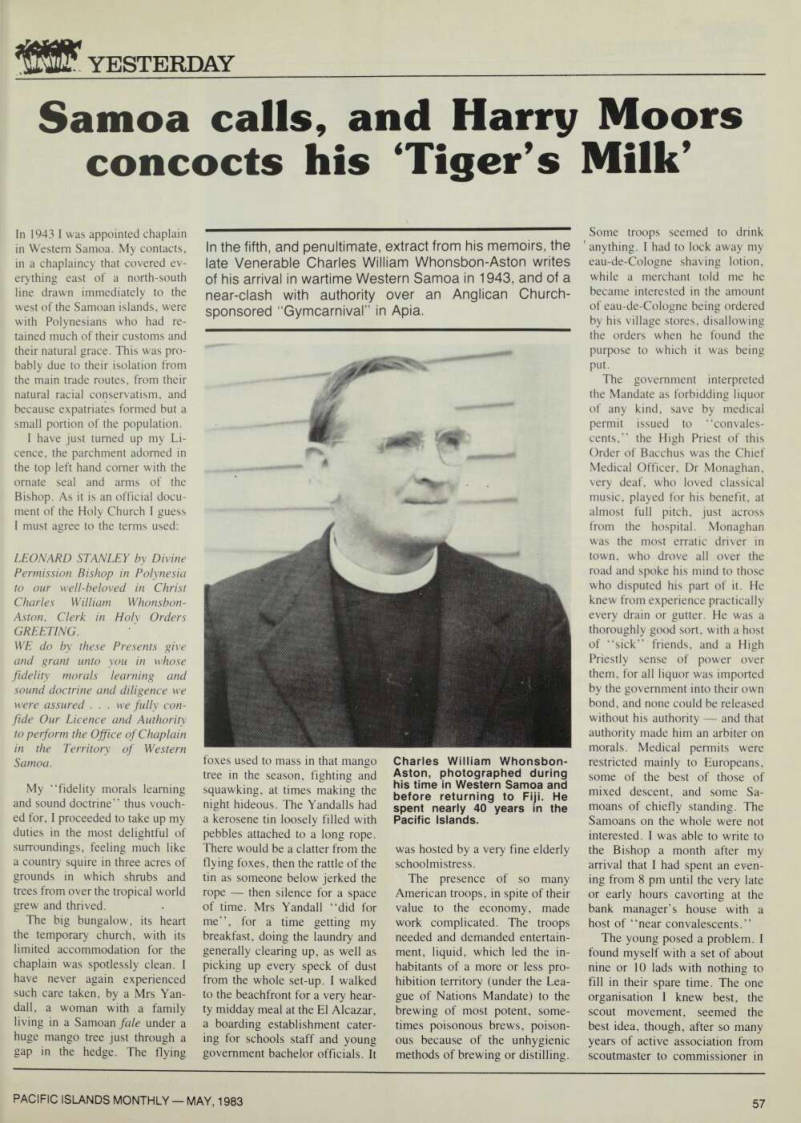
Charles William Whonsbon- Aston, photographed during his time in Western Samoa and before returning to Fiji. He spent nearly 40 years in the Pacific Islands.
Sydney, commissioner again in
Fiji, I felt I had had a surfeit of it.
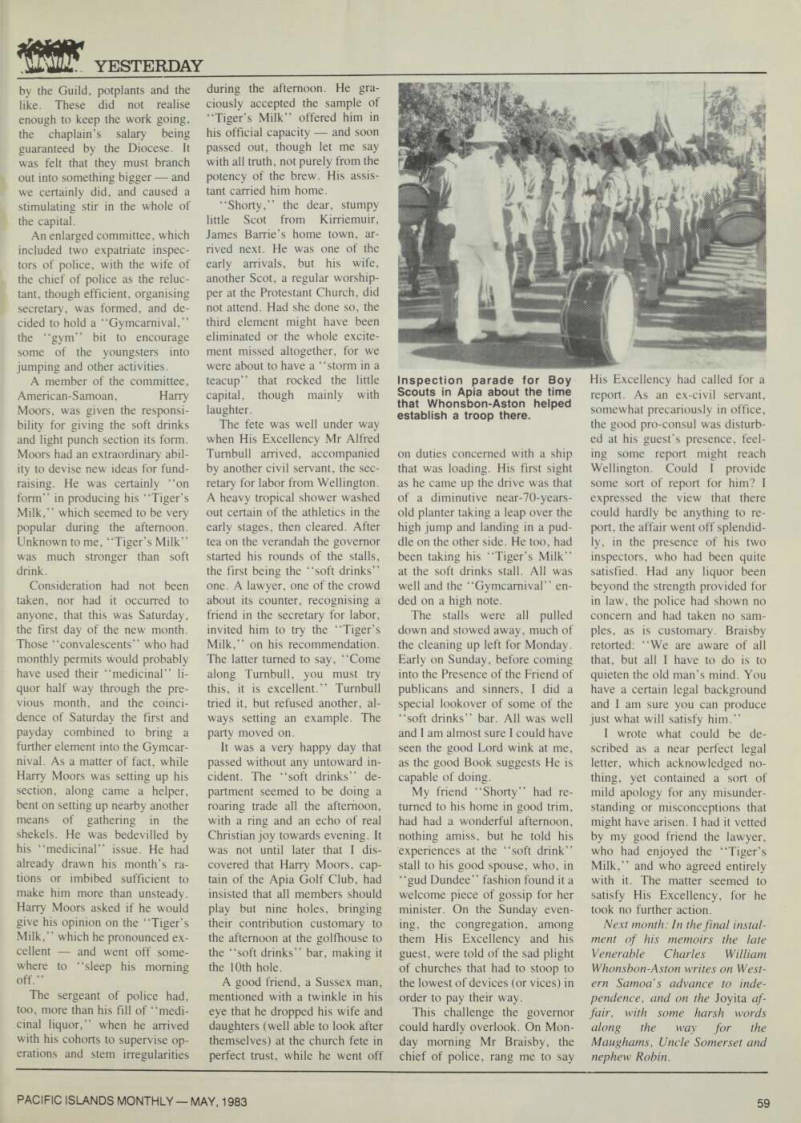
However, in November 1943, my small band, augmented by friends from the Le Ifiifi School opposite us, decided to start a troop. The foundations we laid must have been sound, for today, nearly 30 years later, it is one of
the few voluntary organisations
in Samoa that has continued without a break, officered by its own people, most of whom have come through the ranks.
Hardly had I mentioned the matter in public when His Excel lency, Mr Alfred Turnbull, call ed me up to request, almost plead, that I should not start a scout troop. The crux of the matter was that, during the Mau troubles, a chief of high degree (later to be a very close friend of mine) Mataafa Fiame Faumunia Mulinu‘u 11, had been the leader of the scout movement and had used his cohorts as a junior part of the military aspect of the situation. Turnbull’s function during the war years was simply to “keep the peace,” to let the
wheels of State turn over quietly.
He suggested we should try something else, say, the Boys Brigade, which had become a sort of L.M.S. youth activity.
I grew to appreciate Turnbull and had much sympathy for him.
He was a loyal civil servant left too long in an acting capacity, dependent in his actions very much on authorities in New Zea land, who had little appreciation of the mind of the Samoans. His loyalty as a government official could not guarantee a similar loyalty from his superiors. He seemed from both sides to have a Damoclean sword always poised over him.
Having viewed the situation I explained to Turnbull that I had no real knowledge of or attach ment to the Boys Brigade and I felt I should stick to the move ment I knew best. He then asked for an assurance that I would keep the movement strictly with in the chaplaincy, to which I reluctantly agreed.
Ecumenism that is a de lightful word, much in use today.
sometimes meaningfully empty.
But when I arrived in Samoa in 1943 old rivalries still obtained.
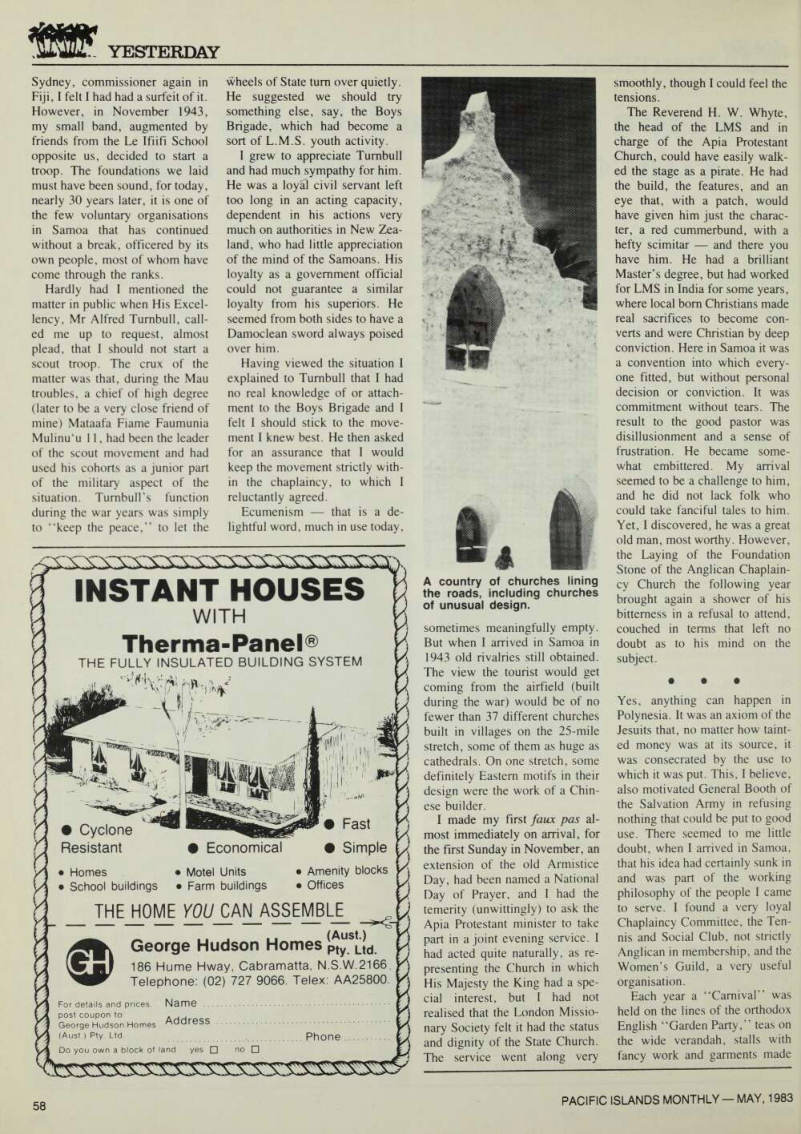
The view the tourist would get coming from the airfield (built during the war) would be of no fewer than 37 different churches built in villages on the 25-mile stretch, some of them as huge as cathedrals. On one stretch, some definitely Eastern motifs in their design were the work of a Chin ese builder.
I made my first faux pas al most immediately on arrival, for the first Sunday in November, an extension of the old Armistice Day, had been named a National Day of Prayer, and I had the temerity (unwittingly) to ask the Apia Protestant minister to take part in a joint evening service. I had acted quite naturally, as re presenting the Church in which His Majesty the King had a spe cial interest, but I had not realised that the London Missio nary Society felt it had the status and dignity of the State Church.
The service went along very
smoothly, though I could feel the tensions.
The Reverend H. W. Whyte, the head of the LMS and in charge of the Apia Protestant Church, could have easily walk ed the stage as a pirate. He had the build, the features, and an eye that, with a patch, would have given him just the charac ter, a red cummerbund, with a hefty scimitar and there you have him. He had a brilliant Master’s degree, but had worked for LMS in India for some years, where local bom Christians made real sacrifices to become con verts and were Christian by deep conviction. Here in Samoa it was a convention into which every one fitted, but without personal decision or conviction. It was commitment without tears. The result to the good pastor was disillusionment and a sense of frustration. He became some what embittered. My arrival seemed to be a challenge to him, and he did not lack folk who could take fanciful tales to him.
Yet, I discovered, he was a great old man, most worthy. However, the Laying of the Foundation Stone of the Anglican Chaplain cy Church the following year brought again a shower of his bitterness in a refusal to attend, couched in terms that left no doubt as to his mind on the
subject.
• • • Yes, anything can happen in Polynesia. It was an axiom of the Jesuits that, no matter how taint ed money was at its source, it was consecrated by the use to which it was put. This, I believe, also motivated General Booth of the Salvation Army in refusing nothing that could be put to good use. There seemed to me little doubt, when I arrived in Samoa, that his idea had certainly sunk in and was part of the working philosophy of the people I came to serve. I found a very loyal Chaplaincy Committee, the Ten nis and Social Club, not strictly Anglican in membership, and the Women’s Guild, a very useful
organisation.
Each year a “Carnival” was held on the lines of the orthodox English “Garden Party,” teas on the wide verandah, stalls with fancy work and garments made
A country of churches lining the roads, including churches of unusual design.
by the Guild, potplants and the like. These did not realise enough to keep the work going, the chaplain’s salary being guaranteed by the Diocese. It was felt that they must branch out into something bigger and we certainly did, and caused a stimulating stir in the whole of the capital.
An enlarged committee, which
included two expatriate inspec
tors of police, with the wife of the chief of police as the reluc
tant, though efficient, organising
secretary, was formed, and de cided to hold a “Gymcamival,” the “gym” bit to encourage some of the youngsters into jumping and other activities.
A member of the committee,
American-Samoan, Harry
Moors, was given the responsi bility for giving the soft drinks and light punch section its form.
Moors had an extraordinary abil ity to devise new ideas for fund raising. He was certainly “on form” in producing his “Tiger’s Milk,” which seemed to be very popular during the afternoon.
Unknown to me, “Tiger’s Milk” was much stronger than soft drink.
Consideration had not been taken, nor had it occurred to anyone, that this was Saturday, the first day of the new month.
Those “convalescents” who had
monthly permits would probably
have used their “medicinal” li quor half way through the pre vious month, and the coinci dence of Saturday the first and payday combined to bring a further element into the Gymcar nival. As a matter of fact, while Harry Moors was setting up his section, along came a helper, bent on setting up nearby another means of gathering in the shekels. He was bedevilled by his “medicinal” issue. He had already drawn his month’s ra tions or imbibed sufficient to make him more than unsteady.
Harry Moors asked if he would give his opinion on the “Tiger’s Milk,” which he pronounced ex cellent and went off some where to “sleep his morning off.”
The sergeant of police had, too, more than his fill of “medi cinal liquor,” when he arrived with his cohorts to supervise op erations and stem irregularities
during the afternoon. He gra ciously accepted the sample of “Tiger’s Milk’’ offered him in his official capacity and soon passed out, though let me say with all truth, not purely from the potency of the brew. His assis tant carried him home.
“Shorty,” the dear, stumpy little Scot from Kirriemuir, James Barrie’s home town, ar rived next. He was one of the early arrivals, but his wife, another Scot, a regular worship per at the Protestant Church, did not attend. Had she done so, the third element might have been eliminated or the whole excite ment missed altogether, for we were about to have a “storm in a teacup” that rocked the little
capital, though mainly with
laughter.
The fete was well under way when His Excellency Mr Alfred Turnbull arrived, accompanied by another civil servant, the sec retary for labor from Wellington.
A heavy tropical shower washed out certain of the athletics in the early stages, then cleared. After tea on the verandah the governor started his rounds of the stalls, the first being the “soft drinks” one. A lawyer, one of the crowd about its counter, recognising a friend in the secretary for labor, invited him to try the “Tiger’s Milk,” on his recommendation.
The latter turned to say, “Come along Turnbull, you must try this, it is excellent.” Turnbull tried it, but refused another, al ways setting an example. The party moved on.
It was a very happy day that passed without any untoward in cident. The “soft drinks” de partment seemed to be doing a roaring trade all the afternoon, with a ring and an echo of real Christian joy towards evening. It was not until later that I dis covered that Harry Moors, cap tain of the Apia Golf Club, had insisted that all members should play but nine holes, bringing their contribution customary to the afternoon at the golfhouse to the “soft drinks” bar, making it the 10th hole.
A good friend, a Sussex man, mentioned with a twinkle in his eye that he dropped his wife and daughters (well able to look after themselves) at the church fete in perfect trust, while he went off
on duties concerned with a ship that was loading. His first sight as he came up the drive was that of a diminutive near-70-years old planter taking a leap over the high jump and landing in a pud dle on the other side. He too, had been taking his “Tiger’s Milk’’ at the soft drinks stall. All was well and the “Gymcamival’’ en ded on a high note.
The stalls were all pulled down and stowed away, much of the cleaning up left for Monday.
Early on Sunday, before coming into the Presence of the Friend of publicans and sinners, I did a special lookover of some of the “soft drinks’’ bar. All was well and I am almost sure I could have seen the good Lord wink at me, as the good Book suggests He is
capable of doing.
My friend “Shorty’’ had re turned to his home in good trim, had had a wonderful afternoon, nothing amiss, but he told his experiences at the “soft drink’’ stall to his good spouse, who, in “gud Dundee’’ fashion found it a welcome piece of gossip for her minister. On the Sunday even ing, the congregation, among them His Excellency and his guest, were told of the sad plight of churches that had to stoop to the lowest of devices (or vices) in order to pay their way.
This challenge the governor could hardly overlook. On Mon
day morning Mr Braisby, the
chief of police, rang me to say
His Excellency had called for a report. As an ex-civil servant, somewhat precariously in office, the good pro-consul was disturb ed at his guest’s presence, feel ing some report might reach
Wellington. Could I provide
some sort of report for him? I expressed the view that there could hardly be anything to re port, the affair went off splendid ly, in the presence of his two inspectors, who had been quite satisfied. Had any liquor been
beyond the strength provided for
in law, the police had shown no concern and had taken no sam ples, as is customary. Braisby retorted: “We are aware of all that, but all I have to do is to quieten the old man’s mind. You have a certain legal background and I am sure you can produce just what will satisfy him.’’
I wrote what could be de scribed as a near perfect legal letter, which acknowledged no thing, yet contained a sort of mild apology for any misunder
standing or misconceptions that
might have arisen. I had it vetted by my good friend the lawyer, who had enjoyed the “Tiger’s Milk,’’ and who agreed entirely with it. The matter seemed to satisfy His Excellency, for he took no further action.
Next month: In the final instal ment of his memoirs the late Venerable Charles William Whonsbon-Aston writes on West ern Samoa’s advance to inde pendence, and on the Joyita af fair, with some harsh words along the way for the Maughams, Uncle Somerset and
nephew Robin.
Inspection parade for Boy Scouts in Apia about the time that Whonsbon-Aston helped establish a troop there.