One man’s quest
pp. 55-56 · Read in the full issue
for the earthly Paradise
The Golden Window. By Len Staples. Published by the L.J.
Staples Family Trust, Box 366, Rarotonga. Distributed in Aust ralia by Kingfisher Books, Mel bourne. $A14.95. ISBN 0 9593678 0 2.
During most of 1957, Len Sta ples sailed through the pages of PlM’s Cruising Yachts columns in his yacht Solquest. With his wife Joyce and their two chil-
dren, he had left Sydney that May, and headed for Honolulu via Auckland and French Poly nesia, intent on gaining perma nent entry to the U.S. by knock ing directly on the door for the family had no immigration permits.
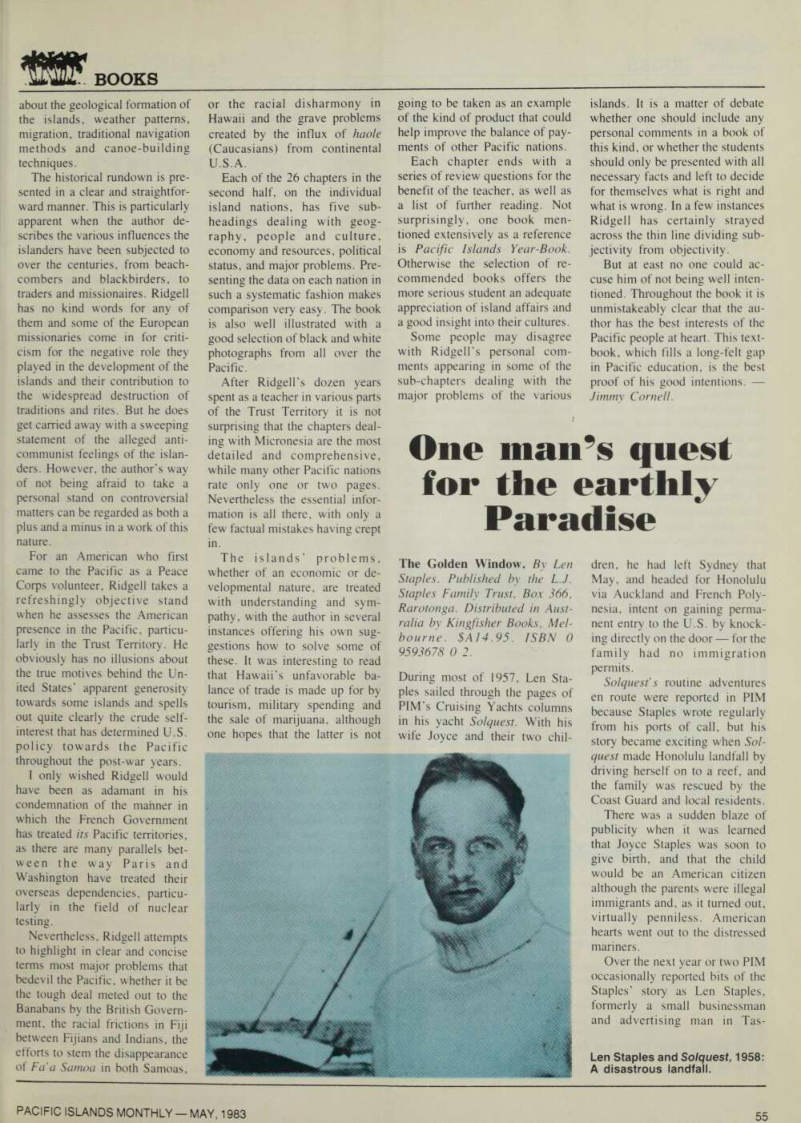
Solquest’s routine adventures en route were reported in PIM because Staples wrote regularly from his ports of call, but his story became exciting when Sol quest made Honolulu landfall by driving herself on to a reef, and the family was rescued by the Coast Guard and local residents.
There was a sudden blaze of publicity when it was learned that Joyce Staples was soon to give birth, and that the child would be an American citizen although the parents were illegal immigrants and, as it turned out, virtually penniless. American hearts went out to the distressed mariners.
Over the next year or two PIM occasionally reported bits of the Staples’ story as Len Staples, formerly a small businessman and advertising man in Tas-
Len Staples and Solquest, 1958: A disastrous landfall.
mania, fought a long fight to stay in the U.S. with their new son Kim.
They got much warm and un stinting help from ordinary peo ple and from many officials who had to administer the system, appeals even being made to the President, and an Act of Con gress passed.
But by 1959 Staples’ attitude to the U.S. had soured, and the family returned to Australia, where his marriage to Joyce broke up, and from where he began a long search for new happiness in the islands of the South Pacific. He lives today in Rarotonga, after having tried Tahiti, New Zealand, Lord Howe Island (off the east coast of Australia), and Queensland.
The Golden Window is his autobiography, and it makes compelling reading. He is, to begin with, a competent writer, and his descriptive passages of small boat sailing, and storms at sea, are in themselves worth the price of admission. The narrative fairly dashes along, and there are no boring chapters.
The real fascination however is with the unfolding story of a restless soul in search of Nirva na. Time and again he fights through to rainbow’s end, only to find no joy, and the search must go on. Again it will entirely consume his restless energy, and the energy of the people close to him, for Staples is entirely self centred in his search, claiming the full attention and support of those around him.
Probably it is this aspect of Staples’ character that makes The Golden Window compulsive reading. He demands our atten tion too, and he gets it, even at times against our better judg ment. Why should we have to sit here while this prickly, inwardly
suspicious personality presents
us with a detailed account of his thoughts, fears and transgres sions, and yet never once gives us his age?
Staples clearly is a remarkable persuader, who having convinc ed himself of the rightness of his course, knows how to take us along with him. But only until the end of his story. When the
words stop and he has no more claim on our attention, we are left with a feeling of relief that his life wasn’t ours; that our involvement was only tenuous.
The passage in which he writes of his disenchantment with the America he thought would be his Holy Grail is an example both of his ability with words, and of his propensity for disillusionment.
“The idealism originally motivating our quest had long since withered and died. Rose tinted spectacles of naive gulli
bility had been replaced by re
vealing magnification of close
scrutiny, bringing into critical
focus the country we had entered at such a frightening cost, with repayments made from an irrep laceable, irrecoverable and now depleted treasury of time, health and money.
“I discerned a paradox, in which the abundant American affluence created an insatiable hunger for still more, and all basic values were sacrificed to the pursuit of a nebulous ultimate Utopia, while no one possessed
time enough to enjoy what they
already held; and I recalled the
languid islands of Polynesia,
where the opposite was true.
“I perceived the American im age, a mould of conformity im possibly emerged from a mon grel breed, in which there was an obsessive regard for group par ticipation, group striving, group deprivation, and group domi nance, wherein the possibility of plural harmoniousness was bas tardised into brutalised com petitiveness. Every frenetic mi nute of every frenetic day, Americans brought to bear on each other emotional, social and financial pressures forcing their fellow human into stipulated moulds of conformity, and those who did not conform were outcasts.”
The aggressively non conformist Staples sees Ameri cans as living in “a corrosive society which distilled within them deep reservoirs of suspicion and mistrust”. Americans at home were “at the one time generous yet selfish, companion able yet estranged”.
In Rarotonga during his first lengthy stay on a beachfront leasehold he finds that Ura, his
French Polynesian girl friend, is not the lady he thought she was, and he leaves Utopia for Auck land where he meets and marries Temuana, from the Cook island of Manihiki, 19 years his junior.
As the Holy Grail is not in New Zealand either, they go to Lord Howe Island where Staples feels that “maybe our search is over”. But there is unhappiness and tragedy for them there.
Staples takes on the bureau crats over the sections of the Lord Howe Island Act which give perks to the locally born and is soon involved in ‘‘currents of discrimination, of deliberate ob
struction and sucking quicksands
of harassment.”
But even worse was to come when the Staples’ 13-week-old daughter was found to be dead after Staples one night had cradl ed her in his arms, and police charged him with murder, alleg ing he had suffocated the child.
In Sydney, an inquest found she had died not of suffocation but of pneumonitis, a viral form of pneumonia, and he was released.
They left Lord Howe forever,
Staples expressing a contempt
for the local people that might be actionable if it were possible to libel a community.
A great many tourists to pre sent-day Rarotonga know the Staples’ beachside motel, The
Little Polynesian, and probably
know Staples too. He says he wants to spend the rest of his time quietly painting and writ ing, perhaps on Manihiki, and educate his children.
“All searching is done,” he writes, “and I have come to rest at the point of compromise . . . the half-way swing of the
pendulum.”
It is hard to believe that he
truly has come to rest.
Stuart
Inder.
Books received
Monopolists and Freebooters. By 0. H.
K. Spate. Published 1983 by Australian National University Press, P.O Box 4, Canberra, ACT, 2600. ISBN o 7081 1844 5. Price $39.00.
Travels to New Guinea: Diaries, Let ters, Documents. By N. Mikloucho- Maclay. Published 1982 by Progress Pub lishers, Moscow. Distributed by Current Book Distributors Pty. Ltd., 425 Pitt Street, Sydney, NSW, 2000. Price $8.75.
Which Future for Norfolk Island? By Christopher Nobbs. Published 1983 by Norfolk Marketing, Box 114, Norfolk Island. No ISBN. Price $6.95.