Melanesia ...
p. 51 · Read in the full issue
Not a book on oral tradition in Melanesia ...
Oral Tradition in Melanesia.
Edited by Donald Denoon and Roderic Lacey. Published by the University of Papua New Guinea and the Institute of Papua New Guinea Studies, Port Moresby, 1981. 270 pp. Kina 4.95. No.
Isbn.
Oral Tradition in Melanesia is misnamed. More exactly it is about the teaching of oral history at the University of Papua New Guinea during the 19705. The chapters concentrate on PNG, ignoring the Solomons and Vanuatu, but include one on long-distance voyages in Poly nesia and two relating oral tradi tions from parts of the world other than Melanesia.
For the most past it is a study of Papua New Guinean regional history. Areas covered include Enga, Oro, Central and Milne
Bay provinces, written by lead
ing national historians.
There are also more theoretical chapters on problems associated with oral sources, in PNG and elsewhere in time and place. Carl
Loeliger’s chapter on oral
sources and Old Testament texts relates well to modem oral tradi tion and Christianity in the Pacif ic, in similar transition from an oral to a written base. But one wonders at the relevance of
Stephanie Farrall’s comparison
of The Song of Roland to sung and written epics in Melanesia.
The best chapters show the
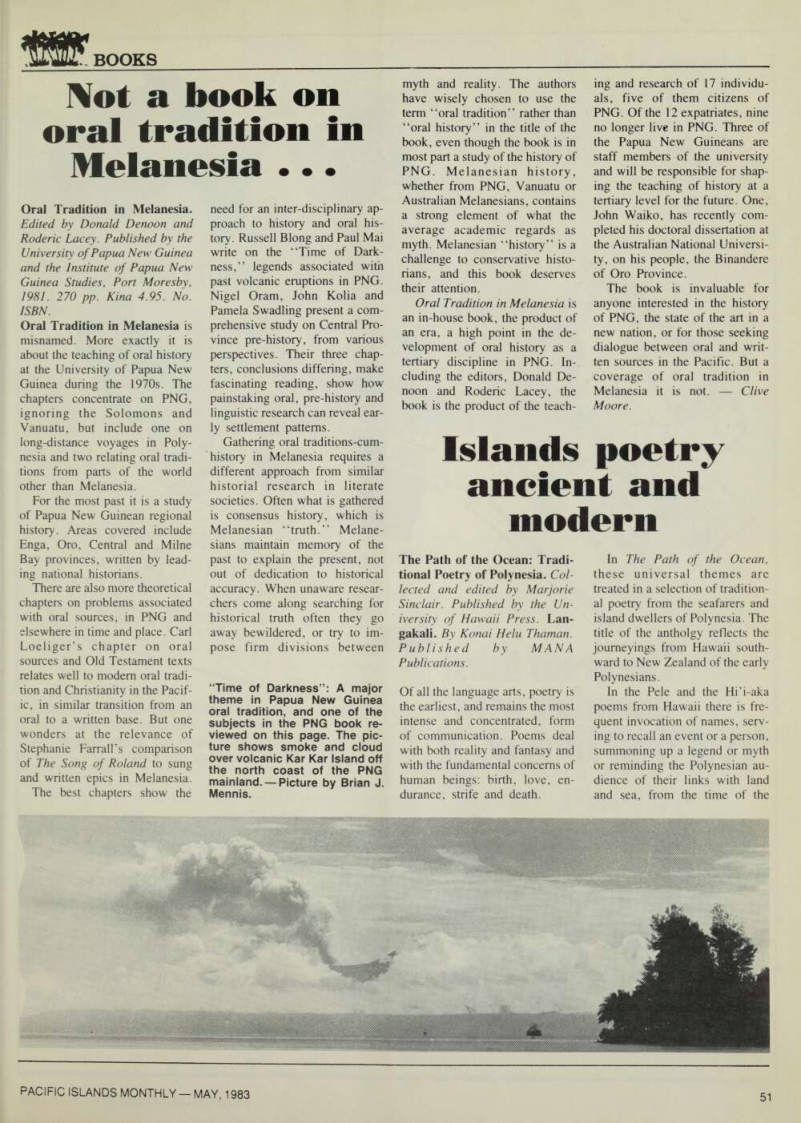
need for an inter-disciplinary ap proach to history and oral his tory. Russell Blong and Paul Mai write on the “Time of Dark ness,” legends associated with past volcanic eruptions in PNG.
Nigel Oram, John Kolia and Pamela Swadling present a com prehensive study on Central Pro vince pre-history, from various perspectives. Their three chap ters, conclusions differing, make fascinating reading, show how painstaking oral, pre-history and linguistic research can reveal ear ly settlement patterns.
Gathering oral traditions-cum history in Melanesia requires a different approach from similar historial research in literate societies. Often what is gathered is consensus history, which is Melanesian “truth.” Melane sians maintain memory of the past to explain the present, not out of dedication to historical accuracy. When unaware resear chers come along searching for historical truth often they go away bewildered, or try to im pose firm divisions between
myth and reality. The authors have wisely chosen to use the term “oral tradition” rather than “oral history” in the title of the book, even though the book is in most part a study of the history of PNG. Melanesian history, whether from PNG, Vanuatu or Australian Melanesians, contains a strong element of what the average academic regards as myth. Melanesian “history” is a challenge to conservative histo rians, and this book deserves their attention.
Oral Tradition in Melanesia is an in-house book, the product of an era, a high point in the de velopment of oral history as a tertiary discipline in PNG. In cluding the editors, Donald De noon and Roderic Lacey, the book is the product of the teach
ing and research of 17 individu als, five of them citizens of PNG. Of the 12 expatriates, nine no longer live in PNG. Three of the Papua New Guineans are staff members of the university and will be responsible for shap ing the teaching of history at a tertiary level for the future. One, John Waiko, has recently com pleted his doctoral dissertation at the Australian National Universi ty, on his people, the Binandere of Oro Province.
The book is invaluable for anyone interested in the history of PNG, the state of the art in a new nation, or for those seeking dialogue between oral and writ ten sources in the Pacific. But a coverage of oral tradition in
Melanesia it is not.
Clive
Moore.