Islands poetry
pp. 51-53 · Read in the full issue

ancient and modern
The Path of the Ocean: Tradi tional Poetry of Polynesia. Col lected and edited by Marjorie Sinclair. Published by the Un iversity of Hawaii Press. Lan gakali. By Konai Helu Thaman.
Published by MANA Publications.
Of all the language arts, poetry is the earliest, and remains the most intense and concentrated, form of communication. Poems deal with both reality and fantasy and with the fundamental concerns of human beings: birth, love, en durance, strife and death.
In The Path of the Ocean, these universal themes are treated in a selection of tradition al poetry from the seafarers and island dwellers of Polynesia. The title of the antholgy reflects the joumeyings from Hawaii south ward to New Zealand of the early Polynesians.
In the Pele and the Hi’i-aka poems from Hawaii there is fre quent invocation of names, serv ing to recall an event or a person, summoning up a legend or myth or reminding the Polynesian au dience of their links with land and sea, from the time of the
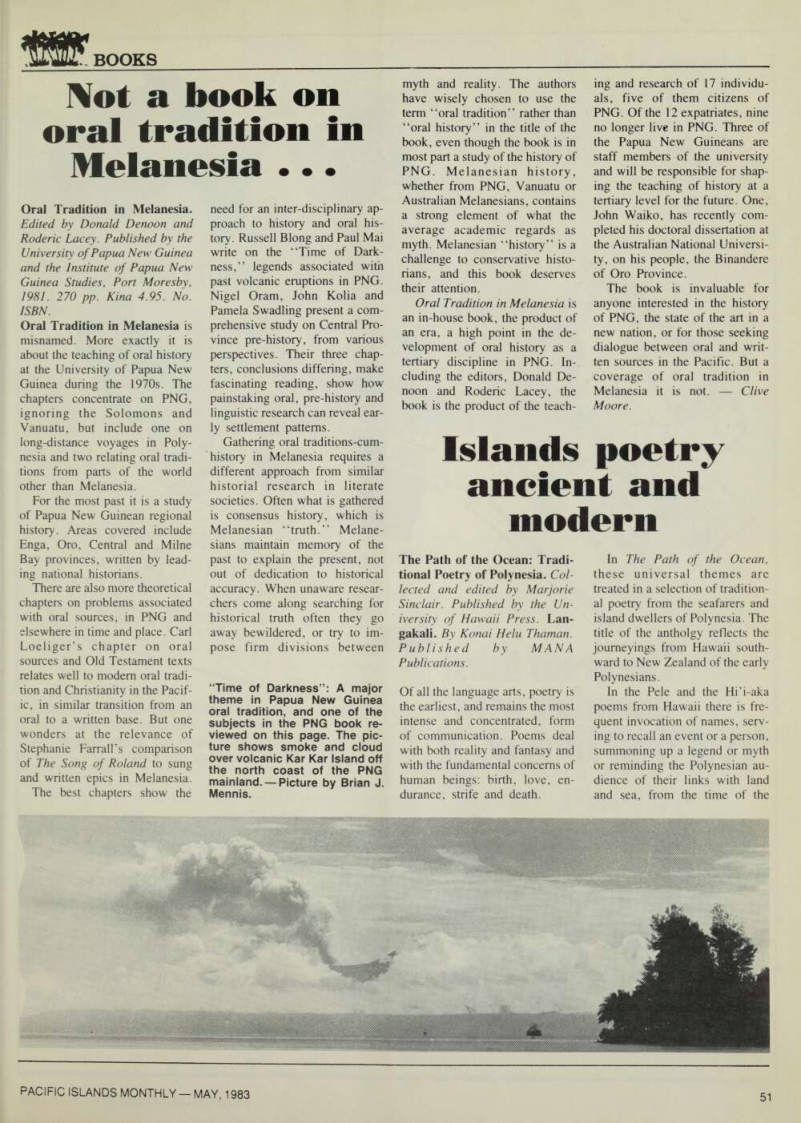
“Time of Darkness”: A major theme in Papua New Guinea oral tradition, and one of the subjects in the PNG book re viewed on this page. The pic ture shows smoke and cloud over volcanic Kar Kar Island off the north coast of the PNG
mainland. - Picture by Brian J.
Mennis.
great voyages., Hi’i-aka’s chant to restore Lohi’au to life speaks of: The god Ku of the small cloud Ku of the long cloud Ku of the mackerel cloud Ku of the red and ragged cloud in the sky.
When Hi’i-aka turns for home she has a vision of the burning of her ohia trees on Hawaii; Fire-split rocks strike the sun; Fire pours on the sea at Puna; The bright sea at Ku-ki’i.
The gods of the night at the eastern gate, The skeleton woods that loom.
Apart from the songs of war, of loss, of death, creation chants and invocations to the gods in
this satisfying collection, one
thread that stands out is that of love. From Samoa there is the last farewell sung by the eel-man who loves Sina; And make a fan to fan yourself When meditating on your love for me.
You will see my face in the coconuts And kiss it each time you drink.
A song from Vaitupu has all the compressed understatement of a Japanese haiku: I walked along the eastern shore Round the outskirts of Sapepe Your footprints are hard to forget.
And a delightful poem from Easter Island that tells of a girl
leaving her lover, early in the
morning:
O Miru, you are dampened to the bones by dew . . .
You won’t be dry when you go To soak the paper mulberry To make the cloth for the ribbon of your topknot.
The Path of the Ocean, edited by Professor Marjorie Sinclair, who spent much of her life in Hawaii and who received the Hawaii Writers’ Award in 1981, should be on the bookshelf of anyone with an interest in poetry, and in particular the traditional songs and chants of the Pacific.
An introduction emphasising the importance of the Polynesian set ing to the poetry which de veloped out of it, and an exten sive bibliography, are bonuses.
Most of the poems and chants have a sonorous magnificence.
In fact almost all of them demand to be read aloud.
Amidst the incantations, lyrics and chants of Marjorie Sinclair’s collection, there is the occasional note of unease, of concern as to what may happen to traditional values as the outside world furth er encroaches on Polynesia’s is lands and atolls. In the chanter Ka-’ahu’s song, the leprosy he refers to is as much figurative as real: What will become of Hawaii?
What will leprosy do to my people?
What will become of our land?
A similar concern is expressed in Langakali, a second volume of poems by the Tongan poet Konai Helu Thaman, whose first volume You, the Choice of My Parents was reviewed in PIM in December, 1981. In the title poem of this second volume, addressed to the sweet-flowering tree which is itself rarely found
in the Tonga of today, there is a strong evocation of the way in which so-called progress can af fect tradition: Langkali!
No longer do I see your face Adorn our roads and roaming grooms Or perfume the evening sea breeze.
Broken beer bottles Greet the incoming tides And gravetalk is no more, For the unblinking eyes of the plastic flowers Stare away visitors from Pulotu, Home of our warriors and conversationalists.
Several of Konai Helu Tha man’s poems have a note of pain in them or of disillusion, as in
“Sunday Sadness,” describing
. . . tearless people with velvet shoes Who have ceased to walk The good rich island earth Of yam harvests And plentiful Sundays . . .
Mrs Thaman is perhaps at her best and most perceptive when
examining relationships:
your familiar face is strange . . . quiet pain lingers like coral dust we are both afraid to say I love you as I love you.
Langkali offers food for thought and for the emotions and in it Konai Helu Thaman dis plays once again her sure touch
with language.
Ursula Nixon.
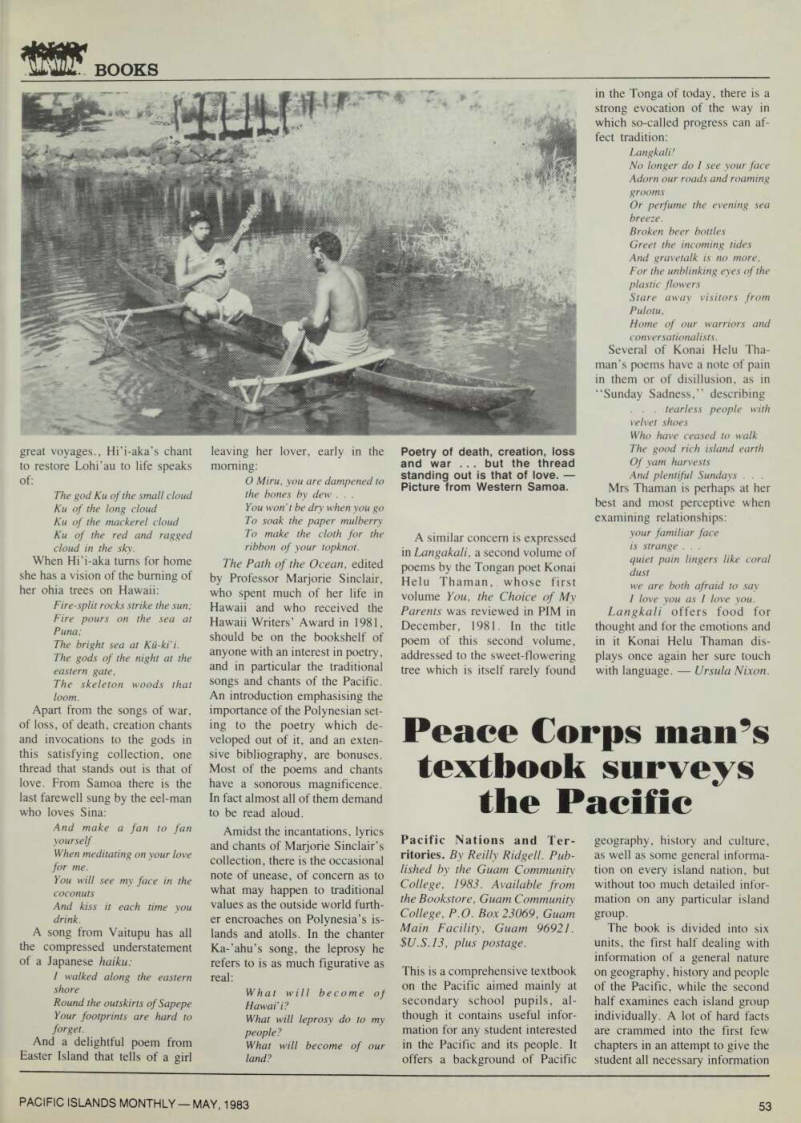
Poetry of death, creation, loss and war . . . but the thread standing out is that of love.- Picture from Western Samoa.