non-academic history
pp. 49-50 · Read in the full issue
Books
Vanuatu
A short, readable, non-academic history
To Kill a Bird With Two Stones: A Short History of Vanuatu. By Jeremy Mac Cla ncy. Published by the Vanuatu Cultural Centre, Port Vila SAS (approx.).
This publication, written by a young British social an thropologist, makes no preten sion to being a thoroughly re searched and tightly documented coverage of the kind which might have been produced by a profes sional historian. It is more in the nature of an attempt, undertaken at relatively short notice and without access to much of the relevant documentary evidence for the post-1870 period, to pro duce a short, general, popular history aimed primarily at a ni- Vanuatu audience. The author has had to venture outside the boundaries of his own expertise, and has often, as he freely ack nowledges, had to rely heavily
on secondary and tertiary
sources. He had written what he regards as “only an introduction to the history of Vanuatu, merely a setting out of the main themes in chronological order.” (p. 10).
The first chapter, “Begin
nings” (pp. 15-17), essays a very brief overview of the ear liest pre-history of Vanuatu.
Here Mac Clancy seems at times to be out of his depth, as when (p. 15) he lists the speckled ground skink among “certain birds” which came from Aust ralia, or when (pp. 15-17) he produces the substantially con tradictory statements. “Before man came the islands were covered in forests” and “The north-west of many islands are (sic) in the rain shadow areas and have open grassland.”
In the chapter on “Custom” (pp. 18-37) Mac Clancy ventures first of all into the as yet not too well elucidated field of the remo ter cultural pre-history of the
islands. Here he has perforce to rely heavily on the work of others, and again he seems on occasion to be out of his depth, as when (p. 18) he has the first human arrivals in the Pacific coming around 4000 to 5000 years ago and as moving from the north-west Pacific and Papua New Guinea via Solomon Islands to Vanuatu about 2000 years later, i.e. 2000 to 3000 years ago, and yet cites the earliest known Vanuatu settlement, on Malo, as being at least 3500 years ago.
In addition to this rather
cavalier handling of dates he does not adequately bring out the lack of firm consensus among the
pre-historians on the migration
route(s) and the dating of the peopling of the south-west Pacific.
In the field of linguistic pre
history Mac Clancy tells us that
“the languages of Futuna and Aniwa for instance, are practical ly a Tongan one (sic) and are unlike almost all other ni- Vanuatu languages” (p. 18). In fact Futunan and Aniwan are dialects of the one language, Futuna-Aniwa, which is one of
the three relatively recently ar rived Polynesian Outlier lan guages of Vanuatu (the other two are the Mele-Fila and the Erhae
languages.)
In common with other Polyne sian outliers these all appear to have the Samoic, rather than the Tongic, languages as their clos est relatives. The remainder (and the greater part) of this chapter consists of a description (again based on acknowledged sources) of ni-Vanuatu society, or rather societies, during the years before
the impact of Europeans.
This coverage brings out something of the cultural variety of Vanuatu, but comes (p. 35) to what some might regard as an excessively sombre and eth nocentric conclusion as to the general quality of traditional pre contact lifestyles in these islands.
I have reservations about the statement (p. 22) that villages were “small isolated anarchic units” (my emphasis). I would also question the extent to which the notion of mana (ref. p. 24) was current within the range of ni-Vanuatu cultures.
The chapter “1825-1865” (pp. 38-53) considers the initial years of substantial contact with Europeans, and focuses on the sandalwood trade and the coming
of Christianity, with only passing
mention of the whalers. The re
source-exploitative, self
destructive, and often violent na ture of the sandalwood trade is effectively presented, as are the
chequered early years of Presby
terian missionary endeavor in the central and southern islands (in-
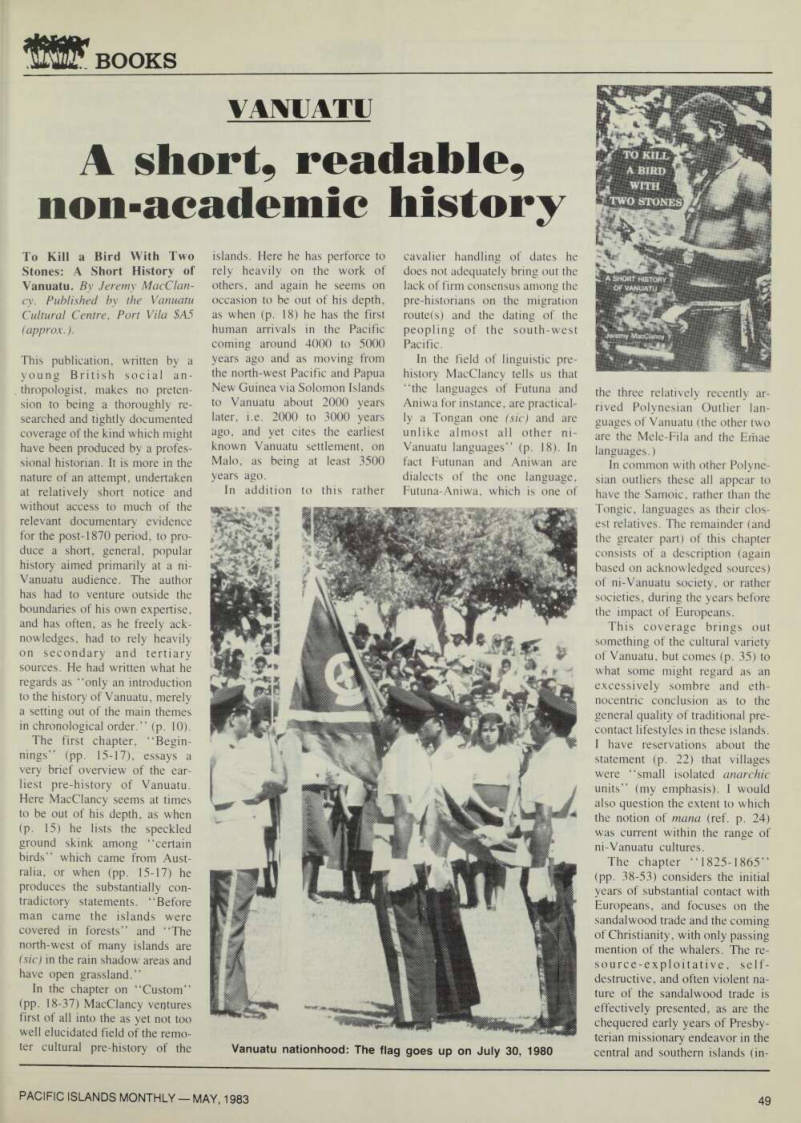
Vanuatu nationhood: The flag goes up on July 30, 1980
eluding Paton’s infamous at
tempt at gunboat Christianity)
and the beginnings of the Melanesian Mission (Anglican) presence primarily in the north ern islands.
In ”1866-1906” (pp. 54-79) the infamous ”black-birding” period is well described and the impact on traditional ni-Vanuatu society of those who survived the labor trade and returned to the islands is considered. There is a brief but sound treatment of the effects of the labor trade on the
beginnings and early develop
ment of Bislama. Also effective is the description of the back ground and lead-up to the estab lishment of that bizarre creation, the Anglo-French Con dominium. Sound coverage is given to the beginnings of exten sive alienation of land by Euro pean planters (mainly French) and to the increasing awareness among ni-Vanuatu of the poten tial during this period of the Christian missionary presence as a counter to the heavily exploita tive aspects of the total European
impact.
”1906-1939” (pp. 80-104) deals with the early years of the Condominium including its inef fectual Joint Court which suc ceeded only in furthering the alienation of land by Europeans.
The vicissitudes of the plantation economy in the ’2os and ’3os are well described, as are the con tinuing and changing activities of the missions. There are glimpses in this chapter of changes in ni- Vanuatu notions about Euro peans and the European pre sence, but more attention might well have been given to on-going indigenous value structures dur ing this period. ”1939-1970” (pp. 105-22) deals with the impact of World War 2 on Vanuatu, with some indigenous millenary movements (especially John Frum), with the economic development of the ’sos and ’6os which saw the increasing involvement of ni- Vanuatu in the cash economy, with the substantial development of European-style education for ni-Vanuatu, and with the begin nings of ni-Vanuatu involvement in political activity above village level through local government councils and through Advisory Council’s progression from be
ing entirely nominated to being partly elected.
In “The Seventies” (pp. 123- 39) Mac Clancy attempts a very difficult task, namely the neces sarily brief description of the eventful and at times turbulent decade which culminated in the attainment of independence for Vanuatu. In my opinion the coverage gives insufficient re cognition to the degree of politic al sophistication and organisa tional efficiency developed by the Vanuaaku Party during this period. This chapter includes brief accounts of the develop ment of Nagriamel, of the emergence of independence-by -1980 as a viable proposition, and of the complex progression to wards that independence. As Mac Clancy well recognises, these events are too recent for a definitive account to be possible.
When that account does become possible it will merit and require not a chapter but an entire book. ”1980” (pp. 140-147) briefly recounts the final hectic rundown to the declaration of independ ence in July 1980 and the subse quent mopping-up operations.
Mac Clancy, writing in October 1980, was too close in time to the events to be able to state the full extent of French official duplici ty during this period.
I have at some points in this review been critical of some as pects of Mac Clancy’s approach, but my overall verdict is that this book constitutes a very worth while attempt at a short, emi nently readable, non-academic history a history primarily of the European impact on Vanuatu. If it has a bias this consists of an over-concentration on events in the Presbyterian sphere of influence at the ex pense of those in the sphere of the Melanesian Mission.
The book, which was printed in Port Vila, contains many photographic illustrations which are of considerable intrinsic documentary and historical inter est. The author has very laudably donated the copyright, and any profits from the book, to the Vanuatu Cultural Centre, from
which it is obtainable.
David
Walsh.
*Dr Walsh lectures in an thropological linguistics at the University of Sydney.