People
pp. 44-47 · Read in the full issue

An American tourist with a dif ference recently visited the island of Rapa, in the far south of French Polynesia’s Austral Is lands group.
He is Gustave Paulay, a graduate in biology from the Un iversity of Washington.
Mr Paulay first visited Rapa in 1979-80, and became deeply concerned with the extent of soil erosion on the island.
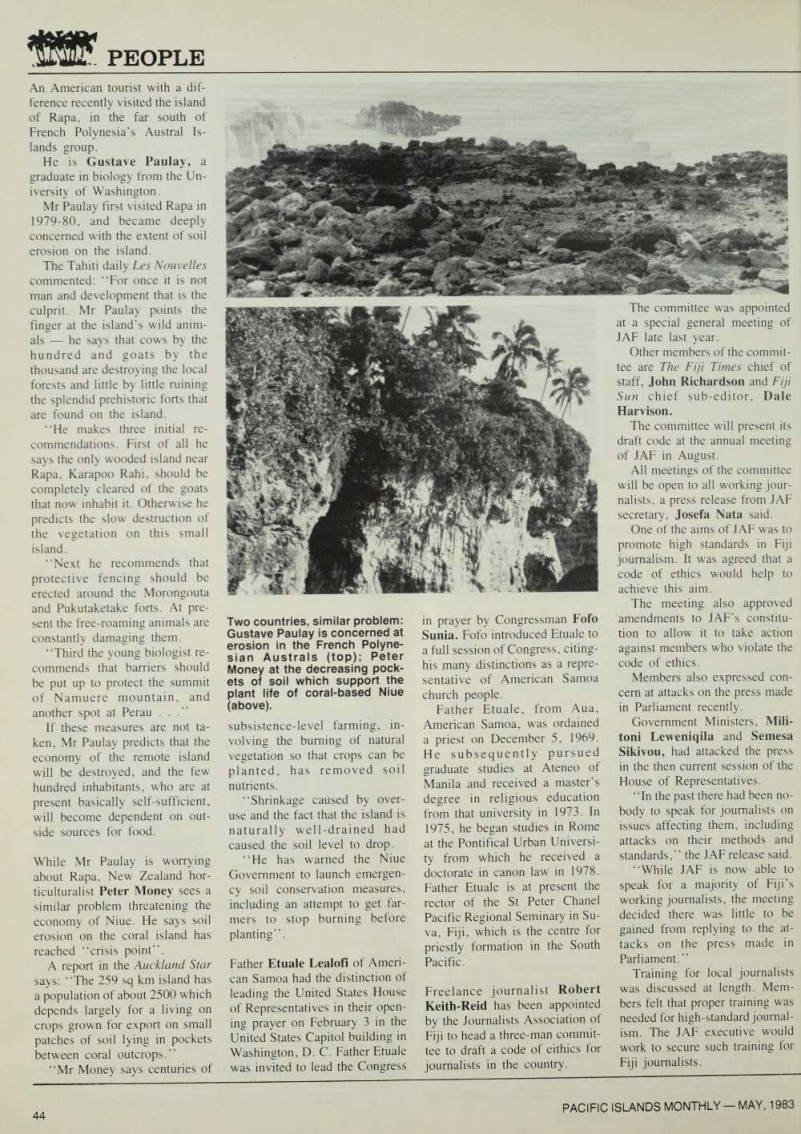
The Tahiti daily Les Nouvelles commented: “For once it is not man and development that is the culprit. Mr Paulay points the finger at the island’s wild anim als he says that cows by the hundred and goats by the thousand are destroying the local forests and little by little ruining the splendid prehistoric forts that are found on the island.
“He makes three initial re commendations. First of all he says the only wooded island near Rapa, Karapoo Rahi, should be completely cleared of the goats that now inhabit it. Otherwise he predicts the slow destruction of the vegetation on this small island.
“Next he recommends that protective fencing should be erected around the Morongouta and Pukutaketake forts. At pre sent the free-roaming animals are constantly damaging them.
“Third the young biologist re commends that barriers should be put up to protect the summit of Namuere mountain, and another spot at Perau ...”
If these measures are not ta ken, Mr Paulay predicts that the economy of the remote island will be destroyed, and the few hundred inhabitants, who are at present basically self-sufficient, will become dependent on out side sources for food.
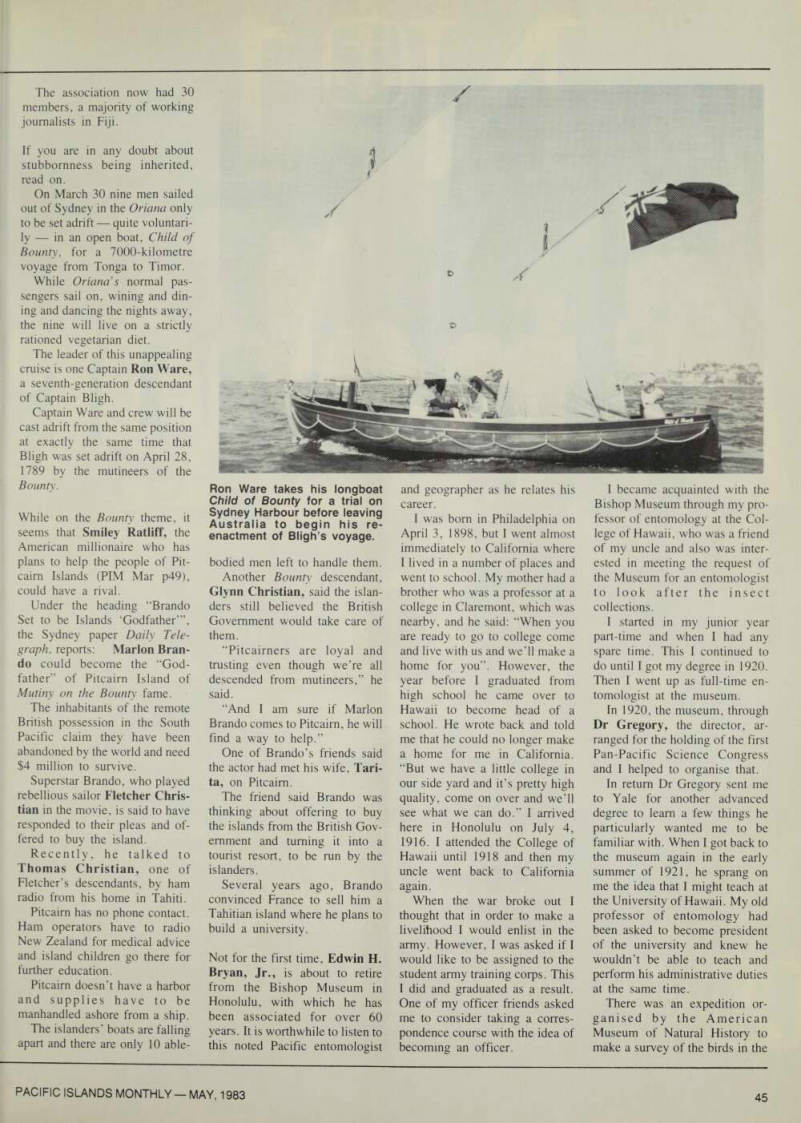
While Mr Paulay is worrying about Rapa, New Zealand hor ticulturalist Peter Money sees a similar problem threatening the economy of Niue. He says soil erosion on the coral island has reached “crisis point”.
A report in the Auckland Star says: “The 259 sq km island has a population of about 2500 which depends largely for a living on crops grown for export on small patches of soil lying in pockets between coral outcrops.”
“Mr Money says centuries of
subsistence-level farming, in volving the burning of natural vegetation so that crops can be planted, has removed soil nutrients.
“Shrinkage caused by over use and the fact that the island is naturally well-drained had caused the soil level to drop.
“He has warned the Niue Government to launch emergen cy soil conservation measures, including an attempt to get far mers to stop burning before planting”.
Father Etuale Lealofi of Ameri can Samoa had the distinction of leading the United States House of Representatives in their open ing prayer on February 3 in the United States Capitol building in Washington, D. C. Father Etuale was invited to lead the Congress
in prayer by Congressman Fofo Sunia. Fofo introduced Etuale to a full session of Congress, citing his many distinctions as a repre sentative of American Samoa church people.
Father Etuale, from Aua, American Samoa, was ordained a priest on December 5, 1969.
He subsequently pursued graduate studies at Ateneo of Manila and received a master’s degree in religious education from that university in 1973. In 1975, he began studies in Rome at the Pontifical Urban Universi ty from which he received a doctorate in canon law in 1978.
Father Etuale is at present the rector of the St Peter Chanel Pacific Regional Seminary in Su va, Fiji, which is the centre for priestly formation in the South Pacific.
Freelance journalist Robert Keith-Reid has been appointed by the Journalists Association of Fiji to head a three-man commit tee to draft a code of eithics for journalists in the country.
The committee was appointed at a special general meeting of JAF late last year.
Other members of the commit tee are The Fiji Times chief of staff, John Richardson and Fiji Sun chief sub-editor. Dale Harvison.
The committee will present its draft code at the annual meeting of JAF in August.
All meetings of the committee will be open to all working jour nalists, a press release from JAF secretary, Josefa Nata said.
One of the aims of JAF was to promote high standards in Fiji journalism. It was agreed that a code of ethics would help to achieve this aim.
The meeting also approved amendments to JAF’s constitu tion to allow it to take action against members who violate the code of ethics.
Members also expressed con cern at attacks on the press made in Parliament recently.
Government Ministers, Mili toni Leweniqila and Semesa Sikivou, had attacked the press in the then current session of the House of Representatives.
“In the past there had been no body to speak for journalists on issues affecting them, including attacks on their methods and standards,” the JAF release said.
“While JAF is now able to speak for a majority of Fiji’s working journalists, the meeting decided there was little to be gained from replying to the at tacks on the press made in Parliament.”
Training for local journalists was discussed at length. Mem bers felt that proper training was needed for high-standard journal ism. The JAF executive would work to secure such training for Fiji journalists.
Two countries, similar problem: Gustave Paulay is concerned at erosion in the French Polyne sian Australs (top); Peter Money at the decreasing pock ets of soil which support the plant life of coral-based Niue
(above).
The association now had 30 members, a majority of working
journalists in Fiji.
If you are in any doubt about stubbornness being inherited, read on.
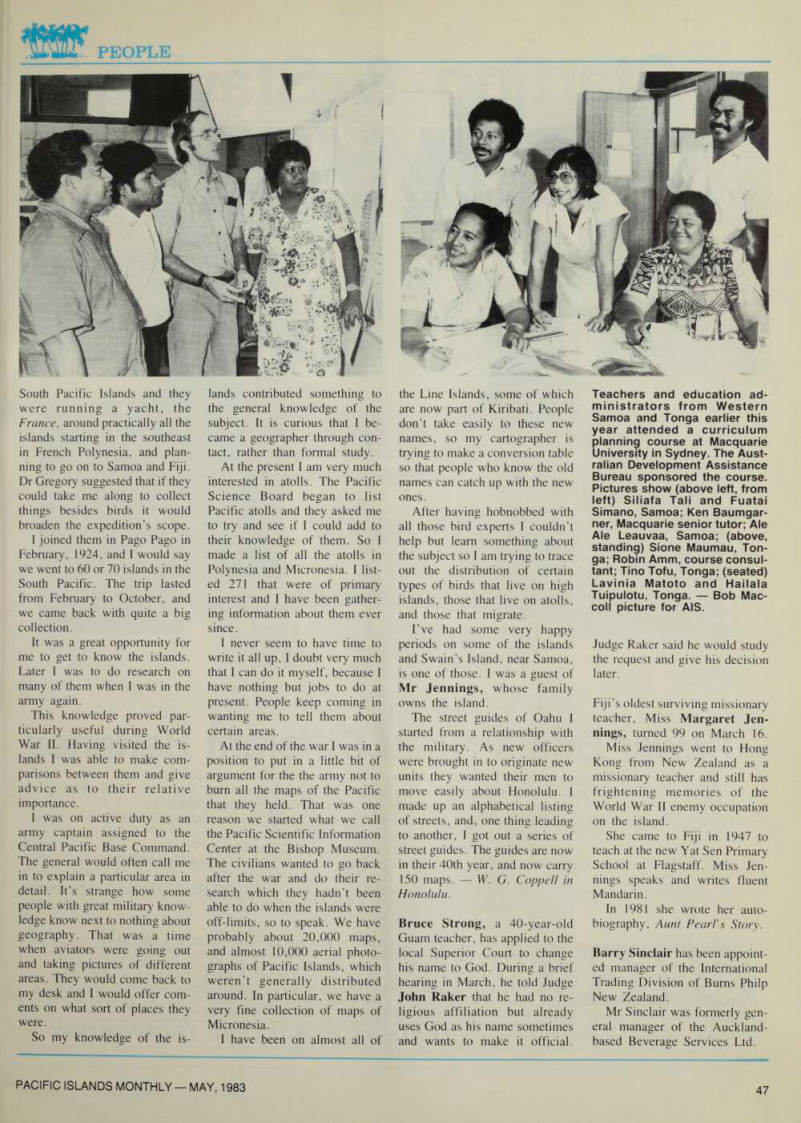
On March 30 nine men sailed out of Sydney in the Oriana only to be set adrift quite voluntari ly in an open boat, Child of Bounty, for a 7000-kilometre voyage from Tonga to Timor.
While Oriana s normal pas sengers sail on, wining and din
ing and dancing the nights away,
the nine will live on a strictly rationed vegetarian diet.
The leader of this unappealing cruise is one Captain Ron Ware, a seventh-generation descendant
of Captain Bligh.
Captain Ware and crew will be cast adrift from the same position at exactly the same time that Bligh was set adrift on April 28, 1789 by the mutineers of the Bounty.
While on the Bounty theme, it seems that Smiley Ratliff, the American millionaire who has plans to help the people of Pit cairn Islands (PIM Mar p 49), could have a rival.
Under the heading “Brando Set to be Islands ‘Godfather’”, the Sydney paper Daily Tele graph, reports: Marlon Bran do could become the “God father” of Pitcairn Island of Mutiny on the Bounty fame.
The inhabitants of the remote British possession in the South Pacific claim they have been abandoned by the world and need $4 million to survive.
Superstar Brando, who played
rebellious sailor Fletcher Chris tian in the movie, is said to have responded to their pleas and of fered to buy the island.
Recently, he talked to Thomas Christian, one of Fletcher’s descendants, by ham radio from his home in Tahiti.
Pitcairn has no phone contact.
Ham operators have to radio New Zealand for medical advice and island children go there for further education.
Pitcairn doesn’t have a harbor and supplies have to be manhandled ashore from a ship.
The islanders’ boats are falling apart and there are only 10 able-
bodied men left to handle them.
Another Bounty descendant, Glynn Christian, said the islan ders still believed the British Government would take care of them.
“Pitcairners are loyal and trusting even though we’re all descended from mutineers,” he said.
“And I am sure if Marlon Brando comes to Pitcairn, he will find a way to help.”
One of Brando’s friends said the actor had met his wife, Tari ta, on Pitcairn.
The friend said Brando was
thinking about offering to buy
the islands from the British Gov ernment and turning it into a tourist resort, to be run by the islanders.
Several years ago, Brando convinced France to sell him a Tahitian island where he plans to build a university.
Not for the first time, Edwin H.
Bryan, Jr., is about to retire from the Bishop Museum in Honolulu, with which he has been associated for over 60 years. It is worthwhile to listen to this noted Pacific entomologist
and geographer as he relates his career.
I was bom in Philadelphia on April 3, 1898, but I went almost immediately to California where I lived in a number of places and went to school. My mother had a brother who was a professor at a college in Claremont, which was nearby, and he said; “When you are ready to go to college come and live with us and we’ll make a home for you”. However, the year before I graduated from high school he came over to Hawaii to become head of a school. He wrote back and told me that he could no longer make a home for me in California.
“But we have a little college in our side yard and it’s pretty high quality, come on over and we’ll see what we can do.” I arrived here in Honolulu on July 4, 1916. I attended the College of Hawaii until 1918 and then my uncle went back to California
again.
When the war broke out I thought that in order to make a livelihood I would enlist in the army. However, I was asked if I would like to be assigned to the student army training corps. This I did and graduated as a result.
One of my officer friends asked me to consider taking a corres pondence course with the idea of becoming an officer.
I became acquainted with the Bishop Museum through my pro fessor of entomology at the Col lege of Hawaii, who was a friend of my uncle and also was inter ested in meeting the request of the Museum for an entomologist to look after the insect collections.
I started in my junior year part-time and when I had any spare time. This I continued to do until I got my degree in 1920.
Then I went up as full-time en tomologist at the museum.
In 1920, the museum, through Dr Gregory, the director, ar ranged for the holding of the first Pan-Pacific Science Congress and I helped to organise that.
In return Dr Gregory sent me to Yale for another advanced degree to leam a few things he particularly wanted me to be familiar with. When I got back to the museum again in the early summer of 1921, he sprang on me the idea that I might teach at the University of Hawaii. My old
professor of entomology had
been asked to become president of the university and knew he wouldn’t be able to teach and perform his administrative duties at the same time.
There was an expedition or
ganised by the American
Museum of Natural History to make a survey of the birds in the
Ron Ware takes his longboat Child of Bounty for a trial on
Sydney Harbour before leaving
Australia to begin his re enactment of Bligh’s voyage.
South Pacific Islands and they were running a yacht, the France, around practically all the islands starting in the southeast in French Polynesia, and plan ning to go on to Samoa and Fiji.
Dr Gregory suggested that if they could take me along to collect things besides birds it would broaden the expedition’s scope.
I joined them in Pago Pago in February, 1924, and I would say we went to 60 or 70 islands in the South Pacific. The trip lasted from February to October, and we came back with quite a big collection.
It was a great opportunity for me to get to know the islands.
Later I was to do research on many of them when I was in the
army again.
This knowledge proved par ticularly useful during World War 11. Having visited the is lands I was able to make com parisons between them and give advice as to their relative
importance.
I was on active duty as an army captain assigned to the Central Pacific Base Command.
The general would often call me in to explain a particular area in detail. It's strange how some people with great military know ledge know next to nothing about geography. That was a time when aviators were going out and taking pictures of different areas. They would come back to my desk and I would offer cem ents on what sort of places they were.
So my knowledge of the is
lands contributed something to the general knowledge of the subject. It is curious that I be came a geographer through con tact, rather than formal study.
At the present I am very much interested in atolls. The Pacific Science Board began to list Pacific atolls and they asked me to try and see if I could add to their knowledge of them. So I made a list of all the atolls in Polynesia and Micronesia. I list ed 271 that were of primary interest and I have been gather ing information about them ever since.
I never seem to have time to write it all up, I doubt very much that I can do it myself, because I have nothing but jobs to do at
present. People keep coming in
wanting me to tell them about certain areas.
At the end of the war I was in a position to put in a little bit of argument for the the army not to bum all the maps of the Pacific that they held. That was one reason we started what we call the Pacific Scientific Information Center at the Bishop Museum.
The civilians wanted to go back after the war and do their re search which they hadn’t been able to do when the islands were off-limits, so to speak. We have probably about 20,000 maps, and almost 10,000 aerial photo graphs of Pacific Islands, which weren’t generally distributed around. In particular, we have a very fine collection of maps of Micronesia.
I have been on almost all of
the Line Islands, some of which are now part of Kiribati. People don’t take easily to these new names, so my cartographer is trying to make a conversion table so that people who know the old names can catch up with the new ones.
After having hobnobbed with all those bird experts I couldn’t help but learn something about the subject so I am trying to trace out the distribution of certain types of birds that live on high islands, those that live on atolls, and those that migrate.
I’ve had some very happy periods on some of the islands and Swain’s Island, near Samoa, is one of those. I was a guest of Mr Jennings, whose family owns the island.
The street guides of Oahu I started from a relationship with the military. As new officers were brought in to originate new units they wanted their men to move easily about Honolulu. I made up an alphabetical listing of streets, and, one thing leading to another, I got out a series of street guides. The guides are now in their 40th year, and now carry
150 maps.
W. G. Coppell in
Honolulu.
Bruce Strong, a 40-year-old Guam teacher, has applied to the local Superior Court to change his name to God. During a brief hearing in March, he told Judge John Raker that he had no re
ligious affiliation but already
uses God as his name sometimes and wants to make it official.
Judge Raker said he would study the request and give his decision later.
Fiji’s oldest surviving missionary
teacher, Miss Margaret Jen nings, turned 99 on March 16.
Miss Jennings went to Hong Kong from New Zealand as a missionary teacher and still has frightening memories of the World War II enemy occupation on the island.
She came to Fiji in 1947 to teach at the new Yat Sen Primary School at Flagstaff. Miss Jen nings speaks and writes fluent Mandarin.
In 1981 she wrote her auto biography, Aunt Pearl’s Story.
Barry Sinclair has been appoint ed manager of the International Trading Division of Bums Philp New Zealand.
Mr Sinclair was formerly gen eral manager of the Auckland based Beverage Services Ltd.
Teachers and education ad ministrators from Western Samoa and Tonga earlier this year attended a curriculum planning course at Macquarie University in Sydney. The Aust ralian Development Assistance Bureau sponsored the course.
Pictures show (above left, from left) Siliafa Tali and Fuatai Simano, Samoa; Ken Baumgar ner, Macquarie senior tutor; Ale Ale Leauvaa, Samoa; (above, standing) Sione Maumau, Ton ga; Robin Amm, course consul tant; Tino Tofu, Tonga; (seated) Lavinia Matoto and Hailala
Tuipulotu, Tonga. - Bob Mac
coil picture for AIS.