Long nightmare
pp. 40-43 · Read in the full issue
of Pastor lupeli
As the books are written on the history of the spread of Chris tianity in the Pacific and the history of Kiribati, a Samoan missionary, known simply as Pastor lupeli, is at long last win
ning the recognition previously
reserved for his white counterparts.
But what none of the books have revealed is the terrible nightmare that Pastor lupeli was forced to live with in the latter part of his life: his presence at the murder of 22 men on Tarawa, Kiribati, by the Japanese during World War II has never before been revealed.
He is dead now but his story has been revealed by his grand daughter who now lives in Wel lington, New Zealand. Because she is seriously ill she prefers to remain nameless. She told the story after Wellington’s Evening Post newspaper published an ar ticle on the killings from previ ously secret New Zealand Army files. lupeli was bom in Faealili, Western Samoa, towards the end of the 1880 s and like many Sa moans found his calling with the
London Missionary Society. As
a young man he worked with mssionary William Goward and at the turn of the century both men went to Rongorongo on the atoll of Beru, 380 kilometres southeast of Tarawa. There they set up a training school for local
pastors. Before leaving Samoa Pastor lupeli had married Sera and during their many contented years on Beru they had a daugh ter, Simoli.
Among the first signs that the world was to come crashing in on them was the arrival of the Fijian naval vessel Viti at Beru. Two young New Zealanders, A. L.
Taylor and T. C. Murray came ashore. They were post office radio operators and they had been placed on Beru to watch the movements of Japanese ships and aircraft and report back to
“He was a mystery to them, and so was Samoa itself”
Suva as fears of a Pacific war grew.
In all 14 New Zealand radio operators were posted to atolls in the Gilberts group. Three sol diers were also sent to keep the men company, but none was armed. The mother of one of them said later it left the men “like rats in a trap.”
Then, at the end of the year, came Pearl Harbor. According to the Wellington woman’s re collection of what her grandpa rents told her, the first people on Beru knew of war was when, several days after Pearl Harbor, a Japanese fighter flew over the atoll and strafed villagers.
“The plane came in and spray
ed them with bullets,” the wo man said. “My grandmother was lying with the women and after the plane had gone she got up and said Ts everybody all right.’
This other woman said, ‘No, I don’t think so’.” A bullet had taken away the side of her face.
Later, at home as Sera chang ed, Pastor lupeli noticed blood on his wife’s back and dis covered a small fragment of bul let had wounded her.
“None of the people could understand why this had hap pened, why they had been attack
ed. They had nothing to do with the war.”
Despite war and isolation the New Zealanders remained at their posts transmitting vital in formation back to Suva whence it was forwarded to Hawaii and New Zealand. In February 1942 Viti was able to take fresh sup plies to some of the coastwatch ers, and found that none of them wanted to leave.
Nine months after Pearl Har bor, the Japanese moved to rope in the coastwatchers. The Japan ese arrived at Beru on September 26, 1942, as Taylor and Murray quickly sent out a last message: “Three enemy warships. Good luck.” They had been living with
Pastor lupeli and he told them to destroy their radio and go and hide.
The Japanese troops raped most of Bern’s women at bay onet point and seized retired mis sionary Tony Sadd and Pastor lupeli. The Samoan was some thing of a mystery to the Japanese.
“The Japanese didn’t know what to make of him,’’ his grand-daughter said. “He looked different from the other islan ders, he was bigger. They asked where he was from and he said Samoa, but the Japanese didn’t seem to know where Samoa was.’’
The two New Zealanders hid in holes they had dug in the ground and successfully evaded the Japanese who left the atoll after a day. But they knew about the two, and warned the islanders that they must not let them escape.
“ Mr Taylor asked me how the Bern people would feel if they ran away,” a young clerk, Ikamawa said later. “I told them the natives would be sorry if they ran away, as the Japanese would kill them all.”
When, a week later, the Japan ese returned, Murray and Taylor surrendered. Pastor lupeli often commented later of the great bravery he felt the two had shown in surrendering for the sake of the islanders.
The two New Zealanders, Sadd and Pastor lupeli were ta ken to Betio, main island in the
Tarawa atoll. Sadd and the New Zealanders were put among a total of 22 people who were all tied to coconut trees with tele phone wiring. Their numbers in cluded 17 New Zealand soldiers and coastwatchers and a blind 73-year-old retired mariner. Cap tain I. R. Handley.
After several days the 22 were moved to a hospital compound once used to house insane pa tients. During the day they were made to work on unloading
ships.
Because of the Japanese con
“He wanted to forget, so he never told his story”
fusion about Pastor lupeli, he was allowed to live with a local family, but on such a small is land he was under constant watch.
Around midday on October 15, 1942, Betio was shelled by an American warship and two aircraft bombed Japanese ships in the channel.
When it was over the Catholic bishop, Octave Terrienne, later recalled that a gang of Korean laborers, armed with axes and knives, showed up at his house looking for a European who, they said, had escaped. The bishop’s cook, Mikaere, recalled that the searchers later returned.
“One Japanese came to the
bishop’s fence and showed him a sword which was stained with blood ... It was fresh. The Japanese said that the European who had run away was dead.”
The events of that day were later the subject of an inquiry conducted by Major D. C. I.
Wernham, of the High Commis sion for the Western Pacific. The only eye-witness he could find to the events was Mikaere who, after seeing the blood-stained sword had gone to gather coconuts when he heard shouting from the hospital. He ran to a
nearby empty house, 40 metres
from the prisoners’ compound,
and looked out.
“While I was sitting in that house I saw all the Europeans sitting down in line in front of the first house inside the lunatic en closure. There were a lot of Japanese coolies inside the enclosure.
“One Japanese stepped for ward to the first European in the line and cut his head off. Then I saw a second European have his head cut off, and I could not see the third one because I fainted.”
All 22 were killed.
Until today it was not known that there was another eye witness: Pastor lupeli. For
reasons he never knew, the Japanese forced him to watch the
killings.
“I can remember my grand father telling me that the Japan ese tried to make Mr Sadd walk over the Union Jack. He refused to do that so they killed him.”
Pastor lupeli watched as the men were beheaded.
“He was quite prepared to die too, but the Japanese didn’t kill him.”
Instead they warned him that if he ever said a word about what happened his wife back on Bern would be punished.
After the American landings on Tarawa in November 1943 he went back to Bern and tried to
forget.
“My grandmother said he never said a word about it, he wanted to forget.”
In 1948 Pastor lupeli returned to Samoa to retire.
“He never said a word about what happened to adults, only to the children, and then, only to tell us of the horrors of war.”
But as he slowly became senile, Pastor lupeli began to relive that day of terror.
“I would be sweeping the veranda when he would say ‘No, no, stop sweeping, that’s a head there, look out, the head is rol
ling this way’.
“And sometimes he would stand up and start speaking English and say ‘Come this way sir’ and start bowing and acting all respectful. I would say to him ‘who is it, who are you speaking
to’ and he would say 'Quiet, can ’ t you see it is the
Japanese’.”
When word of the killings got back to New Zealand, Welling ton wanted to press war crime
charges against the Japanese
commander on Tarawa, Matzu Shosa. But they were worried at the strength of the case. Mikaere,
the only eye-witness they knew
of, was not considered reliable
enough.
Wernham had found two men, Frank Highland and local const able Takaua, who had seen the bodies.
“The bodies were all partly burnt,” Highland told Wemham.
“I lifted one body with just an arm burnt and showed it to Takaua. There were no heads on the bodies. I saw another heap in the pit and under the iron were the skulls.” The grave was ap parently blown up by an Ameri can shell during the landings and Wernham said that with about 7000 bodies on the atoll he doubted it was possible to find the New Zealanders.
“No doubt some human re mains could be found, as there can hardly be a square yard in
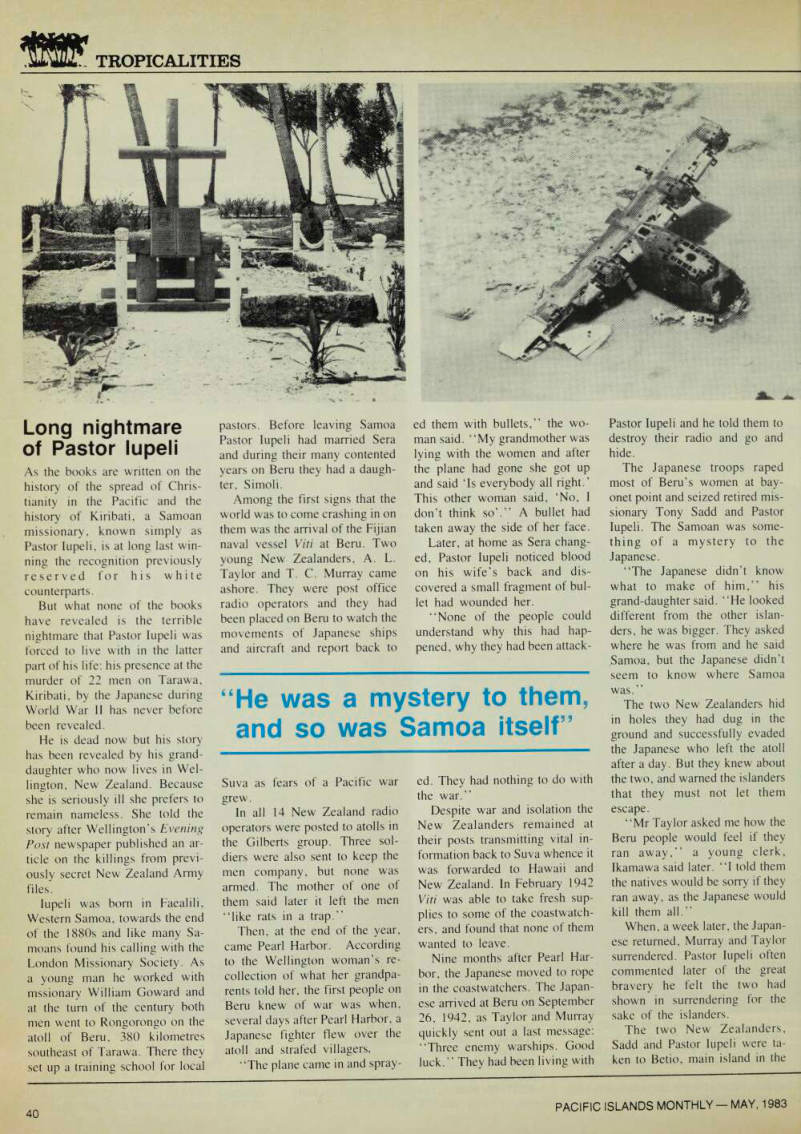
Impact of the Pacific War on Kiribati, background to Pastor lupeli’s nightmare: A memorial (left) recalls executions which lupeli was forced to watch.
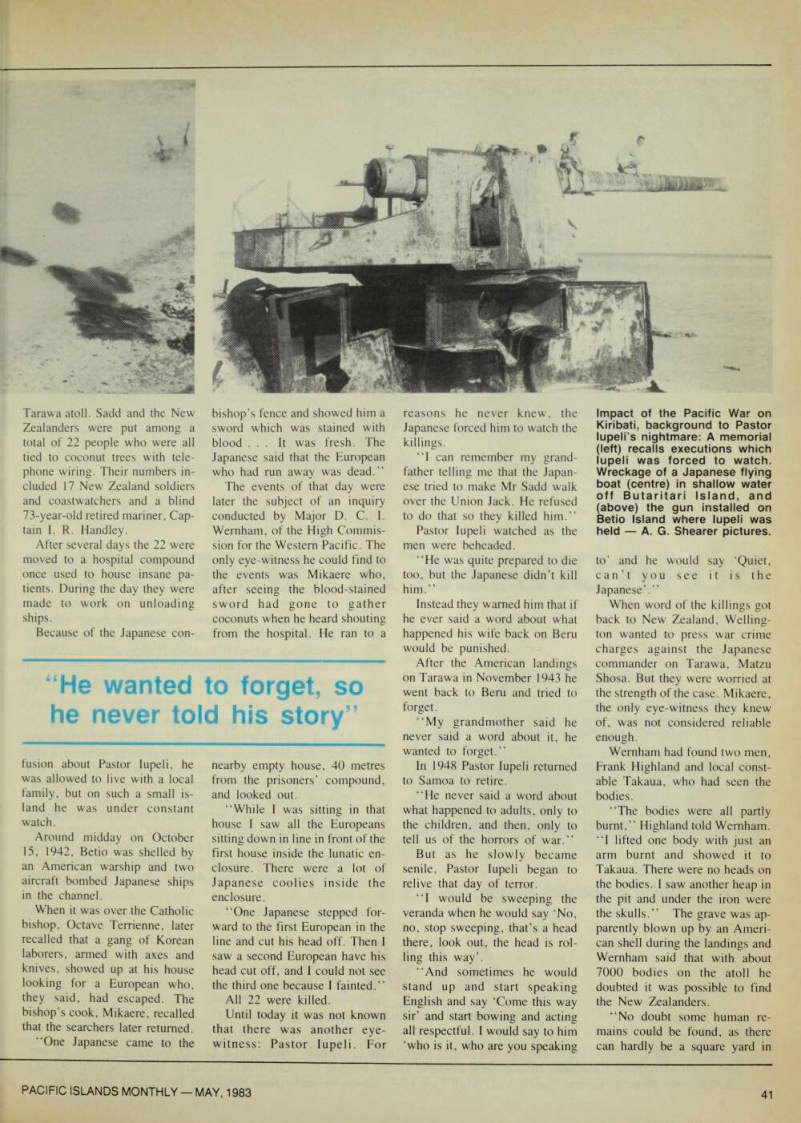
Wreckage of a Japanese flying boat (centre) in shallow water off Butaritari Island, and (above) the gun installed on Betio Island where lupeli was held - A. G. Shearer pictures.
Betio where they could not be found.”
Wemham had visited Bern in his inquiry, but he never spoke to
Pastor lupeli.
If Matzu Shosa had been found he would have been charg ed with the deaths of 20 men; Murray and Taylor would have been left off the indictment.
Wemham could not find any body who ever saw the two men on Betio. Pastor lupeli had.
The fate of the Japanese com mander was never known. Dur ing the battle for Betio, five American marines had attacked
the Japanese bunker headquarters
with gasoline and grenades.
When the battle was over 200 charred bodies of Japanese were pulled out. Shosa’s was probably among them.
Pastor lupeli is today remem bered for his outstanding con tribution to the growth of Chris tianity in the Pacific. His terror of the war years remained essen
tially a private nightmare, and he
made no attempt to have his story told.
He died in 1960. — Michael J.
Field in Wellington.
“Drowned” man in
Tahiti butchery
A French businessman who after shamming his own death tried to start a new life in Tahiti under a false name has been sentenced to
a three-year suspended jail term
for fraud.
Louis Jagut, once the manager of a prosperous wholesale butch ery in Brittany, France, staged his own death by drowning off the French coast before fleeing to the Pacific with stolen identity papers.
He got a job as a butcher in a local supermarkets and was later joined by his former secretary who was his mistress.
But an insurance company which paid up about $510,000 to his wife, last year grew suspi cious that the death may have been phoney and set detectives on his tracks.
When finally arrested, Mr Ja gut explained that he had wanted “to flee the fast life of a com pany manager with social obliga tion” and that his attempts to cover up his affair with his sec
retary had become “unbearable.”
But according to the sentence handed down by a Tahiti court in March, Mr Jagut will now have to work just as hard to pay back more than $l7OO a year to the insurance company he defrauded.
American Samoa,
statistically
A few statistics on American Samoa are revealing.
It has the second highest birth rate in the world. One out of every 10 women is pregnant.
American Samoa is third in the world in per capita beer con sumption, just behind Australia and West Germany.
And American Samoa lost more men per capita in Vietnam than any other American community.
It is the only spot of U.S. soil below the equator, the place where SUS7O million dollars of U.S. aid goes every year to a population of just over 30,000.
And yet many Americans, if they have heard of the place at all, have no clear idea where it is. But this attitude is not new.
The territory was signed over to the U.S. in 1900 but the deed was not legally ratified by Con gress until 1929.
The U.S. should be aware of her possession.
Immigration is increasing: es timates say that up to 120,000 Samoans now live in Hawaii and the continental U.S. They bring with them their language and customs and consider themselves loyal Americans. Those who join
the Army (and recruiters never have any trouble filling their quotas) were never drafted.
Those who died in the not-so different jungles of Vietnam were volunteers.
The changes have been great over the past 50 years. Thatch roofs have disappeared almost completely, given over to con crete houses with tin roofs.
Canned foods and packaged, processed foods are now part of the Samoan diet.
Labor-intensive activities, farming, fishing, cooking in ground ovens and washing clothes in the river bed are now mostly chores “of the old days”.
Most people are employed by the government, while laun dromats and restaurants are booming and the main industry, tuna canning, is accomplished by other hands: Koreans and Taiwanese do the fishing, and Western Samoans, seeking better pay, arrive to can the tuna.
Joseph Theroux in Pago Pago.
Sitmar sweetens
gifts to Tonga
Since the disastrous cyclone Isaac struck Tonga in March, 1982, the Sitmar line vessel Fair star has freighted, free of charge, more than 120 crates of aid items from Australia to Tonga.
The secretary of the Tonga- Australia Association, John Slender, told PIM: “Had the Sit mar Line not made the generous offer to transport this aid equip ment, we would have been faced with a freight bill of many thousands of dollars. Quite
frankly I don’t see how we could have paid such an amount. These aid items may never have left our shores. The Tongan people owe a great deal of thanks to this fine shipping company.”
Uniting Church
history project
Historians of Australia’s Uniting Church and academic historians have formed an advisory com mittee with a view to determin ing guidelines for a comprehen sive history of the church in the Pacific.
In addition to the church’s work in Polynesia, Melanesia and Micronesia, the multi volume project aims to record the church’s work among Aboriginal Australians and in East Asia.
Chaired by Dr. John Brown, General Secretary of the Com mission for World Mission, the committee includes Uniting Church historians Geoff Cum mins, Ross Mackay and Andrew Thomley, while university Pacif ic historians are represented by Niel Gunson (Australian Natonal University), Peter Hempenstall (Newcastle Uni.), Caroline Ral ston (Macquarie Uni.) and Nor man Douglas (Uni. of NSW).
A recent meeting benefited from the presence of John Garrett of Suva whose own book To Live Among the Stars: Christian Ori gins in Oceania has received very enthusiastic reviews.
Norman Douglas in Sydney.
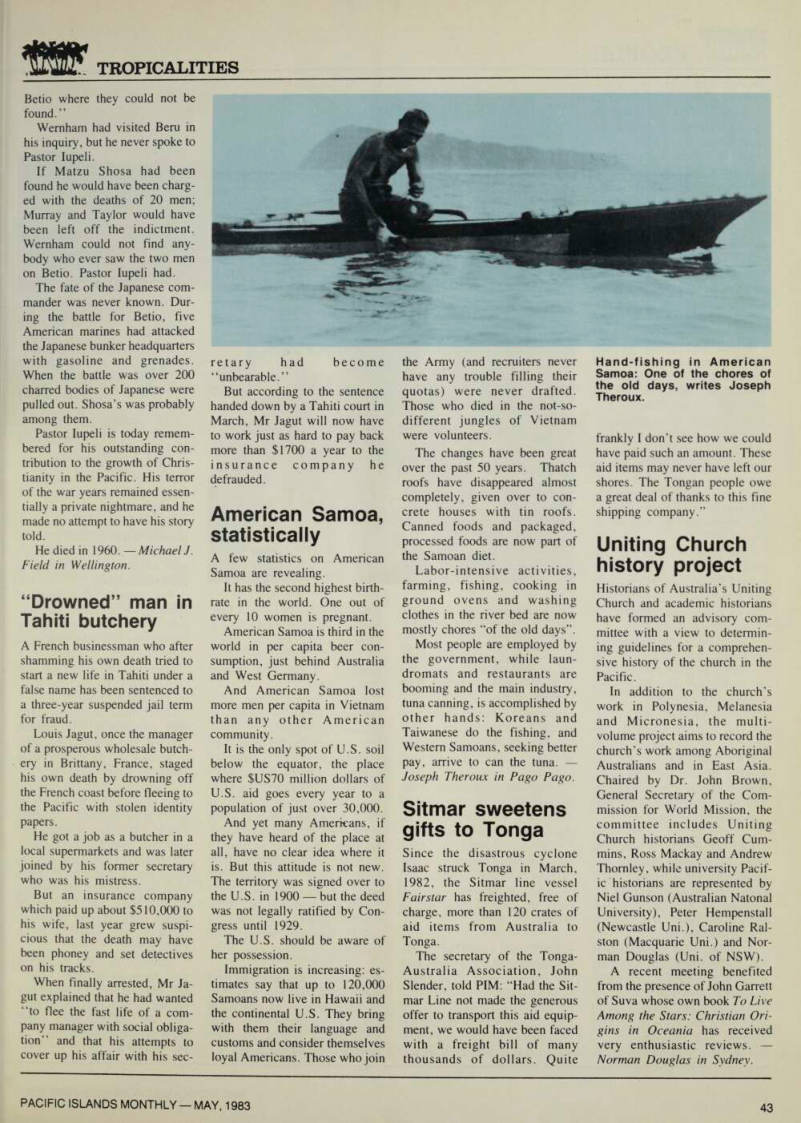
Hand-fishing in American Samoa: One of the chores of the old days, writes Joseph Theroux.