Developing,
p. 37 · Read in the full issue
Tropicalities
Waikiki: Developing, but dusty
“Although Waikiki Beach has a world reputation as a glamorous vacation spot, its physical assets have for many years been nibbl ed at by currents and tides. What was once a wide expanse of fine sand has now become a tiny strip that often disappoints visitors and causes Island residents to assume an apologetic attitude.”
This observation, made by an anonymous contributor to the April 1949 issue of Paradise of the Pacific magazine, could not be made today of Oahu’s favorite resort area.
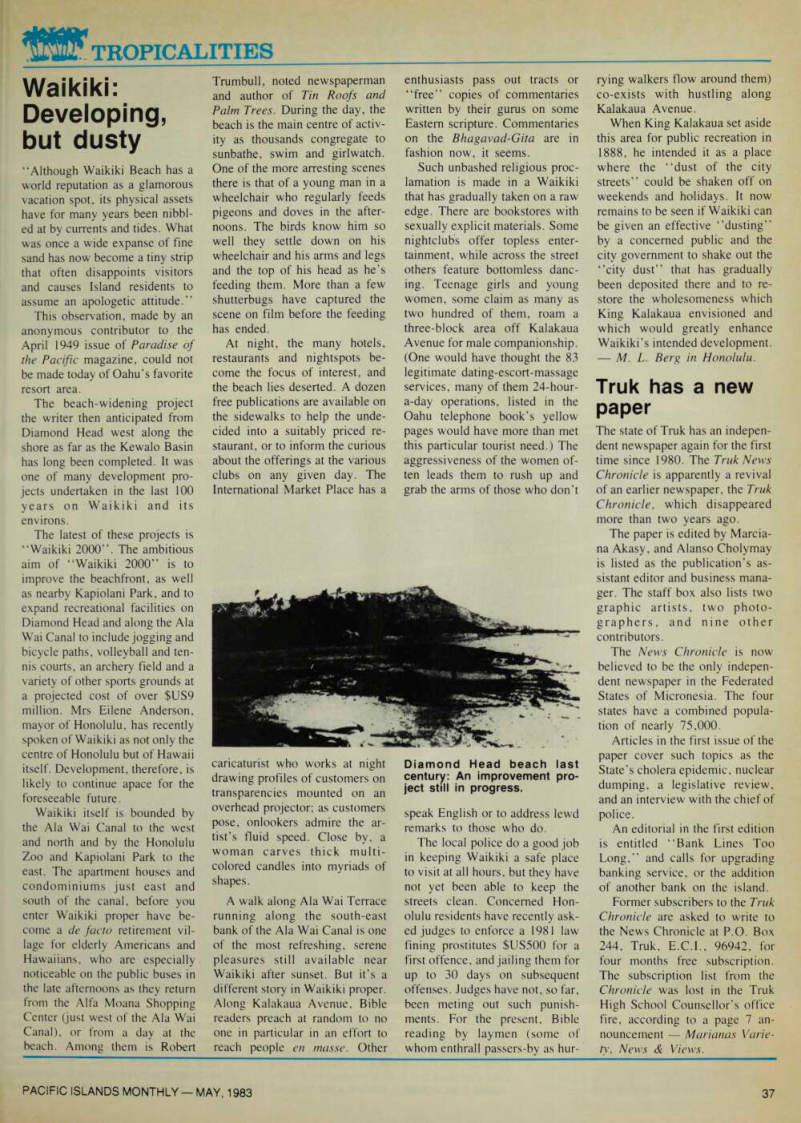
The beach-widening project the writer then anticipated from Diamond Head west along the shore as far as the Kewalo Basin has long been completed. It was one of many development pro jects undertaken in the last 100 years on Waikiki and its environs.
The latest of these projects is “Waikiki 2000”. The ambitious aim of “Waikiki 2000” is to improve the beachfront, as well as nearby Kapiolani Park, and to expand recreational facilities on Diamond Head and along the Ala Wai Canal to include jogging and
bicycle paths, volleyball and ten
nis courts, an archery field and a variety of other sports grounds at a projected cost of over SUS 9 million. Mrs Eilene Anderson, mayor of Honolulu, has recently spoken of Waikiki as not only the centre of Honolulu but of Hawaii itself. Development, therefore, is likely to continue apace for the foreseeable future.
Waikiki itself is bounded by the Ala Wai Canal to the west and north and by the Honolulu Zoo and Kapiolani Park to the east. The apartment houses and condominiums just east and south of the canal, before you enter Waikiki proper have be come a de facto retirement vil lage for elderly Americans and Hawaiians, who are especially noticeable on the public buses in the late afternoons as they return from the Alfa Moana Shopping Center (just west of the Ala Wai Canal), or from a day at the beach. Among them is Robert
Trumbull, noted newspaperman and author of Tin Roofs and Palm Trees. During the day, the beach is the main centre of activ ity as thousands congregate to sunbathe, swim and girl watch.
One of the more arresting scenes there is that of a young man in a wheelchair who regularly feeds pigeons and doves in the after noons. The birds know him so well they settle down on his wheelchair and his arms and legs and the top of his head as he’s feeding them. More than a few shutterbugs have captured the scene on film before the feeding has ended.
At night, the many hotels, restaurants and nightspots be come the focus of interest, and the beach lies deserted. A dozen free publications are available on the sidewalks to help the unde cided into a suitably priced re staurant, or to inform the curious about the offerings at the various clubs on any given day. The International Market Place has a
caricaturist who works at night drawing profiles of customers on transparencies mounted on an overhead projector; as customers pose, onlookers admire the ar tist’s fluid speed. Close by, a woman carves thick multi colored candles into myriads of
shapes.
A walk along Ala Wai Terrace
running along the south-east
bank of the Ala Wai Canal is one of the most refreshing, serene pleasures still available near Waikiki after sunset. But it’s a different story in Waikiki proper.
Along Kalakaua Avenue, Bible readers preach at random to no one in particular in an effort to reach people en masse. Other
enthusiasts pass out tracts or “free” copies of commentaries written by their gurus on some Eastern scripture. Commentaries on the Bhagavad-Gita are in fashion now, it seems.
Such unbashed religious proc lamation is made in a Waikiki that has gradually taken on a raw edge. There are bookstores with sexually explicit materials. Some nightclubs offer topless enter tainment, while across the street others feature bottomless danc ing. Teenage girls and young women, some claim as many as two hundred of them, roam a three-block area off Kalakaua Avenue for male companionship. (One would have thought the 83 legitimate dating-escort-massage services, many of them 24-hour a-day operations, listed in the Oahu telephone book’s yellow pages would have more than met this particular tourist need.) The aggressiveness of the women of ten leads them to rush up and grab the arms of those who don’t
speak English or to address lewd remarks to those who do.
The local police do a good job in keeping Waikiki a safe place to visit at all hours, but they have not yet been able to keep the streets clean. Concerned Hon olulu residents have recently ask ed judges to enforce a 1981 law fining prostitutes SUSSOO for a first offence, and jailing them for up to 30 days on subsequent offenses. Judges have not, so far, been meting out such punish ments. For the present, Bible reading by laymen (some of whom enthrall passers-by as hur
rying walkers flow around them) co-exists with hustling along Kalakaua Avenue.
When King Kalakaua set aside this area for public recreation in 1888, he intended it as a place where the “dust of the city streets” could be shaken off on weekends and holidays. It now remains to be seen if Waikiki can be given an effective “dusting” by a concerned public and the city government to shake out the “city dust” that has gradually been deposited there and to re store the wholesomeness which King Kalakaua envisioned and which would greatly enhance Waikiki’s intended development.
M. L. Berg in Honolulu.
Truk has a new
paper
The state of Truk has an indepen dent newspaper again for the first time since 1980. The Truk News Chronicle is apparently a revival of an earlier newspaper, the Truk Chronicle, which disappeared more than two years ago.
The paper is edited by Marcia na Akasy, and Alanso Cholymay is listed as the publication’s as sistant editor and business mana ger. The staff box also lists two graphic artists, two photo graphers, and nine other contributors.
The News Chronicle is now believed to be the only indepen dent newspaper in the Federated States of Micronesia. The four states have a combined popula tion of nearly 75,000.
Articles in the first issue of the paper cover such topics as the State’s cholera epidemic, nuclear dumping, a legislative review, and an interview with the chief of police.
An editorial in the first edition is entitled “Bank Lines Too Long,” and calls for upgrading banking service, or the addition of another bank on the island.
Former subscribers to the Truk Chronicle are asked to write to the News Chronicle at P.O. Box 244, Truk, E.C.L, 96942, for four months free subscription.
The subscription list from the Chronicle was lost in the Truk High School Counsellor’s office fire, according to a page 7 an nouncement Marianas Varie ty, News & Views.
Diamond Head beach last century: An improvement pro ject still in progress.