success story
pp. 27-29 · Read in the full issue

PTC: A Hawaii success story
As mentioned previously in this column, a number of events serv ed to rekindle United States in terest in the Pacific in the late 19705. As one consequence, three international conferences relating to the Pacific were held in Hawaii during 1979 and 1980, and each resulted in a new organ isation headquartered in Hon olulu. Two of these the Pacif
ic Islands Development Program
and the Pacific Basin Develop ment Council were described in the March and April issues of
Pim.
The discussions which eventu ally led to the third conference and organisation did not at the outset include the Pacific Is lands. As early as 1975, repre sentatives from both government and private sectors in Japan and the United States were discussing their inability to keep abreast of and manage the rapid technolog ical advances being made in tele communications. By the follow ing year, bureaucrats in President Ford’s administration proposed an annual conference in which nations of the “Pacific Ocean Basin’’ could meet to exchange
views and data on telecommuni cations and to work toward har monising telecommunications facilities, services, and policies in the region. Representatives from several U.S. government agencies, large U.S. corpora tions, and the academic world gathered in Washington DC to discuss the idea. As commonly happens, even the best laid plans of mice and men go by the wayside with changes of ad ministrations and with Car ter’s defeat of Ford in 1976, the proposal died in Washington.
It was to remain alive, howev er, in Hawaii. Upon his return to Honolulu, Richard Barber, an administrator at the University of Hawaii and one of the academic participants at the Washington meeting, had shared his observa tions with an informal telecom munications interest group at home. While enthusiastic about a “Pacific Ocean Basin’’ confer ence, Barber and the Honolulu group’s conception of the region was broader than that held in Washington. In their view, such a conference should include the Pacific Islands, Central and
South American, and South-east Asian nations, Canada and Aust ralia, as well as Japan and the United States.
The Honolulu group gathered support from several organisa tions including the State of Hawaii’s Department of Plan ning and Economic Develop ment, the University of Hawaii, the Hawaiian Telephone Com pany, and the Hawaii Telecom munications Association. A two day conference, PTC ’79, co chaired by Barber and Dr Nor man Abramson, also of the Un iversity of Hawaii, was held dur ing January 1979. It attracted 315 individuals from 18 coun tries, and over 60 papers were delivered which explored matters ranging from technical issues to the social and cultural impacts of newly developed telecommuni cations systems.
Following the conference, a steering committee of about two dozen conferees began planning for a permanent organisation to continue and expand on the PTC ’79 activities. Among the plan ners were three well-known Pacific personalities; Stuart Kin gan, scientific officer, Cook Is lands; Rex Lee, twice governor of American Samoa; and John Sheppard, then deputy director of SPEC.
A second annual conference, PTC ’BO, was expanded to three days in January 1980. Ratu Sir
Kamisese Mara, Prime Minister of Fiji, gave one of the keynote addresses focusing on the tele communication needs of Pacific Island nations. The conference was again successful with 425 participants from 23 countries.
The efforts of the steering com mittee had also borne fruit, and the Pacific Telecommunications Council was established as a non-profit organisation located in Hawaii. A board of trustees with an executive board was elected, and Barber left his position at the university after he was named the council’s first director.
The objectives of the council are several: to provide a forum for the interchange of informa tion and ideas regarding telecom munications in the Pacific; to promote an awareness of the varied telecommunication needs of different parts of the region; to address specific telecommunica tion issues and to assist in solv ing them; to make available the viewpoints and recommenda tions of the council to national, regional, and international or
ganisations responsible for tele
communication policies. In Bar ber’s view, “perhaps the main purpose of the council is to serve as a catalyst to bring different
people together who normally
don’t talk to each other.’’
The council refers to the “Pacific Hemisphere’’ and indi cates that, for its purposes; “The
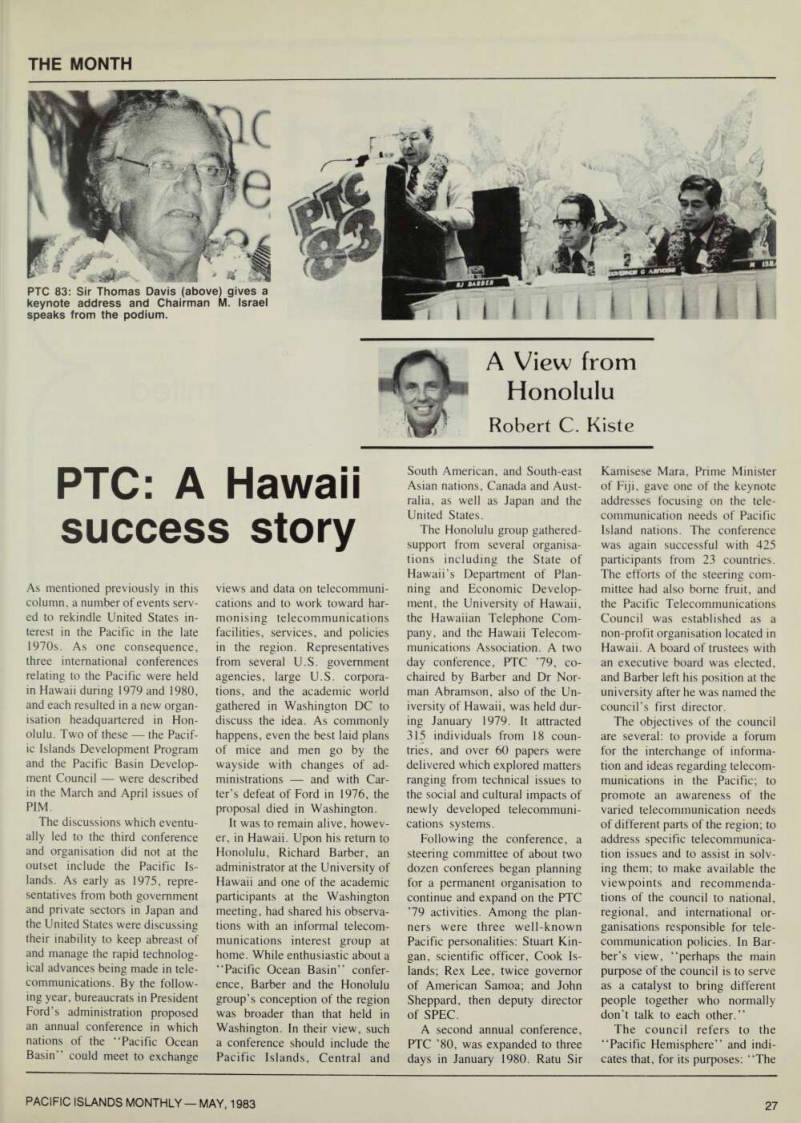
PTC 83: Sir Thomas Davis (above) gives a keynote address and Chairman M. Israel speaks from the podium.
A View from Honolulu Robert C. Kiste
Pacific area comprises the Pacif ic Ocean and the countries within or adjacent to its contiguous seas.” Council members are of three types: profit-making organ isations, non-profit organisa tions, and individuals.
Members include users, sup pliers, and carriers of telecom munications equipment and ser vices, along with educational in stitutions, government agencies, and research and professional or ganisations. Individual members include engineers, researchers, academicians, policy-makers, consultants, broadcasters, and other telecommunication profes sionals. As of March 1983, total council membership was 153 (53 profit making organisations, 24 non-profit entities and 76 individuals).
The council and the annual conference are both self supporting through the annual dues of the membership and con ference registration fees respec tively. The council’s staff is small, consisting of Director Barber, two staff assistants, part time professionals on contract, and student help from the univer sity. Its office is located near the university at: 1110 University Avenue, Suite 303, Honolulu, Hawaii, 96826, USA.
Reflecting upon the council’s activities and accomplishments, Director Barber points to six areas: 1. The annual conferences have continued to be quite suc cessful with a diverse mix of participants. The three-day January format has been main tained and the site has continued to be Honolulu, although it may vary in the near future. PTC ’Bl included a symposium on “Pacific Island Telecommunica tions” and a round-table discus sion on “Pacific Island Needs- Solutions.” Keynote speakers for PTC 'B2 included Sir Thomas Davis, then Prime Minister of the Cook Islands, and Hawaii’s Gov enor George Ariyoshi. A number of informal sessions on the Pacif ic Islands were part of PTC ’B3.
The number of participants con tinues to average a little over 400 from approximately 25 coun tries. Each year, there are about 25 exhibitors of telecommunica tions products and services. 2. Beginning in 1980, mid-
year seminars are held in con junction with meetings of the board of trustees. The seminars bring telecommunications issues of interest to the attention of leaders and opinion-makers in various countries concerned with the region. The 1980 seminar was held in Tokyo. The 1981 and 1982 sessions were in Washing ton, DC and Manila. Average attendance has been about 250 individuals and New Zealand is being considered as a meeting site in the near future. 3. The council has compiled The Human Resources Directory which is an electronically stored and indexed data base of tele communication professionals in the Pacific area. It lists over 500 individuals with their occupa tions, interests, languages, and mailing and telex addresses. In dividuals or organisations may have access to the Directory for a fee, and its purpose is to help build inter-personal networks and to serve as a reference for
those seeking professional
expertise.
4. A Survey of Other Entities has also been concluded. It lists over 150 regional and other or ganisations with an interest in telecommunications in the Pacific. 5. In August, 1980, a quarter ly newsletter was launched. It reports news of the council as
well as general information on telecommunications activities, issues, and concerns in the Pacific. 6. The council has a publica tion program. Proceedings of each of the annual conferences have been published. To appear in the next month or so is a volume Telecom Pacific which contains 20 papers on Pacific telecommunications. Ratu Mara has contributed the foreword and one of the papers, “Telecom munications and Developing Countries in the Pacific,” was written by Thomas Davis.
There is no doubt that the council is enjoying considerable initial success. The number of its members has doubled in the last two years and the annual confer ence and seminars are well estab lished and supported. The coun cil has received international re cognition by governments and other organisations in the area.
Its short history has already been the subject of a M.A. thesis (Origins, Growth and Future Di rections of the Pacific Telecom munications Council by Kari J.
Anderson, University of Hawaii, 1981). Director Barber obviously believes in the council and its future. He left a secure position to take the directorship during the council’s infancy, and he has obviously been the guiding hand behind it.
At present, the council's mem bership is dominated by North America and East Asia, with over 100 of the total of 153 members. However, in order at least partially to offset this imba lance, the board of trustees is structured to give equal represen tation to seven sub-regions of the area: North America, Central America, South America, East Asia, Southeast Asia, South Asia, and Oceania.
Barber is concerned that the interests and needs of Pacific Island nations should not be overlooked. He believes that the council provides a forum in which island needs can be heard and can serve as an alternative to governments, official agencies, and suppliers as a reliable source of information. The council has responded to requests for infor mation from island countries, and a demonstration of satellite
equipment especially suited to
small island countries is planned
for PTC ’B4.
Robert C. Kiste.
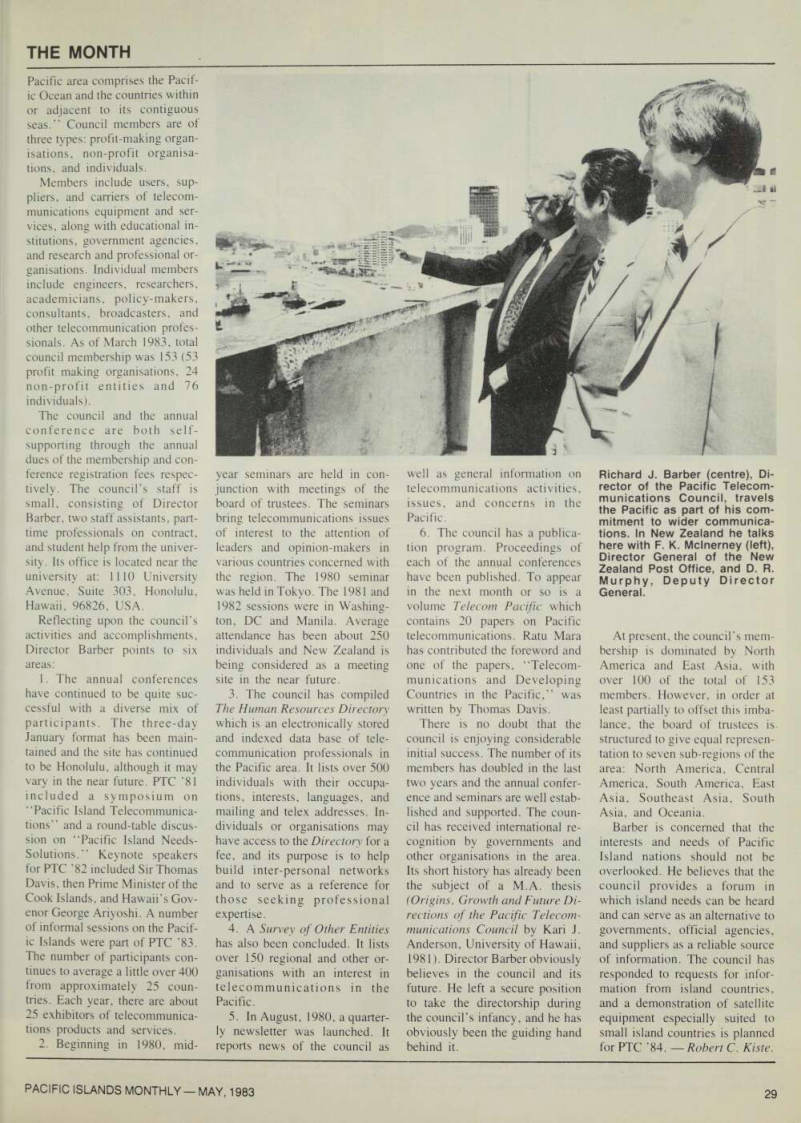
Richard J. Barber (centre), Di rector of the Pacific Telecom munications Council, travels the Pacific as part of his com mitment to wider communica tions. In New Zealand he talks here with F. K. Mclnerney (left), Director General of the New Zealand Post Office, and D. R.
Murphy, Deputy Director General.