Congress: An appraisal
pp. 31-32 · Read in the full issue
The 15th Pacific Science Congress: An appraisal
The Pacific Science Association is an organisation which is contributing to closer links in the Pacific through research and information exchange involv ing a wide field of scientific knowlege. Here DR DAVID WALSH, of the Anthropology Department at the University of Sydney, gives an appraisal of the association’s 15th congress.
The 15th Pacific Science Con gress was held from February 1 to 11 at the University of Otago, in Dunedin, New Zealand. These congresses are held at intervals of about four years, and are organised by the Pacific Science Association an international,
non-govemmental regional sci
entific body which has a mem bership drawn from over 40 countries and areas within or bordering on the Pacific Ocean or having territorial respon sibilities within the region.
The objectives of the associa tion are “to initiate and promote co-operation in the study of sci entific problems relating to the
Pacific region more particu
larly those affecting the prosperi ty and well-being of Pacific peo ples; and to strengthen the bonds of peace among Pacific peoples
by promoting a feeling of
brotherhood among scientists of all Pacific countries.”
The congresses are open to all who are interested in the objec tives of the association. The 15th Congress, which had as its gen eral theme “Conservation, De velopment and Utilisation of the Resources of the Pacific”, at
traded over 1500 scientists and other interested people from a wide selection of member countries.
A comprehensive range of specific fields within the physic al, medical and social sciences was represented within the vari ous symposia and sections of the congress.
The program included four general symposia: Energy in Ag riculture; High Latitude Re sources: Their Assessment and Development; Resources, Sci ence and the Law of the Sea; and Pacific Island Potentials.
There were also 14 section programs in the fields of Ecology and Environmental Protection, Solid Earth Sciences, Geog raphy, Museums in Pacific Re search, Marine Sciences, Coral Reefs, Botany, Forestry, Fresh
Water Sciences, Entomology, Social Sciences and Humanities, Public Health and Medical Sci ences, Nutrition, and Science Communication and Education.
At a congress organised on this scale, with 14 sections and one symposium or more usually in session concurrently, and of ten with six or more sub-sections within a given section operating concurrent programs, obviously no one individual can keep in touch with, let alone participate in, everything that is going on even within one particular section.
As an anthropological linguist I was primarily interested in some of the sub-sections within
Section K Social Sciences and Humanities. Something of the range of specific interests covered by this section can be inferred from the titles of its various sub-sections.
In the linguistic field there were “Reconstruction and Clas sification in the Austronesian Language Family”, “Structural Analysis and Classification of Papuan and Australian Lan guages”, “Pidgin and Creole Languages in the Pacific: Past, Present and Future”, and “Dictionaries for Oceanic
Peoples.”
In the field of prehistory and archaeology there were “Prehis toric Food Production Systems in the Pacific”, “Archaeology in Micronesia”, “The Origins of Food Production, Metallurgy and the State in Mainland Southeast Asia”, “Settlement Pattern Ar chaeology in the Pacific”, “Studies in Pre-European and Traditional Fishing in the Pacif ic”, “Archaeological Science in the Pacific Region”, “The Pre history of Australia and Papua New Guinea”, and “Public Ar chaeology in Pacific Countries”.
Also within Section K there were sub-sections on “Physical Anthropology in the Pacific”, “Development of the Arts in the Pacific”, “Maori Studies”, “Transformations of Polynesian Culture”, “Shame, Embarrass ment and Related Notions in Micronesian Culture”, “Politic al Developments in Mic ronesia”, “Pacific Trade and In vestment Patterns”, “Telecom munications in the Pacific: Its Impact on Economic, Social and Political Conditions”, “Urban isation in the South Pacific and Southeast Asian Areas”, “Tech nology Transfer in the Pacific Region”, and “Inter-cultural History: The Ecology of Culture Contact in the Pacific”.
Most of these sub-sections had programs lasting two, three or four days, with morning sessions from 9.00 until noon and after noon sessions from 2.00 until 5.00 or 5.30. In addition, ple nary sessions of the Congress were held each week-day from noon until 1.00 in the auditorium of the Otago Museum. At these sessions addresses were given by various distinguished invited speakers, among whom, in the social sciences field, were Sir Edmund Leach (Cambridge) speaking on “Ocean of Oppor
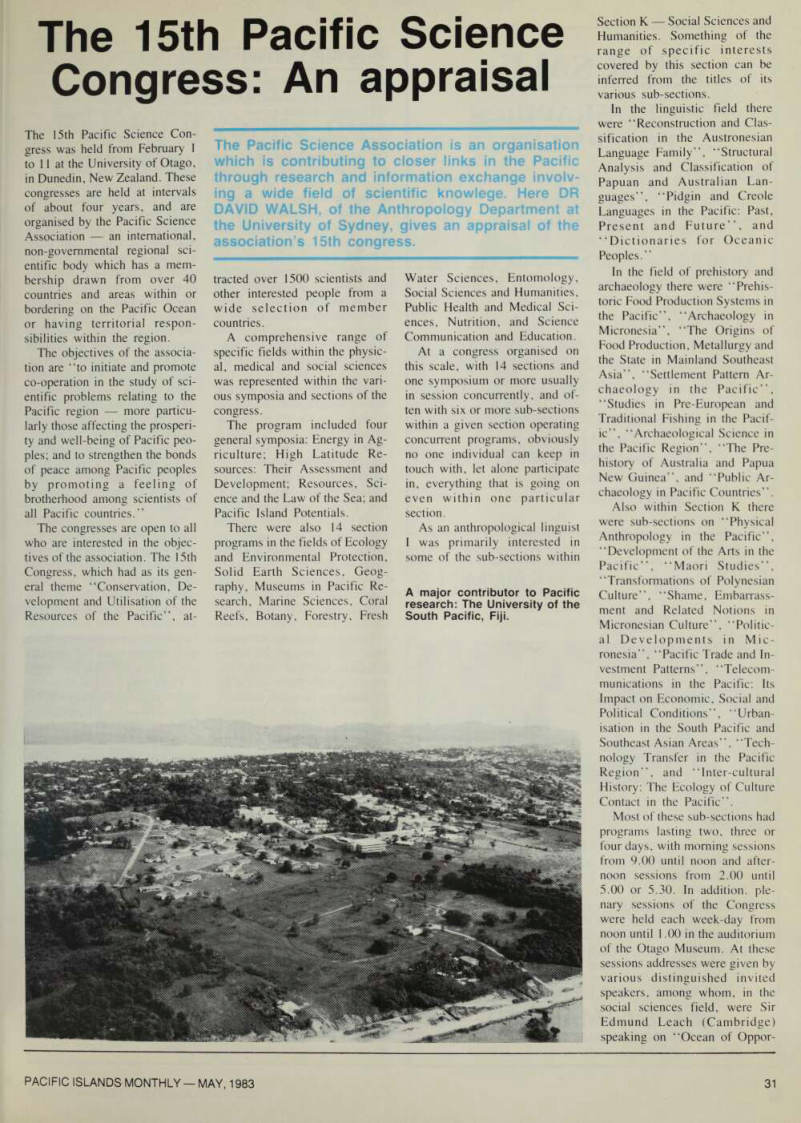
A major contributor to Pacific research: The University of the South Pacific, Fiji.
tunities?”, and Professor R.
Gerard Ward (Australian Nation al University) speaking on “Ag riculture, Size and Distance in Pacific Island Futures”. Some of the evenings were taken up with section dinners, and others were used for meetings of various learned and scientific societies whose members, usually dispers ed throughout Australasia and the Pacific, were gathered in Dunedin for the Congress.
While most of the papers in the linguistic sub-sections and certain specific papers in other sub-sections (notably a couple of linguistically oriented papers in the “Maori Studies’’ sub section, several papers in the sub-sections concerned with Oceanic prehistory and cultural anthropology, and even a couple of papers in the sub-section on “Pacific Trade and Investment Patterns”) were of interest to me, my main concern was with the papers in the sub-section on “Reconstruction and Classifica tion in the Austronesian Lan guage Family”. This sub-section had a program of 23 papers (in cluding my own offering on the lower-order reconstruction of flora and fauna nomenclature within the East Austronesian lin guistic subgroup) which oc cupied four days of the congress.
The Austronesian language family is a grouping of related languages which is of about the same linguistic status as the In do-European language family. It has over 800 member languages distributed throughout the Pacific region, from Easter Island in the east to Hawaii and southern Taiwan in the north to New Zealand in the south, and even to Madagascar in the west. It in cludes all the indigenous lan guages of Polynesia and Mic ronesia, most of those in island Melanesia and coastal Papua New Guinea, and most of the languages of the Philippines, In donesia and Malaysia.
Much of the recent and current research on these languages is historically oriented, being con cerned with the reconstruction of aspects of ancestral languages at various levels within the family (e.g. reconstruction of Proto- Polynesian, the language im mediately ancestral to the Poly nesian sub-group of languages).
and with investigating the pat terns of sub-grouping within the family, i.e. with finding out which groups of Austronesian languages have members that are more closely related to each other than they are to other lan guages in the family.
The keynote address in the sub-section dealing with recon struction and classification in the
Austronesian family was given
by Professor George Grace (Lin
guistics Department, University
of Hawaii at Manoa). His topic was “Oceanic Sub-grouping:
Retrospect and Prospect” a
consideration of what had been achieved in the sub-grouping of the Oceanic, or East Austrone sian, languages since the late 1940 s (when his involvement with the field had begun), and of what was likely to be achieved during the next two decades.
This particular sub-section at tracted about 40 linguists from universities throughout the Pacif ic region and even from two in
Europe.
One of the great values of meetings such as the Pacific Sci ence Congress is that they bring together, from many different locations, the experts in a given field, such as the above
mentioned historically-oriented
investigation of the Austronesian
languages, and provide them
with opportunities to consider aspects of each other’s work.
These opportunities exist not
only, nor even always primarily,
in the formal conference ses sions, but also in informal dis cussions which often go on well into the small hours of the
morning.
This particular congress brought together most of the specialists in one of my own main fields of research and gave me ample chance to talk at length with them. If the other 1500 or so
participants found the Congress
to be similarly productive then part, at least, of its objective will have been achieved.
Another part will have been achieved if the longterm results of these contacts between scien tists from many specific fields eventually contribute to the well being and harmonious co existence of all of us who live in
the Pacific region.
David
Walsh.