Sea, sky, local
pp. 23-25 · Read in the full issue
polls, all stormy
In PIM March (p. 35) we wrote of Cyclone Nano which devastated the Tuamotus in January, “such disasters occur in this part of the Pacific at most once in a lifetime.” Our article was writ ten in the first days of February.
On February 14, the “imposs ible” happened; another cyc lone, this time dubbed Orama (Tahitian for “Vision”) was bom between the Equator and the Marquesas group. Unlike Nano,
which had travelled in a well established pattern along an arc like path from north to south, Orama didn’t seem to know where to go.
Its first sudden change of di rection occurred at 15 deg. latitude when it veered off due east through the Tuamotus all the way to the Kon-Tiki island of Raroia, causing terrible havoc on all atolls in between. It also sank an old wooden ship, the Tamarii
Takehau, which should long since have been condemned, causing the loss of five lives.
Everyone expected Orama
eventually to peter out in the empty vastness of the ocean east of the Tuamotus, as cyclones have tended to do in the past. It did exactly the opposite: it stopped dead in its tracks at Raroia, then quickly returned to the scene of its earlier crimes in the centre of the Tuamotu group, flattening the few houses still left standing from its first assault.
Then, on February 23, it set out for Tahiti. Or at least, so it seemed. But it soon changed course once again, taking off, at increasing speed, in a south-
easterly direction. On February
27 it inflicted extensive wave and wind damage on the nuclear test ing base at Moruroa, which had been severely hit by Nano only a month before (PIM Mar. P. 31), Naturally, there wasn’t much the authorities could do during these two anxious weeks except issue well-meaning but totally ineffectual advice to the poor atoll dwellers who, unlike the Tahitians, have no mountains to flee to. This did not stop a green French administrator from urging them to take refuge “on the highest point of the atoll,” and to do so “in good time” before they were hit by the cyclone whose peculiar characteristic was that it was behaving in a manner that was totally unpredictable! or
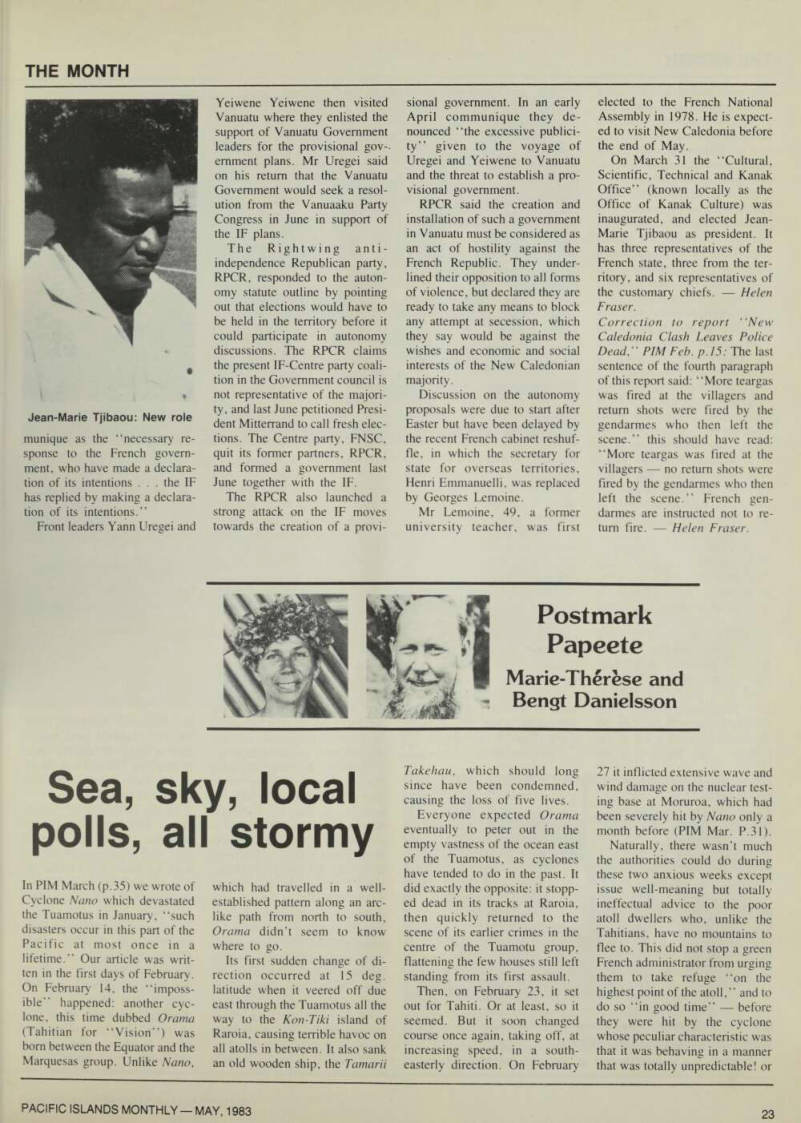
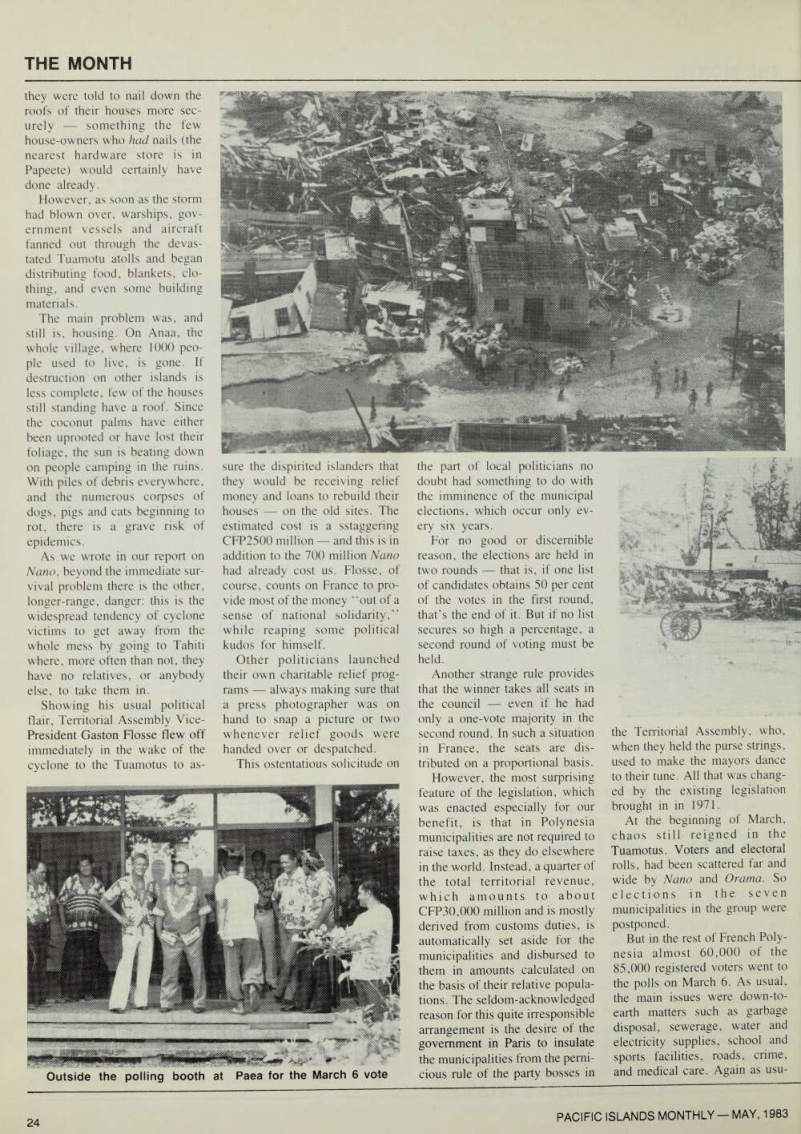
Postmark Papeete Marie-Thérèse and Bengt Danielsson
they were told to nail down the roofs of their houses more sec urely something the few house-owners who had nails (the nearest hardware store is in Papeete) would certainly have
done already.
However, as soon as the storm had blown over, warships, gov ernment vessels and aircraft fanned out through the devas tated Tuamotu atolls and began distributing food, blankets, clo thing, and even some building materials.
The main problem was, and still is, housing. On Anaa, the whole village, where 1000 peo ple used to live, is gone. If destruction on other islands is less complete, few of the houses still standing have a roof. Since the coconut palms have either been uprooted or have lost their foliage, the sun is beating down on people camping in the ruins.
With piles of debris everywhere, and the numerous corpses of dogs, pigs and cats beginning to rot, there is a grave risk of
epidemics.
As we wrote in our report on Nano, beyond the immediate sur vival problem there is the other, longer-range, danger: this is the
widespread tendency of cyclone
victims to get away from the whole mess by going to Tahiti where, more often than not, they have no relatives, or anybody else, to take them in.
Showing his usual political
flair, Territorial Assembly Vice- President Gaston Flosse flew off immediately in the wake of the cyclone to the Tuamotus to as-
sure the dispirited islanders that they would be receiving relief money and loans to rebuild their houses on the old sites. The estimated cost is a sstaggering CFP2SOO million and this is in addition to the 700 million Nano had already cost us. Flosse, of course, counts on France to pro vide most of the money “out of a sense of national solidarity,’’
while reaping some political
kudos for himself.
Other politicians launched their own charitable relief prog rams always making sure that a press photographer was on hand to snap a picture or two whenever relief goods were handed over or despatched.
This ostentatious solicitude on
the part of local politicians no doubt had something to do with the imminence of the municipal elections, which occur only ev ery six years.
For no good or discernible reason, the elections are held in two rounds that is, if one list of candidates obtains 50 per cent of the votes in the first round, that’s the end of it. But if no list secures so high a percentage, a second round of voting must be held.
Another strange rule provides that the winner takes all seats in the council even if he had only a one-vote majority in the second round. In such a situation in France, the seats are dis tributed on a proportional basis.
However, the most surprising feature of the legislation, which was enacted especially for our benefit, is that in Polynesia municipalities are not required to raise taxes, as they do elsewhere in the world. Instead, a quarter of the total territorial revenue, which amounts to about CFP3O,OOO million and is mostly derived from customs duties, is automatically set aside for the municipalities and disbursed to them in amounts calculated on the basis of their relative popula tions. The seldom-acknowledged reason for this quite irresponsible arrangement is the desire of the government in Paris to insulate the municipalities from the perni cious rule of the party bosses in
the Territorial Assembly, who, when they held the purse strings, used to make the mayors dance to their tune. All that was chang ed by the existing legislation brought in in 1971.
At the beginning of March, chaos still reigned in the Tuamotus. Voters and electoral rolls, had been scattered far and wide by Nano and Orama. So elections in the seven municipalities in the group were
postponed.
But in the rest of French Poly nesia almost 60,000 of the 85,000 registered voters went to the polls on March 6. As usual, the main issues were down-to earth matters such as garbage disposal, sewerage, water and
electricity supplies, school and
sports facilities, roads, crime, and medical care. Again as usu
Outside the polling booth at Paea for the March 6 vote
al, to a much larger extent than in territorial or national elections, the incumbent mayors and their challengers either had only weak
affiliations with political parties,
or no affiliations at all, counting mainly on the strength of their personalities and local family ties. This is especially the case in the outer islands.
But in Tahiti and Moorea at least, the three major political parties were all represented in the elections, and the results there fore furnished some indication of their present relative strengths.
The question uppermost in all minds was whether Flosse and his Tahoeraa party had managed to consolidate their position since they ousted the Autonomist Front Uni of Francis Sanford from control of the Territorial Assembly and the Council of
Government in May last year (PIM Jul ’B2 p. 22), or whether the pendulum was already swing ing back. The third party to be watched was the la mana te nunaa, made up of angry young Polynesians who favor an inde pendent socialist republic, and who won three seats in the May ’B2 elections to the 30-member Territorial Assembly.
Apparent winners in the first round were the candidates of Flosse’s party, who captured five municipalities, with the Auton omists taking only three. But two re-elected independent mayors Emile Vernaudon in Mahinad and Jacuie Graffe in Paea now lean towards the Autonomists, making the first-round score al most even.
The size of the 48 municipalities should also be ta
ken into account, they vary greatly, from a few hundred in habitants to more than 20,000. In this light it was a serious setback for Tahoeraa when it failed mis erably to unseat Jean Juventin, the mayor of Papeete, the largest city in the territory and its capit al. Juventin secured a second six year term with a whopping 68 per cent of the vote. (It’s worth noting that the huge Chinese electorate in Papeete this time split almost 50/50 between Tahoeraa and the Autonomists).
In Punaauia, with a population of 8000, Flosse’s right-hand man Alexandre Leontieff failed to topple the incumbent Autonomist mayor. The la mana te nunaa, which stood candidates every where except in the Marquesas, was severely handicapped by the “winner take all" rule. It cap
tured only one small municipali ty in the Austral Islands.
In the Windward Islands, this left only the three municipalities of Faaa, Papara and Moorea in volved in the second round on March 13.
Faaa, whose population is now about 17,000, about half of them recent immigrants from the outer islands, was once the fiefdom of Autonomist leader Francis San ford, who resigned as mayor in 1977 when he became the territ ory’s chief executive. In the first round of voting on March 6, Sanford’s mumbling and bumbl ing successor scored only a poor fourth, and seemed bound to lose his position. On Moorea and in Papara the first round had ended more or less in a draw, and the final outcome was impossible to predict. But the very fact that the
prestigious mayor of Moorea, John Teariki, had been forced into a run-off was itself a partial defeat.
The campaign for the second round was barely under way when the weather station an nounced the almost unbelievable news that a third cyclone, Reva, was heading for the Leeward Islands from the north. Being by now accustomed to the capri cious ways of the new, 1983, generation of cyclones, we were all holding our breath in Tahiti as well. Well, if the very worst did not happen, we were never theless pretty close to disaster on Saturday, March 12, when Reva passed 100 kilometres northeast of Tahiti. This seemed to be a safe enough distance. But the
cyclonic wind, whirling around
the dead eye at a speed of 150
kilometres an hour, did a crazy and completely unexpected thing: it jumped over the Tahitian mountains and descended through the narrow valleys on the west coast, slamming into all buildings that stood in its way.
Although more than 1000 houses were either destroyed, unroofed, or damaged in other ways. This added at least another 2000 mill ion to the disaster bill for 1983.
By some miracle, nobody was crushed by the falling trees, walls and roofs. But, as we later learned, two passengers on the trading vessel, Taporolll, which was returning from the Mar quesas, were washed overboard
and drowned less than 50 kilometres from Papeete.
If the cyclone had been just a little slower, the assault on Tahiti would have occurred on election day and prevented most voters from reaching the polling sta tions. As it was, when election day dawned, Reva was already on its way to Moruroa, where the damage once again was fearful.
A comparable disaster in the world of politics was the defeat of John Teariki on Moorea, whose mayor he had been for the past 30 years. Teariki’s defeat can no doubt be put down to the influx of hundreds of new settlers on the island, both French and part-European, many of whom are involved in Moorea’s boom ing tourist industry. These peo
ple clearly preferred the dynam
ic, pragmatic business philosophy of the Tahoeraa chal lenger, Franklin Brotherson, to the strict, London Missionary Society, morality of the 100 per cent Polynesian like Teariki.
In Papara too the Tahoeraa
challenger, Tuainu Legayic, won
over the incumbent Autonomist mayor, Mithou Lehartel. But the margin 16 votes was so tiny that the result could almost be regarded as a draw.
In Faaa, to the surprise of
everybody including himself
Oscar Temaru, leader of the
pro-independence, anti-bomb
Front de Liberation de la Poly nesie won easily. His win was due to some extent to the failure of his adversaries to knock to gether an alliance. But it was due even more to his well-tailored policies. In the context of the municipal election Oscar Temaru had nothing to say about the urgent need for independence, or why the nuclear tests must be stopped at once. Instead, he pro mised again and again that, if elected, he would do his utmost to find jobs and better housing for the thousands of poor devils who live in the huge slum areas in Faaa.
The fact that he won by such a wide margin demonstrated once more that, in municipal elec tions, the issues capable of gal vanising voters are simply not the same as in other elections.
Marie-Thérèse and Bengt Danielsson.
Damage from a cyclonic wind that did “a crazy and unexpect ed thing”. - La Dépêche pictures.