autonomy plan
pp. 21-23 · Read in the full issue

France unveils autonomy plan
France presented the broad out lines and philosophy of its pro posed statute of autonomy to New Caledonian politicians in mid-March. They have not been widely welcomed in the territory.
The statute follows the in troduction by decree in 1982 of seven reforms in New Caledonia by which France aimed to “re move the inequalities and injus tices existing in the territory.”
The reforms, which are now get ting off the ground (PIM Mar. p. 37), include the returning of much tribal land to customary
Melanesian owners, the setting up of an office of Kanak culture, economic development of the in terior and the islands, and the introduction of Melanesian “as sessors” to the judicial system.
The aims of the proposed sta tute rest upon three requirements: “increased responsibility for ter ritorial politicians, the responsi bility of the French state in its work of emancipation, and the insertion of the territory in its geographic environment, the South Pacific.”
The statute would alter the
present hierarchy of high com missioner (governor), govern ment council and territorial as sembly to one which increases local executive powers.
More power would be concen trated in the “territorial govern ment” (former government council) whose president would be elected by the assembly, with the president choosing his own ministers. Most importantly the role of the French high commis sioner would be re-defined. No longer governor of the territory, he would represent the French Republic and be chief of the French state services. However, he would retain control of public order and justice, and powers over the territorial institutions.
Independence Front leaders is sued a communique recalling that their politicians had been
elected on a platform of Kanak socialist independence and that IF members had confirmed this position at their various party congresses (PIM Jan. p. 15). The IF regards autonomy as a ques tion of the past, stressing that it does not figure in their platform.
However it could be accepted, their communique says, if it were in the framework of a time table leading towards independence.
The IF warns that if France per sists with plans that go no further than autonomy, they will estab lish a provisional government of the Kanak National Liberation Front and will withdraw from government institutions in New Caledonia.
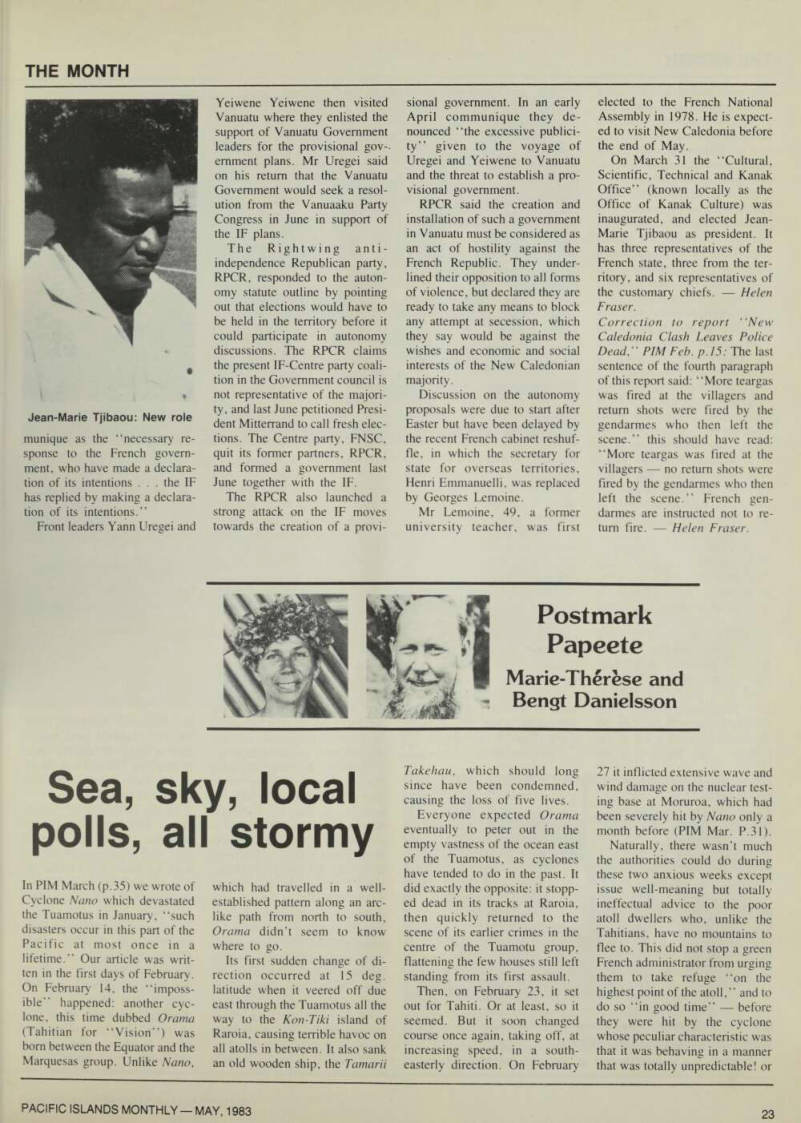
Union Caledonienne leader and Vice-President of the Gov ernment Council, Jean-Marie Tjibaou, describes the IF corn-
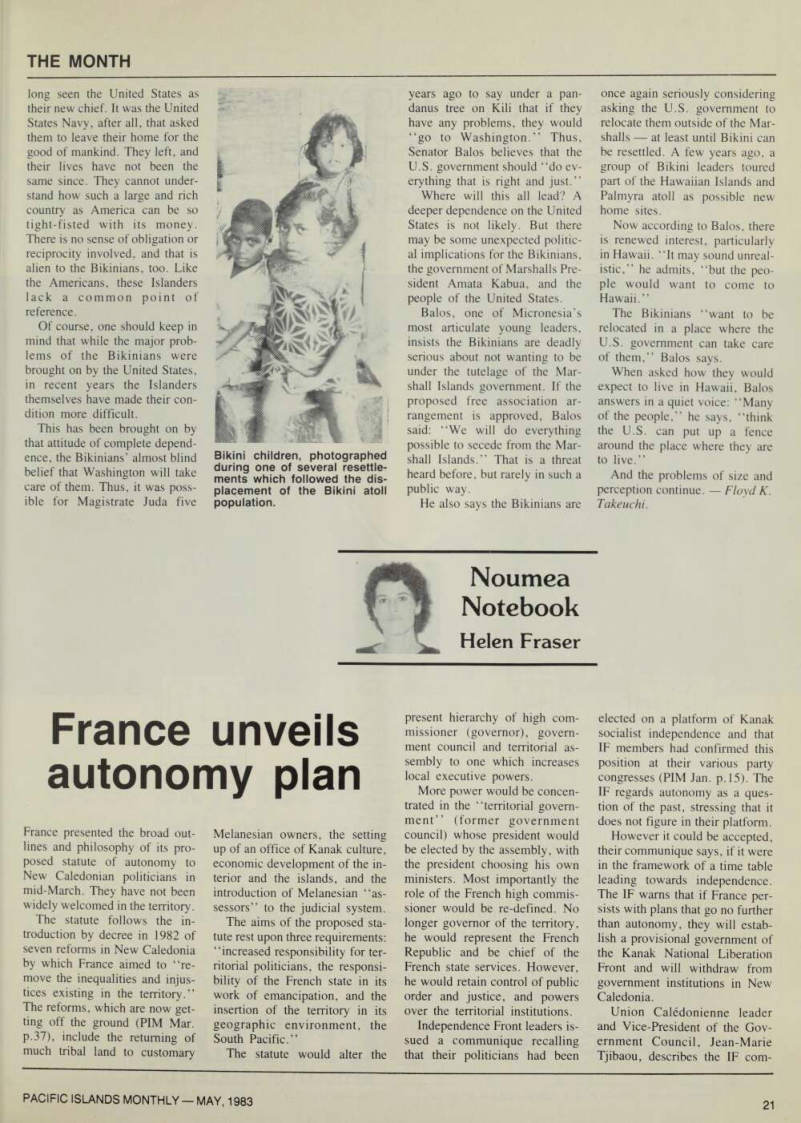
Noumea Notebook Helen Fraser
munique as the “necessary re sponse to the French govern ment, who have made a declara tion of its intentions ... the IF has replied by making a declara tion of its intentions.”
Front leaders Yann Uregei and
Yeiwene Yeiwene then visited Vanuatu where they enlisted the support of Vanuatu Government leaders for the provisional gov-, emment plans. Mr Uregei said on his return that the Vanuatu Government would seek a resol ution from the Vanuaaku Party Congress in June in support of the IF plans.
The Rightwing anti
independence Republican party,
RPCR, responded to the auton omy statute outline by pointing out that elections would have to be held in the territory before it could participate in autonomy discussions. The RPCR claims the present IF-Centre party coali tion in the Government council is not representative of the majori ty, and last June petitioned Presi dent Mitterrand to call fresh elec tions. The Centre party, FNSC, quit its former partners, RPCR, and formed a government last June together with the IF.
The RPCR also launched a strong attack on the IF moves towards the creation of a provi
sional government. In an early April communique they de nounced “the excessive publici ty” given to the voyage of Uregei and Yeiwene to Vanuatu and the threat to establish a pro visional government.
RPCR said the creation and installation of such a government in Vanuatu must be considered as an act of hostility against the French Republic. They under lined their opposition to all forms of violence, but declared they are ready to take any means to block any attempt at secession, which they say would be against the wishes and economic and social interests of the New Caledonian majority.
Discussion on the autonomy proposals were due to start after Easter but have been delayed by the recent French cabinet reshuf fle, in which the secretary for state for overseas territories, Henri Emmanuelli, was replaced by Georges Lemoine.
Mr Lemoine, 49, a former university teacher, was first
elected to the French National Assembly in 1978. He is expect ed to visit New Caledonia before the end of May.
On March 31 the “Cultural, Scientific, Technical and Kanak Office” (known locally as the Office of Kanak Culture) was inaugurated, and elected Jean- Marie Tjibaou as president. It has three representatives of the French state, three from the ter ritory, and six representatives of the customary chiefs. Helen Fraser.
Correction to report “New Caledonia Clash Leaves Police Dead,” PIM Feb. p. 15: The last sentence of the fourth paragraph of this report said: “More teargas was fired at the villagers and return shots were fired by the gendarmes who then left the scene.” this should have read: “More teargas was fired at the villagers no return shots were fired by the gendarmes who then left the scene.” French gen darmes are instructed not to re
turn fire.
Helen Fraser.
Jean-Marie Tjibaou: New role