Exile without end
pp. 19-21 · Read in the full issue

for the Bikinians
Size is everything for Ameri cans. They come from a country that has vast distances. Their culture is built upon the notion that bigger is usually better.
So they often have a very difficult time understanding in an empathetic way the concerns of Islanders who live their lives on small, isolated spits of sand.
Americans simply have no refer ence point.
In many respects, this has been the central problem that has plagued relations between Americans and the people of Bikini atoll in the Marshall Is lands. For 37 years, they have been talking past each other not intentionally, but that has been the effect.
This long-standing issue in Micronesia is again in the news following the March visit to Washington of most of Bikini’s senior leaders. The 11-member delegation, headed by Magistrate Tomaki Juda and Marshalls Senator Henchi Balos, spent 45 minutes with Vice-President George Bush in the White House.
It was the first time that the Bikinians had met with such a high-ranking American leader.
Most of their official dealings have been with members of Con gress, who may enjoy consider able clout but who are not a heartbeat away from the presidency.
The historic meeting, which took place on March 3, was arranged by Fred Zeder, Presi dent Reagan’s personal represen tative to the Micronesian status
negotiations. Zeder is a long time Bush supporter, and a per sonal friend of the vice president. Indeed, it was that close tie that got the wealthy Honolulu businessman his ap pointment as U.S. ambassador to the status talks.
The Bikinians came away en couraged by the meeting with Bush. Not optimistic they have had too many hopes dashed over the years. But to have had their case personally heard by the United States’ second highest leader counts for something.
Senator Balos, who was bom on Bikini shortly before it be-
came an atomic testing ground in 1946, spoke for the group at the meeting with Bush. He told the
vice-president;
“Our desires are very simple.
In 1946, when we were moved away from home, we were told that the move would be tempor ary and that the United States would care for us until we could return home. Thirty-seven years have passed and we are still not home. We are told that Bikini will not be safe to live on for more than 100 years. We ask only that the United States con tinue to care for us until we can return home.”
What concerns the Bikinians is that under the proposed Compact of Free Association, the United States and the Marshall Islands government agree to close American courts to any claims arising out of the 12 years of atomic testing in those Islands.
The Bikinians have a $450 mill
ion claim pending against
Washington in a federal court.
Thus, Balos told Bush: “The Marshall Islands Government did not cause the damage at Bikini and it should not be asked to take care of us as a result of that damage. We do not want the
United States to walk away from us and close the books on Bikini.
This is our fear about the com pact . . .
“All but three of the Bikinians here today,” Bales continued, “were bom on Bikini. We want to die on Bikini and we want our children and grandchildren to live and die on Bikini, our only home. We ask you and President Reagan to do all in your power to help us return to our homeland. ’ ’
Since the mid-19505, the Biki nians have lived on Kili Island, an unprotected island in the southern Marshalls. It does not have the lagoon Bikini did, and it does not have the emotional or cultural significance Bikini has.
Their homeland, unfortunate ly, is also still very radioactive.
So much so that U.S. scientists do not expect most of the atoll’s islands to be safe for habitation for at least 60 years, if ever.
What Balos and the others want is a continuing pledge from Washington that the needs of the Bikinians will be met until Bikini is safe enough to return to. Those needs are all-consuming ev erything from a trust fund to most of the food they eat. That is in the form of U.S. Department of Agriculture canned and pack aged goods.
It is here that the hopes of the Bikinians, and the outlook of Americans, are so far apart.
The Americans see a group of about 1100 people being support ed by the United States govern ment and wonder what the “complaining” is about. These people are fed and even housed by Uncle Sam, and still their leaders travel to Washington as often as four times a year to press the case for more.
The Bikinians, who come from a culture with paramount chiefs who traditionally care for the welfare of their people, have
Notes from the North Floyd K. Takeuchi on Micronesia
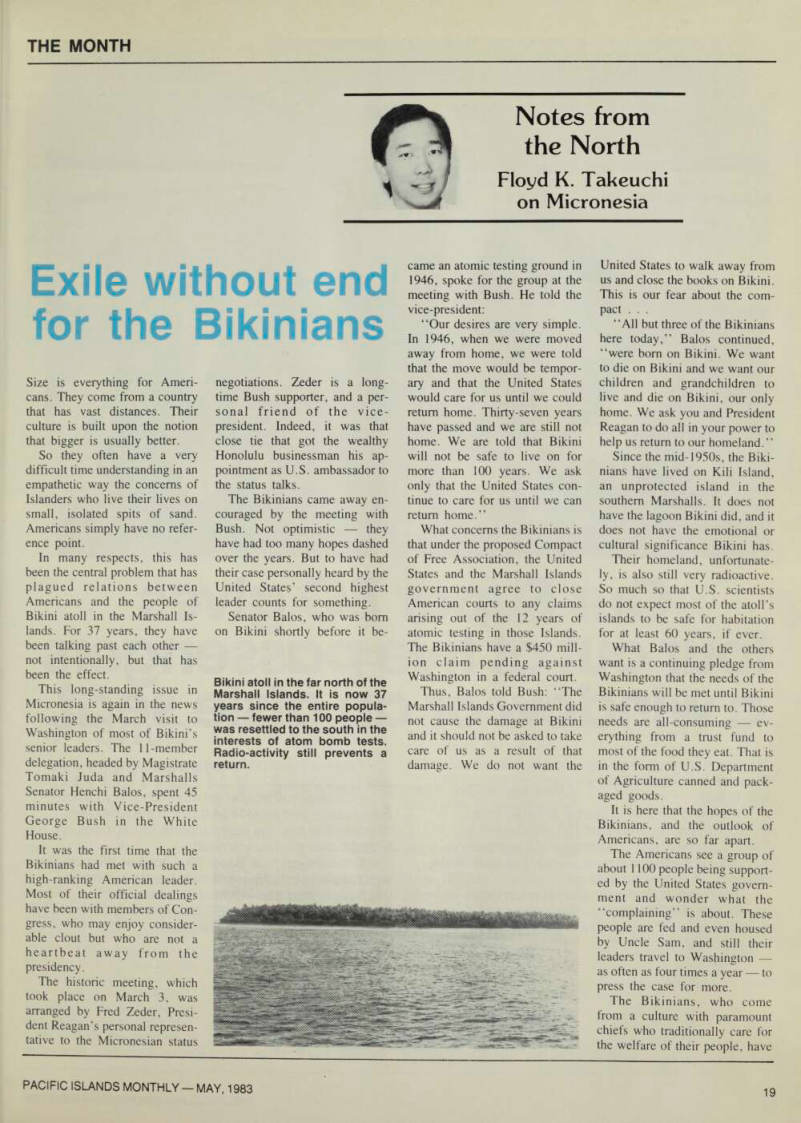
Bikini atoll in the far north of the Marshall Islands. It is now 37 years since the entire popula tion - fewer than 100 people was resettled to the south in the interests of atom bomb tests.
Radio-activity still prevents a return.
long seen the United States as their new chief. It was the United States Navy, after all, that asked them to leave their home for the good of mankind. They left, and their lives have not been the same since. They cannot under stand how such a large and rich country as America can be so tight-fisted with its money.
There is no sense of obligation or reciprocity involved, and that is alien to the Bikinians, too. Like the Americans, these Islanders lack a common point of reference.
Of course, one should keep in mind that while the major prob lems of the Bikinians were brought on by the United States, in recent years the Islanders themselves have made their con dition more difficult.
This has been brought on by that attitude of complete depend ence, the Bikinians’ almost blind belief that Washington will take care of them. Thus, it was poss ible for Magistrate Juda five
years ago to say under a pan danus tree on Kili that if they have any problems, they would “go to Washington.” Thus, Senator Balos believes that the U.S. government should “do ev
erything that is right and just.”
Where will this all lead? A deeper dependence on the United States is not likely. But there may be some unexpected politic al implications for the Bikinians, the government of Marshalls Pre sident Amata Kabua, and the people of the United States.
Balos, one of Micronesia’s most articulate young leaders, insists the Bikinians are deadly serious about not wanting to be under the tutelage of the Mar shall Islands government. If the proposed free association ar rangement is approved, Balos said: “We will do everything possible to secede from the Mar shall Islands.” That is a threat heard before, but rarely in such a
public way.
He also says the Bikinians are
once again seriously considering asking the U.S. government to relocate them outside of the Mar shalls at least until Bikini can be resettled. A few years ago, a group of Bikini leaders toured part of the Hawaiian Islands and Palmyra atoll as possible new home sites.
Now according to Balos, there is renewed interest, particularly in Hawaii. “It may sound unreal istic,” he admits, “but the peo ple would want to come to Hawaii.”
The Bikinians “want to be relocated in a place where the U.S. government can take care of them,” Balos says.
When asked how they would expect to live in Hawaii, Balos answers in a quiet voice: “Many of the people,” he says, “think the U.S. can put up a fence around the place where they are to live.”
And the problems of size and
perception continue.
Takeuchi.
Floyd K.
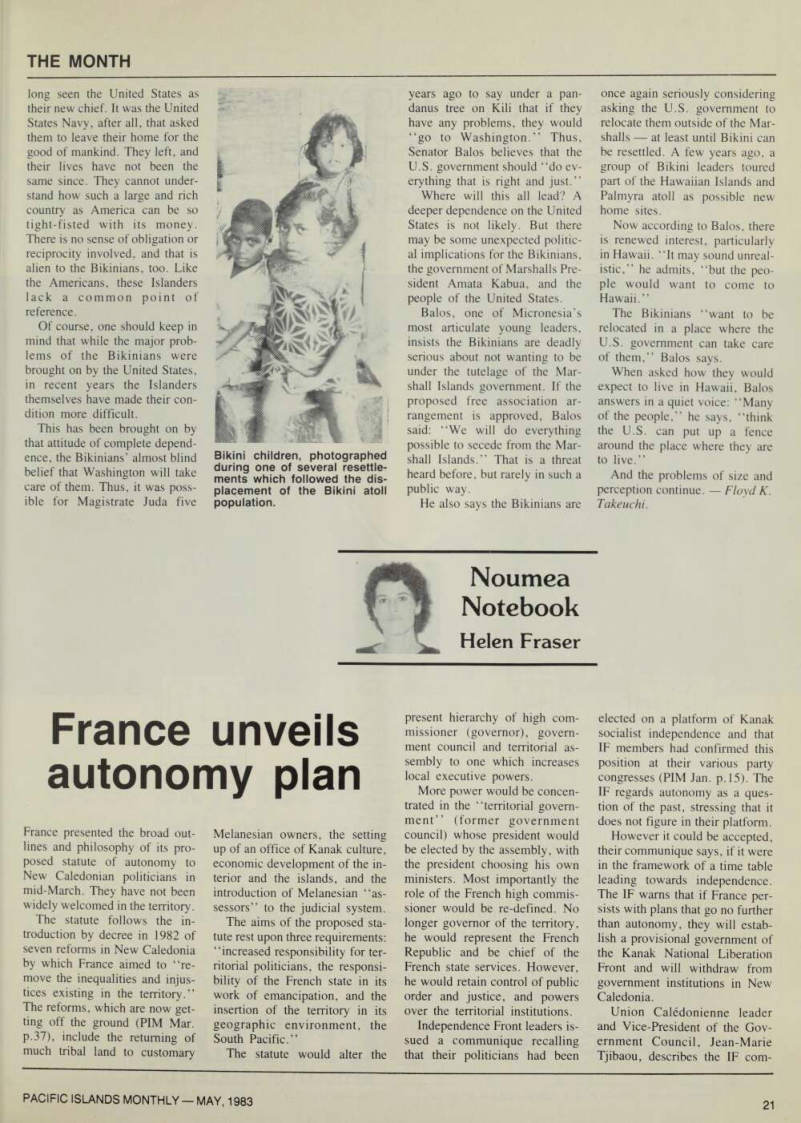
Bikini children, photographed during one of several resettle ments which followed the dis placement of the Bikini atoll population.