Voice Of Vanuatu
p. 18 · Read in the full issue
Above all for Vanuatu
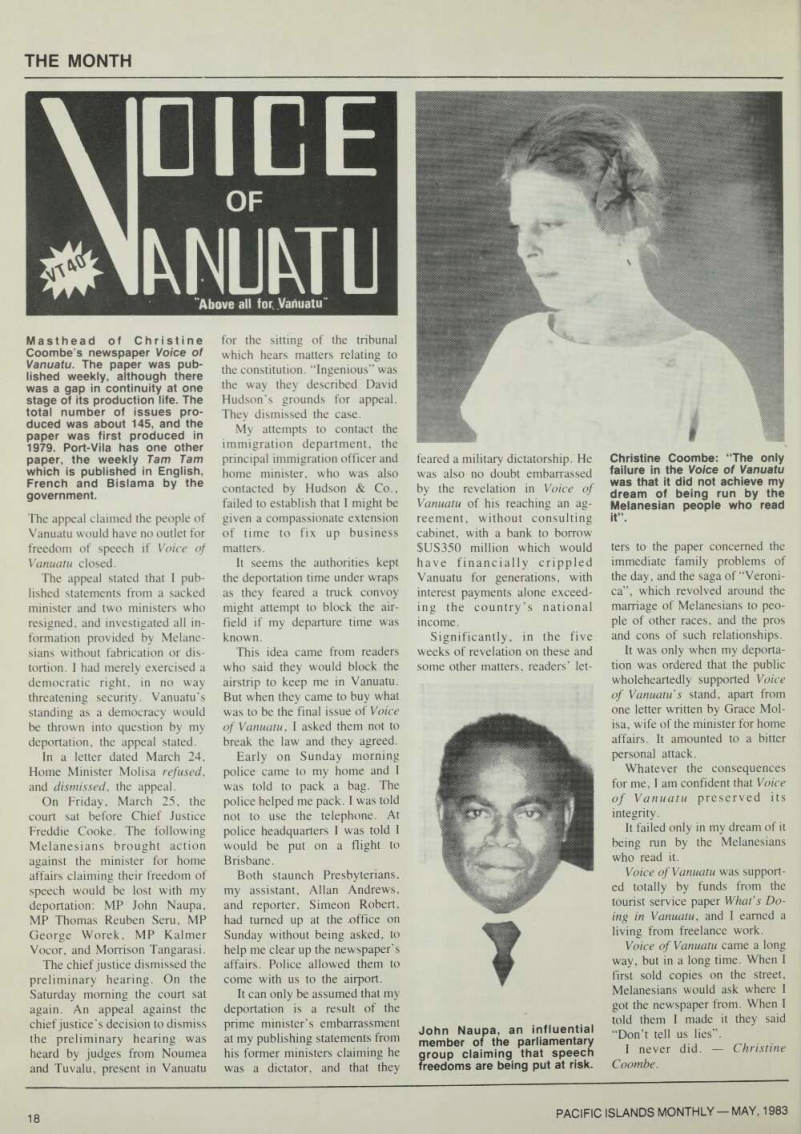
Masthead of Christine Coombe’s newspaper Voice of Vanuatu. The paper was pub lished weekly, although there was a gap in continuity at one stage of its production life. The total number of issues pro duced was about 145, and the paper was first produced in 1979. Port-Vila has one other paper, the weekly Tam Tam which is published in English, French and Bislama by the government.
The appeal claimed the people of Vanuatu would have no outlet for freedom of speech if Voice of Vanuatu closed.
The appeal stated that I pub lished statements from a sacked minister and two ministers who resigned, and investigated all in formation provided by Melane sians without fabrication or dis tortion. I had merely exercised a democratic right, in no way
threatening security. Vanuatu’s
standing as a democracy would be thrown into question by my
deportation, the appeal stated.
In a letter dated March 24, Home Minister Molisa refused, and dismissed, the appeal.
On Friday, March 25, the court sat before Chief Justice Freddie Cooke. The following Melanesians brought action against the minister for home affairs claiming their freedom of speech would be lost with my deportation: MP John Naupa, MP Thomas Reuben Seru, MP George Worek, MP Kalmer Vocor, and Morrison Tangarasi.
The chief justice dismissed the preliminary hearing. On the Saturday morning the court sat again. An appeal against the chief justice’s decision to dismiss
the preliminary hearing was
heard by judges from Noumea and Tuvalu, present in Vanuatu
for the sitting of the tribunal which hears matters relating to the constitution. “Ingenious” was the way they described David
Hudson’s grounds for appeal.
They dismissed the case.
My attempts to contact the
immigration department, the
principal immigration officer and
home minister, who was also contacted by Hudson & Co., failed to establish that I might be
given a compassionate extension
of time to fix up business matters.
It seems the authorities kept the deportation time under wraps as they feared a truck convoy might attempt to block the air field if my departure time was known.
This idea came from readers who said they would block the airstrip to keep me in Vanuatu.
But when they came to buy what was to be the final issue of Voice of Vanuatu, I asked them not to break the law and they agreed.
Early on Sunday morning
police came to my home and I was told to pack a bag. The police helped me pack. I was told not to use the telephone. At police headquarters I was told I would be put on a flight to Brisbane.
Both staunch Presbyterians, my assistant, Allan Andrews, and reporter, Simeon Robert, had turned up at the .office on Sunday without being asked, to help me clear up the newspaper’s affairs. Police allowed them to come with us to the airport.
It can only be assumed that my deportation is a result of the prime minister’s embarrassment at my publishing statements from his former ministers claiming he was a dictator, and that they
feared a military dictatorship. He was also no doubt embarrassed by the revelation in Voice of Vanuatu of his reaching an ag reement, without consulting cabinet, with a bank to borrow SUS3SO million which would have financially crippled Vanuatu for generations, with interest payments alone exceed ing the country’s national income.
Significantly, in the five weeks of revelation on these and some other matters, readers’ let-
ters to the paper concerned the
immediate family problems of
the day, and the saga of “Veroni ca”, which revolved around the marriage of Melanesians to peo ple of other races, and the pros and cons of such relationships.
It was only when my deporta tion was ordered that the public
wholeheartedly supported Voice
of Vanuatu’s stand, apart from one letter written by Grace Mol isa, wife of the minister for home affairs. It amounted to a bitter
personal attack.
Whatever the consequences for me, I am confident that Voice
of Vanuatu preserved its
integrity.
It failed only in my dream of it being run by the Melanesians who read it.
Voice of Vanuatu was support ed totally by funds from the tourist service paper What’s Do ing in Vanuatu, and I earned a living from freelance work.
Voice of Vanuatu came a long way, but in a long time. When I first sold copies on the street, Melanesians would ask where I got the newspaper from. When I told them I made it they said “Don’t tell us lies”.
I never did.
Christine
Coombe.
John Naupa, an influential member of the parliamentary group claiming that speech freedoms are being put at risk.
Christine Coombe: “The only failure in the Voice of Vanuatu was that it did not achieve my dream of being run by the Melanesian people who read it”.