Compact onion
pp. 40-43 · Read in the full issue

Layers of the Compact onion
Notes from the North Floyd K. Takeuchi on Micronesia
Fourteen years ago, when Americans and Micronesians began to formally consider the Trust Territory’s future political status, there was a strong undercurrent in the islands that a new
vista was opening up. For the first time, the wards of so many colonial masters were dealing as
equals across the negotiating
table. One could be forgiven for feeling at times that the future
was theirs for the negotiating.
The euphoria didn’t last long, and by late 1982, when the last of the three Micronesian free association agreements was ap proved by island and American political status teams, cynicism had replaced any feelings of nas cent nationalism.
There remains, however, a critical need to understand what has transpired over the past 14 years. The free association ag reement, for all its critics, essen
tially remains the only game in town.
In that regard, Americans and Micronesians should be very grateful to Brother Henry Schwalbenberg, SJ, a relative newcomer to the Byzantine world of North Pacific politics.
He has, in a year and a half in Micronesia, done what many considered the near-impossible: he has explained in simple terms what the free association com pact is all about. He is affiliated
with the Catholic Mission’s Mic ronesian Seminar of Truk.
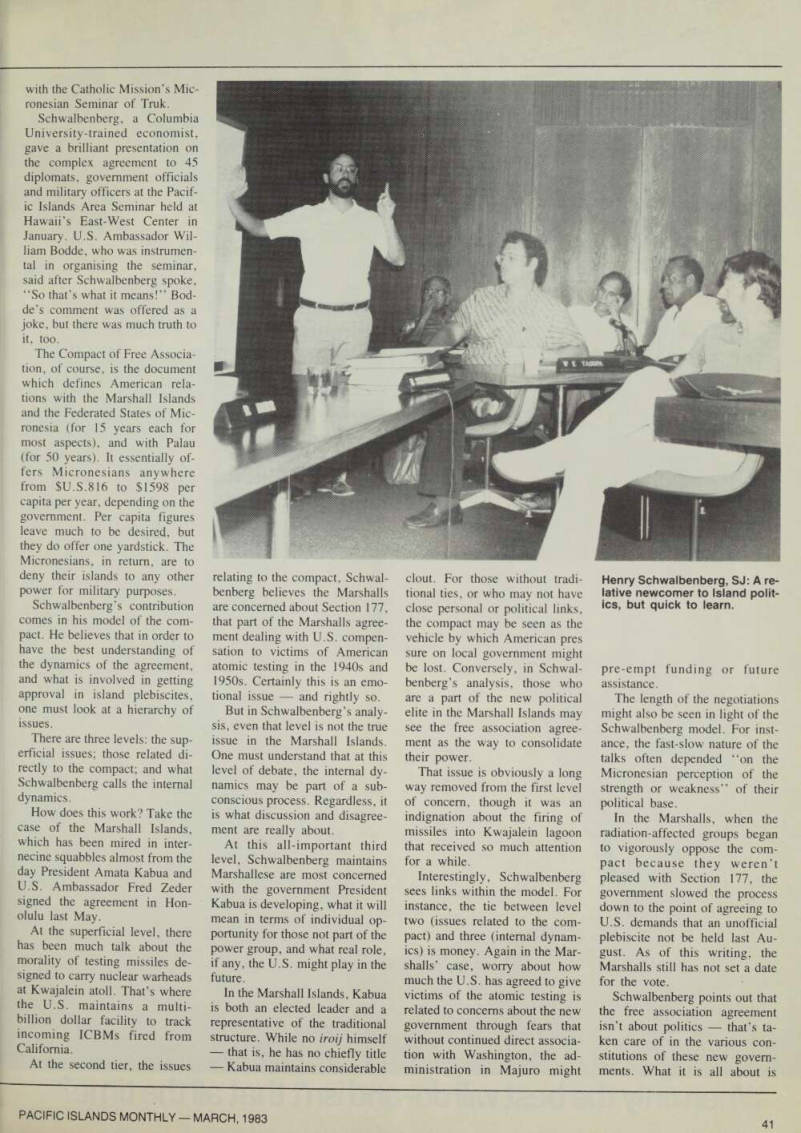
Schwalbenberg, a Columbia University-trained economist, gave a brilliant presentation on the complex agreement to 45 diplomats, government officials and military officers at the Pacif ic Islands Area Seminar held at Hawaii’s East-West Center in January. U.S. Ambassador Wil liam Bodde, who was instrumen tal in organising the seminar, said after Schwalbenberg spoke, “So that’s what it means!” Bod de’s comment was offered as a joke, but there was much truth to it, too.
The Compact of Free Associa tion, of course, is the document which defines American rela tions with the Marshall Islands and the Federated States of Mic ronesia (for 15 years each for most aspects), and with Palau (for 50 years). It essentially of fers Micronesians anywhere from $U.5.816 to $1598 per capita per year, depending on the government. Per capita figures leave much to be desired, but they do offer one yardstick. The Micronesians, in return, are to deny their islands to any other power for military purposes.
Schwalbenberg’s contribution
comes in his model of the com pact. He believes that in order to have the best understanding of the dynamics of the agreement, and what is involved in getting approval in island plebiscites, one must look at a hierarchy of issues.
There are three levels: the sup erficial issues; those related di rectly to the compact; and what Schwalbenberg calls the internal dynamics.
How does this work? Take the case of the Marshall Islands, which has been mired in inter necine squabbles almost from the day President Amata Kabua and U.S. Ambassador Fred Zeder signed the agreement in Hon olulu last May.
At the superficial level, there has been much talk about the morality of testing missiles de signed to carry nuclear warheads at Kwajalein atoll. That’s where the U.S. maintains a multi billion dollar facility to track incoming ICBMs fired from California.
At the second tier, the issues
relating to the compact, Schwal benberg believes the Marshalls are concerned about Section 177, that part of the Marshalls agree ment dealing with U.S. compen sation to victims of American atomic testing in the 1940 s and 19505. Certainly this is an emo tional issue and rightly so.
But in Schwalbenberg’s analy sis, even that level is not the true issue in the Marshall Islands.
One must understand that at this level of debate, the internal dy namics may be part of a sub conscious process. Regardless, it is what discussion and disagree ment are really about.
At this all-important third level, Schwalbenberg maintains Marshallese are most concerned with the government President Kabua is developing, what it will mean in terms of individual op portunity for those not part of the power group, and what real role, if any, the U.S. might play in the future.
In the Marshall Islands, Kabua is both an elected leader and a representative of the traditional structure. While no iroij himself that is, he has no chiefly title Kabua maintains considerable
clout. For those without tradi tional ties, or who may not have close personal or political links, the compact may be seen as the vehicle by which American pres sure on local government might be lost. Conversely, in Schwal benberg’s analysis, those who are a part of the new political elite in the Marshall Islands may see the free association agree ment as the way to consolidate their power.
That issue is obviously a long way removed from the first level of concern, though it was an indignation about the firing of missiles into Kwajalein lagoon that received so much attention for a while.
Interestingly, Schwalbenberg
sees links within the model. For instance, the tie between level two (issues related to the com pact) and three (internal dynam ics) is money. Again in the Mar shalls’ case, worry about how much the U.S. has agreed to give victims of the atomic testing is related to concerns about the new government through fears that without continued direct associa tion with Washington, the ad ministration in Majuro might
pre-empt funding or future assistance.
The length of the negotiations might also be seen in light of the Schwalbenberg model. For inst ance, the fast-slow nature of the talks often depended “on the Micronesian perception of the strength or weakness” of their political base.
In the Marshalls, when the radiation-affected groups began to vigorously oppose the com pact because they weren’t pleased with Section 177, the government slowed the process down to the point of agreeing to U.S. demands that an unofficial plebiscite not be held last Au gust. As of this writing, the Marshalls still has not set a date for the vote.
Schwalbenberg points out that the free association agreement isn’t about politics that’s ta ken care of in the various con stitutions of these new govern ments. What it is all about is
Henry Schwalbenberg, SJ: A re lative newcomer to Island polit ics, but quick to learn.
military rights and economics, and those translate into money.
In the case of Micronesia, it is lots of money. Depending on how one factors in the effect of inflation, the three entities could receive upwards of $3-$4 billion.
For these small islands, with relatively small populations, that could have a tremendous impact.
What will the effect of all this assistance be, assuming the ag reement is approved in all three areas?
Schwalbenberg, who perhaps represents the best type of person a colonial country can contribute to a developing region, sees the U.S. and Micronesians establish ing “a system of give me this for that”. The danger, he believes, is that in the end “you under mine the legitimacy of the gov ernment” by pouring in so much easy money.
The Schwalbenberg model is by no means perfect. He’d be the first to acknowledge that. Inter estingly, one of the seminar par ticipants, Dr Leonard Mason of the University of Hawaii, asked Schwalbenberg if he’d applied the same criteria to the U.S. (He hadn’t.)
But Schwalbenberg’s analysis
goes a long way towards making
the free association agreeement, and issues related to it, under standable. Indeed, for perhaps the first time, those who use Schwalbenberg’s approach may not agree on a point or two, but they know what they are dis
agreeing about.
It is not surprising that the island governments, and some officials in American cities, have not been happy with Schwalben berg’s work. That disenchant ment, it seems, comes from hav ing their work made so evident.
It may also be related to the fact that in Schwalbenberg’s re lated work the careful descrip tion of the compact section-by section the point has been emphasised that money is the key to this proposed relationship. Is landers have given up certain rights in exchange for American
guarantees of high funding
levels.
Thus, Schwalbenberg says: “I think there’s a perception that you can’t ‘buy off’ a Microne sian. I would say you are correct.
But the issue is, are you right?”
And that, as Schwalbenberg knows well, is something that cannot be modelled. It is known only in each individual’s heart.
Floyd K. Takeuchi.
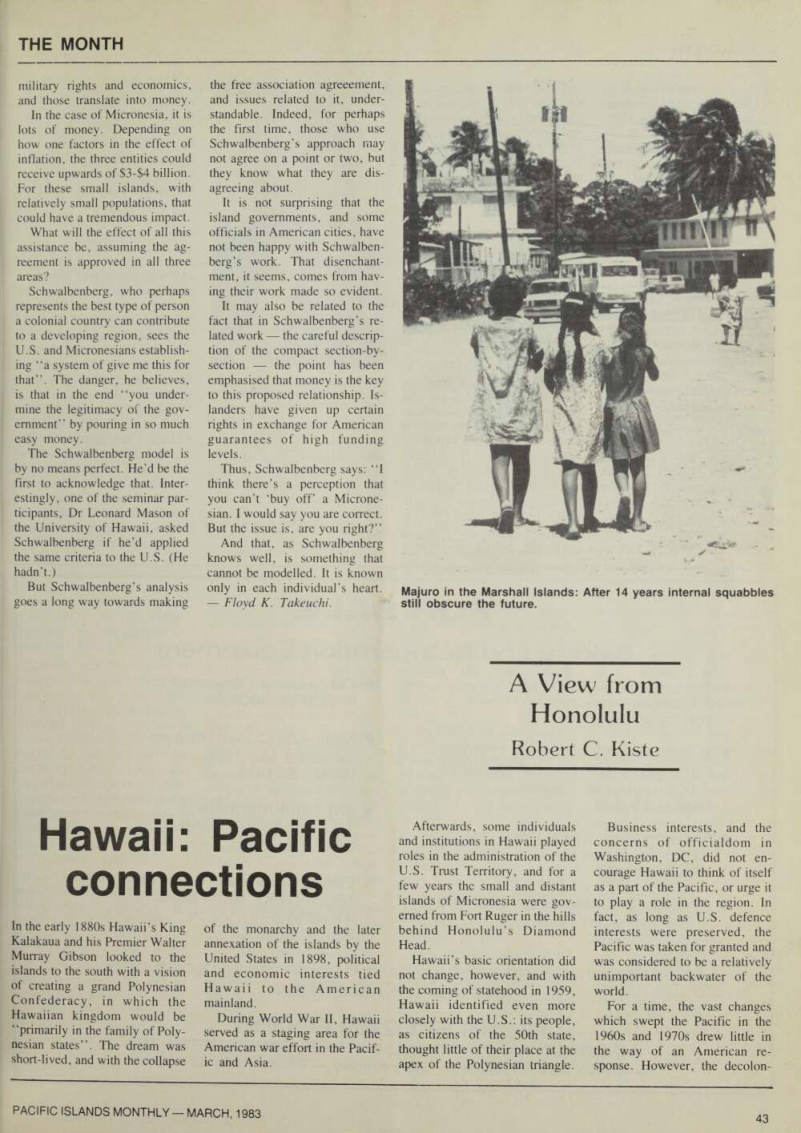
Majuro in the Marshall Islands: After 14 years internal squabbles still obscure the future.