Pacific

Islnads
Monthly
March, 1983
American Samoa USSI.7S Australia *A$l.5O Cook Islands NZ$l.5O Fiji F 51.50 Hawaii USSI.9S Kiribati A 51.75 Nauru A 51.75 New Caledonia CFPI9O New Zealand NZS2.OO
Niue Nzsi.So
Norfolk Island A 51.50 Papua New Guinea K 1.50 Solomon Islands 551.50 Tahiti CFPI9O Tonga P 1.50 Tuvalu A 51.75
Usa U 552.25
USTT and Guam USSI.9S Vanuatu VT1.50 Western Samoa T 1.95 •Recommended retail price only.
Registered by Australia Post.
Publication No. NBPI2IO
Si x' IN :SflM|Ofl'mD
Mm|Mp
%<, 1 ' ' ’ ’ *-♦ n V %& % 4 & BON «K|ii
Advertisements & other items, p. 2 (1 item)
to Video
The VT-11E is video at its easiest. Easy operation; Play, Record, Fast Forward, Rewind and Visual Searcl during playback via a four-corner access switch.
From Hitachi, the gateway to greater video
entertainment.
VT-11E
Features
• TProgram/10-Day Preset Recording
**.9 240-min. Recording/Playback with E-240 Tape
• Visual Search
• Freeze Action
Wh •'Wired Remote Control *>*
» ©~ cm®?™ • h,t *ch! ...»
ion «sa, ~«» \yp
HITACHI
AUSTRALIA: Hitachi Sales Australia Pty., Ltd., 153 Keys Road, Moorabbin, Victoria 3189 Phone: (555) 8722 NEW ZEALAND: AWA New Zealand Limited, Wi-neera Drive, P.O. Box 50-248, Porirua Phone: PRO 75-069 PAPUA NEW GUINEA: S O. Svensson (N.G.) Ltd., P.O.
Box 705, Port Moresby; Phone; 21-2111 FIJI ISLANDS: AWA New Zealand Limited, 47 Foster Road (P.O. Box 858) Suva Fiji. Phone: 31207 K NEW CALEDONIA: Caldis, B.P. Ml, Noumea Phone: 26.23.50 TAHITI: Ets Chene Alain, P.O. Box 272, Papeete Phone: 2.88.68 SOLOMON ISLANDS: Technique Radios Centre L P.O. Box 465, Honiara;Phone: 416
Pacific Islands Monthly
Vol. 54 No. 3
March 1983
(Usps 952480)
Representatives
AUSTRALIA: Distribution; The Herald and Weekly Times Ltd., 44-74 Flinders St., Melbourne, Vic., 3000. Advertis ing Reps Brisbane D, Wood, Anday Agency, Box 1918, GPO Brisbane, 4001, telephone 44-3485, 44-1546; Adelaide Hastwell Williamson Rouse Pty. Ltd., PO Box 419, Norwood, SA, 5067; 59 Kensington Road, Norwood; telephone (08) 332-3322, telex 87113.
FIJI: Distribution and subscriptions Desai Book shops, P.O. Box 160, Suva, Fiji, telephone Suva 23036.
Advertising Fiji Times & Herald Ltd., 20 Gordon St., Suva, telephone 31-2111, telex FJ2124.
FRENCH POLYNESIA: Distribution Hachette Pacifi que, 10 Ave Bruat, Papeete, telephone 25610.
HAWAII, UNITED STATES: Distribution PIM, Hawaii, PO Box 22250, Honolulu, Hawaii, 96822 Advertising Brian C. Asgill, Apt. 1308,1676 Ala Moana Blvd., Honolulu, Hawaii, 96815, telephone (808) 955-9718.
JAPAN; Advertising and subscriptions Universal Media Corporation, GPO Box 1762, Tokyo, telephone 666- 3036, cables UNIMEDIA Tokio, telex 2524665.
MALAYSIA: Advertising snd subscriptions Worldwide Media Services, 57-B Komplex Damai, Jin Dato Haji Eusoff, Kuala Lumpur, telephone 63-9340, cables WORLDMEDIA Kuala Lumpur, telex 31533.
NEW CALEDONIA: Distribution Depot Centre de Presse Michel Pentecost, CBP2, Noumea, telephone 27- 2434, 27-4729.
NEW ZEALAND: Distribution Gordon & Gotch, PO Box 584, 2 Carr Road, Mt. Roskill, Auckland 4 Advertising International Media Representatives Ltd., PO Box 2313 Auckland, telephone 79-5487; 49-3389, cables Intereps,’
Auckland. Subscriptions Ross Haines & Son Ltd., PO Box 1289, Auckland, telephone 76-9042.
PAPUA NEW GUINEA: Distribution Gordon & Gotch, PO Box 3395, Port Moresby, telephone 25-4551, 25-4855 Advertising PNG Post-Courier, PO Box 85, Port Mores by, telephone 21-2577, telex 22120.
PHILIPPINES: Advertising The GF Group, 12 San Ignacio St., Uroaneta Village, Makati, Metro Manila,telephone 817-7299, telex 45950 and 4233.
UNITED KINGDOM; The Herald & Weekly Times Ltd., No 1 Maltravers Street, London WC2R 3DZ, England, tele phone 01 836 5162, telex London 21989.
UNITED STATES MAINLAND: Advertising Joshua B.
Powers Jr., Powers International Inc., 551 Fifth Ave. New York, New York 10 017, telephone 867-9580, telex 236514 Subscriptions PIM, Hawaii, PO Box 22250, Honolulu Hawaii, 96822.
Payments by personal cheque are only acceptable in Australian (from a branch in Australia), U.S. and New Zealand currency. For all other remittances please send an international bank draft in Australian dollars.
Published monthly by Pacific Publications (Aust) Pty Ltd and printed in Australia by Walter Alteri Printing (Australia) Pty. Ltd., Dmgley, Vic.
Australian cover price is recommended retail only. Regis tered by Australia Post, publication No. NBPI2IO. Second class postage paid at Honolulu, Hawaii. Copyright Pacific Publications (Aust.) Pty. Ltd.
Postmaster Honolulu: Send address changes to PIM Hawaii, PO Box 22250 Honolulu, Hawaii, 96822.
Subscriptions
American Samoa Local Aust. $US21 $18 Australia $A18 $18 Canada $US27 $25 Cook Islands $19 Fiji $18 French Polynesia $22 Guam $US23 $20 Hawaii $US23 $20 Japan $20 Kiribati $19 Micronesia Nauru New Caledonia $US23 $20 $21 $22 New Zealand Niue Norfolk Island
Snz24
$18 $19 $15 Northern Marianas $US23 $20 Papua New Guinea $23 Solomon Islands $19 Tonga $19 Tuvalu United Kingdom Stg 15 $19 $25 U.S. Mainland Vanuatu $US27 $25 $19 $18 $A25 Western Samoa Elsewhere
Inside
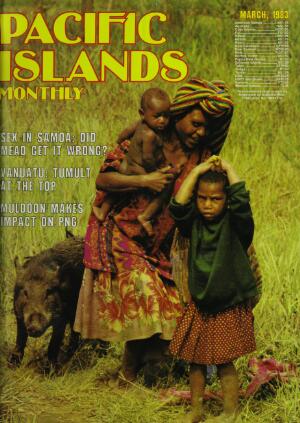
• THE COMING OF AGE CONTROVERSY Joseph Theroux in Pago Pago fires a salvo in what promises to be a long battle between supporters and detractors of Margaret Mead’s 1928 work Coming of Age in Samoa. The row has broken out even before publication of Professor Derek Freeman’s book, Margaret Mead and Samoa: The Making and Unmaking of an Anthropoligical Myth 10 • NEW ZEALAND AND PAPUA NEW GUINEA Controversy at first but a good working relationship overall mark the tour of Papua New Guinea by New Zealand Prime Minister Muldoon 23 • TOURISM IN VANUATU Dr Norman Douglas takes a close look at Vanuatu’s booming tourist industry, placing it in the context of the country’s overall economic development strategy 61 • PAPUA IN THE 1930 s A further instalment of the memoirs of the late Venerable Charles William Whonsbon-Aston, Anglican Archdeacon Emeritus of Polynesia, introduces a number of memorable characters of the Papua of the 19305, including the formidable missionary lady, Nellie Hullett 58 • VANUATU In her first “The Month” column, Christine Coombe describes the political turmoil at the top in Vanuatu as it approaches the third anniversary of its independence 35 • THE MONTH A new PIM feature begins with on-the-spot columnists reviewing the events in French Polynesia, Micronesia, Hawaii, New Caledonia and Vanuatu 31 Cover picture: It’s “To market, to market” for this family in the Eastern Highlands of Papua New Guinea noger Marchant picture.
American Samoa -jq Books 53 Deaths 70
?ji . ... I*7, 54
French Polynesia 31 . 29,’ 43, 55 Islands Press 47 Letters 7 Maori art ' 22 Marshall Islands 29 Micronesia ‘.'.‘.‘.'.'.’.'.'V/tt, 40 New Caledonia 37 Notes from the North "40 Noumea Notebook 37 Pacific Exploration 18
Pacific Report 5 Papua New Guinea 21, 23, 53, 56, 57 People 49 Political Currents 23 Postmark Papeete 31 Report from Vanuatu 35 Shipping timetables 70 The Month 31 Tradewinds . g 1 Tropicalities 17 X? nuat u 21, 35, 61 View from Honolulu 43 Western Samoa 27 Yachts 67 Yesterday ’ 57
Advertisements & other items, pp. 3-4 (2 items)
Pacific Islands Monthly March, 1983
3
Founded 1930 by R. W. Robson Editor Angus Smales Associate Editor Malcolm Salmon Advertising Manager Stephen Brandon Editorial Adviser John Carter A Pacific Publications production 76 Clarence Street, Sydney, 2000, GPO Box 3408, Sydney, 2001.
Cables: PAOPUB Sydney.
Telex; 21242 (answers INTARAD).
Telephone; Sydney 20-231.
Melbourne 63-0211.
Manager: John Berry (03) 63-0211 Ext. 1860.
Cool it
with reliable Australian refrigeration
and air-eonditioning
Australian refrigeration and air-conditioning equipment has long been tested and proven in climatic conditions similar to those of the Pacific region.
A wide range is available for commercial and domestic use. It includes freezers, display and storage refrigerators, coolrooms, ice-makers and both room and large area airconditioners. Solar air-conditioning equipment has also been developed to a practical economic level.
And of course being Austraban-made you get quick delivery, quick service.
Check to see how Australia can satisfy your cooling requirements. a H'lrn -I For more information
Ask the Australian TVade Commissioner
Port Moresby: Phone 25 9333. Suva: Phone 312844. Honolulu: Phone (8081524a050. Noumea: Phone 2. 2414, 2 i 2426.
Pacific Report
Palau Tangle After Plebiscite
President Reagan’s personal representative to the Micronesian political status negotiations Fred M. Zeder was reported on his way to Palau in mid-February for talks with Palauan officials in an effort to sort out the tangle resulting from the plebiscite on future status held earlier in the month (PIM Feb. p. 5). With most ballots counted, it was clear that 60 per cent of voters were in favor of autonomy (under the so-called Compact of Free Association with the United States). But it was equally clear that the vote in favor of overturning the part of the Palauan constitution banning the presence of nuclear weapons in the territory was under 50 per cent, well short of the 75 per cent figure required by the constitution. Palauan officials had said earlier that unless this percentage was reached, the compact itself could not go into force. Replying to a third and final question, as to what the 15,000 Palauans should do if the compact failed to win approval, 60 per cent of voters opted for independence.
Kiribati Goes To The Polls
The voters of Kiribati went to the polls on January 12 and 19 to elect a new parliament following the fall of the previous government of President leremia Tabai (PIM Feb. p. 13). Ten members of the previous parliament lost their seats, including two Cabinet ministers: Ataraoti Bwebwenibure (Marakei), former minister for health and family planning, and leremia Tata (Butaritari), former minister for the Line and Phoenix group.
Former President leremia Tabai was returned in his Nonouti constituency with 75.4 per cent of the vote in the first round.
Next step is to bring all the elected members to Tarawa where, from among their number, they will elect not fewer than three and not more than four candidates for the presidency. Then, sometime in late February, the nation will hold a referendum to choose the next president. If Mr Tabai is again elected, it will be for a third term. Unless the constitution is changed, he will never be permitted to be president again on the expiry of that term.
Billy Schutz in Tarawa.
Kiribati, Nauru Oppose N-Dumping
Opponents and advocates of nuclear dumping at sea clashed at a February international meeting on the London Dumping Convention, which regulates disposal of waste in the oceans.
The small Pacific Island States of Nauru and Kiribati, opposing Japanese plans to dump nuclear waste in the Western Pacific, called for a world ban on radioactive dumping. But the bigger States, including the United States, the Soviet Union and Japan, spoke against the proposal and suggested instead a scientific review to assess the harm done by nuclear dumping. Spain proposed a suspension of dumping and the Nordic countries suggested a gradual phasing out of dumping by 1990. The talks were adjourned despite strong objections by Spain. Last year, the only countries dumping nuclear waste at sea were Britain, Switzerland, Belgium and The Netherlands. Their use of a dumping ground off north-west Spain has led to numerous protests in that country.
Diplomatic Ties For Indonesia, Solomons
Indonesia and Solomon Islands have agreed to establish diplomatic relations. The move followed a January visit to Indonesia by Solomons Minister for Foreign Affairs Dennis Lulei, during which he visited East Timor. With his Indonesian counterpart, Dr Mochtar Kusumaatmadja, Mr Lulei also discuss ed technical co-operation, trade and industrial relations between the two countries. The official Indonesian Newsletter, reporting the visit, left no doubt as to who, it thought, was the major beneficiary of the deal. Its headline said “Solomon Islands Gains Diplomatic Recognition’’. The newsletter noted approv ingly that Solomon Islands “had abstained during the voting on the East Timor question in the United Nations General Assem bly in 1981, but had voted in favor of Indonesia in 1982’’
Refugees Quit Irian Java For Png
More than 1000 refugees are reported to have fled the Indone sian province of Irian Jaya into Papua New Guinea in January- February. The flow of refugees follows reportedly increased Indonesian military action against the Irian Jaya rebel move
ment. Other reasons offered for the refugee flow are Indonesia’s plans to resettle Javanese in the border area, and drought, which is affecting both Irian Jaya and PNG. PNG’s Acting Minister for Foreign Affairs Tony Siaguru told parliament in February that up to 1500 Irian Jayan refugees are now in border areas of West Sepik province. But he said the government’s policy was that whatever happened in Irian Jaya was In donesia’s responsibility. It is reported that the refugees are crossing the border in small groups, and that many are in poor health and need medicines, food and shelter. PNG may seek help from the United Nations High Commissioner for Refugees.
Across the border in Irian Jaya Governor Izaac Hindom has denounced rebel leaders such as Seth Rumkorem as “idiots”, and appealed to the population “to rise with the Indonesian armed forces and wipe them out once and for all”. He said the easternmost province of Irian Jaya was an inseparable part of the Indonesian Unitary State. As such, like the other provinces of the country, Irian Jaya was open to every Indonesian citizen, especially to transmigrants.
Fiji’S New G-G Sworn In
Fiji’s new Governor-General Ratu Sir Penaia Ganilau was officially sworn in in February. Ratu Sir Penaia, the former deputy prime minister, takes over from Fiji’s first local governor general, Ratu Sir George Cakobau. Ratu Sir Penaia was sworn in as governor-general by Fiji’s chief justice, Sir Timoci Tuivaga.
Prime Minister Ratu Sir Kamisese Mara said Fiji’s decision to have its second local governor-general was proof of the country’s maturity. Ratu Mara later announced he would not appoint a new deputy prime minister. A government statement said the prime minister had assumed responsibility for the Fijian affairs section of the portfolio held by his former deputy. The other section, covering rural development, had been given to the minister of state without portfolio, Apisai Tora. The statement added that while Ratu Mara travelled overseas in future, ministers would act in his place by rotation.
Muldoon Arouses Png Minister’S Ire
Papua New Guinea’s Justice Minister, Tony Bais, has strongly criticised the New Zealand Prime Minister Robert Muldoon over comments he made in Port Moresby during his recent visit about New Caledonian independence. At a meeting with several senior PNG ministers, Mr Muldoon said he didn’t think anything positive could be gained by putting pressure on France to decolonise. Mr Muldoon said he believed New Caledonia and the other French Pacific territories would be independent within two decades and he felt it was better to let things take their course. But Mr Bais claimed Mr Muldoon was trying to dictate to PNG what its foreign policy should be. He said Mr Muldoon supported racism in South Africa by allowing the Springbok rugby union team into New Zealand in 1981. He claimed that because of this, Mr Muldoon should be the last one to tell PNG to go slow on the decolonisation issue.
Matthew Hunter: France Reaffirms Claim
France has reaffirmed its ownership of two uninhabited islands which are also claimed by Vanuatu (PIM Feb. p. 5). French Ambassador to Fiji Robert Puissant said in February that his country regarded as “incontestable” its sovereignty over Matth ew and Hunter islands. The two small islands lie east of New Caledonia and south-east of Vanuatu. Mr Puissant said that Vanuatu’s former rulers, Britain and France, had told the government in Port-Vila at independence in 1980 that the islands had always been regarded as part of New Caledonia. He said Vanuatu had not replied to notes about the matter. Vanuatu raised claims to the islands last December after Fiji and France announced an agreement on the demarcation of 200-mile economic zones putting Matthew and Hunter islands inside the New Caledonian limit. Fiji later said the agreement did not mean it accepted the French claim to the islands, but Vanuatu Prime Minister Father Walter Uni complained strongly, and said his government would raise the issue in Paris and Suva.
Cooks Minister Visits Nz, Oz
The Cook Islands Minister for Economic Development Vincent Ingram arrived in Auckland in February for a two-week visit to
New Zealand and Australia to discuss bilateral aid. Mr Ingram said he expected aid to be held at current levels, in spite of the serious drought that has hit the country’s agriculture. He said his country, which faces a general election March 30, has made considerable economic progress during the past four years.
New Zealand provided almost $lO million in aid last year, while Australia provided $2 million in a three-year period ending in June.
Png’S Namaliu Injured In Plane Crash
Papua New Guinea’s Minister for Foreign Affairs and Trade Rabbie Namaliu was injured in a military aircraft crash in February. The PNG Defence Force Nomad crashed on take-off from Daru airstrip in Western Province. Of the six people aboard, three suffered broken arms, including Mr Namaliu, and one pilot suffered a fractured pelvis. The foreign minister was about to start his first tour of government posts along the border with Irian Jaya. Australia moved rapidly to dispel fears over the safety of its Nomad aircraft, following criticism from PNG. PNG Defence Minister Epel Tito has said he personally does not want any more of the aircraft because of their “appalling” safety record in PNG. Australia has given PNG five Nomads under a defence co-operation program. One crashed late in 1981, killing two pilots. Mr Tito said another privately-owned Nomad had also crashed. But senior officials from Australia’s defence depart ment say the Nomads’ safety record throughout the world has been particularly good. They say a Nomad which crashed in 1981 was flown into a blind valley in bad weather, and there has never been any suggestion that the plane was at fault. The officials added that the most recent crash was still being investigated by authorities in PNG.
Scientists Against Dam, For Herbarium
A major international scientific body has called on the Australian Federal Government to impose a three-year moratorium on building a hydro-electric dam on the Gordon River in southwest Tasmania. The 15th Pacific Science Association Congress held in Dunedin, New Zealand, in February, called on the Federal and Tasmanian governments to accept the moratorium, recom mended by an Australian Senate committee late last year. The meeting’s resolution was sent to Australian Prime Minister Fraser, and other political leaders. One delegate said inclusion of the dam site on the World Heritage List had put the region on a par with other ancient wonders of the world. The Congress also appealed to the Papua New Guinea Government to do everything possible to maintain the National Herbarium and Botanical Garden at Lae. Association members said the her barium and garden had taken hundreds of thousands of hours’ work to create, and was the only one of its kind in PNG or the world. They said the collection of plants would be lost if they were not constantly looked after. The association said it is the world’s best collection of living PNG plants. ‘‘BACK TO THE FARM” SAYS U.N. MAN The United Nations’ resident representative in the South Pacific, Mr Halcombe, says it is essential that both the public and private sectors in the region vigorously support investment in industries based on agriculture. Speaking in Suva, in February, Mr Halcombe said studies had shown that the region’s rural areas offered the greatest prospect for absorbing the unemployed. He added that the drift of people to urban areas was looming as one of the main trends likely to frustrate orderly social and economic development in the South Pacific. Mr Halcombe was speaking at the launching of a U.N.-sponsored community development program. The two-year project will cost about $lOO,OOO.
Png Cuts Out Horserace Broadcasts
Papua New Guinea’s national radio network has suspended its horse-racing coverage following criticism of its cost and the effects of gambling on the people. The network has been broadcasting Australian races since last May. But new chairman of the NBC Austin Sapias, in one of his first decisions in the job, has suspended the relays indefinitely. The race broadcasts were introduced by former chairman Leo Morgan. The new chairman says the race call service has been dropped pending a review of its cost and consideration of recent public criticism that the service encourages gambling and contributes to social breakdown in PNG.
Port-Vila: Would-Be Escaper Sentenced
An Australian, Ken Cassel, 52, who escaped from Port-Vila prison last September with secessionist leader Jimmy Stevens (PIM Oct. ’B2 p 7), has been sentenced to another three years.
Cassel was already serving a three-and-a-half year sentence for stealing the trading vessel Glenelg from Port-Vila harbor in December 1981 (PIM Feb ’B2 p 6). In the breakout last Septem ber, Stevens, Cassel and four others, stole a tourist launch and forced the night watchman overboard. They were recaptured within 12 hours. Stevens has already been tried and sentenced to another two-and-a-half years for his part in the escape bid.
“Free Thursdays” Plea By Jailed Minister
A Solomon Islands government minister has begun serving three months in jail for having caused bodily harm to another man. The minister, John Ngina, is responsible for com munications,transport and government utilities. He went to prison after losing an appeal against his sentence but im mediately asked to be let out each Thursday to attend cabinet meetings. The opposition says this would be a mockery of justice. At last report the government was still considering the matter. The story began when police told Mr Ngina that they wouldn’t be taking any further action on a complaint he’d made against a man for malicious damage. The minister said he would enforce the law himself, chased the man through Honiara market, knocked him down and kicked him.
Fishing Vessel Seized In Solomons
Solomon Islands authorities in February detained a foreign fishing vessel suspected of fishing illegally near Anuta island in the country’s eastern province of Temotu. The vessel was believed to be Taiwanese-owned and operating out of Espiritu Santo in Vanuatu. Vanuatu licenses a fleet of Taiwanese fishing boats but they have no rights to fish in Solomon Island waters.
The trawler was escorted by the Solomon Islands vessel Vutai, to the provincial headquarters at Lata.
Png Parliament Opens With A Blast
Papua New Guinea’s parliament met for its 1983 inaugural session on February 14 but adjourned soon afterwards because none of the planned legislation was ready to be presented. The leader of government business, Minister for Broadcasting and Information Boyamo Sali, said he was furious and would reprimand the heads of the government departments involved. Mr Sali said cabinet had approved the final version of a number of important bills but the departments responsible had not been able to prepare the bills in time for the parliamentary session
Loneuness Of A Long-Distance Yellowfin
A yellowfin tuna released near Fiji in 1980 has been caught by an American vessel in the eastern Pacific 3806 nautical miles away. The catch sets a new distance record for tuna migration.
The American ship has returned a tag attached to the fish under the South Pacific Commission’s tuna and billfish assessment program, which is aimed at helping Island nations by increasing knowledge of migratory habits of the two species.
Solomons Squad For Rugby Union Event
A team from Solomon Islands is to take part in the international seven-a-side rugby union competition in Hong Kong for the first time this year. The Cathay Pacific tournament, held each March in Hong Kong, has become one of the most important events in the international rugby union calendar. Twenty countries are expected to take part this year. A spokesman for rugby union in Solomon Islands, the third South Pacific country to enter the tournament, said the squad for Hong Kong had already been chosen, and was training hard. Papua New Guinea and Fiji have been playing in the competition for a number of years. Fiji has won it three times.
Cheat Charges Delay Fiji Exam Results
Allegations of cheating during the New Zealand school certifi cate examinations last year have held up the results of students at two Fiji secondary schools. The examination is controlled by New Zealand’s education department and is taken by a large number of Pacific Islands students. Suva said the New Zealand authorities are still investigating the allegations and will send their report to the two schools involved and the Fiji education ministry. All other schools in Fiji have received their results.
Message of

Letters
Message of some sunken stamps
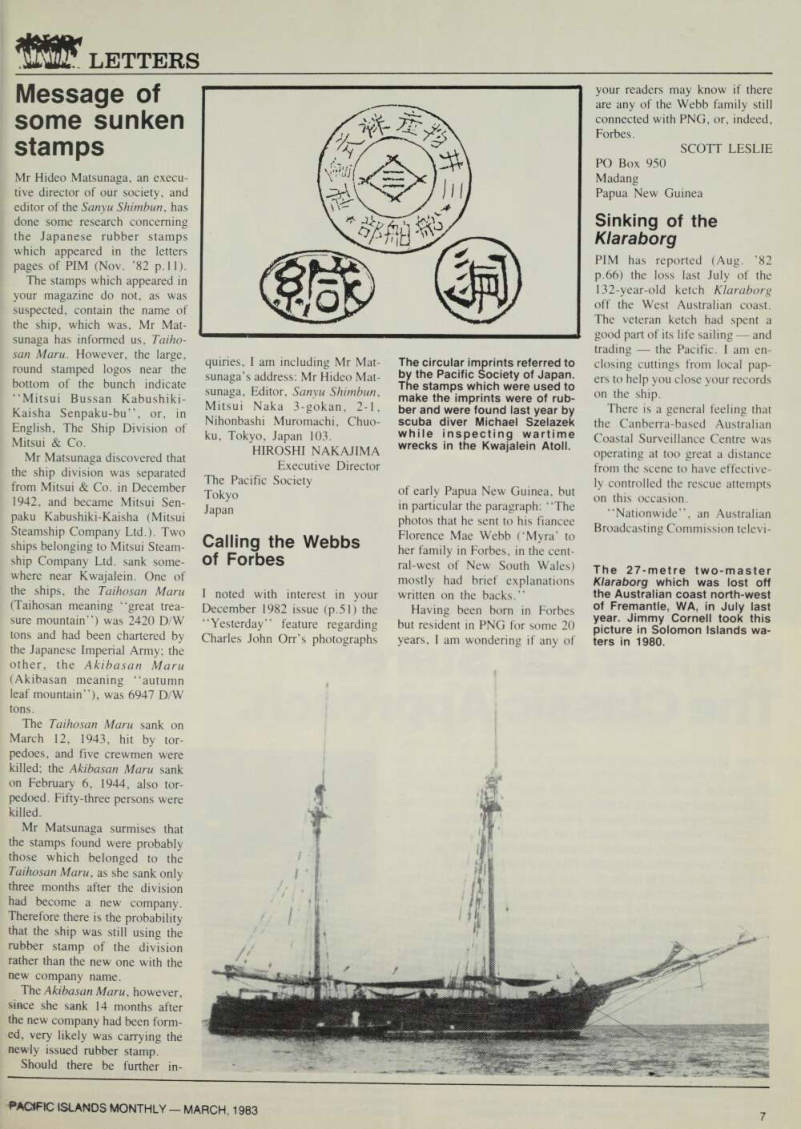
Mr Hideo Matsunaga, an execu tive director of our society, and editor of the Sanyu Shimbun, has done some research concerning the Japanese rubber stamps which appeared in the letters pages of PIM (Nov. ’B2 p.ll).
The stamps which appeared in your magazine do not, as was suspected, contain the name of the ship, which was, Mr Mat sunaga has informed us, Taiho san Maru. However, the large, round stamped logos near the bottom of the bunch indicate “Mitsui Bussan Kabushiki- Kaisha Senpaku-bu”, or, in English, The Ship Division of Mitsui & Co.
Mr Matsunaga discovered that the ship division was separated from Mitsui & Co. in December 1942, and became Mitsui Sen paku Kabushiki-Kaisha (Mitsui Steamship Company Ltd.). Two ships belonging to Mitsui Steam ship Company Ltd. sank some where near Kwajalein. One of the ships, the Taihosan Maru (Taihosan meaning “great trea sure mountain”) was 2420 D/W tons and had been chartered by the Japanese Imperial Army; the other, the Akibasan Maru (Akibasan meaning “autumn leaf mountain”), was 6947 D/W tons.
The Taihosan Maru sank on March 12, 1943, hit by tor pedoes, and five crewmen were killed; the Akibasan Maru sank on February 6, 1944, also tor pedoed. Fifty-three persons were killed.
Mr Matsunaga surmises that the stamps found were probably those which belonged to the Taihosan Maru, as she sank only three months after the division had become a new company.
Therefore there is the probability that the ship was still using the rubber stamp of the division rather than the new one with the new company name.
The Akibasan Maru, however, since she sank 14 months after the new company had been form ed, very likely was carrying the newly issued rubber stamp.
Should there be further in-
quiries, I am including Mr Mat sunaga’s address: Mr Hideo Mat sunaga, Editor, Sanyu Shimbun, Mitsui Naka 3-gokan, 2-1, Nihonbashi Muromachi, Chuo ku, Tokyo, Japan 103.
Hiroshi Nakajima
Executive Director The Pacific Society Tokyo Japan Calling the Webbs of Forbes I noted with interest in your December 1982 issue (p. 51) the “Yesterday” feature regarding Charles John Orr’s photographs
of early Papua New Guinea, but in particular the paragraph; ‘The photos that he sent to his fiancee Florence Mae Webb (‘Myra’ to her family in Forbes, in the cent ral-west of New South Wales) mostly had brief explanations written on the backs.”
Having been bom in Forbes but resident in PNG for some 20 years, I am wondering if any of
your readers may know if there are any of the Webb family still connected with PNG, or, indeed, Forbes.
Scott Leslie
PO Box 950 Madang Papua New Guinea
Sinking of the
Klaraborg
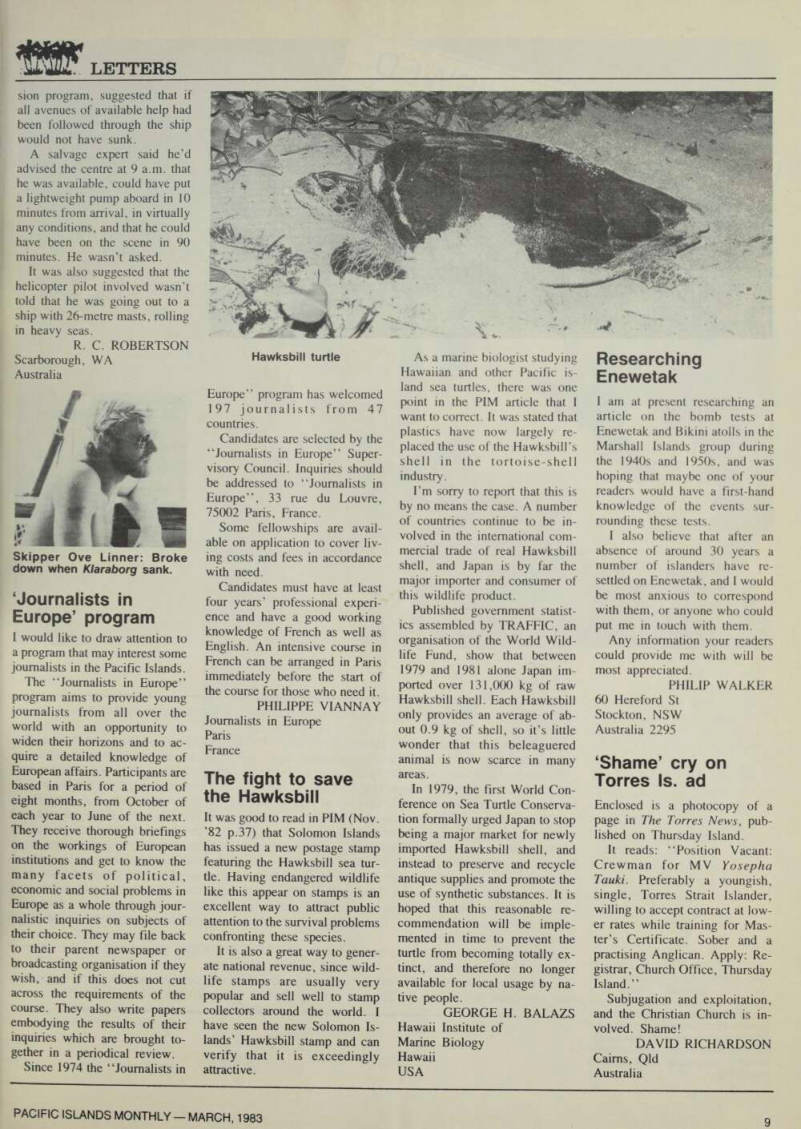
PIM has reported (Aug. ’B2 p. 66) the loss last July of the 132-year-old ketch Klaraborg off the West Australian coast.
The veteran ketch had spent a good part of its life sailing and trading the Pacific. I am en closing cuttings from local pap ers to help you close your records on the ship.
There is a general feeling that the Canberra-based Australian Coastal Surveillance Centre was operating at too great a distance from the scene to have effective ly controlled the rescue attempts on this occasion.
“Nationwide”, an Australian Broadcasting Commission televi-
The 27-metre two-master Klaraborg which was lost off the Australian coast north-west of Fremantle, WA, in July last year. Jimmy Cornell took this picture in Solomon Islands wa ters in 1980.
The circular imprints referred to by the Pacific Society of Japan.
The stamps which were used to make the imprints were of rub ber and were found last year by scuba diver Michael Szelazek while inspecting wartime wrecks in the Kwajalein Atoll.
sion program, suggested that if all avenues of available help had been followed through the ship would not have sunk.
A salvage expert said he’d advised the centre at 9 a.m. that he was available, could have put a lightweight pump aboard in 10 minutes from arrival, in virtually any conditions, and that he could have been on the scene in 90 minutes. He wasn’t asked.
It was also suggested that the
helicopter pilot involved wasn’t
told that he was going out to a ship with 26-metre masts, rolling in heavy seas.
R. C. Robertson
Scarborough, WA Australia
‘Journalists in
Europe’ program
I would like to draw attention to a program that may interest some journalists in the Pacific Islands.
The “Journalists in Europe” program aims to provide young journalists from all over the world with an opportunity to widen their horizons and to ac quire a detailed knowledge of European affairs. Participants are based in Paris for a period of eight months, from October of each year to June of the next.
They receive thorough briefings on the workings of European institutions and get to know the many facets of political, economic and social problems in Europe as a whole through jour nalistic inquiries on subjects of their choice. They may file back to their parent newspaper or broadcasting organisation if they wish, and if this does not cut across the requirements of the course. They also write papers embodying the results of their inquiries which are brought to gether in a periodical review.
Since 1974 the “Journalists in
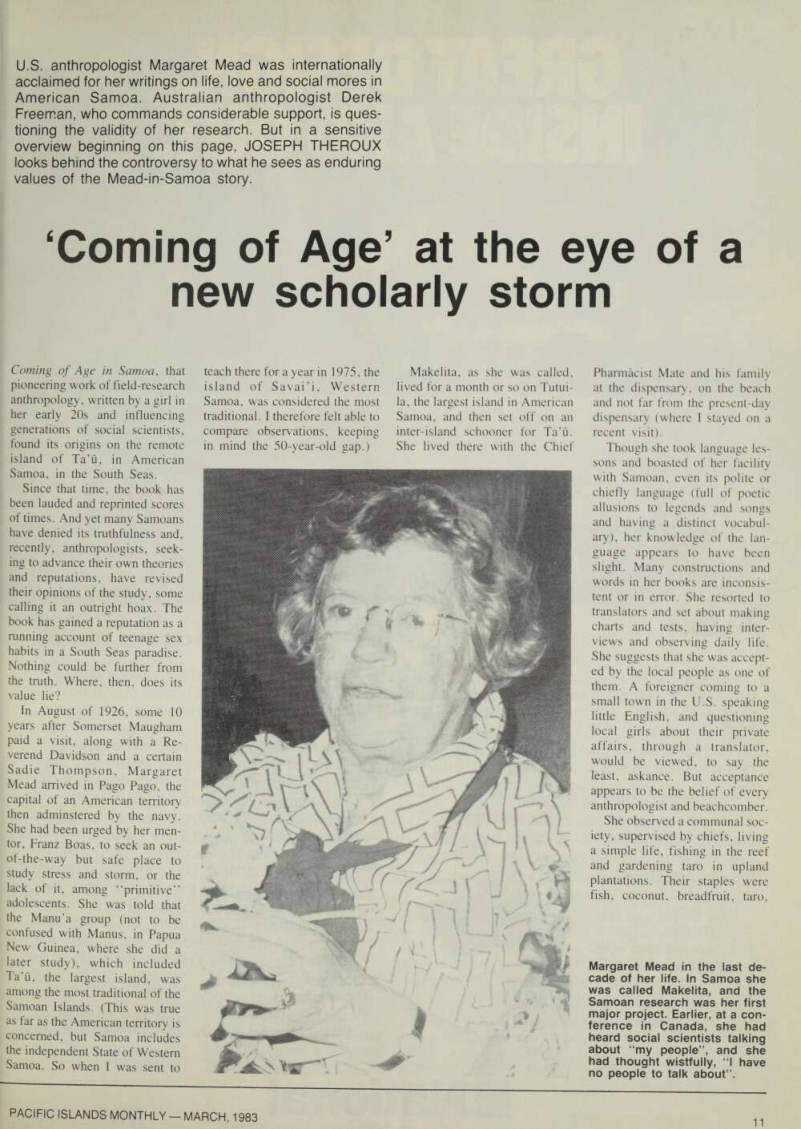
Hawksbill turtle Europe” program has welcomed 197 journalists from 47 countries.
Candidates are selected by the "Journalists in Europe” Super
visory Council. Inquiries should
be addressed to “Journalists in Europe”, 33 rue du Louvre, 75002 Paris, France.
Some fellowships are avail able on application to cover liv ing costs and fees in accordance with need.
Candidates must have at least four years’ professional experi ence and have a good working knowledge of French as well as English. An intensive course in French can be arranged in Paris immediately before the start of the course for those who need it.
Philippe Viannay
Journalists in Europe Paris France
The fight to save
the Hawksbill
It was good to read in PIM (Nov. ’B2 p. 37) that Solomon Islands has issued a new postage stamp featuring the Hawksbill sea tur tle. Having endangered wildlife like this appear on stamps is an excellent way to attract public attention to the survival problems confronting these species.
It is also a great way to gener ate national revenue, since wild life stamps are usually very popular and sell well to stamp collectors around the world. I have seen the new Solomon Is lands’ Hawksbill stamp and can verify that it is exceedingly attractive.
As a marine biologist studying Hawaiian and other Pacific is land sea turtles, there was one point in the PIM article that I want to correct. It was stated that plastics have now largely re placed the use of the Hawksbilfs shell in the tortoise-shell industry.
I’m sorry to report that this is by no means the case. A number of countries continue to be in volved in the international com mercial trade of real Hawksbill shell, and Japan is by far the major importer and consumer of this wildlife product.
Published government statist ics assembled by TRAFFIC, an organisation of the World Wild life Fund, show that between 1979 and 1981 alone Japan im ported over 131,000 kg of raw Hawksbill shell. Each Hawksbill only provides an average of ab out 0.9 kg of shell, so it’s little wonder that this beleaguered animal is now scarce in many areas.
In 1979, the first World Con ference on Sea Turtle Conserva tion formally urged Japan to stop being a major market for newly imported Hawksbill shell, and instead to preserve and recycle antique supplies and promote the use of synthetic substances. It is hoped that this reasonable re commendation will be imple mented in time to prevent the turtle from becoming totally ex tinct, and therefore no longer available for local usage by na tive people.
George H. Balazs
Hawaii Institute of Marine Biology Hawaii
Usa
Researching
Enewetak
I am at present researching an article on the bomb tests at Enewetak and Bikini atolls in the Marshall Islands group during the 1940 s and 19505, and was hoping that maybe one of your readers would have a first-hand knowledge of the events sur rounding these tests.
I also believe that after an absence of around 30 years a number of islanders have re settled on Enewetak, and I would be most anxious to correspond with them, or anyone who could put me in touch with them.
Any information your readers could provide me with will be
most appreciated.
Philip Walker
60 Hereford St Stockton, NSW Australia 2295
‘Shame’ cry on
Torres Is. ad
Enclosed is a photocopy of a page in The Torres News, pub lished on Thursday Island.
It reads: “Position Vacant; Crewman for MV Yosepha Tauki. Preferably a youngish, single, Torres Strait Islander, willing to accept contract at low er rates while training for Mas ter’s Certificate. Sober and a practising Anglican. Apply: Re gistrar, Church Office, Thursday Island.”
Subjugation and exploitation, and the Christian Church is in volved. Shame!
David Richardson
Caims, Qld Australia
Skipper Ove Linner: Broke down when Klaraborg sank.
Advertisements & other items, pp. 7-10 (2 items)
7
f»ACIfIC ISLANDS MONTHLY —MARCH, 1983
The Classic Approach
Pioneer Car Stereo.
Pioneer. In car stereos, we’re classic.
Our component systems let you be creative. You can combine the separate high-tech decks, tuners, amps, graphic equalizers and speakers to build your own, personalized system.
And get more power and greater pleasure in the bargain.
Or, go for our popular regular car stereos. They’ve got many of the features found on classy home hi-fi systems, such as Auto-Reverse, electronic memory Preset tuning, Music Search and lots more.
Components or regular style, they’re all designed for maximum power and convenience, made with the kind of craftsmanship which distinguishes a true classic.
Pioneer. The classic approach to automotive audio that makes listening a treasure of pleasure on any road, in any car. 2213-1 1 TS-1644 • - isis.gas ft ft -iiaab *.;.9 CD-
KP-909G
Qf) PIONEER*
For further information, please contact: .
Australia: Pioneer Marketing Services Pty. Ltd. (Incorporated in Victoria), P.O. Box 295, Mordialloc, Victoria, 3195 Tel; 580-9911 Fiji Islands; Brijlal & Company,G.P.O. Box No. 362, Suva, Fiji Islands Tel. 22258 New Zealand: Monaco Distributors Ltd., 2 Poland Road, Glenfield, Auckland, New Zealand Tel; (09) 444-9144 Norfolk Island: Burns Philp (Norfolk Island) Ltd., P.O. Box 21, Norfolk Island New Hebrides: Burns Philp (New Hebrides) Ltd., Vila, New Hebrides iru Island: Jacob Enterprises, P.O. Box No. 4, Republic of Nauru iti: Tahiti Hi-Fi, P.O. Box 848, Papeete, Tahiti , . v Caledonia: Menard Pacifique Sari, B.P. 3899, Noumea, New Caledonia 48*24*36 erican Samoa: Transpac Corporation, P.O. Box 1477, Pago Pago, American noa 96799 Tel: 633-5224 . . T . otonga: South Seas International Ltd., P.O. Box 49, Rarotonga, Cook Islands Tel. 232:> lua New Guinea: Bali Merchants Pty. Ltd., P.O. Box 6103, Boroko Tel. 254887
■ po}
OOQ
ill
s# 5p Few works of anthropology arouse public controversy. Fewer still do so before they are even published.
But that has been the fate of Professor DEREK FREEMAN’S Margaret Mead and Samoa: The Making and Unmaking of an Anthropological Myth, which is due for publication in April.
Professor Freeman, professor emeritus of anthropology at the Australian National University, has claimed in public statements that the famous American anthropologist “got it totally wrong” in her first and most famous book, Coming of Age in Samoa. Against her picture of a permissive, gentle, relatively conflict-free Samoan society, he depicts a puritanical, competitive, violent and authoritarian one. The clash between the two viewpoints has overtones of the nature versus nurture” debate among anthropologists whether heredity or environment is the more important factor in shaping human beings. In one of his statements, Professor Freeman accused Miss Mead of “extreme cultural determinism”. A press report noted that many scholars who have lined up behind Professor Freeman are “long-time champions of biological determinism, a doctrine that has gained considerable credence within the academic community during the past decade.”
One of Professor Freeman’s broadsides against Margaret Mead appeared in the Pago Pago newspaper, Samoa News.
Pago resident, American teacher and writer JOSEPH THEROUX, was stirred to take another look at the 55-year-old book at the centre of the controversy.
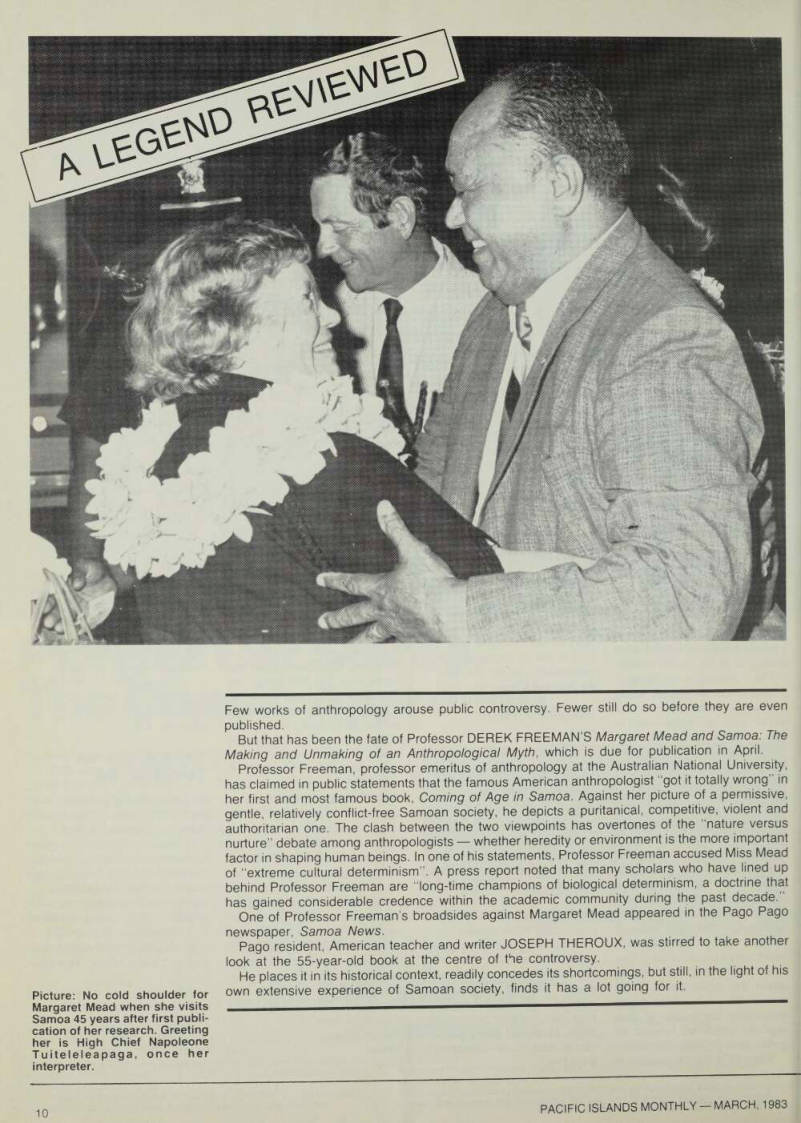
He places it in its historical context, readily concedes its shortcomings, but still, in the light of his Picture: No cold shoulder for own extensive experience of Samoan society, finds it has a lot going for it.
Margaret Mead when she visits ——— —■ ———-— Samoa 45 years after first publication of her research. Greeting her is High Chief Napoleone Tuiteleleapaga, once her interpreter.
‘Coming of Age’ at the eye of a new scholarly storm

new scholarly storm
U.S. anthropologist Margaret Mead was internationally acclaimed for her writings on life, love and social mores in American Samoa. Australian anthropologist Derek Freeman, who commands considerable support, is ques tioning the validity of her research. But in a sensitive overview beginning on this page, JOSEPH THEROUX looks behind the controversy to what he sees as enduring values of the Mead-in-Samoa story.
Coming of Age in Samoa, that pioneering work of field-research anthropology, written by a girl in her early 20s and influencing generations of social scientists, found its origins on the remote island of Ta’u, in American Samoa, in the South Seas.
Since that time, the book has been lauded and reprinted scores of times. And yet many Samoans have denied its truthfulness and, recently, anthropologists, seek ing to advance their own theories and reputations, have revised their opinions of the study, some calling it an outright hoax. The book has gained a reputation as a running account of teenage sex habits in a South Seas paradise.
Nothing could be further from the truth. Where, then, does its value lie?
In August of 1926, some 10 years after Somerset Maugham paid a visit, along with a Re verend Davidson and a certain Sadie Thompson, Margaret Mead arrived in Pago Pago, the capital of an American territory then adminstered by the navy.
She had been urged by her men tor, Franz Boas, to seek an out of-the-way but safe place to study stress and storm, or the lack of it, among “primitive” adolescents. She was told that the Manu’a group (not to be confused with Manus, in Papua New Guinea, where she did a later study), which included Ta’u, the largest island, was among the most traditional of the Samoan Islands. (This was true as far as the American territory is concerned, but Samoa includes the independent State of Western Samoa. So when I was sent to
teach there for a year in 1975, the island of Savai’i, Western Samoa, was considered the most traditional. I therefore felt able to compare observations, keeping in mind the 50-year-old gap.)
Makelita, as she was called, lived for a month or so on Tutui la, the largest island in American Samoa, and then set off on an inter-island schooner for Ta’u.
She lived there with the Chief
Pharmacist Mate and his family at the dispensary, on the beach and not far from the present-day dispensary (where I stayed on a recent visit).
Though she took language les sons and boasted of her facility with Samoan, even its polite or chiefly language (full of poetic allusions to legends and songs and having a distinct vocabul ary), her knowledge of the lan guage appears to have been slight. Many constructions and words in her books are inconsis tent or in error. She resorted to translators and set about making charts and tests, having inter views and observing daily life.
She suggests that she was accept ed by the local people as one of them. A foreigner coming to a small town in the U.S. speaking little English, and questioning local girls about their private affairs, through a translator, would be viewed, to say the least, askance. But acceptance appears to be the belief of every anthropologist and beachcomber.
She observed a communal soc iety, supervised by chiefs, living a simple life, fishing in the reef and gardening taro in upland plantations. Their staples were fish, coconut, breadfruit, taro,
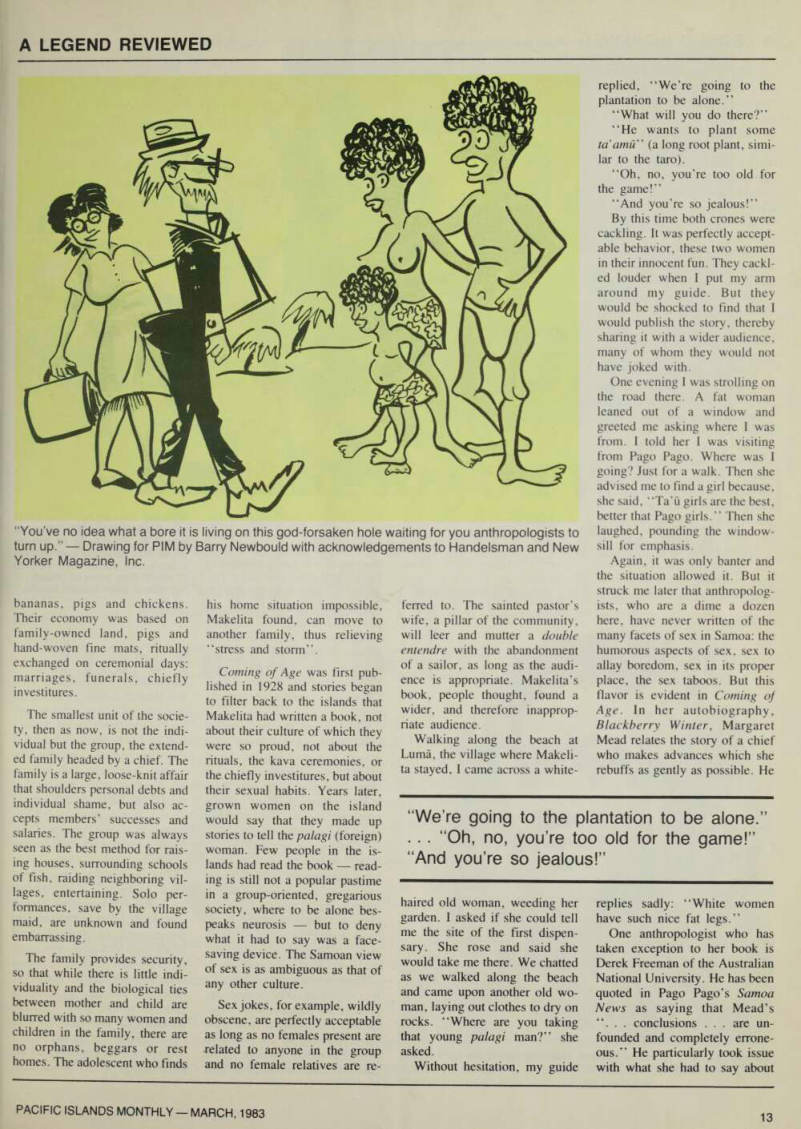
Margaret Mead in the last de cade of her life. In Samoa she was called Makelita, and the Samoan research was her first major project. Earlier, at a con ference in Canada, she had heard social scientists talking about “my people”, and she had thought wistfully, “I have no people to talk about”.
A Legend Reviewed
bananas, pigs and chickens.
Their economy was based on family-owned land, pigs and hand-woven fine mats, ritually exchanged on ceremonial days; marriages, funerals, chiefly investitures.
The smallest unit of the socie ty, then as now, is not the indi vidual but the group, the extend ed family headed by a chief. The family is a large, loose-knit affair that shoulders personal debts and individual shame, but also ac cepts members’ successes and salaries. The group was always seen as the best method for rais ing houses, surrounding schools of fish, raiding neighboring vil lages, entertaining. Solo per formances, save by the village maid, are unknown and found embarrassing.
The family provides security, so that while there is little indi viduality and the biological ties between mother and child are blurred with so many women and children in the family, there are no orphans, beggars or rest homes. The adolescent who finds
his home situation impossible, Makelita found, can move to another family, thus relieving “stress and storm”.
Coming of Age was first pub lished in 1928 and stories began to filter back to the islands that Makelita had written a book, not about their culture of which they were so proud, not about the rituals, the kava ceremonies, or the chiefly investitures, but about their sexual habits. Years later, grown women on the island would say that they made up stories to tell the palagi (foreign) woman. Few people in the is lands had read the book read ing is still not a popular pastime in a group-oriented, gregarious society, where to be alone bes peaks neurosis but to deny what it had to say was a face saving device. The Samoan view of sex is as ambiguous as that of any other culture.
Sex jokes, for example, wildly obscene, are perfectly acceptable as long as no females present are related to anyone in the group and no female relatives are re
ferred to. The sainted pastor’s wife, a pillar of the community, will leer and mutter a double entendre with the abandonment of a sailor, as long as the audi ence is appropriate. Makelita’s book, people thought, found a wider, and therefore inapprop riate audience.
Walking along the beach at Luma, the village where Makeli ta stayed, I came across a white
replied, “We’re going to the plantation to be alone.”
“What will you do there?”
“He wants to plant some ta’amii ” (a long root plant, simi lar to the taro).
“Oh, no, you’re too old for the game!”
“And you’re so jealous!”
By this time both crones were cackling. It was perfectly accept able behavior, these two women in their innocent fun. They cackl ed louder when 1 put my arm around my guide. But they would be shocked to find that I would publish the story, thereby sharing it with a wider audience, many of whom they would not have joked with.
One evening I was strolling on the road there. A fat woman leaned out of a window and greeted me asking where I was from. I told her I was visiting from Pago Pago. Where was I going? Just for a walk. Then she advised me to find a girl because, she said, “Ta’u girls are the best, better that Pago girls.” Then she laughed, pounding the window sill for emphasis.
Again, it was only banter and the situation allowed it. But it struck me later that anthropolog ists, who are a dime a dozen here, have never written of the many facets of sex in Samoa: the humorous aspects of sex, sex to allay boredom, sex in its proper place, the sex taboos. But this flavor is evident in Coming oj Age. In her autobiography.
Blackberry Winter , Margaret Mead relates the story of a chief who makes advances which she rebuffs as gently as possible. He
“We’re going to the plantation to be alone.” ... “Oh, no, you’re too old for the game!”
“And you’re so jealous!”
haired old woman, weeding her garden. I asked if she could tell me the site of the first dispen sary. She rose and said she would take me there. We chatted as we walked along the beach and came upon another old wo man, laying out clothes to dry on rocks. “Where are you taking that young palagi man?” she asked.
Without hesitation, my guide
replies sadly: “White women have such nice fat legs.”
One anthropologist who has taken exception to her book is Derek Freeman of the Australian National University. He has been quoted in Pago Pago’s Samoa News as saying that Mead’s . . conclusions ... are un founded and completely errone ous.” He particularly took issue with what she had to say about
“You’ve no idea what a bore it is living on this god-forsaken hole waiting for you anthropologists to turn up.” - Drawing for RIM by Barry Newbould with acknowledgements to Handelsman and New Yorker Magazine, Inc.
virginity. T know of no place in the world where the status of virginity is so important pract ically sacred as in Samoa," he was quoted as saying. This is true, at least as far as the village maid is concerned. But. Freeman subscribes to a sort of moral “trickle-down theory": because the virginity of the village maid is held sacred, so is that of untitled girls. Of course virginity is important and promiscuity is viewed with disgust. But people make mistakes and Samoans are far more forgiving of such things than most people. The “illegiti mate" child is readily accepted into the family and the girl is not
disgraced.
Samoa is not a paradise of free love as it has been portrayed, but nor is it a cloistered nunnery where virginity is sacrosanct. So much bilge has been written ab out the place, especially in the area of sex, that it is difficult to sort it all out. Unfortunately, Makelita contributed to it, in exaggerations and in her gaps, in ignoring concepts that did not fit her theories.
For example, in writing truth fully about sexual habits, one must include a discussion of Polynesia’s so-called Third Sex,
of which Samoa’s fa’afafines are a part. The word literally trans lates “womanish" and is applied to any effeminate male. These
individuals are simply accepted
and yet have never been studied
by anthropologists, possibly be cause the idea of “perversion" did not fit neatly into their theories of a sexually permissive Eden. Makelita lists only two cases of male homosexuality, one as an isolated case, the other described under the heading “The Mentally Defective and the Mentally Diseased". She recog nised no true cases of female homosexuality (fa’atama “like a boy”) and never uses the words.
Fa’afafines are not always homosexual, though those who are are also transvestites. Some marry, have children, and reach high social rank. One who lived in my village on Savai’i was a respected judge. They undoub tedly had a function in the old, pre-Christian society, possibly as sexual instructors. Now they band together in softball teams and dancing groups. And at titudes are changing: Samoan students, educated in the U.S., have brought back red-neck slang: “faggot" and “queer" are words heard increasingly.
Those who argue that Makelita was wrong in some of her con clusions are unaware of her situa tion in 1926 many, in fact, know nothing of the situation now. Latter-day anthropologists have difficulty deciding just how
traditional or Westernised Ta’u was then or is now: even trained eyes see what they want to see.
Tourists, brought up on the no tion of the South Seas paradise that was got up by 18th and 19th century explorers and writers, are blind to crime, power fai lures, and the litter that covers Ta’u’s coral reefs 20th century problems that would nor mally prevent them from finding paradise.
The changes have been great since Makelita’s time. Thatch roofs have disappeared almost completely, give over to concrete houses with tin roofs. Canned foods and packaged, processed foods are now part of the Samoan diet. Labor-intensive activities, farming, fishing, cooking in ground ovens and washing clothes in the river bed, are now mostly chores “of the old days”.
Most people are employed by the government, while laundromats
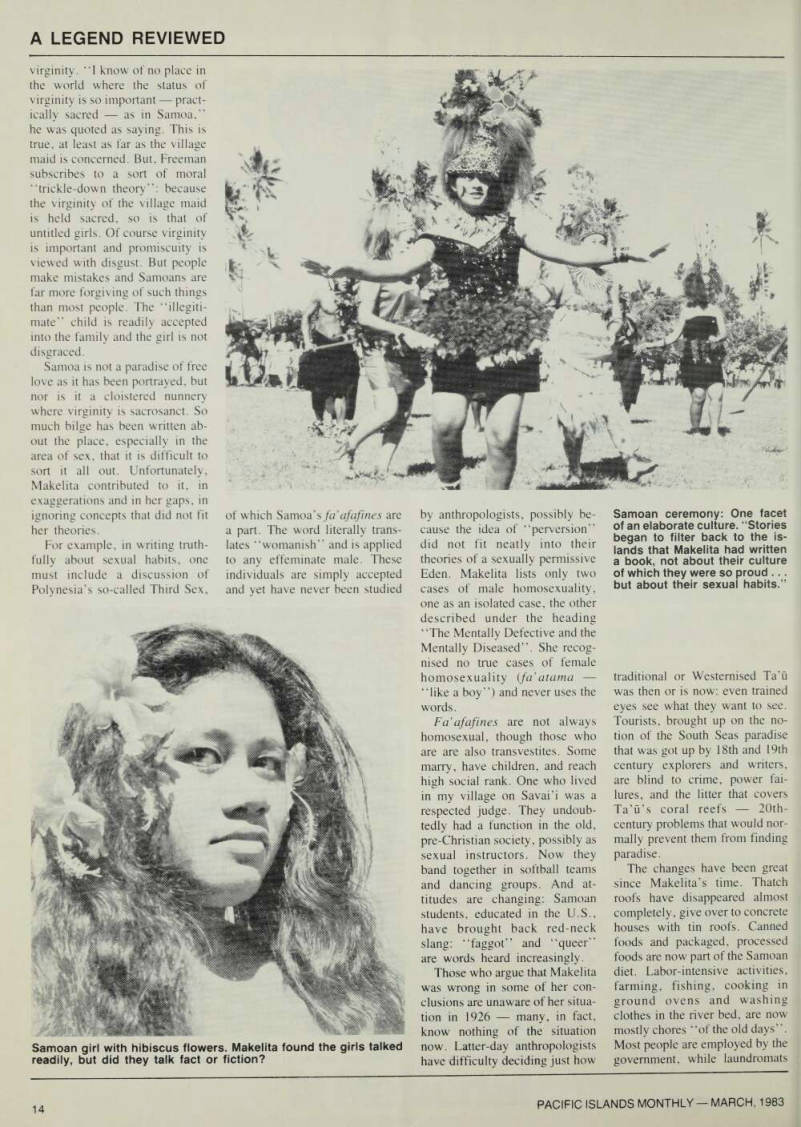
Samoan girl with hibiscus flowers. Makelita found the girls talked readily, but did they talk fact or fiction?
Samoan ceremony: One facet of an elaborate culture. “Stories began to filter back to the is lands that Makelita had written a book, not about their culture of which they were so proud ... but about their sexual habits."
and restaurants are booming and the main industry, tuna canning, is accomplished by other hands: Koreans and Taiwanese do the fishing and Western Samoans, seeking better pay, arrive to can the tuna.
Even basic taboos are chang ing. Makelita noticed the strong brother-sister taboo which for bade them from even speaking directly to each other. Some of my students in American Samoa had never even heard of the injunction, and many had no knowledge of the chiefly lan guage or its function, referring to it as the “old people’s language.”
A few years ago a Samoan girl wrote to a nationally syndicated advice column complaining of the adviser’s reference to the
“free love” in Samoa, and the low value placed on virginity there. “My virginity is the great est gift I can give to my hus band,” she wrote. Makelita anti cipated the questions of later generations and wondered in her autobiography what relevance her first book would have on American-educated Samoans, grandchildren of those she knew.
She wrote cautionary prefaces to succeeding editions of the book, emphasising how long ago the study was made.
It is unfair nowadays to carp, for the Westernisation of Ameri can Samoa and of Samoans, liv ing in Hawaii and as far away as Boston, has distanced them from the old values. Of course virgini ty, for instance, is valued, but how many of them (let alone anthropologists) have seen a de floration ceremony, or the vil lage women parading a bloodied bridal cloth?
One ex-student of mine is now in the army. On a recent leave, she told me that her fellow sol diers had questioned her about a
defloration ceremony they had witnessed in a movie. She had hotly denied that Samoans had ever done such things.
All these changes must be ta ken into account by those who want to unseat Makelita. She was young when she wrote her first book, was not fluent, stayed for less than a year and made mis takes. But one forgets the state of anthropology at the time, when culture was a technical word and reliable field methods were not in existence. She did extremely
well, bringing anthropology
home to the layman and also providing scholarly accounts of just those things the Samoans felt she neglected rites, rituals and ceremonies in The Social Or ganization of Manu’a (1930).
It would be a pity if Makelita’s studies were seen as only mate rial to be debunked. She was a far better writer and shrewder observer of cultures (her own included) than some of these academic barnacles now give her credit for. Though her book was hailed as a classic, it has its
errors and these should be noted.
But it is a picture of a society that barely exits any more. Modem Samoans and some anthropolog ists now disagree with her find ings. New books should and will be written, new studies done and
analysed.
In her autobiography, Makeli ta wrote that in 1924 she attended a conference in Toronto. There she heard social scientists discuss their own studies and each talked about “my people”. She wrote later: “I had no people to talk about.”
If she was defensive of her book, special to her because it was her first major study, the basis for her claim that the Sa moans were, in her phrase, “my people”, her first people (though many other groups would be come hers), it is understandable.
I remember the words of Robert Louis Stevenson, another writer on Samoa (and who is buried there): ‘ ‘The first love, the first sun rise, the first South Seas Island, are memories apart ...”
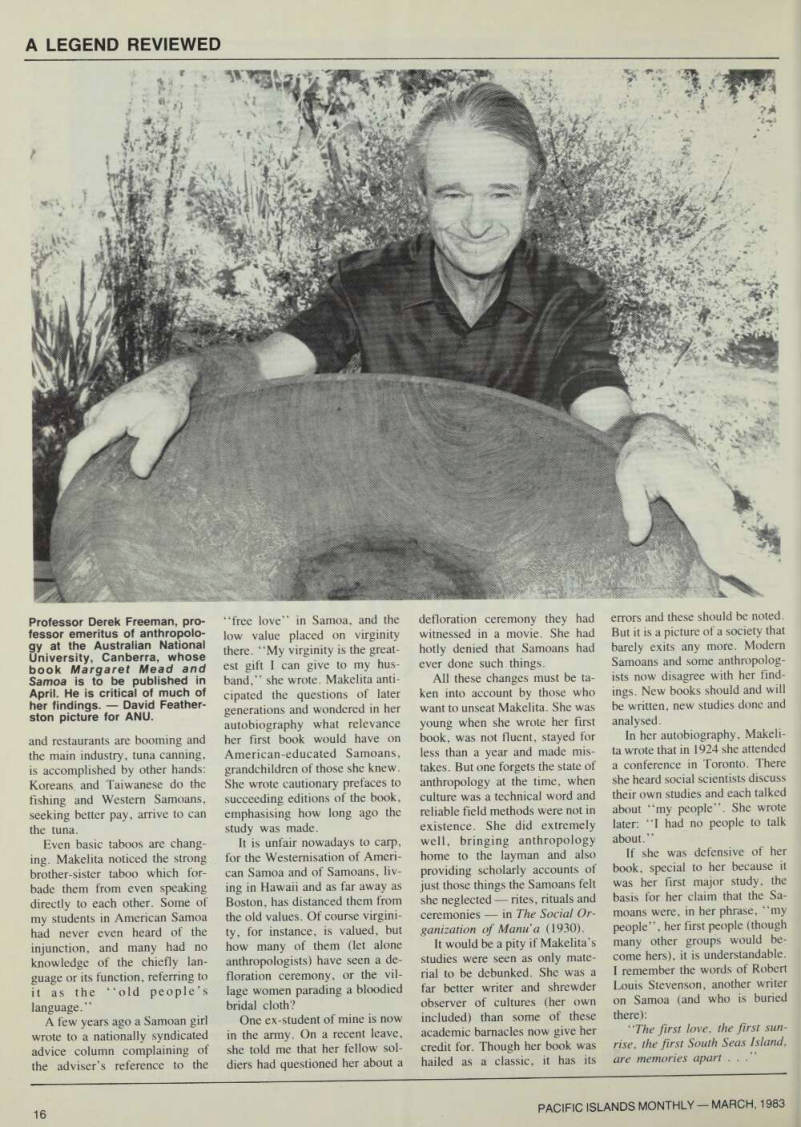
Professor Derek Freeman, pro fessor emeritus of anthropolo gy at the Australian National University, Canberra, whose book Margaret Mead and Samoa is to be published in April. He is critical of much of her findings. - David Feather ston picture for ANU.
Advertisements & other items, pp. 12-15 (1 item)
National
11l > I CZDrLr: National Video Cassette Recorder NV-300 ms fttfi - a •' ■
THE NEW NV-300
VIDEO CASSETTE RECORDER
As you can see, our new NV-300 is a great looking video cassette recorder. Clean lines.
Sophisticated design. Compact and lightweight.
Easy on your eyes. Easy to fit in any size room.
But great looks aren’t everything. And we certainly don’t expect you to buy the NV-300 just because you like what you see on the outside.
It’s what’s inside that really counts.
And if you could see inside the NV-300, you’d discover a technological design at the least the equal of (and probably better than} the beautiful design on the . L outside. Incredibly accurate quartz-locked, directdrive motors to power the capstan and video head cylinder. And a one-piece chassis, die-cast from a lightweight aluminum alloy especially resistant to metal fatigue and temperature change, to support the NV-300.
Just two examples of the technology and production engineering that enable our video recorders to deliver sharp picture quality year after year.
The NV-300 is an operational beauty too.
You can record one program while watching another. When you’re away from home, it can automatically record, within a 14-day period, your favorite program. And, the NV-300 features super-convenient one-touch timer recording that lets you record up to 120 minutes Cat 30-minute intervals}. There’s cue and review for fast, easy location of the program or sequence you wish to replay, and an 8-mode remote control unit. Plus all the other features you expect from a great video cassette recorder.
We’ve helped make VMS the world’s favorite videotaping system.
Come see the great new NV-300 in action today, and you’ll clearly see why. 11
National
Panacnnir and Tnr.hnins are the brandnames of Matsushita Electric.
VMS
Dnzed recording I TV programs and
Vicon spreaders utilise a spout that moves with a pendulum action to achieve the most accurate spreading available anywhere in the world A fact which, in these times of rising fertiliser bills, has in no small way contributed to making us the market leader in every country in which weVe been sold The spout itself is adjustable for three different
spreading widths.
On all models a special key is provided for these
adjustments.
On top of this there are
Proving to you we
make the worlds most
accurate spreader
has never been simpler.
96 positions for application working on slopes. your spreading rate simply rates and an efficiency of All spreaders have a mini- and efficiently, spreading action that means! ■ . , mum number of With it you'll be able to there's no need to go back over old ground The Vicon range can
accurately
spread seed insecticide or fertiliser from any thing between a six metre (18 foot) width to a 14 metre (46 foot) width. moving parts, each monitor accurately how J"| of which is resistant much of your fertiliser and Ito corrosion, and an powdered products you use ■ r fj:fl extremely low during each run. •I friction line which And you won't need to I means a reduction be a mathematical genius tc 1 1 §in fuel consumptioa quickly discover that with So confident are Vicon you have the most |we of the savings accurate spreader available that you'll make in on today's market, fertiliser costs by using w the Vicon spreader, we've And they're not adverse- designed and patented a slide ly affected by crosswind or rule that allows you to set You re better e( i u 'PP ed with sunbeam vicon
* •REGISTERED TRADE MARK © COPYRIGHT
F °R INFORMATION CONTACT: Telephone: (02) 789 0222. Telex: 20206. Cables: “Sunbeam” Sydney.
All Correspondence: Sunbeam Corporation, Wade Street, Campsie, N.S.W., Australia 2194
SRD232R
y/27
vms
When Fiji, Tonga,
Tropicalities
The Vitiaz Arc
When Fiji, Tonga, and Vanuatu were one
New evidence found by scientists at the University of California shows that Fiji broke away from the islands of Vanuatu and Tonga around five to eight million years ago.
Before that, geologists thought the split in the seabed which caused Fiji to separate from its neighbors happened between 10 to 15 million years ago.
Professor of Earth Sciences James Gill and graduate students Allen Stork and Peter Whelan presented their new findings in San Francisco at this year’s meeting of the American Geophysical Union in a paper entitled “Volcanism Accom panying Arc Fragmentation in Fiji.”
According to Gill, the scien tists focused on Fiji because it is “a place where there have been many changes in lava composi tions particularly over the last 10 million years.” The scientists hoped to link these chemical changes to events in Fiji’s com plex geological history.
Perhaps 50 million years ago, Fiji, Tonga and Vanuatu made up a single island arc called the Vitiaz arc.
The Vitiaz arc is believed by most scientists to have formed along the north-east margin of the Australian-Indian plate a huge slab of the earth’s crust that includes the continents of Aust ralia and India and part of the seafloor beneath the Indian and Pacific Oceans.
The ancient arc ran parallel to a “subduction zone” where the Pacific plate was diving, or being
ing of different source rocks much as brands distinguish range cattle owned by different ranchers.
Isotopes atoms of the same elements that differ in atomic
mass help geochemists deter
mine to what extent molten mate rial from deep source rocks has been contaminated by melting and mixing with upper rocks on its way to the earth’s surface.
Radiometric ages tell scientists when the lavas erupted.
The scientists believe this melting of plate material very likely marked the onset of the break-up of the Vitiaz arc.
Dramatic trace element differ ences in Fijian lavas erupted after three million years ago suggest that by three million years ago arc fragmentation was complete
“subducted”, beneath the Indian
plate.
Between eight and five million years ago, according to the scien tists, the Vitiaz arc began to break up as Vanuatu slowly separated from Fiji and Tonga.
Fiji and Tonga appear to have remained intact until three mill ion years ago, when the config uration of the three arc fragments was established.
At that time also, the Califor nia scientists say, subduction ceased beneath the Fiji portion of the sundered arc.
“That there is some relation ship between subduction and is land arc volcanism has been known for some time,” says Gill, “but the exact nature of that relationship is not known.” To understand it better, Gill, Stork, and Whelan made their study of Fiji’s volcanic rocks.
“Our interpretations,” the sci entists write, “are outgrowths of several almost-completed studies at UCSC about Fiji over the last five years, which have yielded over 100 new radiometric ages and over 500 new rock analyses, including extensive trace element and isotope data.”
Trace elements elements such as lead and strontium which are present in barely detectable or “trace” amounts disting uish lavas derived from the melt
and subduction beneath Fiji had ceased.
Gill says that the Californian study of Fiji marks “the first time that rocks from a 30-
million-year-old history of one
island arc have been so thorough ly studied by chemical analysis and age dating.”
But, he notes, the “frustra tion, or the dilemma, is that we still don’t know why” certain geologic events such as arc fragmentation and cessation of subduction are reflected as they are in lava compositions.
The Fiji Times.
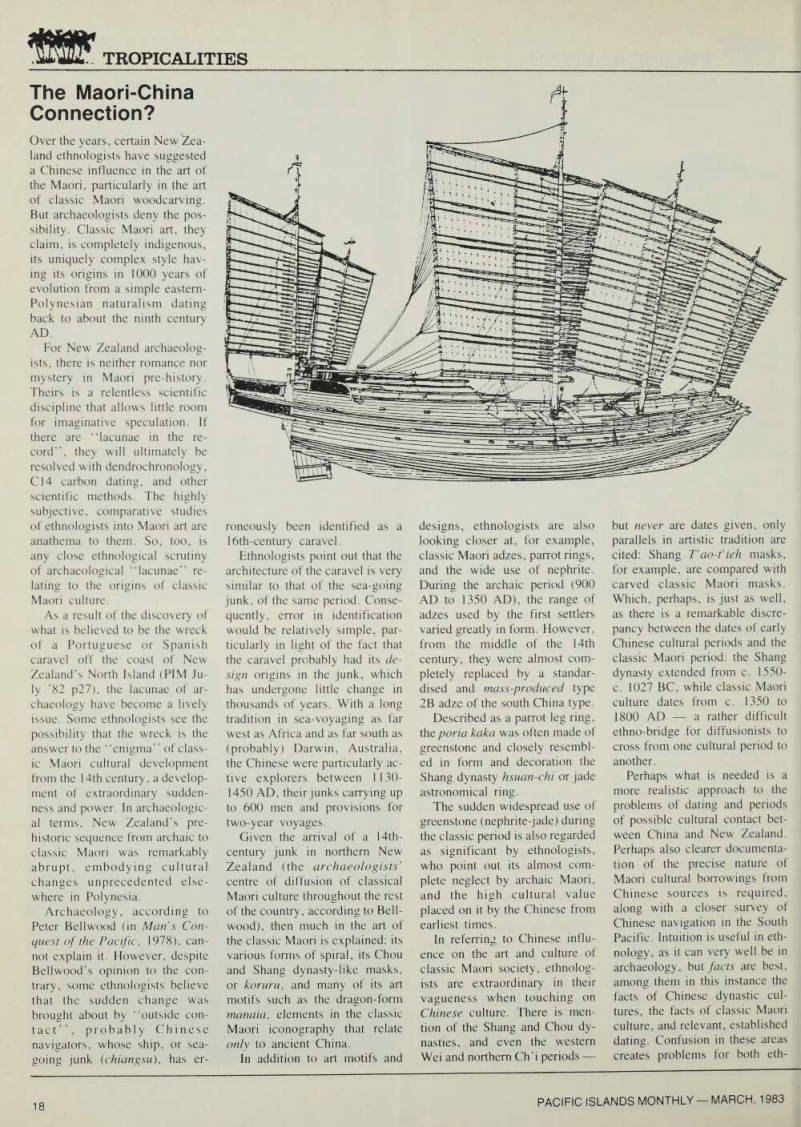
One of Fiji’s best-known land marks, Rama or Joske’s Thumb, not far from Suva. It is a volcanic plug, one of the many examples of volcanic rock
which are attracting geological
interest in Fiji.
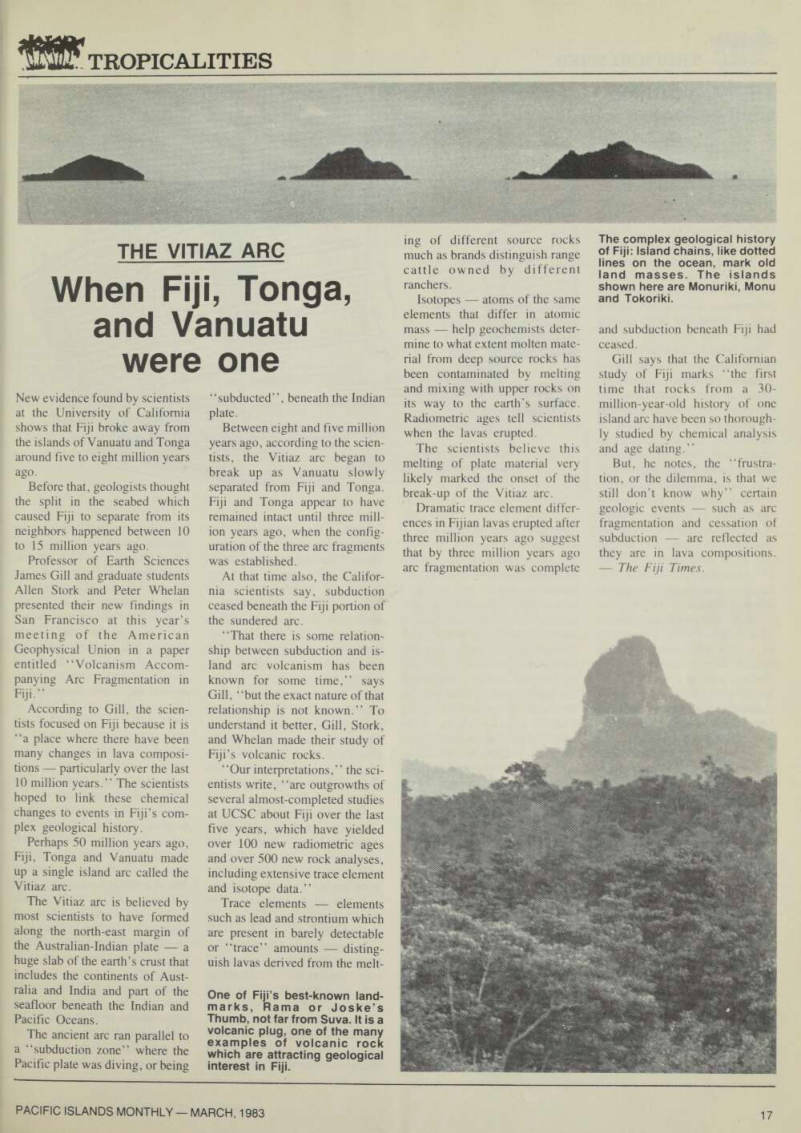
The complex geological history of Fiji: Island chains, like dotted lines on the ocean, mark old land masses. The islands shown here are Monuriki, Monu and Tokoriki.
The Maori-China

Connection?
Over the years, certain New Zea
land ethnologists have suggested
a Chinese influence in the art of the Maori, particularly in the art of classic Maori woodcarving.
But archaeologists deny the pos sibility. Classic Maori art, they
claim, is completely indigenous,
its uniquely complex style hav ing its origins in 1000 years of evolution from a simple eastem-
Polynesian naturalism dating
back to about the ninth century AD.
For New Zealand archaeolog ists, there is neither romance nor mystery in Maori pre-history.
Theirs is a relentless scientific discipline that allows little room
for imaginative speculation. If
there are “lacunae in the re cord”, they will ultimately be resolved with dendrochronology,
Cl 4 carbon dating, and other
scientific methods. The highly
subjective, comparative studies
of ethnologists into Maori art are anathema to them. So, too, is
any close ethnological scrutiny
of archaeological “lacunae” re lating to the origins of classic Maori culture.
As a result of the discovery of what is believed to be the wreck of a Portuguese or Spanish caravel off the coast of New Zealand’s North Island (PIM Ju ly ’B2 p 27), the lacunae of ar chaeology have become a lively issue. Some ethnologists see the possibility that the wreck is the answer to the “enigma” of class ic Maori cultural development from the 14th century, a develop ment of extraordinary sudden ness and power. In archaeologic al terms, New Zealand’s pre historic sequence from archaic to classic Maori was remarkably
abrupt, embodying cultural
changes unprecedented else
where in Polynesia.
Archaeology, according to Peter Bellwood (in Man’s Con quest of the Pacific, 1978), can not explain it. However, despite Bellwood’s opinion to the con trary, some ethnologists believe that the sudden change was brought about by “outside con tact’’, probably Chinese navigators, whose ship, or sea going junk ( chiangsu ), has er-
roneously been identified as a
16th-century caravel.
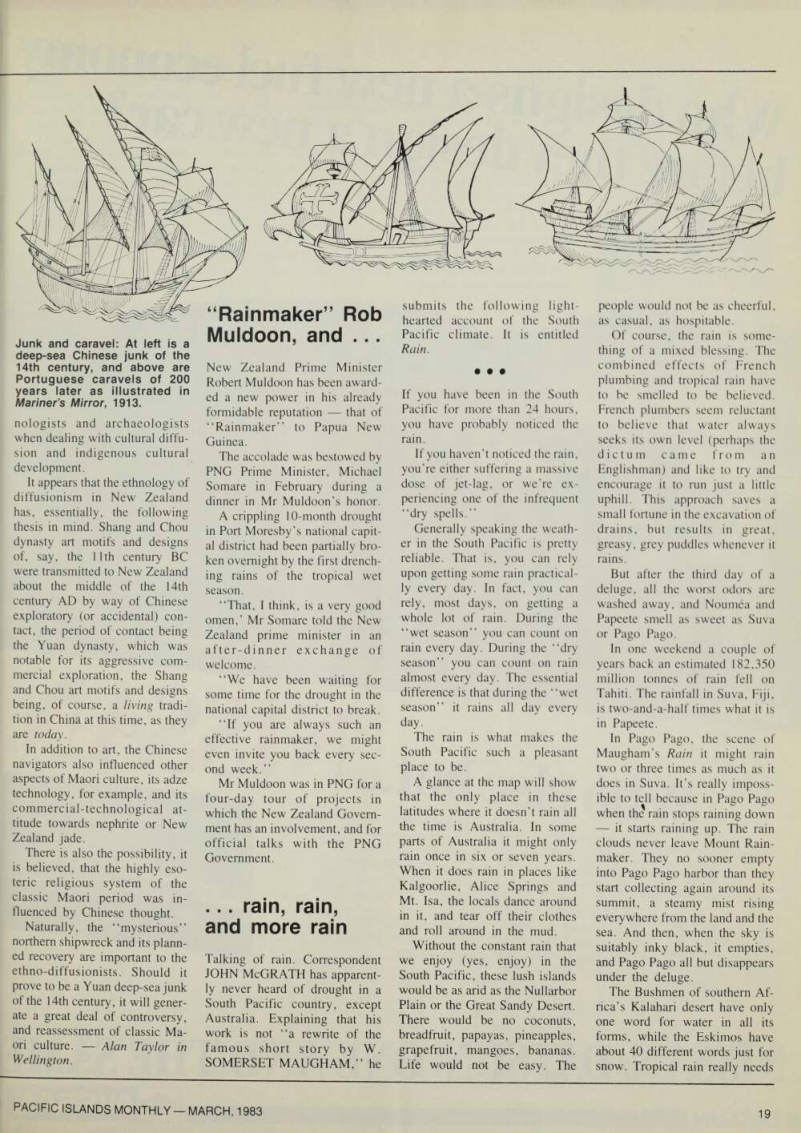
Ethnologists point out that the architecture of the caravel is very similar to that of the sea-going junk, of the same period. Conse quently, error in identification would be relatively simple, par ticularly in light of the fact that the caravel probably had its de sign origins in the junk, which has undergone little change in thousands of years. With a long tradition in sea-voyaging as far west as Africa and as far south as (probably) Darwin, Australia, the Chinese were particularly ac tive explorers between 1130- 1450 AD, their junks carrying up to 600 men and provisions for two-year voyages.
Given the arrival of a 14th century junk in northern New Zealand (the archaeologists’ centre of diffusion of classical Maori culture throughout the rest of the country, according to Bell wood), then much in the art of the classic Maori is explained: its various forms of spiral, its Chou
and Shang dynasty-like masks,
or koruru, and many of its art motifs such as the dragon-form manaia, elements in the classic Maori iconography that relate only to ancient China.
In addition to art motifs and
designs, ethnologists are also looking closer at, for example, classic Maori adzes, parrot rings, and the wide use of nephrite.
During the archaic period (900 AD to 1350 AD), the range of adzes used by the first settlers varied greatly in form. However, from the middle of the 14th century, they were almost com pletely replaced by a standar dised and mass-produced type 2B adze of the south China type.
Described as a parrot leg ring, the poria kaka was often made of greenstone and closely resembl ed in form and decoration the Shang dynasty hsuan-chi or jade astronomical ring.
The sudden widespread use of greenstone (nephrite-jade) during the classic period is also regarded as significant by ethnologists, who point out its almost com plete neglect by archaic Maori, and the high cultural value placed on it by the Chinese from earliest times.
In referring to Chinese influ ence on the art and culture of classic Maori society, ethnolog ists are extraordinary in their vagueness when touching on Chinese culture. There is men tion of the Shang and Chou dy nasties, and even the western Wei and northern Ch’i periods
but never are dates given, only parallels in artistic tradition are cited: Shang Tao-t’ieh masks, for example, are compared with carved classic Maori masks.
Which, perhaps, is just as well, as there is a remarkable discre pancy between the dates of early Chinese cultural periods and the classic Maori period: the Shang dynasty extended from c. 1550c. 1027 BC, while classic Maori culture dates from c. 1350 to 1800 AD a rather difficult ethno-bridge for diffusionists to cross from one cultural period to another.
Perhaps what is needed is a more realistic approach to the
problems of dating and periods
of possible cultural contact bet ween China and New Zealand.
Perhaps also clearer documenta tion of the precise nature of Maori cultural borrowings from Chinese sources is required, along with a closer survey of Chinese navigation in the South Pacific. Intuition is useful in eth nology, as it can very well be in archaeology, but facts are best, among them in this instance the facts of Chinese dynastic cul tures, the facts of classic Maori culture, and relevant, established dating. Confusion in these areas creates problems for both eth-
nologists and archaeologists when dealing with cultural diffu sion and indigenous cultural development.
It appears that the ethnology of diffusionism in New Zealand has, essentially, the following thesis in mind. Shang and Chou dynasty art motifs and designs of, say, the 11th century BC were transmitted to New Zealand about the middle of the 14th century AD by way of Chinese exploratory (or accidental) con tact, the period of contact being the Yuan dynasty, which was notable for its aggressive com mercial exploration, the Shang and Chou art motifs and designs being, of course, a living tradi tion in China at this time, as they are today.
In addition to art, the Chinese navigators also influenced other aspects of Maori culture, its adze technology, for example, and its
commercial-technological at
titude towards nephrite or New Zealand jade.
There is also the possibility, it is believed, that the highly eso teric religious system of the classic Maori period was in fluenced by Chinese thought.
Naturally, the “mysterious” northern shipwreck and its plann ed recovery are important to the ethno-diffusionists. Should it prove to be a Yuan deep-sea junk of the 14th century, it will gener ate a great deal of controversy, and reassessment of classic Ma ori culture. Alan Taylor in Wellington.
“Rainmaker” Rob
Muldoon, and ...
New Zealand Prime Minister Robert Muldoon has been award ed a new power in his already formidable reputation that of “Rainmaker” to Papua New Guinea.
The accolade was bestowed by PNG Prime Minister, Michael Somare in February during a dinner in Mr Muldoon’s honor.
A crippling 10-month drought
in Port Moresby’s national capit al district had been partially bro ken overnight by the first drench ing rains of the tropical wet season.
“That, I think, is a very good omen,’ Mr Somare told the New Zealand prime minister in an after-dinner exchange of welcome.
“We have been waiting for some time for the drought in the national capital district to break.
“If you are always such an effective rainmaker, we might even invite you back every sec ond week.”
Mr Muldoon was in PNG for a four-day tour of projects in which the New Zealand Govern ment has an involvement, and for official talks with the PNG Government.
... rain, rain,
and more rain
Talking of rain. Correspondent
JOHN McGRATH has apparent ly never heard of drought in a South Pacific country, except Australia. Explaining that his work is not “a rewrite of the famous short story by W.
Somerset Maugham,” He
submits the following light
hearted account of the South Pacific climate. It is entitled Rain. • • • If you have been in the South Pacific for more than 24 hours, you have probably noticed the rain.
If you haven’t noticed the rain, you’re either suffering a massive dose of jet-lag, or we’re ex periencing one of the infrequent
“dry spells.’’
Generally speaking the weath
er in the South Pacific is pretty reliable. That is, you can rely upon getting some rain practical ly every day. In fact, you can
rely, most days, on getting a
whole lot of rain. During the “wet season” you can count on
rain every day. During the “dry
season” you can count on rain almost every day. The essential difference is that during the “wet season” it rains all day every
day.
The rain is what makes the South Pacific such a pleasant place to be.
A glance at the map will show that the only place in these latitudes where it doesn’t rain all the time is Australia. In some parts of Australia it might only rain once in six or seven years.
When it does rain in places like
Kalgoorlie, Alice Springs and
Mt. Isa, the locals dance around in it, and tear off their clothes and roll around in the mud.
Without the constant rain that
we enjoy (yes, enjoy) in the
South Pacific, these lush islands would be as arid as the Nullarbor Plain or the Great Sandy Desert.
There would be no coconuts, breadfruit, papayas, pineapples, grapefruit, mangoes, bananas.
Life would not be easy. The
people would not be as cheerful, as casual, as hospitable.
Of course, the rain is some thing of a mixed blessing. The combined effects of French plumbing and tropical rain have to be smelled to be believed.
French plumbers seem reluctant to believe that water always seeks its own level (perhaps the dictum came from an Englishman) and like to try and encourage it to run just a little uphill. This approach saves a small fortune in the excavation of drains, but results in great, greasy, grey puddles whenever it rains.
But after the third day of a deluge, all the worst odors are washed away, and Noumea and Papeete smell as sweet as Suva or Pago Pago.
In one weekend a couple of years back an estimated 182,350 million tonnes of rain fell on Tahiti. The rainfall in Suva, Fiji, is two-and-a-half times what it is in Papeete.
In Pago Pago, the scene of Maugham’s Rain it might rain two or three times as much as it does in Suva. It’s really imposs ible to tell because in Pago Pago when the rain stops raining down it starts raining up. The rain clouds never leave Mount Rain maker. They no sooner empty into Pago Pago harbor than they start collecting again around its summit, a steamy mist rising everywhere from the land and the sea. And then, when the sky is suitably inky black, it empties, and Pago Pago all but disappears under the deluge.
The Bushmen of southern Af rica’s Kalahari desert have only one word for water in all its forms, while the Eskimos have about 40 different words just for snow. Tropical rain really needs
Junk and caravel: At left is a deep-sea Chinese junk of the 14th century, and above are Portuguese caravels of 200 years later as illustrated in Mariner’s Mirror, 1913.
a similarly expanded vocabulary
to do justice to its variety.
There’s the soft sprinkle show er. The sun is barely concealed behind a fleecy cloud, or may even be shining through the rain.
This is the very best time to walk around. You become a sort of air-conditioned pedestrian, a water-cooled ambulator. Your clothes (of course you’re wearing pure cotton) dry out in the warmth just about as fast as they get wet. And what our science teachers pompously called the “latent heat of vaporisation’’ transfers your body heat from the skin to the cotton and thence to the air with a consequent drop in skin temperature and a delightful sensation of coolness.
The next step up the rain scale is just as pleasant it’s rather too heavy to walk around in, and so provides an excellent excuse to sit around and do nothing.
Great weather for sipping gin and tonic you might even care to try it in the old Pacific style short, no ice, the tonic at room temperature. That’s the way the drink was invented in the days before refrigeration, and it’s sur
prisingly refreshing and very
tasty.
Rainy days like these are espe cially pleasant in the bars and sidewalk cafes of Papeete.
Tahitians don’t give a damn about getting wet, so the passing parade of brightly dressed, gaily
chatting Polynesians continues.
And in the bars around the “quartier latin” you are sure to find small groups singing, and
maybe dancing, to a couple of
guitars or ukeleles.
Then there’s rain Suva-style which happens all over the Pacific, but especially in Suva.
This rain comes crashing
down, completely obscuring the
landscape and drowning out ev ery sound other than its own stupendous percussion. Especial ly pleasant at night provided you’re snug indoors with some
whisky, and maybe some pleas
ant company.
Definitely not weather for
strolling in. And driving is right
out of the question.
Pago Pago-style rain is like Suva rain, but magnified about five times. A fantastic downpour that falls so heavily and so fast that the percussive effect is blurr
ed into one great continuous rushing roar. The water literally pours out of the sky a foot
loose Niagara.
Sweetest of all, perhaps, is the scattered, pattering rain that comes at the end of a heavy deluge and signals that the rain is being blown away.
There are random musical ef fects as light breezes move the rain this way and that. A tinkling concerto for water, played by the wind.
This rain is for listening to and is best appreciated in bed.
Introducing
Shark Callers
and Namaki
Dr. W. G. COPPELL writes on two new documentary films on significant themes from Pacific Islands life: Dennis O’Rourke must be seen as the pre-eminent figure among Australian documentary film makers who have turned for themes to social issues of the
Pacific Islands region. Following
his most recent study of the impact of television in Yap, Mr O’Rourke’s latest film is to my mind his finest yet.
Entitled The Shark Callers of Kontu, the film could only be made after he had spent consider able time in the village of Kontu, New Ireland, Papua New Guinea, in order to obtain the co operation of the people which alone made possible the filming
of quite unique material.
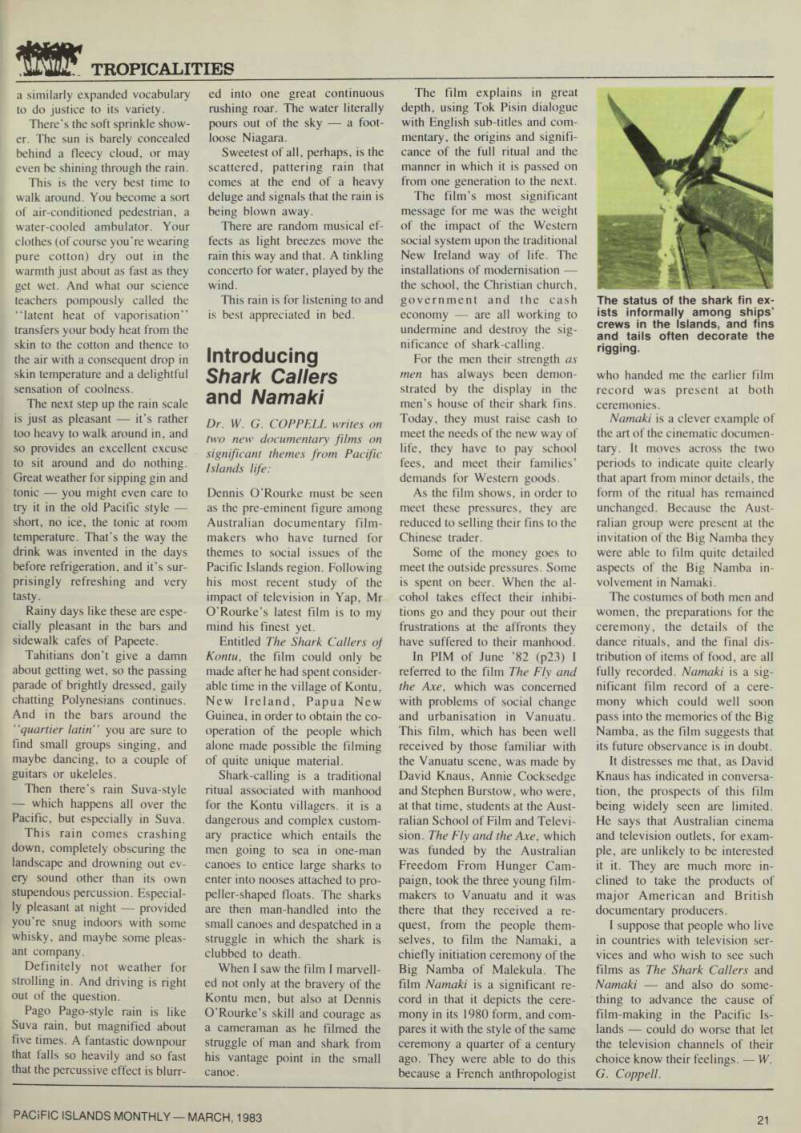
Shark-calling is a traditional ritual associated with manhood for the Kontu villagers, it is a dangerous and complex custom ary practice which entails the men going to sea in one-man canoes to entice large sharks to enter into nooses attached to pro peller-shaped floats. The sharks are then man-handled into the small canoes and despatched in a struggle in which the shark is clubbed to death.
When I saw the film I marvell ed not only at the bravery of the Kontu men, but also at Dennis O’Rourke’s skill and courage as a cameraman as he filmed the struggle of man and shark from his vantage point in the small canoe.
The film explains in great depth, using Tok Pisin dialogue with English sub-titles and com mentary, the origins and signifi cance of the full ritual and the manner in which it is passed on from one generation to the next.
The film’s most significant message for me was the weight of the impact of the Western social system upon the traditional New Ireland way of life. The installations of modernisation the school, the Christian church, government and the cash economy are all working to undermine and destroy the sig nificance of shark-calling.
For the men their strength as men has always been demon strated by the display in the men’s house of their shark fins.
Today, they must raise cash to meet the needs of the new way of life, they have to pay school fees, and meet their families’ demands for Western goods.
As the film shows, in order to meet these pressures, they are reduced to selling their fins to the Chinese trader.
Some of the money goes to meet the outside pressures. Some is spent on beer. When the al cohol takes effect their inhibi tions go and they pour out their frustrations at the affronts they have suffered to their manhood.
In PIM of June ’B2 (p 23) I referred to the film The Fly and the Axe, which was concerned with problems of social change and urbanisation in Vanuatu.
This film, which has been well received by those familiar with the Vanuatu scene, was made by David Knaus, Annie Cocksedge and Stephen Burstow, who were, at that time, students at the Aust ralian School of Film and Televi sion. The Fly and the Axe, which was funded by the Australian Freedom From Hunger Cam paign, took the three young film makers to Vanuatu and it was there that they received a re quest, from the people them selves, to film the Namaki, a chiefly initiation ceremony of the Big Namba of Malekula. The film Namaki is a significant re cord in that it depicts the cere mony in its 1980 form, and com pares it with the style of the same ceremony a quarter of a century ago. They were able to do this because a French anthropologist
who handed me the earlier film record was present at both ceremonies.
Namaki is a clever example of the art of the cinematic documen tary. It moves across the two periods to indicate quite clearly that apart from minor details, the form of the ritual has remained unchanged. Because the Aust ralian group were present at the invitation of the Big Namba they were able to film quite detailed aspects of the Big Namba in volvement in Namaki.
The costumes of both men and women, the preparations for the ceremony, the details of the dance rituals, and the final dis tribution of items of food, are all fully recorded. Namaki is a sig nificant film record of a cere mony which could well soon pass into the memories of the Big Namba, as the film suggests that its future observance is in doubt.
It distresses me that, as David Knaus has indicated in conversa tion, the prospects of this film being widely seen are limited.
He says that Australian cinema and television outlets, for exam ple, are unlikely to be interested it it. They are much more in clined to take the products of major American and British
documentary producers.
I suppose that people who live in countries with television ser vices and who wish to see such films as The Shark Callers and Namaki and also do some thing to advance the cause of film-making in the Pacific Is lands could do worse that let the television channels of their
choice know their feelings.
w.
G. Coppell.
The status of the shark fin ex ists informally among ships’ crews in the Islands, and fins and tails often decorate the
rigging.
Advertisements & other items, p. 20 (1 item)
aaassis®"
t
Who else but
oicn used digd • ••
NISSAN.
Nissan recognizes the That’s because wor i d over. make the new Nissai as possible, adva nced E-type eng,ne Recreated our a driveespecially for Sunn^ nd effic ient combustion fs minimal triown eavings not but more only gave us D power, too.
'We^sousedW^onst^*
reduce (uekwastmg «®g tety ,
"se'and oiU
£gSSJ*™***«
NISSAN/DATSUN: ONE AND THE SAME
DATSUN
NISSAN
Maori art goes
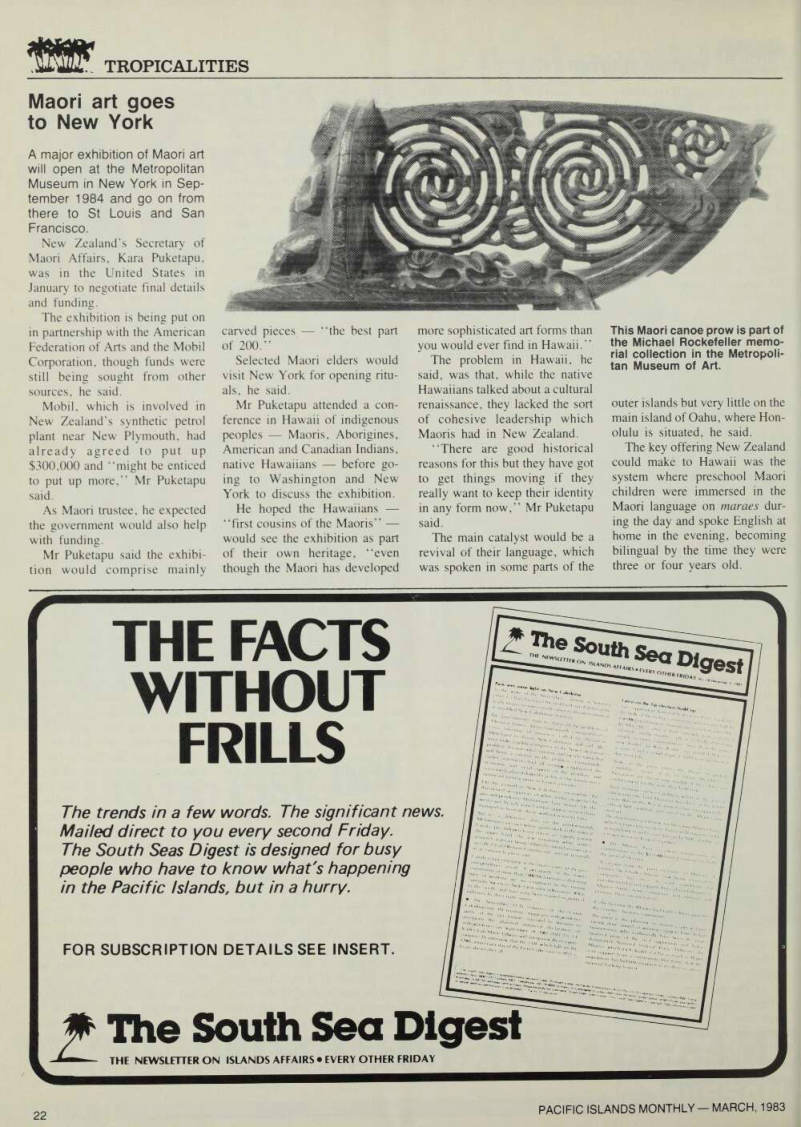
to New York
A major exhibition of Maori art will open at the Metropolitan Museum in New York in Sep tember 1984 and go on from there to St Louis and San Francisco.
New Zealand’s Secretary of Maori Affairs, Kara Puketapu, was in the United States in January to negotiate final details and funding.
The exhibition is being put on in partnership with the American Federation of Arts and the Mobil Corporation, though funds were still being sought from other sources, he said.
Mobil, which is involved in New Zealand's synthetic petrol plant near New Plymouth, had already agreed to put up $300,000 and “might be enticed to put up more,” Mr Puketapu said.
As Maori trustee, he expected the government would also help with funding.
Mr Puketapu said the exhibi tion would comprise mainly
carved pieces “the best part of 200.”
Selected Maori elders would visit New York for opening ritu als, he said.
Mr Puketapu attended a con ference in Hawaii of indigenous
peoples Maoris, Aborigines,
American and Canadian Indians, native Hawaiians before go ing to Washington and New York to discuss the exhibition.
He hoped the Hawaiians “first cousins of the Maoris” would see the exhibition as part of their own heritage, “even though the Maori has developed
more sophisticated art forms than you would ever find in Hawaii.”
The problem in Hawaii, he said, was that, while the native Hawaiians talked about a cultural renaissance, they lacked the sort of cohesive leadership which Maoris had in New Zealand.
“There are good historical reasons for this but they have got to get things moving if they
really want to keep their identity
in any form now,” Mr Puketapu said.
The main catalyst would be a revival of their language, which was spoken in some parts of the
outer islands but very little on the main island of Oahu, where Hon olulu is situated, he said.
The key offering New Zealand could make to Hawaii was the system where preschool Maori children were immersed in the Maori language on maraes dur ing the day and spoke English at home in the evening, becoming
bilingual by the time they were
three or four years old.
This Maori canoe prow is part of the Michael Rockefeller memo rial collection in the Metropoli tan Museum of Art.
Advertisements & other items, p. 22 (1 item)
Without
THE FACTS
FRILLS
The trends in a few words. The significant news.
Mailed direct to you every second Friday.
The South Seas Digest is designed for busy people who have to know what's happening in the Pacific Islands, but in a hurry.
FOR SUBSCRIPTION DETAILS SEE INSERT.
The South Sea Digest
THE NEWSLETTER ON ISLANDS AFFAIRS • EVERY OTHER FRIDAY
Jr The So
SaS?.* gest
Controversial, but Muldoon has
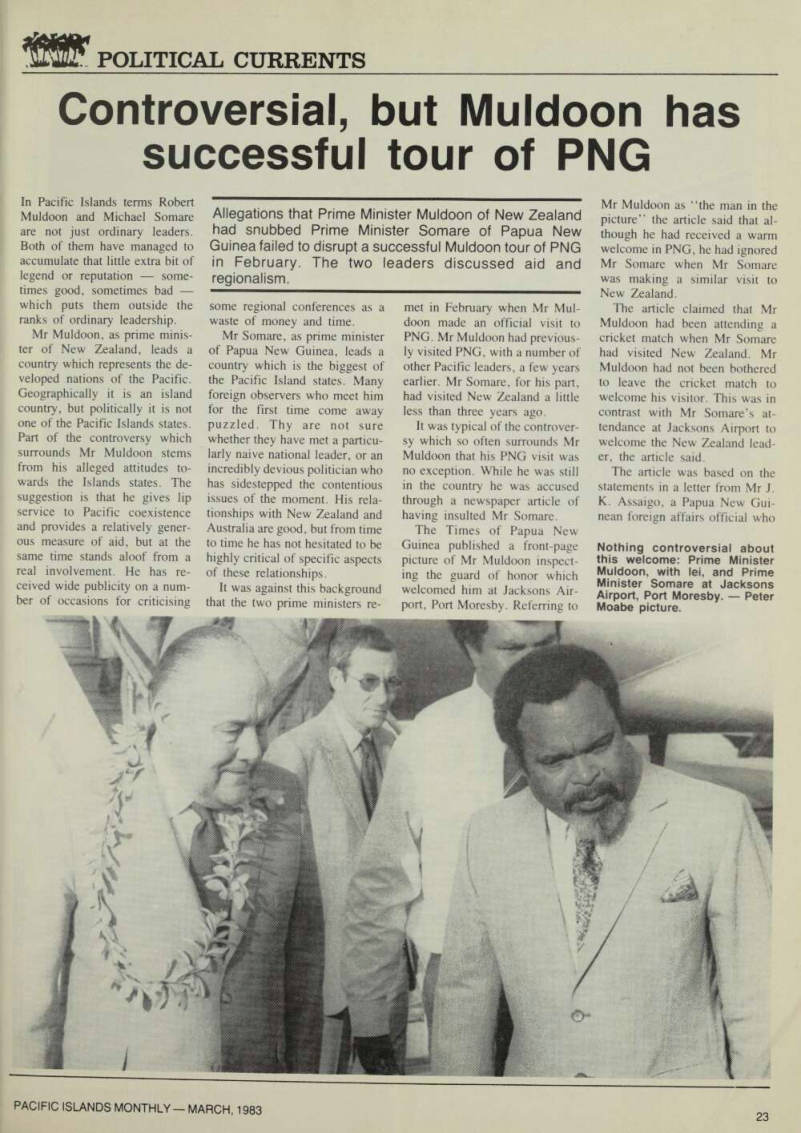

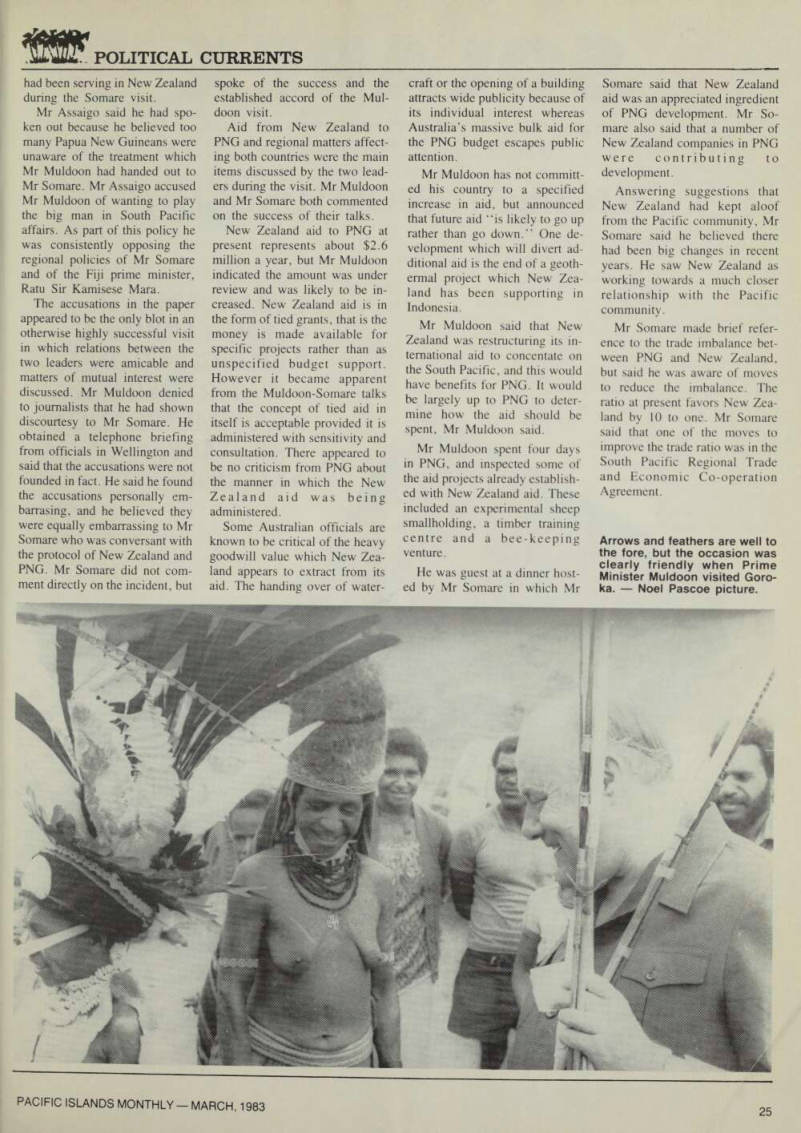
Political Currents
Controversial, but Muldoon has successful tour of PNG
in Pacific Islands terms Robert Muldoon and Michael Somare are not just ordinary leaders.
Both of them have managed to accumulate that little extra bit of
legend or reputation some
times good, sometimes bad which puts them outside the
ranks of ordinary leadership.
Mr Muldoon, as prime minis ter of New Zealand, leads a country which represents the de veloped nations of the Pacific.
Geographically it is an island country, but politically it is not one of the Pacific Islands states.
Part of the controversy which surrounds Mr Muldoon stems from his alleged attitudes to wards the Islands states. The suggestion is that he gives lip service to Pacific coexistence and provides a relatively gener ous measure of aid, but at the same time stands aloof from a real involvement. He has re ceived wide publicity on a num ber of occasions for criticising
Allegations that Prime Minister Muldoon of New Zealand had snubbed Prime Minister Somare of Papua New Guinea failed to disrupt a successful Muldoon tour of PNG in February. The two leaders discussed aid and regionalism.
some regional conferences as a waste of money and time.
Mr Somare, as prime minister of Papua New Guinea, leads a country which is the biggest of the Pacific Island states. Many foreign observers who meet him for the first time come away puzzled. Thy are not sure whether they have met a particu larly naive national leader, or an incredibly devious politician who has sidestepped the contentious issues of the moment. His rela tionships with New Zealand and Australia are good, but from time to time he has not hesitated to be highly critical of specific aspects of these relationships.
It was against this background that the two prime ministers re
met in February when Mr Mul doon made an official visit to PNG. Mr Muldoon had previous ly visited PNG, with a number of other Pacific leaders, a few years earlier. Mr Somare, for his part, had visited New Zealand a little less than three years ago.
It was typical of the controver sy which so often surrounds Mr Muldoon that his PNG visit was no exception. While he was still in the country he was accused through a newspaper article of having insulted Mr Somare.
The Times of Papua New Guinea published a front-page picture of Mr Muldoon inspect ing the guard of honor which welcomed him at Jacksons Air port, Port Moresby. Referring to
Mr Muldoon as “the man in the picture” the article said that al though he had received a warm welcome in PNG, he had ignored Mr Somare when Mr Somare was making a similar visit to New Zealand.
The article claimed that Mr Muldoon had been attending a cricket match when Mr Somare had visited New Zealand. Mr Muldoon had not been bothered to leave the cricket match to welcome his visitor. This was in contrast with Mr Somare’s at tendance at Jacksons Airport to welcome the New Zealand lead er, the article said.
The article was based on the statements in a letter from Mr J.
K. Assaigo, a Papua New Gui nean foreign affairs official who
Nothing controversial about this welcome: Prime Minister Muldoon, with lei, and Prime Minister Somare at Jacksons
Airport, Port Moresby. - Peter
Moabe picture.
had been serving in New Zealand during the Somare visit.
Mr Assaigo said he had spo ken out because he believed too many Papua New Guineans were unaware of the treatment which Mr Muldoon had handed out to Mr Somare. Mr Assaigo accused Mr Muldoon of wanting to play the big man in South Pacific affairs. As part of this policy he
was consistently opposing the
regional policies of Mr Somare and of the Fiji prime minister, Ratu Sir Kamisese Mara.
The accusations in the paper appeared to be the only blot in an otherwise highly successful visit in which relations between the two leaders were amicable and matters of mutual interest were discussed. Mr Muldoon denied to journalists that he had shown discourtesy to Mr Somare. He
obtained a telephone briefing
from officials in Wellington and said that the accusations were not founded in fact. He said he found the accusations personally em barrasing, and he believed they were equally embarrassing to Mr Somare who was conversant with the protocol of New Zealand and PNG. Mr Somare did not com ment directly on the incident, but
spoke of the success and the established accord of the Mul doon visit.
Aid from New Zealand to PNG and regional matters affect ing both countries were the main items discussed by the two lead ers during the visit. Mr Muldoon and Mr Somare both commented on the success of their talks.
New Zealand aid to PNG at present represents about $2.6 million a year, but Mr Muldoon indicated the amount was under review and was likely to be in creased. New Zealand aid is in the form of tied grants, that is the money is made available for specific projects rather than as
unspecified budget support.
However it became apparent from the Muldoon-Somare talks that the concept of tied aid in itself is acceptable provided it is administered with sensitivity and consultation. There appeared to be no criticism from PNG about the manner in which the New Zealand aid was being administered.
Some Australian officials are known to be critical of the heavy goodwill value which New Zea land appears to extract from its aid. The handing over of water
craft or the opening of a building attracts wide publicity because of its individual interest whereas Australia’s massive bulk aid for the PNG budget escapes public attention.
Mr Muldoon has not committ ed his country to a specified increase in aid, but announced that future aid “is likely to go up rather than go down.” One de velopment which will divert ad ditional aid is the end of a geoth ermal project which New Zea land has been supporting in Indonesia.
Mr Muldoon said that New Zealand was restructuring its in ternational aid to concentate on the South Pacific, and this would have benefits for PNG. It would be largely up to PNG to deter mine how the aid should be spent, Mr Muldoon said.
Mr Muldoon spent four days in PNG, and inspected some of the aid projects already establish ed with New Zealand aid. These
included an experimental sheep
smallholding, a timber training
centre and a bee-keeping venture.
He was guest at a dinner host ed by Mr Somare in which Mr
Somare said that New Zealand aid was an appreciated ingredient of PNG development. Mr So mare also said that a number of New Zealand companies in PNG were contributing to
development.
Answering suggestions that
New Zealand had kept aloof from the Pacific community, Mr Somare said he believed there had been big changes in recent years. He saw New Zealand as working towards a much closer relationship with the Pacific
community.
Mr Somare made brief refer ence to the trade imbalance bet ween PNG and New Zealand, but said he was aware of moves to reduce the imbalance. The ratio at present favors New Zea land by 10 to one. Mr Somare said that one of the moves to improve the trade ratio was in the South Pacific Regional Trade and Economic Co-operation Agreement.
Arrows and feathers are well to the fore, but the occasion was
clearly friendly when Prime
Minister Muldoon visited Goro
ka. - Noel Pascoe picture.
Advertisements & other items, pp. 24-26 (1 item)
Regional Airliners
Bik m w ■ at"
mak
L m I ■V f w m ami: a mm m i a' m <■■ .a- KS #*»< i * ■ - v « > *
SHORTS WIDE BODIED
REGIONAL AIRLINERS
WILL CARRY YOU
THROUGH TO THEI99Os
It took the world's oldest and one of the most experienced airplane manufacturers to build wide-bodied generation Commuterliners. In every aspect the Shorts 330 and 360 are designed for effic.ency and the 330 is already well proven in airline service having carried over ten million fare-paying passengers to (date > wfrilst the 360 benefits greatly from its established heritage and is now in airline service in the U.K. and U.b. ■ They are built with simple and functional, highly reliable philosophies in mind. They eqmpped with quiet, fuel-efficient engines. And they have the most advanced flight deck equipment to be found COm The provide outstanding comfort and appeal for up to 30 and 36 passengers respectively.
With these facilities, commuter passengers, and the airline operators, have the widest choice of reliable, fuel efficient, wide-bodied regional airliners in the world.
• SOLAREX 9
5 BELLONA AVE., REGENTS PARK 2143 AUSTRALIA I f TELEPHONE (02) 644 5055 TELEX AA 21975
ELECTRICITY FROM SUNLIGHT
% w. * ¥ >■ f.
A * \
tnßßJsg
VILLAGE POWER
HOUSE LIGHTING
REFRIGERATION
WATER PUMPING
COMMUNICATIONS
MILITARY
MARINE
One of the earths most abunbant elements, Silicon, is the basic ingredient of the two materials shown here sand, and the solar cell.
Combined together as a single panel or in an array of multiple panels, and by adding one extra free ingredient sunlight solar cells can generate sufficient electricity for almost any application.
PACIFIC ISLANDS MONTHLY MARCH, 1983
Imports tender scheme
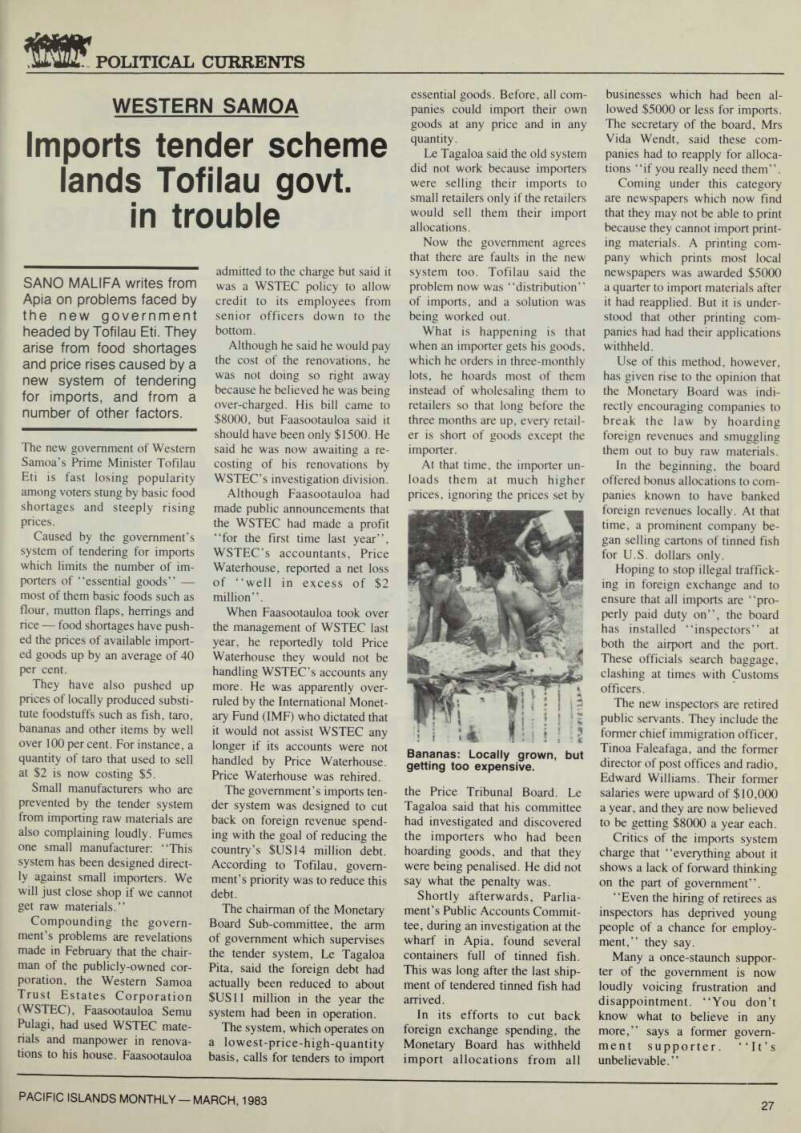
Western Samoa
Imports tender scheme lands Tofilau govt. in trouble
SANO MALIFA writes from Apia on problems faced by the new government headed by Tofilau Eti. They arise from food shortages and price rises caused by a new system of tendering for imports, and from a number of other factors.
The new government of Western Samoa’s Prime Minister Tofilau Eti is fast losing popularity among voters stung by basic food shortages and steeply rising prices.
Caused by the government’s system of tendering for imports which limits the number of im porters of “essential goods” most of them basic foods such as flour, mutton flaps, herrings and rice food shortages have push ed the prices of available import ed goods up by an average of 40 per cent.
They have also pushed up prices of locally produced substi tute foodstuffs such as fish, taro, bananas and other items by well over 100 per cent. For instance, a quantity of taro that used to sell at $2 is now costing $5.
Small manufacturers who are prevented by the tender system from importing raw materials are also complaining loudly. Fumes one small manufacturer: “This system has been designed direct ly against small importers. We will just close shop if we cannot get raw materials.”
Compounding the govern ment’s problems are revelations made in February that the chair man of the publicly-owned cor poration, the Western Samoa Trust Estates Corporation (WSTEC), Faasootauloa Semu Pulagi, had used WSTEC mate rials and manpower in renova tions to his house. Faasootauloa
admitted to the charge but said it was a WSTEC policy to allow credit to its employees from senior officers down to the bottom.
Although he said he would pay the cost of the renovations, he was not doing so right away because he believed he was being over-charged. His bill came to $BOOO, but Faasootauloa said it should have been only $l5OO. He said he was now awaiting a re costing of his renovations by WSTEC’s investigation division.
Although Faasootauloa had made public announcements that the WSTEC had made a profit “for the first time last year”, WSTEC’s accountants, Price Waterhouse, reported a net loss of “well in excess of $2 million”.
When Faasootauloa took over the management of WSTEC last year, he reportedly told Price Waterhouse they would not be handling WSTEC’s accounts any more. He was apparently over ruled by the International Monet ary Fund (IMF) who dictated that it would not assist WSTEC any longer if its accounts were not handled by Price Waterhouse.
Price Waterhouse was rehired.
The government’s imports ten der system was designed to cut back on foreign revenue spend ing with the goal of reducing the country’s SUSI 4 million debt.
According to Tofilau, govern ment’s priority was to reduce this debt.
The chairman of the Monetary Board Sub-committee, the arm of government which supervises the tender system, Le Tagaloa Pita, said the foreign debt had actually been reduced to about SUSII million in the year the system had been in operation.
The system, which operates on
a lowest-price-high-quantity
basis, calls for tenders to import
essential goods. Before, all com panies could import their own goods at any price and in any
quantity.
Le Tagaloa said the old system did not work because importers were selling their imports to small retailers only if the retailers would sell them their import allocations.
Now the government agrees that there are faults in the new system too. Tofilau said the problem now was “distribution” of imports, and a solution was being worked out.
What is happening is that when an importer gets his goods, which he orders in three-monthly lots, he hoards most of them instead of wholesaling them to retailers so that long before the three months are up, every retail er is short of goods except the
importer.
At that time, the importer un loads them at much higher
prices, ignoring the prices set by
the Price Tribunal Board. Le Tagaloa said that his committee had investigated and discovered the importers who had been hoarding goods, and that they were being penalised. He did not say what the penalty was.
Shortly afterwards, Parlia ment’s Public Accounts Commit tee, during an investigation at the wharf in Apia, found several containers full of tinned fish.
This was long after the last ship ment of tendered tinned fish had arrived.
In its efforts to cut back foreign exchange spending, the Monetary Board has withheld import allocations from all
businesses which had been al lowed $5OOO or less for imports.
The secretary of the board, Mrs Vida Wendt, said these com panies had to reapply for alloca tions “if you really need them”.
Coming under this category are newspapers which now find that they may not be able to print because they cannot import print ing materials. A printing com pany which prints most local newspapers was awarded $5OOO a quarter to import materials after it had reapplied. But it is under stood that other printing com panies had had their applications withheld.
Use of this method, however, has given rise to the opinion that the Monetary Board was indi rectly encouraging companies to break the law by hoarding foreign revenues and smuggling them out to buy raw materials.
In the beginning, the board offered bonus allocations to com panies known to have banked foreign revenues locally. At that time, a prominent company be gan selling cartons of tinned fish for U.S. dollars only.
Hoping to stop illegal traffick ing in foreign exchange and to ensure that all imports are “pro perly paid duty on”, the board has installed “inspectors” at both the airport and the port.
These officials search baggage, clashing at times with Customs officers.
The new inspectors are retired public servants. They include the former chief immigration officer, Tinoa Faleafaga, and the former director of post offices and radio, Edward Williams. Their former salaries were upward of $lO,OOO a year, and they are now believed to be getting $BOOO a year each.
Critics of the imports system charge that “everything about it shows a lack of forward thinking on the part of government”.
“Even the hiring of retirees as inspectors has deprived young people of a chance for employ ment,” they say.
Many a once-staunch suppor ter of the government is now loudly voicing frustration and disappointment. “You don’t know what to believe in any more,” says a former govern ment supporter. ‘‘lt’s unbelievable.”
Bananas: Locally grown, but getting too expensive.
Advertisements & other items, p. 28 (1 item)
The Super 80.
TWA has chosen a quieter,
more comfortable, and
very economical new airplane.
A r***»
THE SUPER 80.
Trans World Airlines has ordered fifteen new McDonnell Douglas Super 80s, accelerating a move by airlines around the world toward this popular design.
TWenty-two airlines have now chosen this economical and fuelefficient Pratt & Whitney-powered plane.
Airlines choosing the Super 80 are doing it now because they urgently need the operating efficiency and passenger appeal it offers. The 150passenger Super 80 is ideally sized and priced for today’s travel needs and is preferred by knowledgeable travellers by as much as 8-1 over ordinary airliners. /
MCDOIMNELL
Marshalls leaders cry
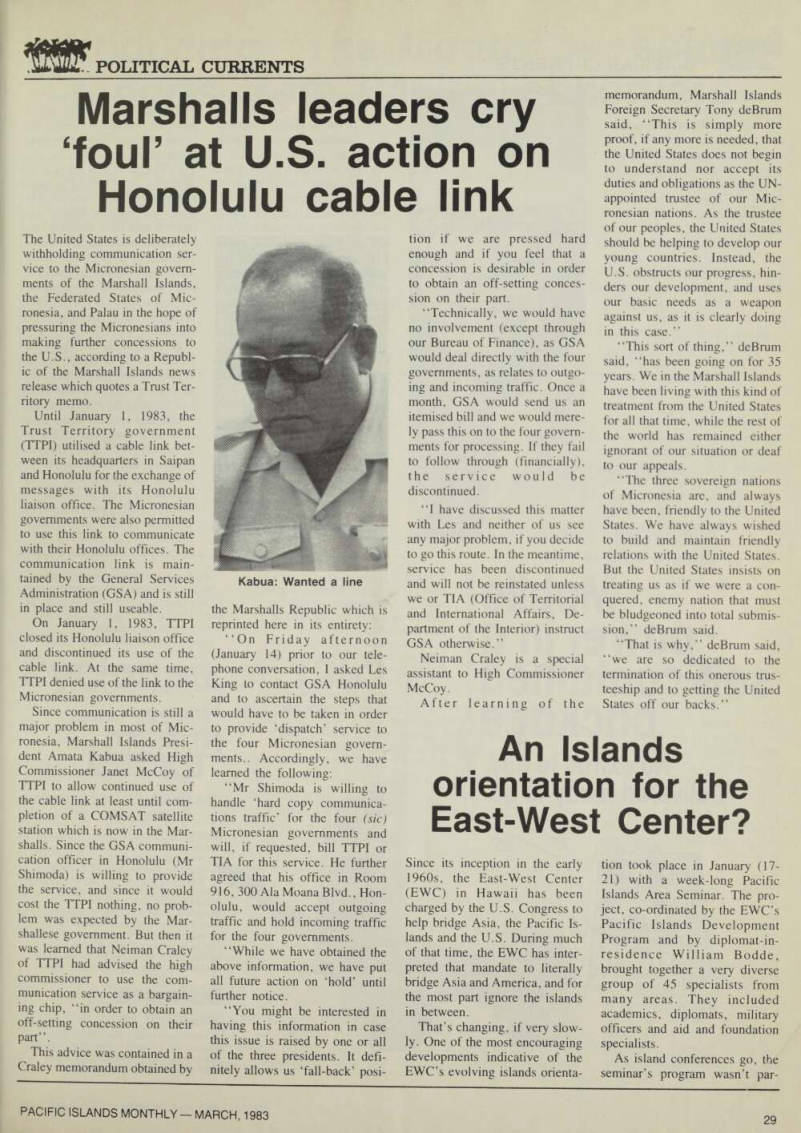
‘foul’ at U.S. action on Honolulu cable link
The United States is deliberately withholding communication ser vice to the Micronesian govern ments of the Marshall Islands, the Federated States of Mic ronesia, and Palau in the hope of pressuring the Micronesians into making further concessions to the U.S., according to a Republ ic of the Marshall Islands news release which quotes a Trust Ter ritory memo.
Until January 1, 1983, the Trust Territory government (TTPI) utilised a cable link bet ween its headquarters in Saipan and Honolulu for the exchange of messages with its Honolulu liaison office. The Micronesian governments were also permitted to use this link to communicate with their Honolulu offices. The communication link is main tained by the General Services Administration (GSA) and is still in place and still useable.
On January 1, 1983, TTPI closed its Honolulu liaison office and discontinued its use of the cable link. At the same time, TTPI denied use of the link to the Micronesian governments.
Since communication is still a major problem in most of Mic ronesia, Marshall Islands Presi dent Amata Kabua asked High Commissioner Janet McCoy of TTPI to allow continued use of the cable link at least until com pletion of a COMSAT satellite station which is now in the Mar shalls. Since the GSA communi cation officer in Honolulu (Mr Shimoda) is willing to provide the service, and since it would cost the TTPI nothing, no prob lem was expected by the Mar shallese government. But then it was learned that Neiman Craley of TTPI had advised the high commissioner to use the com munication service as a bargain ing chip, “in order to obtain an off-setting concession on their part”.
This advice was contained in a Craley memorandum obtained by
the Marshalls Republic which is reprinted here in its entirety: ‘‘On Friday afternoon (January 14) prior to our tele phone conversation, I asked Les King to contact GSA Honolulu and to ascertain the steps that would have to be taken in order to provide ‘dispatch’ service to the four Micronesian govern ments.. Accordingly, we have learned the following: “Mr Shimoda is willing to handle ‘hard copy communica tions traffic’ for the four (sic) Micronesian governments and will, if requested, bill TTPI or TIA for this service. He further agreed that his office in Room 916, 300 Ala Moana Blvd., Hon olulu, would accept outgoing traffic and hold incoming traffic for the four governments.
“While we have obtained the above information, we have put all future action on ‘hold’ until further notice.
“You might be interested in having this information in case this issue is raised by one or all of the three presidents. It defi nitely allows us ‘fall-back’ posi
tion if we are pressed hard enough and if you feel that a concession is desirable in order to obtain an off-setting conces sion on their part.
“Technically, we would have no involvement (except through our Bureau of Finance), as GSA would deal directly with the four governments, as relates to outgo ing and incoming traffic. Once a month, GSA would send us an itemised bill and we would mere ly pass this on to the four govern ments for processing. If they fail
to follow through (financially),
the service would be discontinued.
“I have discussed this matter with Les and neither of us see any major problem, if you decide to go this route. In the meantime, service has been discontinued and will not be reinstated unless we or TIA (Office of Territorial and International Affairs, De partment of the Interior) instruct GSA otherwise.”
Neiman Craley is a special assistant to High Commissioner
McCoy.
After learning of the
memorandum, Marshall Islands
Foreign Secretary Tony deßrum
said, “This is simply more proof, if any more is needed, that the United States does not begin to understand nor accept its duties and obligations as the UN appointed trustee of our Mic ronesian nations. As the trustee of our peoples, the United States should be helping to develop our young countries. Instead, the U.S. obstructs our progress, hin ders our development, and uses our basic needs as a weapon against us, as it is clearly doing in this case.”
“This sort of thing,” deßrum said, “has been going on for 35 years. We in the Marshall Islands have been living with this kind of treatment from the United States for all that time, while the rest of the world has remained either ignorant of our situation or deaf to our appeals.
“The three sovereign nations of Micronesia are, and always have been, friendly to the United States. We have always wished to build and maintain friendly relations with the United States.
But the United States insists on treating us as if we were a con quered, enemy nation that must be bludgeoned into total submis sion,” deßrum said.
“That is why,” deßrum said, “we are so dedicated to the termination of this onerous trus teeship and to getting the United States off our backs.”
Kabua: Wanted a line
East-West Center?

An Islands orientation for the East-West Center?
Since its inception in the early 19605, the East-West Center (EWC) in Hawaii has been charged by the U.S. Congress to help bridge Asia, the Pacific Is lands and the U.S. During much of that time, the EWC has inter preted that mandate to literally bridge Asia and America, and for the most part ignore the islands in between.
That’s changing, if very slow ly. One of the most encouraging developments indicative of the EWC’s evolving islands orienta
tion took place in January (17- 21) with a week-long Pacific Islands Area Seminar. The pro ject, co-ordinated by the EWC’s Pacific Islands Development Program and by diplomat-in residence William Bodde, brought together a very diverse group of 45 specialists from many areas. They included academics, diplomats, military officers and aid and foundation specialists.
As island conferences go, the seminar’s program wasn’t par-
ticularly notable. It included ex tensive and well presented back ground on the Pacific, discussion of current issues (both political and economic) and other contem porary matters. If anything, the program managed to condense into a few days what normally is presented in two or three similar meetings.
What was particularly impor tant was that the seminar may represent the EWC’s first serious attempt to venture into the is lands outside of its normal bureaucratic framework.
A few points are noteworthy: • A surprisingly diverse group attended, paying upwards of SUSSOO in tuition fees alone.
In the diplomatic contingent, there was a Chilean, a Japanese, a Canadian and two Germans.
American representatives in cluded foreign service officers from the U.S. missions in Suva and Port Moresby. In addition, those planners in the Hawaii based military command who de al with the islands were in attend ance. An indication of the inter-
est generated by the program in the South Pacific was the pre sense of South Pacific Commis sion Secretary-General Francis Bugotu for the entire week. • The program was billed as a comprehensive introduction to the region, and it did its job well.
The expectation is that the EWC, perhaps early next year, will fol low-up with another seminar.
EWC President Victor Li has indicated his interest, and most participants were in favor of such a move. A more narrowly focused program seems likely. • For the Hawaii-based con tingent, one of the “surprising” elements of the seminar was the very large number of island specialists in residence here. It made the point that Hawaii does
have the resources to expand its Pacific role, a theme the state’s
governor, George Ariyoshi, has
begun pushing with increasing seriousness. • There were areas of weakness. The lack of a larger number of islanders was trouble some. Ambassador Bodde says more would have attended, but had to cancel at the last minute.
The lack of any official French representative was also unfortu nate. That came about, apparent ly, because the EWC overlooked them when invitations were issued.
No doubt a draw of the Pacific Islands Area Seminar was its venue: Hawaii isn’t a bad place to spend a week or so discussing and debating the Pacific Islands.
But that shouldn’t take away from what took place in Hawaii in January. If the EWC takes the initiative and builds upon the foundation established by the seminar, it could be on the way towards making itself a real force
in island affairs.
Takeuchi.
Floyd K.
William Bodde, diplomat-in residence at the East-West Center in Hawaii, who helped organise the seminar. He said that last-minute cancellations affected attendance, but he was well pleased with the overall result.
Advertisements & other items, p. 30 (1 item)
package
Mobile
power in a
self-contained
package
No extras to buy.
Deiivered ready to go.
f Dis^ a □
LEI 29 HPH S&P
20kVA or 31kVA power wherever you want it. From rugged, reliable Dis-gen units that come complete with cabinet, fuel tank, power outlets, etc. And need no special mounting platform.
Dis-gen electric generating sets. An astute combination of Onan generator and Perkins diesel.
Tough enough to take the hardest knocks. In mining. Construction sites.
Outback engineering projects. Hire companies.
Or anywhere you need a durable, dependable 240/415v power source.
A special marine model is also available.
Rigid underchassis protects the unit wherever you take it. And however you get it there, On a truck or a trailer. On skids. Or lifted in by crane. Undercarriages, 2 or 4 wheels, available as options.
Dis-gen. Mobility and power in a selfcontained package.
Dis-gen 20kVA and 31kVA
electric generating sets.
Available from;
LINCOLN!
Marc welding
The Lincoln Electric Company
(Aust.) Pty. Ltd.
Sydney (Head Office) 35 Bryant street, Podstow, NSW 2211 Telephone: (02) 772 7222 Telex: 22792 Cables: "Llnconweld", Sydney Newcastle Telephone: (049) 61 5381 Telex 28263 Wollongong Telephone: (042) 28 0565 Melbourne Telephone: (03) 481 8444 Telex 31958 Brisbane Telephone: (07) 277 2955 Telex: 41268 Townsville Telephone: (077) 79 9777 Telex 47247 Mackay Telephone: (079) 51 2599 Telex: 48655 Adelaide Telephone: (08) 43 8061 Telex 82794 Perth Telephone: (09) 277 8744 Telex 92914 Karratha (WA) Telephone: (091) 85 2405 Telex 99640 Launceston Telephone (003) 26 3388 Telex 58517
Distragen
Distragen Pty Ltd.
New South Wales (Head Office) 4 Mitchell Road, Brookvale, NSW 2100 Telephone: (02) 9381777 Telex 27733 Melbourne Telephone: (03) 481 0508 Telex 31958 Brisbane Telephone: (07) 275 2926 Telex: 41268 22*
Introducing “The Month” - special
reports from Pacific observers
“The Month” is a new PIM feature designed to provide insights into a number of significant Pacific Island areas and written by correspon dents on the spot.
It will provide five re gular columns on the fol lowing areas: French
Polynesia “The
Month” incorporates the
long-standing “Post mark Papeete” feature of Marie-Therese and Bengt Danielsson; Mic ronesia Floyd K.
Takeuchi continues his series of commentaries on the fast-moving Mic ronesian scene begun in PIM February: New Caledonia Helen Fraser has taken over
the ‘‘Noumea Notebook” portfolio which has been missing for some time from our pages; Hawaii Dr Robert C. Kiste, director of the Pacific Is lands Studies Program, University of Hawaii, will write regularly on Hawaiian affairs, espe cially as they relate to Pacific Island questions:
Vanuatu Christine Coombe, founder and editor of the weekly Voice of Vanuatu, com ments on affairs in that country, which is a pe rennial source of interest to Pacific Islands watchers.
Welcome to “The Month”.
Cyclones of 1903

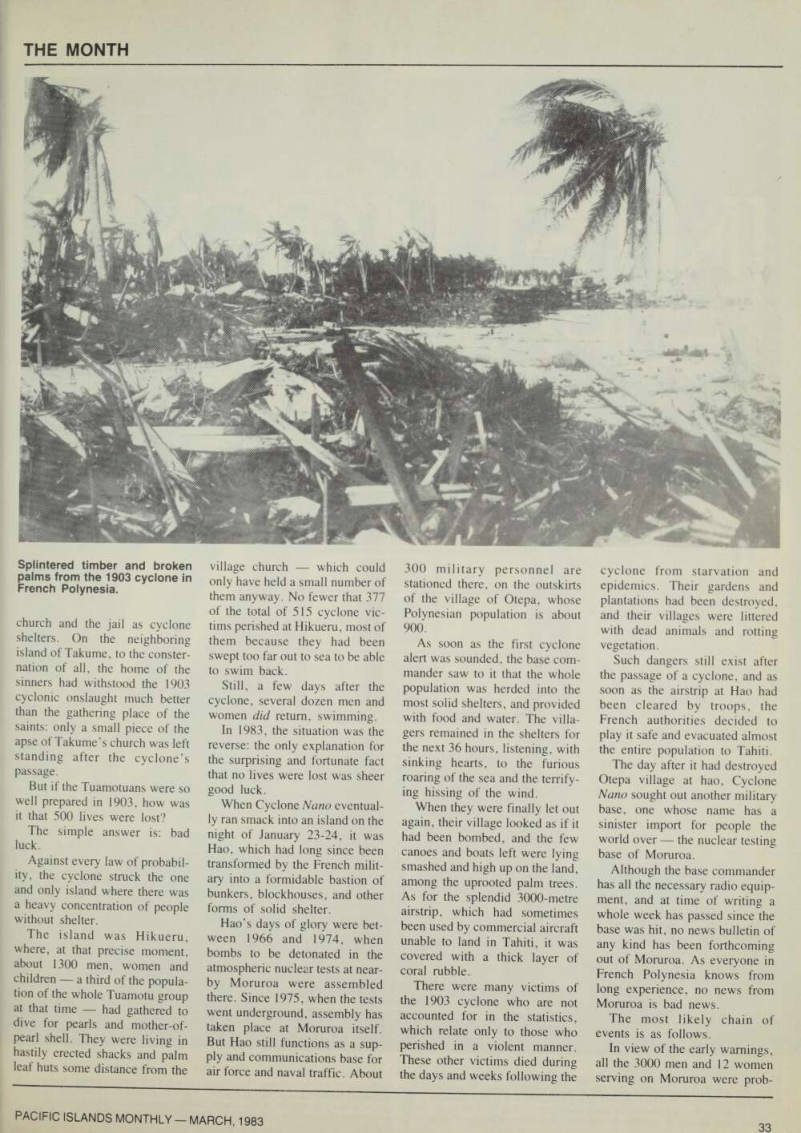

and 1983
Postmark Papeete Marie-Therese and Bengt Danielsson
In the local parlance of Tahiti “the cyclone” invariably means the one that, in 1903, devastated the islands of the Tuamotu group, east of Tahiti, and drown ed more than 500 people. The best account of “the cyclone” is to be found in the novel, The Hurricane , by Nordhoff and Hall, which builds on informa tion obtained by the authors from survivors.
“The cyclone” was followed in 1905 and 1906 by two others of much less destructive force.
But in the popular tradition, these have been overshadowed by, and even merged with, the big one of 1903.
It was not until January 1983 that the Tuamotus were once
again hit by a comparable, full scale, cyclone. This one fully lived up to its code name of Nano, the Tahitian word for “ex plosive force” applied, for example, to a spear or a bullet.
Nano’s first exploit was to deluge the Marquesas on January 21-22. From the Marquesas it travelled slowly southwards along the eastern edge of the Tuamotus, generating whirl winds of up to 200 kilometres per hour, and stirring up 10-metre high waves which engulfed at least 15 atolls, including Hao, the site of a military communica tions centre, and the nuclear test ing base of Moruroa. Although the destruction wrought on houses, wharves, airstrips and
coconut plantations was terrific, surprisingly enough no human lives were lost.
The explanation for this fortunate circumstance most commonly heard in the present situation in French Polynesia is the prevalence of transistor radios in the territory. Even in the remotest islands practically every family owns a radio and listens regularly to the Tahitian-language programs which include weather forecasts. Since Cyclone Nano originated in the Marquesas, and moved across the ocean at the rather slow rate of 20-odd kilometres per hour, the Tuamotuans were warned well in advance of its coming.
But proud as we may be of the technical achievement represented by modem radio communications, we should not forget that the naked Tuamotuans of old had their own extensive weather lore, and were perfectly able to read all the signs of sea and sky that
warned them of the approach of a cyclone.
All existing records show, for example, that in 1903, through out the Tuamotu group, people were aware that the cyclone was coming, and had taken shelter in good time. Not in palm trees as the South Seas books and movies would have it but in the most solid buildings they could find, which usually meant the churches. There were also on most islands prisons with equally solid walls, built for the purpose of locking up offenders against the missionary-inspired codes of behavior, which forbade practic ally everything that had given pleasure to the Tuamotuans from time immemorial; uninhibited love-making, frenzied singing and dancing, heroic warrior deeds, and cannibal feasts. On an island like Raroia, where we lived from 1949 to ’5l, the old folk were still at that time debat ing the relative merits of the
church and the jail as cyclone shelters. On the neighboring island of Takume, to the conster nation of all, the home of the sinners had withstood the 1903 cyclonic onslaught much better than the gathering place of the saints: only a small piece of the apse of Takume’s church was left standing after the cyclone’s passage.
But if the Tuamotuans were so well prepared in 1903, how was it that 500 lives were lost?
The simple answer is: bad luck.
Against every law of probabil ity, the cyclone struck the one and only island where there was a heavy concentration of people without shelter.
The island was Hikueru, where, at that precise moment, about 1300 men, women and children a third of the popula tion of the whole Tuamotu group at that time had gathered to dive for pearls and mother-of pearl shell. They were living in hastily erected shacks and palm leaf huts some distance from the
village church which could only have held a small number of them anyway. No fewer that 377 of the total of 515 cyclone vic tims perished at Hikueru, most of them because they had been swept too far out to sea to be able to swim back.
Still, a few days after the cyclone, several dozen men and women did return, swimming.
In 1983, the situation was the reverse: the only explanation for the surprising and fortunate fact that no lives were lost was sheer good luck.
When Cyclone Nano eventual ly ran smack into an island on the night of January 23-24, it was Hao, which had long since been transformed by the French milit ary into a formidable bastion of bunkers, blockhouses, and other forms of solid shelter.
Hao’s days of glory were bet ween 1966 and 1974, when bombs to be detonated in the atmospheric nuclear tests at near by Moruroa were assembled there. Since 1975, when the tests went underground, assembly has taken place at Moruroa itself.
But Hao still functions as a sup ply and communications base for air force and naval traffic. About
-300 military personnel are stationed there, on the outskirts of the village of Otepa, whose Polynesian population is about As soon as the first cyclone alert was sounded, the base commander saw to it that the whole population was herded into the most solid shelters, and provided with food and water. The villagers remained in the shelters for the next 36 hours, listening, with sinking hearts, to the furious roaring of the sea and the terrifying hissing of the wind.
When they were finally let out again, their village looked as if it had been bombed, and the few canoes and boats left were lying smashed and high up on the land, among the uprooted palm trees.
As for the splendid 3000-metre airstrip, which had sometimes been used by commercial aircraft unable to land in Tahiti, it was covered with a thick layer of coral rubble.
There were many victims of the 1903 cyclone who are not accounted for in the statistics, which relate only to those who perished in a violent manner.
These other victims died during the days and weeks following the
cyclone from starvation and epidemics. Their gardens and plantations had been destroyed, and their villages were littered with dead animals and rotting vegetation.
Such dangers still exist after the passage of a cyclone, and as soon as the airstrip at Hao had been cleared by troops, the French authorities decided to play it safe and evacuated almost the entire population to Tahiti.
The day after it had destroyed Otepa village at hao. Cyclone Nano sought out another military base, one whose name has a sinister import for people the world over the nuclear testing base of Moruroa.
Although the base commander has all the necessary radio equip ment, and at time of writing a whole week has passed since the base was hit, no news bulletin of any kind has been forthcoming out of Moruroa. As everyone in French Polynesia knows from long experience, no news from Moruroa is bad news.
The most likely chain of events is as follows.
In view of the early warnings, all the 3000 men and 12 women serving on Moruroa were prob
Splintered timber and broken palms from the 1903 cyclone in French Polynesia.
ably able to take shelter in good time on the 23 four-and-a-half metre high platforms erected two years ago on the reef near the village, with precisely such an emergency in mind. They all
probably escaped relatively un
hurt, without any other problem than the destruction of their liv ing quarters. It is also possible that by some miracle the drilling platform erected in the waters of the lagoon withstood the fierce onslaught of hurricane-force winds and waves.
But there remains the terrible problem of the huge amounts of nuclear waste which for years have been piling up on Moruroa’s north coast, and which now and then have spilled over into the ocean and even been carried to foreign shores.
The Moruroa base people should at least tell us how much of this
lethal stuff some of it consists
of plutonium was dispersed
by Cyclone Nano, and what mea sures are comtemplated to meet similar situations in the future.
Looking at the other islands in the Tuamotu group, there is not much difference at all between the ravages caused by the two
cyclones occurring 80 years
apart. The shelters available to the islanders are also the same
although the prisons have long
since disappeared with the ad vent of a more secular and de mocratic form of government.
But on the other hand the number of churches has increased many times over, due to the ever in
creasing competition from new
sects. Whatever divisions and bitterness they cause, the new churches serve the whole com munity in times of natural disas ters, and their multiplication in
fact corresponds to the needs of a population which has at least doubled since 1903.
Finally, we can now clearly see that the 1903 cyclone destroyed not only human lives, but also speeded up the erosion of the traditional Polynesian culture. Polynesian-type houses, canoes, fishing gear and tools were carried away and replaced with houses and gear of European materials and manufacture. innumerable manuscripts in which the islanders had written down genealogies and other ancient lore as soon as the missionaries had taught them the three Rs were lost. More often than not, the islanders who perished were elderly people, who had acted as repositories and transmitters of the Polynesian culture.
The mass media have already
announced that the Hao islan ders, evacuated by the army to Tahiti, “have settled down hap pily in their new surroundings”, which, unfortunately, most like ly means that they will be staying for good. Their ranks are already
being rapidly swelled by other
“refugees” from the Tuamotus
whose only justification for
abandoning their home islands is the awful fright Nano has given them and their apparently com plete unawareness that such dis asters occur in this part of the Pacific at most once in a lifetime.
Unfortunately, moving from
the relative security of life on their home islands to the urban, Western-style life they find at tractive in Papeete, means for most Polynesians a journey on a one-way ticket to poverty and
disarray.
Marie-Thérèse and
Bengt Danielsson.
Advertisements & other items, pp. 32-34 (2 items)
Expert
Insurance Service
throughout the islands
Queensland Insurance (Fiji) Limited
Head Office, 34 Usher St . SUVA General Manager: L. G, Liddell A,A.1.1. Assistant Managers: R Jackson. Vijay Lai Phone: 23851 LAUTOKA OFFICE Burns Philp Bldg Naviti St District Manager: J. Dalton, Phone 60642 LABASA OFFICE: Burns Philp Bldg District Manager: R, Sharma Phone: 82139
Queensland Insurance (PNG) Limited
PAPUA NEW GUINEA
Head Office. B.N.G Building, Musgrave St PORT MORESBY. General Manager: T. Sarti Phone: 21 2144 LAE 4th St & Coronation Drive. District Manager: C. D Hillier Phone: 423873.
MOUNT HAGEN: Hagen Drive District Manager G, Hayes Phone; 521002 ARAWA: Chebu St. District Manager: J Longbut, Phone: 951555.
MADANG Kasagten St. District Manager: N D Ramage. Phone: 822020.
RABAUL Wirraway St. District Manager R. McManus Phone: 921014.
QBE Insurance (International) Limited
VANUATU PORT VILA: Rue de Paris, Suite 19,Oceania Bldg. Manager: I. R Martin.
Phone; 2299.
SANTO: Burns Philp ( Vanuatu) Ltd Phone: 230.
PACIFIC AGENCIES
NEW CALEDONIA Ste W. A. Johnston, S AP L. 5 Rue Anatole France, NOUMEA Phone: 272083.
TAHITI Arthur Chung, Immeuble 8.1.5., Front de Mer, PAPEETE Phone. 2 86 19 NIUE: Burns Philp (South Sea) Company Ltd.
NORFOLK ISLAND: Burns Philp ('N I ) Company Ltd. Phone: 2191 SAMOA APIA Burns Philp (South Sea) Company Ltd, Phone 22611 TONGA Burns Ph ip (South Sea) Company Ltd NUKUALOFA Phone 21500 HAAPAI, VAVAU
MEMBERS OF THE
INSURANCE GROUP LIMITED
K ' ' ' IF r A C \ 1. £ ■ W hen Sansui mates computers with high performance component systems you get convenience. Like "Compu Edit.” a feature that allows automatic edit recording of songs from disc to tape in any programmed order. And the "Compu-Selector System” for one-touch synchronized play. And memory station selection.
Intelligent Super Compo the smartest hi-fi systems ever designed. = o % i\ N For further information please contact; SANSUI ELECTRIC CO., LTD. 14-1 Izumi 2-chome, Suginami-ku, Tokyo 168, Japan. fi Pnn/?83 Alfred Place North Sydney, N.S.W. 2060, Australia Phone: • Australia VANFI (Aust.) Pty. Ltd. 297, City Road, South Melbourne Victona 3205, Austraha AM dPI Port Moresby Phone: 929-0293 • Fiji Prabhu Brothers Ltd. PO. Box 183, Nadi Phone: 71122 . Papua Michei Q p Noumea phone: 27 . 59 . n PM 256411 • New Zealand David Reid Electronics Ltd. PO. Box 2630, PO Box 434 C Villa Phone: 2035 • Tahiti SIMEL PO. Box 3338 Papeete Phone: 2-49-68 • Central Pacific Nauru Co-operative Society Republic of Nauru • Vanuatu The Sound Centre P.U. Box 434, vma rnone
The Month
top in Vanuatu
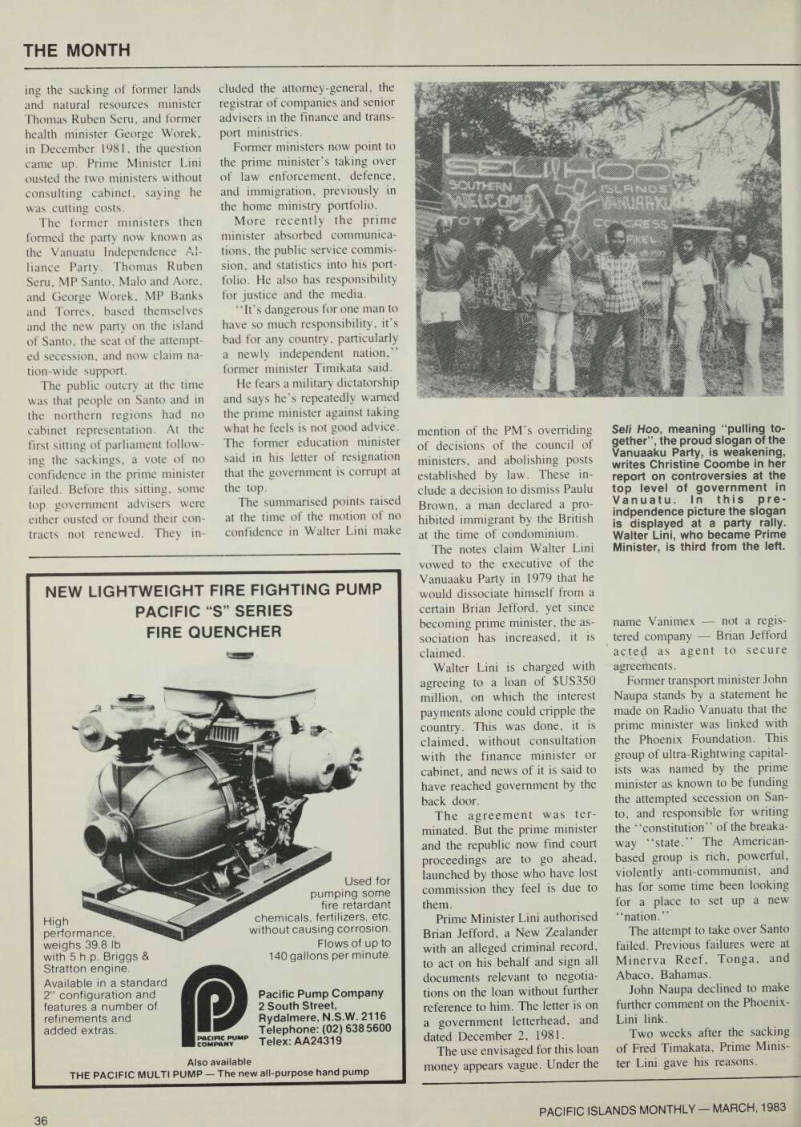
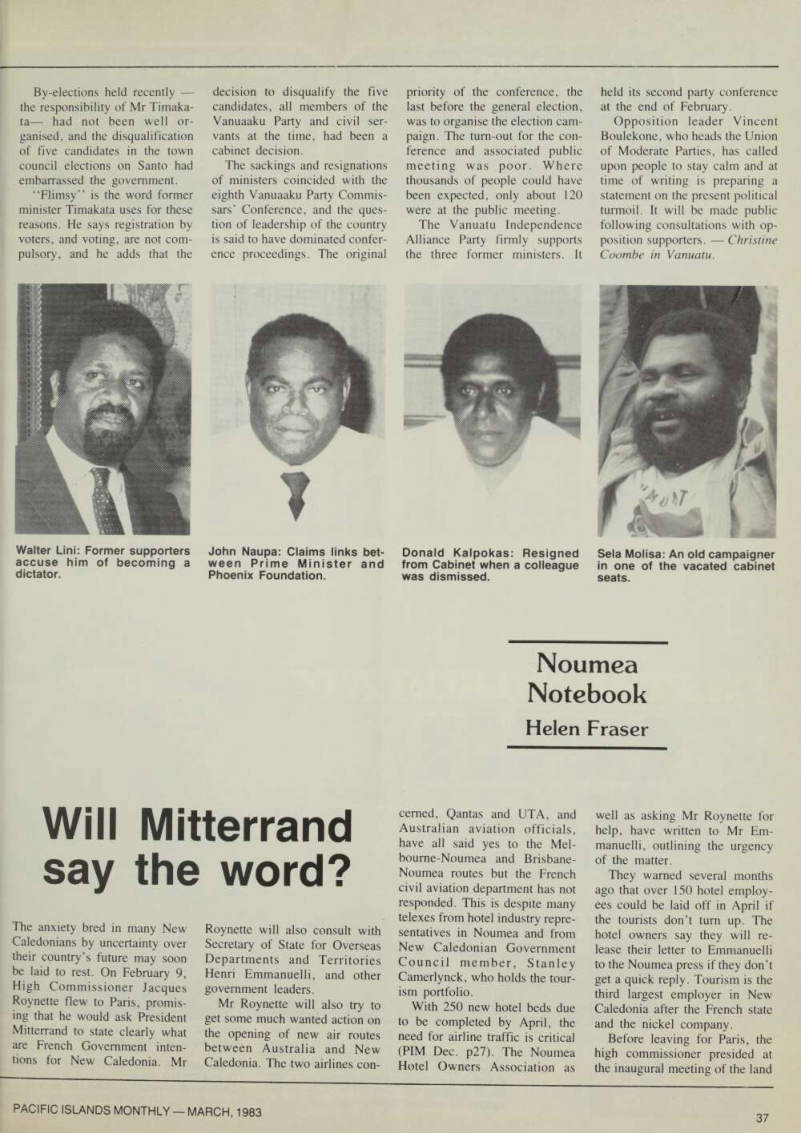
Turmoil at the top in Vanuatu
Report from Vanuatu Christine Coombe
Sell Hoo, meaning “pulling to gether”, the proud slogan of the Vanuaaku Party, is weakened.
And it has been weakened at a crucial time.
General elections for the young nation of Vanuatu are due by November 1983, the first since independence from joint British and French rule in 1980.
But the loss of three ministers, half of Prime Minister Walter Uni’s cabinet, in February, has sparked serious charges focused on the prime minister’s ability to lead the nation.
First, the Deputy Prime Minis ter and Minister for Home Af fairs, Fred Timakata, was sacked
by Prime Minister Lini, who said he would give his reasons later.
Then, the Minister of Educa tion, Donald Kalpokas, resigned.
He was followed by the Minister of Transport,John Naupa.
Both resigning ministers gave a period of notice which was not accepted by the prime minister, who immediately terminated their ministerial appointments.
Following this flurry of events, Prime Minister Lini has been charged with dictatorship, corruption, giving authority to an alleged criminal to act on his behalf, raising loan money of SUS3SO million without cabinet
approval, allowing an adviser to remain in government against the decision of the council of minis ters, and of links with the ultra- Rightwing Phoenix Foundation which is known to have support ed the attempted secession of the island of Santo which was in the hands of rebels on independence.
Ironically, the three former ministers making these allega tions are long-standing and trust ed friends of Walter Lini, all founder members of the Vanuaaku Party, who put the goal of political freedom for the people of the nation above all other considerations.
Those who know the prime minister, an Anglican father, find the accusations beyond be lief. An enigma, they say of him.
Prime Minister Lini has declined to comment on all accusations.
All he has said is that he won’t resign.
His resignation is what the three former ministers want.
However, they have all pledged their continued support for the party, and it appears that they have kept silent about their fears, and the allegations they are now making, in order to hold the party together.
Except in one case new ap pointments have been made to the vacated ministerial positions.
The new deputy prime minis ter is Sethy Regenvanu, minister for lands and natural resources.
The new minister for home affairs is Sela Molisa, an MP from a Santo constituency.
Onneyn Tahi, an MP from Ambae-Maewo, is the new minister of education.
In the case of John Naupa, two weeks after his resignation no one had been found to accept the portfolio. In the meantime, Fi nance Minister Kalpokor Kal sakau is acting minister of transport.
This isn’t the first questioning of Lini’s ability to lead. Follow
ing the sacking of former lands and natural resources minister Thomas Ruben Seru, and former health minister George Worek, in December 1981, the question came up. Prime Minister Lini ousted the two ministers without
consulting cabinet, saying he
was cutting costs.
The former ministers then formed the party now known as the Vanuatu Independence Al liance Party. Thomas Ruben Seru, MP Santo, Malo and Aore, and George Worek, MP Banks and Torres, based themselves and the new party on the island of Santo, the seat of the attempt ed secession, and now claim na tion-wide support.
The public outcry at the time was that people on Santo and in the northern regions had no cabinet representation. At the first sitting of parliament follow ing the sackings, a vote of no confidence in the prime minister failed. Before this sitting, some top government advisers were either ousted or found their con tracts not renewed. They in
eluded the attorney-general, the registrar of companies and senior advisers in the finance and trans port ministries.
Former ministers now point to the prime minister’s taking over of law enforcement, defence, and immigration, previously in the home ministry portfolio.
More recently the prime minister absorbed communica tions, the public service commis sion, and statistics into his port folio. He also has responsibility for justice and the media.
“It’s dangerous for one man to have so much responsibility, it’s bad for any country, particularly a newly independent nation,’’ former minister Timikata said.
He fears a military dictatorship and says he’s repeatedly warned the prime minister against taking what he feels is not good advice.
The former education minister said in his letter of resignation that the government is corrupt at the top.
The summarised points raised at the time of the motion of no confidence in Walter Lini make
mention of the PM's overriding of decisions of the council of ministers, and abolishing posts established by law. These in clude a decision to dismiss Paulu Brown, a man declared a pro hibited immigrant by the British at the time of condominium.
The notes claim Walter Lini vowed to the executive of the Vanuaaku Party in 1979 that he would dissociate himself from a certain Brian Jefford, yet since becoming prime minister, the as sociation has increased, it is claimed.
Walter Lini is charged with agreeing to a loan of SUS3SO million, on which the interest payments alone could cripple the country. This was done, it is claimed, without consultation with the finance minister or cabinet, and news of it is said to have reached government by the back door.
The agreement was ter minated. But the prime minister and the republic now find court proceedings are to go ahead, launched by those who have lost commission they feel is due to them.
Prime Minister Lini authorised Brian Jefford, a New Zealander with an alleged criminal record, to act on his behalf and sign all documents relevant to negotia tions on the loan without further reference to him. The letter is on a government letterhead, and dated December 2, 1981.
The use envisaged for this loan money appears vague. Under the
name Vanimex not a regis tered company Brian Jefford actetl as agent to secure agreerhents.
Former transport minister John Naupa stands by a statement he made on Radio Vanuatu that the prime minister was linked with the Phoenix Foundation. This group of ultra-Rightwing capital ists was named by the prime minister as known to be funding the attempted secession on San to, and responsible for writing the “constitution’’ of the breaka way “state.” The American based group is rich, powerful, violently anti-communist, and has for some time been looking for a place to set up a new “nation.”
The attempt to take over Santo failed. Previous failures were at Minerva Reef, Tonga, and Abaco, Bahamas.
John Naupa declined to make further comment on the Phoenix- Lini link.
Two weeks after the sacking of Fred Timakata, Prime Minis ter Lini gave his reasons.
Sell Hoo, meaning “pulling to gether”, the proud slogan of the Vanuaaku Party, is weakening, writes Christine Coombe in her report on controversies at the top level of government in Vanuatu. In this pre indpendence picture the slogan is displayed at a party rally.
Walter Lini, who became Prime Minister, is third from the left.
By-elections held recently
the responsibility of Mr Timaka ta — had not been well or
ganised, and the disqualification
of five candidates in the town council elections on Santo had embarrassed the government.
“Flimsy” is the word former minister Timakata uses for these reasons. He says registration by voters, and voting, are not com pulsory, and he adds that the
decision to disqualify the five candidates, all members of the Vanuaaku Party and civil ser vants at the time, had been a cabinet decision.
The sackings and resignations
of ministers coincided with the
eighth Vanuaaku Party Commis
sars’ Conference, and the ques tion of leadership of the country is said to have dominated confer
ence proceedings. The original
priority of the conference, the last before the general election, was to organise the election cam paign. The turn-out for the con ference and associated public meeting was poor. Where thousands of people could have been expected, only about 120 were at the public meeting.
The Vanuatu Independence Alliance Party firmly supports the three former ministers. It
held its second party conference at the end of February.
Opposition leader Vincent Boulekone, who heads the Union of Moderate Parties, has called upon people to stay calm and at time of writing is preparing a statement on the present political turmoil. It will be made public following consultations with op
position supporters. - Coombe in Vanuatu.
Christine
Walter Lini: Former supporters accuse him of becoming a dictator.
John Naupa: Claims links bet ween Prime Minister and Phoenix Foundation.
Donald Kalpokas: Resigned from Cabinet when a colleague was dismissed.
Sela Molisa: An old campaigner in one of the vacated cabinet seats.
Advertisements & other items, p. 36 (1 item)
Fire Quencher
NEW LIGHTWEIGHT FIRE FIGHTING PUMP
PACIFIC “S” SERIES
% * M High performance, weighs 39.8 lb with 5 h.p. Briggs & Stratton engine.
Available in a standard 2" configuration and features a number of refinements and added extras.
I PACIFIC PUMP
■company Used for
pumping some
fire retardant chemicals, fertilizers, etc. without causing corrosion.
Flows of up to 140 gallons per minute.
Pacific Pump Company 2 South Street, Rydalmere, N.S.W. 2116 Telephone: (02) 638 5600 Telex: AA24319 Also available THE PACIFIC MULTI PUMP The new all-purpose hand pump
Will Mitterrand


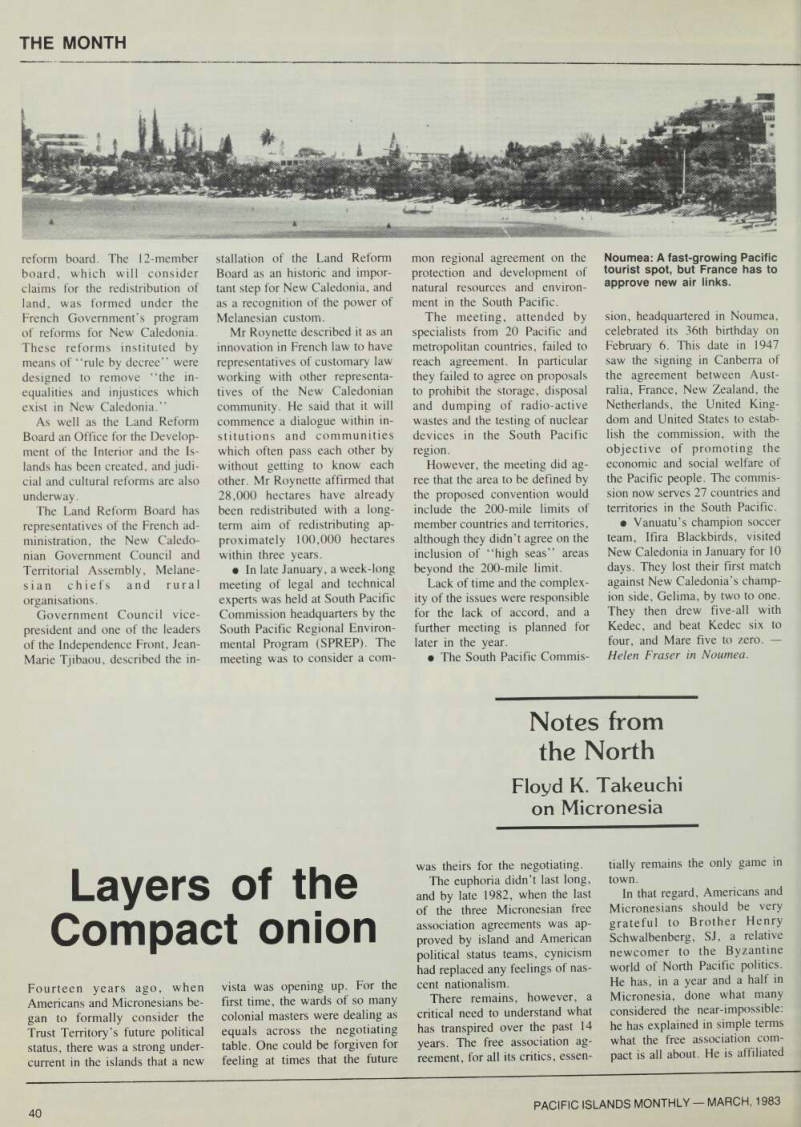
say the word?
Noumea Notebook Helen Fraser
The anxiety bred in many New Caledonians by uncertainty over their country’s future may soon be laid to rest. On February 9, High Commissioner Jacques Roynette flew to Paris, promis ing that he would ask President Mitterrand to state clearly what are French Government inten tions for New Caledonia. Mr
Roynette will also consult with Secretary of State for Overseas Departments and Territories Henri Emmanuelli, and other government leaders.
Mr Roynette will also try to get some much wanted action on the opening of new air routes between Australia and New Caledonia. The two airlines con
cemed, Qantas and UTA, and Australian aviation officials, have all said yes to the Mel boume-Noumea and Brisbane- Noumea routes but the French civil aviation department has not responded. This is despite many telexes from hotel industry repre sentatives in Noumea and from New Caledonian Government Council member, Stanley Camerlynck, who holds the tour ism portfolio.
With 250 new hotel beds due to be completed by April, the need for airline traffic is critical (PIM Dec. p 27). The Noumea Hotel Owners Association as
well as asking Mr Roynette for help, have written to Mr Em manuelli, outlining the urgency of the matter.
They warned several months ago that over 150 hotel employ ees could be laid off in April if the tourists don’t turn up. The hotel owners say they will re lease their letter to Emmanuelli to the Noumea press if they don’t get a quick reply. Tourism is the third largest employer in New Caledonia after the French state and the nickel company.
Before leaving for Paris, the high commissioner presided at the inaugural meeting of the land
reform board. The 12-member board, which will consider claims for the redistribution of land, was formed under the French Government’s program of reforms for New Caledonia.
These reforms instituted by means of “rule by decree’’ were designed to remove “the in
equalities and injustices which
exist in New Caledonia.’’
As well as the Land Reform Board an Office for the Develop ment of the Interior and the Is lands has been created, and judi cial and cultural reforms are also underway.
The Land Reform Board has representatives of the French ad ministration, the New Caledo nian Government Council and Territorial Assembly, Melane sian chiefs and rural
organisations.
Government Council vice president and one of the leaders of the Independence Front, Jean- Marie Tjibaou, described the in
stallation of the Land Reform Board as an historic and impor tant step for New Caledonia, and as a recognition of the power of Melanesian custom.
Mr Roynette described it as an innovation in French law to have representatives of customary law working with other representa tives of the New Caledonian community. He said that it will commence a dialogue within in stitutions and communities which often pass each other by without getting to know each other. Mr Roynette affirmed that 28,000 hectares have already been redistributed with a long term aim of redistributing ap proximately 100,000 hectares within three years. • In late January, a week-long meeting of legal and technical experts was held at South Pacific Commission headquarters by the South Pacific Regional Environ mental Program (SPREP). The meeting was to consider a corn
mon regional agreement on the protection and development of natural resources and environ ment in the South Pacific.
The meeting, attended by specialists from 20 Pacific and metropolitan countries, failed to reach agreement. In particular they failed to agree on proposals to prohibit the storage, disposal and dumping of radio-active wastes and the testing of nuclear devices in the South Pacific region.
However, the meeting did ag ree that the area to be defined by the proposed convention would include the 200-mile limits of member countries and territories, although they didn’t agree on the inclusion of “high seas’’ areas beyond the 200-mile limit.
Lack of time and the complex ity of the issues were responsible for the lack of accord, and a further meeting is planned for later in the year. • The South Pacific Commis
sion, headquartered in Noumea, celebrated its 36th birthday on February 6. This date in 1947 saw the signing in Canberra of the agreement between Aust ralia, France, New Zealand, the Netherlands, the United King dom and United States to estab lish the commission, with the
objective of promoting the
economic and social welfare of the Pacific people. The commis sion now serves 27 countries and territories in the South Pacific. • Vanuatu’s champion soccer team, Ifira Blackbirds, visited New Caledonia in January for 10 days. They lost their first match against New Caledonia’s champ ion side, Gelima, by two to one.
They then drew five-all with Kedec, and beat Kedec six to four, and Mare five to zero.
Helen Fraser in Noumea.
Noumea: A fast-growing Pacific tourist spot, but France has to approve new air links.
Advertisements & other items, pp. 38-39 (1 item)
Toyota
LAND CRUISER
STATION WAGON
LAND CRUISER
PICK UP
HI ACE
CB *-jr !t? n * :
TOYOTA
SERVICE
PAPUA NEW GUINEA: ELA MOTORS,
Scratchley Rd„ Badili, P.O. Box 675. Port Moresby.
NORTHERN MARIANAS & U.S.T.T.:
MICROL CORPORATION, P.O. Box 267, Saipan.
FIJI: AUTOMOTIVE SUPPLIES COMPANY, G.P.O.
Box 355, Suva.
AMERICAN SAMOA: BURNS PHILP
(SOUTHSEA) CO., LTD., P.O. Box 129, Pago Pago.
WESTERN SAMOA: BURNS PHILP (SOUTHSEA)
CO., LTD., P.O. Box 188, Apia.
TONGA: BURNS PHILP (SOUTHSEA) CO., LTD.,
P O. Box 55, Nuku’alofa.
GUAM: ATKINS, KROLL (GUAM) LTD., P.O. Box 64 Tamuning.
DYNA
HI-LUX
DOUBLE CAB
M r HR
TRUCK
HEAVY DUTY
TOYOTA ROADMASTERS:
READY TO TAKE
ON THE TOUGHEST JOBS.
Meet Toyota’s hard working commercial vehicles.
Tough. Durable. Ready to meet the challenge of the worst roads and climates. Ready to do the job called for with ease.
Rugged veterans, each one specifically designed to meet the different demands of the world’s businesses.
One of them is just right for you.
There are no vehicles more reliable. And if you need it, Toyota is ready with fast backup service
Toyota’s roadmastera, they’re a
ANUATU: VANUATU MOTORS, P.O. Box 18. Port Vila. KIRIBATI: TARAWA MOTORS. Box 36 Bairiki ljl DMOM- MPMHAMA CMTcnnmoro /o ■ \ i t-hn -r . •.
DLOMON: MENDANA ENTERPRISES (5.1.) LTD.,
P.O. Box 174, Honiara.
Mill: NIPPON AUTOMOTO, B.P. 342, Papeete
OOK ISLANDS: COOK ISLANDS TRADING
ORPORATION LTD., P.O. Box 92, Rarotonga
AURU: NAURU COOPERATIVE SOCIETY.
Tarawa, Kiribati.
NORFOLK ISLAND: BORRY’S RENTAL CARS,
MOUNT PITT (ENTERPRISES) LTD., P.O. Box 169.
NEW CALEDONIA: SERVICE IMPORTATION
AUTOMOBILE DU PACIFIQUE, Rond-Point
du Pacifique (Station Total) B.P. 438, Noumea.
TOYOTA
The Toyota range includes:
COROLLA, STARLET, CORONA, CRESSIDA, HI-LUX
STOUT, HI ACE, DYNA, COASTER and LAND CRUISER
Compact onion
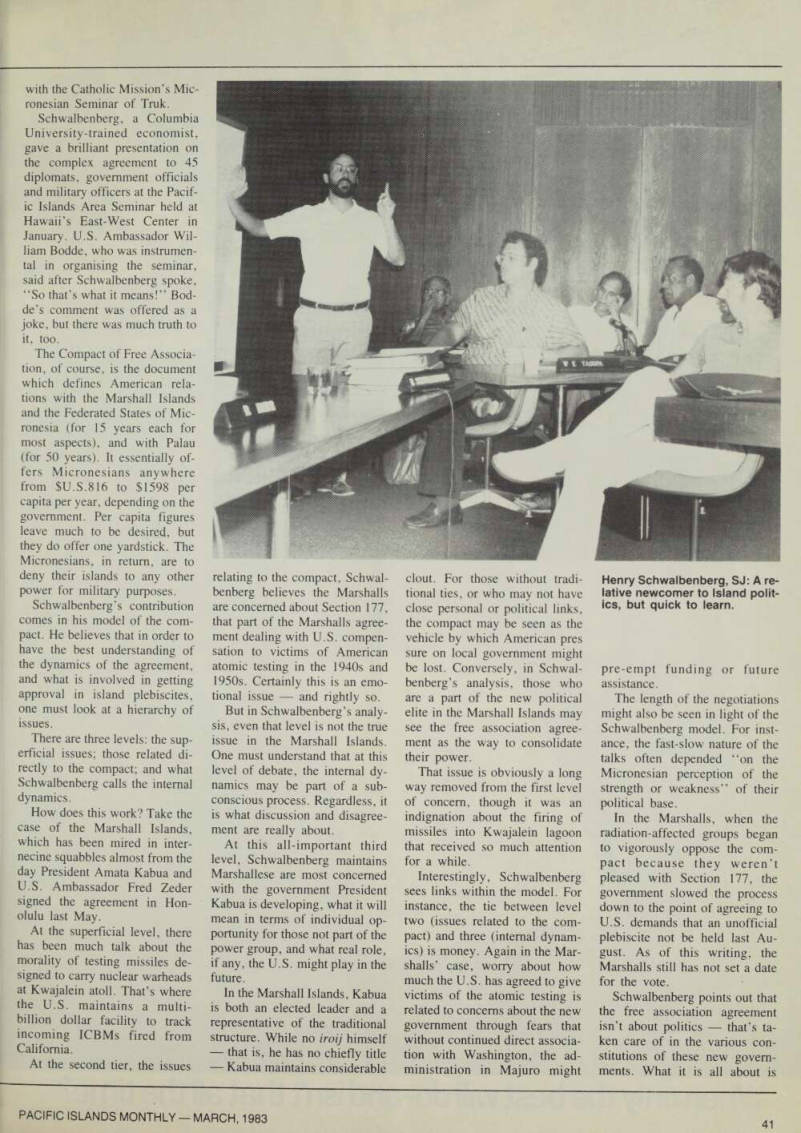
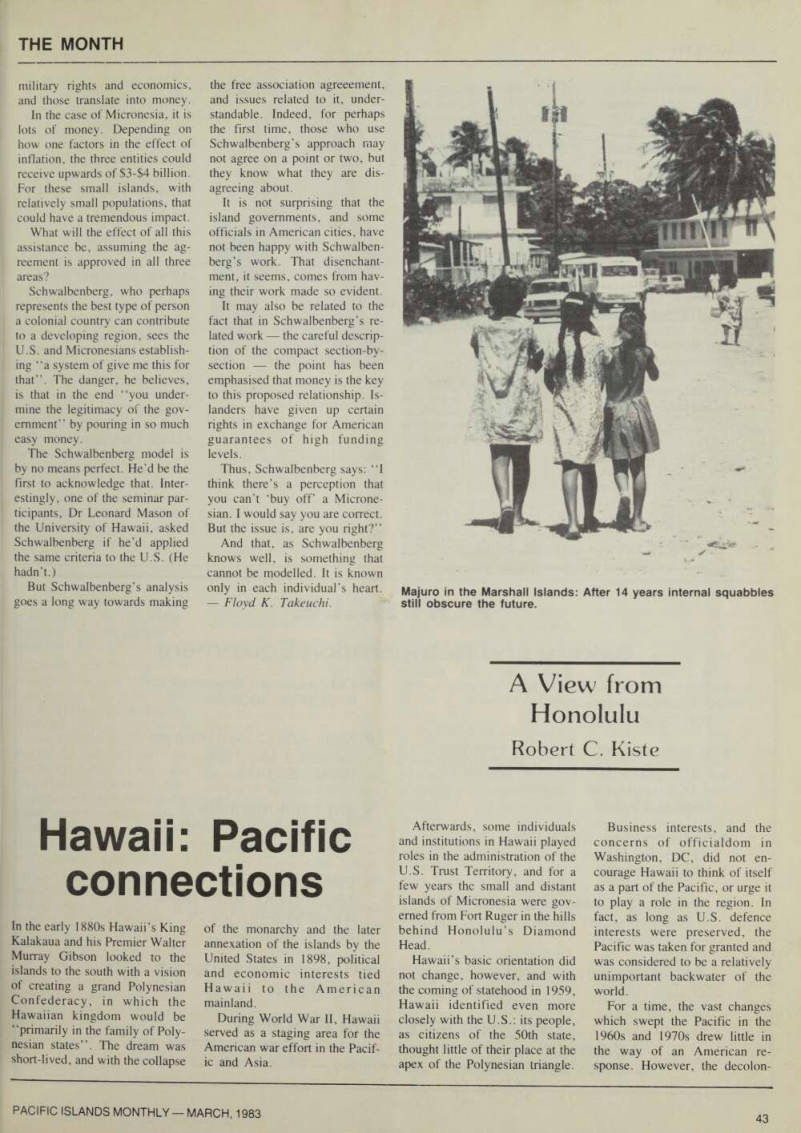
Layers of the Compact onion
Notes from the North Floyd K. Takeuchi on Micronesia
Fourteen years ago, when Americans and Micronesians began to formally consider the Trust Territory’s future political status, there was a strong undercurrent in the islands that a new
vista was opening up. For the first time, the wards of so many colonial masters were dealing as
equals across the negotiating
table. One could be forgiven for feeling at times that the future
was theirs for the negotiating.
The euphoria didn’t last long, and by late 1982, when the last of the three Micronesian free association agreements was ap proved by island and American political status teams, cynicism had replaced any feelings of nas cent nationalism.
There remains, however, a critical need to understand what has transpired over the past 14 years. The free association ag reement, for all its critics, essen
tially remains the only game in town.
In that regard, Americans and Micronesians should be very grateful to Brother Henry Schwalbenberg, SJ, a relative newcomer to the Byzantine world of North Pacific politics.
He has, in a year and a half in Micronesia, done what many considered the near-impossible: he has explained in simple terms what the free association com pact is all about. He is affiliated
with the Catholic Mission’s Mic ronesian Seminar of Truk.
Schwalbenberg, a Columbia University-trained economist, gave a brilliant presentation on the complex agreement to 45 diplomats, government officials and military officers at the Pacif ic Islands Area Seminar held at Hawaii’s East-West Center in January. U.S. Ambassador Wil liam Bodde, who was instrumen tal in organising the seminar, said after Schwalbenberg spoke, “So that’s what it means!” Bod de’s comment was offered as a joke, but there was much truth to it, too.
The Compact of Free Associa tion, of course, is the document which defines American rela tions with the Marshall Islands and the Federated States of Mic ronesia (for 15 years each for most aspects), and with Palau (for 50 years). It essentially of fers Micronesians anywhere from $U.5.816 to $1598 per capita per year, depending on the government. Per capita figures leave much to be desired, but they do offer one yardstick. The Micronesians, in return, are to deny their islands to any other power for military purposes.
Schwalbenberg’s contribution
comes in his model of the com pact. He believes that in order to have the best understanding of the dynamics of the agreement, and what is involved in getting approval in island plebiscites, one must look at a hierarchy of issues.
There are three levels: the sup erficial issues; those related di rectly to the compact; and what Schwalbenberg calls the internal dynamics.
How does this work? Take the case of the Marshall Islands, which has been mired in inter necine squabbles almost from the day President Amata Kabua and U.S. Ambassador Fred Zeder signed the agreement in Hon olulu last May.
At the superficial level, there has been much talk about the morality of testing missiles de signed to carry nuclear warheads at Kwajalein atoll. That’s where the U.S. maintains a multi billion dollar facility to track incoming ICBMs fired from California.
At the second tier, the issues
relating to the compact, Schwal benberg believes the Marshalls are concerned about Section 177, that part of the Marshalls agree ment dealing with U.S. compen sation to victims of American atomic testing in the 1940 s and 19505. Certainly this is an emo tional issue and rightly so.
But in Schwalbenberg’s analy sis, even that level is not the true issue in the Marshall Islands.
One must understand that at this level of debate, the internal dy namics may be part of a sub conscious process. Regardless, it is what discussion and disagree ment are really about.
At this all-important third level, Schwalbenberg maintains Marshallese are most concerned with the government President Kabua is developing, what it will mean in terms of individual op portunity for those not part of the power group, and what real role, if any, the U.S. might play in the future.
In the Marshall Islands, Kabua is both an elected leader and a representative of the traditional structure. While no iroij himself that is, he has no chiefly title Kabua maintains considerable
clout. For those without tradi tional ties, or who may not have close personal or political links, the compact may be seen as the vehicle by which American pres sure on local government might be lost. Conversely, in Schwal benberg’s analysis, those who are a part of the new political elite in the Marshall Islands may see the free association agree ment as the way to consolidate their power.
That issue is obviously a long way removed from the first level of concern, though it was an indignation about the firing of missiles into Kwajalein lagoon that received so much attention for a while.
Interestingly, Schwalbenberg
sees links within the model. For instance, the tie between level two (issues related to the com pact) and three (internal dynam ics) is money. Again in the Mar shalls’ case, worry about how much the U.S. has agreed to give victims of the atomic testing is related to concerns about the new government through fears that without continued direct associa tion with Washington, the ad ministration in Majuro might
pre-empt funding or future assistance.
The length of the negotiations might also be seen in light of the Schwalbenberg model. For inst ance, the fast-slow nature of the talks often depended “on the Micronesian perception of the strength or weakness” of their political base.
In the Marshalls, when the radiation-affected groups began to vigorously oppose the com pact because they weren’t pleased with Section 177, the government slowed the process down to the point of agreeing to U.S. demands that an unofficial plebiscite not be held last Au gust. As of this writing, the Marshalls still has not set a date for the vote.
Schwalbenberg points out that the free association agreement isn’t about politics that’s ta ken care of in the various con stitutions of these new govern ments. What it is all about is
Henry Schwalbenberg, SJ: A re lative newcomer to Island polit ics, but quick to learn.
military rights and economics, and those translate into money.
In the case of Micronesia, it is lots of money. Depending on how one factors in the effect of inflation, the three entities could receive upwards of $3-$4 billion.
For these small islands, with relatively small populations, that could have a tremendous impact.
What will the effect of all this assistance be, assuming the ag reement is approved in all three areas?
Schwalbenberg, who perhaps represents the best type of person a colonial country can contribute to a developing region, sees the U.S. and Micronesians establish ing “a system of give me this for that”. The danger, he believes, is that in the end “you under mine the legitimacy of the gov ernment” by pouring in so much easy money.
The Schwalbenberg model is by no means perfect. He’d be the first to acknowledge that. Inter estingly, one of the seminar par ticipants, Dr Leonard Mason of the University of Hawaii, asked Schwalbenberg if he’d applied the same criteria to the U.S. (He hadn’t.)
But Schwalbenberg’s analysis
goes a long way towards making
the free association agreeement, and issues related to it, under standable. Indeed, for perhaps the first time, those who use Schwalbenberg’s approach may not agree on a point or two, but they know what they are dis
agreeing about.
It is not surprising that the island governments, and some officials in American cities, have not been happy with Schwalben berg’s work. That disenchant ment, it seems, comes from hav ing their work made so evident.
It may also be related to the fact that in Schwalbenberg’s re lated work the careful descrip tion of the compact section-by section the point has been emphasised that money is the key to this proposed relationship. Is landers have given up certain rights in exchange for American
guarantees of high funding
levels.
Thus, Schwalbenberg says: “I think there’s a perception that you can’t ‘buy off’ a Microne sian. I would say you are correct.
But the issue is, are you right?”
And that, as Schwalbenberg knows well, is something that cannot be modelled. It is known only in each individual’s heart.
Floyd K. Takeuchi.
Majuro in the Marshall Islands: After 14 years internal squabbles still obscure the future.
Advertisements & other items, p. 42 (1 item)
When only the best will do-and isn't that all the time?
»uuu "Utlu ' I ■ o fit ■■ Vmm M
STS
* -1 ' ' ’ - : *#v f J e -■■v:.:-- ■^■rv-.:'. ?, i '*s%*''•. s . eaa When only the best will do-and isn't that all the time?
Hawaii: Pacific
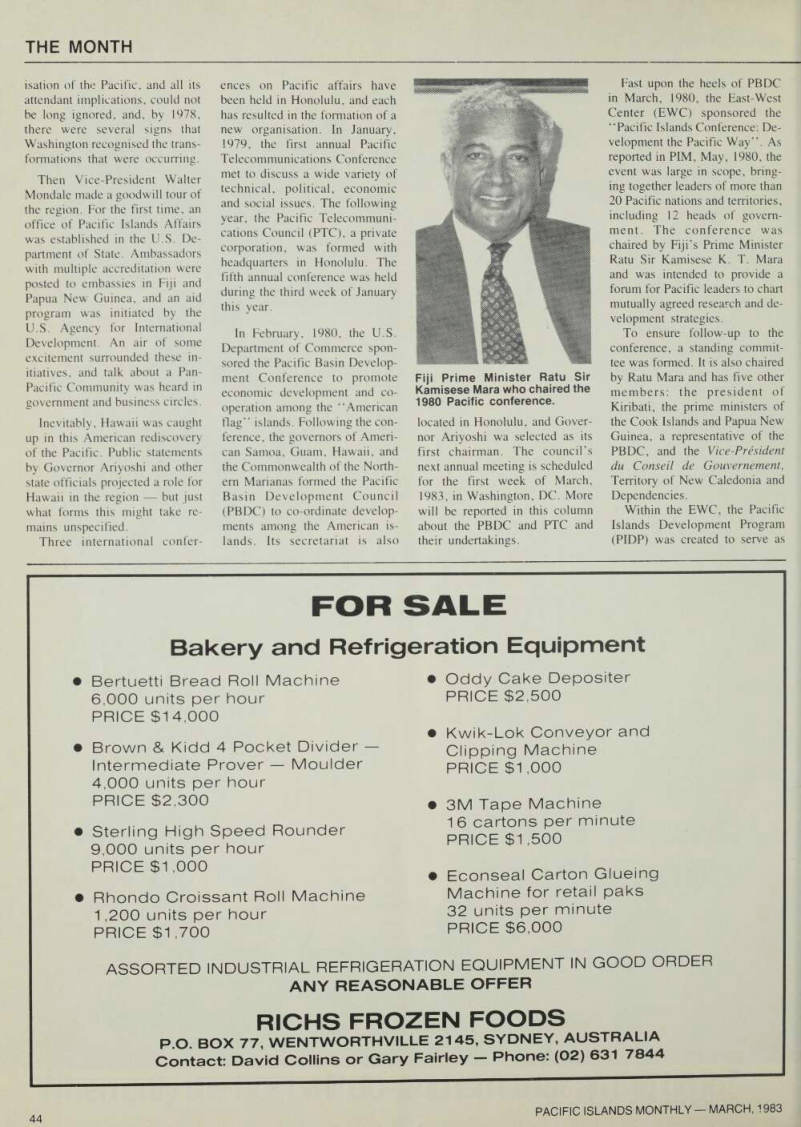
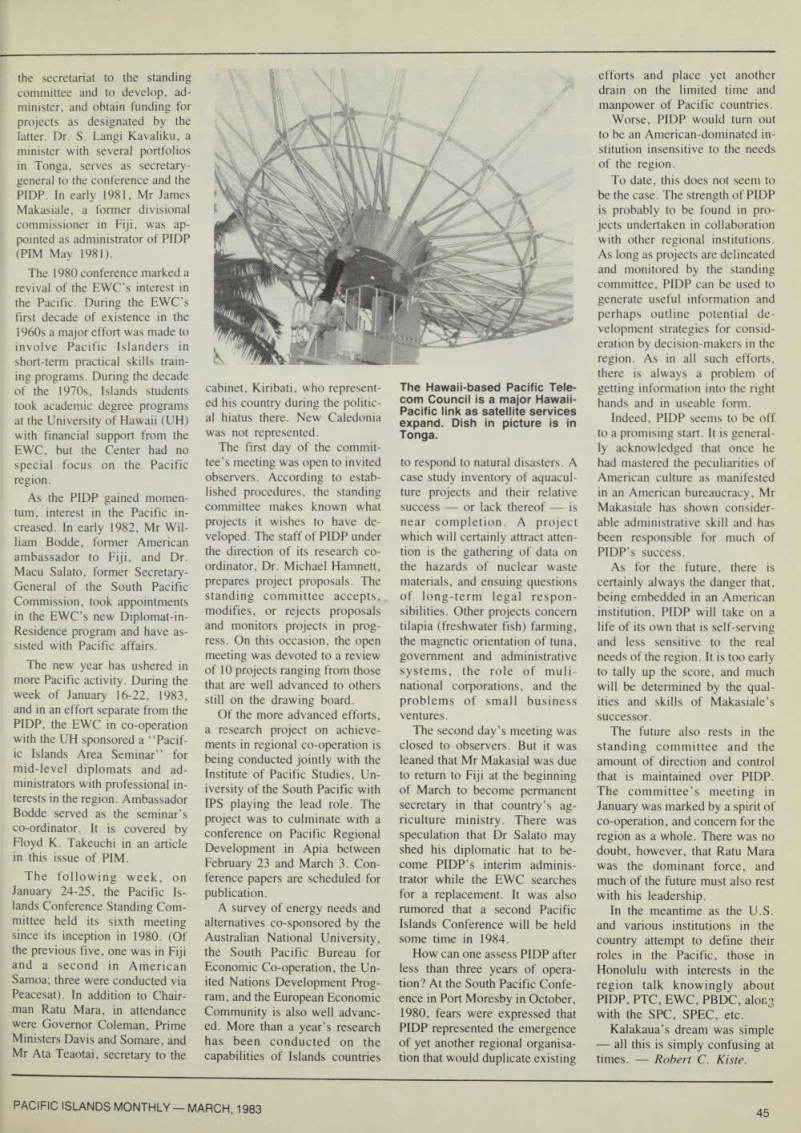
connections
A View from Honolulu Robert C. Kiste
In the early 1880 s Hawaii’s King Kalakaua and his Premier Walter Murray Gibson looked to the islands to the south with a vision of creating a grand Polynesian Confederacy, in which the Hawaiian kingdom would be “primarily in the family of Poly nesian states’’. The dream was short-lived, and with the collapse
of the monarchy and the later annexation of the islands by the United States in 1898, political and economic interests tied Hawaii to the American mainland.
During World War 11, Hawaii served as a staging area for the American war effort in the Pacif ic and Asia.
Afterwards, some individuals and institutions in Hawaii played roles in the administration of the U.S. Trust Territory, and for a few years the small and distant islands of Micronesia were gov erned from Fort Ruger in the hills behind Honolulu’s Diamond Head.
Hawaii’s basic orientation did not change, however, and with the coming of statehood in 1959, Hawaii identified even more closely with the U.S.: its people, as citizens of the 50th state, thought little of their place at the apex of the Polynesian triangle.
Business interests, and the concerns of officialdom in Washington, DC, did not en courage Hawaii to think of itself as a part of the Pacific, or urge it to play a role in the region. In fact, as long as U.S. defence interests were preserved, the Pacific was taken for granted and was considered to be a relatively unimportant backwater of the world.
For a time, the vast changes which swept the Pacific in the 1960 s and 1970 s drew little in the way of an American re sponse. However, the decolon
isation of the Pacific, and all its attendant implications, could not be long ignored, and, by 1978, there were several signs that
Washington recognised the trans
formations that were occurring.
Then Vice-President Walter Mondale made a goodwill tour of the region. For the first time, an office of Pacific Islands Affairs was established in the U.S. De partment of State. Ambassadors with multiple accreditation were posted to embassies in Fiji and Papua New Guinea, and an aid program was initiated by the U.S. Agency for International Development. An air of some excitement surrounded these in itiatives, and talk about a Pan- Pacific Community was heard in government and business circles.
Inevitably, Hawaii was caught
up in this American rediscovery of the Pacific. Public statements by Governor Ariyoshi and other state officials projected a role for Hawaii in the region but just what forms this might take re
mains unspecified.
Three international confer
ences on Pacific affairs have been held in Honolulu, and each has resulted in the formation of a new organisation. In January, 1979, the first annual Pacific Telecommunications Conference met to discuss a wide variety of technical, political, economic and social issues. The following year, the Pacific Telecommuni cations Council (PTC), a private corporation, was formed with headquarters in Honolulu. The fifth annual conference was held during the third week of January this year.
In February, 1980, the U.S.
Department of Commerce spon sored the Pacific Basin Develop ment Conference to promote economic development and co operation among the “American flag” islands. Following the con ference, the governors of Ameri can Samoa, Guam, Hawaii, and the Commonwealth of the North ern Marianas formed the Pacific Basin Development Council (PBDC) to co-ordinate develop ments among the American is lands. Its secretariat is also
located in Honolulu, and Gover nor Ariyoshi wa selected as its first chairman. The council’s next annual meeting is scheduled for the first week of March, 1983, in Washington, DC. More will be reported in this column about the PBDC and PTC and
their undertakings.
Fast upon the heels of PBDC in March, 1980, the East-West Center (EWC) sponsored the “Pacific Islands Conference: De velopment the Pacific Way”. As reported in PIM, May, 1980, the event was large in scope, bring ing together leaders of more than 20 Pacific nations and territories, including 12 heads of govern ment. The conference was chaired by Fiji’s Prime Minister Ratu Sir Kamisese K. T. Mara and was intended to provide a forum for Pacific leaders to chart mutually agreed research and de
velopment strategies.
To ensure follow-up to the conference, a standing commit tee was formed. It is also chaired by Ratu Mara and has five other members: the president of Kiribati, the prime ministers of the Cook Islands and Papua New Guinea, a representative of the PBDC, and the Vice-President du Conseil de Gouvernement, Territory of New Caledonia and
Dependencies.
Within the EWC, the Pacific
Islands Development Program
(PIDP) was created to serve as
Fiji Prime Minister Ratu Sir Kamisese Mara who chaired the 1980 Pacific conference.
the secretariat to the standing committee and to develop, ad minister, and obtain funding for projects as designated by the latter. Dr. S. Langi Kavaliku, a minister with several portfolios in Tonga, serves as secretary general to the conference and the PIDP. In early 1981, Mr James Makasiale, a former divisional commissioner in Fiji, was ap pointed as administrator of PIDP (PIM May 1981).
The 1980 conference marked a revival of the EWC’s interest in the Pacific. During the EWC’s first decade of existence in the 1960 s a major effort was made to involve Pacific Islanders in short-term practical skills train ing programs. During the decade of the 19705, Islands students took academic degree programs at the University of Hawaii (UH) with financial support from the EWC, but the Center had no special focus on the Pacific region.
As the PIDP gained momen tum, interest in the Pacific in creased. In early 1982, Mr Wil liam Bodde, former American ambassador to Fiji, and Dr.
Macu Salato, former Secretary- General of the South Pacific Commission, took appointments in the EWC’s new Diplomat-in- Residence program and have as sisted with Pacific affairs.
The new year has ushered in more Pacific activity. During the week of January 16-22, 1983, and in an effort separate from the PIDP, the EWC in co-operation with the UH sponsored a “Pacif ic Islands Area Seminar’’ for mid-level diplomats and ad ministrators with professional in terests in the region. Ambassador Bodde served as the seminar’s co-ordinator. It is covered by Floyd K. Takeuchi in an article in this issue of PIM.
The following week, on January 24-25, the Pacific Is lands Conference Standing Com mittee held its sixth meeting since its inception in 1980. (Of the previous five, one was in Fiji and a second in American Samoa; three were conducted via Peacesat). In addition to Chair man Ratu Mara, in attendance were Governor Coleman, Prime Ministers Davis and Somare, and Mr Ata Teaotai, secretary to the
cabinet, Kiribati, who represent ed his country during the politic al hiatus there. New Caledonia was not represented.
The first day of the commit tee’s meeting was open to invited observers. According to estab lished procedures, the standing committee makes known what projects it wishes to have de veloped. The staff of PIDP under the direction of its research co ordinator, Dr. Michael Hamnett, prepares project proposals. The standing committee accepts, modifies, or rejects proposals and monitors projects in prog ress. On this occasion, the open meeting was devoted to a review of 10 projects ranging from those that are well advanced to others still on the drawing board.
Of the more advanced efforts, a research project on achieve ments in regional co-operation is being conducted jointly with the Institute of Pacific Studies, Un iversity of the South Pacific with IPS playing the lead role. The project was to culminate with a conference on Pacific Regional Development in Apia between February 23 and March 3. Con ference papers are scheduled for publication.
A survey of energy needs and alternatives co-sponsored by the Australian National University, the South Pacific Bureau for Economic Co-operation, the Un ited Nations Development Prog ram, and the European Economic Community is also well advanc ed. More than a year’s research has been conducted on the capabilities of Islands countries
to respond to natural disasters. A case study inventory of aquacul ture projects and their relative success or lack thereof is near completion. A project which will certainly attract atten tion is the gathering of data on the hazards of nuclear waste materials, and ensuing questions of long-term legal respon sibilities. Other projects concern tilapia (freshwater fish) farming, the magnetic orientation of tuna, government and administrative systems, the role of muli national corporations, and the problems of small business ventures.
The second day’s meeting was closed to observers. But it was leaned that Mr Makasial was due to return to Fiji at the beginning of March to become permanent secretary in that country’s ag riculture ministry. There was speculation that Dr Salato may shed his diplomatic hat to be come PIDP’s interim adminis trator while the EWC searches for a replacement. It was also rumored that a second Pacific Islands Conference will be held some time in 1984.
How can one assess PIDP after less than three years of opera tion? At the South Pacific Confe ence in Port Moresby in October, 1980, fears were expressed that PIDP represented the emergence of yet another regional organisa tion that would duplicate existing
efforts and place yet another drain on the limited time and manpower of Pacific countries.
Worse, PIDP would turn out to be an American-dominated in stitution insensitive to the needs of the region.
To date, this does not seem to be the case. The strength of PIDP is probably to be found in pro jects undertaken in collaboration with other regional institutions.
As long as projects are delineated and monitored by the standing committee, PIDP can be used to generate useful information and perhaps outline potential de
velopment strategies for consid
eration by decision-makers in the region. As in all such efforts, there is always a problem of getting information into the right hands and in useable form.
Indeed, PIDP seems to be off to a promising start. It is general ly acknowledged that once he had mastered the peculiarities of American culture as manifested in an American bureaucracy, Mr Makasiale has shown consider able administrative skill and has been responsible for much of PIDP’s success.
As for the future, there is certainly always the danger that, being embedded in an American institution, PIDP will take on a life of its own that is self-serving and less sensitive to the real needs of the region. It is too early to tally up the score, and much will be determined by the qual ities and skills of Makasiale’s successor.
The future also rests in the standing committee and the amount of direction and control that is maintained over PIDP.
The committee’s meeting in January was marked by a spirit of co-operation, and concern for the region as a whole. There was no doubt, however, that Ratu Mara was the dominant force, and much of the future must also rest with his leadership.
In the meantime as the U.S. and various institutions in the country attempt to define their roles in the Pacific, those in Honolulu with interests in the
region talk knowingly about
Pidp, Ptc, Ewc, Pbdc, Along
with the SPC, SPEC, etc.
Kalakaua’s dream was simple all this is simply confusing at
times.
Robert C. Kiste.
The Hawaii-based Pacific Tele com Council is a major Hawaii- Pacific link as satellite services expand. Dish in picture is in
Tonga.
Advertisements & other items, pp. 44-46 (1 item)
Bakery and Refrigeration Equipment
FOR SALE
• Bertuetti Bread Roll Machine 6.000 units per hour
PRICE $14,000
• Brown & Kidd 4 Pocket Divider Intermediate Prover Moulder 4.000 units per hour
PRICE $2,300
• Sterling High Speed Rounder 9.000 units per hour
PRICE $l,OOO
• Rhondo Croissant Roll Machine 1,200 units per hour
PRICE $1,700
• Oddy Cake Depositer
PRICE $2,500
• Kwik-Lok Conveyor and Clipping Machine
PRICE $l,OOO
• 3M Tape Machine 16 cartons per minute
PRICE $1,500
• Econseal Carton Glueing Machine for retail paks 32 units per minute
PRICE $6,000
ASSORTED INDUSTRIAL REFRIGERATION EQUIPMENT IN GOOD ORDER
ANY REASONABLE OFFER
RICHS FROZEN FOODS
P.O. BOX 77, WENTWORTHVILLE 2145, SYDNEY, AUSTRALIA Contact: David Collins or Gary Fairley Phone: (02) 631 7844
Starting & Staying
poweb
■jHi W f i
AMP
■ unnu j*.
V MASK*
now
dm, 7 jjjß^
Power Boats Need Different Batteries
There is a big difference between a car battery and a marine battery.
A car battery, for example, is never really discharged, as it is only used for a few seconds each day and promptly re-charged. Not so your cruiser or sportsfisherman.
Starting the engine is only the beginning. During the day, weekend or cruise, how often will you run the live bait tank, the depth sounder, the nav. lights or maintain a listening watch on your radio transceiver?
As well as cranking power, boats need staying power. Boats need Besco s Marine Batteries, deep cycle, heavy duty marine batteries. + . . .
If vour boat is getting a little flat in the electrics department, write or phone BESCO today - and asK for more information, more facts about
BESCO MARINE BATTERIES.
BESCO
I - Papua New Guinea: Lae/Rabaul - Auto Marine Industries, PO Box res, Lae. 42-1125. Port Moresby: Par Sales Pty. Ltd., Boroko. 25-6266. Fiji: Bar Motor Parts Ltd., PO Box 51> 74-070 New Caledonia; Lotissement Industrie!, BP 889, Noumea. 27-4906. Hong Kong. Tl.
Knight & Co., PO Box 5585, T.S.T. Kowloon, 3-66 5341. N.Z.: Battery Services Ltd PO 27-375, Auckland 4, 694-111. Gould Batteries, 58 Hautana St Lower Welhngton.
Telex: CHACO N.Z. 3714. Other Areas: Jarwil International Pty. LtcL, 410 Kent St., Sydney, Batteries Division Of Sims Products Pty Ltd / 2000. (02) 264-3477. Telex: AA 72102. Besco Batteries, Villawood, 2163. (02) 632-02ji_ A Peko Wall send Group Member “ “““ “
LEADERS IN BATTERY
Islands
From the
Press
From a letter from T. M. Tona expressing his opinion that quarters for domestic servants are racist and should be demolished, in the Papua New Guinea Post-Courier I would like to appeal to the Government to consider demolishing the colonial “boi haus” in today’s language domestic quarters or sheds. The so-called boi haus was built in the colonial era primarily to project the master-servant relationship. This is no doubt a continuation of the inhuman practice of slavery in parts of Africa, America and the world.
From an article in Cook Islands News entitled “Rain Censored?”
Five members of the Censorship Committee were viewing a picture for censorship purposes on Tuesday night. The movie was based on Vietnam during their monsoon season and in the picture it was raining continuously. The censors joked about the rain and said “that’s what we need.” One of the censors then said they should reject the picture because it would make the Rarotonga people unhappy to see so much rain without there any falling in Rarotonga. As the censors were leaving the theatre, an unusual thing happened. It began to rain . . . The movie has been accepted!
From the Papua New Guinea Post-Courier, Port Moresby, after water shortages led to a political attack on Prime Minister Michael Somare Opposition Leader Diro and his deputy Father Momis blamed Mr Somare for water shortages in the National Capital District. “I’m flattered that Mr Diro should think I have the power to make it rain,” Mr Somare said. “He obviously thinks I have supernatural powers, but unfortunately I am merely prime minister.” Mr Somare said he was particularly amused that Father Momis had joined Mr Diro in making the statement.
Considering his vocation, the good father should have closer links with the supernatural than other politicians, Mr Somare said. He offered to co-operate with Father Momis if there appeared to be a way of breaking the drought.
From a letter in Cook Island News, expressing fears of the effect of Westernisation and the subsequent increase in petty crimes I’ve heard from temporary residents, or tourists, how we people are so lucky to live in such a country as ours where one has the feeling of being safe wherever he goes. For instance, here’s one comment from a Swedish friend. “This is the only place where I can go to the Banana Court, get drunk and probably fall asleep beside the road on the way home, and I know for sure that if I had a $2O sticking out of my pocket, one kind person would come up to me, push the money back further into my pocket, wake me up and say . . . “Where do you live, so I can take you home?”
From Voice of Vanuatu A conversion campaign by the Presbyterian church on Tanna recently is said to be successful. Seven hundred villagers are said to have put away black magic. Jimmy Anson and Pastor Maki Manses recently visited the island. Custom chiefs and elders are among those converted to Christianity, the Port-Vila office announced.
From a Letter to the Editor in The Samoa Times, signed A Sad Sad Samoan In Samoa the only land that is freehold are expensive small sections and very little of it. The rest is customary land unused and impossible to acquire through purchase. To get a small section you have to crawl to your matai or take on a title which is a costly matter, and if you do manage to get a piece it is a shaky deal in which you have to give, give, give, or get kicked out. This is the uncertainty that makes the youth uncertain. All they can see is a bleak uncertain future.
From an article on public facilities, Voice of Vanuatu Tourists could be adding more than dollars to government coffers. They could be spending pennies. And at one of the hubs of government; Constitution Building. Port-Vila Council member, George Kalsakau, made this suggestion at the January monthly meeting of the Town council. I find it almost impossible to believe there are still no public lavatories in the capital, George Kalsakau said.
From an article entitled “Judge and His Court,’’ in The Observer, Western Samoa Who says judges enjoy back-door gifts from would-be defendants? Anyone who has second thoughts may try taking a roast pig and fine mats to the judge’s back door. The judge would undoubtedly send the pig, fine mats and all back even to the other end of Savaii and slam the defendant with four years instead of two.
From the Norfolk Islander, an article on East-West Airlines’ new fleet of jets and turbo-prop Friendships In announcing the new East-West “look,” managing director Bryan Grey said “The need to be modem was only part of the decision to go to jets. On the Norfolk Island run, the Turboprop F 27 could carry just 35 passengers instead of 50 for which it is built, because it had to carry enough fuel to go on to Auckland or Noumea if the often capricious weather closed Norfolk’s airport. Because of the high fuel consumption the fare carried a special fuel surcharge and passengers had to be weighed before flying. Too many fatties sometimes meant someone had to get off ... ’’
From a comment by columnist Akio Heine in the Marshall Islands Journal on “anti-Western” thinking ... No one ever forced anybody who was wearing grass skirts to wear better-looking and longer-lasting clothes. No one forced anybody who was cutting down trees with a dull stone axe to use a steel one if he has one. If anything, our forefathers saw all these great Western things and said “By golly, I’m going to get that one too.” And we’ve been saying “By golly, I’m going to get that one too,” ever since.
From the Papua New Guinea Post-Courier The Ok Tedi strikers want a 300 per cent pay rise. And they want a week off work every four months to “socialise with women.”
From an editorial on the problems of crime in the Marshall Islands, Marshall Islands Journal Security patrols may be part of the solution but a more important part would be for the community to more actively discourage such destructive behavior. The people committing these crimes are not faceless machines. They are real people with names and others know the crimes are being committed.
We cannot expect people to develop the economy if they are constantly worried about being robbed or broken into.
From an item in The Samoa Times entitled “Easy
Money”
Members of Parliament, including Cabinet Ministers, last year received more than $500,000 by way of salaries and other benefits. Without the Ministers who worked full time the ordinary MPs were paid nearly $450,000. This worked out at some $12,750 for each MP. For the eight hours of sittings during the whole year this means the ordinary MPs receive well over $l5OO an hour . . . this rate is more than eight times the rate of pay of MPs in the richest nation on earth.
Advertisements & other items, p. 48 (1 item)
quencher with
MANUFACTURED IN AUSTRALIA BY:
R. M. GOW & CO. LTD.
30-Gow Street, Moorooka Queensland, 4105. Australia.
P.O. Box 111, Moorooka Queensland, 4105 Australia Cables: Fidelity Telex: GOWCO AA42839 & 1 4 J u £ EA. * * r
The great thirst
quencher with
real fruit flavour.
SS£
I ft*
Read ytof, [}
QUALITY AUSTRALIAN
BOi
J ) I J
c *r s v^te ,fe^oSc srs; m A i r i r* L / 6vP c*
ASSTD. FLAVOURS
v.«* n»5 *
GOLD
FiiyuifE
2 LITRE CORDIALS
GOLD
CREST
Fulfrute Fruit Juice Cordial really quenches the thirst Fulfrute is economical in the 2 litre Flagon, so Mums love it as much as the kids. 750 m hi murrMicEcoßDiAi
CORDIALS
P&LFROtB
Fulfrute - another R.M.Gow Group quality product
People
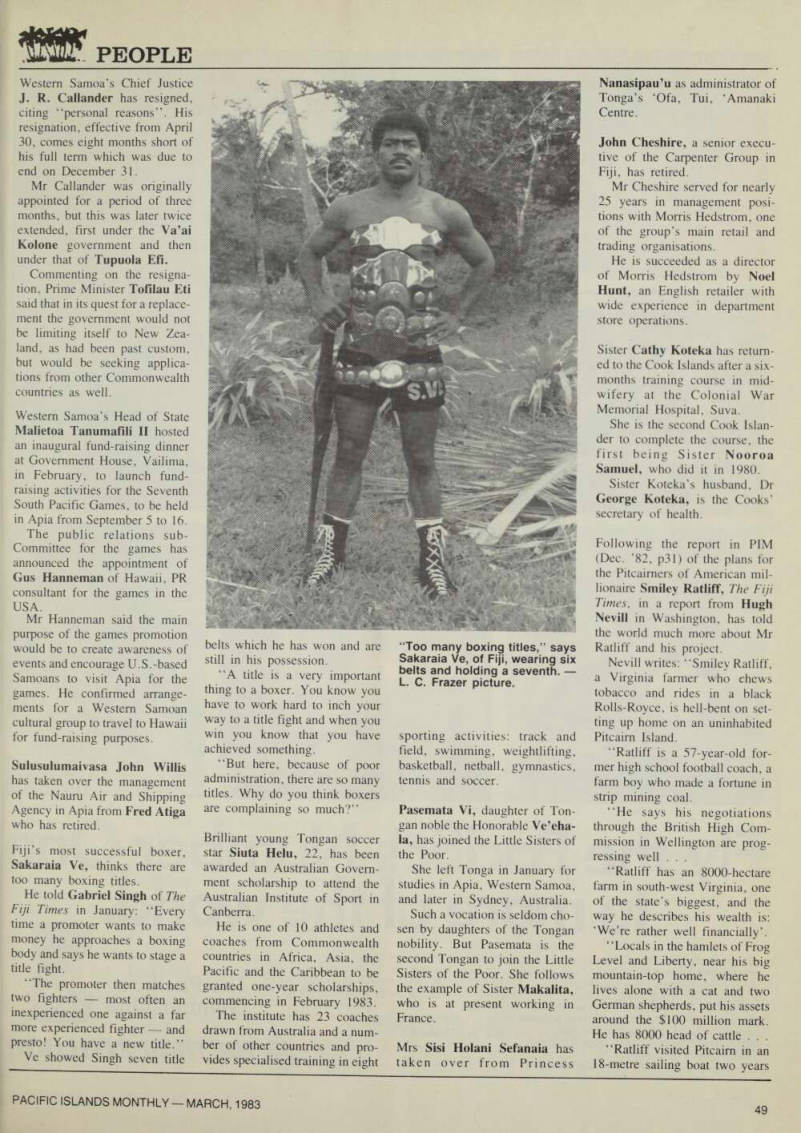
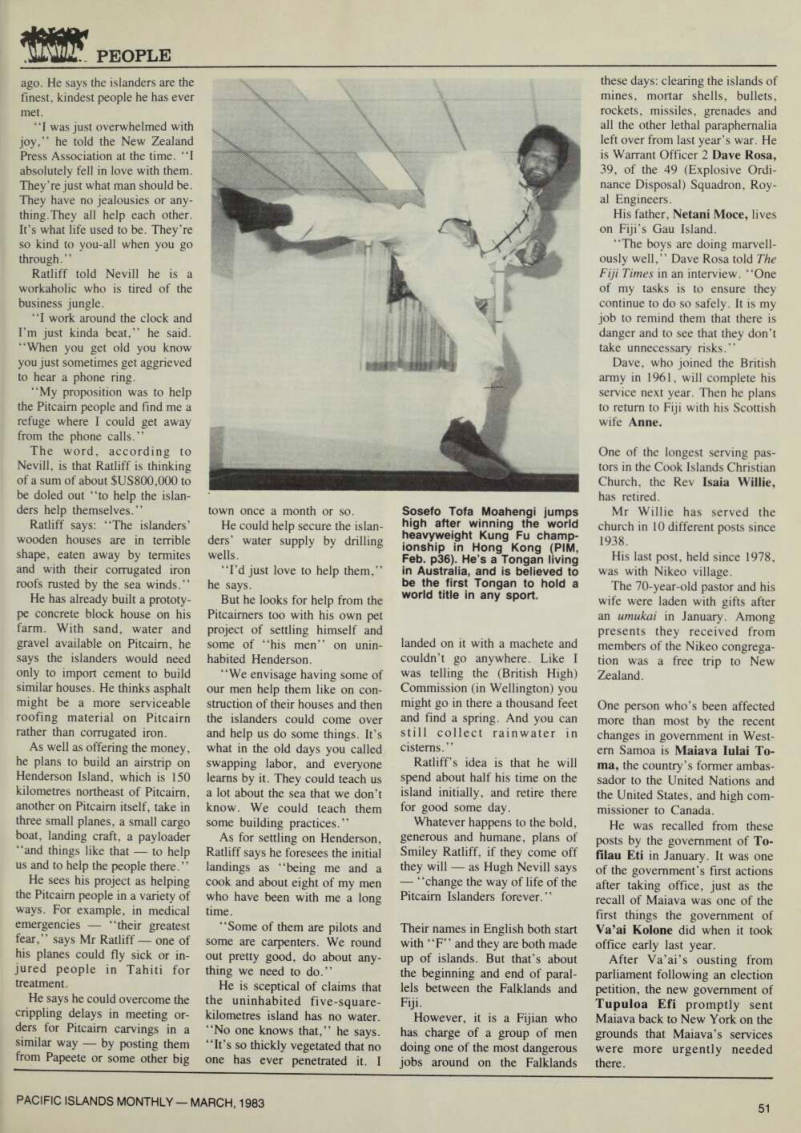
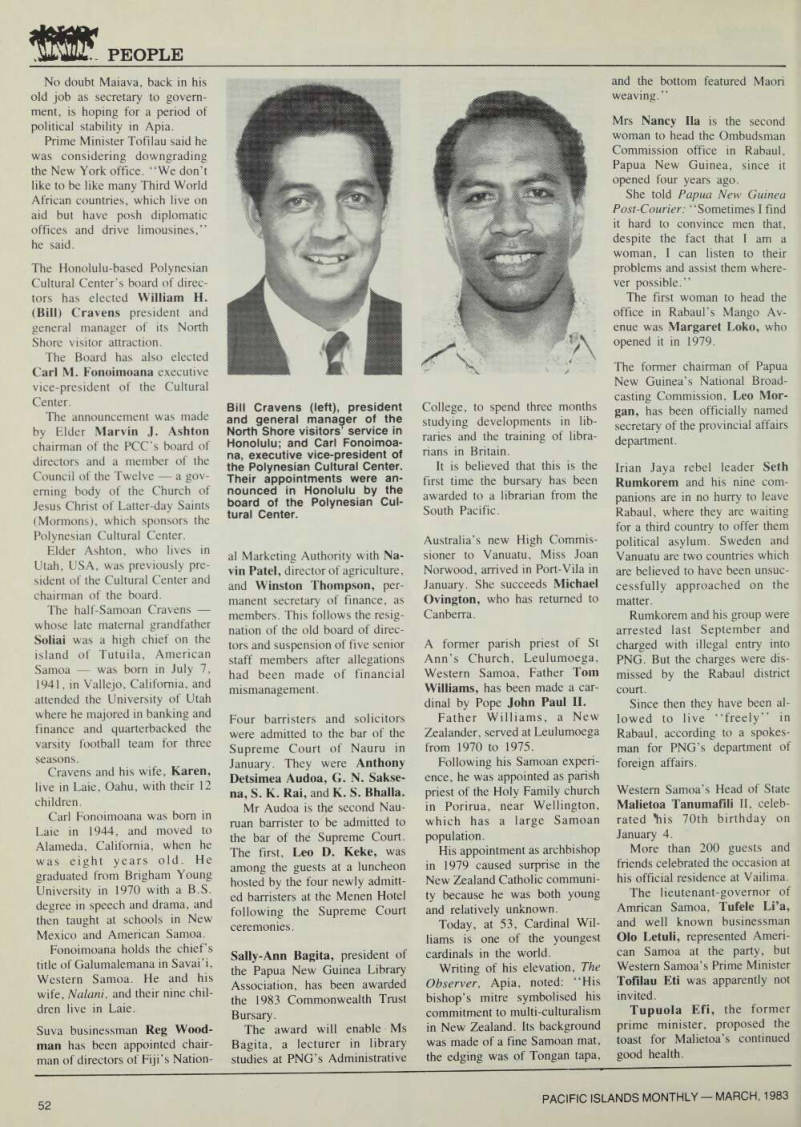
Western Samoa’s Chief Justice J. R. Callander has resigned,
citing “personal reasons”. His
resignation, effective from April
30, comes eight months short of his full term which was due to end on December 31.
Mr Callander was originally appointed for a period of three months, but this was later twice extended, first under the Va’ai Kolone government and then under that of Tupuola Efi.
Commenting on the resigna
tion, Prime Minister Tofilau Eti said that in its quest for a replace ment the government would not be limiting itself to New Zea land, as had been past custom, but would be seeking applica tions from other Commonwealth countries as well.
Western Samoa’s Head of State Malietoa Tanumafili II hosted
an inaugural fund-raising dinner
at Government House, Vailima, in February, to launch fund raising activities for the Seventh South Pacific Games, to be held in Apia from September 5 to 16.
The public relations sub committee for the games has announced the appointment of Gus Hanneman of Hawaii, PR consultant for the games in the
Usa.
Mr Hanneman said the main purpose of the games promotion would be to create awareness of events and encourage U.S.-based Samoans to visit Apia for the games. He confirmed arrange ments for a Western Samoan cultural group to travel to Hawaii for fund-raising purposes.
Sulusulumaivasa John Willis has taken over the management of the Nauru Air and Shipping Agency in Apia from Fred Atiga who has retired.
Fiji’s most successful boxer, Sakaraia Ve, thinks there are too many boxing titles.
He told Gabriel Singh of The Fiji Times in January: “Every time a promoter wants to make money he approaches a boxing body and says he wants to stage a
title fight.
“The promoter then matches two fighters most often an inexperienced one against a far more experienced fighter and presto! You have a new title.”
Ve showed Singh seven title
belts which he has won and are still in his possession.
“A title is a very important thing to a boxer. You know you have to work hard to inch your way to a title fight and when you win you know that you have achieved something.
“But here, because of poor administration, there are so many titles. Why do you think boxers are complaining so much?’’
Brilliant young Tongan soccer star Siuta Helu, 22, has been awarded an Australian Govern ment scholarship to attend the Australian Institute of Sport in Canberra.
He is one of 10 athletes and coaches from Commonwealth countries in Africa, Asia, the Pacific and the Caribbean to be granted one-year scholarships, commencing in February 1983.
The institute has 23 coaches drawn from Australia and a num ber of other countries and pro vides specialised training in eight
sporting activities; track and field, swimming, weightlifting, basketball, netball, gymnastics, tennis and soccer.
Pasemata Vi, daughter of Ton gan noble the Honorable Ve’eha la, has joined the Little Sisters of the Poor.
She left Tonga in January for studies in Apia, Western Samoa, and later in Sydney, Australia.
Such a vocation is seldom cho sen by daughters of the Tongan nobility. But Pasemata is the second Tongan to join the Little Sisters of the Poor. She follows the example of Sister Makalita, who is at present working in France.
Mrs Sisi Holani Sefanaia has taken over from Princess
Nanasipau’u as administrator of Tonga’s ‘Ofa, Tui, ‘Amanaki Centre.
John Cheshire, a senior execu tive of the Carpenter Group in Fiji, has retired.
Mr Cheshire served for nearly 25 years in management posi tions with Morris Hedstrom, one of the group’s main retail and trading organisations.
He is succeeded as a director of Morris Hedstrom by Noel Hunt, an English retailer with wide experience in department store operations.
Sister Cathy Koteka has return ed to the Cook Islands after a six months training course in mid wifery at the Colonial War Memorial Hospital, Suva.
She is the second Cook Islan der to complete the course, the first being Sister Nooroa Samuel, who did it in 1980.
Sister Koteka’s husband. Dr George Koteka, is the Cooks’ secretary of health.
Following the report in PIM (Dec. ’B2, p3l) of the plans for the Pitcairners of American mil lionaire Smiley Ratliff, The Fiji Times, in a report from Hugh Nevill in Washington, has told the world much more about Mr Ratliff and his project.
Nevill writes: “Smiley Ratliff, a Virginia farmer who ehews tobacco and rides in a black Rolls-Royce, is hell-bent on set ting up home on an uninhabited Pitcairn Island.
“Ratliff is a 57-year-old for mer high school football coach, a farm boy who made a fortune in strip mining coal.
“He says his negotiations through the British High Com mission in Wellington are prog ressing well . . .
“Ratliff has an 8000-hectare farm in south-west Virginia, one of the state’s biggest, and the way he describes his wealth is: ‘We’re rather well financially’.
“Locals in the hamlets of Frog Level and Liberty, near his big mountain-top home, where he lives alone with a cat and two German shepherds, put his assets around the $lOO million mark.
He has 8000 head of cattle . . .
“Ratliff visited Pitcairn in an 18-metre sailing boat two years
“Too many boxing titles," says Sakaraia Ve, of Fiji, wearing six belts and holding a seventh. - L. C. Frazer picture.
ago. He says the islanders are the finest, kindest people he has ever met.
“I was just overwhelmed with joy,” he told the New Zealand Press Association at the time. “I absolutely fell in love with them.
They’re just what man should be.
They have no jealousies or any thing. They all help each other.
It’s what life used to be. They’re so kind to you-all when you go through.”
Ratliff told Nevill he is a workaholic who is tired of the business jungle.
“I work around the clock and I’m just kinda beat,” he said.
“When you get old you know you just sometimes get aggrieved to hear a phone ring.
“My proposition was to help the Pitcairn people and find me a refuge where I could get away from the phone calls.”
The word, according to Nevill, is that Ratliff is thinking of a sum of about SUSBOO,OOO to be doled out “to help the islan ders help themselves.”
Ratliff says: “The islanders’ wooden houses are in terrible shape, eaten away by termites and with their corrugated iron roofs rusted by the sea winds.”
He has already built a prototy pe concrete block house on his farm. With sand, water and gravel available on Pitcairn, he says the islanders would need only to import cement to build similar houses. He thinks asphalt might be a more serviceable roofing material on Pitcairn rather than corrugated iron.
As well as offering the money, he plans to build an airstrip on Henderson Island, which is 150 kilometres northeast of Pitcairn, another on Pitcairn itself, take in three small planes, a small cargo boat, landing craft, a pay loader “and things like that to help us and to help the people there.”
He sees his project as helping the Pitcairn people in a variety of ways. For example, in medical emergencies “their greatest fear,” says Mr Ratliff one of his planes could fly sick or in jured people in Tahiti for treatment.
He says he could overcome the crippling delays in meeting or ders for Pitcairn carvings in a similar way by posting them from Papeete or some other big
town once a month or so.
He could help secure the islan ders’ water supply by drilling wells.
“I’d just love to help them,” he says.
But he looks for help from the Pitcairners too with his own pet project of settling himself and some of “his men” on unin habited Henderson.
“We envisage having some of our men help them like on con struction of their houses and then the islanders could come over and help us do some things. It’s what in the old days you called swapping labor, and everyone learns by it. They could teach us a lot about the sea that we don’t know. We could teach them some building practices.”
As for settling on Henderson, Ratliff says he foresees the initial landings as “being me and a cook and about eight of my men who have been with me a long time.
“Some of them are pilots and some are carpenters. We round out pretty good, do about any thing we need to do.”
He is sceptical of claims that the uninhabited five-square kilometres island has no water.
“No one knows that,” he says.
“It’s so thickly vegetated that no one has ever penetrated it. I
landed on it with a machete and couldn’t go anywhere. Like I was telling the (British High) Commission (in Wellington) you might go in there a thousand feet and find a spring. And you can still collect rainwater in cisterns.’’
Ratliff’s idea is that he will spend about half his time on the island initially, and retire there for good some day.
Whatever happens to the bold, generous and humane, plans of Smiley Ratliff, if they come off they will as Hugh Nevill says “change the way of life of the Pitcairn Islanders forever.’’
Their names in English both start with “F” and they are both made up of islands. But that’s about the beginning and end of paral lels between the Falklands and Fiji.
However, it is a Fijian who has charge of a group of men doing one of the most dangerous jobs around on the Falklands
these days: clearing the islands of mines, mortar shells, bullets, rockets, missiles, grenades and all the other lethal paraphernalia left over from last year’s war. He is Warrant Officer 2 Dave Rosa, 39, of the 49 (Explosive Ordi nance Disposal) Squadron, Roy al Engineers.
His father, Netani Moce, lives on Fiji’s Gau Island.
“The boys are doing marvell ously well,’’ Dave Rosa told The Fiji Times in an interview. “One of my tasks is to ensure they continue to do so safely. It is my job to remind them that there is danger and to see that they don’t take unnecessary risks.’’
Dave, who joined the British army in 1961, will complete his service next year. Then he plans to return to Fiji with his Scottish wife Anne.
One of the longest serving pas tors in the Cook Islands Christian Church, the Rev Isaia Willie, has retired.
Mr Willie has served the church in 10 different posts since 1938.
His last post, held since 1978, was with Nikeo village.
The 70-year-old pastor and his wife were laden with gifts after an umukai in January. Among presents they received from members of the Nikeo congrega tion was a free trip to New Zealand.
One person who’s been affected more than most by the recent changes in government in West ern Samoa is Maiava lulai To ma, the country’s former ambas sador to the United Nations and the United States, and high com missioner to Canada.
He was recalled from these posts by the government of To filau Eti in January. It was one of the government’s first actions after taking office, just as the recall of Maiava was one of the first things the government of Va’ai Kolone did when it took office early last year.
After Va’ai’s ousting from parliament following an election petition, the new government of Tupuloa Efi promptly sent Maiava back to New York on the grounds that Maiava’s services were more urgently needed there.
Sosefo Tofa Moahengi jumps high after winning the world heavyweight Kung Fu champ ionship in Hong Kong (PIM, Feb. p36). He’s a Tongan living in Australia, and is believed to be the first Tongan to hold a world title in any sport.
No doubt Maiava, back in his old job as secretary to govern ment, is hoping for a period of
political stability in Apia.
Prime Minister Tofilau said he
was considering downgrading
the New York office. “We don’t like to be like many Third World African countries, which live on aid but have posh diplomatic offices and drive limousines,” he said.
The Honolulu-based Polynesian Cultural Center’s board of direc tors has elected William H. (Bill) Cravens president and general manager of its North Shore visitor attraction.
The Board has also elected Carl M. Fonoimoana executive vice-president of the Cultural Center.
The announcement was made by Elder Marvin J. Ashton chairman of the PCC’s board of directors and a member of the Council of the Twelve a gov erning body of the Church of Jesus Christ of Latter-day Saints (Mormons), which sponsors the Polynesian Cultural Center.
Elder Ashton, who lives in Utah, USA, was previously pre sident of the Cultural Center and chairman of the board.
The half-Samoan Cravens whose late maternal grandfather Soliai was a high chief on the island of Tutuila, American Samoa was bom in July 7, 1941, in Vallejo, California, and attended the University of Utah where he majored in banking and finance and quarterbacked the varsity football team for three seasons.
Cravens and his wife, Karen, live in Laie, Oahu, with their 12 children.
Carl Fonoimoana was bom in Laie in 1944, and moved to Alameda, California, when he was eight years old. He
graduated from Brigham Young
University in 1970 with a B.S. degree in speech and drama, and then taught at schools in New Mexico and American Samoa.
Fonoimoana holds the chief’s title of Galumalemana in Savai’i, Western Samoa. He and his wife, Nalani, and their nine chil dren live in Laie.
Suva businessman Reg Wood man has been appointed chair man of directors of Fiji’s Nation-
al Marketing Authority with Na vin Patel, director of agriculture, and Winston Thompson, per manent secretary of finance, as members. This follows the resig nation of the old board of direc tors and suspension of five senior staff members after allegations had been made of financial mismanagement.
Four barristers and solicitors were admitted to the bar of the Supreme Court of Nauru in January. They were Anthony Detsimea Audoa, G. N. Sakse na, S. K. Rai, and K. S. Bhalla.
Mr Audoa is the second Nau ruan barrister to be admitted to the bar of the Supreme Court.
The first, Leo D. Keke, was among the guests at a luncheon hosted by the four newly admitt ed barristers at the Menen Hotel following the Supreme Court ceremonies.
Sally-Ann Bagita, president of
the Papua New Guinea Library Association, has been awarded the 1983 Commonwealth Trust Bursary.
The award will enable Ms Bagita, a lecturer in library studies at PNG’s Administrative
College, to spend three months studying developments in lib raries and the training of libra rians in Britain.
It is believed that this is the first time the bursary has been awarded to a librarian from the South Pacific.
Australia’s new High Commis sioner to Vanuatu, Miss Joan Norwood, arrived in Port-Vila in January. She succeeds Michael Ovington, who has returned to Canberra.
A former parish priest of St Ann’s Church, Leulumoega, Western Samoa, Father Tom Williams, has been made a car dinal by Pope John Paul 11.
Father Williams, a New Zealander, served at Leulumoega from 1970 to 1975.
Following his Samoan experi ence, he was appointed as parish priest of the Holy Family church in Porirua, near Wellington, which has a large Samoan population.
His appointment as archbishop in 1979 caused surprise in the New Zealand Catholic communi ty because he was both young and relatively unknown.
Today, at 53, Cardinal Wil liams is one of the youngest cardinals in the world.
Writing of his elevation, The Observer, Apia, noted: “His bishop’s mitre symbolised his commitment to multi-culturalism in New Zealand. Its background was made of a fine Samoan mat, the edging was of Tongan tapa,
and the bottom featured Maori weaving.”
Mrs Nancy Ha is the second woman to head the Ombudsman Commission office in Rabaul, Papua New Guinea, since it opened four years ago.
She told Papua New Guinea Post-Courier: “Sometimes I find it hard to convince men that, despite the fact that I am a woman, I can listen to their problems and assist them where
ver possible.”
The first woman to head the office in Rabaufs Mango Av enue was Margaret Loko, who opened it in 1979.
The former chairman of Papua New Guinea’s National Broad casting Commission, Leo Mor gan, has been officially named secretary of the provincial affairs department.
Irian Jaya rebel leader Seth Rumkorem and his nine com panions are in no hurry to leave Rabaul, where they are waiting for a third country to offer them
political asylum. Sweden and
Vanuatu are two countries which are believed to have been unsuc
cessfully approached on the
matter.
Rumkorem and his group were arrested last September and charged with illegal entry into PNG. But the charges were dis missed by the Rabaul district court.
Since then they have been al lowed to live “freely” in Rabaul, according to a spokes man for PNG’s department of foreign affairs.
Western Samoa’s Head of State Malietoa Tanumafili 11, celeb rated Iris 70th birthday on January 4.
More than 200 guests and friends celebrated the occasion at his official residence at Vailima.
The lieutenant-governor of Amrican Samoa, Tufele Li’a, and well known businessman 010 Letuli, represented Ameri can Samoa at the party, but Western Samoa’s Prime Minister Tofilau Eti was apparently not invited.
Tupuola Efi, the former
prime minister, proposed the
toast for Malietoa’s continued good health.
Bill Cravens (left), president
and general manager of the North Shore visitors’ service in Honolulu; and Carl Fonoimoa na, executive vice-president of the Polynesian Cultural Center.
Their appointments were an nounced in Honolulu by the board of the Polynesian Cul tural Center.
Advertisements & other items, p. 50 (1 item)
Fly the Pacific’s Number One
m 0"% n * T ft. o m * m m m 11 mi ©Walt Disney Productions
to more of the world.
You can fly Air New Zealand to more and more of the great destinations of the world, like Tokyo, Honolulu and Los Angeles, Singapore and Hong Kong, Sydney, Melbourne, Brisbane and Perth as well as throughout New Zealand. And now, you can catch our “London Express”, the fast comfortable way to London from Auckland, Nadi, Papeete or Honolulu.
On every flight you’ll enjoy the careful attentive service that made Air New Zealand, the pioneer airline of the Pacific routes, so famous; a reputation we’re proud to maintain today wherever we fly you to.
See your travel agent or Air New Zealand.
The Pacific's
Number One
air new zeaiann
ANZ 82/13
Sepik Diary
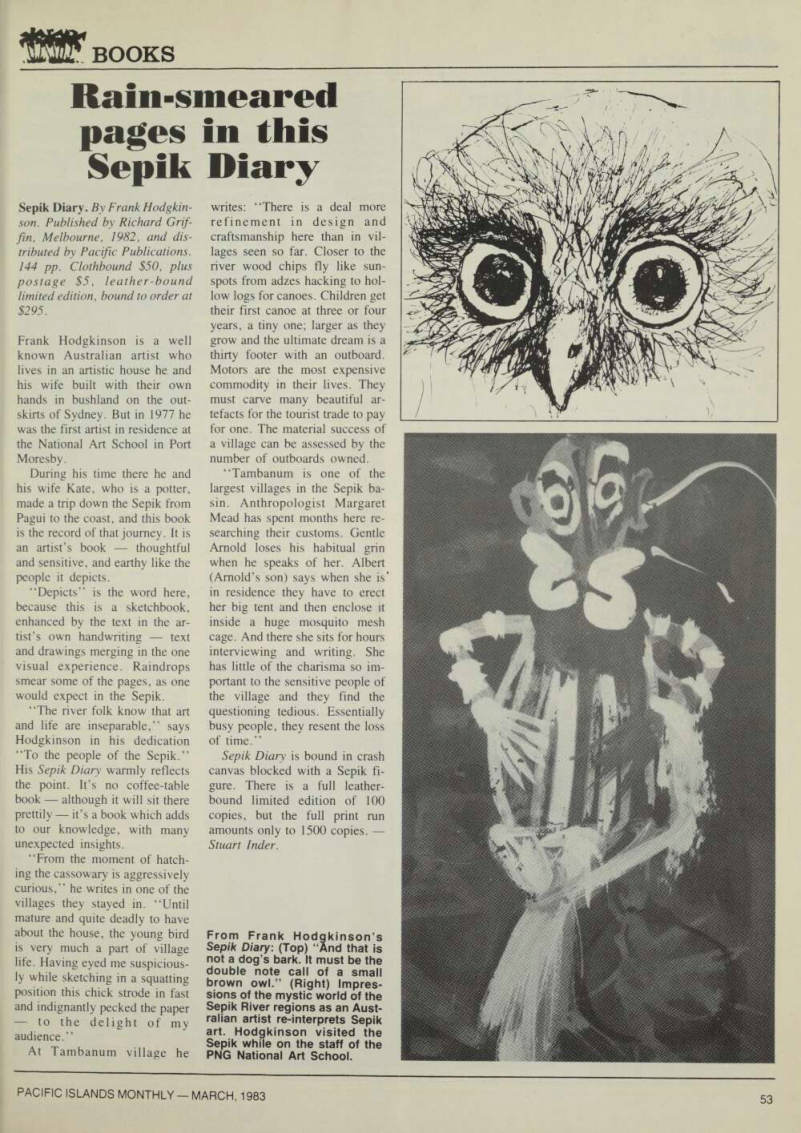
Books
Rain-smeared pages in this Sepik Diary
Sepik Diary. By Frank Hodgkin son. Published by Richard Grif fin, Melbourne, 1982, and dis tributed by Pacific Publications. 144 pp. Clothbound $5O, plus postage $5, leather-bound limited edition, bound to order at $295.
Frank Hodgkinson is a well known Australian artist who lives in an artistic house he and his wife built with their own hands in bushland on the out skirts of Sydney. But in 1977 he was the first artist in residence at the National Art School in Port Moresby.
During his time there he and his wife Kate, who is a potter, made a trip down the Sepik from Pagui to the coast, and this book is the record of that journey. It is an artist’s book thoughtful and sensitive, and earthy like the people it depicts.
“Depicts” is the word here, because this is a sketchbook, enhanced by the text in the ar tist’s own handwriting text and drawings merging in the one visual experience. Raindrops smear some of the pages, as one would expect in the Sepik.
“The river folk know that art and life are inseparable,” says Hodgkinson in his dedication “To the people of the Sepik.”
His Sepik Diary warmly reflects the point. It’s no coffee-table book although it will sit there prettily it’s a book which adds to our knowledge, with many unexpected insights.
“From the moment of hatch ing the cassowary is aggressively curious,” he writes in one of the villages they stayed in. “Until mature and quite deadly to have about the house, the young bird is very much a part of village life. Having eyed me suspicious ly while sketching in a squatting position this chick strode in fast and indignantly pecked the paper to the delight of my audience.”
At Tambanum village he
writes: “There is a deal more refinement in design and craftsmanship here than in vil lages seen so far. Closer to the river wood chips fly like sun spots from adzes hacking to hol low logs for canoes. Children get their first canoe at three or four years, a tiny one; larger as they grow and the ultimate dream is a thirty footer with an outboard.
Motors are the most expensive commodity in their lives. They must carve many beautiful ar tefacts for the tourist trade to pay for one. The material success of a village can be assessed by the number of outboards owned.
“Tambanum is one of the
largest villages in the Sepik ba
sin. Anthropologist Margaret
Mead has spent months here re searching their customs. Gentle Arnold loses his habitual grin when he speaks of her. Albert (Arnold’s son) says when she is in residence they have to erect her big tent and then enclose it inside a huge mosquito mesh cage. And there she sits for hours
interviewing and writing. She
has little of the charisma so im portant to the sensitive people of the village and they find the
questioning tedious. Essentially
busy people, they resent the loss
of time.”
Sepik Diary is bound in crash canvas blocked with a Sepik fi gure. There is a full leather bound limited edition of 100 copies, but the full print run amounts only to 1500 copies.
Stuart Inder.
From Frank Hodgkinson’s Sepik Diary: (Top) “And that is not a dog’s bark. It must be the double note call of a small brown owl.” (Right) Impres sions of the mystic world of the Sepik River regions as an Aust ralian artist re-interprets Sepik art. Hodgkinson visited the Sepik while on the staff of the PNG National Art School.
Fijian scholar
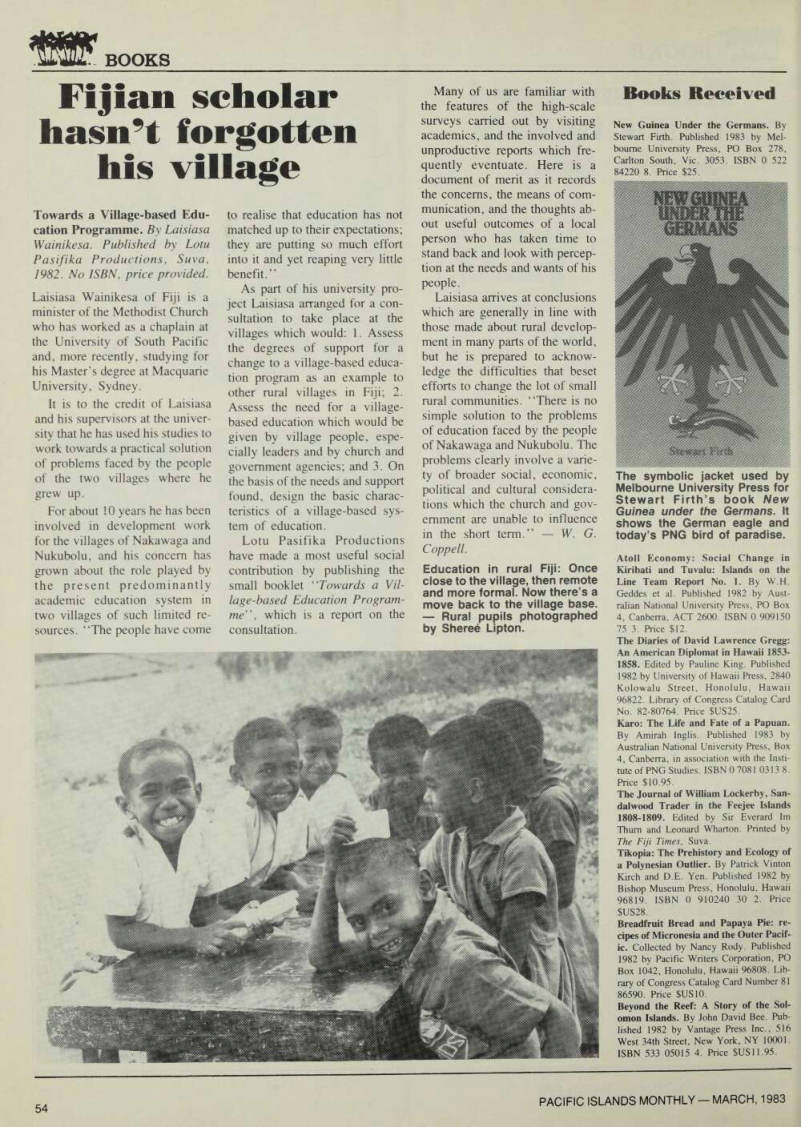
hasn’t forgotten his village
Towards a Village-based Edu cation Programme. By Laisiasa Wainikesa. Published by Lotu Pasifika Productions, Suva, 1982. No ISBN, price provided.
Laisiasa Wainikesa of Fiji is a minister of the Methodist Church who has worked as a chaplain at the University of South Pacific and, more recently, studying for his Master’s degree at Macquarie
University, Sydney.
It is to the credit of Laisiasa and his supervisors at the univer sity that he has used his studies to work towards a practical solution
of problems faced by the people
of the two villages where he grew up.
For about 10 years he has been involved in development work for the villages of Nakawaga and Nukubolu, and his concern has grown about the role played by the present predominantly academic education system in two villages of such limited re sources. ‘‘The people have come
Many of us are familiar with the features of the high-scale surveys carried out by visiting academics, and the involved and unproductive reports which fre quently eventuate. Here is a document of merit as it records the concerns, the means of com munication, and the thoughts ab out useful outcomes of a local person who has taken time to stand back and look with percep tion at the needs and wants of his
people.
Laisiasa arrives at conclusions which are generally in line with those made about rural develop ment in many parts of the world, but he is prepared to acknow ledge the difficulties that beset efforts to change the lot of small rural communities. ‘‘There is no simple solution to the problems of education faced by the people of Nakawaga and Nukubolu. The problems clearly involve a varie ty of broader social, economic, political and cultural considera tions which the church and gov ernment are unable to influence
to realise that education has not matched up to their expectations; they are putting so much effort into it and yet reaping very little benefit.’’
As part of his university pro ject Laisiasa arranged for a con sultation to take place at the villages which would: 1. Assess the degrees of support for a change to a village-based educa tion program as an example to other rural villages in Fiji; 2.
Assess the need for a village based education which would be
given by village people, espe
cially leaders and by church and government agencies; and 3. On the basis of the needs and support found, design the basic charac teristics of a village-based sys tem of education.
Lotu Pasifika Productions have made a most useful social
contribution by publishing the
small booklet “ Towards a Vil lage-based Education Program me”, which is a report on the consultation.
in the short term.”
W. G.
Coppell.
Education in rural Fiji: Once close to the village, then remote and more formal. Now there’s a move back to the village base.
- Rural pupils photographed
by Shereé Lipton.
Books Received
New Guinea Under the Germans. By Stewart Firth. Published 1983 by Mel bourne University Press, PO Box 278, Carlton South, Vic. 3053. ISBN 0 522 84220 8. Price $25.
Atoll Economy: Social Change in Kiribati and Tuvalu: Islands on the Line Team Report No. 1. By W.H.
Geddes et al. Published 1982 by Aust ralian National University Press, PO Box 4, Canberra, ACT 2600. ISBN 0 909150 75 3. Price $l2.
The Diaries of David Lawrence Gregg: An American Diplomat in Hawaii 1853- 1858. Edited by Pauline King. Published 1982 by University of Hawaii Press, 2840 Kolowalu Street, Honolulu, Hawaii 96822. Library of Congress Catalog Card No. 82-80764. Price SUS2S.
Karo: The Life and Fate of a Papuan.
By Amirah Inglis. Published 1983 by Australian National University Press, Box 4, Canberra, in association with the Insti tute of PNG Studies. ISBN 0 7081 0313 8.
Price $10.95.
The Journal of William Lockerby, San dalwood Trader in the Feejee Islands 1808-1809. Edited by Sir Everard Im Thum and Leonard Wharton. Printed by The Fiji Times, Suva.
Tikopia: The Prehistory and Ecology of a Polynesian Outlier. By Patrick Vinton Kirch and D.E. Yen. Published 1982 by Bishop Museum Press, Honolulu, Hawaii 96819. ISBN 0 910240 30 2. Price
Sus2B.
Breadfruit Bread and Papaya Pie: re cipes of Micronesia and the Outer Pacif ic. Collected by Nancy Rody. Published 1982 by Pacific Writers Corporation, PO Box 1042, Honolulu, Hawaii 96808. Lib rary of Congress Catalog Card Number 81 86590. Price SUSIO.
Beyond the Reef: A Story of the Sol omon Islands. By John David Bee. Pub lished 1982 by Vantage Press Inc., 516 West 34th Street, New York, NY 10001.
ISBN 533 05015 4. Price $U511.95.
The symbolic jacket used by Melbourne University Press for Stewart Firth's book New Guinea under the Germans. It shows the German eagle and today’s PNG bird of paradise.
are remembering
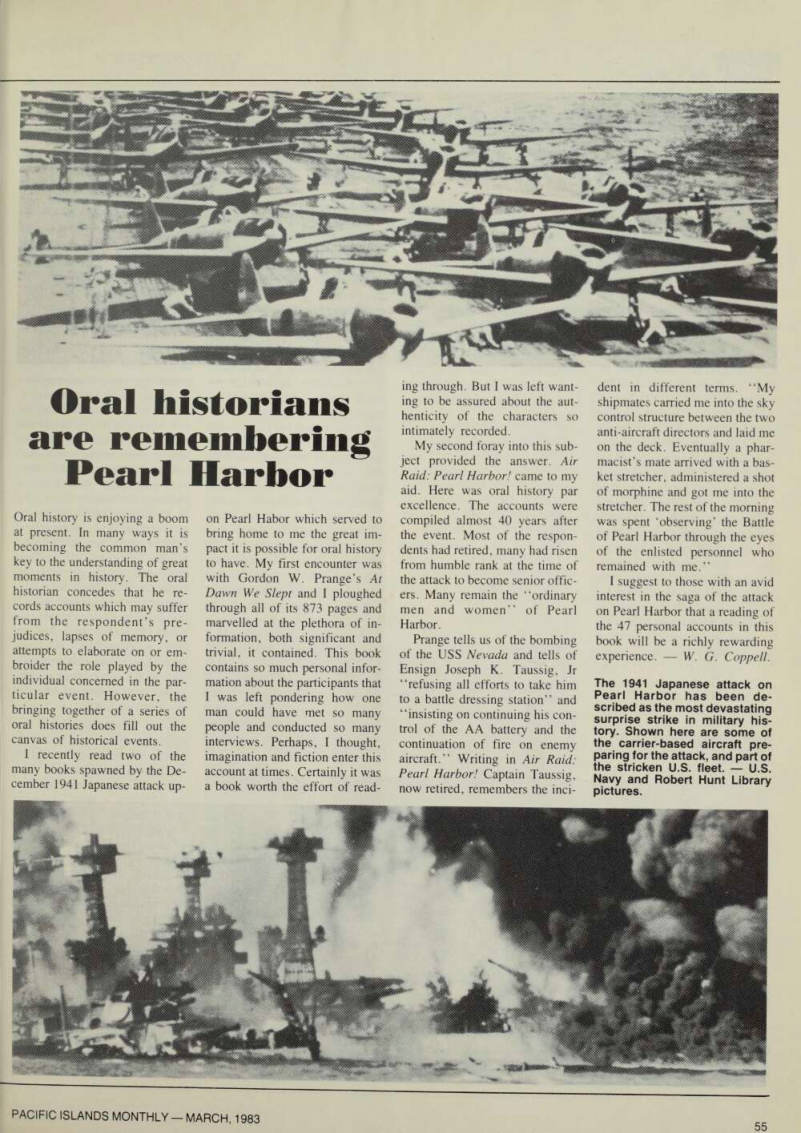
Oral historians are remembering Pearl Harbor
Oral history is enjoying a boom at present. In many ways it is becoming the common man’s key to the understanding of great moments in history. The oral historian concedes that he re cords accounts which may suffer from the respondent’s pre judices, lapses of memory, or attempts to elaborate on or em broider the role played by the individual concerned in the par ticular event. However, the bringing together of a series of oral histories does fill out the canvas of historical events.
I recently read two of the many books spawned by the De cember 1941 Japanese attack up
on Pearl Habor which served to bring home to me the great im pact it is possible for oral history to have. My first encounter was with Gordon W. Prange’s At Dawn We Slept and I ploughed through all of its 873 pages and marvelled at the plethora of in formation, both significant and trivial, it contained. This book contains so much personal infor mation about the participants that I was left pondering how one man could have met so many people and conducted so many interviews. Perhaps, I thought, imagination and fiction enter this account at times. Certainly it was a book worth the effort of read
ing through. But I was left want ing to be assured about the aut henticity of the characters so intimately recorded.
My second foray into this sub ject provided the answer. Air Raid: Pearl Harbor! came to my aid. Here was oral history par excellence. The accounts were compiled almost 40 years after the event. Most of the respon dents had retired, many had risen from humble rank at the time of the attack to become senior offic ers. Many remain the “ordinary men and women’’ of Pearl Harbor.
Prange tells us of the bombing of the USS Nevada and tells of Ensign Joseph K. Taussig, Jr “refusing all efforts to take him to a battle dressing station’’ and “insisting on continuing his con trol of the AA battery and the continuation of fire on enemy aircraft.’’ Writing in Air Raid: Pearl Harbor! Captain Taussig, now retired, remembers the inci
dent in different terms. “My shipmates carried me into the sky control structure between the two anti-aircraft directors and laid me on the deck. Eventually a phar macist’s mate arrived with a bas ket stretcher, administered a shot of morphine and got me into the stretcher. The rest of the morning was spent ‘observing’ the Battle of Pearl Harbor through the eyes of the enlisted personnel who remained with me.’’
I suggest to those with an avid interest in the saga of the attack on Pearl Harbor that a reading of the 47 personal accounts in this book will be a richly rewarding
experience.
W. G. Coppell.
The 1941 Japanese attack on Pearl Harbor has been de scribed as the most devastating surprise strike in military his tory. Shown here are some of the carrier-based aircraft pre paring for the attack, and part of the stricken U.S. fleet. - U.S.
Navy and Robert Hunt Library pictures.
Pigs don’t fly - but
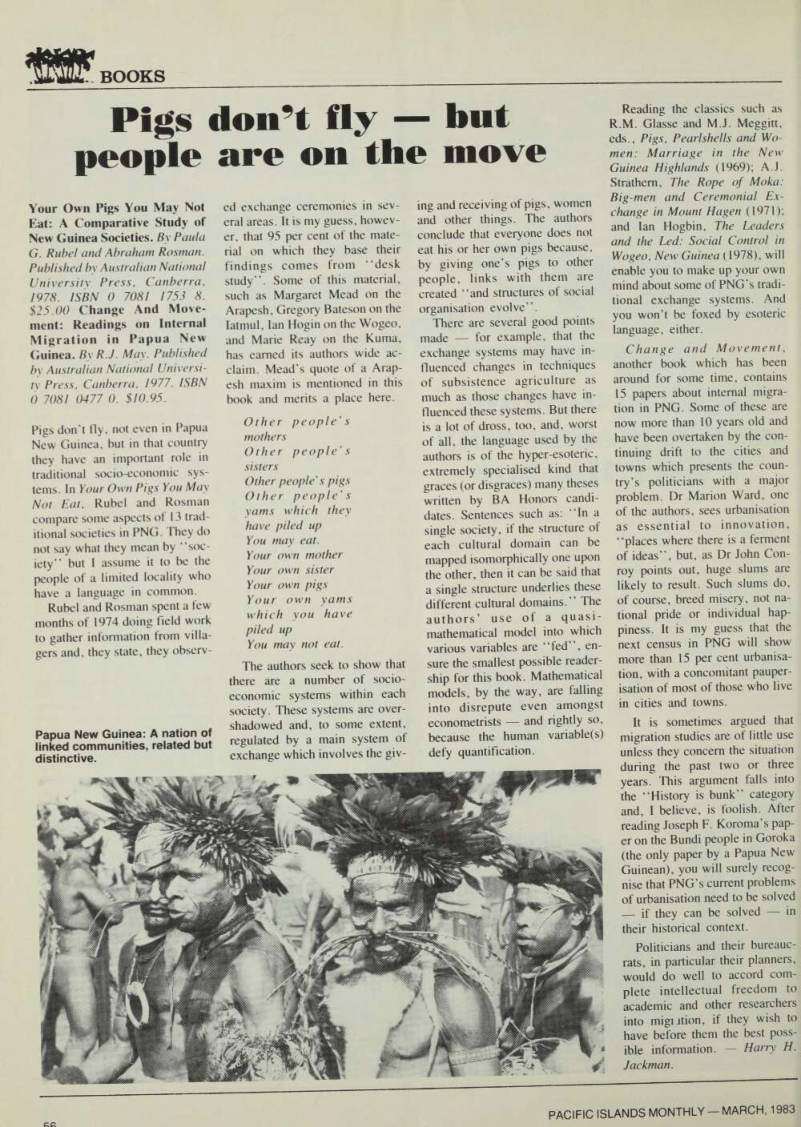
people are on the move
Your Own Pigs You May Not Eat: A Comparative Study of New Guinea Societies. By Paula G. Rubel and Abraham Rosman.
Published by Australian National University Press, Canberra,
1978. Isbn 0 7081 1753 8.
$25.00 Change And Move ment: Readings on Internal Migration in Papua New Guinea. B\ R.J . May. Published by Australian National Universi ty Press, Canberra. 1977. ISBN 0 7081 0477 0. $10.95.
Pigs don’t fly, not even in Papua New Guinea, but in that country they have an important role in traditional socio-economic sys tems. In Your Own Pigs You May Not Eat. Rubel and Rosman compare some aspects of 13 trad itional societies in PNG. They do not say what they mean by “soc iety” but I assume it to be the people of a limited locality who have a language in common.
Rubel and Rosman spent a few months of 1974 doing field work to gather information from villa gers and, they state, they observ
ed exchange ceremonies in sev eral areas. It is my guess, howev er, that 95 per cent of the mate rial on which they base their findings comes from “desk study”. Some of this material, such as Margaret Mead on the Arapesh, Gregory Bateson on the latmul, lan Hogin on the Wogeo, and Marie Reay on the Kuma, has earned its authors wide ac claim. Mead’s quote of a Arap esh maxim is mentioned in this book and merits a place here.
Other people’s
mothers
Other people’s
sisters
Other people’s pigs
Other people’s
yams which they have piled up You may eat.
Your own mother Your own sister Your own pigs Your own yams which you have
piled up
You may not eat.
The authors seek to show that there are a number of socio economic systems within each society. These systems are over shadowed and, to some extent, regulated by a main system of exchange which involves the giv
. c mg and receiving of pigs, women j i ... xiL and other things. The authors ... b , „ conclude that everyone does not j eat his or her own pigs because, . . . , . . .. bv giving one s pigs to other y , , , .u people, links with them are H • created and structures of social organ.sa.ton evolve There are several good points made - for example, that the exchange systems may have in fluenced changes in techniques of subsistence agriculture as much as those changes have in fluenced these systems. But there is a lot of dross, too, and, worst of all, the language used by the authors is of the hyper-esoteric, extremely specialised kind that graces (or disgraces) many theses written by BA Honors candi dates. Sentences such as: “In a single society, if the structure of each cultural domain can be
mapped isomorphically one upon
the other, then it can be said that a single structure underlies these different cultural domains.” The authors’ use of a quasi mathematical model into which various variables are “fed”, en sure the smallest possible reader ship for this book. Mathematical models, by the way, are falling into disrepute even amongst econometrists and rightly so, because the human variable(s)
defy quantification.
Reading the classics such as R.M. Glasse and M.J. Meggitt, eds., Pigs, Pearlshells and Wo men: Marriage in the New Guinea Highlands (1969); A.J.
Strathem, The Rope of Moka: Big-men and Ceremonial Ex change in Mount Hagen (1971); and lan Hogbin, The Leaders and the Led: Social Control in Wogeo, New Guinea (1978), will enable you to make up your own mind about some of PNG’s tradi tional exchange systems. And you won’t be foxed by esoteric language, either.
Change and Movement, another book which has been around for some time, contains 15 papers about internal migra tion in PNG. Some of these are now more than 10 years old and have been overtaken by the con tinuing drift to the cities and towns which presents the coun try’s politicians with a major problem. Dr Marion Ward, one of the authors, sees urbanisation as essential to innovation, “places where there is a ferment of ideas’’, but, as Dr John Con roy points out, huge slums are likely to result. Such slums do, of course, breed misery, not na tional pride or individual hap piness. It is my guess that the next census in PNG will show more than 15 per cent urbanisa tion, with a concomitant pauper isation of most of those who live in cities and towns.
It is sometimes argued that migration studies are of little use unless they concern the situation during the past two or three years. This argument falls into the “History is bunk’’ category and, I believe, is foolish. After reading Joseph F. Koroma’s pap er on the Bundi people in Goroka (the only paper by a Papua New Guinean), you will surely recog nise that PNG’s current problems of urbanisation need to be solved if they can be solved in their historical context.
Politicians and their bureauc rats, in particular their planners, would do well to accord com plete intellectual freedom to academic and other researchers into migiition, if they wish to have before them the best poss
ible information.
Jackman.
Harry H.
Papua New Guinea: A nation of linked communities, related but distinctive.
Nellie and the witch doctor:
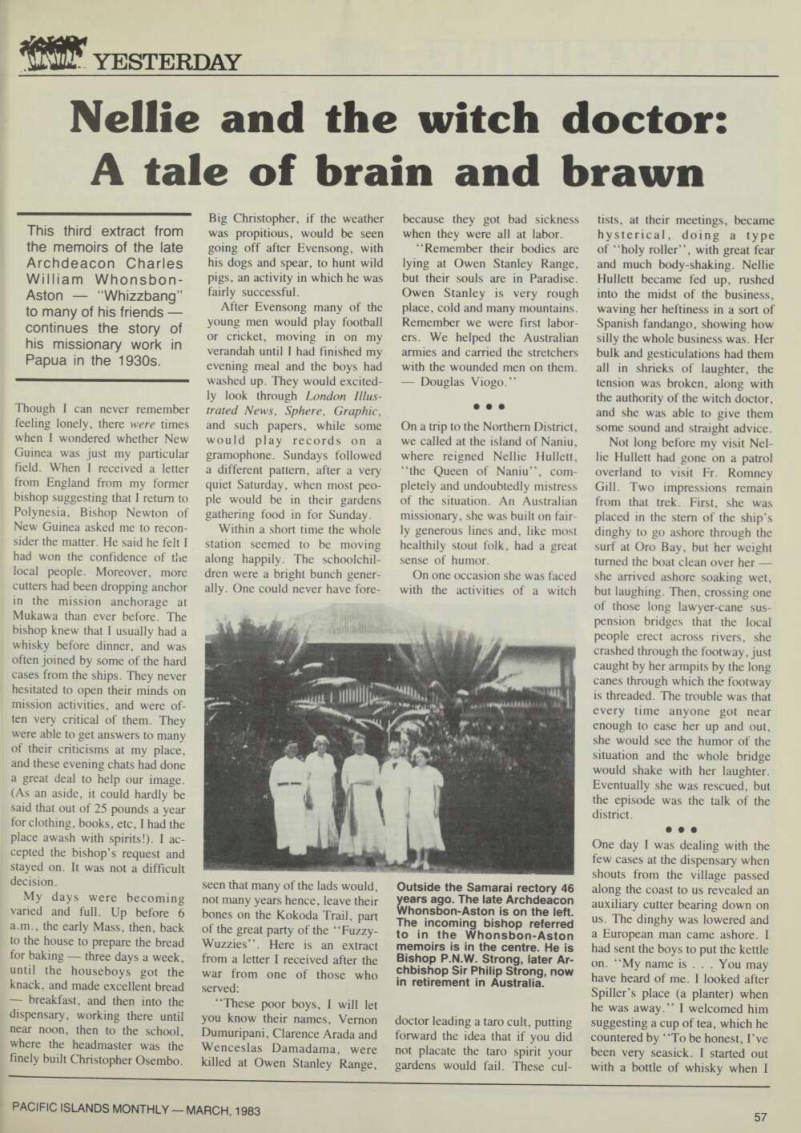

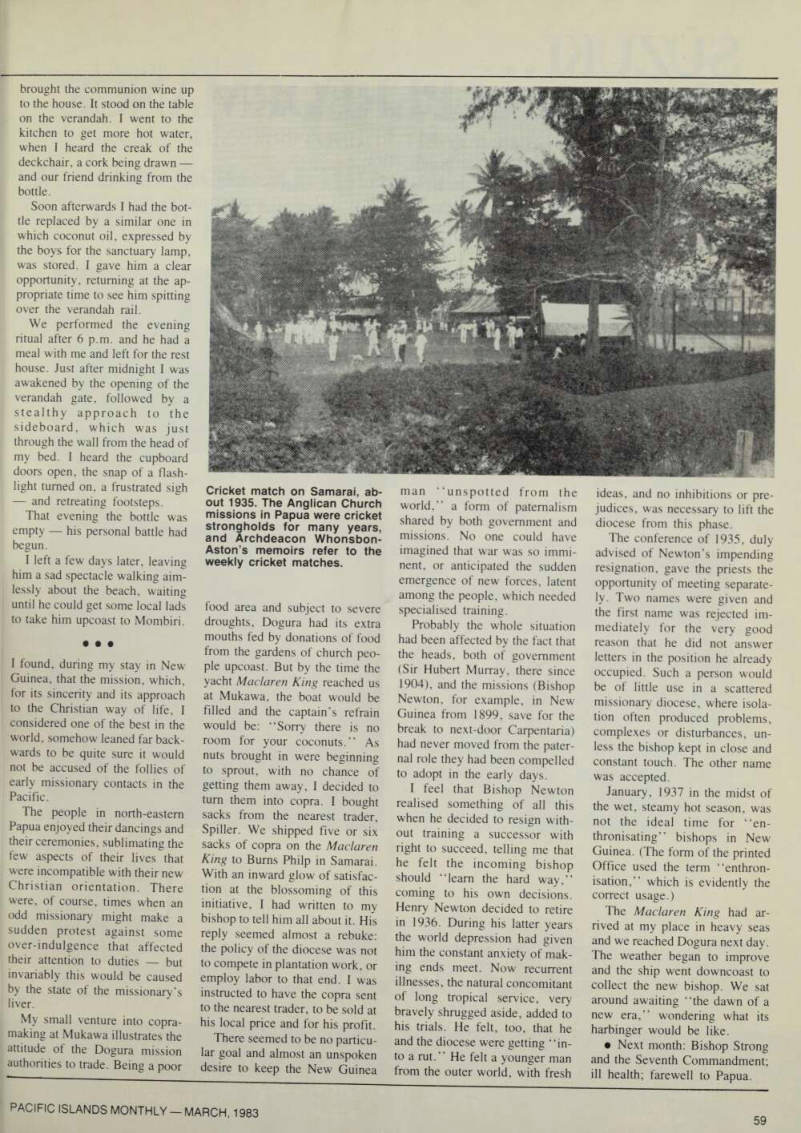
Yesterday
Nellie and the witch doctor: A tale of brain and brawn
This third extract from the memoirs of the late Archdeacon Charles William Whonsbon- Aston “Whizzbang” to many of his friends continues the story of his missionary work in Papua in the 19305.
Though I can never remember feeling lonely, there were times when I wondered whether New Guinea was just my particular field. When I received a letter from England from my former bishop suggesting that I return to Polynesia, Bishop Newton of New Guinea asked me to recon sider the matter. He said he felt I had won the confidence of the local people. Moreover, more cutters had been dropping anchor in the mission anchorage at Mukawa than ever before. The bishop knew that I usually had a whisky before dinner, and was often joined by some of the hard cases from the ships. They never hesitated to open their minds on mission activities, and were of ten very critical of them. They were able to get answers to many of their criticisms at my place, and these evening chats had done a great deal to help our image. (As an aside, it could hardly be said that out of 25 pounds a year for clothing, books, etc, I had the place awash with spirits!). I ac cepted the bishop’s request and stayed on. It was not a difficult decision.
My days were becoming varied and full. Up before 6 a.m., the early Mass, then, back to the house to prepare the bread for baking three days a week, until the houseboys got the knack, and made excellent bread breakfast, and then into the dispensary, working there until near noon, then to the school, where the headmaster was the finely built Christopher Osembo.
Big Christopher, if the weather was propitious, would be seen going off after Evensong, with his dogs and spear, to hunt wild pigs, an activity in which he was
fairly successful.
After Evensong many of the young men would play football or cricket, moving in on my verandah until I had finished my evening meal and the boys had washed up. They would excited ly look through London Illus trated News, Sphere, Graphic, and such papers, while some would play records on a gramophone. Sundays followed a different pattern, after a very quiet Saturday, when most peo ple would be in their gardens gathering food in for Sunday.
Within a short time the whole station seemed to be moving
along happily. The schoolchil
dren were a bright bunch gener ally. One could never have fore
because they got bad sickness when they were all at labor.
“Remember their bodies are lying at Owen Stanley Range, but their souls are in Paradise.
Owen Stanley is very rough place, cold and many mountains.
Remember we were first labor ers. We helped the Australian armies and carried the stretchers with the wounded men on them.
Douglas Viogo.”
• • • On a trip to the Northern District, we called at the island of Naniu, where reigned Nellie Hullett, “the Queen of Naniu”, com pletely and undoubtedly mistress of the situation. An Australian missionary, she was built on fair ly generous lines and, like most healthily stout folk, had a great sense of humor.
On one occasion she was faced with the activities of a witch
seen that many of the lads would, not many years hence, leave their bones on the Kokoda Trail, part of the great party of the “Fuzzy- Wuzzies”. Here is an extract from a letter I received after the war from one of those who served: “These poor boys, I will let you know their names, Vernon Dumuripani, Clarence Arada and Wenceslas Damadama, were killed at Owen Stanley Range,
doctor leading a taro cult, putting forward the idea that if you did not placate the taro spirit your gardens would fail. These cul
lists, at their meetings, became hysterical, doing a type of “holy roller”, with great fear and much body-shaking. Nellie Hullett became fed up, rushed into the midst of the business, waving her heftiness in a sort of Spanish fandango, showing how silly the whole business was. Her bulk and gesticulations had them all in shrieks of laughter, the tension was broken, along with the authority of the witch doctor, and she was able to give them some sound and straight advice.
Not long before my visit Nel lie Hullett had gone on a patrol overland to visit Fr. Romney Gill. Two impressions remain from that trek. First, she was placed in the stem of the ship’s dinghy to go ashore through the surf at Oro Bay, but her weight turned the boat clean over her she arrived ashore soaking wet, but laughing. Then, crossing one of those long lawyer-cane sus pension bridges that the local people erect across rivers, she crashed through the footway, just caught by her armpits by the long canes through which the footway is threaded. The trouble was that every time anyone got near enough to ease her up and out, she would see the humor of the situation and the whole bridge would shake with her laughter.
Eventually she was rescued, but the episode was the talk of the district. • • • One day I was dealing with the few cases at the dispensary when shouts from the village passed along the coast to us revealed an auxiliary cutter bearing down on us. The dinghy was lowered and a European man came ashore. I had sent the boys to put the kettle on. “My name is . . . You may have heard of me. I looked after Spider’s place (a planter) when he was away.” I welcomed him suggesting a cup of tea, which he countered by “To be honest, I’ve been very seasick. I started out with a bottle of whisky when I
Outside the Samarai rectory 46 years ago. The late Archdeacon Whonsbon-Aston is on the left.
The incoming bishop referred to in the Whonsbon-Aston memoirs is in the centre. He is Bishop P.N.W. Strong, later Ar chbishop Sir Philip Strong, now in retirement in Australia.
left. I find it good for seasick ness. The boat heeled over and I lost it overboard. I wonder, have you a drop by you?”
He came up to my verandah and I brought out all I had, about half a bottle, with a glass stop per, and he poured a portion with a shaky hand. Tea came in and I proceeded to pour for him, but he asked could he have a further whisky. I now gathered some thing from his appearance. I re plied: ”Yes, you can have another and that will be the last for now.”
I had just moved away towards the dispensary when I heard the glass stopper clink. I called to one of the boys to bring the bottle to me, but I had overlooked the brandy bottle still on the sideboard from Christmas. In no time I heard the pop of the cork from that.
The man had gone from Samarai on the cutter up to the Mombiri Plantation, now dere lict, above me, to see if it could be brought back into production.
Urged by his thirst he had
called into Spider’s at Menapi, to find him missing, away at his other store at Cape Nelson. He had called the houseboy and ask ed if there were any spirits in the storeroom, and the boy had re plied in the negative. He took a walk along the beach and, as he returned, the missionary, Frere Lane, had come out to meet him.
He had told Fr. Lane the story of the lost bottle.
Later, he had helped the boy up to take the screening from over the planter’s storeroom door and ransacked the place. I men tioned to him that I would be leaving in a few days to go north and would certainly be seeing Spiller. He pleaded that I should put in a word for him, for he must have emptied about 24 small bottles. Spiller had some cogent remarks to make when I did see him.
I let him sleep on in the gov ernment rest house. Near four o’clock I sent to ask him up for a cup of tea. I did not then realise that the server in the morning, for some unknown reason, had
brought the communion wine up to the house. It stood on the table on the verandah. I went to the kitchen to get more hot water, when I heard the creak of the deckchair, a cork being drawn and our friend drinking from the bottle.
Soon afterwards I had the bot tle replaced by a similar one in which coconut oil, expressed by the boys for the sanctuary lamp, was stored. I gave him a clear opportunity, returning at the ap propriate time to see him spitting over the verandah rail.
We performed the evening ritual after 6 p.m. and he had a meal with me and left for the rest house. Just after midnight I was awakened by the opening of the verandah gate, followed by a stealthy approach to the sideboard, which was just through the wall from the head of my bed. I heard the cupboard doors open, the snap of a flash light turned on, a frustrated sigh and retreating footsteps.
That evening the bottle was empty his personal battle had begun.
I left a few days later, leaving him a sad spectacle walking aim lessly about the beach, waiting until he could get some local lads to take him upcoast to Mombiri. • • • I found, during my stay in New Guinea, that the mission, which, for its sincerity and its approach to the Christian way of life, I considered one of the best in the world, somehow leaned far back wards to be quite sure it would not be accused of the follies of early missionary contacts in the Pacific.
The people in north-eastern Papua enjoyed their dancings and their ceremonies, sublimating the few aspects of their lives that were incompatible with their new Christian orientation. There were, of course, times when an odd missionary might make a sudden protest against some over-indulgence that affected their attention to duties but invariably this would be caused by the state of the missionary’s liver.
My small venture into copra making at Mukawa illustrates the attitude of the Dogura mission authorities to trade. Being a poor
food area and subject to severe droughts, Dogura had its extra mouths fed by donations of food from the gardens of church peo ple upcoast. But by the time the yacht Maclaren King reached us at Mukawa, the boat would be filled and the captain’s refrain would be: “Sorry there is no room for your coconuts.’’ As nuts brought in were beginning to sprout, with no chance of getting them away, I decided to turn them into copra. I bought sacks from the nearest trader, Spiller. We shipped five or six sacks of copra on the Maclaren King to Bums Philp in Samarai.
With an inward glow of satisfac tion at the blossoming of this initiative, I had written to my bishop to tell him all about it. His reply seemed almost a rebuke: the policy of the diocese was not to compete in plantation work, or employ labor to that end. I was instructed to have the copra sent to the nearest trader, to be sold at his local price and for his profit.
There seemed to be no particu lar goal and almost an unspoken desire to keep the New Guinea
man unspotted from the world,’’ a form of paternalism shared by both government and missions. No one could have imagined that war was so imminent, or anticipated the sudden emergence of new forces, latent among the people, which needed specialised training. probably the whole situation had been affected by the fact that the heads, both of government (Sir Hubert Murray, there since 1904), and the missions (Bishop Newton, for example, in New Guinea from 1899, save for the break to next-door Carpentaria) had never moved from the paternal role they had been compelled to adopt in the early days.
I feel that Bishop Newton realised something of all this when he decided to resign without training a successor with right to succeed, telling me that he felt the incoming bishop should leam the hard way,’’ coming to his own decisions.
Henry Newton decided to retire in 1936. During his latter years the world depression had given him the constant anxiety of making ends meet. Now recurrent illnesses, the natural concomitant of long tropical service, very bravely shrugged aside, added to his trials. He felt, too, that he and the diocese were getting “into a rut. He felt a younger man from the outer world, with fresh
ideas, and no inhibitions or pre judices, was necessary to lift the diocese from this phase.
The conference of 1935, duly advised of Newton’s impending resignation, gave the priests the opportunity of meeting separate ly. Two names were given and the first name was rejected im mediately for the very good reason that he did not answer letters in the position he already occupied. Such a person would be of little use in a scattered missionary diocese, where isola tion often produced problems, complexes or disturbances, un less the bishop kept in close and constant touch. The other name was accepted.
January, 1937 in the midst of the wet, steamy hot season, was not the ideal time for “en thronisating” bishops in New Guinea. (The form of the printed Office used the term “enthron isation,” which is evidently the correct usage.) The Maclaren King had ar rived at my place in heavy seas and we reached Dogura next day.
The weather began to improve and the ship went downcoast to collect the new bishop. We sat around awaiting “the dawn of a new era,’’ wondering what its harbinger would be like. • Next month: Bishop Strong and the Seventh Commandment; ill health; farewell to Papua.
Cricket match on Samarai, ab out 1935. The Anglican Church missions in Papua were cricket strongholds for many years, and Archdeacon Whonsbon- Aston’s memoirs refer to the weekly cricket matches.
Advertisements & other items, pp. 58-62 (2 items)
imimimißE
Msm
LOCAL AGENTS AND PAPUA NEW GUINEA
REPRESENTATION RABAUL. M. & C. Seeto,
P.O. Box 131, Rabaul.
Telephone 92 2919.
MADANG: W. Double, P.O. Box 22, Madang.
Telephone 82 2696.
FIJI
K. Witherington Ltd., P.O. Box 293, Suva.
Telephone 22 356.
428 George St., Sydney.
Cables: Henco Sydney.
G.P.O. Box 3949.
Telephone: 232 5377.
For specialised and
personalised buying
service throughout the Pacific Islands and the East.
Resident Agents in other Pacific Territories.
VANUATU
John Lum & Associates, P.O. Box 65, Santo.
Telephone 329.
SOLOMON ISLANDS
Mr. Tom Lo, P.O. Box 327, Honiara.
Telephone 399 1 I Li
DEMON has supplied the broadcasting industry with professional ment for many years and met with highest acclaim.
H-5: “DEMON” 4-band portable mini component system.
Powerful 160 W of output power with 2-way wood cabinet speakers.
Built-in phono equalizer circuit for perfect compatibility.
Flexible power supply allows use anywhere —at home, outdoors, in the car.
DEMON
70 vears experience In sound research & development
NIPPON COLUMBIA CO. LTD
No. 14-14, AKASAKA 4-CHOME, MINATO-KU, TOKYO 107, JAPAN
Suzuki £
SUZUKI...
The name of PERFORMANCE
SUZUKI OUTBOARDS are truly ALL ROUND PERFORMER. . reliable, durable and economical under any situation.
SUZUKI prepared outboards line up exclusively for the usage of professionals, and of course, also for the pleasure. Each has different construction respectively, so that you can choose your engine that is best suited to your boat and usage.
Get the fruitful life through SUZUKI OUTBOARDS.
A- Zm M m m T : % 16 types from 2ps to 140ps
SUZUKI £
SUZUKI MOTOR CO., LTD. Hamamatsu, Japan SUZUKI GENERATOR 2500 • NEW ZEALAND SOUTH PACIRC SUZUK IDISTRIBUTORS LTD. p HONE 58-599 PHONE:2-9i SERVICE PTY,LTD. PHONE:42-2679 • RJI NIRANJANS U U STE. SUPERCAL PHONE: 272 C • SOLOMON SOLOMON ISLANDPHONE; 565 •VANUATU HENRILEROUX #QUAM island CYCLERY
SsSsSslSsffir—
FORESTMIL
PORTABLE
SAWMILL
FORESTMIL WILL BE
[DEMONSTRATED IN
SUVA, FIJI, APRIL 18
[TO APRIL 21, 1983
A Mini Self Contained Sawmill
complete with Diesel Engine or Electric Motor L Forestmil produces any size accurate timber ready to use up to 12" x 9" x 24'.
Purchase price and operating cost of Forestmil is less than other sawing equipment with similar production capacity.
Forestmil reduces timber waste and also reduces log transport cost. Timber is sawn direct from the log in the forest.
Forestmil can be moved to a new location in one hour.
Forestmil will saw hardwood or softwood from logs of any diameter.
Over 1000 Forestmils are sawing timber in 23 countries.
Forestmil has been manufactured for 18 years.
For literature and prices please contact the manufacturers.
MacQuarrie Industries Pty.Ltd.
PO Box 20 Coburg 3058, Victoria, Australia.
Phone 350-3411 Telex 33729. Cables; Macbound, Melbourne.
INSTANT HOUSES
WITH
Therma-Panel®
THE FULLY INSULATED BUILDING SYSTEM
ii a 'V A
• Cyclone
Resistant • Economical Homes School buildings Motel Units Farm buildings
THE HOME YOU CAN ASSEMBLE
A u • Fast
• Simple
u Amenity blocks Offices . . .. (Aust.) George Hudson Homes pty Ltd 186 Hume Hway, Cabramatta, N.5.W.2166, Telephone: (02) 727 9066. Telex: AA25800.
For details and prices. Name post coupon to: Addrp , George Hudson Homes r ' uu,c ' (Aust.) Pty. Ltd.
Do you own a block of land yes □ no □ Phone
high public relations profile
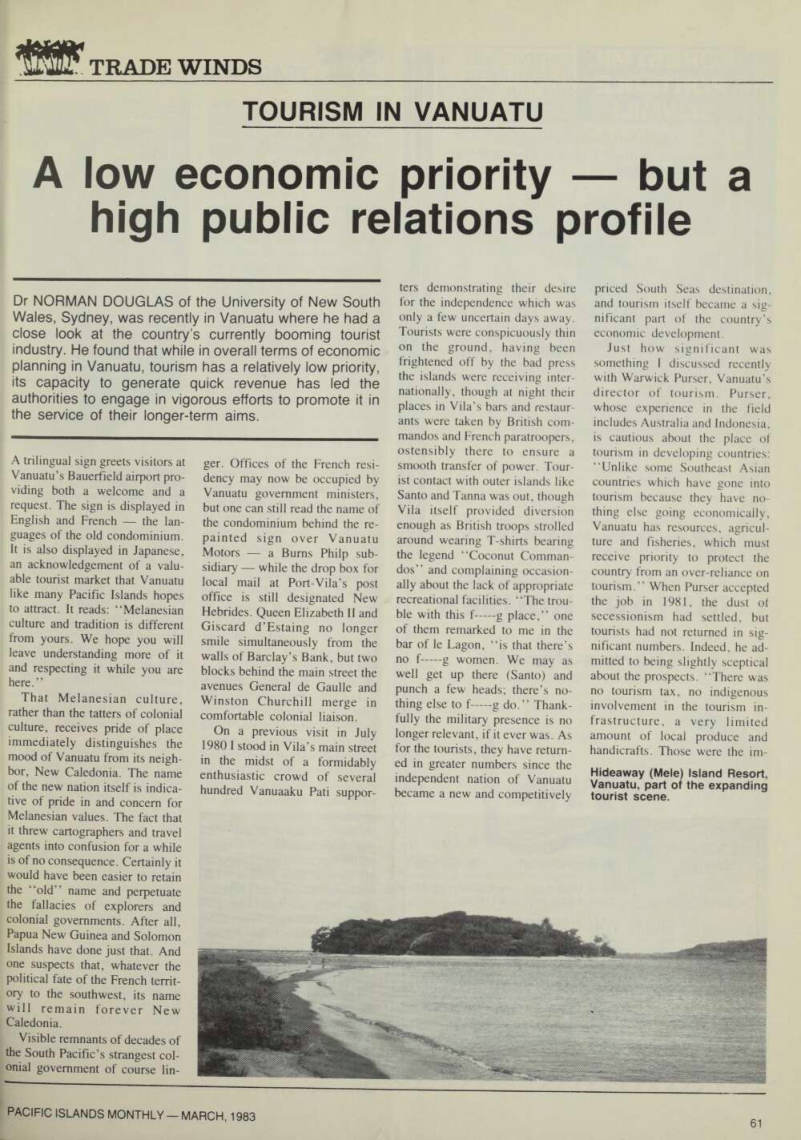

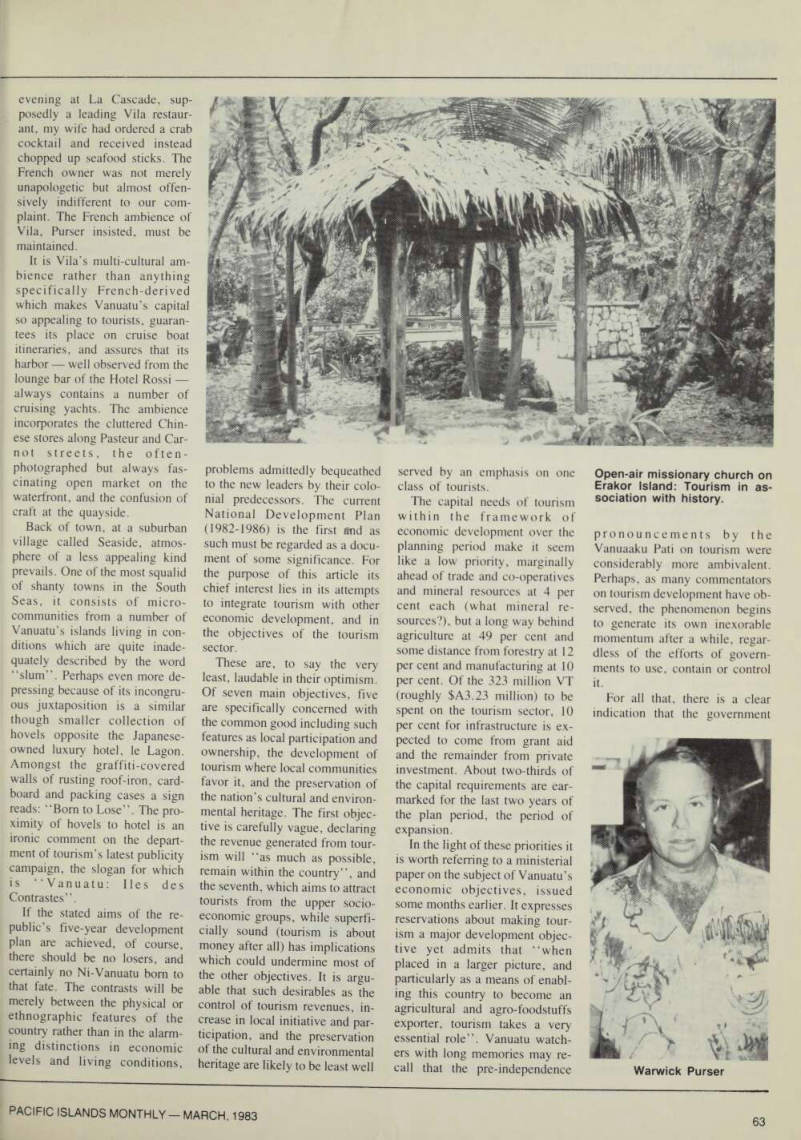
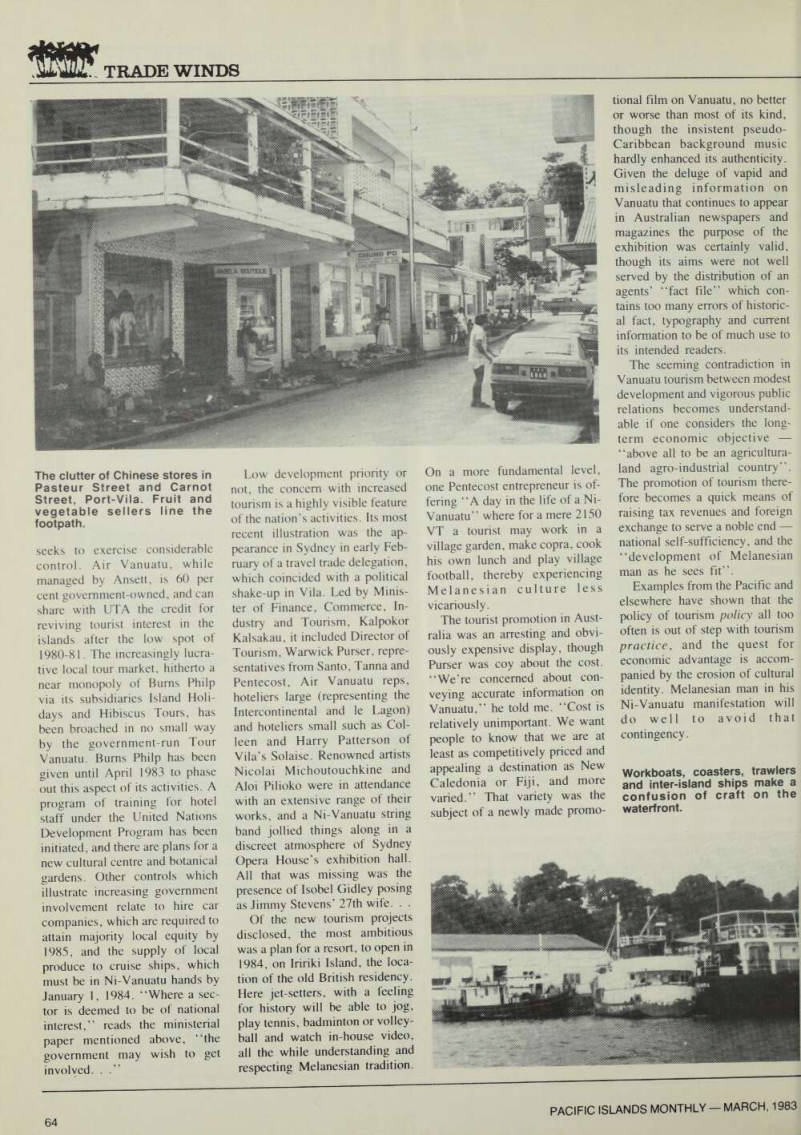
Trade Winds
Tourism In Vanuatu
A low economic priority - but a high public relations profile
Dr NORMAN DOUGLAS of the University of New South Wales, Sydney, was recently in Vanuatu where he had a close look at the country’s currently booming tourist industry. He found that while in overall terms of economic planning in Vanuatu, tourism has a relatively low priority, its capacity to generate quick revenue has led the authorities to engage in vigorous efforts to promote it in the service of their longer-term aims.
A trilingual sign greets visitors at Vanuatu’s Bauerfield airport pro viding both a welcome and a request. The sign is displayed in English and French the lan guages of the old condominium.
It is also displayed in Japanese, an acknowledgement of a valu able tourist market that Vanuatu like many Pacific Islands hopes to attract. It reads; “Melanesian culture and tradition is different from yours. We hope you will leave understanding more of it and respecting it while you are here.”
That Melanesian culture, rather than the tatters of colonial culture, receives pride of place immediately distinguishes the mood of Vanuatu from its neigh bor, New Caledonia. The name of the new nation itself is indica tive of pride in and concern for Melanesian values. The fact that it threw cartographers and travel agents into confusion for a while is of no consequence. Certainly it would have been easier to retain the “old” name and perpetuate the fallacies of explorers and colonial governments. After all, Papua New Guinea and Solomon Islands have done just that. And one suspects that, whatever the political fate of the French territ ory to the southwest, its name will remain forever New Caledonia.
Visible remnants of decades of the South Pacific’s strangest col onial government of course lin
ger. Offices of the French resi dency may now be occupied by Vanuatu government ministers, but one can still read the name of the condominium behind the re painted sign over Vanuatu Motors a Bums Philp sub sidiary while the drop box for local mail at Port-Vila’s post office is still designated New Hebrides. Queen Elizabeth II and Giscard d’Estaing no longer smile simultaneously from the walls of Barclay’s Bank, but two blocks behind the main street the avenues General de Gaulle and Winston Churchill merge in comfortable colonial liaison.
On a previous visit in July 1980 I stood in Vila’s main street in the midst of a formidably enthusiastic crowd of several hundred Vanuaaku Pati suppor
ters demonstrating their desire for the independence which was only a few uncertain days away.
Tourists were conspicuously thin on the ground, having been frightened off by the bad press the islands were receiving inter nationally, though at night their places in Vila’s bars and restaur ants were taken by British com mandos and French paratroopers, ostensibly there to ensure a smooth transfer of power. Tour ist contact with outer islands like Santo and Tanna was out, though Vila itself provided diversion enough as British troops strolled around wearing T-shirts bearing the legend “Coconut Comman dos” and complaining occasion ally about the lack of appropriate recreational facilities. “The trou ble with this f g place,” one of them remarked to me in the bar of le Lagon, “is that there’s no f g women. We may as well get up there (Santo) and punch a few heads; there’s no thing else to f-—g do.” Thank fully the military presence is no longer relevant, if it ever was. As for the tourists, they have return ed in greater numbers since the independent nation of Vanuatu became a new and competitively
priced South Seas destination, and tourism itself became a sig nificant part of the country’s economic development.
Just how significant was something I discussed recently with Warwick Purser, Vanuatu’s director of tourism. Purser, whose experience in the field includes Australia and Indonesia, is cautious about the place of tourism in developing countries: “Unlike some Southeast Asian countries which have gone into tourism because they have no thing else going economically, Vanuatu has resources, agricul ture and fisheries, which must receive priority to protect the country from an over-reliance on tourism.” When Purser accepted the job in 1981, the dust of secessionism had settled, but tourists had not returned in sig nificant numbers. Indeed, he ad mitted to being slightly sceptical about the prospects. “There was no tourism tax, no indigenous involvement in the tourism in frastructure, a very limited amount of local produce and handicrafts. Those were the im-
Hideaway (Mele) Island Resort, Vanuatu, part of the expanding tourist scene.
mediate challenges.” My impre
ssions were that those challenges were well on the way to being met, though there had been some
predictable grumbling about the
10 per cent government tourist tax (compare 3 per cent in Fiji).
Purser expects that the expat riate role in Vanuatu tourism “should and must always con tinue” but makes it clear that development must respect the needs of the local population.
American writer Paul Theroux once claimed that tourism invari
ably turned a country’s popula
tion into waiters and chamber maids. It is that possibility that Purser is determined to avoid.
“The local entrepreneur must be given incentives. A tourism in which Ni-Vanuatu are employed only as waitresses or taxi-drivers would be intolerable.”
At the same time he is under
standably wary, given Vanuatu’s
post-colonial land tenure prob
lems, of some of the deals which seek to involve Ni-Vanuatu in tourism of the resort develop ment type; “We don’t want another Erakor!” The remark surprised me, since I was staying at the Erakor Island resort and enjoying its superb location, its associations with missionary his tory, and its wonderfully low
key atmosphere. “My objec
tion,” Purser continued, “is to the way the place was established as a joint venture. It’s now the policy of this government to dis courage similar ventures based on a sharing of the net profits. It leads to all sorts of suspicion and hence trouble. We don’t expect custom landowners to have ex perience in analysing hotel ex penses and profits, so the form we hope to adopt is one of a percentage of gross revenue clear off the top, rather than encourag ing them to give land in return for being 50 per cent sharehol ders. There are too many grey areas. Custom landowners don’t always understand why, for inst ance, in the interests of promo tion, it is necessary to give travel agents free accommodation.”
I had to admit a sympathy with their attitude. I’ve never really
understood why either, especial
ly since most travel agents re main lamentably ignorant about the products they are attempting
to sell. To get to Port-Vila from Sydney the first time I had to fight off determined attempts by an agent to sell me first Noumea’s Club Med and then Queensland’s Dunk Island. On Erakor itself, the resort’s co manager Jill Palise was quick to refute any suggestion that the arrangement was less than satis factory. “The villagers take a great pride in the resort,’’ she assured me, “both as sharehol ders in the enterprise and as employees.’’
Purser envisages a natural limit to tourism development: “Our workforce . . . The popu lation of Vanuatu is relatively small (an estimated 120,000 in 1981) and there are other work priorities.” There is no precise figure on employment in tourism but estimates place it at about 1000, about a seventieth of the workforce. The chances of Vanuatu going the way of Hawaii in tourism seem comfort ably remote. “We’re not really in the numbers business here,” said Purser. “Whafs important to me is that handicrafts sold in Vila should not come from Taiwan or Manila and hotels shouldn’t have to serve canned fruit salad and fish fingers.” The illustration was apt. The previous
Ni-Vanuatu string band at the Sydney Opera House: Quiet jol lity in discreet surroundings.
evening at La Cascade, sup posedly a leading Vila restaur ant, my wife had ordered a crab cocktail and received instead chopped up seafood sticks. The French owner was not merely unapologetic but almost offen sively indifferent to our com plaint. The French ambience of Vila, Purser insisted, must be maintained.
It is Vila’s multi-cultural am bience rather than anything specifically French-derived which makes Vanuatu’s capital so appealing to tourists, guaran tees its place on cruise boat itineraries, and assures that its harbor well observed from the lounge bar of the Hotel Rossi always contains a number of cruising yachts. The ambience incorporates the cluttered Chin ese stores along Pasteur and Car not streets, the often photographed but always fas cinating open market on the waterfront, and the confusion of craft at the quayside.
Back of town, at a suburban village called Seaside, atmos phere of a less appealing kind prevails. One of the most squalid of shanty towns in the South Seas, it consists of micro communities from a number of Vanuatu’s islands living in con ditions which are quite inade quately described by the word “slum’’. Perhaps even more de pressing because of its incongru ous juxtaposition is a similar though smaller collection of hovels opposite the Japanese owned luxury hotel, le Lagon.
Amongst the graffiti-covered walls of rusting roof-iron, card board and packing cases a sign reads: “Bom to Lose’’. The pro ximity of hovels to hotel is an ironic comment on the depart ment of tourism’s latest publicity campaign, the slogan for which is “Vanuatu: lies des Contras tes”.
If the stated aims of the re public’s five-year development plan are achieved, of course, there should be no losers, and certainly no Ni-Vanuatu bom to that fate. The contrasts will be merely between the physical or ethnographic features of the country rather than in the alarm ing distinctions in economic levels and living conditions,
problems admittedly bequeathed to the new leaders by their colo nial predecessors. The current National Development Plan (1982-1986) is the first find as such must be regarded as a docu ment of some significance. For the purpose of this article its chief interest lies in its attempts to integrate tourism with other economic development, and in the objectives of the tourism sector.
These are, to say the very least, laudable in their optimism.
Of seven main objectives, five are specifically concerned with the common good including such features as local participation and ownership, the development of tourism where local communities favor it, and the preservation of the nation’s cultural and environ mental heritage. The first objec tive is carefully vague, declaring the revenue generated from tour ism will “as much as possible, remain within the country’’, and the seventh, which aims to attract tourists from the upper socio economic groups, while superfi cially sound (tourism is about money after all) has implications which could undermine most of the other objectives. It is argu able that such desirables as the control of tourism revenues, in crease in local initiative and par ticipation, and the preservation of the cultural and environmental heritage are likely to be least well
served by an emphasis on one class of tourists.
The capital needs of tourism within the framework of economic development over the planning period make it seem like a low priority, marginally ahead of trade and co-operatives and mineral resources at 4 per cent each (what mineral re sources?), but a long way behind agriculture at 49 per cent and some distance from forestry at 12 per cent and manufacturing at 10 per cent. Of the 323 million VT (roughly $A3.23 million) to be spent on the tourism sector, 10 per cent for infrastructure is ex pected to come from grant aid and the remainder from private investment. About two-thirds of the capital requirements are ear marked for the last two years of the plan period, the period of expansion.
In the light of these priorities it is worth referring to a ministerial paper on the subject of Vanuatu’s economic objectives, issued some months earlier. It expresses reservations about making tour ism a major development objec tive yet admits that “when placed in a larger picture, and particularly as a means of enabl ing this country to become an agricultural and agro-foodstuffs exporter, tourism takes a very essential role’’. Vanuatu watch ers with long memories may re call that the pre-independence
pronouncements by the Vanuaaku Pati on tourism were considerably more ambivalent.
Perhaps, as many commentators on tourism development have ob served, the phenomenon begins to generate its own inexorable momentum after a while, regar dless of the efforts of govern ments to use, contain or control it.
For all that, there is a clear indication that the government
Open-air missionary church on
Erakor Island: Tourism in as sociation with history.
Warwick Purser
seeks to exercise considerable control. Air Vanuatu, while managed by Ansett, is 60 per cent government-owned, and can share with UTA the credit for reviving tourist interest in the islands after the low spot of 1980-81. The increasingly lucra tive local tour market, hitherto a near monopoly of Bums Philp via its subsidiaries Island Holi days and Hibiscus Tours, has been broached in no small way by the government-run Tour Vanuatu. Bums Philp has been given until April 1983 to phase out this aspect of its activities. A program of training for hotel staff under the United Nations Development Program has been initiated, and there are plans for a new cultural centre and botanical gardens. Other controls which illustrate increasing government involvement relate to hire car companies, which are required to attain majority local equity by 1985, and the supply of local produce to cruise ships, which must be in Ni-Vanuatu hands by January 1, 1984. “Where a sec tor is deemed to be of national interest,” reads the ministerial paper mentioned above, “the government may wish to get involved. . .”
Low development priority or not, the concern with increased tourism is a highly visible feature of the nation’s activities. Its most recent illustration was the ap pearance in Sydney in early Feb ruary of a travel trade delegation, which coincided with a political shake-up in Vila. Led by Minis ter of Finance, Commerce, In dustry and Tourism, Kalpokor Kalsakau, it included Director of Tourism, Warwick Purser, repre sentatives from Santo, Tanna and Pentecost, Air Vanuatu reps, hoteliers large (representing the Intercontinental and le Lagon) and hoteliers small such as Col leen and Harry Patterson of Vila’s Solaise. Renowned artists Nicolai Michoutouchkine and Aloi Pilioko were in attendance with an extensive range of their works, and a Ni-Vanuatu string band jollied things along in a discreet atmosphere of Sydney Opera House’s exhibition hall.
All that was missing was the presence of Isobel Gidley posing as Jimmy Stevens’ 27th wife. . .
Of the new tourism projects disclosed, the most ambitious was a plan for a resort, to open in 1984, on Iririki Island, the loca tion of the old British residency.
Here jet-setters, with a feeling for history will be able to jog, play tennis, badminton or volley ball and watch in-house video, all the while understanding and respecting Melanesian tradition.
On a more fundamental level, one Pentecost entrepreneur is of fering “A day in the life of a Ni- Vanuatu” where for a mere 2150 VT a tourist may work in a village garden, make copra, cook his own lunch and play village football, thereby experiencing Melanesian culture less
vicariously.
The tourist promotion in Aust ralia was an arresting and obvi
ously expensive display, though
Purser was coy about the cost.
“WeTe concerned about con veying accurate information on Vanuatu,” he told me. “Cost is relatively unimportant. We want people to know that we are at least as competitively priced and appealing a destination as New Caledonia or Fiji, and more varied.” That variety was the subject of a newly made promo
tional film on Vanuatu, no better or worse than most of its kind, though the insistent pseudo- Caribbean background music
hardly enhanced its authenticity.
Given the deluge of vapid and misleading information on Vanuatu that continues to appear in Australian newspapers and magazines the purpose of the exhibition was certainly valid, though its aims were not well served by the distribution of an agents’ “fact file’’ which con tains too many errors of historic al fact, typography and current information to be of much use to its intended readers.
The seeming contradiction in Vanuatu tourism between modest development and vigorous public relations becomes understand able if one considers the long term economic objective “above all to be an agricultura
land agro-industrial country”.
The promotion of tourism there fore becomes a quick means of raising tax revenues and foreign exchange to serve a noble end national self-sufficiency, and the “development of Melanesian man as he sees fit”.
Examples from the Pacific and elsewhere have shown that the policy of tourism policy all too often is out of step with tourism practice, and the quest for economic advantage is accom panied by the erosion of cultural identity. Melanesian man in his Ni-Vanuatu manifestation will do well to avoid that
contingency.
The clutter of Chinese stores in Pasteur Street and Carnot Street, Port-Vila. Fruit and vegetable sellers line the
footpath.
Workboats, coasters, trawlers and Inter-island ships make a confusion of craft on the waterfront.
Product review
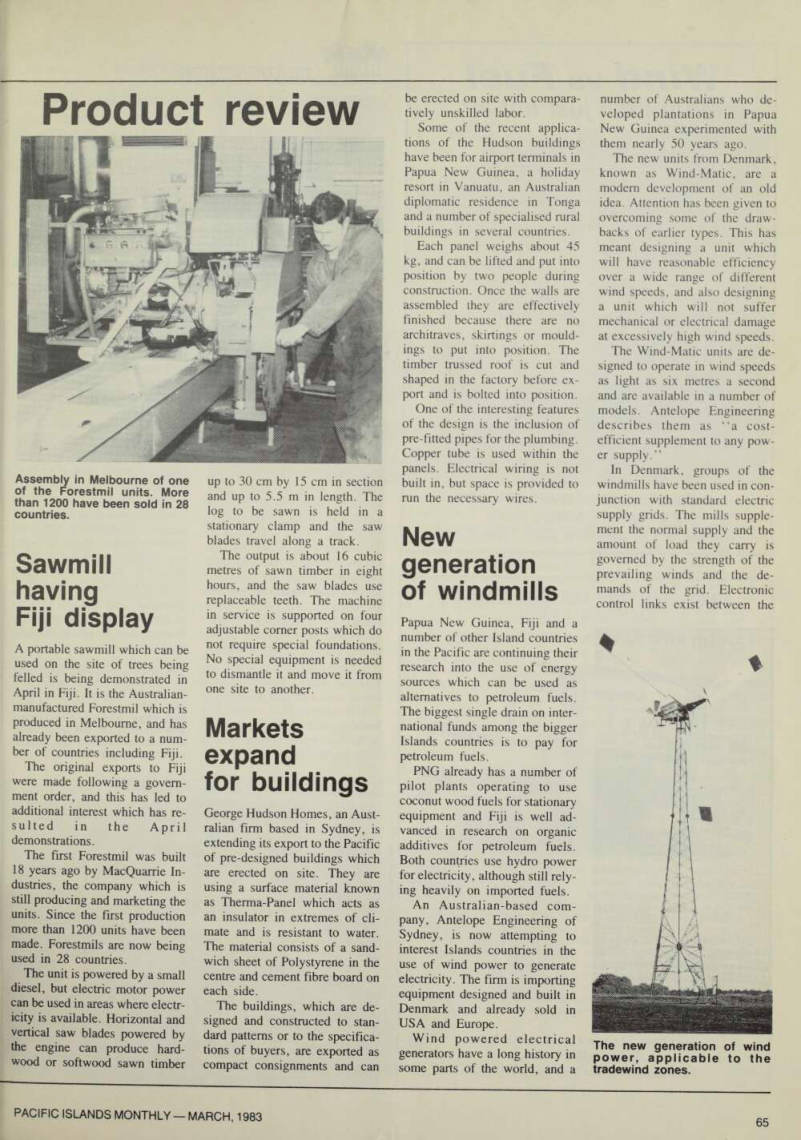
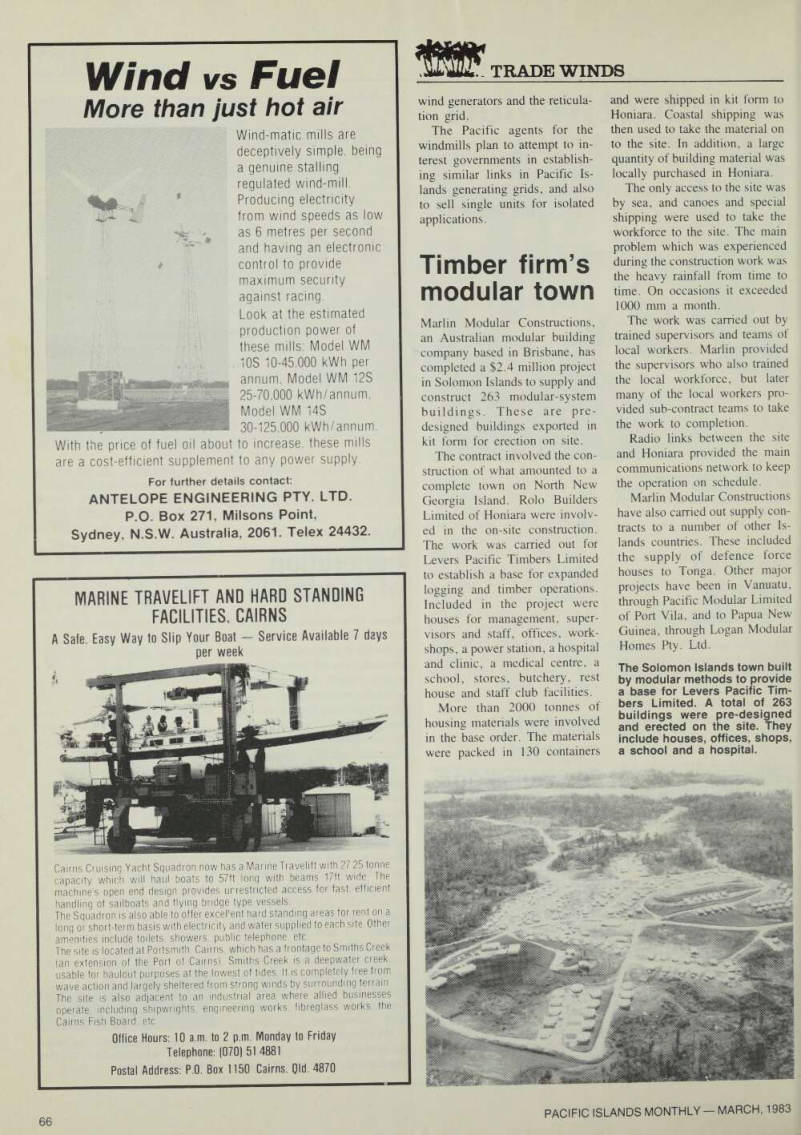
Sawmill
having
Fiji display
A portable sawmill which can be used on the site of trees being felled is being demonstrated in April in Fiji. It is the Australian manufactured Forestmil which is produced in Melbourne, and has already been exported to a num ber of countries including Fiji.
The original exports to Fiji were made following a govern ment order, and this has led to additional interest which has re sulted in the April demonstrations.
The first Forestmil was built 18 years ago by MacQuarrie In dustries, the company which is still producing and marketing the units. Since the first production more than 1200 units have been made. Forestmils are now being used in 28 countries.
The unit is powered by a small diesel, but electric motor power can be used in areas where electr icity is available. Horizontal and vertical saw blades powered by the engine can produce hard wood or softwood sawn timber
up to 30 cm by 15 cm in section and up to 5.5 m in length. The log to be sawn is held in a stationary clamp and the saw blades travel along a track.
The output is about 16 cubic metres of sawn timber in eight hours, and the saw blades use replaceable teeth. The machine in service is supported on four adjustable comer posts which do not require special foundations.
No special equipment is needed to dismantle it and move it from one site to another.
Markets
expand
for buildings
George Hudson Homes, an Aust ralian firm based in Sydney, is extending its export to the Pacific of pre-designed buildings which are erected on site. They are using a surface material known as Therma-Panel which acts as an insulator in extremes of cli mate and is resistant to water.
The material consists of a sand wich sheet of Polystyrene in the centre and cement fibre board on each side.
The buildings, which are de signed and constructed to stan dard patterns or to the specifica tions of buyers, are exported as compact consignments and can
be erected on site with compara tively unskilled labor.
Some of the recent applica tions of the Hudson buildings have been for airport terminals in Papua New Guinea, a holiday resort in Vanuatu, an Australian diplomatic residence in Tonga and a number of specialised rural buildings in several countries.
Each panel weighs about 45 kg, and can be lifted and put into position by two people during construction. Once the walls are assembled they are effectively finished because there are no architraves, skirtings or mould ings to put into position. The timber trussed roof is cut and shaped in the factory before ex port and is bolted into position.
One of the interesting features of the design is the inclusion of pre-fitted pipes for the plumbing.
Copper tube is used within the panels. Electrical wiring is not built in, but space is provided to run the necessary wires.
New
generation
of windmills
Papua New Guinea, Fiji and a number of other Island countries in the Pacific are continuing their research into the use of energy sources which can be used as alternatives to petroleum fuels.
The biggest single drain on inter national funds among the bigger Islands countries is to pay for petroleum fuels.
PNG already has a number of pilot plants operating to use coconut wood fuels for stationary equipment and Fiji is well ad vanced in research on organic additives for petroleum fuels.
Both countries use hydro power for electricity, although still rely ing heavily on imported fuels.
An Australian-based com pany, Antelope Engineering of Sydney, is now attempting to interest Islands countries in the use of wind power to generate electricity. The firm is importing equipment designed and built in Denmark and already sold in USA and Europe.
Wind powered electrical generators have a long history in some parts of the world, and a
number of Australians who de veloped plantations in Papua New Guinea experimented with them nearly 50 years ago.
The new units from Denmark, known as Wind-Matic, are a modem development of an old idea. Attention has been given to overcoming some of the draw backs of earlier types. This has meant designing a unit which will have reasonable efficiency over a wide range of different wind speeds, and also designing a unit which will not suffer mechanical or electrical damage
at excessively high wind speeds.
The Wind-Matic units are de signed to operate in wind speeds as light as six metres a second and are available in a number of
models. Antelope Engineering
describes them as “a cost efficient supplement to any pow
er supply.”
In Denmark, groups of the windmills have been used in con junction with standard electric supply grids. The mills supple ment the normal supply and the amount of load they carry is governed by the strength of the prevailing winds and the de mands of the grid. Electronic control links exist between the
Assembly in Melbourne of one of the Forestmil units. More than 1200 have been sold in 28 countries.
The new generation of wind power, applicable to the tradewind zones.
wind generators and the reticula
tion grid.
The Pacific agents for the windmills plan to attempt to in terest governments in establish ing similar links in Pacific Is lands generating grids, and also to sell single units for isolated
applications.
Timber firm’s
modular town
Marlin Modular Constructions, an Australian modular building company based in Brisbane, has completed a $2.4 million project in Solomon Islands to supply and construct 263 modular-system buildings. These are pre
designed buildings exported in
kit form for erection on site.
The contract involved the con struction of what amounted to a complete town on North New Georgia Island. Rolo Builders Limited of Honiara were involv ed in the on-site construction.
The work was carried out for Levers Pacific Timbers Limited to establish a base for expanded
logging and timber operations.
Included in the project were houses for management, super visors and staff, offices, work shops, a power station, a hospital and clinic, a medical centre, a school, stores, butchery, rest house and staff club facilities.
More than 2000 tonnes of housing materials were involved in the base order. The materials were packed in 130 containers
and were shipped in kit form to Honiara. Coastal shipping was then used to take the material on to the site. In addition, a large quantity of building material was
locally purchased in Honiara.
The only access to the site was by sea, and canoes and special shipping were used to take the workforce to the site. The main problem which was experienced during the construction work was the heavy rainfall from time to time. On occasions it exceeded 1000 mm a month.
The work was carried out by trained supervisors and teams of local workers. Marlin provided the supervisors who also trained the local workforce, but later many of the local workers pro vided sub-contract teams to take the work to completion.
Radio links between the site and Honiara provided the main communications network to keep the operation on schedule.
Marlin Modular Constructions have also carried out supply con tracts to a number of other Is lands countries. These included the supply of defence force houses to Tonga. Other major projects have been in Vanuatu, through Pacific Modular Limited of Port Vila, and to Papua New Guinea, through Logan Modular Homes Pty. Ltd.
The Solomon Islands town built by modular methods to provide a base for Levers Pacific Tim bers Limited. A total of 263 buildings were pre-designed and erected on the site. They include houses, offices, shops, a school and a hospital.
Advertisements & other items, p. 66 (1 item)
Wind vs Fuel
More than just hot air
4$ Wind-matic mills are deceptively simple, being a genuine stalling regulated wind-mill.
Producing electricity from wind speeds as low as 6 metres per second and having an electronic control to provide maximum security against racing.
Look at the estimated production power of these mills; Model WM 10S 10-45,000 kWh per annum. Model WM 12S 25-70.000 kWh/annum, Model WM 14S 30-125.000 kWh/annum.
With the price of fuel oil about to increase, these mills are a cost-efficient supplement to any power supply.
For further details contact:
ANTELOPE ENGINEERING PTY. LTD.
P.O. Box 271, Milsons Point, Sydney, N.S.W. Australia, 2061. Telex 24432.
MARINE TRAVELIFT AND HARD STANDING
FACILITIES, CAIRNS
A Safe. Easy Way to Slip Your Boat Service Available 7 days
per week
Am Cairns Cruising Yacht Squadron now has a Marine Travelitt with 27.25 tonne capacity which will haul boats to 57ft long with beams 17ft wide. The machine's open end design provides unrestricted access for fast, efficient handling of sailboats and flying bridge type vessels.
The Squadron is also able to offer excel'ent hard standing areas for rent on a long or short-term basis with electricity and water supplied to each site. Other amenities include toilets, showers, public telephone, etc.
The site is located at Portsmith, Cairns, which has a frontageto Smiths Creek (an extension of the Port of Cairns). Smiths Creek is a deepwater creek, usable for haulout purposes at the lowest of tides. It is completely free from wave action and largely sheltered from strong winds by surrounding terrain The site is also adjacent to an industrial area where allied businesses operate, including shipwrights, engineering works, fibreglass works, the Cairns Fish Board, etc.
Office Hours: 10 a.m. to 2 p.m. Monday to Friday
Telephone; (070) 51 4881
Postal Address: P.O. Box 1150 Cairns. Old. 4870
Yachts
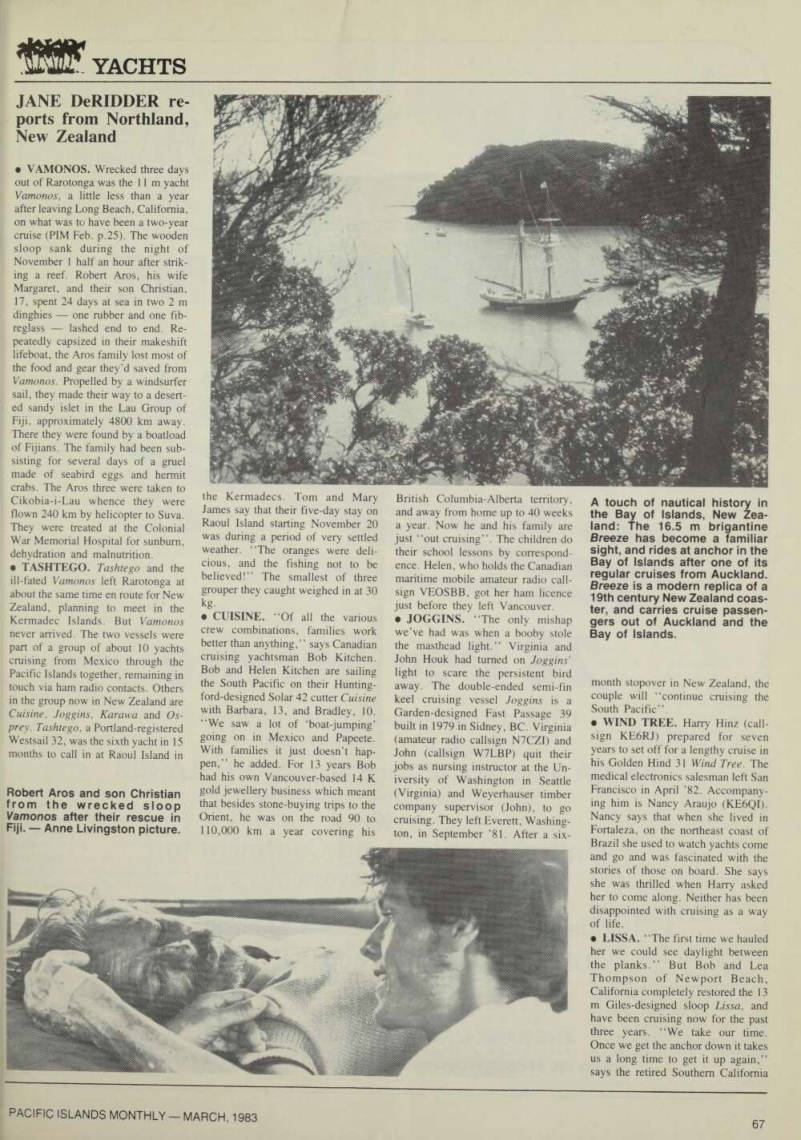
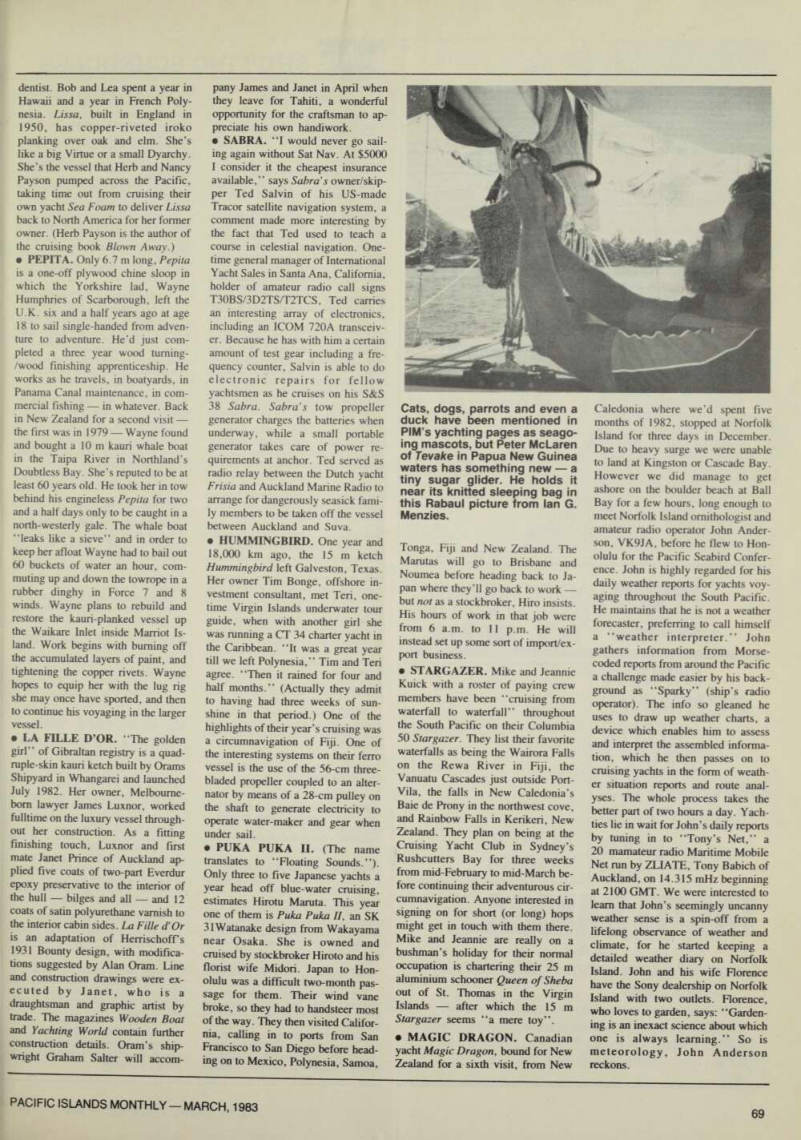
Jane Deridder Re
ports from Northland, New Zealand
• VAMONOS. Wrecked three days out of Rarotonga was the 11 m yacht Vamonos, a little less than a year after leaving Long Beach, California, on what was to have been a two-year cruise (PIM Feb. p. 25). The wooden sloop sank during the night of November 1 half an hour after strik ing a reef. Robert Arcs, his wife Margaret, and their son Christian, 17, spent 24 days at sea in two 2 m dinghies one rubber and one fib reglass lashed end to end. Re peatedly capsized in their makeshift lifeboat, the Aros family lost most of the food and gear they’d saved from Vamonos. Propelled by a windsurfer sail, they made their way to a desert ed sandy islet in the Lau Group of Fiji, approximately 4800 km away.
There they were found by a boatload of Fijians. The family had been sub sisting for several days of a gruel made of seabird eggs and hermit crabs. The Aros three were taken to Cikobia-i-Lau whence they were flown 240 km by helicopter to Suva.
They were treated at the Colonial War Memorial Hospital for sunburn, dehydration and malnutrition. • TASHTEGO. Tashtego and the ill-fated Vamonos left Rarotonga at about the same time en route for New Zealand, planning to meet in the Kermadec Islands. But Vamonos never arrived. The two vessels were part of a group of about 10 yachts cruising from Mexico through the Pacific Islands together, remaining in touch via ham radio contacts. Others in the group now in New Zealand are Cuisine, Joggins, Karawa and Os prey. Tashtego, a Portland-registered Westsail 32, was the sixth yacht in 15 months to call in at Raoul Island in
the Kermadecs. Tom and Mary James say that their five-day stay on Raoul Island starting November 20 was during a period of very settled weather. “The oranges were deli cious, and the fishing not to be believed!” The smallest of three grouper they caught weighed in at 30 kg • CUISINE. “Of all the various crew combinations, families work better than anything,” says Canadian cruising yachtsman Bob Kitchen.
Bob and Helen Kitchen are sailing the South Pacific on their Hunting ford-designed Solar 42 cutter Cuisine with Barbara, 13, and Bradley, 10.
“We saw a lot of ‘boat-jumping’ going on in Mexico and Papeete.
With families it just doesn’t hap pen,” he added. For 13 years Bob had his own Vancouver-based 14 K gold jewellery business which meant that besides stone-buying trips to the Orient, he was on the road 90 to 110,000 km a year covering his
British Columbia-Alberta territory, and away from home up to 40 weeks a year. Now he and his family are just “out cruising”. The children do their school lessons by correspond ence. Helen, who holds the Canadian maritime mobile amateur radio call sign VEOSBB, got her ham licence just before they left Vancouver. • JOGGINS. “The only mishap we’ve had was when a booby stole the masthead light.” Virginia and John Houk had turned on Joggins’ light to scare the persistent bird away. The double-ended semi-fin keel cruising vessel Joggins is a
Garden-designed Fast Passage 39
built in 1979 in Sidney, BC. Virginia (amateur radio callsign N7CZI) and John (callsign W7LBP) quit their jobs as nursing instructor at the Un iversity of Washington in Seattle (Virginia) and Weyerhauser timber company supervisor (John), to go cruising. They left Everett, Washing ton, in September ’Bl. After a six
month stopover in New Zealand, the couple will “continue cruising the South Pacific”. • WIND TREE. Harry Hinz (call sign KE6RJ) prepared for seven years to set off for a lengthy cruise in his Golden Hind 31 Wind Tree. The medical electronics salesman left San Francisco in April ’B2. Accompany
ing him is Nancy Araujo (KE6QI).
Nancy says that when she lived in Fortaleza, on the northeast coast of Brazil she used to watch yachts come and go and was fascinated with the stories of those on board. She says she was thrilled when Harry asked her to come along. Neither has been disappointed with cruising as a way of life. • LISSA. “The first time we hauled her we could see daylight between the planks.” But Bob and Lea
Thompson of Newport Beach,
California completely restored the 13 m Giles-designed sloop Lissa, and have been cruising now for the past three years. “We take our time.
Once we get the anchor down it takes us a long time to get it up again,” says the retired Southern California
Robert Arcs and son Christian from the wrecked sloop Vamonos after their rescue in
Fiji. - Anne Livingston picture.
A touch of nautical history in the Bay of Islands, New Zea land: The 16.5 m brigantine Breeze has become a familiar sight, and rides at anchor in the Bay of Islands after one of its regular cruises from Auckland.
Breeze is a modern replica of a 19th century New Zealand coas ter, and carries cruise passen gers out of Auckland and the Bay of Islands.
dentist. Bob and Lea spent a year in Hawaii and a year in French Poly nesia. Lissa, built in England in 1950, has copper-riveted iroko planking over oak and elm. She’s like a big Virtue or a small Dyarchy.
She’s the vessel that Herb and Nancy Payson pumped across the Pacific, taking time out from cruising their own yacht Sea Foam to deliver Lissa back to North America for her former owner. (Herb Payson is the author of the cruising book Blown Away.) • PEPITA. Only 6.7 m long, Pepita is a one-off plywood chine sloop in which the Yorkshire lad, Wayne Humphries of Scarborough, left the U.K. six and a half years ago at age 18 to sail single-handed from adven ture to adventure. He’d just com pleted a three year wood tuming
/wood finishing apprenticeship. He
works as he travels, in boatyards, in Panama Canal maintenance, in com mercial fishing in whatever. Back in New Zealand for a second visit the first was in 1979 Wayne found and bought a 10 m kauri whale boat in the Taipa River in Northland’s Doubtless Bay. She’s reputed to be at least 60 years old. He took her in tow behind his engineless Pepita for two and a half days only to be caught in a north-westerly gale. The whale boat “leaks like a sieve” and in order to keep her afloat Wayne had to bail out 60 buckets of water an hour, com muting up and down the towrope in a rubber dinghy in Force 7 and 8 winds. Wayne plans to rebuild and restore the kauri-planked vessel up the Waikare Inlet inside Marriot Is land. Work begins with burning off the accumulated layers of paint, and tightening the copper rivets. Wayne hopes to equip her with the lug rig she may once have sported, and then to continue his voyaging in the larger vessel. • LA FILLE D’OR. “The golden girl” of Gibraltan registry is a quad ruple-skin kauri ketch built by Grams Shipyard in Whangarei and launched July 1982. Her owner. Melbourne born lawyer James Luxnor, worked fulltime on the luxury vessel through out her construction. As a fitting finishing touch, Luxnor and first mate Janet Prince of Auckland ap plied five coats of two-part Everdur epoxy preservative to the interior of the hull bilges and all and 12 coats of satin polyurethane varnish to the interior cabin sides. La Fille d’Or is an adaptation of Herrischoffs 1931 Bounty design, with modifica tions suggested by Alan Oram. Line and construction drawings were ex ecuted by Janet, who is a
draughtsman and graphic artist by
trade. The magazines Wooden Boat and Yachting World contain further construction details. Oram’s ship wright Graham Salter will accom
pany James and Janet in April when they leave for Tahiti, a wonderful opportunity for the craftsman to ap preciate his own handiwork. • SABRA. “I would never go sail ing again without Sat Nav. At $5OOO I consider it the cheapest insurance available,” says Sabra’s owner/skip per Ted Salvin of his US-made Tracer satellite navigation system, a comment made more interesting by the fact that Ted used to teach a course in celestial navigation. One time general manager of International Yacht Sales in Santa Ana, California, holder of amateur radio call signs T3OBS/3D2TS/T2TCS, Ted carries an interesting array of electronics,
including an ICOM 720 A transceiv
er. Because he has with him a certain amount of test gear including a fre quency counter, Salvin is able to do electronic repairs for fellow yachtsmen as he cruises on his S&S 38 Sabra. Sabra’s tow propeller generator charges the batteries when underway, while a small portable generator takes care of power re quirements at anchor. Ted served as radio relay between the Dutch yacht Frisia and Auckland Marine Radio to arrange for dangerously seasick fami ly members to be taken off the vessel between Auckland and Suva. • HUMMINGBIRD. One year and 18,000 km ago, the 15 m ketch Hummingbird left Galveston, Texas.
Her owner Tim Bonge, offshore in vestment consultant, met Teri, one time Virgin Islands underwater tour guide, when with another girl she was running a CT 34 charter yacht in the Caribbean. “It was a great year till we left Polynesia,” Tim and Teri agree. “Then it rained for four and half months.” (Actually they admit to having had three weeks of sun shine in that period.) One of the highlights of their year’s cruising was a circumnavigation of Fiji. One of the interesting systems on their ferro vessel is the use of the 56-cm three bladed propeller coupled to an alter nator by means of a 28-cm pulley on the shaft to generate electricity to operate water-maker and gear when under sail. • PUKA PUKA 11. (The name
translates to “Floating Sounds.”).
Only three to five Japanese yachts a year head off blue-water cruising, estimates Hirotu Manila. This year one of them is Puka Puka 11, an SK
31Watanake design from Wakayama
near Osaka. She is owned and cruised by stockbroker Hiroto and his florist wife Midori. Japan to Hon olulu was a difficult two-month pas sage for them. Their wind vane broke, so they had to handsteer most of the way. They then visited Califor nia, calling in to ports from San Francisco to San Diego before head ing on to Mexico, Polynesia, Samoa,
Tonga, Fiji and New Zealand. The Manilas will go to Brisbane and Noumea before heading back to Ja pan where they’ll go back to work but not as a stockbroker, Hiro insists.
His hours of work in that job were from 6 a.m. to 11 p.m. He will instead set up some sort of import/ex port business. • STARGAZER. Mike and Jeannie Kuick with a roster of paying crew members have been “cruising from waterfall to waterfall” throughout the South Pacific on their Columbia 50 Stargazer. They list their favorite waterfalls as being the Wairora Falls on the Rewa River in Fiji, the Vanuatu Cascades just outside Port- Vila, the falls in New Caledonia’s Baie de Prony in the northwest cove, and Rainbow Falls in Kerikeri, New Zealand. They plan on being at the Cruising Yacht Club in Sydney’s Rushcutters Bay for three weeks from mid-February to mid-March be fore continuing their adventurous cir cumnavigation. Anyone interested in signing on for short (or long) hops might get in touch with them there.
Mike and Jeannie are really on a bushman’s holiday for their normal occupation is chartering their 25 m aluminium schooner Queen of Sheba out of St. Thomas in the Virgin Islands after which the 15 m Stargazer seems “a mere toy”. • MAGIC DRAGON. Canadian yacht Magic Dragon, bound for New Zealand for a sixth visit, from New
Caledonia where we’d spent five months of 1982, stopped at Norfolk Island for three days in December.
Due to heavy surge we were unable to land at Kingston or Cascade Bay.
However we did manage to get ashore on the boulder beach at Ball Bay for a few hours, long enough to meet Norfolk Island ornithologist and amateur radio operator John Ander son, VK9JA, before he flew to Hon olulu for the Pacific Seabird Confer ence. John is highly regarded for his daily weather reports for yachts voy aging throughout the South Pacific.
He maintains that he is not a weather forecaster, preferring to call himself a “weather interpreter.” John gathers information from Morse coded reports from around the Pacific a challenge made easier by his back ground as “Sparky” (ship’s radio operator). The info so gleaned he uses to draw up weather charts, a device which enables him to assess and interpret the assembled informa tion, which he then passes on to cruising yachts in the form of weath er situation reports and route anal yses. The whole process takes the better part of two hours a day. Yach ties lie in wait for John’s daily reports by tuning in to “Tony’s Net,” a 20 mamateur radio Maritime Mobile Net run by ZLIATE, Tony Babich of Auckland, on 14.315 mHz beginning at 2100 GMT. We were interested to learn that John’s seemingly uncanny weather sense is a spin-off from a lifelong observance of weather and climate, for he started keeping a detailed weather diary on Norfolk Island. John and his wife Florence have the Sony dealership on Norfolk Island with two outlets. Florence, who loves to garden, says: “Garden ing is an inexact science about which one is always learning.” So is meteorology, John Anderson reckons.
Cats, dogs, parrots and even a duck have been mentioned in PIM’s yachting pages as seago ing mascots, but Peter McLaren of Tevake in Papua New Guinea
waters has something new - a
tiny sugar glider. He holds it near its knitted sleeping bag in this Rabaul picture from Ian G.
Menzies.
Advertisements & other items, pp. 68-70 (1 item)
28 Day Service
GLOBAL SERVICE FOR SHIPPERS
V
THE BANK LINE
i A***
28 Day Service
United Kingdom and Continent to:
PAPEETE • NOUMEA
PAPUA NEW GUINEA and SOLOMON ISLANDS
PORT VILA & SANTO BY TRANSHIPMENT
* United Kingdom and Continent to: SUVA AND LAUTOKA (FCL LCL & LINITISED ONLY) * Papua New Guinea and Solomon Islands to:
UNITED KINGDOM and CONTINENT
For particulars apply:
THE BANK LINE (AUSTRALASIA) PTY. LTD.
Suite 801, 51 Pitt Street, Sydney 2000. Australia. Tel; 272041. Tlx: 24063.
LAE
KIUNGA
PORT
MORESBY
DILLINGHAM AUSTRALIA
ALOTAU
SHIPPING
MASON
LAE
P.O. Box 1032 Phone: 423811 Tlx: Carship 42508 P O Box 10 Phone 212466 Tlx: Carship 22182
CAIRNS
BRISBANE
CAIRNS
John Burke Shipping P.O. Box 509 Phone: (07) 521701 Tlx: 40483 Mason Shipping Co. 26A Abbott Street Phone: (070) 516933 Tlx: 48405 P.O. Box 840
TOWNSVILLE
PACIFIC ISLANDS
TRANSPORT LINE
M.V. SIRIUS
TAHITI SAMOA =••
JUUC
Qeqeral Steair(shjp
General Agents 400 California Street, San Francisco. CA. USA PAPEETE: Agence Maritime Internationale, Tahiti PAGO PAGO: Polynesia Shipping Services, Inc.
APIA: Burns Philp (South Sea) Company, Ltd.
Shipping Schedules
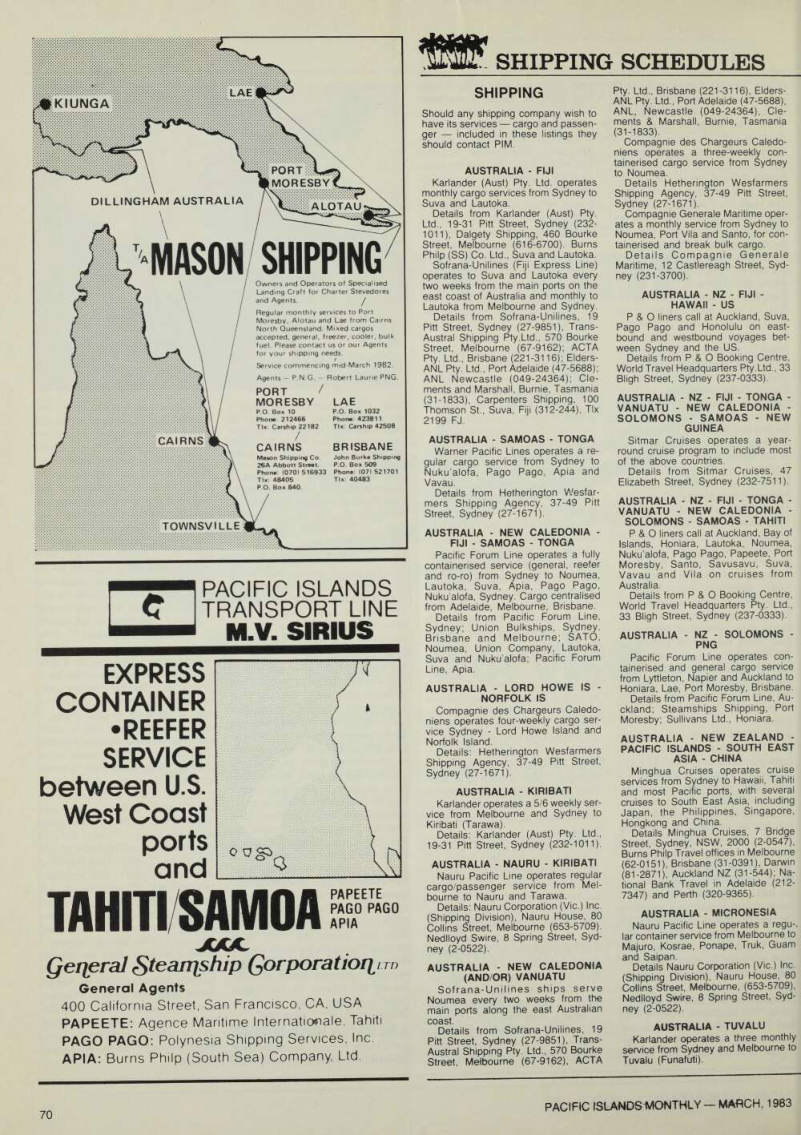
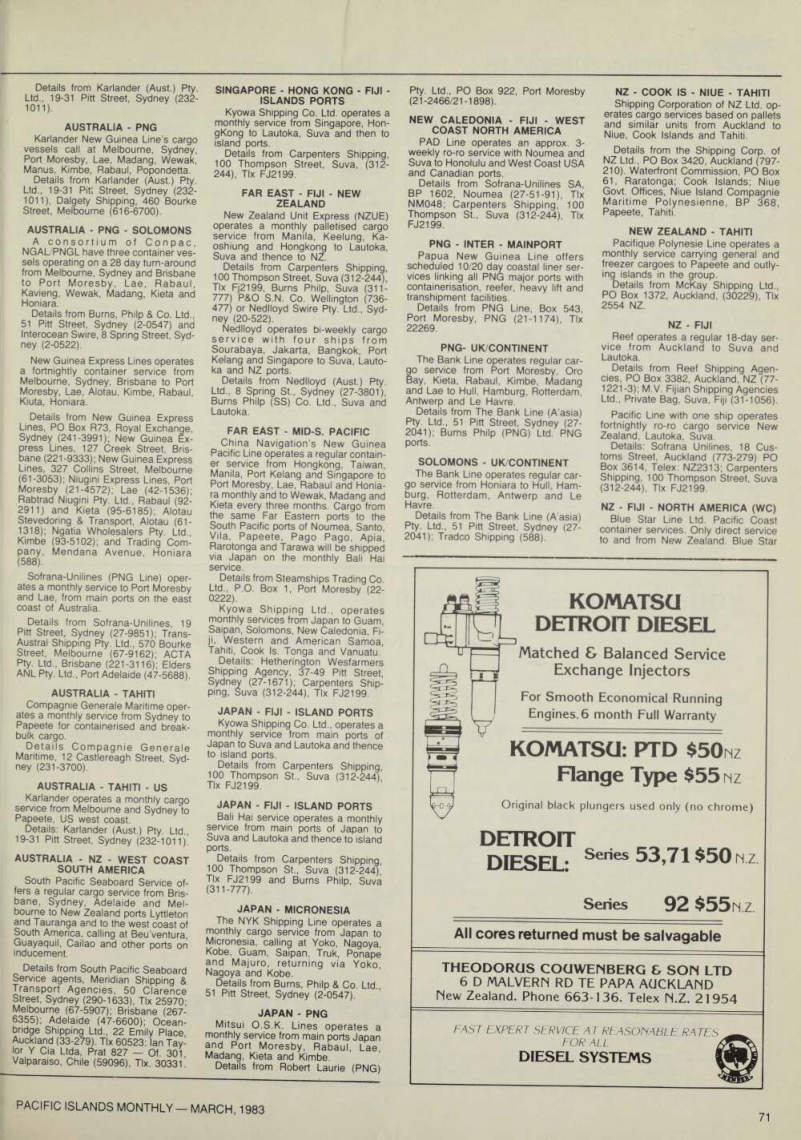
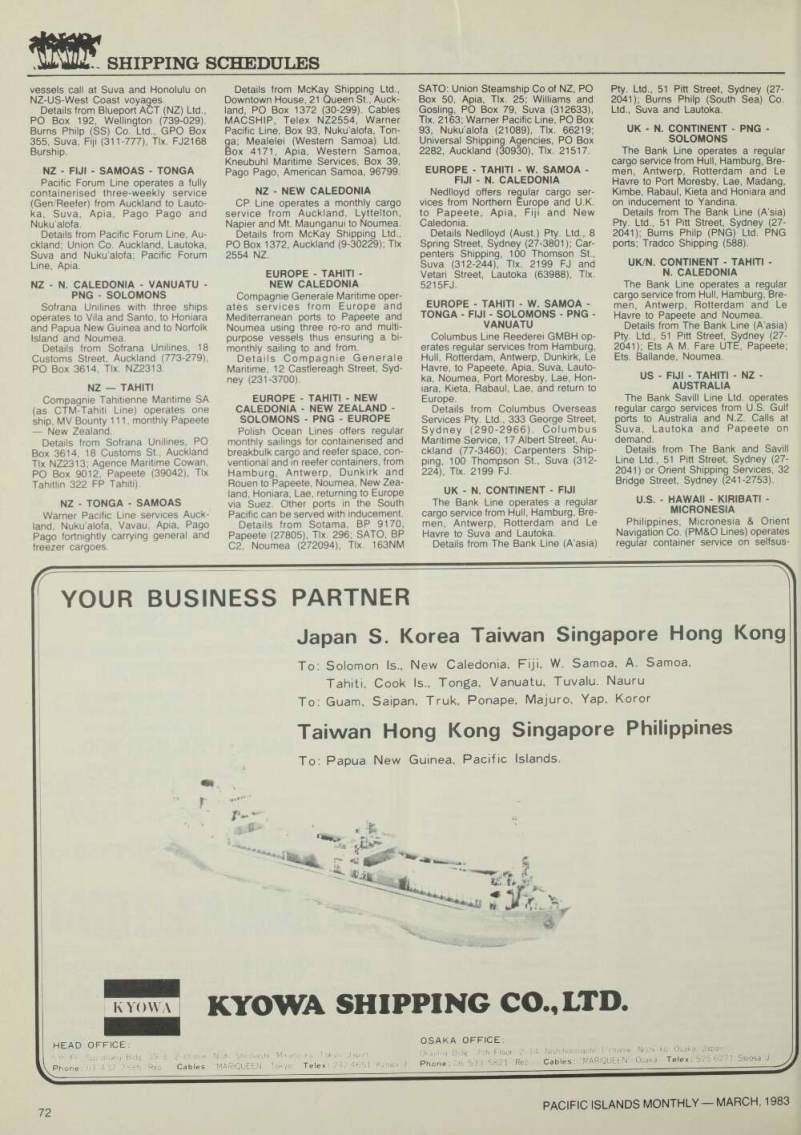
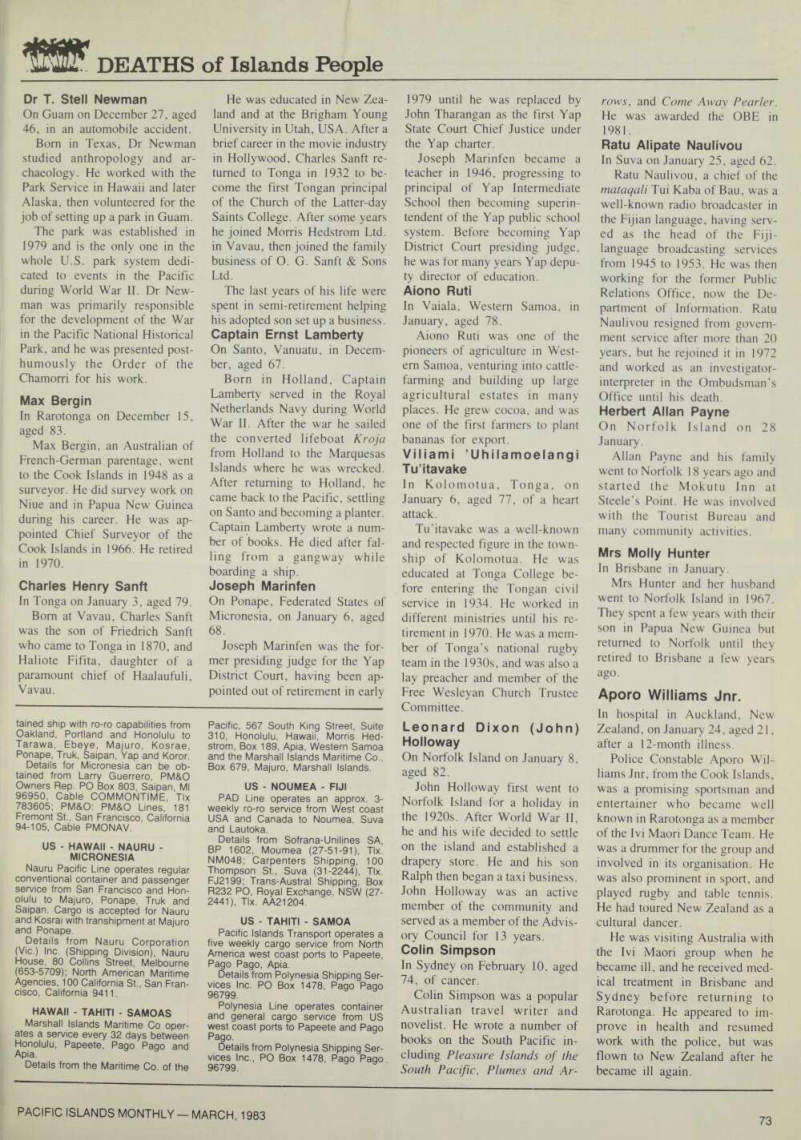
Shipping
Should any shipping company wish to have its services cargo and passen ger included in these listings they should contact PIM.
Australia - Fiji
Karlander (Aust) Pty. Ltd. operates monthly cargo services from Sydney to Suva and Lautoka.
Details from Karlander (Aust) Pty.
Ltd., 19-31 Pitt Street, Sydney (232- Id 1), Dalgety Shipping, 460 Bourke Street, Melbourne (616-6700). Burns Philp (SS) Co. Ltd., Suva and Lautoka.
Sofrana-Unilines (Fiji Express Line) operates to Suva and Lautoka every two weeks from the main ports on the east coast of Australia and monthly to Lautoka from Melbourne and Sydney.
Details from Sofrana-Unilines, 19 Pitt Street, Sydney (27-9851), Trans- Austral Shipping Pty.Ltd., 570 Bourke Street, Melbourne (67-9162); ACTA Pty. Ltd., Brisbane (221-3116); Elders- ANL Pty. Ltd., Port Adelaide (47-5688); ANL Newcastle (049-24364); Cle ments and Marshall, Burnie, Tasmania (31-1833), Carpenters Shipping, 100 Thomson St., Suva, Fiji (312-244), Tlx 2199 FJ.
Australia - Samoas - Tonga
Warner Pacific Lines operates a re gular cargo service from Sydney to Nuku’alofa, Pago Pago, Apia and Vavau.
Details from Hetherington Wesfar mers Shipping Agency, 37-49 Pitt Street, Sydney (27-1671).
Australia - New Caledonia -
Fiji - Samoas - Tonga
Pacific Forum Line operates a fully containerised service (general, reefer and ro-ro) from Sydney to Noumea, Lautoka, Suva, Apia, Pago Pago, Nuku’alofa, Sydney. Cargo centralised from Adelaide, Melbourne, Brisbane.
Details from Pacific Forum Line, Sydney: Union Bulkships, Sydney, Brisbane and Melbourne: SATO, Noumea, Union Company, Lautoka, Suva and Nuku’alofa: Pacific Forum Line, Apia.
Australia - Lord Howe Is -
Norfolk Is
Compagnie des Chargeurs Caledo niens operates four-weekly cargo ser vice Sydney - Lord Howe Island and Norfolk Island.
Details: Hetherington Wesfarmers Shipping Agency, 37-49 Pitt Street, Sydney (27-1671).
Australia - Kiribati
Karlander operates a 5/6 weekly ser vice from Melbourne and Sydney to Kiribati (Tarawa).
Details: Karlander (Aust) Pty. Ltd., 19-31 Pitt Street, Sydney (232-1011).
Australia - Nauru - Kiribati
Nauru Pacific Line operates regular cargo/passenger service from Mel bourne to Nauru and Tarawa.
Details; Nauru Corporation (Vic.) Inc. (Shipping Division), Nauru House, 80 Collins Street, Melbourne (653-5709).
Nedlloyd Swire, 8 Spring Street, Syd ney (2-0522).
Australia - New Caledonia
(And/Or) Vanuatu
Sofrana-Unilines ships serve Noumea every two weeks from the main ports along the east Australian coast.
Details from Sofrana-Unilines, 19 Pitt Street, Sydney (27-9851), Trans- Austral Shipping Pty. Ltd., 570 Bourke Street, Melbourne (67-9162), ACTA
Pty. Ltd., Brisbane (221-3116), Elders- ANL Pty. Ltd., Port Adelaide (47-5688), ANL, Newcastle (049-24364), Cle ments & Marshall, Burnie, Tasmania (31-1833).
Compagnie des Chargeurs Caledo nians operates a three-weekly con tainerised cargo service from Sydney to Noumea.
Details Hetherington Wesfarmers Shipping Agency, 37-49 Pitt Street, Sydney (27-1671).
Compagnie Generale Maritime oper ates a monthly service from Sydney to Noumea, Port Vila and Santo, for con tainerised and break bulk cargo.
Details Compagnie Generale Maritime, 12 Castlereagh Street, Syd ney (231-3700).
Australia - Nz - Fiji -
Hawaii - Us
P & O liners call at Auckland, Suva, Pago Pago and Honolulu on east bound and westbound voyages bet ween Sydney and the US.
Details from P & O Booking Centre, World Travel Headquarters Pty.Ltd., 33 Bligh Street, Sydney (237-0333).
AUSTRALIA - NZ - FIJI - TONGA -
Vanuatu - New Caledonia -
Solomons - Samoas - New
Guinea
Sitmar Cruises operates a year round cruise program to include most of the above countries.
Details from Sitmar Cruises, 47 Elizabeth Street, Sydney (232-7511).
AUSTRALIA - NZ - FIJI - TONGA -
Vanuatu - New Caledonia -
Solomons - Samoas - Tahiti
P & O liners call at Auckland, Bay of Islands, Honiara, Lautoka, Noumea, Nukualofa, Pago Pago, Papeete, Port Moresby, Santo, Savusavu, Suva, Vavau and Vila on cruises from Australia.
Details from P & O Booking Centre, World Travel Headquarters Pty. Ltd., 33 Bligh Street, Sydney (237-0333).
Australia - Nz - Solomons -
Png
Pacific Forum Line operates con tainerised and general cargo service from Lyttleton, Napier and Auckland to Honiara, Lae, Port Moresby, Brisbane.
Details from Pacific Forum Line, Au ckland; Steamships Shipping, Port Moresby: Sullivans Ltd., Honiara.
Australia - New Zealand -
Pacific Islands - South East
Asia - China
Minghua Cruises operates cruise services from Sydney to Hawaii, Tahiti and most Pacific ports, with several cruises to South East Asia, including Japan, the Philippines, Singapore, Hongkong and China.
Details Minghua Cruises, 7 Bridge Street, Sydney, NSW, 2000 (2-0547), Burns Philp Travel offices in Melbourne (62-0151), Brisbane (31-0391), Darwin (81-2871), Auckland NZ (31-544); Na tional Bank Travel in Adelaide (212- 7347) and Perth (320-9365).
Australia - Micronesia
Nauru Pacific Line operates a regu-. lar container service from Melbourne to Majuro, Kosrae, Ponape, Truk, Guam and Saipan.
Details Nauru Corporation (Vic.) Inc. (Shipping Division), Nauru House, 80 Collins Street, Melbourne, (653-5709), Nedlloyd Swire, 8 Spring Street, Syd ney (2-0522).
Australia - Tuvalu
Karlander operates a three monthly service from Sydney and Melbourne to
Tuvalu (Funafuti).
Details from Karlander (Aust.) Pty.
Ltd., 19-31 Pitt Street, Sydney (232- 1011).
Australia - Png
Karlander New Guinea Line’s cargo vessels call at Melbourne, Sydney, Port Moresby, Lae, Madang, Wewak, Manus, Kimbe, Rabaul, Popondetta.
Details from Karlander (Aust.) Pty.
Ltd., 19-31 Pin Street, Sydney (232- 1011), Dalgety Shipping, 460 Bourke Street, Melbourne (616-6700).
Australia - Png - Solomons
A consortium of Conpac, NGAL/PNGL have three container ves sels operating on a 28 day turn-around from Melbourne, Sydney and Brisbane to Port Moresby, Lae, Rabaul, Kavieng, Wewak, Madang, Kieta and Honiara.
Details from Burns, Philp & Co. Ltd., 51 Pitt Street, Sydney (2-0547) and Interocean Swire, 8 Spring Street, Syd ney (2-0522).
New Guinea Express Lines operates a fortnightly container service from Melbourne, Sydney, Brisbane to Port Moresby, Lae, Alotau, Kimbe, Rabaul, Kiuta, Honiara.
Details from New Guinea Express Lines, PO Box R 73, Royal Exchange, Sydney (241-3991); New Guinea Ex press Lines, 127 Creek Street, Bris bane (221-9333); New Guinea Express Lines, 327 Collins Street, Melbourne (61-3053); Niugini Express Lines, Port Moresby (21-4572); Lae (42-1536); Rabtrad Niugini Pty. Ltd., Rabaul (92- 2911) and Kieta (95-6185); Alotau Stevedoring & Transport, Alotau (61- 1318); Ngatia Wholesalers Pty. Ltd., Kimbe (93-5102); and Trading Com pany, Mendana Avenue, Honiara (588).
Sofrana-Unilines (PNG Line) oper ates a monthly service to Port Moresby and Lae, from main ports on the east coast of Australia.
Details from Sofrana-Unilines, 19 Pitt Street, Sydney (27-9851); Trans- Austral Shipping Pty. Ltd., 570 Bourke Street, Melbourne (67-9162); ACTA Pty. Ltd., Brisbane (221-3116); Elders ANL Pty. Ltd., Port Adelaide (47-5688).
Australia - Tahiti
Compagnie Generale Maritime oper ates a monthly service from Sydney to Papeete for containerised and break bulk cargo.
Details Compagnie Generale Maritime, 12 Castlereagh Street, Syd ney (231-3700).
Australia - Tahiti - Us
Karlander operates a monthly cargo service from Melbourne and Sydney to Papeete, US west coast.
Details: Karlander (Aust.) Pty. Ltd., 19-31 Pitt Street, Sydney (232-1011).
Australia - Nz - West Coast
South America
South Pacific Seaboard Service of fers a regular cargo service from Bris bane, Sydney, Adelaide and Mel bourne to New Zealand ports Lyttleton and Tauranga and to the west coast of South America, calling at Beu’ventura, Guayaquil, Cailao and other ports on inducement.
Details from South Pacific Seaboard Service agents, Meridian Shipping & Transport Agencies, 50 Clarence Street, Sydney (290-1633), Tlx 25970; Melbourne (67-5907); Brisbane (267- 6355); Adelaide (47-6600); Ocean bridge Shipping Ltd., 22 Emily Place Auckland (33-279). Tlx 60523: lan Tay lor Y Cia Ltda, Prat 827 Of. 301 Valparaiso, Chile (59096), Tlx. 30331!
SINGAPORE - HONG KONG - FIJI -
Islands Ports
Kyowa Shipping Co. Ltd. operates a monthly service from Singapore, Hon g Kong to Lautoka, Suva and then to island ports.
Details from Carpenters Shipping, 100 Thompson Street, Suva, (312- 244), Tlx FJ2199.
Far East - Fiji - New
Zealand
New Zealand Unit Express (NZUE) operates a monthly palletised cargo service from Manila, Keelung, Ka oshiung and Hongkong to Lautoka, Suva and thence to NZ.
Details from Carpenters Shipping, 100 Thompson Street, Suva (312-244), Tlx Fj2199, Burns Philp, Suva (311- 777) P&O S.N. Co. Wellington (736- 477) or Nedlloyd Swire Pty. Ltd., Syd ney (20-522).
Nedlloyd operates bi-weekly cargo service with four ships from Sourabaya, Jakarta, Bangkok, Port Kelang and Singapore to Suva, Lauto ka and NZ ports.
Details from Nedlloyd (Aust.) Pty.
Ltd., 8 Spring St., Sydney (27-3801), Burns Philp (SS) Co. Ltd., Suva and Lautoka.
Far East - Mid-S. Pacific
China Navigation’s New Guinea Pacific Line operates a regular contain er service from Hongkong, Taiwan, Manila, Port Kelang and Singapore to Port Moresby, Lae, Rabaul and Honia ra monthly and to Wewak, Madang and Kieta every three months. Cargo from the same Far Eastern ports to the South Pacific ports of Noumea, Santo, Vila, Papeete, Pago Pago, Apia, Rarotonga and Tarawa will be shipped via Japan on the monthly Bali Hai service.
Details from Steamships Trading Co.
Ltd., P.O. Box 1, Port Moresby (22- 0222).
Kyowa Shipping Ltd., operates monthly services from Japan to Guam, Saipan, Solomons, New Caledonia, Fi ji, Western and American Samoa, Tahiti, Cook Is. Tonga and Vanuatu.
Details: Hetherington Wesfarmers Shipping Agency, 37-49 Pitt Street, Sydney (27-1671); Carpenters Ship ping, Suva (312-244), Tlx FJ2199.
Japan - Fiji - Island Ports
Kyowa Shipping Co. Ltd., operates a monthly service from main ports of Japan to Suva and Lautoka and thence to island ports.
Details from Carpenters Shipping, 100 Thompson St., Suva (312-244) Tlx FJ2199.
Japan - Fiji - Island Ports
Bali Hai service operates a monthly service from main ports of Japan to Suva and Lautoka and thence to island ports.
Details from Carpenters Shipping, 100 Thompson St., Suva (312-244), Tlx FJ2199 and Burns Philp, Suva (311-777).
Japan - Micronesia
The NYK Shipping Line operates a monthly cargo service from Japan to Micronesia, calling at Yoko, Nagoya, Kobe, Guam, Saipan, Truk, Ponape and Majuro, returning via Yoko, Nagoya and Kobe.
Details from Burns, Philp & Co. Ltd 51 Pitt Street, Sydney (2-0547).
Japan - Png
Mitsui O.S.K. Lines operates a monthly service from main ports Japan and Port Moresby, Rabaul, Lae Madang, Kieta and Kimbe.
Details from Robert Laurie (PNG)
Pty. Ltd., PO Box 922, Port Moresby (21-2466/21-1898).
New Caledonia - Fiji - West
Coast North America
PAD Line operates an approx. 3weekly ro-ro service with Noumea and Suva to Honolulu and West Coast USA and Canadian ports.
Details from Sofrana-Unilines SA, BP 1602, Noumea (27-51-91), Tlx NMO4B; Carpenters Shipping, 100 Thompson St., Suva (312-244), Tlx FJ2199.
Png - Inter - Mainport
Papua New Guinea Line offers scheduled 10/20 day coastal liner ser vices linking all PNG major ports with containerisation, reefer, heavy lift and transhipment facilities.
Details from PNG Line, Box 543, Port Moresby, PNG (21-1174), Tlx 22269.
Png- Uk/Continent
The Bank Line operates regular car go service from Port Moresby, Oro Bay, Kieta, Rabaul, Kimbe, Madang and Lae to Hull, Hamburg, Rotterdam, Antwerp and Le Havre.
Details from The Bank Line (A’asia) Pty. Ltd., 51 Pitt Street, Sydney (27- 2041); Burns Philp (PNG) Ltd. PNG ports.
Solomons - Uk/Continent
The Bank Line operates regular car go service from Honiara to Hull, Ham burg, Rotterdam, Antwerp and Le Havre.
Details from The Bank Line (A’asia) Pty. Ltd., 51 Pitt Street, Sydney (27- 2041); Tradco Shipping (588).
NZ - COOK IS - NIUE - TAHITI Shipping Corporation of NZ Ltd. op erates cargo services based on pallets and similar units from Auckland to Niue, Cook Islands and Tahiti.
Details from the Shipping Corp. of NZ Ltd., PO Box 3420, Auckland (797- 210). Waterfront Commission, PO Box 61, Raratonga; Cook Islands; Niue Govt. Offices, Niue Island Compagnie Maritime Polynesienne, BP 368, Papeete, Tahiti.
New Zealand - Tahiti
Pacifique Polynesie Line operates a monthly service carrying general and freezer cargoes to Papeete and outly ing islands in the group.
Details from McKay Shipping Ltd., PO Box 1372, Auckland, (30229), Tlx 2554 NZ.
Nz - Fiji
Reef operates a regular 18-day ser vice from Auckland to Suva and Lautoka.
Details from Reef Shipping Agen cies, PO Box 3382, Auckland, NZ (77- 1221-3); M.V. Fijian Shipping Agencies Ltd., Private Bag, Suva, Fiji (31-1056).
Pacific Line with one ship operates fortnightly ro-ro cargo service New Zealand, Lautoka, Suva.
Details: Sofrana Unilines, 18 Cus toms Street, Auckland (773-279) PO Box 3614, Telex. NZ2313; Carpenters Shipping, 100 Thompson Street, Suva (312-244), Tlx FJ2199.
NZ - FIJI - NORTH AMERICA (WC) Blue Star Line Ltd. Pacific Coast container services. Only direct service to and from New Zealand. Blue Star
vessels call at Suva and Honolulu on NZ-US-West Coast voyages.
Details from Blueport ACT (NZ) Ltd., PO Box 192, Wellington (739-029).
Burns Philp (SS) Co. Ltd., GPO Box 355, Suva, Fiji (311-777), Tlx. FJ2168 Burship.
NZ - FIJI - SAMOAS - TONGA Pacific Forum Line operates a fully containerised three-weekly service (Gen/Reefer) from Auckland to Lauto ka, Suva, Apia, Pago Pago and Nukualofa.
Details from Pacific Forum Line, Au ckland; Union Co. Auckland, Lautoka, Suva and Nukualofa; Pacific Forum Line, Apia.
NZ - N. CALEDONIA - VANUATU -
Png - Solomons
Sofrana Unilines with three ships operates to Vila and Santo, to Honiara and Papua New Guinea and to Norfolk Island and Noumea.
Details from Sofrana Unilines, 18 Customs Street, Auckland (773-279), PO Box 3614, Tlx. NZ2313.
Nz Tahiti
Compagnie Tahitienne Maritime SA (as CTM-Tahiti Line) operates one ship, MV Bounty 111, monthly Papeete New Zealand.
Details from Sofrana Unilines, PO Box 3614, 18 Customs St., Auckland Tlx NZ2313; Agence Maritime Cowan, PO Box 9012, Papeete (39042), Tlx Tahitlin 322 FP Tahiti).
Nz - Tonga - Samoas
Warner Pacific Line services Auck land, Nukualofa, Vavau, Apia, Pago Pago fortnightly carrying general and freezer cargoes.
Details from McKay Shipping Ltd., Downtown House, 21 Queen St., Auck land, PO Box 1372 (30-299). Cables MACSHIP, Telex NZ2554, Warner Pacific Line, Box 93, Nukualofa, Ton ga; Mealelei (Western Samoa) Ltd.
Box 4171, Apia, Western Samoa, Kneubuhl Maritime Services, Box 39, Pago Pago, American Samoa, 96799.
Nz - New Caledonia
CP Line operates a monthly cargo service from Auckland, Lyttelton, Napier and Mt. Maunganui to Noumea.
Details from McKay Shipping Ltd., PO Box 1372, Auckland (9-30229); Tlx 2554 NZ.
Europe - Tahiti -
New Caledonia
Compagnie General© Maritime oper ates services from Europe and Mediterranean ports to Papeete and Noumea using three ro-ro and multi purpose vessels thus ensuring a bi monthly sailing to and from.
Details Compagnie Generate Maritime, 12 Castlereagh Street, Syd ney (231-3700).
Europe - Tahiti - New
Caledonia - New Zealand -
Solomons - Png - Europe
Polish Ocean Lines offers regular monthly sailings for containerised and breakbulk cargo and reefer space, con ventional and in reefer containers, from Hamburg, Antwerp, Dunkirk and Rouen to Papeete, Noumea, New Zea land, Honiara, Lae, returning to Europe via Suez. Other ports in the South Pacific can be served with inducement.
Details from Sotama, BP 9170, Papeete (27805), Tlx. 296; SATO, BP C 2, Noumea (272094), Tlx. 163 NM
SATO; Union Steamship Co of NZ, PO Box 50, Apia, Tlx. 25; Williams and Gosling, PO Box 79, Suva (312633), Tlx. 2163; Warner Pacific Line, PO Box 93, Nukualofa (21089), Tlx. 66219; Universal Shipping Agencies, PO Box 2282, Auckland (30930), Tlx. 21517.
EUROPE - TAHITI - W. SAMOA -
Fiji - N. Caledonia
Nedlloyd offers regular cargo ser vices from Northern Europe and U.K. to Papeete, Apia, Fiji and New Caledonia.
Details Nedlloyd (Aust.) Pty. Ltd., 8 Spring Street, Sydney (27-3801); Car penters Shipping, 100 Thomson St., Suva (312-244), Tlx. 2199 FJ and Vetari Street, Lautoka (63988), Tlx. 5215FJ.
EUROPE - TAHITI - W. SAMOA - TONGA - FIJI - SOLOMONS - PNG -
Vanuatu
Columbus Line Reederei GMBH op erates regular services from Hamburg, Hull, Rotterdam, Antwerp, Dunkirk, Le Havre, to Papeete, Apia, Suva, Lauto ka, Noumea, Port Moresby, Lae, Hon iara, Kieta, Rabaul, Lae, and return to Europe.
Details from Columbus Overseas Services Pty. Ltd., 333 George Street, Sydney (290-2966). Columbus Maritime Service, 17 Albert Street, Au ckland (77-3460); Carpenters Ship ping, 100 Thompson St., Suva (312- 224), Tlx. 2199 FJ.
Uk - N. Continent - Fiji
The Bank Line operates a regular cargo service from Hull, Hamburg, Bre men, Antwerp, Rotterdam and Le Havre to Suva and Lautoka.
Details from The Bank Line (A’asia)
Pty. Ltd., 51 Pitt Street, Sydney (27- 2041); Burns Philp (South Sea) Co.
Ltd., Suva and Lautoka.
UK - N. CONTINENT - PNG -
Solomons
The Bank Line operates a regular cargo service from Hull, Hamburg, Bre men, Antwerp, Rotterdam and Le Havre to Port Moresby, Lae, Madang, Kimbe, Rabaul, Kieta and Honiara and on inducement to Yandina.
Details from The Bank Line (A’sia) Pty. Ltd., 51 Pitt Street, Sydney (27- 2041); Burns Philp (PNG) Ltd. PNG ports; Trade© Shipping (588).
Uk/N. Continent - Tahiti -
N. Caledonia
The Bank Line operates a regular cargo service from Hull, Hamburg, Bre men, Antwerp, Rotterdam and Le Havre to Papeete and Noumea.
Details from The Bank Line (A'asia) Pty. Ltd., 51 Pitt Street, Sydney (27- 2041); Ets A M. Fare UTE, Papeete; Ets. Ballande, Noumea.
US - FIJI - TAHITI - NZ -
Australia
The Bank Savill Line Ltd. operates regular cargo services from U.S. Gulf ports to Australia and N.Z. Calls at Suva, Lautoka and Papeete on demand.
Details from The Bank and Savill Line Ltd., 51 Pitt Street, Sydney (27- 2041) or Orient Shipping Services, 32 Bridge Street, Sydney (241-2753).
U.S. - Hawaii - Kiribati -
Micronesia
Philippines, Micronesia & Orient Navigation Co. (PM&O Lines) operates regular container service on selfsus
tained ship with ro-ro capabilities from Oakland, Portland and Honolulu to Tarawa, Ebeye, Majuro, Kosrae, Ponape, Truk, Saipan, Yap and Koror.
Details for Micronesia can be ob tained from Larry Guerrero, PM&O Owners Rep. PO Box 803, Saipan, Ml 96950, Cable COMMONTIME, Tlx 783605; PM&O: PM&O Lines, 181 Fremont St., San Francisco, California 94-105, Cable PMONAV.
Us - Hawaii - Nauru -
Micronesia
Nauru Pacific Line operates regular conventional container and passenger service from San Francisco and Hon olulu to Majuro, Ponape, Truk and Saipan. Cargo is accepted for Nauru and Kosrai with transhipment at Majuro and Ponape.
Details from Nauru Corporation (Vic.) Inc. (Shipping Division), Nauru House, 80 Collins Street, Melbourne (653-5709); North American Maritime Agencies, 100 California St., San Fran cisco, California 9411.
Hawaii - Tahiti - Samoas
Marshall Islands Maritime Co oper ates a service every 32 days between Honolulu, Papeete, Pago Pago and Apia.
Details from the Maritime Co. of the
Pacific, 567 South King Street, Suite 310, Honolulu, Hawaii, Morris Hed strom, Box 189, Apia, Western Samoa and the Marshall Islands Maritime Co., Box 679, Majuro, Marshall Islands.
Us - Noumea - Fiji
PAD Line operates an approx. 3weekly ro-ro service from West coast USA and Canada to Noumea, Suva and Lautoka.
Details from Sofrana-Unilines SA, BP 1602, Moumea (27-51-91), Tlx.
NMO4B; Carpenters Shipping, 100 Thompson St., Suva (31-2244), Tlx.
FJ2199; Trans-Austral Shipping, Box R 232 PO, Royal Exchange, NSW (27- 2441), Tlx. AA21204.
Us - Tahiti - Samoa
Pacific Islands Transport operates a five weekly cargo service from North America west coast ports to Papeete,
Pago Pago, Apia.
Details from Polynesia Shipping Ser vices Inc. PO Box 1478, Pago Pago 96799.
Polynesia Line operates container and general cargo service from US west coast ports to Papeete and Pago
Pago.
Details from Polynesia Shipping Ser vices Inc., PO Box 1478, Pago Pago 96799.
Advertisements & other items, pp. 71-72 (1 item)
Flange Type $55 nz
to
KOMATSU
DETROIT DIESEL
ZD Matched & Balanced Service
Exchange Injectors
For Smooth Economical Running Engines. 6 month Full Warranty
KOMATSU: PTD ssomz
Flange Type $55 nz
Original black plungers used only (no chrome)
DETROIT
DIESEL* 53,71550m.z
Series 92 $55
rs.z.
All cores returned must be salvagable
THEODORCJS COCJWENBERG & SON LTD
6 D MALVERN RD TE PAPA AUCKLAND New Zealand. Phone 663-136. Telex N.Z. 21954
FAST EXPERT SERVICE AT REASONABLE RATES
FOR ALL /
DIESEL SYSTEMS j
YOUR BUSINESS PARTNER
Japan S. Korea Taiwan Singapore Hong Kong To: Solomon Is.. New Caledonia, Fiji, W. Samoa, A. Samoa, Tahiti, Cook Is., Tonga, Vanuatu, Tuvalu. Nauru To: Guam, Saipan, Truk, Ponape, Majuro, Yap, Koror
Taiwan Hong Kong Singapore Philippines
To: Papua New Guinea, Pacific Islands.
r* «y U. ~U.lt sW
K VOW A
KYOWA SHIPPING CO., LTD.
HEAD OFFICE:
5 th Fl ./Suzurnaru Bldg, Phone: 0 3 '437 2385 3'Jc Rep 2 - Chorne.
Cables: Ni shi - Shinhashi.
'MARIQUEENV
Mtialoku. Tokyo, Japan. |okyo. Telex: 24 2-4651
OSAKA OFFICE;
Okajirna Bldg., 7ih Floor, 2 1 Phone: 6 533 5821 'ReJ 4. Nishihonmachi \ -chorne. Nishi-ku. Osaka. Japan Cables: MARIQUEEN" Osaka Telex ; 525 6271 Ssiosa J
DEATHS of Islands People
Dr T. Stell Newman On Guam on December 27, aged 46, in an automobile accident.
Bom in Texas, Dr Newman studied anthropology and ar chaeology. He worked with the Park Service in Hawaii and later Alaska, then volunteered for the job of setting up a park in Guam.
The park was established in 1979 and is the only one in the whole U.S. park system dedi cated to events in the Pacific during World War 11. Dr New
man was primarily responsible
for the development of the War in the Pacific National Historical Park, and he was presented post humously the Order of the Chamorri for his work.
Max Bergin
In Rarotonga on December 15,
aged 83.
Max Bergin, an Australian of French-German parentage, went to the Cook Islands in 1948 as a surveyor. He did survey work on Niue and in Papua New Guinea during his career. He was ap pointed Chief Surveyor of the Cook Islands in 1966. He retired in 1970.
Charles Henry Sanft In Tonga on January 3, aged 79.
Bom at Vavau, Charles Sanft was the son of Friedrich Sanft who came to Tonga in 1870, and Haliote Fifita, daughter of a paramount chief of Haalaufuli, Vavau.
He was educated in New Zea land and at the Brigham Young University in Utah, USA. After a brief career in the movie industry in Hollywood, Charles Sanft re turned to Tonga in 1932 to be come the first Tongan principal of the Church of the Latter-day Saints College. After some years he joined Morris Hedstrom Ltd. in Vavau, then joined the family business of O. G. Sanft & Sons Ltd.
The last years of his life were spent in semi-retirement helping his adopted son set up a business.
Captain Ernst Lamberty On Santo, Vanuatu, in Decem ber, aged 67.
Born in Holland, Captain Lamberty served in the Royal Netherlands Navy during World War 11. After the war he sailed the converted lifeboat Kroja from Holland to the Marquesas Islands where he was wrecked.
After returning to Holland, he came back to the Pacific, settling on Santo and becoming a planter.
Captain Lamberty wrote a num ber of books. He died after fal ling from a gangway while boarding a ship.
Joseph Marinfen On Ponape, Federated States of Micronesia, on January 6, aged 68.
Joseph Marinfen was the for mer presiding judge for the Yap District Court, having been ap pointed out of retirement in early
1979 until he was replaced by John Tharangan as the first Yap State Court Chief Justice under the Yap charter.
Joseph Marinfen became a teacher in 1946, progressing to principal of Yap Intermediate School then becoming superin tendent of the Yap public school system. Before becoming Yap District Court presiding judge, he was for many years Yap depu ty director of education.
Aiono Ruti In Vaiala, Western Samoa, in January, aged 78.
Aiono Ruti was one of the pioneers of agriculture in West ern Samoa, venturing into cattle farming and building up large agricultural estates in many places. He grew cocoa, and was one of the first farmers to plant bananas for export.
Viliami ’Uhilamoelangi
Tu’itavake In Kolomotua, Tonga, on January 6, aged 77, of a heart attack.
Tu’itavake was a well-known and respected figure in the town ship of Kolomotua. He was educated at Tonga College be fore entering the Tongan civil service in 1934. He worked in different ministries until his re tirement in 1970. He was a mem ber of Tonga’s national rugby team in the 19305, and was also a lay preacher and member of the Free Wesleyan Church Trustee Committee.
Leonard Dixon (John)
Holloway
On Norfolk Island on January 8, aged 82.
John Holloway first went to Norfolk Island for a holiday in the 19205. After World War 11, he and his wife decided to settle on the island and established a drapery store. He and his son Ralph then began a taxi business.
John Holloway was an active member of the community and served as a member of the Advis ory Council for 13 years.
Colin Simpson
In Sydney on February 10, aged 74, of cancer.
Colin Simpson was a popular Australian travel writer and novelist. He wrote a number of books on the South Pacific in cluding Pleasure Islands of the South Pacific, Plumes and Ar
rows, and Come Away Pearler.
He was awarded the OBE in 1981.
Ratu Alipate Naulivou In Suva on January 25, aged 62.
Ratu Naulivou, a chief of the mataqali Tui Kaba of Bau, was a well-known radio broadcaster in
the Fijian language, having serv
ed as the head of the Fiji
language broadcasting sendees
from 1945 to 1953. He was then working for the former Public Relations Office, now the De partment of Information. Ratu Naulivou resigned from govern ment service after more than 20 years, but he rejoined it in 1972 and worked as an investigator interpreter in the Ombudsman’s Office until his death.
Herbert Allan Payne On Norfolk Island on 28
January.
Allan Payne and his family went to Norfolk 18 years ago and started the Mokutu Inn at Steele’s Point. He was involved with the Tourist Bureau and many community activities.
Mrs Molly Hunter In Brisbane in January.
Mrs Hunter and her husband went to Norfolk Island in 1967.
They spent a few years with their son in Papua New Guinea but returned to Norfolk until they retired to Brisbane a few years ago.
Aporo Williams Jnr.
In hospital in Auckland, New Zealand, on January 24, aged 21, after a 12-month illness.
Police Constable Aporo Wil liams Jnr, from the Cook Islands, was a promising sportsman and entertainer who became well known in Rarotonga as a member of the Ivi Maori Dance Team. He was a drummer for the group and involved in its organisation. He was also prominent in sport, and played rugby and table tennis.
He had toured New Zealand as a cultural dancer.
He was visiting Australia with the Ivi Maori group when he became ill, and he received med ical treatment in Brisbane and
Sydney before returning to
Rarotonga. He appeared to im prove in health and resumed work with the police, but was flown to New Zealand after he became ill again.
Advertising
Index
Aggie Grey’s 74 Air New Zealand 50 Amatil 42 Antelope Engineering 66 Australian Trade 4 Bank Line 68 Besco Jarwil 46 Cairns CYC 66 Couwenberg Diesel 71 Henry Cumines 58 Hitachi 2 Hudson Homes 62 K. Morton 74 Kyowa Shipping 72 Leo Menne 74 Lincoln Electrics 50 Mason Shipping 70 Matsushita 12 McDonnell Douglas 28 MacQuarrie Industries 62 Nippon Columbia 58 Nissan 20 Pacific Pumps 36 Papua Hotel 74 Peter Fisher 74 Pioneer 8 P.I.T. Shipping 70 QBE Insurance 32 Rich’s Frozen Foods 44 R. M. Gow 48 Robert Stephens 74 Sansui Electric 34 Solarex 26 Sonar Ships 74 South Sea Digest 22 Sunbeam Rural 15 Suva Sails 74 Suzuki Marine 60 Suzuki Motor 75 Toyota 38 Trio Kenwood 76
Advertisements & other items, pp. 74-76 (2 items)
Peter Fisher Trading Pty. Ltd.
381 PITT STREET, SYDNEY, 2000, AUSTRALIA
Telephone: 264 5395 CABLES: “FISHERION”, SYDNEY
TELEX: AUSTAS AA20149 ATT. PETER FISHER
EXPORTERS TO THE PACIFIC ISLANDS
Stay at Aggie Grey’s . . . the South Pacific’s legendary hotel.
Situated right in the heart of Western Samoa. Enjoy Polynesian-stylc friendliness and service, in cool surroundings, superb entertainment and food.
Magnificent white sand beaches only a short drive away. Airconditioned rooms, swimming pool and full bar- facilities.
Bookings through Union Steamship Company of NZ, Pan Am, Air New Zealand or direct to Aggie Grey’s, Apia, Western Sampa. Cables: ‘AGGIES’Apia.
my
SONAR SHIPS BROKERAGE
We have for sale the following Twin screw Landing Craft. 262' GRT 1550., NRT 735., $4,400,000 Aust. 145' GRT 357 . NRT 98.66 . DWT 323 T $440,000 Aust. 140' GRT 396., NRT 275., DWT 400 T $615,000 U.S. 130' GRT 266 , NRT 190., DWT 415 T $600,000 U.S. 127' GRT 280., NRT 144 . DWT 250 T $65,000 U.S. 105' GRT 174 , NRT 56., DWT 166 T $365,000 U.S. 96' GRT 180., NRT 50 , DWT 140 T $430,000 U.S 89' GRT 121., NRT 47.. DWT 90T $325,000 Aust. 76’ Bulk Fuel 11500 gal., DWT SOT $250,000 Aust. 60' Needs work (obviously) $25,000 Aust. 57' Open cargo space $60,000 Aust. 47' GRT 43.61 , NRT 28.05 , DWT 20T $140,000 Aust.
The above vessels have v'arious combinations of Bulk fuel, cargo, refrigeration etc. For further details contact Jack Ball or lan Robertson at Sonar Ships Brokerage, Box 1811. Cairns Old Australia. Ph. (070) 51 1212.
Always looking for listings on cargo vessels, tankers barges and commercial craft
FOR RIM ADVERTISING:
GPO BOX 3408, SYDNEY,
NSW, AUSTRALIA, 2001.
At Last!
p
PORT MOR
* Right in business cep * A traditiorlfor comfort and Tine food * All reborns airconditioned * Restaurant * Ba * Banquet hall
A. C. NEUMANN
manager Phone 21-2622 , Cabl
FOR SALE
45' hard chine steel yacht hull Externally sandblasted, primed and undercoated Plans to complete this twin bilge keel ketch are available together with ground tackle. SS water tanks, main mast and rigging.
Located Honiara. Solomon Islands. Price SI $14,000 but negotiable depending on fittings required Contact Mr. R. Bird, c/- Sullivans Pty.
Ltd., Box 3, Honiara, Solomon Islands.
AT LAST!
A sailmaker in Fiji.
PLUS the largest range of quality marine fittings in the South Pacific.
New sails & repairs
David Hughes
SUVA SAILS
36 Stewart Street, Suva Phone: 312 331 Telex: FJ2279 Nuclear-Free Pacific
ACCOUNTING/
COMPUTER
SPECIALIST
Would like to relocate to Pacific area. U.S. citizen, Male, Age 27, Degrees: 8.8. A. in Business Computer Management, B.A. in Journalism. Will consider offer from both government and business.
Contact: Gary Clark 2725 94th St.
Lubbock, Texas 79423
USA.
PHONE: (806) 745-8900
PURCHASING AND
SUPPLY MANAGEMENT
Contract position wanted in Pacific country for qualified Australian with excellent credentials and experience.
Write or cable; Supply GPO Box 329 Brisbane Qld 4000 Australia
ATTENTION!
Anyone knowing the whereabouts of Mr.Sione Toa Maka (D. 0.8. 16.1.55) formerly of Tonga, last known to be residing in San Francisco,USA, in 1979 while attending a California university, please contact at your earliest convenience, by letter, K. Morton, 10 Disney Street, Stafford Heights, Brisbane, 4053, Queensland, Australia.
Postage on letters received will be refunded if necessary
WANTED: PLANTATION
MANAGEMENT OR LEASE
Two Australian families, brother and brother-in-law, both in their early thirties, seeking to manage or lease a plantation in the region of the Pacific. Previous experience in cocoa, copra, coffee and livestock. Send replies to: Robert Stephens 195 Dalton Street Orange, NSW 2800 Australia
STAMPS WANTED
Stamp collector would like to exchange stamps with someone in the South Pacific or else purchase in bulk from bank accumulations or institutions.
Leo Menne 810 Barbara Road Hendersonville NC 28739
USA
V 5* s ▼ 4 i - A 4 4 ► A I-/0/0; Canadian version .
Wv I -V' * 055 *
I I 'EM
.s jk *b -v V %■ - SUZUKI Vehicles are shipped to approximately 100 countries throughout the world and are well received by users in those countries. Behind the high-quality of SUZUKI 4wheelers is the in-depth research carried out from all aspects, rigorous tests and an extensive after-sales service net-work. Vehicles that are ready when you need them and which you can trust when driving. SUZUKI Vehicles.
w/UKI the name of per furnace.
SOLOMON ISLANDS SOLOMON ISLAND SERVICE STATION LTD, NEW CALEDONIA STE, SUPERCAL PAPUA NEW GUINEA VANUATU HENRI LEROUX NIUE ISLAND BURNS PHILP (SOUTH SEA)CO., LTD. PONAPE LEO ETSCHEIT TAHITI NIPPON AUTOMOTO GUAM & SAIPAN ISLAND CYCLERY, INC. NORFOLK MARTIN'S AGENCIES LTD. SAMOA PACIFIC PRODUCTS, INC. TONGA PACIFIC PRODUCTS, INC. NAURU EQUAPAC MOTORS FUJI NIRANJANS AUTOPORT LTD.
KIRIBATI : KIRIBATI CO-OPERATIVE WHOLESALE SOCIETY LIMITED RAROTONGA: AUTO HOLDINGS LTD.
System of your
You’re probably not the only one you know who’s thought of getting a really
good hi-fi system.
And then been turned off by the sheer complexity of it all.
Now we make you an offer. Choose a group of these elite hi-fi components to precisely match your needs and budget.
And create the stereo system of your
dreams!
maoßßLjam
■ k : ■ ■ S:-;; (v 1 m m
SERIES
KENWOOD
* New corporate symbol
TRIO-KENWOOD CORPORATION
Shionogi Shibuya Building, 17-5, 2-chome, Shibuya, Shibuya-ku, Tokyo 150, Japan NEW ZEALAND JOHN GILBERT & CO., LTD. Auckland Tel.ooll-64-9-3083^ FIJI PEPE’S DUTY FREE CENTRE LTD. Tel. 26187, 25191 PAPUA NEW GUINEA S.O. SVENSSON (N.G.) LTD. Port Moresby Tel. 42-4* SOLOMON ISLANDS TECHNIQUE RADIOS CENTRE LTD. Honiara Tel. 416 f NEW CALEDONIA HI-FI VOX Noumea Tel. 27-2466 VANUATU FUNG CHOI LUEN Port-Vila Tel. 2556
TAHITI MAISON AURORE Papeete Tel. 29703
AMERICAN SAMOA ISLAND PACIFIC AGENCIES, INC. Pago Pago Tel. 61.
REPUBLIC OF NAURU NAURU CO-OPERATIVE SOCIETY
MARIANA ISLANDS J.C. TENORIO ENTERPRISES Saipan Tel. 6445 TRIO-KENWOOD (AUSTRALIA) PTY. LTD. (INCORPORATED IN N.S.W.) 4E Woodcock Place, Lane Cove. N.S.W. 2066, Australia. Tel: 428-1455