Advertisements & other items, pp. 1-3 (2 items)
■wmBBH
PACIFIC
ISLANDS
MONTHLY
FEBRUARY, 1983
r American Samoa USSI.7S Australia *A$l.5O Cook Islands NZ$l.5O Fiji F 51.50 Hawaii US$l.95 Kiribati Asl.?r Nauru A 51.75 New Caledonia CFPY9O New Zealand NZS2.DO Niue NZ$l.5O Norfolk Island A 51.50 Papua NafVv Guinea K 1.50 Solomon Islands 551.50
Tahiti/- CFPI9O
Tonga 1 P 1.50 Tuvalu _J A 51.75
USA U 552.25
USTT and Guam US$l.95 Vanuatu rVTI.SO Western Samoa b T 1.95 * Recommended retail price only.
Registered by Australia Post.
Publication No. NBPI2IO *l4.
■wmBBH Wm '
ON MICRONESIA
0| DOLLAR SLIDE
HELPS ISLANDS
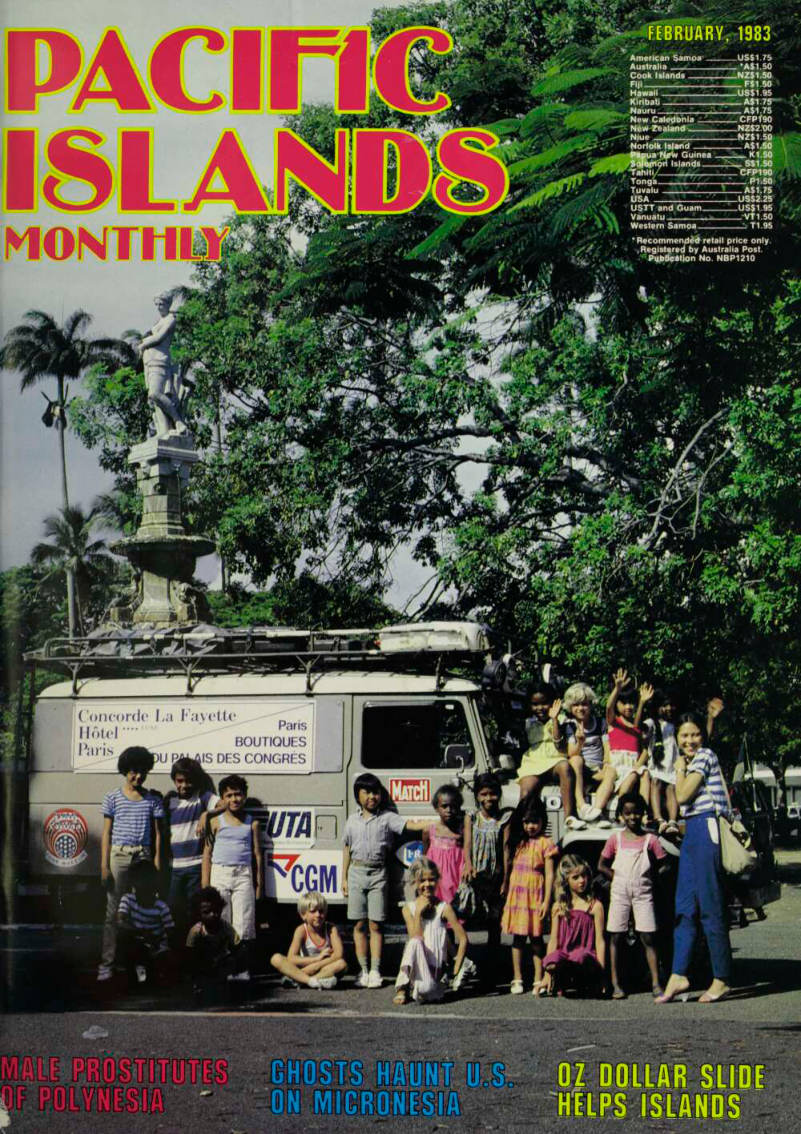
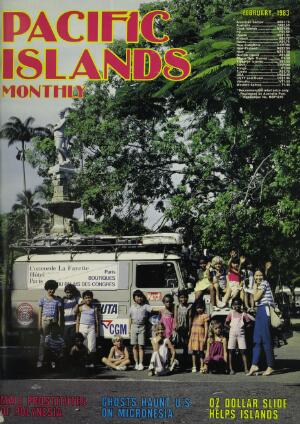
Cover picture: Children of all races welcomed round-the-world travellers Jean- Claude and Jocelyn Hunin in the Place des Cocotiers, Noumea, in December. In their Toyota Land Cruiser the couple had effected the first land link-up ever between Paris and Noumea (PIM Jan. p 37). Jocelyn is at right of the picture in blue-and-white striped shirt. Jean-Claude (pictured right) was behind the camera that took the photograph.
Thump!
Making The World An Exciting Place
- HSSSte OHC 4-valve 248 cm 4 22.5 PS
CDI "Mf fork -
XL. The world’s best selling 4-stroke trail bikes.
The brute force that sets the pace. XL. From those who build perfection. To those who demand it.
WORLD’S LARGEST MOTORCYCLE MANUFACTURER
HONDA MOTOR CO.. LTD. TOKYO, JAPAN
f/ €t
XLSOOR
XLI2SS
XLI BOS
XLIOOS
PAPUA NEW GUINEA: Steamships Trading Company Ltd. P.O. Box 1, Port Moresby/TAHITI; Honda Distribution S.A.R.L. B.P. 1665, Papeete/FIJI ISLANDS: Carpenters Motors Private Mail Bag Suva Fiji/ KIRIBATI: Atoll Motor & Marine Services P.O. Box 49 Bairiki Tarawa/U.S. TRUST TERRITORY: United Micronesia Development Association P.O. Box 238, Saipan Mariana Islands 96950/ COOK ISLANDS: Cook Islands Motor Centre Ltd. P.O. Box 74, Rarotonga/AMERICAN SAMOA: Holiday Motors, Parts and Service P.O. Box 968 Pago Pago, American Samoa 96799/Haleck s Certre Ltd. PO. Box 1138,'bago Pago, American Samoa 96799/GUAM: Mark’s Motor Co., Inc. P.O. Box DV, Agana/WESTERN SAMOA: Motor Distributors (Samoa) Ltd. P.O. Box 576 Apia/SOLOMON ISLANDS: Guadalcanal Garage Limited PO. Box 537 Honiara/NEW CALEDONIA; Establissements Ballande Boite Postale No. C 4 Noumea Cedex/NIUE ISLAND: Niue Island United Enterprises P.O.
Box 4, Alofi/NAURU: Nauru Cooperation Republic of Naulu/TUVALU: Tuvalu Co-operative Wholesale Society P.O. Box Funafuti, Tuvalu/TONGA: Tonga Industrial Traders P.O. Box 1035, Nukualofa Tonga
Pacific Islands Monthly
Vol. 55 No. 2 February 1983 (USPS 952480)
Representatives
AUSTRALIA: Distribution: The Herald and Weekly Times Ltd., 44-74 Flinders St., Melbourne, Vic., 3000. Advertis ing Reps Brisbane D. Wood, Anday Agency, Box 1918, GPO Brisbane, 4001, telephone 44-3485, 44-1546; Adelaide Hastwell Media, PO Box 30, Glen Osmond, SA, 5064, 23 Avenue Road, Frewville, SA, 5063, telephone 79-9271.
FIJI: Distribution and subscriptions Desai Book shops, P.O. Box 160, Suva, Fiji, telephone Suva 23036.
Advertising Fiji Times & Herald Ltd., 20 Gordon St., Suva, telephone 31-2111, telex FJ2124.
FRENCH POLYNESIA: Distribution Hatchette Pacifi que, 10 Ave Bruat, Papeete, telephone 25610.
HAWAII, UNITED STATES: Distribution PIM, Hawaii, PO Box 22250, Honolulu, Hawaii, 96822. Advertising Brian C. Asgill, Apt. 1308,1676 Ala Moana Blvd., Honolulu, Hawaii, 96815, telephone (808) 955-9718.
JAPAN: Advertising and subscriptions Universal Media Corporation, GPO Box 1762, Tokyo, telephone 666- 3036, cables UNIMEDIA Tokio, telex 2524665.
MALAYSIA: Advertising snd subscriptions Worldwide Media Services, 57-B Komplex Damai, Jin Dato Haji Eusoff, Kuala Lumpur, telephone 63-9340, cables WORLDMEDIA Kuala Lumpur, telex 31533.
NEW CALEDONIA: Distribution Depot Centre de Presse Michel Pentecost, CBP2, Noumea, telephone 27- 2434, 27-4729.
NEW ZEALAND: Distribution Gordon & Gotch, PO Box 584, 2 Carr Road, Mt. Roskill, Auckland 4 Advertising International Media Representatives Ltd., PO Box 2313, Auckland, telephone 79-5487; 49-3389, cables Intereps, Auckland. Subscriptions Ross Haines & Son Ltd., PO Box 1289, Auckland, telephone 76-9042.
PAPUA NEW GUINEA: Distribution Gordon & Gotch, PO Box 3395, Port Moresby, telephone 25-4551,25-4855.
Advertising PNG Post-Courier, PO Box 85, Port Mores by, telephone 21-2577, telex 22120.
PHILIPPINES: Advertising The GF Group, 12 San Ignacio St., Uroaneta Village, Makati, Metro Manila,telephone 817-7299, telex 45950 and 4233.
UNITED KINGDOM: The Herald & Weekly Times Ltd., No. 1 Maltravers Street, London WC2R 3DZ, England, tele phone 01 836 5162, telex London 21989.
UNITED STATES MAINLAND; Advertising Joshua B Powers Jr., Powers International Inc., 551 Fifth Ave., New York, New York 10 017, telephone 867-9580, telex 236514.
Subscriptions PIM, Hawaii, PO Box 22250, Honolulu, Hawaii, 96822.
Payments by personal cheque are only acceptable in Australian (from a branch in Australia), U.S. and New Zealand currency. For all other remittances please send an international bank draft in Australian dollars.
Published monthly by Pacific Publications (Aust.) Pty. Ltd. and printed in Australia by Walter Alteri Printing (Australia) Pty. Ltd., Dingley, Vic.
Australian cover price is recommended retail only. Regis tered by Australia Post, publication No. NBPI2IO. Second class postage paid at Honolulu, Hawaii. Copyright Pacific Publications (Aust.) Pty. Ltd.
Postmaster Honolulu: Send address changes to PIM Hawaii, PO Box 22250, Honolulu, Hawaii, 96822.
Subscriptions
Local Aust.
American Samoa
Sus21
$18 Australia $A18 $18 Canada
Sus27
$25 Cook Islands $19 Fiji $18 French Polynesia $22 Guam $US23 $20 Hawaii $US23 $20 Japan $20 Kiribati $19 Micronesia $US23 $20 Nauru $21 New Caledonia $22 New Zealand $NZ24 $18 Niue $19 Norfolk Island $15 Northern Marianas
Sus23
$20 Papua New Guinea $23 Solomon Islands $19 Tonga $19 Tuvalu $19 United Kingdom Stg 15 $25 U.S. Mainland $US27 $25 Vanuatu $19 Western Samoa $18 Elsewhere $A25
The Mont
• MALE PROSTITUTION IN POLYNESIA Deborah MacFarlane writes on the role of Western seamen and cruise ship passengers in fostering the emergence of a new social stratum of transvestite male prostitutes in a number of Polynesian countries 11 • MICRONESIA Floyd K. Takeuchi launches a monthly column on Micronesian affairs with a reflection on how heavily memories of World War II weighs on U.S. policies towards this part of the Pacific 29 • A TURNING POINT FOR PNG? Papua New Guinea, bedevilled by falling export income, will appeal to Australia for more aid, while reconsidering its domestic economic policies 17 • NEW CALEDONIA Helen Fraser reports on the tumult in the French territory following the fatal shooting of two French paramilitary policemen by Melanesians at La Foa . 15 • KIRIBATI Billy Schutz in Tarawa provides insights into the background to the December 1982 defeat of the government headed by President Teremia Tabai 13 • FRENCH POLYNESIA Marie-Threse and Bengt Danielsson try to sort fact from fiction (and figuring) in local discussions concerning the territorial budget 32 • WEAKER AUSTRALIAN DOLLAR HELPS ISLANDS Finance writer Peter Freeman reports on how the trade imbalance with Australia suffered by a number of Pacific Island countries has been to some extent alleviated by the slide of the Australian dollar on world money markets, and some other factors 51
Australia in the Pacific 51 Books 39
Christianity 39
Cook Islands 36, 54 Deaths 65 Fiji 36, 54, 55 French Polynesia 32 Hawaii 43 Islands Press 21 Kiribati 13 Letters 7 Micronesia 29 New Caledonia 15 Pacific Report 5
Papua New Guinea 19, 36, 44, 53, 55 People 36 Political Currents 13 Postmark Papeete 32 Solomon Islands 54 Tonga n Tradewinds 51 Tropicalities 19 U.S. in the Pacific 9 Vanuatu 7, 55 Western Samoa 11 Shipping timetables 63 Yachts 56 Yesterday 45
Advertisements & other items, pp. 3-4 (2 items)
Pacific Islands Monthly February, 1983
3
Founded 1930 by R. W. Robson Editor Angus Smales Associate Editor Malcolm Salmon Advertising Manager Stephen Brandon Editorial Adviser John Carter A Pacific Publications production 76 Clarence Street, Sydney, 2000, GPO Box 3408, Sydney, 2001.
Cables: PACPUB Sydney.
Telex: 21242 (answers INTARAD).
Telephone. Sydney 20-231.
Melbourne 63-0211.
Manager: John Berry (03) 63-0211 Ext. 1860.
?m nilk
non-fat dried n* ■ic UJ ui
A : : : HJU. CREAM
mm TAMIN ENRICHED $
?m nilk
d O OER
POWDER,
Anchi mm ml) A mmi
9 ANCHOR
memmmu . 25J I*; : ' WmW: \ AM
* MMI
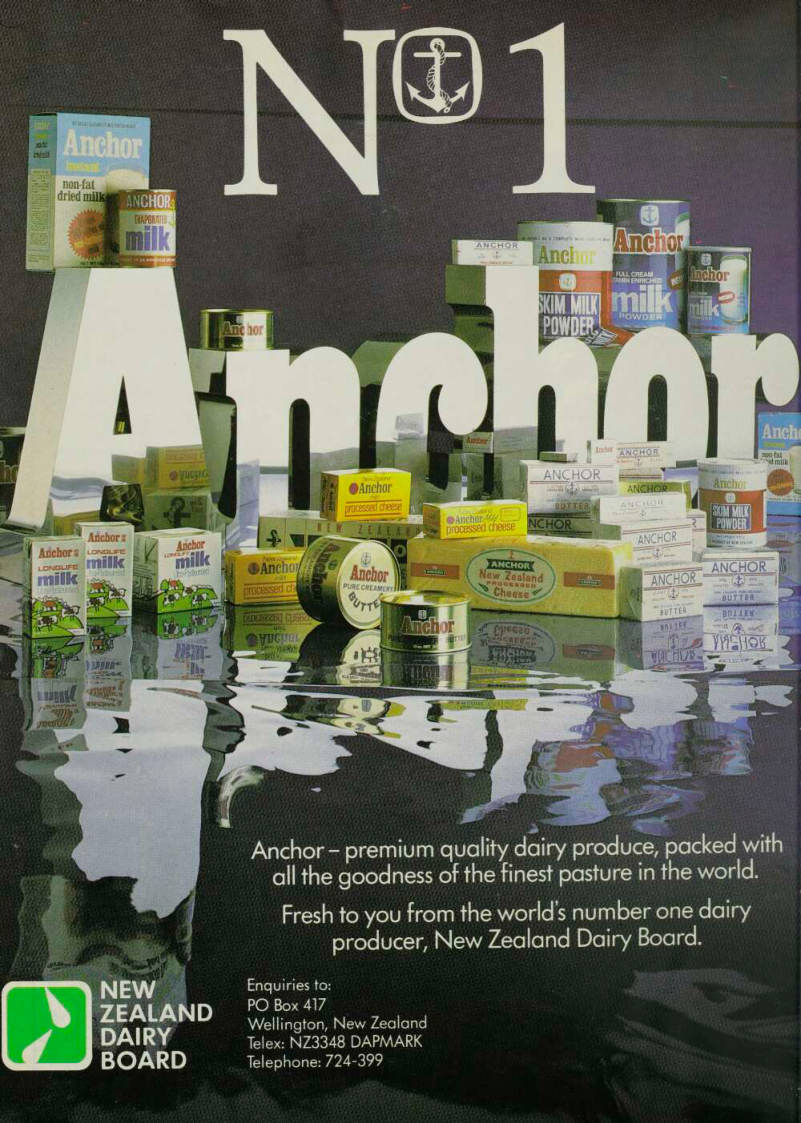
sms *=ym Anchor - premium quality dairy produce, packed with all the goodness of the finest pasture in the world.
Fresh to you from the world's number one dairy
producer, New Zealand Dairy Board.
NEW
ZEALAND
DAIRY
BOARD
Enquiries to: PO Box 417 Wellington, New Zealand
Telex: NZ3348 DAPMARK
Telephone: 724-399
Pacific Report
Palau Plebiscite Postponed
The plebiscite to decide the political future of Palau was postponed for a month from January 11 (PIM Jan p 5) to February 10. President Reagan’s personal representative for negotiations on Micronesia’s future, Fred M. Zeder, said the delay had been requested by the Palau Government to give residents more time to study the various issues. Voters will be asked to approve or reject a “compact” of free association with the USA. If they reject the compact, they are to state whether they prefer independence or a still closer association with the USA which has administered Palau under United Nations trusteeship.
Amaraich Raps U.S.A. On Information Program
Chairman of the Federated States of Micronesia Commission of Future Political Status and Transition, Andon Amaraich, has criticised the United States for “their failure to provide adequate funding for the public information program” designed to educate the people on the Compact of Free Association before the plebiscite. Speaking at a meeting of the FSM Plebiscite Com mission, Mr Amaraich said the FSM submitted a proposed SU.S.I million budget for the information program with detailed justifications 10 months ago but had only received $lOO,OOO and no assurances of further funding. The $lOO,OOO would not even cover the cost of translating the compact document into eight languages, said Mr Amaraich. The Marshall Islands and Palau, with their much smaller populations, apparently were receiving more money than the FSM. “This is merely another example of the failure of U.S. bureaucrats to honor the commitments and responsibilities of their government to our people,” he said. FSM Vice-President Petrus Tun, elected chairman of the Plebiscite Commission, said the U.S. Ambassador for Micronesian status negotiations, Fred M. Zeder, had recently suggested in a letter to FSM President Tosiwo Nakayama that the plebiscite should be held in April or May.
“Trade Prospects Bright” Mccabe
The Trade Commissioner in Australia for South Pacific Forum countries, Bill McCabe, has said there will be a big expansion of sales promotion activities this year. Mr McCabe said Forum countries believe sales on the Australian market could be significantly increased. He said they have been encouraged by the results of a recent display of South Pacific goods at the Australian Government’s International Trade Development Centre in Sydney. Mr McCabe, who recently returned from a two-month tour of Forum countries, said the display is expected to result in about $1 million worth of new business in the coming year. He said contracts already signed with Australian importers following the display are worth about $150,000.
Filipino Company Loses Out In Png
A Filipino company has lost the right to develop Papua New Guinea’s largest timber resource. PNG Prime Minister Michael Somare said after a December cabinet meeting that the company, Hetura Meja, had lost the contract to develop the multi-million dollar Vanimo timber project in West Sepik pro vince, near the Irian Jaya border. Hetura Meja had failed to lodge detailed proposals with the government by the deadline of Christmas Day. The future of the Vanimo project is now in doubt.
In a controversial decision earlier last year, the then government of Sir Julius Chan over-ruled the advice of its own expert negotiating committee and signed an agreement with Hetura Meja, which had no previous experience in the timber industry.
The company had said it would be able to raise $l4O million in development capital for the project. Vanimo Timber was to have been Papua New Guinea’s third largest development project, after the Bougainville and OK Tedi copper and gold mines. The executive director of the National Investment Development Authority, Wep Kanawi, has claimed that PNG had lost at least $27 million in potential foreign investment during 1982. because of bureaucratic bungling. Mr Kanawi said he doubted that several investment projects, including Vanimo Timber, would ever get off the ground.
Greyhound Controversy In Fiji
The Fiji Government has appointed a committee to advise whether Australian bookmaker Bill Waterhouse should be
allowed to introduce greyhound racing to the country. Mr Waterhouse wants to run greyhound racing in the town of Nausori, near Suva. Nausori town council supports the plan, because rent paid by Mr Waterhouse for the local stadium would solve its financial problems. But Fiji’s Society for the Prevention of Cruelty to Animals is against it. The society claims Mr Waterhouse plans to import up to 1000 greyhounds from Australia, and says abandoned greyhounds would add to the long-standing problem of wild dogs in Fiji. The problem arises in part from the reluctance of Hindus to kill animals.
Young Kanaks Study English In Vanuatu
Twenty-five Melanesian students from New Caledonia recently completed a six-week English-language course organised by the University of the South Pacific in Vanuatu. The course for the students, aged between 15 and 20, was jointly arranged by New Caledonia’s Independence Front and the Port-Vila section of the university. It is the second such course to be conducted.
W. Samoa Tackles School-Leavers’ Problem
The government of Western Samoa plans to encourage more vocational training to help alleviate the serious problem among school-leavers. A spokesman for the Education Department said only about one-tenth of the 4000 young people leaving school in Western Samoa each year were finding jobs. The spokesman said the situation was worsening, but it was hoped that an increase in vocational training would widen the employ ment prospects of school-leavers.
Vanuatu Trade Mission In New Caledonia
A trade mission from Vanuatu visited New Caledonia in Decem ber. Its leader, Joseph Laloyer, said working groups would be introduced to study problems of transport, health and customs regulations. He said a similar mission from New Caledonia would visit Vanuatu in April to discuss the conclusions arrived at by the groups.
Second Tv Channel For New Caledonia
New Caledonia will get a second television channel by Christ mas, according to a statement by the director of the French broadcasting service, France Regions Three, Fred Jouhaud. Mr Jouhaud said it would be called Radio Telefusion Outre-Mer, and would share its evening news with the present channel but apart from this would present different programs, covering a wider range of subjects than at present. However, Mr Jouhaud said the new channel would not be operating at its full capacity until 1985.
Fiji Reassures Vanuatu On Islands Claim
Fiji has told Vanuatu that a boundary agreement reached between Fiji and France (RIM Jan p 5) does not in any way prejudice Vanuatu’s claims to Matthew and Hunter Islands. Fiji’s Foreign Minister Mosese Qionibaravi said he gave this assur ance in a letter to Vanuatu’s Prime Minister, Father Walter Uni.
The agreement defines territorial borders where Fiji’s 200-mile economic zone overlaps that of the French possessions of New Caledonia in the south, and Wallis and Futuna Islands in the north. Mr Qionibaravi told parliament in Suva that it had been agreed that the accord would be drawn up in such a way as not to prejudice Vanuatu’s territorial claim.
Pornography Flood Worries Png
Papua New Guinea customs officials are worried about an increase in the amount of pornography entering the country.
Controller of Customs Paul Loki said 1800 pornographic items were seized in 1982 in Port Moresby compared with only 800 in 1981. He said the pornographic books, films, magazines and photographs were mostly from Australia, West Germany and the USA. Mr Loki said that as numbers for other ports had yet to be added to the Port Moresby figure, the trend was “quite
alarming.”
Somare Speaks Up For Press Freedom
Papua New Guinea Prime Minister Michael Somare says one of the finest achievements of his country’s independence is a free press. Mr Somare was commenting on advice from a firm of advertising and marketing consultants that PNG’s newspapers and radio news services should be made to report more favorably on government activities. The prime minister said he
rejected any such idea. Mr Somare said some developing countries had muzzled their news media, but PNG had managed to keep the press free and independent. There was “no way” the government would limit freedom of the press for short-term political gain.
Png Bans Sugar Imports
Papua New Guinea has announced it will ban imports of sugar from February 1 three months ahead of schedule. The ban is to protect the country’s new sugar industry in the Ramu Valley, where milling began last August. It will cut out imports which have recently amounted to 30,000 tonnes a year, mostly from Australia.
Png To Join Intelsat
Papua New Guinea is to join an international telecommunica tions satellite organisation Intelsat. This will give the country access to the 12 satellites at present provided by Intelsat over the Pacific, Atlantic and Indian Oceans, linking almost 400 earth stations in more than 140 nations around the world. PNG’s earth station is to be built during the next 12 months at a cost of about $3.4 million. Prime Minister Michael Somare said the country’s two submarine cables from Madang are nearing the end of their design life, and, without Intelsat, PNG would be left with only the Port Moresby to Cairns cable by the end of the decade for all international communications.
Usp Pulls In Financial Horns
The University of the South Pacific has decided not to extend the contracts of teaching staff because of the university’s current financial difficulties. The decision was taken by the university’s governing council following a recommendation by a review committee. However, contracts of teaching staff with six years’ service may be extended in recognition of outstanding work at the university. The council meeting, chaired by Donald Kalpokas of Vanuatu, established two special committees. One, headed by Lyle Cupit, former chief executive of the Carpenter group of companies in Fiji, will examine university staff salaries and working conditions. The other will report on the effectiveness with which the University utilises its finances and facilities.
Fiji’S Big Plunge On Forum Line
Fiji is to borrow just over $1.5 million from the European Investment Bank to help it become the Pacific Forum Line’s second biggest shareholder. The House of Representatives in Suva has given the government permission to raise the loan. Fiji will also use more than $1 million in aid from Australia to help it achieve a shareholding of 27 per cent in the Forum Line. Only Papua New Guinea, on 37 per cent, will have a larger share. A Radio Australia correspondent in Suva said Fiji had indicated earlier that it would not increase its share beyond the initial contribution of $lO,OOO. But Finance Minister Charles Walker told parliament the government had changed its mind after the line was restructured and new management took over. South Pacific Forum countries agreed earlier last year to inject $l9 million into the line to salvage it.
DELAYS WITH AIR ROUTE HIT N.C. TOURISM Delays in the opening of a new air route between Melbourne and Noumea have raised the possibility of unemployment in the island’s tourist industry. Members of the Noumea Hotel Owners’
Association have said that about 150 people would have to be laid off early in 1983 because of the delay. They said the anticipated opening of the route led to the construction of four new tourist complexes in New Caledonia, and there would be about 250 more hotel beds available by March. However, the French Government has not entered negotiations on the new route to its colony and has not offered a reason for its lack of response. The French airline, UTA, the Australian national airline, Qantas, and Australian aviation officials have all agreed to the new flights. The hotel owners say lack of definite information on when they would start meant that it was too late to publicise the new route before their February-March tourist season. They said this would mean that staff from seven hotels in Noumea would have to be laid off.
Png’S $1.4 Million Computer
Papua New Guinea’s national computer centre is to buy a new computer at a cost of about $1.4 million. The Public Service
Minister, Tony Siaguru, said a contract signed with International Computers Ltd includes five years of staff training. The new computer is to be installed during the next three months. It will replace two smaller ones being leased by the centre in Port Moresby. Mr Siaguru said new systems to be introduced by the national computer centre during the next three years would improve the administration of government funds, assets and staff throughout Papua New Guinea.
Delayed Postwar Clean-Up On Christmas
On Christmas Island, Kiribati, three Australian Navy technicians are helping with the removal of military equipment left behind after World War 11. The technicians are training local personnel in the use of clearance and salvage equipment that has been shipped to the island. It is expected that removal of the military equipment from valuable agricultural land will take about four months.
Fiji Beating Inflation?
Fiji’s official annual inflation rate for 1982 was seven per cent four point two per cent less than in 1981. It was the second consecutive drop in Fiji’s inflation rate, after the peak of 14.5 per cent in 1980. According to the acting government statistician, Tulsi Ram, all sections of the consumer price index, apart from alcohol and tobacco, rose at a slower rate this year.
Lae Airport To Nadzab Again
Papua New Guinea’s national government in January confirmed plans to shift Lae airport from its present site near town back to Nadzab an airbase in World War II which is about 40 kilometres from Lae. Transport Minister Matthew Bendumb said the shift will apply from this year. The announcement came shortly after fire destroyed Air Niugini’s passenger terminal at Lae airport, causing damage estimated at $650,000. Nadzab served as Lae’s airport until public and airline protests forced a change several years ago.
Austria Chips In With Customs Aid
Austria has given equipment to help maintain customs controls in six Pacific Island countries. The Austrian government has given scales, binoculars and dictaphones to Fiji, the Cook Islands, Vanuatu, Kiribati, Tonga and Solomon Islands. The equipment is part of Austria’s aid to developing countries.
Prince Renounces Succession Rights
HRH Prince Viliami Tupoulahi Mailefihi Tuku’aho, the youngest son of Tonga’s Prime Minister, HRH Prince Fatafehi Tu’ipelehake and Princess Melenaite, has renounced all rights to succeed to the throne of Tonga as from Wednesday, January 5, 1983. The 25-year-old former prince was married to a commoner, Miss Mary Victoria Faletau, 21, on January 8. Mr Tuku’aho is a nephew of King Tafa’ahau Tupou IV, who granted the renunciation and attended the January 8 wedding together with the royal family.
New Museum For Western Samoa
Western Samoa’s first National Museum and Culture Centre was officially opened in December by Tooa Salamasina, sister of the Head of State. The opening was marked by a special exhibition of photographs of Maori carvings by a leading New Zealand photographer, Brian Brake. The museum is funded by the Western Samoan government and private overseas donors.
Png To Sell Luxury Jet
Papua New Guinea has commissioned a Danish company to sell the executive jet bought by former Prime Minister Sir Julius Chan. The country’s present leader, Michael Somare, com paigned in last year’s election on the promise that he would sell the luxury plane. He said in December that World Jet Trading of Copenhagen had contracted to find a buyer and sell the jet for $B.l million within three months. The company will get a three per cent commission if it is successful. The Grumman Gulf stream G-2 cost Sir Julius Chan’s government $6.5 million.
France Helps Fiji Cultural Project
The French Government is assisting Fiji in setting up a cultural research program to help preserve Fijian traditions and cultures.
The program will be conducted by Dr Solange Petit-Skinner, an anthropologist and psychologist from the United States. France is meeting the cost of Dr Petit-Skinner’s salary and helping in the provision of technical equipment.
Vanuatu (1)
Letters
The land
issue in
Vanuatu (1)
The letter written to the Prime Minister of Vanuatu, Father Walter Hadye Lini, by Dr Alan Ward, La Trobe University, Melbourne (PIM Nov p 8), is most interesting in the subject it discusses, but warrants a few comments. I must say at the outset that I do not agree with him.
As far as the islanders are
concerned, the principal problem
raised by the presence of an “alienator” is this presence it self. They have been ready to accept, in many cases and I concur with them in principle that the representative of a family they have known for two to five generations be allowed to stay as a lessee, either on a large tract of land where he remains a produc er and perhaps an investor, or on small plots on which he keeps his house and lives from some out
side activity.
Many such “alienators” have only stayed on so as to get from the people an official and regis tered lease, which they hope to sell to a newcomer, so that they can retire with the proceeds to France, New Caledonia, Aust ralia or elsewhere. The villagers would accept helping a friend and neighbor to stay on, but do not relish the idea of opening the way to the coming of a new brand of settlers.
Thus we come to the idea that those alienators who decide to go should be paid for the improve ments they have made on the land. In fact, and this is part of the problem, there are no im provements to be seen which would warrant payment. Most of the coffee and cocoa plantations were abandoned long ago, and now there are cattle ranches either under coconut trees or the open sky. In the first case, the coconut trees may be over 90 years old or at least over 60, without any improvement what ever having been made. Putting cattle under coconut trees is not such an improvement that it should warrant payment.
In some rare cases there has
been some replanting done in the last 20 years. Unfortunately, in most cases the replanting was done on newly cleared areas.
This has been strongly contested by the people in the villages concerned: they are not in a mood to accept this as an im provement and have often as a result striven to get the “alienator” out (e.g. Tisman Bay on Malekula, and Lonorore plantation on Pentecost). Such cases are considered as solved by everyone concerned, and nothing should be done to reopen them.
I am personally against any payment for improvements, ex cept when it can be demonstrated that there have been real im provements. Putting up fences for cattle, in Vanuatu’s climate, and considering the value of the soil, is not an improvement. It means that so-called bush areas have been cleared and opened to over-grazing and erosion. The Europeans in Vanuatu have done little to conserve existing re-
sources, that is the physical and chemical elements, and the biological agents present in the soil.
I do not believe that there will be any positive, or negative, con sequences for New Caledonia.
What we need is a prosperous and orderly Vanuatu, where peo ple work their own land and find a market for their produce, not a fragile economy burdened by payments made to alienators who have never been invited to settle, who took land by force or guile, and mistreated the people for a century.
In New Caledonia we have made a political decision to buy the land from the settlers and hand it back to the Melanesian people. This decision does not
make economic sense, but has been made in an historical con text, that of conquest: European settlement in greater numbers than Vanuatu; and political expe diency, as much locally as vis d vis France itself. It does not need to be shrouded in the convenient but hypocritical and technically unjustified idea of payment for improvements made. Extensive cattle ranching is no improvement.
I must protest against the idea that in Vanuatu the people have neither the skills nor the capital to run a plantation or redevelop it. The plantation system is no more a model for economic de velopment. The areas alienated by Europeans will go back to family units, except, as in south eastern Santo, where there are insufficient people ready to settle again on their former lands a problem of numbers more than anything else. The State will have to play an important role here. The real problem is not capital. The land is there. Nor is it skills the people have them or can be helped to acquire them.
By this I mean useful skills, not those derived from theoretical ideas, but those needed for pro ducing for a market, according to the conditions set by market forces. There is no easy way out.
Europeans can have a place in the building of the economy, but only if they want to stay because they love the place and the peo ple, not because they want to get away as soon as possible with as much money as possible. The sons and daughters of former settlers can be useful, but only if they do not ask for financial privileges against the real privilege of living in Vanuatu.
(Professor)
Jean Guiart
Paris France
The land issue
in Vanuatu (2)
Dr Alan W. Ward is to be con gratulated on his courageous and far-sighted letter (PIM Nov p 8), and, most particularly, on his self-sacrificing action in resign ing from his post as Director of Rural Lands in Vanuatu.
Every French settler who is eager to enter into partnership
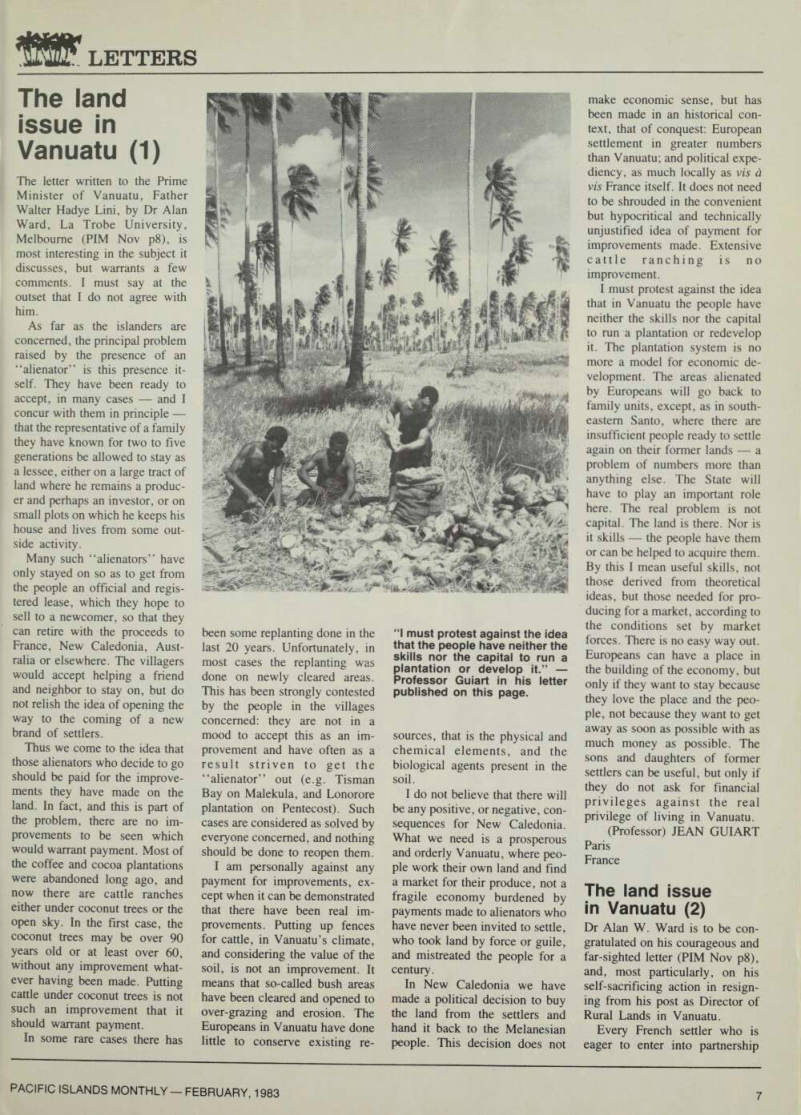
"I must protest against the idea that the people have neither the skills nor the capital to run a plantation or develop it."
Professor Guiart in his letter published on this page.
with Ni-Vanuatu to develop the land they live on should be grate ful to him, and to PIM for pub lishing his letter.
The land problem in Vanuatu since independence has been pre sented in a false light. How can one believe that the ancestors of the present-day Ni-Vanuatu shrewd, clever, hard bargainers as they were didn’t under stand what was happening when they sold or otherwise did a deal on land with white settlers?
I attach a copy of a 1912 document in which Hugh. Ale xander Robertson, a Presbyterian missionary on the islands of Er romanga, states on oath that he was witness to a formal transac tion in 1895 in which Gordon Macmillan Robertson purchased land for the sum of 20 pounds from a group of Ni-Vanuatu vendors.
Jean-Claude Rouleau
Port-Vila Vanuatu
“The Bounty
Experiment”
I am surprised that in the re cent discussions in PIM on films concerning the Bounty mutiny more attention has not been paid to a fine film made by Film Australia, The Bounty Experiment.
Not only is this 50-minute documentary, made on location on Pitcairn and Norfolk Islands, beautifully photographed and full of human interest, but its com mentary matches the quality of the images which is far from always being the case.
For the film’s makers, there were no “heroes” or “villains” in the Bounty mutiny, but merely Englishmen of the late 18th cen tury motivated by conflicting values of their times.
A sample: “In the late 18th
century, European explorers re turned from the Pacific with wonderful stories ... The Pacific was a new-found paradise, a paradise to be exploited. A sen suous place, and a place to be evangelised.
“While most sailors in those days had to be forced into ser vice, a voyage to the Pacific was like a magnet. The strongest and most able seamen could be cho sen. Beautiful women called men to dreams of wild romance, and to wild and headstrong actions.
The Pacific became a place of conflict as well as beauty.
“The mutiny on the Bounty had all the ingredients for epic movies. Clark Gable and Marlon Brando became Fletcher Chris tian. Charles Laughton and Trevor Howard became Captain Bligh.
“It’s a classic tale of conflict between two fundamental forces, between the sense of responsibil ity, of obligation, of commit ment to duty, and a contrary force, a yearning to drop the burdens, the drudgery of life as it really is and escape to something better.
“Those two forces in human nature came into collision 200 years ago on the Bounty. The collision caused the most famous mutiny in the whole history of the sea...”
The commentary returns to this opening theme in the closing moments of the film: the descendants of the mutineers lead a life they treasure.
“On Norfolk, the Pitcairners, as they still call themselves, manage to preserve their special identity in the face of pressures that erode it.
“The Pitcairners on Pitcairn see their isolation as a blessing, but the price they have to pay for it is rising.
“Being free or being respons
ible aren’t always the opposites that they seemed to be to Captain Bligh and Fletcher Christian.
“For the people of Pitcairn the two are very much bound together.
It’s a film that deserves much wider exposure, in Australia and elsewhere, than it has apparently had, and a credit to all those involved in its making John Shaw, who produced, directed, and filmed it, as well as writing the script; Howard Spry, sound technician, editor Richard Hind ley, and narrator Ed Howard.
This is not forgetting the peo ple on Pitcairn and Norfolk, who made a contribution of vibrant human warmth.
P. Warbeck
Sydney NSW Australia
Imperialist
Usa? (1)
Reader Urban Kapler’s claim (PIM Oct pi 3) that South Viet nam had a “functioning” gov ernment when the United States intervened in that country is spe cious, at the very least.
Historians and other observers generally recognise that, throughout most of the 1960 s and the early 19705, no South Viet namese government (read: dic tatorship) would have lasted more than a few weeks without the support, both political and military, of the United States.
Indeed, when the U.S. Govern ment did withdraw its support, Ngo Dinh Diem fell not to the Viet Cong or the North Vietnam ese, but to the people of South Vietnam in general.
Mr Kapler also confuses im perialism with colonialism. Im perialism does not involve the suppression of a country’s sovereignty as does colonial
ism but the exercise of power over a sovereign country’s deci sions regarding certain factors considered to be, for various “strategic” reasons, of paramount importance to the “security” of the imperial coun try. In that sense, a number of actions undertaken by the U.S. in Latin America, in Southern Afri ca, in the Pacific, and so on, can certainly be viewed as forming part of “imperialistic designs”, whether or not they are success ful. The same can be said about the actions of the Soviet Union in Eastern Europe, Afghanistan, Cuba, etc.
For a manifestation of modem colonialism, one has only to turn back a few pages in the same issue of PIM, where it is stated (p 5) that “the independence op tion (for the Marshall Islands Republic) has been rejected as unacceptable by U.S. negotiators”.
Michel Forand
Ottawa Canada
Imperialist
Usa? (2)
The letter from Urban Kapler (PIM Oct pi 3) requires rebuttal.
That U.S. policy in Vietnam was imperialist can be seen in NSC 5429-2 dated August 20, 1954 (see Department of Defense edi tion of the Pentagon Papers: United States-Vietnam Relations 1945-1967, House Committee on Armed Services Committee Print 92nd Congress Book 10, pp 736- 7, emphasis added).
“If requested by a legitimate local government which requires
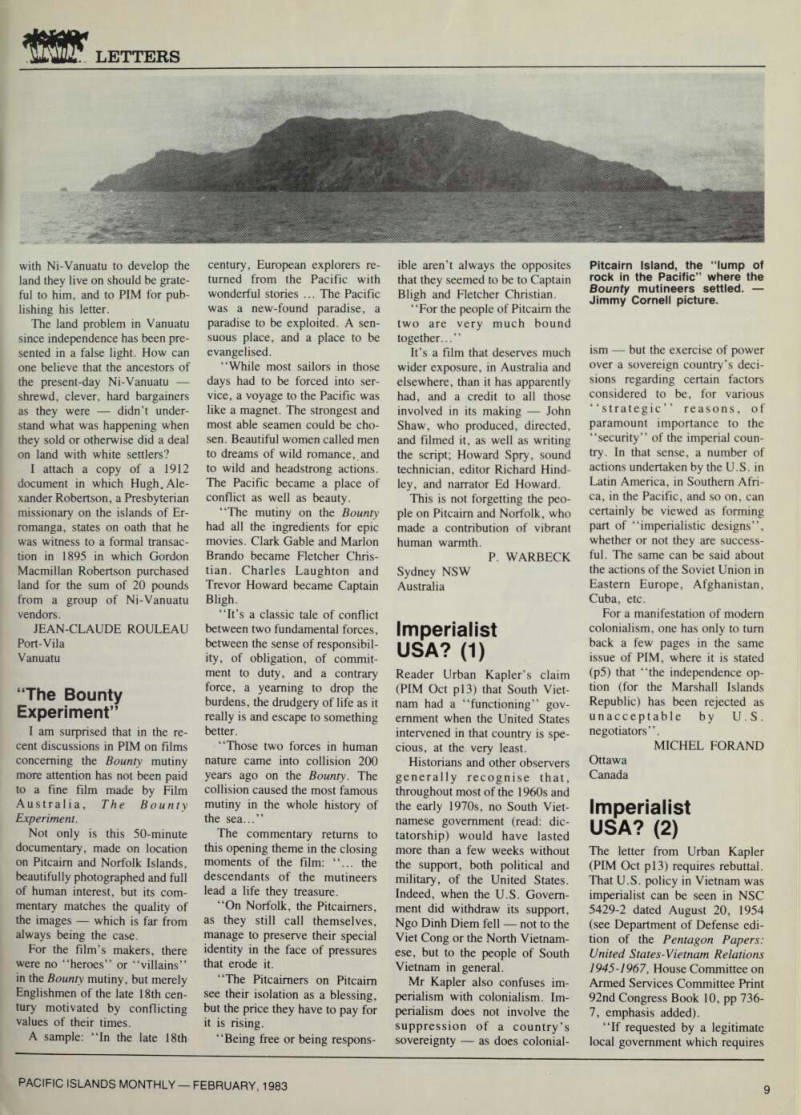
Pitcairn Island, the “lump of rock in the Pacific” where the Bounty mutineers settled.
Jimmy Cornell picture.
assistance to defeat local Com munist subversion or rebellion not consisting of armed attack, the U.S. should view such a situation so gravely that, in addi tion to giving all possible covert and overt support within Execu tive Branch authority, the Presi dent should at once consider Congressional authority to take appropriate action, which might if necessary and feasible include the use of U.S. military forces locally or against the external source of such subversion or re bellion (including Communist China if determined to be the source).”
In short, the U.S. will militari ly intervene as it sees fit against any group or government it de termines to be Communist and subverting a government it de clares as “legitimate”, even if the “subversion” is not an arm ed attack and would lead to war with China its legal obligation to the UN Charter notwithstand ing. And all of this is conceived within the context of the Geneva
Peace Accords of 1954 for French withdrawal from Vietnam.
Where Mr Kapler gets his fi gure of “5,000,000 people of Southeast Asia” murdered since the “liberation of South Viet nam” must also be questioned.
Perhaps like President Reagan he relies on the “authority” of The Reader’s Digest. After all, they were the first institution in the U.S. to publish the figure of 2,000,000 dead (now blossomed to 3,000,000 in some media re ports) as victims of the Pol Pot regime in Kampuchea. Their fi gure was based on an interview with an official of the Kampuc hean Government (who denies the interview occurred), publish ed in a Catholic family magazine from Rome which is so obscure that no library in the U.S. has a subscription to it.
That the U.S. had no imperial ist designs on the Pacific after World War II begs the facts. One has only to consider the history of U.S. relations with Mic-
ronesia and the Ryukyus. The Philippines were “given” their independence only after the U.S. assured to itself control over the economy of the islands. (And we must not forget the near genocid al U.S. policy in the early 20th century toward the Philippines.) As for the islands mentioned by Mr Kapler, he ignores the report of the House Committee on Nav al Affairs Study of Pacific Bases (Comm. Print, 79th Cong., 1945). They had designs not only on Micronesia, the Ryukyus, and the islands named by Mr Kapler, but many more including the Izus, Bonins, New Hebrides, Cebu, and the Gilberts. It was only the vigorous objections of its European colonial allies, and the tremendous financial burden required, that combined to force the U.S. to pull in its horns.
What I have noted above has been in the public domain for years. Where has Mr Kapler been all these years?
David Paul
Belmont, Mass.
Usa
Archaeology
weak?
I read PIM every month with interest but find that the reporting of anthropological and particu larly archaeological research in the islands is often inaccurate. I cite some examples from your September and October issues.
For instance Stephen Weins tein’s discussion of Kahoolawe Island in Hawaii includes a state ment that the island “is one of the few places in Hawaii that has not been explored (archaeologic ally) with a fine tooth comb”. In fact the opposite is true.
Kahoolawe is the only major Hawaiian island that has been intensively surveyed archaeolog ically, with over 500 sites having been recorded. Archaeological survey was undertaken by the navy in large part as a result of pressure from the Protect Kahoolawe Ghana. The whole island has been placed on the National Register of Historic Places in recognition of its his toric importance. Whether con tinued bombing is appropriate given this status is of course a moot point. Until massive ero
sion was caused, the island did have an agricultural economy, probably based on growing sweet potatoes.
Similarly the Danielssons’ ar ticle on Tikopia gets that island’s prehistory a bit wrong. There is no archaeological evidence of an earlier population being wiped out by a cyclone and much show ing a merging of cultures in later prehistory to produce the present “Polynesian” look to the is lands. I hope PIM will review Pat Kirch and Doug Yen’s excel lent new book on the prehistory and ecology of Tikopia, just pub lished by the Bishop Museum, so these misconceptions can be cleared up.
I have always found Robert Langdon’s (see his review of Feinberg’s Anuta ) and Erich von Daniken’s views of Pacific his tory to be equally invidious.
Thus Anuta’s culture is supposed to be a product of Europeandn dian influence (the same kind of argument as in Langdon’s Lost Caravel), and that of Kiribati a product of spacemen. When will Pacific prehistory and culture be properly credited to Pacific islan ders themselves rather than to “superior” outsiders! And when will PIM get a qualified ar chaeologist to check the accuracy of the reports that are published in its pages?
One final quibble. Anuta was already firmly on the an thropological map in 1973 with yet another Bishop Museum pub lication, edited by Doug Yen and Janet Gordon, called Anuta: A Polynesian Outlier in the Sol omon Islands.
Matthew Spriggs
(Assistant Professor) University of Hawaii at Manoa Honolulu Hawaii
Usa
PIM cannot pretend to be (or to employ) any sort of final au thority on subjects such as those raised by Professor Spriggs. Af ter all, anthropologists and ar chaeologists spend a great deal of their time arguing among themselves. What we do ap preciate are letters from readers like Professor Spriggs which ex press a spirited viewpoint on material appearing in our pages.
Pim.
Advertisements & other items, pp. 8-10 (3 items)
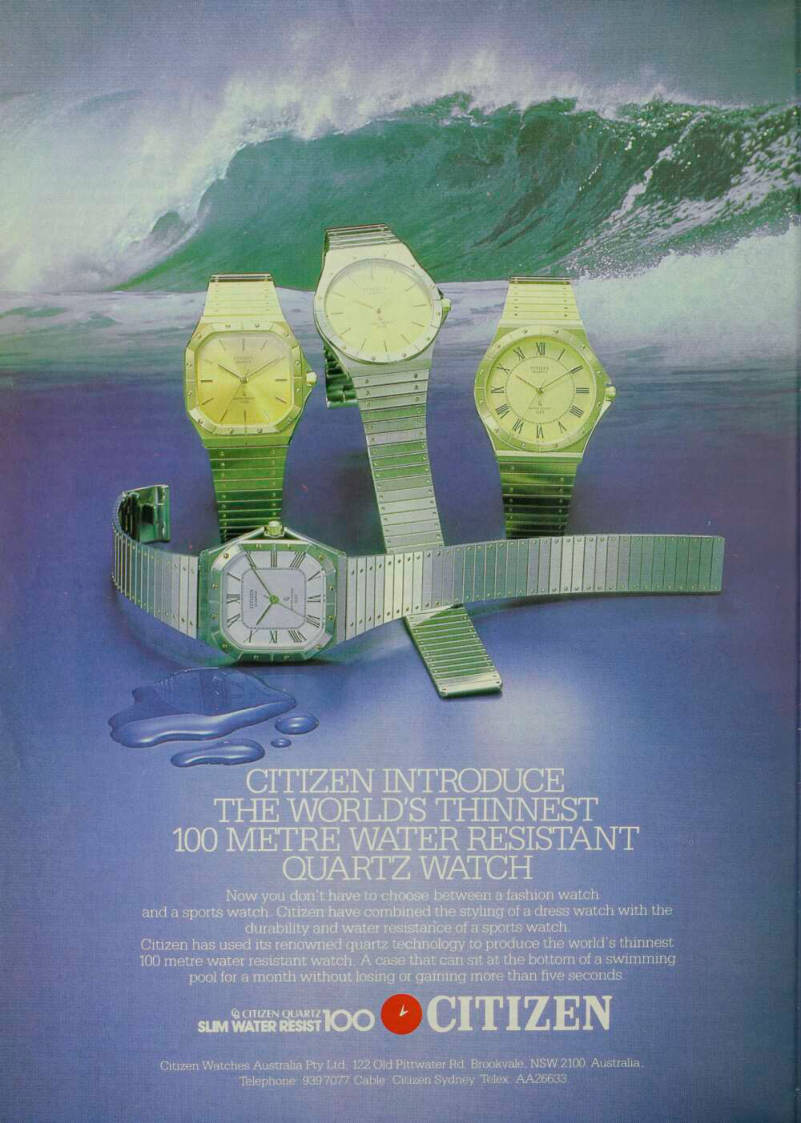
Citizen Introduce
THE WORLD’S THINNEST
100 METRE WATER RESISTANT
QUARTZ WATCH
Now you don't have to choose between a fashion watch and a sports watch. Citizen have combined the styling of a dress watch with the durability and water resistance of a sports watch.
Citizen has used its renowned quartz technology to produce the world’s thinnest 100 metre water resistant watch. A case that can sit at the bottom of a swimming pool for a month without losing or gaining more than five seconds.
SUM WATBJ RESIST CITIZEN
Citizen Watches Australia Pty Ltd, 122 Old Pittwater Rd, Brookvale, NSW 2100. Australia.
Telephone. 9397077 Cable: Citizen Sydney Telex: AA26633.
Letters
Letters
Trans-sexual prostitution in Polynesia
Polynesia: A tradition defiled?
Deborah Macfar
LANE, writer of this arti cle, is a New Zealand medical student doing a Master of Public Health degree at the University of
Sydney, Australia.
The article is the result of three months research carried out late last year in Tahiti, Hawaii and San Francisco. It is based on part of Ms MacFarlane’s work for her MPH thesis.
For some years now, the larger Polynesian islands have seen the emergence of an intriguing type of character: young, flamboyant and predominantly of Polynesian origin, they frequent the bars and clubs, emerging from time to time to parade the streets and solicit male clients willing to pay them for their sexual services.
At first glance they could be mistaken for female prostitutes, and indeed some behave so con vincingly as women that even upon close examination no mas culine traits can be detected.
These individuals are, howev er, trans-sexual prostitutes, males who identify so closely with women that they adopt a feminine lifestyle, and support themselves through prostitution.
Indeed, trans-sexual prostitution has become so prevalent throughout Polynesia that one can readily indicate on a map of the Polynesian triangle the is lands where it can now be found.
Many historical references in dicate that transvestism and trans-sexualism were similarly prevalent in Polynesia hundreds of years ago. In an earlier PIM article, “Polynesia’s Third Sex”
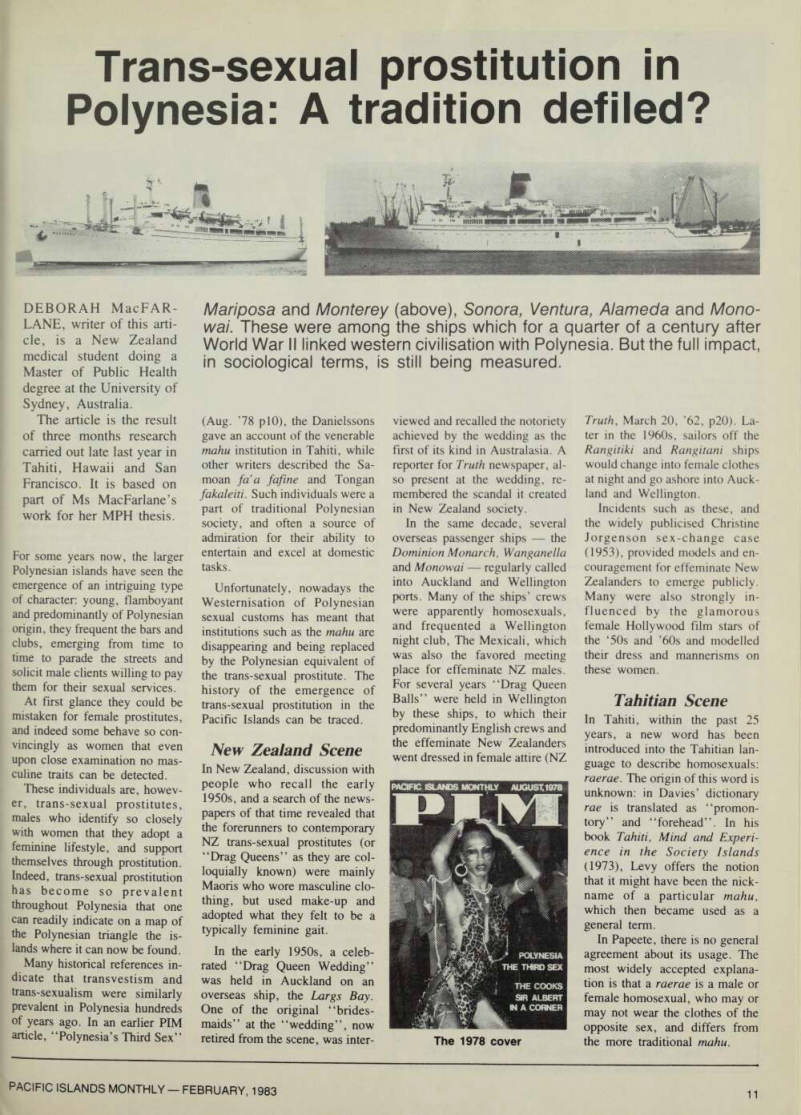
Mariposa and Monterey (above), Sonora, Ventura, Alameda and Mono wai. These were among the ships which for a quarter of a century after World War II linked western civilisation with Polynesia. But the full impact, in sociological terms, is still being measured.
(Aug. ’7B plO), the Danielssons gave an account of the venerable mahu institution in Tahiti, while other writers described the Sa moan fa a fafine and Tongan fakaleiti. Such individuals were a part of traditional Polynesian society, and often a source of admiration for their ability to entertain and excel at domestic tasks.
Unfortunately, nowadays the Westernisation of Polynesian sexual customs has meant that institutions such as the mahu are disappearing and being replaced by the Polynesian equivalent of the trans-sexual prostitute. The history of the emergence of trans-sexual prostitution in the Pacific Islands can be traced.
New Zealand Scene In New Zealand, discussion with people who recall the early 19505, and a search of the news papers of that time revealed that the forerunners to contemporary NZ trans-sexual prostitutes (or “Drag Queens” as they are col loquially known) were mainly Maoris who wore masculine clo thing, but used make-up and adopted what they felt to be a typically feminine gait.
In the early 19505, a celeb rated “Drag Queen Wedding” was held in Auckland on an overseas ship, the Largs Bay.
One of the original “brides maids” at the “wedding”, now retired from the scene, was inter
viewed and recalled the notoriety achieved by the wedding as the first of its kind in Australasia. A reporter for Truth newspaper, al so present at the wedding, re membered the scandal it created in New Zealand society.
In the same decade, several overseas passenger ships the Dominion Monarch, Wanganella and Monowai regularly called into Auckland and Wellington ports. Many of the ships’ crews were apparently homosexuals, and frequented a Wellington night club. The Mexicali, which was also the favored meeting place for effeminate NZ males.
For several years “Drag Queen Balls” were held in Wellington by these ships, to which their predominantly English crews and the effeminate New Zealanders went dressed in female attire (NZ
Truth , March 20, ’62, p2O). La ter in the 19605, sailors off the Rangitiki and Rangitani ships would change into female clothes at night and go ashore into Auck land and Wellington.
Incidents such as these, and the widely publicised Christine Jorgenson sex-change case (1953), provided models and en couragement for effeminate New Zealanders to emerge publicly.
Many were also strongly in fluenced by the glamorous female Hollywood film stars of the ‘sos and ’6os and modelled their dress and mannerisms on these women.
Tahitian Scene In Tahiti, within the past 25 years, a new word has been introduced into the Tahitian lan guage to describe homosexuals: raerae. The origin of this word is unknown: in Davies’ dictionary rae is translated as “promon tory” and “forehead”. In his book Tahiti, Mind and Experi ence in the Society Islands (1973), Levy offers the notion that it might have been the nick name of a particular mahu, which then became used as a general term.
In Papeete, there is no general agreement about its usage. The most widely accepted explana tion is that a raerae is a male or female homosexual, who may or may not wear the clothes of the opposite sex, and differs from the more traditional mahu.
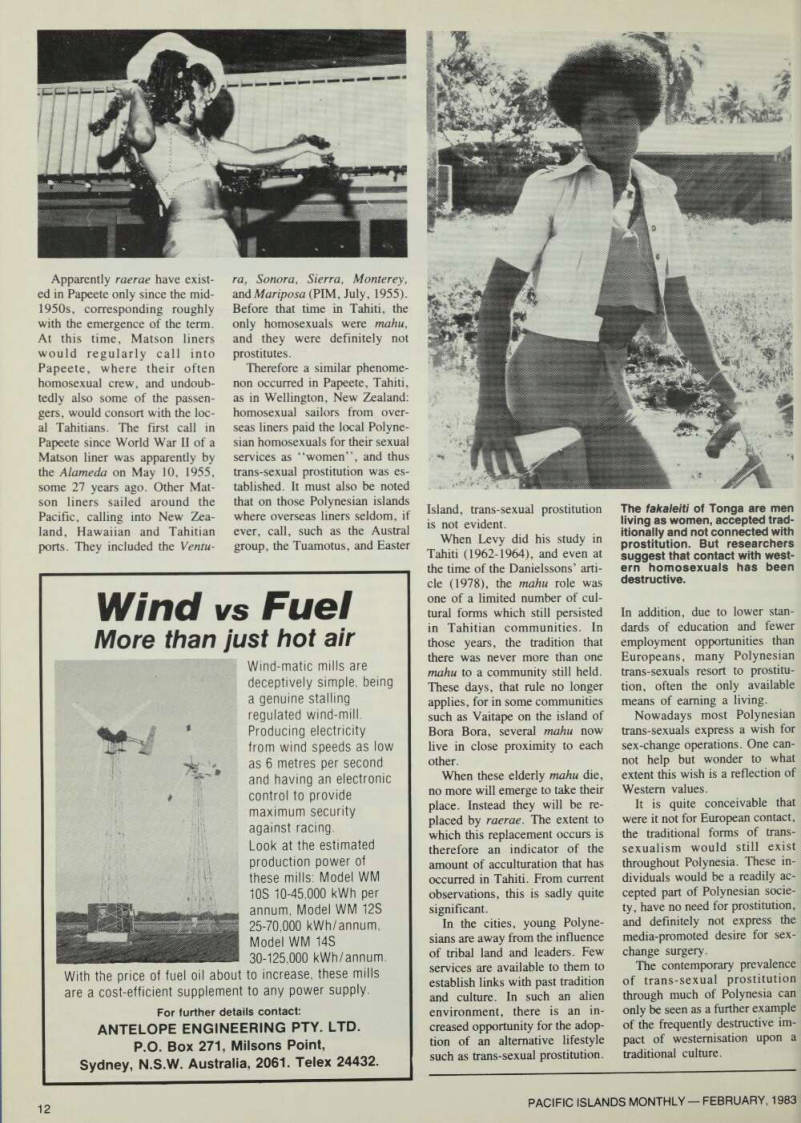
The 1978 cover
Apparently raerae have exist ed in Papeete only since the mid -19505, corresponding roughly with the emergence of the term.
At this time, Matson liners would regularly call into Papeete, where their often homosexual crew, and undoub tedly also some of the passen gers, would consort with the loc al Tahitians. The first call in Papeete since World War II of a Matson liner was apparently by the Alameda on May 10, 1955, some 27 years ago. Other Mat son liners sailed around the Pacific, calling into New Zea land, Hawaiian and Tahitian ports. They included the Ventu
ra, Sonora, Sierra, Monterey, and Mariposa (PIM, July, 1955).
Before that time in Tahiti, the only homosexuals were mahu, and they were definitely not prostitutes.
Therefore a similar phenome non occurred in Papeete, Tahiti, as in Wellington, New Zealand; homosexual sailors from over seas liners paid the local Polyne sian homosexuals for their sexual services as “women”, and thus trans-sexual prostitution was es tablished. It must also be noted that on those Polynesian islands where overseas liners seldom, if ever, call, such as the Austral group, the Tuamotus, and Easter
Island, trans-sexual prostitution is not evident.
When Levy did his study in Tahiti (1962-1964), and even at the time of the Danielssons’ arti cle (1978), the mahu role was one of a limited number of cul tural forms which still persisted in Tahitian communities. In those years, the tradition that there was never more than one mahu to a community still held.
These days, that rule no longer applies, for in some communities such as Vaitape on the island of Bora Bora, several mahu now live in close proximity to each other.
When these elderly mahu die, no more will emerge to take their place. Instead they will be re placed by raerae. The extent to which this replacement occurs is therefore an indicator of the amount of acculturation that has occurred in Tahiti. From current observations, this is sadly quite significant.
In the cities, young Polyne sians are away from the influence of tribal land and leaders. Few services are available to them to establish links with past tradition and culture. In such an alien environment, there is an in creased opportunity for the adop tion of an alternative lifestyle such as trans-sexual prostitution.
In addition, due to lower stan dards of education and fewer employment opportunities than Europeans, many Polynesian trans-sexuals resort to prostitu tion, often the only available means of earning a living.
Nowadays most Polynesian trans-sexuals express a wish for sex-change operations. One can not help but wonder to what extent this wish is a reflection of Western values.
It is quite conceivable that were it not for European contact, the traditional forms of trans sexualism would still exist throughout Polynesia. These in dividuals would be a readily ac cepted part of Polynesian socie ty, have no need for prostitution, and definitely not express the media-promoted desire for sex change surgery.
The contemporary prevalence of trans-sexual prostitution through much of Polynesia can only be seen as a further example of the frequently destructive im pact of westernisation upon a traditional culture.
The fakaleiti of Tonga are men living as women, accepted trad itionally and not connected with prostitution. But researchers suggest that contact with west ern homosexuals has been destructive.
Advertisements & other items, p. 12 (1 item)
Wind vs Fuel
More than just hot air
Wind-matic mills are deceptively simple, being a genuine stalling regulated wind-mill.
Producing electricity from wind speeds as low as 6 metres per second and having an electronic control to provide maximum security against racing.
Look at the estimated production power of these mills: Model WM 10S 10-45,000 kWh per annum, Model WM 12S 25-70,000 kWh/annum, Model WM 14S 30-125,000 kWh/annum.
With the price of fuel oil about to increase, these mills are a cost-efficient supplement to any power supply.
For further details contact:
ANTELOPE ENGINEERING PTY. LTD.
P.O. Box 271, Milsons Point, Sydney, N.S.W. Australia, 2061. Telex 24432.
Airline, shipping issues in fall

Political Currents
Airline, shipping issues in fall of Kiribati Government
BILLY SCHUTZ in Tarawa has talked to former Presi dent leremia Tabai and other chief actors in the drama which saw the fall of the government of Kiribati on December 10, 1982 (PIM Jan p 33). His report shows that there were is sues at stake quite apart from the formal one of an amendment to civil service
pay legislation.
The formal cause of the defeat of the Kiribati Government under President leremia Tabai was the rejection by 20 votes to 15 by the Maneaba ni Maungatabu (House of Assembly) of a government move to correct what it saw as an anomaly in civil service pay legislation. But a number of other issues lay beneath the surface.
The pay move would have legitimised salary rises of five per cent granted earlier in 1982 without the necessary backing in law to the holders of the six constitutional posts in the State set-up of Kiribati: the Speaker of the House, the chairman of the Public Service Commission, the Attorney-General, the Chief Jus tice, the Commissioner of Police, and the Director of Au dit. It would also have allowed them to receive rises in future, in line with civil service pay rates, without resort to constitutional amendments all the time.
The House had rejected the government’s bill on the issue on December 9. Former President Tabai told me in an interview: “I felt there was an issue of confi dence in that vote.” So, when the matter was reintroduced the next day, he included the issue of confidence. “It would not have been honorable to carry on with out doing so,” he said.
He said he was puzzled as to why the House had rejected the
bill. “The amount involved is only $1869. We were only trying to correct an oversight in existing legislation which had been point ed out by the Director of Audit. ”
But a spokesman for the newly formed opposition party Wiia I- Kiribati (Mouth of the Kiribati People) claimed the president had used the confidence issue to threaten members with the poss ible loss of their seats if they did not support his amendment. (The Kiribati Constitution provides that in the event of the defeat of a government, parliament must be dissolved and fresh elections held.) The spokesman admitted that his party had taken full advan tage of the confidence issue when it came up.
“The leremia government has been untruthful in the past,” he said.
His party’s main objections were to the losses incurred by Air Tungaru’s Boeing 727, and what he called the “continual sub sidy” to the Kiribati Shipping Corporation.
The spokesman claimed that expenditure figures on the Boe ing had never been made avail able to MPs. On the shipping corporation, he said that the gov ernment had allowed it to use money from the National Provi dent Fund, and had guaranteed it a bank loan to purchase a new ship.
On the issue of the salary rises for “the top six”, he said they were constitutional appointees and not civil servants. They should be treated the same as MPs and excluded from the civil service rises.
Responding to these opposi tion criticisms, former President Tabai said that opposition spokesmen should have raised the confidence issue “at a more appropriate time”. “This was not the time to discuss Air Tun garu and the shipping corpora tion,” he said.
The House had approved a Supplementary Appropriation Bill granting more money to Air Tungaru in May. “I can’t under stand how their opinions have changed so drastically in such a short time,” he said. The differ-
ence between chartering Air Nauru to do the Tarawa- Christmas Island-Honolulu run, and operating the Air Tungaru 727, was “nothing major”, he said. It was important to main tain the link with the Line Is lands, and the most practical means was by air. Mr Tabai added that details of expenditure on the Boeing were contained in a report by the Director of Audit, which had already been tabled in the House.
On the shipping corporation, the former president said for the provident fund or the national bank or any other financial in stitution to make a loan was “normal commercial practice”.
He did not regard such a loan as a subsidy. He said it was a sign of a country’s independence to buy a ship from local funds and not rely on aid. “Opposition mem bers should be proud of this rather than decrying it,” he said. (The ship concerned, the MB Nei Momi, a 300-tonne Japanese
built, cargo and passenger vessel costing $1.9 million, is already in operation.) On the issue of “the top six”, Mr Tabai said they held “con stitutional” posts only to main tain their independence of gov ernments, but, apart from this consideration, they were the same as other civil service posts.
Mr Tabai said that to accuse him of “threatening” members with the loss of their seats was to suggest he had the power to sack members. “How can I threaten members without threatening my own government?” he asked.
Summing up, Mr Tabai said he believed the opposition had only criticised and had offered nothing constructive.
A general election was scheduled for January 12, and the election of a new president by the new parliament was expected to take place in the second half of February.
Until a new president is elect ed, Kiribati will be governed by a Council of State comprising the Speaker of the House, the chair man of the Public Service Com mission, and the Chief Justice.
Fiji: Not
the end of
the Gnus
Fiji’s Prime Minister Ratu Sir Kamises Mara revived an old idea when in December he pro posed the formation of a “gov ernment of national unity” for the country..
Discussed briefly two years ago, the idea this time is buttress ed by a paper supporting it which has been prepared by Dr Ahmed Ali, former University of the South Pacific political scientist who is now Fiji’s minister of education.
Discussing the proposal for a “Gnu,” political columnist Robert Keith-Reid wrote in the
Tabai: “How can I threaten members without threatening my own government?”
The Fiji Times of December 11: “On Tuesday a New Zealand High Court judge, Sir John White, is due to open his one man Royal Commission of In quiry into what really happened up to, and perhaps after, the election.
“Did the Alliance really try to fix the NFP with sinister outside help? Did the NFP really try to do the same to the Alliance? And so on, and so on.
“What surfaces in the White wash is bound to raise hackles and tempers again.
“It might be quite some time before the PM and Mr Reddy will be able to feel that they can get together to talk Gnu, if at all.
“In his Gnu talk so far the Prime Minister has seemed to imply that a goverment of nation al unity wouldn’t just be an ordi nary coalition government.
“Nor would it turn Fiji into a one-party state.
“Over the years since inde pendence came Fiji’s way he has said, more than once, that he’s become more and more convinc ed that the pure Westminster style of democracy, with a gov ernment side and an opposition side blustering away at each other across the floor of parlia ment, doesn’t work all that well in a multi-racial country such as Fiji, where stark divisions of race make a big and often dangerous difference in the way people think and react in response to things said and done by the other side.
“Mr Reddy’s first reaction has been to emphasise how very dif ficult it will be for Fiji’s political parties to get together in a state of Gnu-dom.
“A very delicate and complex business it will be, he said.
“And he was right.”
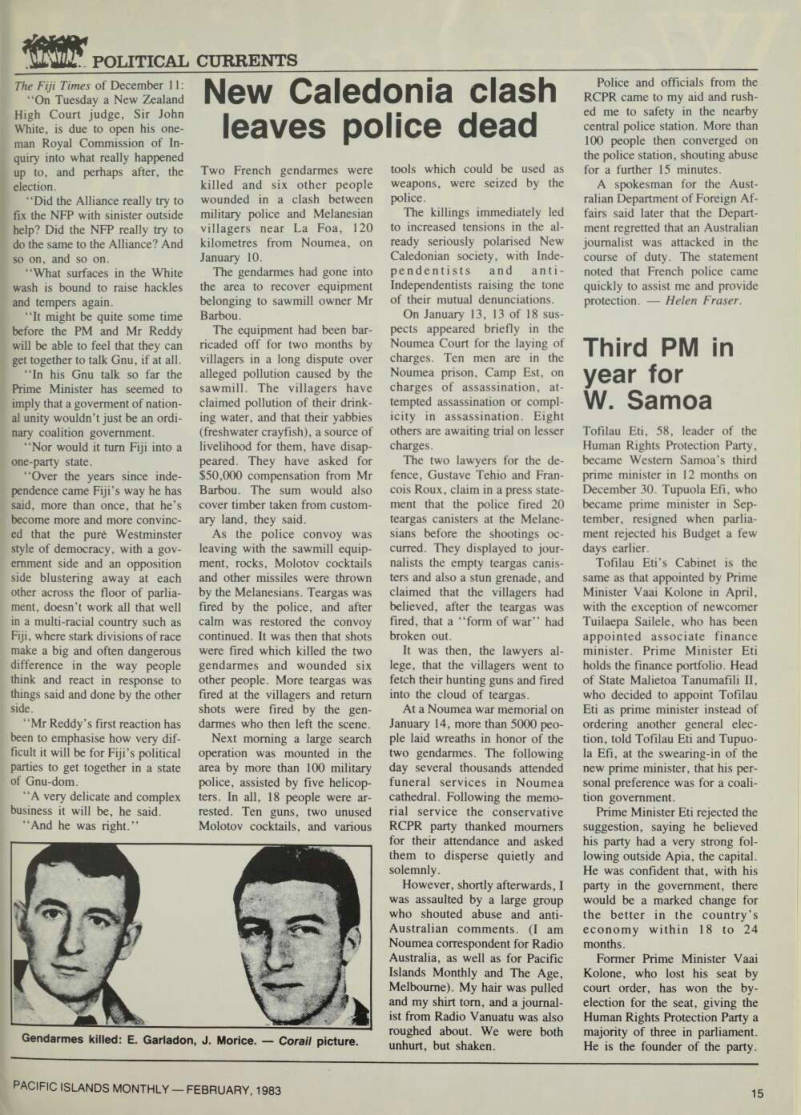
Gendarmes killed: E. Garladon, J. Morice. Corail picture.
Advertisements & other items, p. 14 (1 item)
Australia can supply
Ml % IK 1
reliable builders hardware
Australian building materials have proven reliable and long-lasting under the toughest conditions. They keep working efficiently even in climatic extremes of scorching sun, torrential downpours and cyclonic winds. It’s because they are made to Australian Building Codes that are very strict by world standards. An extensive range of these high quality products is available. Handtools.
Fasteners, nuts, bolts, screws. Door and window fittings. Cabinetware.
Electrical cable, switches and accessories. Light fittings. Insulation.
Solar hot water systems. Abrasives.
Adhesives. Sealants. Protective coatings. Plumbing materials. 0) Bathroom and kitchen fittings.
And also most other kinds of building hardware and materials.
Check the Australian Trade Commissioner for the suppliers who can help you.
Ask the expert who knows Australia For details of suppliers phone the Australian Trade Commissioner at: Suva: Phone 312844.
Port Moresby: Phone 25 9333.
Honolulu: Phone (808) 524 5050.
Noumea: Phone 27 2414,27 2426.
Ask the Australian WW Trade Commissioner
leaves police dead
New Caledonia clash leaves police dead
Two French gendarmes were killed and six other people wounded in a clash between military police and Melanesian villagers near La Foa, 120 kilometres from Noumea, on January 10.
The gendarmes had gone into the area to recover equipment belonging to sawmill owner Mr Barbou.
The equipment had been bar ricaded off for two months by villagers in a long dispute over alleged pollution caused by the sawmill. The villagers have claimed pollution of their drink ing water, and that their yabbies (freshwater crayfish), a source of livelihood for them, have disap peared. They have asked for $50,000 compensation from Mr Barbou. The sum would also cover timber taken from custom ary land, they said.
As the police convoy was leaving with the sawmill equip ment, rocks, Molotov cocktails and other missiles were thrown by the Melanesians. Teargas was fired by the police, and after calm was restored the convoy continued. It was then that shots were fired which killed the two gendarmes and wounded six other people. More teargas was fired at the villagers and return shots were fired by the gen darmes who then left the scene.
Next morning a large search operation was mounted in the area by more than 100 military police, assisted by five helicop ters. In all, 18 people were ar rested. Ten guns, two unused Molotov cocktails, and various
tools which could be used as weapons, were seized by the police.
The killings immediately led to increased tensions in the al ready seriously polarised New Caledonian society, with Inde pendentists and anti- Independentists raising the tone of their mutual denunciations.
On January 13, 13 of 18 sus pects appeared briefly in the Noumea Court for the laying of charges. Ten men are in the Noumea prison, Camp Est, on charges of assassination, at tempted assassination or compl icity in assassination. Eight others are awaiting trial on lesser charges.
The two lawyers for the de fence, Gustave Tehio and Fran cois Roux, claim in a press state ment that the police fired 20 teargas canisters at the Melane sians before the shootings oc curred. They displayed to jour nalists the empty teargas canis ters and also a stun grenade, and claimed that the villagers had believed, after the teargas was fired, that a “form of war” had broken out.
It was then, the lawyers al lege, that the villagers went to fetch their hunting guns and fired into the cloud of teargas.
At a Noumea war memorial on January 14, more than 5000 peo ple laid wreaths in honor of the two gendarmes. The following day several thousands attended funeral services in Noumea cathedral. Following the memo rial service the conservative RCPR party thanked mourners for their attendance and asked them to disperse quietly and solemnly.
However, shortly afterwards, I was assaulted by a large group who shouted abuse and anti- Australian comments. (I am Noumea correspondent for Radio Australia, as well as for Pacific Islands Monthly and The Age, Melbourne). My hair was pulled and my shirt tom, and a journal ist from Radio Vanuatu was also roughed about. We were both unhurt, but shaken.
Police and officials from the RCPR came to my aid and rush ed me to safety in the nearby central police station. More than 100 people then converged on the police station, shouting abuse for a further 15 minutes.
A spokesman for the Aust ralian Department of Foreign Af fairs said later that the Depart ment regretted that an Australian journalist was attacked in the course of duty. The statement noted that French police came quickly to assist me and provide
protection.
Helen Fraser.
Third PM in
year for
W. Samoa
Tofilau Eti, 58, leader of the Human Rights Protection Party, became Western Samoa’s third prime minister in 12 months on December 30. Tupuola Efi, who became prime minister in Sep tember, resigned when parlia ment rejected his Budget a few days earlier.
Tofilau Eti’s Cabinet is the same as that appointed by Prime Minister Vaai Kolone in April, with the exception of newcomer Tuilaepa Sailele, who has been appointed associate finance minister. Prime Minister Eti holds the finance portfolio. Head of State Malietoa Tanumafili 11, who decided to appoint Tofilau Eti as prime minister instead of ordering another general elec tion, told Tofilau Eti and Tupuo la Efi, at the swearing-in of the new prime minister, that his per sonal preference was for a coali tion government.
Prime Minister Eti rejected the suggestion, saying he believed his party had a very strong fol lowing outside Apia, the capital.
He was confident that, with his party in the government, there would be a marked change for the better in the country’s economy within 18 to 24 months.
Former Prime Minister Vaai Kolone, who lost his seat by court order, has won the by election for the seat, giving the Human Rights Protection Party a majority of three in parliament.
He is the founder of the party.
Advertisements & other items, p. 16 (1 item)
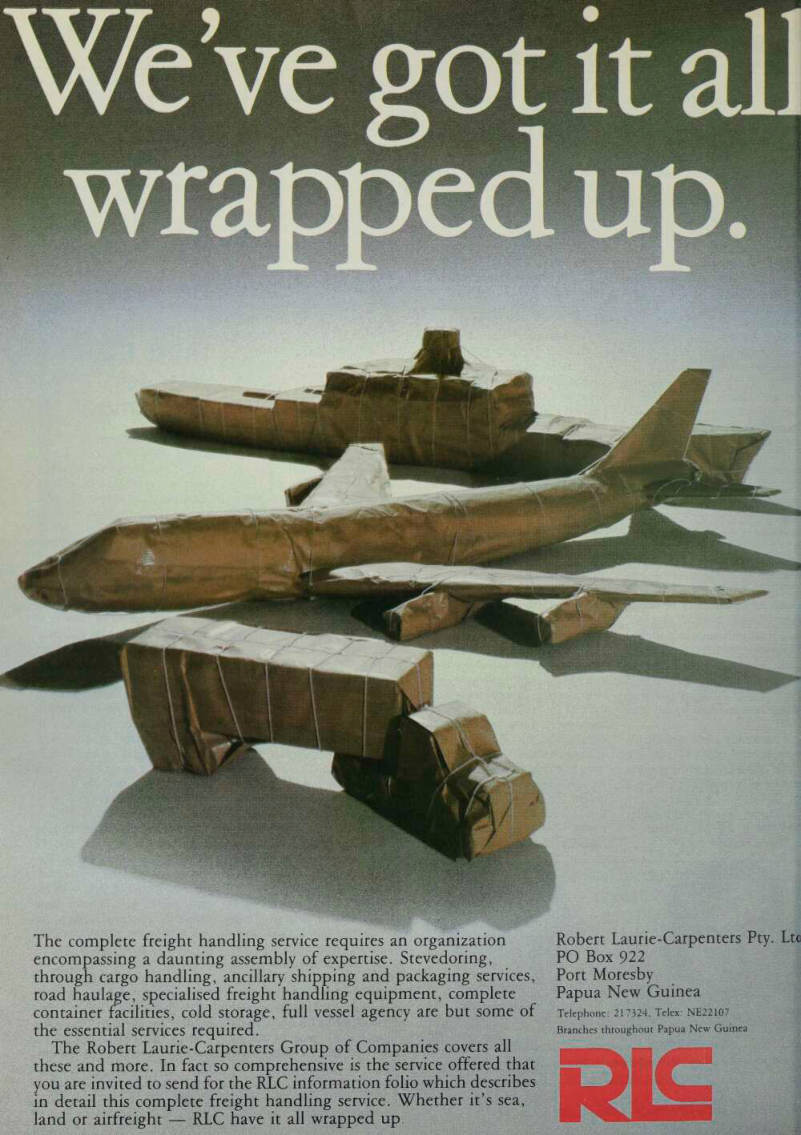
We’ve got it all
wra
The complete freight handling service requires an organization encompassing a daunting assembly of expertise. Stevedoring, through cargo handling, ancillary shipping and packaging services, road haulage, specialised freight handling equipment, complete container facilities, cold storage, full vessel agency are but some of the essential services required.
The Robert Laurie-Carpenters Group of Companies covers all these and more. In fact so comprehensive is the service offered that you are invited to send for the RLC information folio which describes in detail this complete freight handling service. Whether it’s sea, land or airfreight RLC have it all wrapped up Robert Laurie-Carpenters Pty. Lt PO Box 922 Port Moresby Papua New Guinea Telephone; 217324, Telex: NE22107 Branches throughout Papua New Guinea g c
Troubled PNG asking Australia
to increase its aid grant
Social problems, violence, un employment and crime have shown a marked increase in Papua New Guinea in the past 18 months. The situation is due in a large degree to an acute shortage of money, the depletion of re serves and a generally troubled economy. It is a far cry from the financial strength which marked PNG’s early years of independ ence in the mid 19705.
If any illustration is needed of the extent of the problems which PNG is facing, it is provided by the public service. The govern ment has retrenched about 10 percent of the public service. The numbers involved are nearly 3000 Papua New Guineans and about 300 contract outsiders in cluding Australians, New Zealanders, Britons and Filipinos.
It has long been claimed that the size of the PNG public ser vice was excessive, and repre sented an inheritance from Aust ralian administration in PNG.
Successive governments in PNG have conceded this, but have also claimed that a big public service was not out of place because of the opportunities it provided to phase Papua New Guineans into their new type of society.
The heavy retrenchments have not only brought increasing hard ship to the newly-emerged wage earning community, but have se verely cut the extent and scope of public works and services. This in turn has cut into private sector economic activity and employment.
An estimated 88 percent of Papua New Guineans still rely directly on their ancestral land for a subsistence-type economy.
But although they are outside the cash economy, they are not unaf fected by what has happened.
There is a widespread belief that countries like PNG can fall back on subsistence living in times of economic stress, but this is not practical. The result is that neith er the people of the new
Papua New Guinea, which gets nearly one-third of its national budget revenue from an annual Australian aid grant, has run into serious financial problems. At talks to be held in March PNG will ask Australia for an extra 12 percent on the agreed aid program to the end of 1986. Is an increase justified, and how will Australia react?
economy nor the people of the old economy can over-ride a de pression any better than can the people of developed countries.
Surveys by the World Bank and by Australian institutions have been critical to some extent of PNG’s national expenditure and spending patterns. PNG’s own central bank has issued a number of warnings, too. The suggestion is that PNG is partly to blame for its economic prob lems. This however is seen by many observers as extremely mild criticism against the back ground of PNG’s few short years of nationhood. In balance, PNG has shown a high degree of fi nancial responsibility particu larly in comparison with many other new nations, they believe.
The major cause of the present situation in PNG is a combina tion of world recessions and fal ling world markets. PNG’s great est single money earner is its copper and gold mining industry, but copper prices last year were at their lowest level for nearly 30 years and the tropical produce exported by PNG always a fickle money-earner also fell to low levels. Even copra, the
old standby which is never a glamorous money-earner but is usually more steady than other tropical crops, fell to an extreme low.
On top of reduced national incomes, PNG had its own ver sion of spiralling wage rates and it was further hit by the huge increases in the cost of petroleum fuels. Petroleum fuels create the biggest single drain on PNG foreign reserves, and PNG’s own expenditure estimates were re peatedly outstripped by the speed at which petroleum prices rose.
PNG cabinet ministers are well in the forefront of Pacific think ing in matters of alternative ener gy, but this is of little comfort to their country in its current heavy dependence on petroleum fuels.
One of the boasts of Michael Somare when he first became prime minister was that he did not want the Australian grant in aid to continue at a high level.
He believed that by tapering off the grant a stimulus would be provided to make PNG develop its self-reliance.
But circumstances have forced a change, and PNG has now made a formal approach to Aust
ralia for greater aid. The first tentative talks were held late last year when the Fraser government in Australia told the newly returned Somare government in PNG that it could not immediate ly accede to the request, but was prepared to bring forward the next round of scheduled talks to examine the PNG aid program.
These talks are now scheduled to be held in March.
The current Australian aid program to PNG is part of a five year program which runs into the end of 1986. It started at a base of $241.3 million in 1981. It is adjusted upwards each year to account for inflation but at the same time it is adjusted down wards at five percent a year in real value. This was done with the agreement of PNG as a scheme to build self-reliance, and in fact Australian aid each year has been taking a lower proportion of the total PNG budget.
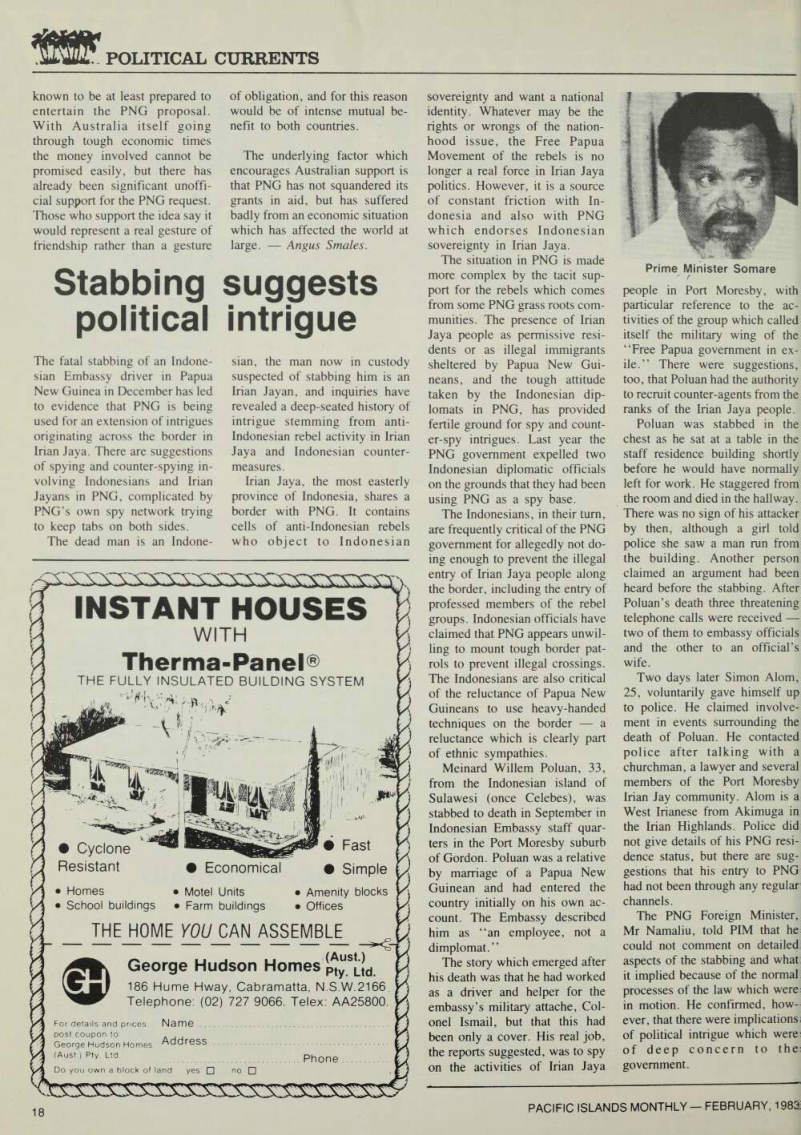
PNG’s proposal now is that the rate of annual decrease of the aid should be slowed down. This would be accomplished by re taining the grant at its base level until the end of 1984 and then decreasing it slightly for the re maining two years. The total additional amount which Aust ralia would pay would be just over $lOO million in four years, equivalent to about an extra 12 percent.
Members of political parties on both sides of the fence are
known to be at least prepared to entertain the PNG proposal.
With Australia itself going
through tough economic times
the money involved cannot be promised easily, but there has
already been significant unoffi
cial support for the PNG request.
Those who support the idea say it would represent a real gesture of friendship rather than a gesture
of obligation, and for this reason would be of intense mutual be nefit to both countries.
The underlying factor which encourages Australian support is that PNG has not squandered its grants in aid, but has suffered badly from an economic situation which has affected the world at
large.
Angus Smales.
Png’S Proposal For Aid
The following table shows the level of budget support which Australia is already giving to PNG, and the increases which PNG will propose to Australia at talks in March. Figures are in millions of dollars Australian.
81-82 82-83 83-84 84-85 85-86 What PNG is getting 241.3 229.3 217.8 206.9 196.6 What PNG is asking 241.3 241.3 241.3 236.4 231.7 Making an increase of — 12.0 23.5 29.5 35.1 Total increase over five years 100.1
Stabbing suggests
political intrigue
The fatal stabbing of an Indone sian Embassy driver in Papua New Guinea in December has led to evidence that PNG is being used for an extension of intrigues originating across the border in Irian Jaya. There are suggestions of spying and counter-spying in volving Indonesians and Irian Jayans in PNG, complicated by PNG’s own spy network trying to keep tabs on both sides.
The dead man is an Indone
sian, the man now in custody suspected of stabbing him is an Irian Jayan, and inquiries have revealed a deep-seated history of intrigue stemming from anti- Indonesian rebel activity in Irian Jaya and Indonesian counter measures.
Irian Jaya, the most easterly province of Indonesia, shares a border with PNG. It contains cells of anti-Indonesian rebels who object to Indonesian
sovereignty and want a national identity. Whatever may be the rights or wrongs of the nation hood issue, the Free Papua Movement of the rebels is no longer a real force in Irian Jaya politics. However, it is a source of constant friction with In donesia and also with PNG which endorses Indonesian
sovereignty in Irian Jaya.
The situation in PNG is made more complex by the tacit sup port for the rebels which comes from some PNG grass roots com munities. The presence of Irian
Jaya people as permissive resi
dents or as illegal immigrants sheltered by Papua New Gui neans, and the tough attitude taken by the Indonesian dip lomats in PNG, has provided fertile ground for spy and count er-spy intrigues. Last year the PNG government expelled two Indonesian diplomatic officials on the grounds that they had been using PNG as a spy base.
The Indonesians, in their turn, are frequently critical of the PNG government for allegedly not do
ing enough to prevent the illegal
entry of Irian Jaya people along the border, including the entry of professed members of the rebel groups. Indonesian officials have claimed that PNG appears unwil ling to mount tough border pat rols to prevent illegal crossings.
The Indonesians are also critical of the reluctance of Papua New Guineans to use heavy-handed techniques on the border a reluctance which is clearly part of ethnic sympathies.
Meinard Willem Poluan, 33, from the Indonesian island of Sulawesi (once Celebes), was stabbed to death in September in Indonesian Embassy staff quar ters in the Port Moresby suburb of Gordon. Poluan was a relative by marriage of a Papua New Guinean and had entered the country initially on his own ac count. The Embassy described him as “an employee, not a
dimplomat.”
The story which emerged after his death was that he had worked as a driver and helper for the
embassy’s military attache, Col
onel Ismail, but that this had been only a cover. His real job, the reports suggested, was to spy on the activities of Irian Jaya
people in Port Moresby, with particular reference to the ac tivities of the group which called itself the military wing of the “Free Papua government in ex ile.” There were suggestions, too, that Poluan had the authority to recruit counter-agents from the ranks of the Irian Jay a people.
Poluan was stabbed in the chest as he sat at a table in the
staff residence building shortly
before he would have normally left for work. He staggered from the room and died in the hallway.
There was no sign of his attacker
by then, although a girl told
police she saw a man run from the building. Another person claimed an argument had been heard before the stabbing. After Poluan’s death three threatening telephone calls were received two of them to embassy officials and the other to an official’s wife.
Two days later Simon Alom, 25, voluntarily gave himself up to police. He claimed involve ment in events surrounding the death of Poluan. He contacted police after talking with a churchman, a lawyer and several members of the Port Moresby Irian Jay community. Alom is a West Irianese from Akimuga in the Irian Highlands. Police did not give details of his PNG resi dence status, but there are sug gestions that his entry to PNG had not been through any regular channels.
The PNG Foreign Minister, Mr Namaliu, told PIM that he could not comment on detailed aspects of the stabbing and what it implied because of the normal processes of the law which were in motion. He confirmed, how ever, that there were implications of political intrigue which were of deep concern to the; government.
Prime Minister Somare
Advertisements & other items, p. 18 (2 items)
Political Currents
Instant Houses^
WITH
Therma-Panel®
THE FULLY INSULATED BUILDING SYSTEM
i i■ , r • Fast • Simple • Cyclone Resistant • Economical a Homes School buildings Amenity blocks Offices Motel Units Farm buildings U
THE HOME YOU CAN ASSEMBLE J
George Hudson Homes pjy s Ltd . 186 Hume Hway, Cabramatta, N.5.W.2166 Telephone; (02) 727 9066. Telex: AA25800 Phone
expats
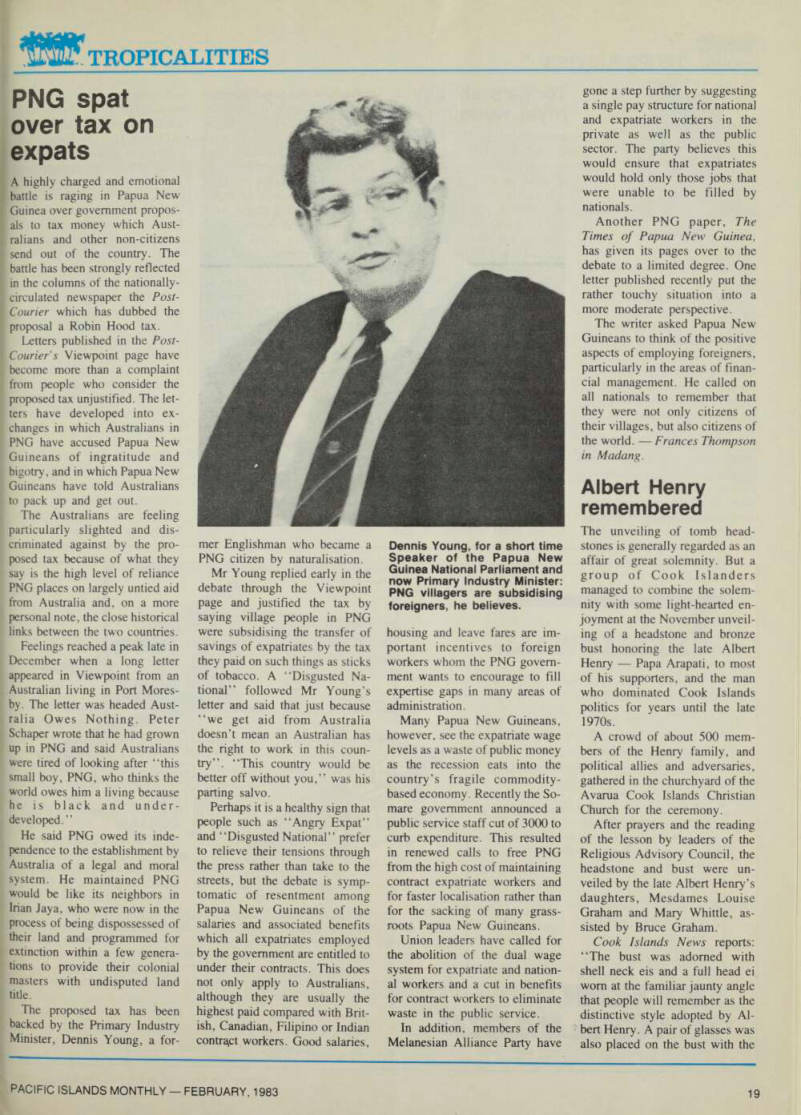
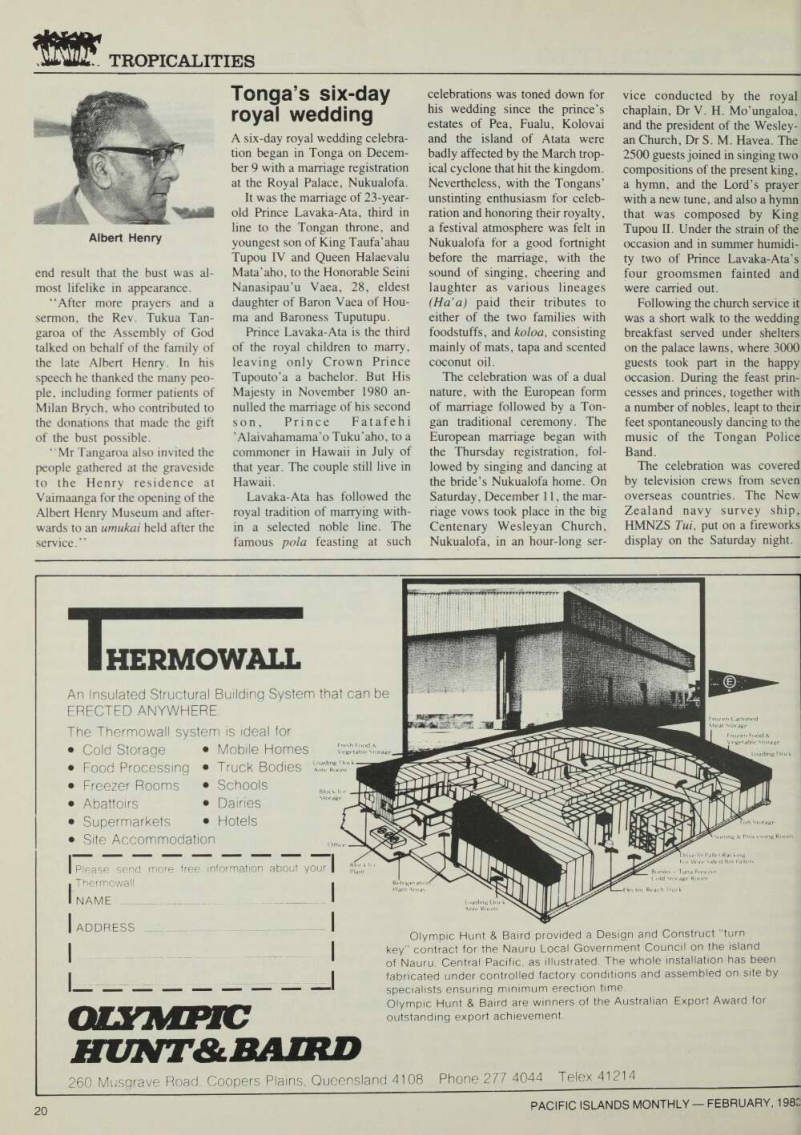
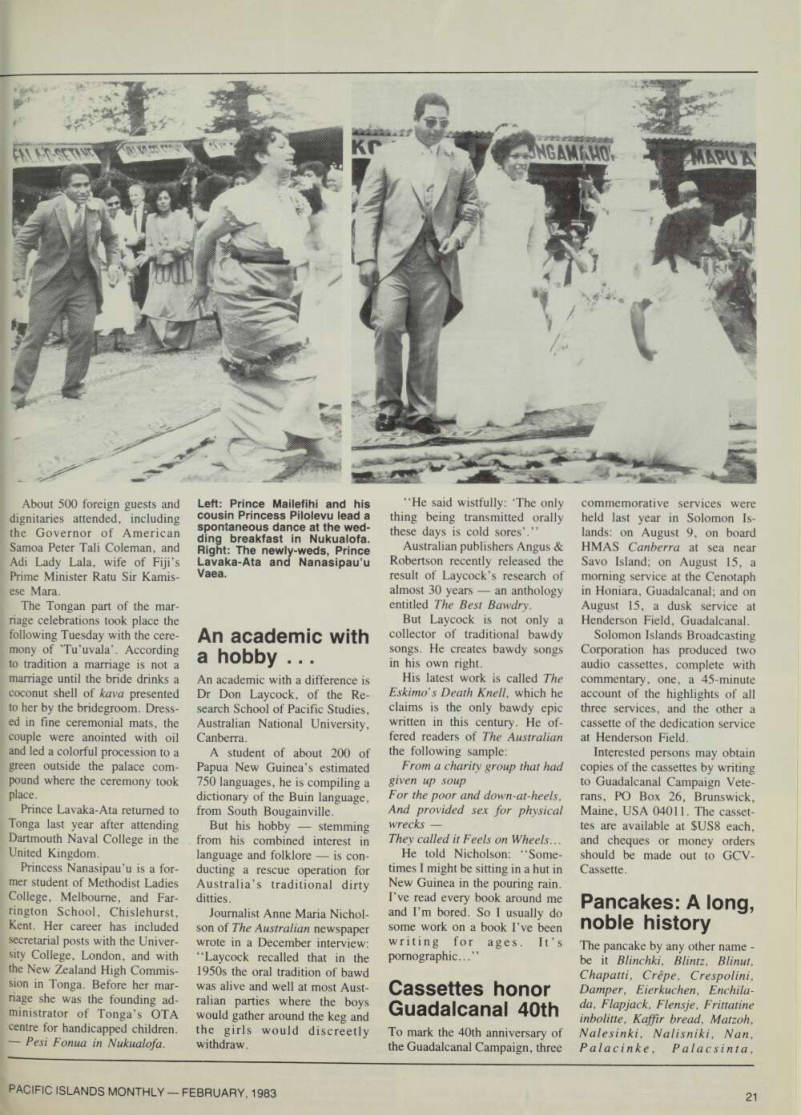
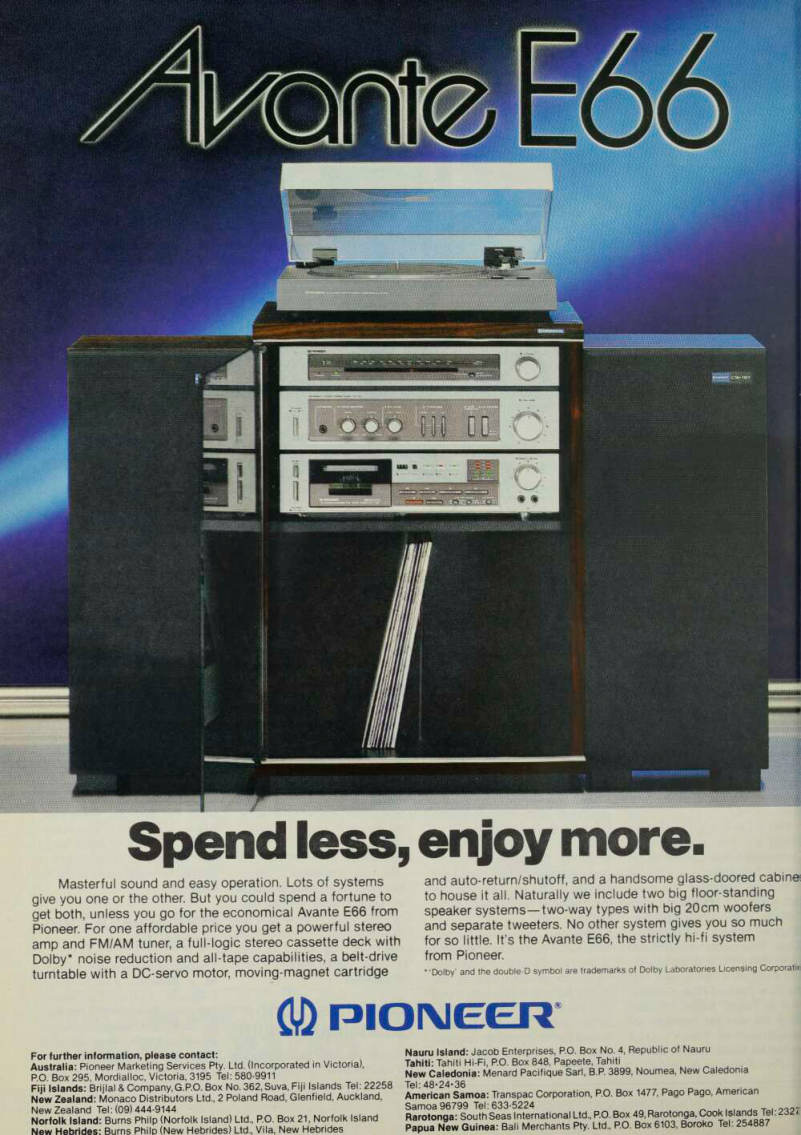
Tropicalities
PNG spat
over tax on
expats
A highly charged and emotional battle is raging in Papua New Guinea over government propos als to tax money which Aust ralians and other non-citizens send out of the country. The battle has been strongly reflected in the columns of the nationally circulated newspaper the Post- Courier which has dubbed the proposal a Robin Hood tax.
Letters published in the Post- Courier’s Viewpoint page have become more than a complaint from people who consider the proposed tax unjustified. The let ters have developed into ex changes in which Australians in PNG have accused Papua New Guineans of ingratitude and bigotry, and in which Papua New Guineans have told Australians to pack up and get out.
The Australians are feeling particularly slighted and dis criminated against by the pro posed tax because of what they say is the high level of reliance PNG places on largely untied aid from Australia and, on a more personal note, the close historical links between the two countries.
Feelings reached a peak late in December when a long letter appeared in Viewpoint from an Australian living in Port Mores by. The letter was headed Aust ralia Owes Nothing. Peter Schaper wrote that he had grown up in PNG and said Australians were tired of looking after “this small boy, PNG, who thinks the world owes him a living because he is black and under developed.”
He said PNG owed its inde pendence to the establishment by Australia of a legal and moral system. He maintained PNG would be like its neighbors in Irian Jaya, who were now in the process of being dispossessed of their land and programmed for extinction within a few genera tions to provide their colonial masters with undisputed land title.
The proposed tax has been backed by the Primary Industry Minister, Dennis Young, a for-
mer Englishman who became a PNG citizen by naturalisation.
Mr Young replied early in the debate through the Viewpoint page and justified the tax by saying village people in PNG were subsidising the transfer of savings of expatriates by the tax they paid on such things as sticks of tobacco. A “Disgusted Na tional” followed Mr Young’s letter and said that just because “we get aid from Australia doesn’t mean an Australian has the right to work in this coun try”. “This country would be better off without you,” was his parting salvo.
Perhaps it is a healthy sign that people such as “Angry Expat” and “Disgusted National” prefer to relieve their tensions through the press rather than take to the streets, but the debate is symp tomatic of resentment among Papua New Guineans of the salaries and associated benefits which all expatriates employed by the government are entitled to under their contracts. This does not only apply to Australians, although they are usually the highest paid compared with Brit ish, Canadian, Filipino or Indian contract workers. Good salaries,
housing and leave fares are im portant incentives to foreign workers whom the PNG govern ment wants to encourage to fill expertise gaps in many areas of administration.
Many Papua New Guineans, however, see the expatriate wage levels as a waste of public money as the recession eats into the country’s fragile commodity based economy. Recently the So mare government announced a public service staff cut of 3000 to curb expenditure. This resulted in renewed calls to free PNG from the high cost of maintaining contract expatriate workers and for faster localisation rather than for the sacking of many grass roots Papua New Guineans.
Union leaders have called for the abolition of the dual wage system for expatriate and nation al workers and a cut in benefits for contract workers to eliminate waste in the public service.
In addition, members of the Melanesian Alliance Party have
gone a step further by suggesting a single pay structure for national and expatriate workers in the private as well as the public sector. The party believes this would ensure that expatriates would hold only those jobs that were unable to be filled by nationals.
Another PNG paper, The Times of Papua New Guinea, has given its pages over to the debate to a limited degree. One letter published recently put the rather touchy situation into a more moderate perspective.
The writer asked Papua New Guineans to think of the positive aspects of employing foreigners, particularly in the areas of finan cial management. He called on all nationals to remember that they were not only citizens of their villages, but also citizens of
the world.
Frances Thompson
in Madang.
Albert Henry
remembered
The unveiling of tomb head stones is generally regarded as an affair of great solemnity. But a group of Cook Islanders managed to combine the solem nity with some light-hearted en joyment at the November unveil ing of a headstone and bronze bust honoring the late Albert Henry Papa Arapati, to most of his supporters, and the man who dominated Cook Islands politics for years until the late 19705.
A crowd of about 500 mem bers of the Henry family, and political allies and adversaries, gathered in the churchyard of the Avarua Cook Islands Christian Church for the ceremony.
After prayers and the reading of the lesson by leaders of the Religious Advisory Council, the headstone and bust were un veiled by the late Albert Henry’s daughters, Mesdames Louise Graham and Mary Whittle, as sisted by Bruce Graham.
Cook Islands News reports: “The bust was adorned with shell neck eis and a full head ei worn at the familiar jaunty angle that people will remember as the distinctive style adopted by Al bert Henry. A pair of glasses was also placed on the bust with the
Dennis Young, for a short time Speaker of the Papua New Guinea National Parliament and now Primary Industry Minister:
PNG villagers are subsidising
foreigners, he believes.
end result that the bust was al most lifelike in appearance.
“After more prayers and a sermon, the Rev. Tukua Tan garoa of the Assembly of God talked on behalf of the family of the late Albert Henry. In his speech he thanked the many peo
ple, including former patients of
Milan Brych, who contributed to the donations that made the gift of the bust possible.
“Mr Tangaroa also invited the
people gathered at the graveside
to the Henry residence at Vaimaanga for the opening of the Albert Henry Museum and after wards to an umukai held after the service.”
Tonga’s six-day
royal wedding
A six-day royal wedding celebra tion began in Tonga on Decem ber 9 with a marriage registration at the Royal Palace, Nukualofa.
It was the marriage of 23-year old Prince Lavaka-Ata, third in line to the Tongan throne, and youngest son of King Taufa’ahau Tupou IV and Queen Halaevalu Mata’aho, to the Honorable Seini Nanasipau’u Vaea, 28, eldest daughter of Baron Vaea of Hou ma and Baroness Tuputupu.
Prince Lavaka-Ata is the third of the royal children to marry, leaving only Crown Prince Tupouto’a a bachelor. But His Majesty in November 1980 an nulled the marriage of his second son. Prince Fatafehi ’Alaivahamama’o Tuku’aho, to a commoner in Hawaii in July of that year. The couple still live in Hawaii.
Lavaka-Ata has followed the royal tradition of marrying with in a selected noble line. The famous pola feasting at such
celebrations was toned down for his wedding since the prince’s estates of Pea, Fualu, Kolovai and the island of Atata were badly affected by the March trop ical cyclone that hit the kingdom.
Nevertheless, with the Tongans’ unstinting enthusiasm for celeb ration and honoring their royalty, a festival atmosphere was felt in Nukualofa for a good fortnight before the marriage, with the sound of singing, cheering and laughter as various lineages (Ha a) paid their tributes to either of the two families with foodstuffs, and koloa, consisting mainly of mats, tapa and scented coconut oil.
The celebration was of a dual nature, with the European form of marriage followed by a Ton gan traditional ceremony. The European marriage began with the Thursday registration, fol lowed by singing and dancing at the bride’s Nukualofa home. On Saturday, December 11, the mar riage vows took place in the big Centenary Wesleyan Church, Nukualofa, in an hour-long ser
vice conducted by the royal chaplain, Dr V. H. Mo’ungaloa, and the president of the Wesley an Church, Dr S. M. Havea. The 2500 guests joined in singing two compositions of the present king, a hymn, and the Lord’s prayer with a new tune, and also a hymn that was composed by King Tupou 11. Under the strain of the occasion and in summer humidi ty two of Prince Lavaka-Ata’s four groomsmen fainted and were carried out.
Following the church service it was a short walk to the wedding breakfast served under shelters on the palace lawns, where 3000 guests took part in the happy occasion. During the feast prin cesses and princes, together with a number of nobles, leapt to their feet spontaneously dancing to the music of the Tongan Police Band.
The celebration was covered by television crews from seven overseas countries. The New Zealand navy survey ship, HMNZS Tui, put on a fireworks display on the Saturday night.
Albert Henry
About 500 foreign guests and dignitaries attended, including the Governor of American Samoa Peter Tali Coleman, and Adi Lady Lala, wife of Fiji’s Prime Minister Ratu Sir Kamis ese Mara.
The Tongan part of the mar riage celebrations took place the following Tuesday with the cere mony of Tu’uvala’. According to tradition a marriage is not a marriage until the bride drinks a coconut shell of kava presented to her by the bridegroom. Dress ed in fine ceremonial mats, the couple were anointed with oil and led a colorful procession to a green outside the palace com pound where the ceremony took place.
Prince Lavaka-Ata returned to Tonga last year after attending Dartmouth Naval College in the United Kingdom.
Princess Nanasipau’u is a for mer student of Methodist Ladies College, Melbourne, and Far rington School, Chislehurst, Kent. Her career has included secretarial posts with the Univer sity College, London, and with the New Zealand High Commis sion in Tonga. Before her mar riage she was the founding ad ministrator of Tonga’s OTA centre for handicapped children.
Pesi Fonua in Nukualofa.
An academic with
a hobby ...
An academic with a difference is Dr Don Laycock, of the Re search School of Pacific Studies, Australian National University, Canberra.
A student of about 200 of Papua New Guinea’s estimated 750 languages, he is compiling a dictionary of the Buin language, from South Bougainville.
But his hobby stemming from his combined interest in language and folklore is con ducting a rescue operation for Australia’s traditional dirty ditties.
Journalist Anne Maria Nichol son of The Australian newspaper wrote in a December interview: “Laycock recalled that in the 1950 s the oral tradition of bawd was alive and well at most Aust ralian parties where the boys would gather around the keg and the girls would discreetly withdraw.
“He said wistfully: The only thing being transmitted orally these days is cold sores’. ’’
Australian publishers Angus & Robertson recently released the result of Lay cock’s research of almost 30 years an anthology entitled The Best Bawdry.
But Laycock is not only a collector of traditional bawdy songs. He creates bawdy songs in his own right.
His latest work is called The Eskimo’s Death Knell, which he claims is the only bawdy epic written in this century. He of fered readers of The Australian the following sample: From a charity group that had given up soup For the poor and down-at-heels, And provided sex for physical wrecks They called it Feels on Wheels...
He told Nicholson: “Some times I might be sitting in a hut in New Guinea in the pouring rain.
I’ve read every book around me and I’m bored. So I usually do some work on a book I’ve been writing for ages. It’s pornographic...’’
Cassettes honor
Guadalcanal 40th
To mark the 40th anniversary of the Guadalcanal Campaign, three
commemorative services were held last year in Solomon Is lands: on August 9, on board HMAS Canberra at sea near Savo Island; on August 15, a morning service at the Cenotaph in Honiara, Guadalcanal; and on August 15, a dusk service at Henderson Field, Guadalcanal.
Solomon Islands Broadcasting Corporation has produced two audio cassettes, complete with commentary, one, a 45-minute account of the highlights of all three services, and the other a cassette of the dedication service at Henderson Field.
Interested persons may obtain copies of the cassettes by writing to Guadalcanal Campaign Vete rans, PO Box 26, Brunswick, Maine, USA 04011. The casset tes are available at SUSB each, and cheques or money orders should be made out to GCV- Cassette.
Pancakes: A long,
noble history
The pancake by any other name be it Blinchki, Blintz, Blinut, Chapatti, Crepe, Crespolini, Damper, Eierkuchen, Enchila da, Flapjack, Flensje, Frittatine inbolitte, Kaffir bread, Matzoh, Nalesinki, Nalisniki, Nan, Palacinke, P a lac sinta ,
Left: Prince Mailefihi and his cousin Princess Pilolevu lead a spontaneous dance at the wed ding breakfast in Nukualofa.
Right: The newly-weds, Prince Lavaka-Ata and Nanasipau’u Vaea.
Palatschinke, Pan, Pannekake, Pannekoeke, Pannequet, Pannk aka, Pannukakku, Papadom, Paratha, Pfannkuchen, Pikelet, Pin, Pizza, Scrippelle imbusse, Taco, Tortilla, Tostada (or a host of others even more ancient) is said by food historians to be the first deliberately made dish in any cuisine. And it occurs in every known culinary repertoire.
In Europe, “querns” used to pound grain into meal before mixing with water and baking on a hot stone date from 4000 BC, while in China the tradition if not the evidence goes back much further. The fact that in the present day older cultures of Irian Jaya and Papua New Guinea, sago pancakes are made in an identical manner testifies to the antiquity of the recipe.
The confection which Alfred the Great allegedly burnt was, of course, a dish of pancakes; and, while it may be stretching his tory, it is a pleasant reflection that the chastening experience of being scorned for incompetence by an enraged cowherd’s wife may have played some part in transforming an arrogant layab out into the greatest combination of warrior, scholar and king that England has ever known.
Pancakes were used originally as a means of making starch palatable whether flour from wheat (as in most of Europe and parts of China), rice (Asia), pulses and lentils (India), potatoes and maize (South America), buckwheat (North America), and taro, kumara, cas sava, arrowroots, yams and breadfruit in the Pacific. Buck wheat is not wheat, or even a cereal it is a herb closely related to rhubarb which pro duces achenes resembling beech nuts nor, of course, are the rootcrops and breadfruit. Simi larly, tortillas are made from the starch of a Cycad (a palm), while in South Africa another palm provides the source of kaffir bread. Variation in the basic mix was achieved by the use of starches of different origins, or of different textures; thus flour might be finely “bolted” or sieved to yield semola (as dis tinct from the more coarsely ground semolina) but at best flour and water “damper” was
an uninspired stomach filler de pending greatly on what foods accompanied it for palatability.
Discovery of fermentation, and there is evidence that the Polynesians discovered the art of fermentation of breadfruit many centuries ago, enabled “leaven ing” and led to the admixture of eggs and dairy products, to yield a much more exciting pancake good enough to eat by itself. To this day. Orthodox Jews acknow ledge the ascetic virtues of a simple flour and water matzoh and when it is prescribed guard strictly against possible contami nation by the tastier fermented product. Evidence of a similar religious distinction lies in the English custom of eating pan cakes on Shrove Tuesday to use up the eggs, milk and butter to be foregone during Lent.
It is, of course, the relation between the pancake and its ac companiments that reveals the philosophy of the cuisine. Thus, the American hotcake “stack” or the English pikelet is merely a carrier for gluttonous quantities of maple syrup, jam and cream; Indian chapattis and Mexican tacos provide an edible platter on which to assemble meat and chil lies; the Chinese country pancake is a mundane calorie provider (in
contrast to the haute cuisine pancake served with Peking Duck); while in the Italian pizza, the pancake base is the least important part of the dish.
The supreme art of the dedi cated pancake chef is exem plified (for me) by the French crepe, the Russian blini and the Jewish blintz the very anti thesis of matzah. The crepe is a delicate envelope of finely ground flour, eggs, butter and milk, brandy and sweetings, which complements its contents and sauce. (Even the intoxicating marinade of crepes suzettes be comes just another sticky con coction if the crepe is not proper ly prepared.) The blini is a thin, crisp pancake made of a mixture of wheat and buckwheat flours, always served with sour cream or yoghurt, often with caviar, and as a base for an imperial variety of hors d’oeuvres. The Jewish blintz is made of wheat flour and served with flavored cream; it may be savory, containing goat cheese, liver, etc, or sweet and studded with brandy-soaked dried fruit, cinnamon and lemon peel.
In the Pacific, pancakes have come a long way from the Poly nesian Manua (taro) and Mahi (fermented breadfruit) cakes of yore. Some aficionados would argue that a peak has been reach ed at the Pancake Manor, in Brisbane, where the variety of the fare is enhanced by the uni
que ambiance in which it is serv ed. The Pancake Manor was once a Pro-Cathedral the church which housed the congre gation of Brisbane’s Anglican Cathedral after the closure of St John’s Pro-Cathedral (on the site of what is now part of Queen’s Park), and the consecration of a new Cathedral in 1910. It was originally built as a mission church (in 1904) but among the earlier functions hosted were the enthronement of a new Bishop of Brisbane, in 1904, and the inau guration of the first provincial Synod of Queensland, in 1906.
Later, it came to serve its origin al purpose as a mission church; it housed an ANZAC Club during the 1914-18 war; and it became the centre of endeavors to rescue “poor women who have sunk to the lowest depths of degrada tion’’. As the Anglican church mission, St Luke’s was respons ible for ministering to districts which had no parishes or churches, and it played that role until the 1950 s when it became the meeting place of the Synod of the Diocese. In 1977, it became available for rent and was trans formed into a restaurant.
The Australian company which established the Pancake Manor refurbished the mission church as the great hall of a medieval English castle, with a jousting tent in the middle, hous ing lifesize chess men. It was conceived as a sort of old
The scene in Brisbane: From mission church to cathedral to meeting place; and now to Pan cake Manor.
fashioned coffee house where the customer might sit down at mid day or midnight (or, indeed, from one to the other) and eat, drink coffee, play chess, back gammon, or draughts, and above all talk.
The Pancake Manor menu is a far cry from the austerity of Australian outback damper or even Polynesian Mahi cakes; and the use of a mission church as an exotic restaurant may seem inap propriate. But since the feeding of the five thousand on the shores of Lake Galilee with the bibl ical equivalent of seafood crepe the need to minister to the body as well as the spirit has been accepted. St Luke then like his mission church in Bris
bane to this day was ever concerned with the practicalities
of his vocation.
Dennis
Richardson.
Tonga gets new
sports centre
Sport in Tonga is getting a new impetus from the Hihifo Sports Centre, an organisation estab lished last year to organise sport on a national basis, to encourage new sports and to keep an eye on international sport involving or likely to involve Tongan competitors.
The centre was sponsored by the Hihifo Rugby Club, and the idea came from senior rugby players who had travelled over-
seas to represent Tonga. They saw the extent to which sport was being diversified in other coun tries, and decided to work for similar diversification at home.
Peseti Ma’afu, a former Tonga national rugby captain who is secretary of the new centre, said recently that sport in Tonga had tended to centre on rugby. He said: “For many years rugby has dominated the interests of the people in the Western District.
But not everyone can play rugby.
Others may be good at boxing, tennis, running and other sports.
We decided to form a body to
provide wider sporting facilities,
to bring in expert advice on up to-date techniques, and to organ
ise competitions.”
The organisers found great dif ficulty in obtaining land for the project, but the situation was saved when Fakahau Valu, cap tain of the Hihifo Senior A rugby team, offered his entire tax allot ment as a site for the centre and its grounds. (Tax allotments are the land allocations made to Ton ga citizens. Fakahau Valu’s land totals just over 3.2 hectares. It
was cleared to provide a sports ground and site for a clubhouse and other facilities.) Rugby, basketball, volleyball, tennis and soccer competitions have been held at the centre since it was set up. More than 60 Tongans are putting their time and energy into the development of the centre, and they look forward to the day when interna tional events may be held there.
Fakahau Valu is pleased with the way the centre is developing.
He said recently: “We just had to do something. Too many promis ing sportsmen were getting dis heartened, and too many people were hanging round town with nothing to do. This is one way to help them, and to foster sport in Tonga.”
Fakahau has been a member of the Tonga national rugby team for nine years, and has toured England with the team. Pesi Forma in Nukualofa.
UPNG’s archival
treasures
The New Guinea Collection in the library of the University of Papua New Guinea, besides en deavoring to acquire a copy of everything published in or about PNG, has a large and growing collection of manuscripts used by researchers in the study of PNG’s history.
The National Archives at Waigani is the proper repository for the records of government, but the university remains the only institution in the country which collects manuscripts of all kinds relating to PNG. These include not only the private pap ers of individuals, but the records of non-official national organisa tions, businesses, and church and missionary archives.
The Currie Commission on Higher Education recommended in its report to the Australian Government in 1964 the early establishment of a university in PNG, and a university library as a high priority. At that time it was considered that a separate collection of research materials, dealing exclusively with New Guinea (PNG and Irian Jaya), should be created as a part of the proposed university library. The
Fakahau Valu
first librarian, W. G. Buick, be gan collecting a number of publi cations in 1966 including the remnants of the library of G. A.
V. Stanley, a noted Territorian who had a deep involvement in the literature of the New Guinea region. It was Stanley’s own private papers which were the first manuscript acquisition of the New Guinea Collection.
Since then an active collecting program has been pursued and a wide variety of papers have been deposited. These range in scope from records of the Boy Scout Association, introduced to PNG in 1926, to a handwritten general history of Iso Iso Vapu by the poet Allan Natachee, to the pap ers of W. C. Groves, director of education in Papua New Guinea from 1946 to 1958.
Where possible, microfilm copies are also acquired of sig nificant collections of archives concerned with PNG held by repositories overseas.
But in terms of quantity, the archives of two prominent churches in PNG are the most important collections. The Ang lican and United Churches have made the New Guinea Collection the place of deposit for their records, and groups of papers continue to be transferred as they pass out of currency and become archives.
The United Church was form ed in 1968 by a coming together of the Papua Ekalesia (formerly the London Missionary Society), the Overseas Missions districts of the Methodist Church in Aust ralia and New Zealand, the Kwato Extension Association and the United Church, Port Moresby. Every region of PNG is represented in the United Church archives. The earliest re cords are of the London Missio nary Society which began work on the mainland in 1872 and in the years that followed spread its influence at many points along the length of the south coast.
The Australian Board of the Methodist Overseas Missions es tablished a mission on Dobu Is land in 1891. Dobu served as the first headquarters as a network of circuits, sections and stations were opened throughout the Pa puan islands. Excellent records in surprisingly good condition
Cyclone In French Polynesia
survive from the earliest days of the Methodists’ work in this reg ion; through the missionaries in ter-action with the local peoples, insight can be gained into the social and economic conditions of the time and the welfare and education of the people.
As well as the extensive cor respondence conducted at mis sion headquarters, there are the records of regular meetings held at local level, a good proportion of which have been preserved.
The missionaries attempted to learn the predominant languages of the region and many docu ments are in the vernacular.
Records of the Mission Hos pital at Salamo, opened by Sir Hubert Murray in 1926, provide a valuable source for research, with details of operations per formed and treatments adminis tered. School records also survive.
The Methodist Overseas Mis sions’ activities in the New Guinea Islands region are docu mented in minutes of New Bri tain District meetings which are extant from the late 1870 s. Much more detailed records are pre sented from later times. The Southern Highlands are repre
sented in mission archives from Mendi; a Methodist Mission was set up at Mendi in 1950 at the same time that administration was being established in the area.
The New Guinea Collection archives are housed in an air conditioned repository on the third floor of the university lib rary and are made available to bona fide researchers. Certain collections are restricted and may only be consulted or copied after permission has been obtained from the depositor. Special stor age conditions are essential for archives so that, as far as poss ible, further deterioration in the documents can be arrested. It is hoped that repair facilities will be introduced soon so that papers which are at the moment too fragile to be handled can be used again by researchers.
Archives are unique accumu lations of documents which have been set aside for permanent pre servation; as such they are irrep laceable. They can be microfilm ed and the originals can be de stroyed or allowed to deteriorate beyond repair; but filming is an expensive process and reproduc tions are never as satisfactory to use as the originals. We do not
want a copy of the documents granting self-government signed by Michael Somare as Chief Minister, or the Declaration of Loyalty signed by him as first Prime Minister on Independence Day we want the originals to be preserved.
These documents are as much a national treasure and a part of the cultural heritage as the con tents of the National Museum and Art Gallery. So too are the large collections of records, offi cial and non-official, that sur vived through the centuries, sometimes fortuitously, which we must preserve for ourselves and future generations. It is es sential, therefore, that steps be taken to gather in and preserve these records as the source mate rial for future scholars and histo rians, for it is through such re cords that a detailed and accurate knowledge of the past can be sought.
The New Guinea Collection at the university library is a national treasure-house and the natural home for the private and non official archives of PNG. —An drew Griffin, Archivist, New Guinea Collection, Port Moresby.
Damage estimated at tens of millions of francs was caused by Cyclone Lisa which ripped through French Poly nesia in mid-December. This picture by Denis Herrmann of the Tahiti daily Les Nouvelles shows a telecommuni cations tower destroyed by the cyc lone at Mt Marau.
New tack in anti
malaria fight
Two scientists from the Universi ty of New South Wales, Sydney, are trying to develop a cure for malaria based on drugs used in the treatment of cancer.
Professor Bill O’Sullivan and Dr Annette Gero, of the School of Biochemistry, are trying to find a way to stop the malerial parasite from multiplying within the human red blood cell.
Reported in the University of NSW magazine, the two scien tists said that certain types of cancer, particularly leukemia, caused the white blood cells to multiply, and drugs had been developed to inhibit this process.
Professor O’Sullivan and Dr Gero were currently testing some which they hope would have a similar effect on the malarial parasite, the magazine said.
The scientists said the need to develope a new treatment for malaria had been brought about by the increased resistance of the malarial parasite to existing anti malarial drugs such as chloro quine, pyrimethamine and sul phonamide. The mosquito had also built up a resistance to insecticides like DDT, which in the past had been used as the chief means of eradication of the disease throughout the world.
World wide attempts to pro duce a malaria vaccine were be lieved to be at least a decade away, the magazine said. The process was complicated by the fact that the malaria parasite as sumed three different forms in the red blood cell, which meant that a vaccine against each one might have to be developed.
Professor O’Sullivan and Dr.
Gero believed it might take less time to produce a new anti malarial drug.
Fate of Maewo
women Three hundred women, the total female population of two villages on Maewo Island, Vanuatu, died of poison, says the legend of the Stone of Lefenepalo, a legend handed down in all Maewo families and kept green by fre quent telling.
The women lived in the vil-
lages at each end of the Maewo plateau on the 610-metre high mountain range which forms the island’s backbone. The men of the two villages had a pastime
wife-swapping. They would go
from their own village to the village at the other end of the plateau and make love to the women.
It was an arrangement which pleased the men, obviously, but the women became jealous of the women in the other village, so the legend goes, and as it was told recently to the Vanuatu newspaper Voice of Vanuatu by Chief Lenard, of Maewo, who heard it from his grandfather.
The women of the village de cided to poison their rivals.
Coincidentally, their rivals de cided on an identical plan. Both plans worked. The poison was strong, and all the women died.
A memorial stone was erected midway between the villages, as a memorial of the tragedy and as a reminder to keep the peace, says Chief Lenard.
Until recently, it was all just a legend, both the tragedy and the stone.
Now it has been proved, say the Maewo people. When the new airfield (opened in Decem ber) was being constructed, the stone was unearthed and with it the skeletal remains of many
bodies, buried deep in the ground near the residue of what had been a big fire.
The bones have all been re buried. The stone stands at the airfield terminal.
Sydney, the new
surf capital
Sydney will be the scene for the
world professional surfing
championship decider in future years.
The switch from Hawaii to Australia to complete the interna tional contest circuit was agreed at the annual meeting of the governing body of the sport in Honolulu in December.
The move is one of several changes aimed at placing the sport on a better financial and
organisational basis.
The administrative headquar ters of the movement will now be in Los Angeles and headed by expatriate Australian lan Cairns, a former world champion.
In the past the grand prix circuit ran on a calendar year basis, starting in Australia and ending in Hawaii.
From this year, it will start in South Africa in June and finish with the 2SM-Coca-Cola Surfab out in Sydney in April, 1984.
Solomon Islands carver Charlie Lamondy Pinau caused wide spread interest in Australia in January when he demonstrated his skills in two of the eastern state capitals, Sydney and Bris bane. The success of the ven ture, sponsored by business and cultural interests, may re sult in the establishment of a shop in Brisbane to sell tradi tional Solomon Islands carvings.
Americans Robert Charles Arcs, his wife Margaret and his son Christian reach Suva in De cember after their rescue at sea. Their yacht Vamonos hit a reef and broke up north of the Cook Islands. They drifted for 25 days in two dinghies lashed together before reaching a sandbar in Fiji waters. They were found on the sandbar two
days later. -Anne Livingston
picture for The Fiji Times.
Advertisements & other items, pp. 20-28 (1 item)
OiLsns/mc
1
HERMOWALL
An Insulated Structural Building System that can be
ERECTED ANYWHERE.
The Thermowall system is ideal for Cold Storage • Food Processing • Freezer Rooms • Abattoirs •
Supermarkets •
Site Accommodation Please send Thermowall.
NAME
Mobile Homes Truck Bodies Schools Dairies Hotels more free information about your
ADDRESS
Fish Storage k Sorting t* Processing Room Drive In Pallet Rat king For Wire Sided Bin Pallets Bonito Tuna Free/er >ld Storage Room -Ele< tru Reac h I ru< k
OiLsns/mc
Olympic Hunt & Baird provided a Design and Construct “turn key” contract for the Nauru Local Government Council on the island of Nauru. Central Pacific, as illustrated. The whole installation has been fabricated under controlled factory conditions and assembled on site by specialists ensuring minimum erection time.
Olympic Hunt & Baird are winners of the Australian Export Award for outstanding export achievement. 260 Musgrave Road. Coopers Plains, Queensland 4108 Phone 277 4044 Telex 41214
Spend less, enjoy more.
Masterful sound and easy operation. Lots of systems give you one or the other. But you could spend a fortune to get both, unless you go for the economical Avante E 66 from Pioneer. For one affordable price you get a powerful stereo amp and FM/AM tuner, a full-logic stereo cassette deck with Dolby* noise reduction and all-tape capabilities, a belt-drive turntable with a DC-servo motor, moving-magnet cartridge For further information, please contact: Australia: Pioneer Marketing Services Pty. Ltd. (Incorporated in Victoria), P.O. Box 295, Mordialloc, Victoria, 3195 Tel: 580-9911 Fiji Islands: Brijlal & Company,G.P.O. Box No. 362, Suva, Fiji Islands Tel: 22258 New Zealand: Monaco Distributors Ltd., 2 Poland Road, Glenfield, Auckland, New Zealand Tel: (09) 444-9144 Norfolk Island: Burns Philp (Norfolk Island) Ltd., P.O. Box 21, Norfolk Island New Hebrides: Burns Philo (New Hebrides) Ltd., Vila, New Hebrides and auto-return/shutoff, and a handsome glass-doored cabin© to house it all. Naturally we include two big floor-standing speaker systems—two-way types with big 20cm woofers and separate tweeters. No other system gives you so much for so little. It’s the Avante E 66, the strictly hi-fi system from Pioneer.
“Dolby' and the double-D symbol are trademarks of Dolby Laboratories Licensing Corporate
dD PIONEER
Nauru Island: Jacob Enterprises, P.O. Box No. 4, Republic of Nauru Tahiti: Tahiti Hi-Fi, P.O. Box 848, Papeete, Tahiti New Caledonia; Menard Pacifique Sari, B.P. 3899, Noumea, New Caledonia Tel: 48-24-36 American Samoa; Transpac Corporation, P.O. Box 1477, Pago Pago, American Samoa 96799 Tel: 633-5224 ... . _. OQO - Rarotonga ; South Seas International Ltd., P.O. Box 49, Rarotonga, Cook Islands Tel. 232/, Papua New Guinea: Bali Merchants Pty. Ltd., P.O. Box 6103, Boroko Tel: 254887
SONAR SHIPS BROKERAGE
We have for sale the following Twin screw Landing Craft 262' GRT 1550 , NRT 735 . $4,400,000 Aust. 145' GRT 357 . NRT 98.66 . DWT 323 T $440,000 Aust.
140' GRT 396
130' GRT 266
127' GRT 280
105' GRT 174
96' GRT 180 .
. NRT 275., DWT 400 T $615,000 U S.
NRT 190 , DWT 415 T $600,000 U S.
NRT 144 DWT 250 T $65,000 US. . NRT 56.. DWT 166 T $365,000 U S.
NRT 50.. DWT 140 T $430,000 U S. 89' GRT 121., NRT 47.. DWT 90T $325,000 Aust. 76' Bulk Fuel 11500 gal , DWT SOT $250,000 Aust. 60’ Needs work (obviously) $25,000 Aust. 57' Open cargo space $60,000 Aust. 47' GRT 43 61 NRT 28.05 , DWT 20T $140,000 Aust.
The above vessels have various combinations of Bulk fuel, cargo refrigeration etc. For further details contact Jack Ball or lan Robertson at Sonar Ships Brokerage. Box 1811. Cairns Old Australia Ph. (070) 51 1212 Always looking for listings on cargo vessels, tankers, barges and commercial craft
CAPTAIN W. L KENNEDY PTY. LTD.
Suite 14, Cremorne Plaza P.O. Box 225, Cremorne 2090 (Established 1931) Brokers for the sale and charter of all commercial and pleasure craft.
TOURIST VESSEL Fully equipped to accommodate 12 passengers and crew. Large saloon and bar. Current international licence. 79' x 19'6" x 6'5". Twin 190 hp diesels. Speed 12 knots. 50 KVA alternator. Full electronic equipment. Excellent condition. 5A375.000 STEEL TUG. 7S' x 18'. 350 HP. Diesel. Radio. Depth sounder.
Amenities. Excellent condition. 5A75.000 Consider offer We have many more craft of various types listed to select from.
PHONE (02) 9081805 TELEX AA22333
The two ingredients
common to all Caskade products
999 Down-to-earth, honest effectiveness and genuine value-for-money are the two essential ingredients Caskade build into all
their products.
This top selling range has achieved remarkable success in New Zealand where Caskade manufactures a wide range of products for an equally wide range of uses and users.
And as Caskade’s market includes domestic as well as industrial consumers, all Caskade products are available in bulk for commercial and industrial uses, or packaged for the domestic market.
BOUNCE
Cleans, softens and whitens nappies without laundering.
CASKADE DISINFECTANT
A powerful general disinfectant. deans softens and napptes without laundering
COMPLETE IS
NAPPY CLEANSER
HAPPY NAPPY
A pre-wash rinse to sanitise nappies. hand cleanser
SWARFEGA
Heavy-duty hand cleaner.
Happy
nappy
CONKER
Spray-on cleaner for engines and automotive parts
CLEANS'SANITIZES
SOFTENS
FLOWING SOAP
Liquid toilet soap in a pump.
HSmFECTANT
NtTSQCHf
500 g in
Qsfmi
9
BOWL CLEAN
Liquid toilet bowl cleaner.
BOWI
CLEAN
flowing soap
NEOPOL
Removes dirt and restores shine to wood and furniture. 400 ml
BCA 7385
WORK SOAP
Liquid soap for extra-dirty hands.
Trade enquiries welcome.
For further information contact: The Export Division, Healing Industries Ltd, Private Bag, Rosebank, Auckland, 7, NEW ZEALAND
Telex: NZ 21695, A/B: HEALING,
Cables: HEALING.
Expert
Insurance Service
throughout the islands
Queensland Insurance (Fiji) Limited
Head Office. 34 Usher St.. SUVA , General Manager: L. G. Liddell A.A.I I Assistant Managers; R. Jackson. Vijay Lai. Phone: 23851.
LAUTOKA OFFICE Burns Philp Bldg , Naviti St. District Manager: J, Dalton. Phone: 60642.
LABASA OFFICE Burns Philp Bldg. District Manager; R. Sharma Phone: 8 2139
Queensland Insurance (PNG) Limited
PAPUA NEW GUINEA
Head Office. B N.G Building, Musgrave St..PORT MORESBY. General Manager. T. Sarti Phone: 212144 LAE 4th St. & Coronation Drive. District Manager: C. D. Hillier Phone: 423873.
MOUNT HAGEN Hagen Drive. District Manager: G. Hayes Phone: 521002.
ARAWA: Chebu St. District Manager. J Longbut. Phone: 951555.
MADANG: Kasagten St District Manager: N. D. Ramage Phone: 822020 RABAUL: Wirraway St. District Manager: R. McManus Phone. 921014
QBE Insurance (International) Limited
VANUATU, PORT VILA: Rue de Pans, Suite 19,Oceania Bldg. Manager. I. R Martin.
Phone: 2299 SANTO; Burns Philp (Vanuatu) Ltd. Phone: 230.
PACIFIC AGENCIES
NEW CALEDONIA: Ste. W. A. Johnston. S.A.R.L. 5 Rue Anatole France. NOUMEA Phone: 272083.
TAHITI Arthur Chung. Immeuble BIS, Front de Mer, PAPEETE Rhone: 2.86.19 NIUE Burns Philp (South Sea) Company Ltd.
NORFOLK ISLAND: Burns Philp ('N I ) Company Ltd. Phone: 2191 SAMOA: APIA, Burns Philp (South Sea) Company Ltd Phone: 22611 TONGA Burns Philp (South Sea) Company Ltd NUKU'ALOFA Phone 21500 HAAPAI, VAVAU
MEMBERS OF THE
QBE INSURANCE GROUP LIMITED
policies in Micronesia
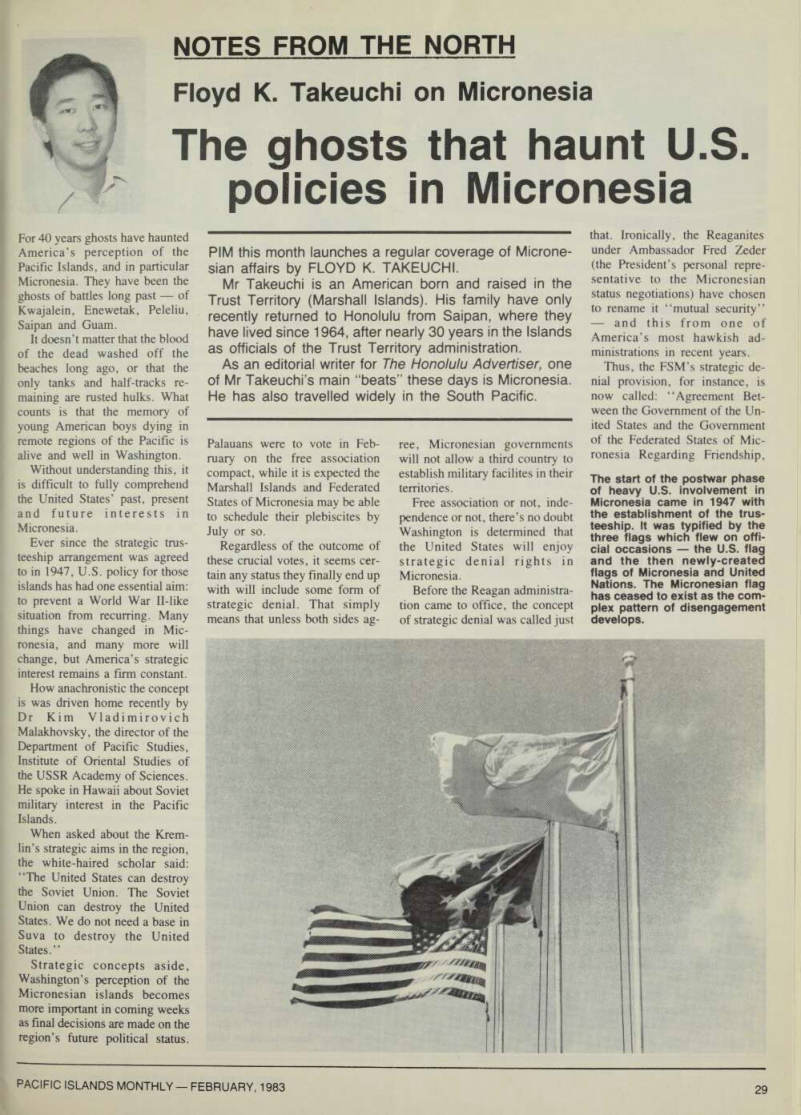
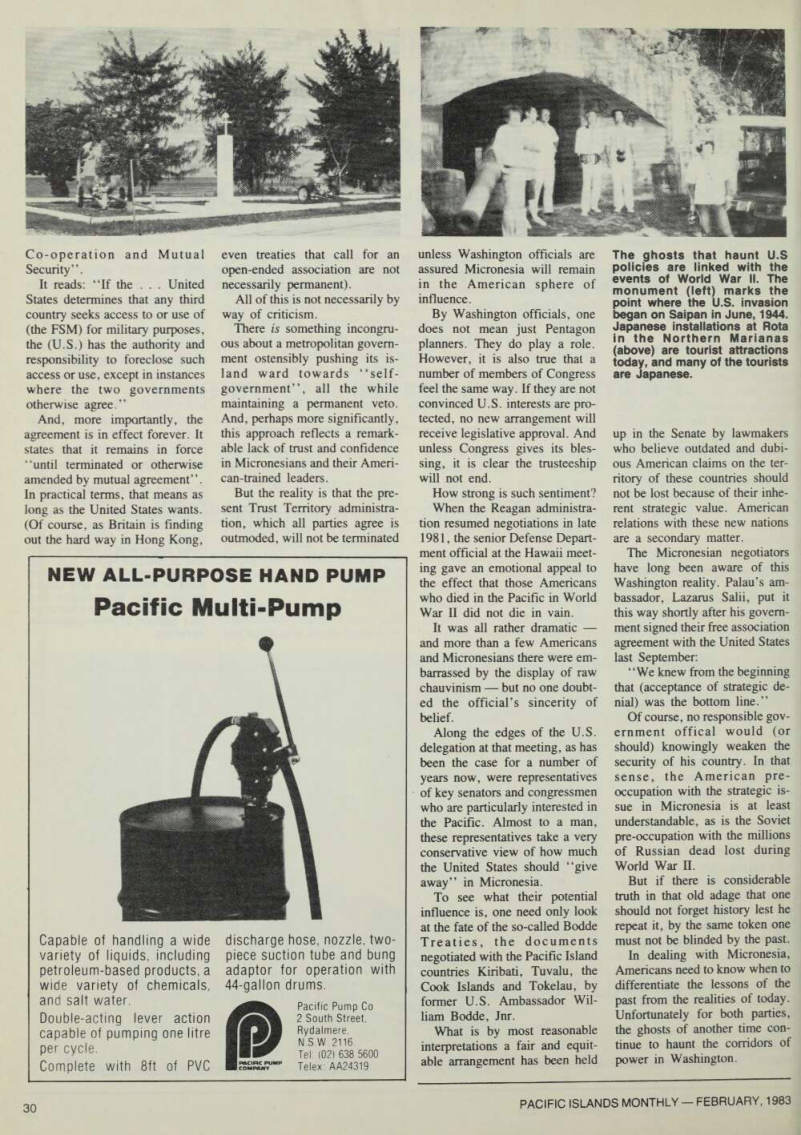
Notes From The North
Floyd K. Takeuchi on Micronesia The ghosts that haunt U.S. policies in Micronesia
For 40 years ghosts have haunted America’s perception of the Pacific Islands, and in particular Micronesia. They have been the ghosts of battles long past of Kwajalein, Enewetak, Peleliu, Saipan and Guam.
It doesn’t matter that the blood of the dead washed off the beaches long ago, or that the only tanks and half-tracks re maining are rusted hulks. What counts is that the memory of young American boys dying in remote regions of the Pacific is alive and well in Washington.
Without understanding this, it is difficult to fully comprehend the United States’ past, present and future interests in Micronesia.
Ever since the strategic trus teeship arrangement was agreed to in 1947, U.S. policy for those islands has had one essential aim; to prevent a World War 11-like situation from recurring. Many things have changed in Mic ronesia, and many more will change, but America’s strategic interest remains a firm constant.
How anachronistic the concept is was driven home recently by Dr Kim Vladimirovich Malakhovsky, the director of the Department of Pacific Studies, Institute of Oriental Studies of the USSR Academy of Sciences.
He spoke in Hawaii about Soviet military interest in the Pacific Islands.
When asked about the Krem lin’s strategic aims in the region, the white-haired scholar said; “The United States can destroy the Soviet Union. The Soviet Union can destroy the United States. We do not need a base in Suva to destroy the United States.”
Strategic concepts aside, Washington’s perception of the Micronesian islands becomes more important in coming weeks as final decisions are made on the region’s future political status.
RIM this month launches a regular coverage of Microne sian affairs by FLOYD K. TAKEUCHI.
Mr Takeuchi is an American born and raised in the Trust Territory (Marshall Islands). His family have only recently returned to Honolulu from Saipan, where they have lived since 1964, after nearly 30 years in the Islands as officials of the Trust Territory administration.
As an editorial writer for The Honolulu Advertiser, one of Mr Takeuchi’s main “beats” these days is Micronesia.
He has also travelled widely in the South Pacific.
Palauans were to vote in Feb ruary on the free association compact, while it is expected the Marshall Islands and Federated States of Micronesia may be able to schedule their plebiscites by July or so.
Regardless of the outcome of these crucial votes, it seems cer tain any status they finally end up with will include some form of strategic denial. That simply means that unless both sides ag
ree, Micronesian governments will not allow a third country to establish military facilites in their territories.
Free association or not, independence or not, there’s no doubt Washington is determined that the United States will enjoy strategic denial rights in Micronesia d Before the Reagan admmistration came to office, the concept of strategic denial was called just
that. Ironically, the Reaganites under Ambassador Fred Zeder (the President’s personal repre sentative to the Micronesian status negotiations) have chosen to rename it “mutual security” and this from one of America’s most hawkish ad ministrations in recent years.
Thus, the FSM’s strategic de nial provision, for instance, is now called: “Agreement Bet ween the Government of the Un ited States and the Government of the Federated States of Mic ronesia Regarding Friendship,
The start of the postwar phase of heavy U.S. involvement in Micronesia came in 1947 with the establishment of the trus
teeship. It was typified by the
three flags which flew on offi cial occasions the U.S. flag and the then newly-created flags of Micronesia and United Nations. The Micronesian flag has ceased to exist as the com plex pattern of disengagement
develops.
Co-operation and Mutual Security’’.
It reads: “If the ... United States determines that any third country seeks access to or use of (the FSM) for military purposes, the (U.S.) has the authority and responsibility to foreclose such access or use, except in instances where the two governments otherwise agree.’’
And, more importantly, the agreement is in effect forever. It states that it remains in force “until terminated or otherwise amended by mutual agreement”.
In practical terms, that means as long as the United States wants. (Of course, as Britain is finding out the hard way in Hong Kong,
even treaties that call for an open-ended association are not necessarily permanent).
All of this is not necessarily by way of criticism.
There is something incongru ous about a metropolitan govern ment ostensibly pushing its is land ward towards “self government”, all the while maintaining a permanent veto.
And, perhaps more significantly, this approach reflects a remark able lack of trust and confidence in Micronesians and their Ameri can-trained leaders.
But the reality is that the pre sent Trust Territory administra tion, which all parties agree is outmoded, will not be terminated
unless Washington officials are assured Micronesia will remain in the American sphere of influence.
By Washington officials, one does not mean just Pentagon planners. They do play a role.
However, it is also true that a number of members of Congress feel the same way. If they are not convinced U.S. interests are pro tected, no new arrangement will receive legislative approval. And unless Congress gives its bles sing, it is clear the trusteeship will not end.
How strong is such sentiment?
When the Reagan administra tion resumed negotiations in late 1981, the senior Defense Depart ment official at the Hawaii meet ing gave an emotional appeal to the effect that those Americans who died in the Pacific in World War II did not die in vain.
It was all rather dramatic and more than a few Americans and Micronesians there were em barrassed by the display of raw chauvinism but no one doubt ed the official’s sincerity of belief.
Along the edges of the U.S. delegation at that meeting, as has been the case for a number of years now, were representatives of key senators and congressmen who are particularly interested in the Pacific. Almost to a man, these representatives take a very conservative view of how much the United States should “give away’’ in Micronesia.
To see what their potential influence is, one need only look at the fate of the so-called Bodde Treaties, the documents negotiated with the Pacific Island countries Kiribati, Tuvalu, the Cook Islands and Tokelau, by former U.S. Ambassador Wil liam Bodde, Jnr.
What is by most reasonable interpretations a fair and equit able arrangement has been held
up in the Senate by lawmakers who believe outdated and dubi ous American claims on the ter ritory of these countries should not be lost because of their inhe rent strategic value. American relations with these new nations are a secondary matter.
The Micronesian negotiators have long been aware of this Washington reality. Palau’s am bassador, Lazarus Salii, put it this way shortly after his govern ment signed their free association agreement with the United States last September: “We knew from the beginning that (acceptance of strategic de nial) was the bottom line.’’
Of course, no responsible gov ernment offical would (or should) knowingly weaken the security of his country. In that sense, the American pre occupation with the strategic is sue in Micronesia is at least understandable, as is the Soviet pre-occupation with the millions of Russian dead lost during World War D.
But if there is considerable truth in that old adage that one should not forget history lest he repeat it, by the same token one must not be blinded by the past.
In dealing with Micronesia, Americans need to know when to differentiate the lessons of the past from the realities of today.
Unfortunately for both parties, the ghosts of another time con tinue to haunt the corridors of power in Washington.
The ghosts that haunt U.S policies are linked with the events of World War II. The monument (left) marks the point where the U.S. invasion began on Saipan in June, 1944.
Japanese installations at Rota in the Northern Marianas (above) are tourist attractions today, and many of the tourists are Japanese.
Advertisements & other items, pp. 30-31 (2 items)
Pacific Multi-Pump
NEW ALL-PURPOSE HAND PUMP
Capable of handling a wide variety of liquids, including petroleum-based products, a wide variety of chemicals, and salt water.
Double-acting lever action capable of pumping one litre per cycle.
Complete with Bft of PVC discharge hose, nozzle, twopiece suction tube and bung adaptor for operation with 44-gallon drums.
Pacific Pump Co 2 South Street.
Rydalmere.
NSW 2116
Tel: (02) 638 5600 Telex: AA24319
From the
ISLANDS
PRESS
From the Flotsam & Jetsam column in The Fiji Times Scientists in the U.S. say endangered giant leatherback sea tur tles are killing themselves by eating discarded plastic bags they mistake for jellyfish. They say autopsies of leatherbacks have revealed stomachs and intestines blocked by plastic sandwich bags, potato chip bags, garbage bags and other plastic items.
“Overtaxed”, Port Moresby, complains in a letter to the Papua New Guinea Post-Courer, Port Moresby, about Primary Industry Minister Young’s suggestion to tax money sent out of the country by expatriates.
I am already taxed heavily, and now Mr Young wants to tax me again on my savings. Robin Hood was a gentleman compared to Mr Young. The corruption and mismanagement within the Gov ernment departments would be envied by Idi Amin. The police and its fight against crime is non-existent. The frustration of trying to train National citizens who only wish to get drunk or go back to the village is unbelievable.
From “Among Other Things” in the Marshall Islands Journal by columnist Akio Heine on hopes for the new year.
We hope that in the upcoming referendum on the Compact of Free Association in the Marshall Islands our good friend and neighbor to the south the Republic of Nauru will this time keep its claws off lending loans to any factions in this republic as it did the last time around. It is important that no one buys votes.
And along those same lines, we wish such powerful United States Intelligence agencies like CIA and DIA will keep their mostly dirty fingers off from this referendum as well.
From Radio Vanuatu’s local news bulletins The Prime Minister has issued a statement against violence in Government offices. In a press release, Fr Walter Lini stated that disagreements between certain Senior Government Officials have developed into scenes of physical violence. The release says such deplorable occurrences will not be tolerated by his government. The Prime Minister’s statement says this is a law abiding community in which proper channels exist for resolving disputes and disagreements. All officials are herby advised to settle their differences in a rational, civilised and proper manner, the statement ends. It is believed the Prime Minster’s warning was issued after an incident last week in Port-Vila involving officials in the Department of Health. Physical violence is be lieved to have taken place between high ranking officials of the department.
From a letter in the Tohi Tala Niue commenting on a report that the Niue Government will be a sponsor of a Cultural and Miss Niue contest at Niue Hotel.
The promotion of Cultural values is a very good idea which I fully support wholeheartedly and the Government should sponsor it. But what has the Government to do with a Beauty Queen?
What benefit can people get from a Beauty contest in that the Government co-sponsor it? Is Beauty Contest part of the Niue Culture? Where else in the world Government co-sponsor Beauty Queens? Editor, Beauty contest I believe are sponsored by pri vate organisations, therefore I greatly protest in the Government co-sponsoring or playing a part on such outrageous event,
“Beauty Contest”. The Government should sponsor something useful for the well-being of its diminishing population and other problems of the day, not Beauty Queen Contest.
“Why the discrimination?” asks a letter writer in the Papua New Guinea Post-Courier, Port Moresby.
Lately, there has been some unfavorable comment on the in flux of Asians and Asian businessmen into PNG. It is under standable enough if only for the economic good of the country.
But why the discrimination? PNG is infested with whites also.
There are whites involved in private business, whites employed by the Government and whites employed by the private sector.
Asians are generally a clean and industrious race. An all-white expatriate population in PNG would not be a good thing. It is not a good thing to get drunk and act loud and aggressive after one beer too many. Nor is it a good thing to show animosity towards Asians.
From the Marshall Islands Journal The Assumption Nativity Play we went to see today sure was better than some of the Kung Fu—Karate—Judo movies we’ve been to . . . Incidentally, Infant Jesus, who was supposed to be played by Thomas R. Samuel was unavailable for the day-time show so we unfortunately couldn’t see him. But no problem because Mary and the others were there at the Inn.
Reported in Te Uekeraa, Kiribati A man is now recovering in the Betio hospital after being bitten by a shark on Saturday . . . Medical authorites in Betio said the incident occurred when a big shark struck the canoe as the two (men) were hauling their net. Maeke fell off the outrigger and the shark attacked him. Maeke managed to kill the shark but had to be admitted to hospital for a wound treatment in the left leg. The shark measured 12 feet.
A comment on the possible closure of the local radio station reported in Marianas Variety News & Views, Saipan.
They should not close WSZE because it’s good for announce ments, like when someone dies you can go there and announce it.
An editorial comment in The Fiji Times entitled “Women on the Bench”.
There are or there will be shortly vacancies on the Sup reme Court Bench. We urge the Judicial and Legal Services Commission to seriously consider appointing a woman judge, to be recruited either locally if a suitably qualified woman is avail able, or from abroad. We also urge the commission to appoint a few women magistrates. We have expressed reservations in this column previously about the sentencing policies of the courts in cases of rape, particularly child rape, and other similar offences against women. Only a woman can truly appreciate the violent trauma inflicted on another by such horrendous crimes and the indelible stigma they leave behind.
From an article on the work of the Liang Island Re search Centre, in Madang Province, published in The Times of PNG.
Contrary to popular belief, a giant clam will not cut off your leg if you accidentally step into its open jaws. Again, its first reac tion is to close partially and hold onto the foot snugly. The serrated clam edges do not close completely shut and cut off the foot. In order to tighten its grip, the clam must go through three stages of expelling water from its innards and collapsing its single giant muscle. Just leaving the foot quiet for several mi nutes if you have enough air to remain under water that long will entice the clam to relax its grip.
A caption to a photograph illustrating an article on the opening of Lae airport in the Marshall Islands, reported in the Marshall Islands Journal.
Paul Ishoda of Resources & Development, Senator Jollie Lojikar, and Senator Ataji Balos are greeted with flowers and a song.
The flowers were plastic because Typhoon Pamela blew away all the real ones.
budget debate
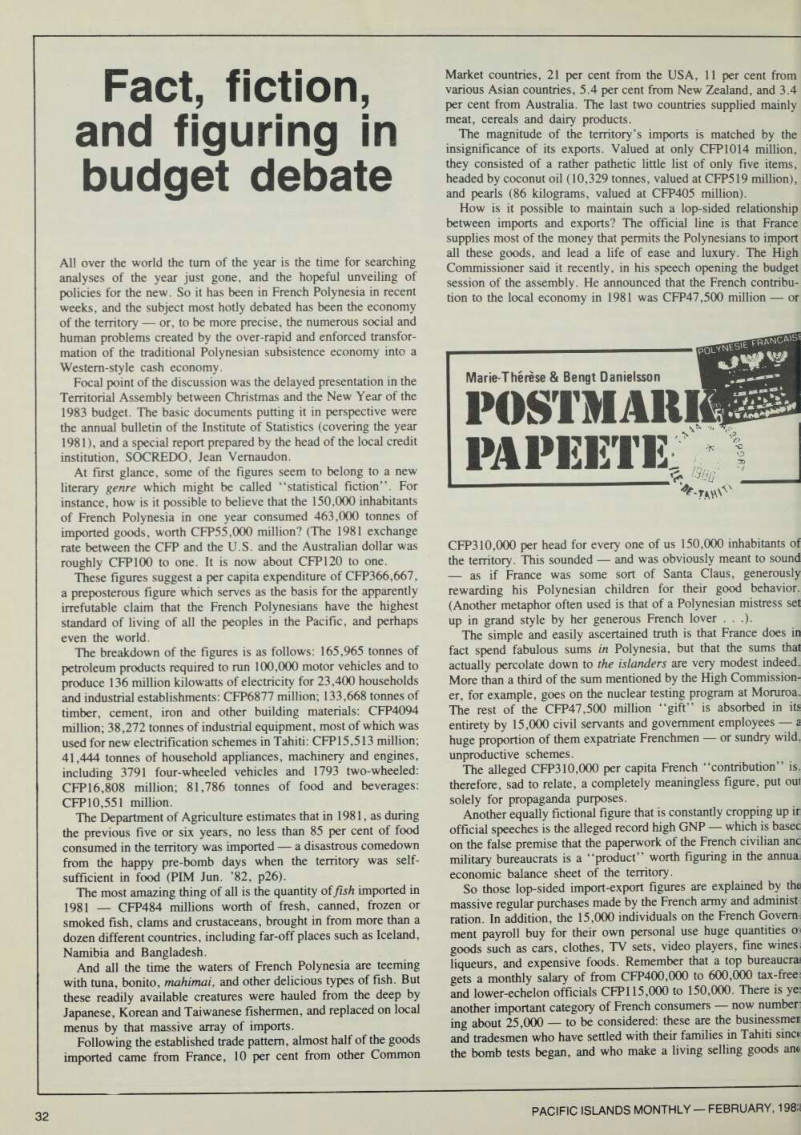
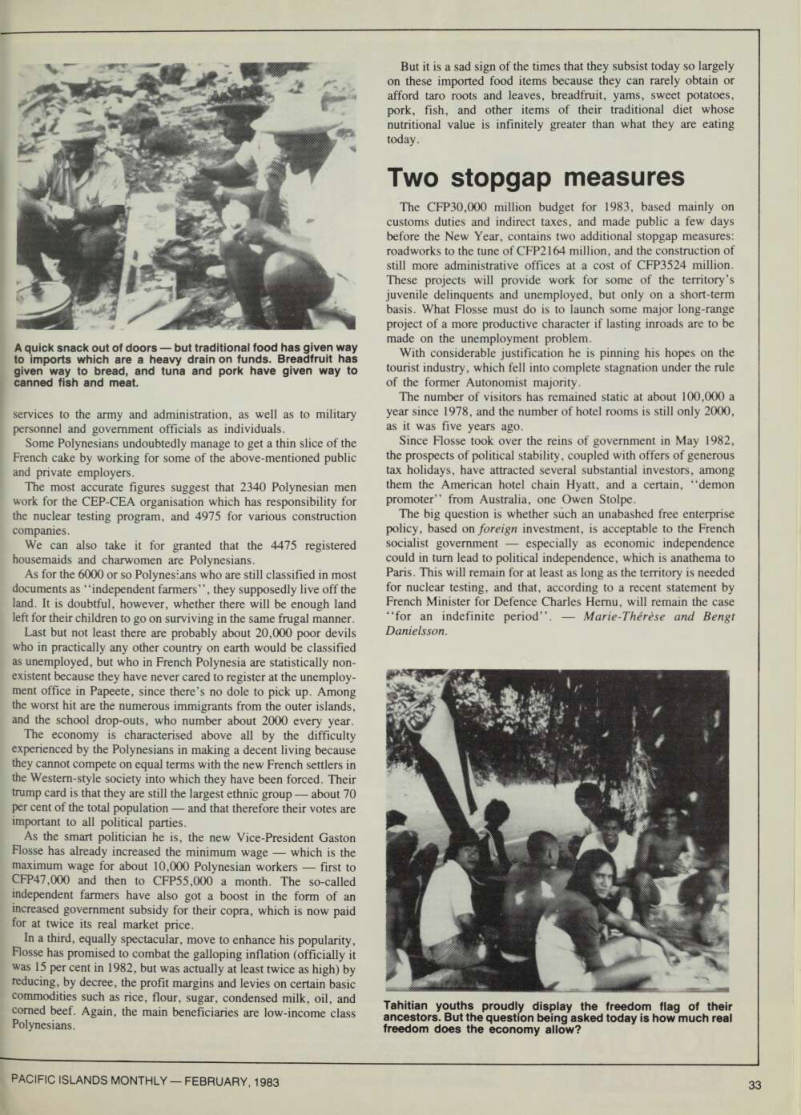
Fact, fiction, and figuring in budget debate
All over the world the turn of the year is the time for searching analyses of the year just gone, and the hopeful unveiling of policies for the new. So it has been in French Polynesia in recent weeks, and the subject most hotly debated has been the economy of the territory or, to be more precise, the numerous social and human problems created by the over-rapid and enforced transfor mation of the traditional Polynesian subsistence economy into a Western-style cash economy.
Focal point of the discussion was the delayed presentation in the Territorial Assembly between Christmas and the New Year of the 1983 budget. The basic documents putting it in perspective were the annual bulletin of the Institute of Statistics (covering the year 1981), and a special report prepared by the head of the local credit institution, SOCREDO, Jean Vemaudon.
At first glance, some of the figures seem to belong to a new literary genre which might be called “statistical fiction”. For instance, how is it possible to believe that the 150,000 inhabitants of French Polynesia in one year consumed 463,000 tonnes of imported goods, worth CFP55,000 million? (The 1981 exchange rate between the CFP and the U.S. and the Australian dollar was roughly CFP 100 to one. It is now about CFP 120 to one.
These figures suggest a per capita expenditure of CFP366,667, a preposterous figure which serves as the basis for the apparently irrefutable claim that the French Polynesians have the highest standard of living of all the peoples in the Pacific, and perhaps even the world.
The breakdown of the figures is as follows; 165,965 tonnes of petroleum products required to run 100,000 motor vehicles and to produce 136 million kilowatts of electricity for 23,400 households and industrial establishments: CFP6B77 million; 133,668 tonnes of timber, cement, iron and other building materials: CFP4O94 million; 38,272 tonnes of industrial equipment, most of which was used for new electrification schemes in Tahiti; CFP15,513 million; 41,444 tonnes of household appliances, machinery and engines, including 3791 four-wheeled vehicles and 1793 two-wheeled: CFPI6,BOB million; 81,786 tonnes of food and beverages: CFP10,551 million.
The Department of Agriculture estimates that in 1981, as during the previous five or six years, no less than 85 per cent of food consumed in the territory was imported a disastrous comedown from the happy pre-bomb days when the territory was self sufficient in food (PIM Jun. ’B2, p 26).
The most amazing thing of all is the quantity of fish imported in 1981 CFP4B4 millions worth of fresh, canned, frozen or smoked fish, clams and crustaceans, brought in from more than a dozen different countries, including far-off places such as Iceland, Namibia and Bangladesh.
And all the time the waters of French Polynesia are teeming with tuna, bonito, mahimai, and other delicious types of fish. But these readily available creatures were hauled from the deep by Japanese, Korean and Taiwanese fishermen, and replaced on local menus by that massive array of imports.
Following the established trade pattern, almost half of the goods imported came from France, 10 per cent from other Common
Market countries, 21 per cent from the USA, 11 per cent from various Asian countries, 5.4 per cent from New Zealand, and 3.4 per cent from Australia. The last two countries supplied mainly meat, cereals and dairy products.
The magnitude of the territory’s imports is matched by the insignificance of its exports. Valued at only CFPIOI4 million, they consisted of a rather pathetic little list of only five items, headed by coconut oil (10,329 tonnes, valued at CFPSI9 million), and pearls (86 kilograms, valued at CFP4OS million).
How is it possible to maintain such a lop-sided relationship between imports and exports? The official line is that France supplies most of the money that permits the Polynesians to import all these goods, and lead a life of ease and luxury. The High Commissioner said it recently, in his speech opening the budget session of the assembly. He announced that the French contribu tion to the local economy in 1981 was CFP47,500 million or
CFP3IO,OOO per head for every one of us 150,000 inhabitants of the territory. This sounded and was obviously meant to sound as if France was some sort of Santa Claus, generously rewarding his Polynesian children for their good behavior. (Another metaphor often used is that of a Polynesian mistress set up in grand style by her generous French lover . . .).
The simple and easily ascertained truth is that France does in fact spend fabulous sums in Polynesia, but that the sums that actually percolate down to the islanders are very modest indeed., More than a third of the sum mentioned by the High Commission er, for example, goes on the nuclear testing program at Moruroa.
The rest of the CFP47,500 million “gift” is absorbed in its entirety by 15,000 civil servants and government employees a huge proportion of them expatriate Frenchmen or sundry wild, unproductive schemes.
The alleged CFP3IO,OOO per capita French “contribution” is, therefore, sad to relate, a completely meaningless figure, put out solely for propaganda purposes.
Another equally fictional figure that is constantly cropping up in official speeches is the alleged record high GNP which is basec on the false premise that the paperwork of the French civilian anc military bureaucrats is a “product” worth figuring in the annuaj economic balance sheet of the territory.
So those lop-sided import-export figures are explained by the massive regular purchases made by the French army and administ ration. In addition, the 15,000 individuals on the French Governi ment payroll buy for their own personal use huge quantities o:< goods such as cars, clothes, TV sets, video players, fine wines; liqueurs, and expensive foods. Remember that a top bureaucrai gets a monthly salary of from CFP4OO,OOO to 600,000 tax-free; and lower-echelon officials CFPIIS,OOO to 150,000. There is ye: another important category of French consumers now numben ing about 25,000 to be considered: these are the businessmen and tradesmen who have settled with their families in Tahiti sine* the bomb tests began, and who make a living selling goods ano
services to the army and administration, as well as to military personnel and government officials as individuals.
Some Polynesians undoubtedly manage to get a thin slice of the French cake by working for some of the above-mentioned public and private employers.
The most accurate figures suggest that 2340 Polynesian men work for the CEP-CEA organisation which has responsibility for the nuclear testing program, and 4975 for various construction companies.
We can also take it for granted that the 4475 registered housemaids and charwomen are Polynesians.
As for the 6000 or so Polynesians who are still classified in most documents as “independent farmers’’, they supposedly live off the land. It is doubtful, however, whether there will be enough land left for their children to go on surviving in the same frugal manner.
Last but not least there are probably about 20,000 poor devils who in practically any other country on earth would be classified as unemployed, but who in French Polynesia are statistically non existent because they have never cared to register at the unemploy ment office in Papeete, since there’s no dole to pick up. Among the worst hit are the numerous immigrants from the outer islands, and the school drop-outs, who number about 2000 every year.
The economy is characterised above all by the difficulty experienced by the Polynesians in making a decent living because they cannot compete on equal terms with the new French settlers in the Western-style society into which they have been forced. Their trump card is that they are still the largest ethnic group about 70 per cent of the total population and that therefore their votes are important to all political parties.
As the smart politician he is, the new Vice-President Gaston Flosse has already increased the minimum wage which is the maximum wage for about 10,000 Polynesian workers first to CFP47,000 and then to CFP55,000 a month. The so-called independent farmers have also got a boost in the form of an increased government subsidy for their copra, which is now paid for at twice its real market price.
In a third, equally spectacular, move to enhance his popularity, Flosse has promised to combat the galloping inflation (officially it was 15 per cent in 1982, but was actually at least twice as high) by reducing, by decree, the profit margins and levies on certain basic commodities such as rice, flour, sugar, condensed milk, oil, and corned beef. Again, the main beneficiaries are low-income class Polynesians.
But it is a sad sign of the times that they subsist today so largely on these imported food items because they can rarely obtain or afford taro roots and leaves, breadfruit, yams, sweet potatoes, pork, fish, and other items of their traditional diet whose nutritional value is infinitely greater than what they are eating today.
Two stopgap measures
The CFP3O,OOO million budget for 1983, based mainly on customs duties and indirect taxes, and made public a few days before the New Year, contains two additional stopgap measures: roadworks to the tune of CFP2I64 million, and the construction of still more administrative offices at a cost of CFP3524 million.
These projects will provide work for some of the territory’s juvenile delinquents and unemployed, but only on a short-term basis. What Flosse must do is to launch some major long-range project of a more productive character if lasting inroads are to be made on the unemployment problem.
With considerable justification he is pinning his hopes on the tourist industry, which fell into complete stagnation under the rule of the former Autonomist majority.
The number of visitors has remained static at about 100,000 a year since 1978, and the number of hotel rooms is still only 2000, as it was five years ago.
Since Flosse took over the reins of government in May 1982, the prospects of political stability, coupled with offers of generous tax holidays, have attracted several substantial investors, among them the American hotel chain Hyatt, and a certain, “demon promoter’’ from Australia, one Owen Stolpe.
The big question is whether such an unabashed free enterprise policy, based on foreign investment, is acceptable to the French socialist government especially as economic independence could in turn lead to political independence, which is anathema to Paris. This will remain for at least as long as the territory is needed for nuclear testing, and that, according to a recent statement by French Minister for Defence Charles Hemu, will remain the case
“for an indefinite period’’.
Marie-Thérèse and Bengt
Daniels son.
A quick snack out of doors but traditional food has given way to imports which are a heavy drain on funds. Breadfruit has given way to bread, and tuna and pork have given way to canned fish and meat.
Tahitian youths proudly display the freedom flag of their ancestors. But the question being asked today is how much real freedom does the economy allow?
Advertisements & other items, pp. 34-35 (1 item)
Toyota
LAND CRUISER
STATION WAGON
LAND CRUISER
PICK UP
HI ACE
m 13 wm
TOYOTA
PAPUA NEW GUINEA: ELA MOTORS, (SOUTHSEA) CO.. LTD., P.O. Box 129, Pago Pa<f Scratchley Rd„ Badili, P.O. Box 675, Port Moresby WESTERN SAMOA. BURNS PHILP (SOUTHSEA 0
SERVICE
NORTHERN MARIANAS & U.S.T.T.:
MICROL CORPORATION, P.O. Box 267, Saipan.
FIJI: AUTOMOTIVE SUPPLIES COMPANY, G.P.O.
Box 355, Suva.
AMERICAN SAMOA; BURNS PHILP
CO., LTD., P.O. Box 188, Apia.
TONGA; BURNS PHILP (SOUTHSEA) CO., LTD.,
P.O. Box 55, Nuku’alofa.
GUAM: ATKINS. KROLL (GUAM) LTD., P.O. Box : Tamuning.
DYNA
ES\
HI-LUX
DOUBLE CAB
m WU uu Is
OVNA
TRUCK
HEAVY DUTY
jTX •- •; i 0
THE TOYOTA ROA
READY TO TAKE
ON THE TOUGHEST JOBS
Meet Toyota’s hard working commercial vehicles.
Tough. Durable. Ready to meet the challenge of the worst roads and climates. Ready to do the job called for with ease.
Rugged veterans, each one specifically designed to meet the different demands of the world’s businesses.
One of them is just right for you.
There are no vehicles more reliable. And if you need it, Toyota is ready with fast backup servi
Toyota’s roadmasters, they’re a
'ANUATU: VANUATU MOTORS P.O. Box 18, Port Vila. KIRIBATI: TARAWA MOTORS, Box 36 Bairiki 111 rillAkl. UrKinAKI A riLiTrnnrM/M-rt , . . .—. * Tarawa. Kiribati.
NORFOLK ISLAND: BORRY’S RENTAL CARS,
MOUNT PITT (ENTERPRISES) LTD., P.O. Box 169.
NEW CALEDONIA: SERVICE IMPORTATION
AUTOMOBILE DU PACIFIQUE, Rond-Point
du Pacifique (Station Total) B.P. 438, Noumea.
The Toyota range includes .
COROLLA, STARLET. CORONA, CRESSIDA, HI-LUX
STOUT, HI ACE. DYNA, COASTER and LAND CRUISER
People
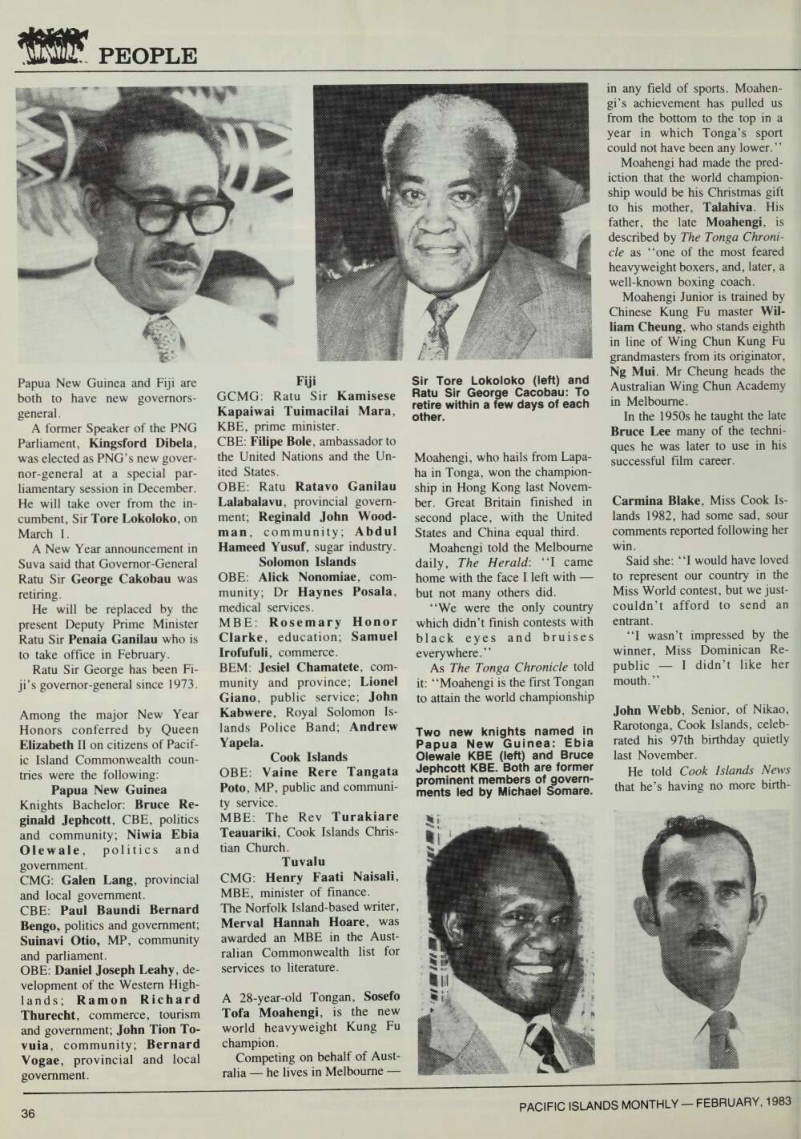
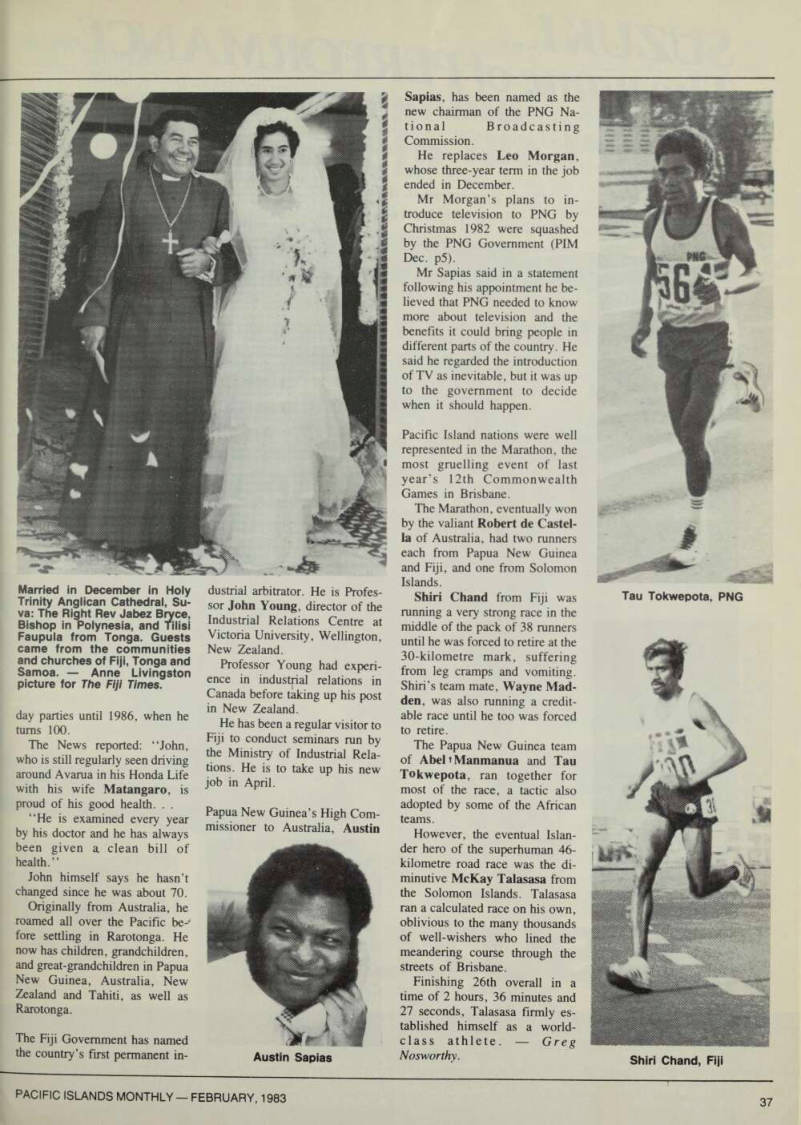
Papua New Guinea and Fiji are both to have new govemors general.
A former Speaker of the PNG Parliament, Kingsford Dibela, was elected as PNG’s new gover nor-general at a special par liamentary session in December.
He will take over from the in cumbent, Sir Tore Lokoloko, on March 1.
A New Year announcement in Suva said that Governor-General Ratu Sir George Cakobau was retiring.
He will be replaced by the present Deputy Prime Minister Ratu Sir Penaia Ganilau who is to take office in February.
Ratu Sir George has been Fi ji’s governor-general since 1973.
Among the major New Year Honors conferred by Queen Elizabeth II on citizens of Pacif ic Island Commonwealth coun tries were the following: Papua New Guinea Knights Bachelor: Bruce Re ginald Jephcott, CBE, politics and community; Niwia Ebia Olewale, politics and government.
CMG: Galen Lang, provincial and local government.
CBE: Paul Baundi Bernard Bengo, politics and government; Suinavi Otio, MP, community and parliament.
OBE: Daniel Joseph Leahy, de velopment of the Western High lands; Ramon Richard Thurecht, commerce, tourism and government; John Tion To vuia, community; Bernard Vogae, provincial and local government.
Fiji GCMG; Ratu Sir Kamisese Kapaiwai Tuimacilai Mara, KBE, prime minister.
CBE: Filipe Bole, ambassador to the United Nations and the Un ited States.
OBE: Ratu Ratavo Ganilau Lalabalavu, provincial govern ment; Reginald John Wood man, community; Abdul Hameed Yusuf, sugar industry.
Solomon Islands OBE: Alick Nonomiae, com munity; Dr Haynes Posala, medical services.
MBE: Rosemary Honor Clarke, education; Samuel Irofufuli, commerce.
BEM: Jesiel Chamatete, com munity and province; Lionel Giano, public service; John Kabwere, Royal Solomon Is lands Police Band; Andrew Yapela.
Cook Islands OBE: Vaine Rere Tangata Poto, MP, public and communi ty service.
MBE; The Rev Turakiare Teauariki, Cook Islands Chris tian Church.
Tuvalu CMG: Henry Faati Naisali, MBE, minister of finance.
The Norfolk Island-based writer, Merval Hannah Hoare, was awarded an MBE in the Aust ralian Commonwealth list for services to literature.
A 28-year-old Tongan, Sosefo Tofa Moahengi, is the new world heavyweight Kung Fu champion.
Competing on behalf of Aust ralia he lives in Melbourne
Moahengi, who hails from Lapa ha in Tonga, won the champion ship in Hong Kong last Novem ber. Great Britain finished in second place, with the United States and China equal third.
Moahengi told the Melbourne daily. The Herald : “I came home with the face I left with but not many others did.
“We were the only country which didn’t finish contests with black eyes and bruises everywhere.”
As The Tonga Chronicle told it: “Moahengi is the first Tongan to attain the world championship
in any field of sports. Moahen gi’s achievement has pulled us from the bottom to the top in a year in which Tonga’s sport could not have been any lower. ’ ’
Moahengi had made the pred iction that the world champion ship would be his Christmas gift to his mother, Talahiva. His father, the late Moahengi, is described by The Tonga Chroni cle as “one of the most feared heavyweight boxers, and, later, a well-known boxing coach.
Moahengi Junior is trained by Chinese Kung Fu master Wil liam Cheung, who stands eighth in line of Wing Chun Kung Fu
grandmasters from its originator,
Ng Mui. Mr Cheung heads the Australian Wing Chun Academy in Melbourne.
In the 1950 s he taught the late Bruce Lee many of the techni ques he was later to use in his successful film career.
Carmina Blake, Miss Cook Is lands 1982, had some sad, sour
comments reported following her
win.
Said she: “I would have loved to represent our country in the Miss World contest, but we just couldn’t afford to send an entrant.
“I wasn’t impressed by the winner, Miss Dominican Re public I didn’t like her mouth.”
John Webb, Senior, of Nikao, Rarotonga, Cook Islands, celeb rated his 97th birthday quietly last November.
He told Cook Islands News that he’s having no more birth-
Sir Tore Lokoloko (left) and Ratu Sir George Cacobau: To retire within a few days of each other.
Two new knights named in Papua New Guinea: Ebia Olewale KBE (left) and Bruce Jephcott KBE. Both are former prominent members of govern ments led by Michael Somare.
dustrial arbitrator. He is Profes sor John Young, director of the Industrial Relations Centre at Victoria University, Wellington, New Zealand.
Professor Young had experi ence in industrial relations in Canada before taking up his post in New Zealand.
He has been a regular visitor to Fiji to conduct seminars run by the Ministry of Industrial Rela tions. He is to take up his new job in April.
Papua New Guinea’s High Com missioner to Australia, Austin
day parties until 1986, when he turns 100.
The News reported; “John, who is still regularly seen driving around Avarua in his Honda Life with his wife Matangaro, is proud of his good health. . .
“He is examined every year by his doctor and he has always been given a clean bill of health.”
John himself says he hasn’t changed since he was about 70.
Originally from Australia, he roamed all over the Pacific be-* fore settling in Rarotonga. He now has children, grandchildren, and great-grandchildren in Papua New Guinea, Australia, New Zealand and Tahiti, as well as
Rarotonga.
The Fiji Government has named the country’s first permanent in-
Sapias, has been named as the new chairman of the PNG Na tional Broadcasting Commission.
He replaces Leo Morgan, whose three-year term in the job ended in December.
Mr Morgan’s plans to in troduce television to PNG by Christmas 1982 were squashed by the PNG Government (PIM Dec. p 5).
Mr Sapias said in a statement following his appointment he be lieved that PNG needed to know more about television and the benefits it could bring people in different parts of the country. He said he regarded the introduction of TV as inevitable, but it was up to the government to decide when it should happen.
Pacific Island nations were well represented in the Marathon, the most gruelling event of last year’s 12th Commonwealth Games in Brisbane.
The Marathon, eventually won by the valiant Robert de Castel la of Australia, had two runners each from Papua New Guinea and Fiji, and one from Solomon Islands.
Shiri Chand from Fiji was running a very strong race in the middle of the pack of 38 runners until he was forced to retire at the 30-kilometre mark, suffering from leg cramps and vomiting.
Shin’s team mate, Wayne Mad den, was also running a credit able race until he too was forced to retire.
The Papua New Guinea team of Abel ’ Manmanua and Tau Tokwepota, ran together for most of the race, a tactic also adopted by some of the African teams.
However, the eventual Islan der hero of the superhuman 46kilometre road race was the di minutive McKay Talasasa from the Solomon Islands. Talasasa ran a calculated race on his own, oblivious to the many thousands of well-wishers who lined the meandering course through the streets of Brisbane.
Finishing 26th overall in a time of 2 hours, 36 minutes and 27 seconds, Talasasa firmly es tablished himself as a world
class athlete.
Greg
Nosworthy.
Married in December In Holy Trinity Anglican Cathedral, Su va: The Right Rev Jabez Bryce, Bishop in Polynesia, and Tilisi Faupula from Tonga. Guests came from the communities and churches of Fiji, Tonga and Samoa. Anne Livingston picture for The Fiji Times.
Austin Sapias
Tau Tokwepota, PNG
Shiri Chand, Fiji
Advertisements & other items, p. 38 (1 item)
ssssss^Si^^ ; xse^
SUZUKI — ppnpORMAKCE
The name of r f** UND performed. ***
SUZUKI prepared autbo Ba<* to your boat and usage. : \1 : :
SUZUKi
RsfficooM |i a 1 MO - J * >
SUZUKI 1
SUZUKI MOTOR CO., LTD. Hamamatsu, Japan SUZUKI GENERATOR SEIBOO lEW ZEALAND SOUTH PACIFIC SUZUKI DISTRIBUTORS LTD. PHONE: 58-599 • PAPUA NEW GUINEA .HISPEED DJESEL RVICE PTY. LTD. PHONE: 42-2679 • FIJI NIRANJANS AUTOPORT LTD. PHONE: 381555 * TAHITI NIPPON AUTOMOTO PHONt 2-98-19 OLOMON SOLOMON ISLAND PHONE: 565 • VANUATU HENRI LEROUX • NEW CALENOONjASTE SUPERCAL PHONE. 272'068 MERIAN SAMOA PACIFIC PRODUCTS, INC. PHONE; 639-9140 • WESTERN SAMOA VATCO LTI> • ISWND INC.
DNE-565-2298 • NIUE BURNS PHILP CO.,LTD. • NAURU EQUIPAC MOTORS PHONE: 4019 • TONGA TONGA EQUIPMENT AP AMBROSE • KOROR BECHESRRAKT. COMPANY PHONE: 338 • TRUK KIOMASA STORE PHONE: 470
First “all-embracing” history
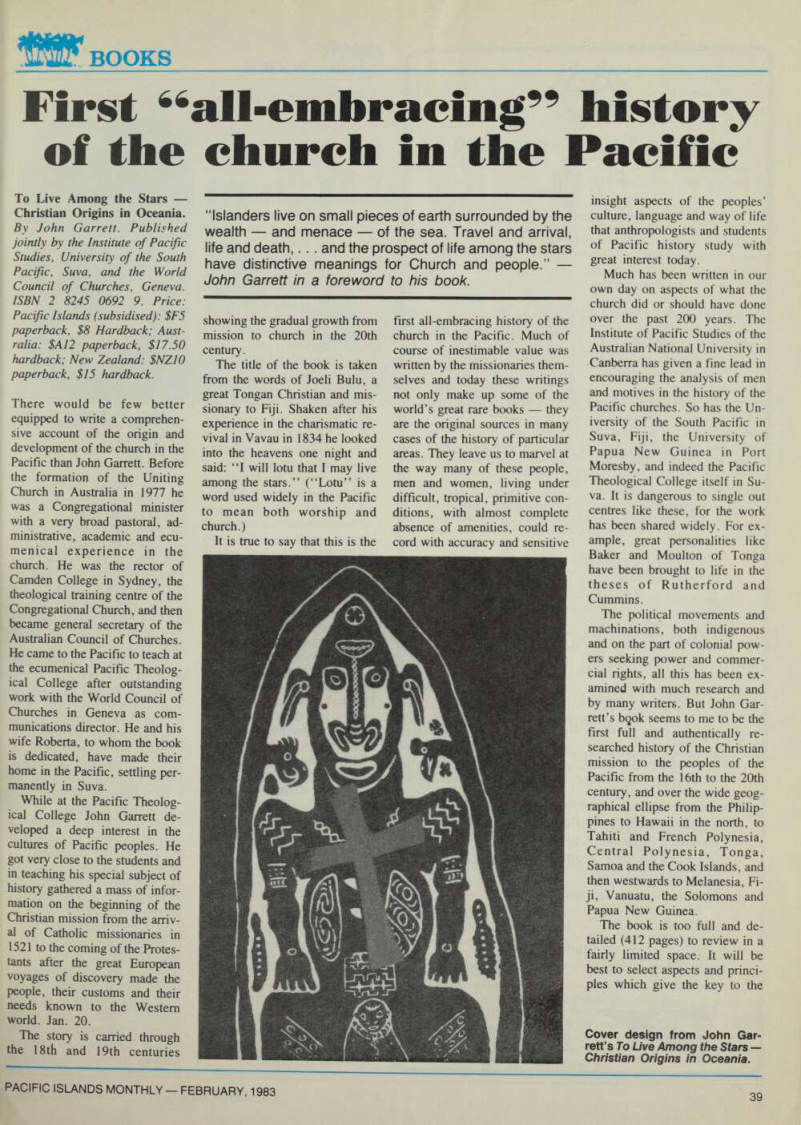
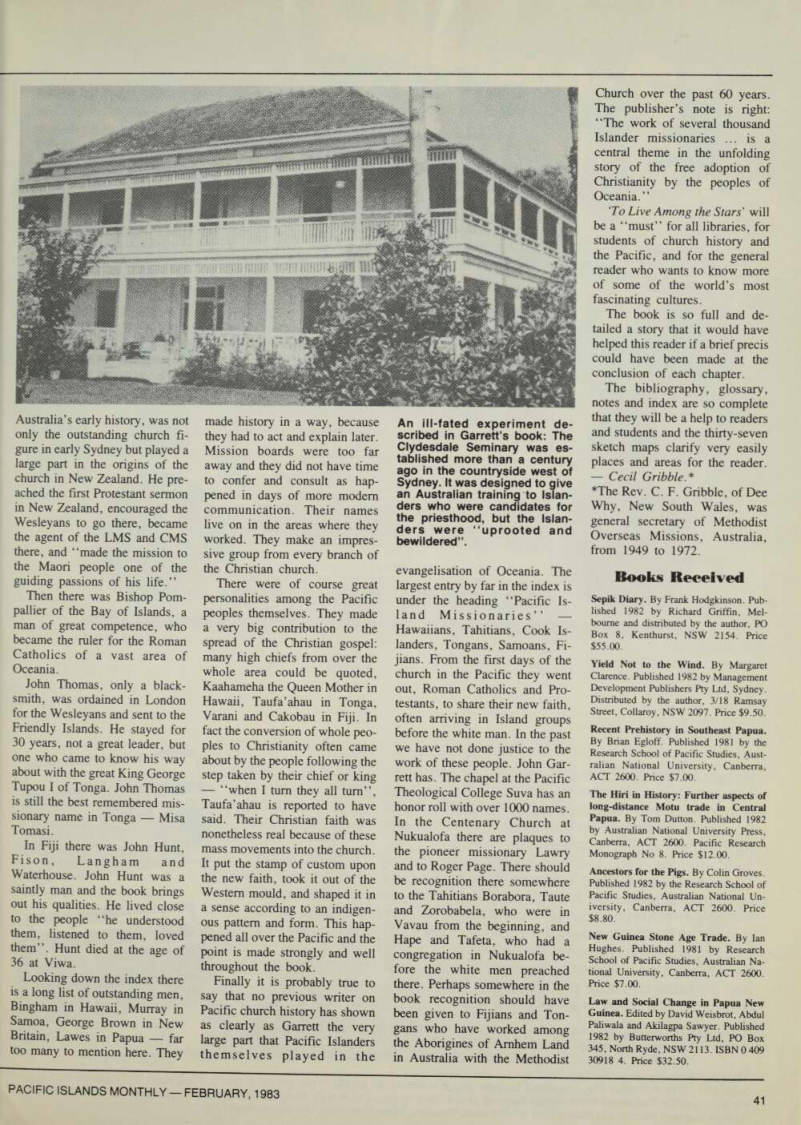
Books
First “all-embracing” history of the church in the Pacific
To Live Among the Stars Christian Origins in Oceania.
By John Garrett. Published jointly by the Institute of Pacific Studies, University of the South Pacific, Suva, and the World Council of Churches, Geneva.
ISBN 2 8245 0692 9. Price: Pacific Islands (subsidised): SFS paperback, $8 Hardback; Aust ralia: SAI2 paperback, $17.50 hardback; New Zealand: SNZIO paperback, $l5 hardback.
There would be few better equipped to write a comprehen sive account of the origin and development of the church in the Pacific than John Garrett. Before the formation of the Uniting Church in Australia in 1977 he was a Congregational minister with a very broad pastoral, ad ministrative, academic and ecu menical experience in the church. He was the rector of Camden College in Sydney, the theological training centre of the Congregational Church, and then became general secretary of the Australian Council of Churches.
He came to the Pacific to teach at the ecumenical Pacific Theolog ical College after outstanding work with the World Council of Churches in Geneva as com munications director. He and his wife Roberta, to whom the book is dedicated, have made their home in the Pacific, settling per manently in Suva.
While at the Pacific Theolog ical College John Garrett de veloped a deep interest in the cultures of Pacific peoples. He got very close to the students and in teaching his special subject of history gathered a mass of infor mation on the beginning of the Christian mission from the arriv al of Catholic missionaries in 1521 to the coming of the Protes tants after the great European voyages of discovery made the people, their customs and their needs known to the Western world. Jan. 20.
The story is carried through the 18th and 19th centuries
“Islanders live on small pieces of earth surrounded by the wealth and menace of the sea. Travel and arrival, life and death,. . . and the prospect of life among the stars have distinctive meanings for Church and people.”
John Garrett in a foreword to his book.
showing the gradual growth from mission to church in the 20th century.
The title of the book is taken from the words of Joeli Bulu, a great Tongan Christian and mis sionary to Fiji. Shaken after his experience in the charismatic re vival in Vavau in 1834 he looked into the heavens one night and said: “I will lotu that I may live among the stars.” (“Lotu” is a word used widely in the Pacific to mean both worship and church.) It is true to say that this is the
first all-embracing history of the church in the Pacific. Much of course of inestimable value was written by the missionaries them selves and today these writings not only make up some of the world’s great rare books they are the original sources in many cases of the history of particular areas. They leave us to marvel at the way many of these people, men and women, living under difficult, tropical, primitive con ditions, with almost complete absence of amenities, could re cord with accuracy and sensitive
insight aspects of the peoples’ culture, language and way of life that anthropologists and students of Pacific history study with great interest today.
Much has been written in our own day on aspects of what the church did or should have done over the past 200 years. The Institute of Pacific Studies of the Australian National University in Canberra has given a fine lead in encouraging the analysis of men and motives in the history of the Pacific churches. So has the Un iversity of the South Pacific in Suva, Fiji, the University of Papua New Guinea in Port Moresby, and indeed the Pacific Theological College itself in Su va. It is dangerous to single out centres like these, for the work has been shared widely. For ex ample, great personalities like Baker and Moulton of Tonga have been brought to life in the theses of Rutherford and Cummins.
The political movements and machinations, both indigenous and on the part of colonial pow ers seeking power and commer cial rights, all this has been ex amined with much research and by many writers. But John Gar rett’s bqok seems to me to be the first full and authentically re searched history of the Christian mission to the peoples of the Pacific from the 16th to the 20th century, and over the wide geog raphical ellipse from the Philip pines to Hawaii in the north, to Tahiti and French Polynesia, Central Polynesia, Tonga, Samoa and the Cook Islands, and then westwards to Melanesia, Fi ji, Vanuatu, the Solomons and Papua New Guinea.
The book is too full and de tailed (412 pages) to review in a fairly limited space. It will be best to select aspects and princi ples which give the key to the
Cover design from John Gar rett’s To Live Among the Stars- Christian Origins in Oceania.
amazing spread of Christian teaching over so wide an area in so short a time. Latourette, perhaps the most outstanding his torian of Christian missions, in his work of seven volumes A History of the Expansion of Christianity claims that the 19th century saw the most explosive and rapid coming of people into Christianity that had happened since the first century. John Gar rett gives some definite clues as to how this happened in Oceania.
These are: (1) the results of the evangelical movements in the churches of Europe and America; (2) the outstanding personalities that seemed to be called and ready to undertake the leadership of the Pacific churches; and (3), perhaps the most salient reason of all for the wide sweep of mission across the Pacific, the willingness and quality of Pacific Islanders themselves to be mis sionaries to their own Polynesian and Melanesian kinsmen and wo men over the whole area.
The missionary societies in England sprang up in the main out of the Evangelical revival that swept over the English churches in the 18th and early 19th centuries. Within practical ly a decade the London Missio nary Society, the Church Missio nary Society, Wesleyan and Bap tist societies were formed. The conviction of sin and evil in the heart of man was deep and wide.
Men and women’s own experi ence of Salvation and Christ made them sure of a gospel that could raise mankind the world over from the deepest depth. So Charles Wesley’s hymns echoed his brother John’s evangelical preaching and global certainty.
Thy undistinguishing regard Was cast on Adam’s fallen race, For all Thou hast in Christ prepared Sufficient sovereign saving grace.
The journals of Cook and other explorers of the Pacific told of the primitive nature of whole communities of men and women and the churches through the mission societies of the time felt the need to go out, as Niel Gunson wrote, as “Messengers of Grace”. Throughout the book we see this as the underlying motive of the expansion.
From America too came the men with the same evangelical zeal to Hawaii whose revival in the mission of 1837 was ascribed to “fervent preaching by rugged new missionaries whose own flagging faith had been fired be fore they came to Hawaii in the searing frontier evangelism of America’s north-eastern ‘burned over district’ centred in upper New York State”.
There were of course many other motives at work in the Pacific: besides the fight for men and women’s souls there was the fight for colonial expan sion and the struggle for denomi national precedence. In these days of ecumenical understand ing it is strange to read of the bitter relationship of Protestants and Roman Catholics in the Pacific area over a century of time. It is stranger still to read of the conflicts of Protestants; Methodists and LMS in Samoa, and even between leaders of the same church, Baker and Moulton in Tonga, Lawry and Leigh in New Zealand. Situations which make some of us ashamed today John Garrett has recorded with sensitivity and understanding.
The second important thread running through the book is the towering nature of some of the players in the whole scene, both Roman Catholic and Protestant.
Marsden, the enigmatic figure of
John Garrett: Minister of relig ion, writer and a former com munications director for the World Council of Churches. He lives in Fiji.
Australia’s early history, was not only the outstanding church figure in early Sydney but played a large part in the origins of the church in New Zealand. He preached the first Protestant sermon in New Zealand, encouraged the Wesleyans to go there, became the agent of the LMS and CMS there, and “made the mission to the Maori people one of the guiding passions of his life.”
Then there was Bishop Pompallier of the Bay of Islands, a man of great competence, who became the ruler for the Roman Catholics of a vast area of John Thomas, only a blacksmith, was ordained in London for the Wesleyans and sent to the Friendly Islands. He stayed for 30 years, not a great leader, but one who came to know his way about with the great King George Tupou I of Tonga. John Thomas is still the best remembered missionary name in Tonga Misa Tomasi.
In Fiji there was John Hunt, Fison, Langham and Waterhouse. John Hunt was a saintly man and the book brings out his qualities. He lived close to the people “he understood listened to them, loved them Hunt died at the age of 36 at Viwa.
Looking down the index there is a long list of outstanding men, Bingham in Hawaii, Murray in Samoa, George Brown in New Britain, Lawes in Papua far too many to mention here. They
made history in a way, because they had to act and explain later, Mission boards were too far away and they did not have time to confer and consult as hap pened in days of more modem communication. Their names live on in the areas where they worked. They make an impres sive group from every branch of the Christian church, There were of course great personalities among the Pacific peoples themselves. They made a very big contribution to the spread of the Christian gospel: many high chiefs from over the whole area could be quoted, Kaahameha the Queen Mother in Hawaii, Taufa’ahau in Tonga, Varani and Cakobau in Fiji. In fact the conversion of whole peo pies to Christianity often came about by the people following the step taken by their chief or king “when I turn they all turn”, Taufa’ahau is reported to have said. Their Christian faith was nonetheless real because of these mass movements into the church.
It put the stamp of custom upon the new faith, took it out of the Western mould, and shaped it in a sense according to an indigen ous pattern and form. This hap pened all over the Pacific and the point is made strongly and well throughout the book.
Finally it is probably true to say that no previous writer on Pacific church history has shown as clearly as Garrett the very large part that Pacific Islanders themselves played in the
evangelisation of Oceania. The largest entry by far in the index is under the heading “Pacific Is land Missionaries’’
Hawaiians, Tahitians, Cook Is landers, Tongans, Samoans, Fi jians. From the first days of the church in the Pacific they went out, Roman Catholics and Pro testants, to share their new faith, often arriving in Island groups before the white man. In the past we have not done justice to the work of these people. John Gar rett has. The chapel at the Pacific Theological College Suva has an honor roll with over 1000 names.
In the Centenary Church at Nukualofa there are plaques to the pioneer missionary Lawry and to Roger Page. There should be recognition there somewhere to the Tahitians Borabora, Taute and Zorobabela, who were in Vavau from the beginning, and Hape and Tafeta, who had a congregation in Nukualofa be fore the white men preached there. Perhaps somewhere in the book recognition should have been given to Fijians and Ton gans who have worked among the Aborigines of Arnhem Land in Australia with the Methodist
Church over the past 60 years.
The publisher’s note is right: “The work of several thousand Islander missionaries ... is a central theme in the unfolding story of the free adoption of
Christianity by the peoples of
Oceania.” ‘To Live Among the Stars’ will be a “must” for all libraries, for students of church history and the Pacific, and for the general reader who wants to know more of some of the world’s most
fascinating cultures.
The book is so full and de tailed a story that it would have helped this reader if a brief precis could have been made at the conclusion of each chapter.
The bibliography, glossary,
notes and index are so complete that they will be a help to readers and students and the thirty-seven sketch maps clarify very easily places and areas for the reader.
Cecil Gribble.* ♦The Rev. C. F. Gribble, of Dee Why, New South Wales, was general secretary of Methodist Overseas Missions, Australia, from 1949 to 1972.
Books Received Sepik Diary. By Frank Hodgkinson. Pub lished 1982 by Richard Griffin, Mel bourne and distributed by the author, PO Box 8, Kenthurst, NSW 2154. Price $55.00.
Yield Not to the Wind. By Margaret Clarence. Published 1982 by Management Development Publishers Pty Ltd, Sydney.
Distributed by the author, 3/18 Ramsay Street, CoUaroy, NSW 2097. Price $9.50.
Recent Prehistory in Southeast Papua.
By Brian Egloff. Published 1981 by the Research School of Pacific Studies, Aust ralian National University, Canberra, ACT 2600. Price $7.00.
The Hiri in History: Further aspects of long-distance Motu trade in Central Papua. By Tom Dutton. Published 1982 by Australian National University Press, Canberra, ACT 2600. Pacific Research Monograph No 8. Price $12.00.
Ancestors for the Pigs. By Colin Groves.
Published 1982 by the Research School of Pacific Studies, Australian National Un iversity, Canberra, ACT 2600. Price
$B.Bo.
New Guinea Stone Age Trade. By lan Hughes. Published 1981 by Research School of Pacific Studies, Australian Na tional University, Canberra, ACT 2600.
Price $7.00.
Law and Social Change in Papua New Guinea. Edited by David Weisbrot, Abdul Paliwala and Akilagpa Sawyer. Published 1982 by Butterworths Pty Ltd, PO Box 345, North Ryde, NSW 2113. ISBN 0 409 30918 4. Price $32.50.
An ill-fated experiment de scribed in Garrett’s book: The
Clydesdale Seminary was es
tablished more than a century ago in the countryside west of
Sydney. It was designed to give
an Australian training to Islan ders who were candidates for the priesthood, but the Islan ders were “uprooted and bewildered”.
Advertisements & other items, pp. 40-42 (1 item)
Pty. Ltd.
WATER WHEEL EXPORTS
493 Bourke Street, Melbourne. 3000, Australia Cables: Watermill-Melbourne.
Telex: AA 32165 Telephone: 602 1433
THE WATER WHEEL GROUP OF COMPANIES
Winners of Australia's Top Export Award and Flour Millers for over 100 years
BEST AUSTRALIAN
WHEATEN FLOUR
(High Protein, Bakers. Stone ground Wholemeal. Donut).
COOLROOMS REFRIGERATED
CABINETS ETC.
INCLUDING SALT WATER
ICE MAKERS
STOCK & POULTRY FEEDS
(Pellets or Mash form)
YELLOW SPLIT PEAS &
WHOLE PEAS
(Machine-Dressed)
COMPLETE RANGE OF FROZEN
AND GENERAL FOOD ITEMS
QUALITY AUSTRALIAN
WINES
WOOD FUEL STOVES
AND WATER HEATERS
FOR FURTHER INFORMATION
Return this coupon to:
WATER WHEEL EXPORTS PTY. LTD.
Please forward me: Name Address.
Phone; More information on your above products/ product Export Manager Water Wheel Exports Pty. Ltd. 53 Market Street, (P-O. Box 38) South Melbourne 3205 Australia Telex: AA 32165 (same) Telephone: 699 1722 C 3
o r
3 -way P oW t system
AIWA
o m a o • • • : -l
CA-WlO
Here’s a formula for real listening fun: with the AIWA CA-WlO, you can play two cassettes in sequence (for uninterrupted listening) or dub from one to the other (with time-saving double-speed recording).
Speakers are fully detachable too, so you can move them high or low for the best sound arrangement.
Built with such top features as AlWA’s exclusive “Dynamic Super Loudness” and Dolby* noise reduction, the CA-WlO is a real audio system that works off AC house current, self-contained batteries or DC power from your car or boat. And its hi-fi amplifier puts out a mighty 40 Watts of power for great sounds from radio, cassettes or even an external stereo turntable.
Best of all, it’s a member of the world’s most innovative family of home and portable cassette products: AIWA, aiwa for craftsmanship Japan’s first in 1964, leaders ever since.
AIWA
* cs CS-200 ‘Dolby and the double-D symbol are trademarks of Dolby Laboratories Licensing Corporation.
AIWA CO., LTD. 11-9, Ueno 1-chome, Taito-ku, Tokyo, Japan.
Australia AIWA Australia Pty., Ltd./Cook Islands Island Merchants Ltd./Fiji P. Hargovind & Co., D. Panchhod & Micropac Audio Inc /New Caledonia hifivox/New Zealand Milaw Trading Co., Ltd./P.N.G. Oceania Indent Agency (P.N.G.) Pty., Ltd./Solomon Islands Harvest Pacific Ltd./Tahiti Fare Hi-Fi Stereo/Vanuatu (New Hebrides) The Sound Centre Ltd.
In praise of the Hawaiian canoe
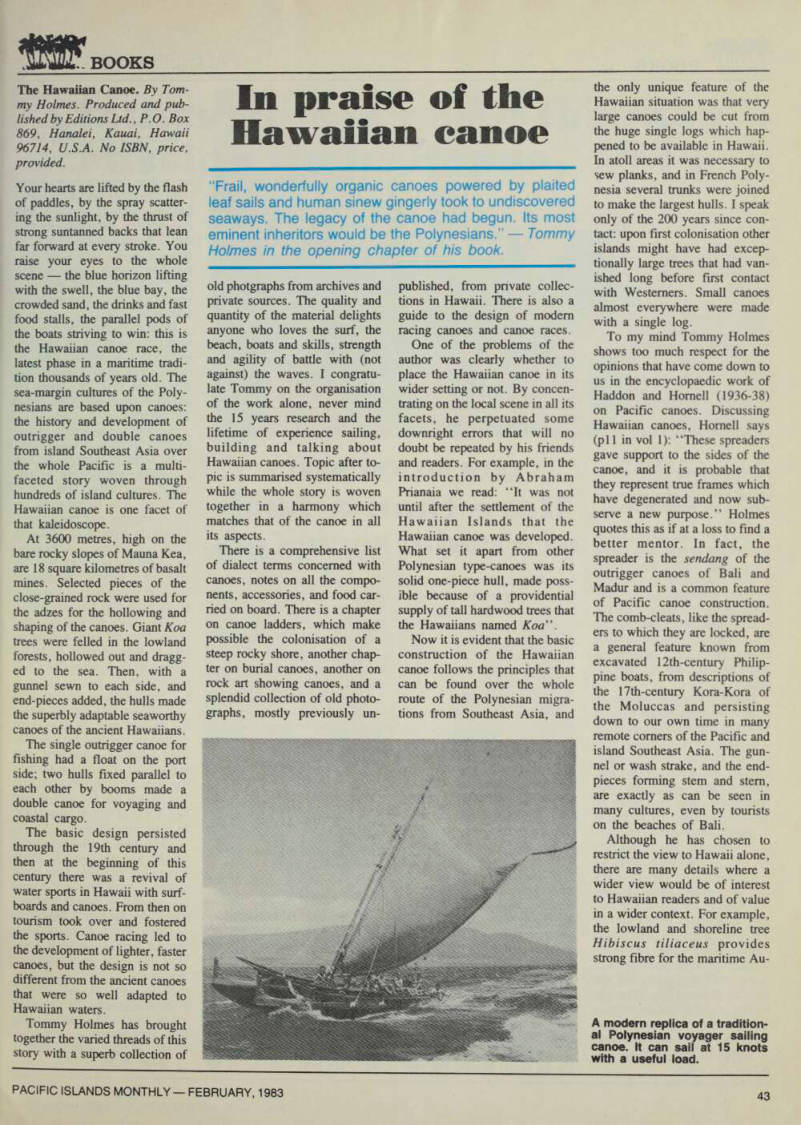
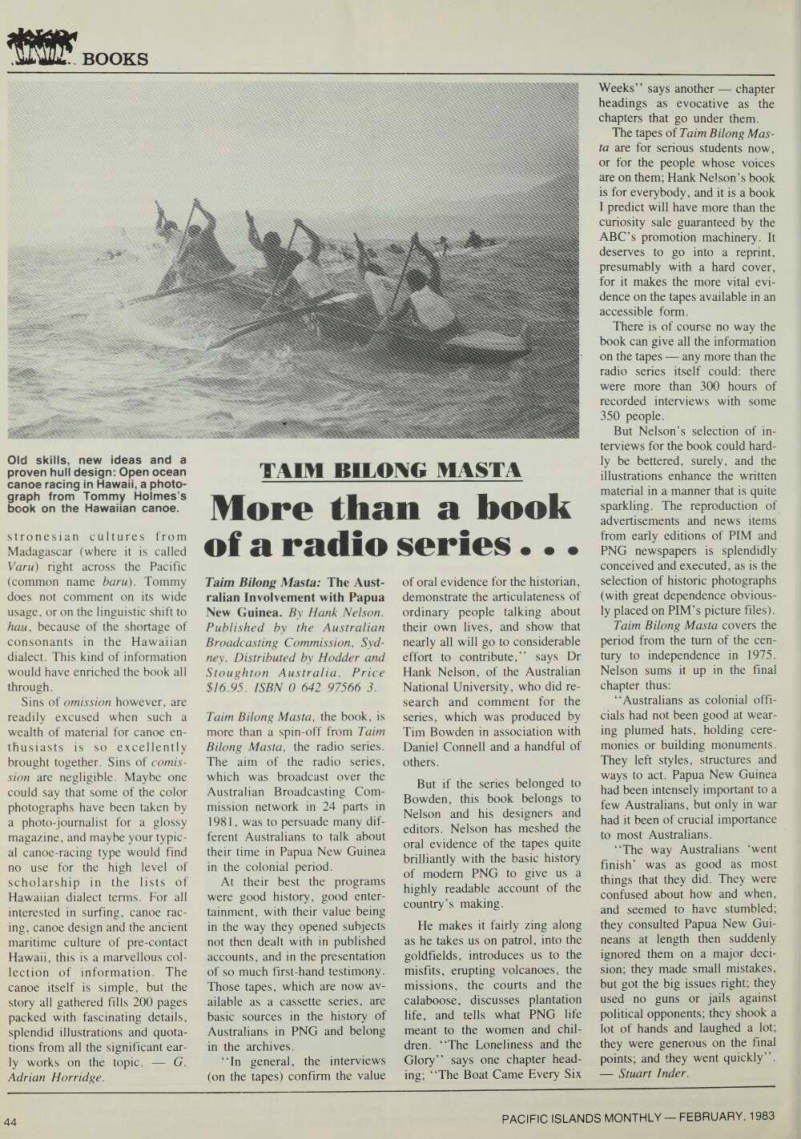
Hawaiian canoe
The Hawaiian Canoe. By Tom my Holmes. Produced and pub lished by Editions Ltd., P. O. Box 869, Hanalei, Kauai, Hawaii 96714, U.S.A. No ISBN, price, provided.
Your hearts are lifted by the flash of paddles, by the spray scatter ing the sunlight, by the thrust of strong suntanned backs that lean far forward at every stroke. You raise your eyes to the whole scene the blue horizon lifting with the swell, the blue bay, the crowded sand, the drinks and fast food stalls, the parallel pods of the boats striving to win: this is the Hawaiian canoe race, the latest phase in a maritime tradi tion thousands of years old. The sea-margin cultures of the Poly nesians are based upon canoes: the history and development of outrigger and double canoes from island Southeast Asia over the whole Pacific is a multi faceted story woven through hundreds of island cultures. The Hawaiian canoe is one facet of that kaleidoscope.
At 3600 metres, high on the bare rocky slopes of Mauna Kea, are 18 square kilometres of basalt mines. Selected pieces of the close-grained rock were used for the adzes for the hollowing and shaping of the canoes. Giant Koa trees were felled in the lowland forests, hollowed out and dragg ed to the sea. Then, with a gunnel sewn to each side, and end-pieces added, the hulls made the superbly adaptable seaworthy canoes of the ancient Hawaiians.
The single outrigger canoe for fishing had a float on the port side; two hulls fixed parallel to each other by booms made a double canoe for voyaging and coastal cargo.
The basic design persisted through the 19th century and then at the beginning of this century there was a revival of water sports in Hawaii with surf boards and canoes. From then on tourism took over and fostered the sports. Canoe racing led to the development of lighter, faster canoes, but the design is not so different from the ancient canoes that were so well adapted to Hawaiian waters.
Tommy Holmes has brought together the varied threads of this story with a superb collection of
“Frail, wonderfully organic canoes powered by plaited leaf sails and human sinew gingerly took to undiscovered seaways. The legacy of the canoe had begun. Its most eminent inheritors would be the Polynesians.” Tommy Holmes in the opening chapter of his book.
old photgraphs from archives and private sources. The quality and quantity of the material delights anyone who loves the surf, the beach, boats and skills, strength and agility of battle with (not against) the waves. I congratu late Tommy on the organisation of the work alone, never mind the 15 years research and the lifetime of experience sailing, building and talking about Hawaiian canoes. Topic after to pic is summarised systematically while the whole story is woven together in a harmony which matches that of the canoe in all its aspects.
There is a comprehensive list of dialect terms concerned with canoes, notes on all the compo nents, accessories, and food car ried on board. There is a chapter on canoe ladders, which make possible the colonisation of a steep rocky shore, another chap ter on burial canoes, another on rock art showing canoes, and a splendid collection of old photo graphs, mostly previously un
published, from private collec tions in Hawaii. There is also a guide to the design of modem racing canoes and canoe races.
One of the problems of the author was clearly whether to place the Hawaiian canoe in its wider setting or not. By concen trating on the local scene in all its facets, he perpetuated some downright errors that will no doubt be repeated by his friends and readers. For example, in the introduction by Abraham Prianaia we read; “It was not until after the settlement of the Hawaiian Islands that the Hawaiian canoe was developed.
What set it apart from other Polynesian type-canoes was its solid one-piece hull, made poss ible because of a providential supply of tall hardwood trees that the Hawaiians named Koa'\ Now it is evident that the basic construction of the Hawaiian canoe follows the principles that can be found over the whole route of the Polynesian migra tions from Southeast Asia, and
the only unique feature of the Hawaiian situation was that very large canoes could be cut from the huge single logs which hap pened to be available in Hawaii.
In atoll areas it was necessary to sew planks, and in French Poly nesia several trunks were joined to make the largest hulls. I speak only of the 200 years since con tact: upon first colonisation other islands might have had excep tionally large trees that had van ished long before first contact with Westerners. Small canoes almost everywhere were made with a single log.
To my mind Tommy Holmes shows too much respect for the opinions that have come down to us in the encyclopaedic work of Haddon and Homell (1936-38) on Pacific canoes. Discussing Hawaiian canoes, Homell says (pll in vol 1): “These spreaders gave support to the sides of the canoe, and it is probable that they represent true frames which have degenerated and now sub serve a new purpose.” Holmes quotes this as if at a loss to find a better mentor. In fact, the spreader is the sendang of the outrigger canoes of Bali and Madur and is a common feature of Pacific canoe construction.
The comb-cleats, like the spread ers to which they are locked, are a general feature known from excavated 12th-century Philip pine boats, from descriptions of the 17th-century Kora-Kora of the Moluccas and persisting down to our own time in many remote comers of the Pacific and island Southeast Asia. The gun nel or wash strake, and the end pieces forming stem and stem, are exactly as can be seen in many cultures, even by tourists on the beaches of Bali.
Although he has chosen to restrict the view to Hawaii alone, there are many details where a wider view would be of interest to Hawaiian readers and of value in a wider context. For example, the lowland and shoreline tree Hibiscus tiliaceus provides strong fibre for the maritime Au-
A modern replica of a tradition al Polynesian voyager sailing canoe. It can sail at 15 knots with a useful load.
stronesian cultures from Madagascar (where it is called Varu ) right across the Pacific (common name baru). Tommy does not comment on its wide usage, or on the linguistic shift to hau , because of the shortage of consonants in the Hawaiian dialect. This kind of information would have enriched the book all
through.
Sins of omission however, are readily excused when such a wealth of material for canoe en thusiasts is so excellently brought together. Sins of comis sion are negligible. Maybe one could say that some of the color photographs have been taken by a photo-joumalist for a glossy magazine, and maybe your typic al canoe-racing type would find no use for the high level of scholarship in the lists of Hawaiian dialect terms. For all interested in surfing, canoe rac ing, canoe design and the ancient maritime culture of pre-contact Hawaii, this is a marvellous col lection of information. The canoe itself is simple, but the story all gathered fills 200 pages packed with fascinating details, splendid illustrations and quota tions from all the significant ear
ly works on the topic.
G.
Adrian Horridge.
Old skills, new ideas and a proven hull design: Open ocean canoe racing in Hawaii, a photo graph from Tommy Holmes’s book on the Hawaiian canoe.
of a radio series...
Taim Bilonc Masta
More than a book of a radio series...
Taim Bilong Masta: The Aust ralian Involvement with Papua New Guinea. By Hank Nelson.
Published by the Australian Broadcasting Commission, Syd ney. Distributed by Hodder and Stoughton Australia. Price
$16.95. Isbn 0 642 97566 3.
Taim Bilong Masta, the book, is more than a spin-off from Taim Bilong Masta, the radio series.
The aim of the radio series, which was broadcast over the Australian Broadcasting Com mission network in 24 parts in 1981, was to persuade many dif ferent Australians to talk about their time in Papua New Guinea in the colonial period.
At their best the programs
were good history, good enter
tainment, with their value being
in the way they opened subjects
not then dealt with in published accounts, and in the presentation of so much first-hand testimony.
Those tapes, which are now av ailable as a cassette series, are basic sources in the history of Australians in PNG and belong in the archives.
“In general, the interviews (on the tapes) confirm the value
of oral evidence for the historian, demonstrate the articulateness of
ordinary people talking about
their own lives, and show that nearly all will go to considerable effort to contribute,” says Dr Hank Nelson, of the Australian National University, who did re search and comment for the series, which was produced by Tim Bowden in association with Daniel Connell and a handful of others.
But if the series belonged to Bowden, this book belongs to Nelson and his designers and editors. Nelson has meshed the oral evidence of the tapes quite brilliantly with the basic history of modem PNG to give us a highly readable account of the country’s making.
He makes it fairly zing along as he takes us on patrol, into the goldfields, introduces us to the misfits, erupting volcanoes, the missions, the courts and the calaboose, discusses plantation life, and tells what PNG life meant to the women and chil dren. “The Loneliness and the Glory” says one chapter head ing; “The Boat Came Every Six
Weeks” says another chapter headings as evocative as the chapters that go under them.
The tapes of Taim Bilong Mas ta are for serious students now, or for the people whose voices are on them; Hank Nelson’s book is for everybody, and it is a book I predict will have more than the curiosity sale guaranteed by the ABC’s promotion machinery. It deserves to go into a reprint, presumably with a hard cover, for it makes the more vital evi dence on the tapes available in an accessible form.
There is of course no way the book can give all the information on the tapes any more than the radio series itself could: there were more than 300 hours of recorded interviews with some 350 people.
But Nelson’s selection of in terviews for the book could hard ly be bettered, surely, and the illustrations enhance the written material in a manner that is quite sparkling. The reproduction of advertisements and news items from early editions of PIM and PNG newspapers is splendidly conceived and executed, as is the selection of historic photographs (with great dependence obvious ly placed on PlM’s picture files).
Taim Bilong Masta covers the period from the turn of the cen tury to independence in 1975.
Nelson sums it up in the final chapter thus: “Australians as colonial offi cials had not been good at wear ing plumed hats, holding cere monies or building monuments.
They left styles, structures and ways to act. Papua New Guinea had been intensely important to a few Australians, but only in war had it been of crucial importance to most Australians.
“The way Australians ‘went finish’ was as good as most things that they did. They were confused about how and when, and seemed to have stumbled; they consulted Papua New Gui neans at length then suddenly ignored them on a major deci sion; they made small mistakes, but got the big issues right; they used no guns or jails against political opponents; they shook a lot of hands and laughed a lot; they were generous on the final points; and they went quickly”.
Stuart Inder.
Missionary in Papua, 1934
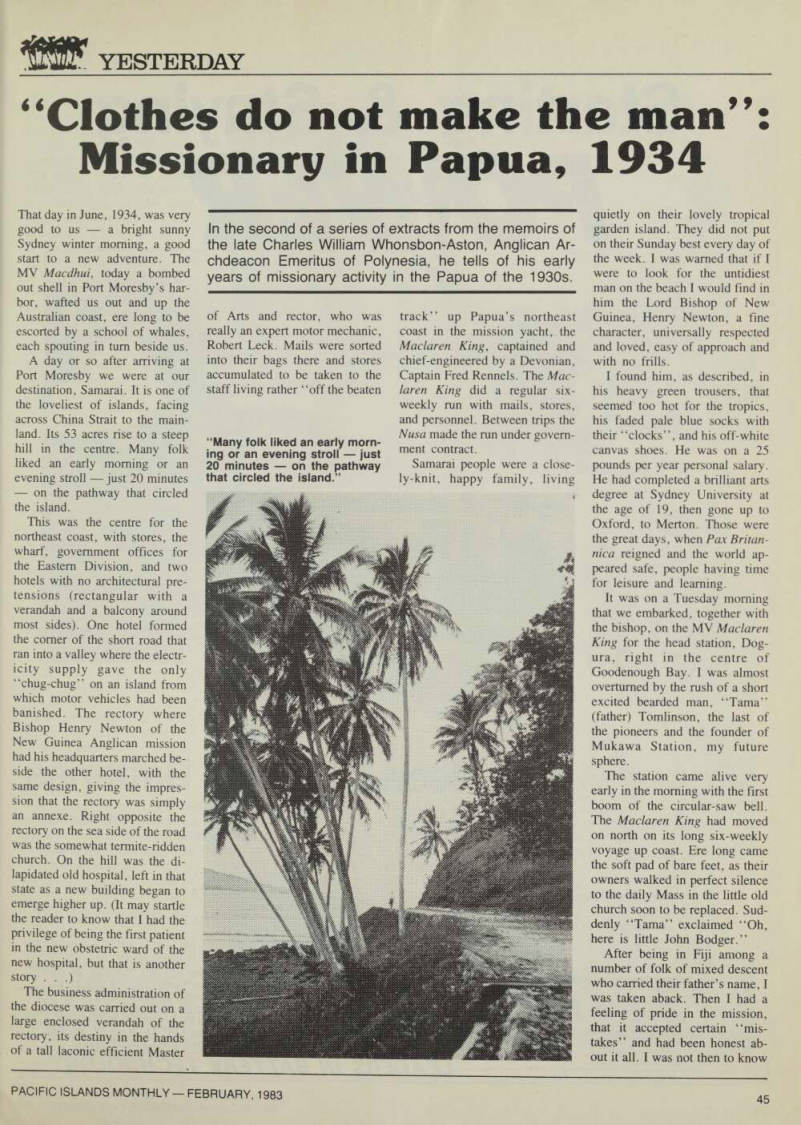

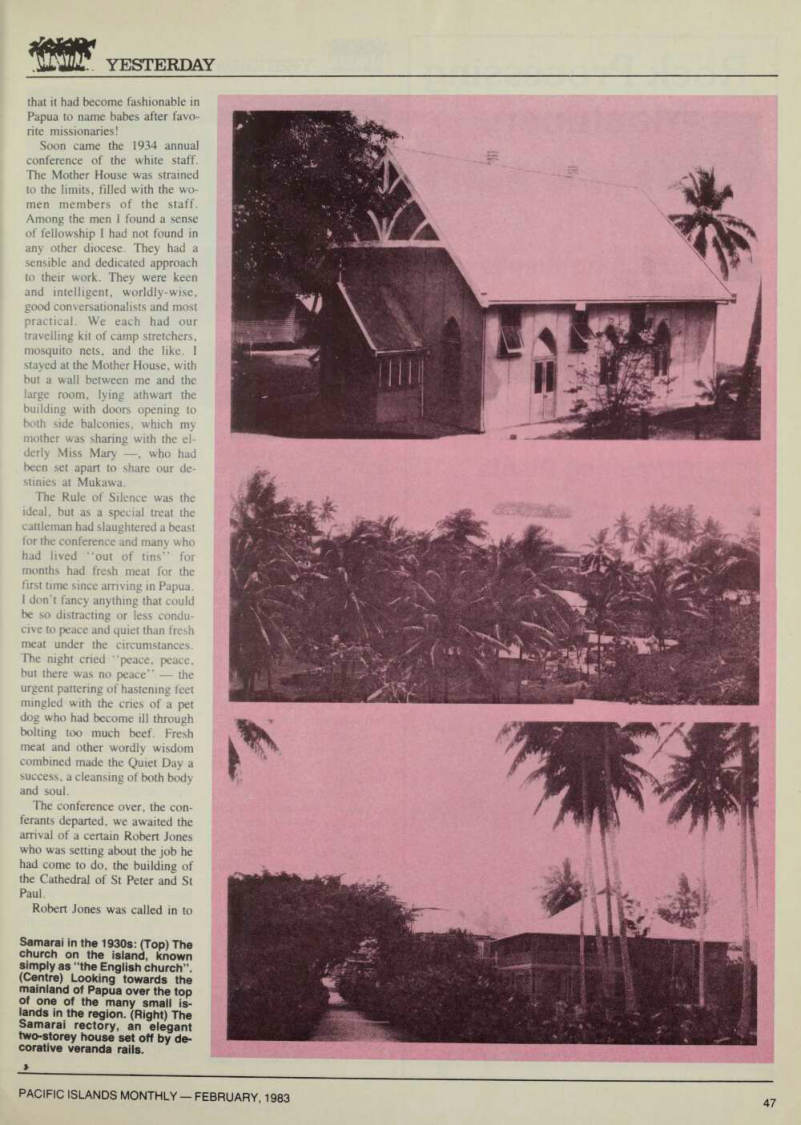
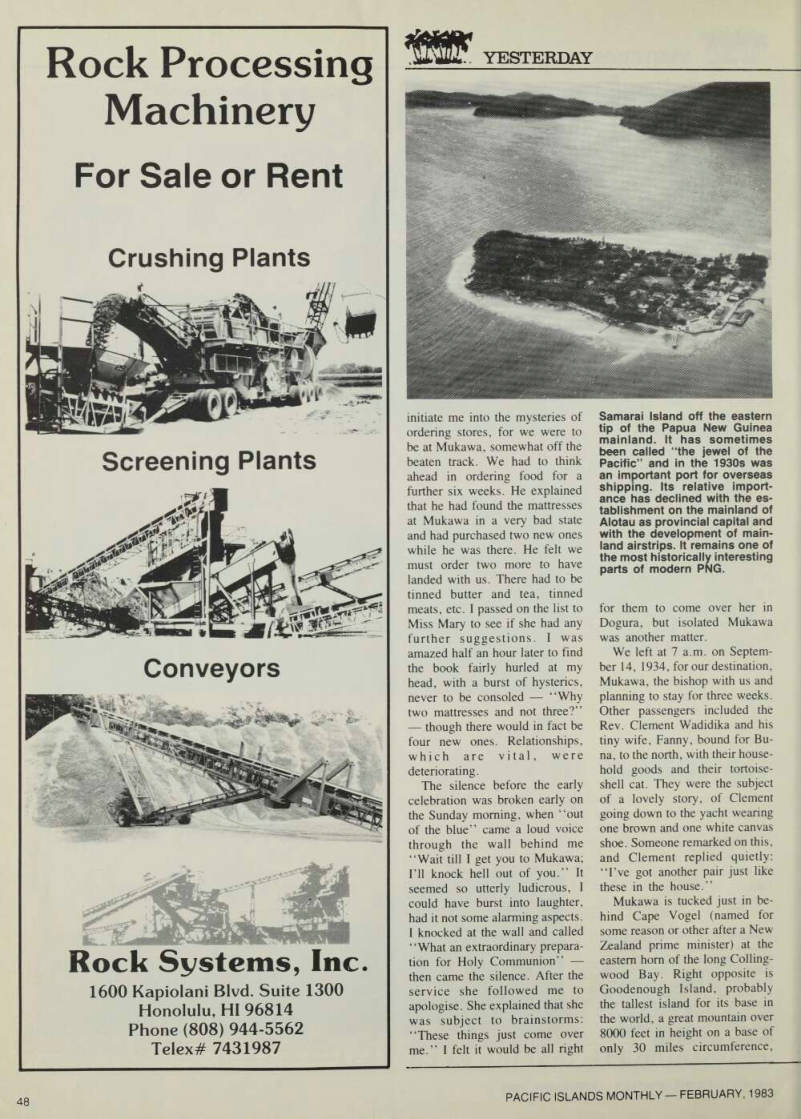
Yesterday
“Clothes do not make the man”: Missionary in Papua, 1934
That day in June, 1934, was very good to us a bright sunny Sydney winter morning, a good start to a new adventure. The MV Macdhui, today a bombed out shell in Port Moresby’s har bor, wafted us out and up the Australian coast, ere long to be escorted by a school of whales, each spouting in turn beside us.
A day or so after arriving at Port Moresby we were at our destination, Samarai. It is one of the loveliest of islands, facing across China Strait to the main land. Its 53 acres rise to a steep hill in the centre. Many folk liked an early morning or an evening stroll just 20 minutes on the pathway that circled the island.
This was the centre for the northeast coast, with stores, the wharf, government offices for the Eastern Division, and two hotels with no architectural pre tensions (rectangular with a verandah and a balcony around most sides). One hotel formed the comer of the short road that ran into a valley where the electr icity supply gave the only “chug-chug” on an island from which motor vehicles had been banished. The rectory where Bishop Henry Newton of the New Guinea Anglican mission had his headquarters marched be side the other hotel, with the same design, giving the impres sion that the rectory was simply an annexe. Right opposite the rectory on the sea side of the road was the somewhat termite-ridden church. On the hill was the di lapidated old hospital, left in that state as a new building began to emerge higher up. (It may startle the reader to know that I had the privilege of being the first patient in the new obstetric ward of the new hospital, but that is another story . . .) The business administration of the diocese was carried out on a large enclosed verandah of the rectory, its destiny in the hands of a tall laconic efficient Master
In the second of a series of extracts from the memoirs of the late Charles William Whonsbon-Aston, Anglican Ar chdeacon Emeritus of Polynesia, he tells of his early years of missionary activity in the Papua of the 19305.
of Arts and rector, who was really an expert motor mechanic, Robert Leek. Mails were sorted into their bags there and stores accumulated to be taken to the staff living rather “off the beaten
track” up Papua’s northeast coast in the mission yacht, the Maclaren King, captained and chief-engineered by a Devonian, Captain Fred Rennels. The Mac laren King did a regular six weekly run with mails, stores, and personnel. Between trips the Nusa made the run under govern ment contract.
Samarai people were a close ly-knit, happy family, living
quietly on their lovely tropical garden island. They did not put on their Sunday best every day of the week. I was warned that if I were to look for the untidiest man on the beach I would find in him the Lord Bishop of New Guinea, Henry Newton, a fine character, universally respected and loved, easy of approach and with no frills.
I found him, as described, in his heavy green trousers, that seemed too hot for the tropics, his faded pale blue socks with their “clocks”, and his off-white canvas shoes. He was on a 25 pounds per year personal salary.
He had completed a brilliant arts degree at Sydney University at the age of 19, then gone up to Oxford, to Merton. Those were the great days, when Pax Britan nica reigned and the world ap peared safe, people having time for leisure and learning.
It was on a Tuesday morning that we embarked, together with the bishop, on the MV Maclaren King for the head station, Dog ura, right in the centre of Goodenough Bay. I was almost overturned by the rush of a short excited bearded man, “Tama” (father) Tomlinson, the last of the pioneers and the founder of Mukawa Station, my future sphere.
The station came alive very early in the morning with the first boom of the circular-saw bell.
The Maclaren King had moved on north on its long six-weekly voyage up coast. Ere long came the soft pad of bare feet, as their owners walked in perfect silence to the daily Mass in the little old church soon to be replaced. Sud denly “Tama” exclaimed “Oh, here is little John Bodger.”
After being in Fiji among a number of folk of mixed descent who carried their father’s name, I was taken aback. Then I had a feeling of pride in the mission, that it accepted certain “mis takes” and had been honest ab out it all. I was not then to know
“Many folk liked an early morn ing or an evening stroll just 20 minutes on the pathway that circled the island."
that it had become fashionable in Papua to name babes after favo rite missionaries!
Soon came the 1934 annual conference of the white staff.
The Mother House was strained to the limits, filled with the wo men members of the staff.
Among the men I found a sense of fellowship I had not found in any other diocese. They had a sensible and dedicated approach to their work. They were keen and intelligent, worldly-wise, good conversationalists and most practical. We each had our travelling kit of camp stretchers, mosquito nets, and the like. I stayed at the Mother House, with but a wall between me and the large room, lying athwart the building with doors opening to both side balconies, which my mother was sharing with the el derly Miss Mary —, who had been set apart to share our de stinies at Mukawa.
The Rule of Silence was the ideal, but as a special treat the cattleman had slaughtered a beast for the conference and many who had lived “out of tins” for months had fresh meat for the first lime since arriving in Papua.
I don’t fancy anything that could be so distracting or less condu cive to peace and quiet than fresh meat under the circumstances.
The night cried “peace, peace, but there was no peace’’ the urgent pattering of hastening feet mingled with the cries of a pet dog who had become ill through bolting too much beef. Fresh meat and other wordly wisdom combined made the Quiet Day a success, a cleansing of both body and soul.
The conference over, the con ferants departed, we awaited the arrival of a certain Robert Jones who was setting about the job he had come to do, the building of the Cathedral of St Peter and St Paul.
Robert Jones was called in to
Samarai in the 19305: (Top) The church on the island, known simply as “the English church”. (Centre) Looking towards the mainland of Papua over the top of one of the many small is lands in the region. (Right) The Samarai rectory, an elegant two-storey house set off by de corative veranda rails.
initiate me into the mysteries of ordering stores, for we were to be at Mukawa, somewhat off the beaten track. We had to think ahead in ordering food for a further six weeks. He explained that he had found the mattresses at Mukawa in a very bad state and had purchased two new ones while he was there. He felt we must order two more to have landed with us. There had to be tinned butter and tea, tinned meats, etc. I passed on the list to Miss Mary to see if she had any further suggestions. I was amazed half an hour later to find the book fairly hurled at my head, with a burst of hysterics, never to be consoled “Why two mattresses and not three?” though there would in fact be four new ones. Relationships, which are vital, were
deteriorating.
The silence before the early celebration was broken early on the Sunday morning, when “out of the blue” came a loud voice through the wall behind me “Wait till I get you to Mukawa; I’ll knock hell out of you.” It seemed so utterly ludicrous, I could have burst into laughter, had it not some alarming aspects.
I knocked at the wall and called “What an extraordinary prepara tion for Holy Communion” then came the silence. After the service she followed me to apologise. She explained that she was subject to brainstorms: “These things just come over me.” I felt it would be all right
for them to come over her in Dogura, but isolated Mukawa was another matter.
We left at 7 a.m. on Septem ber 14, 1934, for our destination, Mukawa, the bishop with us and planning to stay for three weeks.
Other passengers included the Rev. Clement Wadidika and his tiny wife, Fanny, bound for Bu na, to the north, with their house hold goods and their tortoise shell cat. They were the subject of a lovely story, of Clement going down to the yacht wearing one brown and one white canvas shoe. Someone remarked on this, and Clement replied quietly: “I’ve got another pair just like these in the house.”
Mukawa is tucked just in be hind Cape Vogel (named for some reason or other after a New Zealand prime minister) at the eastern horn of the long Colling wood Bay. Right opposite is Goodenough Island, probably the tallest island for its base in the world, a great mountain over 8000 feet in height on a base of only 30 miles circumference,
Samara! Island off the eastern tip of the Papua New Guinea mainland. It has sometimes been called ‘the jewel of the Pacific” and in the 1930s was an important port for overseas shipping. Its relative import ance has declined with the es tablishment on the mainland of Alotau as provincial capital and with the development of main land airstrips. It remains one of
the most historically interesting
parts of modern PNG.
with a narrow coastal plain.
Once, after nearly four days of heavy north-westerly seasonal rain and heavy seas, the sun burst across it late in the afternoon with a perfect rainbow, seen through the high spray of the surf running on our small beach, with a waterfall pouring down the steep jungle-clad slopes for about 7000 feet.
Christopher Osembo, a big, well set-up Mambare man, the school headmaster, was on the beach to meet us. He had been generally in charge during the absence of any other authority.
His wife was Maggie, who, be ing wife of the teacher and there fore higher in the social struc ture, wore a Mother Hubbard arrangement above her grass skirts.
The attractive thatch church was full for Solemn Evensong, sung in the Mukawan dialect.
The building held about 450, the men on one side down to the boys in front who were practical ly unclothed, save for the “ka ra” of tapa cloth, which left little to the imagination. One got ac customed to this uniform as time went by, but I am afraid my mother, at 77 and somewhat Vic torian in background, hardly be came used to it, though after a time her sense of humor pre vailed. However at first she was horrified to see a 13-year-old part-time houseboy waving a bedroom utensil as he greeted his friends passing on the beach.
Bishop Newton remained with us, first, to see us settled in, and, second, to prepare a large class of adults and children brought in from far and wide for baptism or confirmation. The Maclaren King left very early in the morn ing and we unpacked our person
al belongings. The ice chest (quite the thing in those days) looked positively silly sitting there in the wilds, the nearest ice blocks miles away. I felt like Robinson Crusoe.
In those days it would have been fantastic to think that New Guinea people, Stone Age and grass-skirted, would ever find the big world moving in on them.
It seemed to me that the main object of schooling at the time was to give them some means of reading and some idea of mea surements and weights and money, in order to save them from exploitation. Very few were encouraged to anything higher, and the government’s es timation of the position seemed to be underlined by the arrival each year of a retired school inspector from Queensland. As he could hardly be expected to know the dialects, all the exams were taken in English, and from the results the mission gathered a subsidy, according to grade, from the lowest at five shillings
for those who satisfied the ex aminer, through seven-and six pence to 10 shillings.
The inspector during my first few years was just over 80 years old, Colonel Hooper, a grand old soul, very kindly in his assess ments. He was one of the school master type who became col onels between the Boer War and World War 1, graduating through the command of school cadet corps and the volunteers, used to command, who did good work in their fields. He would like to talk about his time in Egypt, Gaza, Heliopolis, Mena Camp, even “the Battle of the Wazir” into which he was call ed, then he would retire, a teetotaller, to rest, aglow with revival of old memories, to rise with the birds to give us a good record.
I learnt that clothes or the lack of them do not make the man, and, with the memory of early missionary enthusiasm in the Pacific fpr clothing bringing dis aster to the wearers, the mission
did nothing to encourage the loc al people to dress. Our local priests and teachers, following the example of government clerks and so on, liked their shirts and waistcloth on occa sions, and village men of stand ing wore the waistcloth in public.
But all this came from them selves, as any change of custom should. There was no shame in their accustomed “undress” and one got completely used to it.
The women were very modest in the Cape Vogel area, wearing longish grass skirts.
We were soon settling in, and my amazing old mother had ta ken over the domestic manage ment very efficiently. We had to be quite sure of having sufficient supplies for there was no nearby
Another view of the famous cor al path which skirts the island of Samarai.
Seeing Samarai for the first time in the days before air travel became general. But even to day the island is too small for an airstrip. Visitors land on the mainland and cross by workboat.
store to slip around to, nor was there the baker or the plumber.
Mother’s old skill in bread making (years upon years earlier) came back to her. Every second day yeast was prepared from limes from two trees that stood right against the open back verandah. At one stage of the year, about October I fancy, these trees would harbor for a few evenings thousands of small beetles, like the “ladybird”, at tracted by the lights on the table.
Soon after my arrival I climbed the old road, much neglected and scored by rainstorms, to the plateau above and to its extremi
ty. Dog’s Hill, to the light which had been placed there by the mission in 1899 to help mariners.
The villages had been there for some generations for their pro tection against other tribes, and the mission buildings had been situated there. But now both vil lages and mission were on the coastal strip below.
I found the famous Dog’s Hill (Cape Vogel) light a most primi tive affair, seriously neglected through lack of supervision by the two villagers paid by the government to tend it. A few months later I received charts from the Admiralty asking if I could indicate the position of the light and give any further infor mation to bring the chart up to date. Only a few days before I had been reading through the old 1914 logbooks and had come
across a record of a detachment of warships passing Cape Vogel going north. Then the next day's record stated they were seen re turning. It seemed a mystery to me, which was solved when the mission veteran “Tama” Tom linson told me that they had been a detachment intended to capture Rabaul a few days earlier, but the commanding officer, poorly equipped with correct charts, de cided not to risk his vessels on this quiet backdoor route.
My life was taking on a sort of Swiss Family Robinson aspect, tackling all sorts of jobs I never before suspected I should have to deal with. White ants had managed to get into the storeroom, attacking the door posts and lintels and the dinghy sails. This called for new skills, though I found some men who
had helped with the whaleboat sails some time before.
Freed from the work that had anchored me at the centre I was able to visit up and down the district. Each out-station had a small thatched house, on stilts, for the priest to stay overnight in, near the grass church. Down coast were Bogaboga, Ginada, laseiase really the name of a small island, laseiaseago, just off the coast, where Nicholas the Greek, a well-known character, would often camp with his fish ing boats and crew, almost bring ing doom to the future of the village from their lustful posses sion of the local lasses and Wabubu.
One Saturday afternoon I seemed to have walked far ahead of my carriers. Suddenly from the nearby mangroves shot a small narrow canoe paddled by a practically naked local man. who offered to ferry me over.
Halfway across, with the canoe riding a fair swell coming in from the sea, the man, Jeremiah, stopped to show me some arrows tipped with human bone which he had bought from the Suau people. Bows and ar rows were not used in the district we were in, and I wondered. The tossing boat half a mile from shore was giving me a little anxiety and I decided we should hurry on. I found, when I arrived on the other side, that Jeremiah had been discharged from the armed constabularly as a mental case and, as they seemed to have no mental institution to take him, they had sent him back to his village. That is another of my allergies, tossing in mid-ocean in a narrow canoe with a madman. . .
A week later Fr. Frere Lane, my “next-door’’ (many crocodiley miles away) neigh bor, told me of sleeping in the bone-dry thatch and bamboo rest house at Kirikirikona, the limit of his district towards mine, and being awakened in the night by the same Jeremiah crawling over the floor towards his campbed holding aloft a flaming torch of coconut fronds, sparks flying in all directions. . . • Next month: A wandering drunk, the “Queen of Naniu" . and mission paternalism.
Early pictures of Samarai re flect a stark frontier-like atmos phere (top) but later the island gained a reputation for its gar dens and tree-lined walks (above).
Advertisements & other items, pp. 46-48 (2 items)
Starting & Staying
¥ER ml ■a « T fi
AMP
POY/VER
** r
now
Amr
dfSS m us& &83D
Power Boats Need Different Batteries
There is a big difference between a car battery and a marine battery.
A car battery, for example, is never really discharged, as it is only used for a few seconds each day and promptly re-charged. Not so your cruiser or sportsfisherman.
Starting the engine is only the beginning. During the day, weekend or cruise, how often will you run the live bait tank, the depth sounder, the nav. lights or maintain a listening watch on your radio transceiver?
As well as cranking power, boats need staying power. Boats need Besco’s Marine Batteries, deep cycle, heavy duty marine batteries.
If your boat is getting a little flat in the electrics department, write or phone BESCO today and ask for more information, more facts about
BESCO MARINE BATTERIES.
i Papua New Guinea: Lae/Rabaul Auto Marine Industries, PO Box 785, Lae. 42-1125. Port ' Moresby: Par Sales Pty. Ltd., Boroko. 25-6266. FIJI: Bar Motor Parts Ltd., PO Box 51, Bar, 74-070. New Caledonia: Lotissement Industrie!, BP 889, Noumea. 27-4906. Hong Kong: T.l. . Knight & Co., PO Box 5585, T.S.T. Kowloon, 3-66 5341. N.Z.: Battery Services (Industrial) Ltd., I PO 27-375, Auckland 4, 694-111. Gould Batteries, 58 Hautana St., Lower Hutt, Wellington. f Telex: CHACO N.Z. 3714. Other Areas: Jarwil International Pty. Ltd., 410 Kent St., Sydney, Batteries Division Of S.ms Products Pty Ltd / 2000. (02) 264-3477. Telex: AA 72102. Besco Batteries. Villawood, 2163. (02) 632-0251.
LEADERS IN BATTERY TECHNOLOGY-
BESCO
Rock Processing
Machinery
For Sale or Rent
Crushing Plants •k-i* ■ Screening Plants Conveyors : V . as i Rock Systems, Inc 1600 Kapiolani Blvd. Suite 1300 Honolulu, HI 96814 Phone (808) 944-5562 Telex# 7431987
Yesterday
monster trade imbalance
Trade Winds
Australia And The Islands
New circumstances cut back a monster trade imbalance
Many small island nations of the South Pacific have long labored under a massive trade imbalance with Australia.
For example, for every SAB worth of goods Fiji buys from Australia it manages to sell Aust ralia only $1 worth. In the case of Papua New Guinea the ratio is six to one, while for New Caledonia it is a staggering 27 to one.
But while this imbalance still exists, a variety of factors com bined in 1981-82 in part at least to reduce the islands’ historic trade deficit with their big neighbor.
Two of these factors the weakening of the Australian dol lar and the slide in the price of oil were unequivocally favorable developments for the tiny Pacific states.
The third the slump in commodity prices was a much more mixed blessing since this one acted to bring down the trade imbalance with Australia only through its recessionary impact on the island economies.
The direct consequence of this was some tough economic belt tightening. This resulted in lower consumption and reduced com pany inventories and so a drop in imports from countries such as Australia.
Indicative of the tough economic times suffered in the South Pacific in 1981-82 was the profit slump of Australia’s two main Pacific traders Bums Philp and Co. Ltd. and W. R.
Carpenter Holdings Ltd. by 51 per cent and 74 per cent respectively.
As a result of the combination of these three factors the imbal ance of trade in Australia’s favor was sharply cut back in 1981-82.
In the case of Fiji a 1980-81 imbalance of $153.4 million was reduced to $139.3 million, a drop of 9.2 per cent.
Solomon Islands and Vanuatu
Finance writer PETER FREEMAN analyses pluses and minuses in the 1981-82 trading relationships with Aust ralia of a number of Pacific Island nations.
The weakened Australian dollar, the reduced price of oil, and the slump in prices of islands-produced com modities each in its different way helped to reduce their massive trade imbalances with Australia.
But long-term solutions to the problem, Freeman says, seem as elusive as ever, with tourism offering the best prospects of at least some short-term relief.
performed even better, cutting their trade imbalance with Aust ralia by almost 23 per cent to $17.6 million and $10.3 million respectively. New Caledonia re corded a cut of 17 per cent, while Western Samoa reduced its im balance by 10 per cent.
PNG, heavily dependent on coffee and cocoa exports to Aust ralia, and able to maintain im ports thanks to continued Aust ralian aid, managed a reduction in its trade imbalance of only 2.5 per cent to $350 million.
Cyclone-devastated Tonga was the only Pacific Island state to experience a worsened trade balance, with the need for addi tional imports from Australia pushing this up by 15 per cent to $6 million.
Tonga was also one of three Pacific Island nations which didn’t benefit from a stronger rate of exchange against what has generally been a weakening Australian dollar. While the Australian dollar has recently re gained some of the ground lost against its United States counter part the slide against most other currencies including many in the Pacific continues unabated.
This reflects the Australian Government’s policy of steadily
lowering the trade-weighted in
dex the measure of the Aust ralian dollar against other curren cies weighted to take account of trade flows. In 1982 it fell 8 per cent to 83.2.
In the course of 1982 the Aust ralian dollar fell by about 6 per cent against the Fiji dollar, 4 per cent compared to the PNG kina, 7 per cent against the Vanuatu currency, and 3 per cent against the Western Samoan tala.
The currencies of Solomon Is lands, New Caledonia and Tonga either weakened slightly or held their own against the Australian dollar.
The big winners from all this have been Fiji, which imported $159.8 million worth of goods from Australia in 1981-82, and Papua New Guinea whose im ports from Australia totalled $420.13 million.
Thanks partly to the weaker Australian dollar, this represent ed falls of 5.8 per cent and 3.1 per cent respectively compared to the previous financial year.
By far the most significant drop for Fiji was a 13.3 per cent decline in the value of fuel im ported from Australia. This fell to $68.4 million still more than four times the cost of any other single item imported from Australia.
The drop in Fiji’s fuel import bill also reflected the world-wide slide in the price of oil and, it can be assumed, some cutback in usage due to the local economic downturn.
Just how significant all three factors were exchange rate changes, the lower oil price and reduced demand isn’t clear.
What is important is the fact Fiji
had to part with less of its valu able foreign exchange to pay its oil bill.
Other Pacific Island states to benefit in the same way were New Caledonia, whose fuel bill with Australia dropped 22 per cent to just over $4 million, and PNG, which had an 8.4 per cent lower payout for fuel from Aust ralia in 1981-82. In that year the cost was $42.4 million, com pared to $46.3 million in 1980- 81.
Fiji’s trade balance with Aust ralia also benefited from a 16 per cent drop by value in imports of manufactured goods from Aust ralia, and a 13 per cent fall in imports of machinery and trans port equipment.
On the debit side, food im ports from Australia rose 19 per cent to $23 million.
Like many of its island neigh bors, Fiji imports a significant amount of its staple food, with one of the main items being rice.
A major supplier of rice to Fiji is Ricegrowers Co-operative Mills Ltd., based in Leeton, New South Wales, which is also a major exporter of rice to PNG, Solomon Islands, Tonga and Vanuatu. For the last three, rice is the biggest single item in the list of products bought from Australia.
Going against the Fiji trend, food imports from Australia including rice by three other major Pacific Island nations fell in 1981-82.
Food imports from Australia by New Caledonia dropped 8.6 per cent to $17.7 million, PNG’s Australian food import bill fell 9.6 per cent to $106.3 million, and Solomon Islands’ bill was 35 per cent lower at $3.2 million.
In contrast to most other Pacif ic Island states Fiji’s balance of trade benefited from a strong lift in exports to Australia. These rose by 26 per cent to $20.5 million. Traditionally, about half
of Fiji’s exports to Australia have been accounted for by gold, with the other major export being coconut oil.
New Caledonia’s exports to Australia fell by almost 27 per cent last financial year and, at a tiny $1.4 million, are almost non-existent. The equally insig nificant Solomon Islands’ ex ports to Australia fell by just under 40 per cent to under $1 million.
For PNG, the stronger kina helped to compensate partly for the heavy fall in commodity prices, especially prices of coffee and cocoa, which make up al most 50 per cent and 25 per cent respectively of the country’s ex ports to Australia.
However, the slump in the value of these commodities caused exports to Australia to fall from $74.4 million in 1980-81 to last year’s $69.9 million.
While efforts have been made to provide greater access to Aust ralian markets for the products of Fiji and other island countries, this has so far produced few positive results.
One such initiative the South Pacific Regional Trade and Economic Co-operation Agreement (SPARTECA) seems to bear this out. Aimed at giving duty-free entry for island products to Australia and New Zealand, it has apparently generated few benefits.
According to Hugh Reynolds, the islands manager for Bums Philp, it will take a long time to build up the light industry needed to take advantage of easier entry to Australia.
While Bums Philp, for exam ple, is examining the possibility of manufacturing high quality soap in Fiji for export, Mr Rey nolds said the scheme would take some time to get off the ground.
SPARTECA has also generated some heated argu ments. One was about Fiji-made garments which at first seemed to qualify for duty-free entry. How
ever, they were later put in this category only if Fiji was able to secure part of the Australian global quota.
Another constraint in develop ing import replacement indus tries and investigating alternative sources of supply other than Australia is the strings that go with aid.
Although Australia supplies a large amount of aid to South Pacific nations, some carries the condition that goods involved must be bought from Australia.
Possibly the best long-term av enue for redressing the imba lance suffered by the Pacific Is land states in relation to Australia is to boost earnings from so called “invisibles” payments for freight, insurance, invest ments, tourism, and other simi larly intangible items.
For the islands of the Pacific the main hope for substantial gains in this area rests with tourism.
Here the biggest hurdle to be overcome is distance, and the concomitant issues of the cost and availability of transport. For PNG, the problem is the high cost of its internal air service (combined with expensive ac commodation), while for places like Tonga and Western Samoa the main difficulty is for tourists actually to get there.
While New Caledonia and Vanuatu attract a large number of Australian tourists, the greatest success in exploiting its tourist potential has gone to Fiji.
Despite the fall in the Aust ralian dollar the inflow of tourists to Fiji from Australia has been running at record levels in the last three months.
This has come on top of a 20 per cent increase in Australian tourists visiting Fiji to September 30, 1982. In that nine-months period 93,047 Australians went to Fiji on holidays compared to 76,311 over the same period in the previous year. With each tourist spending an estimated
$6OO a visit, over and above air fares and package hotel accom modation, tourism from Aust ralia generated around $56 mil lion in the year to September 30.
All told, tourism produces just over half of Fiji’s gross national product.
It should be noted, however, that the income earned from tour ism must be balanced against the large, but unquantified, cost of importing (usually from Aust ralia) many of the items tourists consume when they are in Fiji.
Just what the future holds for the Pacific Island states, both in terms of tourism and the overall trade balance with Australia, is far from clear.
While the huge imbalance with Australia was partly re dressed in 1981-82 there seems little hope of making any further large gains quickly.
If gains do in fact come, it may only reflect the fact that Australia is increasingly being replaced as the main source of imports by New Zealand, whose currency has weakened dramatic ally against its Pacific neighbors.
While this is, naturally, wel come news for New Zealand producers, it will do little to solve the chronic balance of pay ments problems of the Pacific Island nations.
SP beer “export
example”
Papua New Guinea’s govern ment is being urged to develop a more effective export incentive scheme.
The marketing controller of South Pacific Brewery Ltd., Ken Webb, says the existing scheme allows tax concessions on profits earned from exports. However, this presumes that a product is being sold overseas in the first place.
He says exporters need more help in meeting the initial costs of investigating and establishing overseas markets.
After two years of preparation, the South Pacific Brewery in Port Moresby began exporting PNG beer to Hawaii last September, and to Sydney and Brisbane in November (PIM Dec p3l). Mr Webb says demand for the spe cial export lager in Hawaii has grown to more than 32,000 cans a month, while the current Syd ney and Brisbane demand is ab out half this amount.
He says other overseas mar kets being investigated by the brewery include California, Nauru, Fiji, Tonga, Hong Kong and New Zealand.
South Pacific Brewery of Port Moresby, which believes the PNG government should de velop export incentives, shows its beer in Australia. From left: Sydney importer John Wad dington, Australian trade offi cial Paul Barrett and PNG trade official Aiwa Olmi.
Remembering
Jfk Of Ptio9
Solomon Islands is hoping to attract tourists from the USA to a new museum containing relics of World War 11.
The museum, at Rendova Har bor, has been set up by local communities on the site of a base used during the war by American patrol-torpedo boats. One of the PT commanders stationed at Re ndova Harbor was Lieutenant John F. Kennedy later to become United States President.
Among guests at the official opening in December of the two bamboo buildings which house the exhibits was John Karo, who was a scout leader in the area at the time of the war and who helped to organise the rescue of Kennedy and his crew after their PTIO9 had been rammed and sunk by a Japanese destroyer in August, 1943. The museum was opened by Bara Buchanan of the Solomon Islands Tourist Author ity who promised help in promoting the attraction, but warned that it might not be pro fitable for some time.
Language rule
hits trade
The Cook Islands and Papua New Guinea say their trade with the French territories of New Caledonia and Tahiti is being disrupted by a French Govern ment ruling on trade documents.
A French directive that all documents accompanying goods should be prepared in French came into force last October. A Radio Australia correspondent in Suva says the complaints have been investigated by the South Pacific Bureau for Economic Co- Operation. He says the com plaints arose because English speaking trading countries in the Pacific have difficulty finding local translators.
PNG welcomes
Italpesca
An Italian consortium is to invest more than $3O million in Papua New Guinea over the next five years, creating a PNG-owned tu na industry. The country’s
cabinet has ratified an agreement with the consortium, Italpesca, under which a purse-seiner tuna fishing fleet will be formed to fish PNG’s rich tuna fishing grounds. The country’s Primary Industry Minister, Dennis Young, said that within five years the fleet, which will be owned by PNG, should be har vesting 40,000 tonnes of tuna a year.
He said that at today’s prices, this would be worth $4O million a year. Mr Young said final details would be worked out next year, but the first stage of the agreement provided for the purchase of two or three purse seine trawlers, and a 2000-tonne cold storage plant which might be built in either Manus or Rabaul.
Oz help with
Samoa’s EEZ
An Australian army survey team is assisting Western Samoa to define the 200-mile exclusive economic zone around its coast.
The team will accurately deter mine the reference points on land from which the zone will be measured.
Australia’s Minister for De fence, lan Sinclair, said that once the 200-mile zone was mapped out it would allow Western Samoa to plan the development of its marine resources and effec tively control the area.
Record sugar
output in Fiji
Fiji in 1982 produced a record 485.000 tonnes of sugar, worth more than $l5O million. This is 12.000 tonnes more than the pre vious record, set in 1979.
Chief executive of the Fiji Sugar Corporation, Rasheed Ali, said that this year’s crushing period was short because of in creased mill capacity, and as a result cane had its maximum sugar content when it was
processed.
Mr Rasheed Ali forecast con
tinuing depressed prices on the
world sugar market for the next few years. He said Fiji was fortu nate to have firm markets for its
1982 production.
Meanwhile, a senior govern-
ment minister has tipped that tourism could overtake sugar as
Fiji’s biggest foreign exchange
earner in 1983. Fiji’s Tourism Minister, Mr Qionibaravi, told parliament that a predicted seven per cent growth in the number of visitors would mean Fiji stood to earn in excess of $l6O million from tourism in 1983.
Advertisements & other items, pp. 52-54 (1 item)
Komatsu flakes a Difference
i at* V VS \ - In critical areas like reliability and performance, Komatsu products and systems are making a significant difference at mining and construction sites around the world.
In the CISA, for example, Komatsu’s largest and most powerful work machine the D455A bulldozer is establishing a superior record of reliability and productivity at mining sites that virtually no other machine in its class can match.
And in another critical area, technology, Komatsu is also making a difference in responding to market demands for improved product quality, and for new and original product innovations.
Consider our new computerized seabed robot system: Operating on the ocean floor, it can relay TV pictures of the seabed to a mother ship, or perform man-like boring, drilling and piling operations down to planned depths of 500 meters* Discover the Komatsu difference above sea level, or down to depths of 500 meters. Komatsu a name you can build on.
•H KOMATSU LTD.
Tokyo, Japan Komatsu offices: Tokyo, Sydney, Singapore, Jakarta, Manila, Bangkok, Bangalore, Karachi, Beijing, Istanbul, Cairo, Alger, Dubai, Tehran, Baghdad, Jeddah, Riyadh, Damman, Nairobi, Abidjan, Lagos, Johannesburg, Moscow, Warsaw, Brussels, Paris, Madrid, Frankfurt, Stuttgart, London, Habana, Buenos Aires, Panama, Caracas, Sao Paulo, Bogota, Mexico City, San Francisco, Oakland, Philadelphia, Detroit, Dallas, Atlanta, Chicago, Toronto, Vancouver, and distributors in over 100 countries around the world. m
In Technology
52 m m m ■ V % The Komatsu seabed robot system is currently operating ,n the Japan Inland Sea at depths down to a maximum of 70 meters, in a government-sponsored bridge works program
PETER FISHER TRADING Pty. Ltd.
381 PITT STREET, SYDNEY, 2000, AUSTRALIA
Telephone: 264 5395 CABLES: “FISHERION”, SYDNEY
TELEX; AUSTAS AA20149 ATT. PETER FISHER
EXPORTERS TO THE PACIFIC ISLANDS
FORESTMIL
PORTABLE
SAWMILL
FORESTMIL WILL BE
DEMONSTRATED IN
SUVA, FIJI, APRIL 18
TO APRIL 21, 1983
A Mini Self Contained Sawmill
complete with Diesel Engine or Electric Motor >*• Forestmil produces any size accurate timber ready to use up to 12" x 9" x 24', Purchase price and operating cost of Forestmil is less than other sawing equipment with similar production capacity.
Forestmil reduces timber waste and also reduces log transport cost. Timber is sawn direct from the log in the forest.
Forestmil can be moved to a new location in one hour.
Forestmil will saw hardwood or softwood from logs of any diameter.
Over 1000 Forestmils are sawing timber in 23 countries.
Forestmil has been manufactured for 18 years.
For literature and prices please contact the manufacturers.
MacQuarrie Industries Pty.Ltd.
P.O. Box 20, Coburg 3058, Victoria, Australia Phone 350-3411. Telex 33729. Cables: Macbound, Melbourne.
IBZE™iMSBg
LOCAL AGENTS AND
REPRESENTATION
428 George St., Sydney.
Cables: Henco Sydney.
G.P.O. Box 3949.
Telephone: 232 5377.
For specialised and
personalised buying
service throughout
the Pacific Islands and the East.
Resident Agents in other Pacific Territories.
PAPUA NEW GUINEA
RABAUL: M. & C. Seeto, P.O. Box 131, Rabaul.
Telephone 92 2919.
MADANG: W. Double, P.O. Box 22, Madang.
Telephone 82 2696.
FIJI
K. Witherington Ltd.
P.O. Box 293, Suva.
Telephone 22 356.
VANUATU
John Lum & Associates, P.O. Box 65, Santo.
Telephone 329.
SOLOMON ISLANDS
Mr. Tom Lo, P.O. Box 327, Honiara.
Telephone 399
tie
Fiji, PNG trade
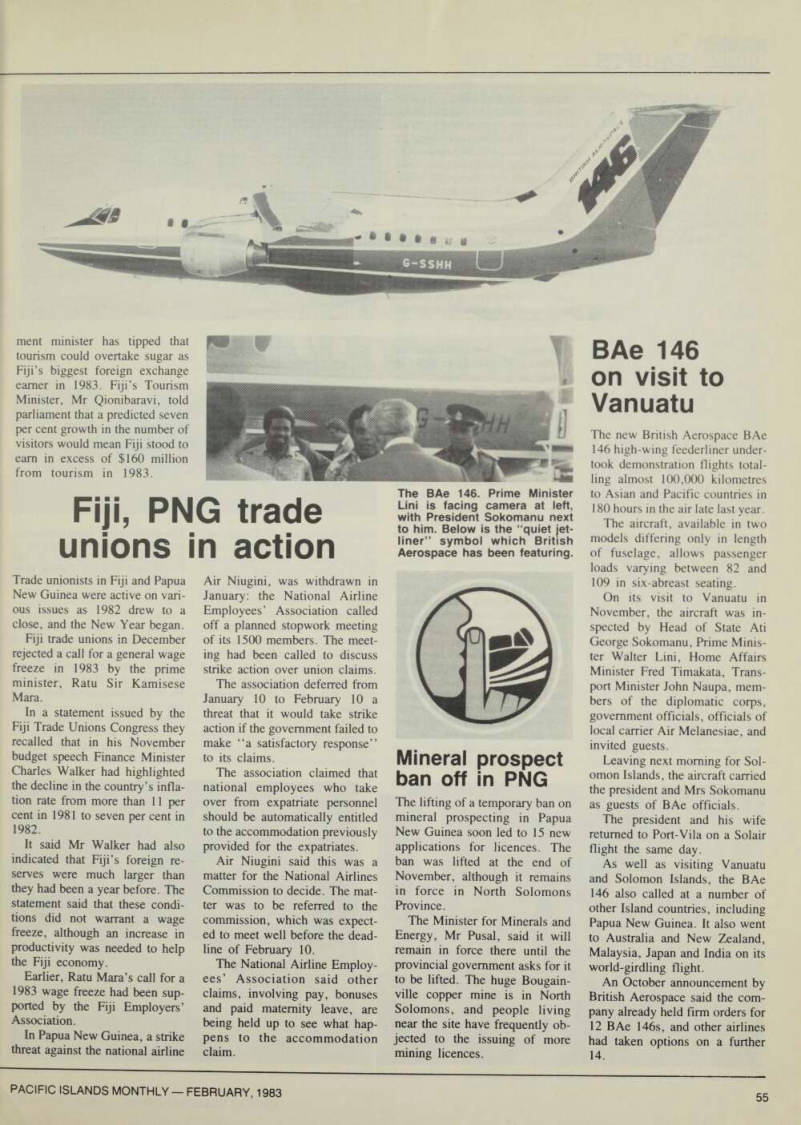
unions in action
Trade unionists in Fiji and Papua New Guinea were active on vari ous issues as 1982 drew to a close, and the New Year began.
Fiji trade unions in December rejected a call for a general wage freeze in 1983 by the prime minister, Ratu Sir Kamisese Mara.
In a statement issued by the Fiji Trade Unions Congress they recalled that in his November budget speech Finance Minister Charles Walker had highlighted the decline in the country’s infla tion rate from more than 11 per cent in 1981 to seven per cent in 1982.
It said Mr Walker had also indicated that Fiji’s foreign re serves were much larger than they had been a year before. The statement said that these condi tions did not warrant a wage freeze, although an increase in productivity was needed to help the Fiji economy.
Earlier, Ratu Mara’s call for a 1983 wage freeze had been sup ported by the Fiji Employers’
Association.
In Papua New Guinea, a strike threat against the national airline
Air Niugini, was withdrawn in January: the National Airline Employees’ Association called off a planned slopwork meeting of its 1500 members. The meet ing had been called to discuss strike action over union claims.
The association deferred from January 10 to February 10 a threat that it would take strike action if the government failed to make “a satisfactory response” to its claims.
The association claimed that national employees who take over from expatriate personnel should be automatically entitled to the accommodation previously provided for the expatriates.
Air Niugini said this was a matter for the National Airlines Commission to decide. The mat ter was to be referred to the commission, which was expect ed to meet well before the dead line of February 10.
The National Airline Employ ees’ Association said other claims, involving pay, bonuses and paid maternity leave, are being held up to see what hap pens to the accommodation claim.
Mineral prospect
ban off in PNG
The lifting of a temporary ban on mineral prospecting in Papua New Guinea soon led to 15 new applications for licences. The ban was lifted at the end of November, although it remains in force in North Solomons Province.
The Minister for Minerals and Energy, Mr Pusal, said it will remain in force there until the provincial government asks for it to be lifted. The huge Bougain ville copper mine is in North Solomons, and people living near the site have frequently ob jected to the issuing of more mining licences.
BAe 146
on visit to
Vanuatu
The new British Aerospace BAe 146 high-wing feederliner under took demonstration flights total ling almost 100,000 kilometres to Asian and Pacific countries in 180 hours in the air late last year.
The aircraft, available in two models differing only in length of fuselage, allows passenger loads varying between 82 and 109 in six-abreast seating.
On its visit to Vanuatu in November, the aircraft was in spected by Head of State Ati George Sokomanu, Prime Minis ter Walter Lini, Home Affairs Minister Fred Timakata, Trans port Minister John Naupa, mem bers of the diplomatic corps, government officials, officials of local carrier Air Melanesiae, and invited guests.
Leaving next morning for Sol omon Islands, the aircraft carried the president and Mrs Sokomanu as guests of BAe officials.
The president and his wife returned to Port-Vila on a Solair flight the same day.
As well as visiting Vanuatu and Solomon Islands, the BAe 146 also called at a number of other Island countries, including Papua New Guinea. It also went to Australia and New Zealand, Malaysia, Japan and India on its world-girdling flight.
An October announcement by British Aerospace said the com pany already held firm orders for 12 BAe 1465, and other airlines had taken options on a further 14.
The BAe 146. Prime Minister Lini is facing camera at left, with President Sokomanu next to him. Below is the “quiet jet liner’’ symbol which British Aerospace has been featuring.
Yachts
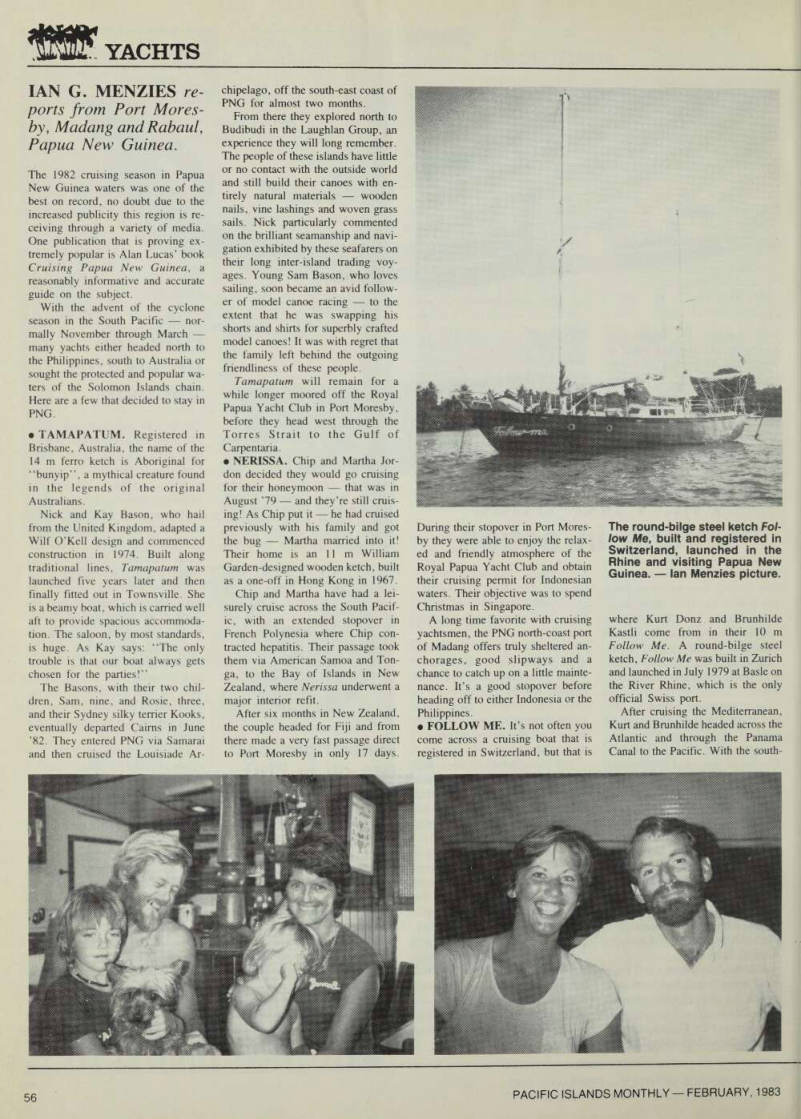
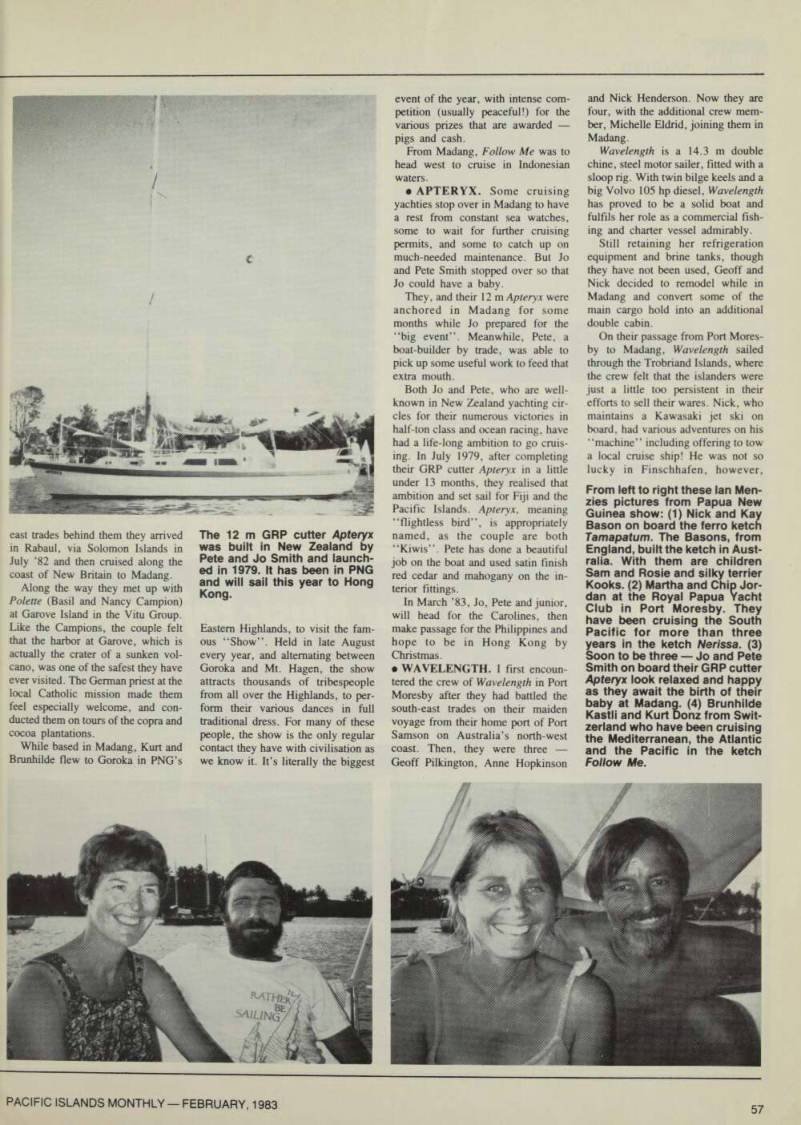
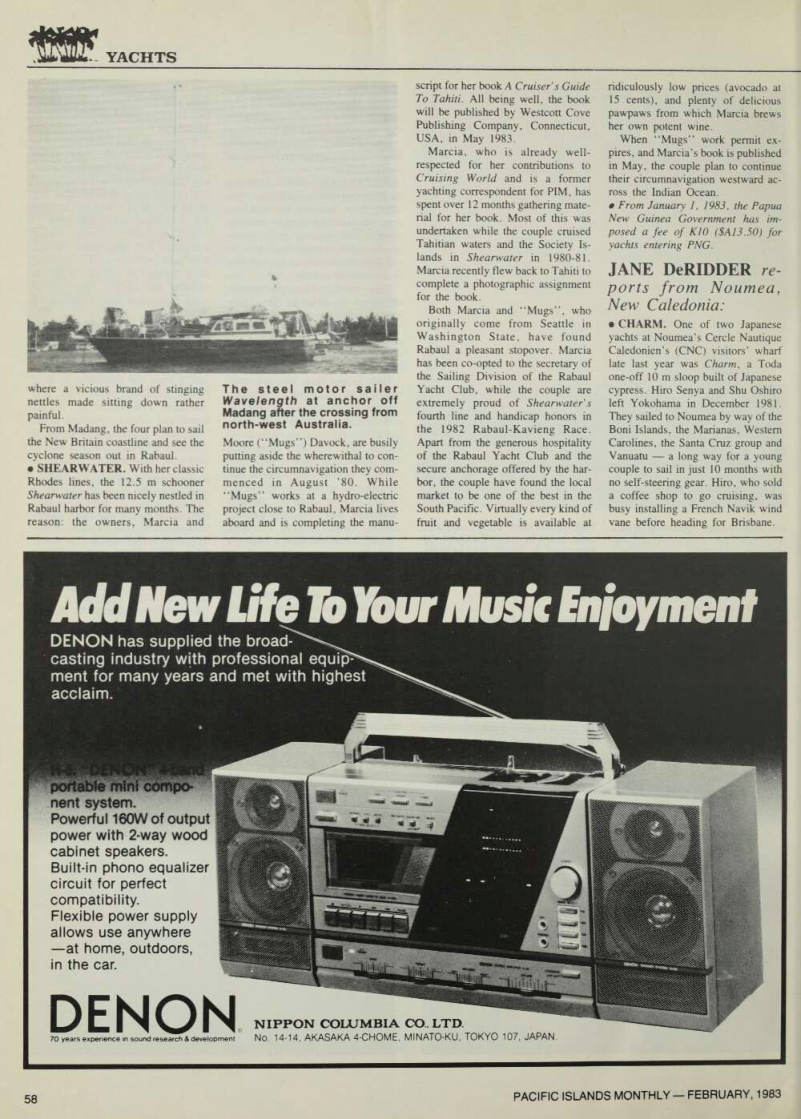
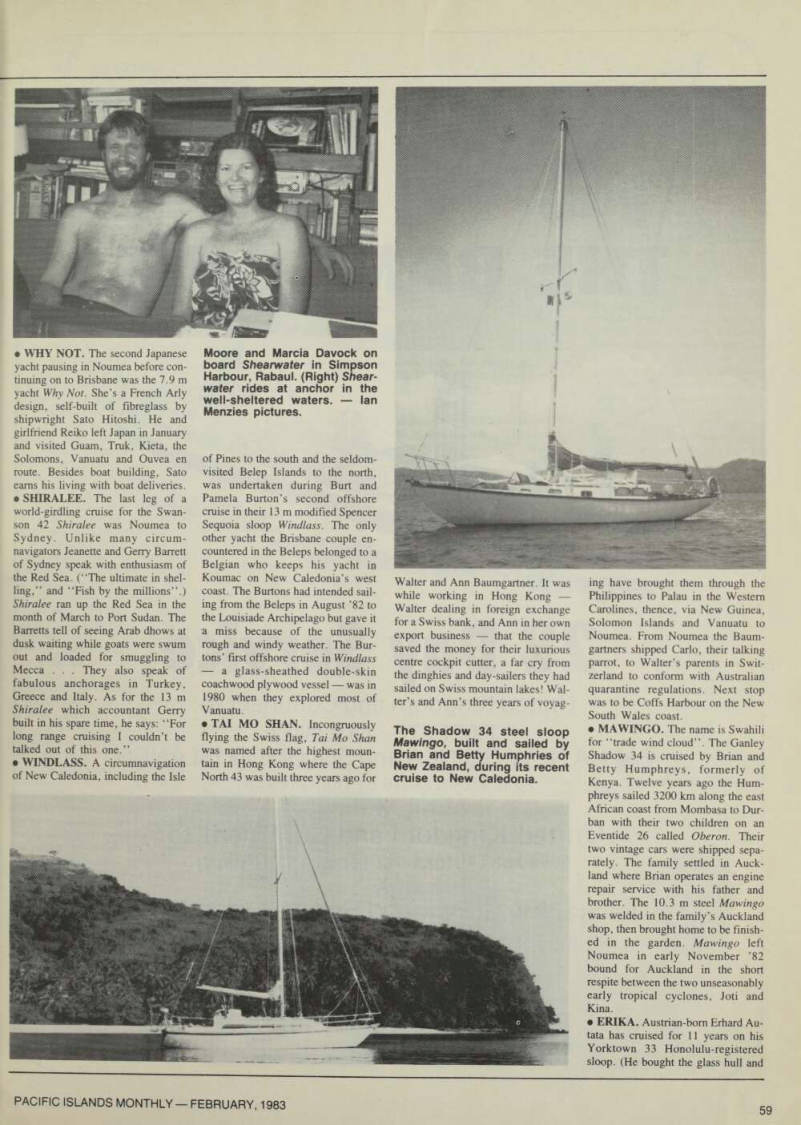
Lan G. Menzies Re
ports from Port Mores
by, Madang and Rabaul,
Papua New Guinea.
The 1982 cruising season in Papua New Guinea waters was one of the best on record, no doubt due to the increased publicity this region is re ceiving through a variety of media.
One publication that is proving ex tremely popular is Alan Lucas’ book Cruising Papua New Guinea, a reasonably informative and accurate
guide on the subject.
With the advent of the cyclone season in the South Pacific nor
mally November through March
many yachts either headed north to the Philippines, south to Australia or sought the protected and popular wa ters of the Solomon Islands chain.
Here are a few that decided to stay in
Png.
• TAMAPATUM. Registered in Brisbane, Australia, the name of the 14 m ferro ketch is Aboriginal for “bunyip”, a mythical creature found in the legends of the original Australians.
Nick and Kay Bason, who hail from the United Kingdom, adapted a Wilf O’Kell design and commenced construction in 1974. Built along traditional lines, Tamapatum was launched five years later and then finally fitted out in Townsville. She is a beamy boat, which is carried well aft to provide spacious accommoda tion. The saloon, by most standards, is huge. As Kay says: “The only trouble is that our boat always gets chosen for the parties!’’
The Basons, with their two chil dren, Sam, nine, and Rosie, three, and their Sydney silky terrier Kooks, eventually departed Caims in June ’B2. They entered PNG via Samarai and then cruised the Louisiade Ar
chipelago, off the south-east coast of PNG for almost two months.
From there they explored north to Budibudi in the Laughlan Group, an experience they will long remember.
The people of these islands have little or no contact with the outside world and still build their canoes with en tirely natural materials wooden nails, vine lashings and woven grass sails. Nick particularly commented on the brilliant seamanship and navi gation exhibited by these seafarers on their long inter-island trading voy ages. Young Sam Bason, who loves sailing, soon became an avid follow er of model canoe racing to the extent that he was swapping his shorts and shirts for superbly crafted model canoes! It was with regret that the family left behind the outgoing friendliness of these people.
Tamapatum will remain for a while longer moored off the Royal Papua Yacht Club in Port Moresby, before they head west through the Torres Strait to the Gulf of
Carpentaria.
• NERISSA. Chip and Martha Jor don decided they would go cruising for their honeymoon that was in August ’79 and they’re still cruis ing! As Chip put it he had cruised previously with his family and got the bug Martha married into it!
Their home is an 11 m William Garden-designed wooden ketch, built as a one-off in Hong Kong in 1967.
Chip and Martha have had a lei surely cruise across the South Pacif ic, with an extended stopover in French Polynesia where Chip con tracted hepatitis. Their passage took them via American Samoa and Ton ga, to the Bay of Islands in New Zealand, where Nerissa underwent a major interior refit.
After six months in New Zealand, the couple headed for Fiji and from there made a very fast passage direct to Port Moresby in only 17 days.
During their stopover in Port Mores by they were able to enjoy the relax ed and friendly atmosphere of the Royal Papua Yacht Club and obtain their cruising permit for Indonesian waters. Their objective was to spend Christmas in Singapore.
A long time favorite with cruising yachtsmen, the PNG north-coast port of Madang offers truly sheltered an chorages, good slipways and a chance to catch up on a little mainte nance. It’s a good stopover before heading off to either Indonesia or the
Philippines.
• FOLLOW ME. It’s not often you come across a cruising boat that is registered in Switzerland, but that is
where Kurt Donz and Brunhilde Kastli come from in their 10 m Follow Me. A round-bilge steel ketch, Follow Me was built in Zurich and launched in July 1979 at Basle on the River Rhine, which is the only official Swiss port.
After cruising the Mediterranean, Kurt and Brunhilde headed across the Atlantic and through the Panama Canal to the Pacific. With the south-
The round-bilge steel ketch Fol low Me, built and registered in Switzerland, launched in the Rhine and visiting Papua New Guinea. lan Menzies picture.
east trades behind them they arrived in Rabaul, via Solomon Islands in July ’B2 and then cruised along the coast of New Britain to Madang.
Along the way they met up with Polette (Basil and Nancy Campion) at Garove Island in the Vitu Group.
Like the Campions, the couple felt that the harbor at Garove, which is actually the crater of a sunken vol cano, was one of the safest they have ever visited. The German priest at the local Catholic mission made them feel especially welcome, and con ducted them on tours of the copra and cocoa plantations.
While based in Madang, Kurt and Brunhilde flew to Goroka in PNG’s
Eastern Highlands, to visit the fam ous “Show”. Held in late August every year, and alternating between Goroka and Mt. Hagen, the show attracts thousands of tribespeople from all over the Highlands, to per form their various dances in full traditional dress. For many of these people, the show is the only regular contact they have with civilisation as we know it. It’s literally the biggest
event of the year, with intense com petition (usually peaceful!) for the various prizes that are awarded pigs and cash.
From Madang, Follow Me was to head west to cruise in Indonesian waters. • APTERYX. Some cruising yachties stop over in Madang to have a rest from constant sea watches, some to wait for further cruising permits, and some to catch up on much-needed maintenance. But Jo and Pete Smith stopped over so that Jo could have a baby.
They, and their 12 m Apteryx were anchored in Madang for some months while Jo prepared for the “big event”. Meanwhile, Pete, a boat-builder by trade, was able to pick up some useful work to feed that extra mouth.
Both Jo and Pete, who are well known in New Zealand yachting cir cles for their numerous victories in half-ton class and ocean racing, have had a life-long ambition to go cruis ing. In July 1979, after completing their GRP cutter Apteryx in a little under 13 months, they realised that ambition and set sail for Fiji and the Pacific Islands. Apteryx, meaning
“flightless bird”, is appropriately
named, as the couple are both “Kiwis”. Pete has done a beautiful job on the boat and used satin finish red cedar and mahogany on the in
terior fittings.
In March ’B3, Jo, Pete and junior, will head for the Carolines, then make passage for the Philippines and hope to be in Hong Kong by Christmas. • WAVELENGTH. I first encoun tered the crew of Wavelength in Port Moresby after they had battled the south-east trades on their maiden voyage from their home port of Port Samson on Australia’s north-west coast. Then, they were three
Geoff Pilkington, Anne Hopkinson
and Nick Henderson. Now they are four, with the additional crew mem ber, Michelle Eldrid, joining them in
Madang.
Wavelength is a 14.3 m double chine, steel motor sailer, fitted with a sloop rig. With twin bilge keels and a big Volvo 105 hp diesel, Wavelength has proved to be a solid boat and fulfils her role as a commercial fish ing and charter vessel admirably.
Still retaining her refrigeration
equipment and brine tanks, though they have not been used, Geoff and Nick decided to remodel while in Madang and convert some of the main cargo hold into an additional double cabin.
On their passage from Port Mores
by to Madang, Wavelength sailed
through the Trobriand Islands, where the crew felt that the islanders were just a little too persistent in their efforts to sell their wares. Nick, who maintains a Kawasaki jet ski on board, had various adventures on his “machine” including offering to tow a local cruise ship! He was not so lucky in Finschhafen, however.
The 12 m GRP cutter Apteryx was built in New Zealand by Pete and Jo Smith and launch ed in 1979. It has been in PNG and will sail this year to Hong
Kong.
From left to right these lan Men zies pictures from Papua New Guinea show: (1) Nick and Kay Bason on board the ferro ketch Tamapatum. The Basons, from England, built the ketch in Aust ralia. With them are children Sam and Rosie and silky terrier Kooks. (2) Martha and Chip Jor dan at the Royal Papua Yacht Club in Port Moresby. They have been cruising the South Pacific for more than three years in the ketch Nerissa. (3) Soon to be three-Jo and Pete Smith on board their GRP cutter Apteryx look relaxed and happy as they await the birth of their
baby at Madang. (4) Brunhilde
Kastli and Kurt Donz from Swit zerland who have been cruising the Mediterranean, the Atlantic and the Pacific in the ketch Follow Me.
where a vicious brand of stinging nettles made sitting down rather painful.
From Madang, the four plan to sail the New Britain coastline and see the cyclone season out in Rabaul. • SHEARWATER. With her classic Rhodes lines, the 12.5 m schooner Shearwater has been nicely nestled in Rabaul harbor for many months. The reason: the owners, Marcia and
Moore (“Mugs”) Davock, are busily putting aside the wherewithal to con tinue the circumnavigation they com menced in August ’BO. While “Mugs” works at a hydro-electric project close to Rabaul, Marcia lives aboard and is completing the manu
script for her book A Cruiser’s Guide To Tahiti. All being well, the book will be published by Westcott Cove
Publishing Company, Connecticut,
USA, in May 1983.
Marcia, who is already wellrespected for her contributions to Cruising World and is a former yachting correspondent for PIM, has spent over 12 months gathering material for her book. Most of this was undertaken while the couple cruised Tahitian waters and the Society Islands in Shearwater in 1980-81.
Marcia recently flew back to Tahiti to
complete a photographic assignment
for the book.
Both Marcia and “Mugs”, who originally come from Seattle in Washington State, have found Rabaul a pleasant stopover. Marcia has been co-opted to the secretary of the Sailing Division of the Rabaul Yacht Club, while the couple are extremely proud of Shearwater s fourth line and handicap honors in the 1982 Rabaul-Kavieng Race.
Apart from the generous hospitality of the Rabaul Yacht Club and the secure anchorage offered by the harbor, the couple have found the local market to be one of the best in the South Pacific. Virtually every kind of fruit and vegetable is available at
ridiculously low prices (avocado at 15 cents), and plenty of delicious pawpaws from which Marcia brews her own potent wine.
When “Mugs” work permit ex pires, and Marcia’s book is published in May, the couple plan to continue their circumnavigation westward ac ross the Indian Ocean, From January 1, 1983, the Papua New Guinea Government has im posed a fee of KlO (5A13.50) for yachts entering PNG.
Jane Deridder Re
ports from No limed
K T . , ’ ™ ew Caledonia / • CHARM. One of two Japanese yachts at Noumea’s Cercle Nautique Caledonien’s (CNC) visitors’ wharf late last year was Charm , a Toda one-off 10 m sloop built of Japanese cypress. Hiro Senya and Shu Oshiro left Yokohama in December 1981.
They sailed to Noumea by way of the Boni Islands, the Marianas, Western Carolines, the Santa Cruz group and Vanuatu a long way for a young couple to sail in just 10 months with no self-steering gear. Hiro, who sold a coffee shop to go cruising, was busy installing a French Navik wind vane before heading for Brisbane.
The steel motor sailer Wavelength at anchor off Madang after the crossing from north-west Australia.
• WHY NOT. The second Japanese yacht pausing in Noumea before con tinuing on to Brisbane was the 7.9 m yacht Why Not. She’s a French Arly
design, self-built of fibreglass by
shipwright Sato Hitoshi. He and girlfriend Reiko left Japan in January and visited Guam, Truk, Kieta, the Solomons, Vanuatu and Ouvea en route. Besides boat building, Sato earns his living with boat deliveries. • SHIRALEE. The last leg of a world-girdling cruise for the Swan son 42 Shiralee was Noumea to Sydney. Unlike many circum navigators Jeanette and Gerry Barrett of Sydney speak with enthusiasm of the Red Sea. (“The ultimate in shel ling,” and “Fish by the millions”.) Shiralee ran up the Red Sea in the month of March to Port Sudan. The Barretts tell of seeing Arab dhows at dusk waiting while goats were swum out and loaded for smuggling to Mecca . . . They also speak of
fabulous anchorages in Turkey,
Greece and Italy. As for the 13 m Shiralee which accountant Gerry built in his spare time, he says: “For long range cruising I couldn’t be talked out of this one.” • WINDLASS. A circumnavigation of New Caledonia, including the Isle
of Pines to the south and the seldom visited Belep Islands to the north, was undertaken during Burt and Pamela Burton’s second offshore cruise in their 13 m modified Spencer
Sequoia sloop Windlass. The only
other yacht the Brisbane couple en countered in the Beleps belonged to a Belgian who keeps his yacht in Koumac on New Caledonia’s west coast. The Burtons had intended sail ing from the Beleps in August ’B2 to the Louisiade Archipelago but gave it a miss because of the unusually rough and windy weather. The Bur tons’ first offshore cruise in Windlass a glass-sheathed double-skin coachwood plywood vessel was in 1980 when they explored most of Vanuatu. • TAI MO SHAN. Incongruously flying the Swiss flag, Tai Mo Shan was named after the highest moun tain in Hong Kong where the Cape North 43 was built three years ago for
Walter and Ann Baumgartner. It was
while working in Hong Kong
Walter dealing in foreign exchange
for a Swiss bank, and Ann in her own export business that the couple saved the money for their luxurious centre cockpit cutter, a far cry from the dinghies and day-sailers they had sailed on Swiss mountain lakes! Wal ter’s and Ann’s three years of voyag-
ing have brought them through the Philippines to Palau in the Western Carolines, thence, via New Guinea, Solomon Islands and Vanuatu to Noumea. From Noumea the Baum gartners shipped Carlo, their talking parrot, to Walter’s parents in Swit zerland to conform with Australian quarantine regulations. Next stop was to be Coffs Harbour on the New South Wales coast. • MAWINGO. The name is Swahili for “trade wind cloud”. The Ganley Shadow 34 is cruised by Brian and
Betty Humphreys, formerly of
Kenya. Twelve years ago the Hum phreys sailed 3200 km along the east African coast from Mombasa to Dur ban with their two children on an Eventide 26 called Oberon. Their two vintage cars were shipped sepa rately. The family settled in Auck land where Brian operates an engine repair service with his father and brother. The 10.3 m steel Mawingo was welded in the family’s Auckland shop, then brought home to be finish ed in the garden. Mawingo left Noumea in early November ’B2 bound for Auckland in the short respite between the two unseasonably
early tropical cyclones, Joti and
Kina. • ERIKA. Austrian-born Erhard Au tata has cruised for 11 years on his Yorktown 33 Honolulu-registered sloop. (He bought the glass hull and
Moore and Marcia Davock on board Shearwater in Simpson
Harbour, Rabaul. (Right) Shear
water rides at anchor in the well-sheltered waters. lan
Menzies pictures.
The Shadow 34 steel sloop Mawingo, built and sailed by Brian and Betty Humphries of New Zealand, during its recent cruise to New Caledonia.
decks from Henry McKewen, the voice of Bugs Bunny!) Carpenter/ref rigeration mechanic, Erhard com pleted the kit boat in Long Beach, and outfitted it at Dana Point, California. He considers building boats a challenge, and far more fun than house-building, where “every thing is square”. Erhard plans to return to Tahiti after spending hur ricane season in Gladstone, Queens land “wind permitting”. About the appointments on red-hulled Erika, Erhard says: “Omega? I wasted my money on it. My digital depth soun der is the most important bit of
gear.”
• AERANDIR. With 17,000 km under the keel in 11 months, Aeran dir is earning her name slowly but surely, say Peter and Chris McHugh of their English-designed, Tasma nian-built half-tonner. ( Aerandir is a Tolkien “Silmarillian” name mean ing “sea wanderer”.) Peter, a clerk from Devonport, Tasmania, and Chris, a nurse from Christchurch, New Zealand, sailed their 9 m steel yacht as far as Pitcairn Island where, true to her name, Aerandir took off on her own to be caught 3 km offshore. Her 10 kg CQR anchor with 18 m of chain was retrieved by Steve Christian. Christian free-dived 15 m deep to bring up the end of the chafed anchor line. The McHughs approached New Caledonia’s Havan nah Passage during a westerly blow with zero visibility. They had to turn around and wait for two days.
“That’s when a Sat Nav would have been very nice,” Brian admitted.
Aerandir left Noumea in blustery
south-easterlies with Tropical Cyc
lone Kina at her heels, bound for Christchurch for refurbishing. • MANU-KA-RERE. A sistership to John Guzzwell’s Trekka, Manu- Ka-Rere, a cold-moulded 6 m sloop, is owned and sailed by New Zealan ders Cindy Slark, 25, and her brother Jon, 23. They were joined by their co-owner brother Matt, 22, for the Malololailai to Port-Vila Race.
Manu-Ka-Rere was the smallest but not the slowest of 17 cruising yachts taking part in what Jon termed “a perfect downwind race”. Then voyage from Noumea to Brisbane between Tropical Cyclones Joti and Kina will not have been in such idyllic conditions. During the five years that the three Slarks have own ed the mini-sloop it has fallen mainly to Cindy to sail and look after the vessel, for young Matt is a student at the University of Canterbury, and Jon spent three years on Tuvalu working as a diver with the New Zealand aid program engaged in
blasting and clearing channels
through the reefs of various islands.
Jon plans on taking a commercial diving course with a view to employ-
ment on oil rigs. Cindy, holder of a law degree, was working as a “post ie” before their departure, delivering mail by bicycle in Birkenhead. “Best job I’ve ever had,” she says. • HEBER. Bearing an Irish name, carrying an all South African crew, flying the red ensign and with port of registry London, Heber was built in Cork in 1917 as a fishing boat. This hefty 14-tonne gaff rigged wooden vessel (10.4 m waterline, 12.8 m overall, 1.8 m draft) has been totally rebuilt by Robin Smith in the 11 years he has owned and cruised her
framing, planking, decks, super
structure included. Robin even deepened the keel and copper-plated the hull below the waterline. It was while teaching, and rebuilding Heber in Capetown, that Robin met and married fellow teacher Jenny. Baby Nadine Smith was bom two months prematurely in Taio Hai in the Mar quesas. A minute 2 kg at birth, Nadine lost 400 grams before she took hold of life and became the healthy seven-month-old we saw in Noumea. Nadine’s Marquesan name
Taihia Hoata ite Moana means “be loved soft light which illuminates the ocean”. The Smith family and crew member Martin were waiting for the effects of Tropical Cyclone Kina to pass before heading for Brisbane. • SUSURUMBA. Don and Bridget Bruneski’s trimaran, with the melodious Zimbabwean name, is easily recognisable. She’s a red hulled Hedley Nichol 36 tri, sporting a wind generator with a Canadian maple leaf painted on the vane trail ing behind the whirling airfoil blades. Architect Don Bruneski of Rossland, British Columbia, says the heart of his electric generating sys tem is a generator sold by Hamilton Ferris of Santa Cruz, California, which is designed to work with a tow propeller. When a 6 hp OMC out board prop on its 1 m stainless steel shaft and 20 m of line is towed at 5 knots the device generates at 5 amps. (8 amps at 7 knots.) When the trima ran travels faster, the generator pro duces as much as 10 amps but it heats up and the propeller has to be hauled in. While in Suva, Don finished
building the wind generator using data supplied by Bridget’s sister Catherine who scoured London lib raries and additional info gleaned from the Department of Energy and the University of the South Pacific.
“It nas made such a difference to our lives,” they say. Susurumba has only an ouboard motor as auxiliary en gine. A Honda portable generator was formerly used to charge the batteries. Therefore alternative ener gy sources are even more important than they are to most other cruising vessels, particularly since Don and Rhodesian-bom Bridget like to keep in regular touch with family and friends worldwide by means of amateur radio contacts. (Call sign SWIED.) Before entering the South Pacific the Bruneskis spent over a year in Mexico’s Sea of Cortez based in Puerto Escondido. Here they adopted Baby Paul, now a sturdy, active little fellow with a good set of sea legs. Susurumba will sail from Noumea to Brisbane where Bridget is looking forward to space, time and regular playmates for Paul. Bridget says: “I just wish we could find some means of harnessing Paul’s energy!” • AKATES. The 12 m Akates, the “faithful friend” of Virgil’s Aeneid, is a Boro design yawl built of steel in Perth, Western Australia, then finish ed by owner Terry Hickey. Terry and Lois started cruising Akates in 1977 up the Queensland coast. Now retired and on their first offshore voyage, the
Perth couple plan on spending two
years or so in the Pacific, including hurricane season in New Caledonia where they are “fascinated by the color of the place, the flowers and dresses and everywhere the young people on their two-wheel matadore machines flat out, shirts flying, reck
lessly gay.”
Bridget, Paul and Don Bruneski on board Susurumba. (Left) Jen ny Smith and baby Nadine of Heber.
The superb Norwegian-designed Duen, home for Albert and Dotty Fletcher, motors out of Madang, PNG, for an offshore cruise.-lan Menzies picture.
• SILVIA. “Papa Blondie” missed his 65th birthday because of crossing the International Date Line. He is Herbert Jivegard, master of the blue hulled 9 m Albin Ballad, a half-tonne
fibreglass ocean cruising sloop
named after the Queen of Sweden and proudly flying the blue and gold flag. Herbert says that when he re tired from his 30 years as wholesale food broker and fulfilled a dream by leaving in June ’79 on his own small ship, “A new world opened to me”.
He learned to speak English, took up macrame and knot work, and began
writing travelling newsletters for
family, friends and former employ ees, many of whom have joined the vessel as guests particularly when Silvia was Caribbean-based in St Vincent for two years. Erik Hell strom 34, sales engineer for the Ger man BASF chemical company and longtime friend of Herbert’s, joined Silvia in St Thomas as first mate for her Pacific cruise. Though Herbert and Erik find the South Pacific not nearly as hot and sunny as they’d been led to believe, the “beautiful people, good friends and incredible hospitality’’ more than make up for it. Papa Blondie’s newsletter is pub lished in weekly instalments in a Swedish newspaper. • PANACHE. A survivor of Ton ga’s Cyclone Isaac, Panache was one of several yachts waiting in the rain in Noumea in mid-November for heavy weather to subside before set ting sail for Queensland. Tony Barra plans on a major refit for his eight year-old Catalina 30 in either Bris bane or Bundaberg. Panache’s crew member Jennifer Guilbert was look ing forward to getting underway for she loves ocean passages and speaks with enthusiasm of “clean air and tons of space ...” • FRISIA. When the Dutch vessel Frisia, a 14.3 m steel ketch, was caught in a gale on her maiden voyage from New Zealand to Suva, Hessel Dykstra became concerned for the well-being of his severely seasick wife and daughters. Seven year-old Michelle in particular was
suffering from severe dehydration
and it was feared she might go into shock. Abiding by radioed medical advice, Hessel arranged to have the three transferred to the Fiji vessel Tui Cakau which was in their vicinity.
Hessel’s Sat Nav fix made location an easy matter. The Tui Cakau low ered a lifeboat in its lee enabling the transfer to be made quickly and safe ly in spite of large swells running.
Again on radioed medical advice, treatment of the seasick patients took the form of flat Coca-Cola, glucose and dry cabin biscuits.
Aboard Frisia, 12-year-old Remco was promoted to first mate, a posi tion he has filled competently ever
since. The Dykstras were reunited in Suva and have enjoyed cruising their
family-built floating home in Fiji
waters. Fortunately the weather was fair for the sail from Suva to New Caledonia.
Frisia is a luxuriously appointed blue-hulled ketch. She was designed by Albert Blok, former chief draughtsman for the Dutch naval architect, H. W. DeVoogt. Hessel welded the hull himself. His wife Stella sandblasted it and took charge of sanding, painting and varnishing when the time came. In fact the whole family was involved in the six year project. For the Noumea- Brisbane leg of Frisia’s cruise, Stella
was planning on trying the relatively
new “sticker-behind-the-ear” sea
sickness remedy.
• BIG BEAR H. Wrecked near Christmas Island, the Vancouver registered schooner Big Bear H (PIM Oct. ’B2, p 73) struck a reef at night in mid-October in heavy rain squalls while en route to Hawaii with a delivery crew. Owner Helmut Petrak flew in with salvage experts but efforts to refloat the 13.7 m yacht were unsuccessful.
From Atlantic to Pacific in the Swedish yacht Silvia. Owner and skipper Herbert Jivegärd (top) and first mate Erik Hellström.
Advertisements & other items, pp. 58-62 (2 items)
Yachts
Demon
min j *a.
' component system.
Powerful 160 W of output power with 2-way wood cabinet speakers.
Built-in phono equalizer circuit for perfect compatibility.
Flexible power supply allows use anywhere —at home, outdoors, in the car.
DEMON
70 years experience in sound research & development
NIPPON COLUMBIA CO. LTD
No. 14-14, AKASAKA 4-CHOME, MINATO-KU, TOKYO 107, JAPAN.
THE BANK LINE
28 Day Service
United Kingdom and Continent to:
PAPEETE • NOUMEA
PAPUA NEW GUINEA and SOLOMON ISLANDS
PORT VI LA & SANTO BY TRANSHIPMENT United Kingdom and Continent to: SUVA AND LAUTOKA (FCL LCL & UNITISED ONLY) Papua New Guinea and Solomon Islands to;
UNITED KINGDOM and CONTINENT
For particulars apply:
THE BANK LINE (AUSTRALASIA) PTY. LTD.
Suite 801, 51 Pitt Street, Sydney 2000. Australia. Tel: 272041. Tlx: 24063. «S£ Cfth
A >A S'" x s
Only our Dragon Boat
visits more ports,
more often,
in the South Pacific.
The New Guinea Pacific Line offers the quality handling you're used to, through its exclusive containerised service to Papua New Guinea and the Solomon Islands.
Rely on us all the way. • Fast transit times to all ports. • A guaranteed schedule every 30 days, thanks to berths in Papua New Guinea and Honiara reserved for N.G.P.L. use. • Safe, secure transport of goods in containers, both L.C.L., and F.C.L. no more damage or pilferage of cargo. • A wide coverage of all ports with the monthly container service from Hong Kong, Singapore, Taiwan, the Philippines, Malaysia and Bangkok to all Papua New Guinea ports and Honiara.
For further details on our reliable Dragon Boat service contact:
PAPUA NEW GUINEA
Steamship Trading Co., Ltd.
Port Moresby Telephone: 212000
NEW GUINEA
PACIFIC LINE
HONG KONG
Swire Shipping (Agencies) Ltd.
Telephone: 5-264311
SINGAPORE
Straits Shipping Pte. Ltd.
Telephone: 436071
Shipping Schedules
Australia - Fiji
Karlander (Aust) Pty. Ltd. operates monthly cargo services from Sydney to Suva and Lautoka.
Details from Karlander (Aust) Pty.
Ltd., 19-31 Pitt Street, Sydney (232- 1011), Dalgety Shipping, 460 Bourke Street, Melbourne (616-6700). Burns Philp (SS) Co. Ltd., Suva and Lautoka.
Sofrana-Unilines (Fiji Express Line) operates to Suva and Lautoka every two weeks from the main ports on the east coast of Australia and monthly to Lautoka from Melbourne and Sydney.
Details from Sofrana-Unilines, 19 Pitt Street, Sydney (27-9851), Trans- Austral Shipping Pty.Ltd., 570 Bourke Street, Melbourne (67-9162); ACTA Pty. Ltd., Brisbane (221-3116); Elders- ANL Pty. Ltd., Port Adelaide (47-5688); ANL Newcastle (049-24364); Cle ments and Marshall, Burnie, Tasmania (31-1833), Carpenters Shipping, 100 Thomson St., Suva, Fiji (312-244), Tlx 2199 FJ.
Australia - Samoas - Niue -
Tonga
Warner Pacific Lines operates a re gular cargo service from Sydney to Nukualofa, Pago Pago, Apia, Niue and Vavau.
Details from Hetherington Wesfar mers Shipping Agency, 37-49 Pitt Street, Sydney (27-1671).
Australia - New Caledonia -
Fiji ■ Samoas - Tonga
Pacific Forum Line operates a fully containerised service (general, reefer and ro-ro) from Sydney to Noumea, Lautoka, Suva, Apia, Pago Pago, Nukualofa, Sydney. Cargo centralised from Adelaide, Melbourne, Brisbane.
Details from Pacific Forum Line, Sydney: Union Bulkships, Sydney, Brisbane and Melbourne; SATO, Noumea, Union Company, Lautoka, Suva and Nuku’alofa; Pacific Forum Line, Apia.
Australia - Lord Howe Is -
Norfolk Is
Compagnie des Chargeurs Caledo nians operates four-weexly cargo ser vice Sydney - Lord Howe Island and Norfolk Island.
Details: Hetherington Wesfarmers Shipping Agency, 37-49 Pitt Street, Sydney (27-1671).
Australia - Kiribati
Karlander operates a 5/6 weekly service from Melbourne and Sydney to Kiribati (Tarawa).
Details: Karlander (Aust) Pty. Ltd., 19-31 Pitt Street, Sydney (232-1011).
Australia - Nauru - Kiribati
Nauru Pacific Line operates regular cargo/passenger service from Mel bourne to Nauru and Tarawa.
Details: Nauru Corporation (Vic.) Inc. (Shipping Division), Nauru House, 80 Collins Street, Melbourne (653-5709).
Nedlloyd Swire, 8 Spring Street, Syd ney (2-0522).
Australia - New Caledonia
(And/Or) Vanuatu
Sofrana-Unilines ships serve Noumea every two weeks from the main ports along the east Australian coast.
Details from Sofrana-Unilines, 19 Pitt Street, Sydney (27-9851), Trans- Austral Shipping Pty. Ltd., 570 Bourke Street, Melbourne (67-9162), ACTA Pty. Ltd., Brisbane (221-3116), Elders- ANL Pty. Ltd., Port Adelaide (47-5688), ANL, Newcastle (049-24364), Cle ments & Marshall, Burnie, Tasmania (31-1833).
Compagnie des Chargeurs Caledo niens operates a three-weekly con
tainerised cargo service from Sydney to Noumea.
Details Hetherington Wesfarmers Shipping Agency, 37-49 Pitt Street, Sydney (27-1671).
Compagnie Generale Maritime oper ates a monthly service from Sydney to Noumea, Port Vila and Santo, for con tainerised and break bulk cargo.
Details Compagnie Generale Maritime, 12 Castlereagh Street, Syd ney (231-3700).
Australia - Nz - Fiji -
Hawaii - Us
P&O liners call at Auckland, Suva, Pago Pago and Honolulu on east bound and westbound voyages bet ween Sydney and the US.
Details from P&O Booking Centre, World Travel Headquarters Pty.Ltd., 33 Bligh Street, Sydney (237-0333).
AUSTRALIA - NZ - FIJI - TONGA -
Vanuatu - New Caledonia -
Solomons - Samoas - New
Guinea
Sitmar Cruises operates a year round cruise program to include most of the above countries.
Details from Sitmar Cruises, 47 Elizabeth Street, Sydney (232-7511).
AUSTRALIA - NZ - FIJI - TONGA -
Vanuatu - New Caledonia -
Solomons - Samoas - Tahiti
P&O liners call at Auckland, Bay of Islands, Honiara, Lautoka, Noumea, Nukualofa, Pago Pago, Papeete, Port Moresby, Santo, Savusavu, Suva, Vavau and Vila on cruises from Australia.
Details from P&O Booking Centre, World Travel Headquarters Pty. Ltd., 33 Bligh Street, Sydney (237-0333).
Australia - Nz - Solomons -
Png
Pacific Forum Line operates con tainerised and general cargo service from Lyttleton, Napier and Auckland to Honiara, Lae, Port Moresby, Brisbane.
Details from Pacific Forum Line, Au ckland: Steamships Shipping, Port Moresby: Sullivans Ltd., Honiara.
Australia - New Zealand -
Pacific Islands - South East
Asia - China
Minghua Cruises operates cruise services from Sydney to Hawaii, Tahiti and most Pacific ports, with several cruises to South bast Asia, including Japan, the Philippines, Singapore, Hongkong and China.
Details Minghua Cruises, 7 Bridge Street, Sydney, NSW, 2000 (2-0547), Burns Philp Travel offices in Melbourne (62-0151), Brisbane (31-0391), Darwin (81-2871), Auckland NZ (31-544); Na tional Bank Travel in Adelaide (212- 7347) and Perth (320-9365).
Australia - Micronesia
Nauru Pacific Line operates a regu lar container service from Melbourne to Majuro, Kosrae, Ponape, Truk, Guam and Saipan.
Details Nauru Corporation (Vic.) Inc. (Shipping Division), Nauru House, 80 Collins Street, Melbourne, (653-5709), Nedlloyd Swire, 8 Spring Street, Syd ney (2-0522).
Australia - Tuvalu
Karlander operates a three monthly service from Sydney and Melbourne to
Tuvalu (Funafuti).
Details from Karlander (Aust.) Pty.
Ltd., 19-31 Pitt Street, Sydney (232- 1011).
Australia - Png
Karlander New Guinea Line's cargo vessels call at Melbourne, Sydney,
Port Moresby, Lae, Madang, Wewak, Manus, Kimbe, Rabaul, Popondetta.
Details from Karlander (Aust.) Pty.
Ltd., 19-31 Pitt Street, Sydney (232- 1011), Dalgety Shipping, 460 Bourke Street, Melbourne (616-6700).
Australia - Png - Solomons
A consortium of Conpac, NGAL/PNGL have three container ves sels operating on a 28 day turn-around from Melbourne, Sydney and Brisbane to Port Moresby, Lae, Rabaul, Kavieng, Wewak, Madang, Kieta and Honiara.
Details from Burns, Philp & Co. Ltd., 51 Pitt Street, Sydney (2-0547) and Interocean Swire, 8 Spring Street, Syd ney (2-0522).
New Guinea Express Lines operates a fortnightly container service from Melbourne, Sydney, Brisbane to Port Moresby, Lae, Alotau, Kimbe, Rabaul, Kiuta, Honiara.
Details from New Guinea Express Lines, PO Box R 73, Royal Exchange, Sydney (241-3991); New Guinea Ex press Lines, 127 Creek Street, Bris bane (221-9333); New Guinea Express Lines, 327 Collins Street, Melbourne (61-3053); Niugini Express Lines, Port Moresby (21-4572); Lae (42-1536); Rabtrad Niugini Pty. Ltd., Rabaul (92- 2911) and Kieta (95-6185); Alotau Stevedoring & Transport, Alotau (61- 1318); Ngatia Wholesalers Pty. Ltd., Kimbe (93-5102); and Trading Com pany, Mendana Avenue, Honiara (588).
Sofrana-Unilines (PNG Line) oper ates a monthly service to Port Moresby and Lae, from main ports on the east coast of Australia.
Details from Sofrana-Unilines, 19 Pitt Street, Sydney (27-9851); Trans- Austral Shipping Pty. Ltd., 570 Bourke Street, Melbourne (67-9162); ACTA Pty. Ltd., Brisbane (221-3116); Elders ANL Pty. Ltd., Port Adelaide (47-5688).
Australia - Tahiti
Compagnie Generale Maritime oper ates a monthly service from Sydney to Papeete for containerised and break bulk cargo.
Details Compagnie Generale Maritime, 12 Castlereagh Street, Syd ney (231-3700).
Australia - Tahiti - Us
Karlander operates a monthly cargo service from Melbourne and Sydney to Papeete, US west coast.
Details: Karlander (Aust.) Pty. Ltd., 19-31 Pitt Street, Sydney (232-1011).
Australia - Nz - West Coast
South America
South Pacific Seaboard Service of fers a regular cargo service from Bris bane, Sydney, Adelaide and Mel bourne to New Zealand ports Lyttleton and Tauranga and to the west coast of South America, calling at Beu’ventura, Guayaquil, Cailao and other ports on inducement.
Details from South Pacific Seaboard Service agents, Meridian Shipping & Transport Agencies, 50 Clarence Street, Sydney (290-1633), Tlx 25970; Melbourne (67-5907); Brisbane (267- 6355); Adelaide (47-6600); Ocean bridge Shipping Ltd., 22 Emily Place, Auckland (33-279). Tlx 60523; lan Tay lor Y Cia Ltda, Prat 827 Of. 301, Valparaiso, Chile (59096), Tlx. 30331.
Singapore - Hongkong • Fiji -
Islands Ports
Kyowa Shipping Co. Ltd. operates a monthly service from Singapore, Hon gkong to Lautoka, Suva and then to island ports.
Details from Carpenters Shipping, 100 Thompson Street, Suva, (312- 244), Tlx FJ2199.
Far East - Fiji - New
Zealand
New Zealand Unit Express (NZUE) operates a monthly palletised cargo service from Manila, Keelung, Ka oshiung and Hongkong to Lautoka, Suva and thence to N 2.
Details from Carpenters Shipping, 100 Thompson Street, Suva (312-244), Tlx Fj2199, Burns Philp, Suva (311- 777) P&O S.N. Co. Wellington (736- 477) or Nedlloyd Swire Pty. Ltd., Syd ney (20-522).
Nedlloyd operates bi-weekly cargo service with four ships from Sourabaya, Jakarta, Bangkok, Port Kelang and Singapore to Suva, Lauto ka and NZ ports.
Details from Nedlloyd (Aust.) Pty.
Ltd., 8 Spring St., Sydney (27-3801), Burns Philp (SS) Co. Ltd., Suva and Lautoka.
Far East - Mid-S. Pacific
China Navigation’s New Guinea Pacific Line operates a regular contain er service from Hongkong, Taiwan, Manila, Port Kelang and Singapore to Port Moresby, Lae, Rabaul and Honia ra monthly and to Wewak, Madang and Kieta every three months. Cargo from the same Far Eastern ports to the South Pacific ports of Noumea, Santo, Vila, Papeete, Pago Pago, Apia, Rarotonga and Tarawa will be shipped via Japan on the monthly Bali Hai service.
Details from Steamships Trading Co.
Ltd., P.O. Box 1, Port Moresby (22- 0222).
Kyowa Shipping Ltd., operates monthly services from Japan to Guam, Saipan, Solomons, New Caledonia, Fi ji, Western and American Samoa, Tahiti, Cook Is. Tonga and Vanuatu.
Details: Hetherington Wesfarmers Shipping Agency, 37-49 Pitt Street, Sydney (27-1671); Carpenters Ship ping, Suva (312-244), Tlx FJ2199.
Japan - Fiji - New Zealand
Kyowa Shipping Co. Ltd., operates a monthly service from main ports of Japan to Suva and Lautoka and thence to island ports and NZ.
Details from Carpenters Shipping, 100 Thompson St., Suva (312-244), Tlx FJ2199.
Japan - Fiji - Island Ports
Bali Hai service operates a monthly service from main ports of Japan to Suva and Lautoka and thence to island ports.
Details from Carpenters Shipping, 100 Thompson St., Suva (312-244), Tlx FJ2199 and Burns Philp, Suva (311-777).
Japan - Micronesia
The NYK Shipping Line operates a monthly cargo service from Japan to Micronesia, calling at Yoko, Nagoya, Kobe, Guam, Saipan, Truk, Ponape and Majuro, returning via Yoko, Nagoya and Kobe.
Details from Burns, Philp & Co. Ltd., 51 Pitt Street, Sydney (2-0547).
Japan - Png
Mitsui O.S.K. Lines operates a monthly service from main ports Japan and Port Moresby, Rabaul, Lae, Madang, Kieta and Kimbe.
Details from Robert-Laurie (PNG) Pty. Ltd., PO Box 922, Port Moresby (21-2466/21-1898).
New Caledonia - Fiji - West
Coast North America
PAD Line operates an approx. 3weekly ro-ro service with Noumea and Suva to Honolulu and West Coast USA and Canadian ports.
Details from Sofrana-Unilines SA, BP 1602, Noumea (27-51-91), Tlx
NMO4B; Carpenters Shipping, 100 Thompson St., Suva (312-244), Tlx FJ2199.
Png - Inter - Mainport
Papua New Guinea Line offers scheduled 10/20 day coastal liner ser vices linking all PNG major ports with containerisation, reefer, heavy lift and transhipment facilities.
Details from PNG Line, Box 543, Port Moresby, PNG (21-1174), Tlx 22269.
Png- Uk/Continent
The Bank Line operates regular car go service from Port Moresby, Oro Bay, Kieta, Rabaul, Kimbe, Madang and Lae to Hull, Hamburg, Rotterdam, Antwerp and Le Havre.
Details from The Bank Line (A’asia) Pty. Ltd., 51 Pitt Street, Sydney (27- 2041); Burns Philp (PNG) Ltd. PNG ports.
Solomons - Uk/Continent
The Bank Line operates regular car go service from Honiara to Hull, Ham burg, Rotterdam, Antwerp and Le Havre.
Details from The Bank Line (A'asia) Pty. Ltd., 51 Pitt Street, Sydney (27- 2041); Tradco Shipping (588).
NZ - COOK IS - NIUE - TAHITI Shipping Corporation of NZ Ltd. op erates cargo services based on pallets and similar units from Auckland to Niue, Cook Islands and Tahiti.
Details from the Shipping Corp. of NZ Ltd., PO Box 3420, Auckland (797- 210). Waterfront Commission, PO Box 61, Raratonga; Cook Islands; Niue Govt. Offices, Niue Island Compagnie
Maritime Polynesienne, BP 368, Papeete, Tahiti.
New Zealand - Tahiti
Pacifique Polynesie Line operates a monthly service carrying general and freezer cargoes to Papeete and outly ing islands in the group.
Details from McKay Shipping Ltd., PO Box 1372, Auckland, (930-229), Tlx 2554 NZ.
Nz - Fiji
Reef operates a regular 18-day ser vice from Auckland to Suva and Lautoka.
Details from Reef Shipping Agen cies, PO Box 3382, Auckland, NZ (77- 1221-3); M.V. Fijian Shipping Agencies Ltd., Private Bag, Suva, Fiji (31-1056).
Pacific Line with one ship operates fortnightly ro-ro cargo service New Zealand, Lautoka, Suva.
Details: Sofrana Unilines, 18 Cus toms Street, Auckland (773-279) PO Box 3614, Telex: NZ2313; Carpenters Shipping, 100 Thompson Street, Suva (312-244), Tlx FJ2199.
NZ - FIJI - NORTH AMERICA (WC) Blue Star Line Ltd. Pacific Coast container services. Only direct service to and from New Zealand. Blue Star vessels call at Suva and Honolulu on NZ-US-West Coast voyages.
Details from Blueport ACT (NZ) Ltd., PO Box 192, Wellington (739-029).
Burns Philp (SS) Co. Ltd., GPO Box 355, Suva, Fiji (311-777), Tlx. FJ2168 Burship.
NZ - FIJI - SAMOAS - TONGA Pacific Forum Line operates a fully containerised three-weekly service
(Gen/Reefer) from Auckland to Lauto ka, Suva, Apia, Pago Pago and Nukualofa.
Details from Pacific Forum Line, Au ckland: Union Co. Auckland, Lautoka, Suva and Nukualofa; Pacific Forum Line, Apia.
NZ - N. CALEDONIA - VANUATU -
Png - Solomons
Sofrana Unilines with three ships operates to Vila and Santo, to Honiara and Papua New Guinea and to Norfolk Island and Noumea.
Details from Sofrana Unilines, 18 Customs Street, Auckland (773-279), PO Box 3614, Tlx. NZ2313.
Nz Tahiti
Compagnie Tahitienne Maritime SA (as CTM-Tahiti Line) operates one ship, MV Bounty 111, monthly Papeete New Zealand.
Details from Sofrana Unilines, PO Box 3614, 18 Customs St., Auckland Tlx NZ2313; Agence Maritime Cowan, PO Box 9012, Papeete (39042), Tlx Tahitlin 322 FP Tahiti).
Nz - Tonga - Samoas
Warner Pacific Line services Auck land, Nukualofa, Vavau, Apia, Pago Pago fortnightly carrying general and freezer cargoes.
Details from McKay Shipping Ltd., Downtown House, 21 Queen St., Auck land, PO Box 1372 (30-299). Cables MACSHIP, Telex NZ2554, Warner Pacific Line, Box 93, Nukualofa, Ton ga; Mealelei (Western Samoa) Ltd.
Box 4171, Apia, Western Samoa, Kneubuhl Maritime Services, Box 39, Pago Pago, American Samoa, 96799.
Nz - New Caledonia
CP Line operates a monthly cargo service from Auckland, Lyttelton, Napier and Mt. Maunganui to Noumea.
Details from McKay Shipping Ltd., PO Box 1372, Auckland (9-30229); Tlx 2554 NZ.
Europe - Tahiti -
New Caledonia
Compagnie Generate Maritime oper ates services from Europe and Mediterranean ports to Papeete and Noumea using three ro-ro and multi purpose vessels thus ensuring a bi monthly sailing to and from.
Details Compagnie Generale Maritime, 12 Castlereagh Street, Syd ney (231-3700).
Europe - Tahiti - New
Caledonia - New Zealand -
Solomons - Png - Europe
Polish Ocean Lines offers regular monthly sailings for containerised and breakbulk cargo from Hamburg, Ant werp, Dunkirk and Rouen to Papeete, Noumea, New Zealand, Honiara, Lae, returning to Europe via Suez. Other ports in the South Pacific can be serv ed with inducement.
Details from Sotama, BP 9170, Papeete (27805), Tlx. 296; SATO, BP C 2, Noumea (272094), Tlx. 163 NM SATO: Union Steamship Co of NZ, PO Box 50, Apia, Tlx. 25; Williams and Gosling, PO Box 79, Suva (312633), Tlx. 2163; Warner Pacific Line, PO Box 93, Nukualofa (21089), Tlx. 66219; Universal Shipping Agencies, PO Box 2282, Auckland (30930), Tlx. 21517.
EUROPE - TAHITI - W. SAMOA -
Fiji - N. Caledonia
Nedlloyd offers regular cargo ser vices from Northern Europe and U.K. to Papeete, Apia, Fiji and New Caledonia.
Details Nedlloyd (Aust.) Pty. Ltd., 8 Spring Street, Sydney (27-3801); Car
penters Shipping, 100 Thomson St., Suva (312-244), Tlx. 2199 FJ and Vetari Street, Lautoka (63988), Tlx. 5215FJ.
EUROPE - TAHITI - W. SAMOA - TONGA - FIJI - SOLOMONS - PNG -
Vanuatu
Columbus Line Reederei GMBH op erates regular services from Hamburg, Hull, Rotterdam, Antwerp, Dunkirk, Le Havre, to Papeete, Apia, Suva, Lauto ka, Noumea, Port Moresby, Lae, Hon iara, Kieta, Rabaul, Lae, and return to Europe.
Details from Columbus Overseas Services Pty. Ltd., 333 George Street, Sydney (290-2966). Columbus Maritime Service, 17 Albert Street, Au ckland (77-3460); Carpenters Ship ping, 100 Thompson St., Suva (312- 224), Tlx. 2199 FJ.
Uk - N. Continent - Fiji
The Bank Line operates a regular cargo service from Hull, Hamburg, Bre men, Antwerp, Rotterdam and Le Havre to Suva and Lautoka.
Details from The Bank Line (A’asia) Pty. Ltd., 51 Pitt Street, Sydney (27- 2041); Burns Philp (South Sea) Co.
Ltd., Suva and Lautoka.
UK - N. CONTINENT - PNG -
Solomons
The Bank Line operates a regular cargo service from Hull, Hamburg, Bre men, Antwerp, Rotterdam and Le Havre to Port Moresby, Lae, Madang, Kimbe, Rabaul, Kieta and Honiara and on inducement to Yandina.
Details from The Bank Line (A’sia) Pty. Ltd., 51 Pitt Street, Sydney (27- 2041); Burns Philp (PNG) Ltd. PNG ports; Tradco Shipping (588).
Uk/N. Continent - Tahiti -
N. Caledonia
The Bank Line operates a regular cargo service from Hull, Hamburg, Bre men, Antwerp, Rotterdam and Le Havre to Papeete and Noumea.
Details from The Bank Line (A’asia) Pty. Ltd., 51 Pitt Street, Sydney (27- 2041); Ets A M. Fare UTE, Papeete; Ets. Ballande, Noumea.
US - FIJI - TAHITI - NZ -
Australia
The Bank Savill Line Ltd. operates regular cargo services from U.S. Gulf ports to Australia and N.Z. Calls at Suva, Lautoka and Papeete on demand.
Details from The Bank and Savill Line Ltd., 51 Pitt Street, Sydney (27- 2041) or Orient Shipping Services, 32 Bridge Street, Sydney (241-2753).
U.S. - Hawaii - Kiribati -
Micronesia
Philippines, Micronesia & Orient Navigation Co. (PM&O Lines) operates regular container service on selfsus tained ship with ro-ro capabilities from Oakland, Portland and Honolulu to Tarawa, Ebeye, Majuro, Kosrae, Ponape, Truk, Saipan, Yap and Koror.
Details for Micronesia can be ob tained from Larry Guerrero, PM&O Owners Rep. PO Box 803, Saipan, Ml 96950, Cable COMMONTIME, Tlx 783605; PM&O: PM&O Lines, 181 Fremont St., San Francisco, California 94-105, Cable PMONAV.
Us - Hawaii - Nauru -
Micronesia
Nauru Pacific Line operates regular conventional container and passenger service from San Francisco and Hon olulu to Majuro, Ponape, Truk and Saipan. Cargo is accepted for Nauru and Kosrai with transhipment at Majuro and Ponape.
Details from Nauru Corporation (Vic.) Inc. (Shipping Division), Nauru House, 80 Collins Street, Melbourne (653-5709); North American Maritime Agencies, 100 California St., San Fran cisco, California 9411.
Hawaii - Tahiti - Samoas
Marshall Islands Maritime Co oper ates a service every 32 days between Honolulu, Papeete, Pago Pago and Apia.
Details from the Maritime Co. of the Pacific, Honolulu, Hawaii, Morris Hed strom, Box 189, Apia, Western Samoa and the Marshall Islands Maritime Co., Majuro, Marshall Islands.
Us - Noumea - Fiji
PAD Line operates an approx. 3weekly ro-ro service from west coast USA and Canada to Noumea and Suva.
Details from Sofrana-Unilines SA, BP 1602, Moumea (27-51-91), Tlx.
NMO4B; Carpenters Shipping, 100 Thompson St., Suva (31-2244), Tlx.
FJ2199; Trans-Austral Shipping, Box R 232 PO, Royal Exchange, NSW (27- 2441), Tlx. AA21204.
Us - Tahiti - Samoa
Pacific Islands Transport operates a five weekly cargo service from North America west coast ports to Papeete, Pago Pago, Apia.
Details from Polynesia Shipping Ser vices Inc. PO Box 1478, Pago Pago 96799.
Polynesia Line operates container and general cargo service from US west coast ports to Papeete and Pago Pago.
Details from Polynesia Shipping Ser vices Inc., PO Box 1478, Pago Pago 96799.
Advertisements & other items, p. 64 (1 item)
Tahiti Samoa Bf°
c
PACIFIC ISLANDS
TRANSPORT LINE
M.V. SIRIUS
and I Va
TAHITI SAMOA BF°
xu.
Qeqeral Steanjship (Corporation m, General Agents 400 California Street, San Francisco, CA, USA PAPEETE: Agence Maritime Internationale, Tahiti PAGO PAGO: Polynesia Shipping Services, Inc.
APIA; Burns Philp (South Sea) Company, Ltd.
DEATHS of Islands People
Bishop Sir Louis Vangeke At Bereina, Papua New Guinea, on December 15, from heart fai lure at the age of 87.
Louis Vangeke was the first Papua New Guinean to be or dained a priest of the Roman Catholic Church. His ordination it took place in 1937 outside PNG was significant historic ally because it was initiated by a group of French-influenced church-men. The mainstream of the church in 1937 in Papua and New Guinea was under Aust ralian, German and U.S. influ ence, and had shown little move ment towards absorbing Papua New Guineans into higher positions.
Louis Vangeke was bom in 1904 at Veifaa, a village in the Mekeo area of the PNG Central Province. His primary education was on Yule Island, the historic French-linked missionary and teaching station which has be come known more recently as the birth-place of the PNG national flag.
He became a teacher in his home village, but after a few
years joined the Roman Catholic mission. He was a lay worker and later a brother and worked on a number of projects which es tablished churches and schools in central Papua in the early 19205.
Two French missionary priests, Father J. Pineau and Bishop Alian de Boismenu, encouraged him to become increasingly in volved in the work of the church, leading to his selection in 1928 to train for the priesthood.
He was sent to a French semi nary on the Indian Ocean island of Madagascar, and in the nine years he spent there he extended his general education, became a fluent French speaker and suc cessfully completed his theolog ical studies. He returned to PNG in 1937 to a big welcome from the Papuan coastal people, and celebrated his first Mass in the cathedral at Port Moresby.
He was then 32 years old and at the start of a career which made him one of the most widely known and respected native-born churchmen in PNG. As an MSC priest he spent the next 35 years working in parishes in many parts of the Papuan side of PNG.
Some of his postings were to areas where lawlessness and trib al fighting flourished.
He became well known for his practical approach to the priest hood, helping to establish ag riculture and trade contacts in the interests of the communities where he worked. He also wrote the words and music for many of the hymns now sung in the parishes of southeast Papua.
He was made a bishop in 1973 and knighted in 1980.
Nearly 4000 people attended his funeral at Veiffa.
George Starr Christian On Norfolk Island on November 13, aged 76.
Bom and educated on Nor folk, George Christian worked in Queensland and Solomon Islands before joining the Austral Bronze Co. in Sydney, where he re mained for 42 years. On his retirement he returned to Norfolk with his wife Hagar.
Iroijlaplap Manini Kabua On Ebeye, Marshall Islands, on November 11, in his 80s.
One of the major Iroij of the
Ralik chain of islands, Manini Kabua was the uncle of President Amata Kabua of the Marshall Islands.
His own sons and daughters were active in the restructuring of the military use agreements for Kwajalein Atoll.
He was buried in Buoj, Ailinglaplap.
Ratu Napolione Natadra Of a heart attack in Natogo, Tavua, Fiji, on December 20, aged 73.
Ratu Napolione Natadra own ed the land where the Monasavu hydro-electric scheme is being constructed, and was responsible for persuading his people to sign the agreement which made the project possible. Ratu Napolione Natadra was in the colonial police force before returning to his people. He was installed as Tui Nadrau in 1973.
Stan Brown Jr.
At Monasavu on Viti Levu, Fiji, on December 17, aged 29.
A professional diver, Stan Brown was working underwater in the Monasavu hydro-lake when it is believed his breathing apparatus failed and he was drowned. Stan Brown was a for mer student at Suva Grammar School. He later studied in Auck land, obtaining a certificate in civil engineering. He was mar ried with a year-old son.
Stan Brown was the son of Commander Stan Brown, com mander of Fiji’s Naval Squadron.
Leslie Henry Corbett In Brisbane, Queensland, on November 27.
Les Corbett was one of the Australians trapped in Rabaul when World War II came to Papua New Guinea in 1942, but he was also one of the much smaller group of people who returned to live in Rabaul after the war. He walked out of Rabaul ahead of the advancing Japanese, and described later how he wore out three pairs of shoes in his long trek to safety through the forests and along the beaches of New Britain.
He became one of Rabaul’s best known businessmen during the period of vigorous recon
stmction which followed the war, and played a part in the redevelopment of Rabaul. He was assistant manager and later general manager of Colyer Wat son (NG) Ltd., a widely diver sified company later bought by Steamships Trading Company Ltd. He was one of the business and civic leaders whose lobbying resulted in Rabaul being rebuilt.
The then Australian administra tion of PNG had favored building a new town near Kokopo 30 kilometres away because of the potential volcanic activity on the old Rabaul site.
Mr Corbett had been living in retirement in Brisbane at the time of his death.
Chief Nataniela On Rotuma, Fiji, on December 18.
Chief Nataniela was the Gagaj Maraf of Rotuma, a chiefly title held by the head of the Noatau district, one of the seven tradi tional districts of the island. He had held the title for about 14 years. It is believed he was suf fering from kidney trouble at the time of his death.
John Haycraft
In a mining accident at Vatukou la, Fiji, in December, aged about 50.
John Haycraft was an Aust ralian geologist working with Western Mining Corporation Holdings Ltd. He was killed when an underground chute col lapsed, burying him in mud and rock. His wife was in Fiji with him, although his family was in Australia.
Harry Wiltshire-Webb
In Brisbane, Queensland, on De cember 20, aged 76.
The first British solicitor to set up in private practice in Port- Vila, Harry Webb came to the then New Hebrides with his wife Jean in the mid-19605.
Harry always lent a sym pathetic ear to the troubles of his fellow man, and his purse was always open for those in dire straits. He seldom sent out ac counts, and then only to those he knew could afford to pay.
Harry Webb was probably the first lawyer to question many of
the legal rulings in the courts of Vila, and he fought strenuously for justice for people of all races.
He became aQC during his time in Vila.
Those who knew him and his wife remember them with admi ration for their integrity and the help they were always ready to give to the underdog, and with affection for their generosity and
good humor.
Katherine Paul.
Paul Sandblom In the USA in mid-December.
An American, Paul Sandblom first went to Fiji in December 1979. He and his U.S.-based company, United Marketing Corporation, became involved in a scheme to harvest Fiji’s pine forests which developed into a row between the Fiji Govern ment on the one hand and the pine landowners on the other. A decision taken by the govern ment to ban Paul Sandblom from Fiji on the grounds of previous convictions for fraud led to de monstrations on behalf of the landowners, and to mass arrests.
Eventually contracts for the harvesting of the pine forests were given to British Petroleum (SWP) Ltd. in a joint venture with the Fiji Pine Commission.
However, as a direct result of Sandblom’s connections with Fi
ji, the Fijian landowners’ De laniyavu Pine Agency, and the controversial political group, the Western United Front, were formed.
Ivy Karen Buffett On Norfolk Island on December 6, aged 63.
Bom on Norfolk Island, Ivy Buffett (nee Evans) went to Syd ney in 1938, returning to Norfolk in 1965. She worked at Norfolk Island Hospital for many years, and was a keen singer and pianist.
Father Dionne In Boston, Mass., USA, on Sep tember 14, 1982, after a long illness, aged 75.
An American of French- Canadian extraction, Father Dionne went to Papua New Guinea in 1939 with the Marist Brothers to pioneer missionary work among the Keriaka people of Bougainville Island. His fre quent journeys into the largely unexplored interior made him the first white man most of his future parishioners were to see.
He was evacuated in Decem ber 1942 by submarine after the Japanese invasion but returned after the war to remain in PNG until the mid-1960s when he re turned to America.
Father Dionne took an active interest in the culture and lore of the people of Bougainville and was a leading authority on the area at the time of his death.
Rick Giddings.
Captain Gordon Fenton In Whangarei, New Zealand, on November 3, aged 93.
Captain Fenton could claim two “firsts” in the history of aviation in Fiji: in 1930 he be came the first pilot to register a commercial aircraft a Sim monds Spartan biplane in Fiji, and on July 14 of that year he made the first airmail delivery flight the country had ever known.
The Depression thwarted his two attempts in 1930 and 1932 to start an airline of his own, and when Fiji Airways was formed in 1933 he joined it as a pilot.
His aerobatic displays over Suva aroused great public interest.
Advertising
Index
Aggie Grey’s 66 Aiwa 42
Antelope Engineering . 12
Australian Trade 14 Bank Line 60 Besco Jarwil 46
Captain Kennedy 24
China Navigation 62 Chung Kai 66 Citizen Watches 8 God’s Word 66 Healing 26 Henry Cumines 54 Honda 2 Hudson Homes 18
Kimpton Gateway 66
Komatsu 52 MacQuarrie Industries . 54 Nippon Columbia 58 New Zealand Dairy 4 Olympic Hunt & Baird . 20 Pacific Pumps 30 Papua Hotel 66 Peter Fisher 53 Pioneer 22 P.I.T. Line 64 QBE Insurance 28 R. Lawrie Carpenters .. 16 Rock Systems 48 Sonar Ships 24 Suva Sails 66 Suzuki Marine 38 Suzuki Motors 67 Teac 68
Toyota 34
Waterwheel Exports ... 40
Advertisements & other items, pp. 66-68 (2 items)
At Last!
A sailmaker in Fiji.
PLUS the largest range of quality marine fittings in the South Pacific.
New sails & repairs
David Hughes
SUVA SAILS
36 Stewart Street, Suva Phone: 312 331 Telex: FJ2279 Nuclear-Free Pacific
p
PORT MOR
* Right in business cep * A traditiojfjfor comfort and fine food * All rdoms airconditioned ' * Restaurant * Ba * Banquet hall
~A. C. NEUMANN
manager Phone 21-2622 Cable‘iAFTßJb’;
Stay at Aggie Grey’s . . . the South Pacific’s
legendary hotel.
Situated right in the heart of Western Samoa. Enjoy Polynesian style friendliness and service, in cool surroundings, superb entertainment and food.
Magnificent white sand beaches only a short drive away. Airconditioned rooms, swimming pool and full bar facilities.
Bookings through Union Steam ship Company of NZ, Pan Am, Air New Zealand or direct to Aggie Grey’s, Apia, Western Sampa. Cables: ‘AGGIES’Apia.
Freely
Given
A true understanding of God's Word.
If you have been searching for the true meaning, of the Scriptures this free monthly booklet is for you.
Write to God's Way P.O. Box 41, North Ryde, Australia 2113
MOVABLE HOUSING
UNIT
For details contact: Mr Kan, Chung Kai C & MEL, Yee Wah Ind. Building, 11/F C, Tuen Mun, N T Hong Kong
OIL SEED PROCESSING
EQUIPMENT
1 Mark 2 Rosedown, 2 Mark 3 Rosedown Units with Kettle Associated Augers, Elevators, Pumps, Lines and Tanks Equipment, capable of processing 2.5 tonnes approx of Seed or Copra per hour.
EQUIPMENT ON SITE DALBY, QLD
To be sold for removal at attractive price.
For details contact Manager
KIMPTON GATEWAY GRAIN CO.
Carrington Rd, Toowoomba, Phone: (076) 346711
SUMI the name of performance.
* HOTO: Canadian version The Progressive Automobile Manufacturer for The 80s.
SUZUKI MOTOR CO, LTD
SUZUKI
SOOTakatsuka. Hamamatsu, Japan I Suzuki $
A .
■ % > *2SK j 3KBL
SUZUKI Vehicles are shipped to approximately 100 countries throughout the world and are well received by users in those countries. Behind the high-quality of SUZUKI 4 wheelers is the in-depth research carried out fro all aspects, rigorous tests and an extensive ff after-sales service net-work. Vehicles that ff S’ are ready when you need them and which you can trust when driving. SUZUKI Vehicles.
ÜBR/IP
& 28 r. 4’
SUMI the name of performance.
SOLOMON ISLANDS SOLOMON ISLAND SERVICE STATION LTD. NEW CALEDONIA STE. SUPERCAL PAPUA NEW GUINEA PNG MOTORS VANUATU HENRI LEROUX NIUE ISLAND BURNS PHILP (SOUTH SEA) CO., LTD. PONAPE LEO ETSCHEIT TAHITI NIPPON AUTOMOTO GUAM & SAIPAN ISAND CYCLERY, INC. NORFOLK MARTIN’S AGENCIES LTD. SAMOA PACIFIC PRODUCTS, INC. TONGA PACIRC PRODUCTS. INC. NAURU EQUAPAC MOTORS FUJI NIRANJANS AUTOPORT LTD KIRIBATI: KIRIBATI CO-OPERATIVE WHOLESALE SOCIETY LIMITED RAROTONGA: AUTO HOLDINGS LTD.
An All-New Yfo\ d of Sonic
i Introducing the Hew PRISM Component Systems. /Refined reproduction performance and enhanced appearance make the flew PRISM systems an extremely musical elegant addition to any listening/living environment.
Another taste of advanced technology from TEAC.
COMPONENT SYSTEMS
t 8® I l a 1 \ I ► A , * Where Art and Technology Meet Australia: TEAC Australia, Pty., Ltd. 115 Whiteman Street South Meiboume 3205 New Zealand: tlSchSVotf?Vanuatu: Sound 43?°Vifa Republic of Vann New Caledonia: HIFIVOX 79. Rue de Sebastopol BP, 1458, Noumea Tahiti: Etablissements Wiking P.O Box <237 ijz Hue uu warecna* ruu.
H