Pacafic
Islands
Monthly
January, 1983
Samoa USSI.7S* Australia __JL *ASI.SOj Cook Islands NZSI.SOI Fiji F 51.50 Hawaii USSI.9S Kiribati A 51.75 Nauru A 51.75 New Caledonia CFPI9O New Zealand NZS2.OO Niue NZ$l.5O Norfolk Island A 51.50 Papua New Guinea K 1.50 Solomon Islands 551.50 Tahiti CFPI9O Tonga P 1.50 Tuvalu A 51.75
Usa Uss2.2S
USTT and Guam USSI.9S Vanuatu *,VT1.50 Western Samoa ‘Recommended retail price only.
Registered by Australia Pfett.
Publication No. NBPI2IO
Auru President
Oses Libelsdtr
MBillßßi
Iw Yotksdotitrs
Pajh Eibf Fs C/Fnds
Advertisements & other items, p. 2 (1 item)
Designer stereo by Pioneer.
□ □ ■ ' Ultra Stereo Cassette Recorder V. m \ a %
One size fits all.
It’s a perfect fit, and fashionable, too. This ultra-mini Pioneer portable delivers a big stereophonic sound wherever you go.
It’s a radio-cassette recorder packed with features that make AM/FM-stereo tuning and stereo cassette recording and playback easy—tape-select with metal-tape play, Cue & Review, built-in stereo microphones and lots more. All in a handy, eye-catching package that weighs only 780 grams, with batteries. It’s “designer stereo” in your choice of four colours to fit your musical lifestyle perfectly. Try the SK-QlO on for size at your Pioneer showroom today.
Colours: Silver, Black, Red, Blue Two stereo miniplug headphone jacks provided. We recommend the Pioneer SE-L 4 “Lite-Phones.”
CU> PIONEER
For further information, please contact: Nauru Island: Jacob Enterprises, P.O. Box No. 4, Republic of Nauru Australia: Pioneer Marketing Services Pty. Ltd. (Incorporated in Victoria), Tahiti: Tahiti Hi-Fi, P.O. Box 848, Papeete, Tahiti P.O. Box 295, Mordialloc, Victoria, 3195 Tel: 580-9911 New Caledonia: Menard Pacifique Sari, B.P. 3899, Noumea, New Caledonia Fiji Islands: Brijlal & Company,G.P.O. Box No. 362, Suva, Fiji Islands Tel: 22258 Tel: 48*24*36 New Zealand: Monaco Distributors Ltd., 2 Poland Road, Glenfield, Auckland, American Samoa: Transpac Corporation, P.O. Box 1477, Pago Pago, American New Zealand Tel: (09) 444-9144 Samoa 96799 Tel: 633-5224 Norfolk Island: Burns Philp (Norfolk Island) Ltd., P.O. Box 21, Norfolk Island Rarotonga: South Seas International Ltd., P.O. Box 49,Rarotonga, Cook Islands Te1:2327 New Hebrides: Burns Philp (New Hebrides) Ltd., Vila, New Hebrides Papua New Guinea: Bali Merchants Pty. Ltd., P.O. Box 6103, Boroko Tel: 254887 satt m r i
Pacific Islands Monthly
Vol. 55 No. 1 January 1983 (USPS 952480)
Representatives
AUSTRALIA: Distribution: The Herald and Weekly Times Ltd., 44-74 Flinders St., Melbourne, Vic., 3000. Advertis ing Reps Brisbane D. Wood, Anday Agency, Box 1918, GPO Brisbane, 4001, telephone 44-3485, 44-1546: Adelaide Hastwell Media, PO Box 30, Glen Osmond, SA, 5064, 23 Avenue Road, Frewville, SA, 5063, telephone 79-9271.
FIJI: Distribution and subscriptions Desai Book shops, P.O. Box 160, Suva, Fiji, telephone Suva 23036.
Advertising Fiji Times & Herald Ltd., 20 Gordon St., Suva, telephone 31-2111, telex FJ2124.
FRENCH POLYNESIA: Distribution Hatchette Pacifi que, 10 Ave Bruat, Papeete, telephone 25610.
HAWAII, UNITED STATES: Distribution PIM, Hawaii, PO Box 22250, Honolulu, Hawaii, 96822. Advertising Brian C. Asgill, Apt. 1308, 1676 Ala Moana Blvd., Honolulu, Hawaii, 96815, telephone (808) 955-9718.
JAPAN: Advertising and subscriptions Universal Media Corporation, GPO Box 1762, Tokyo, telephone 666- 3036.
NEW CALEDONIA: Distribution Depot Centre de Presse Michel Pentecost, CBP2, Noumea, telephone 27-2434, 27-4729.
NEW ZEALAND: Distribution Gordon & Gotch, PO Box 584, 2 Carr Road, Mt. Roskill, Auckland 4 Advertising International Media Representatives Ltd., PO Box 2313, Auckland, telephone 79-5487; 49-3389, cables Intereps, Auckland. Subscriptions Ross Haines & Son Ltd., PO Box 1289, Auckland, telephone 76-9042.
PAPUA NEW GUINEA: Distribution Gordon & Gotch, PO Box 3395, Port Moresby, telephone 25-4551,25-4855.
Advertising PNG Post-Courier, PO Box 85, Port Mores by, telephone 21-2577.
PHILIPPINES: Advertising The GF Group, 12 San Ignacio St., Uroaneta Village, Makati, Metro Manila.
UNITED KINGDOM: The Herald & Weekly Times Ltd., No. 1 Maltravers Street, London WC2R 3DZ, England, tele phone 01 836 5162, telex London 21989.
UNITED STATES MAINLAND: Advertising Joshua B.
Powers Jr., Powers International Inc., 551 Fifth Ave., New York, New York 10 017, telephone 867-9580, telex 236514.
Subscriptions PIM, Hawaii, PO Box 22250, Honolulu.
Hawaii, 96822.
Subscriptions
Payments by personal cheque are only acceptable in Australian (from a branch in Australia), U.S. and New Zealand currency. For all other remittances please send an international bank draft in Australian dollars.
Published monthly by Pacific Publications (Aust.) Pty. Ltd. and printed in Australia by Walter Alteri Printing (Australia) Pty. Ltd., Dingley, Vic.
Australian cover price is recommended retail only. Regis tered by Australia Post, publication No. NBPI2IO. Second class postage paid at Honolulu, Hawaii. Copyright Pacific Publications (Aust.) Pty. Ltd.
Postmaster Honolulu; Send address changes to PIM Hawaii, PO Box 22250.
Honolulu, Hawaii, 96822.
rhnjhjn ha Lochal Aust.
American Samoa $US21 $18 Australia $A18 $18 Canada $US27 $25 Cook Islands $19 Fiji $18 French Polynesia $22 Guam $US23 $20 Hawaii
Sus23
$20 Japan $20 Kiribati $19 Micronesia $US23 $20 Nauru $21 New Caledonia $22 New Zealand $NZ24 $18 Niue $19 Norfolk Island $15 Northern Marianas $US23 $20 Papua New Guinea $23 Solomon Islands $19 Tonga $19 Tuvalu $19 United Kingdom Stg 15 $25 U.S. Mainland $US27 $25 Vanuatu $19 Western Samoa $18 Elsewhere $A25
The Month
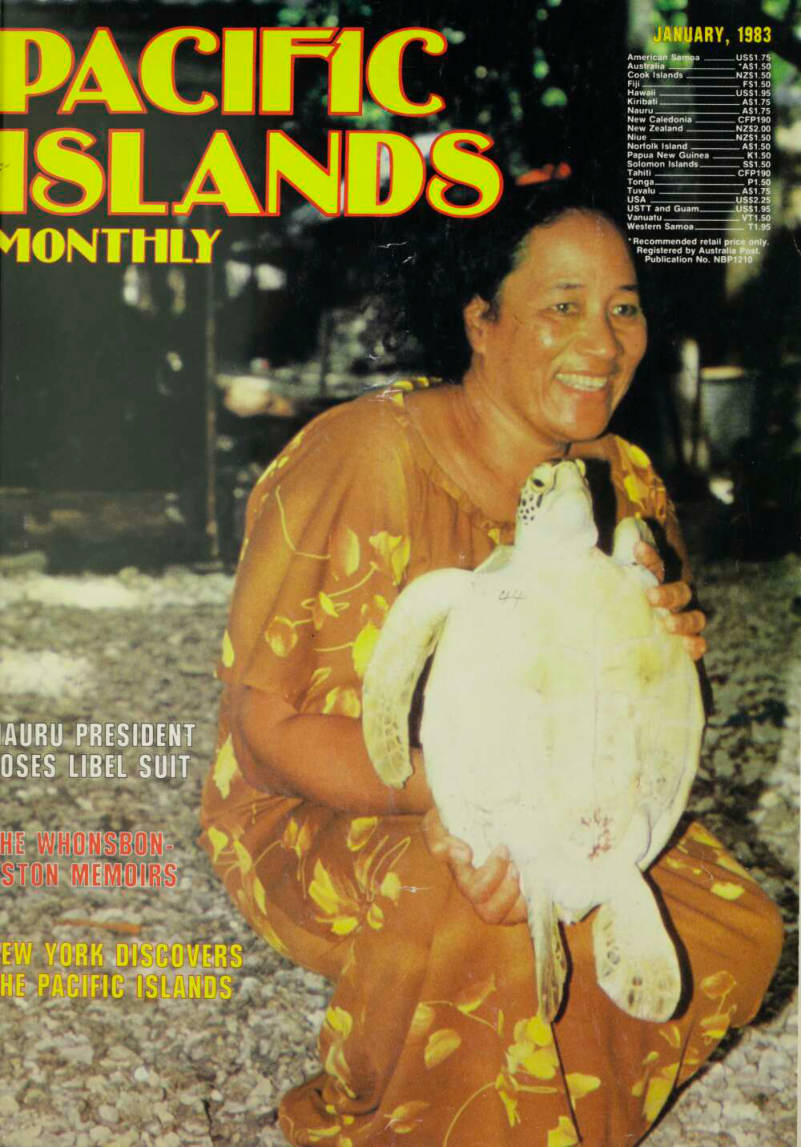
• FRENCH PACIFIC TERRITORIES Retiring Australian Consul-General in Noumea, Dr Malcolm Leader, speaks to a Tahitian daily about Australian attitudes to France’s Pacific territories, and Helen Fraser reports from Noumea on latest developments in New Caledonia 13, 15 • MIRACLE MEN AT WORK IN TAHITI Marie-Therese and Bengt Danielsson write on the recent doings of two public figures claiming a special relationship with the Deity; a visiting French-Canadian priest who claims to have faith-healing powers, and a home-grown freedom fighter who says God has enjoined him to lead the people of French Polynesia to independence 24 • COCONUTS SPROUT IN THE BIG APPLE Caroline Yacoe writes from New York of a remarkable new wave of interest there in matters relating to the Pacific Islands 17 • AIR NIUGINI TO GET A DUTCH HELPING HAND? Papua New Guinea’s flag-carrier is expected to sign an agreement with KLM-Royal Dutch Airlines under which the latter will provide it with a contract management service 53 • BORDALLO BACK AS GUAM GOVERNOR Mark L. Berg reports on the gubernatorial elections which saw Democrat Ricardo Bordallo displace the Republican incumbent as Governor of Guam 30 • NAURU PRESIDENT’S LIBEL SUIT Michael Leidermann reports from Honolulu on why a judge has rejected a SUS4O million libel claim by President Hammer Deßoburt against the Gannett newspaper chain 29 • THE WHONSBON-ASTON PAPERS First in a series of extracts from the memoirs of one of the most noted clergymen to serve in the South Seas in this century, Archdeacon Charles William Whonsbon-Aston 47 Cover picture: Mrs. Siniva Sosene of Tokelau smiles happily as she holds her pet sea turtle; about the turtle's feelings we're not so sure. George H. Balazs picture.
Australia in the Pacific 13 Books 41 Cook Islands 36 Deaths 65 Fiji 18, 33, 47 France in the Pacific 13 Guam 29, 30 Irian Jaya 31 Islands Press 27 Japan in the Pacific 32 Kiribati 33 Law of the Sea 32 Letters 7 Nauru 29 New Caledonia 19, 19
Palau 21 Papua New Guinea 17, 19, 41, 53 People 37 Political Currents 29 Postmark Papeete 24 Samoas 12,45 Shipping Services 63 Tonga 7, 11 Tradewinds 53 Tropicalities 17 Tuvalu 7 U.S. in the Pacific 12, 17, 33 Vanuatu 29 Yachts 57 Yesterday 47
Advertisements & other items, pp. 3-4 (2 items)
~ Founded 1930 by R. W. Robson
Founded 1930 by R. W. Robson Editor Angus Smales Associate Editor Malcolm Salmon Advertising Manager Stephen Brandon Editorial Adviser John Carter A Pacific Publications production 76 Clarence Street, Sydney, 2000, GPO Box 3408, Sydney, 2001.
Cables: PACPUB Sydney.
Telex: 21242 (answers INTARAD).
Telephone. Sydney 20-231.
Melbourne 63-0211.
Manager: John Berry (03) 63-0211 Ext. 1860.
nm milk
ANCHOR
• V! 4gj| full CREAM t Hill
Sm "««N ENRICH® ; «£
nm milk
KM
°OWDiR
POW
w Anch
SKIM MILK
HER
dt anchor
ANCHOR
£3 mm. r,3alia IT ftWB m £ *
NEW
ZEALAND
DAIRY
BOARD
Anchor - premium quality dairy produce, packed with all the goodness of the finest pasture in the world.
Fresh to you from the world’s number one dairy
producer, New Zealand Dairy Board.
Enquiries to: PO Box 417 Wellington, New Zealand
Telex: NZ3348 DAPMARK
Telephone: 724-399
Pacific Report
January 11 For Palau Plebiscite
The U.S. Government has set January 11 as the date of a plebiscite to decide the political future of Palau. Voters will be asked to approve or reject the compact of free association with the U.S., and in the event that the compact is rejected, whether they want a closer relationship with the U.S., or independence.
Hawaii “Disaster Area” After Hurricane
A hurricane that swept across the Hawaiin islands in late November with winds of up to 180 km an hour was the worst to strike the islands for 23 years. One person was killed, more than 100 treated for minor injuries, and nearly 7000 evacuated from their homes. President Reagan later declared Hawaii a disaster area. Damage to private and public property on Kauai and the more populous island of Oahu has been estimated at about SUSI6O million. Military officials said army facilities may have sustained damage totalling at least $3O million. The Red Cross said the hurricane destroyed 180 homes on Oahu and Kauai, and damaged more than 14,000.
Uni Raps France-Fiji Accord
The Prime Minister of Vanuatu, Father Walter Uni, has criticised an agreement between France and Fiji over the demarcation of maritime economic zones. In parliament in late November Fr Uni referred to the part of the agreement concerning New Caledonia. In particular he referred to Matthew and Hunter islands, two uninhabited islands south of Vanuatu, which he said were the sovereign territory of Vanuatu (PIM Jul ’B2 p 35). Fr Uni said that if Fiji recognised these two islands as part of New Caledonia, this would be a direct threat to peace, unity and stability. He added that even the Independence Front in New Caledonia recognised that Matthew and Hunter islands belong ed to Vanuatu. The Opposition leader, Mr Boulekone, supported the prime minister’s stand and urged that outstanding questions of maritime zones be resolved with neighboring states. Until the Law of the Sea Conference proposed the division of the oceans into economic and fisheries zones, uninhabited specks like Matthew and Hunter had no significance. Today, with the South Pacific Islands nations declaring their 200-mile zones, the two islands assume greater importance.
Png Troops Raid Rebel Camp
Papua New Guinea troops and police in late November raided an Irian Jaya rebel camp on the PNG side of the border, driving the rebels back into Indonesia. PNG’s Foreign Minister, Rabbie Namaliu, said the group of about 50 guerrillas had apparently been warned and had fled the camp by the time the troops arrived. Mr Namaliu said police had burnt down houses in the rebel sanctuary and destroyed food gardens. Sources in Port Moresby said the action would be welcomed in Indonesia as showing a desire by the new PNG government for improved relations. Relations between PNG and Indonesia were strained in June 1981 when the former PNG government accused Indonesian troops of making raids across the border. Sweden has been reported to be considering a request from the PNG Government and the United Nations High Commissioner for Refugees that it give refuge and permanent residence to the “Free West Papua” (Indonesian Irian Jaya) guerrilla leader, Seth Rumkorem. The report also covers Mr Rumkorem’s two subordinates, Fred Athaboe and Luis Nussy.
No Tv For Christmas
Papua New Guinea did not get television on Christmas Day as had been promised by its National Broadcasting Commission.
The PNG cabinet directed NBC chairman Leo Morgan, and Media Minister Boyamo Sali, not to introduce broadcast TV for at least four years. Prime Minister Michael Somare said cabinet had told Mr Morgan to redirect whatever funds he had allocated for television to improve provincial radio services. Earlier, Mr Morgan had promised he would introduce pilot television broadcasts on Christmas Day in Port Moresby, Lae and Mount Hagen. Satellite receiving dishes have been built in all these centres and Mr Morgan had approached the Australian Broad casting Commission for approval to re-transmit ABC television programs. The ABC said it did not have copyright outside Australia for many of its programs, and so could not approve re transmission.
OZ DEFENCE CHIEF IN S.W. PACIFIC TOUR The assistant chief of the Australian Defence Force staff, Major- General Gration, visited five southwest Pacific countries in December for talks on defence co-operation. General Gration was accompanied by a senior officer of the Strategic and International Policy Division of the Defence Department. They visited Fiji, Vanuatu, Solomon Islands, Western Samoa and Tonga.
Noumea Course For Drugs Fighters
Customs officers and police from South Pacific countries were taught new ways of identifying and detecting illegal drugs at a course held in New Caledonia in November. Those taking part studied latest methods used by international drug traffickers.
The two-week course was run by the South Pacific Commission with financial help from the Australian and New Zealand Governments, the United Nations, and the Commonwealth Fund for Technical Co-operation. The South Pacific is becoming increasingly important as a drug route. A haul of 300 kilograms of cannabis was made recently in Noumea. The drugs were believed to be en route from Bangkok to Sydney.
Repayment Shortfall On Png Plantations
The Papua New Guinea government has got back only a third of the money it spent on buying plantations from foreign owners in the first five years of independence. The plantation acquisition scheme, suspended two years ago, saw ownership of 84 plantations pass back to the traditional landowners. About SAIO million was paid to former owners, mostly Australians. It was intended that this amount could be paid back from plantation profits, but Lands Minister Bebes Korowaro said only about $3 1 /2 million has been paid back so far. He says repayments in many cases had been slow because the plantations were run down, and good managers were in short supply.
Fiji: Deport Order On Medallist
The winner of Fiji’s only gold medal at the October 1982 Commonwealth Games in Brisbane has been told to leave Fiji.
Immigration officials said in December that Sani Fine, a Tongan, had outstayed his visitor’s permit, and the fact that he is married to a Fiji woman did not give him automatic right to stay in the country. Fine won a boxing gold medal at the Brisbane Games and has been voted Fiji’s sportsman of the year. With 14 days to appeal against the Immigration Department’s ruling, Sani Fine was cheered by a statement from Immigration Minister Ratu William Toganivalu saying that he will give “sympathetic consid eration” to the case, and that Fine had “enhanced Fiji’s reputation internationally”, and “needed support”.
“MULDOON STALLS ON CITIZENSHIP” - W. SAMOA Western Samoa has strongly criticised New Zealand Prime Minster Robert Muldoon for delaying talks on the citizenship issue until the new year. The Western Samoan cabinet spokes man, Asi Sagaga, said Mr Muldoon was playing politics by not holding talks with Western Samoa’s Prime Minister Tupuola Efi until February. He said Mr Muldoon was hoping that there would be a change of government in Western Samoa before February.
The Western Samoa leader says he wants to change an agreement signed by the previous Prime Minister, Va’ai Kolone.
Tupuola Efi has said the agreement denies a large number of Western Samoans their right to New Zealand citizenship.
Solomons Minister Warns On Graft
The Solomon Islands budget was brought down in parliament on November 25. Finance Minister Bartholomew Ulufa’alu issued a strong warning to members about corruption. Mr Ulufa’alu, who leads the National Democratic Party, junior party in the coalition government, said his department had seen and heard too many irresponsible ideas from people who thought they could make instant riches in the Solomon Islands. He warned members that it was their responsibility not to gamble away the country’s natural resources or mortgage the nation’s independence for personal gain. Observers said the minister’s comments could be interpreted as criticism of members of the prime minister’s party.
They noted that Prime Minister Solomon Mamaloni was not in parliament when the speech was delivered. The budget pro vided for spending of about $75 million. There were no increases in taxes or other duties. Mr Ulufa’alu, a former union
leader, urged wage restraint over the coming 12 months so that the Solomon Islands could better weather the worldwide economic recession.
THE HIGH SEAS ARE CLEAN, SO CLEAN...
Almost 100 marine scientists have concluded after a four-year study that earlier reports of the impending demise of the world’s oceans are without foundation, and that they are in fact alive and well except at the edges, where they come into contact with human society and its garbage. There, they say, the pollution is serious. Their findings, released in Geneva in November by the United Nations Enviroment Program (UNEP), clearly contradict dire warnings issued at the 1972 Stockholm environmental conference that led the UN to study the health of the seas. The 112-page report says that the growing amount of waste dumped into the oceans has still not had any significant effect on the health of the high seas. The ocean floor shows little sign of garbage piling up to pollute the depths. Currents and chemical processes break down most wastes, even oil from oil spills, then absorb it with little or no trace. The report says the tightest controls should be introduced for two man-made pollutants nuclear waste and DDT. No public health problem should arise if nuclear waste is dumped according to the strict guidelines set down by the International Atomic Agency, the report says. It should be severely controlled, but storing it on land in unused mines would carry a much higher risk since it would enter drinking water. As for DDT, the report says there is a risk that in some coastal zones residue levels of DDT are being reached in some marine organisms that might make them unacceptable as human food. Asked why he and the research team had taken such a moderated stand on dumping wastes into the sea, the head of the UNEP regional seas program, Dr S. Keckes, said: “We live on the land, not in the sea. We have to stike some kind of balance.”
Fiji’S National Bank Posts A Profit
Fiji’s National Bank has recorded its first profit in eight years.
The bank, one of six commercial banks in Fiji, reported a profit of F 5228,000 for the financial year ending last June. National Bank Chairman Josevata Kamikamica said the good trading results enabled the bank to eliminate accumulated losses and pay a small dividend to the Fiji Government.
Somare Treated For “Exhaustion”
Papua New Guinea’s Prime Minister Michael Somare was released from hospital in late November after having been treated for exhaustion. He was on doctors’ orders to take five days complete rest. Mr Somare had complained of chest pains and sickness in parliament near the end of a long sitting on the budget. The senior medical officer with the PNG Defence Force, Colonel Eaton, said checks had shown that Mr Somare was not suffering from heart or blood pressure problems. His illness had been caused by overwork.
Png Opens Up To Islands Students
As from this year, Papua New Guinea is offering 10 percent of all places in its tertiary educational institutions to students from other South Pacific Island countries. Announcing this in a meeting with Jesoni Takala, Fiji’s roving representative to member contries in the South Pacific Forum, PNG’s Foreign Minister Rabbie Namaliu paid tribute to the role played by Fiji’s educational institutions in PNG’s development. He recalled that PNG had had students studying medicine in Fiji since the 19505.
The new offer means that more than 100 places will become available to Pacific Islands students at PNG’s two universities, and its various administrative, technical, commercial and ag ricultural colleges.
Fiji-China Rice-Growing Plan
Fiji and China have signed an agreement to develop 60 hectares of rice paddies about 30 kilometres from Suva. China will plan and design the scheme and help supply equipment and experience, the project will be developed next to a Fiji Govern ment rice irrigation scheme at Navua. Two years ago, Chinese experts studied Fiji’s rice production and recommended ways to improve yields and help reduce rice imports.
Solomons’ Cut Of Oz Defence Aid
Australian defence co-operation aid to Solomon Islands is the
highest per capita of the South Pacific Island states according to Australia’s High Commissioner in Honiara, Trevor Sofield. Mr Sofield was commenting on criticism from the Solomon Islands’
Police and Justice Minister, Paul Keyaumi that Australia’s defence aid was too small. Mr Kayaumi had claimed that Australia had given substantial support to other Pacific countries for military purposes, but had given very little to Solomon Islands. Mr Sofield said Solomon Islands this financial year will receive $A4.2 million in defence co-operation aid, $1.7 million more than last financial year. In total figures, it was second only to Papua New Guinea, but on a per capita basis was the highest.
Arrow’S Shot In The Air
A second airline has begun services between American Samoa and Hawaii. The American airline, Arrow Air, has three services each week between Pago Pago and Honolulu. It began the service with drastically reduced fares, but the American Samoa airline, South Pacific Islands Airways, which also operates on the route, matched the cuts.
Approvals, Rejections, For Air Nauru
The United States Civil Aeronautics Board (CAB) has approved Air Nauru’s application to provide services between Nauru and Honolulu via Tarawa and Majuro and beyond Pago Pago to Niue and Auckland. But the New Zealand Government has rejected the airline’s application to embark or disembark passengers between Pago Pago and Auckland, and the Kiribati Government has placed a similar ban on traffic between Tarawa and Honolulu. CAB also prohibits Air Nauru from carrying locals between Honolulu and Majuro, Ponape, Truk, Palau, Guam, Saipan and Pago Pago.
Oz Bows Out Of Png Aviation
The last of the functions still under Australian Government control in Papua New Guinea those concerning civil aviation are to come totally under the PNG government’s control in January. When PNG gained independence from Australia in September 1975, most government functions were transferred to PNG. However, some aspects of civil aviation have remained the responsibility of the Australian civil aviation agency until now. PNG’s Transport Minister, Matthew Bendum, told parlia ment in November that a new office will be formed within his department to take charge of civil aviation, symbolising PNG’s independence and its ability in aviation management.
New Caledonia: “No” To Energy Reform
New Caledonia’s Territorial Assembly voted in late November to reject the French government’s latest reform for the territory, concerning energy. However, the assembly’s 20-10 vote has no legal force as France has been ruling New Caledonia by decree since December 1981 when the Mitterrand government took the power to impose a series of reforms on New Caledonia to remove what it called injustices and inequalities in the territory.
Earlier reforms concerned land, economic development, recog nition of some Melanesian culture and identity, and recognition of some Melanesian customary law. Only the reform dealing with customary law received the approval of the assembly. The energy reform seeks to place energy supplies under the control of territorial authorities rather than private companies.
“Co-Operate To Beat Slump” Escap
A United Nations agency has urged developing countries in Asia and the Pacific to increase their economic co-operation in an effort to ease the effects of the world recession. It said co operation could be expanded between state trading organisa tions, and trade preference systems, or multi-national trading bodies, could be set up. The UN Economic and Social Commis sion for Asia and the Pacific (ESCAP), meeting in Bangkok, called on the UN to help poorer countries find ways of attracting investment to overcome shortages of foreign capital.
Watch For Palauan First-Day Covers
The hand-over of U.S. postal services to the Republic of Palau has been completed, as provided for in the recently initialled Compact of Free Association. The republic is the first govern ment in Micronesia to establish its own post office. It hopes to realise SUSI million a year through its services, including the issue of its own stamps.
Tonga and

Letters
Tonga and the Games
Most people believed that the Commonwealth Games in Bris bane last October were staged not only for the benefit of the competitors, but also for the pur pose of enabling the various peo ples from Commonwealth coun tries to meet together in a com mon bond through their interest in sport.
Reflecting this notion was the pre-games conference known as the Commonwealth and Interna tional Conference on Sport, Phy sical Education, Recreation and Dance. The conference, under the direction of Dr lan Jobling of the University of Queensland, produced a most impressive list of keynote and supporting speak ers from all parts of the world.
A group of sporting en thusiasts in Tonga realised the importance the conference could have for their small island king dom where sport, recreation and dance play such important roles in the lifestyle. They gathered the names of those who were both able to pay for their airfares and accommodation, and suit able to represent their kingdom at the conference. The list of coaches, administrators and en thusiasts numbered over 200.
Travel arrangements were finally completed by the charter of a Boeing 707 aircraft which would take the first paid-up and ap proved contingent. The Immigra tion Department in Canberra was advised, and it requested the Australian High Commission in Tonga to issue the necessary visas, subject to the normal requirements.
And so ends the enthusiasm.
The conditions of approval for the visas placed by the High Commission upon the intending participants included production of a bank draft payable in Aust ralia of $7OO to cover 10 days’ expenses (that was after accom modation and return air fares had been paid). Efforts to meet the conditions were hampered by the fact that the organisers were ad vised of the requirements only four days before the charter flight was due to leave.
Notwithstanding all this, the organisers tried to arrange for those able to meet the conditions
to travel independently. Twenty
one applications for visas were lodged with the commission within the next 48 hours. Applic ants included two nobles of the realm and the superintendent of the Tonga Police Force.
Final cancellation of all effort
came the following morning
when all applications were re turned to the organisers without approval. They still don’t know who would have been permitted to attend. One of the nobles in question was the son-in-law of the Prime Minister of Tonga.
However, the Tonga Police Band, of which the Kingdom is justly proud, had an official role at the games.
It is quite a shame that more of their countrymen, who are also members of the Commonwealth, could not share the experience.
Robert W. Moin
Nukualofa Tonga Two readers offer contrasting opinions on the visit to Tuvalu last October by Queen Elizabeth II and her husband Prince Philip, Duke of Edinburgh. Both letters have been cut for length.
The Queen in
Tuvalu (1)
“Superb”, “Fantastic”, “We’ve never seen anything like it”. Those were some of the
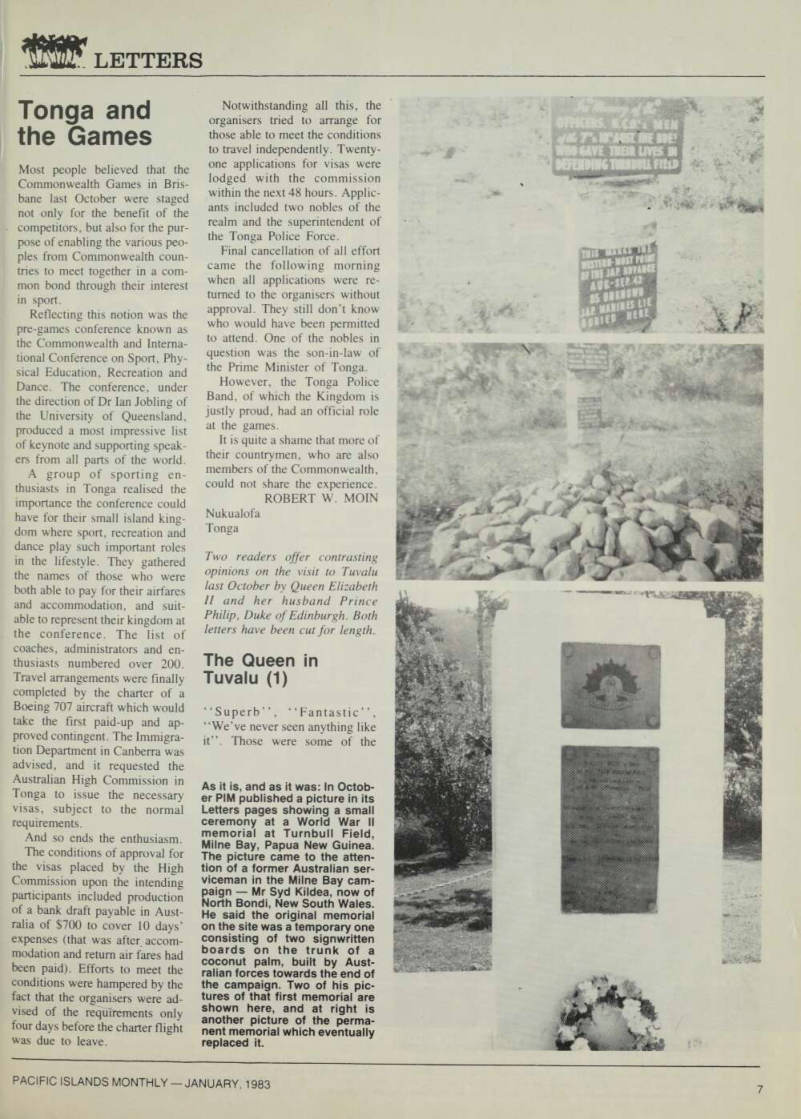
As it is, and as it was: In Octob er PIM published a picture in its Letters pages showing a small ceremony at a World War II memorial at Turnbull Field, Milne Bay, Papua New Guinea.
The picture came to the atten tion of a former Australian ser viceman in the Milne Bay cam paign Mr Syd Kildea, now of North Bondi, New South Wales.
He said the original memorial on the site was a temporary one consisting of two signwritten boards on the trunk of a coconut palm, built by Aust ralian forces towards the end of the campaign. Two of his pic tures of that first memorial are shown here, and at right is another picture of the perma nent memorial which eventually replaced it.
comments made by the 11 mem bers of the international media, who actually made it to Tuvalu to be present for the Royal visit which took place on October 26- 27, 1982. As anyone who has ever tried to get to Tuvalu knows, it is a difficult enough place to reach at the best of times. In theory, 18 members of the press corps were supposed to get here, but several fell by the wayside and those that did not make it will be kicking them selves when they see from the reports of those who did just what they missed.
Where else in the whole Com monwealth would the ordinary citizen be able to get within a few feet of Her Majesty or His Royal Highness, Prince Philip, Duke of Edinburgh, not on one occasion, but umpteen occasions during the two days which the Royal couple spent visiting this, one of the smallest and remotest, yet at the same time most loyal, outposts of the Commonwealth of Nations?
That the Royal couple
thoroughly enjoyed the visit was made abundantly clear on numer ous occasions during the two days, but in no more striking form than on the final departure, when Her Majesty and Prince Philip allowed themselves to be carried shoulder high on canoes, in the pouring rain. They must have been soaked to the skin by the time they reached the com parative haven of the Royal barge, which was to take them back out to H.M. Yacht Britan nia. They would never have al lowed that to happen had they themselves not been thoroughly enchanted with the welcome which they had received.
And who could fail to be charmed by these open-hearted people, who are intensely loyal to the British Crown, in spite of the fact that this has not always been appreciated by the other side?
That the visit was an over whelming success there can be no doubt. The people of Tuvalu had been preparing for months for the great event, and, when it arrived, they gave of their best. It is true that there were some internal disputes within the tight ly-knit group of eight main is lands, but to an outsider that was
not immediately apparent. The local people were delighted at the way things went, the expatriate population, who are there to serve the Tuvaluan people, were delighted, and the representa tives of the media, who can be a very hard-bitten bunch of indi viduals, were also delighted. In deed, had you been able to see these people on the night Her Majesty departed, dressed in loc al costumes, living it up in the country’s only hotel which can only accommodate 14 people you would see how entirely the visiting 11 had been cap tivated by this remote island of Funafuti, only about a square mile in size, set in the middle of 500,000 square miles of ocean.
There had been previous royal visits to the islands in 1959 H.R.H. Prince Philip had visited Vaitupu, in 1978 H.R.H.
Princess Margaret had visited Funafuti for the independence celebrations and in 1979 H.R.H.
Princess Anne had called briefly at the time of the independence celebrations at Tarawa. This, however, was the first occasion
in the 90 years, in which the country has been associated with the British Crown that a reigning British monarch had actually made it to Tuvalu.
What a welcome they gave her. Over 20 large canoes, mann ed by four people, and decorated red, white and blue assembled about a quarter of a mile offshore to greet the Royal couple on their arrival. In the centre of the fleet were two specially made canoes, which were to transport the Roy al couple ashore. On each of them an armchair had been lashed.
The chairs used had not been
specially imported, they were
merely new ones of the kind to be found in the houses of senior government officials and expat riate officers working on con tract. Her Majesty’s canoe was painted in Tuvalu’s colors of turquoise and yellow, while that of Prince Philip was red, white and blue.
As the canoes reached the beach Tuvaluan men, dressed in local costume of skirts of pan danus leaves, with decorations of ferns around their necks, arms and legs, entered the water and bodily carried the two canoes up the beach, through a triumphal
archway and on to the roadway on which mats had been laid.
Lining the shore and the roadway were more than 1000 people, anxious not to miss this historic occasion. The route to the maneapa, where the first official functions were to be held, had been provided with a fence around which garlands of ferns had been wreathed. In front of it stood the schoolchildren, clutch ing their little flags the Tuvalu flag or the British one - looking most attractive in their turquoise uniforms. All around were Tuva luan men and women, mostly in traditional costumes.
On a given signal the two royal canoes, which had not touched the ground, were each lifted up on to the shoulders of 26 stalwart men. In front of the Queen's canoe were a group of dancers, behind it and in front of the Duke’s canoe came some singers and behind the Duke came more singers indeed all the spectators once the canoes had passed. The triumphal pro cession proceeded slowly the 300 yards or so to the tennis court the only hard one in Tuvalu outside the maneapa. There the canoes were slowly lowered and the Queen and Prince Philip de scended a short flight of steps to the ground.
Her Majesty’s official repre sentative in Tuvalu, the Gover nor-General, Sir Fiatau Penitala Teo, was the first to greet her, introducing her to Lady Teo and the Prime Minister, the Rt. Hon.
Dr Tomasi Puapua and his wife, followed by senior Tuvaluan and expatriate officials. The party then moved into the maneapa for the official speeches of welcome and a short dancing display.
This spectacular welcome set the tone for the whole visit.
The maneapa at Vaiaku, where the main government buildings are located on Funafuti, had been almost doubl ed in size in a pleasing mixture of local and traditional materials.
Alongside it was a new building in local materials, where the food for the feast on the first evening was assembled. In the same area a new and attractive building in permanent materials, had been erected to house stalls of handic rafts from each of the islands.
Elsewhere buildings had been
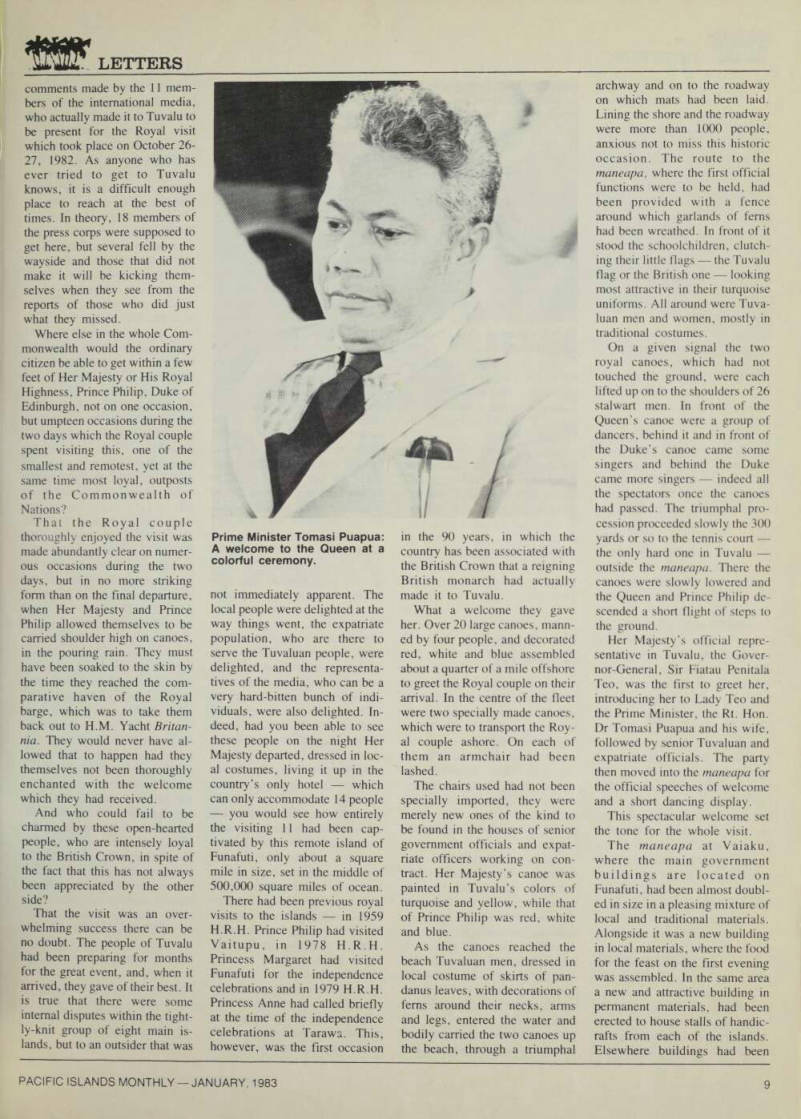
Prime Minister Tomasi Puapua: A welcome to the Queen at a colorful ceremony.
painted and the place generally smartened up even the main rubbish dump, past which Her Majesty drove on several occa sions, had been given a facelift or covering! Perhaps the most striking aspect was the large amount of planting of flowers, trees and shrubs which had taken place. Labor for this was pro vided by the inhabitants of Funafuti prison. Under the able direction of a long-time resident of Funafuti, Sam Rawlins, they worked from dawn to well after dark to make the capital as attrac tive as possible.
The feast and dancing that first
evening were something every
one who witnessed the occasion will never forget. To ensure that there were representatives from each island present the Govern ment had provided free transport for people from each in fact hundreds of others made their own way to Funafuti as well. Food was brought in both
by boat and by the amphibian
plane, which provides a lifeline to most of the outer islands. Even flowers were flown in, as the numerous garlands which were made took a heavy toll of the local bushes. The repast laid be fore the Royal couple and the other official guests would have fed 20 or 30 people. On the Queen’s “mat” were coconut crabs, crayfish, a roast pig, fish, bananas, germinating nuts, pula ka, breadfruit, fekei and other local delicacies, including roast noddy birds, highly prized in the islands. They did not, however, appeal to the Queen, who ap peared to have sampled some breadfruit, a little of the pig and some coconut crab meat, fol lowed by a banana. Neither she nor the Duke had touched the bottle of Perrier water thought fully provided for them.
After the feast came the danc ing, with each island group seek ing to out-dance and out-sing the others. They all wore variations of traditional dress the men and women in their dancing skirts of pandanus leaves, de corated with strips of yellow, black, red, white and brownish red. The noise was deafening, the enthusiasm infectious, and on many occasions the Duke joined in clapping in time with the dancers. It was nearly 11 p.m.
almost an hour behind schedule when the Royal party left to return to their yacht.
The second day’s activities consisted of a tour of places of note around Funafuti, including the local hospital outside which the Queen and Prince Philip watched a demonstration of how to cut toddy, which they then tasted and the local prim ary school. The children were all lined up outside, garlanded on top of their uniforms. One group caused considerable amusement by giving an animated recitation of some English nursery rhymes.
Then it was on to see the coconut tree planted in 1970 by Prince Charles, to lay the foundation stone for the new parliament building, a visit to the Bank of Tuvalu and a call at the country’s main revenue-earner, the Philatelic Bureau.
After the rainy farewell, all concerned were satisfied that the Tuvaluans had provided their Queen with a welcome she will never forget, and that she and her husband had delighted them with their obvious appreciation of what had been prepared.
Guy Slatter
Funafuti Tuvalu
The Queen in
Tuvalu (2)
Almost all routine and develop mental activities in Tuvalu were replaced by preparations for the Royal visit on October 26, 1982.
Preparations began many months before and were intensified as D- Day drew close. Funafuti, the capital, could hardly bear the weight of extra people who swarmed in to dance for and to get a glimpse of the Royal Family.
The capital badly lacks health facilities both in private homes and public places even for per manent residents of Funafuti.
Add on an extra few and the problems become acute. Perhaps the official reasoning behind all this was that this was a reason able sacrifice for a once-in-a lifetime experience of entertain ing and viewing the Royal Fami ly in person.
Poor old Nivanga, the only inter-island vessel, which has be
come more of a liability than an asset, was employed shipping in entertainers from the outer is lands. Building materals for the new co-operative store at Nui Island were missed on the ship’s two previous trips. (God knows what else got missed, particular ly in the way of essential goods for the outer islands).
Roads began to enjoy smooth
surfaces, public buildings cropp
ed up, the jetty underwent neces sary repairs, and the general sur roundings became as pure as crystal. The public buildings will be put to good use after the Royal visit, but the roads should be smooth all the time and the same goes for cleanliness. It is a pity that standards will fall back again to pre-Royal visit conditions.
All police officers stationed on outer islands were called to the capital to take part in the guard of honor mounted for the Royal Family. Apart from this, they could be put on the beat to
tighten security. Administration
of law and order on outer islands for the meantime was allocated to inexperienced special constables.
A sizeable number of civil servants were released from their routine duties to join rehearsals of programs set for the visit.
Whether their daily work was carried out by their colleagues back in the office nobody can tell. If not this would mean a general setback to the public ser vice rendered to the country.
Originally government had said that due to lack of funds entertainment for the Royal visit would be confined to perform ances by people residing in the capital. Later, the government gave the green light for one dancing group from each island outside the capital. But each group had to find its own accom modation and means of survival while at headquarters. They also had to meet their fares both ways. Later still, government had a change of heart and al lowed the dancing teams to travel “free” on the Nivanga. Then the seven dancing teams received $lOOO each in cash. As each team consists of 25 performers the allowance per head was $4O.
Some of the groups were in the capital for more than a month and in view of the consumption
“basket” $4O a head was far
from adequate. Fortunately, the
dancers generally brought with
them their own provisions from their islands. But when you are employed to do a job you do it at the expense of the employer not at your own expense. Some people may argue that, because of the present situation in Tuvalu, people ought to be pre pared to make sacrifices. That may be true. But national leaders must be expected to take a lead in this respect before they start
agitating uneducated villagers in
to doing so.
In the early days of prepara tion a circular letter from the Secretary to the Ministry of Commerce and Natural Re sources went out to all islands through Island Councils request ing production of handicraft from which a set would be selected for presentation to the Royal Family as presents. The rest was to go on display in the newly finished handicraft store and no doubt will be put on sale. God knows where the proceeds will go. As usual the letter declared that there was no money to pay the producers. “No money” has be come a popular slogan of the present government. Reactions from other islands are not known, but Nukulaelae reacted violently against the request be cause there was a general feeling the government was cheating the ill-informed villagers. In this day and age no one should be expect ed to work for no reward.
Subsistence living in an island environment requires hard cash to pay for lighting, fuel, soap, matches, a set of fishing gear, a set of hand tools, ropes, paints and sail cloth for canoes, hand carts and bicycles for transport.
Unfortunately, some imported foodstuffs have become staples.
Now, with the help of Save The Children, villagers have ventured into the field of capital intensive projects such as water tanks and roofing iron for water catchment.
We don’t need to be told how expensive it is to purchase these items at current prices let alone future prices due to inflation at countries of supply. As prices of commodities go up steadily, in comes of villagers keep shrink ing. Their only major income in their own right has been the sale
of copra. The price of copra has been down from 10c a lb. first grade to 6c first grade for some time now.
Occasions such as the Queen’s visit provide a golden opportuni ty for the authorities to supple ment village incomes not to rob the villagers of their time and effort. To take advantage of the age-old tradition of blind obedi ence to authority does not serve
the country’s long-term objec
tives, and could sooner or later prove to be a heated political issue.
The other important matter of principle has been the willing ness of the administration to agi tate the poor to make sacrifices for the rich. The British monarch is among the richest people on earth. Do we regard ourselves as responsible representatives of the people by taking from the poor to give to the already rich? Karl Marx, Lenin and Mao Tse-tung would turn in their graves if they knew the kind of thing that has been going on.
The “no money’’ slogan is beginning to give a nauseating taste to many people. Even civil servants are openly joking about it. The government says “no money’’, but money is readily available to pay salaries and per sonal allowances, including an nual incremental credits as they become due. One pride of the present government has been their ability to beg for money more effectively than the pre vious one. But when the time comes for money to be used effectively, government says there isn’t any.
Everyone here agrees that the Queen, as Tuvalu’s Head of State, represented locally by the Governor-General, should be ac corded the best traditional wel come. But it should be a wel come that does not disrupt na tional services, one that the economy can afford, and above all one that does not jeopardise
long-term national objectives.
Isakala Paeniu
Nukulaelae Tuvalu
Tonga tourism
needs shake-up
I have no wish to question the accuracy of the survey carried
out by the Tonga Visitors Bureau (PIM Oct ’B2 p7l) and I found the officers there most helpful within their limitations. For ex
ample, although they provide the
addresses of people that offer accommodation, they are not al lowed to comment on the quality of it, or so I was told. When one adds this lack of information to the fact that no Tongan authority inspects the said accommodation to ensure that it complies with even minimum acceptable stan dards of hygiene, the visitor is
rather handicapped.
The Pacific Islands are our favorite playground and we re turned to Tonga early in 1982.
We were most disappointed. The quality of the things it has to offer seems to decline as the years go by. This is a sad reflec tion on a kingdom inhabited by such fine people. I feel that un less Tongatapu upgrades its facilities, Vavau will become the tourist spot of the country.
To give some examples let me
cite the main streets of Nukualo fa. What excuse is there after all these years for the lack of effec tive sealing? A stroll to the bank or post office is likely to produce a sprained ankle. Then there is the nonsense of the airline ar rangements where people are re gularly over-booked, off-loaded, have confirmed tickets uncon firmed, and generally suffer frus trating delays if one dares to change one’s itinerary. The or ganisation or whatever it is at the so-called international airport is an unmitigated disgrace.
Need one mention the seedy decline of the capital’s interna tional hotel. It would no longer rate in the Michelin guide. Years ago it was superb. The meals were first-rate, the service im peccable and the toilets beyond reproach. Look today! The air conditioners in the dining room cease to function, cleanliness is no longer a top priority, the toilets near the lounge bar stink, and the smell often creeps into the lounge. As for meals, there is better value at Joe’s fish and chip shop (when he has any chips, that is). In some of the rooms, the carpets are stained badly where the worn-out air
conditioners leak. The pool is not cleaned as often as it should be and the attractive garden setting near it is often littered with beer cans and other debris. This mess stays there for days. After the rain, the dance floor can remain flooded until someone decides it
ought to be mopped up, especial
ly if it’s time to put on the
weekly entertainment.
My view is that the Tongan authorities have become far too complacent. “Visitors will turn up whether any effort is made or not”, seems to be the belief. It is a pity, but people with money to spend want the best value for their dollars. Tonga does not provide this today. It could do so again without spoiling it. Until it casts off its lethargy, my Pacific choices will remain Rarotonga and Port-Vila.
P. Harrison-Mattley
Guildford, NSW Australia
Remembering
Illyria
My article (PIM Jan ’B2 p 57) on the subject of cruising yachts in the Pacific mentioned a large brigantine Illyria, which visited
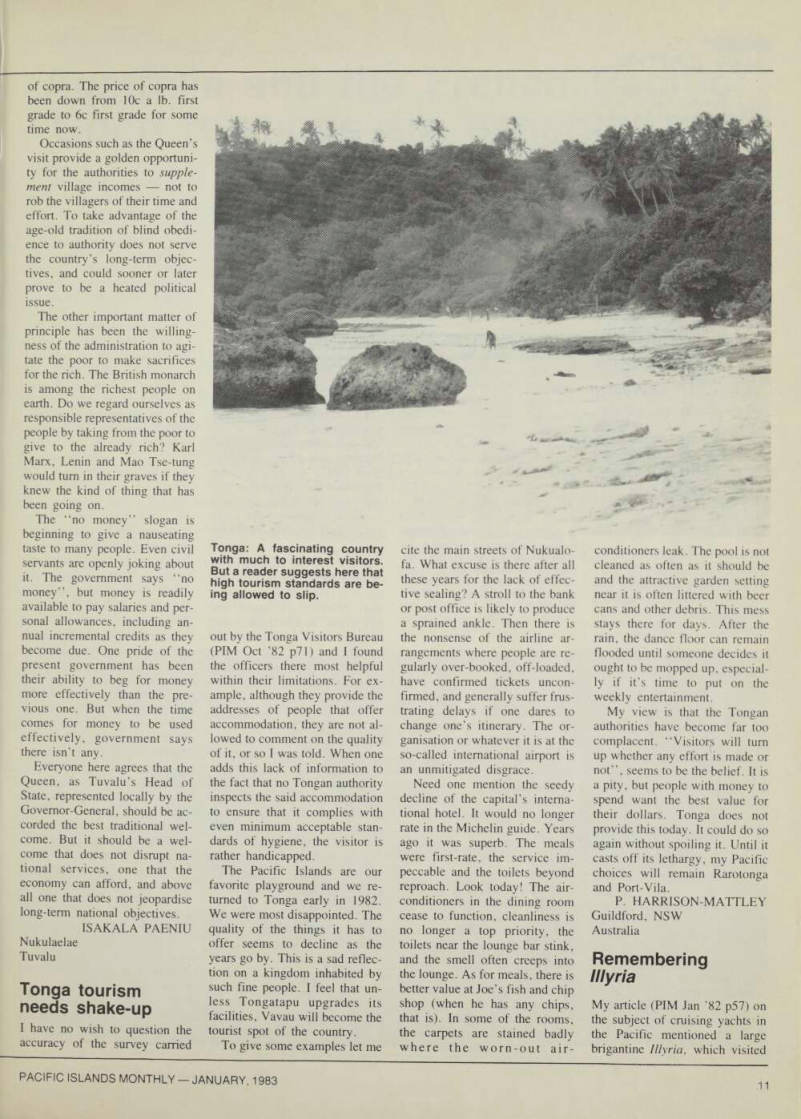
Tonga: A fascinating country
with much to interest visitors.
But a reader suggests here that high tourism standards are be ing allowed to slip.
Lae, New Guinea, in 1928 while on an extended Pacific cruise under the command of its young owner, Cornelius Crane.
In spite of inquiries made to various American yachting magazines as to the vital statist ics of the vessel’s construction none could give me an answer, although all seemed to be ac quainted with her.
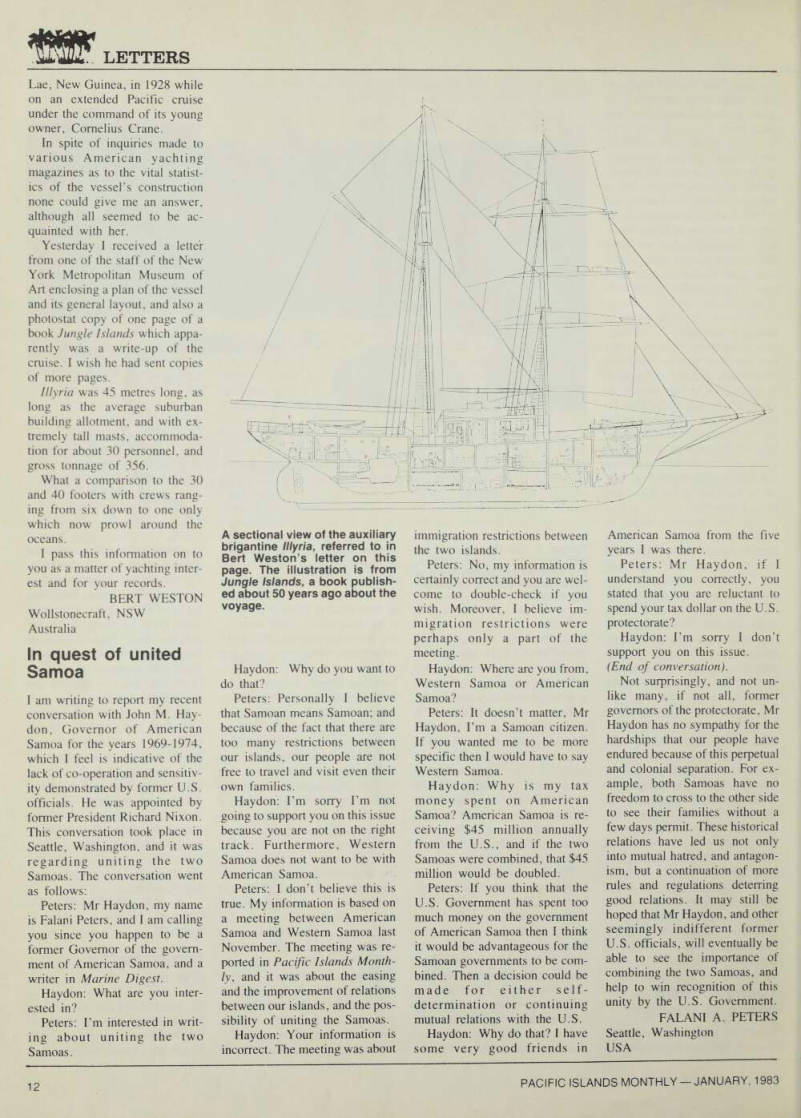
Yesterday I received a letter from one of the staff of the New York Metropolitan Museum of Art enclosing a plan of the vessel and its general layout, and also a photostat copy of one page of a book Jungle Islands which appa rently was a write-up of the cruise. I wish he had sent copies of more pages.
Illyria was 45 metres long, as long as the average suburban building allotment, and with ex tremely tall masts, accommoda tion for about 30 personnel, and gross tonnage of 356.
What a comparison to the 30 and 40 footers with crews rang ing from six down to one only which now prowl around the oceans.
I pass this information on to you as a matter of yachting inter est and for your records.
Bert Weston
Wollstonecraft, NSW Australia
In quest of united
Samoa
I am writing to report my recent conversation with John M. Hay don, Governor of American Samoa for the years 1969-1974, which I feel is indicative of the lack of co-operation and sensitiv ity demonstrated by former U.S. officials. He was appointed by former President Richard Nixon.
This conversation took place in Seattle, Washington, and it was regarding uniting the two Samoas. The conversation went as follows; Peters; Mr Haydon, my name is Falani Peters, and I am calling you since you happen to be a former Governor of the govern ment of American Samoa, and a writer in Marine Digest.
Haydon: What are you inter ested in?
Peters; I’m interested in writ ing about uniting the two Samoas.
Haydon: Why do you want to do that?
Peters; Personally I believe that Samoan means Samoan; and because of the fact that there are too many restrictions between our islands, our people are not free to travel and visit even their own families.
Haydon; I’m sorry I’m not going to support you on this issue because you are not on the right track. Furthermore, Western Samoa does not want to be with American Samoa.
Peters: I don’t believe this is true. My information is based on a meeting between American Samoa and Western Samoa last November. The meeting was re ported in Pacific Islands Month ly, and it was about the easing and the improvement of relations between our islands, and the pos sibility of uniting the Samoas.
Haydon: Your information is incorrect. The meeting was about
immigration restrictions between the two islands.
Peters: No, my information is certainly correct and you are wel come to double-check if you wish. Moreover, I believe im migration restrictions were perhaps only a part of the
meeting.
Haydon: Where are you from, Western Samoa or American Samoa?
Peters: It doesn’t matter, Mr Haydon, I’m a Samoan citizen.
If you wanted me to be more specific then I would have to say Western Samoa.
Haydon: Why is my tax money spent on American Samoa? American Samoa is re
ceiving $45 million annually
from the U.S., and if the two Samoas were combined, that $45 million would be doubled.
Peters: If you think that the U.S. Government has spent too much money on the government of American Samoa then I think it would be advantageous for the Samoan governments to be com bined. Then a decision could be made for either self determination or continuing mutual relations with the U.S.
Haydon; Why do that? I have some very good friends in
American Samoa from the five years I was there.
Peters: Mr Haydon, if I understand you correctly, you stated that you are reluctant to spend your tax dollar on the U.S.
protectorate?
Haydon; I’m sorry I don’t support you on this issue. (End of conversation).
Not surprisingly, and not un like many, if not all, former governors of the protectorate, Mr Haydon has no sympathy for the hardships that our people have endured because of this perpetual and colonial separation. For ex ample, both Samoas have no freedom to cross to the other side to see their families without a few days permit. These historical relations have led us not only into mutual hatred, and antagon ism, but a continuation of more
rules and regulations deterring
good relations. It may still be hoped that Mr Haydon, and other seemingly indifferent former U.S. officials, will eventually be able to see the importance of combining the two Samoas, and help to win recognition of this unity by the U.S. Government.
Falani A. Peters
Seattle, Washington
Usa
A sectional view of the auxiliary brigantine lllyria, referred to in Bert Weston’s letter on this page. The illustration is from Jungle Islands, a book publish ed about 50 years ago about the voyage.
Advertisements & other items, p. 8 (1 item)
ertips
\ V II
Convenient Com
7
ertips
w hen Sansui mates computers with high performance component systems you get convenience. Like "Compu Edit.,'' a feature that allows automatic edit recording of songs from disc to tape in any programmed order. And the "Compu-Selector System” for one-touch synchronized play. And memory station selection.
Intelligent Super Compo the smartest hi-fi systems ever designed. \
Sun s ui
For further information please contact: SANSUI ELECTRIC CO., LTD. 14-1 Izumi 2-chome, Suginami-ku, Tokyo 168, Japan. p . • Australia VANFI (Aust.) Pty. Ltd. 297, City Road, South Melbourne, Victoria 3205, Australia Phone: 690-6200/283 Alfred Place, North Sydney N.S.W. 2060, Australia Phon 929-0293 • Fiji Prabhu Brothers Ltd. PO. Box 183, Nadi Phone: 71122 • Papua New Guinea Oceania Indent Agency (P.N.G.) Pty. Ltd. Box 5518 Boroko, Port Moresby Phone.
PM 256411 • New Zealand David Reid Electronics Ltd. PO. Box 2630, Auckland, Phone: 488-049 •New Caledonia M.M. Mercier Michel B.PI 123, Noumea Phone. 27-59.11 • Central Pacific Nauru Co-operative Society Republic of Nauru • Vanuatu The Sound Centre PO. Box 434, Villa Phone: 2035 • Tahiti SIMEL PO. Box 3338 Papeete Phone. 2 9
Australia and the French Pacific:
Pacific Diplomacy
Australia and the French Pacific: “Good relations are essential ..."
Dr Malcolm Leader, who has been Australian consul-general based in Noumea for the past three years, has completed his mission and will be returning to Canberra in a fortnight.
Dr Leader’s responsibilities covered the three French Pacific territories of New Caledonia, Wallis and Futuna, and French Polynesia.
We were able to meet him in the course of his “farewell visit’’ to Tahiti, the fifth time he has come to our island. ‘ 7 now have many friends here,’’ he said in his impeccable French. Then we talked about Australia and its relations with the countries and territories surrounding that island-continent.
M.L. Australia certainly be lieves it has a role to play within its geographical region. But that does not mean interference, and it is essential that we have good relations with neighboring coun tries or territories. So we must have regular contacts. This is why immediately after the end of hostilities in World War II one of the very first consular posts set up by Australia anywhere in the
The Tahiti daily Les Nouvelles of November 27, 1982, carried the following interview with Dr MALCOLM LEAD ER, who was then about to complete a three-year mission as Australian consul-general in Noumea, New Caledonia, with responsibility for all French Pacific territories. The interview, in which Dr Leader discusses Australian policies on a number of issues related to France’s Pacific territories, was conducted by Les Nouvelles journalist ANDRE NOUET. The translation is by PIM.
world was in Noumea. We now have about a dozen people work ing there. Apart from myself, there are three Australian consuls regularly visiting the French Pacific territories from Noumea.
L. English-speaking and French-speaking people live side by side in the Pacific, but their relations have for a long time been superficial, even marked by a certain mistrust. Do you think we’ve been moving towards a more open dialogue over recent times?
M. I am accustomed to a certain ambiguity in the attitude of New Caledonians towards Australia. New Caledonia is a very large island whose people appreciate the advantages of hav
ing Australia close handy for holidays, making purchases, and so on. But they seem to fear that in the relatioship there’s another side to the coin. I hasten to add that these fears are absolutely groundless.
L. Are there any develop ments in Australian policy on the matter of New Caledonian independence?
M. Australia supports the decision of the recent South Pacific Forum which expressed a very favorable attitude to the reforms begun by the French Government. The desire was ex pressed to see this program car ried through, and a timetable established leading up to a peace ful and orderly accession to inde
pendence. But I add that at the beginning of the resolution adopted by the Forum there is a reaffirmation of the principles of self-determination and independence.
L. Principles are all very fine, but couldn’t there be a contradiction between self determination and independence?
Who, in your opinion, should be allowed to express their views in any referendum or other elec toral process?
M. Australia has a policy of non-interference in the affairs of others, and if problems of this nature were to arise later on it would be up to the New Caledo nians to sort them out. I am aware that the Independence Front takes the view that the Kanak people have been col onised, and that they alone have the right to determine what the
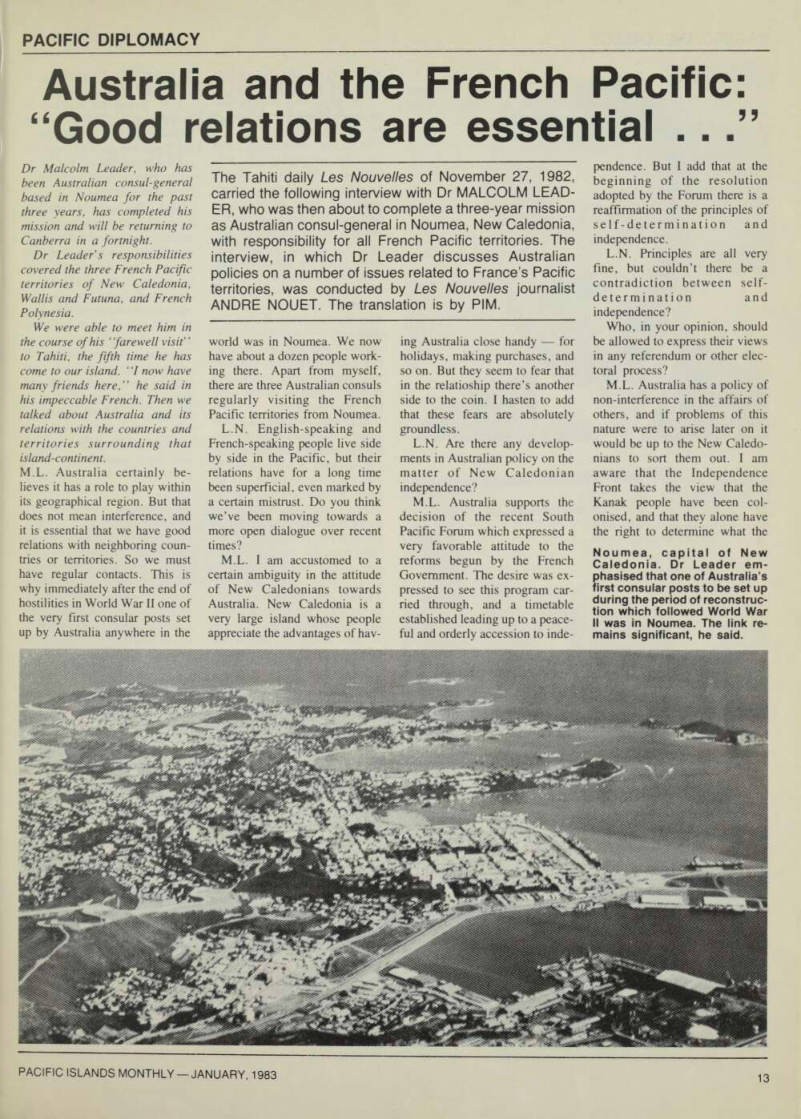
Noumea, capital of New Caledonia. Dr Leader em phasised that one of Australia’s first consular posts to be set up during the period of reconstruc tion which followed World War II was in Noumea. The link re mains significant, he said.
outcome of this colonisation is to be.
L. Does your country take the same position on the future of French Polynesia?
M. For Australians, Tahiti can’t be compared with New Caledonia. First of all, there’s the matter of distance. What’s more, we have democracy in Australia, and we are particularly attached to the democratic pro cess. On several occasions in recent times the French Govern ment has reaffirmed its concern that the wishes of the populations concerned are respected. So there are no problems on that score.
L. Tahiti and its islands are in the tourist business, but there still aren’t many Australians coming to visit us. Is the situa
tion hopeless?
M. No, definitely not. I’m actually delighted with the pre sent growth of tourism between our countries. It’s been going on ever since the resumption of the
three weekly Qantas flights.
There’s increased passenger traffic both ways, and I think it’s fine that Polynesians are discov ering Australia. During my time here on this visit I’ve issued 80 visas. While it’s true that Vanuatu and Fiji have a particu lar attraction for Australian tour ists, the French Pacific territories New Caledonia, Wallis and Futuna, and Polynesia offer
the traveller the bonus of a little breath of France.
L. Before the numbers of
people travelling for pleasure can
be built up to any great extent, the world will have to come out of the present long period of crisis. How is Australia faring in these touchy times?
M. The crisis is affecting Australia too. We have an un employment rate of 7.5 percent.
But Australians believe in their country, and the future looks promising. We have many sources of wealth that we don’t even know about yet. We look forward to a great development of the Australian continent, which at present is home to 15 million citizens. They are hard working people, who still have a sense of adventure. They’ll get through the difficult times.
In the course of the interview, Dr Leader asked several times that more emphasis should be given to his purely consular duties.
But politics kept on coming back in.
After all, politics determine the very way we live. The Aust ralian consul-general under stands this very well, and this is probably why he agreed to en lighten our readers about Aust ralian attitudes. We wish him all the very best as he takes up his
new post.
Andre Nouet.
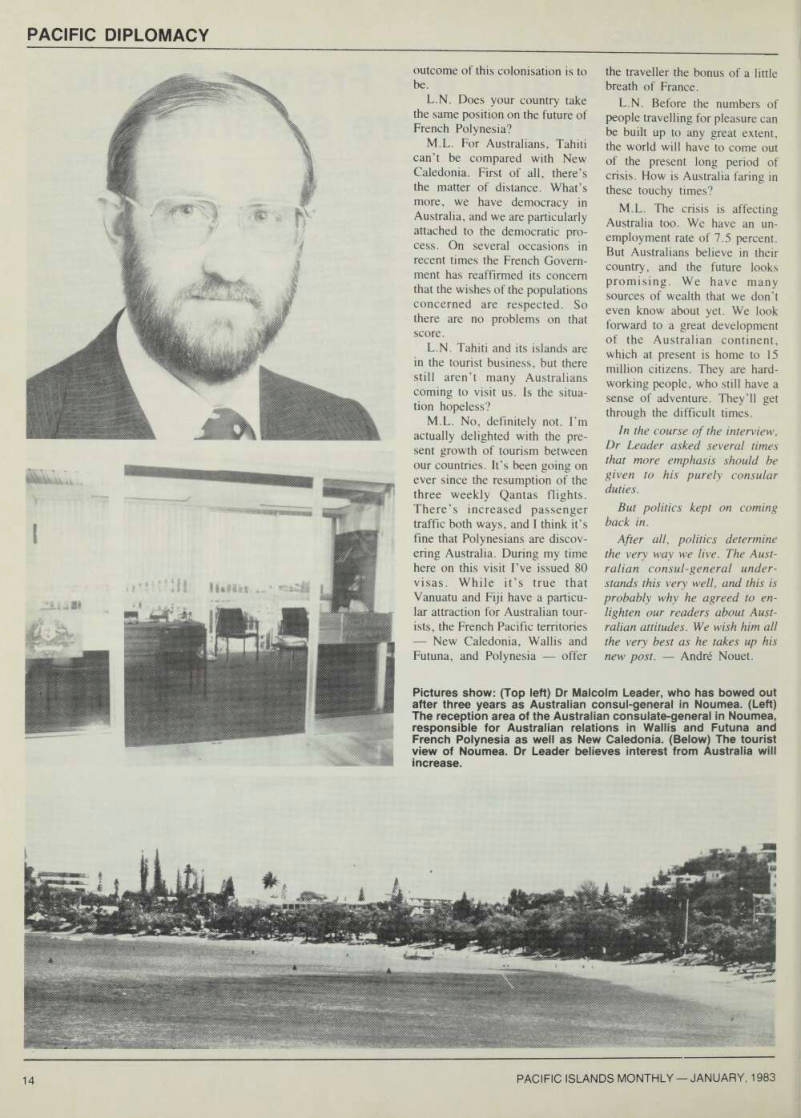
Pictures show: (Top left) Dr Malcolm Leader, who has bowed out after three years as Australian consul-general in Noumea. (Left) The reception area of the Australian consulate-general in Noumea, responsible for Australian relations in Wallis and Futuna and French Polynesia as well as New Caledonia. (Below) The tourist view of Noumea. Dr Leader believes interest from Australia will increase.
“Talk independence
New Caledonia
“Talk independence or we don’t talk at all” - U.C.
More than 3000 Union Caledonienne members gathered at Sarramea, 130 kilometres north of Noumea, in November, for the 13th annual congress of their party.
A major resolution to emerge by unanimous decision from the three-day congress was that dis cussions on autonomy will be
possible only if they are clearly
designed to lead to independ ence. The French Government has promised a reform of New
Caledonia’s statute in order to grant more autonomy. But now no leaders of the Union Caledonienne can participate in autonomy discussions without a prior guarantee of independence.
The congress also adopted in principle the outline of a con stitution for a Kanak socialist state, in the form of a democratic decentralised republic. The na tional parliament would com prise a national assembly elected by universal suffrage, and a se nate of “custom” chiefs. The latter would rule on matters af fecting customary Kanak socie ty, while the national assembly
would legislate on matters of state.
One guest at the congress was Pastor Simon Buama of New Caledonia’s Evangelical Church, who stressed the support of his church for the Independence Front and their goals.
Other speeches of support were given by union leaders, leaders of other parties in the Independence Front, and by Jean-Claude Routier, a member of the executive bureau of the French Socialist Party. Mr Routier said his visit to New Caledonia had enabled him to see first hand the “scandalous and extraordinary conditions” in which the Kanak people existed.
He assured the congress that changes were taking place, even though these were not sufficient ly in evidence for some. He said his party was aware of the Inde pendence Front’s aim for inde pendence in 1984, but that he hoped decisions would be taken democratically, in a spirit of sol idarity and friendship.
During the same weekend as the congress, a group of Melane sians occupied land belonging to the Devillers family near Baco, 300 kilometres north of Noumea.
The group was led by Rene Guiart (son of French an thropologist, Professor Jean Guiart), and Augustin Wabealo.
They set up barricades on roads leading to the property, and built a symbolic house on the farmer’s land. Several hundred Garde Mobile personnel were at the scene but did not intervene for fear of provoking violence. A Right-wing deputy, Justin Guil lemard, and three other members of his RPCR party, attempted to visit the Devillers family but found their way blocked. Later Mr Guillemard criticised the “nonchalance of the au thorities”, and described French law as being ineffectual in New Caledonia. At an RPCR press conference, party leaders called upon their supporters to be “vigilant and aware of the dangerous political situation which exists.”
A party communique called on the high commissioner and French authorities to ensure that French law is firmly applied to all in New Caledonia, especially laws relating to freedom of movement, personal security and protection of private property.
The RPCR statement added that they will not accept that extremist groups can illegally oc cupy land, erect road barricades,
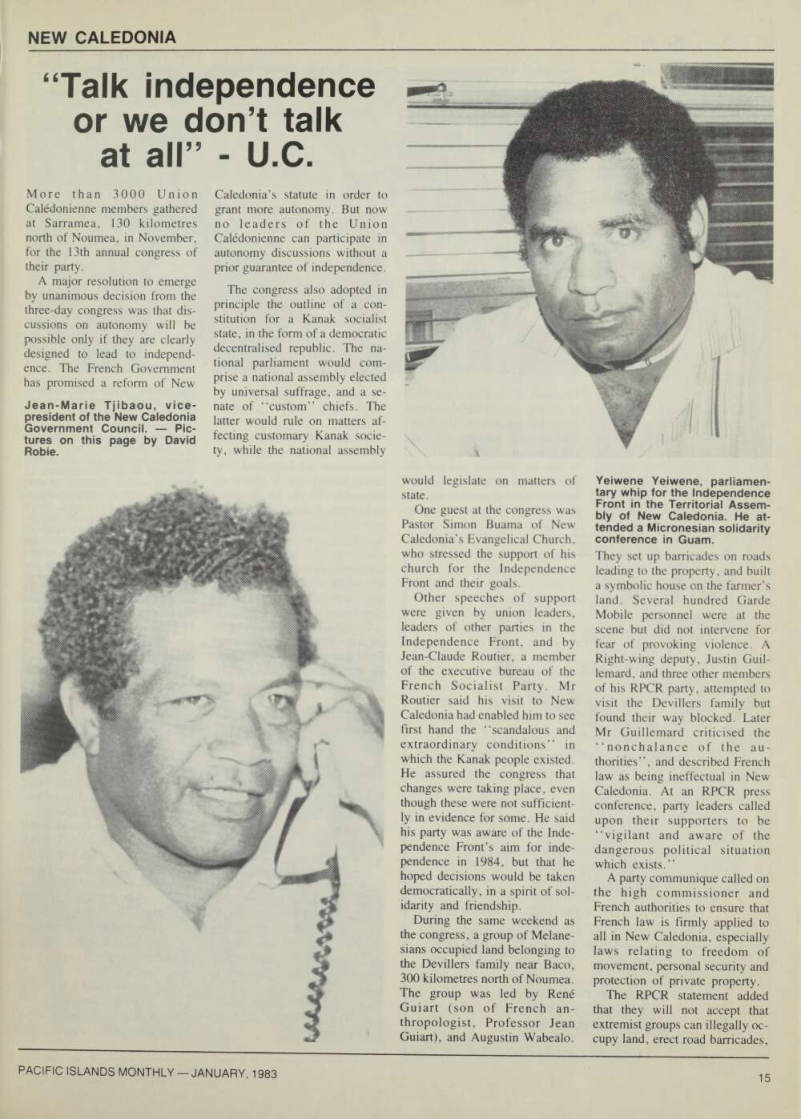
Jean-Marie Tjibaou, vice president of the New Caledonia Government Council. - Pic tures on this page by David Robie.
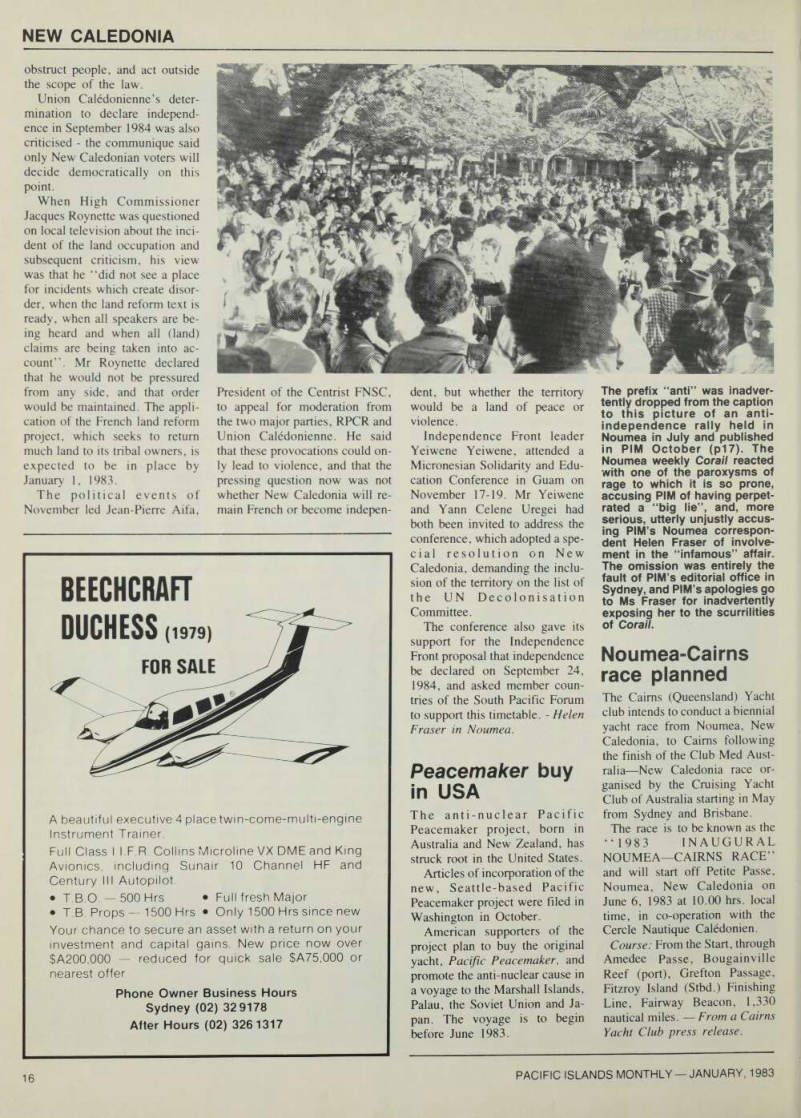
Yeiwene Yeiwene, parliamen tary whip for the Independence Front in the Territorial Assem bly of New Caledonia. He at tended a Micronesian solidarity conference in Guam.
obstruct people, and act outside the scope of the law.
Union Caledonienne’s deter mination to declare independ ence in September 1984 was also criticised - the communique said only New Caledonian voters will decide democratically on this point.
When High Commissioner
Jacques Roynette was questioned
on local television about the inci dent of the land occupation and subsequent criticism, his view was that he “did not see a place for incidents which create disor der, when the land reform text is ready, when all speakers are be ing heard and when all (land) claims are being taken into ac count ”. Mr Roynette declared that he would not be pressured from any side, and that order would be maintained. The appli cation of the French land reform project, which seeks to return much land to its tribal owners, is expected to be in place by January 1, 1983.
The political events of November led Jean-Pierre Aifa,
President of the Centrist FNSC, to appeal for moderation from the two major parties, RPCR and Union Caledonienne. He said that these provocations could on ly lead to violence, and that the pressing question now was not whether New Caledonia will re main French or become indepen
dent, but whether the territory would be a land of peace or violence.
Independence Front leader Yeiwene Yeiwene, attended a Micronesian Solidarity and Edu cation Conference in Guam on November 17-19. Mr Yeiwene and Yann Celene Uregei had both been invited to address the conference, which adopted a spe cial resolution on New Caledonia, demanding the inclu sion of the territory on the list of the UN Decolonisation Committee.
The conference also gave its support for the Independence Front proposal that independence be declared on September 24, 1984, and asked member coun tries of the South Pacific Forum to support this timetable. - Helen Fraser in Noumea.
Peacemaker buy
in USA
The anti-nuclear Pacific Peacemaker project, born in Australia and New Zealand, has struck root in the United States.
Articles of incorporation of the new, Seattle-based Pacific Peacemaker project were filed in Washington in October.
American supporters of the project plan to buy the original yacht, Pacific Peacemaker, and promote the anti-nuclear cause in a voyage to the Marshall Islands, Palau, the Soviet Union and Ja pan. The voyage is to begin before June 1983.
Noumea-Cairns
race planned
The Cairns (Queensland) Yacht club intends to conduct a biennial yacht race from Noumea, New Caledonia, to Cairns following the finish of the Club Med Aust ralia—New Caledonia race or ganised by the Cruising Yacht Club of Australia starting in May from Sydney and Brisbane.
The race is to be known as the
“ 1983 Inaugural
Noumea-Cairns Race”
and will start off Petite Passe, Noumea, New Caledonia on June 6, 1983 at 10.00 hrs. local time, in co-operation with the Cercle Nautique Caledonien.
Course: From the Start, through Amedee Passe, Bougainville Reef (port), Grefton Passage, Fitzroy Island (Stbd.) Finishing Line, Fairway Beacon, 1,330 nautical miles. From a Cairns Yacht Club press release.
The prefix “anti” was inadver tently dropped from the caption to this picture of an anti
independence rally held in
Noumea in July and published in PIM October (p17). The Noumea weekly Corail reacted with one of the paroxysms of rage to which it is so prone, accusing PIM of having perpet rated a “big lie”, and, more serious, utterly unjustly accus ing PIM’s Noumea correspon dent Helen Fraser of involve ment in the “infamous” affair.
The omission was entirely the fault of PIM’s editorial office in Sydney, and PIM’s apologies go to Ms Fraser for inadvertently exposing her to the scurrilities of Corail.
Advertisements & other items, p. 16 (1 item)
Duchess (1979)
BEECHCRAFT
FOR SALE
A beautiful executive 4 placetwin-come-multi-engine Instrument Trainer.
Full Class I I.F.R. Collins Microline VX DME and King Avionics, including Sunair 10 Channel HF and Century 111 Autopilot. • T. 8.0. 500 Hrs • Full fresh Major • T.B. Props 1500 Hrs • Only 1500 Hrs since new Your chance to secure an asset with a return on your investment and capital gains. New price now over $A200,000 reduced for quick sale $A75,000 or nearest offer.
Phone Owner Business Hours Sydney (02) 32 9178 After Hours (02) 3261317
Big Apple
Tropicalities
Coconuts sprout in the Big Apple
Programs concerning the Pacific region continued to be scheduled throughout autumn 1982 at New York’s Metropolitan Museum of Art, Asia Society and Natural History Museum.
“Ceremonies and Spirits,” an exhibition of art from Africa, the Pacific Islands and the Americas selected from the Metropolitan’s Michael C. Rockefeller Wing, toured New York’s five boroughs.
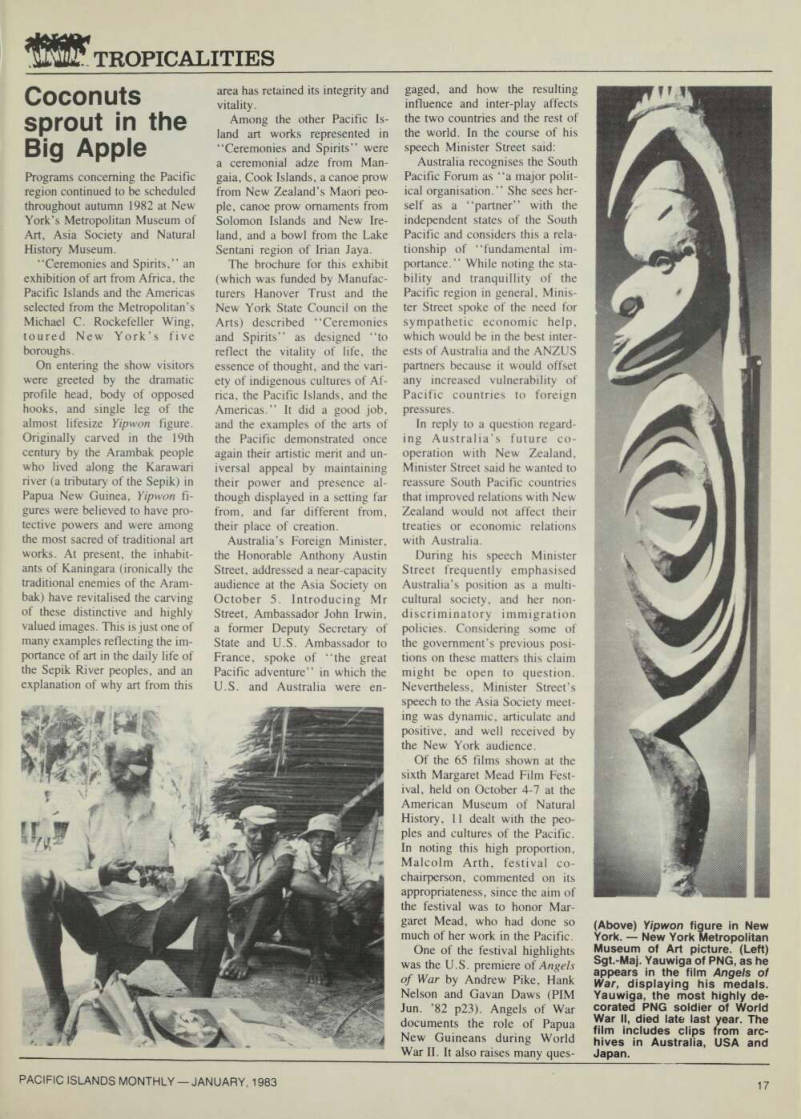
On entering the show visitors were greeted by the dramatic profile head, body of opposed hooks, and single leg of the almost lifesize Yipwon figure.
Originally carved in the 19th century by the Arambak people who lived along the Karawari river (a tributary of the Sepik) in Papua New Guinea, Yipwon fi gures were believed to have pro tective powers and were among the most sacred of traditional art works. At present, the inhabit ants of Kaningara (ironically the traditional enemies of the Aram bak) have revitalised the carving of these distinctive and highly valued images. This is just one of many examples reflecting the im portance of art in the daily life of the Sepik River peoples, and an explanation of why art from this
area has retained its integrity and
vitality.
Among the other Pacific Is land art works represented in “Ceremonies and Spirits” were a ceremonial adze from Man gaia, Cook Islands, a canoe prow from New Zealand’s Maori peo ple, canoe prow ornaments from Solomon Islands and New Ire land, and a bowl from the Lake Sentani region of Irian Jaya.
The brochure for this exhibit (which was funded by Manufac turers Hanover Trust and the New York State Council on the Arts) described “Ceremonies and Spirits” as designed “to reflect the vitality of life, the essence of thought, and the vari ety of indigenous cultures of Af rica, the Pacific Islands, and the Americas.” It did a good job, and the examples of the arts of the Pacific demonstrated once again their artistic merit and un
iversal appeal by maintaining
their power and presence al though displayed in a setting far from, and far different from, their place of creation.
Australia’s Foreign Minister, the Honorable Anthony Austin Street, addressed a near-capacity audience at the Asia Society on October 5. Introducing Mr Street, Ambassador John Irwin, a former Deputy Secretary of State and U.S. Ambassador to France, spoke of “the great Pacific adventure” in which the U.S. and Australia were en-
gaged, and how the resulting influence and inter-play affects the two countries and the rest of the world. In the course of his speech Minister Street said: Australia recognises the South Pacific Forum as “a major polit ical organisation.” She sees her self as a “partner” with the independent states of the South Pacific and considers this a rela tionship of “fundamental im portance.” While noting the sta bility and tranquillity of the Pacific region in general. Minis ter Street spoke of the need for sympathetic economic help, which would be in the best inter ests of Australia and the ANZUS partners because it would offset any increased vulnerability of Pacific countries to foreign pressures.
In reply to a question regard
ing Australia’s future co operation with New Zealand, Minister Street said he wanted to reassure South Pacific countries that improved relations with New Zealand would not affect their treaties or economic relations with Australia.
During his speech Minister
Street frequently emphasised
Australia’s position as a multi cultural society, and her non
discriminatory immigration
policies. Considering some of
the government’s previous posi
tions on these matters this claim might be open to question.
Nevertheless, Minister Street’s speech to the Asia Society meet ing was dynamic, articulate and positive, and well received by the New York audience.
Of the 65 films shown at the sixth Margaret Mead Film Fest ival, held on October 4-7 at the American Museum of Natural History, 11 dealt with the peo ples and cultures of the Pacific.
In noting this high proportion,
Malcolm Arth, festival co chairperson, commented on its appropriateness, since the aim of the festival was to honor Mar garet Mead, who had done so much of her work in the Pacific.
One of the festival highlights was the U.S. premiere of Angels of War by Andrew Pike, Hank Nelson and Gavan Daws (PIM Jun. ’B2 p 23). Angels of War documents the role of Papua New Guineans during World War 11. It also raises many ques-
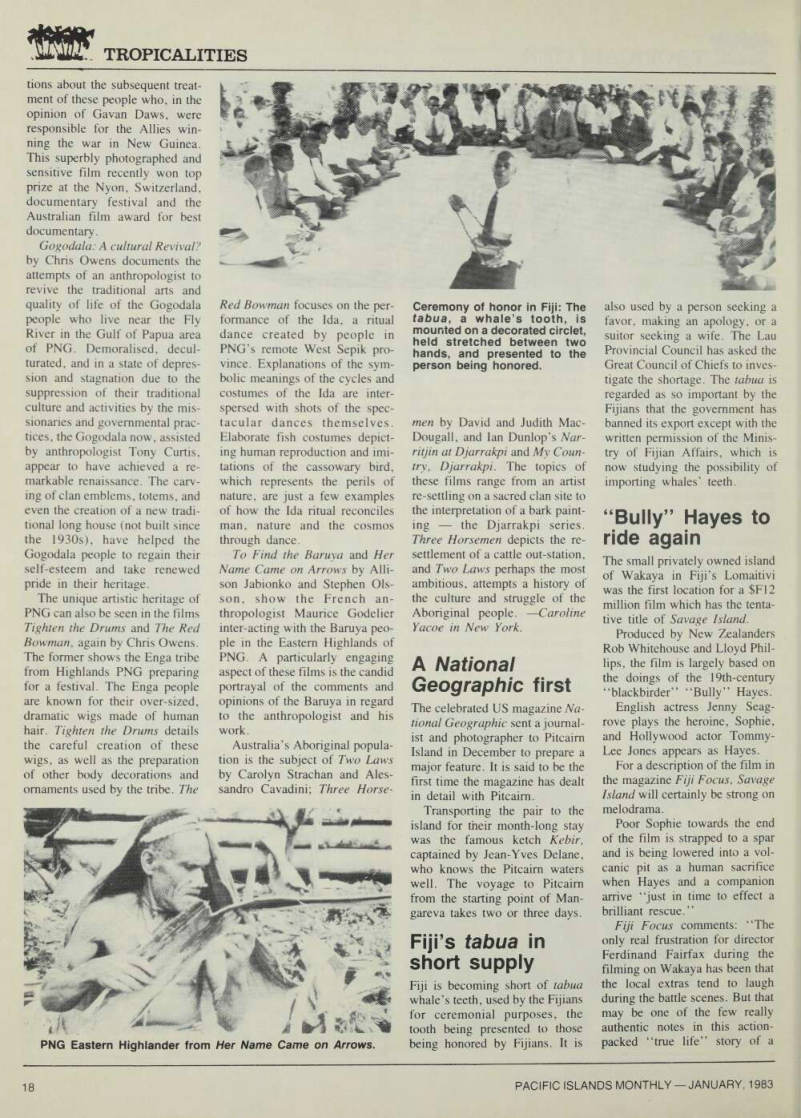
(Above) Yipwon figure in New
York. New York Metropolitan Museum of Art picture. (Left) Sgt.-Maj. Yauwiga of PNG, as he appears in the film Angels of War, displaying his medals.
Yauwiga, the most highly de corated PNG soldier of World War II, died late last year. The film includes clips from arc hives in Australia, USA and Japan.
tions about the subsequent treat ment of these people who, in the opinion of Gavan Daws, were responsible for the Allies win ning the war in New Guinea.
This superbly photographed and sensitive film recently won top prize at the Nyon, Switzerland, documentary festival and the Australian film award for best documentary.
Gogodala: A cultural Revival? by Chris Owens documents the attempts of an anthropologist to revive the traditional arts and quality of life of the Gogodala people who live near the Fly River in the Gulf of Papua area of PNG. Demoralised, decul turated, and in a state of depres sion and stagnation due to the suppression of their traditional culture and activities by the mis sionaries and governmental prac tices, the Gogodala now, assisted by anthropologist Tony Curtis, appear to have achieved a re markable renaissance. The carv ing of clan emblems, totems, and even the creation of a new tradi tional long house (not built since the 19305), have helped the Gogodala people to regain their self-esteem and take renewed pride in their heritage.
The unique artistic heritage of PNG can also be seen in the films Tighten the Drums and The Red Bowman, again by Chris Owens.
The former shows the Enga tribe from Highlands PNG preparing for a festival. The Enga people are known for their over-sized, dramatic wigs made of human hair. Tighten the Drums details the careful creation of these wigs, as well as the preparation of other body decorations and ornaments used by the tribe. The
Red Bowman focuses on the per formance of the Ida, a ritual dance created by people in PNG’s remote West Sepik pro vince. Explanations of the sym bolic meanings of the cycles and costumes of the Ida are inter spersed with shots of the spec tacular dances themselves.
Elaborate fish costumes depict ing human reproduction and imi tations of the cassowary bird, which represents the perils of nature, are just a few examples of how the Ida ritual reconciles man, nature and the cosmos
through dance.
To Find the Baruya and Her Name Came on Arrows by Alli son Jabionko and Stephen Ols son, show the French an thropologist Maurice Godelier inter-acting with the Baruya peo ple in the Eastern Highlands of PNG. A particularly engaging aspect of these films is the candid portrayal of the comments and opinions of the Baruya in regard to the anthropologist and his work.
Australia’s Aboriginal popula tion is the subject of Two Laws by Carolyn Strachan and Ales sandro Cavadini; Three Horse-
men by David and Judith Mac- Dougall, and lan Dunlop’s Nar ritjin at Djarrakpi and My Coun try, Djarrakpi. The topics of these films range from an artist re-settling on a sacred clan site to the interpretation of a bark paint
ing the Djarrakpi series.
Three Horsemen depicts the re settlement of a cattle out-station, and Two Laws perhaps the most ambitious, attempts a history of the culture and struggle of the
Aboriginal people.
Caroline
Yacoe in New York.
A National
Geographic first
The celebrated US magazine Na tional Geographic sent a journal ist and photographer to Pitcairn Island in December to prepare a major feature. It is said to be the first time the magazine has dealt in detail with Pitcairn.
Transporting the pair to the island for their month-long stay was the famous ketch Kebir,
captained by Jean-Yves Delane,
who knows the Pitcairn waters well. The voyage to Pitcairn from the starting point of Man gam va takes two or three days.
Fiji’s tabua in
short supply
Fiji is becoming short of tabua whale’s teeth, used by the Fijians for ceremonial purposes, the tooth being presented to those being honored by Fijians. It is
also used by a person seeking a favor, making an apology, or a suitor seeking a wife. The Lau Provincial Council has asked the Great Council of Chiefs to inves tigate the shortage. The tabua is regarded as so important by the Fijians that the government has banned its export except with the written permission of the Minis try of Fijian Affairs, which is now studying the possibility of importing whales’ teeth.
“Bully” Hayes to
ride again
The small privately owned island of Wakaya in Fiji’s Lomaitivi was the first location for a SFI2 million film which has the tenta tive title of Savage Island.
Produced by New Zealanders Rob Whitehouse and Lloyd Phil lips, the film is largely based on the doings of the 19th-century “blackbirder” “Bully” Hayes.
English actress Jenny Seag
rove plays the heroine, Sophie, and Hollywood actor Tommy- Lee Jones appears as Hayes.
For a description of the film in the magazine Fiji Focus, Savage Island will certainly be strong on melodrama.
Poor Sophie towards the end of the film is strapped to a spar and is being lowered into a vol canic pit as a human sacrifice when Hayes and a companion arrive “just in time to effect a brilliant rescue.”
Fiji Focus comments; “The only real frustration for director Ferdinand Fairfax during the filming on Wakaya has been that the local extras tend to laugh during the battle scenes. But that may be one of the few really authentic notes in this action packed “true life” story of a
PNG Eastern Highlander from Her Name Came on Arrows.
Ceremony of honor in Fiji: The tabua, a whale’s tooth, is mounted on a decorated circlet, held stretched between two hands, and presented to the person being honored.
South Seas “folk hero”. Any way, Fairfax wanted them to look serious and they obliged y y
Hiccups for
30 Jours
The French-language monthly of Pacific affairs 30 Jours, launched at the beginning of 1982, was assailed by the hiccups towards the end of the first year of its existence.
Its November issue failed to appear due to what were called, in a statement issued by its Noumea-based management, production difficulties ’’.
The statement promised that an issue would appear in mid- December and that then, 30 Jours, “like all inhabitants of the South Pacific’’, would go on holiday and not appear again
until February.
Strange that PIM has been around the South Pacific for more than 50 years, and still doesn’t go on holiday between December and February.
Perhaps we have a lesson to learn here from our Gallic con
temporary. Or maybe we’ll just continue to concentrate on ap pearing every month, since that’s what the job seems to be about.
Sucking pig
offends MR
A member of the Papua New Guinea Parliament has called for the banning of a postcard on display in Port Moresby tourist shops. The postcard shows a woman from the Highlands breast-feeding a pig. The High lands MP, Malo Kiniyafa, said he was embarrassed by the card, which he had seen at the Port Moresby Travelodge “where people all over the world come to stay.’’ Breast-feeding of piglets is a common practice in the Highlands, where pigs are the most cherished family possession.
Dawn of Hope
to reach out
The MV Dawn of Hope, single deck, steel cargo vessel (400 tonnes), is being refitted at
Salamaua, Papua New Guinea, for Islands Outreach Shipping Ltd, of Penrith, NSW. The company, described as a “faith ministry,” will provide transport tor Christian workers who will contact pastors and churches, provide a workshop and printing facilities for churches a regular laciiities tor churches, a regular cargo service to isolated island groups, a doctor and mobile dinic, full-time evangelists, bibles and other Christian literati,rp ana other Christian literature.
It is expected that the service will begin early this year from Sydney to Auckland, Vanuatu Tuvalu, Kiribati and Solomon Islands. The company hopes to make a profit, which will be dispersed among the islands for the support of the churches, but i, also hopes for donations towards the cost of the refit.
After 13 years in an annexe at the Port Moresby General Hos pital, the Port Moresby Shel tered Workshop has moved to a new and bigger building and has embarked on an expanded program of activities. The work shop provides handcraft and technical training for hand icapped men and women, and carries out work ranging from bookbinding and sewing to car pentry and small equipment maintenance. Some of the trainees remain with the work shop on a contract employment basis, and others are phased into the open work force. (Top left) Eillen Warabu at work in the sewing section. Her apron and the curtains behind her were screen-printed at the
workshop. (Top right) John
Kambon at work on a book
binding job for a Port Moresby
company. - Pictures, Ela
Geno; notes, Barney Orere, for PNG Information Service.
Advertisements & other items, p. 20 (1 item)
Pofver
Starting & Staying
SB r - J- V,
AMP
ebh g V
ma^M
stow
fSSSHtdt uisd os&
Power Boats Need Different Batteries
There is a big difference between a car battery and a marine battery.
A car battery, for example, is never really discharged, as it is only used for a few seconds each day a nd promptly re-charged. Not so your cruiser or sportsfisherman.
Starting the engine is only the beginning. During the day, weekend or cruise, how often will you run the live bait tank, the depth sounder, the nav. lights or maintain a listening watch on your radio transceiver?
As well as cranking power, boats need staying power. Boats need Besco's Marine Batteries, deep cycle, heavy duty marine batteries.
If your boat is getting a little flat in the electrics department, write or phone BESCO today and ask for more information, more facts about
BESCO MARINE BATTERIES.
BESCO
Batteries Division Of Sims Products Pty Ltd.
A Peko Wall send Group Member m Papua New Guinea: Lae/Rabaul Auto Marine Industries, PO Box 785, Lae. 42-1125. Port I Moresby: Par Sales Pty. Ltd., Boroko. 25-6266. Fiji: Bar Motor Parts Ltd., PO Box 51, Bar, r 74-070 New Caledonia: Lotissement Industrie!, BP 889, Noumea. 27-4906. Hong Kong: T.l.
Knight & Co., PO Box 5585, T.S.T. Kowloon, 3-66 5341. N.Z.: Battery Services (Industrial) Ltd., PO 27-375, Auckland 4, 694-111. Gould Batteries, 58 Hautana St., Lower Hutt, Wellington. - Telex- CHACO N.Z. 3714. Other Areas: Jarwil International Pty. Ltd., 410 Kent St., Sydney, / 2000. (02) 264-3477. Telex: AA 72102. Besco Batteries, Villawood, 2163. (02) 632-0251.
LEADERS IN BATTERY TECHNOLOGY —
The wonder lakes
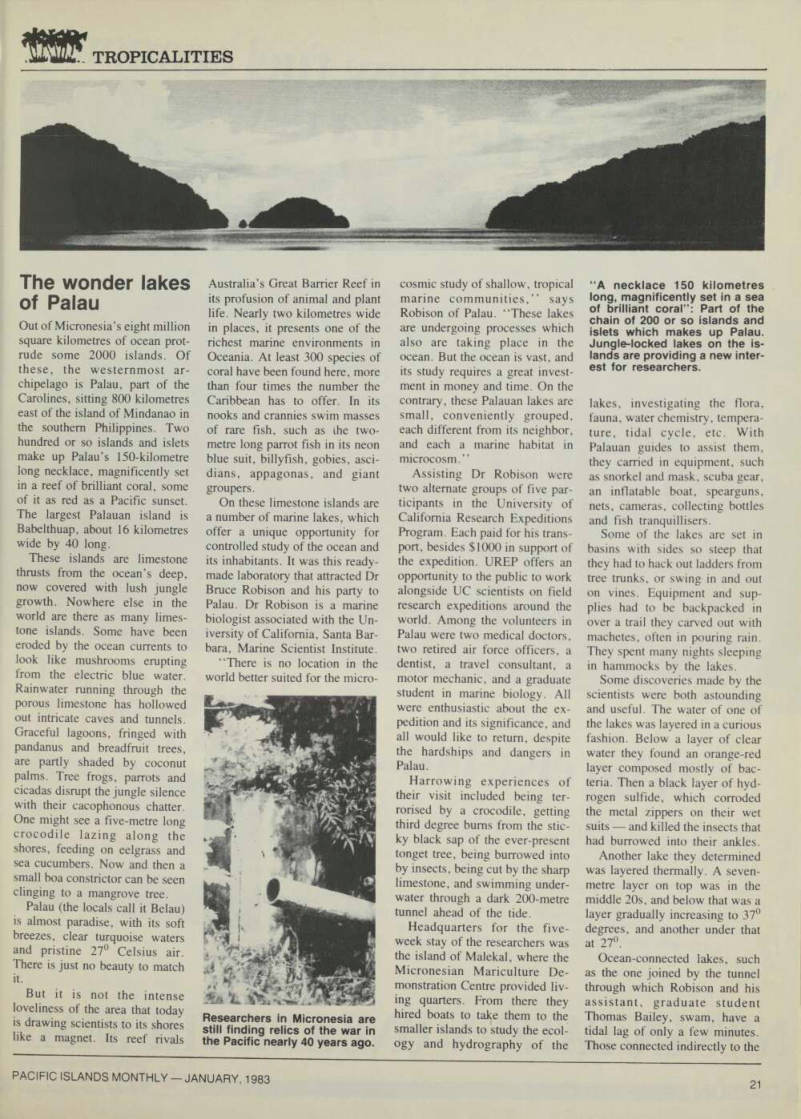

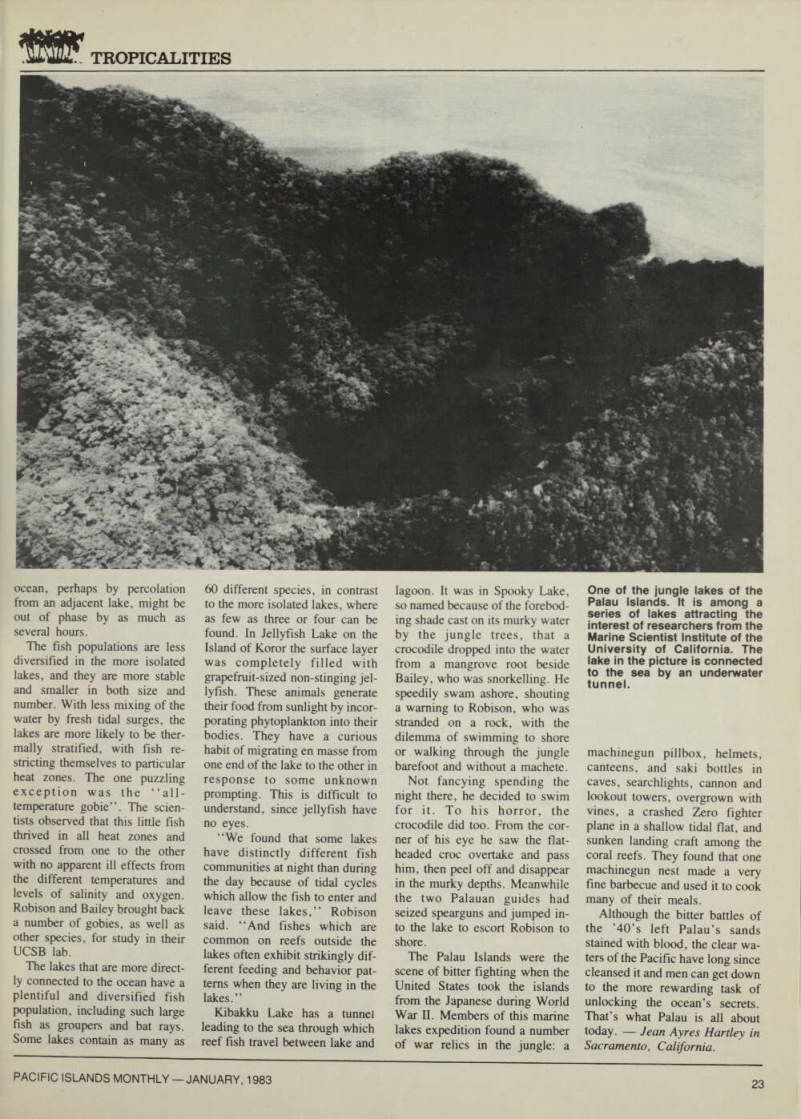
Tropicalities
The wonder lakes of Palau
Australia’s Great Barrier Reef in its profusion of animal and plant life. Nearly two kilometres wide in places, it presents one of the richest marine environments in Oceania. At least 300 species of coral have been found here, more than four times the number the Caribbean has to offer. In its nooks and crannies swim masses of rare fish, such as the two metre long parrot fish in its neon blue suit, billyfish, gobies, asci dians, appagonas, and giant groupers.
On these limestone islands are a number of marine lakes, which offer a unique opportunity for controlled study of the ocean and its inhabitants. It was this ready made laboratory that attracted Dr Bruce Robison and his party to Palau. Dr Robison is a marine biologist associated with the Un iversity of California, Santa Bar bara, Marine Scientist Institute.
“There is no location in the world better suited for the micro-
Out of Micronesia’s eight million square kilometres of ocean prot rude some 2000 islands. Of these, the westernmost ar chipelago is Palau, part of the Carolines, sitting 800 kilometres east of the island of Mindanao in the southern Philippines. Two hundred or so islands and islets make up Palau’s 150-kilometre long necklace, magnificently set in a reef of brilliant coral, some of it as red as a Pacific sunset.
The largest Palauan island is Babelthuap, about 16 kilometres wide by 40 long.
These islands are limestone thrusts from the ocean’s deep, now covered with lush jungle growth. Nowhere else in the world are there as many limes tone islands. Some have been eroded by the ocean currents to look like mushrooms erupting from the electric blue water.
Rainwater running through the porous limestone has hollowed out intricate caves and tunnels.
Graceful lagoons, fringed with pandanus and breadfruit trees, are partly shaded by coconut palms. Tree frogs, parrots and cicadas disrupt the jungle silence with their cacophonous chatter.
One might see a five-metre long crocodile lazing along the shores, feeding on eelgrass and sea cucumbers. Now and then a small boa constrictor can be seen clinging to a mangrove tree.
Palau (the locals call it Belau) is almost paradise, with its soft breezes, clear turquoise waters and pristine 27° Celsius air.
There is just no beauty to match it.
But it is not the intense loveliness of the area that today is drawing scientists to its shores like a magnet. Its reef rivals
cosmic study of shallow, tropical marine communities,” says Robison of Palau. “These lakes are undergoing processes which also are taking place in the ocean. But the ocean is vast, and its study requires a great invest ment in money and time. On the contrary, these Palauan lakes are small, conveniently grouped, each different from its neighbor, and each a marine habitat in microcosm.”
Assisting Dr Robison were two alternate groups of five par ticipants in the University of California Research Expeditions Program. Each paid for his trans port, besides $lOOO in support of the expedition. UREP offers an opportunity to the public to work alongside UC scientists on field research expeditions around the world. Among the volunteers in Palau were two medical doctors, two retired air force officers, a dentist, a travel consultant, a motor mechanic, and a graduate student in marine biology. All were enthusiastic about the ex pedition and its significance, and all would like to return, despite the hardships and dangers in Palau.
Harrowing experiences of their visit included being ter rorised by a crocodile, getting third degree bums from the stic ky black sap of the ever-present tonget tree, being burrowed into by insects, being cut by the sharp limestone, and swimming under water through a dark 200-metre tunnel ahead of the tide.
Headquarters for the five week stay of the researchers was the island of Malekal, where the Micronesian Mariculture De monstration Centre provided liv ing quarters. From there they hired boats to take them to the smaller islands to study the ecol ogy and hydrography of the
lakes, investigating the flora, fauna, water chemistry, tempera ture, tidal cycle, etc. With Palauan guides to assist them, they carried in equipment, such as snorkel and mask, scuba gear, an inflatable boat, spearguns, nets, cameras, collecting bottles and fish tranquillisers.
Some of the lakes are set in basins with sides so steep that they had to hack out ladders from tree trunks, or swing in and out on vines. Equipment and sup plies had to be backpacked in over a trail they carved out with machetes, often in pouring rain.
They spent many nights sleeping in hammocks by the lakes.
Some discoveries made by the scientists were both astounding and useful. The water of one of the lakes was layered in a curious fashion. Below a layer of clear water they found an orange-red layer composed mostly of bac teria. Then a black layer of hyd rogen sulfide, which corroded the metal zippers on their wet suits and killed the insects that had burrowed into their ankles.
Another lake they determined was layered thermally. A seven metre layer on top was in the middle 20s, and below that was a layer gradually increasing to 37° degrees, and another under that at 27°.
Ocean-connected lakes, such as the one joined by the tunnel through which Robison and his assistant, graduate student Thomas Bailey, swam, have a tidal lag of only a few minutes.
Those connected indirectly to the
Researchers in Micronesia are still finding relics of the war in the Pacific nearly 40 years ago.
“A necklace 150 kilometres long, magnificently set in a sea of brilliant coral”: Part of the chain of 200 or so islands and islets which makes up Palau.
Jungle-locked lakes on the is lands are providing a new inter est for researchers.
ocean, perhaps by percolation from an adjacent lake, might be out of phase by as much as several hours.
The fish populations are less diversified in the more isolated lakes, and they are more stable and smaller in both size and number. With less mixing of the water by fresh tidal surges, the lakes are more likely to be ther mally stratified, with fish re stricting themselves to particular heat zones. The one puzzling exception was the “all temperature gobie”. The scien tists observed that this little fish thrived in all heat zones and crossed from one to the other with no apparent ill effects from the different temperatures and levels of salinity and oxygen.
Robison and Bailey brought back a number of gobies, as well as other species, for study in their UCSB lab.
The lakes that are more direct ly connected to the ocean have a plentiful and diversified fish population, including such large fish as groupers and bat rays.
Some lakes contain as many as
60 different species, in contrast to the more isolated lakes, where as few as three or four can be found. In Jellyfish Lake on the Island of Koror the surface layer was completely filled with grapefruit-sized non-stinging jel lyfish. These animals generate their food from sunlight by incor porating phytoplankton into their bodies. They have a curious habit of migrating en masse from one end of the lake to the other in response to some unknown prompting. This is difficult to understand, since jellyfish have no eyes.
“We found that some lakes have distinctly different fish communities at night than during the day because of tidal cycles which allow the fish to enter and leave these lakes,” Robison said. “And fishes which are common on reefs outside the lakes often exhibit strikingly dif ferent feeding and behavior pat terns when they are living in the lakes.”
Kibakku Lake has a tunnel leading to the sea through which reef fish travel between lake and
lagoon. It was in Spooky Lake, so named because of the forebod ing shade cast on its murky water by the jungle trees, that a crocodile dropped into the water from a mangrove root beside Bailey, who was snorkelling. He speedily swam ashore, shouting a warning to Robison, who was stranded on a rock, with the dilemma of swimming to shore or walking through the jungle barefoot and without a machete.
Not fancying spending the night there, he decided to swim for it. To his horror, the crocodile did too. From the cor ner of his eye he saw the flat headed croc overtake and pass him, then peel off and disappear in the murky depths. Meanwhile the two Palauan guides had seized spearguns and jumped in to the lake to escort Robison to shore.
The Palau Islands were the scene of bitter fighting when the United States took the islands from the Japanese during World War n. Members of this marine lakes expedition found a number of war relics in the jungle: a
machinegun pillbox, helmets, canteens, and saki bottles in caves, searchlights, cannon and lookout towers, overgrown with vines, a crashed Zero fighter plane in a shallow tidal flat, and sunken landing craft among the coral reefs. They found that one machinegun nest made a very fine barbecue and used it to cook many of their meals.
Although the bitter battles of the ’4o’s left Palau’s sands stained with blood, the clear wa ters of the Pacific have long since cleansed it and men can get down to the more rewarding task of unlocking the ocean’s secrets.
That’s what Palau is all about
today.
Jean Ayres Hartley in
Sacramento, California
One of the jungle lakes of the Palau Islands. It is among a series of lakes attracting the interest of researchers from the Marine Scientist Institute of the University of California. The lake in the picture is connected to the sea by an underwater tunnel.
Advertisements & other items, p. 22 (1 item)
r^gesSssr
who else but
" .^MCPdhiaW
NISSAN
That's becau^ woTd over,
need for energy toa ical skills to “ 5T=S«>« especially for Sunny s tro™ combustion It s minimal we ightsavings, not power, too.
reduce fueling *^ and
taining ri 9 ,d^ '“l®, more subtle improve.
I>» •£XJkm ar«W««
performance. Nissa n or Datsun, that into every car we acc0 rding to market.
Speculations and equipment may vary
NISSAN/DATSUN: ONE AND THE SAME
Miracle men
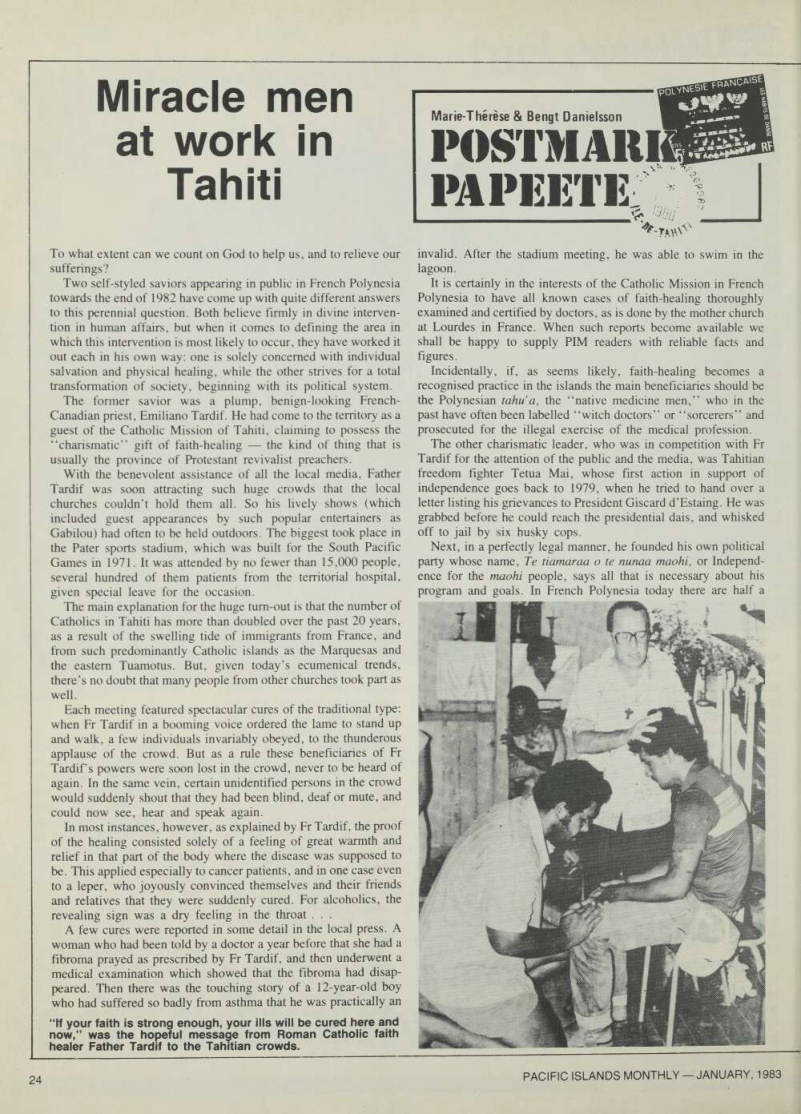
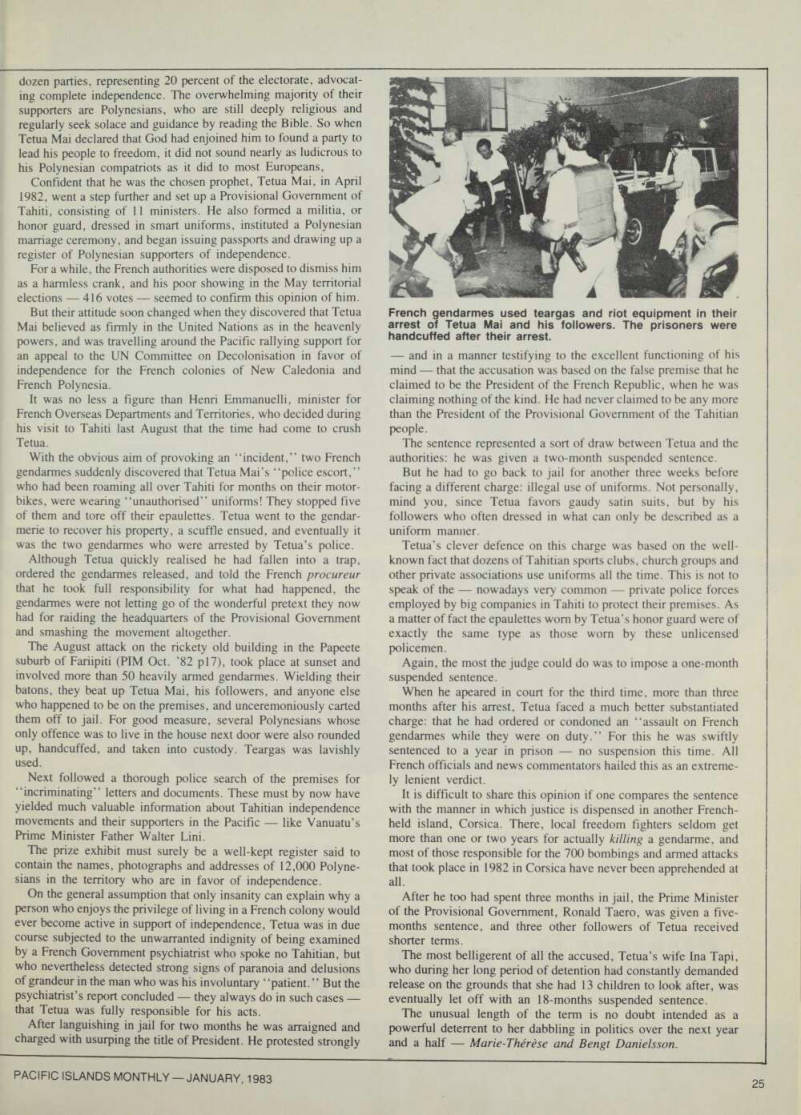
at work in Tahiti
To what extent can we count on God to help us, and to relieve our sufferings?
Two self-styled saviors appearing in public in French Polynesia towards the end of 1982 have come up with quite different answers to this perennial question. Both believe firmly in divine interven tion in human affairs, but when it comes to defining the area in which this intervention is most likely to occur, they have worked it out each in his own way; one is solely concerned with individual salvation and physical healing, while the other strives for a total transformation of society, beginning with its political system.
The former savior was a plump, benign-looking French- Canadian priest, Emiliano Tardif. He had come to the territory as a guest of the Catholic Mission of Tahiti, claiming to possess the “charismatic” gift of faith-healing the kind of thing that is usually the province of Protestant revivalist preachers.
With the benevolent assistance of all the local media, Father Tardif was soon attracting such huge crowds that the local churches couldn’t hold them all. So his lively shows (which included guest appearances by such popular entertainers as Gabilou) had often to be held outdoors. The biggest took place in the Pater sports stadium, which was built for the South Pacific Games in 1971. It was attended by no fewer than 15,000 people, several hundred of them patients from the territorial hospital, given special leave for the occasion.
The main explanation for the huge tum-out is that the number of Catholics in Tahiti has more than doubled over the past 20 years, as a result of the swelling tide of immigrants from France, and from such predominantly Catholic islands as the Marquesas and the eastern Tuamotus. But, given today’s ecumenical trends, there’s no doubt that many people from other churches took part as well.
Each meeting featured spectacular cures of the traditional type: when Fr Tardif in a booming voice ordered the lame to stand up and walk, a few individuals invariably obeyed, to the thunderous applause of the crowd. But as a rule these beneficiaries of Fr Tardif s powers were soon lost in the crowd, never to be heard of again. In the same vein, certain unidentified persons in the crowd would suddenly shout that they had been blind, deaf or mute, and could now see, hear and speak again.
In most instances, however, as explained by Fr Tardif, the proof of the healing consisted solely of a feeling of great warmth and relief in that part of the body where the disease was supposed to be. This applied especially to cancer patients, and in one case even to a leper, who joyously convinced themselves and their friends and relatives that they were suddenly cured. For alcoholics, the revealing sign was a dry feeling in the throat . . .
A few cures were reported in some detail in the local press. A woman who had been told by a doctor a year before that she had a fibroma prayed as prescribed by Fr Tardif, and then underwent a medical examination which showed that the fibroma had disap peared. Then there was the touching story of a 12-year-old boy who had suffered so badly from asthma that he was practically an
invalid. After the stadium meeting, he was able to swim in the
lagoon.
It is certainly in the interests of the Catholic Mission in French Polynesia to have all known cases of faith-healing thoroughly examined and certified by doctors, as is done by the mother church at Lourdes in France. When such reports become available we shall be happy to supply PIM readers with reliable facts and
figures.
Incidentally, if, as seems likely, faith-healing becomes a recognised practice in the islands the main beneficiaries should be the Polynesian tahu’a, the “native medicine men,” who in the past have often been labelled “witch doctors” or “sorcerers” and prosecuted for the illegal exercise of the medical profession.
The other charismatic leader, who was in competition with Fr Tardif for the attention of the public and the media, was Tahitian freedom fighter Tetua Mai, whose first action in support of independence goes back to 1979, when he tried to hand over a letter listing his grievances to President Giscard d’Estaing. He was grabbed before he could reach the presidential dais, and whisked off to jail by six husky cops.
Next, in a perfectly legal manner, he founded his own political party whose name, Te tiamaraa o te nunaa maohi, or Independ ence for the maohi people, says all that is necessary about his program and goals. In French Polynesia today there are half a
“If your faith is strong enough, your ills will be cured here and now,” was the hopeful message from Roman Catholic faith healer Father Tardif to the Tahitian crowds.
dozen parties, representing 20 percent of the electorate, advocat ing complete independence. The overwhelming majority of their supporters are Polynesians, who are still deeply religious and regularly seek solace and guidance by reading the Bible. So when Tetua Mai declared that God had enjoined him to found a party to lead his people to freedom, it did not sound nearly as ludicrous to his Polynesian compatriots as it did to most Europeans, Confident that he was the chosen prophet, Tetua Mai, in April 1982, went a step further and set up a Provisional Government of Tahiti, consisting of 11 ministers. He also formed a militia, or honor guard, dressed in smart uniforms, instituted a Polynesian marriage ceremony, and began issuing passports and drawing up a register of Polynesian supporters of independence.
For a while, the French authorities were disposed to dismiss him as a harmless crank, and his poor showing in the May territorial elections 416 votes seemed to confirm this opinion of him.
But their attitude soon changed when they discovered that Tetua Mai believed as firmly in the United Nations as in the heavenly powers, and was travelling around the Pacific rallying support for an appeal to the UN Committee on Decolonisation in favor of independence for the French colonies of New Caledonia and French Polynesia.
It was no less a figure than Henri Emmanuelli, minister for French Overseas Departments and Territories, who decided during his visit to Tahiti last August that the time had come to crush Tetua.
With the obvious aim of provoking an “incident,” two French gendarmes suddenly discovered that Tetua Mai’s “police escort,” who had been roaming all over Tahiti for months on their motor bikes, were wearing “unauthorised” uniforms! They stopped five of them and tore off their epaulettes. Tetua went to the gendar merie to recover his property, a scuffle ensued, and eventually it was the two gendarmes who were arrested by Tetua’s police.
Although Tetua quickly realised he had fallen into a trap, ordered the gendarmes released, and told the French procureur that he took full responsibility for what had happened, the gendarmes were not letting go of the wonderful pretext they now had for raiding the headquarters of the Provisional Government and smashing the movement altogether.
The August attack on the rickety old building in the Papeete suburb of Fariipiti (PIM Oct. ’B2 pi 7), took place at sunset and involved more than 50 heavily armed gendarmes. Wielding their batons, they beat up Tetua Mai, his followers, and anyone else who happened to be on the premises, and unceremoniously carted them off to jail. For good measure, several Polynesians whose only offence was to live in the house next door were also rounded up, handcuffed, and taken into custody. Teargas was lavishly used.
Next followed a thorough police search of the premises for “incriminating” letters and documents. These must by now have yielded much valuable information about Tahitian independence movements and their supporters in the Pacific like Vanuatu’s Prime Minister Father Walter Lini.
The prize exhibit must surely be a well-kept register said to contain the names, photographs and addresses of 12,000 Polyne sians in the territory who are in favor of independence.
On the general assumption that only insanity can explain why a person who enjoys the privilege of living in a French colony would ever become active in support of independence, Tetua was in due course subjected to the unwarranted indignity of being examined by a French Government psychiatrist who spoke no Tahitian, but who nevertheless detected strong signs of paranoia and delusions of grandeur in the man who was his involuntary “patient. ” But the psychiatrist’s report concluded they always do in such cases that Tetua was fully responsible for his acts.
After languishing in jail for two months he was arraigned and charged with usurping the title of President. He protested strongly
and in a manner testifying to the excellent functioning of his mind that the accusation was based on the false premise that he claimed to be the President of the French Republic, when he was claiming nothing of the kind. He had never claimed to be any more than the President of the Provisional Government of the Tahitian people.
The sentence represented a sort of draw between Tetua and the authorities: he was given a two-month suspended sentence.
But he had to go back to jail for another three weeks before facing a different charge: illegal use of uniforms. Not personally, mind you, since Tetua favors gaudy satin suits, but by his followers who often dressed in what can only be described as a uniform manner.
Tetua’s clever defence on this charge was based on the well known fact that dozens of Tahitian sports clubs, church groups and other private associations use uniforms all the time. This is not to speak of the nowadays very common private police forces employed by big companies in Tahiti to protect their premises. As a matter of fact the epaulettes worn by Tetua’s honor guard were of exactly the same type as those worn by these unlicensed policemen.
Again, the most the judge could do was to impose a one-month suspended sentence.
When he apeared in court for the third time, more than three months after his arrest, Tetua faced a much better substantiated charge: that he had ordered or condoned an “assault on French gendarmes while they were on duty.” For this he was swiftly sentenced to a year in prison no suspension this time. All French officials and news commentators hailed this as an extreme ly lenient verdict.
It is difficult to share this opinion if one compares the sentence with the manner in which justice is dispensed in another French held island, Corsica. There, local freedom fighters seldom get more than one or two years for actually killing a gendarme, and most of those responsible for the 700 bombings and armed attacks that took place in 1982 in Corsica have never been apprehended at all.
After he too had spent three months in jail, the Prime Minister of the Provisional Government, Ronald Taero, was given a five months sentence, and three other followers of Tetua received shorter terms.
The most belligerent of all the accused, Tetua’s wife Ina Tapi, who during her long period of detention had constantly demanded release on the grounds that she had 13 children to look after, was eventually let off with an 18-months suspended sentence.
The unusual length of the term is no doubt intended as a powerful deterrent to her dabbling in politics over the next year and a half Marie-Therese and Bengt Danielsson.
French gendarmes used teargas and riot equipment in their arrest of Tetua Mai and his followers. The prisoners were handcuffed after their arrest.
Advertisements & other items, p. 26 (1 item)
SUMI We am ofaerfawnee.
w 4 A e 4 4 > A D HOTO: Canadian version The Progressive Automobile Manufacturer for TheSO’s.
SUZUKI MOTOR CO, LTD
SUZUKI $
300Takatsuka. Hamamatsu, Japan Suzuki
f >*v\ 1*322^ -*• HiMKEMb dSaS SUZUKI Vehicles are shipped to approximately 100 countries throughout the world and are well received by users in those countries. Behind the high-quality of SUZUKI 4wheelers is the in-depth research carried out from all aspects, rigorous tests and an extensive after-sales service net-work. Vehicles that are ready when you need them and which you can trust when driving. SUZUKI Vehicles.
SUMI We am ofaerfawnee.
SOLOMON ISLANDS SOLOMON ISLAND SERVICE STATION LTD, NEW CALEDONIA STE. SUPERCAL PAPUA NEW GUINEA PNG MOTORS VANUATU HENRI LEROUX NIUE ISLAND BURNS PHILP (SOUTH SEA) CO., LTD. PONAPE LEO ETSCHEIT TAHITI NIPPON AUTOMOTO GUAM & SAIPAN ISLAND CYCLERY, INC. NORFOLK MARTIN’S AGENCIES LTD. SAMOA PACIFIC PRODUCTS, INC. TONGA PACIRC PRODUCTS. INC. NAURU EQUAPAC MOTORS FUJI NIRANJANS AUTOPORT LTD.
KIRIBATI : KIRIBATI CO-OPERATIVE WHOLESALE SOCIETY LIMITED RAROTONGA: AUTO HOLDINGS LTD.
Islands
From the
Press
From an item in The Fiji Times entitled “Beserk priest: police probe”
Police are investigating why a Hindu priest knifed his wife, chopped off her head and then drowned himself in a river. Mr Satya Nand Sharma, 52, had returned to his home in Waidalice, Tailevu, after conducting a religious ceremony when he attacked his wife, Mrs Ved Mali Sharma, 34, said Divisional Police Commander Eastern, Supt. Krishna Goundar. The Medical superintendent of the Colonial War Memorial Hospital, Dr Kenlal said Mrs Sharma’s condition was improving and she could talk yesterday . . .
A report on the sentencing of Jimmy Stevens after his failed escape bid, from Voice of Vanuatu.
The statement says Stevens has 42 children with 25 customary wives. Twelve children are dependent and Stevens said he’s worried about his family responsibilities.
From Voice of Vanuatu, in an article reporting on Queen Elizabeth M’s visit to the Pacific region.
Overseas reports tell of a banquet given in her honour at Funafuti, Tuvalu, at which bats, boiled bananas and blackbirds with their beaks on were served.
From a letter to The Fiji Times with the heading “Love Beach”
The section of open area from the Queen Elizabeth Drive to the beach in front of Veiuto Primary School is being shamelessly used by some immoral individuals to indulge in illicit love at all times of the day. I believe this is a public place and police could take action for misbehaviour in such a place. From morning cars are parked with couples in the rear seats engaged in immoral expressions of illicit love. The other day I witnessed while passing the section on my way to work at 7.30 a.m., two innocent school children peeping to see what was taking place inside a car.
The King of Tonga, as reported by the Tonga Chronicle, advises his people to forget about Cyclone Isaac To illustrate his point, His Majesty said: “We should throw the subject of Isaac out like the way a crafty Sumo wrestler dodged and threw his opponent out of the ring. Forget about Isaac and involve in profitable projects which lead to economic self-reliance.’’
Advertisement in The Observer, Western Samoa For all your Concrete work. Driveway, Sidewalk, Graves, Concrete Slab and all sorts of brick work. Big or Small call Henry. . .
From Comment in Voice of Vanuatu Voice letters would suggest that ni-Vanuatu are most concerned about what the Prime Minister says about other countries while he’s overseas. Concern is good. But few seem to be concerned with what is said and what is done about Vanuatu. . . Our house must be put in order as a priority. While the Prime Minister may be deeply concerned for others, it is a political ploy, and one well used, to focus attention outside the country when it’s getting hot in the kitchen. But no doubt the Prime Minister knew before he entered politics and most certainly knows now in politics there’s no thanks.
From The Observer, Western Samoa Fish, long regarded in some countries as “poor man’s meat”, is finally coming down in price to the level of the poor man’s budget in Samoa. For years we’ve been encouraging the consumption of second-rate, less nutritious tinned fish through cultural practice of presentation of cartons of tinned fish as sua, tendering systems that promote the selling of tinned fish at more affordable prices than fresh fish; and also radio advertisements that urge people to sell coconuts so that they can buy tinned fish. At this rate it is a wonder that the Fish Market has not been dedicated completely to the selling of what else? tinned fish.
From The Bulletin, Nauru “Nauru Chief’, C2RN6, a Boeing 737, was on its normal schedule service to Honiara on Thursday, 11th November when a large noddy bird passed through the port engine causing considerable damage to the first stages of the engine fan system.
From an editorial in The Observer, Western Samoa Western Samoans went from a period of hazy confusion since the beginning of the year to the present lapse of boredom which, if the feeling remains unchanged, will lead to violence. A senior police officer even quipped that police officers were restless having nothing to do because people were “too bored to commit offences’’. Everyone else, it seems, is waiting for something to happen.
From an address to the national parliament by President Ati George Sokomanu of Vanuatu, reported in Tam-Tam There are those who have sat in silence through successive sessions neither contributing to the business of government nor representing their constituencies! To those honourable members I must point out that this House is not a monastery and that they are not here under a vow of silence! They are here to actively participate in the parliamentary process, and to represent their constituencies in this parliament.
Tohi Tala Niue, reporting on the export trade For one reason or other, orders for taros have not been satisfied.
References to cricket, haircuttings and so on appear to have been cited as the reasons for this. Unfortunately those who have placed the orders cannot eat the cricket or haircuttings (a rather blunt but very Niuean way of expressing it) since it is the taros that they want.
From Tohi Tala Niue, an article on hospital property and equipment.
Hospital bed is meant for the sick person only. These beds are therefore very delicate. They are also very costly. Several beds have been rendered useless because visitors sit on them while occupied by the patient. Please when you come visiting the hospital do not sit on the patient’s bed. Remember also that the patient’s bed is an infected area, you may contract the disease by sitting on it. So this request is not only for the safety of the bed but for yours as well.
From a letter entitled “So Mankind May Benefit’ ’ published in Voice of Vanuatu The other day I had a brilliant thought and am writing to Voice of Vanuatu so that the whole of mankind may benefit. I was putting some cans of beer in the fridge, and, inadvertently, I put some in upside down. I was about to capsize them when my mind was illuminated by a flash of pure genius: “Cans are better stored upside down.’’ If cans are stored upside down, the top, from which one pours or drinks, will not collect dirt and will remain clean and uncontaminated. I ask no international recognition or financial reward for this service to civilisation, though unsolicited gifts of capsized cans (full please) will, of course, be gratefully accepted.
From the Flotsam & Jetsam column in The Fiji Times Let there be light. . . the first street lamps in Funafuti, Tuvalu, have been erected. Six lamp-posts were in place for the Queen’s visit in October, and more are on the way.
Advertisements & other items, p. 28 (1 item)
Expert
Insurance Service
throughout the islands
Queensland Insurance (Fiji) Limited
Head Office, 34 Usher St.. SUVA . General Manager: L. G. Liddell A.A.1.1. Assistant Managers : R. Jackson. Vijay Lai. Phone: 23851.
LAUTOKA OFFICE: Burns Philp Bldg., Naviti St. District Manager: J. Dalton. Phone: 60642.
LABASA OFFICE: Burns Philp Bldg. District Manager: R. Sharma Phone; 8 2139
Queensland Insurance (PNG) Limited
PAPUA NEW GUINEA
Head Office, B.N.G. Building, Musgrave St.PORT MORESBY. General Manager: T. Sarti Phone: 21 2144.
LAE. 4th St & Coronation Drive. District Manager: C. D. Hillier Phone: 423873.
MOUNT HAGEN: Hagen Drive District Manager: G Hayes Phone: 521002.
ARAWA: Chebu St. District Manager: J. Longbut. Phone: 951555.
MADANG: Kasagten St. District Manager: N. D. Ramage. Phone: 822020.
RABAUL: Wirraway St, District ManagerP. McManus Phone: 921014.
QBE Insurance (International) Limited
VANUATU, PORT VILA: Rue de Pans, Suite 19, Oceania Bldg. Manager: I, R, Martin.
Phone; 2299.
SANTO: Burns Philp ( Vanuatu) Ltd. Phone: 230,
PACIFIC AGENCIES
NEW CALEDONIA: Ste. W. A. Johnston, S AP L. 5 Rue Anatole France, NOUMEA Phone: 272083.
TAHITI: Arthur Chung. Immeuble 8.1.5., Front de Mer, PAPEETE . Phone: 2.86.19 NIUE: Burns Philp (South Sea) Company Ltd.
NORFOLK ISLAND. Burns Philp ('N I ) Company Ltd. Phone: 2191 SAMOA: APIA, Burns Philp (South Sea) Company Ltd. Phone: 22611 TONGA Burns Philp (South Sea) Company Ltd. NUKUALOFA. Phone 21500 HAAPAI. VAVAU
MEMBERS OF THE
insurance group limited
foreign nations” - Judge
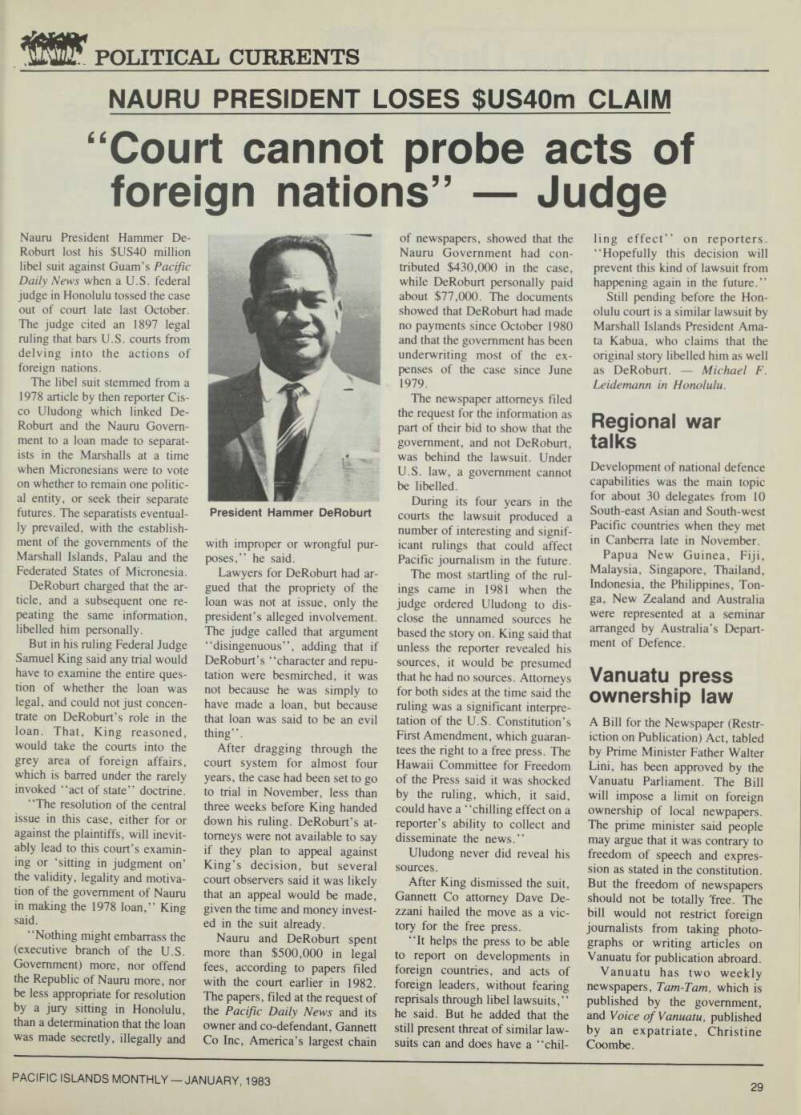
Political Currents
Nauru President Loses $Us4Om Claim
“Court cannot probe acts of foreign nations” - Judge
Nauru President Hammer De- Roburt lost his SUS4O million libel suit against Guam’s Pacific Daily News when a U.S. federal judge in Honolulu tossed the case out of court late last October.
The judge cited an 1897 legal ruling that bars U.S. courts from delving into the actions of foreign nations.
The libel suit stemmed from a 1978 article by then reporter Cis co Uludong which linked De- Roburt and the Nauru Govern ment to a loan made to separat ists in the Marshalls at a time when Micronesians were to vote on whether to remain one politic al entity, or seek their separate futures. The separatists eventual ly prevailed, with the establish ment of the governments of the Marshall Islands, Palau and the Federated States of Micronesia.
Deßoburt charged that the ar ticle, and a subsequent one re peating the same information, libelled him personally.
But in his ruling Federal Judge Samuel King said any trial would have to examine the entire ques tion of whether the loan was legal, and could not just concen trate on Deßoburt’s role in the loan. That, King reasoned, would take the courts into the grey area of foreign affairs, which is barred under the rarely invoked “act of state” doctrine.
“The resolution of the central issue in this case, either for or against the plaintiffs, will inevit ably lead to this court’s examin ing or ‘sitting in judgment on’ the validity, legality and motiva tion of the government of Nauru in making the 1978 loan,” King said.
“Nothing might embarrass the (executive branch of the U.S.
Government) more, nor offend the Republic of Nauru more, nor be less appropriate for resolution by a jury sitting in Honolulu, than a determination that the loan was made secretly, illegally and
with improper or wrongful pur poses,” he said.
Lawyers for Deßoburt had ar gued that the propriety of the loan was not at issue, only the president’s alleged involvement.
The judge called that argument “disingenuous”, adding that if Deßoburt’s “character and repu tation were besmirched, it was not because he was simply to have made a loan, but because that loan was said to be an evil thing”.
After dragging through the court system for almost four years, the case had been set to go to trial in November, less than three weeks before King handed down his ruling. Deßoburt’s at torneys were not available to say if they plan to appeal against King’s decision, but several court observers said it was likely that an appeal would be made, given the time and money invest ed in the suit already.
Nauru and Deßoburt spent more than $500,000 in legal fees, according to papers filed with the court earlier in 1982.
The papers, filed at the request of the Pacific Daily News and its owner and co-defendant, Gannett Co Inc, America’s largest chain
of newspapers, showed that the Nauru Government had con tributed $430,000 in the case, while Deßoburt personally paid about $77,000. The documents showed that Deßoburt had made no payments since October 1980 and that the government has been underwriting most of the ex penses of the case since June 1979.
The newspaper attorneys filed the request for the information as part of their bid to show that the government, and not Deßoburt, was behind the lawsuit. Under U.S. law, a government cannot be libelled.
During its four years in the courts the lawsuit produced a number of interesting and signif icant rulings that could affect Pacific journalism in the future.
The most startling of the rul ings came in 1981 when the judge ordered Uludong to dis close the unnamed sources he based the story on. King said that unless the reporter revealed his sources, it would be presumed that he had no sources. Attorneys for both sides at the time said the ruling was a significant interpre tation of the U.S. Constitution’s First Amendment, which guaran tees the right to a free press. The Hawaii Committee for Freedom of the Press said it was shocked by the ruling, which, it said, could have a “chilling effect on a reporter’s ability to collect and disseminate the news.”
Uludong never did reveal his sources.
After King dismissed the suit, Gannett Co attorney Dave De zzani hailed the move as a vic tory for the free press.
“It helps the press to be able to report on developments in foreign countries, and acts of foreign leaders, without fearing reprisals through libel lawsuits,” he said. But he added that the still present threat of similar law suits can and does have a “chil
ling effect” on reporters.
“Hopefully this decision will prevent this kind of lawsuit from happening again in the future.”
Still pending before the Hon olulu court is a similar lawsuit by Marshall Islands President Ama ta Kabua, who claims that the original story libelled him as well
as Deßoburt.
Michael F.
Leidemann in Honolulu.
Regional war
talks
Development of national defence capabilities was the main topic for about 30 delegates from 10 South-east Asian and South-west Pacific countries when they met in Canberra late in November.
Papua New Guinea, Fiji, Malaysia, Singapore, Thailand, Indonesia, the Philippines, Ton ga, New Zealand and Australia were represented at a seminar arranged by Australia’s Depart ment of Defence.
Vanuatu press
ownership law
A Bill for the Newspaper (Restr iction on Publication) Act, tabled by Prime Minister Father Walter Lini, has been approved by the Vanuatu Parliament. The Bill will impose a limit on foreign ownership of local newpapers.
The prime minister said people may argue that it was contrary to freedom of speech and expres sion as stated in the constitution.
But the freedom of newspapers should not be totally Tree. The bill would not restrict foreign journalists from taking photo graphs or writing articles on Vanuatu for publication abroard.
Vanuatu has two weekly newspapers, Tam-Tam, which is published by the government, and Voice of Vanuatu, published by an expatriate, Christine Coombe.
President Hammer DeRoburt
Bordallo bounces
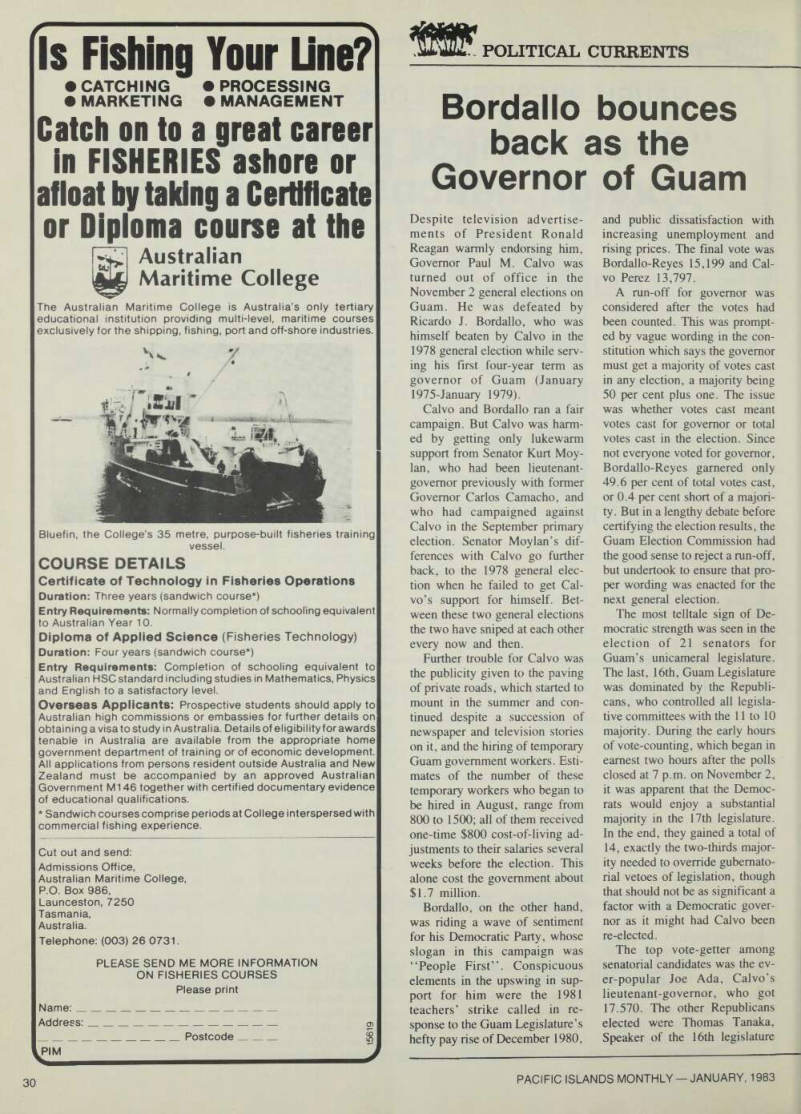
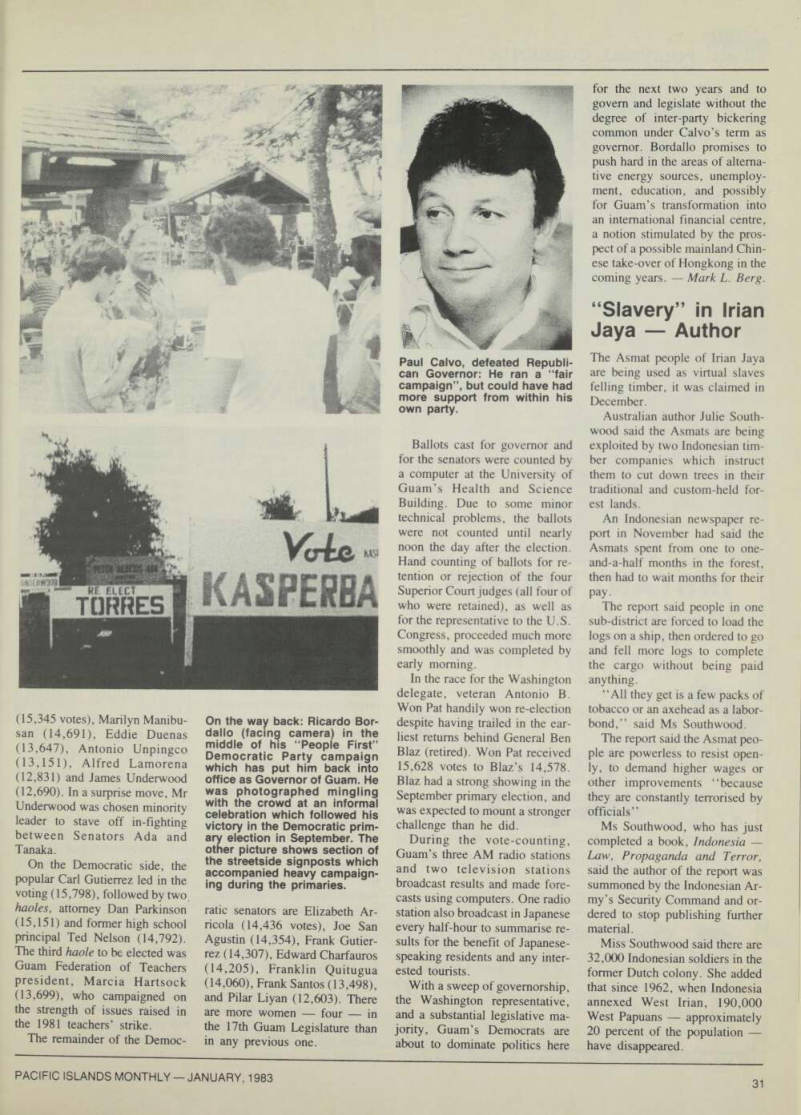
back as the Governor of Guam
Despite television advertise ments of President Ronald Reagan warmly endorsing him, Governor Paul M. Calvo was turned out of office in the November 2 general elections on Guam. He was defeated by Ricardo J. Bordallo, who was himself beaten by Calvo in the 1978 general election while serv ing his first four-year term as governor of Guam (January 1975-January 1979).
Calvo and Bordallo ran a fair campaign. But Calvo was harm ed by getting only lukewarm support from Senator Kurt Moy lan, who had been lieutenant governor previously with former Governor Carlos Camacho, and who had campaigned against Calvo in the September primary election. Senator Moylan’s dif ferences with Calvo go further back, to the 1978 general elec tion when he failed to get Cal vo’s support for himself. Bet ween these two general elections the two have sniped at each other every now and then.
Further trouble for Calvo was the publicity given to the paving of private roads, which started to mount in the summer and con tinued despite a succession of newspaper and television stories on it, and the hiring of temporary Guam government workers. Esti mates of the number of these temporary workers who began to be hired in August, range from 800 to 1500; all of them received one-time $BOO cost-of-living ad justments to their salaries several weeks before the election. This alone cost the government about $1.7 million.
Bordallo, on the other hand, was riding a wave of sentiment for his Democratic Party, whose slogan in this campaign was “People First’’. Conspicuous elements in the upswing in sup port for him were the 1981 teachers’ strike called in re sponse to the Guam Legislature’s hefty pay rise of December 1980,
and public dissatisfaction with
increasing unemployment and
rising prices. The final vote was Bordallo-Reyes 15,199 and Cal vo Perez 13,797.
A run-off for governor was considered after the votes had been counted. This was prompt ed by vague wording in the con stitution which says the governor must get a majority of votes cast in any election, a majority being 50 per cent plus one. The issue was whether votes cast meant votes cast for governor or total votes cast in the election. Since not everyone voted for governor,
Bordallo-Reyes garnered only
49.6 per cent of total votes cast, or 0.4 per cent short of a majori ty. But in a lengthy debate before certifying the election results, the Guam Election Commission had the good sense to reject a run-off, but undertook to ensure that pro per wording was enacted for the next general election.
The most telltale sign of De mocratic strength was seen in the election of 21 senators for Guam’s unicameral legislature.
The last, 16th, Guam Legislature was dominated by the Republi cans, who controlled all legisla tive committees with the 11 to 10 majority. During the early hours of vote-counting, which began in earnest two hours after the polls closed at 7 p.m. on November 2, it was apparent that the Democ rats would enjoy a substantial majority in the 17th legislature.
In the end, they gained a total of 14, exactly the two-thirds major ity needed to override gubernato rial vetoes of legislation, though that should not be as significant a factor with a Democratic gover nor as it might had Calvo been re-elected.
The top vote-getter among senatorial candidates was the ev er-popular Joe Ada, Calvo’s lieutenant-governor, who got 17.570. The other Republicans elected were Thomas Tanaka, Speaker of the 16th legislature
(15,345 votes), Marilyn Manibusan (14,691), Eddie Duenas (13,647), Antonio Unpingco / n Kn Aif j I F 5 ;n d ’ A rec * Lamorena (12,831) and James Underwood (12,690). In a surprise move, Mr Underwood was chosen minority laoHor . „ *c ■ r- t.*leader to stave off m-fightmg between Senators Ada and Tanaka.
On the Democratic side the popular Car. Gutierrez led in the voting (15,798), followed by two haoles, attorney Dan Parkinson (15,151) and former high school principal Ted Nelson (14,792).
The third haole to be elected was Guam Federation of Teachers president, Marcia Hartsock (13,699), who campaigned on the strength of issues raised in the 1981 teachers’ strike.
The remainder of the Democ-
ratic senators are Elizabeth Ar ricola (14,436 votes), Joe San Agustin (14,354), Frank Gutier rez (14,307), Edward Charfauros (14,205), Franklin Quitugua (14,060), Frank Santos (13,498), and Pilar Liyan (12,603). There are more women four in the 17th Guam Legislature than in any previous one.
Ballots cast for governor and for the senators were counted by a computer at the University of Guam’s Health and Science Building. Due to some minor technical problems, the ballots were not counted until nearly noon the day after the election.
Hand counting of ballots for re tention or rejection of the four Superior Court judges (all four of who were retained), as well as for the representative to the U.S.
Congress, proceeded much more smoothly and was completed by early morning.
In the race for the Washington delegate, veteran Antonio B.
Won Pat handily won re-election despite having trailed in the ear liest returns behind General Ben Blaz (retired). Won Pat received 15,628 votes to Blaz’s 14,578.
Blaz had a strong showing in the September primary election, and was expected to mount a stronger challenge than he did.
During the vote-counting, Guam’s three AM radio stations and two television stations broadcast results and made fore casts using computers. One radio station also broadcast in Japanese every half-hour to summarise re sults for the benefit of Japanese speaking residents and any inter ested tourists.
With a sweep of governorship, the Washington representative, and a substantial legislative ma jority, Guam’s Democrats are about to dominate politics here
for the next two years and to govern and legislate without the
degree of inter-party bickering
common under Calvo’s term as governor. Bordallo promises to push hard in the areas of alterna tive energy sources, unemploy ment, education, and possibly for Guam’s transformation into an international financial centre, a notion stimulated by the pros pect of a possible mainland Chin ese take-over of Hongkong in the
coming years.
Mark L. Berg.
“Slavery” in Irian
Jaya Author
The Asmat people of Irian Jaya are being used as virtual slaves felling timber, it was claimed in December.
Australian author Julie South wood said the Asmats are being exploited by two Indonesian tim ber companies which instruct them to cut down trees in their traditional and custom-held for est lands.
An Indonesian newspaper re port in November had said the Asmats spent from one to one and-a-half months in the forest, then had to wait months for their pay.
The report said people in one sub-district are forced to load the logs on a ship, then ordered to go and fell more logs to complete the cargo without being paid anything.
“All they get is a few packs of tobacco or an axehead as a labor bond,” said Ms South wood.
The report said the Asmat peo ple are powerless to resist open ly, to demand higher wages or other improvements “because they are constantly terrorised by officials”
Ms Southwood, who has just completed a book, Indonesia Law, Propaganda and Terror, said the author of the report was summoned by the Indonesian Ar my’s Security Command and or dered to stop publishing further material.
Miss Southwood said there are 32,000 Indonesian soldiers in the former Dutch colony. She added that since 1962, when Indonesia annexed West Irian, 190,000 West Papuans approximately 20 percent of the population have disappeared.
On the way back: Ricardo Bor dallo (facing camera) in the middle of his “People First”
Democratic Party campaign which has put him back into office as Governor of Guam. He was photographed mingling with the crowd at an informal celebration which followed his victory in the Democratic prim ary election in September. The other picture shows section of the streetside signposts which accompanied heavy campaign ing during the primaries.
Paul Calvo, defeated Republi can Governor: He ran a “fair campaign”, but could have had more support from within his own party.
Advertisements & other items, p. 30 (2 items)
Political Currents
Is Fishing Your Line?
• CATCHING • PROCESSING
• MARKETING • MANAGEMENT
Catch on to a great career
in FISHERIES ashore or
afloat by taking a Certificate
or Diploma course at the
ttjT
Australian
Maritime College
The Australian Maritime College is Australia’s only tertiary educational institution providing multi-level, maritime courses exclusively for the shipping, fishing, port and off-shore industries.
Irc'n.Kul
TO Bluefin, the College’s 35 metre, purpose-built fisheries training vessel.
COURSE DETAILS
Certificate of Technology in Fisheries Operations Duration: Three years (sandwich course*) Entry Requirements: Normally completion of schooling equivalent to Australian Year 10.
Diploma of Applied Science (Fisheries Technology)
Duration: Four years (sandwich course*) Entry Requirements: Completion of schooling equivalent to Australian HSC standard including studies in Mathematics, Physics and English to a satisfactory level.
Overseas Applicants: Prospective students should apply to Australian high commissions or embassies for further details on obtaining a visa to study in Australia. Details of eligibility for awards tenable in Australia are available from the appropriate home government department of training or of economic development.
All applications from persons resident outside Australia and New Zealand must be accompanied by an approved Australian Government Ml 46 together with certified documentary evidence of educational qualifications. * Sandwich courses comprise periods at College interspersed with commercial fishing experience.
Cut out and send: Admissions Office, Australian Maritime College, P.O. Box 986, Launceston, 7250 Tasmania, Australia.
Telephone: (003) 26 0731.
PLEASE SEND ME MORE INFORMATION
ON FISHERIES COURSES
Please print Name: Address: Postcode
I PIM
05 i
They’re talking Law of
the Sea in Suva . . .
Japan’s initiative in agreeing to sign the Law of the Sea conven tion is being seen in Fiji as a move that could sway other lead ing countries into signing the agreement.
The view was expressed in Suva recently by Fiji’s Ambas sador to the United Nations, Filipe Bole.
Mr Bole said that it would be extremely difficult for other lead ing countries to refrain from signing the treaty since the deci sion by Japan would mean that it could possibly enter into agree ments with island nations for the exploitation of their marine resources.
He said Japan’s wealth, and readiness to co-operate with the island nations on the exploitation
of marine resources, was a fact well received by the island states.
In an earlier interview, the Prime Minister Ratu Sir Kamis ese Mara described President Reagan’s attitude towards the Law of the Sea as an “obstruc tive act’’. However, Ratu Sir Kamisese was hopeful the US would find a way to accommo date the terms and conditions of the treaty and “be able to come with rest of the world’’.
The Reagan Administration had made it clear during the April session of the treaty talks that the US does not intend sign ing the document because certain parts of the treaty, it says, do not
satisfy US positions and
interests.
The Fiji delegation believes
that apart from the Japanese ges ture another aspect that could persuade other countries to sign the agreement was that the world’s lending institutions would not want to risk providing financial support to any country that wishes to exploit the world’s marine resources unless there ex ists an international agreement to safeguard their interests.
This includes the prevention and detection of illegal fishermen and poachers as well as institut ing arrests and seizure of catches
and fishing equipment.
Particular emphasis is also be
ing placed on apprehending
fishermen who illegally use dy namite for fishing.
The Fiji spokesman said the program of appointing fish war dens from their own villages has become highly effective as more and more fishermen are becom ing aware of the legal powers of wardens.
The 320 articles and nine an nexes of the convention consti tute a guide for state behaviour in the world’s oceans, defining maritime zones, laying down guidelines for drawing boun daries, assigning legal duties and responsibilities and providing machinery for settlement of maritime disputes.
Fiji has declared a 12-mile territorial sea outside its ar chipelagic waters, and from the zone baseline it has declared a 200-mile exclusive economic zone wherein Fiji has reserved for itself the sovereign right to utilise the mineral and fish re sources to be found in those waters and the seabed below.
For islands such as the Rotuma group and Ceva-i-Ra the conven tion also provides for the exten sion of territorial seas and exclu sive economic zones. These, Fiji has already declared. The con vention gives the force of inter national law to the national legis lation which has already been enacted by Fiji in its Marine
Spaces Act.
Fiji Focus.
After nine years of re search, negotiation and drafting, countries through out the world have begun signing the Law of the Sea Convention. The conven tion involves the rights of nations in the ownership, management and control of marine and seabed re sources, and is of far reaching significance to Pacific Island countries.
According to a Decem ber 13 report, 109 nations had already signed the convention in ceremonies at the Law of the Sea con ference centre at Montego Bay, Jamaica. Notable ex ceptions from the early sig natories were USA, Japan and Britain, but the conven tion will remain open for signature for two years from December 10, 1982.
Japanese readiness to sign the convention re ferred to by Fiji’s ambas sador Filipe Bole in the re port on this page was announced by the former government led by Prime Minister Suzuki. The in coming Nakasone govern ment announced in De cember that it would refrain from signing “at least for the time being”, saying that it needed time to explain its position to its major world partners. Britain has adopt ed a similar stand. The USA attitude is much harder.
Two-seat edge to Samoa’s HRPP
Samoa’s HRPP
Western Samoa’s opposition Hu man Rights Protection Party won an important by-election in December.
Its candidate, Fepulai Semi, won 215 votes against 124 for the candidate of the Tupuola government, Leilua Manuao.
The win meant that the HRPP commanded a two-seat majority
in the Legislative assembly,
enough to form a new government.
A radio Australia correspon dent in Apia said the HRPP was also strongly favored to win the January by-election in which for mer prime minister Va’ai Kolone will stand for re-election.
Advertisements & other items, p. 32 (1 item)
Instant Houses
WITH
Therma-Panel®
THE FULLY INSULATED BUILDING SYSTEM
to V r- -4 , ■ • Cyclone Resistant ... H • Fast • Economical • Simple • Homes • Motel Units • Amenity blocks • School buildings • Farm buildings • Offices
THE HOME YOU CAN ASSEMBLE
|J| George Hudson Homes p*y $ |j d , 186 Hume Hway, Cabramatta, N.5.W.2166.
Telephone: (02) 727 9066. Telex: AA25800.
For details and prices. Name post coupon to: . . .
George Hudson Homes AdOreSS (Aust) Pty. Ltd. Phone Do you own a block of land yes □ no □
. . . and New York
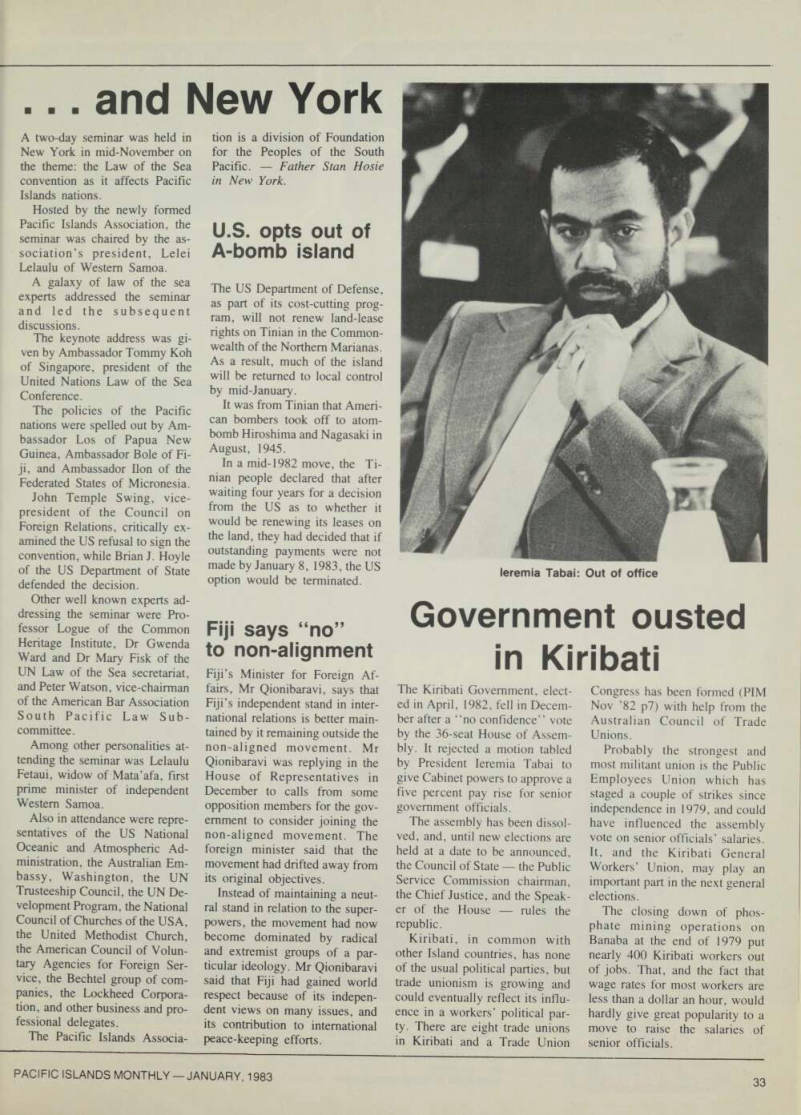
A two-day seminar was held in New York in mid-November on the theme: the Law of the Sea convention as it affects Pacific Islands nations.
Hosted by the newly formed Pacific Islands Association, the seminar was chaired by the as sociation’s president, Lelei Lelaulu of Western Samoa.
A galaxy of law of the sea experts addressed the seminar and led the subsequent discussions.
The keynote address was gi ven by Ambassador Tommy Koh of Singapore, president of the United Nations Law of the Sea Conference.
The policies of the Pacific nations were spelled out by Am bassador Los of Papua New Guinea, Ambassador Bole of Fi ji, and Ambassador lion of the Federated States of Micronesia.
John Temple Swing, vice president of the Council on Foreign Relations, critically ex amined the US refusal to sign the convention, while Brian J. Hoyle of the US Department of State defended the decision.
Other well known experts ad dressing the seminar were Pro fessor Logue of the Common Heritage Institute, Dr Gwenda Ward and Dr Mary Fisk of the UN Law of the Sea secretariat, and Peter Watson, vice-chairman of the American Bar Association South Pacific Law Sub committee.
Among other personalities at tending the seminar was Lelaulu Fetaui, widow of Mata’afa, first prime minister of independent Western Samoa.
Also in attendance were repre sentatives of the US National Oceanic and Atmospheric Ad ministration, the Australian Em bassy, Washington, the UN Trusteeship Council, the UN De velopment Program, the National Council of Churches of the USA, the United Methodist Church, the American Council of Volun tary Agencies for Foreign Ser vice, the Bechtel group of com panies, the Lockheed Corpora tion, and other business and pro fessional delegates.
The Pacific Islands Associa
tion is a division of Foundation for the Peoples of the South
Pacific.
Father Stan Hosie
in New York.
U.S. opts out of
A-bomb island
The US Department of Defense, as part of its cost-cutting prog ram, will not renew land-lease rights on Tinian in the Common wealth of the Northern Marianas.
As a result, much of the island will be returned to local control by mid-January.
It was from Tinian that Ameri can bombers took off to atom bomb Hiroshima and Nagasaki in August, 1945.
In a mid-1982 move, the Ti nian people declared that after waiting four years for a decision from the US as to whether it would be renewing its leases on the land, they had decided that if outstanding payments were not made by January 8, 1983, the US option would be terminated.
Fiji says “no”
to non-alignment
Fiji’s Minister for Foreign Af fairs, Mr Qionibaravi, says that Fiji’s independent stand in inter national relations is better main tained by it remaining outside the non-aligned movement. Mr Qionibaravi was replying in the House of Representatives in December to calls from some opposition members for the gov ernment to consider joining the non-aligned movement. The foreign minister said that the movement had drifted away from its original objectives.
Instead of maintaining a neut ral stand in relation to the super powers, the movement had now become dominated by radical and extremist groups of a par ticular ideology. Mr Qionibaravi said that Fiji had gained world respect because of its indepen dent views on many issues, and its contribution to international peace-keeping efforts.
Government ousted
in Kiribati
The Kiribati Government, elect ed in April, 1982, fell in Decem ber after a “no confidence’’ vote by the 36-seat House of Assem bly. It rejected a motion tabled by President leremia Tabai to give Cabinet powers to approve a five percent pay rise for senior government officials.
The assembly has been dissol ved, and, until new elections are held at a date to be announced, the Council of State the Public Service Commission chairman, the Chief Justice, and the Speak er of the House rules the republic.
Kiribati, in common with other Island countries, has none of the usual political parties, but trade unionism is growing and could eventually reflect its influ ence in a workers’ political par ty. There are eight trade unions in Kiribati and a Trade Union
Congress has been formed (PIM Nov ’B2 p 7) with help from the Australian Council of Trade Unions.
Probably the strongest and most militant union is the Public Employees Union which has staged a couple of strikes since independence in 1979, and could have influenced the assembly vote on senior officials’ salaries.
It, and the Kiribati General Workers’ Union, may play an important part in the next general elections.
The closing down of phos phate mining operations on Banaba at the end of 1979 put nearly 400 Kiribati workers out of jobs. That, and the fact that wage rates for most workers are less than a dollar an hour, would hardly give great popularity to a move to raise the salaries of senior officials.
leremia Tabai: Out of office
Advertisements & other items, pp. 34-35 (1 item)
Toyota
LAND CRUISER
STATION WAGON
LAND CRUISER
PICK UP
HI ACE
(B
ayvD
LP""! )t
TOYOTA
SERVICE
PAPUA NEW GUINEA: ELA MOTORS,
Scratchley Rd., Badili, P.O. Box 675, Port Moresby.
NORTHERN MARIANAS & U.S.T.T.:
MICROL CORPORATION, P.O. Box 267. Saipan.
FIJI: AUTOMOTIVE SUPPLIES COMPANY, G.P.O.
Box 355, Suva.
AMERICAN SAMOA: BURNS PHILP
(SOUTHSEA) CO., LTD., P.O. Box 129, Pago Pago.
WESTERN SAMOA: BURNS PHILP (SOUTHSEA)
CO., LTD., P.O. Box 188, Apia.
TONGA: BURNS PHILP (SOUTHSEA) CO., LTD.,
P.O. Box 55, Nuku’alofa.
GUAM: ATKINS, KROLL (GUAM) LTD., P.O. Box 6428, Tamuning.
DYNA
HI-LUX
DOUBLE CAB
yr ya -
TRUCK
HEAVY DUTY
TX, -...
THE TOYOTA
READY TO
ON THE TOUGHEST *IOBS.
Meet Toyota’s hard working commercial vehicles.
Tough. Durable. Ready to meet the challenge of the worst roads and climates. Ready to do the job called for with ease.
Rugged veterans, each one specifically designed to meet the different demands of the world’s businesses.
One of them is just right for you.
There are no vehicles more reliable. And if you need it, Toyota is ready with fast backup sei Toyota’s roadmasters, they’re a 5 i/ANUATU: VANUATU MOTORS, P.O. Box 18, Port Vila. KIRIBATI: TARAWA MOTORS, Box 36 Bairiki SOLOMON: MENDANA ENTERPRISES (5.1.) LTD., Tarawa. Kiribati. 74. Honiara. NORFOLK ISLAND: BORRY’S RENTAL CARS, rAHIT!: NIPPON AUTOMOTO. B. P. 342, Papeete. MOUNT PITT (ENTERPRISES) LTD., P.O. Box 169.
ISLANDS: COOK ISLANDS TRADING NEW CALEDONIA: SERVICE IMPORTATION 19.«° RATION LTD ’ P - Box 92 - Rar otonga. AUTOMOBILE DU PACIFIQUE, Rond-Point *JAURU: NAURU COOPERATIVE SOCIETY. du Pacifique (Station Total) B.P. 438, Noumea.
TOYOTA
The Toyota range includes:
COROLLA, STARLET, CORONA, CRESSIDA, HI-LUX
STOUT, HI ACE, DYNA, COASTER and LAND CRUISER
“Unity” group aims to win
Cook Islands
“Unity” group aims to win balance of power
A “party” that is against politic al parties aims to win the balance of power in the Cook Islands Parliament at this year’s general elections.
Known as the “Unity” group.
it first appeared in 1978, having been founded by three par liamentary defectors from the then Cook Islands Party govern ment of Albert Henry. Two were former cabinet ministers Dr Joseph Williams and William Es tall and the third, the late Raui Pokoati, a foundation member of the CIP. The group fielded seven candidates in the ’7B elec tions, none of whom was successful.
But Dr Williams, who is now
Unity’s campaign organiser, said
late last year that the group will contest every one of the 24 seats in the new parliament at the elections which must be held before June this year. He said he was confident they would win the balance of power and force a coalition government.
“Unity offers a distinct alter
native to both the CIP and Prime Minister Davis’s Democratic Party,” he said.
He claimed there was already a “very evident shift towards the middle”.
He said the present system of government was “inappropriate and incongruous to the setting and size of the Cook Islands”.
“Party politics, and its inhe rent divisive principles, is alien to our way of life and impedes progress in a small community.
It had split the 17,000 people of the Cooks and divided families. ”
“What is more important,” he went on, “is that the system is susceptible to abuse, misman agement and irresponsible action by a government.”
He cited the former Henry government’s financing of air craft to fly in voters from New
Zealand the event that brought about the ClP’s downfall and what he described as “the blatant squandering” of public funds on overseas travel by ministers in the present government.
Dr Williams said his group would fight the next elections on issues such as the economy, fis cal policies, constitutional changes and the performance of the Democratic Party government.
Prime Minister Sir Thomas Davis: The Unity group accuses his government of squandering money on travel.
Advertisements & other items, pp. 36-40 (1 item)
The Facts
p
PORT MOH
♦ Right in t business cep * A traditiorf/or comfort food * All rOoms airconditioned * Restaurant ♦ Ba * Banquet hall
C. NEUMAIMN
i\ manager % Phone 21-2622
I. Cabl
THE FACTS
WITHOUT
FRILLS
The trends in a few words. The significant news.
Mailed direct to you every second Friday.
The South Seas Digest is designed for busy people who have to know what's happening in the Pacific Islands, but in a hurry.
FOR SUBSCRIPTION DETAILS SEE INSERT.
The South Sea Digest
THE NEWSLETTER ON ISLANDS AFFAIRS • EVERY OTHER FRIDAY
Jlife Commonwealth
Secretariat
(Commonwealth Fund for Technical Co-operation)
SOUTH PACIFIC BUREAU FOR
ECONOMIC CO-OPERATION (SPEC)
(based in Suva, Fiji) 1. Export Marketing Adviser To assist businessmen and Trade Ministries of SPEC countries in their marketing and trade promotion efforts; including evaluation and promotion of existing and potential products: establishing contacts with importers exporters; preparing market profiles: other trade promotion activities. 2. Flandicrafts Co-ordinating Adviser To assist member countries in handicrafts production and export marketing; including introduction of designs products for target markets; quality control; packaging and documentation; and promoting a “quality image”.
Candidates should preferably be University graduates in an appropriate discipline and must have considerable practical experience. A good working knowledge in the Pacific region highly desirable.
The appointments will be for two years in the first instance with possibility of extension. Emoluments are free of tax in Fiji, allowances are provided for shipment of effects, housing, and childrens education.
As the posts are funded by the CFTC. all Commonwealth citizens may apply.
The closing date for applications will be 31 January. 1983. Please write for full details to: The Executive Officer, Commonwealth Secretariat Marlborough House, Pall Mall, London SWIY SHX
The quality and
efficiency you need
Australian
Hospital and Medical
Equipment
Australian hospital and medical equipment has gained a world wide reputation for its high standards of quality and operating efficiency. It is exported to over fifty countries. Typical of the equipment available are cardiac monitors, hospital beds and trolleys, surgical instruments and equipment, invalid aids, centrifuges, spirometers, sterilizers, automatic autoclaves and disposable plasticware. The range is a wide one, so check what Australia has to offer. And remember, Australia being so close also means quick delivery. [?\|
IZjJ
For more information
Ask the Australian Trade Commissioner
Port Moresby: Phone 25 9333. Honolulu: Phone (808) 524 5050.
Suva: Phone 31 2844. Noumea: Phone 27 2414, 27 2426.
people
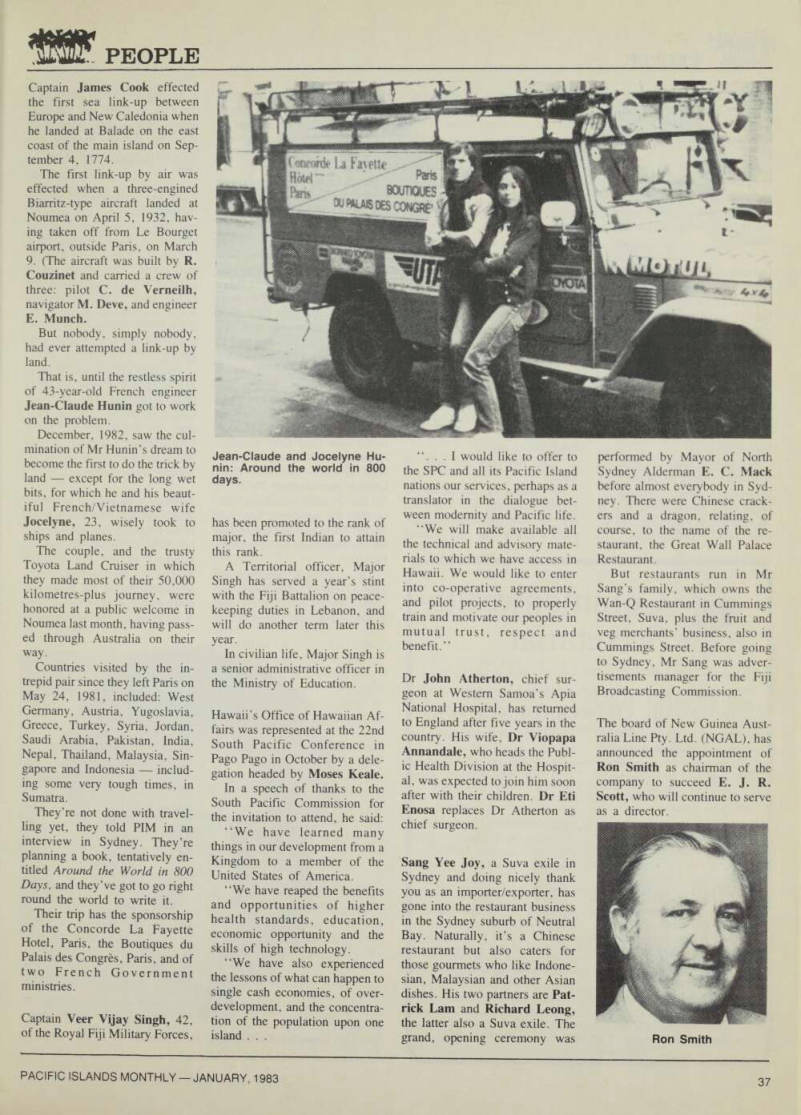
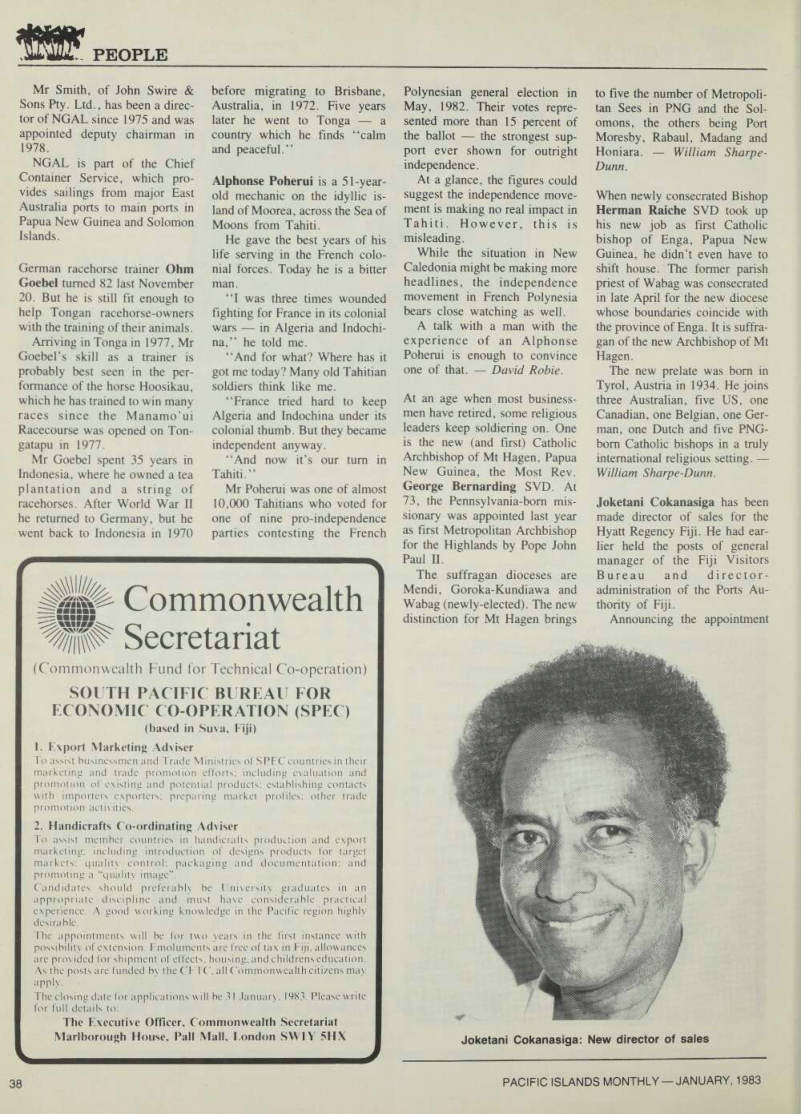
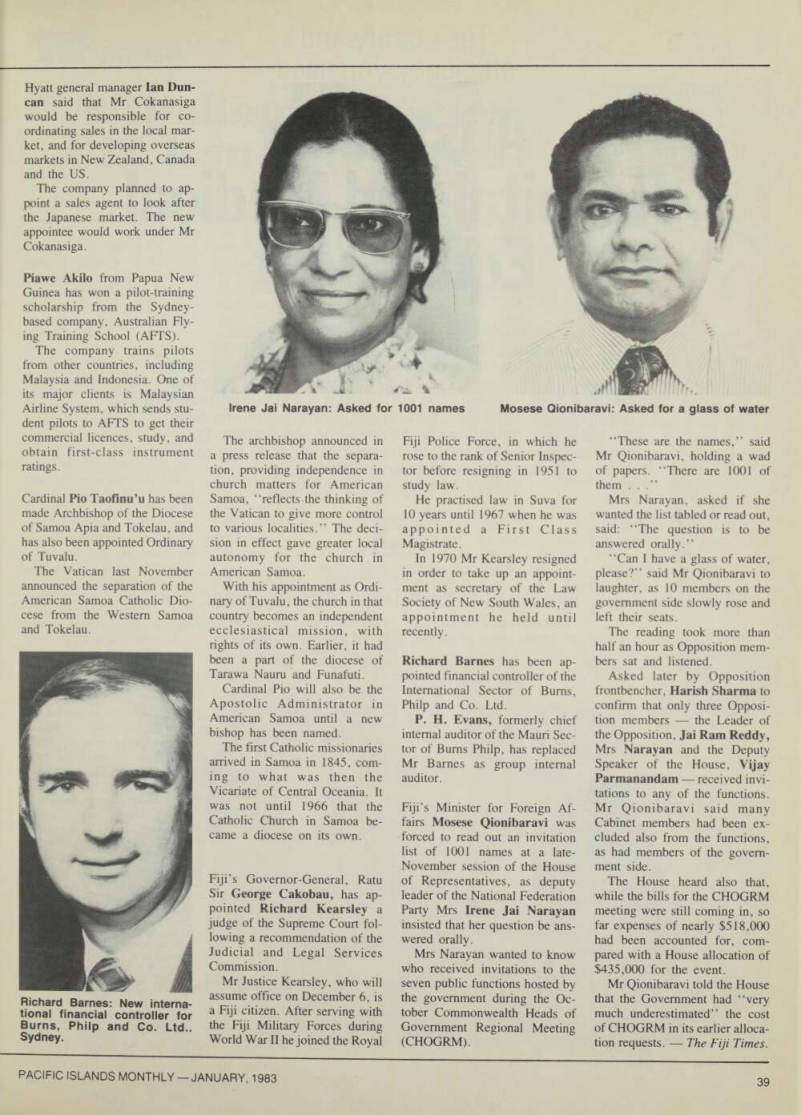
Captain James Cook effected the first sea link-up between Europe and New Caledonia when he landed at Balade on the east coast of the main island on Sep tember 4, 1774.
The first link-up by air was effected when a three-engined Biarritz-type aircraft landed at Noumea on April 5, 1932, hav ing taken off from Le Bourget airport, outside Paris, on March 9. (The aircraft was built by R.
Couzinet and carried a crew of three: pilot C. de Verneilh, navigator M. Deve, and engineer E. Munch.
But nobody, simply nobody, had ever attempted a link-up by land.
That is, until the restless spirit of 43-year-old French engineer Jean-Claude Hunin got to work on the problem.
December, 1982, saw the cul mination of Mr Hunin’s dream to become the first to do the trick by land except for the long wet bits, for which he and his beaut iful French/Vietnamese wife Jocelyne, 23, wisely took to ships and planes.
The couple, and the trusty Toyota Land Cruiser in which they made most of their 50,000 kilometres-plus journey, were honored at a public welcome in Noumea last month, having pass ed through Australia on their way.
Countries visited by the in trepid pair since they left Paris on May 24, 1981, included: West Germany, Austria, Yugoslavia, Greece, Turkey, Syria, Jordan, Saudi Arabia, Pakistan, India, Nepal, Thailand, Malaysia, Sin gapore and Indonesia includ ing some very tough times, in Sumatra.
They’re not done with travel ling yet, they told PIM in an interview in Sydney. They’re planning a book, tentatively en titled Around the World in 800 Days, and they’ve got to go right round the world to write it.
Their trip has the sponsorship of the Concorde La Fayette Hotel, Paris, the Boutiques du Palais des Congres, Paris, and of two French Government ministries.
Captain Veer Vijay Singh, 42, of the Royal Fiji Military Forces,
has been promoted to the rank of major, the first Indian to attain this rank.
A Territorial officer. Major Singh has served a year’s stint with the Fiji Battalion on peace keeping duties in Lebanon, and will do another term later this year.
In civilian life. Major Singh is a senior administrative officer in the Ministry of Education.
Hawaii’s Office of Hawaiian Af fairs was represented at the 22nd South Pacific Conference in Pago Pago in October by a dele gation headed by Moses Keale.
In a speech of thanks to the South Pacific Commission for the invitation to attend, he said: “We have learned many things in our development from a Kingdom to a member of the United States of America.
“We have reaped the benefits and opportunities of higher health standards, education, economic opportunity and the skills of high technology.
“We have also experienced the lessons of what can happen to single cash economies, of over development, and the concentra tion of the population upon one island . . .
. . I would like to offer to the SPC and all its Pacific Island nations our services, perhaps as a translator in the dialogue bet ween modernity and Pacific life.
“We will make available all the technical and advisory mate rials to which we have access in Hawaii. We would like to enter into co-operative agreements, and pilot projects, to properly train and motivate our peoples in mutual trust, respect and benefit.”
Dr John Atherton, chief sur geon at Western Samoa’s Apia National Hospital, has returned to England after five years in the country. His wife. Dr Viopapa Annandale, who heads the Publ ic Health Division at the Hospit al, was expected to join him soon after with their children. Dr Eti Enosa replaces Dr Atherton as chief surgeon.
Sang Yee Joy, a Suva exile in Sydney and doing nicely thank you as an importer/exporter, has gone into the restaurant business in the Sydney suburb of Neutral Bay. Naturally, it’s a Chinese restaurant but also caters for those gourmets who like Indone sian, Malaysian and other Asian dishes. His two partners are Pat rick Lam and Richard Leong, the latter also a Suva exile. The grand, opening ceremony was
performed by Mayor of North Sydney Alderman E. C. Mack before almost everybody in Syd ney. There were Chinese crack ers and a dragon, relating, of course, to the name of the re staurant, the Great Wall Palace Restaurant.
But restaurants run in Mr Sang’s family, which owns the Wan-Q Restaurant in Cummings Street, Suva, plus the fruit and veg merchants’ business, also in Cummings Street. Before going to Sydney, Mr Sang was adver tisements manager for the Fiji Broadcasting Commission.
The board of New Guinea Aust ralia Line Pty. Ltd. (NGAL), has announced the appointment of Ron Smith as chairman of the company to succeed E. J. R.
Scott, who will continue to serve as a director.
Jean-Claude and Jocelyne Hu nin: Around the world in 800 days.
Ron Smith
Mr Smith, of John Swire & Sons Pty. Ltd., has been a direc tor of NGAL since 1975 and was appointed deputy chairman in 1978.
NGAL is part of the Chief Container Service, which pro vides sailings from major East Australia ports to main ports in Papua New Guinea and Solomon Islands.
German racehorse trainer Ohm Goebel turned 82 last November 20. But he is still fit enough to help Tongan racehorse-owners with the training of their animals.
Arriving in Tonga in 1977, Mr Goebel’s skill as a trainer is probably best seen in the per formance of the horse Hoosikau, which he has trained to win many races since the Manamo’ui Racecourse was opened on Ton gatapu in 1977.
Mr Goebel spent 35 years in Indonesia, where he owned a tea plantation and a string of racehorses. After World War II he returned to Germany, but he went back to Indonesia in 1970
before migrating to Brisbane, Australia, in 1972. Five years later he went to Tonga a country which he finds “calm and peaceful.’’
Alphonse Poherui is a 51-year old mechanic on the idyllic is land of Moorea, across the Sea of Moons from Tahiti.
He gave the best years of his life serving in the French colo nial forces. Today he is a bitter man.
“I was three times wounded fighting for France in its colonial wars in Algeria and Indochi na,’’ he told me.
“And for what? Where has it got me today? Many old Tahitian soldiers think like me.
“France tried hard to keep Algeria and Indochina under its colonial thumb. But they became independent anyway.
“And now it’s our turn in Tahiti.”
Mr Poherui was one of almost 10,000 Tahitians who voted for one of nine pro-independence parties contesting the French
Polynesian general election in May, 1982. Their votes repre sented more than 15 percent of the ballot the strongest sup port ever shown for outright independence.
At a glance, the figures could suggest the independence move ment is making no real impact in Tahiti. However, this is misleading.
While the situation in New Caledonia might be making more headlines, the independence movement in French Polynesia bears close watching as well.
A talk with a man with the experience of an Alphonse Poherui is enough to convince
one of that.
David Robie.
At an age when most business men have retired, some religious leaders keep soldiering on. One is the new (and first) Catholic Archbishop of Mt Hagen, Papua New Guinea, the Most Rev.
George Bernarding SVD. At 73, the Pennsylvania-born mis sionary was appointed last year as first Metropolitan Archbishop for the Highlands by Pope John Paul 11.
The suffragan dioceses are Mendi, Goroka-Kundiawa and Wabag (newly-elected). The new distinction for Mt Hagen brings
to five the number of Metropoli tan Sees in PNG and the Sol omons, the others being Port Moresby, Rabaul, Madang and Honiara. William Sharpe- Dunn.
When newly consecrated Bishop Herman Raiche SVD took up his new job as first Catholic bishop of Enga, Papua New Guinea, he didn’t even have to shift house. The former parish priest of Wabag was consecrated in late April for the new diocese whose boundaries coincide with the province of Enga. It is suffra gan of the new Archbishop of Mt Hagen.
The new prelate was bom in Tyrol, Austria in 1934. He joins three Australian, five US, one Canadian, one Belgian, one Ger man, one Dutch and five PNG bom Catholic bishops in a truly international religious setting.
William Sharpe-Dunn.
Joketani Cokanasiga has been made director of sales for the Hyatt Regency Fiji. He had ear lier held the posts of general manager of the Fiji Visitors Bureau and director administration of the Ports Au thority of Fiji.
Announcing the appointment
Joketani Cokanasiga: New director of sales
Hyatt general manager lan Dun can said that Mr Cokanasiga would be responsible for co ordinating sales in the local mar ket, and for developing overseas markets in New Zealand, Canada and the US.
The company planned to ap point a sales agent to look after the Japanese market. The new appointee would work under Mr Cokanasiga.
Piawe Akilo from Papua New Guinea has won a pilot-training
scholarship from the Sydney
based company, Australian Fly
ing Training School (AFTS).
The company trains pilots from other countries, including Malaysia and Indonesia. One of its major clients is Malaysian Airline System, which sends stu dent pilots to AFTS to get their commercial licences, study, and obtain first-class instrument
ratings.
Cardinal Pio Taofinu’u has been made Archbishop of the Diocese of Samoa Apia and Tokelau, and has also been appointed Ordinary of Tuvalu.
The Vatican last November announced the separation of the American Samoa Catholic Dio cese from the Western Samoa and Tokelau.
The archbishop announced in a press release that the separa tion, providing independence in church matters for American Samoa, “reflects the thinking of the Vatican to give more control to various localities.” The deci sion in effect gave greater local autonomy for the church in American Samoa.
With his appointment as Ordi nary of Tuvalu, the church in that country becomes an independent ecclesiastical mission, with rights of its own. Earlier, it had been a part of the diocese of Tarawa Naum and Funafuti.
Cardinal Pio will also be the Apostolic Administrator in American Samoa until a new bishop has been named.
The first Catholic missionaries arrived in Samoa in 1845, com ing to what was then the Vicariate of Central Oceania. It was not until 1966 that the Catholic Church in Samoa be came a diocese on its own.
Fiji’s Governor-General, Ratu Sir George Cakobau, has ap pointed Richard Kearsley a judge of the Supreme Court fol lowing a recommendation of the Judicial and Legal Services Commission.
Mr Justice Kearsley, who will assume office on December 6, is a Fiji citizen. After serving with the Fiji Military Forces during World War II he joined the Royal
Fiji Police Force, in which he rose to the rank of Senior Inspec tor before resigning in 1951 to study law.
He practised law in Suva for 10 years until 1967 when he was appointed a First Class Magistrate.
In 1970 Mr Kearsley resigned in order to take up an appoint ment as secretary of the Law Society of New South Wales, an appointment he held until recently.
Richard Barnes has been ap pointed financial controller of the International Sector of Bums, Philp and Co. Ltd.
P. H. Evans, formerly chief internal auditor of the Mauri Sec tor of Bums Philp, has replaced Mr Barnes as group internal auditor.
Fiji’s Minister for Foreign Af fairs Mosese Qionibaravi was forced to read out an invitation list of 1001 names at a late- November session of the House of Representatives, as deputy leader of the National Federation Party Mrs Irene Jai Narayan insisted that her question be ans wered orally.
Mrs Narayan wanted to know who received invitations to the seven public functions hosted by the government during the Oc tober Commonwealth Heads of Government Regional Meeting
(Chogrm).
“These are the names,” said Mr Qionibaravi, holding a wad of papers. “There are 1001 of them . . .”
Mrs Narayan, asked if she wanted the list tabled or read out, said; “The question is to be answered orally.”
“Can I have a glass of water, please?” said Mr Qionibaravi to laughter, as 10 members on the government side slowly rose and left their seats.
The reading took more than half an hour as Opposition mem bers sat and listened.
Asked later by Opposition frontbencher, Harish Sharma to confirm that only three Opposi tion members the Leader of the Opposition, Jai Ram Reddy, Mrs Narayan and the Deputy Speaker of the House, Vijay Parmanandam received invi tations to any of the functions.
Mr Qionibaravi said many Cabinet members had been ex cluded also from the functions, as had members of the govern ment side.
The House heard also that, while the bills for the CHOGRM meeting were still coming in, so far expenses of nearly $518,000 had been accounted for, com pared with a House allocation of $435,000 for the event.
Mr Qionibaravi told the House that the Government had “very much underestimated” the cost of CHOGRM in its earlier alloca
tion requests.
The Fiji Times.
Richard Barnes: New interna tional financial controller for Burns, Philp and Co. Ltd..
Sydney.
Irene Jai Narayan: Asked for 1001 names
Mosese Qionibaravi: Asked for a glass of water
A Bishop's diaries:
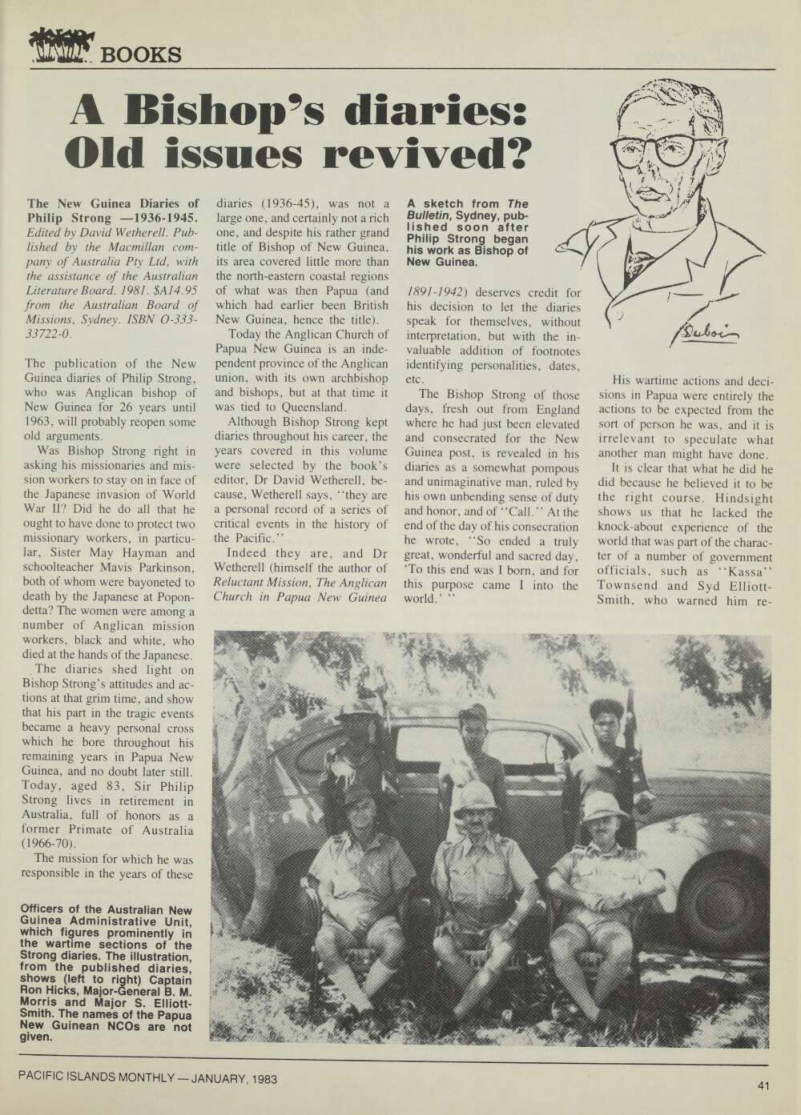
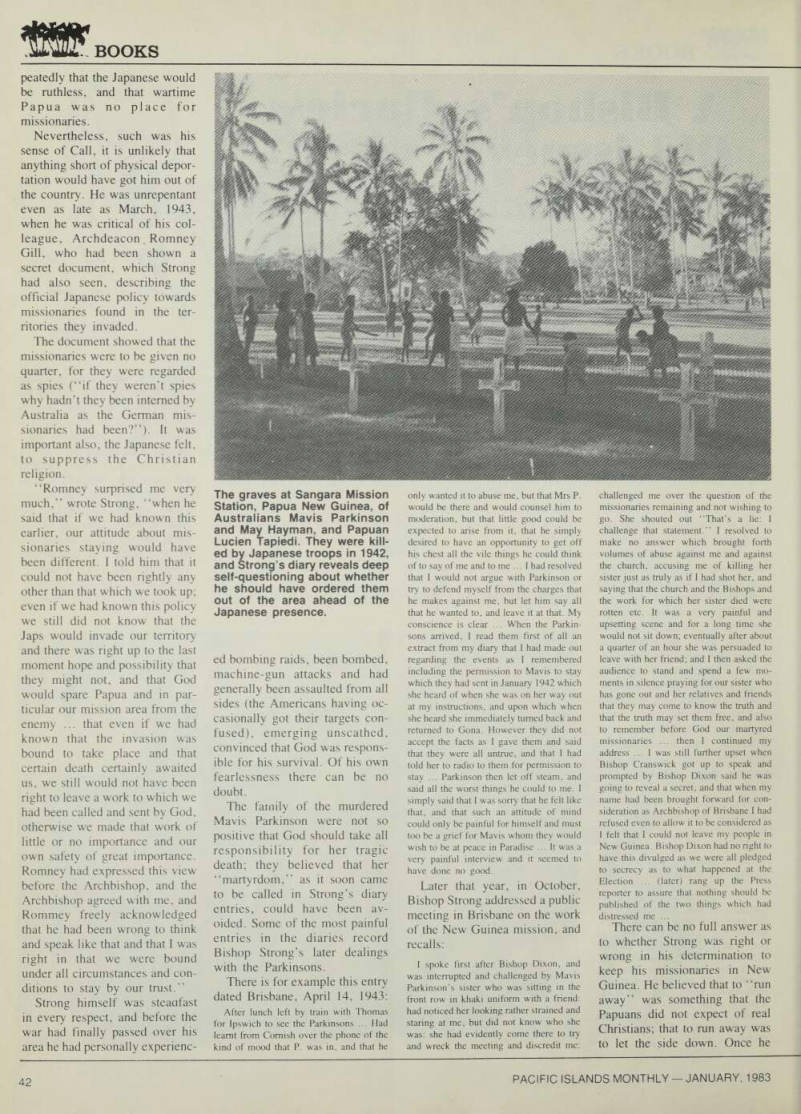
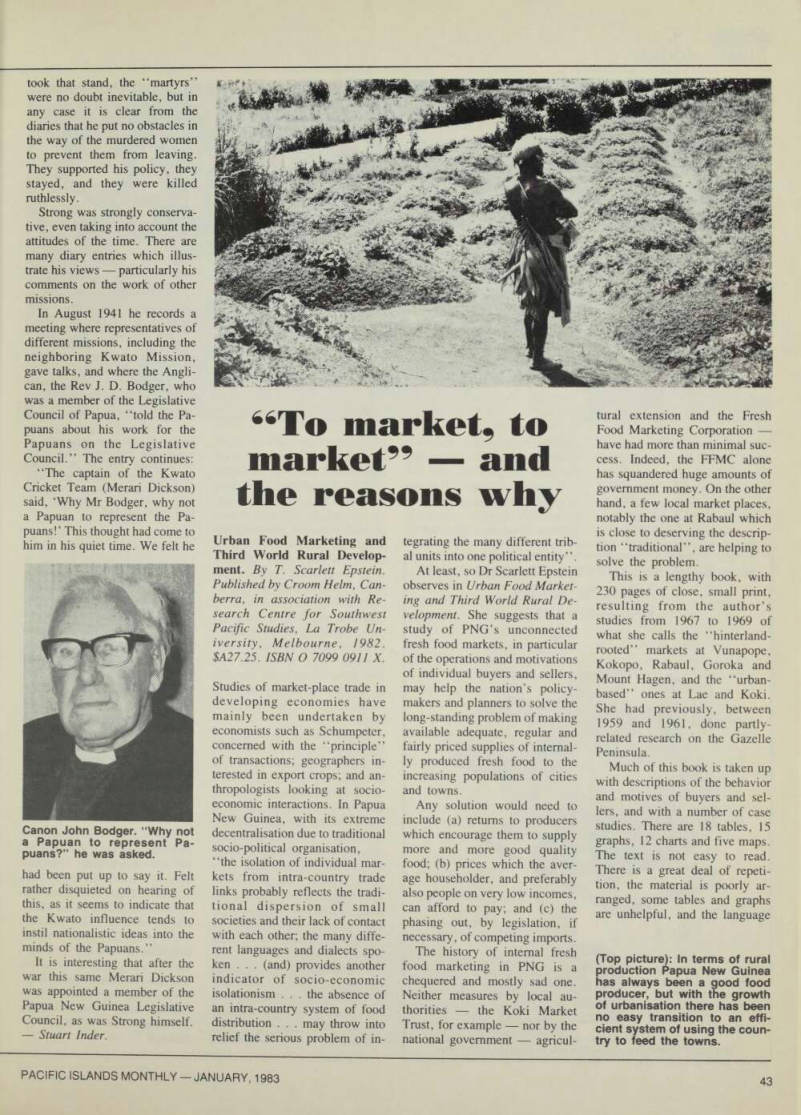
Books
A Bishop's diaries: Old issues revived?
The New Guinea Diaries of Philip Strong -1936-1945.
Edited by David Wetherell. Pub lished by the Macmillan com pany of Australia Pty Ltd, with the assistance of the Australian Literature Board. 1981. $A14.95 from the Australian Board of Missions, Sydney. ISBN 0-333- 33722-0.
The publication of the New Guinea diaries of Philip Strong, who was Anglican bishop of New Guinea for 26 years until 1963, will probably reopen some old arguments.
Was Bishop Strong right in asking his missionaries and mis sion workers to stay on in face of the Japanese invasion of World War II? Did he do all that he ought to have done to protect two missionary workers, in particu lar, Sister May Hayman and schoolteacher Mavis Parkinson, both of whom were bayoneted to death by the Japanese at Popon detta? The women were among a number of Anglican mission workers, black and white, who died at the hands of the Japanese.
The diaries shed light on Bishop Strong’s attitudes and ac tions at that grim time, and show that his part in the tragic events became a heavy personal cross which he bore throughout his remaining years in Papua New Guinea, and no doubt later still.
Today, aged 83, Sir Philip Strong lives in retirement in Australia, full of honors as a former Primate of Australia (1966-70).
The mission for which he was responsible in the years of these
diaries (1936-45), was not a large one, and certainly not a rich one, and despite his rather grand title of Bishop of New Guinea, its area covered little more than the north-eastern coastal regions of what was then Papua (and which had earlier been British New Guinea, hence the title).
Today the Anglican Church of Papua New Guinea is an inde pendent province of the Anglican union, with its own archbishop and bishops, but at that time it was tied to Queensland.
Although Bishop Strong kept
diaries throughout his career, the years covered in this volume were selected by the book’s editor, Dr David Wetherell, be cause, Wetherell says, “they are a personal record of a series of critical events in the history of the Pacific.”
Indeed they are, and Dr Wetherell (himself the author of Reluctant Mission, The Anglican Church in Papua New Guinea
1891-1942 ) deserves credit for his decision to let the diaries speak for themselves, without interpretation, but with the in valuable addition of footnotes identifying personalities, dates, etc.
The Bishop Strong of those days, fresh out from England where he had just been elevated and consecrated for the New Guinea post, is revealed in his diaries as a somewhat pompous and unimaginative man, ruled by his own unbending sense of duty and honor, and of “Call.” At the end of the day of his consecration he wrote, “So ended a truly great, wonderful and sacred day.
To this end was I bom, and for this purpose came I into the world.’ ”
His wartime actions and deci sions in Papua were entirely the actions to be expected from the sort of person he was, and it is irrelevant to speculate what another man might have done.
It is clear that what he did he did because he believed it to be the right course. Hindsight shows us that he lacked the knock-about experience of the world that was part of the charac ter of a number of government officials, such as “Kassa”
Townsend and Syd Elliott- Smith, who warned him re-
Officers of the Australian New Guinea Administrative Unit, which figures prominently in the wartime sections of the Strong diaries. The illustration, from the published diaries, shows (left to right) Captain Ron Hicks, Major-General B. M.
Morris and Major S. Elliott- Smith. The names of the Papua New Guinean NCOs are not given.
A sketch from The Bulletin, Sydney, pub lished soon after Philip Strong began his work as Bishop of New Guinea.
peatedly that the Japanese would be ruthless, and that wartime Papua was no place for missionaries.
Nevertheless, such was his sense of Call, it is unlikely that anything short of physical depor tation would have got him out of the country. He was unrepentant even as late as March, 1943, when he was critical of his col
league, Archdeacon Romney
Gill, who had been shown a secret document, which Strong had also seen, describing the
official Japanese policy towards
missionaries found in the ter ritories they invaded.
The document showed that the missionaries were to be given no quarter, for they were regarded as spies (“if they weren’t spies why hadn’t they been interned by Australia as the German mis sionaries had been?”). It was important also, the Japanese felt, to suppress the Christian
religion.
“Romney surprised me very much,” wrote Strong, “when he said that if we had known this earlier, our attitude about mis sionaries staying would have been different. I told him that it could not have been rightly any other than that which we took up; even if we had known this policy we still did not know that the Japs would invade our territory and there was right up to the last moment hope and possibility that they might not, and that God would spare Papua and in par ticular our mission area from the enemy ... that even if we had known that the invasion was bound to take place and that certain death certainly awaited us, we still would not have been right to leave a work to which we had been called and sent by God, otherwise we made that work of little or no importance and our own safety of great importance.
Romney had expressed this view before the Archbishop, and the Archbishop agreed with me, and
Rommey freely acknowledged
that he had been wrong to think and speak like that and that I was right in that we were bound under all circumstances and con ditions to stay by our trust.”
Strong himself was steadfast in every respect, and before the war had finally passed over his area he had personally experienc-
ed bombing raids, been bombed, machine-gun attacks and had generally been assaulted from all sides (the Americans having oc casionally got their targets con fused), emerging unscathed, convinced that God was respons ible for his survival. Of his own fearlessness there can be no doubt.
The family of the murdered Mavis Parkinson were not so positive that God should take all
responsibility for her tragic
death; they believed that her “martyrdom,” as it soon came to be called in Strong’s diary entries, could have been av oided. Some of the most painful entries in the diaries record
Bishop Strong’s later dealings
with the Parkinsons.
There is for example this entry dated Brisbane, April 14, 1943: After lunch left by train with Thomas for Ipswich to see the Parkinsons ... Had learnt from Cornish over the phone of the kind of mood that P. was in, and that he
only wanted it to abuse me, but that Mrs P. would be there and would counsel him to moderation, but that little good could be expected to arise from it, that he simply desired to have an opportunity to get off his chest all the vile things he could think of to say of me and to me ... I had resolved that I would not argue with Parkinson or try to defend myself from the charges that he makes against me, but let him say all that he wanted to, and leave it at that. My conscience is clear ... When the Parkinsons arrived, 1 read them first of all an extract from my diary that I had made out regarding the events as I remembered including the permission to Mavis to stay which they had sent in January 1942 which she heard of when she was on her way out at my instructions, and upon which when she heard she immediately turned back and returned to Gona. However they did not accept the facts as I gave them and said that they were all untrue, and that I had told her to radio to them for permission to stay ... Parkinson then let off steam, and said all the worst things he could to me. 1 simply said that I was sorry that he felt like that, and that such an attitude of mind could only be painful for himself and must too be a grief for Mavis whom they would wish to be at peace in Paradise ... It was a very painful interview and it seemed to have done no good.
Later that year, in October, J ..
Bishop Strong addressed a public
meeting in Brisbane on the work
of the New Guinea mission, and
recalls:
I spoke first after Bishop Dixon, and
was interrupted and challenged by Mavis
Parkinson’s sister who was sitting in the front row in khaki uniform with a friend: had noticed her looking rather strained and staring at me, but did not know who she was: she had ev.dentiy come there to try and wreck the meeting and discredit me:
challenged me over the question of the missionaries remaining and not wishing to go. She shouted out “That’s a lie: I challenge that statement.” I resolved to make no answer which brought forth volumes of abuse against me and against the church, accusing me of killing her sister just as truly as if I had shot her, and saying that the church and the Bishops and the work for which her sister died were rotten etc. It was a very painful and upsetting scene and for a long time she would not sit down; eventually after about a quarter of an hour she was persuaded to leave with her friend; and I then asked the audience to stand and spend a few mo ments in silence praying for our sister who has gone out and her relatives and friends that they may come to know the truth and that the truth may set them free, and also to remember before God our martyred missionaries ... then I continued my address ... I was still further upset when Bishop Cranswick got up to speak and prompted by Bishop Dixon said he was going to reveal a secret, and that when my name had been brought forward for con sideration as Archbishop of Brisbane I had refused even to allow it to be considered as I felt that I could not leave my people in New Guinea. Bishop Dixon had no right to have this divulged as we were all pledged to secrecy as to what happened at the Election (la,er > . ran B “ P * e Ere “ reporter to assure that nothing should be published of the two things which had distressed me ...
There can be no full answer as t 0 whether Strong was right or wrong in his determination to , . NT
keep hts missionaries in New
Guinea. He believed that to run
away” was something that the
p apuans did not expect of real , Christians; that to run away was to let the side down. Once he
The graves at Sangara Mission Station, Papua New Guinea, of Australians Mavis Parkinson and May Hayman, and Papuan Lucien Tapiedi. They were kill ed by Japanese troops in 1942, and Strong's diary reveals deep self-questioning about whether he should have ordered them out of the area ahead of the Japanese presence.
took that stand, the “martyrs” were no doubt inevitable, but in any case it is clear from the diaries that he put no obstacles in the way of the murdered women to prevent them from leaving.
They supported his policy, they stayed, and they were killed ruthlessly.
Strong was strongly conserva
tive, even taking into account the attitudes of the time. There are many diary entries which illus trate his views particularly his comments on the work of other missions.
In August 1941 he records a
meeting where representatives of
different missions, including the neighboring Kwato Mission, gave talks, and where the Angli can, the Rev J. D. Bodger, who was a member of the Legislative Council of Papua, “told the Pa puans about his work for the
Papuans on the Legislative
Council.” The entry continues: “The captain of the Kwato Cricket Team (Merari Dickson)
said, ‘Why Mr Bodger, why not
a Papuan to represent the Pa puans!’ This thought had come to him in his quiet time. We felt he
had been put up to say it. Felt rather disquieted on hearing of this, as it seems to indicate that the Kwato influence tends to instil nationalistic ideas into the minds of the Papuans.”
It is interesting that after the war this same Merari Dickson was appointed a member of the
Papua New Guinea Legislative
Council, as was Strong himself.
Stuart Inder.
Canon John Bodger. “Why not a Papuan to represent Pa puans?” he was asked.
market” - and
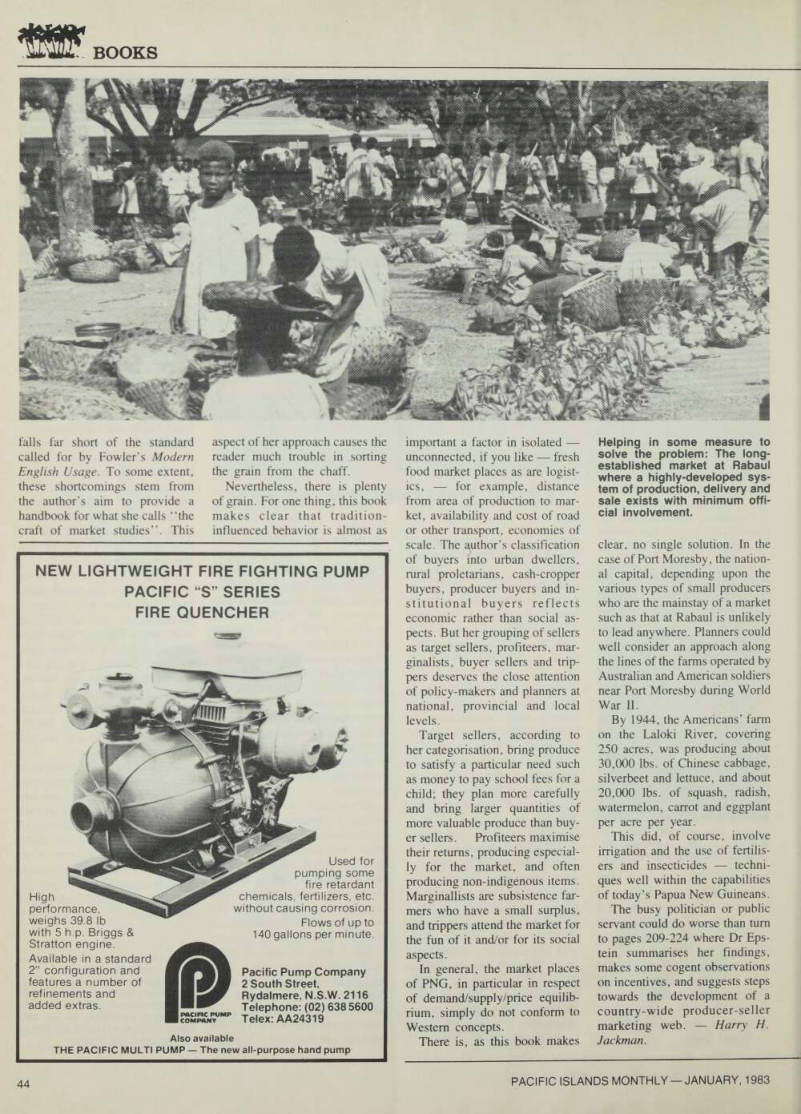
“To market, to market” - and the reasons why
Urban Food Marketing and Third World Rural Develop ment. By T. Scarlett Epstein.
Published by Groom Helm, Can berra, in association with Re search Centre for Southwest Pacific Studies, La Trobe Un iversity, Melbourne, 1982.
5A27.25. Isbn O 7099 0911 X.
Studies of market-place trade in developing economies have mainly been undertaken by economists such as Schumpeter, concerned with the “principle” of transactions; geographers in terested in export crops; and an thropologists looking at socio economic interactions. In Papua New Guinea, with its extreme decentralisation due to traditional socio-political organisation, “the isolation of individual mar kets from intra-country trade links probably reflects the tradi tional dispersion of small societies and their lack of contact with each other; the many diffe rent languages and dialects spo ken . . . (and) provides another indicator of socio-economic isolationism ... the absence of an intra-country system of food distribution . . . may throw into relief the serious problem of in
tegrating the many different trib al units into one political entity”.
At least, so Dr Scarlett Epstein observes in Urban Food Market ing and Third World Rural De velopment. She suggests that a study of PNG’s unconnected fresh food markets, in particular of the operations and motivations of individual buyers and sellers, may help the nation’s policy makers and planners to solve the long-standing problem of making available adequate, regular and fairly priced supplies of internal ly produced fresh food to the increasing populations of cities and towns.
Any solution would need to include (a) returns to producers which encourage them to supply more and more good quality food; (b) prices which the aver age householder, and preferably also people on very low incomes, can afford to pay; and (c) the phasing out, by legislation, if necessary, of competing imports.
The history of internal fresh food marketing in PNG is a chequered and mostly sad one.
Neither measures by local au thorities the Koki Market Trust, for example nor by the national government agricul
tural extension and the Fresh Food Marketing Corporation have had more than minimal suc cess. Indeed, the FFMC alone has squandered huge amounts of government money. On the other hand, a few local market places, notably the one at Rabaul which is close to deserving the descrip tion “traditional”, are helping to solve the problem.
This is a lengthy book, with 230 pages of close, small print, resulting from the author’s studies from 1967 to 1969 of what she calls the “hinterland rooted” markets at Vunapope, Kokopo, Rabaul, Goroka and Mount Hagen, and the “urban based” ones at Lae and Koki.
She had previously, between 1959 and 1961, done partly related research on the Gazelle Peninsula.
Much of this book is taken up with descriptions of the behavior and motives of buyers and sel lers, and with a number of case studies. There are 18 tables, 15 graphs, 12 charts and five maps.
The text is not easy to read.
There is a great deal of repeti tion, the material is poorly ar ranged, some tables and graphs are unhelpful, and the language
(Top picture): In terms of rural production Papua New Guinea has always been a good food producer, but with the growth of urbanisation there has been no easy transition to an effi cient system of using the coun try to feed the towns.
falls far short of the standard called for by Fowler’s Modern English Usage. To some extent, these shortcomings stem from the author’s aim to provide a handbook for what she calls “the craft of market studies’’. This
aspect of her approach causes the reader much trouble in sorting the grain from the chaff.
Nevertheless, there is plenty of grain. For one thing, this book makes clear that tradition influenced behavior is almost as
important a factor in isolated unconnected, if you like fresh food market places as are logist ics, for example, distance from area of production to mar ket, availability and cost of road or other transport, economies of scale. The author’s classification of buyers into urban dwellers, rural proletarians, cash-cropper buyers, producer buyers and in stitutional buyers reflects economic rather than social as pects. But her grouping of sellers as target sellers, profiteers, mar ginalists, buyer sellers and trip pers deserves the close attention of policy-makers and planners at national, provincial and local levels.
Target sellers, according to her categorisation, bring produce to satisfy a particular need such as money to pay school fees for a child; they plan more carefully and bring larger quantities of more valuable produce than buy er sellers. Profiteers maximise their returns, producing especial ly for the market, and often producing non-indigenous items.
Marginallists are subsistence far mers who have a small surplus, and trippers attend the market for the fun of it and/or for its social aspects.
In general, the market places of PNG, in particular in respect of demand/supply/price equilib rium, simply do not conform to Western concepts.
There is, as this book makes
clear, no single solution. In the case of Port Moresby, the nation al capital, depending upon the various types of small producers who are the mainstay of a market such as that at Rabaul is unlikely to lead anywhere. Planners could well consider an approach along the lines of the farms operated by Australian and American soldiers near Port Moresby during World War 11.
By 1944, the Americans’ farm on the Laloki River, covering 250 acres, was producing about 30.000 lbs. of Chinese cabbage, silverbeet and lettuce, and about 20.000 lbs. of squash, radish, watermelon, carrot and eggplant per acre per year.
This did, of course, involve irrigation and the use of fertilis ers and insecticides techni ques well within the capabilities of today’s Papua New Guineans.
The busy politician or public
servant could do worse than turn to pages 209-224 where Dr Eps tein summarises her findings, makes some cogent observations on incentives, and suggests steps towards the development of a
country-wide producer-seller
marketing web.
Harry H.
Jackman.
Helping in some measure to solve the problem: The long established market at Rabaul where a highly-developed sys tem of production, delivery and sale exists with minimum offi cial involvement.
Advertisements & other items, p. 44 (1 item)
New Lightweight Fire Fighting Pump
PACIFIC “S” SERIES
FIRE QUENCHER
I M
High
performance weighs 39.8 lb with 5 h.p. Briggs & Stratton engine.
Available in a standard 2" configuration and features a number of refinements and added extras.
Used for pumping some fire retardant chemicals, fertilizers, etc. without causing corrosion.
Flows of up to 140 gallons per minute.
Pacific Pump Company 2 South Street, Rydalmere, N.S.W. 2116 Telephone: (02)638 5600 Telex: AA24319 Also available THE PACIFIC MULTI PUMP The new all-purpose hand pump
Tigilau, on world stage
Fables of Samoa: Sina, Tigilau, on world stage
Fagogo Fables from Samoa in Samoan and English. Edited by Richard Moyle. Published by Auckland University Press, Pri vate Bag, Auckland, New Zea land, 1981. Price $NZ17.50 Sina and Tigilau have now joined the pantheon of international legends, formally, through the work of Richard Moyle. They are from Samoa, and among the world’s newest cultural heroines and heroes. They are the charac ters of some of Samoa’s best known and loved Fdgogo, pro nounced “Fahngongo,” a word best translated as “fables.”
What a treasure trove the col lator has put into the hands of non-Samoan-speaking folk! It will delight the scholar and satis fy the ordinary reader equally.
Not only has Mr Moyle col lected and arranged entertaining samples of Samoan traditional storytelling, but his translation preserves many of the idiomatic expressions that give such verve and flavor to Samoa’s spoken English, which is remembered with affection by all who’ve been there.
One little mystery remains: How did Mr Moyle manage to choose the final contestants for inclusion in his collection? How did he decide on “which ones Samoans themselves appeared to enjoy most?” The book has 17 fdgogo, out of more than 200 recorded. Mr Moyle was in the Samoas for 26 months between 1966 and 1969 on a comprehen sive ethno-musical survey, and from a variety of storytellers he ended up choosing 15, 13 of whom come from Savaii (the Big Island), with one from Upolu, and one from Manua (American Samoa).
Moyle had a motherlode to mine, a virtually untapped source of oral literature of considerable worth. Though it is more than a decade since he did his research,
the wait has been worth it. The bi-lingual work, with equal em phasis given to both languages, even in the introduction, is com pleted by 15 pages of notes and a
bibliography.
A notable feature of the book is the musical notations given for each tagi (song) as it occurs in the fable, instead of their being placed at the end of the tale. The collator is a considerable musi cian in his own right and has transposed some tagi up or down a semi-tone to facilitate reading.
He is careful to stress that his transcriptions do not indicate how the tagi were to be sung.
Rather they indicate “how they were sung” at a particular time.
This is clearly the first time the fdgogo have been printed with their music hence, too, it is the published premiere of all these little ditties.
Fable is indeed probably the best English word for fdgogo.
But for us, brought up on Aesop, fable does not convey the rich ness or charm of the tru c fdgogo.
O le fdgogo takes the listener of any age into the realm of brave men and loving women, of malice and virtue, and of those preternatural phenomena that loom large in all racial legends.
The art of the fdgogo is an integral part of Samoan folklore.
They are told at night, in the family, by a senior member.
Moyle distinguishes the real fdgogo from contemporary stories (which can be just as interesting).
The original 200 or so were taped for the music only, at first.
But, as Moyle writes: “The value of the stories as a source of description and comment on Sa moan society has become more apparent”. Hence this splended publication, where the narrators are both spontaneous and natur al. No one wrote his story down, so we have the natural warts of repetition, grammatical lapses, and occasional contradictions.
But they certainly didn’t bother me unduly.
Two main characters in the fdgogo are Sina and Tigilau, who form a partnersip reminiscent of Punch and Judy. Sina has several forms to her name. Her confron tations with her husband Tigilau often take ludicrous forms, such as the tale of the execution of his harem after he has recognised the beauties of monogamy. Marital strife is a common theme of the fdgogo. Sina is beautiful, and, unlike Judy, has the sense to keep her mouth shut.
Tigilau is obviously of noble rank undefined. He is young, handsome and strong. He com petes for women’s favors on a par with the Tuitoga of Tonga and Tuifiti of Fiji. His essential humanity comes out in his deal-
ings with those having a super natural aura. He is polite and devious, energetic and audacious in turn. His real depth surfaces in times of crisis.
Naturally, I looked for a cou ple of my favorites and found both in varied versions ‘Tuivalea and Tuiatamia” and “The Snake Olegata”. I have come across fdgogo, originally in English, Tales of Ancient Samoa, translated by the late Brother Herman FMS. Unlike Moyle, Brother Herman used several versions to make a composite storyfor each fdgogo, so the wording as written is not neces sarily that of any original narrator.
Moyle also notes that in Kram er’s monumental Die Samoa In seln (1902) the fdgogo given are “formal and grammatically cor rect and give the distinct impres sion of having been obtained from written, as opposed to spo ken, sources”. Moyle’s aim is simply to present a spoken story
straight from field-tapes.
It was good to note that Moyle had spoken to the Marist scholar, Brother Herman. To him I owed a great personal debt as he was the one who initiated me into the mysteries of Samoan fdgogo dur ing my 16 years in Samoa.
Brother Herman’s 60 years in the area only make one wish that the missions and governments had released workers full-time more often to build up the written side of Samoan folklore. Herman’s up there with Kramer, Buck, Pratt, Mead, Turner, and now Moyle. May the Samoan-bom scholars soon take up the task!
By the way, as PIM will know, this review took some considerable time to be written.
The reason is that my Samoan and Tokelauan friends in Sydney and Melbourne have been pas sing this book from hand to hand around the community and “de
vouring it”.
Bill Sharpe-
Dunn.
Advertisements & other items, p. 46 (1 item)
Keep On Trucking
Goodyear G29h
y , * m
jjjj
K &
Featuring flexomatic tread, this revolutionary
new design is the world’s first tire with self-adjusting tread. A top performing tire, the thread consists of 336 independent wedge like projections. As the tread enters and leaves the
tire-print, these projections independently
self-adjust, resulting in reduced friction and less
tread wear.
Designed for long dependable service, the G 291 wide belts provide excellent resistance to tread and shoulder wear and increase side-wall and puncture resistance. An all-wheel tire, the G 291 works well on front, drive, and trailer wheels. It’s saves you the time and expense of rotation, reduces tire inventory and assures maximum tread life so you can keep on trucking.
good/ycah
See the complete line of over-the-road truck tires by Goodyear.
GOODYEAR INTERNATIONAL CORPORATION
ROOM 1603, WING ON CENTER, 111 CONNAUGHT ROAD CENTRAL. HONG KONG TEL: 5-433320, 5-433331 TELEX 75606 GODYR HX GOODYEAR DISTRIBUTORS IN S.E. ASIA AND PACIFIC BASIN Richard Pieris & Co., Ltd.
Colombo, Sri Lanka Napal Motor Company (P) Ltd.
Biratnagar, Nepal Navana Ltd.
Dacca. Bangladesh.
Diet helm & Co.. Ltd.
Bangkok, Thailand Landis Brothers & Co., Ltd.
Hong Kong Guam Tire & Supply Co.
Agana, Guam Susupe Enterprises Saipan, Mariana Is.
Micro! Corporation Saipan, Mariana Is.
Truk Trading Co.
Truk E. Caroline Is.
P.A.M.I.
Kolonia, Ponape Island Transport Service Co.
Majuro Marshall Is.
Yap Cooperative Ass.
Yap. W. Carolone Is.
Cook Islands Motor Centre Ltd.
Rarotonga, Cook Is.
Ngiratkel Etpison Co., Ltd.
Koror, Palau Boroko Motors Ltd.
Port Moresby, Papua New Guinea Solomon Motors Ltd.
Honiara, Solomon Is.
Santo Engineers Santo, New Hebrides Pacific Motors Vila, New Hebrides
S.G.A.
Noumea, New Caledonia Duncombe Bay Garage Norfolk Is.
GOODYEAR manufacturing locations in Asia: Philippines, Taiwan, Malaysia, Indonesia, Australia, India, Thailand.
Coral Island Motors Suva, Fiji Morris Hedstrom Ltd.
Nuku'alofa, Tonga Morris Hedstrom Ltd.
Apia, Western Samoa Western Samoa Transport Cooperative Society Ltd.
Apia, Western Samoa Samoa Motors Inc.
Pago Pago, American Samoa Service Mobil Papeete, Tahiti In Shun Company Ltd.
Taipei, Taiwan
Anglican Vicarage, Levuka
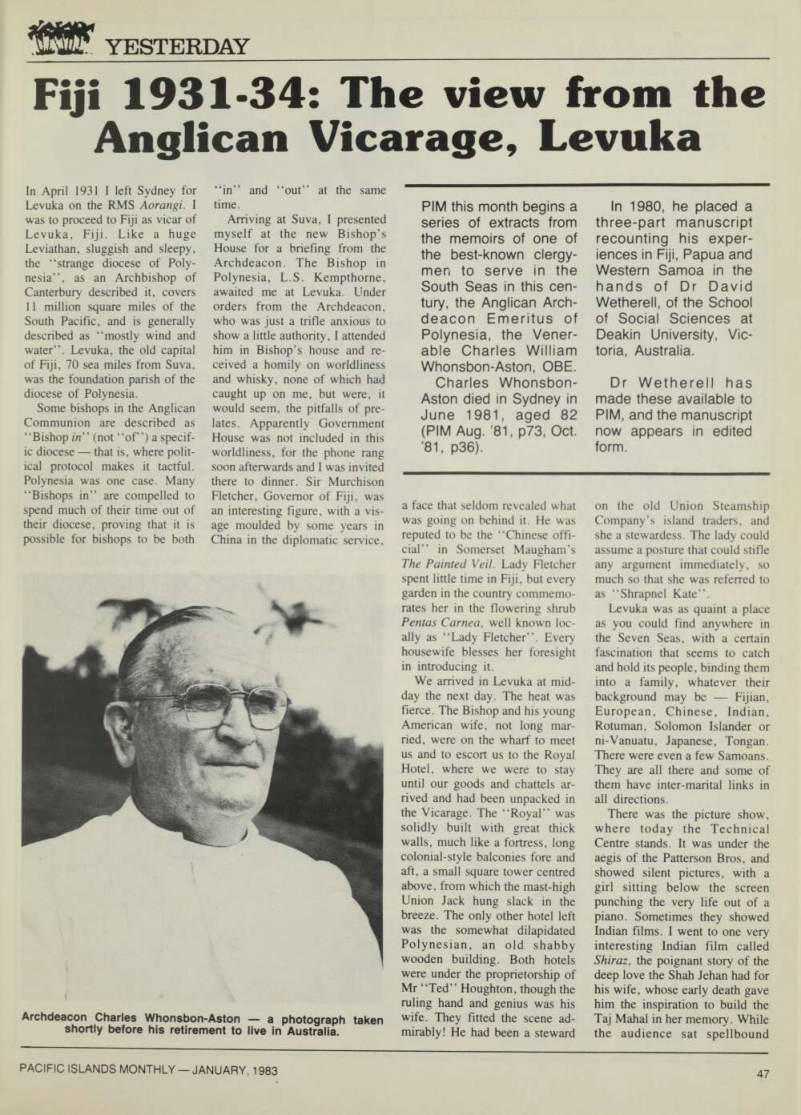

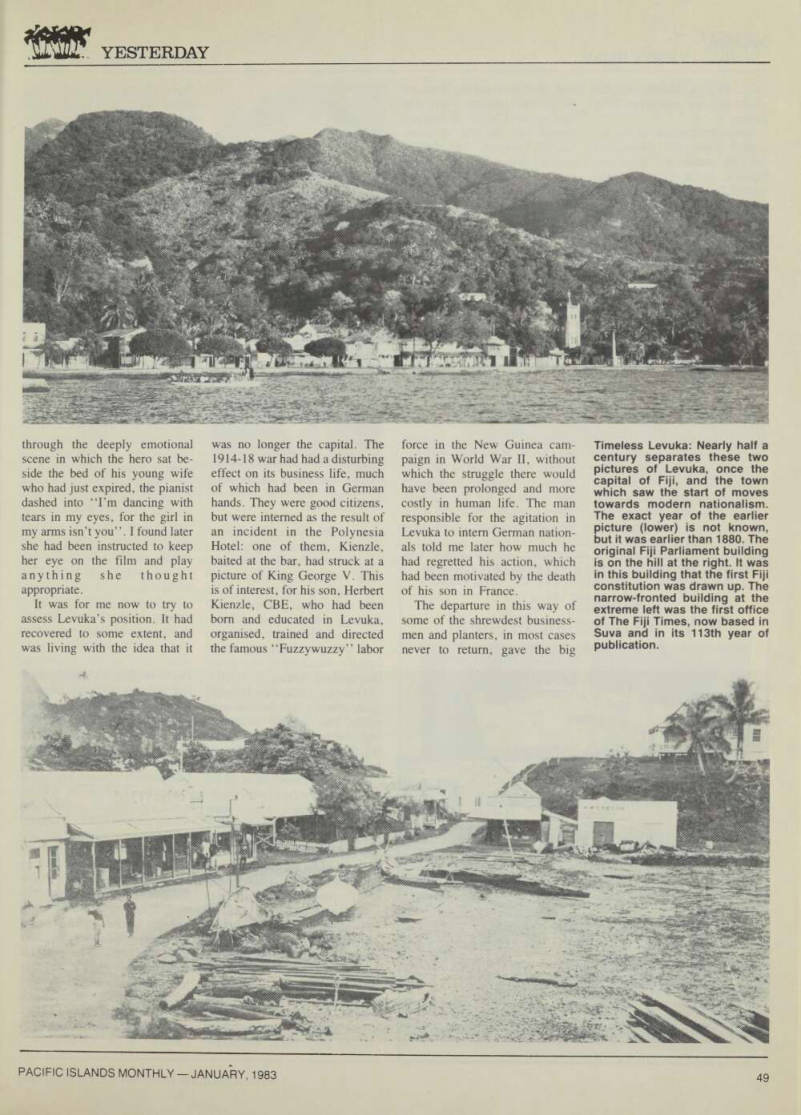
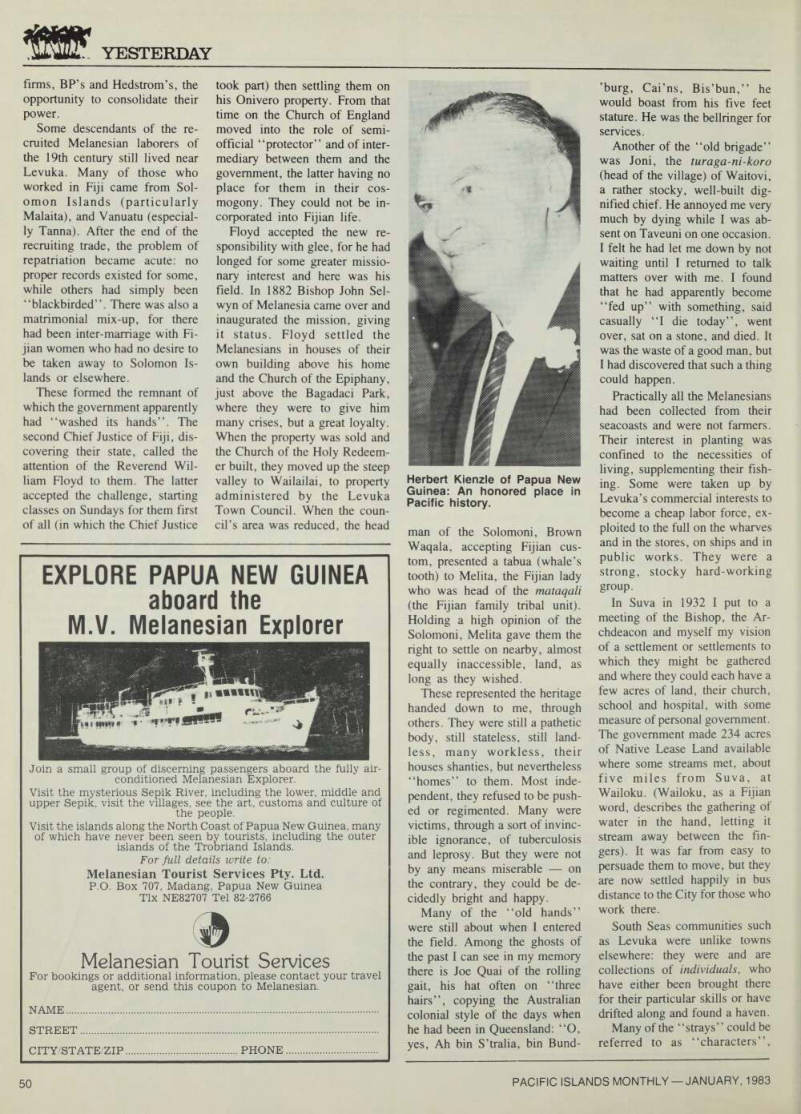
Yesterday
Fiji 1931-34: The view from the Anglican Vicarage, Levuka
In April 1931 I left Sydney for Levuka on the RMS Aorangi. I was to proceed to Fiji as vicar of Levuka, Fiji. Like a huge Leviathan, sluggish and sleepy, the “strange diocese of Poly nesia’’, as an Archbishop of Canterbury described it, covers 11 million square miles of the South Pacific, and is generally described as “mostly wind and water’’. Levuka, the old capital of Fiji, 70 sea miles from Suva, was the foundation parish of the diocese of Polynesia.
Some bishops in the Anglican Communion are described as “Bishop//?” (not “of’) a specif ic diocese that is, where polit ical protocol makes it tactful.
Polynesia was one case. Many “Bishops in” are compelled to spend much of their time out of their diocese, proving that it is possible for bishops to be both
“in’’ and “out’’ at the same time.
Arriving at Suva, I presented myself at the new Bishop’s House for a briefing from the Archdeacon. The Bishop in
Polynesia, L.S. Kempthorne,
awaited me at Levuka. Under orders from the Archdeacon, who was just a trifle anxious to show a little authority, I attended him in Bishop’s house and re ceived a homily on worldliness and whisky, none of which had caught up on me, but were, it would seem, the pitfalls of pre lates. Apparently Government House was not included in this worldliness, for the phone rang soon afterwards and I was invited there to dinner. Sir Murchison Fletcher, Governor of Fiji, was an interesting figure, with a vis age moulded by some years in China in the diplomatic service.
PIM this month begins a series of extracts from the memoirs of one of the best-known clergy men to serve in the South Seas in this cen tury, the Anglican Arch deacon Emeritus of Polynesia, the Vener able Charles William Whonsbon-Aston, QBE.
Charles Whonsbon- Aston died in Sydney in June 1981, aged 82 (PIM Aug. ’Bl, p 73, Oct. ’Bl, p 36).
In 1980, he placed a three-part manuscript recounting his exper iences in Fiji, Papua and Western Samoa in the hands of Dr David Wetherell, of the School of Social Sciences at Deakin University, Vic toria, Australia.
Dr Wetherell has made these available to PIM, and the manuscript now appears in edited form.
a face that seldom revealed what was going on behind it. He was reputed to be the “Chinese offi cial’’ in Somerset Maugham’s The Painted Veil. Lady Fletcher spent little time in Fiji, but every garden in the country commemo rates her in the flowering shrub Pentas Carnea, well known loc ally as “Lady Fletcher’’. Every housewife blesses her foresight in introducing it.
We arrived in Levuka at mid day the next day. The heat was fierce. The Bishop and his young American wife, not long mar ried, were on the wharf to meet us and to escort us to the Royal Hotel, where we were to stay until our goods and chattels ar rived and had been unpacked in the Vicarage. The “Royal’’ was solidly built with great thick walls, much like a fortress, long colonial-style balconies fore and aft, a small square tower centred above, from which the mast-high Union Jack hung slack in the breeze. The only other hotel left was the somewhat dilapidated Polynesian, an old shabby wooden building. Both hotels were under the proprietorship of Mr “Ted’’ Houghton, though the ruling hand and genius was his wife. They fitted the scene ad mirably! He had been a steward
on the old Union Steamship Company’s island traders, and she a stewardess. The lady could assume a posture that could stifle any argument immediately, so much so that she was referred to as “Shrapnel Kate’’.
Levuka was as quaint a place as you could find anywhere in the Seven Seas, with a certain fascination that seems to catch and hold its people, binding them into a family, whatever their background may be Fijian, European, Chinese, Indian, Rotuman, Solomon Islander or ni-Vanuatu, Japanese, Tongan.
There were even a few Samoans.
They are all there and some of them have inter-marital links in all directions.
There was the picture show, where today the Technical Centre stands. It was under the aegis of the Patterson Bros, and showed silent pictures, with a girl sitting below the screen punching the very life out of a piano. Sometimes they showed Indian films. I went to one very interesting Indian film called Shiraz, the poignant story of the deep love the Shah Jehan had for his wife, whose early death gave him the inspiration to build the Taj Mahal in her memory. While the audience sat spellbound
Archdeacon Charles Whonsbon-Aston - a photograph taken shortly before his retirement to live in Australia.
through the deeply emotional scene in which the hero sat be side the bed of his young wife who had just expired, the pianist dashed into ‘T’m dancing with tears in my eyes, for the girl in my arms isn’t you”. I found later she had been instructed to keep her eye on the film and play anything she thought appropriate.
It was for me now to try to assess Levuka’s position. It had recovered to some extent, and was living with the idea that it
was no longer the capital. The 1914-18 war had had a disturbing effect on its business life, much of which had been in German hands. They were good citizens, but were interned as the result of an incident in the Polynesia Hotel: one of them, Kienzle, baited at the bar, had struck at a picture of King George V. This is of interest, for his son, Herbert Kienzle, CBE, who had been bom and educated in Levuka, organised, trained and directed the famous “ Fuzzywuzzy” labor
force in the New Guinea cam paign in World War 11, without which the struggle there would have been prolonged and more costly in human life. The man responsible for the agitation in Levuka to intern German nation als told me later how much he had regretted his action, which had been motivated by the death of his son in France.
The departure in this way of some of the shrewdest business men and planters, in most cases never to return, gave the big
Timeless Levuka: Nearly half a century separates these two pictures of Levuka, once the capital of Fiji, and the town which saw the start of moves towards modern nationalism.
The exact year of the earlier picture (lower) is not known, but it was earlier than 1880. The
original Fiji Parliament building
is on the hill at the right. It was in this building that the first Fiji constitution was drawn up. The narrow-fronted building at the extreme left was the first office of The Fiji Times, now based in Suva and in its 113th year of
publication.
firms, BP’s and Hedstrom’s, the opportunity to consolidate their power.
Some descendants of the recruited Melanesian laborers of the 19th century still lived near Levuka. Many of those who worked in Fiji came from Solomon Islands (particularly Malaita), and Vanuatu (especially Tanna). After the end of the recruiting trade, the problem of repatriation became acute; no proper records existed for some, while others had simply been “blackbirded”. There was also a matrimonial mix-up, for there had been inter-marriage with Fijian women who had no desire to be taken away to Solomon Islands or elsewhere.
These formed the remnant of which the government apparently had “washed its hands”. The second Chief Justice of Fiji, discovering their state, called the attention of the Reverend William Floyd to them. The latter accepted the challenge, starting classes on Sundays for them first of all (in which the Chief Justice
took part) then settling them on his Onivero property. From that time on the Church of England moved into the role of semi official “protector” and of inter mediary between them and the government, the latter having no place for them in their cos mogony. They could not be in corporated into Fijian life, Floyd accepted the new re sponsibility with glee, for he had longed for some greater missio nary interest and here was his field. In 1882 Bishop John Sel wyn of Melanesia came over and inaugurated the mission, giving it status. Floyd settled the Melanesians in houses of their own building above his home and the Church of the Epiphany, just above the Bagadaci Park, where they were to give him many crises, but a great loyalty, When the property was sold and the Church of the Holy Redeem er built, they moved up the steep valley to Wailailai, to property administered by the Levuka Town Council. When the coun cil’s area was reduced, the head
man of the Solomoni, Brown Waqala, accepting Fijian cus tom, presented a tabua (whale’s tooth) to Melita, the Fijian lady who was head of the mataqali (the Fijian family tribal unit).
Holding a high opinion of the Solomoni, Melita gave them the right to settle on nearby, almost equally inaccessible, land, as long as they wished.
These represented the heritage handed down to me, through others. They were still a pathetic body, still stateless, still land less, many workless, their houses shanties, but nevertheless “homes” to them. Most inde pendent, they refused to be push ed or regimented. Many were victims, through a sort of invinc ible ignorance, of tuberculosis and leprosy. But they were not by any means miserable on the contrary, they could be de cidedly bright and happy.
Many of the “old hands” were still about when I entered the field. Among the ghosts of the past I can see in my memory there is Joe Quai of the rolling gait, his hat often on “three hairs”, copying the Australian colonial style of the days when he had been in Queensland: “O, yes, Ah bin S’tralia, bin Bund
’burg, Cai’ns, Bis’bun,” he would boast from his five feet stature. He was the bellringer for services.
Another of the “old brigade’’ was Joni, the turaga-ni-koro (head of the village) of Waitovi, a rather stocky, well-built dig nified chief. He annoyed me very much by dying while I was ab sent on Taveuni on one occasion.
I felt he had let me down by not waiting until I returned to talk matters over with me. I found that he had apparently become “fed up” with something, said casually “I die today”, went over, sat on a stone, and died. It was the waste of a good man, but I had discovered that such a thing
could happen.
Practically all the Melanesians had been collected from their seacoasts and were not farmers.
Their interest in planting was confined to the necessities of
living, supplementing their fish
ing. Some were taken up by Levuka’s commercial interests to become a cheap labor force, ex ploited to the full on the wharves and in the stores, on ships and in public works. They were a
strong, stocky hard-working
group.
In Suva in 1932 I put to a meeting of the Bishop, the Ar chdeacon and myself my vision of a settlement or settlements to
which they might be gathered
and where they could each have a few acres of land, their church, school and hospital, with some measure of personal government.
The government made 234 acres of Native Lease Land available where some streams met, about five miles from Suva, at Wailoku. (Wailoku, as a Fijian word, describes the gathering of water in the hand, letting it stream away between the fin gers). It was far from easy to persuade them to move, but they are now settled happily in bus distance to the City for those who work there.
South Seas communities such as Levuka were unlike towns elsewhere: they were and are collections of individuals, who have either been brought there for their particular skills or have drifted along and found a haven.
Many of the “strays” could be referred to as “characters”,
Herbert Kienzle of Papua New Guinea: An honored place in
Pacific history.
though I feel these days few could be so described. Levuka at one time could produce a Town Clerk bom in a British consulate in Russia, speaking perfect Rus sian; another, a remittance man, with his twin brother, were brothers of a baronet created by Queen Victoria; there was a ba ron connected with the royal house of Italy and there was Warbrooke, one of the drill offic ers recruited from Australia in 1868 to train Cakobau’s savage army. There were but two of them left when I arrived in Levu ka, Warbrooke and Georgius Wright, the father of the interna
tionally known photographer
Rob Wright.
In this, my new world, I saved myself from walking muddy miles by taking any lift I could get, using frail canoes, dinghies, yachts, cutters, ketches, small steamers and warships. I even took to the air, becoming the first of the cloth to fly across the 180th meridian. All this was in the space of those first three years.
There was something ex hilarating about facing out to sea in a ten-ton cutter into a stiffish southeast trade wind, with the country’s flag flying at the top
mast and a copper-hued, mop haired giant “thud, thud, thud ding” on the big lali (war drum) on the fore part of the vessel, the salt spray dashing from the prows that is, provided you are some sort of sailor. My par ish duties often called me to outlying islands such as Ngau (Gau) where there were white settlers near the village of Sawaieke. Our party on our first trip consisted of the doctor, who was taking his wife and family for a trip with him, and an Inspector of Native Schools, a New Zealander. We travelled on the Provincial cutter, the Mara ma-na-Yanuyanu, “the Lady of the Isles”.
We had to call first at the island of Mbatiki where we ar rived at the chiefs house in the evening. After the evening meal entertainment was put on for us in the big bare. The young ladies from a neighboring village, Naivukulani, gave, first of all an excellent meke. Kingsford Smith’s famous plane, the South ern Cross, had passed over their island on that first trans-Pacific flight only a few years earlier, and their hands and bodies moved with the chant to tell their reactions to this event.
(Above) This picture from the Fiji Government Archives shows the town of Levuka about 1885. (Below) Photographed about 20 years ago this picture shows the graceful decay which settled on many of the more imposing buildings of Levuka - this one the town hall.
Dance after dance ensued, with changing partners, the same tune soon becoming monoton ous. Faster and faster beat the drums, likewise the song and the dancing feet, hotter and hotter the closed bure became, with the heat and hiss of the benzine and the kerosene lights. There came the mingling odors of perspiring oily bodies, with the strong scent of the wa-na-kalou, the “string of the gods”, a vine that was the basis of the necklets, soaked in uci, the gaiety reaching its loud est, almost hysterical pitch. All this combined to force the sug gestion that the day was far spent, the dawn was at hand, and that we certainly needed rest. At that moment a vibrant young thing, who had been whirling about on her feet all the evening, approached me with a most fetching smile and cast her salusalu over my head and around my neck, a lovely ges ture, especially as the pungent odor of the garland had gathered to itself four hours of oily sweat.
I discovered it was an invitation
to an “aftermath”. But there are limits over which a parson must not step. In spite of my stars, I just had to decline.
We then went to Nairai Island.
We had no chance to get near the end of the reef where, in 1803, the brig Eliza had struck. The survivors had been landed at
Lawaki village nearby. Every
time I visited that way I used to wonder hopefully whether a
good Providence would guide
my feet to just the spot where some of the $34,000 taken ashore there had shyly hidden themselves . . .
Our stay was not very long and a favorable wind brought us home again to Levuka. The sea was much calmer and the rattle of the drum on the forepeak, as we entered the gap in the Levuka reef, was a warning to the saints who would have slept in their beds, that there would be no excuse for the next morning’s absence from church. It was
Saturday night . . .
Throughout Fiji one is never allowed to forget the great,
though divided, sense of relig ion, with cathedrals and churches, mosques and temples, Sikh and Hindu, with the religi ous processions, the fasts, the firewalking, and the rivalries and fisticuffs. From my hilltop home on one week of the year I could gaze out on Fairyland, spread around and below me, as the Feast of Diwali, the Festival of
Lights, gives praise to the God
dess of Light. I wonder will the day ever come when “the Light to lighten the Gentiles” will shine through it and enrich its meaning? It is a dream, but Christianity in Fiji, as exhibited in the average everyday adherent on the census paper, hardly gives room for optimism. • • • I must assert that all my time was not spent in gallivanting about the countryside. There was much to do in Levuka, with never a dull day. Any farewell, I have found, from any part of the South Seas has its great and emotional moments; leaving Levuka con formed to that pattern. The whole was made more poignant
because it would appear there would be no replacement for me there: the world depression made
staffing difficult.
The Solomon Islanders pre pared a special song of farewell in Fijian, led by their own string band. It had an attractive lilt and their voices blended so harmoni ously in singing (and I give the English translation of one part): “We will miss you, We will miss you. We have loved to see you stand up in church. We have loved the sight of you, Your face is like a beautiful white rose.”
If they had said “red rose” it might have been nearer the mark, but each day they would be arriv ing with farewell gifts, tapa cloth, mats, fans, shells, baskets and necklaces, while on the last evening the young men wanted to sit up in the Vicarage grounds all night. But I needed a good night’s rest, for I was to leave very early next morning by gov ernment tug for Suva, and thence to Australia. My next appoint ment, in 1934, was to be Muka wa, on the Papuan coast.
Next month: New Guinea Ahead.
Levuka town mellowed into a comfortable collection of buildings, held back from excessive expansion by the sea in front and the mountains at the back.
Advertisements & other items, pp. 48-52 (1 item)
quencher with
MANUFACTURED IN AUSTRALIA BY
R. M. GOW & CO. LTD.
30-Gow Street, Moorooka Queensland, 4105. Australia P.O. Box 111, Moorooka Queensland, 4105 Australia Cables: Fidelity Telex: GOWCO AA42839 I
aJ&I
Read ytof,
QUALITY AUSTRALIAN
G ol C^sr waf % <ntx 3; & 4 m & £ zi & o'-?. esT c* & ✓
ASSTD. FLAVOURS
* r V.e s mo rrA
The great thirst
quencher with
real fruit flavour.
w
GOLD
2 LITRE CORDIALS *
GOLD
CREST
Fulfrute Fruit Juice Cordial really quenches the thirst.
Fulfrute is economical in the 2 litre Flagon, so Mums love it as much as the kids.
PIIIfRUTC
fSRWT JUICE CORDIAL
750 m
CORDIALS
HILFRUtB
ORANGE
fruit rSOml Fulfrute - another R.M.Gow Group quality product,
EXPLORE PAPUA NEW GUINEA
aboard the
M.V. Melanesian Explorer
»i«ii el»
*rf JBISIW
Join a small group of discerning passengers aboard the fully airconditioned Melanesian Explorer.
Visit the mysterious Sepik River, including the lower, middle and upper Sepik, visit the villages, see the art, customs and culture of the people.
Visit the islands along the North Coast of Papua New Guinea, many of which have never been seen by tourists, including the outer islands of the Trobriand Islands.
For full details write to: Melanesian Tourist Services Pty. Ltd.
P.O. Box 707, Madang, Papua New Guinea Tlx NE82707 Tel 82-2766
Melanesian Tourist Services
For bookings or additional information, please contact your travel agent, or send this coupon to Melanesian.
NAME
STREET
CITY/STATE/ZIP PHONE
FORESTMIL
PORTABLE
SAWMILL
TO BE DEMONSTRATED IN
SUVA, FIJI, FROM 18th
TO 21st OF EACH MONTH
UNTIL APRIL.
A Mini Self Contained Sawmill
complete with Diesel Engine or Electric Motor W % w.
Forestmil produces any size accurate timber ready to use up to 12" x 9" x 24'.
Purchase price and operating cost of Forestmil is less than other sawing equipment with similar production capacity.
Forestmil reduces timber waste and also reduces log transport cost. Timber is sawn direct from the log in the forest.
Forestmil can be moved to a new location in one hour.
Forestmil will saw hardwood or softwood from logs of any diameter.
Over 1000 Forestmils are sawing timber in 23 countries.
Forestmil has been manufactured for 18 years.
For literature and prices please contact the manufacturers.
Mac Quarrie Industries Pty.Ltd.
P.O. Box 20, Coburg 3058, Victoria, Australia.
Phone: 350-3411. Telex: 33729. Cables: Macbound, Melbourne.
Trade Winds
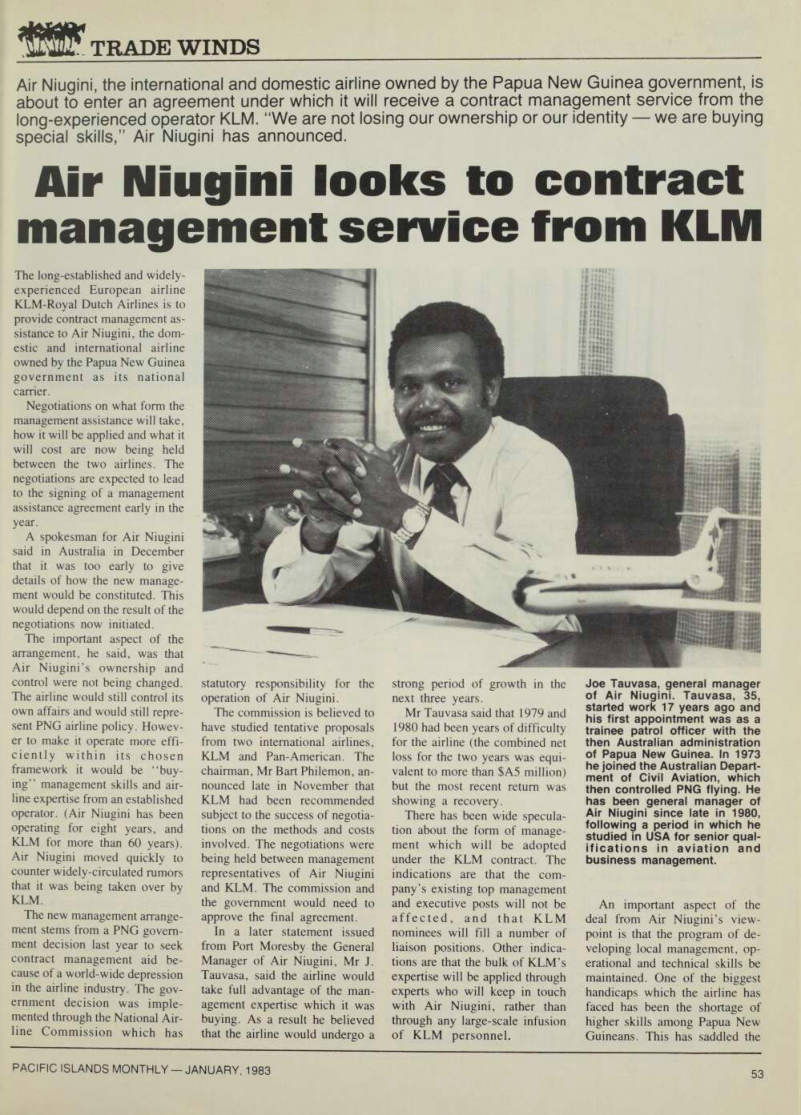
Air Niugini, the international and domestic airline owned by the Papua New Guinea government, is about to enter an agreement under which it will receive a contract management service from the long-experienced operator KLM. “We are not losing our ownership or our identity we are buying special skills,” Air Niugini has announced.
management service from KLM
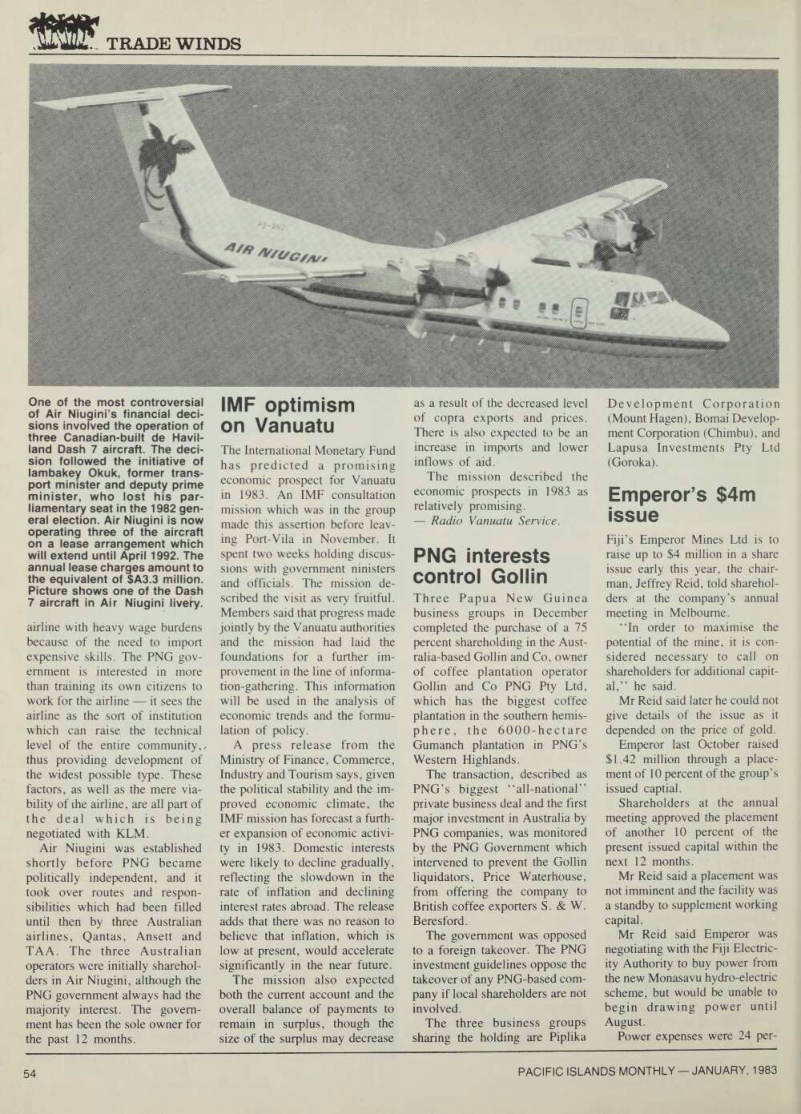
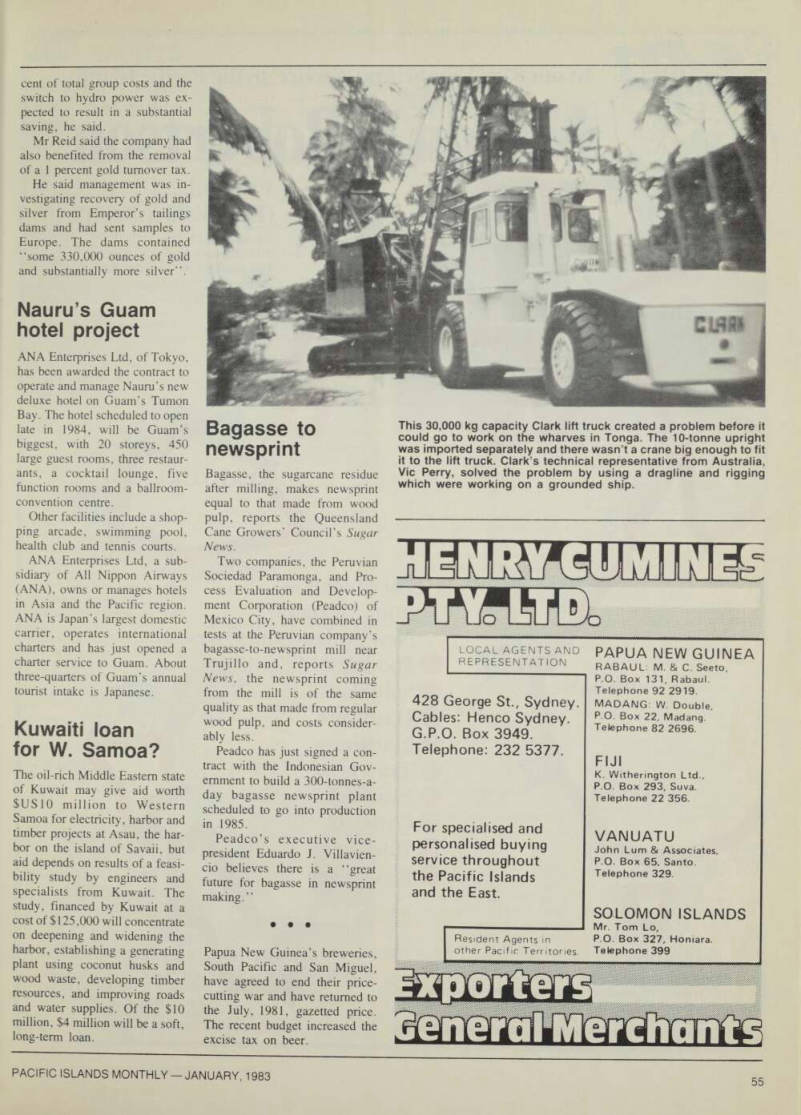
Air Niugini looks to contract management service from KLM
The long-established and widely
experienced European airline KLM-Royal Dutch Airlines is to provide contract management as sistance to Air Niugini, the dom estic and international airline owned by the Papua New Guinea government as its national carrier.
Negotiations on what form the management assistance will take, how it will be applied and what it will cost are now being held between the two airlines. The negotiations are expected to lead to the signing of a management assistance agreement early in the year.
A spokesman for Air Niugini said in Australia in December that it was too early to give details of how the new manage ment would be constituted. This would depend on the result of the negotiations now initiated.
The important aspect of the arrangement, he said, was that
Air Niugini’s ownership and
control were not being changed.
The airline would still control its own affairs and would still repre sent PNG airline policy. Howev er to make it operate more effi ciently within its chosen framework it would be “buy ing” management skills and air line expertise from an established operator. (Air Niugini has been operating for eight years, and KLM for more than 60 years).
Air Niugini moved quickly to counter widely-circulated rumors that it was being taken over by
Klm.
The new management arrange ment stems from a PNG govern ment decision last year to seek contract management aid be cause of a world-wide depression in the airline industry. The gov ernment decision was imple mented through the National Air line Commission which has
statutory responsibility for the operation of Air Niugini.
The commission is believed to have studied tentative proposals from two international airlines, KLM and Pan-American. The chairman, Mr Bart Philemon, an nounced late in November that KLM had been recommended subject to the success of negotia tions on the methods and costs involved. The negotiations were being held between management representatives of Air Niugini and KLM. The commission and the government would need to approve the final agreement.
In a later statement issued from Port Moresby the General Manager of Air Niugini, Mr J.
Tauvasa, said the airline would take full advantage of the man agement expertise which it was buying. As a result he believed that the airline would undergo a
strong period of growth in the next three years.
Mr Tauvasa said that 1979 and 1980 had been years of difficulty for the airline (the combined net loss for the two years was equi valent to more than SAS million) but the most recent return was showing a recovery.
There has been wide specula tion about the form of manage ment which will be adopted under the KLM contract. The indications are that the com
pany’s existing top management
and executive posts will not be affected, and that KLM nominees will fill a number of liaison positions. Other indica tions are that the bulk of KLM’s
expertise will be applied through
experts who will keep in touch with Air Niugini, rather than
through any large-scale infusion
of KLM personnel.
An important aspect of the deal from Air Niugini’s view point is that the program of de veloping local management, op erational and technical skills be maintained. One of the biggest handicaps which the airline has faced has been the shortage of higher skills among Papua New Guineans. This has saddled the
Joe Tauvasa, general manager of Air Niugini. Tauvasa, 35, started work 17 years ago and his first appointment was as a trainee patrol officer with the then Australian administration of Papua New Guinea. In 1973 he joined the Australian Depart ment of Civil Aviation, which then controlled PNG flying. He has been general manager of Air Niugini since late in 1980, following a period in which he studied in USA for senior qual ifications in aviation and business management.
airline with heavy wage burdens because of the need to import expensive skills. The PNG gov ernment is interested in more than training its own citizens to work for the airline it sees the airline as the sort of institution which can raise the technical level of the entire community,,
thus providing development of
the widest possible type. These factors, as well as the mere via bility of ihe airline, are all part of the deal which is being negotiated with KLM.
Air Niugini was established shortly before PNG became
politically independent, and it
took over routes and respon sibilities which had been filled until then by three Australian airlines, Qantas, Ansett and TAA. The three Australian operators were initially sharehol ders in Air Niugini, although the PNG government always had the majority interest. The govern ment has been the sole owner for the past 12 months.
IMF optimism
on Vanuatu
The International Monetary Fund
has predicted a promising
economic prospect for Vanuatu in 1983. An IMF consultation mission which was in the group made this assertion before leav ing Port-Vila in November. It spent two weeks holding discus sions with government ninisters and officials. The mission de scribed the visit as very fruitful.
Members said that progress made jointly by the Vanuatu authorities and the mission had laid the foundations for a further im provement in the line of informa tion-gathering. This information will be used in the analysis of economic trends and the formu lation of policy.
A press release from the Ministry of Finance, Commerce, Industry and Tourism says, given the political stability and the im proved economic climate, the IMF mission has forecast a furth er expansion of economic activi ty in 1983. Domestic interests were likely to decline gradually, reflecting the slowdown in the rate of inflation and declining interest rates abroad. The release adds that there was no reason to believe that inflation, which is low at present, would accelerate significantly in the near future.
The mission also expected both the current account and the overall balance of payments to remain in surplus, though the size of the surplus may decrease
as a result of the decreased level of copra exports and prices.
There is also expected to be an increase in imports and lower inflows of aid.
The mission described the economic prospects in 1983 as relatively promising.
Radio Vanuatu Service.
PNG interests
control Gollin
Three Papua New Guinea business groups in December completed the purchase of a 75 percent shareholding in the Aust ralia-based Gollin and Co, owner of coffee plantation operator Gollin and Co PNG Pty Ltd, which has the biggest coffee plantation in the southern hemis phere, the 6000-hectare Gumanch plantation in PNG’s Western Highlands.
The transaction, described as PNG’s biggest “all-national’’ private business deal and the first major investment in Australia by PNG companies, was monitored by the PNG Government which intervened to prevent the Gollin liquidators, Price Waterhouse, from offering the company to British coffee exporters S. & W.
Beresford.
The government was opposed to a foreign takeover. The PNG investment guidelines oppose the takeover of any PNG-based com pany if local shareholders are not involved.
The three business groups sharing the holding are Piplika
Development Corporation (Mount Hagen), Bomai Develop ment Corporation (Chimbu), and Lapusa Investments Pty Ltd (Goroka).
Emperor’s s4m
issue
Fiji’s Emperor Mines Ltd is to raise up to $4 million in a share issue early this year, the chair man, Jeffrey Reid, told sharehol ders at the company’s annual meeting in Melbourne.
“In order to maximise the potential of the mine, it is con sidered necessary to call on shareholders for additional capit al,’’ he said.
Mr Reid said later he could not give details of the issue as it depended on the price of gold.
Emperor last October raised $1.42 million through a place ment of 10 percent of the group’s issued captial.
Shareholders at the annual meeting approved the placement of another 10 percent of the present issued capital within the next 12 months.
Mr Reid said a placement was not imminent and the facility was a standby to supplement working capital.
Mr Reid said Emperor was negotiating with the Fiji Electric ity Authority to buy power from the new Monasavu hydro-electric scheme, but would be unable to begin drawing power until August.
Power expenses were 24 per
One of the most controversial of Air Niugini’s financial deci sions involved the operation of three Canadian-built de Havil land Dash 7 aircraft. The deci sion followed the initiative of lambakey Okuk, former trans port minister and deputy prime minister, who lost his par liamentary seat in the 1982 gen eral election. Air Niugini is now operating three of the aircraft on a lease arrangement which will extend until April 1992. The annual lease charges amount to the equivalent of $A3.3 million.
Picture shows one of the Dash 7 aircraft in Air Niugini livery.
cent of total group costs and the switch to hydro power was ex pected to result in a substantial saving, he said.
Mr Reid said the company had also benefited from the removal of a 1 percent gold turnover tax.
He said management was in vestigating recovery of gold and silver from Emperor’s tailings dams and had sent samples to Europe. The dams contained “some 330,000 ounces of gold and substantially more silver’’.
Nauru’s Guam
hotel project
ANA Enterprises Ltd, of Tokyo, has been awarded the contract to operate and manage Nauru’s new deluxe hotel on Guam’s Turnon Bay. The hotel scheduled to open late in 1984, will be Guam’s biggest, with 20 storeys, 450 large guest rooms, three restaur ants, a cocktail lounge, five function rooms and a ballroom convention centre.
Other facilities include a shop ping arcade, swimming pool, health club and tennis courts.
ANA Enterprises Ltd, a sub sidiary of All Nippon Airways (ANA), owns or manages hotels in Asia and the Pacific region.
ANA is Japan’s largest domestic carrier, operates international charters and has just opened a charter service to Guam. About three-quarters of Guam’s annual tourist intake is Japanese.
Kuwaiti loan
for W. Samoa?
The oil-rich Middle Eastern state of Kuwait may give aid worth SUSIO million to Western Samoa for electricity, harbor and timber projects at Asau, the har bor on the island of Savaii, but aid depends on results of a feasi bility study by engineers and specialists from Kuwait. The study, financed by Kuwait at a cost of $125,000 will concentrate on deepening and widening the harbor, establishing a generating plant using coconut husks and wood waste, developing timber resources, and improving roads and water supplies. Of the $lO million, $4 million will be a soft, long-term loan.
Bagasse to
newsprint
Bagasse, the sugarcane residue after milling, makes newsprint equal to that made from wood pulp, reports the Queensland Cane Growers’ Council’s Sugar News.
Two companies, the Peruvian Sociedad Paramonga, and Pro cess Evaluation and Develop ment Corporation (Peadco) of Mexico City, have combined in tests at the Peruvian company’s bagasse-to-newsprint mill near Trujillo and, reports Sugar News, the newsprint coming from the mill is of the same quality as that made from regular wood pulp, and costs consider ably less.
Peadco has just signed a con tract with the Indonesian Gov ernment to build a 300-tonnes-a -day bagasse newsprint plant scheduled to go into production in 1985.
Peadco’s executive vice president Eduardo J. Villavien cio believes there is a “great future for bagasse in newsprint making.’’ • • • Papua New Guinea’s breweries, South Pacific and San Miguel, have agreed to end their price cutting war and have returned to the July, 1981, gazetted price.
The recent budget increased the excise tax on beer.
This 30,000 kg capacity Clark lift truck created a problem before it could go to work on the wharves in Tonga. The 10-tonne upright was imported separately and there wasn’t a crane big enough to fit it to the lift truck. Clark’s technical representative from Australia, Vic Perry, solved the problem by using a dragline and rigging which were working on a grounded ship.
Advertisements & other items, pp. 55-56 (1 item)
Tbzeu^3Ilji^
jVufIWH.
LOCAL AGENTS AND
REPRESENTATION
428 George St., Sydney.
Cables: Henco Sydney.
G.P.O. Box 3949.
Telephone: 232 5377.
PAPUA NEW GUINEA
RABAUL: M. & C. Seeto, P.O. Box 131, Rabaul.
Telephone 92 2919.
MADANG: W. Double, P.O. Box 22, Madang.
Telephone 82 2696.
FIJI
K. Witherington Ltd., P.O. Box 293, Suva.
Telephone 22 356.
For specialised and
personalised buying
service throughout
the Pacific Islands and the East.
VANUATU
John Lum & Associates, P.O. Box 65, Santo.
Telephone 329.
Resident Agents in other Pacific Territories.
xporters
SOLOMON ISLANDS
Mr. Tom Lo, P.O. Box 327, Honiara.
Telephone 399
In our 87th Year Selling ‘Service’ to the Pacific Islands
Nelson & Robertson
Pty. Ltd.
(Established 1895)
Pl an tati° n House, 197 Clarence Street, Sydney.
Cables: ‘IVAN’, Sydney, Brisbane.
Telex: AA22381, Sydney.
Phone: 29 2871
KIETA
QBE Rf
O 2: o V >l/ G rV
MADANG
LA . • . v •v.
BRISBANE
SYDNEY
nr • ••• / •••« p.o •• •/•••
LAUTOKA
For Indents
from Australia,
New Zealand and Overseas
Foodstuffs
Softgoods
Hardware
Machinery
Travel
Insurance
Canned Fish
Jute Goods
Real Estate
SvjSUVA
ND
BRANCH OFFICES:
Nelson & Robertson Pty. Ltd., P.O. Box 575, Brisbane, Qld., Australia. 2216966 P.O. Box 2092, Govt. Bldg., Suva, Fiji. 22430 P.O. Box 258, Lautoka, Fiji. 62101 P.O. Box 2420, CPO Auckland 1, New Zealand. 774141
v'::PAPUA NEW GUINEA REPRESENTATIVES:
ini Pty. Ltd., , Rabaul, P.N.G. 922911 . Box 1406, Lae, P.N.G. 422366 . Box 711, Madang, P.N.G. 822066 • P.O. Box 253, Kieta, P.N.G. 956185
Yachts
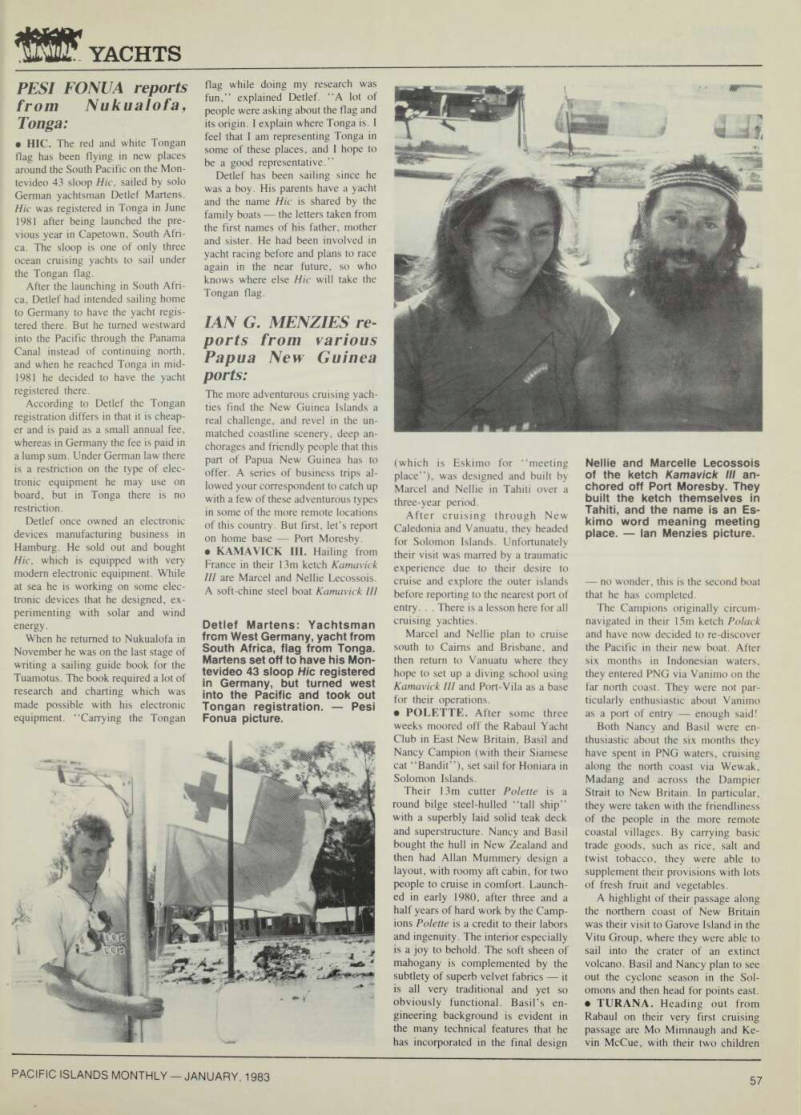
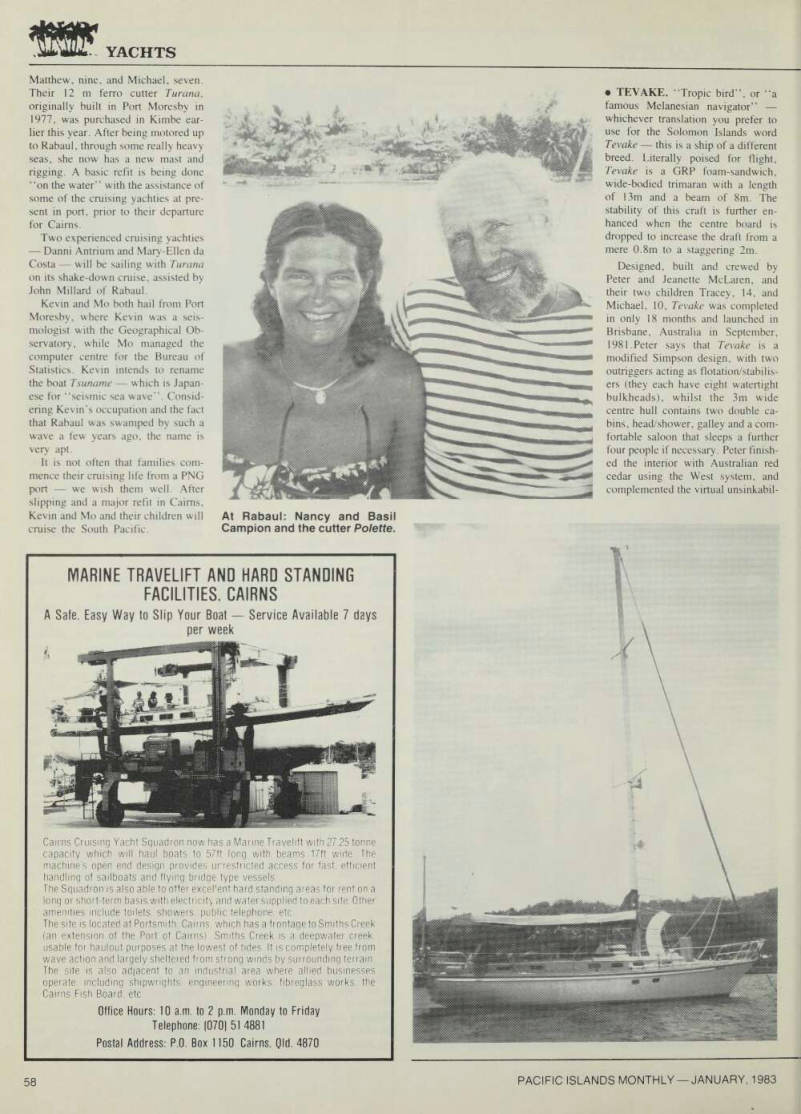
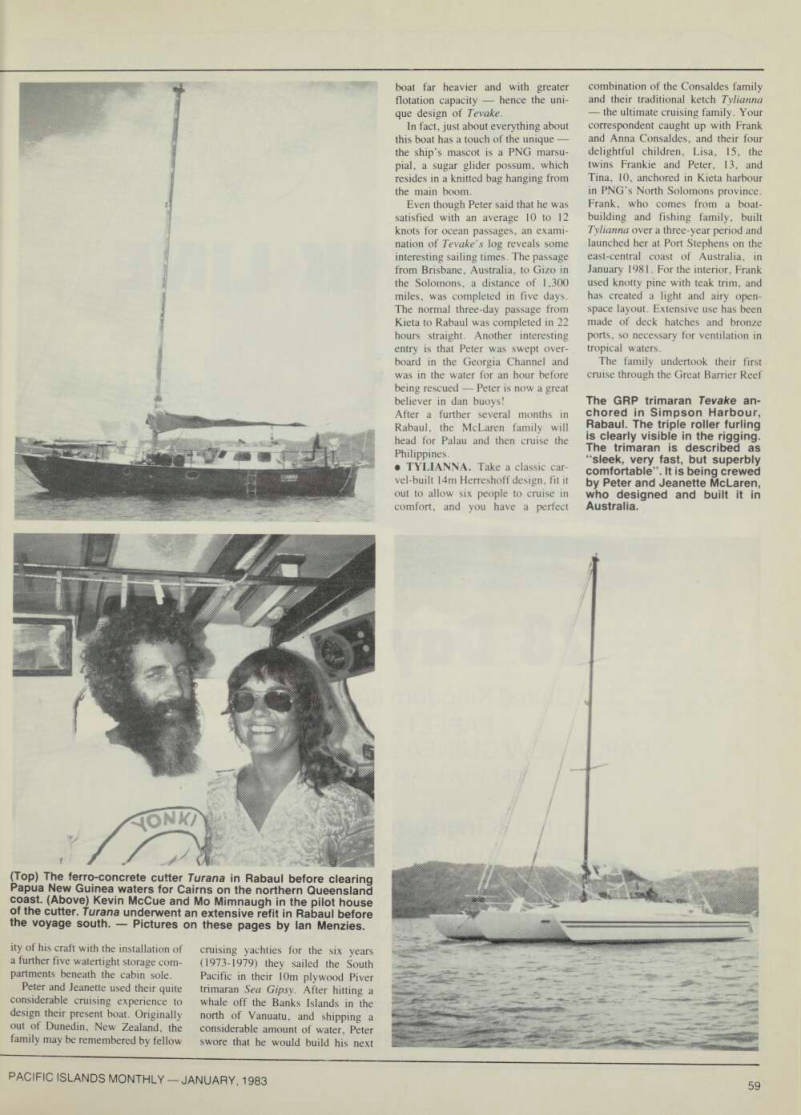
PESI FONUA reports
from Nukualofa,
Tonga:
• HIC. The red and white Tongan flag has been flying in new places around the South Pacific on the Mon tevideo 43 sloop Hie, sailed by solo German yachtsman Detlef Martens.
Hie was registered in Tonga in June 1981 after being launched the pre vious year in Capetown, South Afri ca. The sloop is one of only three ocean cruising yachts to sail under the Tongan flag.
After the launching in South Afri ca, Detlef had intended sailing home to Germany to have the yacht regis tered there. But he turned westward into the Pacific through the Panama Canal instead of continuing north, and when he reached Tonga in mid -1981 he decided to have the yacht
registered there.
According to Detlef the Tongan registration differs in that it is cheap er and is paid as a small annual fee, whereas in Germany the fee is paid in a lump sum. Under German law there is a restriction on the type of elec tronic equipment he may use on board, but in Tonga there is no restriction.
Detlef once owned an electronic devices manufacturing business in Hamburg. He sold out and bought Hie, which is equipped with very modem electronic equipment. While at sea he is working on some elec tronic devices that he designed, ex perimenting with solar and wind energy.
When he returned to Nukualofa in November he was on the last stage of writing a sailing guide book for the Tuamotus. The book required a lot of research and charting which was made possible with his electronic
equipment. “Carrying the Tongan
flag while doing my research was fun,” explained Detlef. “A lot of people were asking about the flag and its origin. I explain where Tonga is. I feel that I am representing Tonga in some of these places, and I hope to
be a good representative.”
Detlef has been sailing since he was a boy. His parents have a yacht and the name Hie is shared by the family boats the letters taken from the first names of his father, mother and sister. He had been involved in yacht racing before and plans to race again in the near future, so who knows where else Hie will take the
Tongan flag.
Lan G. Menzies Re
ports from various
Papua New Guinea
ports:
The more adventurous cruising yach ties find the New Guinea Islands a real challenge, and revel in the un matched coastline scenery, deep an
chorages and friendly people that this
part of Papua New Guinea has to offer. A series of business trips al lowed your correspondent to catch up with a few of these adventurous types in some of the more remote locations of this country. But first, let’s report on home base Port Moresby. • KAMAVICK 111. Hailing from France in their 13m ketch Kamavick 111 are Marcel and Nellie Lecossois.
A soft-chine steel boat Kamavick 111
(which is Eskimo for “meeting
place”), was designed and built by
Marcel and Nellie in Tahiti over a
three-year period.
After cruising through New
Caledonia and Vanuatu, they headed for Solomon Islands. Unfortunately their visit was marred by a traumatic experience due to their desire to cruise and explore the outer islands before reporting to the nearest port of entry. . . There is a lesson here for all
cruising yachties.
Marcel and Nellie plan to cruise south to Caims and Brisbane, and then return to Vanuatu where they hope to set up a diving school using Kamavick 111 and Port-Vila as a base for their operations. • POLETTE. After some three weeks moored off the Rabaul Yacht Club in East New Britain, Basil and Nancy Campion (with their Siamese cat “Bandit”), set sail for Honiara in Solomon Islands.
Their 13m cutter Palette is a round bilge steel-hulled “tall ship” with a superbly laid solid teak deck and superstructure. Nancy and Basil bought the hull in New Zealand and then had Allan Mummery design a layout, with roomy aft cabin, for two people to cruise in comfort. Launch ed in early 1980, after three and a half years of hard work by the Camp ions Palette is a credit to their labors and ingenuity. The interior especially is a joy to behold. The soft sheen of mahogany is complemented by the subtlety of superb velvet fabrics it is all very traditional and yet so obviously functional. Basil’s en gineering background is evident in the many technical features that he has incorporated in the final design
no wonder, this is the second boat that he has completed.
The Campions originally circum
navigated in their 15m ketch Polack and have now decided to re-discover the Pacific in their new boat. After six months in Indonesian waters, they entered PNG via Vanimo on the far north coast. They were not par ticularly enthusiastic about Vanimo as a port of entry enough said!
Both Nancy and Basil were en thusiastic about the six months they have spent in PNG waters, cruising along the north coast via Wewak, Madang and across the Dampier Strait to New Britain. In particular, they were taken with the friendliness of the people in the more remote coastal villages. By carrying basic trade goods, such as rice, salt and twist tobacco, they were able to supplement their provisions with lots of fresh fruit and vegetables.
A highlight of their passage along the northern coast of New Britain was their visit to Garove Island in the Vitu Group, where they were able to sail into the crater of an extinct volcano. Basil and Nancy plan to see out the cyclone season in the Sol omons and then head for points east. • TURANA. Heading out from Rabaul on their very first cruising passage are Mo Mimnaugh and Ke vin McCue, with their two children
Detlef Martens: Yachtsman from West Germany, yacht from South Africa, flag from Tonga.
Martens set off to have his Mon tevideo 43 sloop Hie registered in Germany, but turned west into the Pacific and took out
Tongan registration. Pesi
Fonua picture.
Nellie and Marcelle Lecossois of the ketch Kamavick III an chored off Port Moresby. They built the ketch themselves in Tahiti, and the name is an Es
kimo word meaning meeting
place. lan Menzies picture.
Matthew, nine, and Michael, seven.
Their 12 m ferro cutter Turana, originally built in Port Moresby in 1977, was purchased in Kimbe ear lier this year. After being motored up to Rabaul, through some really heavy seas, she now has a new mast and rigging. A basic refit is being done “on the water” with the assistance of some of the cruising yachties at pre sent in port, prior to their departure for Caims.
Two experienced cruising yachties
Danni Antrium and Mary-Ellen da Costa will be sailing with Turana on its shake-down cruise, assisted by John Millard of Rabaul.
Kevin and Mo both hail from Port Moresby, where Kevin was a seis mologist with the Geographical Ob servatory, while Mo managed the computer centre for the Bureau of Statistics. Kevin intends to rename the boat Tsuname which is Japan ese for "seismic sea wave”. Consid ering Kevin’s occupation and the fact that Rabaul was swamped by such a wave a few years ago, the name is very apt.
It is not often that families com mence their cruising life from a PNG port we wish them well. After slipping and a major refit in Caims, Kevin and Mo and their children will cruise the South Pacific.
• TEVAKE. "Tropic bird”, or “a famous Melanesian navigator” whichever translation you prefer to use for the Solomon Islands word Tevake this is a ship of a different breed. Literally poised for flight, Tevake is a GRP foam-sandwich, wide-bodied trimaran with a length of 13m and a beam of Bm. The stability of this craft is further en hanced when the centre board is dropped to increase the draft from a mere o.Bm to a staggering 2m.
Designed, built and crewed by Peter and Jeanette McLaren, and their two children Tracey, 14, and Michael, 10, Tevake was completed in only 18 months and launched in Brisbane, Australia in September, 1981. Peter says that Tevake is a modified Simpson design, with two outriggers acting as flotation/stabilis ers (they each have eight watertight bulkheads), whilst the 3m wide centre hull contains two double ca bins, head/shower, galley and a com fortable saloon that sleeps a further four people if necessary. Peter finish ed the interior with Australian red cedar using the West system, and complemented the virtual unsinkabil-
At Rabaul: Nancy and Basil Campion and the cutter Polette.
ity of his craft with the installation of a further five watertight storage compartments beneath the cabin sole.
Peter and Jeanette used their quite considerable cruising experience to design their present boat. Originally out of Dunedin, New Zealand, the family may be remembered by fellow
cruising yachties for the six years (1973-1979) they sailed the South Pacific in their 10m plywood Piver trimaran Sea Gipsy. After hitting a whale off the Banks Islands in the north of Vanuatu, and shipping a considerable amount of water, Peter swore that he would build his next
boat far heavier and with greater flotation capacity hence the uni que design of Tevake.
In fact, just about everything about this boat has a touch of the unique the ship’s mascot is a PNG marsu pial, a sugar glider possum, which resides in a knitted bag hanging from the main boom.
Even though Peter said that he was satisfied with an average 10 to 12 knots for ocean passages, an exami nation of Tevake’s log reveals some interesting sailing times. The passage from Brisbane, Australia, to Gizo in the Solomons, a distance of 1,300 miles, was completed in five days.
The normal three-day passage from Kieta to Rabaul was completed in 22 hours straight. Another interesting entry is that Peter was swept over board in the Georgia Channel and was in the water for an hour before being rescued Peter is now a great believer in dan buoys!
After a further several months in Rabaul, the McLaren family will head for Palau and then cruise the
Philippines.
• TYLIANNA. Take a classic car vel-built 14m Herreshoff design, fit it out to allow six people to cruise in comfort, and you have a perfect
combination of the Consaldes family and their traditional ketch Tylianna the ultimate cruising family. Your correspondent caught up with Frank and Anna Consaldes, and their four delightful children, Lisa, 15, the twins Frankie and Peter, 13, and Tina, 10, anchored in Kieta harbour in PNG’s North Solomons province.
Frank, who comes from a boat building and fishing family, built Tylianna over a three-year period and launched her at Port Stephens on the east-central coast of Australia, in January 1981. For the interior, Frank used knotty pine with teak trim, and has created a light and airy open space layout. Extensive use has been made of deck hatches and bronze ports, so necessary for ventilation in tropical waters.
The family undertook their first cruise through the Great Barrier Reef
(Top) The ferro-concrete cutter Turana In Rabaul before clearing Papua New Guinea waters for Cairns on the northern Queensland coast. (Above) Kevin McCue and Mo Mimnaugh in the pilot house of the cutter. Turana underwent an extensive refit in Rabaul before the voyage south. - Pictures on these pages by lan Menzies.
The GRP trimaran Tevake an chored in Simpson Harbour, Rabaul. The triple roller furling is clearly visible in the rigging.
The trimaran is described as “sleek, very fast, but superbly comfortable”. It is being crewed by Peter and Jeanette McLaren, who designed and built it in Australia.
for 12 months. They wanted to get to know their boat and themselves as a family before they ventured further afield. It obviously worked.
Six months ago they entered PNG waters via Samarai and then worked their way along the coastline through Lae to Madang. There they acquired their ship’s cat Kar Kar, named after an island off the coast in the area.
From Madang they sailed inside the main reef right up the north coast of New Britain to Rabaul. In their own words, it was an unforgettable ex perience, even though Frank spent long hours at the masthead guiding the yacht through the many inner reefs. Many of the villagers had never before seen a yacht, leave aside four fair-headed children and the sounds of disco music.
At Umboi Island they were feted at a “singsing” (a traditional feast and dance). While off Cape Gloucester they witnessed the eruption of the volcano, Mt Talawe. With stick to bacco, soap and rice they traded for fresh fruit and vegetables along the way. (A tip fish hooks, and basic tackle and line, are also very much in demand by the coastal villagers.) The family were enthusiastic about cruising in PNG waters and said they
found plenty of deep, protected an
chorages, fairly predictable weather,
made good passages and met friend ly, helpful people along the route.
From Kieta they were to head south to Honiara in Solomon Islands. • GLORIA MARIS. Probably one of the best-known “yachts” and cruising couples in the Pacific, are Joyce and Delmer Stone and their 15m Chinese junk Gloria Maris.
Spent a pleasant hour with this fas cinating couple after they had been dredging for miniature (and micros copic) shells a hobby about which
they are very enthusiastic and re nowned for their expertise and dis coveries of new species.
Joyce is also known to many cruis ing amateur radio operators for the mobile marine network that she ran in Solomon Islands for a period of four years under the call sign Hotel 44 Kilowatt Radio.
From Kieta, Joyce and Delmer were to head south through the Louisiades to Cairns in northern Australia, where they hope to investi gate the possibility of constructing a new cruising catamaran.
Don Travers Re
ports from Tubuai ,
Austral Islands,
French Polynesia:
• KARACHI. A 9 m Yorktown fib reglass centre cockpit sloop, with owners Gene and Shirlee Bishopp and crew Shannon Speier (all USA) on board, called recently at Tubuai.
Gene is a retired mining engineer cruising the Pacific with his wife and occasional crew. Shannon joined up in Tahiti.
Karachi wintered in Hawaiian wa ters after leaving her homeport of San Diego in October 1981. She arrived in Papeete in July ’B2. They cruised the Society Islands before
Cruising in Papua New Guinea waters: (Top) Gloria Maris, famous for its hull pat tern; (below left) Jeanette and Peter McLaren in the trimaran Tevake ; (below) Tylianna at Kieta, Bouganville Island. lan Menzies pictures.
coming to Tubuai. From here they left for Raivavae and returned to Tahiti with plans to cruise the Tuamotus. They have no definite plans after that.
Karachi’s ham call sign is
Ka6Roe.
• GUSTY 11. A French yacht with Captain Roger Dorin of Paris and crew on board arrived in October.
Gusty II was cruising the Austral Islands of Raivavae, Tubuai and Rurutu before returning to Tahiti.
Gusty II was sailed from France.
I have no further information on the yacht, its itinerary or its crew members. They left before I had a chance to meet them.
Peter Mcquarrie
reports from Funafuti,
Tuvalu:
• ERENA RAOI. A 13 m catama ran designed, built and sailed by John Thurston arrived at Funafuti from
Pago Pago, American Samoa.
Erena Raoi was en route for Tarawa, Kiribati, where the yacht was built.
After a short stay in Kiribati, where the yacht was built. After a short stay in Kiribati, she is expected to sail for Papua New Guinea to take up charter work there. • DINK’S SONG. A 13 m Jim Brown-designed Sea Runner trima ran, Dink’s Song was built by Jeff Allen and sailed by Jeff and crew Lilian Ramljak. After a stay of one year in Vanuatu, Dink’s Song was headed for Tahiti via Fiji, Tuvalu, the Samoas and the Cooks. • RIBONO. An 8 m catamaran de
signed for lagoon sailing and short
inter-island crossings between atolls in Kiribati, Ribono stopped for two days at Funafuti for rudder repairs while on her delivery voyage from Lautoka, Fiji, to Tarawa.
Meet the Consaldes family from Australia - ail six of them photographed here in their Her reshoff ketch Tylianna off Kieta in Bougainville, PNG. With Frank and Anna Consaldes are twins Frankie and Peter, Tina and Lisa.
Advertisements & other items, pp. 58-62 (2 items)
Yachts
Facilities. Cairns
MARINE TRAUELIFT AND HARD STANDING
A Sale. Easy Way to Slip Your Boat Service Available 7 flays
per week
ii-' % Asm i’
Cairns Cruising Yacht Squadron now has a Marine Travelift with 27.25 tonne capacity which will haul boats to 57ft long with beams 17ft wide. The machine's open end design provides unrestricted access for fast, efficient handling of sailboats and flying bridge type vessels The Squadron is also able to offer excel’ent hard standing areas for rent on a long or short-term basis with electricity and water supplied to each site. Other amenities include toilets, showers, public telephone, etc.
The site is located at Portsmith. Cairns, which has a frontage to Smiths Creek (an extension of the Port of Cairns). Smiths Creek is a deepwater creek usable for haulout purposes at the lowest of tides. It is completely free from wave action and largely sheltered from strong winds by surrounding terrain The site is also adjacent to an industrial area where allied businesses operate, including shipwrights, engineering works, fibreglass works, the Cairns Fish Board, etc.
Office Hours: 10 a.m. lo 2 p.m. Monday to Friday
Telephone: (070) 51 4881
Postal Address: P.O. Box 1150 Cairns. Old. 4870
GLOBAL SERVICE FOR SHIPPERS
THE BANK LINE
28 Day Service
-JfcfiS United Kingdom and Continent to:
PAPEETE • NOUMEA
PAPUA NEW GUINEA and SOLOMON ISLANDS
PORT VILA & SANTO BY TRANSHIPMENT
* United Kingdom and Continent to; SUVA AND LAUTOKA (FCL LCL & UNITISED ONLY) * Papua New Guinea and Solomon Islands to:
UNITED KINGDOM and CONTINENT
For particulars apply:
THE BANK LINE (AUSTRALASIA) PTY. LTD.
Suite 801, 51 Pitt Street Sydney 2000. Australia. Tel: 272041. Tlx: 24063.
YOUR BUSINESS PARTNER
Japan S. Korea Taiwan Singapore Hong Kong To: Solomon Is., New Caledonia, Fiji, W. Samoa, A. Samoa, Tahiti, Cook Is., Tonga, Vanuatu, Tuvalu. Nauru To; Guam, Saipan, Truk, Ponape, Majuro, Yap, Koror
Taiwan Hong Kong Singapore Philippines
To: Papua New Guinea, Pacific Islands. * I •* IP*
K YOWA
KYOWA SHIPPING CO., LTD.
HEAD OFFICE: OSAKA OFFICE:
sth FI, Suzumaru Bldg 39-8, 2-chome, Nishi-Shinbashi. Mmato-ku, Tokyo, Japan Okajima Bldg. 7ih Floor. 2-14, Nishihonmachi 1-chome, Nishi-ku. Osaka, Japan Phone: 03 43 7 1 2885 -Rep Cables: "MARIQUEEN" Tokyo Telex : 242-4651 Kyowa J Phone: 06 533 5821 'Rep Cables: "MARIQUEEN" Osaka Telex : 525-6271 Ssiosa J
Shipping Schedules
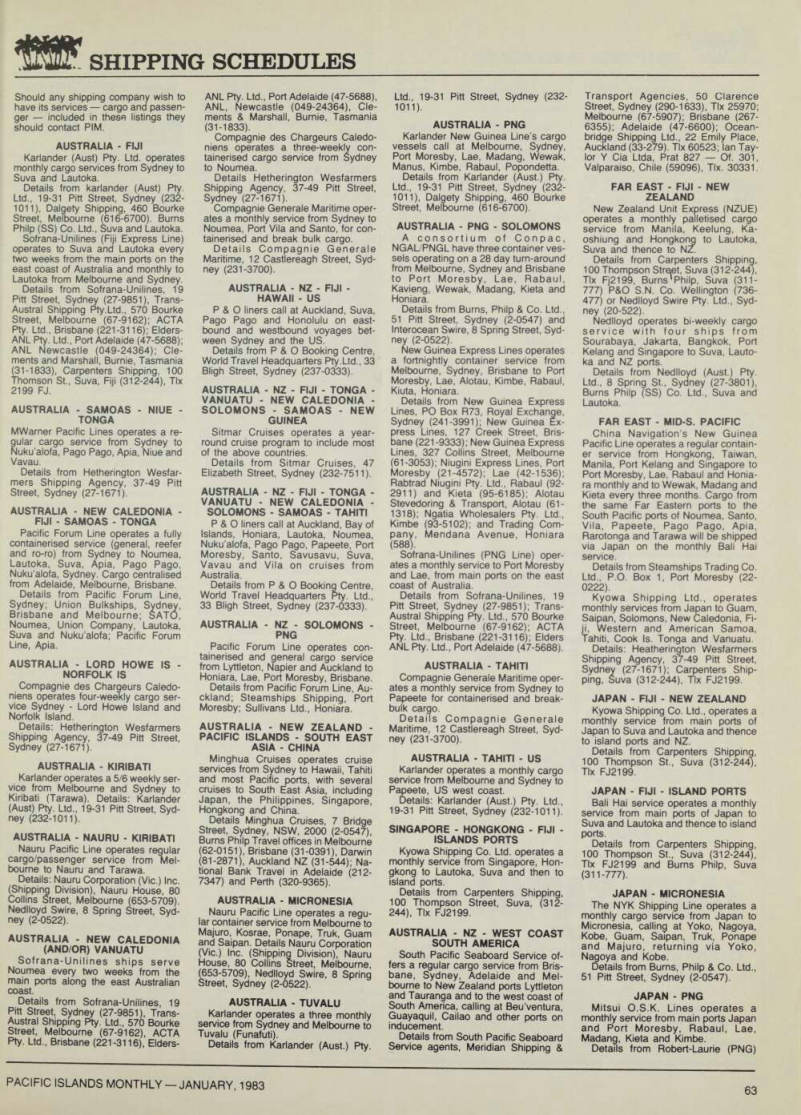
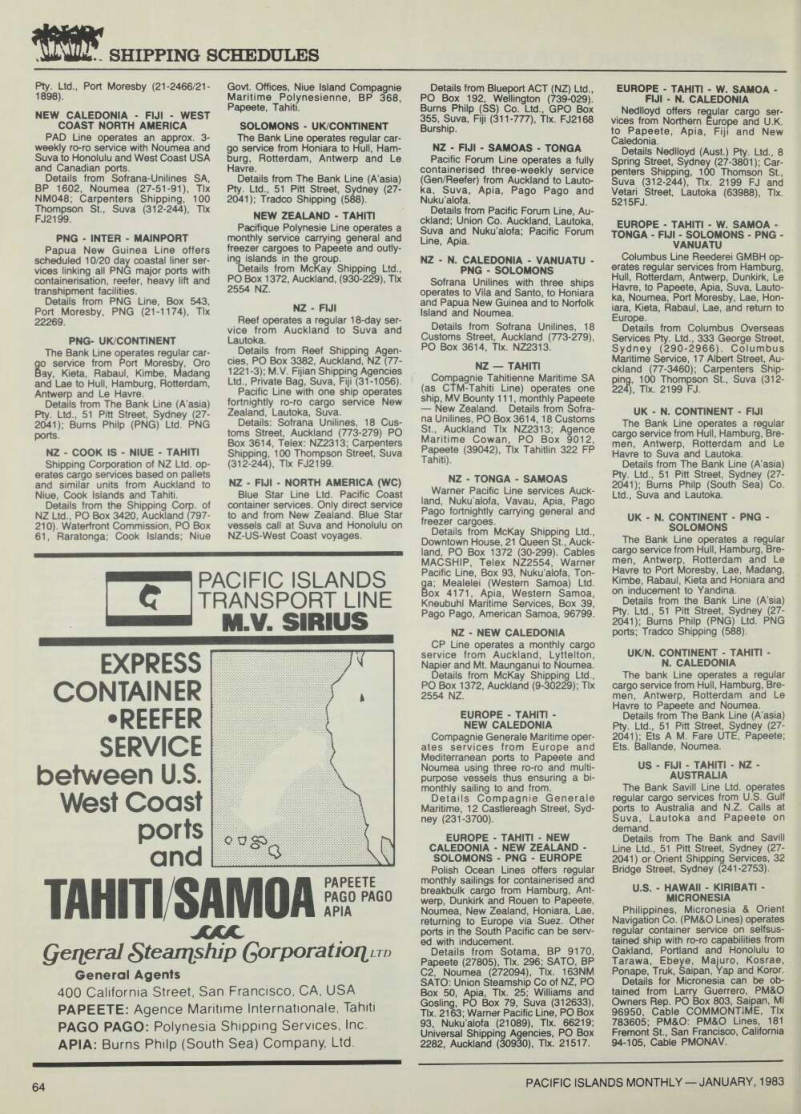
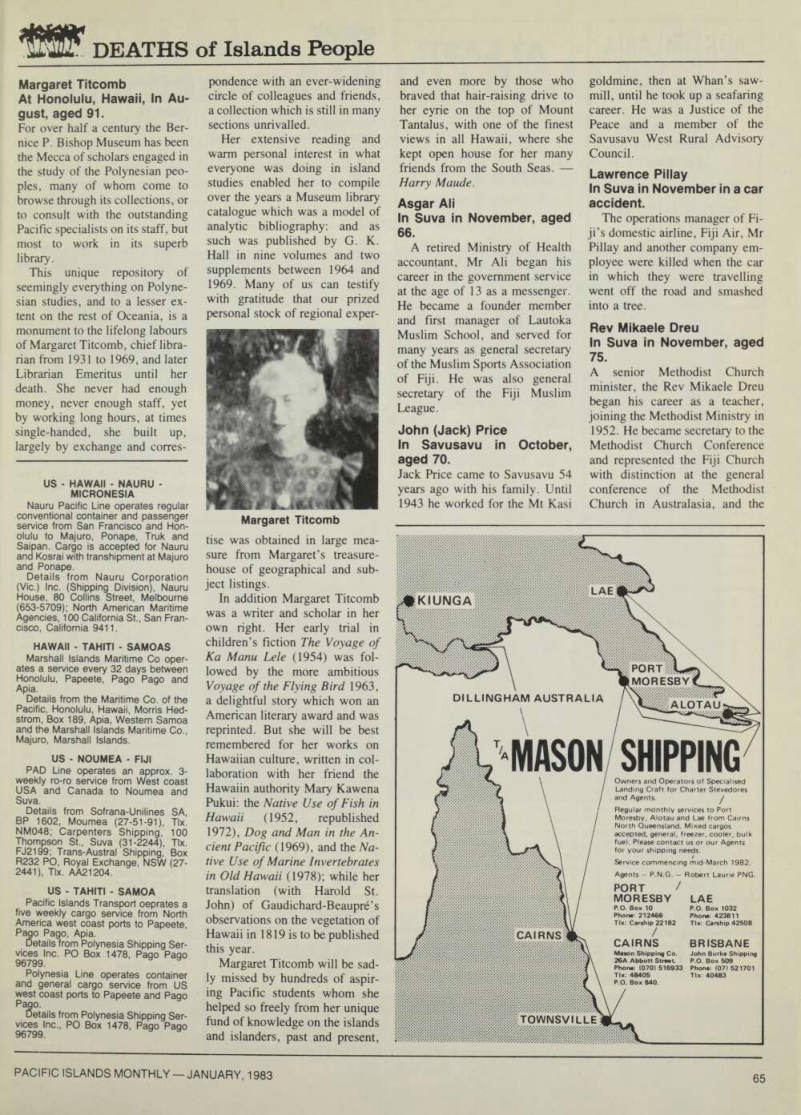
Should any shipping company wish to have its services cargo and passen ger included in these listings they should contact PIM.
Australia - Fiji
Karlander (Aust) Pty. Ltd. operates monthly cargo services from Sydney to Suva and Lautoka.
Details from karlander (Aust) Pty.
Ltd., 19-31 Pitt Street, Sydney (232- 1011), Dalgety Shipping, 460 Bourke Street, Melbourne (616-6700). Burns Philp (SS) Co. Ltd., Suva and Lautoka.
Sofrana-Unilines (Fiji Express Line) operates to Suva and Lautoka every two weeks from the main ports on the east coast of Australia and monthly to Lautoka from Melbourne and Sydney.
Details from Sofrana-Unilines, 19 Pitt Street, Sydney (27-9851), Trans- Austral Shipping Pty.Ltd., 570 Bourke Street, Melbourne (67-9162); ACTA Pty. Ltd., Brisbane (221-3116); Elders- ANL Pty. Ltd., Port Adelaide (47-5688); ANL Newcastle (049-24364); Cle ments and Marshall, Burnie, Tasmania (31-1833), Carpenters Shipping, 100 Thomson St., Suva, Fiji (312-244), Tlx 2199 FJ.
Australia - Samoas - Niue -
Tonga
MWarner Pacific Lines operates a re gular cargo service from Sydney to Nukualofa, Pago Pago, Apia, Niue and Vavau.
Details from Hetherington Wesfar mers Shipping Agency, 37-49 Pitt Street, Sydney (27-1671).
Australia - New Caledonia -
Fiji - Samoas - Tonga
Pacific Forum Line operates a fully containerised service (general, reefer and ro-ro) from Sydney to Noumea, Lautoka, Suva, Apia, Pago Pago, Nukualofa, Sydney. Cargo centralised from Adelaide, Melbourne, Brisbane.
Details from Pacific Forum Line, Sydney: Union Bulkships, Sydney, Brisbane and Melbourne: SATO, Noumea, Union Company, Lautoka, Suva and Nukualofa; Pacific Forum Line, Apia.
Australia - Lord Howe Is -
Norfolk Is
Compagnie des Chargeurs Caledo niens operates four-weekly cargo ser vice Sydney - Lord Howe Island and Norfolk Island.
Details: Hetherington Wesfarmers Shipping Agency, 37-49 Pitt Street,
Sydney (27-1671).
Australia - Kiribati
Karlander operates a 5/6 weekly ser vice from Melbourne and Sydney to Kiribati (Tarawa). Details: Karlander (Aust) Pty. Ltd., 19-31 Pitt Street, Syd ney (232-1011).
Australia - Nauru - Kiribati
Nauru Pacific Line operates regular cargo/passenger service from Mel bourne to Nauru and Tarawa.
Details: Nauru Corporation (Vic.) Inc. (Shipping Division), Nauru House, 80 Collins Street, Melbourne (653-5709).
Nedlloyd Swire, 8 Spring Street, Syd ney (2-0522).
Australia - New Caledonia
(And/Or) Vanuatu
Sofrana-Unilines ships serve Noumea every two weeks from the main ports along the east Australian coast.
Details from Sofrana-Unilines, 19 Pitt Street, Sydney (27-9851), Trans- Austral Shipping Pty. Ltd., 570 Bourke Street, Melbourne (67-9162), ACTA Pty. Ltd., Brisbane (221-3116), Elders-
ANL Pty. Ltd., Port Adelaide (47-5688), ANL, Newcastle (049-24364), Cle ments & Marshall, Burnie, Tasmania (31-1833).
Compagnie des Chargeurs Caledo nians operates a three-weekly con tainerised cargo service from Sydney to Noumea.
Details Hetherington Wesfarmers Shipping Agency, 37-49 Pitt Street, Sydney (27-1671).
Compagnie Generale Maritime oper ates a monthly service from Sydney to Noumea, Port Vila and Santo, for con tainerised and break bulk cargo.
Details Compagnie Generale Maritime, 12 Castlereagh Street, Syd ney (231-3700).
Australia - Nz - Fiji -
Hawaii - Us
P&O liners call at Auckland, Suva, Pago Pago and Honolulu on east bound and westbound voyages bet ween Sydney and the US.
Details from P&O Booking Centre, World Travel Headquarters Pty.Ltd., 33 Bligh Street, Sydney (237-0333).
AUSTRALIA - NZ - FIJI - TONGA -
Vanuatu - New Caledonia -
Solomons - Samoas - New
Guinea
Sitmar Cruises operates a year round cruise program to include most of the above countries.
Details from Sitmar Cruises, 47 Elizabeth Street, Sydney (232-7511).
AUSTRALIA - NZ - FIJI - TONGA -
Vanuatu - New Caledonia -
Solomons - Samoas - Tahiti
P&O liners call at Auckland, Bay of Islands, Honiara, Lautoka, Noumea, Nukualofa, Pago Pago, Papeete, Port Moresby, Santo, Savusavu, Suva, Vavau and Vila on cruises from Australia.
Details from P&O Booking Centre, World Travel Headquarters Pty. Ltd., 33 Bligh Street, Sydney (237-0333).
Australia - Nz - Solomons -
Png
Pacific Forum Line operates con tainerised and general cargo service from Lyttleton, Napier and Auckland to Honiara, Lae, Port Moresby, Brisbane.
Details from Pacific Forum Line, Au
ckland; Steamships Shipping, Port
Moresby; Sullivans Ltd., Honiara.
Australia - New Zealand -
Pacific Islands - South East
Asia - China
Minghua Cruises operates cruise services from Sydney to Hawaii, Tahiti and most Pacific ports, with several cruises to South East Asia, including Japan, the Philippines, Singapore, Hongkong and China.
Details Minghua Cruises, 7 Bridge Street, Sydney, NSW, 2000 (2-0547), Burns Philp Travel offices in Melbourne (62-0151), Brisbane (31-0391), Darwin (81-2871), Auckland NZ (31-544); Na tional Bank Travel in Adelaide (212- 7347) and Perth (320-9365).
Australia - Micronesia
Nauru Pacific Line operates a regu lar container service from Melbourne to Majuro, Kosrae, Ponape, Truk, Guam and Saipan. Details Nauru Corporation
(Vic.) Inc. (Shipping Division), Nauru
House, 80 Collins Street, Melbourne, (653-5709), Nedlloyd Swire, 8 Spring
Street, Sydney (2-0522).
Australia - Tuvalu
Karlander operates a three monthly service from Sydney and Melbourne to
Tuvalu (Funafuti).
Details from Karlander (Aust.) Pty.
Ltd., 19-31 Pitt Street, Sydney (232- 1011).
Australia - Png
Karlander New Guinea Line’s cargo vessels call at Melbourne, Sydney, Port Moresby, Lae, Madang, Wewak, Manus, Kimbe, Rabaul, Popondetta.
Details from Karlander (Aust.) Pty.
Ltd., 19-31 Pitt Street, Sydney (232- 1011), Dalgety Shipping, 460 Bourke Street, Melbourne (616-6700).
Australia - Png - Solomons
A consortium of Conpac, NGAL/PNGL have three container ves sels operating on a 28 day turn-around from Melbourne, Sydney and Brisbane to Port Moresby, Lae, Rabaul, Kavieng, Wewak, Madang, Kieta and Honiara.
Details from Burns, Philp & Co. Ltd., 51 Pitt Street, Sydney (2-0547) and Interocean Swire, 8 Spring Street, Syd ney (2-0522).
New Guinea Express Lines operates a fortnightly container service from Melbourne, Sydney, Brisbane to Port Moresby, Lae, Alotau, Kimbe, Rabaul, Kiuta, Honiara.
Details from New Guinea Express Lines, PO Box R 73, Royal Exchange, Sydney (241-3991); New Guinea Ex press Lines, 127 Creek Street, Bris bane (221-9333); New Guinea Express Lines, 327 Collins Street, Melbourne (61-3053); Niugini Express Lines, Port Moresby (21-4572); Lae (42-1536); Rabtrad Niugini Pty. Ltd., Rabaul (92- 2911) and Kieta (95-6185); Alotau Stevedoring & Transport, Alotau (61- 1318); Ngatia Wholesalers Pty. Ltd., Kimbe (93-5102); and Trading Com pany, Mendana Avenue, Honiara (588).
Sofrana-Unilines (PNG Line) oper ates a monthly service to Port Moresby and Lae, from main ports on the east coast of Australia.
Details from Sofrana-Unilines, 19 Pitt Street, Sydney (27-9851); Trans- Austral Shipping Pty. Ltd., 570 Bourke Street, Melbourne (67-9162); ACTA Pty. Ltd., Brisbane (221-3116); Elders ANL Pty. Ltd., Port Adelaide (47-5688).
Australia - Tahiti
Compagnie Generale Maritime oper ates a monthly service from Sydney to Papeete for containerised and break bulk cargo.
Details Compagnie Generale Maritime, 12 Castlereagh Street, Syd ney (231-3700).
Australia - Tahiti - Us
Karlander operates a monthly cargo service from Melbourne and Sydney to Papeete, US west coast.
Details: Karlander (Aust.) Pty. Ltd., 19-31 Pitt Street, Sydney (232-1011).
Singapore - Hongkong - Fiji -
Islands Ports
Kyowa Shipping Co. Ltd. operates a monthly service from Singapore, Hon gkong to Lautoka, Suva and then to island ports.
Details from Carpenters Shipping, 100 Thompson Street, Suva, (312- 244), Tlx FJ2199.
Australia - Nz - West Coast
South America
South Pacific Seaboard Service of fers a regular cargo service from Bris bane, Sydney, Adelaide and Mel bourne to New Zealand ports Lyttleton and Tauranga and to the west coast of South America, calling at Beu’ventura, Guayaquil, Cailao and other ports on inducement.
Details from South Pacific Seaboard Service agents, Meridian Shipping &
Transport Agencies, 50 Clarence Street, Sydney (290-1633), Tlx 25970; Melbourne (67-5907); Brisbane (267- 6355); Adelaide (47-6600); Ocean bridge Shipping Ltd., 22 Emily Place, Auckland (33-279). Tlx 60523; lan Tay lor Y Cia Ltda, Prat 827 Of. 301, Valparaiso, Chile (59096), Tlx. 30331.
Far East - Fiji - New
Zealand
New Zealand Unit Express (NZUE) operates a monthly palletised cargo service from Manila, Keelung, Ka oshiung and Hongkong to Lautoka, Suva and thence to N 2.
Details from Carpenters Shipping, 100 Thompson Street, Suva (312-244), Tlx Fj2199, Burns * Philp, Suva (311- 777) P&O S.N. Co. Wellington (736- 477) or Nedlloyd Swire Pty. Ltd., Syd ney (20-522).
Nedlloyd operates bi-weekly cargo service with four ships from Sourabaya, Jakarta, Bangkok, Port Kelang and Singapore to Suva, Lauto ka and NZ ports.
Details from Nedlloyd (Aust.) Pty.
Ltd., 8 Spring St., Sydney (27-3801), Burns Philp (SS) Co. Ltd., Suva and Lautoka.
Far East - Mid-S. Pacific
China Navigation’s New Guinea Pacific Line operates a regular contain er service from Hongkong, Taiwan, Manila, Port Kelang and Singapore to Port Moresby, Lae, Rabaul and Honia ra monthly and to Wewak, Madang and Kieta every three months. Cargo from the same Far Eastern ports to the South Pacific ports of Noumea, Santo, Vila, Papeete, Pago Pago, Apia, Rarotonga and Tarawa will be shipped via Japan on the monthly Bali Hai service.
Details from Steamships Trading Co.
Ltd., P.O. Box 1, Port Moresby (22- 0222).
Kyowa Shipping Ltd., operates monthly services from Japan to Guam, Saipan, Solomons, New Caledonia, Fi ji, Western and American Samoa, Tahiti, Cook Is. Tonga and Vanuatu.
Details: Heatherington Wesfarmers Shipping Agency, 37-49 Pitt Street, Sydney (27-1671); Carpenters Ship ping, Suva (312-244), Tlx FJ2199.
Japan - Fiji - New Zealand
Kyowa Shipping Co. Ltd., operates a monthly service from main ports of Japan to Suva and Lautoka and thence to island ports and NZ.
Details from Carpenters Shipping, 100 Thompson St., Suva (312-244), Tlx FJ2199.
Japan - Fiji - Island Ports
Bali Hai service operates a monthly service from main ports of Japan to Suva and Lautoka and thence to island ports.
Details from Carpenters Shipping, 100 Thompson St., Suva (312-244), Tlx FJ2199 and Burns Philp, Suva (311-777).
Japan - Micronesia
The NYK Shipping Line operates a monthly cargo service from Japan to Micronesia, calling at Yoko, Nagoya, Kobe, Guam, Saipan, Truk, Ponape and Majuro, returning via Yoko, Nagoya and Kobe.
Details from Burns, Philp & Co. Ltd., 51 Pitt Street, Sydney (2-0547).
Japan - Png
Mitsui O.S.K. Lines operates a monthly service from main ports Japan and Port Moresby, Rabaul, Lae, Madang, Kieta and Kimbe.
Details from Robert-Laurie (PNG)
Pty. Ltd., Port Moresby (21-2466/21- 1898).
New Caledonia - Fiji - West
Coast North America
PAD Line operates an approx. 3weekly ro-ro service with Noumea and Suva to Honolulu and West Coast USA and Canadian ports.
Details from Sofrana-Unilines SA, BP 1602, Noumea (27-51-91), Tlx NMO4B; Carpenters Shipping, 100 Thompson St., Suva (312-244), Tlx FJ2199.
Png - Inter - Mainport
Papua New Guinea Line offers scheduled 10/20 day coastal liner ser vices linking all PNG major ports with containerisation, reefer, heavy lift and transhipment facilities.
Details from PNG Line, Box 543, Port Moresby, PNG (21-1174), Tlx 22269.
Png- Uk/Continent
The Bank Line operates regular car go service from Port Moresby, Oro Bay, Kieta, Rabaul, Kimbe, Madang and Lae to Hull, Hamburg, Rotterdam, Antwerp and Le Havre.
Details from The Bank Line (A’asia) Pty. Ltd., 51 Pitt Street, Sydney (27- 2041); Burns Philp (PNG) Ltd. PNG ports.
NZ - COOK IS - NIUE - TAHITI Shipping Corporation of NZ Ltd. op erates cargo services based on pallets and similar units from Auckland to Niue, Cook Islands and Tahiti.
Details from the Shipping Corp. of NZ Ltd., PO Box 3420, Auckland (797- 210). Waterfront Commission, PO Box 61, Raratonga; Cook Islands; Niue
Govt. Offices, Niue Island Compagnie Maritime Polynesienne, BP 368, Papeete, Tahiti.
Solomons - Uk/Continent
The Bank Line operates regular car go service from Honiara to Hull, Ham burg, Rotterdam, Antwerp and Le Havre.
Details from The Bank Line (A’asia) Pty. Ltd., 51 Pitt Street, Sydney (27- 2041); Tradco Shipping (588).
New Zealand - Tahiti
Pacifique Polynesie Line operates a monthly service carrying general and freezer cargoes to Papeete and outly ing islands in the group.
Details from McKay Shipping Ltd., PO Box 1372, Auckland, (930-229), Tlx 2554 NZ.
Nz - Fiji
Reef operates a regular 18-day ser vice from Auckland to Suva and Lautoka.
Details from Reef Shipping Agen cies, PO Box 3382, Auckland, NZ (77- 1221-3); M.V. Fijian Shipping Agencies Ltd., Private Bag, Suva, Fiji (31-1056).
Pacific Line with one ship operates fortnightly ro-ro cargo service New Zealand, Lautoka, Suva.
Details: Sofrana Unilines, 18 Cus toms Street, Auckland (773-279) PO Box 3614, Telex: NZ2313; Carpenters Shipping, 100 Thompson Street, Suva (312-244), Tlx FJ2199.
NZ - FIJI - NORTH AMERICA (WC) Blue Star Line Ltd. Pacific Coast container services. Only direct service to and from New Zealand. Blue Star vessels call at Suva and Honolulu on NZ-US-West Coast voyages.
Details from Blueport ACT (NZ) Ltd., PO Box 192, Wellington (739-029).
Burns Philp (SS) Co. Ltd., GPO Box 355, Suva, Fiji (311-777), Tlx. FJ2168 Burship.
NZ - FIJI - SAMOAS - TONGA Pacific Forum Line operates a fully containerised three-weekly service (Gen/Reefer) from Auckland to Lauto ka, Suva, Apia, Pago Pago and Nukualofa.
Details from Pacific Forum Line, Au ckland: Union Co. Auckland, Lautoka, Suva and Nukualofa; Pacific Forum Line, Apia.
NZ - N. CALEDONIA - VANUATU -
Png - Solomons
Sofrana Unilines with three ships operates to Vila and Santo, to Honiara and Papua New Guinea and to Norfolk Island and Noumea.
Details from Sofrana Unilines, 18 Customs Street, Auckland (773-279), PO Box 3614, Tlx. NZ2313.
Nz Tahiti
Compagnie Tahitienne Maritime SA (as CiM-Tahiti Line) operates one ship, MV Bounty 111, monthly Papeete New Zealand. Details from Sofra na Unilines, PO Box 3614,18 Customs St., Auckland Tlx NZ2313; Agence Maritime Cowan, PO Box 9012, Papeete (39042), Tlx Tahitlin 322 FP Tahiti).
Nz - Tonga - Samoas
Warner Pacific Line services Auck land, Nukualofa, Vavau, Apia, Pago Pago fortnightly carrying general and freezer cargoes.
Details from McKay Shipping Ltd., Downtown House, 21 Queen St., Auck land, PO Box 1372 (30-299). Cables MACSHIP, Telex NZ2554, Warner Pacific Line, Box 93, Nukualofa, Ton ga; Mealelei (Western Samoa) Ltd. ox 4171, Apia, Western Samoa, Kneubuhl Maritime Services, Box 39, Pago Pago, American Samoa, 96799.
Nz - New Caledonia
CP Line operates a monthly cargo service from Auckland, Lyttelton, Napier and Mt. Maunganui to Noumea.
Details from McKay Shipping Ltd., PO Box 1372, Auckland (9-30229); Tlx 2554 NZ.
Europe - Tahiti -
New Caledonia
Compagnie Generale Maritime oper ates services from Europe and Mediterranean ports to Papeete and Noumea using three ro-ro and multi purpose vessels thus ensuring a bi monthly sailing to and from.
Details Compagnie Generale Maritime, 12 Castlereagh Street, Syd ney (231-3700).
Europe - Tahiti - New
Caledonia - New Zealand -
Solomons - Png - Europe
Polish Ocean Lines offers regular monthly sailings for containerised and breakbulk cargo from Hamburg, Ant werp, Dunkirk and Rouen to Papeete, Noumea, New Zealand, Honiara, Lae, returning to Europe via Suez. Other ports in the South Pacific can be serv ed with inducement.
Details from Sotama, BP 9170, Papeete (27805), Tlx. 296; SATO, BP C 2, Noumea (272094), Tlx. 163 NM SATO: Union Steamship Co of NZ, PO Box 50, Apia, Tlx. 25; Williams and Gosling, PO Box 79, Suva (312633), Tlx. 2163; Warner Pacific Line, PO Box 93, Nukualofa (21089), Tlx. 66219; Universal Shipping Agencies, PO Box 2282, Auckland (30930), Tlx. 21517.
EUROPE - TAHITI - W. SAMOA -
Fiji - N. Caledonia
Nedlloyd offers regular cargo ser vices from Northern Europe and U.K. to Papeete, Apia, Fiji and New Caledonia.
Details Nedlloyd (Aust.) Pty. Ltd., 8 Spring Street, Sydney (27-3801); Car penters Shipping, 100 Thomson St., Suva (312-244), Tlx. 2199 FJ and Vetari Street, Lautoka (63988), Tlx. 5215FJ.
EUROPE - TAHITI - W. SAMOA - TONGA - FIJI - SOLOMONS - PNG -
Vanuatu
Columbus Line Reederei GMBH op erates regular services from Hamburg, Hull, Rotterdam, Antwerp, Dunkirk, Le Havre, to Papeete, Apia, Suva, Lauto ka, Noumea, Port Moresby, Lae, Hon iara, Kieta, Rabaul, Lae, and return to Europe.
Details from Columbus Overseas Services Pty. Ltd., 333 George Street, Sydney (290-2966). Columbus Maritime Service, 17 Albert Street, Au ckland (77-3460); Carpenters Ship ping, 100 Thompson St., Suva (312- 224), Tlx. 2199 FJ.
Uk - N. Continent • Fiji
The Bank Line operates a regular cargo service from Hull, Hamburg, Bre men, Antwerp, Rotterdam and Le Havre to Suva and Lautoka.
Details from The Bank Line (A’asia) Pty. Ltd., 51 Pitt Street, Sydney (27- 2041); Burns Philp (South Sea) Co.
Ltd., Suva and Lautoka.
UK - N. CONTINENT - PNG -
Solomons
The Bank Line operates a regular cargo service from Hull, Hamburg, Bre men, Antwerp, Rotterdam and Le Havre to Port Moresby, Lae, Madang, Kimbe, Rabaul, Kieta and Honiara and on inducement to Yandina.
Details from the Bank Line (A’sia) Pty. Ltd., 51 Pitt Street, Sydney (27- 2041); Burns Philp (PNG) Ltd. PNG ports; Tradco Shipping (588).
Uk/N. Continent - Tahiti -
N. Caledonia
The bank Line operates a regular cargo service from Hull, Hamburg, Bre men, Antwerp, Rotterdam and Le Havre to Papeete and Noumea.
Details from The Bank Line (A’asia) Pty. Ltd., 51 Pitt Street, Sydney (27- 2041); Ets A M. Fare UTE, Papeete; Ets. Ballande, Noumea.
US - FIJI - TAHITI - NZ -
Australia
The Bank Savill Line Ltd. operates regular cargo services from U.S. Gulf ports to Australia and N.Z. Calls at Suva, Lautoka and Papeete on demand.
Details from The Bank and Savill Line Ltd., 51 Pitt Street, Sydney (27- 2041) or Orient Shipping Services, 32 Bridge Street, Sydney (241-2753).
U.S. - Hawaii - Kiribati -
Micronesia
Philippines, Micronesia & Orient Navigation Co. (PM&O Lines) operates regular container service on selfsus tained ship with ro-ro capabilities from Oakland, Portland and Honolulu to Tarawa, Ebeye, Majuro, Kosrae, Ponape, Truk, Saipan, Yap and Koror.
Details for Micronesia can be ob tained from Larry Guerrero, PM&O Owners Rep. PO Box 803, Saipan, Ml 96950, Cable COMMONTiME, Tlx 783605; PM&O; PM&O Lines, 181 Fremont St., San Francisco, California 94-105, Cable PMONAV.
Us - Hawaii - Nauru -
Micronesia
Nauru Pacific Line operates regular conventional container and passenger service from San Francisco and Hon olulu to Majuro, Ponape, Truk and Saipan. Cargo is accepted for Nauru and Kosrai with transhipment at Majuro and Ponape.
Details from Nauru Corporation (Vic.) Inc. (Shipping Division), Nauru House, 80 Collins Street, Melbourne (653-5709); North American Maritime Agencies, 100 California St., San Fran cisco, California 9411.
Hawaii - Tahiti - Samoas
Marshall Islands Maritime Co oper ates a service every 32 days between Honolulu, Papeete, Pago Pago and Apia.
Details from the Maritime Co. of the Pacific, Honolulu, Hawaii, Morris Hed strom, Box 189, Apia, Western Samoa and the Marshall Islands Maritime Co., Majuro, Marshall Islands.
Us - Noumea - Fiji
PAD Line operates an approx. 3weekly ro-ro service from West coast USA and Canada to Noumea and Suva.
Details from Sofrana-Unilines SA, BP 1602, Moumea (27-51-91), Tlx.
NMO4B; Carpenters Shipping, 100 Thompson St., Suva (31-2244), Tlx.
FJ2199; Trans-Austral Shipping, Box R 232 PO, Royal Exchange, NSW (27- 2441), Tlx. AA21204.
Us - Tahiti - Samoa
Pacific Islands Transport oeprates a five weekly cargo service from North America west coast ports to Papeete, Pago Pago, Apia.
Details from Polynesia Shipping Ser vices Inc. PO Box 1478, Pago Paqo 96799.
Polynesia Line operates container and general cargo service from US west coast ports to Papeete and Pago
Pago.
Details from Polynesia Shipping Ser vices Inc., PO Box 1478, Pago Paqo 96799.
Advertisements & other items, p. 64 (1 item)
Tahuisamoa =••
PACIFIC ISLANDS
C TRANSPORT LINE
“ M.V. SIRIUS
EXPRESS
CONTAINER
•REEFER
SERVICE
between U.S.
West Coast ports and
TAHUISAMOA =••
XX Qeqeral Stecinjshjp Qorporatioiinr> General Agents 400 California Street, San Francisco, CA, USA PAPEETE: Agence Maritime Internationale, Tahiti PAGO PAGO: Polynesia Shipping Services, Inc.
APIA: Burns Philp (South Sea) Company, Ltd.
DEATHS of Islands People
Margaret Titcomb At Honolulu, Hawaii, In Au gust, aged 91.
For over half a century the Ber nice P. Bishop Museum has been the Mecca of scholars engaged in the study of the Polynesian peo ples, many of whom come to browse through its collections, or to consult with the outstanding Pacific specialists on its staff, but most to work in its superb library.
This unique repository of seemingly everything on Polyne sian studies, and to a lesser ex tent on the rest of Oceania, is a monument to the lifelong labours of Margaret Titcomb, chief libra rian from 1931 to 1969, and later Librarian Emeritus until her death. She never had enough money, never enough staff, yet by working long hours, at times single-handed, she built up, largely by exchange and corres
pondence with an ever-widening
circle of colleagues and friends, a collection which is still in many sections unrivalled.
Her extensive reading and warm personal interest in what everyone was doing in island studies enabled her to compile over the years a Museum library catalogue which was a model of
analytic bibliography: and as
such was published by G. K.
Hall in nine volumes and two supplements between 1964 and 1969. Many of us can testify with gratitude that our prized personal stock of regional exper-
tise was obtained in large mea sure from Margaret’s treasure house of geographical and sub ject listings.
In addition Margaret Titcomb was a writer and scholar in her own right. Her early trial in children’s fiction The Voyage of Ka Manu Lele (1954) was fol lowed by the more ambitious Voyage of the Flying Bird 1963, a delightful story which won an American literary award and was reprinted. But she will be best remembered for her works on Hawaiian culture, written in col laboration with her friend the Hawaiin authority Mary Kawena Pukui: the Native Use of Fish in Hawaii (1952, republished 1972), Dog and Man in the An cient Pacific (1969), and the Na tive Use of Marine Invertebrates in Old Hawaii (1978); while her translation (with Harold St.
John) of Gaudichard-Beaupre’s observations on the vegetation of Hawaii in 1819 is to be published this year.
Margaret Titcomb will be sad ly missed by hundreds of aspir ing Pacific students whom she helped so freely from her unique fund of knowledge on the islands and islanders, past and present,
and even more by those who braved that hair-raising drive to her eyrie on the top of Mount Tantalus, with one of the finest views in all Hawaii, where she kept open house for her many friends from the South Seas.
Harry Maude.
Asgar All In Suva in November, aged 66.
A retired Ministry of Health accountant, Mr Ali began his career in the government service at the age of 13 as a messenger.
He became a founder member and first manager of Lautoka Muslim School, and served for many years as general secretary of the Muslim Sports Association of Fiji. He was also general secretary of the Fiji Muslim League.
John (Jack) Price In Savusavu in October, aged 70.
Jack Price came to Savusavu 54 years ago with his family. Until 1943 he worked for the Mt Kasi
goldmine, then at Whan’s saw mill, until he took up a seafaring career. He was a Justice of the Peace and a member of the Savusavu West Rural Advisory Council.
Lawrence Pillay In Suva in November in a car accident.
The operations manager of Fi ji’s domestic airline, Fiji Air, Mr Pillay and another company em ployee were killed when the car in which they were travelling went off the road and smashed into a tree.
Rev Mikaele Dreu In Suva in November, aged 75.
A senior Methodist Church minister, the Rev Mikaele Dreu began his career as a teacher, joining the Methodist Ministry in 1952. He became secretary to the Methodist Church Conference and represented the Fiji Church with distinction at the general conference of the Methodist Church in Australasia, and the
Margaret Titcomb
World Methodist Conference in the USA. The Rev Dreu was also involved in preparing the revised translation of the Fiji Bible, and served as a Suva City councillor.
Donald Seaton Reynolds In Gosford, NSW, on Octob er 1, aged 65.
Donald Reynolds first went to Norfolk over 40 years ago, and was the first person to introduce shorthorn cattle to the island. He also ran a butter factory for a time. He married Violet Chris tian and moved to Australia in 1950, but remained a frequent visitor to Norfolk.
Garth Postlewaight
In Suva on October 7 aged 57.
A co-founder and managing di rector of the Coral See Cruises, Garth Postlewaight came to Fiji from New Zealand in 1957 as a motion picture engineer to set up movie equipment at the Phoenix Theatre in Suva. He married Noelene White and later went into partnership with his father in-law to establish Tropic Cruises Ltd.
Mrs Amy Tololi In Auckland in October, aged 75 Mrs Tololi was the last surviv ing child of Tosotagi Seumanuta fa Pua’aefu’s, the paramount chief in Western Samoa at the beginning of this century. She had lived in New Zealand for 33 years, having previously lived in
Fiji.
Helmut Horace Hendon In Suva on October 26, aged 63 Mr Hendon was the proprietor of the Fisherman’s Lodge near Suva. He came to Fiji in the late 19605, and was responsible for reclaiming much of the land on which Fisherman’s Lodge stands. He designed and built most of the lodge himself.
Mrs Ram Kuar In Lautoka, Fiji on Septem ber 12.
Mrs Ram Kuar was the mother of Alliance MP and bus prop rietor, K.R. Latchan. She and her husband inaugurated a bus service in 1949 which grew into one of the largest bus companies in Fiji, K.R. Latchan Bus Ltd.
Advertisements & other items, pp. 65-66 (1 item)
Mason Shipping
LAE
KIUNGA
PORT V
MORESBY
DILLINGHAM AUSTRALIA
ALOTAU
MASON SHIPPING
PORT
MORESBY
LAE
P.O. Box 10 Phono: 212466 Tlx; Carthip 22182 P.O. Box 1032 Phona; 423811 Tlx; Carship 42508
CAIRNS
CAIRNS
BRISBANE
Mason Shipping Co. 26A Abbott Straat.
Phona: (0701 516933 Tlx: 48405 P.O. Box 840 John Burka Shipping P.O. Box 509 Phona: (07) 521701 Tlx; 40483
TOWNSVILLE
AUSTRALASIA
AND THE
PACIFIC
Antiquarian and Secondhand Books For Sale Regular Catalogues
PETER MOORE,
P.O. Box 66, Cambridge, CBI 3RD, U.K.
AT LAST!
A sailmaker in Fiji, PLUS the largest range of quality marine fittings in the South Pacific.
New sails & repairs
David Hughes
SUVA SAILS
36 Stewart Street, Suva Phone: 312 331 Telex: FJ2279 Nuclear-Free Pacific
PEN-FRIENDS
USA, CANADA, UK
Make lasting friendships through correspondence Send name, age, hobbies
TO: IFOPO's M.O. Dept.
129 Girard Street San Fransisco California 94134
USA
MOVABLE HOUSING
UNIT
For details contact: Mr Kan, Chung Kai C& MEL, Yee Wah Ind. Building, 11/F C, Tuen Mun, N T Hong Kong
Stay at Aggie Grey’s . . . the South Pacific’s
legendary hotel.
Situated right in the heart of Western Samoa. Enjoy Polynesian-style friendliness and service, in cool surroundings, superb entertainment and food.
Magnificent white sand beaches only a short drive away. Airconditioned rooms, swimming pool and full bar facilities.
Bookings through Union Steamship Company of NZ, Pan Am, Air New Zealand or direct to Aggie Grey’s, Apia, Western Samoa. Cables: ‘AGGIES’Apia.
55t>
SONAR SHIPS BROKERAGE
We have for sale the following Twin screw Landing Craft. 262' GRT 1550., NRT 735., $4,400,000 Aust. 145' GRT 357 , NRT 98.66., DWT 323 T $440,000 Aust. 140' GRT 396., NRT 275., DWT 400 T $615,000 U S. 130' GRT 266., NRT 190., DWT 415 T $600,000 U.S. 127' GRT 280., NRT 144., DWT 250 T $65,000 U.S. 105' GRT 174., NRT 56., DWT 166 T $365,000 U.S, 96' GRT 180., NRT 50.. DWT 140 T $430,000 U.S 89' GRT 121., NRT 47., DWT 90T $325,000 Aust, 76' Bulk Fuel 11500 gal., DWT 50T $250,000 Aust. 60’ Needs work (obviously) $25,000 Aust. 57' Open cargo space $60,000 Aust. 47' GRT 43.61 NRT 28.05., DWT 20T $140,000 Aust.
The above vessels have various combinations of Bulk fuel, cargo, refrigeration etc. For further details contact Jack Ball or lan Robertson at Sonar Ships Brokerage. Box 1811. Cairns Old Australia. Ph. (070) 51 1212.
Always looking for listings on cargo vessels, tankers, barges and commercial craft.
FOR RIM ADVERTISING:
GRO BOX 3408, SYDNEY,
NSW, AUSTRALIA, 2001.
PETER FISHER TRADING Pty. Ltd.
381 PITT STREET, SYDNEY, 2000, AUSTRALIA
Telephone: 264 5395 CABLES: “FISHERION”, SYDNEY
TELEX: AUSTAS AA20149 ATT. PETER FISHER
EXPORTERS TO THE PACIFIC ISLANDS
Advertising
Index
Aggie Grey’s 66 Aust. Maritime College — 30 Aust. Trade Commissioner. 40 Aircraft for sale 16 Bank Line 60 Besco Jarwil 20 Cairns C.Y.S 58 Chung Kai 66 Commonwealth Secretariat. 38 Goodyear Tyres 46 Henry Cumines 56 Hudson Homes 32
Ifopo 66
Kyowa Shipping 62 MacQuarrie Industries 52 Mason Shipping 65 Melanesian Tourist 50 New Zealand Dairy Board . 4 Nissan Motors 22 Pacific Pumps 44 Papua Hotel 36 Peter Fisher 66 Peter Moore 66 Pioneer 2 P.l.T. Shipping 64 QBE Insurance 28 R. M. Gow 48 Sansui Electric 8 Sonar Ships 66 South Seas Digest 36 Suva Sails 66 Suzuki Marine 67 Suzuki Motor 26 Thorn EMI 68 Toyota 34-35
Advertisements & other items, pp. 67-68 (1 item)
Suzuki T
SUZUKI...
Hie name of PERFORMANCE
SUZUKI OUTBOARDS are truly ALL ROUND PERFORMER... reliable,
durable and economical under any situation.
SUZUKI prepared outboards line up exclusively for the usage of professionals, and of course, also for the pleasure. Each has different construction respectively, so that you can choose your engine that is best suited to your boat and usage.
Get the fruitful life through SUZUKI OUTBOARDS.
A Afirl n m I. u. i 16 types from 2ps to 140ps
SUZUKI t
SUZUKI MOTOR CO, LTD Hamamatsu, Japan SUZUKI GENERATOR 2500 A SRSt ZEALAND SOUTH PACIHC LTO. PHONE: 58-599 • PAPUA NEW GUINEA HI SPEED DIESEL Lm PHONE: 381558 •TAHITI NIPPON AUTOMOTO PHONE:2-98-19 0^586 rmqmc SuS S A^9v^2« E i^t 9 r!A9,,?^ ESTERN SAMOA VATCO LTD. *GUAM ISLAND CYCLERY, INC.
U D - • NA| JRU EQUIPAC MOTORS PHONE: 4019 • TONGA TONGA EQUIPMENT fAP AMBROSE *KOROR BECHESRRAK T. COMPANY PHONE: 338 *TRUK KIOMASA STORE PHONE' 470
me SHAPE Ur
THINGS TO COME...
b lamp heralds a new era in domestic ■he 2-D lamp delivers almost the flight bulb, but uses only 20% of the at least five times as long; and has a rm colour appearance. small amount of heat generated by The 2-D lam|l allows the use of materials not normally associated with light fittings like fabric and paper and substantially reduces air conditioning costs.
Let the Thorn EMI 2-D lamp light your world for it is truly the shape of things to come... n ffadni *
THORN
Lighting (MZ.) Ltd
mi an sam I ener very [thown emT|
THORN EMI 2D Lamp