Pacific

Islands
Monthly
wert
American Samoa US$l.75 AustnMfa *A$l.5O Cook Islands SI NZ$l.5O Qfl - % F 51.50 _ussi.9s Kiribati -JHS A 51.75 Nauru A 51.75 New Caledonia CFPI9O New Zealand NZ$2.OO
Niue _Nzsi.So
Norfolk Island A 51.50 Papua New Guinea K 1.50 Solomon Islands 551.50 Tahiti CFPI9O Tonga PI-50 Tuvalu A 51.75
Usa U 552.25
USTT and Guam US$l.95 Vanuatu VT1.50 Western Samoa T 1.95 * Recommended retail price only.
Registered by Australia Post.
Publication No. NBPI2IO
British Royallgm||
price in fIE mmmm
H F Nlj| Look South
Pacific Conference
Ibiimmmerfth Umbml'
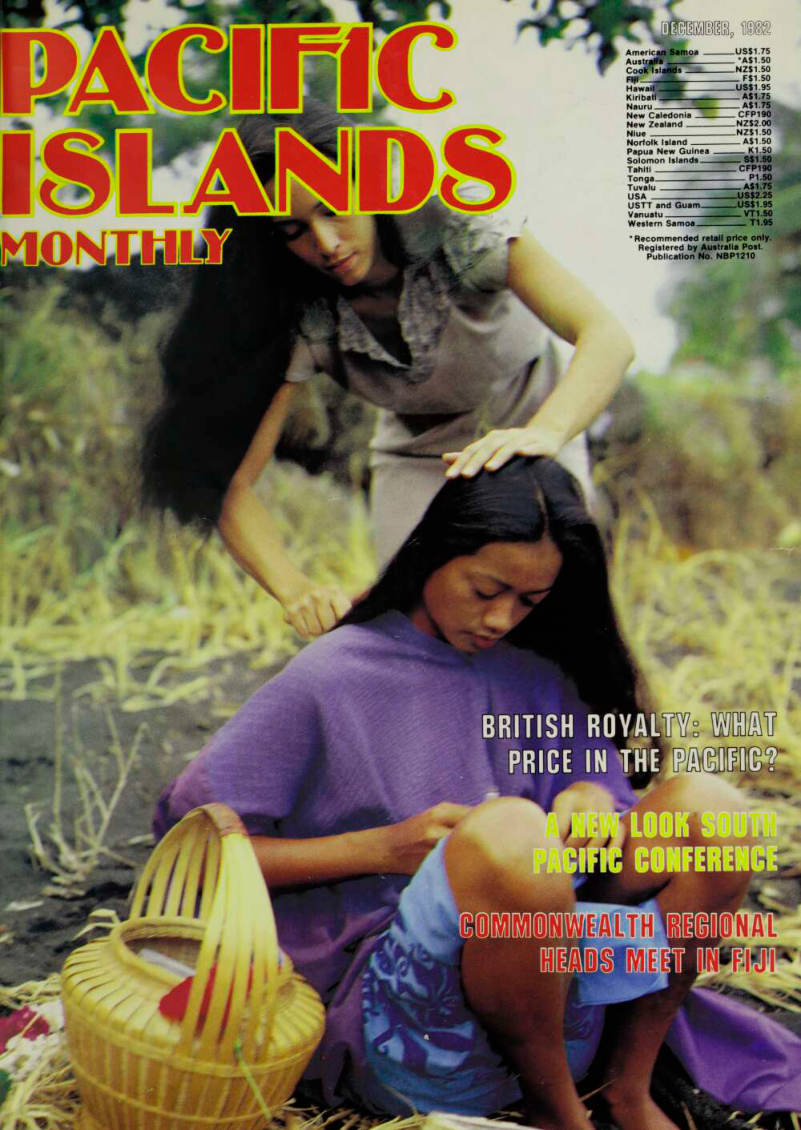
Cover picture: In sisterly fashion, one Tahitian beauty combs the dark tresses of another. Picture by John Shaw.
Advertisements & other items, p. 2 (1 item)
Thump!
Making The World An Exciting Place
assnis
k XL. The world’s best selling 4-stroke trail bikes.
The brute force that sets the pace. XL. From those who build perfection. To those who demand it.
WORLD’S LARGEST MOTORCYCLE MANUFACTURER
HONDA
HONDA MOTOR CO., LTD. TOKYO, JAPAN
XLIOOS
XLI2SS
XLIBSS
XLSOOR
PAPUA NEW GUINEA: Steamships Trading Company Ltd. PO. Box 1, Port Moresby/TAHITI: Honda Distribution S.A.R.L. B.P. 1665, Papeete/FIJI ISLANDS: Carpenters Motors Private Mail Bag Suva, Fiji/ KIRIBATI: Atoll Motor & Marine Services PO. Box 49 Bairiki Tarawa/U.S. TRUST TERRITORY: United Micronesia Development Association PO. Box 238, Saipan Mariana Islands 96950/ COOK ISLANDS; Cook Islands Motor Centre Ltd. PO. Box 74, Rarotonga/AMERICAN SAMOA; Holiday Motors, Parts and Service PO. Box 968 Pago Pago, American Samoa 96799/Haleck’s Service Certre Ltd. PO. Box 1138, Pago Pago, American Samoa 96799/GUAM: Mark’s Motor Co., Inc. PO. Box DV, Agana/WESTERN SAMOA: Motor Distributors (Samoa) Ltd. PO. Box 576, Apia/SOLOMON ISLANDS; Guadalcanal Garage Limited PO. Box 537 Honiara/NEW CALEDONIA: Establissements Ballande Boite Postale No. C 4 Noumea Cedex/NIUE ISLAND: Niue Island United Enterprises PO.
Box 4, Alofi/NAURU: Nauru Cooperation Republic of Naulu/TUVALU: Tuvalu Co-operative Wholesale Society PO. Box Funafuti, Tuvalu/TONGA; Tonga Industrial Traders PO. Box 1035, Nuku’alofa Tonga
Pacific Islands Monthly
Vol. 54 No. 12
December 1982
(Usps 952480)
Representatives
AUSTRALIA: Distribution: The Herald and Weekly Times Ltd., 44-74 Flinders St., Melbourne, Vic., 3000. Advertis ing Reps Brisbane D. Wood, Anday Agency, Box 1918, GPO, Brisbane 4001, telephone 44 3485, 44 1546; Adelaide Hastwell Media,.PO Box 30, Glen Osmond, SA 5064, 23 Avenue Road, Frewville, SA 5063, telephone 79 9271.
FIJI: Distribution and subscriptions Desai Book shops, PO Box 160, Suva, Fiji, telephone Suva 23036.
Advertising Fiji Times & Herald Ltd., 20 Gordon St., Suva, telephone 312 111, telex FJ2124.
FRENCH POLYNESIA: Distribution Hachette Pacifi que, 10 Ave Bruat, Papeete, telephone 25610.
HAWAII, UNITED STATES: Distribution PIM, Hawaii, PO Box 22250, Honolulu, Hawaii 96822. Advertising Roger Brookes, PO Box 10217, Honolulu, Hawaii 96816, tele phone 808 536 6677.
JAPAN: Advertising and subscriptions Universal Media Corporation, GPO Box 1762, Tokyo, telephone 666 3036.
NEW CALEDONIA: Distribution Depot Centre de Presse Michel Pentecost, CBP2, Noumea, telephone 27 2434, 27 4729.
NEW ZEALAND: Distribution Gordon & Gotch, PO Box 584, 2 Carr Road, Mt. Roskill, Auckland 4 Advertising International Media Representatives Ltd, PO Box 2313, Auckland, telephone 795 487; 493 389, cables Intereps, Auckland. Subscriptions Ross Haines & Son Ltd, PO Box 1289, Auckland, telephone 769 042.
PAPUA NEW GUINEA; Distribution Gordon & Gotch, PO Box 3395, Port Moresby, telephone 254551, 254855.
Advertising PNG Post-Courier, PO Box 85, Port Moresby, telephone 21 2577.
UNITED KINGDOM: The Herald & Weekly Times Ltd, No. 1 Maltravers Street, LondonWC2R 3DZ, England, telephone 01 836 5162, telex London 21989.
UNITED STATES MAINLAND: Advertising Joshua B, Powers Jr, Powers International Inc., 551 Fifth Ave., New York, New York 10 017, telephone 867 9580, telex 236514.
Subscriptions PIM, Hawaii, PO Box 22250, Honolulu, Hawaii 96822.
Payments by personal cheque are only acceptable in Australian (from a branch in Australia), US and New Zealand currency. For all other remittances please send an international bank draft in Australian dollars.
Published monthly by Pacific Publications (Aust.) Pty. Ltd and printed in Australia by Walter Alteri Printing (Australia) Pty. Ltd., Dingley, Vic.
Australian cover price is recommended retail only. Regis tered by Australia Post, publication No. NBPI2IO. Second class postage paid at Honolulu, Hawaii. Copyright Pacific Publications (Aust.) Pty. Ltd.
Postmaster Honolulu: Send address changes to PIM Hawaii, PO Box 22250, Honolulu, Hawaii 96822.
Subscriptions
Local Aust.
American Samoa $US21 $18 Australia $A18 $18 Canada $US27 $25 Cook Islands $19 Fiji $18 French Polynesia $22 Guam $US23 $20 Hawaii
Sus23
$20 Japan $20 Kiribati $19 Micronesia
Sus23
$20 Nauru $21 New Caledonia $22 New Zealand $NZ24 $18 Niue $19 Norfolk Island $15 Northern Marianas
Sus23
$20 Papua New Guinea $23 Solomon Islands $19 Tonga $19 Tuvalu $19 United Kingdom Stg 15 $25 US Mainland
Sus27
$25 Vanuatu $19 Western Samoa $18 Elsewhere $A25
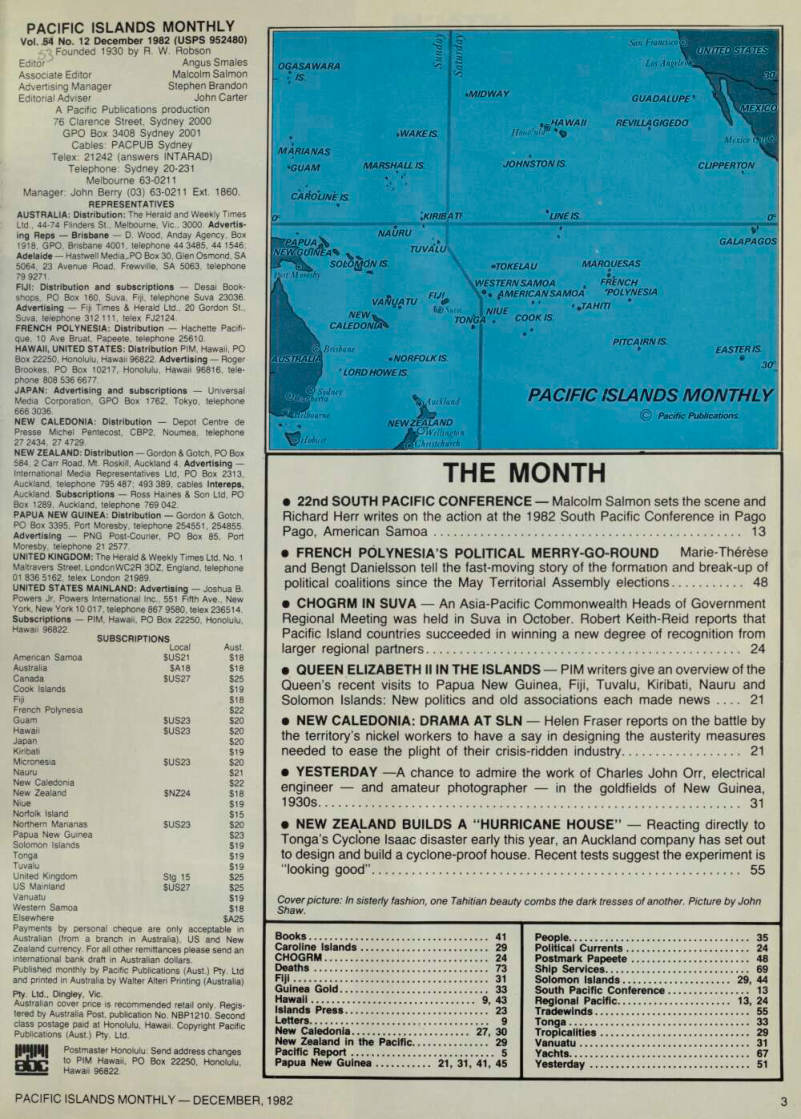
The Month
• 22nd SOUTH PACIFIC CONFERENCE Malcolm Salmon sets the scene and Richard Herr writes on the action at the 1982 South Pacific Conference in Pago Pago, American Samoa 13
• French Polynesia’S Political Merry-Go-Round Marie-Therese
and Bengt Danielsson tell the fast-moving story of the formation and break-up of political coalitions since the May Territorial Assembly elections 48 • CHOGRM IN SUVA An Asia-Pacific Commonwealth Heads of Government Regional Meeting was held in Suva in October. Robert Keith-Reid reports that Pacific Island countries succeeded in winning a new degree of recognition from larger regional partners 24 • QUEEN ELIZABETH II IN THE ISLANDS PIM writers give an overview of the Queen’s recent visits to Papua New Guinea, Fiji, Tuvalu, Kiribati, Nauru and Solomon Islands: New politics and old associations each made news ... 21 • NEW CALEDONIA: DRAMA AT SLN Helen Fraser reports on the battle by the territory’s nickel workers to have a say in designing the austerity measures needed to ease the plight of their crisis-ridden industry 21 • YESTERDAY —A chance to admire the work of Charles John Orr, electrical engineer and amateur photographer in the goldfields of New Guinea, 1930 s 31 • NEW ZEALAND BUILDS A “HURRICANE HOUSE” Reacting directly to Tonga’s Cyclone Isaac disaster early this year, an Auckland company has set out to design and build a cyclone-proof house. Recent tests suggest the experiment is “looking good” 55
Books 41 Caroline Islands 29
Chogrm 24
Deaths 73 Fiji 31 Guinea Gold 33 Hawaii 9, 43 Islands Press 23 Letters 9 New Caledonia 27, 30 New Zealand in the Pacific 29 Pacific Report 5 Papua New Guinea 21, 31, 41, 45
People 35 Political Currents 24 Postmark Papeete 48 Ship Services 69 Solomon Islands 29, 44 South Pacific Conference 13 Regional Pacific 13, 24 Tradewinds 55 Tonga 33 Tropicalities 29 Vanuatu 31 Yachts 67 Yesterday 51
Advertisements & other items, pp. 3-4 (2 items)
Founded 1930 by R. W, Robson
Editor Angus Smales Associate Editor Malcolm Salmon Advertising Manager Stephen Brandon Editorial Adviser John Carter A Pacific Publications production 76 Clarence Street, Sydney 2000 GPO Box 3408 Sydney 2001 Cables: PACPUB Sydney Telex: 21242 (answers INTARAD) Telephone: Sydney 20-231 Melbourne 63-0211 Manager: John Berry (03) 63-0211 Ext. 1860.
Hitachi
VMS
-tp -T. -T\ *T *T *T
TSS*»
nG p 3P^ *6oo* p*»° i«*So* VT-9500E (AU) Wireless Remote Control VTR <° o, i^ Versatile 3-programme/10-day timer recording 13-mode infrared remote control unit for ultimate ease of operation Visual Search in both forward and reverse Still Picture, Slow Motion, and Frame Advance in playback Electronic digital display clock/timer/tape counter with memory function Feather-touch controls and channel lock during recording Oil-damped soft-eject cassette mechanism Auto-stop/auto-rewind at tape's end. plus automatic shut off Jj jJ jA Jj Jj Jj JJ n 1
3EAPCH
-cSSW.
HITACHI
VT-9300E (AU) Visual Search VTR •Convenient 1-programme/10-day timer recording •Visual Search at 9 times normal speed in forward/reverse • 8-mode wired remote control unit • Electronic digital display clock/timer/tape counter with memory function • Feather-touch controls and channel lock during recording • Oil-damped soft-eject cassette mechanism •Auto-stop/auto-rewind at tape’s end, plus antnmatir: shut nff
Pacific Report
Png Slashes Its Public Service
Papua New Guinea’s 1983 budget provides for the abolition of five government departments and the retrenchment of 3000 public servants, or about 10 percent of the national government workforce. It earmarks K 12.5 million to be paid as lump sum redundancy payments to those who will lose their jobs. The budget imposes higher taxes on alcoholic liquor, cigarettes, betting and luxury goods to raise K 10.6 million ($A14.53 million).
The beer tax of 58.5 toea a litre will be linked to the Consumer Price Index, to rise yearly with inflation. A packet of 20 cigarettes will cost about 3 toea more, a standard bottle of spirits K 1.2 more and a bottle of wine 30 toea more. There is a sliding scale of stamp duties on horserace bets, from 50 toea per bet of up to KlO to K 2 per wager of more than K5O. The bookmakers’ turnover tax doubles to two percent and licence fees rise from KlOOO to K5OOO. There will also be a 30 percent tax on instant coffee and air-conditioners; 17.5 percent duty on imported non wooden pre-fabricated buildings, and 15 percent on ready-made cab-chassis trucks. Fruit concentrates used by the soft drink industry will be exempt but small bottles of soft drink will cost 1 toea more. The import tax on luxury goods rises by 10 per cent to 80 percent and duty on cars with engines above 2000 cc rises to 110 percent. Total expenditure will be K 788.3 million ($A1051.1 million), five percent less than the current figure, but PNG is hoping that Australia will restore the 5 percent cut in aid; otherwise 45 projects, unlisted, will be pruned or axed. An agreement signed between the public servants’ union and the government the day after the budget was brought down was apparently successful in heading off threatened industrial action over the sacking of the public servants. The union’s president, Napoleon Liosi, said the agreement for redundancy payments was a big achievement as it set a standard for further similar agreements in PNG. He said he was sad to see one tenth of his members losing their jobs, but the union accepted reality and hoped the terms of the agreement would stop any industrial trouble.
Four Oversee Micronesian Plebiscites
Fiji will join France, Britain and Papua New Guinea in the task of overseeing the three plebiscites to be held in Micronesia on the terms of the Compacts of Free Association between the United States as trustee of the Trust Territories and the three political entities: the Marshall Islands Republic, the Republic of Palau and the Federated States of Micronesia (FSM). The first plebiscite is scheduled to be held in Palau on December 10 and the others will be held soon after. Palau initialled its compact in September (PIM, Oct. p 5), and the FSM in October, but agreement between the Marshall Islands and the United States was delayed because of the Kwajalein Atoll landowners’ opposi tion to the terms offered by the U.S. for continued use of the atoll as a missile-testing base. However, agreement was reached late in October when the landowners accepted new offers by the U.S. The new agreement provides for payment by the U.S. of about SUS 9 million a year for current use of the base, taxes and services: a 30-year term of occupation by the U.S. instead of 50 years, as originally agreed between the Marshalls Government and the U.S.; and payment by the U.S. of about $6 million towards a capital development program to improve Hiving conditions for about 8000 Marshallese living in Ebeye, a few kilometres from the missile range headquarters. In exchange for the reduced term of occupation, the U.S. says it will pay $6.5 million instead of $22 million for the right to extend use of the base beyond 15 years. Provided the various compacts are approved without getting bogged down in the U.S. Congress or the U.N. Trusteeship Council, the stage seems set for termina tion of the trusteeship in 1983.
U.S.-Palau Initial Fund Deal
An agreement, which, under the terms of the Compact of Free Association, will give the Palau Government billions of dollars in U.S. aid, has been initialled in Koror by U.S. Ambassador, Fred M. Zeder and Palauan Ambassador, Lazarus E. Salii of Palau.
The fund will open with capital of SUS6O million, to be invested by Palau to produce $5 million in each of the sixth, 11 th and 16th
years of the compact, and $23.5 million a year for 35 years, commencing on the 16th year. Assuming a 12 percent rate of interest, the initial capital of $6O million will grow to about $3.9 billion at the end of 50 years. This is over and above the funds already provided for Palau under the compact. The fund will not be subject to the jurisdiction of U.S. courts and will be immune from seizure, attachment, currency control or freeze by the U.S.
Government. The fund may be invested only in qualified instruments identified from time to time by mutual agreement of the Palau and U.S. governments.
Union Caledonienne In Congress
Three thousand members of New Caledonia’s largest pro independence party, Union Caledonienne, have directed their leaders not to participate in discussions with the French Government on a statute of autonomy. However, the motion, which was carried unanimously at a November congress of the party, does allow for participation in discussions which lead to independence. The three-day congress, held at Sarramea, 130 km north of Noumea, followed an announcement by the French Government that it would form a commission to reform New Caledonia’s governing statute and grant the territory greater autonomy. The congress also adopted a proposal for a constitu tion for a “Kanak socialist state in the form of a democratic and decentralised republic.”
Anti-Inflation Budget For Fiji
The Fiji Government has produced an anti-inflation Budget, increasing taxes on beer, cigarettes, vehicles and petrol but cutting out the two percent export tax on sugar, molasses and coconut oil. A two cents a litre tax increase on petrol will take the price to 53c. Finance Minister, Charles Walker, budgeted for a deficit of the equivalent of $A30.4 million. Fiji’s inflation rate, at around eight percent, is among the lowest in the Pacific. A joint statement from the Fiji Manufacturers Association, the Employ ers Consultative Association, and the Suva Chamber of Com merce said it was pleasing to note the favorable financial position attained by the country in the past year. Praising the government for its efforts in keeping down inflation, the three organisations said that inflationary trends must be kept to a low level if Fiji was to develop its export potential and economic stability.
Hot Papeete Debate On Pollution
Will the French Government have to clean up its own nuclear mess? This was the question hotly debated in the Territorial Assembly of French Polynesia early in November, when the Paris government submitted a draft of new legislation to prevent pollution of the oceans, especially by oil tankers. Happy to be consulted for once, the assemblymen argued that the most common and dangerous form of pollution in their islands is nuclear contamination, resulting from 41 atmospheric and 44 underground tests, and tacked on an amendment making this a criminal offence and compelling the offender to repair or pay for the damage done. Among the polluted islands the assemblymen want the French army to clean up are, of course, in the first place Moruroa and Fangataufa. Next come such islands as Hao and Mangareva, where over the years hundreds of tons of contaminated material has been dumped into the lagoons by French warships, a method of disposal which gradually has made all local fish poisonous. Marie-Therese and Bengt Danielsson.
Png Minister Raps Oz Journalist
An Australian journalist came in for heavy criticism in Papua New Guinea’s parliament in November. In a personal explana tion to parliament, Papua New Guinea’s Justice Minister, Tony Bais, attacked an article that had appeared in The Sydney Morning Herald newspaper. Mr Bais claimed the article was inaccurate, sensational and unfair. The story was headlined “Police State Off Our Northern Shores” and dealt with the Peace and Good Order Bill then before Parliament. It reported opposition and academic concern over certain provisions of the bill. Mr Bais said the journalist who wrote the article, Kevin Ricketts of Australian Associated Press, was wrong when he wrote that Mr Bais was not strongly supporting the legislation.
He said the reporter was even more inaccurate when he compared Papua New Guinea to South Africa, the Philippines, and South American dictatorships. Mr Bais said the provisions in the bill for limited curfews, passes and bans on demonstrations were aimed at controlling lawlessness. He claimed safeguards in the bill prevented the measures being used for political repression. He said the government was concerned about civil rights but these had no meaning for the latest victims of axe murders in the Highlands, or the notorious rascal gangs in Port Moresby. He said: “I would like Mr Ricketts to leave his comfortable foreign correspondent’s home in Port Moresby and go up to the Highlands. There I would like him to travel around with police to help them clean up the havoc after another axe attack, to be with them while they comfort the survivors and see the damage caused by a lack of order. We in the Government are concerned about the civil rights of our people.”
N.F.P. Sour On Election Inquiry Terms
Fiji’s opposition National Federation Party has criticised the terms of reference of an inquiry (PIM, Nov. p 5) into allegations of foreign interference in the country’s July elections. The NFP leader, Jai Ram Reddy, has written to Prime Minister, Ratu Sir Kamisese Mara, expressing concern that the inquiry will be restricted to comments made during the election campaign and not after it. He said his party wanted the claim by the Prime Minister that the NFP had received $1 million in aid from the Soviet Union to come within the view of the inquiry. Mr Reddy said he was also concerned that a report prepared for Fiji’s ruling Alliance Party by an Australian business consultant, Allan Carroll, may not go before the inquiry.
French “Yes” On Neutron Test
France’s Defence Minister, Charles Hernu, says he attended a successful neutron bomb experiment at Moruroa Atoll in August, 1981. But Defence Ministry officials stressed that only the neutron bomb mechanism had been fired, not a complete bomb.
Mr Henru said France was capable of building and deploying the neutron bomb, but President Mitterrand had not yet made a decision on whether to build the weapon. At the United Nations, French delegate Marcel Delagorge has said France would continue its nuclear tests in the Pacific “until there is an effective process for nuclear disarmament”. He said that bilateral U.S.- Soviet arms control talks now under way in Geneva should be the main focus of efforts towards nuclear disarmament. “The French nuclear deterrent has been kept to the minimum necessary to prevent anyone attempting domination of our country,” he said.
Bordallo Is New Guam Governor
Despite television ads of President Ronald Reagan warmly endorsing him, Republican Governor, Paul M. Calvo, was turned out of office in the November 2 general elections on Guam. Successful candidate was Democrat Ricardo J. Bordallo, who was himself beaten by Calvo in the 1978 general elections while serving his first four-year term as governor (January 1975- January 1979). The Democrat team for governor and lieutenant governor was Bordallo-Reyes. They polled 15,199 votes to 13,797 for the Republican pair, Calvo-Perez. Mark L Berg.
Reddy Warns Of “Anti-Indian” Moves
Fiji’s Opposition leader, Jai Ram Reddy, has warned of an emerging pattern of hatred and ill-will against the country’s Indian community. He called on the Indian people to unite, saying that insults and humiliations they had been subjected to could not be ignored. Mr Reddy was speaking at a meeting in Suva called to discuss resolutions passed at a recent meeting of the Great Council of Chiefs. The resolutions, which are not binding on the Government, seek a mandatory two-thirds of the seats in the house of representatives, and the posts of Prime Minister and Governor-General to be reserved for Fijians. The Opposition leader said the Indian community must protest against all forms of injustice and oppression.
Png Minister Suspended
Papua New Guinea’s Public Utilities Minister Michael Pondros was suspended from office in November. The suspension followed action by the Ombudsman Commission to refer to the public prosecutor allegations that Mr Pondros misappropriated public funds allocated to Manus Province.
New Moves In N.Z. Citizenship Row
The Western Samoa Government in November was seeking talks with the New Zealand Government on NZ citizenship as it affects Samoans following the NZ parliamentary Bill nullifying a British Privy Council ruling that all Western Samoans born between 1924 and 1949, when New Zealand was administrator of Western Samoa, are New Zealand citizens (PIM Sep p 6).
Samoan Prime Minister Tupuola Efi has said his government will attempt to set aside the protocol signed by the previous Vaai Kolone government agreeing to the NZ Bill. The controversy threatens to sour Samoan-New Zealand relations. Tupuola Efi has said that more than 90 per cent of Samoans supported the Government’s move for renegotiation. Meanwhile, a group of Samoans led by church ministers and business people, has filed a petition to the Samoa Supreme Court asking for an order declaring the protocol unconstitutional.
Tahitian In Greenpeace Protest
For the first time in mid-October an activist of Tahitian origin sailed to Moruroa to protest against continued nuclear testing.
He was Guy Taero, who had shortly before been released from a French prison where he had served time on “political sabotage” charges. He joined the Australian Chris Robinson and the Englishman John Castle when the Greenpeace vessel Vega returned once more to the site of the French bomb tests.
Two weeks later the yacht was boarded by gendarmes maritimes and towed into Moruroa lagoon. Main charge brought against the three was that they had illegally entered territorial waters. They strongly denied this. They were subsequently charged with the additional offences of having changed their destination, and not having displayed the prescribed navigation al lights. They replied that they were still bound for Auckland, but were just making a slight detour, and that the regulations referred to by the gendarmes applied to big ships and not small yachts. They never had a chance of replying to these strange charges in court. On arrival in Tahiti by military aircraft, they were immediately transferred to an Auckland-bound Air New Zealand flight. Since it was clearly impossible to indict Taero for having penetrated illegally into his own country, he was eventu ally released. His last protest concerned his cherished Tahitian Bible, which had been confiscated along with his other personal belongings at the time of the seizure. The Vega which is registered in Canada, remains impounded. Marie-Therese and Bengt Danielsson.
N.C. Protest On Shooting Of Aborigine
A New Caledonian trade union, the Union of Kanak and Exploited Workers, has reacted to the November shooting of an Aboriginal youth in the New South Wales, Australia, country town of Moree with the following statement; “The assassination of an Aboriginal brother in NSW by Australian racists highlights the racism and apartheid which exists in this region. We stress our support for all trade union and political organisations which are fighting in Australia for the recognition of Aboriginal rights, and for their rights to land.” The statement adds that the union sees its own struggle in New Caledonia “for Kanak Socialist Independence” as running parallel to that of the Aboriginal people. Helen Fraser.
Cooks P.M. Injured In Fishing Mishap
The Cook Islands Prime Minister, Sir Thomas Davis, flew to New Zealand for medical treatment in November following injuries received when he fell off his seat in a fishing boat in a heavy swell after competing in a fishing contest staged for delegates to the South Pacific Conference in Pago Pago in October. X-rays revealed that Sir Thomas had a broken vertebra in the neck. The fish hooked by Sir Thomas in the contest had made him the winner.
Cyclone Jodie Visits Vanuatu
Cyclone Jodie left a trail of damaged houses, gardens and fruit trees on the northern islands of Vanuatu in late October-early November.
Fees Rise At U.S.P.
The University of the South Pacific has announced an increase of five percent in tuition and boarding fees from next year. The increase will raise the fees for private students from within the university region to just over SF3OOO a year.
Advertisements & other items, pp. 6-8 (1 item)
The World’S
SMALLER THAN
SMALLEST!
Nat
'°nai
* : f’ ■ M W
Lu'dU
5 %e 0
cqssT
Actual size Meet the uag National’s new record holder for the world’s smallest stereo cassette player. It’s so easy to use you can operate it with your eyes closed. Soft-touch play and stop buttons on top, and large, lockable fast forward and rewind buttons on the cassette lid give you quick, precise handling. The super-light, unique single-cord headphones feature an on/off switch right on the cord. And you can even change cassettes while the uag is in its carrying holder. When it comes to i, ipji i music on the move, there’s no better “Way” to go! UJCHJ
RQ-WJI
UJOy
fa & :,-r- -wag
i National
National, Panasonic and Technics are the brandnames of Matsushita Electric.
\ el c I i W i •AW ' iTi ai hen Sansui mates computers with high performance component systems you get convenience. Like "Compu Edit.," a feature that allows automatic edit recording of songs from disc to tape in any programmed order. And the "Compu-Selector System" for synchronized play. And memory station selection.
Intelligent Super Compo the smartest hi-fi systems ever designed. [ For further information please contact: SANSUI ELECTRIC CO., LTD. 14-1 Izumi 2-chome, Suginami-ku, Tokyo 168, Japan. • Australia VANFI (Aust.) Pty. Ltd. 297, City Road, South Melbourne, Victoria 3205, Australia Phone: 690-6200/283 Alfred Place, North Sydney, N.S.W. 2060, Australia Phone: 929-0293 •Fiji Prabhu Brothers Ltd. PO. Box 183, Nadi Phone: 71122 • Papua New Guinea Oceania Indent Agency (P.N.G.) Pty. Ltd. Box 5518, Boroko, Port Moresby Phone: PM 256411 • New Zealand David Reid Electronics Ltd. PO. Box 2630, Auckland, Phone: 488-049 • New Caledonia M.M. Mercier Michel B.P 1123, Noumea Phone; 27.59.11 • Central Pacific Nauru Co-operative Society Republic of Nauru • Vanuatu The Sound Centre PO. Box 434, Villa Phone: 2035 • Tahiti SIMEL PO. Box 3338 Papeete Phone: 2-49-68
treasures of
Letters
Lost
Nan Madol
I was very interested to read of the Bernice P. Bishop Museum in Honolulu (PIM Oct p 26) and its new exhibition “Big Men, Chiefs and Mariners’’, represent ing “the traditional cultures of Melanesia, Polynesia and Micro nesia’’. But, at the same time, I was sorry to see for the Micro nesian section no mention was made of any artifacts from what is certainly one of the greatest monuments to the ancient civil isations of the Pacific the 11 square miles of basalt city and canals of Nan Madol on the island of Ponape in the Carolines.
My company, the Solaise Film
Group, Sydney, completed a 50-
minute documentary on Nan Madol in June this year. While in Ponape I learnt from the Historic Preservation Commission that a great many of the more valuable
and traditionally important
pieces (artifacts) found or plun dered over the last few hundred years lie in museums in Europe the Spanish, then the Ger mans, being the first Europeans to make contact with Ponape and to excavate the many tombs and ceremonial buildings of Nan Madol.
The Historic Preservation Commission has attempted over the years to retrieve some of these artifacts for their own museum, but to no avail. I won der if perhaps the Bishop Museum may be able to help, both for their own exhibition and Ponape’s. If indeed there is some help that could be offered the address is: Ponape Co-ordinator, Historic Preservation Commis sion, PO Box 275, Kolonia, State of Ponape, Eastern Caroline Islands, 96941.
Geoff Cleminson
(Solaise Film Group) Harbord NSW Australia
New hope for
Pacific archives
I enclose information on Parbica, the Pacific Regional Branch, In
temational Council on Archives.
My fellow Parbica Bureau mem bers and I have read your publi cation with interest and ap preciate the value it has in spreading information on hap penings in the area.
Parbica is an exciting develop ment for archives in the Pacific.
The inaugural conference and seminar in Suva late last year received encouraging support, with representatives from 14 dif ferent countries as well as a representative from UNESCO and from the International Coun cil on Archives. There were 30 participants for the training semi nar, and opportunity to meet and discuss common points of inter est was of great value. There is growing realisation that irrep laceable records of significant value are at risk, and it is essen tial that there should be attention paid to the preservation of arc hives in the region.
In July the four members of the bureau met in Rarotonga for an intensive week of discussions on planning a program for Parbi ca. The result is a draft five-year program. The opportunity to meet in Rarotonga to see archival holdings there and have discus sions on the spot was extremely useful.
It is hoped that a general meet ing and seminar for Pacific ar chivists will be held in 1983 possibly in Guam and plans are already under way. We must follow up the promising begin ning as soon as possible.
The first issue of the Parbica newsletter will be published soon. Good communication and exchange of information among Pacific archivists is crucial. The few archivists scattered through out the vast area feel very isolated and gain much from con tact with colleagues from other countries.
For the record, at the inaugural conference of Parbica in Suva, Alfred Wagner, Treasurer of ICA and Director of Archives, Bundesarchiv, West Germany, was the representative of ICA and adviser.
Official regional delegates at tending were as follows; Aust ralia: Bruce Bume, Public Re cords Office of Victoria; Lindsay Cleland, President, Australian
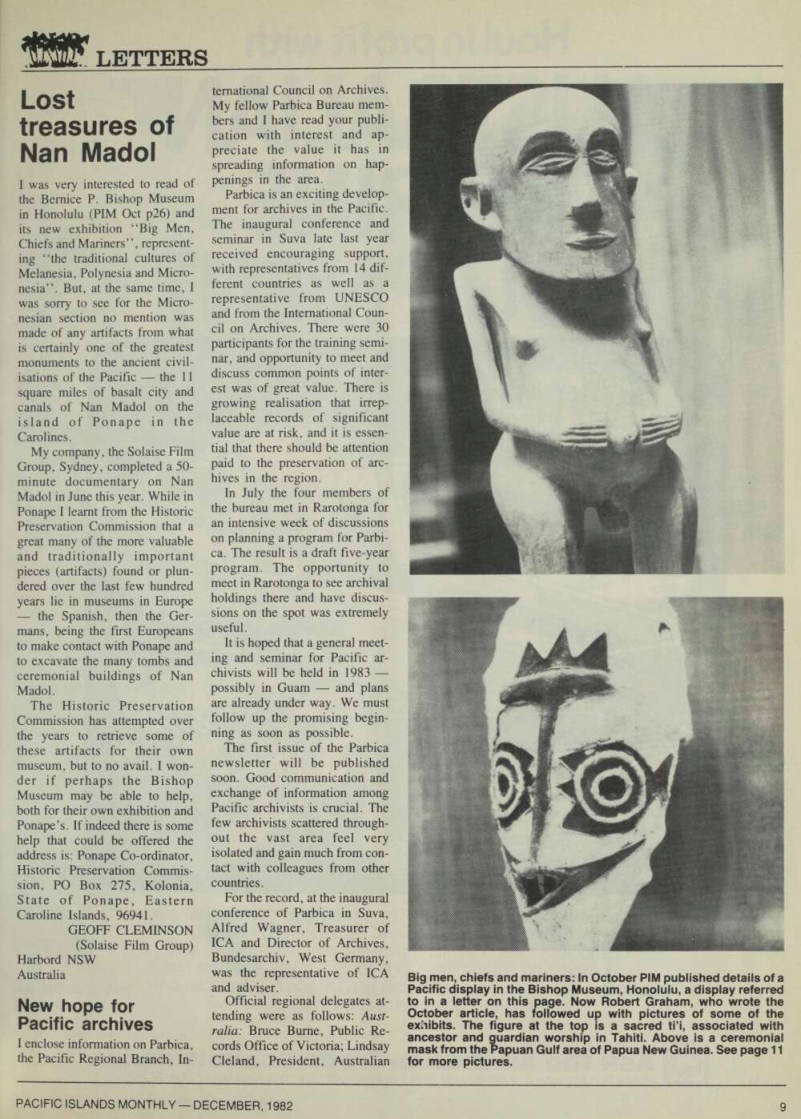
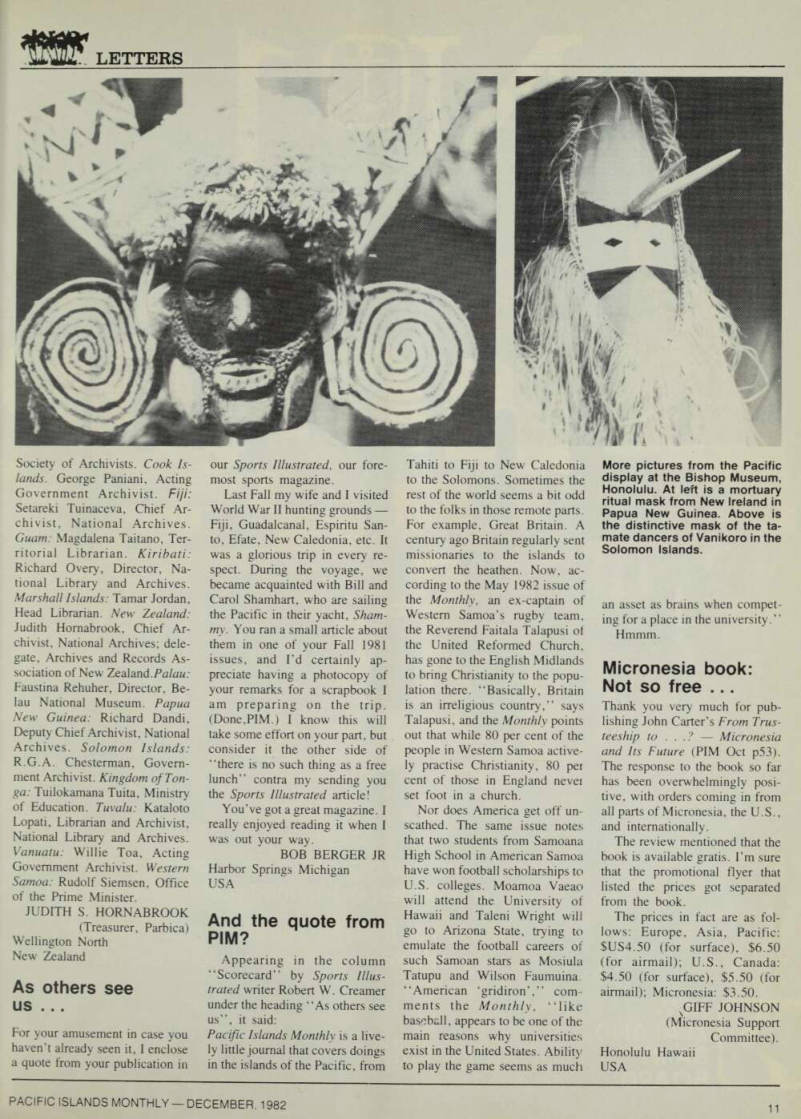
Big men, chiefs and mariners: In October PIM published details of a Pacific display in the Bishop Museum, Honolulu, a display referred to in a letter on this page. Now Robert Graham, who wrote the October article, has followed up with pictures of some of the exhibits. The figure at the top is a sacred ti’i, associated with ancestor and guardian worship in Tahiti. Above is a ceremonial mask from the Papuan Gulf area of Papua New Guinea. See page 11 for more pictures.
Society of Archivists. Cook Is lands. George Paniani, Acting Government Archivist. Fiji: Setareki Tuinaceva, Chief Ar chivist, National Archives.
Guam: Magdalena Taitano, Ter ritorial Librarian. Kiribati: Richard Overy, Director, Na tional Library and Archives.
Marshall Islands: Tamar Jordan, Head Librarian. New Zealand: Judith Homabrook, Chief Ar chivist, National Archives; dele gate, Archives and Records As sociation of New Zealand. Palau: Faustina Rehuher, Director, Be lau National Museum. Papua New Guinea: Richard Dandi, Deputy Chief Archivist, National Archives. Solomon Islands: R.G.A. Chesterman, Govern ment Archivist. Kingdom of Ton ga: Tuilokamana Tuita, Ministry of Education. Tuvalu: Kataloto Lopati, Librarian and Archivist, National Library and Archives.
Vanuatu: Willie Toa, Acting Government Archivist. Western Samoa: Rudolf Siemsen, Office of the Prime Minister.
Judith S. Hornabrook
(Treasurer, Parbica) Wellington North New Zealand As others see us ...
For your amusement in case you haven’t already seen it, I enclose a quote from your publication in
our Sports Illustrated, our fore most sports magazine.
Last Fall my wife and I visited World War II hunting grounds
Fiji, Guadalcanal, Espiritu San
to, Efate, New Caledonia, etc. It was a glorious trip in every re spect. During the voyage, we became acquainted with Bill and Carol Shamhart, who are sailing the Pacific in their yacht. Sham my. You ran a small article about them in one of your Fall 1981 issues, and I’d certainly ap
preciate having a photocopy of
your remarks for a scrapbook I am preparing on the trip. (Done,PIM.) I know this will take some effort on your part, but consider it the other side of “there is no such thing as a free lunch” contra my sending you the Sports Illustrated article!
You’ve got a great magazine. I
really enjoyed reading it when I
was out your way.
Bob Berger Jr
Harbor Springs Michigan
Usa
And the quote from
Pim?
Appearing in the column “Scorecard’’ by Sports Illus trated writer Robert W. Creamer under the heading “As others see us”, it said: Pacific Islands Monthly is a live ly little journal that covers doings in the islands of the Pacific, from
Tahiti to Fiji to New Caledonia to the Solomons. Sometimes the rest of the world seems a bit odd to the folks in those remote parts.
For example. Great Britain. A century ago Britain regularly sent missionaries to the islands to convert the heathen. Now, ac cording to the May 1982 issue of the Monthly, an ex-captain of Western Samoa’s rugby team, the Reverend Faitala Talapusi of the United Reformed Church, has gone to the English Midlands to bring Christianity to the popu lation there. “Basically, Britain is an irreligious country,’’ says Talapusi, and the Monthly points out that while 80 per cent of the people in Western Samoa active
ly practise Christianity, 80 per
cent of those in England never set foot in a church.
Nor does America get off un scathed. The same issue notes that two students from Samoana High School in American Samoa have won football scholarships to U.S. colleges. Moamoa Vaeao will attend the University of Hawaii and Taleni Wright will go to Arizona State, trying to emulate the football careers o£ such Samoan stars as Mosiula Tatupu and Wilson Faumuina “American ‘gridiron’,’’ com ments the Monthly, “like baseball, appears to be one of the main reasons why universities exist in the United States. Ability to play the game seems as much
an asset as brains when compet ing for a place in the university. ’ ’
Hmmm.
Micronesia book:
Not so free ...
Thank you very much for pub lishing John Carter’s From Trus teeship to .. .? Micronesia and Its Future (PIM Oct p 53).
The response to the book so far has been overwhelmingly posi tive, with orders coming in from all parts of Micronesia, the U.S., and internationally.
The review mentioned that the book is available gratis. I’m sure that the promotional flyer that listed the prices got separated from the book.
The prices in fact are as fol lows: Europe, Asia, Pacific: SUS4.SO (for surface), $6.50 (for airmail); U.S., Canada: $4.50 (for surface), $5.50 (for airmail); Micronesia: $3.50.
Giff Johnson
(Micronesia Support Committee).
Honolulu Hawaii
Usa
More pictures from the Pacific display at the Bishop Museum, Honolulu. At left is a mortuary ritual mask from New Ireland in Papua New Guinea. Above is the distinctive mask of the ta mate dancers of Vanikoro in the Solomon Islands.
Advertisements & other items, pp. 10-12 (1 item)
Australian
Haul in profit with
MARINE
EQUIPMENT
■ n n * o Australian marine equipment has fast gained a world-wide reputation for its high quality standard and hard-working reliability.
For stainless steel boat fittings, masts, winches, pulleys, sails, fish processing equipment, work boats-check Australia first.
Australian suppliers are nearer, can service you quicker, can offer you the right equipment at the right price. rn For more information
Ask the Australian Trade Commissioner
Phone Port Moresby 25 9333. Suva 31 2844. Honolulu,(808) 524 5050. Noumea 27 2414, 27 2426.
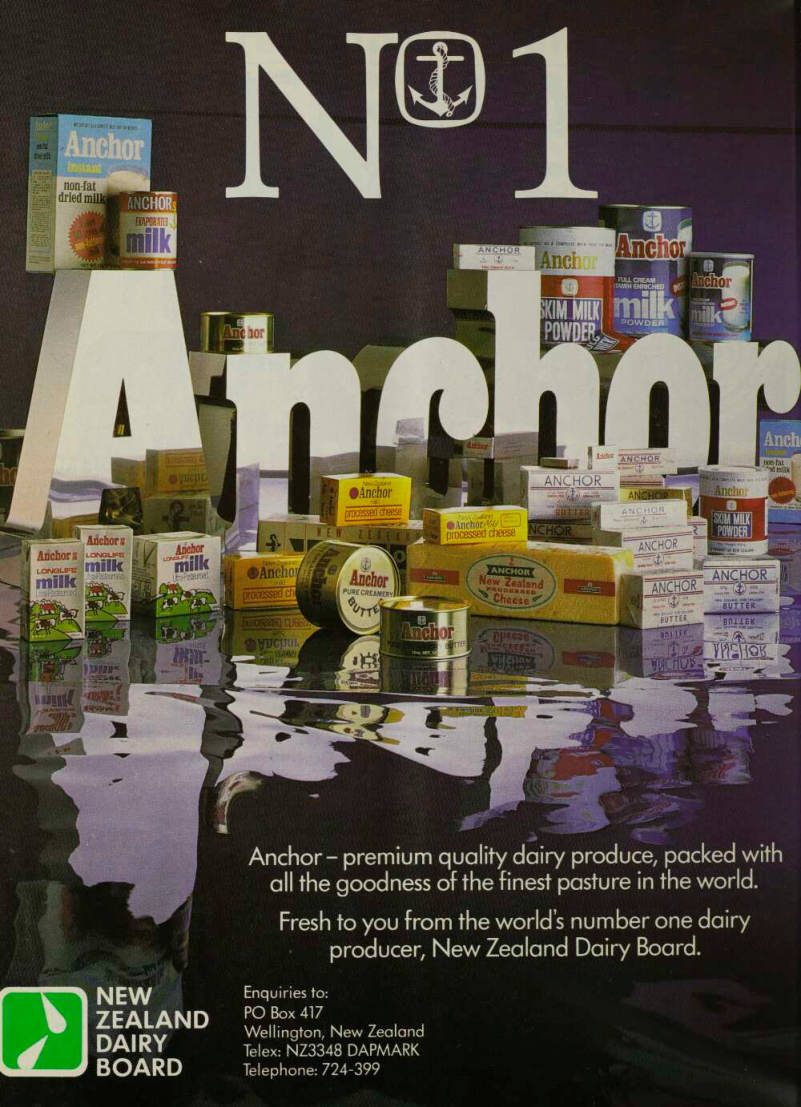
ANCHOR
FULL CREAM
'AMIN ENRICHED
m - Aneh m anchor 3"~S u p «l t- M
NEW
ZEALAND
DAIRY
BOARD
Anchor - premium quality dairy produce, packed with all the goodness of the finest pasture in the world.
Fresh to you from the world’s number one dairy producer, New Zealand Dairy Board.
Enquiries to: PO Box 417 Wellington, New Zealand
Telex: NZ3348 DAPMARK
Telephone: 724-399
The community
22Nd South Pacific Conference
PIM Associate Editor MALCOLM SALMON was in Pago Pago for the 22nd South Pacific Conference in the last week of October. He writes here of his impressions of Pago and of conference doings, onstage and off. His comments are followed by a summary of the work of the conference by Dr RICHARD A. HERR, of the University of Tasmania.
The hand of
nature ...
Speaking at the opening cere mony of the 22nd South Pacific Conference in Pago Pago in Oc tober, Secretary-General Francis Bugotu of the South Pacific Commission remarked on the fact that Pago had hosted three such conferences, more than any other centre apart from Noumea (a special case because it is the site of SPC headquarters).
He said the record was a tri bute to the people of a communi ty as small as Pago, and to their interest in regional affairs.
I think there is another reason: nature has cunningly designed Pago from the start to serve as what our American cousins call a “convention center’’.
No pictures, no written de scriptions, adequately prepare one for the beauty of the island of Tutuila. Thickly wooded moun tains rearing steeply behind the narrow coastal strip at Pago are a constant source of visual delight and of relief for eyes tired of poring over the flood of docu ments inevitably produced by a bureaucratic bash such as the South Pacific Conference. I grew particularly fond of the coconut palms which, here and there, cling defiantly to the precipitous flanks of the mountains, at al titudes greater surely than is real ly good for their health.
Nor has nature forgotten the air-conditioning: Pago’s tropical warmth and high humidity are almost constantly tempered by fresh breezes off the harbor, making a seaside stroll a ready means of cooling-off, as well as of relaxing after the day’s work.
The community
of Pago Pago
There is yet another reason why Pago is a superb venue for events of this kind. The smallness of the Pago community referred to by Mr Bugotu means that the local people can be mobilised and schooled in how to welcome overseas guests with a thorough ness that would be out of the question in a larger centre. Gov ernor Peter Tali Coleman and his aides performed minor miracles in going about this task.
The Governor himself set the example by assuming an abso
lutely crushing workload
throughout the conference and its many and varied accompanying social occasions, and carrying it all off with unfailing dignity and
aplomb.
Members of his family were not far behind him. His well-
favored daughter, Amata Cole man, came especially from Washington to work on the or ganisation of the conference. Her American husband was in charge of a small and effective group responsible for the technical pre parations. As well as Amata, half a dozen of her brothers were also there and at work, having zeroed in on Pago from points as far flung as Baltimdre, San Fran cisco and Alaska.
But it wasn’t only a Coleman family affair. Others with names to conjure with in Samoa, such as Millie Nelson, worked just as hard.
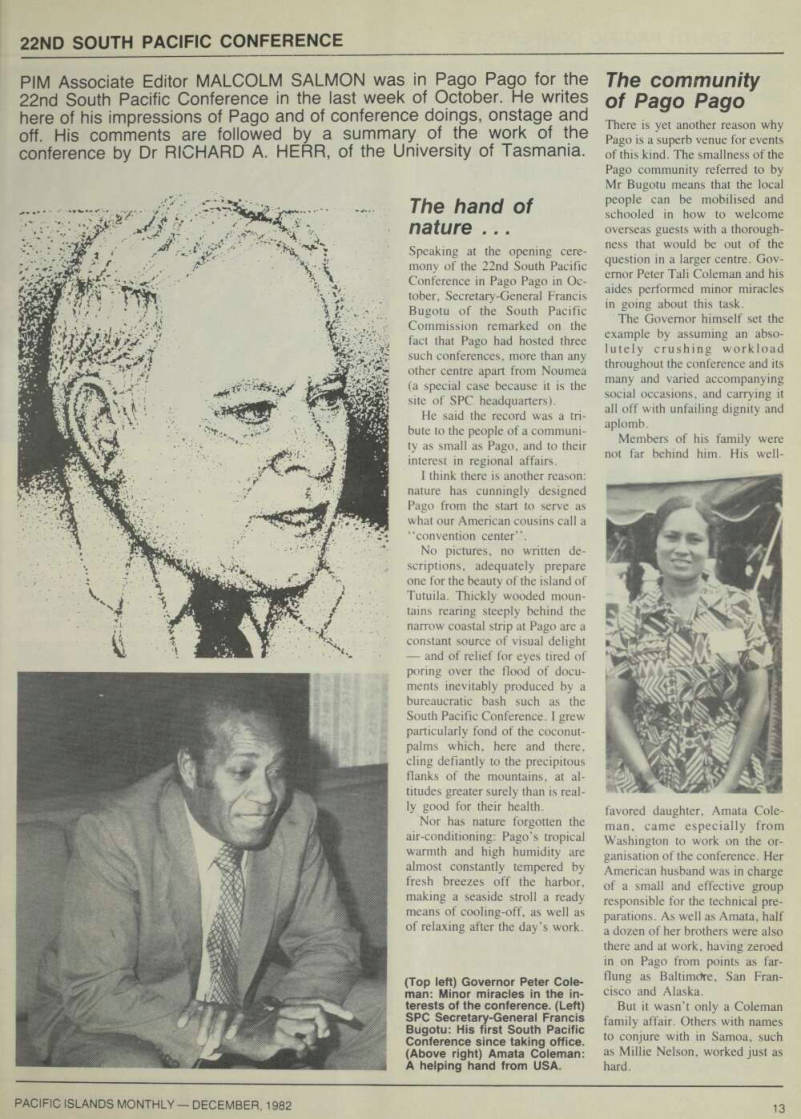
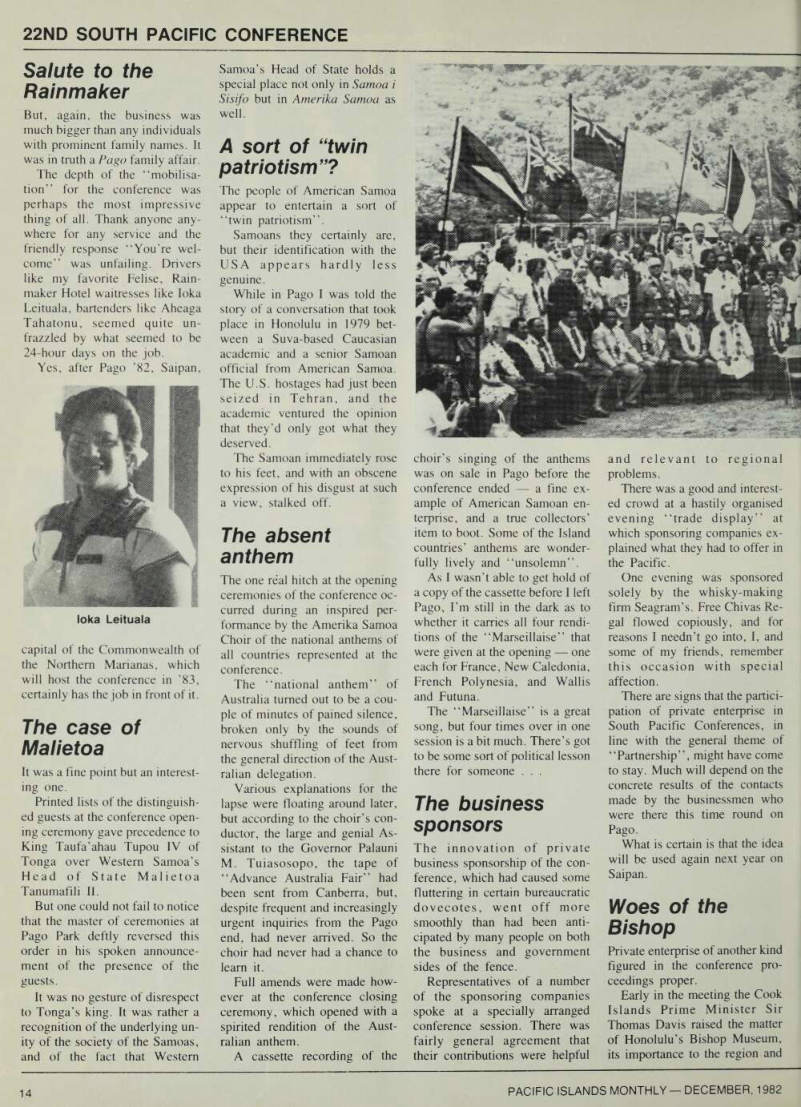
(Top left) Governor Peter Cole man: Minor miracles in the in terests of the conference. (Left) SPC Secretary-General Francis Bugotu: His first South Pacific Conference since taking office. (Above right) Amata Coleman: A helping hand from USA.
Salute to the
Rainmaker
But, again, the business was much bigger than any individuals with prominent family names. It was in truth a Pago family affair.
The depth of the “mobilisa tion” for the conference was perhaps the most impressive thing of all. Thank anyone any where for any service and the friendly response “You’re wel come” was unfailing. Drivers like my favorite Felise, Rain maker Hotel waitresses like loka Leituala, bartenders like Aheaga Tahatonu, seemed quite un frazzled by what seemed to be 24-hour days on the job.
Yes, after Pago ’B2, Saipan,
capital of the Commonwealth of the Northern Marianas, which will host the conference in ’B3, certainly has the job in front of it.
The case of
Malietoa
It was a fine point but an interest
ing one.
Printed lists of the distinguish ed guests at the conference open ing ceremony gave precedence to King Taufa’ahau Tupou IV of Tonga over Western Samoa’s Head of State Malietoa Tanumafili 11.
But one could not fail to notice that the master of ceremonies at Pago Park deftly reversed this order in his spoken announce ment of the presence of the guests.
It was no gesture of disrespect to Tonga’s king. It was rather a recognition of the underlying un ity of the society of the Samoas, and of the fact that Western
Samoa’s Head of State holds a special place not only in Samoa i Sisifo but in Amerika Samoa as well.
A sort of “twin
patriotism”?
The people of American Samoa appear to entertain a sort of “twin patriotism”.
Samoans they certainly are, but their identification with the USA appears hardly less
genuine.
While in Pago I was told the story of a conversation that took place in Honolulu in 1979 bet ween a Suva-based Caucasian academic and a senior Samoan official from American Samoa.
The U.S. hostages had just been seized in Tehran, and the academic ventured the opinion
that they’d only got what they
deserved.
The Samoan immediately rose to his feet, and with an obscene expression of his disgust at such a view, stalked off.
The absent
anthem
The one real hitch at the opening ceremonies of the conference oc curred during an inspired per formance by the Amerika Samoa Choir of the national anthems of all countries represented at the conference.
The “national anthem” of Australia turned out to be a cou ple of minutes of pained silence, broken only by the sounds of nervous shuffling of feet from the general direction of the Aust
ralian delegation.
Various explanations for the lapse were floating around later, but according to the choir’s con ductor, the large and genial As sistant to the Governor Palauni M. Tuiasosopo, the tape of “Advance Australia Fair” had been sent from Canberra, but,
despite frequent and increasingly
urgent inquiries from the Pago end, had never arrived. So the choir had never had a chance to ieam it.
Full amends were made how ever at the conference closing ceremony, which opened with a spirited rendition of the Aust ralian anthem.
A cassette recording of the
choir’s singing of the anthems was on sale in Pago before the conference ended a fine ex ample of American Samoan en terprise, and a true collectors’ item to boot. Some of the Island countries’ anthems are wonder
fully lively and “unsolemn”.
As I wasn’t able to get hold of a copy of the cassette before I left Pago, I’m still in the dark as to whether it carries all four rendi tions of the “Marseillaise” that were given at the opening one each for France, New Caledonia, French Polynesia, and Wallis and Futuna.
The “Marseillaise” is a great song, but four times over in one session is a bit much. There’s got to be some sort of political lesson there for someone . . .
The business
sponsors
The innovation of private business sponsorship of the con ference, which had caused some fluttering in certain bureaucratic dovecotes, went off more smoothly than had been anti
cipated by many people on both
the business and government sides of the fence.
Representatives of a number
of the sponsoring companies
spoke at a specially arranged
conference session. There was
fairly general agreement that
their contributions were helpful
and relevant to regional
problems.
There was a good and interest ed crowd at a hastily organised evening “trade display” at
which sponsoring companies ex
plained what they had to offer in the Pacific.
One evening was sponsored
solely by the whisky-making
firm Seagram’s. Free Chivas Re gal flowed copiously, and for reasons I needn’t go into, I, and some of my friends, remember this occasion with special affection.
There are signs that the partici
pation of private enterprise in
South Pacific Conferences, in line with the general theme of
“Partnership”, might have come
to stay. Much will depend on the concrete results of the contacts made by the businessmen who were there this time round on
Pago.
What is certain is that the idea will be used again next year on Saipan.
Woes of the
Bishop
Private enterprise of another kind figured in the conference pro ceedings proper.
Early in the meeting the Cook Islands Prime Minister Sir Thomas Davis raised the matter of Honolulu’s Bishop Museum, its importance to the region and
loka Leituala
to the South Pacific Commis sion, and its present financial problems. He proposed that the matter should be discussed at a later stage of the conference. The clear implication was that the conference should consider an SPC donation to the museum.
When the matter was finally up for debate, the U.S. spokes man objected that the Bishop Museum was a private institu
tion, and that as a meeting of representatives of governments the conference was not em powered to discuss it.
In the end a compromise solu tion was reached, with the fol lowing form of words; “The
conference, recognising the out
standing contribution by the
Bishop Museum in collecting
and recording natural materials of the region, and recognising its difficulties in obtaining approp riate finance to keep its activities at the present level, urged mem ber countries to assist the museum by supporting its efforts to obtain finance for its activities.”
One was left with the distinct impression that the full story of the museum’s present troubles has yet to be told.
A whiff of the
pork barrel
During my brief time in Pago, I came across an example of pri vate enterprise of yet another kind.
My first accommodation was at a private house converted to a hotel for the occasion of the conference. It was about 12 kilometres from the heart of town, and reached by a newly sealed road running for about a kilometre off the main drag.
As the days went by, I heard more and more references to this road. It seems that local people had been agitating for years to have it sealed, but that nothing had been done. Then hey, presto with the South Pacific Conference on in October, and elections to the local legislature
set for November, the job was suddenly done.
People were also saying poin
tedly that the owner of the pri vate house-hotel just happened to be the brother of a high official in
the legislature . . .
The pork barrel is one of the oldest institutions on earth, and it seems to survive all vicissitudes, revolutions included. So, if it’s
flourishing everywhere else, why
not in Pago?
The cowboy in
the bus
To conclude on private enter prise: I was fascinated to learn that Pago’s bus services run to no timetables, have no scheduled stops, and are subject to no regu lation at all that I could discover.
You simply buy a bus (if you can), and drive it around town at times you think might be approp riate. You pick up passengers wherever they might hail you, and drop them where they want to go.
The bus I caught one day had a driver wearing a black felt cow boy hat and cowboy gear, and a transistor radio blaring out hard rock so loudly I had to thump him on the back when I wanted to get out. He certainly couldn’t have heard a I might have had to say.
It’s a town bus service with a difference. But it seems to work.
Palauni Tuiasosopo —officially he is Assistant to the Governor - conducted the choir which sang at the opening ceremony.
Stuart Inder picture.
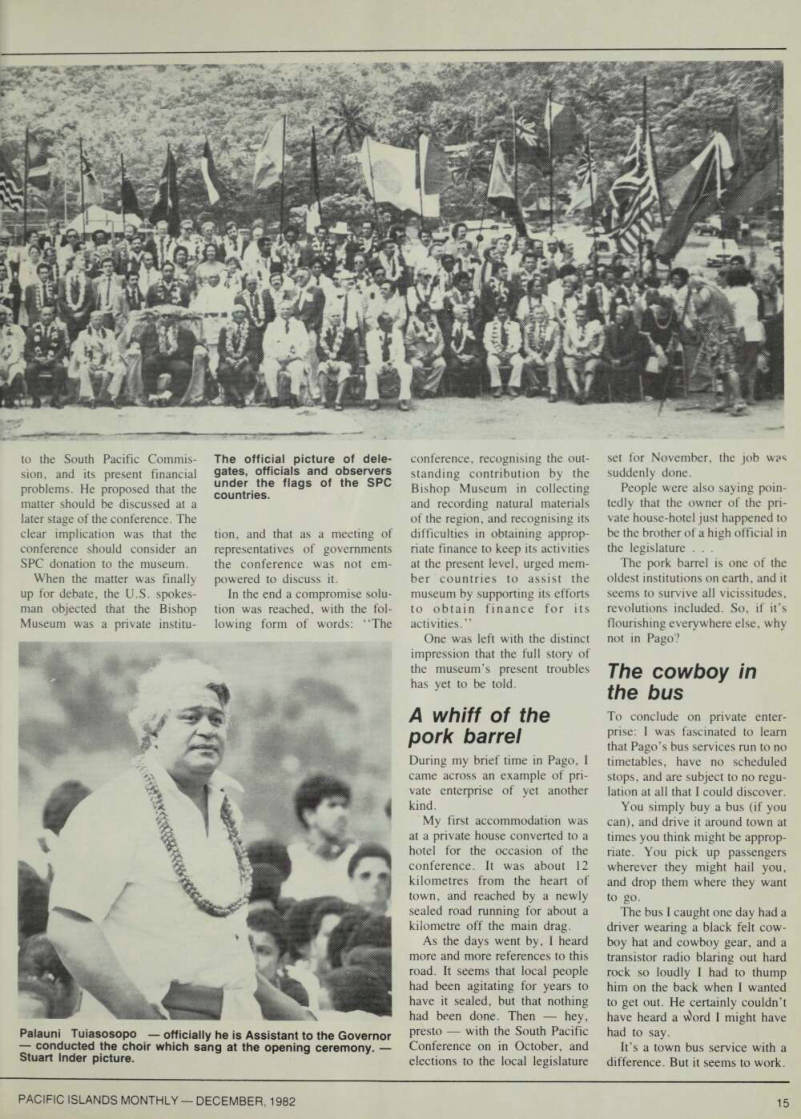
The official picture of dele gates, officials and observers under the flags of the SPC countries.
Advertisements & other items, p. 16 (1 item)
Vi
■ 0 fS 0: y ... 2ri.y mm 0 ■ ili l / u.
from politics and business
22Nd South Pacific Conference
Pago hosts a meeting of “heavies” from politics and business
The opening of the 22nd South Pacific Conference in Pago Pago on October 23 was almost like old times. Established names from the golden years of the South Pacific Commission Ratu Sir Kamisese Mara, Ham mer Deßoburt and Robert Rex
were again present. Tonga’s
King Taufa’ahau Tupou IV and Western Samoa’s Head of State Malietoa Tanumafili made spe cial appearances to add further lustre to the occasion. And for mer Secretaries-General Fred Betham and Macu Salato were in attendance to reaffirm the con tinuity of the SPC. It was all an impressive display of confidence in the SPC. Or was it?
There are other explanations that could be offered. The illus
trious turnout might have been the “21st” celebrations which the conference did not have last year. It may have been just an act of respect for an ageing institu tion. It is even possible that the opening had nothing to do with the SPC directly but was wholly a gesture of goodwill towards host American Samoa’s Gover nor, Peter Tali Coleman.
Whatever their intentions in attending (and informal conver sation during the conference sug gested that the show of support was not accidental), the momen tum created by the large number of regional leaders continued into the work of the conference pro per. By conference end, the vote of confidence in the SPC was unmistakable.
Indeed, concrete evidence of support for the conference was clear even before the opening gavel. While many of the senior leaders left shortly after the offi cial opening, a number remained for the working sessions. These included Sir Thomas Davis, Robert Rex and New Zealand’s Deputy PM Duncan Maclntyre.
In all, approximately two-thirds of the 25 delegations present were headed by leaders of
ministerial rank or above. More overt expressions of support were not long in coming.
Lord Belstead, leading the British delegation, asked for the floor within the first hour to make a special statement. His remarks included references to the value of the SPC as a vehicle for regional co-operation, to the importance of regionalism to the UK, and to the usefulness of the SPC in providing his government
with access to the region. The theme of the SPC’s contribution to regional co-operation was sec onded from the small islands perspective immediately after wards by Prime Minister Davis of the Cooks.
The issue of the role of the SPC, if any, in South Pacific regionalism has overhung the or ganisation like the sword of Damocles for a full decade now.
The pendulum, however, ap-
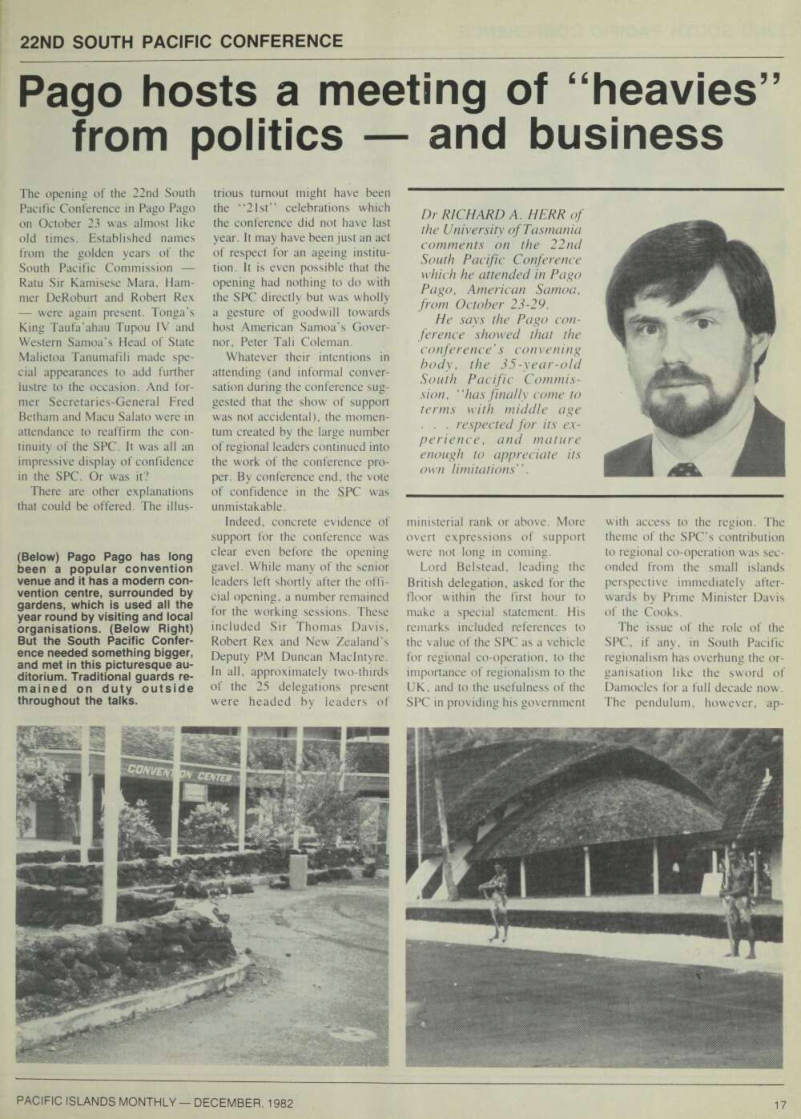
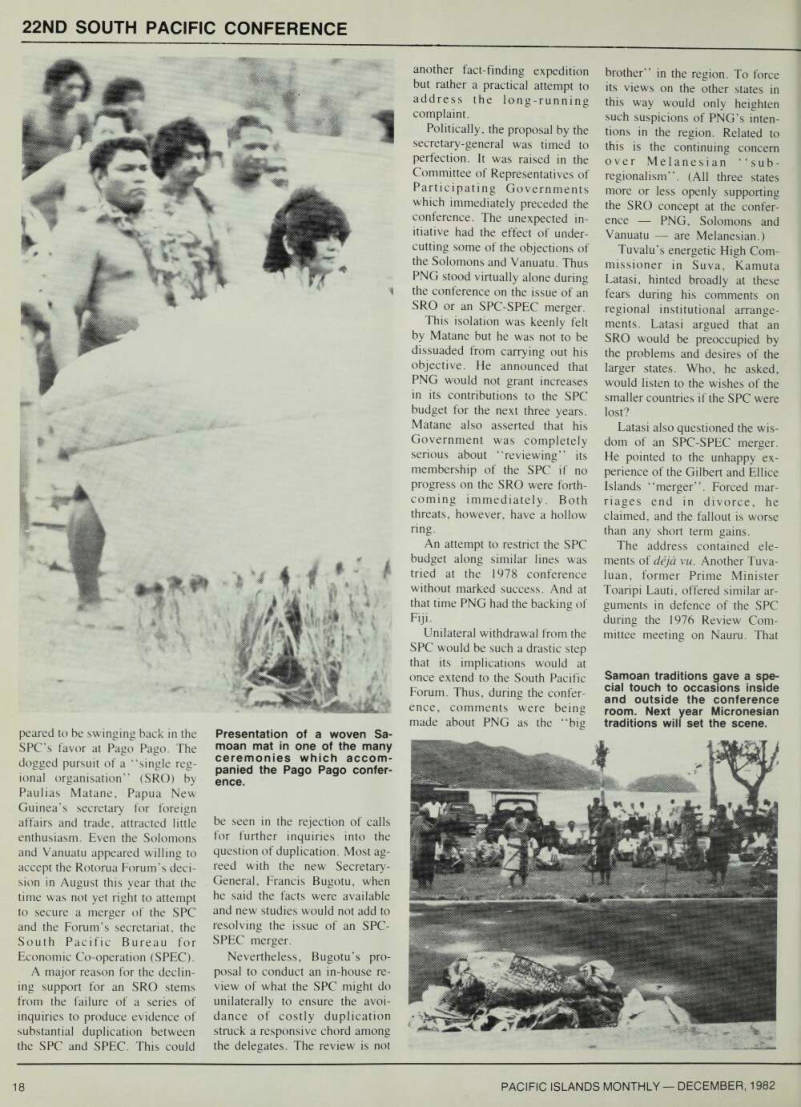
(Below) Pago Pago has long been a popular convention venue and it has a modern con vention centre, surrounded by gardens, which is used all the year round by visiting and local organisations. (Below Right) But the South Pacific Confer ence needed something bigger, and met in this picturesque au ditorium. Traditional guards re mained on duty outside throughout the talks.
Dr Richard A. Herr Of
the University of Tasmania comments on the 22nd South Pacific Conference which he attended in Pago Pago, American Samoa, from October 23-29.
He says the Pago con ference showed that the conference’s convening body, the 35-year-old South Pacific Commis sion, "has finally come to terms with middle age . . . respected for its ex perience, and mature enough to appreciate its own limitations".
peared to be swinging back in the SPC’s favor at Pago Pago. The dogged pursuit of a “single reg ional organisation” (SRO) by Paulias Matane, Papua New Guinea’s secretary for foreign affairs and trade, attracted little enthusiasm. Even the Solomons and Vanuatu appeared willing to accept the Rotorua Forum’s deci sion in August this year that the time was not yet right to attempt to secure a merger of the SPC and the Forum’s secretariat, the South Pacific Bureau for Economic Co-operation (SPEC).
A major reason for the declin ing support for an SRO stems from the failure of a series of inquiries to produce evidence of substantial duplication between the SPC and SPEC. This could
be seen in the rejection of calls for further inquiries into the question of duplication. Most ag reed with the new Secretary- General, Francis Bugotu, when he said the facts were available and new studies would not add to resolving the issue of an SPC SPEC merger.
Nevertheless, Bugotu’s pro posal to conduct an in-house re view of what the SPC might do unilaterally to ensure the avoi dance of costly duplication struck a responsive chord among the delegates. The review is not
another fact-finding expedition but rather a practical attempt to address the long-running complaint.
Politically, the proposal by the secretary-general was timed to perfection. It was raised in the Committee of Representatives of
Participating Governments
which immediately preceded the conference. The unexpected in itiative had the effect of under cutting some of the objections of the Solomons and Vanuatu. Thus PNG stood virtually alone during the conference on the issue of an SRO or an SPC-SPEC merger.
This isolation was keenly felt by Matane but he was not to be dissuaded from carrying out his objective. He announced that PNG would not grant increases in its contributions to the SPC budget for the next three years.
Matane also asserted that his Government was completely serious about “reviewing” its membership of the SPC if no progress on the SRO were forth
coming immediately. Both
threats, however, have a hollow
ring.
An attempt to restrict the SPC budget along similar lines was tried at the 1978 conference without marked success. And at that time PNG had the backing of
Fiji.
Unilateral withdrawal from the SPC would be such a drastic step that its implications would at once extend to the South Pacific Forum. Thus, during the confer ence, comments were being made about PNG as the “big
brother” in the region. To force its views on the other states in this way would only heighten such suspicions of PNG’s inten tions in the region. Related to this is the continuing concern over Melanesian “sub regionalism”. (All three states more or less openly supporting the SRO concept at the confer ence PNG, Solomons and Vanuatu are Melanesian.) Tuvalu’s energetic High Com missioner in Suva, Kamuta Latasi, hinted broadly at these fears during his comments on regional institutional arrange ments. Latasi argued that an SRO would be preoccupied by the problems and desires of the larger states. Who, he asked, would listen to the wishes of the smaller countries if the SPC were lost?
Latasi also questioned the wis dom of an SPC-SPEC merger.
He pointed to the unhappy ex perience of the Gilbert and Ellice Islands “merger”. Forced mar riages end in divorce, he claimed, and the fallout is worse than any short term gains.
The address contained ele ments of dejd vu. Another Tuva luan, former Prime Minister Toaripi Lauti, offered similar ar guments in defence of the SPC during the 1976 Review Com mittee meeting on Nauru. That
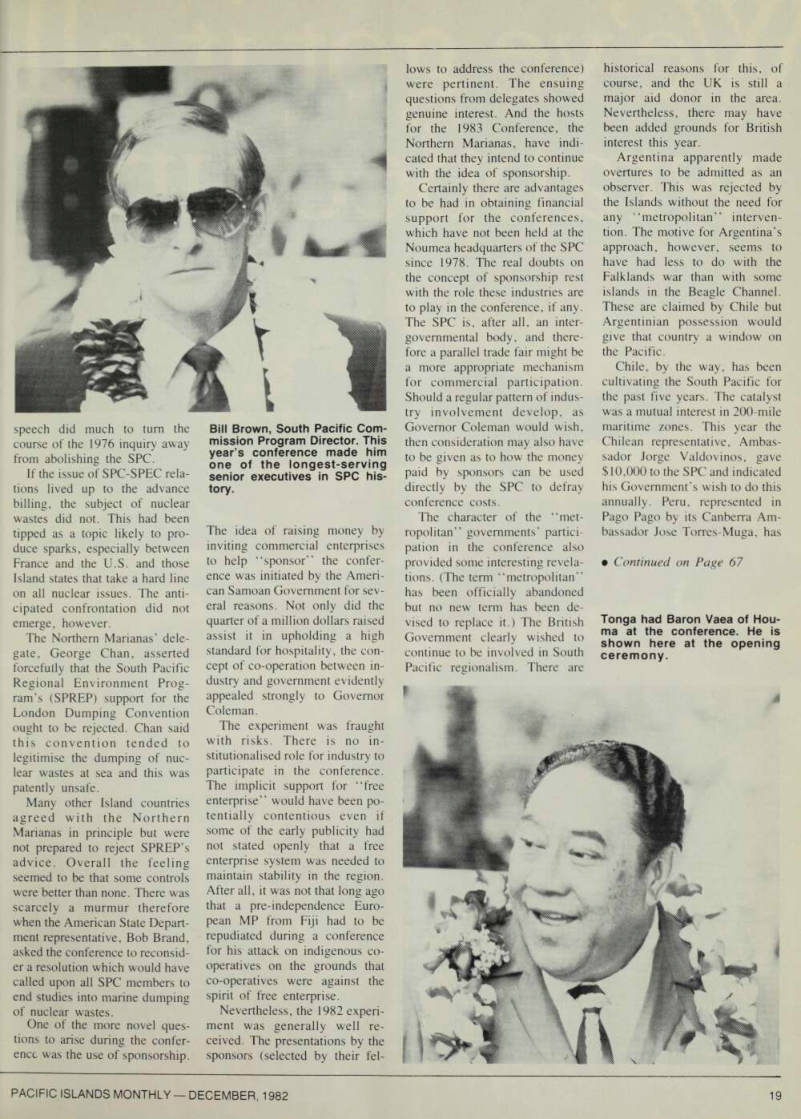
Presentation of a woven Sa moan mat in one of the many ceremonies which accom
panied the Pago Pago confer
ence.
Samoan traditions gave a spe cial touch to occasions inside and outside the conference room. Next year Micronesian traditions will set the scene.
speech did much to turn the course of the 1976 inquiry away from abolishing the SPC.
If the issue of SPC-SPEC rela tions lived up to the advance billing, the subject of nuclear wastes did not. This had been tipped as a topic likely to pro
duce sparks, especially between
France and the U.S. and those Island states that take a hard line on all nuclear issues. The anti cipated confrontation did not emerge, however.
The Northern Marianas’ dele gate, George Chan, asserted forcefully that the South Pacific Regional Environment Prog ram’s (SPREP) support for the London Dumping Convention ought to be rejected. Chan said this convention tended to legitimise the dumping of nuc lear wastes at sea and this was
patently unsafe.
Many other Island countries agreed with the Northern Marianas in principle but were not prepared to reject SPREP’s advice. Overall the feeling seemed to be that some controls were better than none. There was scarcely a murmur therefore when the American State Depart ment representative, Bob Brand, asked the conference to reconsid er a resolution which would have called upon all SPC members to end studies into marine dumping of nuclear wastes.
One of the more novel ques tions to arise during the confer ence was the use of sponsorship.
The idea of raising money by
inviting commercial enterprises
to help “sponsor” the confer ence was initiated by the Ameri can Samoan Government for sev eral reasons. Not only did the quarter of a million dollars raised assist it in upholding a high standard for hospitality, the con cept of co-operation between in dustry and government evidently appealed strongly to Governor Coleman.
The experiment was fraught
with risks. There is no in stitutionalised role for industry to participate in the conference.
The implicit support for “free enterprise” would have been po tentially contentious even if some of the early publicity had not stated openly that a free enterprise system was needed to maintain stability in the region.
After all, it was not that long ago that a pre-independence Euro pean MP from Fiji had to be
repudiated during a conference
for his attack on indigenous co operatives on the grounds that co-operatives were against the
spirit of free enterprise.
Nevertheless, the 1982 experi ment was generally well re ceived. The presentations by the sponsors (selected by their fel
lows to address the conference) were pertinent. The ensuing questions from delegates showed genuine interest. And the hosts for the 1983 Conference, the Northern Marianas, have indi cated that they intend to continue with the idea of sponsorship.
Certainly there are advantages to be had in obtaining financial support for the conferences, which have not been held at the Noumea headquarters of the SPC since 1978. The real doubts on the concept of sponsorship rest with the role these industries are to play in the conference, if any.
The SPC is, after all, an inter governmental body, and there fore a parallel trade fair might be a more appropriate mechanism for commercial participation.
Should a regular pattern of indus try involvement develop, as Governor Coleman would wish, then consideration may also have to be given as to how the money paid by sponsors can be used
directly by the SPC to defray
conference costs.
The character of the “met
ropolitan” governments’ partici
pation in the conference also
provided some interesting revela
tions. (The term “metropolitan” has been officially abandoned but no new term has been de vised to replace it.) The British Government clearly wished to continue to be involved in South Pacific regionalism. There are
historical reasons for this, of course, and the UK is still a major aid donor in the area.
Nevertheless, there may have been added grounds for British interest this year.
Argentina apparently made overtures to be admitted as an observer. This was rejected by the Islands without the need for any “metropolitan” interven tion. The motive for Argentina’s approach, however, seems to have had less to do with the Falklands war than with some islands in the Beagle Channel.
These are claimed by Chile but Argentinian possession would give that country a window on the Pacific.
Chile, by the way, has been cultivating the South Pacific for the past five years. The catalyst was a mutual interest in 200-mile maritime zones. This year the Chilean representative. Ambas sador Jorge Valdovinos, gave $lO,OOO to the SPC and indicated his Government’s wish to do this annually. Peru, represented in Pago Pago by its Canberra Am bassador Jose Torres-Muga, has
• Continued on Page 67
Bill Brown, South Pacific Com mission Program Director. This year’s conference made him one of the longest-serving senior executives in SPC his tory.
Tonga had Baron Vaea of Hou ma at the conference. He is shown here at the opening ceremony.
also been active in the SPC in recent years.
The American delegation was perhaps at the highest level for any South Pacific Conference.
The reason was evidently a show of support for American Samoa — although some wires did ap pear to be crossed between Pago and Washington. Governor Col eman referred several times dur ing the conference to American Samoa’s internal political re sponsibility. At odds with these assertions, however, was the fact that the American delegation was headed by Interior Department Assistant Secretary, Pedro San- Juan, who is responsible for the
U.S. dependencies.
It was somewhat surprising that the element of dependency should have been emphasised. In recent years, the U.S. ambas sador to Suva has led the U.S. delegation. It was rumored that the present incumbent, Fred Eck ert, would have been available but Washington decided other wise. Since Eckert was appoint ed to Suva as a friend of the president, the decision seemed
doubly curious.
President Ronald Reagan made a video appearance at the Conference to welcome dele gates to Pago Pago. His address received more than polite atten tion as most felt it gave the conference greater visibility in the ,U.S.
The Australian delegation was headed by the Minister for De fence Support, Ian Viner.
Perhaps because alphabetical or der dictated that it was called upon first when “metropolitan” interventions were sought, Aust ralia tended to take a more cauti ous line than some of the others.
It may be, however, that Aust ralia now has so much invested in its relations with the Islands that Canberra is becoming rather too careful about rocking any regional boats. This was particu larly evident on SPC-SPEC rela tions where Australia’s com ments could have been taken for either side.
Finally, the success of the con
ference depended substantially
on the work of the secretariat.
The new secretary-general and his staff carried out their duties without a single false step. In deed, Bugotu had some notable successes to his credit. He managed to get a rise in the budget. The work program was adopted without serious modifi cation. His proposal to conduct an in-house review greatly
strengthened the SPC’s position
during the debate on SPC-SPEC relations. And he spoke with authority in defence of the SPC and its work in the region. In all, it was a very polished perform ance for his first conference.
Having attended South Pacific Conferences for the past 11 years, I would have to conclude that this was the most “normal”
Conference since Rarotonga in 1974. The SPC is now 35 years old and it seems thpt the organ isation has finally come to terms with middle age. It is respected for its experience, and mature enough to appreciate its own limitations.
The scene in Pago Pago at the official opening of the 22nd South Pacific Conference. Governor Coleman is greeting delegates as they arrive by car for the ceremony.
Advertisements & other items, p. 20 (1 item)
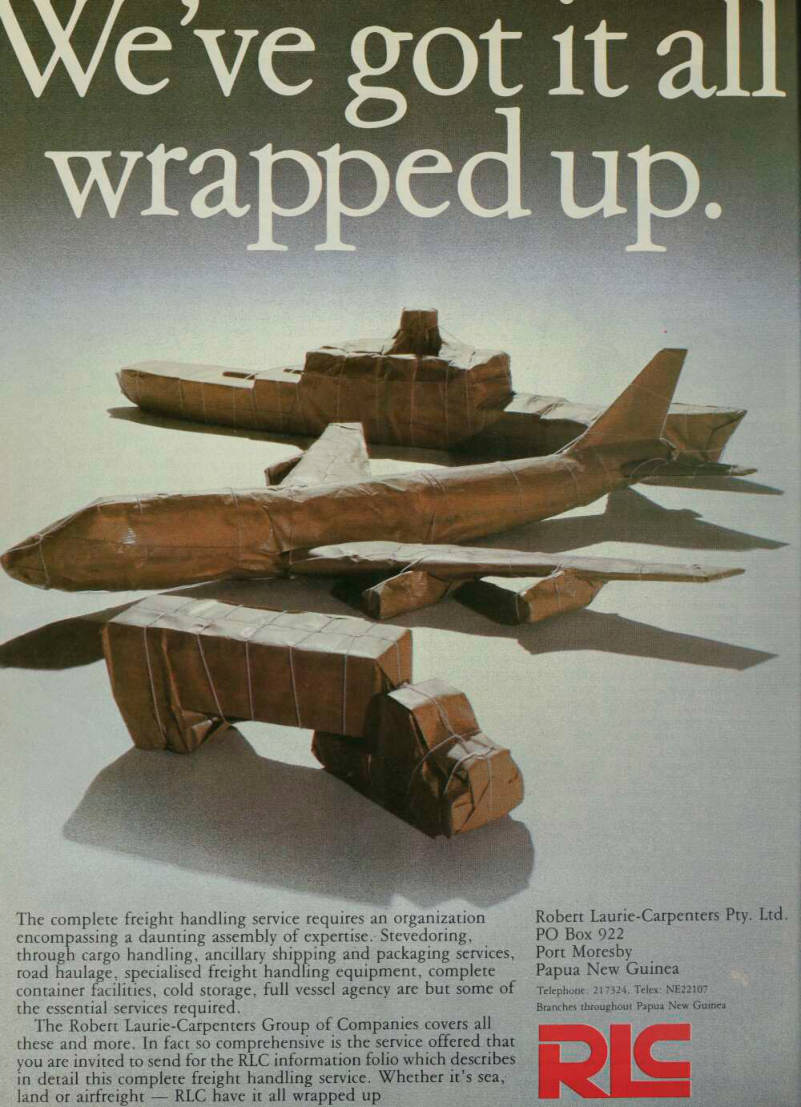
The complete freight handling service requires an organization
encompassing a daunting assembly of expertise. Stevedoring, through cargo handling, ancillary shipping and packaging services, road haulage, specialised freight handling equipment, complete container facilities, cold storage, full vessel agency are but some of the essential services required.
The Robert Laurie-Carpenters Group of Companies covers all these and more. In fact so comprehensive is the service offered that you are invited to send for the RJLC information folio which describes in detail this complete freight handling service. Whether it’s sea, land or airfreight RLC have it all wrapped up Robert Laurie-Carpenters Pty. Ltd.
PO Box 922 Port Moresby Papua New Guinea Telephone; 217324, Telex: NE22107 Branches throughout Papua New Guinea
Queen gets warm welcome, but
Visiting Royalty
Queen gets warm welcome, but PNG looks at its royal link
Wherever the Queen went there was warmth, affection, color and ceremony. But there were also developments which showed the changing nature of the Pacific scene, and which pointed to a new chapter in links between the old world and the new Pacific.
Papua New Guinea in particu lar illustrated the changing scene. The government there was embarrassed when a leaked re port revealed recommendations that the Queen should no longer be formal head of state. But Prime Minister Michael Somare reflected the feeling of his people when he asked Queen Elizabeth to return shortly to open a new
national parliament building
and she accepted.
Solomon Islands has already debated a similar report in parlia ment, suggesting that a local
president should replace the
Queen as head of state. So far Solomon Islands has not adopted any formal recommendation, and in Papua New Guinea the parlia ment has yet to debate certain aspects of a report from the PNG General Constitutional Commission.
Neither country is likely to make any early constitutional change, but the existence of the reports and the evidence which led to them is symptomatic of the changing politics of the Pacific.
PNG was also in the news during the Queen’s Pacific visit when a newspaper published there carried an article highly critical of the Royal Family. The article led to a clash between the owner and some of his staff, and the sale of the newspaper several
days later.
Fiji’s welcome to the Queen was warm and spontaneous, and perhaps the only note of criticism was because it was too formal.
An editorial in the Fiji Times described Queen Elizabeth as the people’s queen, but said that the stiff formality which had sur rounded her visit had given her little chance to meet the people, and little chance for them to meet her.
Queen Elizabeth of England who is also the constitutional head of state of seven Pacific countries visited the Pacific in October. She went to six Island countries: Papua New Guinea, Fiji, Nauru, Solomon Islands, Kiribati and Tuvalu.
One of the highlights of her Fiji tour was to visit the little island of Bau where Fiji chiefs paid homage to her as a chief in her own right. She opened a meeting of the Great Council of Chiefs, and during the cere monies there she presented the award of the Royal Victorian Chain to the Governor-General, Ratu Sir George Cakobau. It is a rare award today, confined to royalty or senior national leaders.
The Deputy Prime Minister, Ratu Sir Penaia Ganilau, was made a Knight Commander of the Royal Victorian Order at a ceremony on board the Royal Yacht Britannia. The award was made by the Queen in recogni tion of the Deputy Prime Minis ter’s part in establishing what was called a special relationship between Fiji and the throne.
Historically, the Queen’s visit to Tuvalu was one of the high lights of her Pacific tour. Tuvalu has the distinction of being the smallest country of which she is Queen. It is 90 years since the country has been associated with the British Grown and there have been several visits by members of the Royal Family, but the Queen was the first reigning monarch to make a visit.
More than 20 traditional canoes escorted the Queen and the Duke of Edinburgh when they came ashore to a colorful
welcoming ceremony. They
walked from the landing area on a carpet of woven mats. Children sang songs and showered the Queen with flowers.
In the Solomon Islands the Queen withstood the famous “nerve test” where men carrying spears attempt to frighten away visitors, and where the measure of the visitor’s stature is to stand fast without flinching. Conch
shells were used like trumpets to welcome the Queen.
The island of Tarawa in Kiribati and the island country of Nauru had the biggest crowds to gather for many years when the Queen visited them. On Nauru white paint was used to brighten up roadside tree trunks in honor of the Queen’s visit.
In Papua New Guinea the Queen’s visit to the Highlands town of Mount Hagen coincided with a savage hailstorm which smashed windows and wind screens, but did not cause any injuries.
Wrapping up the Queen’s four-week tour of the Islands, the English journalist Grania Forbes wrote; “It is true that at times she must have felt the strain as she battled not only against the sear ing heat and oppressive humidi ty, but also against language and cultural barriers.
“Contrary to her image as a reserved and somewhat dignified figure, she has taken the oddest of situations in her stride and with her marvellous good humor she has enjoyed every twist of this magical mystery tour around the Pacific.’’
Newspaper starts
a royal row Ray Thurecht is a difficult man to typify. He exudes a sort of restrained ostentation, bolstered by a history of real achievement which is his ultimate strength.
Like many who have turned a basic skill or technical ability into solid commercial success, he tends to be not quite identifi able with any particular camp.
And like them, too, he may not realise this himself. It’s one of the penalties of a certain type of success.
Thurecht, who is just into his fifties, went from Brisbane in the Australian state of Queensland to Port Moresby in Papua New Guinea nearly 30 years ago. He went there as a Linotype techni cian (a fast-dying trade with the onset of new technology) for the South Pacific Post newspaper, now the PNG Post-Courier. He formed his own job-printing business, PNG Printing, in the 1960 s and he hasn’t looked back.
He leamt to fly (his business runs an aircraft today), he became top man in the PNG chambers of commerce movement, and he kept abreast of new technology in the printing and graphic arts industries. From printing it was a natural step into publishing, and
he eventually amalgamated a
number of news sheets into a five-day-a-week paper Niugini Nius. Niugini Nius got into top gear just under three years ago, published in Lae and simultane ously printed in Lae and Port Moresby. Thurecht used his air craft to freight page negatives over the mountains from Lae to Port Moresby every evening.
Like many publishers he had early editor troubles, but he eventually secured Charles
Cepulis, a capable journalist who
had first come from Australia to PNG to work in the Post- Courier. Cepulis had been a sub editor and news editor on the Post-Courier, he had acted as a editor on a number of occasions,
and immediately before taking
up the Thurecht appointment he had worked in Suva with The Fiji Times.
The third man in the story was Andy Walker, a Scot who had migrated to Australia, who had worked as a journalist in Mel bourne, and who had joined Niugini Nius in Lae.
Walker wrote an article which
disparaged the 'British Royal
Family and its relationship to PNG and which drew attention to the apparent incongruity of roy alty on the other side of the world being a constitutional part of PNG. The article was published
on the eve of Queen Elizabeth’s recent visit to PNG and was critical of the whole structure of British royalty. It referred to the Duke of Edinburgh once Prince Philip of Greece as “Phil the Greek”, it criticised the earnings and situation of the Queen and of the heir to the throne, the Prince of Wales, and it criticised the morals of the Queen’s sister, Princess
Margaret.
From a political and sociolog ical point of view one of the most interesting aspects of the exercise was Walker’s miscalculation of public feeling towards the British Royal Family and its constitu tional position in PNG. He tend ed to reflect an attitude which is
probably more acceptable today
in sections of the old Common wealth than in new nations which
have deliberately sought mem
bership of the Commonwealth.
In any event, neither Walker nor Cepulis had much opportunity to assess reader reaction. A hor rified Thurecht took one look at what his newspaper had publish ed and ordered the destruction of the entire print run after only a small proportion of the run had been sold.
“He probably saw an honor from the Queen going out the window” was one uncharitable comment. In fairness to Thurecht it would seem that his assessment of general PNG attitudes towards the link with the British Crown was much closer to the mark than that of his newspaper.
Walker and Cepulis walked off the job in protest at their owner’s action, but the paper’s continuity was saved when Thurecht's aircraft flew from Port Moresby to Lae bringing two journalists from the Port Moresby paper The Times. Any suggestion that the two were strike-breaking evaporated when it was revealed that the company they worked for. Word Publish ing. had bought Niugini Nius.
Word Publishing grew out of an ecumenical grouping of churches, and has entered the publishing business with no small success. It has put a Papua New Guinean journalist, Sinclair Solomon, into the editor’s chair at Niugini Nius, Cepulis and Walker have left PNG, and Thurecht has ended his flirtation
with the newspaper industry. The price of the sale was not disclosed.
PNG report calls
for a president
Only six days before the Queen was due to visit Papua New Guinea the government was em barrassed by the leaking of a report which recommends, among other things, that the Queen should cease to be the formal head of state and should
be replaced by a Papua New
Guinean president.
In this respect the contents of the report were similar to recom mendations which have been made in Solomon Islands over the past ten months.
The PNG report came from the General Constitutional Commis sion and was meant to have its first airing in parliament. The chairman of the commission, Mr Mahuru Rarau Rarau, was as embarrassed as the government at the disclosure of parts of the
report. The mere fact that the embarrassment was obvious tends to suggest that the senti ments of the report are not or not yet, anyway entrenched.
The report, which circulated in a number of quarters and which also received newspaper publici ty, claimed that many Papua New Guineans wanted a break from their colonial past and a more efficient and appropriate method of recognising a head of state. The report said there was no suggestion that PNG should relinquish its membership of the Commonwealth.
Under PNG’s present constitu tional structure the Queen as head of state is represented by a Papua New Guinean Governor- General, but the degree of real power which rests with parlia ment and the Prime Minister is considerable. However, the con cept is being increasingly ques tioned, according to the constitu tional commission’s report.
The report said “We accept the British Monarch as head of
the Commonwealth of which we are, and will continue to be, a member. We will continue to show Queen Elizabeth our re spect and affection, and will wel come her and her family with our traditional hospitality. But that is a different thing from actually vesting the executive power in the Queen as our head of state.”
The commission’s recommen dation for a president provides for greater effective power than that which is at present vested in the Governor-General. The ap pointment should be made by parliament, the report says. The recommendation also suggests the establishment of a PNG sys tem of honors to replace the present Imperial system. Parlia ment has yet to debate the report.
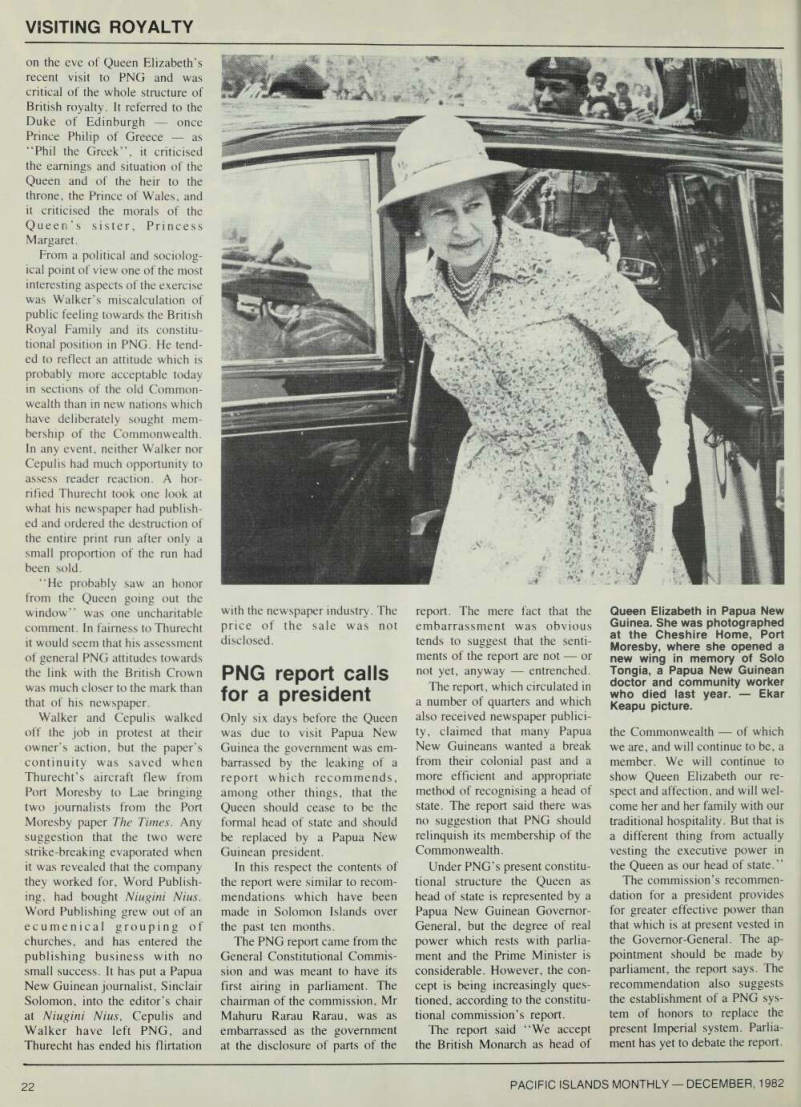
Queen Elizabeth in Papua New Guinea. She was photographed at the Cheshire Home, Port Moresby, where she opened a new wing in memory of Solo Tongia, a Papua New Guinean doctor and community worker who died last year. Ekar
Keapu picture.
Islands
From the
Press
From The Fiji Times, Suva A heading Village crime groups urged.
From an editorial in Voice of Vanuatu, Port-Vila Smart, Britain and France. This week’s jail break showed up yet another example of the incompetent way you organised your New Hebrides. Former colonial masters didn’t leave one secure jail in the land . . .
From a letter in Te Uekeraa, Tarawa. Kiribati, written by Ruka Betero and Ritita Arawatau, Makin Island, protesting against nuclear tests . . . Even though little constructive or effective measures could be taken by our country, we hereby add more noise to the growing uproar.
From an article by Akio Heine in the Marshall Islands Journal on indigenous languages in the Pacific . . . Unfortunately, when you talk in Marshallese without peppering your conversation with some big English words, you are seen as unimportant, a down to earth kind of a guy and even simple minded. Sometimes, you are seen as just a copra maker or what is known locally as ‘‘no school.”
From the Pitcairn Miscellany, Pitcairn Island Would you believe it? That 689 Pitcairn Island T-shirts arrived on Wednesday 16th and were all sold by Thursday 17th. Those Pitcairners sure wear a lot of T-shirts.
From an editorial in the Solomon Star, Honiara, on the Westminster system of government ... no political party has enough good men to form an effective goverment. Some are young, some are too inexperienced, some are corrupt. They come to be Ministers not because they are the best men for the job, but because they promise their vote to one of the party leaders. It is time to stop this. We do not need political parties; we need good men. There are good men in all three parties, and among the independents. It is the duty of these men to stop their party squabbling and form a government of national unity to save Solomon Islands from the mess the Westminster system has got us into.
From Tohi Tala Niue, regarding the reorganisation of the post office and the location of the letter boxes The little room where the boxes are kept is not to be used for consuming of food or as a toilet facility. I know some of you would find it convenient for other purposes. Please do not urinate in that little room.
From the Marshall Islands Journal Senator Katip Mack, the law and order senator from nearby Amo, used body language at Nitijela today to illustrate how he feels and wound up in jail for asserting his feelings too graphically. Mack, the judiciary and governmental affairs committee chairman, was arrested at the Nitijela building for busting windows. Mack not noted for diplomatic negotiations on the Nitijela floor, broke four glass windows and one door by throwing rocks at them.
From The Reporter, Papua New Guinea Reward offered. A reward of KlOO will be offered for the recovery of various items which fell out a hole in my sittingroom window while I was away in Port Moresby recently.
These items include a Luxman cassette deck, a pair of EPI
speakers, a Pentax SPIOOO, a portable Sanyo radio/cassette player, a radio/clock, a black palm bow, four arrows and $2O.
From Uni Tavur, produced by journalism students of the University of Papua New Guinea The number of plates in the UPNG mess has decreased from over 1300 to about 300 after 1008 new plates were issued six weeks ago. “I think there are some well-equipped villages around,” said catering manager Mr Richard Cullen. The plates, each worth K 1.64, were issued along with 1200 cups. Only one tray of cups is left. Mr Cullen said, ‘‘We only have 40 pudding plates now, inadequate to provide pudding for everyone. Some people have starting buying their own plates.
From Tohi Tala Niue, Niue Island A Japanese, British, New Zealand production of the film ‘‘Merry Christmas Mr Lawrence” which is currently being shot in the Cook Islands require 500 skinny white men to play the part as prisoners for 40 dollars a day, but Rarotonga hasn’t got that many skinny white men, so 150 men are to be airlifted from Auckland. This is not enough so according to Cook Islands News 500 skinny white women are now sought to act. The news was released in New Zealand, the man who recruited 150 skinny white men has been placed with calls from skinny white women wanting parts. He has protested that all the calls are hurting his business and wants it to stop.
From the Marianas Variety News & Views, in an article reporting on the policy that passengers have priority over mail on Air Micronesia Complaints that Yap and Palau have not received any mail for 14 days because Air Micronesia flights are booked solid with passengers, have been filed with the airline.
From a letter by Viliame Dau, of Labasa, in The Fiji Times, Suva As an educated Fijian, I found the Prime Minister’s outburst about cannibals and clubbing utterly baffling. There is nothing really to be upset about. In fact, most Fijians are quite proud of our cannibal history and joke about it to visitors. Our tourist brochures successfully use it as a drawcard in selling the country overseas. . .
From the Papua New Guinea Post-Courier, Port Moresby The member for Namatanai and former Prime Minister, Sir Julius Chan, says the National Broadcasting Commission is giving too much prominence to politicians who were defeated in the June elections. In calling on Radio New Ireland not to give airplay to defeated candidates, Sir Julius said: ‘‘Defeated candidates are not spokesmen for the people; they do not represent any legal group and they speak without authority.”
From an editorial in The Fiji Times on the aftermath of
the July general elections
. . . The next few weeks and months are going to be testing times, not only for the Opposition but for parliamentary democracy. The present session of the House has generated so chilly an atmosphere that one could cut it with a knife. The resurgence of racial politics is beginning to cast an ugly shadow over the land. In a secular state like ours, it is absolutely essential to have a strong Government and an equally strong Opposition.
What U.S. lawyer Dick Gerry thinks about the U.S. negotiations with the Marshall Islands, as reported in the Marshall Islands Journal, Majuro ‘‘They are negotiating the same way Custer negotiated with the Indians as unequal inferiors instead of a sovereign nation,”
Gerry said.
From an article on Graphology in Te Uekeraa, Tarawa, Kiribati Sexual traits are also revealed by handwriting. It can, according to Patricia Marne, suggest a lack of interest in sex, possibly frigidity or impotence; or it can suggest a tendency to boast.
Male and female homosexuals write differently from heterosexuals.
from regional Commonwealth
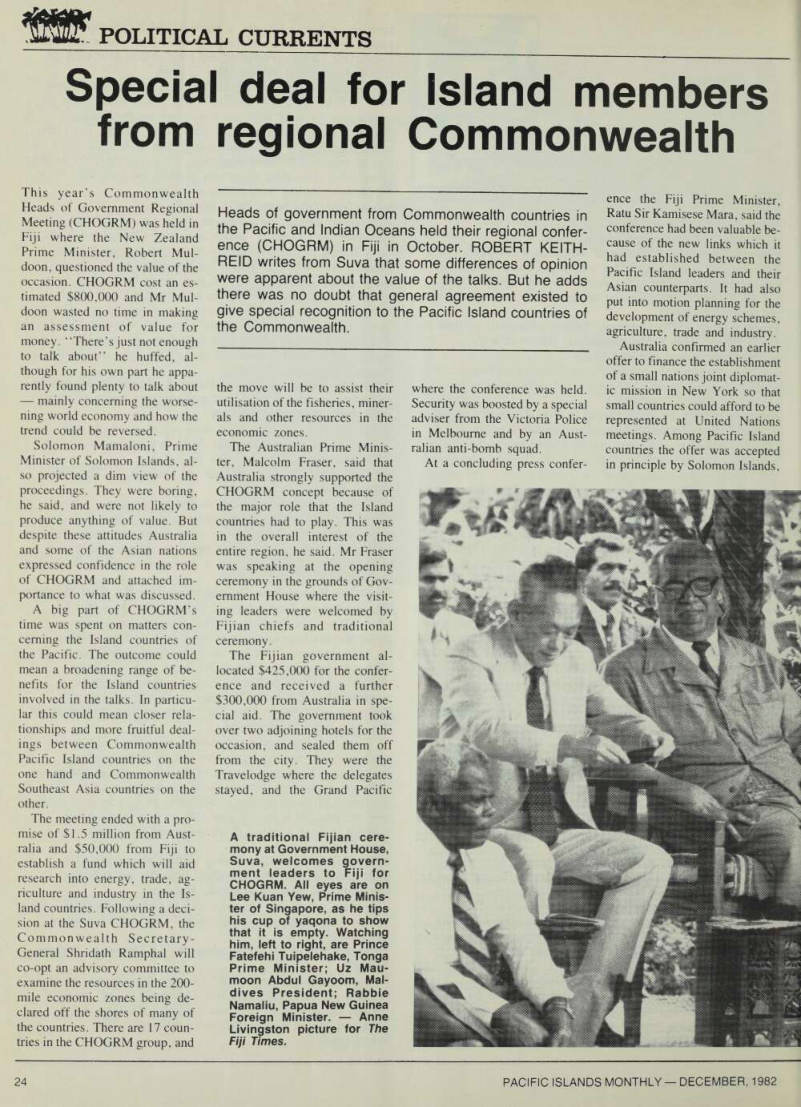
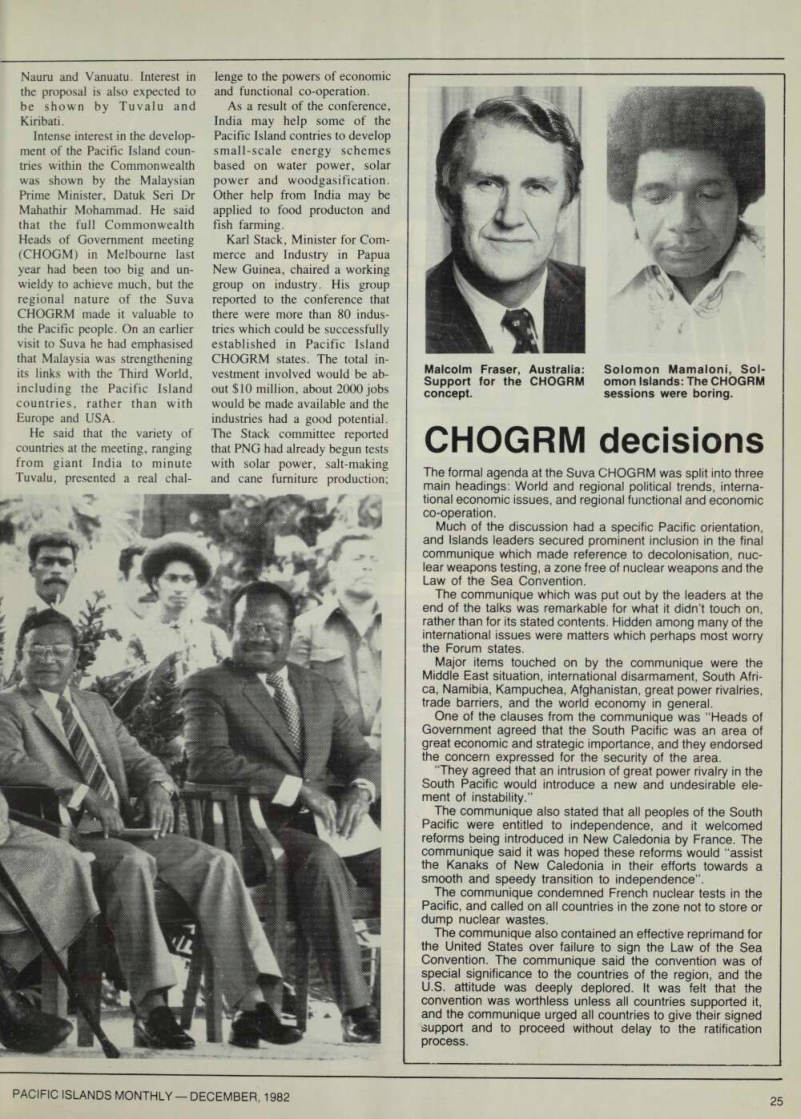
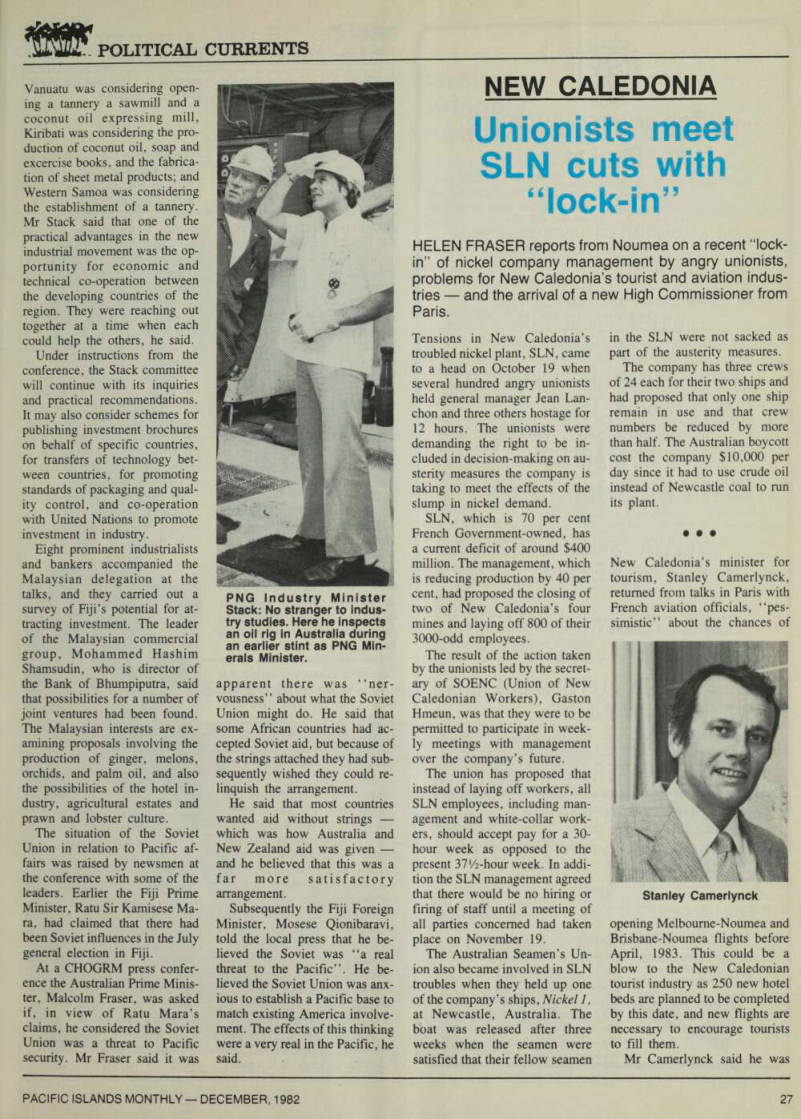
Political Currents
Special deal for Island members from regional Commonwealth
Heads of government from Commonwealth countries in the Pacific and Indian Oceans held their regional confer ence (CHOGRM) in Fiji in October. ROBERT KEITH REID writes from Suva that some differences of opinion were apparent about the value of the talks. But he adds there was no doubt that general agreement existed to give special recognition to the Pacific Island countries of the Commonwealth.
This year’s Commonwealth Heads of Government Regional Meeting (CHOGRM) was held in Fiji where the New Zealand Prime Minister, Robert Mul doon, questioned the value of the occasion. CHOGRM cost an es timated $BOO,OOO and Mr Mul doon wasted no time in making an assessment of value for money. “There’s just not enough to talk about’’ he huffed, al though for his own part he appa rently found plenty to talk about
mainly concerning the worse
ning world economy and how the trend could be reversed.
Solomon Mamaloni, Prime Minister of Solomon Islands, al so projected a dim view of the
proceedings. They were boring,
he said, and were not likely to produce anything of value. But despite these attitudes Australia and some of the Asian nations expressed confidence in the role of CHOGRM and attached im portance to what was discussed.
A big part of CHOGRM’s time was spent on matters con cerning the Island countries of the Pacific. The outcome could mean a broadening range of be nefits for the Island countries involved in the talks. In particu lar this could mean closer rela tionships and more fruitful deal ings between Commonwealth Pacific Island countries on the one hand and Commonwealth Southeast Asia countries on the other.
The meeting ended with a pro mise of $1.5 million from Aust ralia and $50,000 from Fiji to establish a fund which will aid research into energy, trade, ag riculture and industry in the Is land countries. Following a deci sion at the Suva CHOGRM, the
Commonwealth Secretary-
General Shridath Ramphal will co-opt an advisory committee to examine the resources in the 200mile economic zones being de clared off the shores of many of the countries. There are 17 coun tries in the CHOGRM group, and
the move will be to assist their utilisation of the fisheries, miner als and other resources in the economic zones.
The Australian Prime Minis ter, Malcolm Fraser, said that Australia strongly supported the CHOGRM concept because of the major role that the Island countries had to play. This was in the overall interest of the entire region, he said. Mr Fraser was speaking at the opening ceremony in the grounds of Gov ernment House where the visit ing leaders were welcomed by Fijian chiefs and traditional ceremony.
The Fijian government al located $425,000 for the confer ence and received a further $300,000 from Australia in spe cial aid. The government took over two adjoining hotels for the occasion, and sealed them off from the city. They were the Travelodge where the delegates stayed, and the Grand Pacific
where the conference was held.
Security was boosted by a special adviser from the Victoria Police in Melbourne and by an Aust ralian anti-bomb squad.
At a concluding press confer
ence the Fiji Prime Minister, Ratu Sir Kamisese Mara, said the conference had been valuable be cause of the new links which it had established between the Pacific Island leaders and their Asian counterparts. It had also put into motion planning for the development of energy schemes, agriculture, trade and industry.
Australia confirmed an earlier offer to finance the establishment of a small nations joint diplomat ic mission in New York so that small countries could afford to be represented at United Nations meetings. Among Pacific Island countries the offer was accepted in principle by Solomon Islands,
A traditional Fijian cere mony at Government House, Suva, welcomes govern ment leaders to Fiji for CHOGRM. All eyes are on Lee Kuan Yew, Prime Minis ter of Singapore, as he tips his cup of yaqona to show that it is empty. Watching him, left to right, are Prince Fatefehi Tuipelehake, Tonga Prime Minister; Uz Mau moon Abdul Gayoom, Mal dives President; Rabbie Namaliu, Papua New Guinea Foreign Minister. Anne Livingston picture for The Fiji Times.
Nauru and Vanuatu. Interest in the proposal is also expected to be shown by Tuvalu and Kiribati.
Intense interest in the develop ment of the Pacific Island coun tries within the Commonwealth was shown by the Malaysian Prime Minister, Datuk Seri Dr Mahathir Mohammad. He said that the full Commonwealth Heads of Government meeting (CHOGM) in Melbourne last year had been too big and un wieldy to achieve much, but the regional nature of the Suva CHOGRM made it valuable to the Pacific people. On an earlier visit to Suva he had emphasised that Malaysia was strengthening its links with the Third World, including the Pacific Island countries, rather than with Europe and USA.
He said that the variety of countries at the meeting, ranging from giant India to minute Tuvalu, presented a real chal
lenge to the powers of economic and functional co-operation.
As a result of the conference, India may help some of the Pacific Island contries to develop small-scale energy schemes based on water power, solar power and woodgasification.
Other help from India may be applied to food producton and
fish farming.
Karl Stack, Minister for Com merce and Industry in Papua New Guinea, chaired a working group on industry. His group reported to the conference that there were more than 80 indus tries which could be successfully established in Pacific Island CHOGRM states. The total in vestment involved would be ab out $lO million, about 2000 jobs would be made available and the industries had a good potential.
The Stack committee reported that PNG had already begun tests with solar power, salt-making and cane furniture production;
Vanuatu was considering open ing a tannery a sawmill and a coconut oil expressing mill, Kiribati was considering the pro duction of coconut oil, soap and excercise books, and the fabrica tion of sheet metal products; and Western Samoa was considering the establishment of a tannery.
Mr Stack said that one of the practical advantages in the new industrial movement was the op portunity for economic and technical co-operation between the developing countries of the region. They were reaching out together at a time when each could help the others, he said.
Under instructions from the conference, the Stack committee will continue with its inquiries and practical recommendations.
It may also consider schemes for publishing investment brochures on behalf of specific countries, for transfers of technology bet ween countries, for promoting standards of packaging and qual ity control, and co-operation with United Nations to promote investment in industry.
Eight prominent industrialists and bankers accompanied the Malaysian delegation at the talks, and they carried out a survey of Fiji’s potential for at tracting investment. The leader of the Malaysian commercial group, Mohammed Hashim Shamsudin, who is director of the Bank of Bhumpiputra, said that possibilities for a number of joint ventures had been found.
The Malaysian interests are ex amining proposals involving the production of ginger, melons, orchids, and palm oil, and also the possibilities of the hotel in dustry, agricultural estates and prawn and lobster culture.
The situation of the Soviet Union in relation to Pacific af fairs was raised by newsmen at the conference with some of the leaders. Earlier the Fiji Prime Minister, Ratu Sir Kamisese Ma ra, had claimed that there had been Soviet influences in the July general election in Fiji.
At a CHOGRM press confer ence the Australian Prime Minis ter, Malcolm Fraser, was asked if, in view of Ratu Mara’s claims, he considered the Soviet Union was a threat to Pacific security. Mr Fraser said it was
apparent there was “ner vousness” about what the Soviet Union might do. He said that some African countries had ac cepted Soviet aid, but because of the strings attached they had sub sequently wished they could re linquish the arrangement.
He said that most countries wanted aid without strings which was how Australia and New Zealand aid was given and he believed that this was a far more satisfactory arrangement.
Subsequently the Fiji Foreign Minister, Mosese Qionibaravi, told the local press that he be lieved the Soviet was “a real threat to the Pacific”. He be lieved the Soviet Union was anx ious to establish a Pacific base to match existing America involve ment. The effects of this thinking were a very real in the Pacific, he said.
PNG Industry Minister Stack; No stranger to indus try studies. Here he inspects an oil rig in Australia during an earlier stint as PNG Min erals Minister.
CHOGRM decisions
The formal agenda at the Suva CHOGRM was split into three main headings: World and regional political trends, interna tional economic issues, and regional functional and economic co-operation.
Much of the discussion had a specific Pacific orientation, and Islands leaders secured prominent inclusion in the final communique which made reference to decolonisation, nuc lear weapons testing, a zone free of nuclear weapons and the Law of the Sea Convention.
The communique which was put out by the leaders at the end of the talks was remarkable for what it didn’t touch on, rather than for its stated contents. Hidden among many of the international issues were matters which perhaps most worry the Forum states.
Major items touched on by the communique were the Middle East situation, international disarmament, South Afri ca, Namibia, Kampuchea, Afghanistan, great power rivalries, trade barriers, and the world economy in general.
One of the clauses from the communique was “Heads of Government agreed that the South Pacific was an area of great economic and strategic importance, and they endorsed the concern expressed for the security of the area.
“They agreed that an intrusion of great power rivalry in the South Pacific would introduce a new and undesirable ele ment of instability.”
The communique also stated that all peoples of the South Pacific were entitled to independence, and it welcomed reforms being introduced in New Caledonia by France. The communique said it was hoped these reforms would “assist the Kanaks of New Caledonia in their efforts towards a smooth and speedy transition to independence”.
The communique condemned French nuclear tests in the Pacific, and called on all countries in the zone not to store or dump nuclear wastes.
The communique also contained an effective reprimand for the United States over failure to sign the Law of the Sea Convention. The communique said the convention was of special significance to the countries of the region, and the U.S. attitude was deeply deplored. It was felt that the convention was worthless unless all countries supported it, and the communique urged all countries to give their signed support and to proceed without delay to the ratification process.
Solomon Mamaloni, Sol omon Islands: The CHOGRM sessions were borin`g.
Malcolm Fraser, Australia; Support for the CHOGRM concept.
Advertisements & other items, p. 26 (1 item)
m All-New World of Sonic Clarity
Introducing the Hew PRISM Component Systems.
Refined reproduction performance and enhanced appearance make the Hew PRISM systems an extremely musical , elegant addition to any listening/lining environment.
Another taste of advanced technology from TP AC.
COMPONENT SYSTEMS
faxTrii k 8® Is [O'O], = m i-L I 'J. i : -2* -9
TEAC
Where Art and Technology Meet Australia: TEAC Australia, Ply., Ltd. 115 Whiteman Street South Melbourne. Victoria 3205 New Zealand: Direct Imports (N,Z.) Ltd. P.O, Box 72 Hastings Fuji: D. Jeevan & Sons P.O. Box 148, Suva Jew Caledonia: HIFIVOX 79. Rue de Sebastopol B P 1458, Noumea Tahiti; Etablissements Wiking P.O, Box 237 132 Rue Du Marechat Foch Papeete Vanuatu: Sound Center Box 434, Vila Republic of Vanuatu
Unionists meet
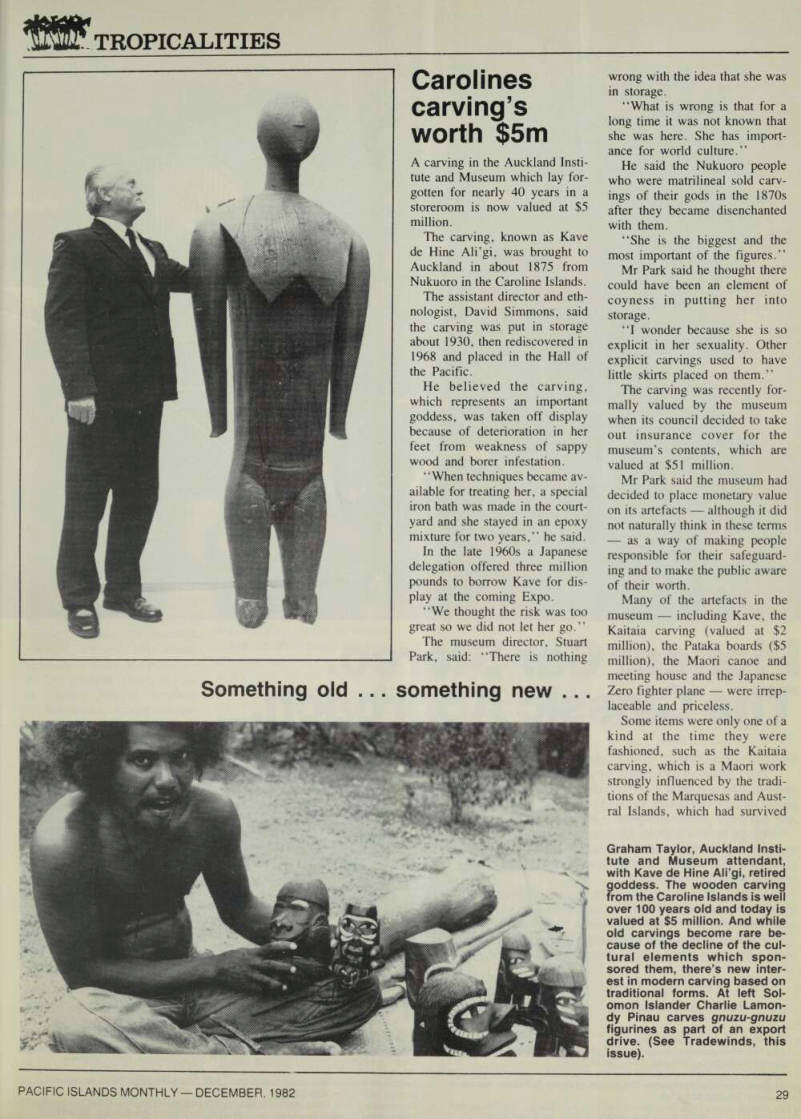

New Caledonia
Unionists meet SLN cuts with “lock-in”
HELEN FRASER reports from Noumea on a recent “lock in” of nickel company management by angry unionists, problems for New Caledonia’s tourist and aviation indus tries and the arrival of a new High Commissioner from Paris.
Tensions in New Caledonia’s troubled nickel plant, SLN, came to a head on October 19 when several hundred angry unionists held general manager Jean Lan chon and three others hostage for 12 hours. The unionists were demanding the right to be in cluded in decision-making on au sterity measures the company is taking to meet the effects of the slump in nickel demand.
SLN, which is 70 per cent French Government-owned, has a current deficit of around $4OO million. The management, which is reducing production by 40 per cent, had proposed the closing of two of New Caledonia’s four mines and laying off 800 of their 3000-odd employees.
The result of the action taken by the unionists led by the secret ary of SOENC (Union of New Caledonian Workers), Gaston Hmeun, was that they were to be permitted to participate in week ly meetings with management over the company’s future.
The union has proposed that instead of laying off workers, all SLN employees, including man agement and white-collar work ers, should accept pay for a 30hour week as opposed to the present 37'/2-hour week. In addi tion the SLN management agreed that there would be no hiring or firing of staff until a meeting of all parties concerned had taken place on November 19, The Australian Seamen’s Un ion also became involved in SLN troubles when they held up one of the company’s ships, Nickel 1, at Newcastle, Australia. The boat was released after three weeks when the seamen were satisfied that their fellow seamen
in the SLN were not sacked as part of the austerity measures.
The company has three crews of 24 each for their two ships and had proposed that only one ship remain in use and that crew numbers be reduced by more than half. The Australian boycott cost the company $lO,OOO per day since it had to use crude oil instead of Newcastle coal to run its plant. • • • New Caledonia’s minister for tourism, Stanley Camerlynck, returned from talks in Paris with French aviation officials, “pes simistic” about the chances of
opening Melboume-Noumea and Brisbane-Noumea flights before April, 1983. This could be a blow to the New Caledonian tourist industry as 250 new hotel beds are planned to be completed by this date, and new flights are necessary to encourage tourists to fill them.
Mr Camerlynck said he was
Stanley Camerlynck
depressed and frustrated with the Paris talks. Australian aviation officials have already given their agreement to the new routes, but French officials had still not gi ven a reply despite having re ceived the relevant documents months before. Tourism is New Caledonia’s second biggest in dustry after nickel, with Aust ralians making up 30 per cent of the 10,000 visitors each year.
Another topic for discussion between Mr Camerlynck and French officials in Paris was the possibility of a regional airline based in New Caledonia. As a French territory, New Caledonia has to receive approval from Paris for such a company. Paris has agreed to its establishment on condition it takes over the Noumea-Wallis service. At pre sent UTA loses nearly $1 million a year on the route, and Mr Camerlynck said that there is no possibility that New Caledonia will accept the responsibility.
The islands of Wallis and Futuna are French dependencies with large populations resident in New Caledonia.
Mr Camerlynck said the only way to solve the problem is for New Caledonia to become more autonomous and gain the power to create a regional airline com pany without intervention from Paris.
On top of all this, New Caledonia’s domestic airline, Air Caledonie, has run into problems over a 30 per cent fare rise.
Supporters of the Independence Front and the Palika party on the Loyalty Islands (east of the main island) blocked runways at Lifou on October 31 and at Mare on November 11. The protestors say that the rise will cause further hardship to the Kanak inhabitants of the islands, most of whom are unemployed. The government council, which had approved the rise, then reviewed the situation and decided on an immediate 18 per cent rise to be followed by a further rise of 15 per cent in March. This was not acceptable and the runway at Lifou was blocked again on November 6 as protestors demanded that the in crease be restricted to 15 per cent for one year. Government Coun cil and Territorial Assembly politicians, together with Air Caledonie officials, held a public
meeting in Lifou and the block ade was called off. • • • France’s High Commissioner to New Caledonia of 11 months, Christian Nucci, bade a tearful farewell to the territory on Oc tober 22, with his replacement, Jacques Roynette, 46, arriving two days later.
Mr Nucci, a senior French Socialist Party politician, was sent to New Caledonia to help the implementation of the French program of economic and social reform. Mr Roynette, also a socialist, is a former high school teacher and has been active in French local politics since 1971.
He said that his top priorities during his indefinite stay in New Caledonia will be dealing with the nickel crisis, continuing with the reforms and working on a revision of the statute which gov erns New Caledonia.
Mr Roynette was greeted at Noumea’s Magenta Airport by several dozen demonstrators from the newly formed Front
Caledonien. Led by Republican
(RCPR) Party member of the Territorial Assembly, Justin Guillemard, the demonstrators carried banners demanding new elections for the assembly and equality for all races. The ban ners also said “No to Kanak socialist independence.” Mr Guilemard said his new group, which is now a political party, will concentrate on mobilising people for large public rallies.
Christian Nucci
Something old ... something new ...
Carolines
carving’s
worth $5m
A carving in the Auckland Insti tute and Museum which lay for gotten for nearly 40 years in a storeroom is now valued at $5 million.
The carving, known as Kave de Hine Ali’gi, was brought to Auckland in about 1875 from Nukuoro in the Caroline Islands.
The assistant director and eth nologist, David Simmons, said the carving was put in storage about 1930, then rediscovered in 1968 and placed in the Hall of the Pacific.
He believed the carving, which represents an important goddess, was taken off display because of deterioration in her feet from weakness of sappy wood and borer infestation.
“When techniques became av ailable for treating her, a special iron bath was made in the court yard and she stayed in an epoxy mixture for two years,” he said.
In the late 1960s a Japanese delegation offered three million pounds to borrow Kave for dis play at the coming Expo.
“We thought the risk was too great so we did not let her go.”
The museum director, Stuart Park, said: “There is nothing
wrong with the idea that she was in storage.
“What is wrong is that for a long time it was not known that she was here. She has import ance for world culture.”
He said the Nukuoro people who were matrilineal sold carv ings of their gods in the 1870 s after they became disenchanted with them.
“She is the biggest and the most important of the figures.”
Mr Park said he thought there could have been an element of coyness in putting her into storage.
“I wonder because she is so explicit in her sexuality. Other explicit carvings used to have little skirts placed on them.”
The carving was recently for mally valued by the museum when its council decided to take out insurance cover for the museum’s contents, which are valued at $5l million.
Mr Park said the museum had decided to place monetary value on its artefacts although it did not naturally think in these terms as a way of making people responsible for their safeguard ing and to make the public aware of their worth.
Many of the artefacts in the museum including Kave, the Kaitaia carving (valued at $2 million), the Pataka boards ($5 million), the Maori canoe and meeting house and the Japanese Zero fighter plane were irrep laceable and priceless.
Some items were only one of a kind at the time they were fashioned, such as the Kaitaia carving, which is a Maori work strongly influenced by the tradi tions of the Marquesas and Aust ral Islands, which had survived
Graham Taylor, Auckland Insti tute and Museum attendant, with Kave de Mine Ali’gi, retired
goddess. The wooden carving
from the Caroline Islands is well over 100 years old and today is valued at $5 million. And while old carvings become rare be cause of the decline of the cul tural elements which spon sored them, there’s new inter est in modern carving based on traditional forms. At left Sol omon Islander Charlie Lamon dy Pinau carves gnuzu-gnuzu figurines as part of an export drive. (See Tradewinds, this issue).
intact while similar items had not, like the Zero.
Although it was ironic the museum should be required to place a monetary value on unique artefacts there was a need for a way of gauging the level of risk when collections went on loan.
Insurance was more valuable as a means of providing for re pair or restoration.
“People tend to think in monetary terms, but the value of these things is a cultural one scientific, historic and aesthet ic,” Mr Simmonds said.
“Since they are not for sale
they do not, strictly speaking,
have a monetary value unless someone pinches them. For that reason the museum has allocated an extra $20,000 this year to
upgrade security.” New Zea
land Herald.
TAFEA’s big
’B2 show
DAVID KOUKARI of Tanna, Vanuatu, reports on what is becoming one of the biggest events in the life of the island the annual TAFEA Agricul tural Show.
After weeks of rain, brilliant sunshine drew a large crowd to Lenakel, Tanna, in southern Vanuatu, for the 15th annual Agricultural Show of TAFEA the five southern islands of Tan na, Anatom, Futuna, Erroman go, and Aniwa. Among the spe cial guests were the Prime Minis ter, Father Walter Lini, and Mrs Lini, High Chief Willie Bong matur, the Australian High Com missioner and other dignitaries.
Each year since 1967 the TAFEA Show has been held in August, the month for harvest ing. The first show was or ganised by local British and French agricultural officers. It must be admitted that at the start it really meant nothing to TAFEA’s subsistence farmers.
The 1967 TAFEA Show was largely unnoticed. But the or ganisers persisted, and each year more and more farmers began to see its value. Gradually, increas ing numbers of subsistence far mers began to grow different kinds of vegetables and crops to sell, and began to pay more
attention to the quality of their livestock. Today, the Agricultur al Show is an important date in the people’s calendar. It is a time when proud farmers can display the fruits of their labor, and perhaps win the $3O first prize for the best English cabbage, or the best yam, onion or lettuce.
For the first time, the show this year was held over two days, a reflection of the attempts by man-TAFEA to make their new country economically independent.
More than ever, the islands’ farmers understand the need to produce good crops and veget ables, and to develop their land wisely. Now it is more than earn ing a living. Now it is a case of feeding ni-Vanuatu in places like Port-Vila, and of gaining export earnings for our young country.
The 1982 TAFEA Show was more, however, than just an ag ricultural show. There were im pressive displays of art and craft work from French-speaking and English-speaking schools. This was to show the people of TAFEA how the standard of edu cation in our islands has im proved, and to encourage people to send their children to school.
There were carvings from the islands’ skilled craftsmen, intri cately woven mats and baskets,
shell jewellery and traditional and modem dresses. There was a traditional custom dance and a
modem string-band competition.
And there were floats, encourag ing both the old and the young to pay more attention to their own culture and environment, en couraging the people of TAFEA to use their own skills to help develop their country.
If the first day of the show was a contest between yams and cab bages, the second was a contest
between politicians.
The day began on a festive note, with the string-band com petition and a female tug-of-war.
Then, at mid-moming, a proces sion of cars and trucks carrying excited Vanuaaku Pati supporters
wound its way through the show crowds. On the first truck was a smiling Barak Sope, secretary general of the Vanuaaku Pati, fresh from his by-election win in Vila the day before.
From the back of an open truck in the centre of the show grounds, speaker after speaker used a noisy, and at times cran ky, loudspeaker to turn the show into a political rally for the Tanna by-election which was only a week away.
Barak Sope was repeatedly in terrupted by applause as he out lined the achievements of the Vanuaaku Pati Government. His reference to new development projects for Tanna, and more access to the New Zealand mar ket, drew a warm response. But it was his statement that the government would honor its 1979 election promise to provide a system of free education before the end of 1983 that gained the warmest applause.
Only metres away, a hastily organised opposition rally com peted with loudspeakers for the crowd’s attention. Tempers flared as speakers tried to oublast their opponents and the “Moder ate” candidate shouted that the Vanuaaku Pati had turned the Agricultural Show into a political sideshow.
Given the reasons for the by election (the fatal shooting in June 1980 of an opposition M.P.) the confrontation might have become serious. But the parting gesture of the candidates, as they shook hands, displayed the underlying co-operative spirit of the TAPE A Show.
The TAFEA Agricultural show is each year attracting more tourists, not least because it is held on an island which boasts the famous “Yasur” Volcano, wild horses, white beaches, blue sea and brilliant sunshine. Come and see for yourself. I think you will have more pleasure on TAFEA island than on any other island in the Pacific. David Koukari.
Not spooky, just
a heart attack ...
The head of Suva’s Colonial War Memorial Hospital, Dr Ken Lai, has quashed speculation that a
The Papua New Guinea bird of paradise has been given yet another role. This time it is on a newly-designed beer label in connection with an export drive to sell beer brewed in Port Moresby to a number of Pacific countries. South Pacific Brew ery has already launched the beer in Hawaii, and more re cently in Australia. A bird of paradise emblem was used for many years on a brand of to bacco sold in PNG, the bird appears on the PNG flag and national emblem, and it is also the emblem of the PNG national airline, Air Niugini.
man who died while taking part in a spear dance for the Queen at Bau island late in October was a sacrifice (madrali) for the recent resiting of the chiefly burial ground on the island.
He said the post-mortem on the man clearly showed that he died of a heart attack and not of any supernatural cause, as rumored.
The dead man, Livai Dcarokodo, a farmer of Navatu in Cakaudrove, collapsed while performing the dance for the Queen on October 31.
He was rushed by helicopter to Bau landing and taken from there to the hospital in an ambulance but was dead on arrival.
“Spear dancing is a strenuous exercise and at the age of 62, taking part in such activity could be dangerous,” Dr Lai said.
Remains of old Bau chiefs were moved to a new burial place when renovations were made be cause of the Queen’s visit and a subsequent meeting of the Great Council of Chiefs.
Towards the ’B4
arts festival
The Council of Pacific Arts meeting, held at South Pacific Commission headquarters, Noumea, from September 15 to 17, was officially opened by the vice-president of the Governing Council of New Caledonia, M Jean-Marie Tjibaou. M Rock Wamytan of New Caledonia chaired the meeting, and the Ver erable Archdeacon Kingi Ihaka of New Zealand was vice chairman.
First item on the agenda was the proposed draft constitution for the council. There were no changes effected to the status of the council, although the basic draft constitution, together with appropriate comments, will be circulated to member countries by the SPC Secretariat. The mat ter will be discussed further at the next meeting of the council.
For all future festivals, the host country will be responsible for producing an anthem for that particular festival. In the case of the 1984 festival the organising committee will consider anthems submitted by Fiji, French Poly nesia, Marshall Islands, Palau
and Papua New Guinea, along with any anthem which they may produce themselves. The host country, New Caledonia, will also decide who is to produce the official film of the 1984 Festival.
After the report by the organis ing committee of the Fourth Fes tival of Pacific Arts had been discussed and highly commend ed, proposals for the organisation of the festival were examined by the meeting. The suggested sub title of the Fourth Festival was altered from “Pacific My New Home” to “Our Pacific Home,” and six areas for discussion pro posed by the committee were outlined: (1) The festival is focused on the cultures of the natives of this region. (2) The festival fits in with to day’s reality and therefore we must examine the cultural prob lems we are faced with in our society today. (3) New data. (4) The dominating place of our knowledge and traditional values. (5) The heart of the festival; our artistic tradition. (6) The theme of the festival, “Pacific 2000.”
The council considered a re quest from the South Pacific Peo ple’s Foundation of Canada (SPPFC), for the Vancouver and Charlotte Islands’ Indians to par ticipate in the Fourth Festival.
After lengthy discussion, the re quest was turned down and it was agreed that participation in the festival would be restricted to member countries of the council only.
The Council of Pacific Arts will not meet in 1983 unless the organising committee feels that a meeting is necessary for the or ganisation of the Fourth Festival.
The Fourth Festival of Pacific Arts is scheduled to be held in New Caledonia in 1984.
230,000 in maths
competition
Anne Kreag, a young American student at the Tonga High School, was among the 18 Wales medallists who gained top marks in the 1982 Australian Mathematics Competition.
Apart from one New Zealan
der, the rest of the medals went to Australian students.
The competition, which is sponsored by the Canberra Col lege of Advanced Education, the Bank of New South Wales and the Canberra Mathematical As sociation, attracted 230,000 en tries from more than 2100 secon dary schools in Australia, New Zealand, Papua New Guinea and the Pacific region.
Of other prizes to non- Australians, awarded in junior, intermediate and senior divi sions, New Zealand won a total of 46, Fiji 19, French Polynesia 13, Papua New Guinea nine, Western Samoa seven, Tonga five, Vanuatu two, and Solomon Islands, New Caledonia, Kiribati and Tokelau one each.
40th anniversary
of Guinea Gold
November 19, 1982, marked the 40th anniversary of the founding of Guinea Gold, the Allied fight ing man’s newspaper in the Southwest Pacific in World War 11.
Writing in the Australian newspaper The Weekend Aust ralian on the occasion, the last editor of Guinea Gold, Horace Chisholm, recalled the problems and satisfactions of working on the four-page paper.
Produced in Australian and American editions, Guinea Gold, when it ceased appearing on June 30, 1946, had a record of 1320 days of unbroken publication.
Mr Chisholm describes the origins of the paper in the mind of Melbourne Herald war corres pondent R. B. Leonard, who was “appalled at the news starvation of the troops in the southwest Pacific all they could depend on were a few radio sets.”
Mr Leonard put his idea for a newspaper to General Sir Thomas Blarney of the Aust ralian army, who replied: “If you think it can be done, you had better do it yourself.”
But Blarney immediately elevated Leonard to the rank of major, solely responsible to him, and gave the new-born paper tiansport priority after ammuni tion but equal with rations. He also named the paper Guinea
Gold, a polite echo of the term “GG”, or “Good Guts’’, a slang expression for “the truth’’, or “accurate information’’ among the troops.
Chisholm ends his account of the three-and-half-year life of Guinea Gold with these words: “At its peak it had been read by 800,000 men: by Australians, Americans and New Zealanders.
It had been read by white men, black men, brown men, red men and yellow men.
“Sir Thomas Blarney had been asked for a final message. It began; The ending of the career of Guinea Gold is, to me, some thing like the passing out of a very favorite pet’.’’
ESCAP acts on
pesticide perils
The United Nations’ Economic and Social Commission for Asia and the Pacific has announced that a special training program is being organised for the South Pacific region in relation to the safe handling and efficient use of agro-pesticides.
An initial planning workshop was held in Fiji from 31 May-11 June, 1982, in which a training program was developed and prospective instructors trained who in turn will train various kinds of end-users in safety as pects of these potentially hazard ous yet indispensible chemicals.
S.A.N.S. Kibria, Executive Sec retary of ESCAP: Fisheries, pest control, agriculture and energy are getting special at tention he has told member countries.
Advertisements & other items, pp. 28-34 (1 item)
Pty. Ltd.
WATER WHEEL EXPORTS
493 Bourke Street, Melbourne, 3000, Australia Cables: Watermill - Melbourne, Telex AA 32165 Telephone: 602 1433
THE WATER WHEEL GROUP OF COMPANIES
Winners of Australia's Top Export Award and Flour Millers for over TOO years
BEST AUSTRALIAN
WHEATEN FLOUR
(High Protein, Bakers. Stone ground Wholemeal. Donut)
COOLROOMS REFRIGERATED
CABINETS ETC.
INCLUDING SALT WATER
ICE MAKERS
STOCK & POULTRY FEEDS
(Pellets or Mash form)
YELLOW SPLIT PEAS &
WHOLE PEAS
(Machine-Dressed)
COMPLETE RANGE OF FROZEN
AND GENERAL FOOD ITEMS
QUALITY AUSTRALIAN
WINES
WOOD FUEL STOVES
AND WATER HEATERS
FOR FURTHER INFORMATION
Return this coupon to:
WATER WHEEL EXPORTS PTY. LTD.
Please forward me: Name Address Phone: More information on your above products/ product Export Manager Water Wheel Exports Pty. Ltd. 53 Market Street, (P.O. Box 38) South Melbourne 3205 Australia Telex; AA 32165 (same) Telephone: 699 1722
t ■.s .** l SBiiIIiSII HI _, I. *%M Ja ■mmmr wm hi!!!
;i!ii!l
ii
III!
i II
mis
■ ■■■ -: c II !« 111 999
ini!
999999
iiiiifl
99999 99999 999
iiiiini
mini 99 Bi 19
Pioneer Car Stereo.
The Classic Approach.
Pioneer. In car stereos, we’re classic.
Our component systems let you be creative. You can combine the separate high-tech decks, tuners, amps, graphic equalizers and speakers to build your own, personalized system.
And get more power and greater pleasure in the bargain.
Or, go for our popular regular car stereos. They’ve got many of the features found on classy home hi-fi systems, such as Auto-Reverse, electronic memory Preset tuning, Music Search and lots more.
Components or regular style, they’re all designed for maximum power and convenience, made with the kind of craftsmanship which distinguishes a true classic.
Pioneer. The classic approach to automotive audio that makes listening a treasure of pleasure on any road, in any car.
ITi
CD TS-1644
KP-909G
CrD PIONEER’
or further information, please contact: ustralia: Pioneer Marketing Services Pty. Ltd. (Incorporated in Victoria), O. Box 295, Mordialloc, Victoria, 3195 Tel: 580-9911 iji Islands: Brijlal & Company, G.P.O. Box No. 362, Suva, Fiji Islands Tel: 22258 ew Zealand: Monaco Distributors Ltd., 2 Poland Road, Glenfield, Auckland, ew Zealand Tel: (09) 444-9144 orfolk Island: Burns Philp (Norfolk Island) Ltd., PO. Box 21, Norfolk Island ouu HohriHec- RnrnQ Philn (New Hebrides) I trl Vila New Hebrides Nauru Island: Jacob Enterprises, PO. Box No. 4, Republic of Nauru Tahiti: Tahiti Hi-Fi, PO. Box 848, Papeete, Tahiti New Caledonia: Menard Pacifique Sari, B.P 3899, Noumea, New Caledonia Tel: 48-24-36 American Samoa: Transpac Corporation, PO. Box 1477, Pago Pago, American Samoa 96799 Tel: 633-5224 Rarotonga: South Seas International Ltd., PO. Box 49, Rarotonga, Cook Islands Tel: 2327 Paoua New Guinea: Bali Merchants Pty. Ltd., PO. Box 6103, Boroko Tel: 254887
.&J Si ■-. : : ;
BBIg
■ .-■■■ ■ v. > S ■ cv< ■ , Ml 5 if ■ • «•;:■ ' ■ ifsy ! v ,; r, %i The best of the big wide-cabin jetliners
is the DC-10.
But being big is only part of being better.
The DC-10 is the crowning achievement of more than 40 years of continuous airliner production by McDonnell Douglas engineers.
Thoroughly tested through 18 million hours before it went into service, it has now carried passengers throughout the world for more than four million hours; that’s more than 500 years in the air, demonstrating its dependability.
Wide-cabin jetliners bring comfort benefits to airline passengers and new quiet to airport communities. The DC-10 has superior comfort with better air conditioning, noticeably quieter cabin interiors, larger windows, and has been acclaimed for its quiet flight into and out of the 170 cities it serves around the globe.
Operating efficiency is important to airlines
and passengers alike, for the fuel saved helps the airline bring better service at the same price and saves the fuel for other uses in our lives. The three-engine DC-10 is unmatched for fuel efficiency on almost any route length you can imagine, from Manila to Hong Kong or Rome to Rio.
The big wide-cabin jets have become popular with travellers and airlines all over the world. More airlines - 44 - are flying the DC-10 than are flying any other wide-cabin trijet, and they fly them to 90 countries on six continents, carrying travellers to more places, more often than any other wide-cabin jetliner.
The DC-10 was designed for the 1980 s, to meet changing travel habits and ecology demands for the years ahead. No other aircraft can match the DC-10. It is ideally suited to the growing needs of growing airlines preparing to offer superior air service at home and abroad.
MCDOjViVELL^y
DOUGLAS
CA-WlO
Here’s a formula for real listening fun: with the AIWA CA-WlO, you can play two cassettes in sequence (for uninterrupted listening) or dub from one to the other (with time-saving double-speed recording).
Speakers are fully detachable too, so you can move them high or low for the best sound arrangement.
Built with such top features as AlWA’s exclusive “Dynamic Super Loudness” and Dolby* noise reduction, the CA-WlO is a real audio system that works off AC house current, self-contained batteries or DC power from your car or boat. And its hi-fi amplifier puts out a mighty 40 Watts of power for great sounds from radio, cassettes or even an external stereo turntable.
Best of all, it’s a member of the world’s most innovative family of home and portable cassette products: AIWA.
Japan’s first in 1964, leaders ever since.
AIWA for craftsmanship
AIWA
CS-300 ‘Dolby and the double-D symbol are trademarks of Dolby Laboratories Licensing Corporation. B m vv m cs-200 AIWA CO., LTD. 11-9, Ueno 1-chome, Taito-ku, Tokyo, Japan.
Distributors: Australia AIWA Australia Pty., Ltd./Cook Islands Island Merchants Ltd./Fiji P. Hargovind & Co., D. Ranchhod & Co./Guam Micropac Audio, Inc./New Caledonia hifivox/New Zealand Milaw Trading Co., Ltd./P.N.G. Oceania Indent Agency (P.N.G.) Pty., Ltd./Solomon islands Harvest Pacific I tn /Tahiti Farp Hi-Fi Stereo/Vanuatu (New Hebrides) The Sound Centre Ltd.
People
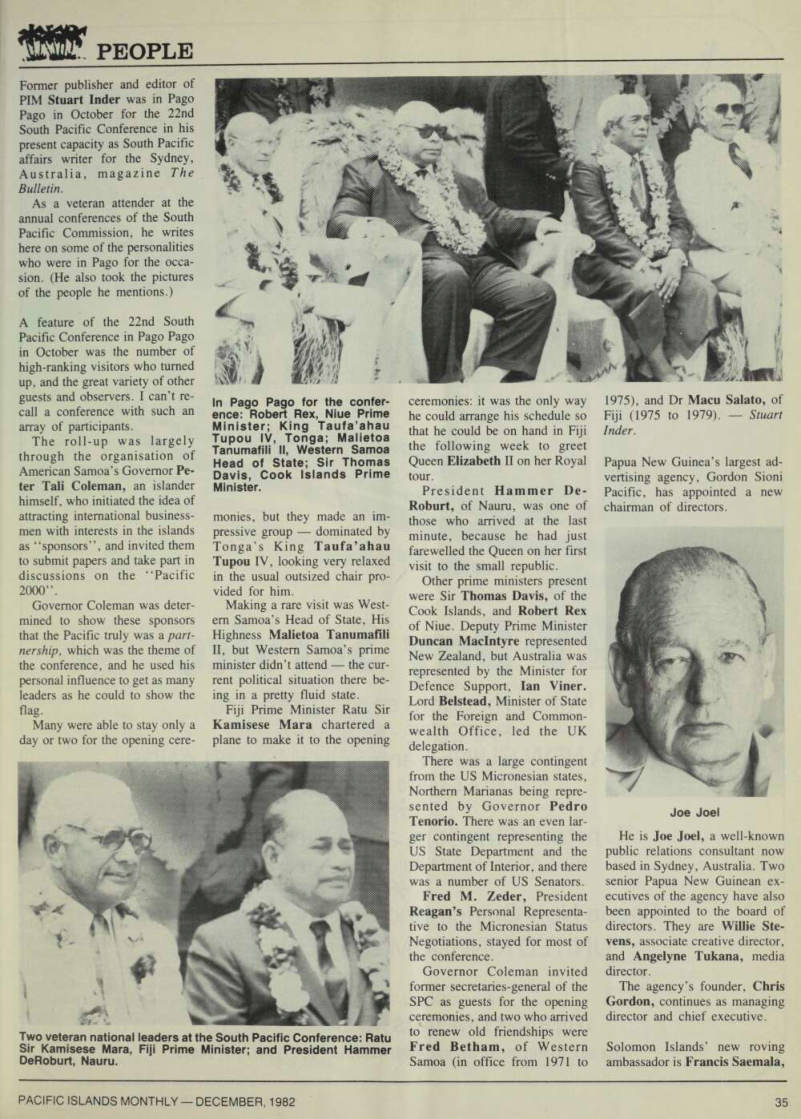
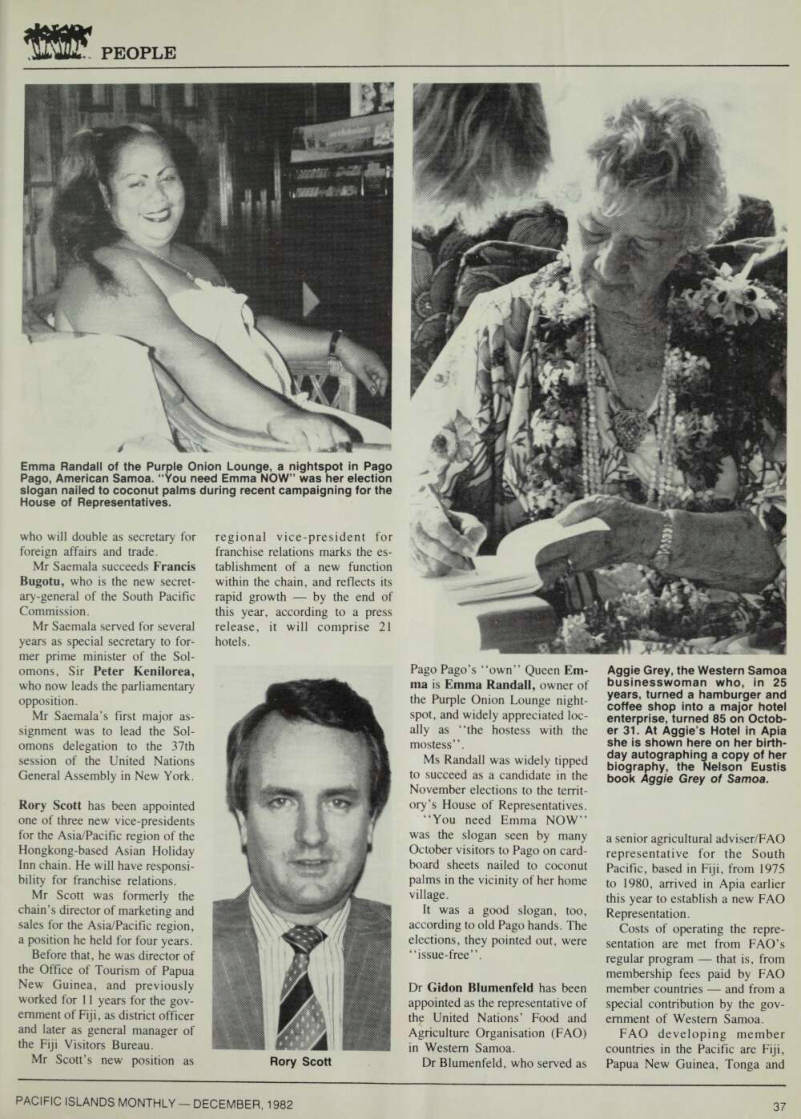
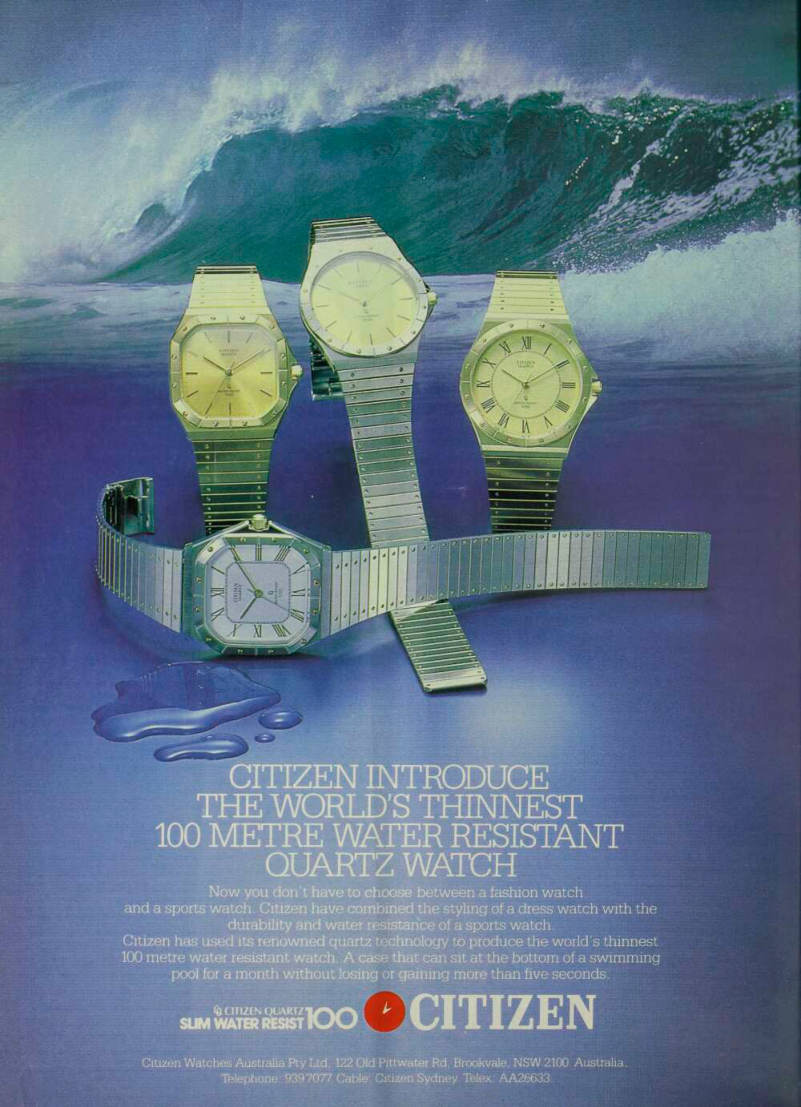
Former publisher and editor of PIM Stuart Inder was in Pago Pago in October for the 22nd South Pacific Conference in his present capacity as South Pacific affairs writer for the Sydney, Australia, magazine The Bulletin.
As a veteran attender at the annual conferences of the South Pacific Commission, he writes here on some of the personalities who were in Pago for the occa sion. (He also took the pictures of the people he mentions.) A feature of the 22nd South Pacific Conference in Pago Pago in October was the number of high-ranking visitors who turned up, and the great variety of other guests and observers. I can’t re call a conference with such an array of participants.
The roll-up was largely through the organisation of American Samoa’s Governor Pe ter Tali Coleman, an islander himself, who initiated the idea of attracting international business men with interests in the islands as “sponsors”, and invited them to submit papers and take part in discussions on the “Pacific 2000”.
Governor Coleman was deter mined to show these sponsors that the Pacific truly was a part nership, which was the theme of the conference, and he used his personal influence to get as many leaders as he could to show the flag.
Many were able to stay only a day or two for the opening cere-
monies, but they made an im pressive group dominated by Tonga’s King Taufa’ahau Tupou IV, looking very relaxed in the usual outsized chair pro vided for him.
Making a rare visit was West ern Samoa’s Head of State, His Highness Malietoa Tanumafili 11, but Western Samoa’s prime minister didn’t attend the cur rent political situation there be ing in a pretty fluid state.
Fiji Prime Minister Ratu Sir Kamisese Mara chartered a plane to make it to the opening
ceremonies: it was the only way he could arrange his schedule so that he could be on hand in Fiji the following week to greet Queen Elizabeth II on her Royal tour.
President Hammer De- Roburt, of Nauru, was one of those who arrived at the last minute, because he had just farewelled the Queen on her first visit to the small republic.
Other prime ministers present were Sir Thomas Davis, of the Cook Islands, and Robert Rex of Niue. Deputy Prime Minister Duncan Maclntyre represented New Zealand, but Australia was represented by the Minister for Defence Support, lan Viner.
Lord Belstead, Minister of State for the Foreign and Common wealth Office, led the UK delegation.
There was a large contingent from the US Micronesian states, Northern Marianas being repre sented by Governor Pedro Tenorio. There was an even lar ger contingent representing the US State Department and the Department of Interior, and there was a number of US Senators.
Fred M. Zeder, President Reagan’s Personal Representa tive to the Micronesian Status Negotiations, stayed for most of the conference.
Governor Coleman invited former secretaries-general of the SPC as guests for the opening ceremonies, and two who arrived to renew old friendships were Fred Betham, of Western Samoa (in office from 1971 to
1975), and Dr Macu Salato, of Fiji (1975 to 1979). Stuart Inder.
Papua New Guinea’s largest ad vertising agency, Gordon Sioni Pacific, has appointed a new chairman of directors.
He is Joe Joel, a well-known public relations consultant now based in Sydney, Australia. Two senior Papua New Guinean ex ecutives of the agency have also been appointed to the board of directors. They are Willie Ste vens, associate creative director, and Angelyne Tukana, media director.
The agency’s founder, Chris Gordon, continues as managing director and chief executive.
Solomon Islands’ new roving ambassador is Francis Saemala,
Two veteran national leaders at the South Pacific Conference: Ratu Sir Kamisese Mara, Fiji Prime Minister; and President Hammer DeRoburt, Nauru.
In Pago Pago for the confer ence: Robert Rex, Niue Prime Minister; King Taufa’ahau Tupou IV, Tonga; Malietoa Tanumafili II, Western Samoa Head of State; Sir Thomas Davis, Cook Islands Prime Minister.
Joe Joel
who will double as secretary for foreign affairs and trade.
Mr Saemala succeeds Francis Bugotu, who is the new secret ary-general of the South Pacific Commission.
Mr Saemala served for several years as special secretary to for mer prime minister of the Sol omons, Sir Peter Kenilorea, who now leads the parliamentary opposition.
Mr Saemala’s first major as signment was to lead the Sol omons delegation to the 37th session of the United Nations General Assembly in New York.
Rory Scott has been appointed one of three new vice-presidents for the Asia/Pacific region of the Hongkong-based Asian Holiday Inn chain. He will have responsi bility for franchise relations.
Mr Scott was formerly the chain’s director of marketing and sales for the Asia/Pacific region, a position he held for four years.
Before that, he was director of the Office of Tourism of Papua New Guinea, and previously worked for 11 years for the gov ernment of Fiji, as district officer and later as general manager of the Fiji Visitors Bureau.
Mr Scott’s new position as
regional vice-president for franchise relations marks the es tablishment of a new function within the chain, and reflects its rapid growth by the end of this year, according to a press release, it will comprise 21 hotels.
Pago Pago’s “own” Queen Em ma is Emma Randall, owner of the Purple Onion Lounge night spot, and widely appreciated loc ally as “the hostess with the mostess”.
Ms Randall was widely tipped to succeed as a candidate in the November elections to the territ ory’s House of Representatives.
“You need Emma NOW” was the slogan seen by many October visitors to Pago on card board sheets nailed to coconut palms in the vicinity of her home village.
It was a good slogan, too, according to old Pago hands. The elections, they pointed out, were “issue-free”.
Dr Gidon Blumenfeld has been appointed as the representative of the United Nations’ Food and Agriculture Organisation (FAO) in Western Samoa.
Dr Blumenfeld, who served as
a senior agricultural adviser/FAO representative for the South Pacific, based in Fiji, from 1975 to 1980, arrived in Apia earlier this year to establish a new FAO Representation.
Costs of operating the repre sentation are met from FAO’s regular program that is, from membership fees paid by FAO member countries and from a special contribution by the gov ernment of Western Samoa.
FAO developing member countries in the Pacific are Fiji, Papua New Guinea, Tonga and
Emma Randall of the Purple Onion Lounge, a nightspot in Pago Pago, American Samoa. “You need Emma NOW” was her election slogan nailed to coconut palms during recent campaigning for the House of Representatives.
Aggie Grey, the Western Samoa businesswoman who, in 25 years, turned a hamburger and coffee shop into a major hotel enterprise, turned 85 on Octob er 31. At Aggie’s Hotel in Apia she is shown here on her birth day autographing a copy of her biography, the Nelson Eustis book Aggie Grey of Samoa.
Rory Scott
Western Samoa, and it is expect ed that the FAO office in Apia will eventually serve them all.
Deputy Prime Minister of Tonga Baron Tuita of Utungake, studied the development of Aust ralia’s solar water heating indus try during a recent visit to Sydney.
Baron Tuita visited the solar production plant of Rheem Aust ralia Ltd., largest hot water sys tem manufacturers in Australia.
He also studied the latest de velopments in gas and electric water heating during an official inspection of the company’s plant in the Sydney suburb of Rydalmere.
Helen Framhein Wong of the Cook Islands has taken up a post
with the South Pacific Bureau for Economic Co-operation (SPEC) headquarters in Suva.
The first Cook Islands woman to serve in an executive position with SPEC, Mrs Framhein Wong is working on a three-year ap pointment as project officer in charge of carrying out studies in the areas of economic develop ment, trade, telecommunica tions, shipping and tourist de velopment in the Pacific region.
She was formerly a senior public servant in the Cooks.
Saturday December 11 has been set as wedding day for HRH Prince Lavaka Ata, youngest son of King Taufa’ahau Tupou IV of Tonga, and Nanasipau’u Vaea, eldest daughter of Tonga’s Minister of Labor, Commerce
and Industries, Baron Vaea and Baroness Tuputupu. The young couple’s engagement was an nounced on July 12 (PIM Sep. p 43).
French High Commissioner to New Caledonia Christian Nucci finally left the territory on Octob er 22.
Earlier in the day, opening the budget session of the Territorial Assembly, Mr Nucci had said of his experience in the territory; “I knew that this was going to be a tough assignment before I ever came here. Along with the vari ous compensations that have come my way, it certainly has been. My feelings have certainly been hurt by insidious and un founded criticisms that have been levelled at me. But I’m a politi
dan, and I knew I owed it to myself not to reply to them, and to leave the Caledonian people to act as the only judge.”
Mr Nucci’s successor, Jac ques Roynette, arrived in Noumea on October 24.
In an arrival interview with the Noumea daily Les Nouvelles, Mr Roynette emphasised that no time limit had been set for his mission in New Caledonia.
He said he had chosen the post of high commissioner in New Caledonia from a number he could have had because it pro mised to be “exciting”.
Dr Geoffrey Caston, former re gistrar of Oxford University, has been named vice-chancellor of the University of the South Pacif ic in Suva.
He succeeds Dr James Maraj, who has joined the World Bank as a consultant.
Dr Caston takes up his post early in 1983.
Baron Tuita, Deputy Prime Minister of Tonga, with Australian officials and industry representatives during his Sydney visit to assess the potential of solar energy for water heating. In the picture, left to right, are: Don Hazeltine, Technical Manager of Rheem’s Appliance Division; Sione Kite, Deputy Secretary in the Office of the Prime Minister, Tonga; Graham Hall, General Manager of Rheem’s Appliance Division; Baron Tuita; Max Boyley and Derek Thompson, Australian Prime Minister’s Department.
Fiji and Papua New Guinea are among 12 countries with army officers at historic Queenscliff Fort, now a modern military staff college, on the Australian coast. They are training for higher rank at the college at the entrance to Port Phillip Bay, Victoria. Among the officers are
(below) Major Jioji Konousi
Konrote of the Royal Fiji Milit ary Forces with his Australian
sponsor, Major Stephen Yates,
and (below left) Major Jack Pas
singan Tuat of the PNG Defence Force with sponsor Major Dave Mills. Patrick McArdell pic ture for AIS.
Advertisements & other items, pp. 36-40 (1 item)
28 Day Service
V,
GLOBAL SERVICE FOR SHIPPERS
1 V
THE
LINE
28 Day Service
United Kingdom and Continent to:
PAPEETE • NOUMEA
PAPUA NEW GUINEA and SOLOMON ISLANDS
PORT VILA & SANTO BY TRANSHIPMENT
United Kingdom and Continent to: SUVA AND LAUTOKA (FCL LCL & UNITISED ONLY) Papua New Guinea and Solomon Islands to;
UNITED KINGDOM and CONTINENT
ay?
For particulars apply:
THE BANK LINE (AUSTRALASIA) PTY. LTD.
Suite 801, 51 Pitt Street Sydney 2000. Australia. Tel: 272041. Tlx; 24063.
CITIZEN INTRODUCE
THE WORLD’S THINNEST
100 METRE WATER RESISTANT
QUARTZ WATCH
Now you don’t have to choose between a fashion watch and a sport s watch. Citizen have combined the styling of a dress watch with the durability and water resistance of a sports watch.
Citizen has used its renowned quartz technology to produce the world’s thinnest 100 metre water resistant watch. A case that can sit at the bottom of a swimming pool for a month without losing or gaining more than five seconds.
CITIZEN
Citizen Watches Australia Pty Ltd. 122 Old Pittwater Rd, Brook vale, NSW 2100. Australia.
Telephone: 9397077. Cable: Citizen Sydney. Telex AA26633
Expert
Insurance Service
throughout the islands
Queensland Insurance (Fiji) Limited
Head Office. 34 Usher St., SUVA . General Manager: L. G. Liddell A.A.1.1. Assistant Managers : R. Jackson. Vijay Lai. Phone: 23851.
LAUTOKA OFFICE: Burns Philp Bldg., Naviti St. District Manager: J. Dalton. Phone: 60642.
LABASA OFFICE: Burns Philp Bldg. District Manager; R SHARMA. Phone: 8 2139
Queensland Insurance (PNG) Limited
PAPUA NEW GUINEA
Head Office, B.N.G. Building, Musgrave St..PORT MORESBY. General Manager: J. M. Dawe Phone. 21 2144.
LAE: 4th St. & Coronation Drive. District Manager: C. D. Hillier Phone: 423873.
MOUNT HAGEN: Hagen Drive. District Manager: G. W. Jack Phone: 521002.
ARAWA: Chebu St. District Manager: J. Longbut. Phone: 951555.
MADANG: Kasagten St. District Manager: N. D. Ramage. Phone. 822020.
RABAUL: Wirraway St. District Manager: W. F Tinker, Phone: 921014.
QBE Insurance (International) Limited
VANUATU, PORT VILA: Rue de Paris, Suite 19, Oceania Bldg, Manager: I. R. Martin.
Phone: 2299.
SANTO. Burns Philp (Vanuatu) Ltd. Phone. 230.
PACIFIC AGENCIES
NEW CALEDONIA. Ste. W. A. Johnston, S.A.R.L. 5 Rue Anatole France, NOUMEA Phone: 272083.
TAHITI: Arthur Chung. Immeuble 8.1.5., Front de Mer, PAPEETE . Phone: 2.86.19 NIUE: Burns Philp (South Sea) Company Ltd.
NORFOLK ISLAND: Burns Philp ('N I ) Company Ltd. Phone: 2191.
SAMOA: APIA, Burns Philp (South Sea) Company Ltd. Phone: 22611.
TONGA Burns Philp (South Sea) Company Ltd. NUKU'ALOFA. Phone 21500 HAAPAI, VAVAU.
MEMBERS OF THE:
QBE INSURANCE GROUP UMITED
Concluding the
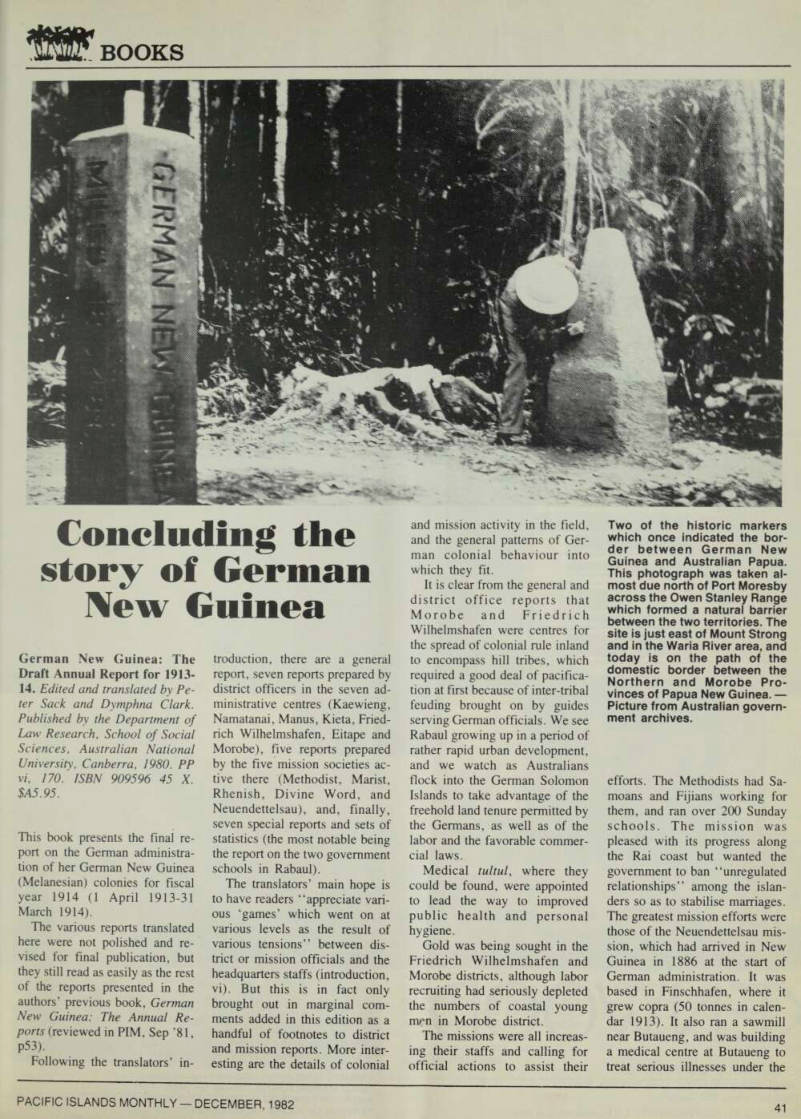

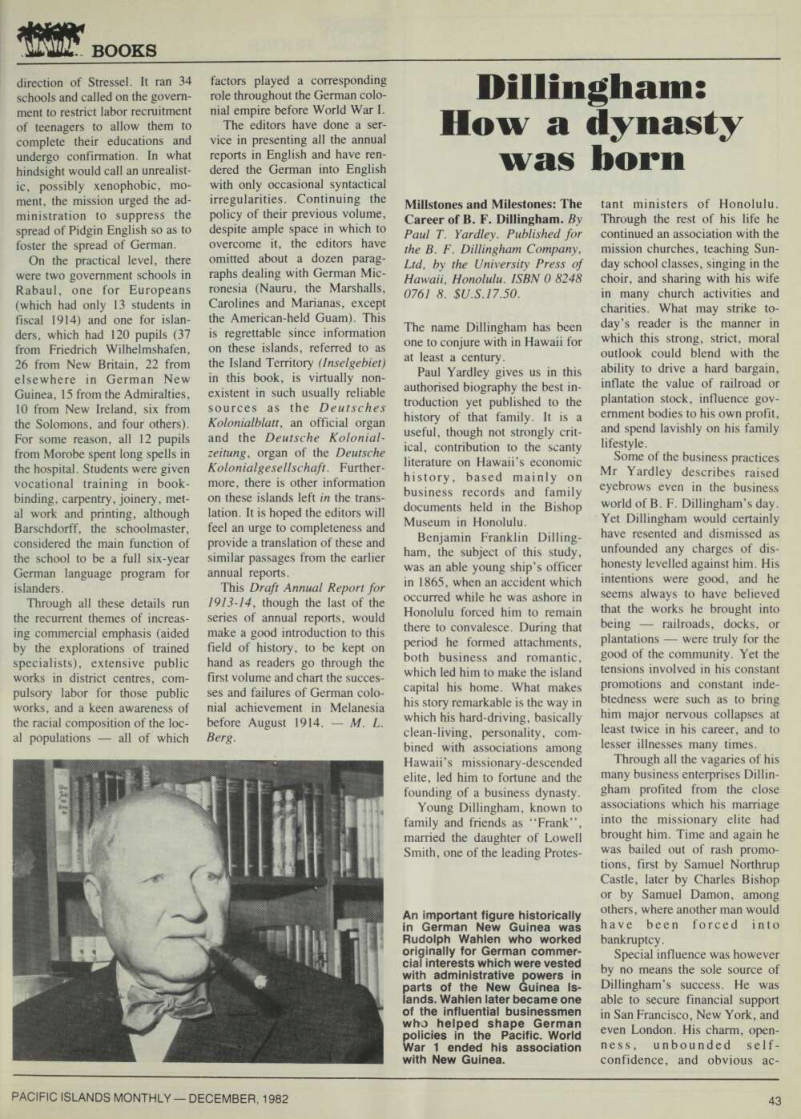
Books
Concluding the story of German New Guinea
German New Guinea: The Draft Annual Report for 1913- 14. Edited and translated by Pe ter Sack and Dymphna Clark.
Published by the Department of Law Research, School of Social Sciences, Australian National University, Canberra, 1980. PP
Vi, 170. Isbn 909596 45 X.
$A5.95.
This book presents the final re port on the German administra tion of her German New Guinea (Melanesian) colonies for fiscal year 1914 (1 April 1913-31 March 1914).
The various reports translated here were not polished and re vised for final publication, but they still read as easily as the rest of the reports presented in the authors’ previous book, German New Guinea: The Annual Re ports (reviewed in PIM, Sep ’Bl, p 53).
Following the translators’ in
troduction, there are a general report, seven reports prepared by district officers in the seven ad ministrative centres (Kaewieng, Namatanai, Manus, Kieta, Fried rich Wilhelmshafen, Eitape and Morobe), five reports prepared by the five mission societies ac tive there (Methodist, Marist, Rhenish, Divine Word, and Neuendettelsau), and, finally, seven special reports and sets of statistics (the most notable being the report on the two government schools in Rabaul).
The translators’ main hope is to have readers “appreciate vari ous ‘games’ which went on at various levels as the result of various tensions” between dis trict or mission officials and the headquarters staffs (introduction, vi). But this is in fact only brought out in marginal com ments added in this edition as a handful of footnotes to district and mission reports. More inter esting are the details of colonial
and mission activity in the field, and the general patterns of Ger man colonial behaviour into which they fit.
It is clear from the general and district office reports that Morobe and Friedrich Wilhelmshafen were centres for the spread of colonial rule inland to encompass hill tribes, which required a good deal of pacifica tion at first because of inter-tribal feuding brought on by guides serving German officials. We see Rabaul growing up in a period of rather rapid urban development, and we watch as Australians flock into the German Solomon Islands to take advantage of the freehold land tenure permitted by the Germans, as well as of the labor and the favorable commer cial laws.
Medical tultul, where they could be found, were appointed to lead the way to improved public health and personal hygiene.
Gold was being sought in the Friedrich Wilhelmshafen and Morobe districts, although labor recruiting had seriously depleted the numbers of coastal young men in Morobe district.
The missions were all increas ing their staffs and calling for official actions to assist their
efforts. The Methodists had Sa moans and Fijians working for them, and ran over 200 Sunday schools. The mission was pleased with its progress along the Rai coast but wanted the government to ban “unregulated relationships’’ among the islan ders so as to stabilise marriages.
The greatest mission efforts were those of the Neuendettelsau mis sion, which had arrived in New Guinea in 1886 at the start of German administration. It was based in Finschhafen, where it grew copra (50 tonnes in calen dar 1913). It also ran a sawmill near Butaueng, and was building a medical centre at Butaueng to treat serious illnesses under the
Two of the historic markers which once indicated the bor der between German New Guinea and Australian Papua.
This photograph was taken al most due north of Port Moresby across the Owen Stanley Range which formed a natural barrier between the two territories. The site is just east of Mount Strong and in the Waria River area, and today is on the path of the domestic border between the Northern and Morobe Pro vinces of Papua New Guinea.
Picture from Australian govern ment archives.
direction of Stressel. It ran 34 schools and called on the govern ment to restrict labor recruitment of teenagers to allow them to complete their educations and undergo confirmation. In what hindsight would call an unrealist
ic, possibly xenophobic, mo
ment, the mission urged the ad ministration to suppress the spread of Pidgin English so as to foster the spread of German.
On the practical level, there were two government schools in Rabaul, one for Europeans (which had only 13 students in fiscal 1914) and one for islan ders, which had 120 pupils (37 from Friedrich Wilhelmshafen, 26 from New Britain, 22 from elsewhere in German New Guinea, 15 from the Admiralties, 10 from New Ireland, six from the Solomons, and four others).
For some reason, all 12 pupils from Morobe spent long spells in the hospital. Students were given vocational training in book
binding, carpentry, joinery, met
al work and printing, although Barschdorff, the schoolmaster, considered the main function of the school to be a full six-year German language program for islanders.
Through all these details run the recurrent themes of increas
ing commercial emphasis (aided
by the explorations of trained
specialists), extensive public
works in district centres, com pulsory labor for those public works, and a keen awareness of the racial composition of the loc al populations all of which
factors played a corresponding role throughout the German colo nial empire before World War I.
The editors have done a ser vice in presenting all the annual reports in English and have ren dered the German into English with only occasional syntactical irregularities. Continuing the policy of their previous volume, despite ample space in which to overcome it, the editors have omitted about a dozen parag raphs dealing with German Mic ronesia (Nauru, the Marshalls, Carolines and Marianas, except the American-held Guam). This is regrettable since information on these islands, referred to as the Island Territory (Inselgebiet) in this book, is virtually non existent in such usually reliable sources as the Deutsches Kolonialblatt, an official organ and the Deutsche Kolonial zeitung, organ of the Deutsche Kolonialgesellschaft. Further more, there is other information on these islands left in the trans lation. It is hoped the editors will feel an urge to completeness and provide a translation of these and similar passages from the earlier annual reports.
This Draft Annual Report for 1913-14, though the last of the series of annual reports, would make a good introduction to this field of history, to be kept on hand as readers go through the first volume and chart the succes ses and failures of German colo nial achievement in Melanesia
before August 1914.
M. L.
Berg.
An important figure historically in German New Guinea was Rudolph Wahlen who worked originally for German commer cial interests which were vested with administrative powers in parts of the New Guinea Is lands. Wahlen later became one of the influential businessmen who helped shape German policies in the Pacific. World War 1 ended his association with New Guinea.
Advertisements & other items, p. 42 (1 item)
Cenwood
Sound that’s as natural as
the world around you
□ iiii
ctfum
ina
HIH
SHI
■- ■■ DC Stereo Integrated Amplifier with Peak Power Meter KT-55 Quartz Synthesizer AM/FM Tuner with Preset KX-55 Logic Cassette Deck with DPSS Music-Search d Dolby* Noise Reduction KD-44R Quartz-PLL Direct-Drive Auto Return Turntable JL-610 SOW 3-Way 3-Speak|| System SRC-16A Audio System Rack )tional models: GE-90 Stereo Graphic Equalizer KH-7 Lightweight Dynamic Stereo Headphones. *TM bolby Laboratories Licensing Corp.
CENWOOD
ew corporate symbol
CORPORATION
lionogi Shibuya Building, 17-5, 2-chome, Shibuya,
libuya-ku, Tokyo 150, Japan
lIOKENWOOD (AUSTRALIA) PTY. LTD. (incorporated in n.s.w.) NEW ZEALAND JOHN GILBERT & CO., LTD. Auckland Tel.ooll-64-9-30839 FIJI PEPE’S DUTY FREE CENTRE LTD. Tel. 26187, 25191 PAPUA NEW GUINEA S.O. SVENSSON (N.G.) LTD. Port Moresby Tel. 42-4467 SOLOMON ISLANDS TECHNIQUE RADIOS CENTRE LTD. Honiara Tel. 416 NEW CALEDONIA HI-FI VOX Noumea Tel. 27-2466 VANUATU FUNG CHOI LUEN. Port-Vila Tel. 2556
TAHITI MAISON AURORE Papeete Tel. 29703
AMERICAN SAMOA ISLAND PACIFIC AGENCIES, INC. Pago Pago Tel. 633-4687
REPUBLIC OF NAURU NAURU CO-OPERATIVE SOCIETY
Dillingham:
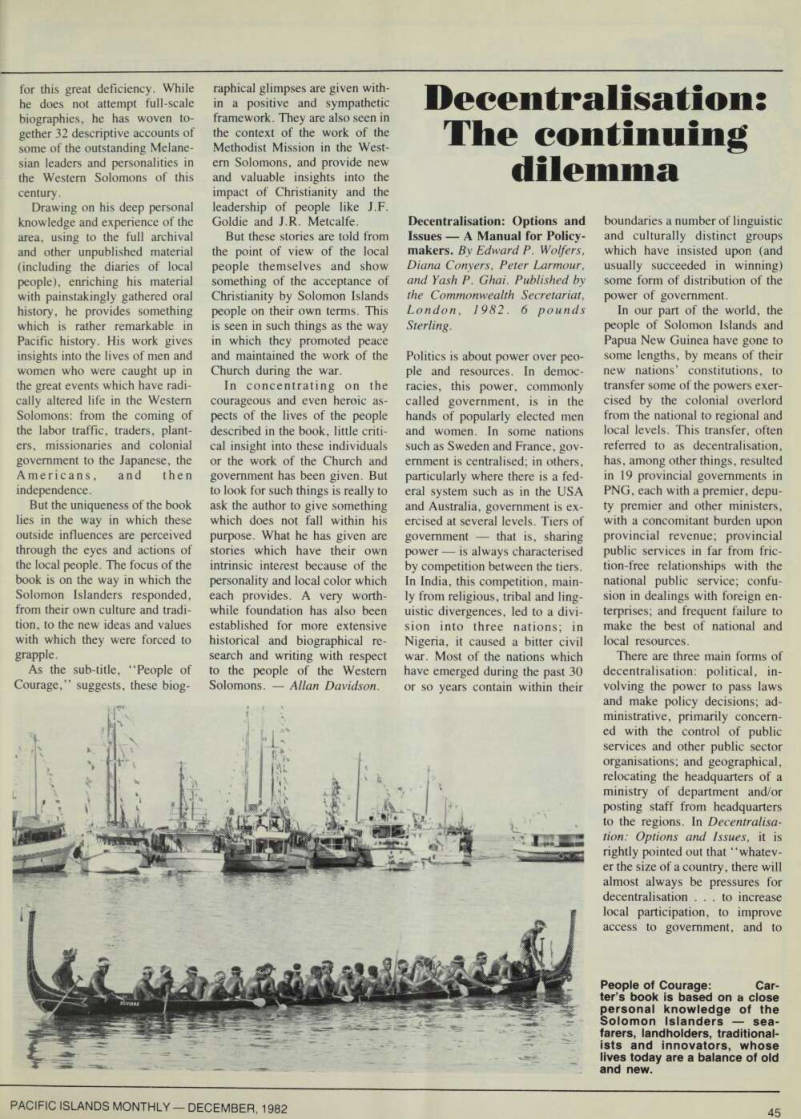
How a dynasty was born
Millstones and Milestones: The Career of B. F. Dillingham. By Paul T. Yardley. Published for the B. F. Dillingham Company, Ltd, by the University Press of Hawaii, Honolulu. ISBN 0 8248
0761 8. Su.S. 17.50.
The name Dillingham has been one to conjure with in Hawaii for at least a century.
Paul Yardley gives us in this authorised biography the best in troduction yet published to the history of that family. It is a useful, though not strongly crit ical, contribution to the scanty literature on Hawaii’s economic history, based mainly on business records and family documents held in the Bishop Museum in Honolulu.
Benjamin Franklin Dilling ham, the subject of this study, was an able young ship’s officer in 1865, when an accident which occurred while he was ashore in Honolulu forced him to remain there to convalesce. During that period he formed attachments, both business and romantic, which led him to make the island capital his home. What makes his story remarkable is the way in which his hard-driving, basically clean-living, personality, com bined with associations among Hawaii’s missionary-descended elite, led him to fortune and the founding of a business dynasty.
Young Dillingham, known to family and friends as “Frank”, married the daughter of Lowell Smith, one of the leading Protes
tant ministers of Honolulu.
Through the rest of his life he continued an association with the mission churches, teaching Sun day school classes, singing in the choir, and sharing with his wife in many church activities and charities. What may strike to day’s reader is the manner in which this strong, strict, moral outlook could blend with the ability to drive a hard bargain, inflate the value of railroad or plantation stock, influence gov ernment bodies to his own profit, and spend lavishly on his family lifestyle.
Some of the business practices Mr Yardley describes raised eyebrows even in the business world ofß. F. Dillingham’s day.
Yet Dillingham would certainly have resented and dismissed as unfounded any charges of dis honesty levelled against him. His intentions were good, and he seems always to have believed that the works he brought into being railroads, docks, or plantations were truly for the good of the community. Yet the tensions involved in his constant promotions and constant inde btedness were such as to bring him major nervous collapses at least twice in his career, and to lesser illnesses many times.
Through all the vagaries of his many business enterprises Dillin gham profited from the close associations which his marriage into the missionary elite had brought him. Time and again he was bailed out of rash promo tions, first by Samuel Northrup Castle, later by Charles Bishop or by Samuel Damon, among others, where another man would have been forced into bankruptcy.
Special influence was however by no means the sole source of Dillingham’s success. He was able to secure financial support in San Francisco, New York, and even London. His charm, open ness, unbounded self confidence, and obvious ac-
quaintance with good living helped him secure financial backing in major financial centres when cautious provin cialism in Honolulu withheld support.
Yardley’s story does not em phasise the tight, oligarchic con trol of Hawaii’s economy in the late 19th and early 20th cen turies, but it illustrates it dramat ically. “Frank” Dillingham was a promoter, a “boomer”, and his restless, imaginative ways put him at odds with nearly every one of the major factoring con cerns that controlled the sources of financing, transportation, pur chasing of supplies, and, above all, access to good agricultural land throughout the Hawaiian group. Yet in the long run it seemed nearly always possible to arrange a new loan or delay payment on an old one with men who did not want to see one of their own circle go under.
Few Hawaiians enter this story and virtually no Orientals, though they made up the majori ty of Hawaii’s population. This account is concerned with the doings among the Caucasian (ha ole) elite, and the others appear only as servants or as faceless laborers. Only once does Mr Yardley permit us a glimpse of Dillingham’s relations with the Hawaiian working people, in a passage which speaks of the re spect and affection which his generosity, friendliness, and free-spending personal ways had brought him among the Hawaiians in his younger days.
Similarly, there is in Yardley’s account little indication of wide spread small-investor involve ment in Dillingham’s enter prises. If there were those who benefited or lost from the wild fluctuations in value, the delayed dividends, or the steady growth of the Oahu Railroad or Olaa plantation, we have no clear picture of their consequences to laborers, small investors, or creditors. Only a few incidents of personal beneficence to the pro moter’s acquaintances whom he knew to have suffered are men tioned here.
By the beginning of the 20th century the bulk of B.F. Dilling ham’s most productive work had been achieved. From that point
on he was engaged in a constant struggle to maintain a semblance of solvency and control in spite of bad investments, overcapital isation, and bankers’ jitters. The Dillingham sons, Walter and Harold in particular, took in creasing amounts of the load off their father’s mind, but they could not stop him from plung ing, as of old, into a few more dubious ventures. Appeals to his vanity, his generosity, or to old associations often swayed the senior’s mind in which sound, prudent business judgment had never been the strongest feature.
But the results of his efforts can be seen today in the powerful Dillingham Corporation and its affiliates. There is the vast area of leeward Oahu, which Dilling ham’s railroad opened up to ag ricultural development. There are parts of the island of Hawaii where his vision pioneered trans portation and plantation growth, now long since passed into other hands. There are vast improve ments to Honolulu and Hilo har bors, carried out or promoted by Dillingham. And finally there are charitable religious, and other social institutions which survive today at least partly as a result of his beneficence.
At his death in 1918 Benjamin Franklin Dillingham was a weal thy man, honored by a devoted family and a respectful commun ity. Certainly many felt that what he had contributed to Hawaii’s economic growth more than jus tified the wealth he had ac
cumulated.
Donald D.
Johnson.
Essays In
Solomons
biography
Ti-Evarane: People of Courage from the Solomon Islands. By George G. Carter. Published by Unichurch Publishing, Rabaul and Auckland. 1981. No price, ISBN provided.
Very little has been produced in the way of Solomon Islands biography. George Carter’s book thus breaks important new ground in making some amends
for this great deficiency. While he does not attempt full-scale biographies, he has woven to gether 32 descriptive accounts of some of the outstanding Melane sian leaders and personalities in the Western Solomons of this century.
Drawing on his deep personal knowledge and experience of the area, using to the full archival and other unpublished material (including the diaries of local people), enriching his material
with painstakingly gathered oral
history, he provides something
which is rather remarkable in Pacific history. His work gives insights into the lives of men and women who were caught up in the great events which have radi cally altered life in the Western Solomons: from the coming of the labor traffic, traders, plant ers, missionaries and colonial government to the Japanese, the Americans, and then
independence.
But the uniqueness of the book lies in the way in which these outside influences are perceived through the eyes and actions of the local people. The focus of the book is on the way in which the Solomon Islanders responded, from their own culture and tradi tion, to the new ideas and values with which they were forced to
grapple.
As the sub-title, “People of
Courage,” suggests, these biog
raphical glimpses are given with
in a positive and sympathetic framework. They are also seen in the context of the work of the Methodist Mission in the West ern Solomons, and provide new and valuable insights into the impact of Christianity and the leadership of people like J.F.
Goldie and J.R. Metcalfe.
But these stories are told from the point of view of the local people themselves and show something of the acceptance of
Christianity by Solomon Islands
people on their own terms. This is seen in such things as the way in which they promoted peace and maintained the work of the Church during the war.
In concentrating on the courageous and even heroic as pects of the lives of the people described in the book, little criti cal insight into these individuals or the work of the Church and government has been given. But to look for such things is really to ask the author to give something which does not fall within his purpose. What he has given are stories which have their own intrinsic interest because of the personality and local color which each provides. A very worth while foundation has also been established for more extensive historical and biographical re search and writing with respect to the people of the Western Solomons. Allan Davidson.
People of Courage: Car ter’s book is based on a close personal knowledge of the Solomon Islanders sea farers, landholders, traditional ists and innovators, whose lives today are a balance of old and new.
Advertisements & other items, p. 44 (1 item)
Secondary
s Assqii
International
School
P-0. Box, 2393 Government Buildings, SUVA
PLACES FOR
1983 ACADEMIC YEAR
AND BEYOND
The International Secondary School in Suva, FIJI, is offering places in classes from Form 1 (11 years) to Form 7 (17-18 years) for the following examinations: 1. New Zealand School Certificate 2. New Zealand University Entrance 3. United Kingdom ‘O’ Levels 4. United Kingdom ‘A’ Levels Currently we are awaiting approval to present the International Baccalaureate.
In 1984, the school will undergo an accreditation visit by the Western-Association of Schools and Colleges, U.S.A. Subjects offered include English, Extra- English (a specialised programme to help students who have English as a second language), Science, Physical Science, Biological Science, Chemistry, Physics, Biology, Computer Courses, Social Science, History, Latin, French, Home Economics, Technical Drawing, Clothing and Textiles, Woodwork, Music, Mathematics, Art.
Other subjects may be offered as required. Physical Education and a wide range of sports are offered swimming, team games, golf, athletics included.
The school has a good record in external examinations, with pass rates usually exceeding 70 per cent success.
The staff is well qualified, the classes small, and multi-national. (Currently, 22 nations are represented on the Student Body.) The buildings are attractive and the rooms well equipped.
If you are interested and would like further details, please phone or write to address below. A scale of fees will be made available on request.
R. Dawson Murray, Principal,
International Secondary School, P.O. Box 2393, Government Buildings, SUVA.
Telephone Number: 393300
The continuing
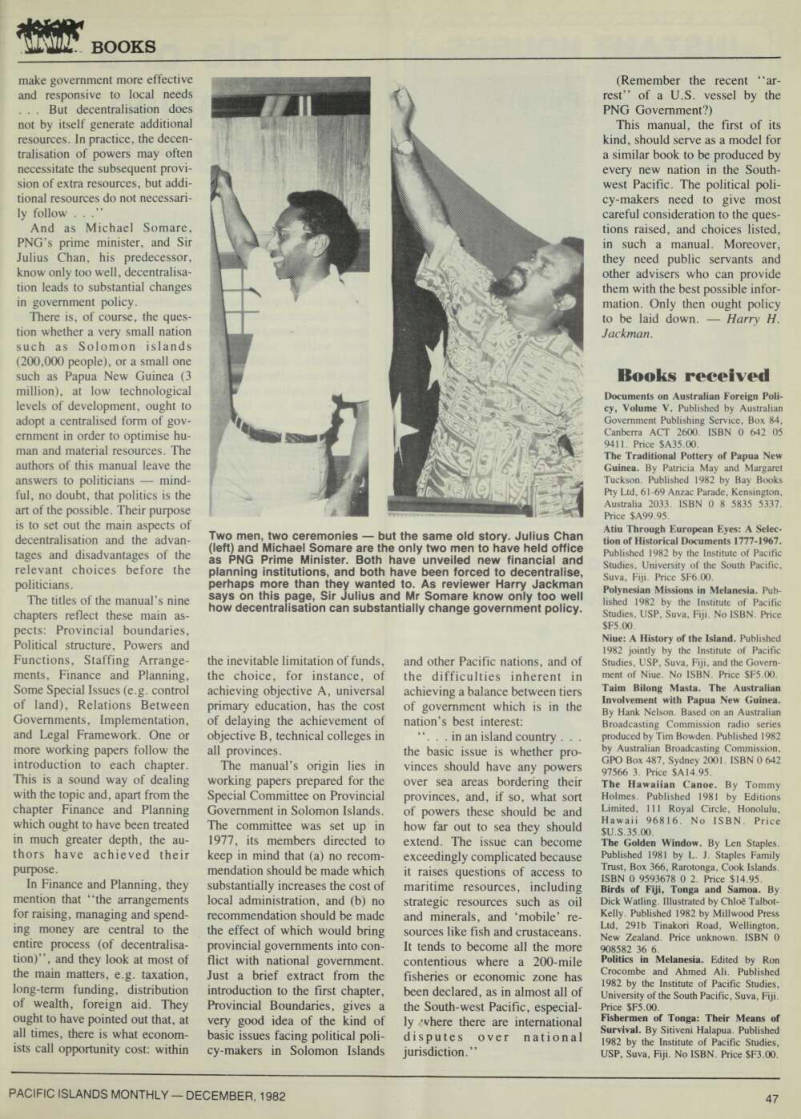
Decentralisation: The continuing dilemma
Decentralisation: Options and Issues A Manual for Policy makers. By Edward P. Wolfers, Diana Conyers, Peter Larmour, and Yash P. Ghai. Published by the Commonwealth Secretariat, London, 1982. 6 pounds Sterling.
Politics is about power over peo ple and resources. In democ racies, this power, commonly called government, is in the hands of popularly elected men and women. In some nations such as Sweden and France, gov ernment is centralised; in others, particularly where there is a fed eral system such as in the USA and Australia, government is ex ercised at several levels. Tiers of government that is, sharing power is always characterised by competition between the tiers.
In India, this competition, main ly from religious, tribal and ling uistic divergences, led to a divi sion into three nations; in Nigeria, it caused a bitter civil war. Most of the nations which have emerged during the past 30 or so years contain within their
boundaries a number of linguistic and culturally distinct groups which have insisted upon (and usually succeeded in winning) some form of distribution of the power of government.
In our part of the world, the people of Solomon Islands and Papua New Guinea have gone to some lengths, by means of their new nations’ constitutions, to transfer some of the powers exer cised by the colonial overlord from the national to regional and local levels. This transfer, often referred to as decentralisation, has, among other things, resulted in 19 provincial governments in PNG, each with a premier, depu ty premier and other ministers, with a concomitant burden upon provincial revenue; provincial public services in far from fric tion-free relationships with the national public service; confu sion in dealings with foreign en terprises; and frequent failure to make the best of national and local resources.
There are three main forms of decentralisation: political, in volving the power to pass laws and make policy decisions; ad ministrative, primarily concern ed with the control of public services and other public sector organisations; and geographical, relocating the headquarters of a ministry of department and/or posting staff from headquarters to the regions. In Decentralisa tion: Options and Issues, it is rightly pointed out that “whatev er the size of a country, there will almost always be pressures for decentralisation ... to increase local participation, to improve access to government, and to
make government more effective and responsive to local needs ... But decentralisation does not by itself generate additional resources. In practice, the decen tralisation of powers may often necessitate the subsequent provi sion of extra resources, but addi tional resources do not necessari ly follow ...”
And as Michael Somare, PNG’s prime minister, and Sir Julius Chan, his predecessor, know only too well, decentralisa tion leads to substantial changes in government policy.
There is, of course, the ques tion whether a very small nation such as Solomon islands (200,000 people), or a small one such as Papua New Guinea (3 million), at low technological levels of development, ought to adopt a centralised form of gov ernment in order to optimise hu man and material resources. The authors of this manual leave the answers to politicians mind ful, no doubt, that politics is the art of the possible. Their purpose is to set out the main aspects of decentralisation and the advan tages and disadvantages of the relevant choices before the politicians.
The titles of the manual’s nine chapters reflect these main as pects: Provincial boundaries, Political structure, Powers and Functions, Staffing Arrange ments, Finance and Planning, Some Special Issues (e.g. control of land), Relations Between Governments, Implementation, and Legal Framework. One or more working papers follow the introduction to each chapter.
This is a sound way of dealing with the topic and, apart from the chapter Finance and Planning which ought to have been treated in much greater depth, the au thors have achieved their purpose.
In Finance and Planning, they mention that “the arrangements for raising, managing and spend ing money are central to the entire process (of decentralisa tion)”, and they look at most of the main matters, e.g. taxation, long-term funding, distribution of wealth, foreign aid. They ought to have pointed out that, at all times, there is what econom ists call opportunity cost: within
the inevitable limitation of funds, the choice, for instance, of achieving objective A, universal primary education, has the cost of delaying the achievement of objective B, technical colleges in all provinces.
The manual’s origin lies in working papers prepared for the Special Committee on Provincial Government in Solomon Islands.
The committee was set up in 1977, its members directed to keep in mind that (a) no recom mendation should be made which substantially increases the cost of local administration, and (b) no recommendation should be made the effect of which would bring provincial governments into con flict with national government.
Just a brief extract from the introduction to the first chapter, Provincial Boundaries, gives a very good idea of the kind of basic issues facing political poli cy-makers in Solomon Islands
and other Pacific nations, and of the difficulties inherent in achieving a balance between tiers of government which is in the nation’s best interest: “. . . in an island country . . . the basic issue is whether pro vinces should have any powers over sea areas bordering their provinces, and, if so, what sort of powers these should be and how far out to sea they should extend. The issue can become exceedingly complicated because it raises questions of access to maritime resources, including strategic resources such as oil and minerals, and ‘mobile’ re sources like fish and crustaceans.
It tends to become all the more contentious where a 200-mile fisheries or economic zone has been declared, as in almost all of the South-west Pacific, especial ly -where there are international disputes over national jurisdiction.”
(Remember the recent “ar rest” of a U.S. vessel by the PNG Government?) This manual, the first of its kind, should serve as a model for a similar book to be produced by every new nation in the South west Pacific. The political poli cy-makers need to give most careful consideration to the ques tions raised, and choices listed, in such a manual. Moreover, they need public servants and other advisers who can provide them with the best possible infor mation. Only then ought policy
to be laid down.
Harry H.
Jackman.
Books received
Documents on Australian Foreign Poli cy, Volume V. Published by Australian Government Publishing Service, Box 84, Canberra ACT 2600. ISBN 0 642 05 9411. Price $A35.00.
The Traditional Pottery of Papua New Guinea. By Patricia May and Margaret Tuckson. Published 1982 by Bay Books Pty Ltd, 61-69 Anzac Parade, Kensington, Australia 2033. ISBN 0 8 5835 5337.
Price 5A99.95.
Atiu Through European Eyes: A Selec tion of Historical Documents 1777-1967.
Published 1982 by the Institute of Pacific Studies, University of the South Pacific, Suva, Fiji. Price $F6.00.
Polynesian Missions in Melanesia. Pub lished 1982 by the Institute of Pacific Studies, USP, Suva, Fiji. No ISBN. Price $F5.00.
Niue: A History of the Island. Published 1982 jointly by the Institute of Pacific Studies, USP, Suva, Fiji, and the Govern ment of Niue. No ISBN. Price $F5.00.
Taim Bilong Masta. The Australian Involvement with Papua New Guinea.
By Hank Nelson. Based on an Australian Broadcasting Commission radio series produced by Tim Bowden. Published 1982 by Australian Broadcasting Commission, GPO Box 487, Sydney 2001. ISBN 0 642 97566 3. Price $A 14.95.
The Hawaiian Canoe. By Tommy Holmes. Published 1981 by Editions Limited, 111 Royal Circle, Honolulu, Hawaii 96816. No ISBN. Price $U.5.35.00.
The Golden Window. By Len Staples.
Published 1981 by L. J. Staples Family Trust, Box 366, Rarotonga, Cook Islands.
ISBN 0 9593678 0 2. Price $14.95.
Birds of Fiji, Tonga and Samoa. By Dick Watling. Illustrated by Chlo£ Talbot- Kelly. Published 1982 by Millwood Press Ltd, 291 b Tinakori Road, Wellington, New Zealand. Price unknown. ISBN 0 908582 36 6.
Politics in Melanesia. Edited by Ron Crocombe and Ahmed Ali. Published 1982 by the Institute of Pacific Studies, University of the South Pacific, Suva, Fiji.
Price $F5.00.
Fishermen of Tonga: Their Means of Survival. By Sitiveni Halapua. Published 1982 by the Institute of Pacific Studies, USP, Suva, Fiji. No ISBN. Price $F3.00.
Two men, two ceremonies but the same old story. Julius Chan (left) and Michael Somare are the only two men to have held office as PNG Prime Minister. Both have unveiled new financial and planning institutions, and both have been forced to decentralise, perhaps more than they wanted to. As reviewer Harry Jackman says on this page, Sir Julius and Mr Somare know only too well how decentralisation can substantially change government policy.
Advertisements & other items, pp. 46-48 (1 item)
Nelson & Robertson
In our 87th Year Selling ‘Service’ to the Pacific Islands
KIETA
nSE/??' O <*. -0 z o > rrm V {V o
RABAUL
MADANG
LAE
•VT.v .*• •••*• L* • ••• •• •• • • • •• *. .A.*.;: ... ...
BRISBANE
SYDNEY
/••• La .V
Pty. Ltd.
(Established 1895)
Plantation House, 197 Clarence Street, Sydney.
Cables: ‘IVAN’, Sydney, Brisbane.
Telex: AA22381, Sydney.
Phone: 29 2871 ...V
LAUTOKA
For Indents
from Australia,
New Zealand and Overseas
Foodstuffs
Softgoods
Hardware
Machinery
Travel
Insurance
Canned Fish
Jute Goods
Real Estate
SUVA
BRANCH OFFICES:
Nelson & Robertson Pty. Ltd., P.O. Box 575, Brisbane, Qld., Australia. 2216966 P,O. Box 2092, Govt. Bldg., Suva, Fiji. 22430 P.O. Box 258, Lautoka, Fiji. 62101 P.O. Box 2420, CPO Auckland 1, New Zealand. 774141 EC • ; .v vv.: ND P.O
PAPUA NEW GUINEA REPRESENTATIVES:
HTini Pty. Ltd., Rabaul, P.N.G. 922911 Box 1406, Lae, P.N.G. 422366 0. Box 711, Madang, P.N.G. 822066 P.O. Box 253, Kieta, P.N.G. 956185
INSTANT HOUSES
WITH
Therma-Panel®
THE FULLY INSULATED BUILDING SYSTEM
Vh &3S • Economical • Fast
• Simple
Homes School buildings Shearer’s quarters • Amenity blocks Farm buildings • Offices
THE HOME YOU CAN ASSEMBLE
(|J» George Hudson Homes p^ s {j d 186 Hume Hway, Cabramatta, N.5.W.2166 Telephone: (02) 727 9066. Telex; AA25800.
For details and prices. Name post coupon to: George Hudson Homes Address (Aust.) Pty. Ltd Do you own a block of land yes □ no □ Phone
NEW ALL-PURPOSE HAND PUMP
Pacific Multi-Pump
♦ Capable of handling a wide variety of liquids, including petroleum-based products, a wide variety of chemicals, and salt water. discharge hose, nozzle, twopiece suction tube and bung adaptor for operation with 44-gallon drums.
Double-acting lever action capable of pumping one litre per cycle.
Complete with Bft of PVC Pacific Pump Co 2 South Street, Rydalmere,
N S W 2116.
Tel: (02) 638 5600 Telex: AA24319
merry-go-round
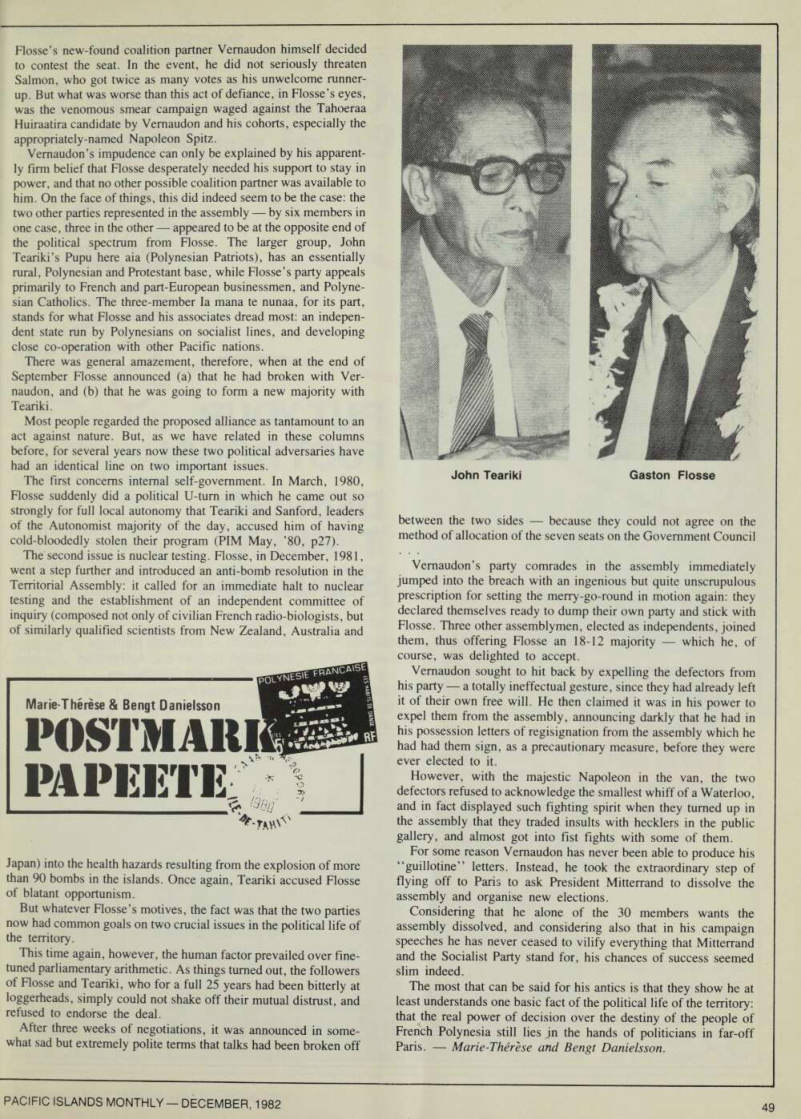
Tale of a Tahitian merry-go-round
The key figure in the new parliamentary majority emerging from the May 23 elections to French Polynesia’s Territorial Assembly was obviously Gaston Flosse, the astute leader of the pro-French Tahoeraa Fluiraatira party, which is affiliated with the metropoli tan-French Gaullist RPR party of Jacques Chirac (PIM Jul. p 22).
From his new position of strength, Flosse promptly undertook to steer a straight course towards a better life for all which most people who’d voted for him took to mean more money, more jobs, more welfare, more cars, more TV sets and more booze. (Incidentally, this also was the basic program of the former majority under Francis Sanford which was booted out because it failed to deliver the goods . . .) But instead, to the amusement or dismay of the people of French Polynesia, what has happened in the four months since Flosse and his team of able young technocrats took over the reins of government is a kind of political merry-go-round, in which those astride the wooden horses have bickered with and pushed and shoved each other, to the accompaniment of howls of abuse and shrill denunciations. And when the merry-go-round finally ground to a halt, everybody was back precisely where they started The key element in these farcical proceedings is the simple fact that Flosse’s party had won only 13 seats in the 30-member assembly. To obtain a working majority, the 13 Tahoeraa Huiraatira assemblymen had therefore to ally themselves with another group holding at least three seats.
The logical choice for the role of ally had seemed to be the new Aia api party, with its three seats in the assembly. The party had been formed shortly before the elections as a breakaway from Francis Sanford’s Ea api party. Foremost of the three turncoats was the young mayor of Mahina, Emile Vemaudon, who is nicknamed “the Sheriff’ because of his predilection for American police methods and uniforms (PIM Aug. p 24).
Mathematically speaking the thing seemed perfect, since it provided a 16-14 majority and catapulted Flosse into the position of vice-president of the assembly. (The president is still the French High Commissioner, who is appointed by the government in Paris.) But Flosse had overlooked the human factor in particular, the ebullience, whimsy and outright megalomania of “the Sheriff”.
He certainly must have had his aprehensions, since he sought at the outset to neutralise his coalition partner by appointing him to the largely ceremonial office of speaker of the assembly. But he overlooked the fact that this post also provided Vemaudon with ample opportunity for meddling and scheming behind his back.
Flosse’s accession to the vice-presidency meant that he had to resign his seat as deputy to the National Assembly in Paris, a position he’d held since 1978. For unfathomable reasons the constitutional set-up is so arranged as to prevent Flosse’s electoral proxy, Tutaha Salmon, from automatically filling the vacated seat.
So a by-election had to be held for the Eastern constituency. The event was made all the more pointless by the fact that the electorate had been especially rigged-up in ’7B to ensure Flosse’s victory, and his proxy was equally sure to win it. That is, until
Flosse’s new-found coalition partner Vemaudon himself decided to contest the seat. In the event, he did not seriously threaten Salmon, who got twice as many votes as his unwelcome runner up. But what was worse than this act of defiance, in Flosse’s eyes, was the venomous smear campaign waged against the Tahoeraa Huiraatira candidate by Vemaudon and his cohorts, especially the
appropriately-named Napoleon Spitz.
Vemaudon’s impudence can only be explained by his apparent ly firm belief that Flosse desperately needed his support to stay in power, and that no other possible coalition partner was available to him. On the face of things, this did indeed seem to be the case: the two other parties represented in the assembly by six members in one case, three in the other appeared to be at the opposite end of the political spectrum from Flosse. The larger group, John Teariki’s Pupu here aia (Polynesian Patriots), has an essentially rural, Polynesian and Protestant base, while Flosse’s party appeals primarily to French and part-European businessmen, and Polyne sian Catholics. The three-member la mana te nunaa, for its part, stands for what Flosse and his associates dread most; an indepen dent state run by Polynesians on socialist lines, and developing close co-operation with other Pacific nations.
There was general amazement, therefore, when at the end of September Flosse announced (a) that he had broken with Ver naudon, and (b) that he was going to form a new majority with Teariki.
Most people regarded the proposed alliance as tantamount to an act against nature. But, as we have related in these columns before, for several years now these two political adversaries have had an identical line on two important issues.
The first concerns internal self-government. In March, 1980, Flosse suddenly did a political U-tum in which he came out so strongly for full local autonomy that Teariki and Sanford, leaders of the Autonomist majority of the day, accused him of having cold-bloodedly stolen their program (PIM May, ’BO, p 27).
The second issue is nuclear testing. Flosse, in December, 1981, went a step further and introduced an anti-bomb resolution in the Territorial Assembly: it called for an immediate halt to nuclear testing and the establishment of an independent committee of inquiry (composed not only of civilian French radio-biologists, but of similarly qualified scientists from New Zealand, Australia and
Japan) into the health hazards resulting from the explosion of more than 90 bombs in the islands. Once again, Teariki accused Flosse of blatant opportunism.
But whatever Flosse’s motives, the fact was that the two parties now had common goals on two crucial issues in the political life of the territory.
This time again, however, the human factor prevailed over fine tuned parliamentary arithmetic. As things turned out, the followers of Flosse and Teariki, who for a full 25 years had been bitterly at loggerheads, simply could not shake off their mutual distrust, and refused to endorse the deal.
After three weeks of negotiations, it was announced in some what sad but extremely polite terms that talks had been broken off
between the two sides because they could not agree on the method of allocation of the seven seats on the Government Council Vemaudon’s party comrades in the assembly immediately jumped into the breach with an ingenious but quite unscrupulous prescription for setting the merry-go-round in motion again: they declared themselves ready to dump their own party and stick with Flosse. Three other assemblymen, elected as independents, joined them, thus offering Flosse an 18-12 majority which he, of course, was delighted to accept.
Vemaudon sought to hit back by expelling the defectors from his party a totally ineffectual gesture, since they had already left it of their own free will. He then claimed it was in his power to expel them from the assembly, announcing darkly that he had in his possession letters of regisignation from the assembly which he had had them sign, as a precautionary measure, before they were ever elected to it.
However, with the majestic Napoleon in the van, the two defectors refused to acknowledge the smallest whiff of a Waterloo, and in fact displayed such fighting spirit when they turned up in the assembly that they traded insults with hecklers in the public gallery, and almost got into fist fights with some of them.
For some reason Vemaudon has never been able to produce his “guillotine” letters. Instead, he took the extraordinary step of flying off to Paris to ask President Mitterrand to dissolve the assembly and organise new elections.
Considering that he alone of the 30 members wants the assembly dissolved, and considering also that in his campaign speeches he has never ceased to vilify everything that Mitterrand and the Socialist Party stand for, his chances of success seemed slim indeed.
The most that can be said for his antics is that they show he at least understands one basic fact of the political life of the territory: that the real power of decision over the destiny of the people of French Polynesia still lies in the hands of politicians in far-off Paris. Marie-Therese and Bengt Danielsson.
Gaston Flosse
John Teariki
Advertisements & other items, p. 50 (1 item)
Timken
o u
PUTYOUR
FOOT DOWN.
DEMAND
TIMKEN
BEARINGS!
TIMKEN
ftfC<ST(REO rSAOtMAKK
If you’re hard headed about the bearings you use ... put your foot down!
Demand Timken" tapered roller bearings, and you’ll get the brand with proven quality, durability and performance.
The brand that’s given you a long run for your money, wherever it’s used.
On top of all this, you’ll benefit from our consistent supply, delivery, and sales and service engineering assistance available from Australian Timken and Authorized Timken" Bearing Distributors throughout the Pacific.
Another way of looking at it is that you’re not going to put your foot in it when you put your foot down and demand Timken bearings.
TIMKEN
REGISTERED TRADEMARK
TAPERED ROLLER BEARINGS
Authorised Bearing Distributors in the Pacific are: O F. Nelson and Co. Ltd., APIA; Kidd Garrett Ltd., AUCKLAND; Motor Specialties Ltd., AUCKLAND; Precision Bearings Ltd., AUCKLAND: United Enterprises Ltd., HONIARA; Sunbeam Transport Ltd., LAUTOKA; Nelle Cie SATMA, NOUMEA; Pacific Distributions, PAPEETE; P N G. Bearing Service, PORT MORESBY; Socametra, PORT VILLA; Burns Philp (South Sea) Company Ltd.,
SUVA.
HOLT 0922ATX
shutterbug in 1930s New Guinea
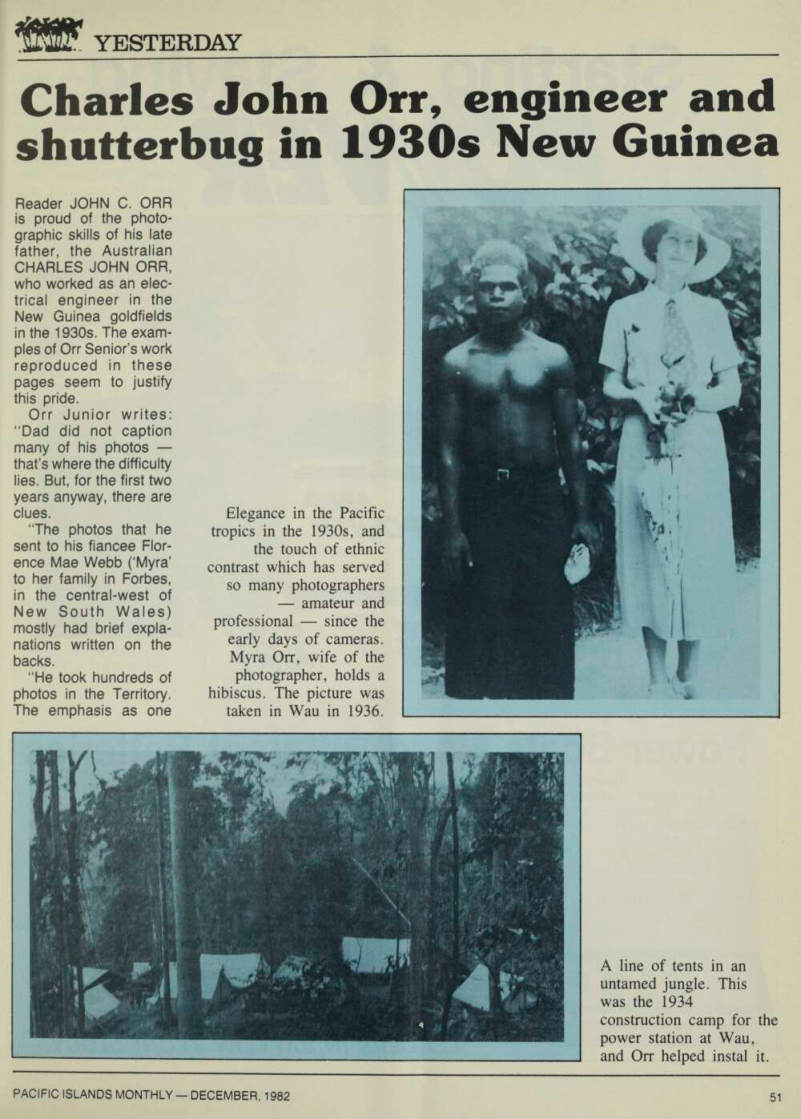
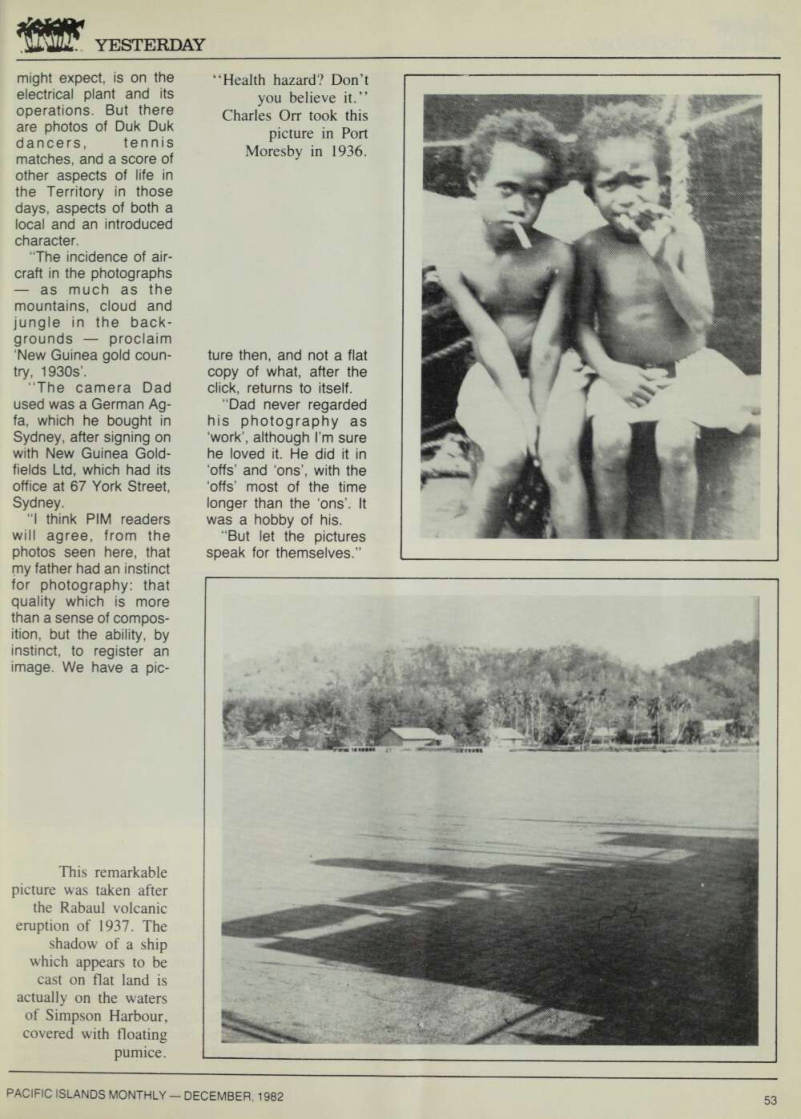
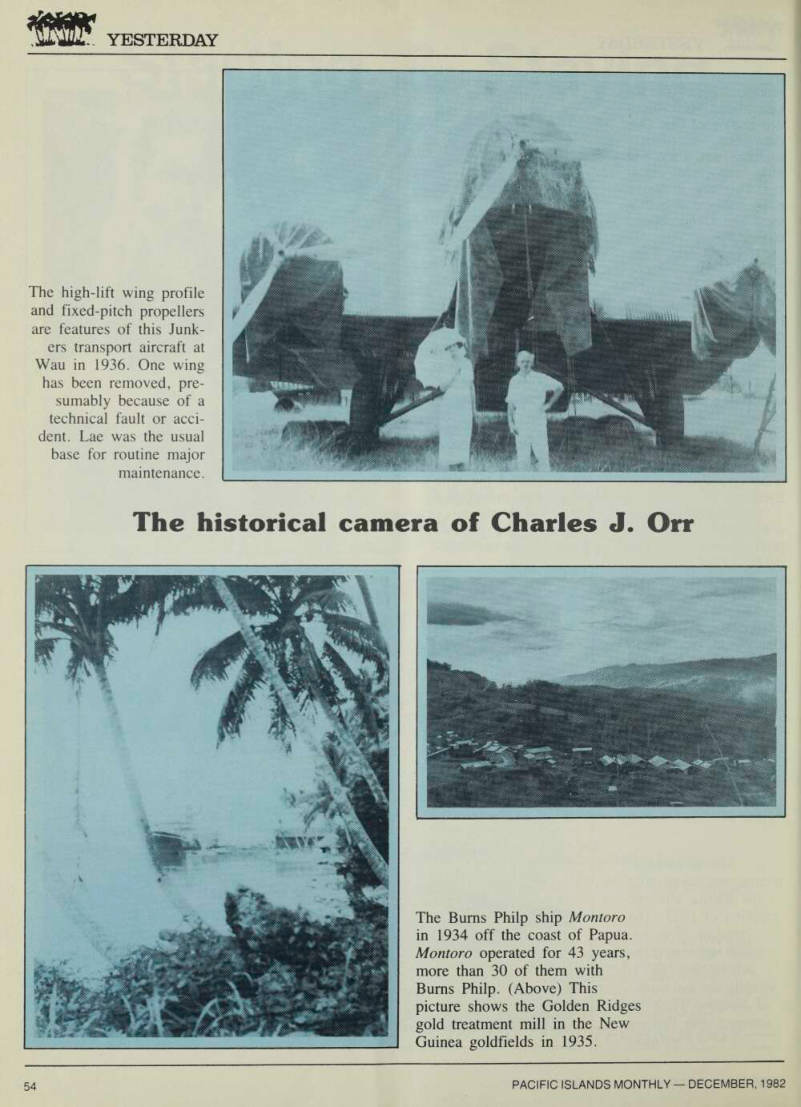
Yesterday
Charles John Orr, engineer and shutterbug in 1930s New Guinea
Reader JOHN C. ORR is proud of the photo graphic skills of his late father, the Australian
Charles John Orr,
who worked as an elec trical engineer in the New Guinea goldfields in the 19305. The exam ples of Orr Senior’s work reproduced in these pages seem to justify this pride.
Orr Junior writes: “Dad did not caption many of his photos that’s where the difficulty lies. But, for the first two years anyway, there are clues.
“The photos that he sent to his fiancee Flor ence Mae Webb (‘Myra’ to her family in Forbes, in the central-west of New South Wales) mostly had brief expla nations written on the backs.
“He took hundreds of photos in the Territory.
The emphasis as one
Elegance in the Pacific tropics in the 19305, and the touch of ethnic contrast which has served so many photographers - amateur and
professional - since the
early days of cameras.
Myra Orr, wife of the photographer, holds a hibiscus. The picture was taken in Wau in 1936.
A line of tents in an untamed jungle. This was the 1934 construction camp for the power station at Wau, and Orr helped instal it.
might expect, is on the electrical plant and its operations. But there are photos of Duk Duk dancers, tennis matches, and a score of other aspects of life in the Territory in those days, aspects of both a local and an introduced character.
“The incidence of air craft in the photographs as much as the mountains, cloud and jungle in the back grounds proclaim ‘New Guinea gold coun try, 19305’.
“The camera Dad used was a German Ag fa, which he bought in Sydney, after signing on with New Guinea Gold fields Ltd, which had its office at 67 York Street, Sydney.
“I think PIM readers will agree, from the photos seen here, that my father had an instinct for photography: that quality which is more than a sense of compos ition, but the ability, by instinct, to register an image. We have a pic
ture then, and not a flat copy of what, after the click, returns to itself.
“Dad never regarded his photography as ‘work’, although I’m sure he loved it. He did it in ‘offs’ and ‘ons’, with the ‘offs’ most of the time longer than the ‘ons’. It was a hobby of his.
“But let the pictures speak for themselves.”
This remarkable picture was taken after the Rabaul volcanic eruption of 1937. The shadow of a ship which appears to be cast on flat land is actually on the waters of Simpson Harbour, covered with floating pumice.
“Health hazard? Don’t you believe it.”
Charles Orr took this picture in Port Moresby in 1936.
The historical camera of Charles J. Orr
The high-lift wing profile
and fixed-pitch propellers are features of this Junk ers transport aircraft at Wau in 1936. One wing has been removed, pre sumably because of a technical fault or acci dent. Lae was the usual base for routine major maintenance.
The Bums Philp ship Montoro in 1934 off the coast of Popua.
Montoro operated for 43 years, more than 30 of them with Bums Philp. (Above) This picture shows the Golden Ridges gold treatment mill in the New Guinea goldfields in 1935.
Advertisements & other items, p. 52 (1 item)
Starting & Staying
■ kSJiW f i
AMP
POWER
V r?*XJ
~m / cowiHuavsuse
fl f D££P CYCIF SATTBW
§" T'TT T * I
I r oeßPoctf
MARM
STOW
*mr /'*!K&*uk?,
CHQ
CZ&
Power Boats Need Different Batteries
There is a big difference between a car battery and a marine battery.
A car battery, for example, is never really discharged, as it is only used for a few seconds each day and promptly re-charged. Not so your cruiser or sportsfisherman.
Starting the engine is only the beginning. During the day, weekend or cruise, how often will you run the live bait tank, the depth sounder, the nav. lights or maintain a listening watch on your radio transceiver?
As well as cranking power, boats need staying power. Boats need Besco's Marine Batteries, deep cycle, heavy duty marine batteries.
If your boat is getting a little flat in the electrics department, write or phone BESCO today and ask for more information, more facts about
BESCO MARINE BATTERIES.
I-
BESCO
Batteries Division Of Sims Products Ply Ltd. / A Peko Wallsend Group Member m Papua New Guinea: Lae/Rabaul Auto Marine Industries, PO Box 785, Lae. 42-1125. Port I Moresby: Par Sales Pty. Ltd., Boroko. 25-6266. Fiji: Bar Motor Parts Ltd., PO Box 51, Bar, r 74-070. New Caledonia: Lotissement Industrie!, BP 889, Noumea. 27-4906. Hong Kong: T.l.
Knight & Co., PO Box 5585, T.S.T. Kowloon, 3-66 5341. N.Z.: Battery Services (Industrial) Ltd., PO 27-375, Auckland 4, 694-111. Gould Batteries, 58 Hautana St., Lower Hutt, Wellington.
Telex: CHACO N.Z. 3714. Other Areas: Jarwil International Pty. Ltd., 410 Kent St., Sydney, 2000. (02) 264-3477. Telex; AA 72102. Besco Batteries, Villawood, 2163. (02) 632-0251.
LEADERS IN BATTERY TECHNOLOGY
firm builds a “Hurricane House”
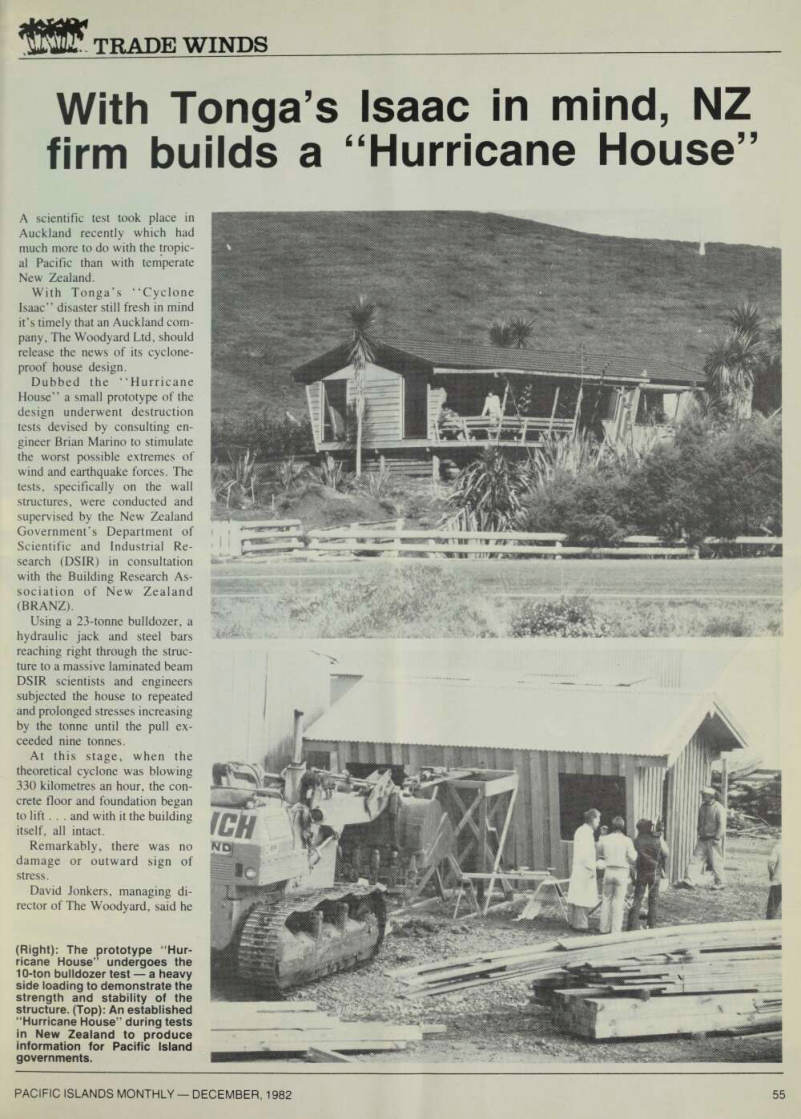
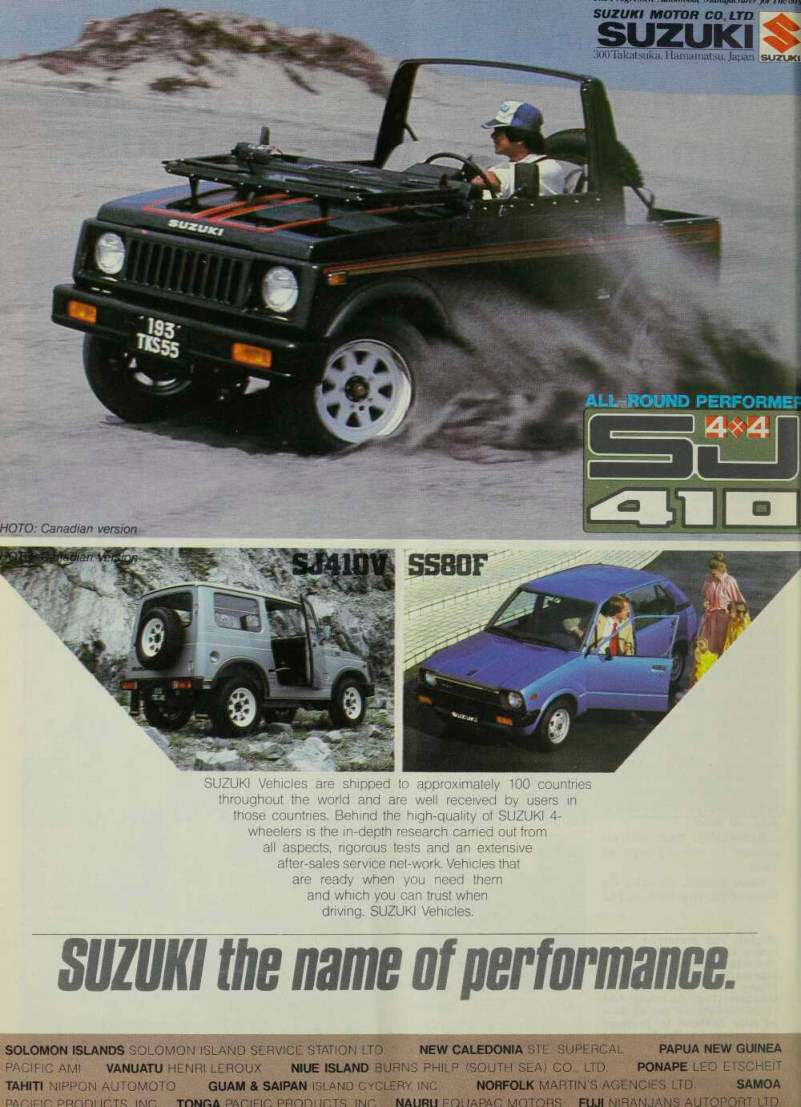
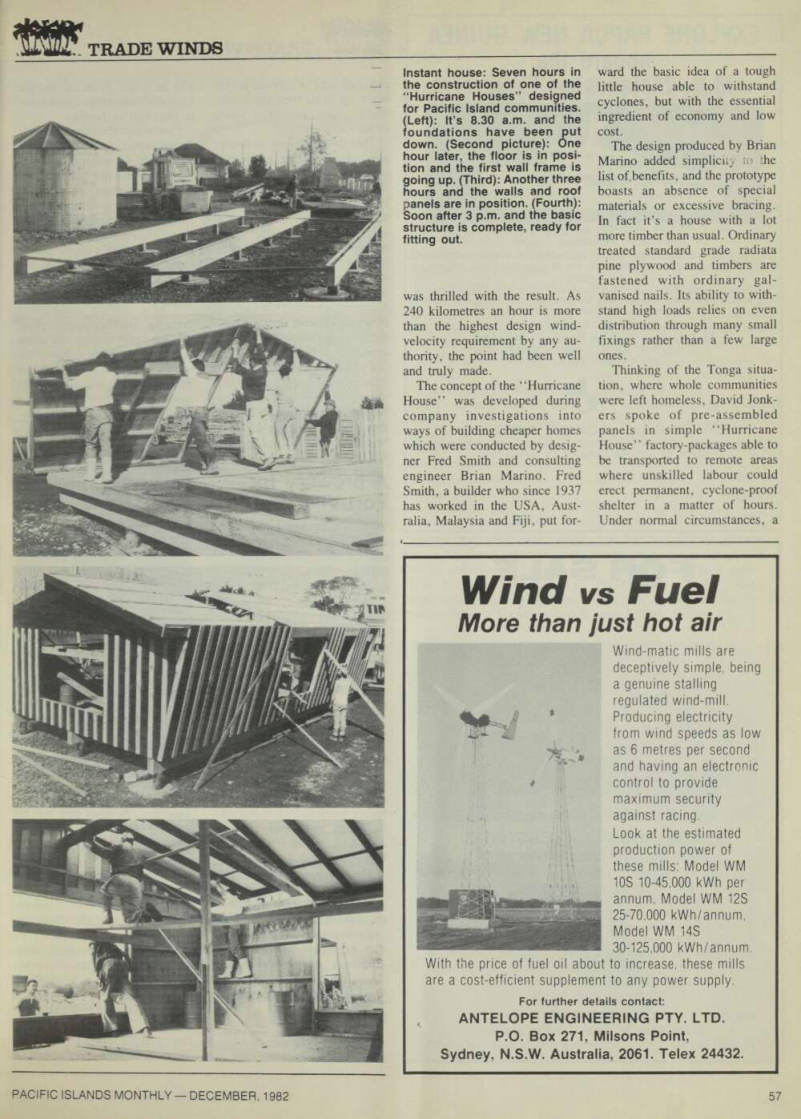
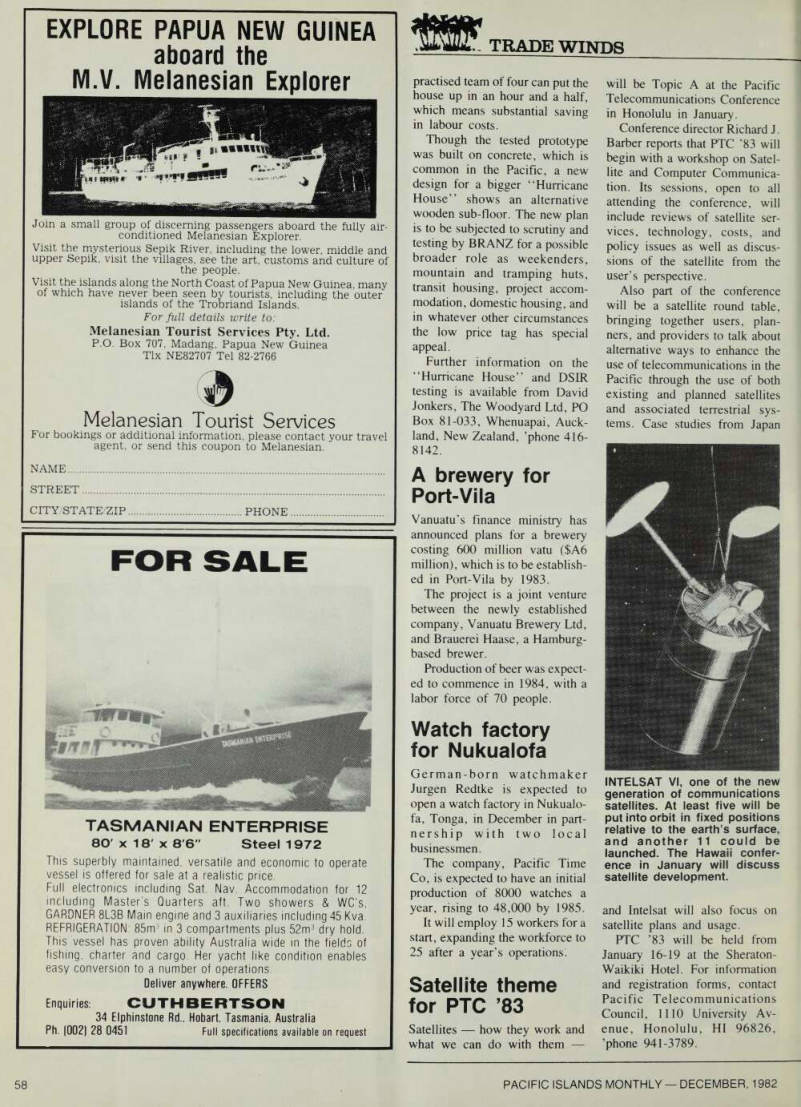
Trade Winds
With Tonga’s Isaac in mind, NZ firm builds a “Hurricane House”
A scientific test took place in Auckland recently which had much more to do with the tropic al Pacific than with temperate New Zealand.
With Tonga’s “Cyclone Isaac” disaster still fresh in mind it’s timely that an Auckland com pany, The Woodyard Ltd, should release the news of its cyclone
proof house design.
Dubbed the “Hurricane House” a small prototype of the design underwent destruction tests devised by consulting en gineer Brian Marino to stimulate the worst possible extremes of wind and earthquake forces. The tests, specifically on the wall structures, were conducted and supervised by the New Zealand Government’s Department of Scientific and Industrial Re search (DSIR) in consultation with the Building Research As sociation of New Zealand
(Branz).
Using a 23-tonne bulldozer, a hydraulic jack and steel bars reaching right through the struc ture to a massive laminated beam DSIR scientists and engineers subjected the house to repeated
and prolonged stresses increasing
by the tonne until the pull ex ceeded nine tonnes.
At this stage, when the
theoretical cyclone was blowing
330 kilometres an hour, the con crete floor and foundation began to lift. . . and with it the building itself, all intact.
Remarkably, there was no damage or outward sign of stress.
David Jonkers, managing di rector of The Woody ard, said he
(Right): The prototype “Hur ricane House” undergoes the 10-ton bulldozer test a heavy side loading to demonstrate the strength and stability of the structure. (Top): An established “Hurricane House” during tests in New Zealand to produce information for Pacific Island governments.
was thrilled with the result. As 240 kilometres an hour is more than the highest design wind velocity requirement by any au thority, the point had been well and truly made.
The concept of the “Hurricane House” was developed during company investigations into ways of building cheaper homes which were conducted by desig ner Fred Smith and consulting engineer Brian Marino. Fred Smith, a builder who since 1937 has worked in the USA, Aust ralia, Malaysia and Fiji, put for
ward the basic idea of a tough little house able to withstand cyclones, but with the essential ingredient of economy and low cost.
The design produced by Brian Marino added simplicity to the list of.benefits, and the prototype boasts an absence of special materials or excessive bracing.
In fact it’s a house with a lot more timber than usual. Ordinary treated standard grade radiata pine plywood and timbers are fastened with ordinary gal vanised nails. Its ability to with stand high loads relies on even distribution through many small fixings rather than a few large ones.
Thinking of the Tonga situa tion, where whole communities were left homeless, David Jonk ers spoke of pre-assembled panels in simple “Hurricane House” factory-packages able to be transported to remote areas where unskilled labour could erect permanent, cyclone-proof shelter in a matter of hours.
Under normal circumstances, a
Instant house: Seven hours in the construction of one of the “Hurricane Houses” designed for Pacific Island communities. (Left): It’s 8.30 a.m. and the foundations have been put down. (Second picture); One hour later, the floor is in posi tion and the first wall frame is going up. (Third): Another three hours and the walls and roof panels are in position. (Fourth): Soon after 3 p.m. and the basic structure is complete, ready for
fitting out.
practised team of four can put the house up in an hour and a half, which means substantial saving in labour costs.
Though the tested prototype was built on concrete, which is common in the Pacific, a new design for a bigger “Hurricane House’’ shows an alternative wooden sub-floor. The new plan is to be subjected to scrutiny and testing by BRANZ for a possible broader role as weekenders, mountain and tramping huts, transit housing, project accom modation, domestic housing, and in whatever other circumstances the low price tag has special appeal.
Further information on the “Hurricane House’’ and DSIR testing is available from David Jonkers, The Woodyard Ltd, PO Box 81-033, Whenuapai, Auck land, New Zealand, ’phone 4lb -8142.
A brewery for
Port-Vila
Vanuatu’s finance ministry has announced plans for a brewery costing 600 million vatu (SA6 million), which is to be establish ed in Port-Vila by 1983.
The project is a joint venture between the newly established company, Vanuatu Brewery Ltd, and Brauerei Haase, a Hamburg based brewer.
Production of beer was expect ed to commence in 1984, with a labor force of 70 people.
Watch factory
for Nukualofa
German-born watchmaker Jurgen Redtke is expected to open a watch factory in Nukualo fa, Tonga, in December in part nership with two local businessmen.
The company, Pacific Time Co, is expected to have an initial production of 8000 watches a year, rising to 48,000 by 1985.
It will employ 15 workers for a start, expanding the workforce to 25 after a year’s operations.
Satellite theme
for PTC ’B3
Satellites how they work and what we can do with them
will be Topic A at the Pacific Telecommunications Conference in Honolulu in January.
Conference director Richard J.
Barber reports that PTC ’B3 will begin with a workshop on Satel lite and Computer Communica tion. Its sessions, open to all attending the conference, will include reviews of satellite ser vices, technology, costs, and policy issues as well as discus sions of the satellite from the user’s perspective.
Also part of the conference will be a satellite round table, bringing together users, plan ners, and providers to talk about alternative ways to enhance the use of telecommunications in the Pacific through the use of both existing and planned satellites and associated terrestrial sys tems. Case studies from Japan
and Intelsat will also focus on satellite plans and usage.
PTC ’B3 will be held from January 16-19 at the Sheraton- Waikiki Hotel. For information and registration forms, contact Pacific Telecommunications Council, 1110 University Av enue, Honolulu, HI 96826, ’phone 941-3789.
INTELSAT VI, one of the new generation of communications satellites. At least five will be put into orbit in fixed positions relative to the earth’s surface, and another 11 could be launched. The Hawaii confer ence in January will discuss satellite development.
SPIA-Lan Chile
joint offer
Officials of South Pacific Island Airways (SPIA) and Lan Chile Airlines have announced that the two carriers have filed a new Circle Pacific Fare available for sale between Honolulu, New York and Miami.
The routing for this new fare includes stops in Papeete, Tahiti; Easter Island; Santiago; Chile; and Lima, Peru, en route to Miami or New York. SPIA will
provide the service between Honolulu and Tahiti, with the rest of the sectors being flown by Lan Chile.
Unlimited stopovers may be made in any of the cities along the route and the fares are valid for one year. Fares also may be combined with any domestic or inter-island fares within the USA or Canada.
While satellite services provide an increasingly flexible communi cations network for the more remote parts of the Pacific, work is now well advanced on the new ANZCAN undersea cable which will provide a trunk route linking Australia and Canada through Norfolk Island, Fiji and Hawaii. It will be a supplementary service to the satellite services and is due to go into service in late 1984, replacing an existing cable (PIM Mar. p5l). Picture shows Fiji-born Mohamed Iqbal (seated) working on one of the cable repeater units at the Australian factory of STC in Liverpool, New South Wales. He and his colleagues wear special clothing to prevent any contami nation entering the repeater. When the cable and its repeaters lie on the bed of the Pacific the workmanship and materials will have to be good enough to allow operation for at least 25 years without maintenance or repair.
Advertisements & other items, pp. 56-58 (2 items)
SUMI the name of performance.
miinyuwM/cr jvr g ne (.
SUZUKI MOTOR CO, LTD A
SUZUKI $
lAATnlrnft'nl'o T_ SOOTakatsuka, Hamamatsu. Japan suzukj B 4 4 4 4 ► O HOTO: Canadian version
SSBOF
>1 v-- 1 r i SP & V.- #; *• SUZUKI Vehicles are shipped to approximately 100 countries throughout the world and are well received by users in those countries. Behind the high-quality of SUZUKI 4wheelers is the in-depth research carried out from all aspects, rigorous tests and an extensive after-sales service net-work. Vehicles that are ready when you need them and which you can trust when driving. SUZUKI Vehicles.
SUMI the name of performance.
SOLOMON ISLANDS SOLOMON ISLAND SERVICE STATION LTD. NEW CALEDONIA STE. SUPERCAL PAPUA NEW GUINEA PACIFIC AMI VANUATU HENRI LEROUX NIUE ISLAND BURNS PHILP (SOUTH SEA) CO., LTD, PONAPE LEO ETSCHEIT TAHITI NIPPON AUTOMOTO GUAM & SAIPAN ISLAND CYCLERY INC. NORFOLK MARTIN’S AGENCIES LTD. SAMOA
Wind VS Fuel
More than just hot air
Wind-matic mills are deceptively simple, being a genuine stalling regulated wind-mill.
Producing electricity from wind speeds as low as 6 metres per second and having an electronic control to provide maximum security against racing.
Look at the estimated production power of these mills: Model WM 10S 10-45,000 kWh per annum, Model WM 12S 25-70,000 kWh/annum, Model WM 14S 30-125,000 kWh/annum.
With the price of fuel oil about to increase, these mills are a cost-efficient supplement to any power supply.
For further details contact:
ANTELOPE ENGINEERING PTY. LTD.
P.O. Box 271, Milsons Point, Sydney, N.S.W. Australia, 2061. Telex 24432.
EXPLORE PAPUA NEW GUINEA
aboard the
M.V. Melanesian Explorer
i««u *t»*n Join a small group of discerning passengers aboard the fully airconditioned Melanesian Explorer.
Visit the mysterious Sepik River, including the lower, middle and upper Sepik, visit the villages, see the art, customs and culture of the people.
Visit the islands along the North Coast of Papua New Guinea, many of which have never been seen by tourists, including the outer islands of the Trobriand Islands.
For full details write to: Melanesian Tourist Services Pty. Ltd.
P.O. Box 707, Madang, Papua New Guinea Tlx NE82707 Tel 82-2766
Melanesian Tourist Services
For bookings or additional information, please contact your travel agent, or send this coupon to Melanesian.
NAME
STREET
CITY STATE ZIP
PHONE
FOR SALE
TASMANIAN ENTERPRISE
80' x 18' x B'6" Steel 1972 This superbly maintained, versatile and economic to operate vessel is offered for sale at a realistic price.
Full electronics including Sat. Nav. Accommodation for 12 including Master’s Quarters aft. Two showers & WC's, GARDNER BL3B Main engine and 3 auxiliaries including 45 Kva.
REFRIGERATION: 85m 3 in 3 compartments plus 52m 3 dry hold.
This vessel has proven ability Australia wide in the fields of fishing, charter and cargo. Her yacht like condition enables easy conversion to a number of operations.
Deliver anywhere. OFFERS Enquiries; CUTHBERTSON 34 Elphinstone Rd.. Hobart. Tasmania. Australia Ph. (002) 28 0451 Full specifications available on request
Trade Winds
its “week” in PNG
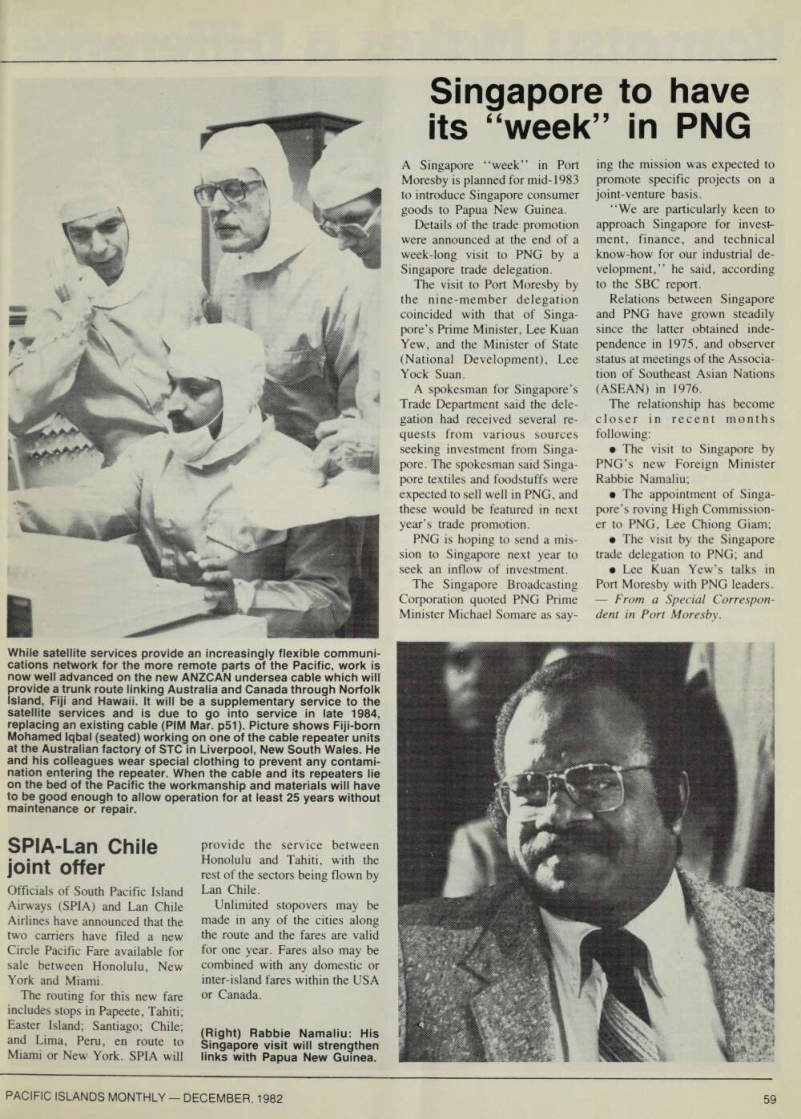
Singapore to have its “week” in PNG
A Singapore “week” in Port Moresby is planned for mid-1983 to introduce Singapore consumer goods to Papua New Guinea.
Details of the trade promotion were announced at the end of a week-long visit to PNG by a Singapore trade delegation.
The visit to Port Moresby by the nine-member delegation coincided with that of Singa pore’s Prime Minister, Lee Kuan Yew, and the Minister of State (National Development), Lee Yock Suan.
A spokesman for Singapore’s Trade Department said the dele gation had received several re quests from various sources seeking investment from Singa pore. The spokesman said Singa pore textiles and foodstuffs were expected to sell well in PNG, and these would be featured in next year’s trade promotion.
PNG is hoping to send a mis sion to Singapore next year to seek an inflow of investment.
The Singapore Broadcasting Corporation quoted PNG Prime Minister Michael Somare as say
ing the mission was expected to promote specific projects on a
joint-venture basis.
“We are particularly keen to
approach Singapore for invest
ment, finance, and technical know-how for our industrial de
velopment,” he said, according
to the SBC report.
Relations between Singapore and PNG have grown steadily since the latter obtained inde pendence in 1975, and observer status at meetings of the Associa tion of Southeast Asian Nations
(Asean) In 1976.
The relationship has become closer in recent months
following:
• The visit to Singapore by PNG’s new Foreign Minister Rabbie Namaliu; • The appointment of Singa
pore’s roving High Commission
er to PNG, Lee Chiong Giam; • The visit by the Singapore trade delegation to PNG; and • Lee Kuan Yew’s talks in Port Moresby with PNG leaders.
From a Special Correspon dent in Port Moresby.
(Right) Rabbie Namaliu: His Singapore visit will strengthen links with Papua New Guinea.
Advertisements & other items, p. 60 (1 item)
Komatsu Makes a Difference
-V, mm : *** X C m.
'•». *^V In critical areas like reliability and performance, Komatsu products and systems are making a significant difference at mining and construction sites around the world.
In the USA, for example, Komatsu’s largest and most powerful work machine the D455A bulldozer is establishing a superior record of reliability and productivity at mining sites that virtually no other machine in its class can match.
And in another critical area, technology, Komatsu is also making a difference in responding to market demands for improved product quality, and for new and original product innovations.
Consider our new computerized seabed robot system: Operating on the ocean floor, it can relay TV pictures of the seabed to a mother ship, or perform man-like boring, drilling and piling operations down to planned depths of 500 meters* Discover the Komatsu difference above sea level, or down to depths of 500 meters. Komatsu a name you can build on.
•H KOMATSU LTD
Tokyo, Japan Komatsu offices: Tokyo, Sydney, Singapore, Jakarta, Manila, Bangkok, Bangalore, Karachi, Beijing, Istanbul, Cairo, Alger, Dubai, Tehran, Baghdad, Jeddah, Riyadh, Damman, Nairobi, Abidjan, Lagos, Johannesburg, Moscow, Warsaw, Brussels, Paris, Madrid, Frankfurt, Stuttgart, London, Habana, Buenos Aires, Panama, Caracas, Sao Paulo, Bogota, Mexico City, San Francisco, Oakland, Philadelphia, Detroit, Dallas, Atlanta, Chicago, Toronto, Vancouver, and distributors in over 100 countries around the world. i * ♦ The Komatsu seabed robot system is currently operating in the Japan Inland Sea at depths down to a maximum of 70 meters, in a government-sponsored bridge works program
Big display of Solomons’
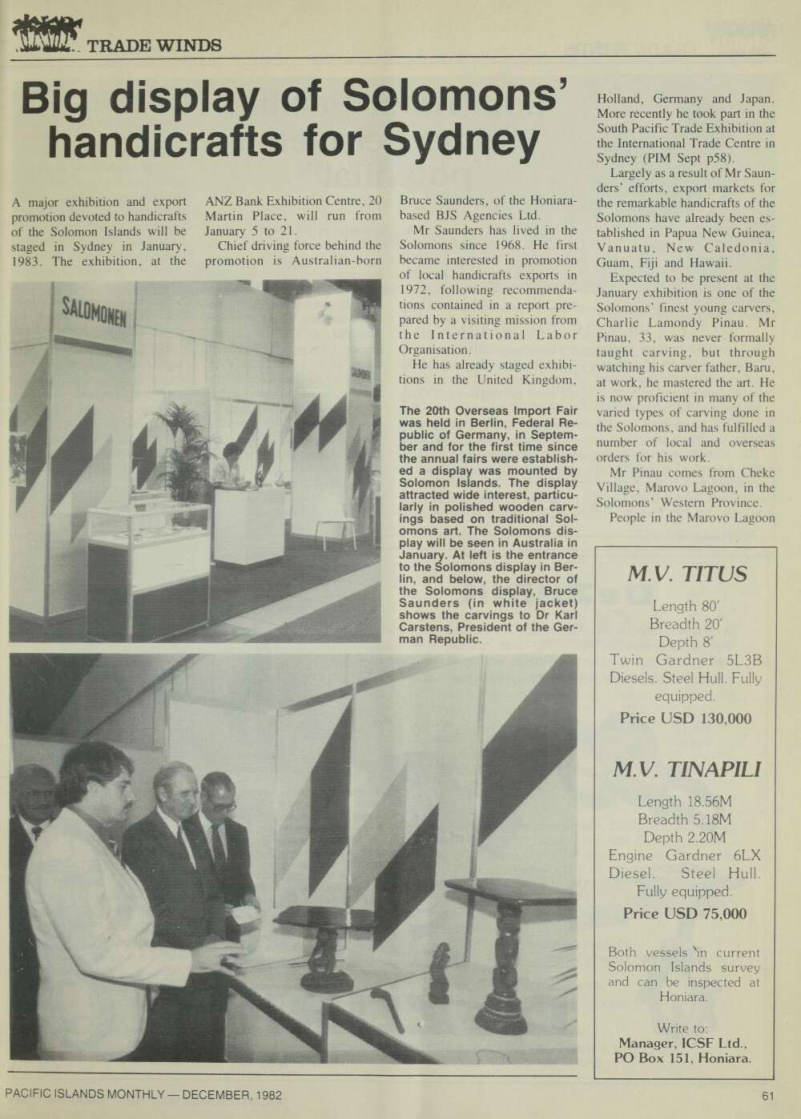

handicrafts for Sydney
A major exhibition and export promotion devoted to handicrafts of the Solomon Islands will be staged in Sydney in January, 1983. The exhibition, at the
ANZ Bank Exhibition Centre, 20 Martin Place, will run from January 5 to 21.
Chief driving force behind the promotion is Australian-born
Bruce Saunders, of the Honiara based BJS Agencies Ltd.
Mr Saunders has lived in the Solomons since 1968. He first became interested in promotion of local handicrafts exports in 1972, following recommenda tions contained in a report pre pared by a visiting mission from the International Labor
Organisation.
He has already staged exhibi tions in the United Kingdom,
Holland, Germany and Japan.
More recently he took part in the South Pacific Trade Exhibition at the International Trade Centre in
Sydney (PIM Sept p5B).
Largely as a result of Mr Saun ders’ efforts, export markets for the remarkable handicrafts of the Solomons have already been es tablished in Papua New Guinea, Vanuatu, New Caledonia, Guam, Fiji and Hawaii.
Expected to be present at the January exhibition is one of the Solomons’ finest young carvers, Charlie Lamondy Pinau. Mr Pinau, 33, was never formally taught carving, but through watching his carver father, Baru, at work, he mastered the art. He is now proficient in many of the varied types of carving done in the Solomons, and has fulfilled a number of local and overseas orders for his work.
Mr Pinau comes from Cheke Village, Marovo Lagoon, in the Solomons’ Western Province.
People in the Marovo Lagoon
The 20th Overseas Import Fair was held in Berlin, Federal Re public of Germany, in Septem ber and for the first time since the annual fairs were establish ed a display was mounted by Solomon Islands. The display attracted wide interest, particu larly in polished wooden carv ings based on traditional Sol omons art. The Solomons dis play will be seen in Australia in January. At left is the entrance to the Solomons display in Ber lin, and below, the director of the Solomons display, Bruce Saunders (in white jacket) shows the carvings to Dr Karl Carstens, President of the Ger man Republic.
area have long been prominent exponents of the art of carving, which is traditionally one of their main income-earners.
Mr Pinau plans to demonstrate his skills to visitors at the
January exhibition in Sydney.
The exhibition is receiving the active support of a number of companies, and of the Sydney based South Pacific Trade Com missioner, Mr Bill McCabe.
Trade Commissioner McCabe
Advertisements & other items, p. 61 (1 item)
Mv. Tinapili
MV. TITUS
Length 80' Breadth 20' Depth 8' Twin Gardner 5L38 Diesels. Steel Hull. Fully equipped.
Price USD 130,000
MV. TINAPILI
Length 18.56 M Breadth 5.18 M Depth 2.20 M Engine Gardner 6LX Diesel. Steel Hull.
Fully equipped.
Price USD 75,000 Both vessels N in current Solomon Islands survey and can be inspected at Honiara.
Write to: Manager, ICSF Ltd., PO Box 151, Honiara.
“Some petroleum
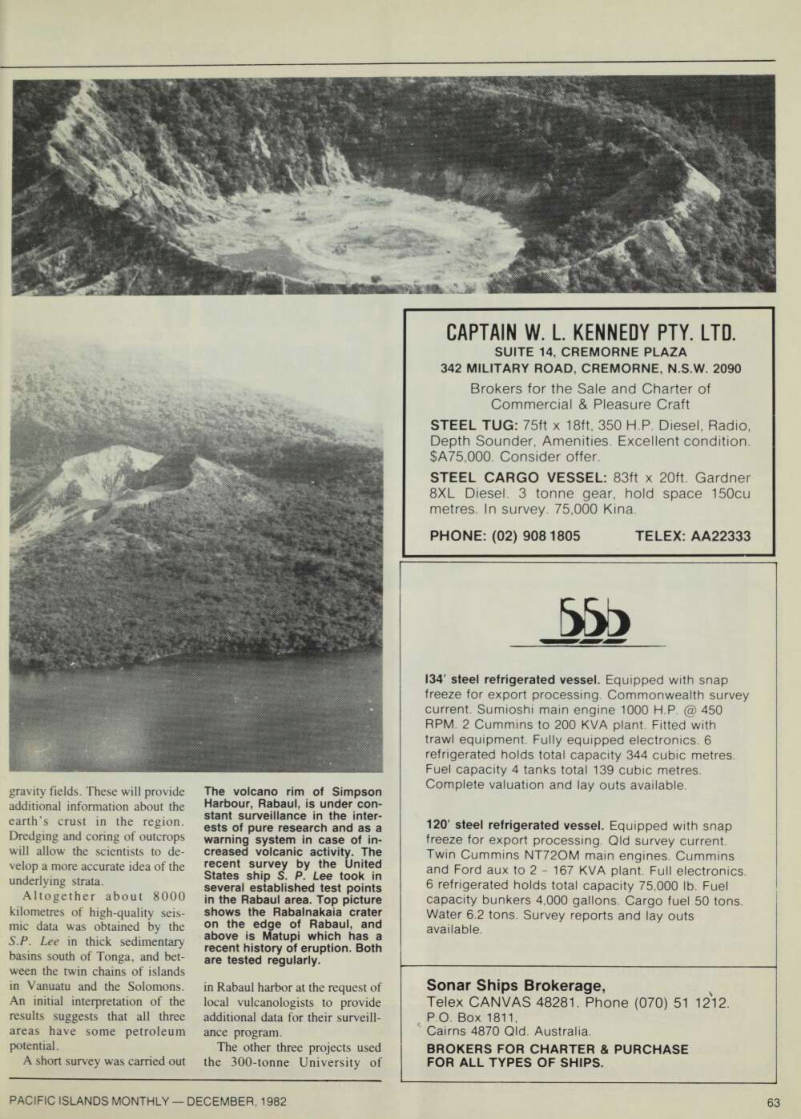

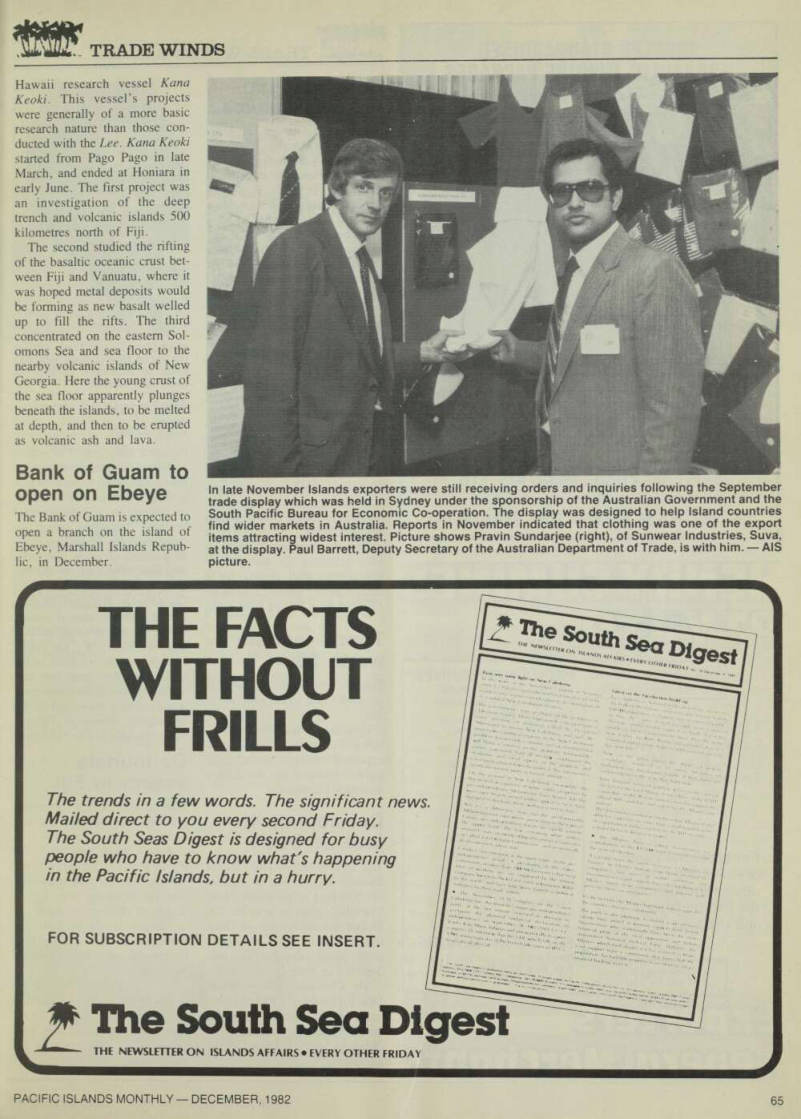
Southwest Pacific: “Some petroleum potential”
Six South Pacific marine geolog ical and geophysical projects which ended in August (PIM Aug p 6) were aimed at better understanding the regional geol ogy, and the mineral and pet roleum potential, of the island arcs of the Southwest Pacific.
The projects were financed by Australia, New Zealand and the United States, and were carried out under the auspices of CCOP /SOPAC (Committee for Co ordination of Joint Prospecting for Mineral Resources in South Pacific Offshore Areas), the UN sponsored organisation based in Suva which is responsible for promoting offshore mineral ex ploration programs for member
countries in the South Pacific.
The research took place in the waters of Tonga, Fiji, Vanuatu, Solomon Islands and Papua New Guinea. Participating scientists came from the three donor coun tries, the five island countries involved, CCOP/SOPAC and France. Each project had Amen can and CCOP/SOPAC nominated co-chief scientists; the latter included Dr David Falvey of Sydney University and Dr Neville Exon of the Bureau of Mineral Resources (BMR), Can berra. Altogether there were 11 Australians aboard ship, drawn from both the Bureau of Mineral Resources and from universities belonging to the
Australian Consortium of Ocean Geoscientists (COGS).
Three projects used the 1500tonne United States Geological Survey research vessel S.P. Lee which normally works in the cold waters off the American west coast including Alaska. (There was certainly no lack of volun teers to work in the South Pacific for a change). The projects were designed to better evaluate the petroleum potential of offshore areas in Tonga, Vanuatu and the Solomons. Research started from Pago Pago in late March and ended in Rabaul in early June.
The S.P. Lee concentrated on sophisticated multichannel seis mic surveying which revealed details of the sedimentary strata to depths of more than 5 km beneath the sea bed. A great deal of computer processing and sci entific analysis is needed before final results will be available.
During the surveying, continu
ous measurements were also made of the earth’s magnetic and
gravity fields. These will provide additional information about the earth’s crust in the region.
Dredging and coring of outcrops will allow the scientists to de velop a more accurate idea of the
underlying strata.
Altogether about 8000 kilometres of high-quality seis mic data was obtained by the S.P. Lee in thick sedimentary basins south of Tonga, and bet ween the twin chains of islands in Vanuatu and the Solomons.
An initial interpretation of the results suggests that all three areas have some petroleum potential.
A short survey was carried out
in Rabaul harbor at the request of local vulcanologists to provide additional data for their surveill ance program.
The other three projects used the 300-tonne University of
The volcano rim of Simpson Harbour, Rabaul, is under con stant surveillance in the inter ests of pure research and as a warning system in case of in creased volcanic activity. The recent survey by the United States ship S. P. Lee took in several established test points in the Rabaul area. Top picture shows the Rabalnakaia crater on the edge of Rabaul, and above is Matupi which has a recent history of eruption. Both are tested regularly.
Hawaii research vessel Kana Keoki. This vessel’s projects were generally of a more basic research nature than those con ducted with the Lee. Kana Keoki started from Pago Pago in late March, and ended at Honiara in early June. The first project was an investigation of the deep trench and volcanic islands 500 kilometres north of Fiji.
The second studied the rifting of the basaltic oceanic crust bet ween Fiji and Vanuatu, where it was hoped metal deposits would be forming as new basalt welled up to fill the rifts. The third concentrated on the eastern Sol omons Sea and sea floor to the nearby volcanic islands of New Georgia. Here the young crust of the sea floor apparently plunges beneath the islands, to be melted at depth, and then to be erupted as volcanic ash and lava.
Bank of Guam to
open on Ebeye
The Bank of Guam is expected to open a branch on the island of Ebeye, Marshall Islands Repub lic, in December.
In late November Islands exporters were still receiving orders and inquiries following the September trade display which was held in Sydney under the sponsorship of the Australian Government and the South Pacific Bureau for Economic Co-operation. The display was designed to help Island countries find wider markets in Australia. Reports in November indicated that clothing was one of the export items attracting widest interest. Picture shows Pravin Sundarjee (right), of Sunwear Industries, Suva, at the display. Paul Barrett, Deputy Secretary of the Australian Department of Trade, is with him. AIS picture.
New Honolulu-
Fiji ship service
Beginning in October, the Mar shall Islands Maritime Company inaugurated a direct shipping ser vice from Honolulu to Fiji and Tonga.
Announcing the service, Mike Noland, president of the Maritime Company of the Pacif ic, general agents for the MIMC, said that until now cargo to Ton ga and Fiji from Honolulu had to be routed via Canada, the U.S.
West coast, and New Zealand before reaching its destination.
Ipseco plant
in action
The 12 mW power station built on Majuro by the British com pany Ipseco was expected to be supplying power by the end of November.
The plant cost the equivalent of SUS 24 million, which was borrowed by the Marshalls Gov ernment from the British-owned Midland Bank.
The government of Belau is also reported to have been negotiating with Ipseco for a similar power station, also to be financed by a British bank loan.
Tonga tourism
worth s6m
Tonga’s tourist industry brought in more than ST6 million in 1981.
Remittances from overseas to talled $l2 million, and copra exports $5 million, according to figures released by the Tonga Statistics Department.
Developing the
jade of Ouen
The Suva-based monthly Island Business reports that the curator of Noumea’s museum, Luc Chevalier, plans to help the 200 Melanesian inhabitants of Ouen Island, south of New Caledonia’s main island, develop the jade deposits on their home island.
Mr Chevalier told reporter Julie Richardson: “I would very much like to help them work on the mine and export the jade. The chief, Chief Tein, is very interested.”
Malaysians look
Fiji over
Malaysia may help Fiji with a variety of business ventures from prawn hatcheries to coconut pro cessing mills and tourist hotels, according to a high-powered business delegation which ac companied the Malaysian Prime Minister, Datuk Seri Dr Mahathir Mahamad, to the Oc tober Commonwealth Heads of Government Regional Meeting (CHOGRM) in Suva.
The delegation which included eight of Malaysia’s top indus trialists and bankers, hand picked by Dr Mahathir, spent four days travelling around the country and was favorably impressed by the investment climate in Fiji.
Zarine Nandan in The Fiji Times.
Oz tourists
swarm to Fiji
Australia’s current economic problems have started a tourist boom for Fiji.
Asha Lakhan reported in The Fiji Times in October: “Thousands of Australian tour ists are flooding into Fiji in search of cheaper holidays.
“Resort hotels in Nadi and Coral Coast areas are reporting occupancy rates well above 90 per cent.
“According to figures re leased by the Bureau of Statistics for August, visitors to Fiji for the first eight months of this year were up 7.1 per cent over the same months last year.”
Aiwa Olmi, Senior Trade Officer for Papua New Guinea, who has been in Australia selling his country’s exports.
Advertisements & other items, pp. 62-66 (1 item)
Dezurbk
A complete valve range in a multitude of material and specification options in sizes Vi” - 72” with manual, pneumatic, hydraulic or electric actuators. Proven worldwide in municipal, industrial and process applications.
Electric Control Valves Resilient Seated Butterfly Valves Paper Stock Consistency Transmitters % w I Vi Knife Gate Valves High Pressure Butterfly Valves
A UNIT OF GENERAL SIGNAL
DeZURBK
DeZURIK OF AUSTRALIA PTY. LTD., P.O. Box 204, Vineyard Road, Sunbury, Victoria 3429, Australia. Telephone: 03-744-2244, Telex: AA33732.
CAPTAIN W. L KENNEDY PTY. LTD.
SUITE 14, CREMORNE PLAZA
342 MILITARY ROAD, CREMORNE, N.S.W. 2090
Brokers for the Sale and Charter of Commercial & Pleasure Craft STEEL TUG: 75ft x 18ft, 350 H.P. Diesel, Radio, Depth Sounder, Amenities. Excellent condition. $A75,000. Consider offer.
STEEL CARGO VESSEL: 83ft x 20ft. Gardner BXL Diesel. 3 tonne gear, hold space 150 cu metres. In survey. 75,000 Kina.
PHONE: (02) 9081805 TELEX: AA22333
134' steel refrigerated vessel. Equipped with snap freeze for export processing. Commonwealth survey current. Sumioshi main engine 1000 H P. @ 450 RPM. 2 Cummins to 200 KVA plant. Fitted with trawl equipment. Fully equipped electronics. 6 refrigerated holds total capacity 344 cubic metres.
Fuel capacity 4 tanks total 139 cubic metres.
Complete valuation and lay outs available. 120' steel refrigerated vessel. Equipped with snap freeze for export processing. Old survey current.
Twin Cummins NT72CM main engines. Cummins and Ford aux to 2 - 167 KVA plant. Full electronics. 6 refrigerated holds total capacity 75,000 lb. Fuel capacity bunkers 4,000 gallons. Cargo fuel 50 tons.
Water 6.2 tons. Survey reports and lay outs available.
Sonar Ships Brokerage,
Telex CANVAS 48281. Phone (070) 51 1212.
P O. Box 1811, Cairns 4870 Old. Australia.
BROKERS FOR CHARTER & PURCHASE
FOR ALL TYPES OF SHIPS.
House kits (tip to 150 square metres in size) fit m a 6 metre container and are currently being exported to Pacific Islands a* • Ml j
It arrives
by container
and you build it
with a Spanner in a
matter of weeks.
r The "Logan Unit" kits consist of galvanised steel framed-insulated-asbestor cement sheeted modules 1 metre wide. Each kit contains all modules including windows and doors, roof members, roof sheets, ceilings and fixing to complete a lock-up unit.
Erection of a kit on an established floor is about 8 days for 2 men. v V * I m
A Marlin Modular Home.
Marlin Modular Constructions supply (and construct where required) cyclone rated modular homes and buildings The system is adaptable for use as housing, schools, offices etc.
Marlin Modular Constructions
P.O. Box 149, Archerfield 4108, Old.
Australia. Phone 345 4444 Telex AA44636
Distributors: Logan Modular Homes, P.O Box 6843, Boroko, Papua New Guinea, Ph 255011, Tlx NE22280.
Pacific Modular Limited, P.O. Box 201, Port Vila, Vanuatu.
THE FACTS
WITHOUT
FRILLS
The trends in a few words. The significant news Mailed direct to you every second Friday.
The South Seas Digest is designed for busy people who have to know what's happening in the Pacific Islands, but in a hurry.
FOR SUBSCRIPTION DETAILS SEE INSERT.
f The South Sea Digest
l THE NEWSLETTER ON ISLANDS AFFAIRS • EVERY OTHER FRIDAY
Sea
Digest
KOSSLER STANDARDISED
HVDRAULIC TURBINE PACKAGES
The hydro-electric alternative to fuel-operated power generation Kossler Turbines have produced a range of turbines that have an output from 10kW-15,000kW per unit and that are capable of operating on a waterhead as low as 1 metre or as high as 1.000 metres. Antelope can offer you a complete package including supervision of the installation of all automated accessories.
For further details contact:
ANTELOPE ENGINEERING PTY. LTD.
P.O. Box 271, Milsons Point, Sydney, N.S.W. Australia, 2061. Telex 24432.
iß^oiiLmgs
LOCAL AGENTS AND
REPRESENTATION
428 George St., Sydney.
Cables: Henco Sydney.
G.P.O. Box 3949.
Telephone: 232 5377.
PAPUA NEW GUINEA
RABAUL: M. & C. Seeto, P.O. Box 131, Rabaul.
Telephone 92 2919.
MADANG: W. Double, P.O. Box 22, Madang.
Telephone 82 2696.
FIJI
K. Witherington Ltd., P.O. Box 293, Suva.
Telephone 22 356.
For specialised and
personalised buying
service throughout
the Pacific Islands and the East.
Resident Agents in other Pacific Territories.
VANUATU
John Lum & Associates, P.O. Box 65, Santo.
Telephone 329.
SOLOMON ISLANDS
Mr. Tom Lo, P.O. Box 327, Honiara.
Telephone 399
Yachts
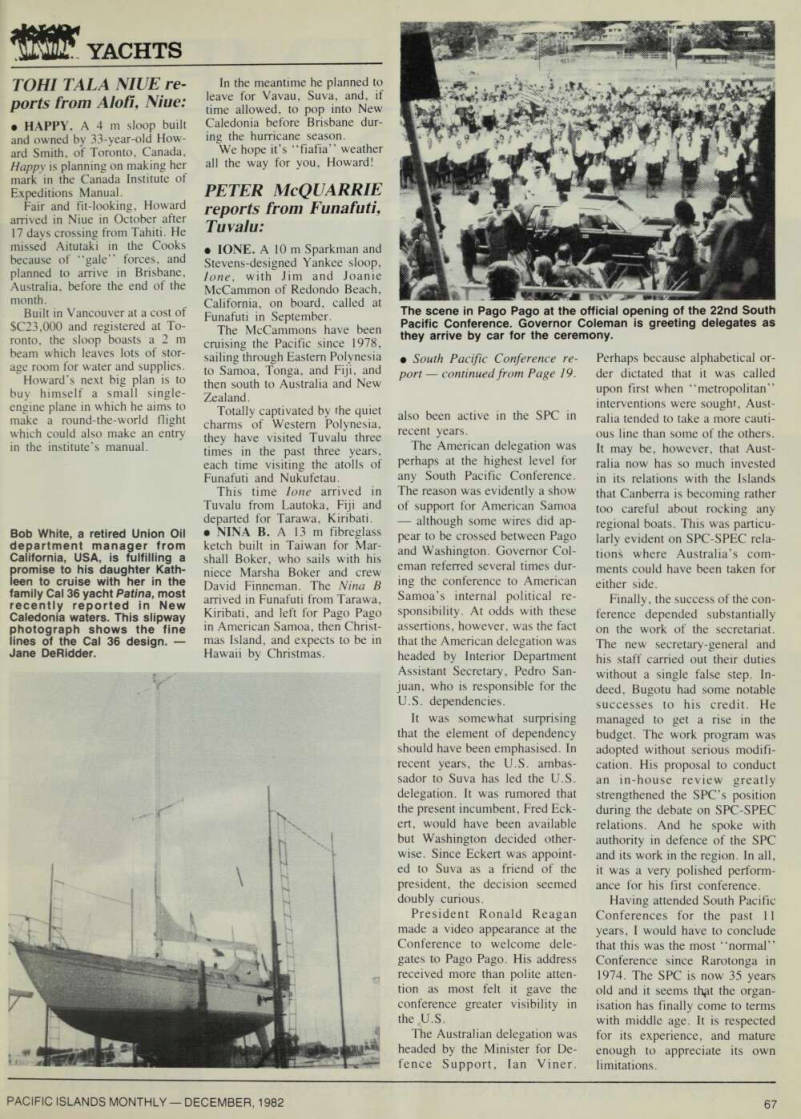
Tohi Tala Niue Re
ports from Aloft, Niue:
• HAPPY, A 4 m sloop built and owned by 33-year-old How ard Smith, of Toronto, Canada, Happy is planning on making her mark in the Canada Institute of
Expeditions Manual.
Fair and fit-looking, Howard arrived in Niue in October after 17 days crossing from Tahiti. He missed Aitutaki in the Cooks because of “gale” forces, and planned to arrive in Brisbane, Australia, before the end of the month.
Built in Vancouver at a cost of $C23,000 and registered at To ronto, the sloop boasts a 2 m beam which leaves lots of stor age room for water and supplies.
Howard’s next big plan is to buy himself a small single engine plane in which he aims to make a round-the-world flight which could also make an entry in the institute’s manual.
In the meantime he planned to leave for Vavau, Suva, and, if time allowed, to pop into New Caledonia before Brisbane dur ing the hurricane season.
We hope it’s “fiafia” weather all the way for you, Howard!
Peter Mcquarrie
reports from Funafuti,
Tuvalu:
• lONE. A 10 m Sparkman and Stevens-designed Yankee sloop, lone, with Jim and Joanie McCammon of Redondo Beach, California, on board, called at Funafuti in September.
The McCammons have been cruising the Pacific since 1978,
sailing through Eastern Polynesia
to Samoa, Tonga, and Fiji, and then south to Australia and New Zealand.
Totally captivated by the quiet
charms of Western Polynesia, they have visited Tuvalu three times in the past three years, each time visiting the atolls of Funafuti and Nukufetau.
This time lone arrived in Tuvalu from Lautoka, Fiji and departed for Tarawa, Kiribati. • NINA B. A 13 m fibreglass ketch built in Taiwan for Mar shall Boker, who sails with his niece Marsha Boker and crew David Finneman. The Nina B arrived in Funafuti from Tarawa, Kiribati, and left for Pago Pago in American Samoa, then Christ mas Island, and expects to be in Hawaii by Christmas.
Bob White, a retired Union Oil department manager from California, USA, is fulfilling a promise to his daughter Kath leen to cruise with her in the family Cal 36 yacht Patina, most recently reported in New Caledonia waters. This slipway photograph shows the fine lines of the Cal 36 design.
Jane DeRidder.
Advertisements & other items, pp. 67-68 (2 items)
67
PACIFIC ISLANDS MONTHLY —DECEMBER, 1982
• South Pacific Conference re port — continued from Page 19.
Gentlemen
PREFER PARKER.
* The Classic Flighter Delux Ballpen 5 ■ >, ■ - The 50 Brown Epoxy Ballpen The Arrow Gold Ballpen Add weight to your words with a pen from Parker. Fine writing instruments that spell out your own special style.
Or the style of someone special. The choice is yours from a wide range of pens to suit all pockets. Parker. The world’s most wanted pen.
Trade enquiries to Parker Pen (Australia) Pty. Ltd., 159 Cleveland Street, Chippendale, N.S.W 2088. Telephone: Sydney ♦ ni/ r D (02) 6994405, Telex: SYDNEY PPENSY 22026. I AK K L K
Shipping Schedules
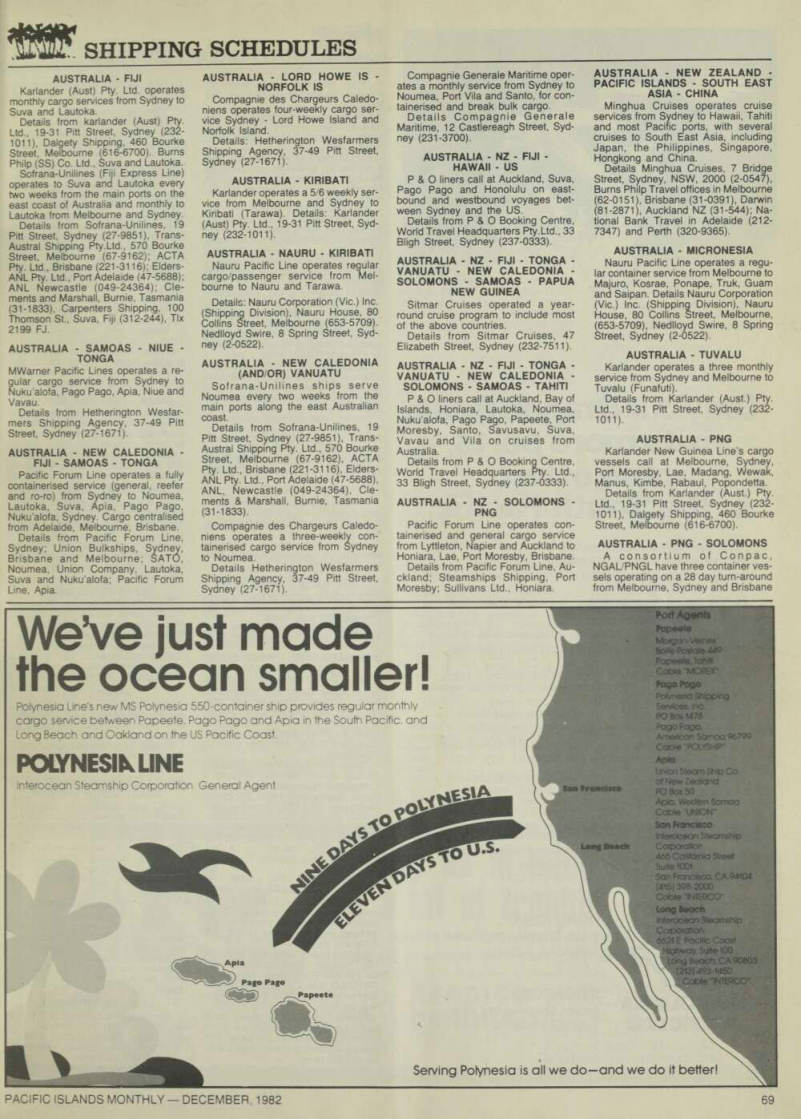
Australia - Fiji
Karlander (Aust) Pty. Ltd. operates monthly cargo services from Sydney to Suva and Lautoka.
Details from karlander (Aust) Pty.
Ltd., 19-31 Pitt Street, Sydney (232- Id 1), Dalgety Shipping, 460 Bourke Street, Melbourne (616-6700). Burns Philp (SS) Co. Ltd., Suva and Lautoka.
Sofrana-Unilines (Fiji Express Line) operates to Suva and Lautoka every two weeks from the main ports on the east coast of Australia and monthly to Lautoka from Melbourne and Sydney.
Details from Sofrana-Unilines, 19 Pitt Street, Sydney (27-9851), Trans- Austral Shipping Pty.Ltd., 570 Bourke Street, Melbourne (67-9162); ACTA Pty. Ltd., Brisbane (221-3116); Elders- ANL Pty. Ltd., Port Adelaide (47-5688); ANL Newcastle (049-24364); Cle ments and Marshall, Burnie, Tasmania (31-1833), Carpenters Shipping, 100 Thomson St., Suva, Fiji (312-244), Tlx 2199 FJ.
Australia - Samoas - Niue ■
Tonga
MWarner Pacific Lines operates a re gular cargo service from Sydney to Nukualofa, Pago Pago, Apia, Niue and Vavau.
Details from Hetherington Wesfar mers Shipping Agency, 37-49 Pitt Street, Sydney (27-1671).
Australia - New Caledonia -
Fiji - Samoas - Tonga
Pacific Forum Line operates a fully containerised service (general, reefer and ro-ro) from Sydney to Noumea, Lautoka, Suva, Apia, Pago Pago, Nukualofa, Sydney. Cargo centralised from Adelaide, Melbourne, Brisbane.
Details from Pacific Forum Line, Sydney: Union Bulkships, Sydney, Brisbane and Melbourne: SATO, Noumea, Union Company, Lautoka, Suva and Nukualofa; Pacific Forum Line, Apia.
Australia - Lord Howe Is -
Norfolk Is
Compagnie des Chargeurs Caledo niens operates four-weekly cargo ser vice Sydney - Lord Howe Island and Norfolk Island.
Details: Hetherington Wesfarmers Shipping Agency, 37-49 Pitt Street, Sydney (27-1671).
Australia - Kiribati
Karlander operates a 5/6 weekly ser vice from Melbourne and Sydney to Kiribati (Tarawa). Details; Karlander (Aust) Pty. Ltd., 19-31 Pitt Street, Syd ney (232-1011).
Australia - Nauru - Kiribati
Nauru Pacific Line operates regular cargo/passenger service from Mel bourne to Nauru and Tarawa.
Details: Nauru Corporation (Vic.) Inc. (Shipping Division), Nauru House, 80 Collins Street, Melbourne (653-5709).
Nedlloyd Swire, 8 Spring Street, Syd ney (2-0522).
Australia - New Caledonia
(And/Or) Vanuatu
Sofrana-Unilines ships serve Noumea every two weeks from the main ports along the east Australian coast.
Details from Sofrana-Unilines, 19 Pitt Street, Sydney (27-9851), Trans- Austral Shipping Pty. Ltd., 570 Bourke Street, Melbourne (67-9162), ACTA Pty. Ltd., Brisbane (221-3116), Elders- ANL Pty. Ltd., Port Adelaide (47-5688), ANL, Newcastle (049-24364), Cle ments & Marshall, Burnie, Tasmania (31-1833).
Compagnie des Chargeurs Caledo niens operates a three-weekly con tainerised cargo service from Sydney to Noumea.
Details Hetherington Wesfarmers Shipping Agency, 37-49 Pitt Street, Sydney (27-1671).
Compagnie Generate Maritime oper ates a monthly service from Sydney to Noumea, Port Vila and Santo, for con tainerised and break bulk cargo.
Details Compagnie Generate Maritime, 12 Castlereagh Street, Syd ney (231-3700).
Australia - Nz - Fiji -
Hawaii - Us
P & O liners call at Auckland, Suva, Pago Pago and Honolulu on east bound and westbound voyages bet ween Sydney and the US.
Details from P & O Booking Centre, World Travel Headquarters Pty.Ltd., 33 Bligh Street, Sydney (237-0333).
AUSTRALIA - NZ - FIJI - TONGA -
Vanuatu - New Caledonia -
Solomons - Samoas - Papua
New Guinea
Sitmar Cruises operated a year round cruise program to include most of the above countries.
Details from Sitmar Cruises, 47 Elizabeth Street, Sydney (232-7511).
AUSTRALIA - NZ - FIJI - TONGA -
Vanuatu - New Caledonia -
Solomons - Samoas - Tahiti
P & O liners call at Auckland, Bay of Islands, Honiara, Lautoka, Noumea, Nukualofa, Pago Pago, Papeete, Port Moresby, Santo, Savusavu, Suva, Vavau and Vila on cruises from Australia.
Details from P & O Booking Centre, World Travel Headquarters Pty. Ltd., 33 Bligh Street, Sydney (237-0333).
Australia - Nz - Solomons -
Png
Pacific Forum Line operates con tainerised and general cargo service from Lyttleton, Napier and Auckland to Honiara, Lae, Port Moresby, Brisbane.
Details from Pacific Forum Line, Au ckland: Steamships Shipping, Port Moresby: Sullivans Ltd., Honiara.
Australia - New Zealand -
Pacific Islands - South East
Asia - China
Minghua Cruises operates cruise services from Sydney to Hawaii, Tahiti and most Pacific ports, with several cruises to South East Asia, including Japan, the Philippines, Singapore, Hongkong and China.
Details Minghua Cruises, 7 Bridge Street, Sydney, NSW, 2000 (2-0547), Burns Philp Travel offices in Melbourne (62-0151), Brisbane (31-0391), Darwin (81-2871), Auckland NZ (31-544); Na tional Bank Travel in Adelaide (212- 7347) and Perth (320-9365).
Australia - Micronesia
Nauru Pacific Line operates a regu lar container service from Melbourne to Majuro, Kosrae, Ponape, Truk, Guam and Saipan. Details Nauru Corporation (Vic.) Inc. (Shipping Division), Nauru House, 80 Collins Street, Melbourne, (653-5709), Nedlloyd Swire, 8 Spring Street, Sydney (2-0522).
Australia - Tuvalu
Karlander operates a three monthly service from Sydney and Melbourne to Tuvalu (Funafuti).
Details from Karlander (Aust.) Pty.
Ltd., 19-31 Pitt Street, Sydney (232- 1011).
Australia - Png
Karlander New Guinea Line’s cargo vessels call at Melbourne, Sydney, Port Moresby, Lae, Madang, Wewak, Manus, Kimbe, Rabaul, Popondetta.
Details from Karlander (Aust.) Pty.
Ltd., 19-31 Pitt Street, Sydney (232- 1011), Dalgety Shipping, 460 Bourke Street, Melbourne (616-6700).
Australia - Png - Solomons
A consortium of Conpac, NGAL/PNGL have three container ves sels operating on a 28 day turn-around from Melbourne, Sydney and Brisbane
to Port Moresby, Lae, Rabaul, Kavieng, Wewak, Madang, Kieta and Honiara.
Details from Burns, Philp & Co. Ltd., 51 Pitt Street, Sydney (2-0547) and Interocean Swire, 8 Spring Street, Syd ney (2-0522).
New Guinea Express Lines operates a fortnightly container service from Melbourne, Sydney, Brisbane to Port Moresby, Lae, Alotau, Kimbe, Rabaul, Kiuta, Honiara.
Details from New Guinea Express Lines, PO Box R 73, Royal Exchange, Sydney (241-3991); McArthur Shipping Agency Co., 39 Creek Street, Brisbane (229-3777); New Guinea Express Lines, 327 Collins Street, Melbourne (61-3053); Niugini Express Lines, Port Moresby (21-4572); Lae (42-1536); Rabtrad Niugini Pty. Ltd., Rabaul (92- 2911) and Kieta (95-6185); Alotau Stevedoring & Transport, Alotau (61- 1318); Ngatia Wholesalers Pty. Ltd., Kimbe (93-5102); and Island Co operative Shipping Federation, Honia ra 175.
Sofrana-Unilines (PNG Line) oper ates a monthly service to Port Mores by, Lae, Rabaul, Kieta, Honiara from main ports on the east coast of Australia.
Details from Sofrana-Unilines, 19 Pitt Street, Sydney (27-9851); Trans- Austral Shipping Pty. Ltd., 570 Bourke Street, Melbourne (67-9162); ACTA Pty. Ltd., Brisbane (221-3116); Elders ANL Pty. Ltd., Port Adelaide (47-5688).
Australia - Tahiti
Compagnie Generale Maritime oper ates a monthly service from Sydney to Papeete for containerised and break bulk cargo.
Details Compagnie Generale Maritime, 12 Castlereagh Street, Syd ney (231-3700).
Australia - Tahiti - Us
Karlander operates a monthly cargo service from Melbourne and Sydney to Papeete, US west coast.
Details: Karlander (Aust.) Pty. Ltd., 19-31 Pitt Street, Sydney (232-1011).
Australia - Nz - West Coast
South America
South Pacific Seaboard Service of fers a regular cargo service from Bris bane, Sydney, Adelaide and Mel bourne to New Zealand ports Lyttleton and Tauranga and to the west coast of South America, calling at Beu’ventura, Guayaquil, Cailao and other ports on inducement.
Details from South Pacific Seaboard Service agents, Meridian Shipping & Transport Agencies, 50 Clarence Street, Sydney (290-1633), Tlx 25970; Melbourne (67-5173); Brisbane (267- 5055); Adelaide (47-6600); Ocean bridge Shipping Ltd., 22 Emily Place, Auckland (33-279). Tlx 60523; lan Tay lor Y Cia Ltda, Prat 827 Of. 301, Valparaiso, Chile (59096), Tlx. 30331.
Far East - Fiji - New
Zealand
New Zealand Unit Express (NZUE) operates a monthly palletised cargo service from Manila, Keelung, Ka oshiung and Hongkong to Lautoka, Suva and thence to NZ.
Details from Carpenters Shipping, 100 Thompson Street, Suva (312-244), Tlx Fj2199, Burns Philp, Suva (311- 777) P&O S.N. Co. Wellington (736- 477) or Nedlloyd Swire Pty. Ltd., Syd ney (20-522).
Nedlloyd operates bi-weekly cargo service with four ships from Sourabaya, Jakarta, Bangkok, Port Kelang and Singapore to Suva, Lauto ka and NZ ports.
Details from Nedlloyd (Aust.) Pty.
Ltd., 8 Spring St., Sydney (27-3801), Burns Philp (SS) Co. Ltd., Suva and Lautoka.
Far East - Mid-S. Pacific
China Navigation’s New Guinea Pacific Line operates a regular contain er service from Hongkong, Taiwan, Manila, Port Kelang and Singapore to Port Moresby, Lae, Rabaul and Honia ra monthly and to Wewak, Madang and Kieta every three months. Cargo from the same Far Eastern ports to the South Pacific ports of Noumea, Santo, Vila, Papeete, Pago Pago, Apia, Rarotonga and Tarawa will be shipped via Japan on the monthly Bali Hai service.
Details from Steamships Trading Co.
Ltd., P.O. Box 1, Port Moresby (22- 0222).
Kyowa Shipping Ltd., operates monthly services from Japan to Guam, Saipan, Solomons, New Caledonia, Fi ji, Western and American Samoa, Tahiti, Cook Is. Tonga and Vanuatu.
Details: Heatherington Wesfarmers Shipping Agency, 37-49 Pitt Street, Sydney (27-1671); Carpenters Ship ping, Suva (312-244), Tlx FJ2199.
Japan - Fiji - New Zealand
Kyowa Shipping Co. Ltd., operates a monthly service from main ports of Japan to Suva and Lautoka and thence to island ports and NZ.
Details from Carpenters Shipping, 100 Thompson St., Suva (312-244), Tlx FJ2199.
Japan - Fiji - Island Ports
Bali Hai service operates a monthly service from main ports of Japan to Suva and Lautoka and thence to island ports.
Details from Carpenters Shipping, 100 Thompson St., Suva (312-244), Tlx FJ2199 and Burns Philp, Suva (311-777).
Japan - Micronesia
The NYK Shipping Line operates a monthly cargo service from Japan to Micronesia, calling at Yoko, Nagoya, Kobe, Guam, Saipan, Truk, Ponape and Majuro, returning via Yoko, Nagoya and Kobe.
Details from Burns, Philp & Co. Ltd., 51 Pitt Street, Sydney (2-0547).
Japan - Png
Mitsui O.S.K. Lines operates a monthly service from main ports Japan and Port Moresby, Rabaul, Lae, Madang, Kieta and Kimbe.
Details from Robert-Laurie (PNG) Pty. Ltd., Port Moresby (21-2466/21- 1898).
New Caledonia - Fiji - West
Coast North America
PAD Line operates an approx. 3weekly ro-ro service with Noumea and Suva to Honolulu and West Coast USA and Canadian ports.
Details from Sofrana-Unilines SA, BP 1602, Noumea (27-51-91), Tlx NMO4B; Carpenters Shipping, 100 Thompson St., Suva (312-244), Tlx FJ2199.
Png - Inter - Mainport
Papua New Guinea Line offers scheduled 10/20 day coastal liner ser vices linking all PNG major ports with containerisation, reefer, heavy lift and transhipment facilities.
Details from PNG Line, Box 543, Port Moresby, PNG (21-1174), Tlx 22269.
Png- Uk/Continent
The Bank Line operates regular car go service from Port Moresby, Oro Bay, Kieta, Rabaul, Kimbe, Madang and Lae to Hull, Hamburg, Rotterdam, Antwerp and Le Havre.
Details from The Bank Line (A'asia)
Pty. Ltd., 51 Pitt Street, Sydney (27- 2041); Burns Philp (PNG) Ltd. PNG ports.
Solomons - Uk/Continent
The Bank Line operates regular car go service from Honiara to Hull, Ham burg, Rotterdam, Antwerp and Le Havre.
Details from The Bank Line (A’asia) Pty. Ltd., 51 Pitt Street, Sydney (27- 2041); Tradco Shipping (588).
NZ - COOK IS - NIUE - TAHITI Shipping Corporation of NZ Ltd. op erates cargo services based on pallets and similar units from Auckland to Niue, Cook Islands and Tahiti.
Details from the Shipping Corp. of NZ Ltd., PO Box 3420, Auckland (797- 210). Waterfront Commission, PO Box 61, Raratonga; Cook Islands; Niue Govt. Offices, Niue Island Compagnie Maritime Polynesienne, BP 368, Papeete, Tahiti.
Nz - Fiji
Reef operates a regular 18-day ser vice from Auckland to Suva and Lautoka.
Details from Reef Shipping Agen cies, PO Box 3382, Auckland, NZ (77- 1221-3); M.V. Fijian Shipping Agencies Ltd., Private Bag, Suva, Fiji (31-1056).
Pacific Line with one ship operates fortnightly ro-ro cargo service New Zealand, Lautoka, Suva.
Details: Sofrana Unilines, 18 Cus toms Street, Auckland (773-279) PO Box 3614, Telex: NZ2313; Carpenters Shipping, 100 Thompson Street, Suva (312-244), Tlx FJ2199.
NZ - FIJI - NORTH AMERICA (WC) Blue Star Line Ltd. Pacific Coast container services. Only direct service to and from New Zealand. Blue Star vessels call at Suva and Honolulu on NZ-US-West Coast voyages.
Details from Blueport ACT (NZ) Ltd., PO Box 192, Wellington (739-029).
Burns Philp (SS) Co. Ltd., GPO Box 355, Suva, Fiji (311-777), Tlx. FJ2168 Burship.
NZ - FIJI - SAMOAS - TONGA Pacific Forum Line operates a fully containerised three-weekly service (Gen/Reefer) from Auckland to Lauto ka, Suva, Apia, Pago Pago and Nuku’alofa.
Details from Pacific Forum Line, Auckland: Union Co. Auckland, Lauto ka, Suva and Nuku’alofa: Pacific Forum Line, Apia.
NZ - N. CALEDONIA - VANUATU -
Png ■ Solomons
Sofrana Unilines with three ships operates to Vila and Santo, to Honiara and Papua New Guinea and to Norfolk Island and Noumea.
Details from Sofrana Unilines, 18
Customs Street, Auckland (773-279), PO Box 3614, Tlx. NZ2313.
Nz Tahiti
Compagnie Tahitienne Maritime SA (as CTM-Tahiti Line) operates one ship, MV Bounty 111, monthly Papeete New Zealand. Details from Sofra na Unilines, PO Box 3614,18 Customs St., Auckland Tlx NZ2313; Agence Maritime Cowan, PO Box 9012, Papeete (39042), Tlx Tahitlin 322 FP Tahiti).
Nz - Tonga - Samoas
Warner Pacific Line services Auck land, Nukualofa, Vavau, Apia, Pago Pago fortnightly carrying general and freezer cargoes.
Details from McKay Shipping Ltd., Downtown House, 21 Queen St., Auck land, PO Box 1372 (30-299). Cables MACSHIP, Telex NZ2554, Warner Pacific Line, Box 93, Nukualofa, Ton ga; Mealelei (Western Samoa) Ltd. ox 4171, Apia, Western Samoa, Kneubuhl Maritime Services, Box 39, Pago Pago, American Samoa, 96799.
Nz - New Caledonia
CP Line operates a monthly cargo service from Auckland, Lyttelton, Napier and Mt. Maunganui to Noumea.
Details from McKay Shipping Ltd., PO Box 1372, Auckland (9-30229); Tlx 2554 NZ.
Europe - Tahiti -
New Caledonia
Compagnie Generate Maritime oper ates services from Europe and Mediterranean ports to Papeete and Noumea using three ro-ro and multi purpose vessels thus ensuring a bi monthly sailing to and from.
Details Compagnie Generale Maritime, 12 Castlereagh Street, Syd ney (231-3700).
Europe - Tahiti - New
Caledonia - New Zealand -
Solomons - Png - Europe
Polish Ocean Lines offers regular monthly sailings for containerised and breakbulk cargo from Hamburg, Ant werp, Dunkirk and Rouen to Papeete, Noumea, New Zealand, Honiara, Lae, returning to Europe via Suez. Other ports in the South Pacific can be serv ed with inducement.
Details from Sotama, BP 9170, Papeete (27805), Tlx. 296; SATO, BP C 2, Noumea (272094), Tlx. 163 NM SATO: Union Steamship Co of NZ, PO Box 50, Apia, Tlx. 25; Williams and Gosling, PO Box 79, Suva (312633), Tlx. 2163; Warner Pacific Line, PO Box 93, Nukualofa (21089), Tlx. 66219; Universal Shipping Agencies, PO Box 2282, Auckland (30930), Tlx. 21517.
EUROPE - TAHITI - W. SAMOA -
Fiji - N. Caledonia
Nedlloyd offers regular cargo ser
vices from Northern Europe and U.K. to Papeete, Apia, Fiji and New Caledonia.
Details Nedlloyd (Aust.) Pty. Ltd., 8 Spring Street, Sydney (27-3801); Car penters Shipping, 100 Thomson St., Suva (312-244), Tlx. 2199 FJ and Vetari Street, Lautoka (63988), Tlx. 5215FJ.
EUROPE - TAHITI - W. SAMOA - TONGA - FIJI - SOLOMONS - PNG -
Vanuatu
Columbus Line Reederei GMBH op erates regular services from Hamburg, Hull, Rotterdam, Antwerp, Dunkirk, Le Havre, to Papeete, Apia, Suva, Lauto ka, Noumea, Port Moresby, Lae, Hon iara, Kieta, Rabaul, Lae, and return to Europe.
Details from Columbus Overseas Services Pty. Ltd., 333 George Street, Sydney (290-2966). Columbus Maritime Service, 17 Albert Street, Auckland (77-3460); Carpenters Ship ping, 100 Thompson St., Suva (312- 224), Tlx. 2199 FJ.
Uk - N. Continent - Fiji
The Bank Line operates a regular cargo service from Hull, Hamburg, Bre men, Antwerp, Rotterdam and Le Havre to Suva and Lautoka.
Details from The Bank Line (A’asia) Pty. Ltd., 51 Pitt Street, Sydney (27- 2041); Burns Philp (South Sea) Co.
Ltd., Suva and Lautoka.
UK - N. CONTINENT - PNG -
Solomons
The Bank Line operates a regular cargo service from Hull, Hamburg, Bre men, Antwerp, Rotterdam and Le Havre to Port Moresby, Lae, Madang, Kimbe, Rabaul, Kieta and Honiara and on inducement to Yandina.
Details from the Bank Line (A’sia) Pty. Ltd., 51 Pitt Street, Sydney (27- 2041); Burns Philp (PNG) Ltd. PNG ports; Tradco Shipping (588).
Uk/N. Continent - Tahiti -
N. Caledonia
The bank Line operates a regular cargo service from Hull, Hamburg, Bre men, Antwerp, Rotterdam and Le Havre to Papeete and Noumea.
Details from The Bank Line (A’asia) Pty. Ltd., 51 Pitt Street, Sydney (27- 2041); Ets A M. Fare UTE, Papeete; Ets. Ballande, Noumea.
US - FIJI - TAHITI - NZ -
Australia
The Bank Savill Line Ltd. operates regular cargo services from U.S. Gulf ports to Australia and N.Z. Calls at Suva, Lautoka and Papeete on demand.
Details from The Bank and Savill Line Ltd., 51 Pitt Street, Sydney (27- 2041) or Orient Shipping Services, 32 Bridge Street, Sydney (241-2753).
U.S. - Hawaii - Kiribati -
Micronesia
Philippines, Micronesia & Orient Navigation Co. (PM&O Lines) operates regular container service on selfsus tained ship with ro-ro capabilities from Oakland, Portland and Honolulu to Tarawa, Ebeye, Majuro, Kosrae, Ponape, Truk, Saipan, Yap and Koror.
Details for Micronesia can be ob tained from Larry Guerrero, PM&O Owners Rep. PO Box 803, Saipan, Ml 96950, Cable COMMONTIME, Tlx 783605; PM&O: PM&O Lines, 181 Fremont St., San Francisco, California 94-105, Cable PMONAV.
Us - Hawaii - Nauru -
Micronesia
Nauru Pacific Line operates regular conventional container and passenger service from San Francisco and Hon olulu to Majuro, Ponape, Truk and Saipan. Cargo is accepted for Nauru and Kosrai with transhipment at Majuro and Ponape.
Details from Nauru Corporation (Vic.) Inc. (Shipping Division), Nauru House, 80 Collins Street, Melbourne (653-5709); North American Maritime Agencies, 100 California St., San Fran cisco, California 9411.
Hawaii - Tahiti - Samoas
Marshall Islands Maritime Co oper ates a service every 32 days between Honolulu, Papeete, Pago Pago and Apia.
Details from the Maritime Co. of the Pacific, Honolulu, Hawaii, Morris Hed strom, Apia, Western Samoa and the Marshall Islands Maritime Co., Majuro, Marshall Islands.
Us - Noumea - Fiji
PAD Line operates an approx. 3weekly ro-ro service from West coast USA and Canada to Noumea and Suva.
Details from Sofrana-Unilines SA, BP 1602, Moumea (27-51-91), Tlx.
NMO4B; Carpenters Shipping, 100 Thompson St., Suva (31-2244), Tlx.
FJ2199; Trans-Austral Shipping, Box R 232 PO. Royal Exchange, NSW (27- 2441), Tlx. AA21204.
Us - Tahiti - Samoa
Pacific Islands Transport oeprates a five weekly cargo service from North America west coast ports to Papeete, Pago Pago, Apia.
Details from Polynesia Shipping Ser vices Inc. PO Box 1478, Pago Pago 96799.
Polynesia Line operates container and general cargo service from US west coast ports to Papeete and Pago Pago.
Details from Polynesia Shipping Ser vices Inc., PO Box 1478, Pago Pago 96799.
Advertisements & other items, pp. 69-72 (1 item)
We’ve just made
the ocean smaller!
Polynesia Line's new MS Polynesia 550-container ship provides regular monthly cargo service between Papeete, Pago Pago and Apia in the South Pacific, and Long Beach and Oakland on the US Pacific Coast.
POLYNESIM.INE
Interocean Steamship Corporation General Agent Port Agents Papeete Mcngon-Vemex Bott© Postale 449 Papeete TaNti Cabte "MOREX"
Pago Pago Polynesia Shipping Services. inc.
PO Bos 1478 Pago Pago, American Samoa 96799 Cotte "POLYSHIP'' Apta Union Steam Ship Co or New Zealand
POBoxSO
Apia, Western Samoa Cc tAe"mCH' San Franc aco tntefoc ©an Steamship Corporation 465 Caiitomia Street Suite tOCH San Francisco, CA 94104 {415)398-2000 Cable’lNTEßCO'' Long Beach interacean Steamship Corporation £ Pacific Coast Highway. Suite 100 Long Seach. CA90803 {2131493-1450 Cette ■WFERCO"
oOV
Hi Q u Q TO Sh 3* £ 3 5* V V Apia Pago Pago Serving Polynesia is all we do—and we do it better!
Only our Dragon Boat
visits more ports,
more often,
in the South Pacific.
The New Guinea Pacific Line offers the quality handling you're used to, through its exclusive containerised service to Papua New Guinea and the Solomon Islands.
Rely on us all the way. • Fast transit times to all ports. • A guaranteed schedule every 30 days, thanks to berths in Papua New Guinea and Honiara reserved for N.G.P.L. use. • Safe, secure transport of goods in containers, both L.C.L., and F.C.L. no more damage or pilferage of cargo. • A wide coverage of all ports with the monthly container service from Hong Kong, Singapore, Taiwan, the Philippines, Malaysia and Bangkok to all Papua New Guinea ports and Honiara.
For further details on our reliable Dragon Boat service contact:
PAPUA NEW GUINEA
Steamship Trading Co., Ltd.
Port Moresby Telephone: 212000
NEW GUINEA
PACIFIC LINE
HONG KONG
Swire Shipping (Agencies) Ltd.
Telephone: 5-264311
SINGAPORE 8
Straits Shipping Re. Ltd.
Telephone; 436071 §
Bearing us in mind will save
ynu a Int nf trouble
when it comes to those hard to get bearings and associated products you can rely on our expertise IMPORT and EXPORT enquiries to Head Office
RCAN/!A 113 MITCHELL STREET, BENDIGO,
|}CIIVI\IW VICTORIA, AUSTRALIA.
TELEX NO. 35105
(AUST) PTY. LTD. BALLARAT .
MILDURA and SHEPPARTON
SUZUKI ...
ml i line up durable l/Hsiiviv >—x boat and usage.
? omBQM*
N|L. '* •* ■• ill ntiili :,*«'• >w *». -.-■> - ... ■ * -*W • \1
Pfc |g ,
fi C
SUZUKI 1
SUZUKI MOTOR CO., LTD Hamamatsu, Japan SUZUKI GENERATOR
DEATHS of Islands People
Paul Yawiga In Papua New Guinea in September, aged 74.
Mr Yawiga, from Marunumbo Village, Wewak, was well known for his distinguished role in World War 11, during which he lost an eye and an arm. He was awarded several medals, in cluding the Pacific Star and
Mbe.
A former policeman in the old Australian Mandated Territory of New Guinea force, Paul Yawiga excelled in the harsh wartime conditions on Bougainville where he served alongside the coastwatchers. For him, the war was a sudden opening of hori zons, with encounters with many foreigners, opportunities to travel, and the praise of Allied servicemen and governments.
In the postwar period, he tried, in spite of his own lack of educa tion, to lead his Sepik people into a wider and more complex world.
He was one of the key infor mants for the recently completed documentary film Angels of War (PIM Jun p 23).
A scholarship will be set up in his honour, to allow two students from the Kubalia area to enter secondary schools each year.
Claude Champion At Dee Why, Sydney, in Sep tember from liver failure.
Bom in Port Moresby in 1906, the youngest son of Herbert Wil liam Champion, CBE, govern ment secretary of Papua 1913 to 1942, Claude was one of Papua’s “Outside Men,” first as a patrol officer and later assistant resident magistrate.
In 1929 he accompanied B.
W. Faithom on a patrol up the
Turama River and followed the Erave River to its confluence with the Purari.
In 1937 he led a patrol, ac companied by F. W. G. Ander son, from Kikori and after eight weeks’ travel made a base camp at Lake Kutubu. From there they went into the Wagafurari and Tarifuroro valleys.
In 1940 he led another patrol, accompanied by R. C. M. Tur ner, from the Strickland to the Tiomu.
From 1942 to 1945 he served with the Australian New Guinea Administrative Unit (ANGAU).
After the war he became assis tant government secretary and later director of civil affairs. He retired to live in Australia in 1961. He was very active in the affairs of the Retired Officers Association of Papua New Guinea.
Claude was a member of a family all of whom made great contributions to the administra tion and exploration of British New Guniea, Papua and Papua New Guinea over a period of more than 60 years. H. E. (Lynn) Clark.
Harry Charman
In Suva on October 9, aged 67.
Mr Charman was awarded an MBE for his work for Fiji youth.
A Cockney, he was always an attraction when he paraded in his “pearly” button suit in Suva’s Hibiscus Festival processions. In younger days in London, he was a professional boxer and served as sparring partner for the British
and Empire boxing champion,
Harry “Kid” Lewis. He founded Charman’s All-Races Sports and Social Club and was a personal
friend of several prominent Brit ish politicians who supported the club with donations.
Louis Mahabir In Britain on September 29, in his 80s.
Louis Mahabir was a former leading scout in Fiji. He was the first Indian to become a scout master, joining the movement before World War 2. He served in the home guard during the war
and was a member of the Special Constabulary. He worked as an engineering foreman in the Publ ic Works Department before migrating to Britain 15 years ago.
Ratu Naiqama Lalabalavu On Taveuni, Fiji, on October 13, aged 51.
Ratu Naiqama served in the Royal Fiji Police Force 1949- 1951. He then enlisted in the Royal Military Forces and saw
active service in the Malayan campaign. In 1957 he joined the Fijian administration and was ap pointed Buli Cakaudrove, and promoted to Roko Tui Macuata in 1970. Ratu Naiqama retired in 1979 as the Roko Tui Tailevu.
Mabel Marion Howes In Timaru, New Zealand in October, aged 72.
Bom in New Zealand, Miss Howes became a qualified teacher in 1932 and in 1946 was appointed to Leifiifi school in Western Samoa. Her three-year contract was continually re newed. A local tribute read: “We don’t need to build a memorial stone to remind us of Miss Howes’ outstanding service to our young people. There are over a thousand living memorial stones, who hopefully, through their effort in life, will carry the good name of Miss Howes throughout Samoa and to other parts of the world and remind us of how this humble and gentle lady spent much of her life educating our children.’
Molik Ishiguro In Majuro on October 10, aged 54.
One of Majuro’s most promi nent businessmen and owner of Hotel Majuro, Molik Tshiguro died unexpectedly of heart complications.
Tai-o-Tonga Henry
In Rarotonga on October 23, aged 69 A brother of the late Albert Henry, Mr Henry had been a radio operator for over 30 years, starting his training in the field in 1937. He served on most of the islands as relieving operator, al though Rarotonga was his main station. Retiring 10 years ago, Mr Henry became an assistant pastor for Nikao. He was one of the longest serving members of the Boys Brigade.
Mrs Nesta Makin In Port-Vila on October 24.
Mrs Makin was the assistant education officer in charge of curriculum change, having start ed her career as a primary school teacher in the 19605. She was a member of the Kasten family from the Banks Islands, and was married to Bob Makin of Radio Vanuatu.
Simon Lauru On Ifira Tenuku, Vanuatu, on October 3.
Simon Lauru was one of the first people on Ifira Tenuku to be educated when the Presbyterian missionaries came to Vanuatu, studying at Tangoa Bible Col lege, South Santo. He was one of the first Ni-Vanuatu to take Christianity to Malakula. He la
ter became a teacher at Iririki District School. His son, Mas sing Lauru, is deputy commis sioner for labor.
Indira Vera Jayant In Suva, in October, aged 59.
Mrs Jayant was well known for her active role in the com munity. She served as a member of the board of St. Giles Hospital and also helped women prisoners serving extra-mural terms by of fering them accommodation in her house. A keen organiser of fund-raising schemes, Mrs Jay ant was also a needlework and crochet enthusiast.
Correction: Based on informa tion published in The Coconut Telegraph, Savusavu, Fiji, PIM reported (Sep p 73) the death of Mr Maika Brown of Levuka. A more recent issue of the news heet has reported: “In an earlier number of The Coconut Tele graph, it was incorrectly report ed that Mr Maika Brown, aged 108, of Levuka, had passed away. We are happy to say that Mr Brown is very well.”
PIM too is happy at the news, and offers its sincere apologies to Mr Brown and all readers for its earlier incorrect report.
Advertisements & other items, p. 73 (1 item)
Tahiti Samoa ~
PACIFIC ISLANDS
TRANSPORT LINE
M.V. SIRIUS
and I VI
TAHITI SAMOA
JUUL
Qeqeral St ean \ship (Corpora tioriiTD General Agents 400 California Street, San Francisco, CA, USA PAPEETE: Agence Maritime Internationale, Tahiti PAGO PAGO: Polynesia Shipping Services, Inc.
APIA: Burns Philp (South Sea) Company, Ltd.
AT LAST!! ALUMINIUM DORY
POLYNESIA 20
,1m OA
2.41 m BEAM
• FISHING DORY • SURF BOAT
• CARGO BOAT • WORK BOAT
To your individual needs.
Available with reliable Yamaha Diesel or bare hull.
CONTACT NOW:
WOODLEYS SLIPWAY PTY LTD
1 BALLS HEAD RD„ WAVERTON 2060. Phone (02) 9295288
Advertising Index
Aiwa 34 Antelope Engineering... 57, 63 Aust. Trade Commissioner. 10 Bank Line 36 Bendigo Bearings 71 Besco Jarwil 52 Captain Kennedy 63 China Navigation 70 Citizen Watches 38 Cuthbertson 58 DeZurik 62 Goodyear 16 Henry Cumines 66 Hitachi 44 Honda 2 Hudson Homes 48 International School 44 Island Co-operative 61 Komatsu 60 Marlin Modular Homes 64 Matsushita National 6 Melanesian Tours 58 McDonnell Douglas 32 Nelson and Robertson 46 New Zealand Dairy 12 Pacific Pumps 48 Parker Pen 68 Pioneer 30 P.I.T. Line 73 PM and O Lines 75 Polynesia Line 69 QBE Insurance 40 Robert Laurie Carpenter 20 Sansui 8 Suzuki Marine 72 Suzuki Motor 56 Teac 26 Timken 50 Toyota 76 Trio Kenwood 42 Water Wheel 28 Woodley’s Slipway 73
Advertisements & other items, pp. 74-76 (1 item)
At Last!
A sailmaker in Fiji.
PLUS the largest range of quality marine fittings in the South Pacific.
New sails & repairs
David Hughes
SUVA SAILS
36 Stewart Street, Suva Phone: 312 331 Telex; FJ2279 Nuclear-Free Pacific
Stay at Aggie Grey’s . . . the South Pacific’s
legendary hotel.
Situated right in the heart of Western Samoa. Enjoy Polynesian style friendliness and service, in coo! surroundings, superb entertainment and food.
Magnificent white sand beaches only a short drive away. Airconditioned rooms, swimming pool and full bar facilities.
Bookings through Union Steamship Company of NZ, Pan Am, Air New Zealand or direct to Aggie Grey’s, Apia, Western Samoa. Cables: ‘AGGIES’Apia.
PORT MOH
* Right in business cep, * A traditiorCior comfort food ♦ All rdoms airconditioned Restaurant * Ba * Banquet hall
A. C. NEUMANN
manager Phone 21-2622
SOLAR
REFRIGERATORS
Portable, no electricity, no moving parts. Needs only sunshine. 4 cubic foot capacity. Makes 15 pounds of ice per day.
U 551995.00.
Nothing else like it available in the world.
Letcher Co.
Box 107, Lancaster California 93534 Phone: 805 / 942 0429
Freely
Given
A true understanding of God's Word.
If you have been search ing for the true meaning, of the Scriptures this free monthly booklet is for you.
Write to God's Way P.O. Box 41, North Ryde, Australia 2113
PETER FISHER TRADING Pty. Ltd.
381 PITT STREET, SYDNEY, 2000, AUSTRALIA
Telephone: 264 5395 CABLES: "FISHERION", SYDNEY
TELEX: AUSTAS AA20149 ATT. PETER FISHER
EXPORTERS TO THE PACIFIC ISLANDS
DESIGNED WITH MICRONESIA
IN MIND Micronesian Commerce.
Micronesian Independence.
These sister ships are the first of their kind. They were designed and built for the primary purpose of serving all Micronesian ports. These large container vessels will bring a new level of “Independence” to local “Commerce” throughout the island communities of Micronesia. PM&O LINES
IIUtTfS
TOYOTA
COROLLA
mm
PAPUA NEW GUINEA:
ELA MOTORS,
Scratchley Rd., Badili, P.O. Box 675, Port .
Moresby.
NORTHERN MARIANAS
& U.S.T.T.: MICROL
CORPORATION,
P.O. Box 267, Saipan.
FIJI:
AUTOMOTIVE
SUPPLIES COMPANY,
G.P.O. Box 355, Suva.
AMERICAN SAMOA:
BURNS BHJEPC 1
bo., ltd’
Pago.
WESTERN SAMOA:
Blfpj&ffl |Lp /.O J
CO., LTD,,
PO\BovlaB.'AQia.
TONtt* BOfiltys PHILP
(SOUTHbSALCO., LTD,,.
P.O. Box 55, NußtraiOTJ.
GUAM: ATKINS, KROLL
(GUAM) LTD., P.O. Box
6428, Tamuning.
VANUATU:
VANUATU MOTORS
P.O. Box 18, Rbrt’Vfla',
SOLOMON:
MENDANA
ENTERPRISES fefc) L/D,,
G.p.apojn A . /
-Honiara.
TAHITI: NtgW
AUJOfcfOtO, B.P. 342,
Papeete.
COOK ISLANDS:
COOK ISLANDS
TRADING
CORPORATION LTD.,
P.O. Box 92, Rarotonga.
NAURU:
NAURU COOPERATIVE
SOCIETY.
KIRIBATI:
TARAWA MOTORS, Box 36,
Bairiki, Tarawa, Kiribati.
NORFOLK ISLAND:
BORRY’S RENTAL CARS,
MOUNT PITT
(ENTERPRISES) LTD.,
P.O. Box 169.
NEW CALEDONIA:
SERVICE IMPORTATION
AUTOMOBILE DU
PACIFIQUE, Rond-Pomt du Pacifique (Station Total) B.P. 438, Noumea.
TOYOTA
SERVICE
- i - —mm
TOYOT/
The Toyota range includes: COROLLA, STARLET, CORONA, CRESSIDA, HI-LUX, STOUT, HI ACE, DYNA, COASTER and LAND CRb