Will Mitterrand
pp. 37-40 · Read in the full issue


say the word?
Noumea Notebook Helen Fraser
The anxiety bred in many New Caledonians by uncertainty over their country’s future may soon be laid to rest. On February 9, High Commissioner Jacques Roynette flew to Paris, promis ing that he would ask President Mitterrand to state clearly what are French Government inten tions for New Caledonia. Mr
Roynette will also consult with Secretary of State for Overseas Departments and Territories Henri Emmanuelli, and other government leaders.
Mr Roynette will also try to get some much wanted action on the opening of new air routes between Australia and New Caledonia. The two airlines con
cemed, Qantas and UTA, and Australian aviation officials, have all said yes to the Mel boume-Noumea and Brisbane- Noumea routes but the French civil aviation department has not responded. This is despite many telexes from hotel industry repre sentatives in Noumea and from New Caledonian Government Council member, Stanley Camerlynck, who holds the tour ism portfolio.
With 250 new hotel beds due to be completed by April, the need for airline traffic is critical (PIM Dec. p 27). The Noumea Hotel Owners Association as
well as asking Mr Roynette for help, have written to Mr Em manuelli, outlining the urgency of the matter.
They warned several months ago that over 150 hotel employ ees could be laid off in April if the tourists don’t turn up. The hotel owners say they will re lease their letter to Emmanuelli to the Noumea press if they don’t get a quick reply. Tourism is the third largest employer in New Caledonia after the French state and the nickel company.
Before leaving for Paris, the high commissioner presided at the inaugural meeting of the land
reform board. The 12-member board, which will consider claims for the redistribution of land, was formed under the French Government’s program of reforms for New Caledonia.
These reforms instituted by means of “rule by decree’’ were designed to remove “the in
equalities and injustices which
exist in New Caledonia.’’
As well as the Land Reform Board an Office for the Develop ment of the Interior and the Is lands has been created, and judi cial and cultural reforms are also underway.
The Land Reform Board has representatives of the French ad ministration, the New Caledo nian Government Council and Territorial Assembly, Melane sian chiefs and rural
organisations.
Government Council vice president and one of the leaders of the Independence Front, Jean- Marie Tjibaou, described the in
stallation of the Land Reform Board as an historic and impor tant step for New Caledonia, and as a recognition of the power of Melanesian custom.
Mr Roynette described it as an innovation in French law to have representatives of customary law working with other representa tives of the New Caledonian community. He said that it will commence a dialogue within in stitutions and communities which often pass each other by without getting to know each other. Mr Roynette affirmed that 28,000 hectares have already been redistributed with a long term aim of redistributing ap proximately 100,000 hectares within three years. • In late January, a week-long meeting of legal and technical experts was held at South Pacific Commission headquarters by the South Pacific Regional Environ mental Program (SPREP). The meeting was to consider a corn
mon regional agreement on the protection and development of natural resources and environ ment in the South Pacific.
The meeting, attended by specialists from 20 Pacific and metropolitan countries, failed to reach agreement. In particular they failed to agree on proposals to prohibit the storage, disposal and dumping of radio-active wastes and the testing of nuclear devices in the South Pacific region.
However, the meeting did ag ree that the area to be defined by the proposed convention would include the 200-mile limits of member countries and territories, although they didn’t agree on the inclusion of “high seas’’ areas beyond the 200-mile limit.
Lack of time and the complex ity of the issues were responsible for the lack of accord, and a further meeting is planned for later in the year. • The South Pacific Commis
sion, headquartered in Noumea, celebrated its 36th birthday on February 6. This date in 1947 saw the signing in Canberra of the agreement between Aust ralia, France, New Zealand, the Netherlands, the United King dom and United States to estab lish the commission, with the
objective of promoting the
economic and social welfare of the Pacific people. The commis sion now serves 27 countries and territories in the South Pacific. • Vanuatu’s champion soccer team, Ifira Blackbirds, visited New Caledonia in January for 10 days. They lost their first match against New Caledonia’s champ ion side, Gelima, by two to one.
They then drew five-all with Kedec, and beat Kedec six to four, and Mare five to zero.
Helen Fraser in Noumea.
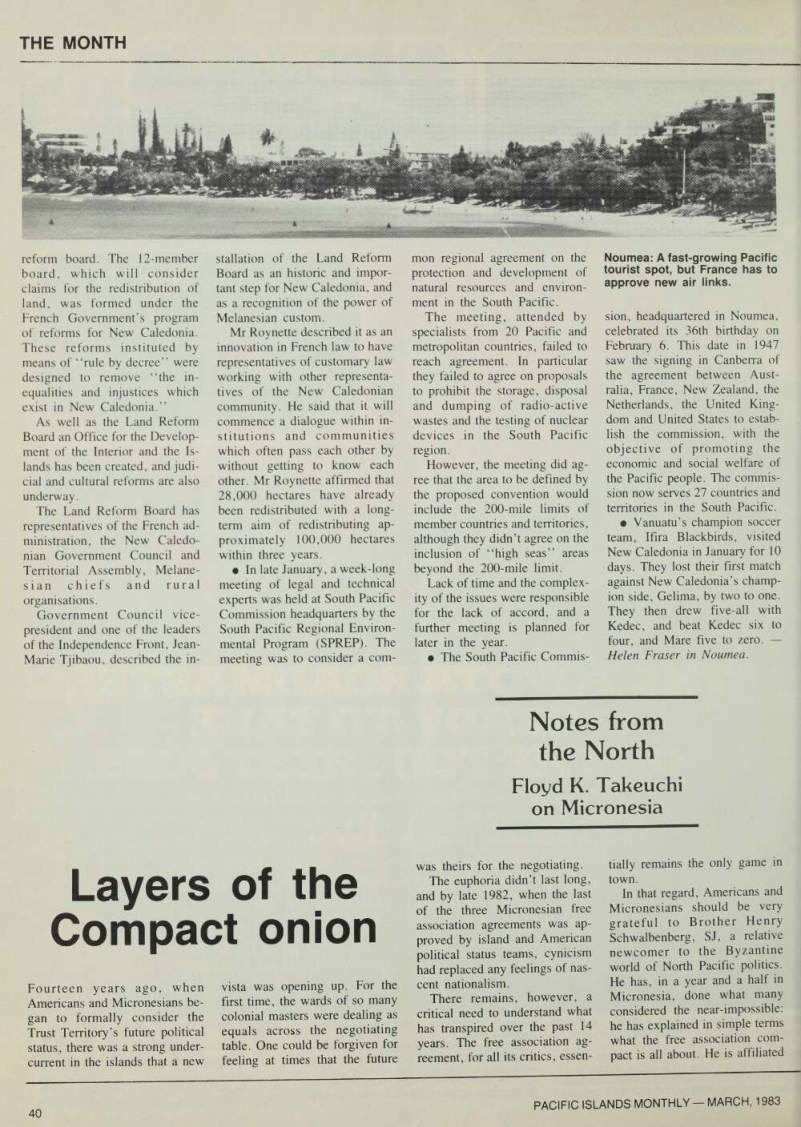
Noumea: A fast-growing Pacific tourist spot, but France has to approve new air links.