top in Vanuatu
pp. 35-37 · Read in the full issue
Turmoil at the top in Vanuatu
Report from Vanuatu Christine Coombe
Sell Hoo, meaning “pulling to gether”, the proud slogan of the Vanuaaku Party, is weakened.
And it has been weakened at a crucial time.
General elections for the young nation of Vanuatu are due by November 1983, the first since independence from joint British and French rule in 1980.
But the loss of three ministers, half of Prime Minister Walter Uni’s cabinet, in February, has sparked serious charges focused on the prime minister’s ability to lead the nation.
First, the Deputy Prime Minis ter and Minister for Home Af fairs, Fred Timakata, was sacked
by Prime Minister Lini, who said he would give his reasons later.
Then, the Minister of Educa tion, Donald Kalpokas, resigned.
He was followed by the Minister of Transport,John Naupa.
Both resigning ministers gave a period of notice which was not accepted by the prime minister, who immediately terminated their ministerial appointments.
Following this flurry of events, Prime Minister Lini has been charged with dictatorship, corruption, giving authority to an alleged criminal to act on his behalf, raising loan money of SUS3SO million without cabinet
approval, allowing an adviser to remain in government against the decision of the council of minis ters, and of links with the ultra- Rightwing Phoenix Foundation which is known to have support ed the attempted secession of the island of Santo which was in the hands of rebels on independence.
Ironically, the three former ministers making these allega tions are long-standing and trust ed friends of Walter Lini, all founder members of the Vanuaaku Party, who put the goal of political freedom for the people of the nation above all other considerations.
Those who know the prime minister, an Anglican father, find the accusations beyond be lief. An enigma, they say of him.
Prime Minister Lini has declined to comment on all accusations.
All he has said is that he won’t resign.
His resignation is what the three former ministers want.
However, they have all pledged their continued support for the party, and it appears that they have kept silent about their fears, and the allegations they are now making, in order to hold the party together.
Except in one case new ap pointments have been made to the vacated ministerial positions.
The new deputy prime minis ter is Sethy Regenvanu, minister for lands and natural resources.
The new minister for home affairs is Sela Molisa, an MP from a Santo constituency.
Onneyn Tahi, an MP from Ambae-Maewo, is the new minister of education.
In the case of John Naupa, two weeks after his resignation no one had been found to accept the portfolio. In the meantime, Fi nance Minister Kalpokor Kal sakau is acting minister of transport.
This isn’t the first questioning of Lini’s ability to lead. Follow
ing the sacking of former lands and natural resources minister Thomas Ruben Seru, and former health minister George Worek, in December 1981, the question came up. Prime Minister Lini ousted the two ministers without
consulting cabinet, saying he
was cutting costs.
The former ministers then formed the party now known as the Vanuatu Independence Al liance Party. Thomas Ruben Seru, MP Santo, Malo and Aore, and George Worek, MP Banks and Torres, based themselves and the new party on the island of Santo, the seat of the attempt ed secession, and now claim na tion-wide support.
The public outcry at the time was that people on Santo and in the northern regions had no cabinet representation. At the first sitting of parliament follow ing the sackings, a vote of no confidence in the prime minister failed. Before this sitting, some top government advisers were either ousted or found their con tracts not renewed. They in
eluded the attorney-general, the registrar of companies and senior advisers in the finance and trans port ministries.
Former ministers now point to the prime minister’s taking over of law enforcement, defence, and immigration, previously in the home ministry portfolio.
More recently the prime minister absorbed communica tions, the public service commis sion, and statistics into his port folio. He also has responsibility for justice and the media.
“It’s dangerous for one man to have so much responsibility, it’s bad for any country, particularly a newly independent nation,’’ former minister Timikata said.
He fears a military dictatorship and says he’s repeatedly warned the prime minister against taking what he feels is not good advice.
The former education minister said in his letter of resignation that the government is corrupt at the top.
The summarised points raised at the time of the motion of no confidence in Walter Lini make
mention of the PM's overriding of decisions of the council of ministers, and abolishing posts established by law. These in clude a decision to dismiss Paulu Brown, a man declared a pro hibited immigrant by the British at the time of condominium.
The notes claim Walter Lini vowed to the executive of the Vanuaaku Party in 1979 that he would dissociate himself from a certain Brian Jefford, yet since becoming prime minister, the as sociation has increased, it is claimed.
Walter Lini is charged with agreeing to a loan of SUS3SO million, on which the interest payments alone could cripple the country. This was done, it is claimed, without consultation with the finance minister or cabinet, and news of it is said to have reached government by the back door.
The agreement was ter minated. But the prime minister and the republic now find court proceedings are to go ahead, launched by those who have lost commission they feel is due to them.
Prime Minister Lini authorised Brian Jefford, a New Zealander with an alleged criminal record, to act on his behalf and sign all documents relevant to negotia tions on the loan without further reference to him. The letter is on a government letterhead, and dated December 2, 1981.
The use envisaged for this loan money appears vague. Under the
name Vanimex not a regis tered company Brian Jefford actetl as agent to secure agreerhents.
Former transport minister John Naupa stands by a statement he made on Radio Vanuatu that the prime minister was linked with the Phoenix Foundation. This group of ultra-Rightwing capital ists was named by the prime minister as known to be funding the attempted secession on San to, and responsible for writing the “constitution’’ of the breaka way “state.” The American based group is rich, powerful, violently anti-communist, and has for some time been looking for a place to set up a new “nation.”
The attempt to take over Santo failed. Previous failures were at Minerva Reef, Tonga, and Abaco, Bahamas.
John Naupa declined to make further comment on the Phoenix- Lini link.
Two weeks after the sacking of Fred Timakata, Prime Minis ter Lini gave his reasons.
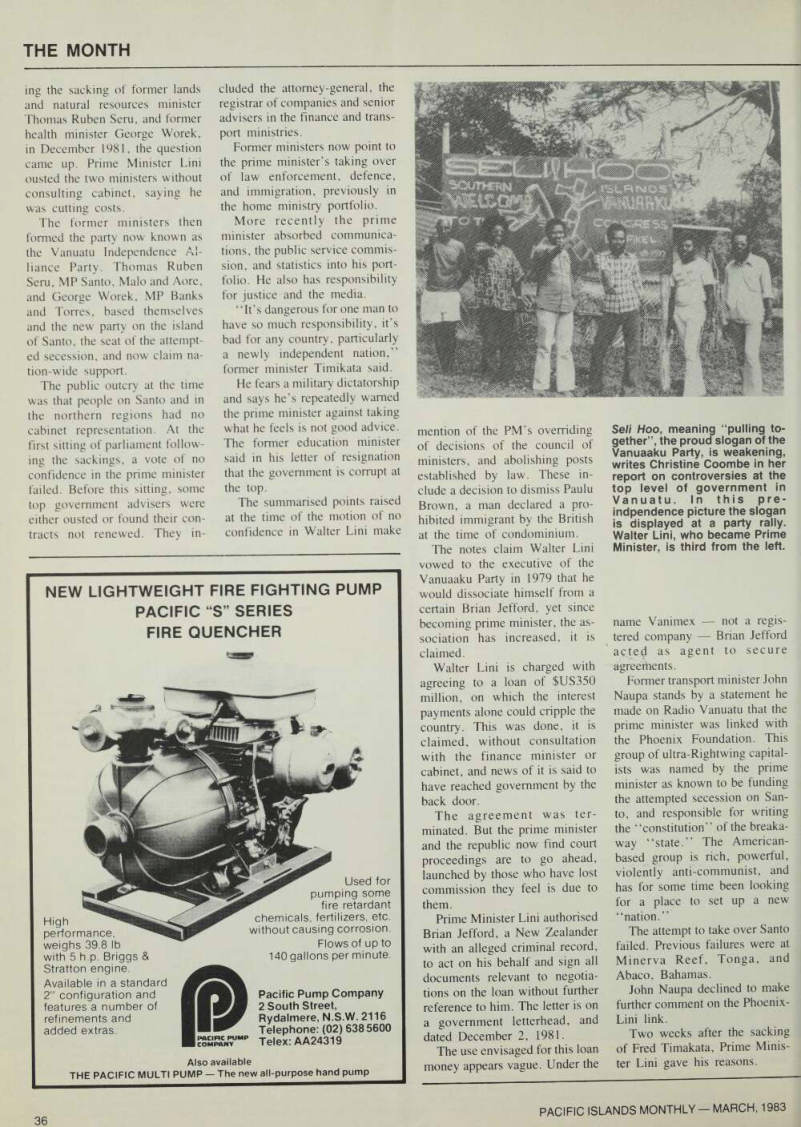
Sell Hoo, meaning “pulling to gether”, the proud slogan of the Vanuaaku Party, is weakening, writes Christine Coombe in her report on controversies at the top level of government in Vanuatu. In this pre indpendence picture the slogan is displayed at a party rally.
Walter Lini, who became Prime Minister, is third from the left.
By-elections held recently
the responsibility of Mr Timaka ta — had not been well or
ganised, and the disqualification
of five candidates in the town council elections on Santo had embarrassed the government.
“Flimsy” is the word former minister Timakata uses for these reasons. He says registration by voters, and voting, are not com pulsory, and he adds that the
decision to disqualify the five candidates, all members of the Vanuaaku Party and civil ser vants at the time, had been a cabinet decision.
The sackings and resignations
of ministers coincided with the
eighth Vanuaaku Party Commis
sars’ Conference, and the ques tion of leadership of the country is said to have dominated confer
ence proceedings. The original
priority of the conference, the last before the general election, was to organise the election cam paign. The turn-out for the con ference and associated public meeting was poor. Where thousands of people could have been expected, only about 120 were at the public meeting.
The Vanuatu Independence Alliance Party firmly supports the three former ministers. It
held its second party conference at the end of February.
Opposition leader Vincent Boulekone, who heads the Union of Moderate Parties, has called upon people to stay calm and at time of writing is preparing a statement on the present political turmoil. It will be made public following consultations with op
position supporters. - Coombe in Vanuatu.
Christine
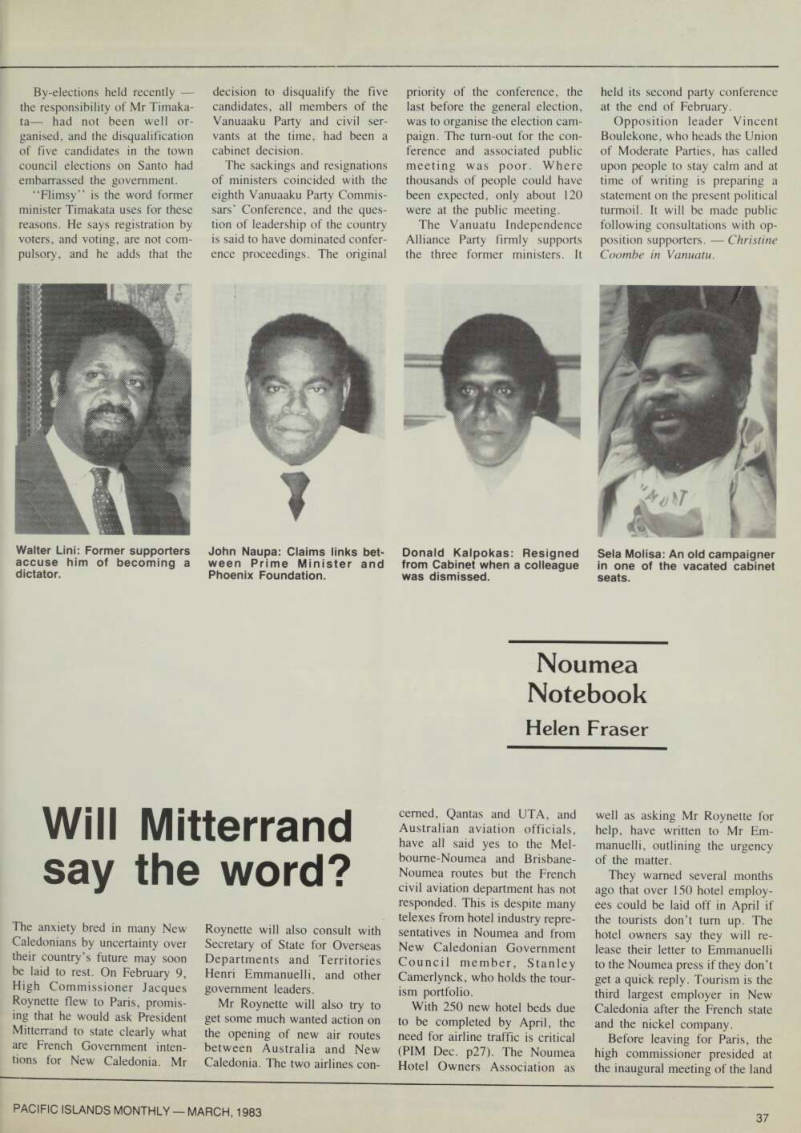
Walter Lini: Former supporters accuse him of becoming a dictator.
John Naupa: Claims links bet ween Prime Minister and Phoenix Foundation.
Donald Kalpokas: Resigned from Cabinet when a colleague was dismissed.
Sela Molisa: An old campaigner in one of the vacated cabinet seats.